Egypt mass trial tomorrow could see death sentences for 500, including Irish teen
Reprieve | November 30, 2014
A mass trial for almost 500 people will resume tomorrow in Egypt, and could see death sentences handed down to the defendants – including an Irish teenager arrested last year while on holiday.
Ibrahim Halawa, from Dublin, was 17 at the time of his arrest during a military crackdown on protests in the city last August. He is one of 494 defendants who could face a death sentence in a makeshift courtroom expected to convene in the Tora prison complex in Cairo. It’s emerged that several other minors are also among the hundreds due in court.
Tomorrow’s hearing follows a mass trial several days ago at which authorities handed down sentences totalling 340 years to 78 children. At that hearing, lawyers were reportedly barred from entering the court.
At the last hearing for Mr Halawa’s mass trial in August this year, a three-judge panel resigned from the case mid-hearing, citing ‘unease’ with the proceedings amid protests from lawyers and defendants alike.
Egypt’s mass trials have been condemned by the UN as illegal and “rife with procedural irregularities”, and by Egyptian rights groups as “a grave violation of… the right to a fair trial”. A report published days ago from the UK Parliament’s Foreign Affairs Committee, meanwhile, criticised the UK Government for failing to list Egypt as a ‘country of concern’ in light of the mass trials and the handing down of death sentences.
Maya Foa, head of the death penalty team at legal charity Reprieve, which is assisting Mr Halawa, said: “It is extremely worrying that the mass trial appears to be going ahead as planned. This is a clear violation of internationally-accepted fair trial standards, and the international community must do all it can to halt them and prevent hundreds of people from potentially being sentenced to death.”
Letter from scientists prompts Suez Canal conspiracy theories
Mada Masr | October 8, 2014
A letter published in an international scientific journal about the ecological risks of expanding the Suez Canal has raised cries of conspiracy theories in local media.
The letter to the editor was signed by 18 scientists from around the world, including lead author Bella Galil of Israel’s National Institute of Oceanography. It was published in Biological Invasions, a peer-reviewed scientific journal which is ranked among the top 25 percent of scholarly publications in the fields of plant and animal sciences.
In keeping with the theme of the journal, the letter raises concerns that Egypt’s plans to widen the Suez Canal will speed the invasion of non-native species into the Mediterranean Sea.
It points out that half of the 700 multicellular non-native species found in the Mediterranean Sea were introduced via the Suez Canal, which it describes as “one of the most potent mechanisms and corridors for invasions by marine species known in the world.” Thus, the authors say, plans to expand the canal come as “ominous news.”
The migration of non-native sea creatures, many of whom have few natural predators in the Mediterranean, has led to “profound environmental, economic and human-health issues,” the authors say.
Among the examples cited are the annual swarms of jellyfish that harm tourism, fisheries and coastal installations such as desalination and power plants, the spread of poisonous pufferfish throughout the Levant and to Italy and Tunisia, and the invasion of several species of fish and prawns and oysters that have displaced local species that have traditionally been harvested by local fisherman.
The letter concludes with a reminder about international conventions that require signatories, including Egypt, to “prevent the introduction of, control or eradicate those alien species which threaten ecosystems, habitats or species,” and a call for a regionally-supervised environmental impact assessment to mitigate a new wave of invasive species that could migrate through a wider and deeper canal.
Ordinarily, a fairly technical letter-to-the-editor of a scientific journal would draw little notice outside of academia. In this case, however, it hit headlines because the lead signatory is a scientist from Israel’s National Institute of Oceanography, and because it involves the Suez Canal expansion, which is widely regarded as a patriotic national project that will underpin Egypt’s future economic success.
The story was picked up by Haaretz newspaper on October 6, and in turn by Egyptian publications. Although the letter was published September 28 in a journal based in the Netherlands, privately owned Youm7 ran a story on it under the headline: “A Zionist attempt to divert attention from October 6 commemoration. Israel starts war of rumors on new Suez Canal project. Tel Aviv publishes fabricated research claiming that widening the canal will pose environmental threat.”
The Mubarak trial verdict – What just happened?
By Hossam Bahgat | Mada Masr | November 29, 2014
There appears to be the usual share of confusion about what the Mubarak trial judge just said and did. As seen on television, the judge promised his “sons in the media” flash drives containing talking points (in the neighborhood of 200 pages) to help them, he said, with their news coverage until they have had a chance to read the entire ruling. Until that summary is available, I will address here a couple of the most persistent questions so far, pending further updates.
Q: Does Mubarak walk out now?
A: Yes. He is free to go for the time being. There have been some conflicting statements in the media on this point by named and unnamed legal sources after the verdict was announced. The confusion stems from the fact that Mubarak was sentenced last May to three years in prison on corruption charges related to embezzling millions of Egyptian pounds from state funds to spend on mansions owned privately by himself and his family.
Because Mubarak was convicted in the “mansions” case in May 2014, many have made the logical assumption that he would serve that sentence until 2017, notwithstanding today’s combination of acquittals and non-convictions of other charges of killing protesters and corruption, which isn’t the case. I have spoken to two senior criminal defense and human rights lawyers, who have independently confirmed that Mubarak’s three-year sentence in the mansions case does not start at the date of his conviction in May 2014, but rather at the date of his arrest and pre-trial detention in May 2011. With today’s acquittal, there is no legal basis for keeping him in prison.
Both sources have directed me to Article 483 of the Code of Criminal Procedures. This is my informal, non-lawyerly English translation:
“If a defendant is found not guilty of a crime for which he was held in pretrial detention then the period of pretrial detention shall be deducted from the period [of imprisonment] to which the defendant is sentenced for any [other] crime he might have committed or for which he has been investigated while in pretrial detention.”
The above is legalese for saying that a defendant’s prison term starts not at the time of sentencing but at the time of detention, even if that detention was for another charge. So even though Mubarak was held between May 2011 and May 2014 for the protester-killing charge, that period will count as time served for the mansions case.
The three-year sentence Mubarak was handed in May 2014 ended, therefore, in May 2014. A coincidence, of course – To suggest otherwise would be ground for prosecution for “insulting the judiciary.”
Q: Was Mubarak acquitted of the charge of killing protesters?
A: No, he wasn’t. He was not convicted either. The judge threw out the entire charge on procedural grounds.
First, the necessary background: Following Mubarak’s abdication of power in February 2011, Public Prosecutor Abdel Meguid Mahmoud decided to investigate the killing of protesters during the 18 days of revolt that ended Mubarak’s tenure. On March 23, 2011, Mahmoud, who had served under Mubarak and remained in office until late 2012, indicted Mubarak’s Interior Minister Habib al-Adly and his senior assistants, but not Mubarak himself, for having ordered or otherwise abetted the killing of protesters throughout the country. Two months later, the Supreme Council of Armed Forces, which had succeeded Mubarak in power, faced pressure from street demonstrations demanding accountability for Mubarak too. On May 24, 2011, the public prosecutor added Mubarak as a co-defendant in the case.
The fact that Mubarak was only added as a defendant two months after the case had been referred to trial is the technicality the judge used today to dismiss the charge against him. By not indicting Mubarak from the beginning, the judge reasoned, the prosecution had made “an implied decision that there were no grounds for criminal proceedings” against him. This “no-grounds” decision can be formally reversed by the public prosecutor within a window of three months. Mubarak’s defense lawyers argued, and today the court agreed, that the prosecution reversed the implied no-grounds designation of Mubarak without following proper procedures. For that technical error, the judge ruled the charge against Mubarak for the killing of protesters as inadmissible and dismissed that charge without considering it or ruling on its merits.
Mubarak’s lawyers had raised that same defense in the first trial (Mubarak was sentenced to life in 2012, before the Court of Cassation threw out that sentence and ordered the retrial that ended today). The first trial court had dismissed that defense, according to Hoda Nasralla, a criminal justice lawyer with the Egyptian Initiative for Personal Rights, who observed and wrote a detailed report on the first trial. Nasralla told me she had argued against that same defense in the first trial, where she represented some of the victims’ families as civil claimants in the case. Here is the gist of her argument:
- There was never a preliminary decision by the prosecution that there were no grounds to try Mubarak, explicit or implicit. It is inconceivable to argue that the March 2011 indictment (in which Mubarak was not named) is a declaration that there was no evidence against Mubarak, because until then Mubarak had never been questioned or even declared a suspect in the trial. A no-grounds designation could not be this subtle.
- Assuming that the decision to not name Mubarak as a defendant in March could be considered an “implied declaration” that there were no grounds to prosecute, then why can’t the decision to add Mubarak as a co-defendant in May be considered an implied reversal of the implied declaration?
- Assuming there was even an explicit no-grounds declaration, Article 213 of the Code of Criminal Procedures allows prosecutors to reopen investigations against any suspect or defendant if new evidence is identified or presented.
Nasralla, like many other observers, is convinced that this procedural argument was bought by today’s court not necessarily for its strength on merits, but because it was an attractive way for the court to dismiss the charge without a not-guilty finding.
Q: Is this the end?
A: Of course not. Egyptian court sagas of this size and nature don’t usually end. But the next stage could be filled with even more drama. The public prosecutor can, and most likely will, appeal today’s verdict before the Court of Cassation (Egypt’s highest court on criminal matters).
This court is not a substantive appeals court – it merely reviews whether or not the lower court decision complied with laws and procedure without reexamining the evidence. The Court of Cassation could simply ratify today’s verdict and that would be the end of it. But if the court decides to overturn and throw away the conviction for the second time, then it doesn’t get to send the case back to a lower criminal court for retrial. The law establishing the court stipulates that a third and final retrial of this nature will be conducted by the justices of the Court of Cassation themselves, who then act as a normal criminal court with full investigative powers.
Cassation justices are considered the nation’s most senior and best qualified bench. And because they’re elected by their peers, they are by far the country’s most independent court. Not that anyone is doubting the independence of other parts of the judiciary, of course.
Muslim scholars’ union slams UAE ‘terrorist’ label
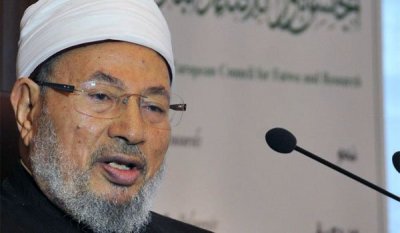
Yusuf Al-Qaradawi
MEMO | November 17, 2014
The International Union of Muslim Scholars (IUMS) expressed its surprise on Monday over the decision by the United Arab Emirates (UAE) to include the bloc on the country’s list of designated terrorist organisations.
In its statement, the union urged the UAE to “reconsider its unjustified position”.
The IUMS, established in 2004 and headed by Islamic scholar Yusuf Al-Qaradawi, was among 83 movements and organisations that were labelled terrorist groups by the UAE on Saturday.
Also included in the list were the Muslim Brotherhood, the Islamic State (ISIS), Yemen’s Shiite Houthi movement and the Egypt-based Ansar Beit Al-Maqdis militant group.
In its statement, the group said it rejects this labelling, asserting that since its establishment ten years ago, the IUMS “has promoted a moderate approach and discouraged extremism, terror and violence using cultural and educational means”.
“The IUMS has issued dozens of statements against terrorist and extremist groups,” it added.
On its website, the IUMS identifies itself as “an institution concerned with the call (Da’wah) to Islam by tongue, pen, and every contemporary legitimate medium; be it recorded, audio, or visual”.
“IUMS is not a local or a regional union, neither an Arab nor a national one, neither an eastern, nor a western union; rather, it represents all Muslims in the entire Islamic world, as well as all the Muslim [minority populations] and Islamic groups outside of the Islamic world.”
It also asserts that it “does not slant towards exaggerations and excesses, nor does it tilt towards default and negligence, but rather it adopts the centremost approach of the centremost Ummah (Islamic nation), an approach of mediation and moderation.”
The Egyptian-born Al-Qaradawi has been under fire by Egypt’s post-coup authorities for his vocal criticism of the military’s ouster – and subsequent imprisonment – of elected president Mohamed Morsi, a Muslim Brotherhood leader, last year.
Egypt branded the Brotherhood a “terrorist” movement late last year following the bombing of a security headquarters in the Nile Delta.
The label was attached to the movement amid a massive crackdown on its members, supporters and leaders on the streets of Cairo and other Egyptian cities and provinces.
Saudi Arabia also designated the Muslim Brotherhood a “terrorist” movement in March of this year, following in Egypt’s footsteps.
The UAE and Saudi Arabia were amongst the first countries to welcome Morsi’s ouster. Both countries – along with Bahrain – withdrew their ambassadors from Doha last March, accusing Qatar of interfering in their affairs.
Many observers, however, linked the rift to Doha’s perceived support for Morsi and the Muslim Brotherhood.
Yet, the three countries agreed on Sunday to return their ambassadors to the Qatari capital following a surprise Gulf summit in Saudi Arabia.
Over 1.7 million Gazans isolated from the world after Israel, Egypt close crossings
Al-Akhbar | November 2, 2014
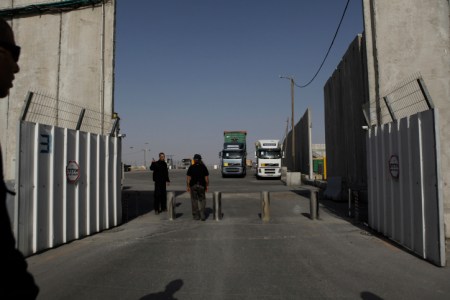
Gaza has become an open-air prison after Israel decided to close two border crossings with Gaza, the army said on Sunday, after a rocket allegedly fired from the Palestinian enclave struck its territory.
The Israeli blockade comes a week after Egypt closed its border with Gaza. With all borders closed, more than one and a half million people in Gaza are now isolated from the outside world. They are prisoners inside the 360 square kilometers that make up the coastal Strip.
“The crossing points for people and goods, Erez and Kerem Shalom, have been closed until further notice except for humanitarian aid,” an army spokeswoman said.
She said that the measure was taken after a rocket fired from Gaza hit Israeli-occupied Palestinian territory on Friday, without causing any casualties or damage.
There was no claim of responsibility from any armed faction in Gaza. A military spokeswoman said forces were still searching for debris.
The projectile struck harmlessly was the first to strike Israeli-occupied territory since September 16, and the second since the end of the Zionist state’s devastating 51-day assault on Gaza.
For 51 days this summer, Israel pounded the Gaza Strip – by air, land and sea – with the stated aim of ending rocket fire from the coastal enclave.
More than 2,160 Gazans, at least 505 of them children, were killed – and 11,000 injured – during seven weeks of unrelenting Israeli attacks in July and August.
The Israeli offensive ended on August 26 with the an Egypt-brokered cease-fire agreement.
However, Israel has violated the terms of the agreement repeatedly ever since.
The agreement calls for reopening Gaza’s border crossings with Israel after an eight-year blockade. Instead, Israel has further sealed the crossings.
The truce also stipulated that Israel would immediately expand the fishing zone off Gaza’s coast, allowing fishermen to sail as far as six nautical miles from shore, and would continue to expand the area gradually.
However, since the ceasefire was signed, Israeli forces have fired at several fishermen who they say have ventured beyond the newly-imposed limit of six nautical miles.
The head of the Gaza fishermen syndicate accused Israel of constantly violating the terms of the agreement.
“Since signing the truce, the Israeli army has violated (the agreement) eight times, arresting fishermen and destroying a giant fishing boat, in addition to firing at fishermen on a daily basis,” he said.
Besides the fishermen, Israeli forces have also fired at other civilians. On Wednesday, Israeli forces shot and injured a Palestinian man on the beach in the northern Gaza Strip.
Furthermore, Gaza is also littered with a large number of unexploded Israeli shells, one of which has recently killed 4-year-old Mohammed Sami Abu-Jrad from the northern Gaza city of Beit Hanoun.
Israel also agreed to allow construction material into Gaza. But two months after the war ended, no building material has entered Gaza due to Israel’s ongoing blockade.
Israel routinely bars the entry of building materials into the embattled coastal enclave on grounds that Palestinian resistance faction Hamas could use them to build underground tunnels or fortifications.
For years, the Gaza Strip has depended on construction materials smuggled into the territory through a network of tunnels linking it to Egypt’s Sinai Peninsula.
A recent crackdown on the tunnels by the Egyptian army, however, has effectively neutralized hundreds of tunnels, severely affecting Gaza’s construction sector.
Egypt leaves Gaza isolated
On Wednesday, Egypt began setting up a buffer zone along its border with the Gaza strip in a move which will see about 800 homes demolished.
It comes in the wake of a suicide car bombing which killed 30 Egyptian soldiers in Sinai last week, the deadliest attack on the military since ousting Egypt’s former president Mohammed Mursi.
Following the bombing, Egypt immediately closed the Rafah crossing into the Gaza Strip, the principal connection between Gaza’s 1.7 million people and the outside world.
In August, Egypt’s authorities have used an attack on the Egyptian military in Sinai as a pretext to start a campaign to destroy lifelines into Gaza. Over 120 tunnels were blown up or filled in.
More than just being the only way for some products to make it into the over 1.5 million Palestinians living in the strip, the Gaza tunnels have become a major source of income for the transporters of goods. Egypt has closed Gaza’s lifelines.
Since the beginning of 2014 until the end of May, Rafah crossing has been opened only 14 out of 120 days, limiting access to humanitarian cases and for other authorized travelers – including foreign nationals and visa holders.
(AFP, Reuters, Al-Akhbar)
Hamas official denies group’s involvement in Sinai attacks
MEMO | October 27, 2014
 Mousa Abu-Marzouk, deputy of the Hamas political bureau, offered his condolences to the families who lost members in the terrorist attack in Abu Zeid, Sinai, on Friday.
Abu-Marzouk said: “We regret hearing about any drop of blood spilt in Egypt or anywhere in the Arab world as such news is very painful.”
In a telephone interview on Egyptian TV show Lazem Nafham, Abu-Marzouk stressed that linking Hamas to the attack in Sinai is an unwarranted claim that lacks any evidence. He said Hamas is a resistance movement that focuses its efforts toward the Israeli occupation and not its brothers in Egypt.
Abu-Marzouk went on to clarify that Hamas’ forces inside the Gaza Strip have increased their security measures to ensure that no activity takes place in Sinai and he asked the Egyptian government to avoid blaming the Palestinian people for actions and events that they have nothing to do with.
Emphasising that Palestinian have no reason to interfere in internal Egyptian affairs, he stressed that no party should accuse Hamas of anything without clear evidence and pointed out that the Palestinians have done nothing short of ensuring Egyptian national security.
“My statements regarding the kidnapping of Egyptian soldiers in Sinai are verified by a trustworthy source,” Abu-Marzouk said. He went on to emphasise that Gaza is the least extremist area in the entire Arab region.
Donors, or enablers? Cairo’s ‘Gaza Reconstruction Conference’
By Julie Webb-Pullman | MEMO | October 12, 2014
CAIRO’S Gaza Reconstruction Conference, you ask incredulously? And well you might – after all, Egypt is currently preventing the entry of materials to complete Qatari-funded projects in Gaza addressing the destruction of previous Israeli offensives. Building of roads, housing estates and hospitals have all ground to a halt despite being underway well before the latest Israeli war crimes in Gaza – crimes which have only further increased the need.
We are seriously expected to accept Egypt as an honest broker? That the current regime has a shred of compassion for the already homeless, sick and injured Gazans still reeling from the 2008-9 and 2012 offensives who it refuses to admit assistance for, let alone those battered by the latest assaults? For the thousands of maimed and injured STILL refused exit through Rafah for necessary medical treatment elsewhere?
Egypt is BLOCKING Gaza reconstruction. At this very moment. Egypt is BLOCKING injured Gazans from receiving essential medical treatment. At this very moment.
Egypt is the bull elephant in the china room of Gaza reconstruction.
But it is not alone.
The United States, funder and arms supplier extraordinaire to the Israeli serial killers, is also chipping in, as is Ban Ki-moon, famous for undermining the UN independent report into Israeli war crimes in 2008-9.
And let us not leave out the criminals themselves – the Israelis, who stand to profit nicely from this exercise in sleight of hand.
Unconfirmed information from the West Bank last week reports that Israeli companies have already been awarded the tenders for the supply of cement and other building materials, standing to reap billions of dollars in the process. It is difficult to imagine a clearer incentive to continue the cycle of ‘destroy and rebuild’ than to reward the criminal by paying them to repair the destruction they have wreaked, rather than make them pay for it.
Which raises the next point – why is the international community being asked to foot the bill for Israeli criminal damage? In criminal law, reparations are paid by the perpetrators of crimes, not by the onlookers (however morally bereft they may have been for failing to act to halt the murderous rampage).
And Israel’s culpability goes further than merely making good its wanton and criminal destruction of Gaza – it is the OCCUPYING POWER, and as such has full responsibility under international law for “restoring” the territory it has occupied.
“The authority of the legitimate power having in fact passed into the hands of the occupant, the latter shall take all measures in his power to restore and ensure, as far as possible, public order and safety…” says Article 43 of the Hague Regulations.
Reports that donors are threatening to withhold Gaza aid “…without fresh impetus in negotiations” exposes the dirty secret of international complicity and enabling of ongoing Israeli abuses of Palestinians.
Israel has been illegally occupying Palestinian territory for decades, built illegal settlements on stolen land, built an illegal apartheid wall, and imposed and maintained an illegal blockade on Gaza for some eight years, breaching a swathe of international laws and UN resolutions – thus exposing the manifest inadequacy of the United Nations in enforcing international law without fear or favour, if not its complete irrelevance in contemporary international affairs.
When Palestinians legitimately resist, they are killed, displaced, have their homes demolished and their country is decimated under the nose and eyes of the international community, which does nothing but launch into another round of victim-blaming ably aided and abetted by the type of response we see today in Cairo, with its emphasis on Israeli security at the expense of Palestinian security – in fact, at the expense of international law itself.
The keys to Israeli and Palestinian security – thus to the longevity of Gaza reconstruction – are in the hands of Israel and the UN: the former, by OBSERVING INTERNATIONAL LAW and withdrawing from occupied territory, leaving the illegal settlements, demolishing the apartheid wall and lifting the siege on Gaza; and the latter, by ENFORCING INTERNATIONAL LAW by holding Israel accountable for its gross abuses not only in regards to the war crimes of 2008-9, 2012, and 2014 but also the 60+ years of breaches of international law and UN Resolutions – and by insisting on the lifting of the siege of Gaza.
The solution certainly does not lie in picking up the bill, and participating in perpetuation of the siege by acting as an international version of the PA Security Services in the West Bank, thereby both acting as an Israeli proxy and lending legitimacy to an Egyptian regime whose role in denying Gazans’ rights is every bit as questionable.
Palestine has an equal right to security, and to defend itself. Which party is occupying and extending its invasion and theft of the territory of the other? THAT is the party that requires international control over its behaviour – and it is clearly not Palestine.
A Gaza reconstruction conference should be held, not in Cairo, but in GAZA – where the international community can see first-hand the destruction the USraeli military machine mercilessly meted out on innocent people and property. But perhaps that is the point – ignorance enables denial.
A Gaza reconstruction conference should be centred on holding the perpetrators accountable, making them pay for their crimes, and ensuring they cannot offend again – by keeping international and humanitarian law centre-stage, not the carnival side-show of ‘Israeli security’ or the equally-absurd victim-blaming and demonisation of Hamas.
A Gaza reconstruction conference should ensure that the criminals do not profit from their crimes, and Israeli firms should be specifically EXCLUDED from all and every tendering process and provision of goods and services in the rebuild.
And the first step in any principled and serious commitment to rebuilding Gaza must be the IMMEDIATE and UNCONDITIONAL lifting of the illegal siege.
If Israel and Egypt refuse to comply, then the Gaza seaport must be immediately opened and if necessary, military protection provided by international peacekeepers for boats entering and leaving Palestinian waters, such that Israeli and Egyptian siege-based attempts to control Palestinians’ enjoyment of their rights to trade and freedom of movement are rendered impotent.
Unless the Gaza Reconstruction Conference delivers Gaza from the siege, holds Israel accountable for its crimes against international and humanitarian law and ensures it does not profit from them, the international community will merely be enabling ongoing Israeli abuse in the best traditions of the dysfunctional incestuous family.
Protests in Egypt against energy price hikes and politicised trials
MEMO | September 20, 2014
Opponents of the military coup have organised mass protests across Egypt condemning the deterioration of living conditions, price hikes and the ongoing electricity crisis. They are also calling for the prosecution of President Abdel Fattah Al-Sisi for “crimes against humanity”.
The protests came in response to a call by the Anti-Coup Alliance, which called for a “new revolutionary week” starting Friday under the slogan, “The oath of the revolution and the vow of the martyr”.
In the affluent Maadi neighborhood in Cairo, protesters denounced lifting subsidies and the increase in fuel prices. They also chanted for the release of all political prisoners and putting an end to torture in prisons.
In Hilwan, the alliance organised a morning protest against military rule and worsening living conditions. They vowed to continue protests until the leader of the coup is prosecuted.
In Baltim town in Kafr Al-Sheikh governorate, protesters condemned politicised trials and price hikes. In Desouk, protesters waved pictures of Mohamed Morsi and Rabaa signs and chanted against the deteriorating living conditions and poor services, especially electricity.
Victims of deadly shipwreck driven out of Gaza by war, unemployment
Al-Akhbar | September 18, 2014
Unemployed and shattered by the 50-day Israeli assault on Gaza, Yasser decided to seek a better life elsewhere, boarding a boat to Europe that sank off Malta last week.
In one of the deadliest migrant shipwrecks on record, the boat, with 500 people on board, was intentionally capsized by traffickers as it made its way from Egypt to Italy.
Only 10 people are known to have survived, among them four Palestinians from the 100 Gazans believed to have been on board. Yasser, a 23-year-old unemployed graduate, was not one of them.
Yasser’s story is far from unusual and explains why some Palestinians in Gaza are ready to risk everything to flee war and poverty in the coastal enclave, which was battered by a devastating seven-week Israeli aggression that ended late last month.
His brother Osama told AFP by telephone from his home in the United Arab Emirates that Yasser had graduated from university in Gaza but struggled to find work.
“He graduated last year and since then, like all young people, he has been unemployed. There is no future for them in Gaza,” Osama told AFP, asking that his family’s name not be published.
The crippling blockade of Gaza by Israel – and more recently Egypt – and Israeli restrictions in the occupied West Bank limit Palestinians’ ability to compete in export markets and contribute to an unemployment rate of almost 25 percent, the World Bank said in 2013.
“I tried to bring him to the Emirates but after seeing several of his friends reach Europe by boat, he decided to leave too,” he said.
Yasser crossed from Gaza into the Sinai Peninsula via the Rafah crossing, paying some local Egyptians nearly $3,000 (2,300 euros) to fix his passage to Europe.
“You never know who you’re giving the money too,” Osama said.
The last time the brothers spoke was on September 5, the day before the boat carrying Yasser set sail from the port of Damietta in Egypt.
“Now I’m waiting to receive the list of survivors to know if he might still be alive,” Osama said.
Escape through the tunnels
Exact numbers of those leaving Gaza and making their way to Europe are hard to come by.
According to the International Organisation for Migration (IOM), some 2,890 people who declared themselves to be Palestinians have reached Italy so far this year.
But even that number may not be credible as some migrants falsely identify themselves as Palestinians to avoid being repatriated to home countries that have extradition agreements with the European Union.
“We estimate that thousands of people have left the Gaza Strip clandestinely over the past two months, especially during the war,” a local human rights worker told AFP.
“Due to the fact they left through tunnels to Egypt — an illegal, secret way to leave — we have no precise figure,” he said, speaking on condition of anonymity due to the sensitivity of the issue.
With Gaza’s own access to the Mediterranean tightly closed by Israel’s naval blockade, those wanting to go to Europe would be forced to travel through the Rafah border crossing with Egypt.
Rafah is Gaza’s only gateway to the world that is not occupied by Israel, but it has been kept largely closed by Egypt for more than a year, with the only other way across via the handful of precarious cross-border smuggling tunnels.
(AFP, Al-Akhbar)
Featured Video

Racist Seinfeld Dances for Joy as Bibi Unveils His New Map
or go to
Aletho News Archives – Video-Images
TV Drama Review
Japanese drama projects Japan’s wartime atrocities onto Chinese characters

Global Times | October 25, 2026
By portraying Chinese characters as perpetrators of ruthless violence while casting Japanese Self-Defense Forces (SDF) intelligence operatives as defenders, the season 2 of the Japanese drama Vivant has recently drawn criticism from Chinese netizens, who argue that its depiction turns historical reality on its head while ignoring Japan’s wartime atrocities.
The TBS drama series – a spy suspense story in which an alleged unofficial intelligence unit of the SDF operates across the globe — has attracted a passionate fanbase. Its currently airing season 2 opened with a household rating of 18.8 percent, the highest for a TV drama this year, according toa commentary article by Japanese media Toyo Keizai.
What draws attention is the portrayal of the enemies in the series, the article noted. Scenes in which the Chinese organization subjects kidnapped members of the SDF unit to brutal torture are repeated with unrelenting intensity.
It is rare for Japanese TV dramas to explicitly portray a real-life country as the enemy, the article noted.
Japanese Prime Minister Sanae Takaichi also made a reference to the drama, saying that she has been recording Vivant and hopes to binge-watch it over the year-end and New Year holidays, according to Japanese media outlets.
China’s CCTV News report on Sunday revealed that the drama features scenes in which Chinese personnel cut off the fingers of and stab Japanese intelligence operatives in the abdomen. Such acts bear striking similarities to the torture inflicted on Chinese nationals by invading Japanese troops during the World War II.
The drama distorts the truth by attributing these atrocities to modern Chinese characters. Beneath the surface, it subtly glorifies Japan’s cross-border overseas operations, blurs the functional boundaries of the SDF and implicitly promotes an expansionist narrative, per CCTV News. … continue
Blog Roll
 Aletho News
- EU facing trillion-euro debt hole while seeking more cash for Kiev
- How US, Europe, Persian Gulf states exhausted missile stockpiles, splurged billions to defend Israel
- Up in arms… Koreans reject U.S. empire’s plan to make South Korea the next Ukraine
- Iran, Turkey, Pakistan, Saudi Arabia could advance region-led security framework in Tehran: FM spox
- Netizens condemn Japanese drama for projecting Japan’s wartime atrocities onto Chinese characters
- Racist Seinfeld Dances for Joy as Bibi Unveils His New Map
- A West Bank War for Netanyahu’s Election Campaign, Could It Backfire?
- Yemen denounces European Parliament’s ‘hypocritical’ push to blacklist Ansarullah
- Qalibaf: UAE’s UN bid aims to ‘clear the runway’ for ‘Greater Israel’, whitewash genocide
- Pakistan reopens Iran border after boosting security: Report
- If Americans Knew
- An error has occurred; the feed is probably down. Try again later.
- No Tricks Zone
- Sudden Stratospheric Warming, Powerful El Niño Combination May Lead To Extreme Europe Cold, Energy Crisis!
- Two New Studies Find Thwaites Glacier Melt Cannot Be Driven By Human Activity Or A Warming Ocean
- E-Cars Reduce CO2 Emissions By Only 41% Compared To Internal Combustion Engine Vehicles
- Predictions Made By Renowned Climate Professor Over Past Decades Have Been Proven To Be Poor
- New Study Suggests Large Regions Of The Pacific Ocean Have Been Cooling For The Last 80 Years
- Germany’s Green Energy Debacle: High Energy Costs Force Kahla Porzellan to Close After 182 Years!
- New Study: 50 Years Of The Most Aggressive ‘Net Zero’ Policies Can Only Affect The Global Climate By 0.03°C
- US September “Heat” Was No Record…Many Records Set Decades Ago
- Latest European Green Energy Debacle; Portugal’s Largest Flagship Solar Park Insolvent!
- Green Energy Debacle: German Expert Professor Fritz Vahrenholt Warns Of Severe Economic And Social Consequences

