Trump’s call for Palestinians’ relocation will threaten regional peace, Arab nations warn
Press TV – February 1, 2025
Major Arab nations have expressed their opposition to US President Donald Trump’s proposal to relocate Palestinians from Gaza and the occupied West Bank to neighboring Egypt and Jordan under any circumstances.
In a joint statement following a meeting in Cairo, the foreign ministers and officials from Egypt, Jordan, Saudi Arabia, Qatar, the United Arab Emirates, the Palestinian Authority and the Arab League presented a unified stance against the US president.
They warned that such a move would threaten regional stability, risk spreading the conflict, and undermine prospects for peace and coexistence among its peoples.
“We affirm our rejection of [any attempts] to compromise Palestinians’ unalienable rights, whether through settlement activities, or evictions or annex of land or through vacating the land from its owners… in any form or under any circumstances or justifications,” the statement read.
The top diplomats emphasized that they were looking forward to working with Trump’s administration to achieve a just and comprehensive peace in the region, it noted.
Trump said last week that he had spoken with the king of Jordan about potentially building housing and moving more than 1 million Palestinians from Gaza to neighboring countries.
The US president added that he would like both Jordan and Egypt — which borders the battered enclave — to house the Palestinians displaced by 15 months of the Israeli regime’s genocidal war.
However, critics said that Trump’s suggestion would be tantamount to ethnic cleansing.
Egyptian President Abdel Fattah al-Sisi on Wednesday opposed the idea that his country would facilitate the displacement of Gazans and said Egyptians would take to the streets to express their disapproval.
Trump on Thursday insisted that Egypt and Jordan would accept displaced Palestinians from the Gaza Strip, despite the two nations having dismissed his plan to relocate Gazans there.
Jordan is already home to several million Palestinians, while tens of thousands live in Egypt. The foreign ministries of Egypt and Jordan have both rejected Trump’s suggestion in recent days.
Russian media reach soars as NATO eyes countermeasures – report
RT | January 30, 2025
A fresh NATO report highlights a sharp increase in the reach of Russian state media outlets RT and Sputnik, particularly in Africa and the Middle East, where the news outlets have gained millions of new followers.
The report, published on Tuesday by the NATO Strategic Communications Centre of Excellence (StratCom COE), examines how Russian media operations have expanded their influence after the escalation of the Ukrainian conflict in early 2022. With Russian state-backed media subjected to blanket bans in the West, the outlets diverted their resources elsewhere.
According to the report, RT Arabic saw its audience grow by ten million users since the breakout of fighting between Ukraine and Russia. Sputnik Arabic also significantly increased its content output, posting 30–35% more frequently, while the news agency’s engagement on social media surged by 80%. Russian embassies in Africa also saw a 41% rise in social media followers, reflecting a broader trend of growing Russian media influence in non-Western regions, the report notes.
It also claims the outlets have been capitalizing on “anti-colonial narratives” and overall frustration with Western policies, particularly in Africa, and blames this on historical ties to the Soviet Union that still shape public perceptions there. In some cases, the narratives have resonated strongly with audiences already skeptical of Western institutions like the International Monetary Fund and the International Criminal Court, the report notes.
While StratCom COE projected its findings to the entirety of the Global South, the report actually examined the work of Russian media – as well as social media activities it had linked to Russia without any solid evidence – in Egypt, Mali, Kenya, South Africa and the UAE.
The authors of the report appeared to struggle with terminology, rejecting the ‘Global South’ over an “increasing pushback” against the name, and shot down the term ‘majority countries,’ claiming it has been promoted by assorted “malign actors” to push their agenda. Instead, the report uses the term ‘Multi-aligned Community,’ vaguely defining it as “states existing outside of the Western environment who have exhibited a preference for aligning or partnering with chosen states depending on specific spheres or issues.”
In response to the expanding reach of Russian media, the NATO report proposes new countermeasures aimed at reducing Moscow’s ever-growing influence. One recommendation is to establish a NATO-led initiative to engage with audiences in Africa and the Middle East, improving direct communication and addressing concerns about Western policies.
The report also suggests that NATO should work with local media outlets to “counter disinformation” and to bankroll local “independent journalism.” It also calls for stronger partnerships with civil society organizations to promote diverse viewpoints and counter what it describes as “one-sided narratives” from Russian state media.
Trump administration pressuring Egypt to push Hamas out of Gaza
Press TV – January 29, 2025
The administration of US President Donald Trump is pressuring Egypt to push the Palestinian resistance movement Hamas out of the besieged Gaza Strip.
On Tuesday, US Secretary of State Marco Rubio told his Egyptian Foreign Minister Badr Abdelatty that the two sides must maintain “close cooperation” in an attempt “to ensure Hamas can never govern Gaza.”
Israel began its campaign of genocide in Gaza in October 2023, after Hamas carried out Operation Al-Aqsa Flood in retaliation for Israel’s intensified atrocities against the Palestinian people.
However, after 15 months of ruthless aggression, the occupying regime failed to achieve its prime objective of eliminating Hamas, despite killing at least 47,306 Palestinians, mostly women and children.
The campaign has currently paused amid a fragile ceasefire.
The US State Department added on Tuesday that Rubio also “reinforced the importance of holding Hamas accountable.”
A day earlier, Trump once again called for forced relocation of Palestinians from Gaza to Egypt and Jordan, despite strong opposition from Cairo and Amman to the plan which has been slammed by the United Nations as “ethnic cleansing.”
The Palestinian leadership has been divided between Fatah and Hamas since 2006, when the latter scored a landslide victory in parliamentary elections in the Gaza Strip.
Hamas has ever since been running the Palestinian enclave, while the Palestinian Authority (PA), which is run by the ruling Fatah party and led by President Mahmoud Abbas, has been based in the autonomous parts of the occupied West Bank.
Israeli Prime Minister Benjamin Netanyahu had declared that the goal of the war for the regime was the total defeat and elimination of Hamas.
However, former US Secretary of State Antony Blinken implied in one of his final appearances, on January 14, that the regime had failed in achieving this goal.
Blinken said assessments by the US had revealed that “Hamas has recruited almost as many new” fighters “as it has lost.”
“That is a recipe for an enduring insurgency and perpetual war,” he added.
Israel managed to assassinate two top leaders of the movement – namely Ismail Haniyeh and Yahya Sinwar – and according to the European Council on Foreign Relations (ECFR), its weapons stockpile is also depleted, but as the dust settles in Gaza, it is clear that the resistance movement has not been eliminated and is still there.
Hamas fighters have prominently featured in the handover of Israeli captives as part of the ceasefire deal with Israel. And members of the Hamas-run civil administration have resumed work. If there is any authority in Gaza, it still appears to be Hamas, Al-Jazeera said in a report.
After “over a year of fighting, the [Hamas] fighters remain very much in control of Gaza,” Hugh Lovatt of the ECFR said.
“Hamas is trying to show Israel that it failed to destroy it but also that the movement will have a veto over Gaza’s future going forward because neither Israel and the PA nor the international community will be able to impose a post-conflict governance or security arrangement,” Lovatt said.
Israel aimed to destroy Hamas’s infrastructure, particularly its extensive tunnel network. However, Israeli media reports suggest that much of the network remains functional, though estimates of its intactness vary widely.
Hamas members told the ECFR that many tunnels have been preserved, restored, or even expanded in some areas.
According to the ECFR, Hamas even recycles “unexploded Israeli rockets, bombs, and artillery shells to use as improvised explosive devices and produce new projectiles.”
The Gaza Strip, home to some 2.4 million Palestinians, has been under Israeli siege since June 2007. The blockade has caused a decline in the standards of living as well as unprecedented levels of unemployment and unrelenting poverty.
Egypt’s Parliament rejects plans for Palestinian resettlement after Trump’s call
MEMO | January 27, 2025
US suspends aid to Ukraine – Politico
RT | January 24, 2025
US Secretary of State Marco Rubio has frozen nearly all new aid grants to Ukraine for 90 days, Politico reported on Friday. The move comes after President Donald Trump ordered a full review of all foreign assistance.
Rubio instructed diplomatic and consular posts to issue “stop-work orders” on nearly all “existing foreign assistance awards,” Politico said, citing an internal document.
According to Politico, the order “shocked” State Department officials and appears to apply to funding for military assistance to Ukraine.
The magazine cited three current and two former officials familiar with the matter as saying Rubio’s guidance means that “no further actions will be taken to disperse aid funding to programs already approved by the US government.”
The BBC, which also reviewed the State Department memo, reported that it appears to “affect everything from development assistance to military aid.”
Although the Pentagon previously told Voice of America that the aid freeze would not affect “security assistance to Ukraine,” Rubio’s memo reportedly only granted exceptions for military aid to Israel and Egypt, without mentioning any other country.
Journalist Ken Klippenstein posted what he said was a copy of Rubio’s guidance, which “pauses all new obligations of funding, pending a review, for foreign assistance programs” funded through the State Department and the US Agency for International Development (USAID).
Trump, who took office on Monday, has ordered a 90-day suspension of all “foreign development assistance for assessment of programmatic efficiencies and consistency with United States foreign policy.”
A USAID official told Reuters that among the programs that were frozen are assistance to schools and healthcare, including emergency maternal care and the vaccination of children.
Since February 2022, USAID has provided $2.6 billion in humanitarian aid, $5 billion in development assistance, and more than $30 billion in “direct budget support,” according to its website.
The US has provided nearly $66 billion in military aid to Ukraine since February 2022, according to the Pentagon.
Trump has repeatedly criticized his predecessor, Joe Biden, for approving unconditional aid to Ukraine and has vowed to implement cost-cutting measures. He also promised to quickly negotiate a peace deal between Moscow and Kiev.
Normalizing expansion: Israel sets its sights on Egypt’s Sinai
By Robert Inlakesh | The Cradle | January 10, 2025
As Israel accuses Egypt of military buildup in the Sinai Peninsula, tensions between the two states – bound by their 1979 normalization treaty – are reaching a boiling point. Israeli officials and allied neoconservative think tanks are now actively escalating rhetoric alleging Cairo’s breach of the peace treaty while hinting at Tel Aviv’s ambitions to expand into Egyptian territory.
In September 2024, the Washington-based Foundation for the Defense of Democracies (FDD) published a report accusing Egypt of allegedly aiding Hamas through tunnels leading into Gaza to enable the Palestinian resistance movement to build its military capabilities. The charges are a stretch, given Cairo’s long-held acrimony toward Muslim Brotherhood-linked organizations.
Sinai standoff intensifies
These claims were further contradicted by recently leaked documents showing Egypt’s aggressive measures to destroy over 2,000 tunnels between 2011 and 2015. Senior Egyptian military officials even explored the construction of a canal to obliterate these underground networks.
Also in September, Israeli military analyst Alon Ben-David admitted on Channel 13 News that “no single open tunnel has been found in the Egyptian territory. No single usable tunnel has been discovered under the Philadelphi Corridor.”
However, Tel Aviv’s allegations did not end there. Israel’s former ambassador to Egypt, David Govrin, has now accused Cairo of violating the normalization treaty by strengthening its military presence in the Sinai. He was quoted by Yedioth Aharonoth as saying, “after all these years, and even after 7 October 2023, questions remain about Egypt’s genuine recognition of Israel within its 1948 borders.”
On 7 January, the occupation state formally demanded explanations from Egypt regarding its military activities in Sinai, citing treaty violations related to demilitarization. The US, which brokered the 1979 treaty, joined the chorus, withholding $95 million in military aid to Egypt – a recurring tactic used to exert pressure on Cairo.
Washington then redirected those funds to the Lebanese Armed Forces (LAF), echoing similar cuts in 2023 when Egypt-bound aid was diverted to Taiwan. The move ties with intensified pressure on Beirut, aiming to coerce and incentivize compliance with US influence over its internal affairs, especially with newly-elected President Joseph Aoun.
While Egypt’s human rights violations have been copiously documented, this is a card that the US government will routinely roll out when they want to see their North African ally play ball. It is worth noting that Egypt has historically been the second-largest US foreign aid recipient after Israel.
Stand-off in the Sinai
In 2005, following Israel’s withdrawal from the Gaza Strip to its periphery, an agreement was reached allowing 750 Egyptian security personnel to enter the Sinai Peninsula.
At the time, Yuval Steinitz, then chairman of Israel’s Foreign Affairs and Defense Committee, vehemently opposed the deal, calling it a “black day” and cautioning:
“We are inviting the cat to keep the cream. This is a solar eclipse that has befallen the government, which is giving up on demilitarizing Sinai in exchange for a lentil stew of compliments and gestures.”
Since then, Cairo has submitted hundreds of requests to deploy additional forces and equipment into Sinai, most of which were approved by Tel Aviv, especially after the rise of a takfiri insurgency in 2013. In 2018, the New York Times revealed that Israel had conducted airstrikes inside Sinai at the request of Egyptian President Abdel Fattah el-Sisi to counter the insurgent activity.
In the aftermath of Operation Al-Aqsa Flood, relations between Cairo and Tel Aviv began to sour significantly. The occupation state initially proposed that Egypt facilitate ethnic cleansing via a mass expulsion of Gaza’s population into Sinai, creating a buffer zone between Gaza and occupied Palestine. President Sisi outright rejected the plan, sparking further tensions.
By early 2024, the occupation military had intensified its invasion of Gaza, with Prime Minister Benjamin Netanyahu signaling an assault on Rafah, Gaza’s southernmost city. Egypt swiftly issued warnings against any attempt to reclaim the Philadelphi Corridor, a border area that separates Egypt and Gaza, arguing that such actions would breach the 1979 normalization treaty.
In a dramatic escalation on 6 May, Israel launched its Rafah offensive on the same day Hamas agreed to a ceasefire proposal. This offensive, which included the seizure of the Rafah Crossing and the Philadelphi Corridor, drew condemnation even from former Israeli Prime Minister Ehud Barak, who described it as “a blatant violation of the peace agreement with Egypt.” Despite threats from Cairo to annul the treaty, Sisi’s primary response was to join South Africa’s case at the International Court of Justice (ICJ), accusing Israel of genocide in Gaza.
When Israeli tanks first entered the Rafah Crossing, they desecrated the area and taunted the Egyptian guards stationed there. Later that same month, a clash broke out, and Israeli soldiers killed an Egyptian soldier. Israel then launched a series of airstrikes in June against targets in the Sinai Peninsula.
The Zionist vision for expansion into Egypt
Last year, uncovered documents in the British National Archives shed light on Israel’s historical campaign to legitimize its claim over the Sinai Peninsula. During Israel’s occupation of Sinai following the 1967 war, pro-Israel lobbyists and think tanks in the west disseminated narratives to delegitimize Egyptian sovereignty over the strategic region.
Only two years after the occupation of the Sinai, which had come as a result of Israel’s war of aggression in June of 1967, the Jewish Observer and Middle East Review published an article that featured a provocative front cover, “Sinai without the Egyptians — a new look at the past, present and future.”
The Zionist Federation of Britain even argued that since Sinai had been under Turkiye’s control until 1923, it should have been incorporated into the British Mandate for Palestine, laying the groundwork for Israel’s claims to the territory.
Fast forward to today, similar arguments have resurfaced to justify Israel’s expansionist ambitions. On 6 January, Israeli-Arabic social media accounts published a map showcasing the supposed territories of the ancient kingdoms of Judah and Israel, sparking condemnation from Jordan and the Persian Gulf states. While these claims overtly target Jordanian, Lebanese, and Syrian lands, they also subtly include parts of modern Egypt, particularly Sinai.
In July of last year, Israel’s Heritage Minister, Amichai Eliyahu, retweeted a post made on X that called for the occupation army to occupy the Sinai Peninsula, along with southern Lebanon, southern Syria, and eventually part of Jordan.
Back in September, as Israel was launching its assault on Lebanon, the Jerusalem Post ran an article entitled ‘Is Lebanon part of Israel’s promised territory?’ that was later removed after considerable backlash.
An existential threat for the WANA region
At this current moment, Israel is openly talking about remaining in southern Lebanon even after the 60-day ceasefire implementation period, as it currently expands its occupation further into Syrian territory by the day. It also seeks an imminent annexation of the occupied West Bank. All of these moves are indicative of Israel’s seriousness in expanding its undeclared borders.
In March 2023, Israeli Finance Minister Bezalel Smotrich openly displayed a “Greater Israel” map, fueling speculation about the Zionist leadership’s long-term goals. The “Greater Israel” vision encompasses parts of Lebanon, Egypt, Syria, Jordan, Saudi Arabia, and Iraq.
Israeli leaders employ fluid justifications – historical, religious, and political – to advance these claims, a strategy the late Hezbollah secretary-general Hassan Nasrallah warned would continue unabated unless confronted by a unified Arab resistance.
Syrian ‘end-game’ will change the Middle East
By Salman Rafi Sheikh – New Eastern Outlook – December 20, 2024
The fall of the Assad regime in Syria may have been a geopolitical loss for Iran (and Russia), but the fact that Islamists have overthrown the regime threatens both Iran and Arab states, creating prospects for their cooperation in the near future and minimising whatever gains the ‘winners’ of this ‘end-game’ may have made.
The ‘Winners’ and the ‘losers’
There are clear ‘winners’ and ‘losers’ in the fall of the Assad regime in Syria. But geopolitics is a very dynamic field in which gains and losses are hardly one-sided. In some ways, the fall of the Assad regime – and the inability of Iran to rescue its key ally in the region – may have been an outcome of Israel’s war on Palestine and Hezbollah, but it does not necessarily mean a permanent weakness of Iran and a permanent gain for Israel. For now, Israel is consolidating this gain by a) seizing Syrian territory, and b) bombarding the Syrian military positions to decimate its ability to launch any counter-offensive at all.
In other words, Israel’s steps show a clear direction. First, it weakened Hezbollah by engaging it in a brutal war. Second, it is now supporting the Islamist takeover of Syria. The Islamists have declared that they have no problem with Israel as their neighbour. Israel’s Netanyahu, on the other hand, has already claimed the credit for “reshaping” the Middle East.
Another clear ‘winner’ is Turkey, which had long wanted Assad to go. For years, the Turkish military had been maintaining a direct presence in Syria’s Idlib province, which also happened to be the main province under (partial) control of the so-called “rebel” Islamists. For years, Turkish forces shielded these groups from the Syrian (and Iranian and Russian) strikes and offensives. In addition, the fact that Turkey allowed these groups to conduct trade across the Turkish border provided these groups with economic support too. Now that Assad is gone, Turkey finds itself in a much better position than it was earlier to counter Kurdish groups.
But there are no ‘losers’
All of this apparently translates into crucial geopolitical gains for Israel (Washington) and Ankara, except there are no permanent ‘losers’ here. The fall of the Assad regime has brought to power a well-known Islamist group globally designated as terrorist. It is said to be only previously allied with al-Qaeda, but the way it controlled Idlib for years provides a sufficiently sound snapshot of where the group stands as an ultra-orthodox network, with serious questions remaining about whether the group was ever able to shun its ideological past.
Still, there is little denying that the ability of armed Islamists to overthrow Assad and capture power has upset not only Tehran but also Riyadh, Doha, Abu Dhabi, Kuwait, and even Cairo. All of these states previously faced actual, or prospects, of popular discontent during the so-called ‘Arab Spring’. All of these states are Muslim-majority states, which makes them vulnerable to groups operating both regionally and domestically to overthrow monarchies and/or existing regimes. Can any of them face similar prospects as Syrians did? Let’s not forget that the “rebels” first emerged in Syria in the wake of the so-called ‘Arab Spring’. If the end of the Asad regime is the continuation of the same ‘movement’, there is no denying that it can reach other states too. A clear logic for these states to cooperate with each other against this Islamist threat, backed as it is by Turkey and Israel, exists.
Therefore, while Iran may have become ‘isolated’ and the fall of the Assad regime may have blocked its ability to support Hezbollah via Syria, Iran’s prospects of developing new – and deeper – relations with the Arab world have also increased manifold. Therefore, while Netanyahu might be right in claiming that he is “reshaping” the Middle East, the new shape might not be exactly to his liking. The coming together of Iran and Arab states would directly undermine Israeli ability to defeat Iran in the short and long run.
Iran and the Arab world
They are already cooperating. Iran, Saudia, Qatar, and Iraq were all quick to oppose Israeli incursions into Syrian territory. A Saudi official statement called the Golan Heights “occupied” territory. This is not an isolated development triggered by Israeli actions. It is an outcome of an ongoing policy convergence between Riyadh and Tehran vis-à-vis Israel. On Nov. 11 at a summit of Islamic nations in Riyadh, the Saudi crown prince called on the international community, i.e., the US mainly, to compel Israel to “respect the sovereignty of the sisterly Islamic Republic of Iran and not to violate its lands.” At the same gathering, he described the Israeli war on Palestine as “collective genocide.”
In Egypt, the fall of the Assad regime has brought back echoes of the fall of the Mubarak regime more than a decade ago. When the present Egyptian ruler overthrew the government of Mohammad Morsi, a Turkish ally, Erdoğan said he would never talk to Sisi. Yet, he met Sisi twice in 2024. The fact that Turkey is now backing Islamists – and it has always supported the Egypt-based Muslim Brotherhood – there is yet again every reason for Egypt to align its policies in ways that might help keep the Islamists at bay. This way includes closer ties with the rest of the Arab world, plus Tehran.
Quoting senior Western diplomats, a recent report in Middle East Eye described the situation as particularly unravelling for the UAE, which has “been unnerved by the US’s manoeuvring to open backchannels of communication to HTS via Turkey”. The report also mentions the UAE’s efforts to “broker talks between the government of Bashar al-Assad and the US. The UAE wanted to strike a grand bargain to keep the Assad family in power”. The only reason why the UAE wanted Assad to stay in power was that the alternative to Assad would cause more damage to Emirati interests than any potential benefits. The Islamists are that alternative now that no one, except the Turks and the Israelis, wants.
Therefore, a logical response of these states (Arab and Iran) is to develop coordinated action to thwart any prospects of an Islamist revival, including the revival of the Islamist State, which has a sizable presence in Afghanistan. This is probably the only way that the Arab states can collectively outmanoeuvre Turkey and Israel. There is also little denying that any effort to deepen Gulf-Iran cooperation will be squarely seen as a welcome development in Moscow and Beijing, both of which have vital interests in the region.
Salman Rafi Sheikh is a research analyst of International Relations and Pakistan’s foreign and domestic affairs.
War in Sudan and its Grim Prospects
By Viktor Mikhin – New Eastern Outlook – November 29, 2024
Russia used its veto power in the UN Security Council (UNSC) to block a draft resolution calling for an end to the 20-month war in Sudan and the commencement of negotiations between the Sudanese Armed Forces (SAF) and the Rapid Support Forces (RSF).
The draft resolution, widely seen as neo-colonial in its design, was proposed by the UK, which holds the UNSC presidency on Sudan, and Sierra Leone, a non-permanent UNSC member, which London appears to have pressured into supporting Western interests in this instance.
Reasons for the Russian Veto
During the drafting process leading up to the vote, several concerns regarding the wording were raised. However, following the vote, it became clear that constructive proposals from UNSC members were disregarded, and their legitimate concerns were not adequately addressed. The Chinese representative stressed that any UNSC resolution or action must “respect the sovereignty, independence, and territorial integrity of Sudan.” He warned that, “Imposing external solutions will only worsen the situation and will neither help end the war nor protect the civilian population.”
Explaining the outcome of the vote, the Russian representative stated: “The main problem with the British draft lies in its misunderstanding of who bears responsibility for protecting the civilian population, as well as border control and security within the country.” According to the Russian representative, “this should be exclusively a matter for the Sudanese government.” He further accused British diplomats of “clearly denying Sudan this right.” He concluded, “Our country will continue to consistently use its veto power to prevent such occurrences against our African brothers.”
Sudanese Support
According to Sudanese Armed Forces (SAF) chief Abdel Fattah al-Burhan, the draft resolution’s wording violated Sudan’s sovereignty. An Arab diplomatic source at the UN explained al-Burhan’s position, stating that the draft “implied an equivalence between the SAF and the RSF, which is something al-Burhan could not accept, especially now that the army is making gains on the ground and receiving stronger political support regionally and internationally.”
Many diplomatic sources in the region agree that the draft resolution failed to reflect the balance of power on the ground, which, according to one, has “definitely shifted in favour of the SAF.” The army currently controls much of Sudanese territory, and al-Burhan enjoys greater international recognition than the RSF and its leader, Mohamed Hamdan Dagalo, also known as Hemeti. They point out that Hemeti heads the RSF, a militia created in 2013 by Omar al-Bashir to protect his brutal regime and responsible for numerous atrocities, particularly in Darfur. Hemeti, along with other RSF figures, has been accused by international humanitarian organisations of ethnic cleansing targeting non-Arab tribes in West Darfur.
The Rift Between al-Burhan and Hemeti
Al-Burhan appointed Hemeti as his deputy on the Transitional Sovereign Council (TSC) formed after the overthrow of al-Bashir. This move drew criticism from the African Union, which stated that it was “a very bad sign, showing that al-Bashir’s successors were attempting to recreate his dictatorial regime, albeit under a democratic façade.” The TSC, it seems, was designed more for the internal distribution of power within al-Bashir’s clique than for any other purpose.
The conflict began in mid-April 2023. Following al-Bashir’s removal, al-Burhan and Hemeti initially joined forces, seizing control but allowing for limited power-sharing with civilians. However, when al-Burhan dismissed the interim civilian government in October 2022, Hemeti seized the opportunity to oppose al-Burhan, claiming the move was “anti-democratic.” According to Arab diplomatic sources, including those who served in Khartoum, Hemeti’s pronouncements on democracy ring hollow. In reality, they say, Hemeti has always aspired to power and believed he could strike a deal with the civilian government to replace al-Burhan as commander-in-chief.
Sudan’s problems are largely driven by regional powers vying for control of the country’s natural resources and exploiting its strategic location. It’s no secret that an Arab capital, with significant investments and interests in Sudan, pushed the West to draft a self-serving resolution which they attempted to sneak through the UNSC. They failed! However, the West remains undeterred, continuing its sophisticated attempts to bring Sudan entirely under its control.
Attempts to Resolve the Conflict
The international community has been closely monitoring the situation in Sudan since the conflict began and, over the past year, has been working with like-minded regional partners to create an opportunity for peace. Cairo, a view shared by Ankara and Tehran, believes that the best chance for peace lies in a unified Sudanese army under a single command, arguing that “otherwise, the country will simply move from one war to another.” Over the past 11 months, a series of meetings have been held in Cairo with representatives from Sudan’s armed, political, and religious forces, aiming to forge a united front capable of cooperating with the SAF based on power-sharing and stability. As the SAF has made military gains against the RSF, the number of Sudanese actors willing to participate has increased. Many believe it is only a matter of time before the RSF is forced to acknowledge its weakening position, despite the support it receives from regional allies.
Since the start of the war, 11 million Sudanese have been displaced. The UN estimates that half are children, the majority of whom lack access to basic nutrition. Furthermore, a further 15 million Sudanese are suffering from food insecurity and a lack of access to essential healthcare.
It was only in mid-August that significant UN humanitarian aid reached Sudan via the Adre crossing point connecting Darfur to Chad. According to the UNHCR, just over 50% of the $2.7 billion budget required for humanitarian assistance in Sudan has been secured in 2023. The UN believes that “Sudan needs more than just immediate humanitarian aid; it needs a proper and workable peace plan. This is what we are working on, and we have the support of several global and regional capitals.”
According to David Patteritt, US envoy to Sudan, outgoing US President Joe Biden is making every effort to secure a deal on Sudan before leaving office on 20 January. However, according to Cairo’s Al-Ahram, this deadline is overly optimistic. The newspaper warns that “we’ll be lucky to see any movement by then, and a deal will take considerably longer,” suggesting that much will depend on the stance of US President Donald Trump’s new administration.
It is therefore abundantly clear who is fanning the flames of civil war in Sudan, attempting to profit from the Sudanese people’s suffering. But this is the 2020s, and neo-colonial politics, however alluringly packaged, no longer hold sway.
Victor Mikhin is a Corresponding Member of the Russian Academy of Natural Sciences (RANS).
Israel’s ‘zugzwang’ moment with Iran
By M. K. BHADRAKUMAR | Indian Punchline | October 28, 2024
A senior US official told Washington Post that the toned-down early morning Israeli strike Saturday on military targets in Iran was a “proportional strike,” which “was moderate enough to quiet the conflict without provoking Iran into a counterattack.”
However, Israeli prime minister Benjamin Netanyahu insisted in a speech on Sunday: “We hit hard Iran’s defence capabilities and its ability to produce missiles that are aimed at us. The attack in Iran was precise and powerful, and it achieved all its objectives.”
But within Israel itself, there is scepticism. Israel’s most popular news outlet Channel 12 called the operation insignificant and demonstrated Iran’s status as a major power in the region. Netanyahu has not released any reliable documentation to back up his claim, which he usually does.
NourNews lampooned that Israeli psychological war against Iran has not worked. Israel hoped to stir up panic that there might be an attack on Iran’s nuclear installations but normal life continues in Iran. It appears that Israel was neither inclined to carry out an extensive attack nor was incapable of conducting such an operation without greater American involvement — or both. Iran’s attack on October 1 badly exposed the weakness of Israeli air defence system.
So, the bottom line is that Israel may have succeeded in conducting a limited predawn operation against Iran without excessively increasing the chances of an all-out war.
Iran’s Supreme Leader, Ayatollah Ali Khamenei, said on Sunday that the “evil committed by the Zionist regime two nights ago should neither be downplayed nor exaggerated”. Khamenei added: “Of course, our officials should be the ones to assess and precisely apprehend what needs to be done and do whatever is in the best interests of this country and nation. They [the enemy] must be made to realize who the Iranian people are and what the Iranian youth are like.”
Khamenei’s remark suggests that an immediate military response is not planned. Indeed, Tehran has been playing down the Israeli strike, saying it caused limited damage.
The foreign ministry said in a statement on Saturday that given Iran’s “inherent right of legitimate defence” under UN Charter, “Tehran will utilise all material and spiritual capabilities of the Iranian nation to defend its security and vital interests, and firmly stand by its duties towards regional peace and security.”
The statement drew attention to Israeli operations in Gaza and Lebanon, but, notably, kept silent on any Iranian response to Saturday’s air strike.
Iran will no doubt weigh the unprecedented diplomatic support from the regional states. This is a moment that Tehran cherishes, as apparent in Foreign Minister Abbas Araghchi’s words: “Since yesterday [Saturday] until now, we are regularly receiving messages from different countries, the statements they issued, the level of condemnation from different countries both in the region. It is really remarkable that it took place at this international level.”
Other statements at the military level played down the Israeli attack saying the air defences intercepted it successfully and only “some limited damage was caused in some areas, the dimensions of which are being investigated.” The public mood in Tehran is one of high expectations from the Pezeshkian government on the economic front.
Javad Zarif, former foreign minister and current strategic adviser to the government, also made no direct threat of retaliation, saying, “The west should move away from its outdated and dangerous paradigm. It must condemn Israel’s recent acts of aggression and join Iran in efforts to end the apartheid, genocide and violence in Palestine and Gaza, and in Lebanon. Recognising Iran’s confident resolve for peace is essential; this unique opportunity should not be missed.” [Emphasis added.]
The Israeli strike did not take Tehran by surprise. In a “scoop”, Axios reported that Israel sent a message to Iran on Friday ahead of its air strikes warning the latter not to respond in “an attempt to limit the ongoing exchange of attacks between Israel and Iran and prevent a wider escalation.”
The message from Tel Aviv conveyed through third parties “made it clear to the Iranians in advance what they [Israelis] are going to attack in general and what they are not going to attack.”
Apparently, the US pressured Israel to calibrate its proposed attack as a “proportionate response”. This becomes hugely important in the downstream, as the Biden Administration’s efforts will continue to prevent conflict between Israel and Iran escalating into a confrontation.
To be sure, Iran will press ahead on the diplomatic track. Interestingly, the Jerusalem Post newspaper highlighted that Araghchi’s hectic tours of regional capitals are “important because he is not only visiting countries that are close to Iran historically or where Iran has interests, such as Lebanon or Iraq; rather, he is doing outreach to countries that have peace with Israel and which are close to the West, such as Jordan and Egypt…
“This shows how Iran is gaining influence in Jordan and Egypt. Egypt and Iran have been on a road to reconciliation, for instance. In addition, Iran and Saudi Arabia have reconciled with China’s backing. Saudi Arabia’s Crown Prince was also in Cairo this week, illustrating how a triangle of ties between Cairo and Tehran is emerging.”
Meanwhile, Tehran will closely watch the November 5 presidential and Congressional elections in the US. In the event of a Kamala Harris presidency, the resumption of nuclear negotiations is highly likely. On the contrary, a Donald Trump presidency may presage a difficult 4-year period ahead, but here too, Russian President Vladimir Putin’s proximity with Trump to calm down tensions between Washington and Tehran should be factored in.
A paradigm shift cannot be ruled out, either. Trump is a quintessential pragmatist who disregarded criticism to engage North Korean leader Kim Jong-Un in a dramatic turnaround, and is not known to be enamoured of Zionism.
Trump boasted on Wednesday of almost daily conversations with Netanyahu. “Bibi called me yesterday, called me the day before,” Trump said. Trump had already reported a telephone conversation with Netanyahu on Saturday, claiming that the latter “wants my view on things.”
Conceivably, Trump’s repeated call for Israel to swiftly defeat Hamas and wrap up the war in Gaza, stems from the apprehension that otherwise, if he wins the upcoming November 5 election, a clash with Iran may become unavoidable.
The US is a far superior military power compared to Iran. But this is a war of attrition that is being fought on multiple fronts. And there is no instance of a nation benefitting from prolonged warfare. Trump abhors open-ended US military interventions. And Iranians are known to be highly nationalistic and subjugating them is impossible.
A prolonged war can result in US retrenchment from West Asia and the destruction of Israel — and may jeopardise Trump’s mesmerising MAGA movement.
Against this tumultuous backdrop, what are Israel’s options? There seems to be no way out of the war in West Asia but the catch is, it won’t be the sort of war Israel is hoping for, let alone can win.
Seymour Hersh wrote in Substack on Tuesday, “I’ve heard nothing from contacts in Beirut close to Hezbollah — whose troops are putting up a stiff fight as they did in Hezbollah’s 2006 war against Israel — that suggests anything other than a long war ahead…”
Israel is a small country and it keeps its head above water thanks to American money. It lacks the capacity to wage a war with Iran on its own steam. The Israeli planes reportedly flew to Iran through US-controlled air space in Syria and Iraq!
The situation is turning into a ‘zugzwang’ in real life for Israel. Anything that Israel does will only make the situation worse, and it doesn’t have a choice not to make a choice, either.
Failure of US policy in the Middle East
By Veniamin Popov – New Eastern Outlook – 10.08.2024
The dramatic events of late July in the Middle East are a clear indication of the failure of American policy in the region.
The Americans, staking their hopes on being able to sweep the Palestinian problem under the carpet, have miscalculated and as a result not only has their influence been weakened, but there is now a real possibility of a new full-scale war.
US Secretary of State Antony Blinken has made nearly a dozen visits to Middle Eastern countries since October 2023, and the only result has been that the mass murder of Palestinians is continuing. The much-publicized “Biden Plan” to resolve the crisis has simply been shelved. All USA’s actions in the Middle East have merely served to exacerbate the situation.
The likelihood of an Iranian response to the Netanyahu government’s actions has brought the entire region to the brink: according to the New York Times, Israel could not fight a war for long alone, so Washington must decide whether to go to war with Iran, along with Israel.
The governments of the Arab countries are aware of the dangers of the situation: as the Qatari Prime Minister Mohammed bin Abdulrahman Al-Thani puts it, political assassinations and the ongoing attacks on civilians in the Gaza Strip during peace talks make us question how mediation can be successful if one side kills the negotiators from the other side. To achieve peace, there is a need for serious partners, and a position of disregard for human life is unacceptable.
Washington is trying to create a military bloc
The American administration tried its best to forge a military alliance between the Arab monarchies and Israel, and to this end it did all it could to woo Riyadh. Today, this strategic plan appears to be an ill-considered fantasy, but Washington is still seeking to create some sort of bloc, with the latest initiative being an economic grouping tentatively named I2U2, consisting of India, Israel, the United Arab Emirates and the United States.
The US is also trying to create an important economic corridor from India to Europe via the Middle East, also known as IMEC (India—Middle East—Europe Economic Corridor). It was designed to promote closer trade and energy ties between the European Union and India, with the help of US allies in the Persian Gulf. The goal is to help India distance itself away from China’s attempts to sideline New Delhi from its One Belt, One Road infrastructure initiative. while creating a grand pro-American economic alliance stretching from the EU through Saudi Arabia and the UAE all the way to India—a grouping that would also isolate Iran. The founding partners of the IMEC are the US, EU (France, Germany and Italy), Saudi Arabia, the UAE and India.
The American plan was to give military weight to these intersecting alliances by forging a mutual defense treaty with Saudi Arabia and also normalizing Saudi-Israeli relations. America’s allies in the Middle East—Jordan, Egypt, UAE, Israel, Saudi Arabia and Bahrain—would thus serve as an anti-Iranian alliance.
Current events make it clear how unrealistic the calculations of the US are. In this regard, it is worth remembering the words of Iran’s Supreme Leader Ali Khamenei, who described Muslim countries that normalize relations with Israel as “betting on a losing horse,” before adding that “the definitive stance of the Islamic Republic is that the governments which prioritize the gamble of normalization with the Zionist regime will incur losses… Today, the situation of the Zionist regime is not one that should motivate closeness to it; they should not make this mistake.”
The decline of the US is also evident in its foreign policy
Washington officials frequently display wishful thinking—notable in this regard is an article dated August 2, 2024 by University of Texas professor Gregory Gause III, published in the Foreign Affairs magazine. He argues that the real prospects for a US-Saudi security deal are very elusive, and that Riyadh should hardly be expected to “take Washington’s side Against China and Russia.”
The well-known US American political scientist John Mearsheimer believes that the US, through its unconstructive actions and miscalculations, “has itself played a decisive role in destroying its own world dominance.”
The renowned French scientist Emmanuel Todd, in a recent interview with the Berliner Zeitung, emphasized that trust in the United States around the world is declining because “the West, with America at its center, is experiencing internal disintegration, and we can see the decline of the West at various levels—if we look not at the GDP inflated by the service sector, but at the real industrial and agricultural production of the West, we can see a huge weakness… here the failures in education, especially in the United States, are even more alarming. Educational attainment there has been falling since 1965, there has been a decrease in the number of students, and tests show that IQ levels are dropping. Today in America they often train not engineers, but lawyers and stockbrokers.” Perhaps this can help to explain the huge failures of US foreign policy, including in the Middle East.
Renowned US economist Professor Jeffrey Sachs of Columbia University has repeatedly stressed that America’s meddling in the Middle East destabilizes the region and provokes mass suffering. Professor Sachs also believes that changes taking place around the world make it reasonable to expect that “a comprehensive peace in the Middle East based on a two-state solution is still achievable.”
Featured Video
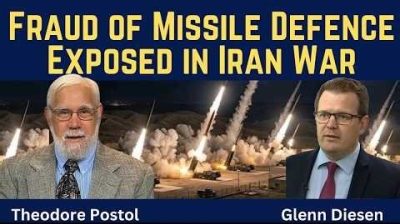
Ted Postol: Fraud of Missile Defence Exposed in Iran War
or go to
Aletho News Archives – Video-Images
Frlom the Archives
“Contested histories”, “contested narratives”: What kind of nonsense is this?
A war of words and concepts!
By Khalil Nakhleh • January 28, 2010
Numerous books and articles have been written, guided by the main thesis that the reason for the prolonged and intractable conflict between Israel and Palestine, and which is constantly at an impasse, is that there are two “contested” histories (of Jews and Arabs in Palestine!), and two “contested” narratives. And one is directed to read and internalize that “contested”, in this sense, means that both narratives are equally valid and with equal legitimacy, and that all alternative reading and interpretation of it, and all attempts to question it are “subjective”, “very personal”, “emotive”, “irrational”, “not credible”, “unreliable”, and “removed from history” … This is, in my view, a total and utter nonsense.
Such an approach ignores actual historical developments and ignores origins of real versus mythical historical developments, and de-legitimizes the continued Palestinian presence in the land of historical Palestine.
Before the onslaught of the Zionist colonial attack on Palestine in the 19th century, there were no claims recorded that the history of Palestine was a “contested history”. The local history was clear and in sharp relief. The indigenous population in Palestine was largely Palestinian Arabs (Muslims and Christians), in addition to a small minority of Palestinian Jews. The majority and minority co-existed and interacted with each other, as they always do in other normal open spaces, through commerce, rituals and friendships, etc. This was in the entire region under Ottoman rule. … continue
Blog Roll
 Aletho News
- Ted Postol: Fraud of Missile Defence Exposed in Iran War
- How An Atrocity Propaganda Campaign Led To The U.S. And Israel Committing Real Atrocities In Iran
- Calls for the reconfiguration of military arrangements in the Gulf region
- Openly Pro-Israel Tech Group Now Has Control over UK’s Most Sensitive National Security Data
- US Intelligence Community is Covering its Ass… What is Really Going On with the US War on Iran?
- Step into My Parlor
- The Trump Administration is Lying About American Casualties in the Persian Gulf Region
- Hezbollah Foils Israeli Landing in Lebanon’s Bekaa
- Iraqi Resistance: Attacks on Beirut suburbs threaten US interests
- US approves $151.8M weapons sale to Israel, waiving congressional review
- If Americans Knew
- At Israel’s hands, Iran is burning, Lebanon and Gaza are crumbling – Not a ceasefire Day 149
- Israel is using the ‘Gaza doctrine’ in Lebanon and Iran
- Saudi journalist says ‘not all attacks’ on Gulf coming from Iran, fears US-Israel dragging monarchies into war
- Iranian officials say Israel carried out some of the drone strikes on Gulf energy sites
- US, Israel ravage Iran and Lebanon; 4 killed in Gaza – Not a ceasefire Day 148
- US troops were told war on Iran was ‘all part of God’s divine plan’, watchdog alleges
- Trump wants to run the show in Iran, but doesn’t know what he’s doing – Not a ceasefire Day 147
- ‘Dirty Work’ :The truth about how Israel was founded
- Mass Expulsion in Lebanon as Israel Expands War: “We Don’t Know Where to Go”
- Lies, distortions, and propaganda: how the U.S. mainstream media coverage on Iran hides the truth
- No Tricks Zone
- Wake-up Call: Survey Shows Majority Of Germans Now Favor Postponing Climate Targets!
- Televised! Leading German Political Candidate Tells Schoolchildren CO2 Makes Sun Hotter!
- New Study: A Century Warming Of 1.1°C Is ‘Commonplace’ And ‘Not Unusual’ During This Interglacial
- New Study: ‘Internal Noise’ And Volcanic Forcing Can Trigger 10-15°C Warming Within Decades
- Glaciers Worldwide Are Suddendly Surging, Experts Blame Warming!
- Surprising Discovery: Sahara Is Greening…Billions Of Trees Where Once Thought To Be Barren
- New Research Reaffirms Clouds, Aerosols, And Surface Solar Radiation Are ‘Driving The Climate System’
- Germany: Electric Car Catches Fire At Charging Station, Sets Off Local “Inferno”, Widespread Damage
- New Study: Canada’s New Brunswick Was 1°C Warmer Than Today During The Medieval Warm Period
- Coal Power Back In Trend As Globe Tries To Keep Pace With Growing Demand For Power
 Aletho News