Zelensky regime leads request for social media platforms to censor “disinformation”
By Christina Maas | Reclaim The Net | April 1, 2023
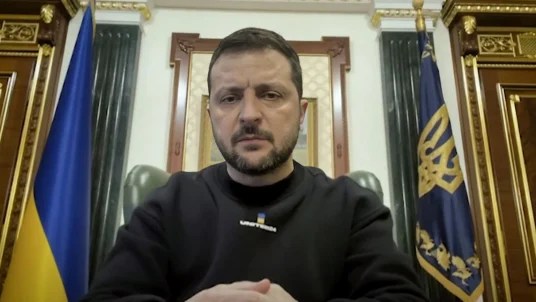
Ukraine has spearheaded a collective call to action, joining forces with seven other Central and Eastern European nations to combat “disinformation” on social media platforms.
In an open letter, the prime ministers of these nations urge prominent tech companies, such as Meta, to implement effective measures that curb the spread of misleading content and foreign interference, which threatens peace, stability, and democracy.
The letter, signed by the leaders of Ukraine, Moldova, Poland, Czech Republic, Slovakia, Estonia, Latvia, and Lithuania, alleges a danger of disinformation campaigns aimed at destabilizing their countries and undermining the European Union‘s support for Ukraine amidst Russia’s aggression.
Tech giants are implored to remain vigilant and avoid inadvertently advancing hostile goals.
Specific steps recommended in the letter include refusing payments from sanctioned individuals, increasing algorithmic transparency, and adjusting algorithms to prioritize accuracy over user engagement.
Furthermore, the leaders insist that platforms dedicate adequate resources to content “moderation” and address the growing challenges posed by deep fakes and AI-generated disinformation.
In response, Meta has stated that it has expanded its fact-checking capabilities in Eastern Europe and implemented measures to combat alleged misinformation related to the conflict in Ukraine.
The company has also restricted access to Russian state-controlled media and added labels to related posts, informing users of the source before they click or share.
EU has abandoned peace and prosperity – Orban

Viktor Orban in Budapest, Hungary, March 27, 2023 © AP / Denes Erdos
RT | April 1, 2023
The EU has forsaken its goal of ensuring peace and prosperity for its members, Hungarian Prime Minister Viktor Orban declared on Friday. Warning that the bloc is considering sending troops into Ukraine, Orban insisted that Hungary will continue pushing for a ceasefire.
“Those who are pro-war have put the whole European Union in danger,” Orban told Radio Kossuth, referring to the ongoing efforts by EU member states to arm Kiev’s forces. To date, Brussels has supplied Kiev with just under $4 billion worth of arms, while individual member states have donated tanks, artillery, and in the case of Poland and Slovakia, fighter jets to Ukraine.
“We expect two things from the European Union; the first is to have lasting peace,” Orban continued. “The second thing we expect of the EU is that it should preserve the prosperity it has achieved, but in comparison war and sanctions are destroying the European economy.”
Energy costs and inflation have soared across the EU since Brussels embargoed Russian fossil fuels following the launch of Moscow’s military operation in Ukraine last February. This embargo and other sanctions have failed to cripple the Russian economy, as their proponents predicted. Instead, Russia’s economy is set to grow faster this year than that of Germany, according to IMF figures.
The prospect of global war is more urgent than the economic threat, Orban said. The Hungarian prime minister claimed in Friday’s interview that EU leaders were considering deploying a “peacekeeping” force to Ukraine. This, he argued, would be a catastrophic escalation.
“When European and American leaders say that if this continues, we could end up in a third world war, it seems incredibly exaggerated at first, but where I work and where I see the events, this is a real danger at this moment,” he said.
Former Russian President Dmitry Medvedev said on Friday that such a force would be Russia’s “direct enemies” and would be “ruthlessly destroyed” on the battlefield.
“Peace talks are not what we should be talking about now, but a ceasefire,” Orban said, explaining that hostilities must be suspended before a settlement can be worked out. Whatever happens in Ukraine, the prime minister stressed that Hungary would not get involved. “They want to squeeze us into this war,” he claimed, referring to EU leaders, but the question of “whether Hungary should take part in the war… or whether it should stay out can only be decided in one place, the Hungarian parliament.”
Facebook ‘disappears’ RT Arabic
RT | March 30, 2023
Mark Zuckerberg’s flagship social network has deleted the page for RT Arabic, rejecting all appeals and handing the address to another user, the channel’s head Maya Manna said on Thursday.
“Two weeks we fought with Facebook to restore the suspended page of RT Arabic, with 17 million subscribers,” Manna said on her Telegram channel. “We tried to get an explanation of what triggered the shutdown, because we never got any strikes or comments.”
After several awkward non-explanations, Facebook’s customer service “simply wished us luck, closed our case, and turned over the URL to another user,” Manna wrote. “Internet democracy in all its glory!”
Facebook blocked the page on March 15, without any explanation or advance warning. Attempts to access the page resulted in the message, “this content isn’t available right now.”
Manna protested the move, calling it proof that the West doesn’t believe in free speech, only “total censorship and blocking.” By way of example, she brought up the EU ban on all “Russian state media” after the military operation in Ukraine began in February 2022, including all of RT’s channels.
“Apparently, this is not enough – the very fact that we exist does not allow them to sleep peacefully,” Manna added.
YouTube was quick to apply the EU ban globally, but continued operating in Russia, its CEO at the time, Susan Wojcicki, told the World Economic Forum in Davos last May. The Ukraine conflict showed that information had “a key role” and “can be weaponized,” said Wojcicki, so YouTube wanted to “help [Russian] citizens know what’s going on and have perspectives from the outside world.”
In November last year, after Facebook’s parent company Meta amended its “violent speech” rules to allow calls of “death to Russians” in the West, the Russian Justice Ministry added it to the register of extremist organizations. The decision affected Facebook and Instagram, but not the messaging platform WhatsApp, because it fell under a different legal category.
THE ARRESTS MORE OR LESS REAL OF KHAN, TRUMP AND PUTIN: THE PANIC OF THE DEEP STATE
By Cesare Sacchetti | The Eye Of The Needle | March 26, 2023
The end of the last week was shaken by an unreal announcement. The ICC tribunal, which has its headquarters in The Hague, announced that it issued a warrant arrest against the President of Russia, Vladimir Putin.
For those who have not any familiarity with this court, it does not have any jurisdiction in Russia due to the simple fact that Russia never signed the treaty that instituted the ICC.
Moreover, the ICC does not have a good reputation at all. We are talking about the court that was illegally prosecuting, according to several jurists, former Serbian president, Slobodan Milosevic with the charge of genocide.
Milosevic was very close to getting an acquittal because he was demolishing the case against him in court. Unfortunately, he could not get one because he died in never clarified circumstances before the end of his trial.
Some observers hold The Hague accountable for his death because Milosevic could have unmasked years of lies spread by NATO against him.
Nevertheless, the ICC prosecutor, Kharim Khan, showed himself before the world press and claimed that Putin was “guilty” of having trafficked Ukrainian children to Russia.
For those who don’t know much about Ukraine before the current war, the truth is quite simple. Ukraine was a world children supermarket. People from every part of the world ordered organs that were harvested from the bodies of innocent Ukrainian children.
Certainly, we are not talking about ordinary people. We are talking about people who travel in private jets. People who attend the WEF and who preach about pseudo-environmentalism while they’re the first to breach the rules of the insane and dystopian world that they imagine.
Therefore, if there is someone here who is guilty of child trafficking that would be the Ukrainian establishment, which is completely corrupt and handled by the foreign puppeteers who installed it in power.
The Euromaidan coup that was defined by Stratfor (a think tank quite close to the US deep state) as the “most blatant coup in history” is the “best” example of how the Ukrainian establishment is fully dependent upon the Anglosphere.
And the ICC has been silent for years about this horrendous traffic. It has not been saying a word about it. So if the ICC is really seeking who is responsible for the abuses suffered by the Ukrainian children, it should look at itself in the mirror. This trafficking has been taking place on the ICC’s watch, which has never lifted a finger to put an end to it.
However, this grotesque and provocative move has nothing to do with juridical issues. As we will see later, this is a political move that is deeply connected with two other announced arrests: that of Donald Trump and the one of the former Pakistani PM, Imran Khan.
The bogus case against Trump
On Friday 17th, Trump announced on Truth Social that the NY’s DA office was planning to arrest him for the Stormy Daniels case.
Basically, the case is founded upon the quite shaky legal grounds that Trump allegedly paid hush money to a pornstar, Stormy Daniels, in order to keep her quiet about his alleged affair with her.
Firstly, we should give a brief introduction about the US legal system and its developments in the latest years.
As many readers probably already know, the DAs in the US are elective assignments. They usually run for the Democratic or the Republican Party and they receive funds for their campaigns. And in recent years, a magnate who has spent a lot of money for getting elected DAs is George Soros. Soros has a very particular type of DA in mind to fulfill his “open society”.
Soros’ idea of a DA is an official who does not prosecute crimes and who allows the streets of his city to be ruled by criminals. The Open Society is literally allowing the dregs of society to have a free hand in harassing, raping, stealing and killing honest citizens.
The globalist world is where everything is upside down and where good is bad and right is wrong.
Therefore, if you happen to live in one of the cities where Soros DAs were elected and you’re a good citizen, you could be in trouble.
As a law abiding citizen, you’re not part of the open society. And you’re even more in trouble if you have political ideas keen to the principles of loving your country and defending it from foreign and domestic enemies.
And this is certainly the case of Donald Trump, who’s the target of never-ending political witch hunts.
In this case, the Soros DA who’s persecuting Trump is Alvin Bragg. Bragg would like to indict Trump for the 130,000 $ of hush money allegedly paid to Daniels. Money that was allegedly transferred to former Trump attorney, Michael Cohen, who, in turn, gave it to Stormy Daniels.
This round of transactions would constitute a falsification of Trump’s business records, according to the NY’s DA. But there’s a problem with all this theory. It is crumbling under the proofs to the contrary that are emerging in these days.
We are talking about crucial exculpatory evidence here like the letter signed by Cohen in which he clearly states that Trump never paid or reimbursed him for the money that he had given to Stormy Daniels in the first place.
In a normal world, the case would have been closed but in Soros’ world, it is not. Bragg’s probe seems to be falling under the blows of this evidence and the Grand Jury that should decide to proceed or not with Trump’s indictment keeps being postponed.
And this is happening because everyone in the legal arena, including Trump’s enemies, knows that Bragg does not have a case, and if he keeps overplaying his hand, he could be the one ending up indicted for abuse of power and for hiding crucial evidence who would immediately exonerate Trump from this bogus probe.
Therefore, Trump’s arrest seems to be less likely as the days go by. Never in the history of the United States, have we seen a President persecuted like Donald Trump.
From the very first moment when he went down the escalator of Trump Tower, he became enemy number one for the deep state.
Immediately, those powers who ruled Washington for decades tried to bar his way to the White House.
They started with the Russiagate hoax, also known as Spygate, which is an international plot that sees involved also British and Italian secret services in order to frame Trump by falsely accusing him of being a “Russian agent”.
They did not stop there. They even tried to physically remove him from the White House with at least two assassination attempts in August 2020 and with another at Mar-a-Lago in January 2021.
They even tried to oust him with the 2020 election fraud, which could be defined as the most blatant electoral fraud in history. Not to mention two attempted and failed impeachments against him, which were both based on preposterous and false accusations.
A war machine was clearly put in motion. It is the machine of those secret powers that have ruled the United States for far too long. Powers that hijacked the history of this country in order to subvert foreign leaders who were not obeying the orders of NATO and of the Israeli lobby. Powers that harmed and killed so many Americans and many other people all around the world.
The American people elected Trump to halt the exploitation of the United States. American people were fed up with seeing their country used to fulfill a global agenda whose only purpose is to establish a world totalitarian government.
And Trump is the political leader who has incarnated that spirit – the spirit of making America great again and of freeing this nation from the chains of her enemies.
The Bragg probe is just the latest attempt of this war against Trump and the American people. Trump is just inches away from officially returning to the White House and, as a result, the deep state launched this bogus investigation. It is an investigation that remains unclear if it will lead to an indictment and an eventual arrest.
The system has a very weak hand and Trump knows it. Most likely, his announcement aimed to expose this plot even if its probabilities of success are very low.
Imran Khan: the man who the deep state wants dead
Someone who is also running the risk of being arrested is former Pakistani PM, Imran Khan. Khan denounced last year a plot that was hatched by NATO’s circles to oust him from power.
Khan was and still is a very dangerous threat for the US deep state powers. The Pakistani leader aimed to establish relations with BRICS and, by doing so, Pakistan would have left the Anglosphere.
If this would come to fruition, NATO would lose another key strategic country in Asia.
That’s why he was removed with a confidence vote that was heavily swayed by foreign influences. But Khan didn’t throw in the towel.
He kept fighting for Pakistan. He keeps gathering massive crowds at his rallies. For the deep state, the risk was too high. They tried to kill him and if Khan is alive today, it is only for the result of miraculous circumstances.
On Saturday 18th, the police stormed his residence. Khan is facing a trial in Islamabad where the charge is of having sold watches that he received as gifts when he was still in charge. It’s not known what is the evidence of this “crime” but this case seems to be quite weak as the one against President Trump.
Therefore, the Pakistani leader could have the opportunity to run at the next election scheduled for this coming October. It’s a nightmarish scenario for the Anglozionist powers because Pakistan would definitely shift towards the multipolar world.
However, there are still some traps set on the way and Khan knows it. This is why he urged his supporters not to engage in any kind of violence because he knows that Sharif, the current PM, is seeking a way to frame him.
So we can see how all these three attempted arrests are connected to each other. Trump, Putin and Khan belong to the international patriotic alliance that is fighting against the globalist side.
On the one hand, we have a side of leaders who are fighting to preserve the sovereignity of their countries. On the other, we have unelected powerful banking families like the Rothschilds who have been trying to destroy the independence and prosperity of every country in the world.
What we saw in the last 14 days is just the latest chapter of this current war between these two sides.
And the globalist side is being inflicted tremendous blows.
Only in this week, Putin received more than 40 African leaders in a conference about the multipolar world. And why he was attending this event, he also received the Chinese president, Xi Jinping.
The BRICS are changing the lines of international politics. The world is shifting from the rule of the Anglosphere empire towards the restoration of the national States.
When Xi Jinping states that the changes that Russia and China are driving are unprecedented in the last 100 years, he’s quite right.
Even Saudi Arabia, a country forged by British and Zionist powers, understood that things went south and restored diplomatic relationships with Iran.
The world is changing at a tremendous speed. We are moving from the old globalized and centralized world towards one when there are no ruling powers. The age of the empires has died. The age of the nations has begun again.
After the defeat of NATO in Ukraine, which is running out of ammunitions, we will have passed the point of no return. NATO’s crisis will be so deep to the point that it could dissolve itself.
At that point, the EU, the last frail bulwark of globalism will be encircled. The crisis of the European establishment will aggravate and people in the EU countries will demand the end of neoliberal austerity and the normalization of relations with Russia.
Italy still seems to be the ideal candidate to run this process considering the fact that she has the most euro skeptical and most pro-Russia people in Europe.
And this is a perspective that scares a lot of members of both the Italian and EU deep state.
The old world of despotism is dying. The new world of free nations is being created.
We are certainly living in one of the most exciting and important times in history.
Serbia and Hungary form Strategic Council despite EU opposition
By Ahmed Adel | March 29, 2023
The idea of forming a Serbia-Hungary Strategic Council was announced by Serbian President Aleksandar Vučić after his meeting with Hungarian Prime Minister Viktor Orbán in Belgrade on March 25. Specifically, Vučić announced that the strategic council between the two countries would be established in May. As Serbia is a non-EU/NATO member, unlike Hungary, it is guaranteed that Brussels and Washington are not happy about the strengthening ties between the two neighbouring countries.
Accordingly, the council would deal with the issue of security, the fight against terrorism, and opens the possibility of cooperation between their armies and police in the military-technical sense. It is for this reason, despite the benefits that this strategic cooperation brings for both countries, Brussels and Washington are not happy with this emergence.
The issue of security is very important and is back at the forefront due to the crisis in Ukraine. More than ever, the spotlight has not just been placed on security in the traditional sense, but also in regards to energy. Serbia and Hungary are connected not only by good mutual relations, but also by their tense relationship with the European Union. Although Hungary is an EU member, it has a number of open issues with the bloc, such as the handling of the war in Ukraine. Fundamentally, Serbia’s and Hungary’s current interests are opposed to that of the EU, and it is also this factor which unites them.
Serbia has excellent economic relations with Russia and China, and Orbán as a Hungarian nationalist, broke from EU consensus and concluded that his country should not have confrontational ties with Moscow. Serbia and Hungary are looking towards a Eurasian future rather than an Atlanticist one, something which binds their commonalities and necessitates the need for a common strategic council.
In addition, Hungary is surrounded by countries with which it has a rather difficult historical (and sometimes current) relations, regardless of mutual NATO and EU membership, namely Romania and Slovakia. However, Hungary also never had great relations with Ukraine or Yugoslavia. With Serbia though, the successor of Yugoslavia, this has massively changed.
Both Belgrade and Budapest have invested a lot of energy into thawing relations in the last ten years. This developing relationship was epitomised with the Serbian Parliament in December ratifying the agreement on strategic cooperation between Serbia and Hungary.
Hungary is the only country neighbouring Serbia that Belgrade has concluded a strategic cooperation with, and it relates to more than twenty areas. This includes infrastructure and the economy, where Hungary is already among the first foreign trade partners of Serbia. This also extends to other sectors too, which is why Hungary is rapidly becoming one of Serbia’s closest partners.
When the future strategic council of Serbia and Hungary is viewed objectively, it is seen as purely political in nature and an effort to thrive under new global circumstances. That is why the council is essential. The current events in Ukraine, where there is a large Hungarian minority, and the remaining question over Kosovo, means that Serbia and Hungary will need to support each other more than ever as most of Europe is in favour of backing the Kiev regime and separatists in Kosovo.
Hungary has openly and repeatedly said that it does not want to be part of any adventure and war. Serbia also maintains a neutral position politically, although the majority of people are pro-Russian because of their own experience with NATO and the entire historical experience preceding and following it.
The fact that Budapest has good relations with not only Belgrade, but also the Republika Srpska (the Serbian entity of the Bosnia and Herzegovina Federation), is also important as it demonstrates again that Orbán’s Hungary is not only working based on values and principles, but also on the need for an ally in the region. Practically, with an interesting turn of historical circumstances, the Hungarians realised that their most reliable ally would be the Serbs, both in Serbia and Republika Srpska.
Hungarian Foreign Minister Péter Szijjártó commented on the meeting in a video on his Facebook page. He stressed that the strategic partnership and friendship between Belgrade and Budapest will greatly contribute to Hungary’s ability to better address the challenges it faces – primarily economic, security, and energy supply.
Szijjártó also recalled that under the long-term agreement with the Russian state-owned Gazprom, “natural gas for Hungary’s supply comes via Serbia, and Hungary stores hundreds of millions of cubic metres of gas for Serbia.”
European countries have destroyed their economies for sanctioning Russia and cutting gas supplies, something Budapest has done its best to avoid. For this reason, it is increasingly finding itself with more common interests with Belgrade and will not be hindered from jointly pursuing them just because Serbia is not an EU or NATO member.
Ahmed Adel is a Cairo-based geopolitics and political economy researcher.
Funding Ukraine ‘War Machine’ Against Russia Means Austerity in Europe
By James Tweedie – Sputnik – 28.03.2023
Western sanctions on Russia over its de-Nazification operation in Ukraine have ricocheted with disastrous results for European economies. Dr Linwood Tauheed, associate professor of Economics at the University of Missouri-Kansas City, linked them to civil unrest now wracking the continent.
The wave of strikes and protests sweeping Europe are in response to austerity policies prompted by sanctions on Russia, an academic has said.
Linwood Tauheed told Sputnik that Europeans are “not willing to be stoic about this any longer.”
The unrest was “an indication that some of the issues caused out there directly by the sanctions, which, of course, was caused by the war, are affecting them greatly,” he said.
The sanctions have been centrally co-ordinated by the European Commission, the unelected executive of the European Union (EU), which has also diverted billions of euros from the ironically-named European Peace Facility fund to buy arms for the Kiev regime.
“All of the EU countries are subject to round and round, and have been, of austerity that is a particular element of having this European Economic Union,” where countries have “given up their own sovereign currency and therefore their ability to solve their individual problems,” Tauheed noted.
EU nations must ask economic giant Germany’s approval before taking any measures to support their own people — as Greece and Italy have discovered. That has formed “a particular view of Germany and Brussels in terms of how those entities affect their individual economies,” Tauheed argued.
He said sanctions on Russia, reduced energy imports, de-industrialisation and falling living standards were “unifying” the public against austerity.
“Their leaders are willing to take limited euro resources and put them into a war machine and send them to Ukraine,” Tauheed stressed. “Austerity is looming and citizens are wondering ‘how we have money to send to Ukraine when we don’t have money to extend our pensions in France?’ Austerity is at the core of this. And it is European-wide, it’s not just country to country.”
The crisis is not limited to public spending and strikes over wages. German financial giant Deutsche Bank is now facing collapse after losing 11 per cent of its share value on Friday, and 29 per cent since the start of the month.
“Large banks in large countries in Europe” are facing “some crisis or another” but the US option of a central bank bail-out was not available to them, the academic said.
“So they’re going to be less able to quell bankruptcies and solvency among European banks than the US has been,” Tauheed said. “More dominoes” will likely fall in Europe, “but that’s also going to be contagious back to the US.”
Moscow calls out US’ rules-based order in Europe
BY M. K. BHADRAKUMAR | INDIAN PUNCHLINE | MARCH 27, 2023
Baroness Goldie is an experienced Scottish politician and life peer who served as Leader of the Scottish Conservative Party from 2005 to 2011 and as the UK’s Minister of State for Defence since 2019. She is anything but a party girl like Liz Truss who often had to swallow her indiscreet words betraying ignorance.
Certainly, Baroness Goldie understood perfectly well the implications of what she put down in a written statement at the House of Lords on March 20 in her answer to Lord Hylton’s seemingly innocuous question: “To ask His Majesty’s Government whether any of the ammunition currently being supplied to Ukraine contains depleted uranium.” (By the way, Lord Hylton is one of 92 hereditary peers elected to remain in the House of Lords; he is currently the longest-serving Crossbench member of the House of Lords, since 1968, and is a dynamic campaigner for peace and the interests of the vulnerable and the marginalised.)
It is a fair guess that the UK Defence Secretary Ben Wallace kept 10 Downing Street informed — and even more important, had prior consultations and concurrence with his US counterpart, Secretary of Defence Lloyd Austin — before Baroness Goldie made the statement.
Both Wallace and Austin are military people and understand why ammunition tipped with “depleted uranium” is needed in the current stage of the proxy war in Ukraine if at all Kiev is to launch a “credible counter-offensive” in spring when the tide of the war has distinctly turned in Russia’s favour.
Equally, both must be well aware that the legality of the NATO intervention in Yugoslavia is still an open issue. In response to NATO’s bombing campaign, former Yugoslavia instituted proceedings before the International Court of Justice on April 29, 1999, against the ten NATO members directly involved in the attack — Belgium, Canada, France, Germany, Italy, the Netherlands, Portugal, Spain, the UK, and the US — citing a series of violations of the law of nations (which included the obligation not to use prohibited weapons.)
Although the ICJ rejected Belgrade’s request for provisional measures, it, nonetheless, declared itself profoundly concerned with the use of force in Yugoslavia, which “under the present circumstances … raises very serious issues of international law.” Suffice to say, the cases brought by Yugoslavia against the NATO respondents still remain on the ICJ’s docket although the petitioner got dismembered.
Make no mistake, Washington and London are consciously repeating the war crime in the former Yugoslavia. The Anglo-Saxon clique’s core objective is a calculated escalation of the proxy war that is certain to draw forth a robust reaction by Moscow, as predictable as night follows day.
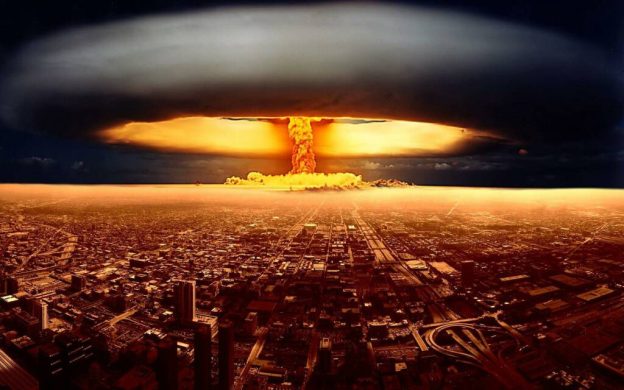
Indeed, that is precisely what happened when Russian President Vladimir Putin announced on Saturday that Russia will deploy its tactical nuclear weapons in Belarus. Putin linked this to a request from Belarus in reaction to Baroness Goldie’s statement in London a week ago.
More importantly, Putin also drew the analogy of the US placing its tactical nuclear weapons on the territories of the allied NATO countries for decades.
The EU and NATO went ballistic after Putin’s disclosure. EU’s chief diplomat Josep Borrell said on Sunday called out Moscow’s decision as “an irresponsible escalation and threat to European security.” He threatened to impose “further sanctions” against Belarus!
A NATO spokeswoman called Moscow’s decision “dangerous and irresponsible.” Interestingly, though, the Biden administration neatly side-stepped the issue, focusing instead that the US has not seen any signs that Russia has moved nuclear weapons to Belarus or anywhere else!
In good measure, National Security Council spokesperson John Kirby added, “We’ve in fact seen no indication he (Putin) has any intention to use nuclear weapons, period, inside Ukraine.”
But then, Putin also made it clear that Russia would first complete construction on a storage facility in Belarus for the tactical nuclear weapons by July 1.
Kirby is fudging. What is the game plan? First, the Anglo-Saxon clique would hope that the issue will create further antagonism in Europe against Russia and Putin personally and would rally European countries behind the Biden administration at a time when fault lines were appearing within the transatlantic alliance over a protracted war in Ukraine that might be catastrophic for European economies.
Washington is hard-pressed to respond to Putin’s remark that Russia is only doing something that the US has been doing for decades. The point is, a mutual commitment not to deploy nuclear weapons in third countries was one of the proposals Moscow made to Washington in December 2021, alongside a commitment that Ukraine would not join NATO. The US ignored it and precipitated the Russian special military operation in Ukraine.
The crux of the matter is, as with the Cuban missile crisis of 1962, the Russian decision on tactical nuclear weapons in Belarus is retaliatory, drawing attention to the US missiles stationed close to its borders. (An estimated 100 nuclear weapons are stored in vaults in five European countries — Belgium, Germany, Italy, Netherlands and Turkey.)
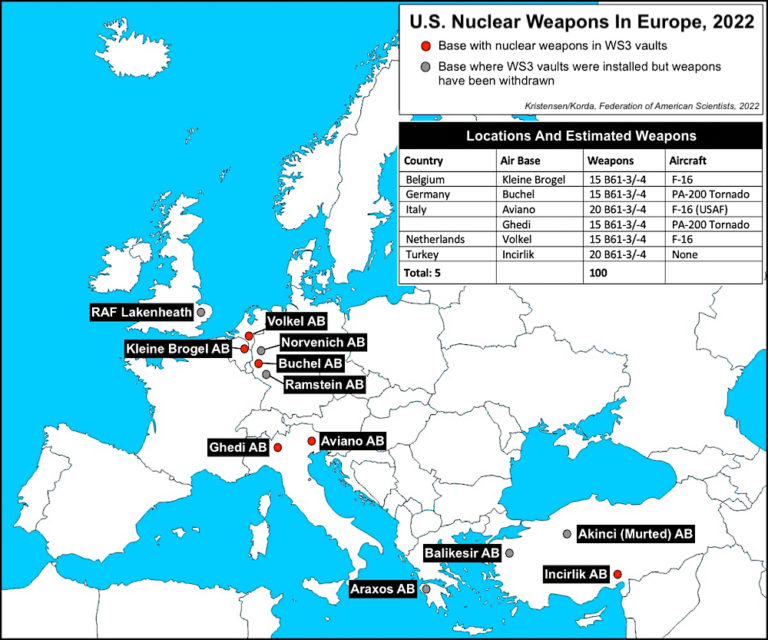
Worse still, the US practices a controversial arrangement known as “nuclear sharing”, under which it installs nuclear equipment on fighter jets of select non-nuclear NATO countries and train their pilots to carry out nuclear strike with US nuclear bombs. This is when the US, being a party to the nuclear Non-Proliferation Treaty (NPT), has promised not to hand over nuclear weapons to other countries, and the non-nuclear countries in the NATO’s sharing arrangement have themselves promised not to receive nuclear weapons from the nuclear weapon states!
NATO declared last year that seven NATO countries have contributed dual-capable aircraft to the nuclear sharing mission. These countries are believed to be the US, Belgium, Germany, Italy, Netherlands, Turkey and Greece. And all are signatories to the NPT!
Welcome to the rules based order! What is perfectly permissible to the “collective West” is forbidden for Russia!
Finally, the diplomatic pirouette has yet another dimension: Britain’s decision to send depleted uranium weaponry to Ukraine is confirming its reputation as the most reckless and unscrupulous state in the whole NATO alliance.
For, there is no question that depleted uranium munitions are radioactive and toxic and their heavy use in the Yugoslavia and Iraq wars has been linked to birth defects and cancers. It has been tied to “the highest rate of genetic damage in any population ever studied” in Fallujah, the city subjected to two brutal US sieges during the invasion of Iraq.
Ironically, the toxicity of depleted uranium munitions has been accepted by many NATO countries and the European Parliament has called for its use to be banned. So, what is Britain up to, behaving like an outlier?
The heart of the matter is that Britain is creating conditions in Europe to base nuclear-armed US bombers in Britain at Lakenheath in Suffolk (which were removed in 1991 in line with the Intermediate Nuclear Forces treaty.)
At a time when the peace movement in Britain is moribund, count on the Russian retaliation to deploy tactical nuclear weapons in Belarus to trigger calls for yet another tit for tat escalation from warmongers and Russophobes. Expect the US bombers to return to Lakenheath in a near future.
The EU is losing relevance in the emerging new world
By Timur Fomenko | RT | March 27, 2023
Vladimir Putin and Xi Jinping met in Moscow last week, and Western circles predictably responded by accusing Russia of becoming “subservient” or even a “vassal state” to China.
MEP Guy Verhofstadt, a Euro-fantasist and former prime minister of Belgium, jeered on Twitter, “Putin’s appalling legacy now includes turning Russia more and more into a Chinese vassal state,” oblivious to the irony of his own words. As the United States took the lead in denouncing China’s peace plan for the Ukraine conflict, publicly setting out the conditions on which it should end, the European Union was nowhere to be seen, or at least had nothing original to say.
This makes Verhofstadt’s comments a damning display of lacking self-awareness. Russia and China are setting out their vision for a new multipolar world, while the US struggles against them in seeking to maintain its hegemonic position. Meanwhile, the European Union has been reduced to the status of a mere bench player in it all, and has become effectively irrelevant. The failure of EU countries to stake out their own will and position amidst the larger powers, as well as their total subservience to the US, has made a mockery of the “strategic autonomy” concept once championed by Emmanuel Macron.
“Strategic autonomy” is a principle of European integration where the EU should be an actor in a multipolar world, which advocates for its own interests and pursues its own agenda. Supporters of this principle insist that the EU should not blindly follow the will of the US when it comes to every foreign policy issue, but should be proactive and enhance its role on the world stage. Therefore, they should not, as is commonly demanded by Washington, take sides on matters such as a new Cold War with China. The term gained growing traction during the years of the Trump administration, when Europe’s relations with the US hit a low due to his particular interpretation of the “America first” doctrine.
However, the practical reality of “strategic autonomy” is that the EU is not a unitary state, but a loose intergovernmental organization of states which, while seeking to establish common positions on a principle of unity, do not truly have a unified foreign-policy-making mechanism. The intra-institutional politics of the EU are often a messy compromise and battle of wills between different levels of actors, including the states themselves, the European Commission, and the European Parliament. This combines with the reality that “European integration” has been a broken process since 2008. Challenges such as the Eurozone financial crisis, Brexit, Covid-19, and internal conflicts with various states such as Poland have all weakened and fractured the EU.
As a result, the EU has been ill-suited to deal with what is, despite media misdirection, the single most explicit source of foreign influence and interference against it, the US. Washington has multiple channels whereby it exerts control over the EU’s many foreign policy actors. Firstly, it uses a web of government-funded think tanks and associated journalists to control public opinion and steer EU countries towards supporting its objectives. Secondly, the US has an extraordinarily political hold over the former Soviet bloc states to the east of the EU (with the exception of Hungary), which it uses to foment increased antagonism against Russia and China, and therefore undermines the attempts of the bloc’s most “autonomous” and powerful states – Germany and France – to pursue more reconciliatory foreign policies.
Thirdly, the US uses the United Kingdom as its primary cheerleader in Europe (be it from within or without the EU) to project its political will onto the continent and override the will of any defiant member states. An example of this is the BBC World Service acting as a massive propaganda machine to push narratives in line with Washington’s foreign policies. Additionally, the US has shown an ability to work with and weaponize the intelligence services of member states against their own countries, such as using Danish intelligence to spy on other European leaders.
Through all these factors, both past and present, the US has been able to keep Europe divided, conflicted, and seemingly unable to pursue any foreign policy which actually meets European interests, as opposed to those of the US. This has culminated even to the extent of literally destroying the Nord Stream pipelines and then propagating a false narrative that Ukraine was responsible. The Ukraine war has ultimately only accelerated the isolation and irrelevance of Europe, which has strengthened the hold of the military-industrial complex over the continent, undermined its energy industries, and thus converted the term “strategic autonomy” into a laughing stock.
One might ask, who is truly the vassal? If a new multipolar world is emerging, it’s fair to say, Europe simply isn’t part of it. Russia, China, and America are the drivers of current events, the EU is but a passenger.
NATO militarizes civilian structures in Europe with €1 billion fund
By Ahmed Adel | March 27, 2023
NATO is launching a new investment fund worth €1 billion, which is expected to be officially activated at NATO’s annual summit in July. The fund aims to militarize the civil sector by using the knowledge and skills of manufacturers, scientific institutions, and start-ups to develop technology with military and defence applications.
The fund, described by NATO as the “world’s first multi-sovereign venture capital fund”, will invest €1 billion into developing dual-use (civilian and military) emerging and disruptive technologies over a 15-year time frame. However, it demonstrates that NATO wants to permanently employ the European economy to the Russian border so they can collectively focus on the Ukrainian crisis.
It will also serve as preparation for any future war against Russia, something that is at great risk of eventuating considering Western efforts to deter Moscow from its special military operation in Ukraine have failed.
In the Ukrainian crisis, the material needs of the Ukrainian military are evident, and especially in preparation for any potential scenario of using NATO forces against Russia. This primarily refers to artillery, ammunition, rockets, bombs, air defence systems and drones. Due to these shortages, projects like this are being developed under the auspices of the NATO pact and are now becoming an investment fund for the economies of member states, depending on the ability of those countries to produce equipment needed for combat needs.
NATO approaches this project by effectively purchasing knowledge and engaging civil institutions, but also by opening various civil-military programs and projects. In addition, there are also investments in the so-called information war, which is part of the intelligence-reconnaissance activity, which is very important for modern warfare.
One NATO official told EURACTIV that the Alliance is looking to have a “competitive edge over strategic competitors”, an obvious reference to Russia.
The Netherlands already announced that it will house the fund. The country also announced that it will facilitate innovative startup companies by helping them find capital.
“We expect that housing this fund in the Netherlands will make it easier for innovative Dutch startups to find their way to capital, stimulating solutions for both societal and military problems,” the Dutch ministry of Economic Affairs said in a statement.
For this reason, the specific technologies invested will include artificial intelligence, big-data processing, biotechnology and human enhancement, novel materials, quantum-enabled technologies as well as propulsion and space. Although the headquarters will likely be in Amsterdam, regional offices will also be established “across the Alliance […] given the wide geographic remit of the Fund”, according to a NATO press release.
It is recalled that the new fund was first announced last year, meaning that the latest announcement made by the Dutch government is a demonstration of a laid-out plan by NATO to bring European civilian structures to operate as if it were in a war time economic climate. This could suggest that NATO is preparing Europe for a much larger conflict with Russia.
However, these provocative actions by the Dutch government comes as the country has been gripped by a wave of strikes in the public and private sectors since the beginning of 2023, something unseen in such a manner for many years. Every week since January, Dutch workers have protested for better wages and living conditions.
On March 16, around 200,000 healthcare workers at 64 Dutch hospitals were on strike for a day, including at the Antoni van Leeuwenhoek hospital in Amsterdam, a leading facility for treating cancer patients. Doctors and healthcare workers in 48 departments of the facility went on strike for the first time ever.
Although the Dutch economy will not shrink this year, its growth will slow down, according to ABN Amro. The bank expects the economy to grow 1.2% this year and 1.3% in 2024, a miniscule amount compared to the 4% growth the Dutch economy enjoyed in the previous years. Persistent inflation will ensure that growth will remain low this year, with ABN Amro expecting consumer prices to rise by 4.4% this year and 4% in 2024.
The higher interest rates, keeping in mind the central banks are trying to curb inflation, also slow the Dutch economy. It costs more to borrow money, which has repercussions for the housing market and investments, ABN Amro said.
Yet, with the Netherlands having no security issues to contend with given its geography, it is voluntarily deepening its involvement in NATO structures aimed against Russia, and all at a time when citizens are protesting weekly and suffering from the Western-wide economic crisis.
Ahmed Adel is an Cairo-based geopolitics and political economy researcher.
EU warns of response to Belarus nuclear move
RT | March 26, 2023
The EU will respond with further sanctions if Belarus presses ahead with hosting Russian nuclear weapons on its soil, the bloc’s top diplomat, Josep Borrell, has stated. Borrell called the decision to transfer tactical weapons to Belarus “an irresponsible escalation” by Moscow.
“Belarus hosting Russian nuclear weapons would mean an irresponsible escalation and threat to European security,” Borrell tweeted on Sunday. “Belarus can still stop it, it is their choice,” he continued, adding that “the EU stands ready to respond with further sanctions.”
Russian President Vladimir Putin revealed on Saturday that his country’s tactical nuclear weapons will arrive in Belarus as early as this summer. Putin said that he made the decision after the UK announced it would transfer toxic depleted uranium munitions to Ukraine, a move he described as a sign of London’s “absolute recklessness.”
Belarus has already been extensively sanctioned by the EU and US since the start of Russia’s military operation in Ukraine last February. Brussels has blacklisted more than 20 Belarusian officials, cut five of the nation’s banks off from the SWIFT system, and imposed numerous trade restrictions.
Prior to 2022, the EU banned Belarusian flights from operating in its airspace and imposed five separate sets of sanctions in response to President Alexander Lukashenko’s 2020 election victory, which the EU deemed fraudulent.
In his announcement on Saturday, Putin explained that any nuclear weapons transferred to Belarus would remain under Russian control.
“There is nothing unusual,” about this arrangement, Putin stated, explaining that “the United States has been doing this for decades” by keeping its own nuclear weapons in Belgium, Germany, Italy, the Netherlands, and Türkiye.
“They have long deployed their tactical nuclear weapons on the territory of their allies,” he said. “We agreed that we will do the same, without violating our international obligations on the non-proliferation of nuclear weapons.”
Hungary comments on Ukraine’s NATO and EU bids
RT | March 25, 2023
Hungary will not agree to Ukraine joining NATO and the EU as long as Kiev continues to discriminate against ethnic Hungarians living in Transcarpathia, Foreign Minister Peter Szijjarto has said.
Szijjarto added that he raised the issue at a meeting with the UN assistant secretary general for human rights, Ilze Brands Kehris.
Up to 99 Hungarian primary and secondary schools are in danger of being closed in Ukraine due to the nation’s education law, Szijjarto said. “I made it clear to Ilze Brands Kehris… that Hungary will not be able to support Ukraine’s transatlantic and European integration [bids] under any circumstances as long as Hungarian schools in the Transcarpathia region are in danger,” the minister wrote on Facebook on Friday.
Kiev has been cracking down on minority language rights for years. Laws enforcing the use of Ukrainian in education and television were adopted as early as 2017 under then-President Pyotr Poroshenko. In 2018, another law banned the teaching of Russian, as well as Romanian, Polish, and Hungarian beyond the primary school level.
In 2019, the Council of Europe’s Venice Commission criticized Ukraine’s State Language Law, saying it “fails to strike balance between strengthening Ukrainian and safeguarding minorities’ linguistic rights.”
Budapest has been among the most vocal critics of Kiev’s language policies in the West. According to Szijjarto, Ukraine has not done anything substantial to address Hungary’s concerns.
“For the past eight years, we have continuously received promises from the Ukrainian authorities that they will solve this problem, but they have not actually done anything,” he said.
Around 156,000 ethnic Hungarians live in Ukraine, most of them in the western region of Transcarpathia. Ukraine is also home to around 150,000 ethnic Romanians and more than 250,000 Moldovans, and Bucharest previously joined Budapest in demanding that the language laws be revised.
In February, Szijjarto announced that the Council of Europe will review Kiev’s treatment of minorities and issue a report on its alleged discrimination against ethnic Hungarians and Romanians living in Ukraine this summer. He pointed to yet another law adopted in December 2022, which mandated the use of Ukrainian in most aspects of daily and public life, including schools.
Featured Video

Trita Parsi: Middle East Unraveling — Are We on the Path to World War?
or go to
Aletho News Archives – Video-Images
New Book
Trans agenda is ‘normalization of sadism’ – US author

RT | September 23, 2026
The US Democratic Party has embraced a transgender agenda that amounts to “the normalization of sadism,” author A.J. Rice has said, warning that radical trans policies would return if the party is allowed to regain power.
Speaking to RT’s America First host Scotty Nell Hughes about his new book, ‘The Curse of the Bearded Lady: How the Trans Mafia Whacked American Sanity’, Rice argued that activists have gained significant influence in schools, medicine, and corporate America while people who questioned the agenda have faced pressure to stay silent.
The author described the “trans mafia” as the sprawling network of people and institutions that have helped the movement gain influence. He singled out parts of academia, wealthy backers, and corporations, and stated that providers of transition-related treatment also have a financial incentive to keep young people in their care indefinitely.
Rice argued that the consequences of these policies ultimately fall on children who are being drawn toward gender-affirming medical treatments and on girls who are expected to share locker rooms or compete in sports with biological males.
He noted that while voters rejected the Democrats’ approach to gender in 2024, the party, which has been “captured by madness,” has since only doubled down and is seeking what is effectively “the normalization of sadism.” … Full article
Blog Roll
 Aletho News
- French-Lebanese man files war crimes complaint over Israeli attacks
- Mahan Air Flight Lands in China Despite US Threat against Iranian Airlines
- US eyes $10bn fund to rebuild war-battered Gulf infrastructure
- Trump meets Rodríguez near Maduro’s prison as Venezuela’s oil flows to US
- Trita Parsi: Middle East Unraveling — Are We on the Path to World War?
- Iran FM meets with US envoy on UN meeting’s sidelines at American side’s insistence: Report
- Qatar PM calls for Gulf security framework with Iran, says war must be ‘wake-up call’
- China condemns US extortion of Iranian airlines, rejects Washington’s ‘illegal’ sanctions threats
- Italy to move military personnel from Taif base after missile strike
- Finland’s Stubb tells European leaders to calm down
- If Americans Knew
- Winter could turn Gaza’s treacherous, war-damaged buildings into deathtraps
- Majority of Democratic Voters Want to Prosecute Both Biden and Trump Administration Officials Over Gaza
- As Gaza languishes, world leaders gather at the UN – Daily Update
- Sanctions are collective punishment: immoral and self-defeating
- Phosphorus Munitions Fired by Israel Burn Groves, Orchards in Southern Lebanon
- Israel Carries Out New Ceasefire Violations Across Gaza
- AI – Emphasis on the ‘I’: Israel Is Funding AI Chatbot Propaganda
- Israel Blocking Hundreds of Wheelchairs for Injured Children From Entering Gaza
- Israel Is Expanding and Upgrading Compounds for Palestinian Militias in Gaza
- The Palestinian-American Residents of This West Bank Town Are Wondering: Where Is Trump?
- No Tricks Zone
- New Study: Earth And Venus Surface Warmth Largely Explained By Convection And Lapse Rate, Not CO2 Or Radiation
- 2025 Nature Paper Claiming Worsening Global Drought Gets RETRACTED …Heavily Flawed
- New Study: ‘Global Drought Shows No Detectable Recent Acceleration Under Climate Warming’
- Economic Masterminds: German Socialists Suggest Taxing Productivity Gains Stemming From Using AI
- The South China Sea Has Not Been Cooperating With The Climate Change Narrative
- Energy Crisis: Germany Enters Heating Season With Historically Low Gas Reserve Fill Levels
- New Study: The Antarctic Ice Sheet Gained Mass From 2020-2024 Due To Staggering Snow And Ice Accumulation
- Study: Ocean Heating Rates From Thousands Of Years Ago ‘Dwarf’ Modern Ocean Heating Rates
- Climate Extremists Target, Attack Large-Scale Power Grid Infrastructure In Germany!
- New Study: Antarctic Ice Melt Has Contributed Less Than 1 Centimeter To Sea Level Rise In The Last 30 Years

