Ukraine moves to drop non-aligned status, apply for NATO membership
RT | August 29, 2014
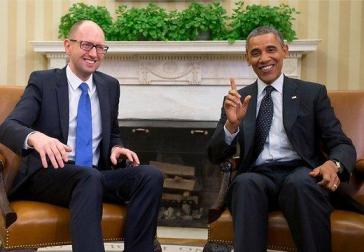
Ukraine’s Cabinet has asked the country’s parliament to consider dropping the country’s non-aligned status and seek membership of NATO.
Prime Minister Arseny Yatsenyuk’s government submitted to the parliament, the Verkhovna Rada, a draft bill that would cancel Ukraine’s non-aligned status and revive the country’s quest to join NATO – a path ditched by ousted President Viktor Yanukovich in 2010.
The move followed a decision by Ukraine’s National Security and Defense Council. It also coincided with an emergency meeting of NATO ambassadors in Brussels to discuss the ongoing crisis in east Ukraine.
If passed, the law would ban Ukraine from joining any political unions which would prevent it from eventually achieving “its key and sole goal” – membership in the European Union, Yatsenyuk said, the government’s press service said in a statement.
Following the adoption of the law, Ukraine will be forbidden from being a member of the Eurasian Customs Union and Eurasian Economic Community, and any other unions “which are in essence nothing but Russia’s Soviet Union,” Yatsenyuk stated.
The premier asked President Petro Poroshenko to classify the draft bill as urgent and called on the parliament to immediately consider it.
Defense Minister Arsen Avakov praised the decision as a “very correct one.”
“If the parliament approves it, the path to NATO will be open,” Avakov said on his Facebook page. “Only madmen would counter such a decision in the current situation.”
NATO said it would respect Kiev’s possible decision to seek membership of the military alliance.
“This is a fundamental principle that each and every nation has an inherent right to decide itself, on its security policies and its alliance affiliations,” the bloc’s chief, Anders Fogh Rasmussen, told the media at an extraordinary meeting of the NATO-Ukraine Commission.
He indicated that the military alliance would be open to discussing Ukraine’s application if it meets the conditions for membership.
“I am not going to interfere with political discussions in Ukraine, but let me remind you of NATO’s decision taken at the Bucharest Summit in 2008 according to which Ukraine will become a member of NATO, provided of course that Ukraine so wishes and provided that Ukraine fulfils the necessary criteria,” he said.
However, the issue was not discussed at Friday’s gathering in Brussels, Rasmussen added.
Washington piles lie upon lie
By Paul Craig Roberts | Press TV | August 29, 2014
The latest Washington lie, this one coming from NATO, is that Russia has invaded Ukraine with 1,000 troops and self-propelled artillery.
How do we know that this is a lie? Is it because we have heard nothing but lies about Russia from NATO, from US ambassador to the UN Samantha Power, from assistant secretary of state Victoria Nuland, from Obama and his entire regime of pathological liars, and from the British, German, and French governments along with the BBC and the entirety of the Western media?
This, of course, is a good reason for knowing that the latest Western propaganda is a lie. Those who are pathological liars don’t suddenly start telling the truth.
But there are even better reasons for understanding that Russia has not invaded Ukraine with 1,000 troops.
One reason is that Putin has invested heavily in diplomacy backed by non-provocative behavior. He would not risk his bet on diplomacy by sending in troops too few in numbers to have a decisive effect on the outcome.
Another reason is that if Putin decides he has no alternative to sending the Russian military to protect the Russian residents in eastern and southern Ukraine, Putin will send in enough troops to do the job quickly as he did in Georgia when the American- and Israeli-trained Georgian army invaded South Ossetia and was destroyed in a few hours by the Russian response. If you hear that 100,000 Russian troops accompanied by air cover have invaded Ukraine, it would be a more believable claim.
A third reason is that the Russian military does not need to send troops into Ukraine in order to stop the bombing and artillery shelling of the Russian populations by Washington’s puppet government in Kiev. The Russian air force can easily and quickly destroy the Ukrainian air force and artillery and, thereby, stop the Ukrainian attack on the secessionist provinces.
It was only two weeks ago that a fabricated report spread by the Guardian and the BBC that a Russian armored convoy entered Ukraine and was destroyed by the Ukrainian military. And two weeks prior to that, we had the hoax of the satellite images allegedly released by the US State Department that the corrupt US ambassador in Kiev spread around the world on social media allegedly showing that Russian forces were firing into Ukraine. One or two weeks from now we will have another lie, and another a week or two after that, and so on.
The cumulative effect of lie piled upon lie for most people is to build the view that the Russians are up to no good. Once this view is established, Western governments can take more serious moves against Russia.
The alleged entry of 1,000 Russian soldiers into Ukraine has been declared by NATO Brigadier General Niko Tak to be a “significant escalation in Russia’s military interference in Ukraine.” The champion liar Samantha Power told the US Security Council that “Russia has to stop lying.” The UK ambassador to the UN said that Russia was guilty of “a clear violation of sovereign Ukrainian territory.” UK prime minister Cameron warned Russia of “further consequences.” German chancellor Merkel announced that there would be more sanctions. A German Security Council advisor declared that “war with Russia is an option.” Polish foreign minister Sikorski called it Russian aggression that required international action. French president Hollande declared Russia’s behavior to be “intolerable.” Ukraine’s security council imposed mandatory conscription.
This suicidal drive toward war with Russia by Europe’s leaders is based entirely on a transparent lie that 1,000 Russian troops crossed into Ukraine.
Of course, the Western media followed in lock-step. The BBC, CNN, and Die Welt are among the most reckless and irresponsible.
The mountain of lies piled up by Western governments and media has obscured the true story. The US government orchestrated the overthrow of the elected government in Ukraine and imposed a US puppet in Kiev. Washington’s puppet government began issuing threats and committing violent acts against the Russian populations in the former Russian territories that Soviet leaders attached to Ukraine. The Russian people in eastern and southern Ukraine resisted the threat brought to them by Washington’s puppet government in Kiev.
Washington continually accuses the Russian government of supporting the people in the territories that have voted their separation from Ukraine. There would be no war, Washington alleges, except for Russian support. But, of course, Washington could easily stop the violence by ordering its puppet government in Kiev to stop the bombing and shelling of the former Russian provinces. If Russia can tell the “separatists” not to fight, Washington can tell Kiev not to fight.
The only possible conclusion from the facts is that Washington is determined to involve Europe in a war with Russia or at least in an armed standoff in order to break up Europe’s political and economic relations with Russia.
Europe’s leaders are going along with this because European countries, except for Charles de Gaulle’s France, have not had independent foreign policies since the end of World War II. They follow Washington’s lead and are well paid for doing so.
The inability of Europe to produce independent leadership dooms Russian President Putin’s diplomacy to failure. If European capitals cannot make decisions independently of Washington, there is no scope for Putin’s diplomacy.
Notice that the very day after Putin met with Washington’s Ukrainian vassal in an effort to resolve the situation, the new lie of Russian invasion was issued in order to ensure that no good can come of the meeting in which Putin invested his time and energy.
Washington’s only interest is in hegemony. Washington has no interest in resolving the situation that Washington itself created in order to bring discomfort and confusion to Russia. With the caveat that the situation could be resolved by Ukrainian economic collapse, otherwise the longer Putin waits to resolve the situation by force, the more difficult the task will be.
Switzerland mirrors EU sanctions against Russia
RT | August 28, 2014
Switzerland has issued an expanded sanctions list against Russia which includes 5 banks, several companies and 11 Russian citizens. The move comes as the country doesn’t want to be used to bypass European sanctions on Moscow.
On Wednesday the Swiss Federal Council decided to widen its policy against Russia and to take all the measures required “to ensure that the most recent sanctions imposed by the European Union cannot be circumvented via Swiss territory,” the State Secretariat for Economic Affairs said in a statement.
The cabinet didn’t name the five Russian banks, but in July, the European Union sharply reduced the abilities of Sberbank, VTB, Gazprombank, Vnesheconombank and the Russian Agricultural Bank.
The affected financial institutions will have limited access to the capital markets of Switzerland. Moreover, Russian banks will require approval to issue long-term financial instruments in Switzerland, the statement said.
Bern also said it had added a further 11 individuals and a number of firms to the list without specifying them.
In addition, Switzerland has banned the import of materials for military purposes, the export of equipment for the oil industry, and limited the opportunity for investment in Crimea and Sevastopol.
The statement also said that the cabinet won’t try to promote any agricultural exports to Russia. Following the Russian food embargo, several European agricultural producers tried to re-export their goods through Switzerland, which were not included in the Russia ban.
Obama Buggers Europe: Sanctions Deepen the Recession
By James Petras :: 08.23.2014
Introduction
The Obama Administration actively pressured Europe to impose harsh sanctions on Russia in order to defend the violent takeover (‘regime change’) in the Ukraine. England, France, Germany and the rest of the European regimes gave in to Washington’s demands.
Russia responded by imposing reciprocal sanctions, especially on agriculture goods, and is establishing alternative trading partners and increasing trade with China, Iran, Latin America and Africa.
The sanctions policies occur at a time when Europe’s economies are in deep economic crisis, exacerbating long-term stagnation and chronic recession. This paper will identify and analyze the crisis and how US-led sanctions policy is fracturing the European Union. Secondly, we will analyze how Washington’s militarist imperial policies undermine Europe economically and destabilize the rest of the world militarily. Thirdly, we will discuss how the European leaders are prodded by Washington, to put it crudely, through an aggressive ‘buggering process’, to surrender their economic sovereignty and how capitulation to the US project in the Ukraine will lead to their long-term decline and decay. Finally, we will discuss the long-term perspectives for a re-aligned world economy where military conflicts can result in large-scale changes.
From Stagnation to Recession from Sanctions to Depression
Across Europe, without exception, recession stalks the economies. The dominant countries, Germany, France and Italy are mired in recession, acutely exacerbated by the sanctions against Russia dictated from Washington. From Nordic Finland, passing through the Baltic States to Central and Southern Europe, the Eurozone ‘recovery’ is ‘kaput’! The ‘triple whammy’ of capitalist disinvestment, economic sanctions and wars has provoked a deepening economic crisis.
Germany: Regime ‘Lick-Spittle’ Scares Industry and Financial Sectors
The German financial market’s confidence is collapsing as a result of Chancellor Merkel’s support for economic sanctions against Russia and President Putin’s reciprocal response. Several hundred thousand German industrial jobs are at risk; imports of Russian oil and gas are in danger; large-scale, long-term German investments and lucrative export markets are at stake. These fears and uncertainties have led to declining investment and an unprecedented negative growth of 0.2% in the German economy in the second quarter of 2014. The recession in Germany ripples throughout Europe – especially affecting Poland, the Czech Republic, Hungary and Southern Europe.
Merkel’s servile capitulation to the US President’s command to sanction one of Germany’s major trade partners, Russia, may seriously harm its economic future. Germany’s industrial exports to Russia amount to 36 billion Euros; there are 20 billion Euros in annual investments; and over 400,000 German workers are employed in companies exporting to Russia . . . Joe Kaeser, CEO of Siemens, pointedly argued that “political tensions posed serious risks for Europe’s growth this year and next”. Sales in some sectors are down 15% since June 2014. Germany’s economy was already facing stagnation even before the coup in Kiev . . .but machinery exporters are especially concerned about losing the Russian market because other markets have declined. For example, German sales to Brazil are down nearly 20%.
In addition, German farmers suffer: Export of German meat and meat products to Russia amount to 276 million Euros or 21% of their non-EU exports. German dairy farmers earned $160 million Euros from trade with Russia, 14% of total exports to non-EU countries.
Merkel knowingly sacrificed German industry, agriculture and employment by submitting to Obama’s policy of ‘buggering his European allies’. On the other hand, Obama’s sanctions against Russia have virtually no impact on US economic interests. Only the Europeans will feel the pinch. Merkel’s support for the US-NATO coup in Kiev and the ongoing military assault against the anti-coup democrats in Eastern Ukraine is leading to a revival of the Cold War confrontational policies toward Russia, and has alienated the majority of German producers and exporters as well as the German public.
Italy: Capitalist Crises and Sanctions
Italy is stuck in a half decade of profound recession continuing throughout 2014. Its GDP fell by 0.2% in the second quarter, bringing the GDP below the level in the year 2000! The sanctions against Russia have cost Italy over $1 billion in lost exports, hitting Northern Italy most acutely and provoking the ire of the conservative Northern League. Big Italian energy companies, with major investments in Russia, face even bigger losses. Italian farmers, from Tuscany to Sicily, are experiencing major losses in agricultural exports. In other words, with sanctions Italy’s chronic sick economy has lost any chance for recovery and will likely pass from recession into depression.
France: From Zero Growth to Recession
France has entered a period of perpetual regression: Unemployment exceeds 11%, underemployment and ‘make work’ exceeds 20% . . . GDP hovers at recession levels, between zero and 0.5% . . . Austerity, involving large-scale cuts in social programs and tax write-offs for business, has eroded consumer spending without increasing capitalist investment. And Obama’s sanctions against Russia will further damage French exporters, especially its agricultural sector and weapons manufacturers. And ‘Hyper-Militarist-Socialist’ President Hollande has exacerbated France’s balance of payments and budget problems by sending the air force and ground troops to intervene on three continents. This has caused over 82% of French voters to choose alternative parties, propelling the nationalist right party, National Front, to the lead.
The ‘Backside of Europe’: Spain, Greece and Portugal
Deeply buried in a near decade-long depression with unemployment ranging from 26% in Greece and Spain to 16% in Portugal, Russia’s reciprocal sanctions against agricultural exports has hit their agro-export sectors most severely, causing mountains of grapes, tomatoes and other perishables to rot in the fields. Tons of Southern Europe’s produce will end up as compost. Tens of thousands of farmers face even greater problems and more will be forced into bankruptcy because of Washington’s dictates.
Spanish farmers stand to lose 158 million Euros from the sanctions against their fresh fruit and nuts, or 22% of their total exports to non-EU countries; Greek farmers will lose 107 million Euros, 41% of exports to non-EU countries. Spanish meat exporters will lose 111 million Euros or 13% of their non-EU markets.
The European Union, for its part, offers meager relief – expecting thousands of hard-pressed farmers to submit to Obama’s demands. In the meantime, as Russia establishes alternative markets in Latin America, the EU has sent its emissaries overseas to beg the Latin American governments to reject multi-billion dollar agro-business deals with Russia and comply with the US-EU sanctions. So far, every country in Latin America has rejected the EU’s ‘charm’ offensive. Ecuadorean President Correa heaped scorn on the EU: “We do not have to ask anyone’s permission to export to friendly nations. As far as I know, Latin America is not part of the European Union”. Egypt and Turkey are stepping in to replace the farmers of Europe and the US by exporting their agricultural produce to Russia.
Hungary, Bulgaria, Poland, Finland, Lithuania, Denmark and the Netherlands
Hungary’s President Viktor Orban rages at the sanctions and threatens to break ranks, as Budapest tallies up its losses in exports, and the threat to its energy-dependent country. Bulgaria’s compliant President caved in to Brussels’ pressure and reneged on a $40 billion dollar pipeline deal signed between Russia and local Bulgarian business leaders precipitating a major banking crisis and the collapse of its second largest bank – Corbank. The deposits of hundreds of thousands of Bulgarians were frozen or just disappeared. When Brussels buggers the Bulgarians, they bankrupt their own banks.
Finland, once the poster-child of the ‘Third Way’ ideologues, is in a long-term depression. Its economy has shrunk for the past 4 consecutive years and even regime optimists estimate that they will need 10 years to recover. Finnish Prime Minister, Alex Stubbs, a free market ideologue, is a staunch supporter of sanctions against Russia although these will drastically cut into agricultural exports (dairy goods, meat, fish, etc.). Stubbs defends his catastrophic capitulation to NATO’s power grab in the Kiev by proclaiming that “our principles (sic) are not for sale; we believe in international institutions; we believe in the rule of law”.
Finland, under its ‘law-abiding’ President, will lose at least 253 million Euros this year or 68% of its exports to non-EU countries. In other words this political marionette has sacrificed the welfare of hundreds of thousands of Finnish dairy farmers and growers to support a NATO-imposed regime in Kiev, which has been sending units of neo-Nazis to slaughter Ukrainian resistance fighters and civilians.
Poland’s billion dollar agricultural export trade with Russia has collapsed, causing Warsaw to beg Washington and Brussels for emergency subsidies and pleading with the apple-exporting Americans to ‘eat Polish apples’. Polish fruit growers will lose 317 million Euros in sales or 61% of their exports to non-EU countries. Their meat exporters will lose 162 million Euros, 20% of its trade with non-EU countries. Dairy farmers will lose 142 million Euros, 32% of exports to non-EU countries.
The Poles, who at every turn have assumed the most reactionary Russophobic posture and were deeply implicated in organizing and training the neo-fascist gangs which overthrew the elected Ukraine government, are now pushing carts down the streets of Warsaw peddling apples and sausages, instead of stocking the supermarket shelves of Russia – and whining that New Yorkers should forsake Upstate apples to take up the slack!
Lithuania will lose 308 million Euros in fresh fruit exports to Russia or 81% of their exports to non-EU countries; dairy farmers will lose 161 million Euros in sales or 74% of non-EU exports. Denmark and Holland will lose over 800 million Euros in agro-exports to Russia –deepening their recession.
Conclusion
While the ever-persuasive con-man in Washington, President Obama has buggered EU leaders into pushing their own economies even deeper into recession, so he can launch a new Cold War with Russia, the US plunges deeper into military confrontations in Iraq, Ukraine and Syria. Obama appears to have lost control over military aid programs in the chaos: Netanyahu’s Zionist allies in Congress managed to by-pass the White House and State Department and approve additional shipments of Pentagon arms to Israel, undercutting any administration leverage over the ongoing Israeli genocide in Gaza.
Japan joins the US-EU sanctions against Russia exacerbating its own economic crisis: In 2014 Japan experienced its worst contraction since 2009, with a 7.1% drop in the second quarter. The increasingly unpopular, Japanese Prime Minister Abe is committed to a military build-up. More Japanese politicians visit Yasukuni Shrine, the militarist temple honoring its war criminals, re-awakening the horrific memories of Imperial Japan’s victims. There are increasingly bellicose Japanese confrontations with China over disputed piles of rock in the South China Sea . . . As Obama’s military pivot to Asia increases, so Japan’s economy sinks.
No European country can benefit from embracing the failed regime in Kiev. . . Ukraine’s currency is in free-fall – ranking below toilet paper. Its major industries, totally dependent on trade with Russia, are bankrupt or have been bombed by the NATO-putsch regime in Kiev. Its agricultural exports are devastated. Meanwhile Ukrainian families are advised to chop their own wood or dig their own coal in anticipation of a winter totally cut off from Russian gas because the oligarchs in Kiev have been unable or unwilling to pay the huge energy debt. For their staunch support of this bankrupt regime, ruled by a ‘Billionaire Oligarch’ in Kiev, for upholding the ‘principles’ so lauded by Finnish President Stubbs, one million European farmers will bury their own apples, pour their own milk in the streets and dump their grapes, oranges and tomatoes in rotting heaps. . . And this is so their leaders, Obama, Cameron, Merkel and Hollande can uphold their real ‘principles’ of territorial expansion, extend their military operations to the borders with Russia and posture as warriors while destroying their countries productive economies, bankrupting their farmers and manufacturers, driving millions more into unemployment and deepening the pains of recession.
Ukraine will join a growing list of countries, Libya, Egypt, Syria, Iraq, Afghanistan, Pakistan, Somalia and Yemen, that Washington and NATO have “saved” (to paraphrase an American general) . . . by being destroyed.
Once again the US military-driven empire-building policy trumps economic development: Destructive wars and sanctions destroy viable markets and impoverish entire sectors of the economy. Imposing sanctions abroad invites retaliation – the boomerang effect cripples domestic producers. As world trade and investment shrink, internal stagnation becomes endemic, recessions deepen and recovery becomes a distant chimera. The financial press, the Wall Street Journal and The Financial Times, which have become megaphones for the western warlords, no longer publish paeans to the free market but unleash vitriolic screeds crying for war and sanctions… which close markets and destroy investor confidence.
Buggered by Obama, European bootlickers bankrupt their own economies and then pass around the begging cup.
Italy faces the reality of a decade of stagnation.
Portugal’s economy crashes and crawls.
Germany’s manufacturing machinery grinds to a halt.
Finland’s ‘principled’ brown-nosing boomerangs.
England is converted into a money-laundering bankers’ city-state where one-third of its children live in poverty.
Poland consumes itself, drunk with weapons and rotting apples.
In a word, by submitting to Washington’s doctrine of permanent wars, Europe eschews the only road out of permanent crisis: peaceful co-existence. The mega-buggers in Washington and the bootlickers in Europe have chosen sanctions over trade and destruction over prosperity. They are paying a price: domestic unrest, displacement from markets by emerging economies and the ascendancy of chaos as a way of life in Western Europe.
NATO – New York Times Convoy Fabrications
By Renee Parsons | CounterPunch | August 25, 2014
On Saturday, the entire humanitarian convoy of 227 trucks crossed back into Russia without incident after having successfully delivered its contents to the Luhansk distribution center. The unwavering round trip project from Russia surmounted considerable bureaucratic delays and political obstacles including wild assertions that the convoy’s true purpose was to ‘smuggle weapons’ to the east Ukraine rebels.
Amidst a multitude of frenzied claims from the Kiev government and its western allies that the convoy was intent on fomenting violence and escalating the conflict as it constituted an ‘illegal incursion” and ‘violated the sovereignty of Ukraine,” the trucks peacefully avoided any confrontation with Ukraine military forces by taking advantage of back roads.
Given the very urgent need to provide immediate medical relief and other life necessities to Ukraine citizens, what has been especially noteworthy during the ten day period in which the Russian convoy was stalled at the border is the extent to which the Kiev government and its EU/US/NATO partners would go to impede a convoy carrying humanitarian supplies. […]
Perhaps the most egregious, the most obviously inexcusable misrepresentation of the facts, however, came from a conveniently-timed front page New York Times article entitled “Russians Open Fire in Ukraine NATO Reports.” whose job it is to be factually accurate and objectively represent all points of view.
With an irresponsible pen more committed to reiterating the Obama Administration’s public relations campaign than journalism, the New York Times again failed in its role as guardian of the truth allowing inaccurate exaggerations and entirely false anecdotes to masquerade as news.
While relying on the usual unnamed, unspecified vague “intelligence reports from several alliance members,” the Times categorically stated that “Russia … escalated tensions with Ukraine…, sending more than 200 trucks from a long-stalled aid convoy and, NATO said, conducting military operations on Ukrainian territory.”
Curiously, the Times article is a somewhat odd, overlapping mixture of reference to the humanitarian convoy interwoven in a story about an alleged Russian military incursion as if the existence of the convoy somehow confirms that a military intrusion has occurred while strangely suggesting that “200 trucks” had something to do with ‘conducting military operations’.
According to the Times “NATO officials said that the Russian military had moved artillery units inside Ukrainian territory in recent days and was using them to fire at Ukrainian forces” and yet the Times reporters did not cite any of NATO’s proof that such artillery movement had occurred or how NATO could confirm that the artillery was firing at Ukrainian forces. In other words, NATO could say that the Moon is made of blue cheese and the Times would run the news in their Food section.
The basis for the assertions were a series of quotes from their favorite prattler NATO Secretary General Rasmussen who insisted (despite a total lack of verification) that “There has been “a major escalation in Russian military involvement in eastern Ukraine since mid-August, including the use of Russian forces” and “Russian artillery support — both cross-border and from within Ukraine — being employed against the Ukrainian armed forces.” Again, the amazingly-incurious Times reporters dutifully wrote whatever they were told with no independent confirmation or analysis.
So as the Times not only included unsubstantiated, circumstantial quotes as fact but Mr. Rasmussen’s acknowledgment that he “did not say how many Russian artillery pieces had moved into Ukraine or where they were located, but one [unidentified] Western official said the number of Russian-operated artillery units was “substantial.”
Until finally, buried at the end of the lengthy article “There were no signs of Russian military vehicles or any other indications of an armed escort by Russian troops.”
What will Poroshenko hear from Putin in Minsk?
By Pyotr AKOPOV* | August 22, 2014
Vladimir Putin and Petro Poroshenko’s upcoming summit in Minsk will be the first in-depth meeting between the leaders of Russia and Ukraine in six months. During that period Ukraine has become embroiled in a civil war and teeters on the verge of an economic meltdown – but officials in Kiev continue to blame everything on Russia. Is there any point in holding a meeting with a hostile Poroshenko?
On August 26 Minsk will host a summit between the leaders of the Customs Union (soon to be known as the Eurasian Economic Union) and the president of Ukraine. Putin, Lukashenko, and Nazarbayev will meet with Petro Poroshenko, who will not arrive on his own, but will be accompanied by representatives of the European Union.
Instead of European Commission President Barroso, those representatives will consist of three European Commissioners, led by Baroness Ashton, the European diplomatic leader. The agenda has yet to be announced – but during a time of war (a hot one in Ukraine and a cold one between Russia and the West), it would obviously be ridiculous to limit the discussions to the purely economic issues stemming from the new association between Ukraine and the EU. Especially since this will literally be the first opportunity for Poroshenko and Putin to meet – that 15-minute quadrilateral meeting with Merkel and Hollande in Normandy can hardly be considered an in-depth encounter. Even if no separate bilateral meeting is held in Minsk, negotiations between the Eurasian troika and Poroshenko will make it possible for everyone to look one another right in the eye and state exactly what it is they really want. What will the presidents of Russia and Ukraine talk about? Will they be able to reach any kind of agreement? And if not – what is the point of such a meeting?
Ukraine considers itself to be in a state of war against Russia – if not legally, then in fact. “We are defending ourselves against Russian aggression” is the position of the Ukrainian government and a sentiment shared by a majority of the Ukrainian population. And Kiev is requesting help – financial, military, and also political – from the West, claiming that the aggression from Moscow was provoked by the European leanings of the Ukrainian people. Poroshenko is threatening Russia with sanctions from Ukraine and demanding that Western sanctions against Russia be beefed up in order to force Moscow to withhold support from the insurgents in eastern Ukraine. Kiev cannot eradicate the rebels on its own – after flexing its military muscle for over three months, the only result is that the civil war in Ukraine can now unequivocally and conclusively be labeled a protracted and bloody affair. But Kiev cannot abandon its military operation because the personal interests of the ruling elite, as well as the position of the United States, encourage attempts to resolve the issue by force. Poroshenko does not run the country single-handedly – but in some manner he seems to personify the entire nation.
It’s no use talking about Ukraine with the one entity – Washington – upon which the government in Kiev is truly dependent. The US will not acknowledge its own momentous influence on Poroshenko, and it is easy to see that America will not only make no move to dampen Kiev’s bellicose fervor, but, on the contrary, is diligently fanning it. Given this environment, Russia can only speak with two of Washington’s vassals – the EU and Kiev. But it would be wrong to refuse to engage in a conversation even of this nature. War is war and talks are talks. Besides, it’s worth it, if only to remind Kiev once again what awaits them in the near future.
What will Poroshenko hear from Putin in Minsk? That the Ukrainian state stands poised between life and death. By spurning peace talks with Novorossiya, Kiev is digging its own grave. By committing herself to an armed response, Ukraine will not only be unable to preserve the unity of the country, she is destroying the last chances for her nation to be resurrected in any guise. Continuing down her path toward integration with Europe, which the Ukrainian parliament should conclusively ratify in September, will deal a mortal blow to the Ukrainian economy that is collapsing as a result of the war and the decline in trade with Russia. Even before the war began, we warned you that if you signed this agreement we would defend our markets. Ukraine is threatening us with sanctions? Are you trying to put the kiss of death on your export trade to Russia? And where are you going to sell your products? You think help will come from overseas? No, they don’t have that kind of money (so claim the European Commissioners with utter dejection). You’re threatening to block the passage of our gas into Europe, while at the same time preparing to have it shipped to you via Slovakia? How will you feed your people this fall, President Poroshenko?
And this is just a small sample of what Putin might say to Poroshenko – and what if he brings up the thousands of dead residents of Donetsk and Luhansk? After all, there must ultimately be some reckoning for all those Ukrainian citizens who have died and for the civil war.
Obviously Putin will be treated to a response citing Crimea and a demand for the return of the former border, or else … However, Poroshenko will be perfectly well aware that his proclamations are absolutely meaningless even as he speaks them – he can only recite his lines perfunctorily, for in fact he has no answers to Putin’s questions. No money, no country, and no exit strategy from this crisis that has already turned into such a calamity. He has nothing – except the hope of victory in his “anti-terrorist operation.” But if that does not materialize – and if Poroshenko finally figures that out from the look on Putin’s face – what can he do? There is no backup plan to rescue the country. Unless one counts the hope that the US and EU will help Kiev out by coming up with one – after all, we (pro-European Ukrainians) go joining them, or to be more precise, they come and fetch us.
And what could the US do? Contacts with Russia have for all practical purposes been severed, new sanctions won’t help, and the attempt to isolate Russia has come to naught. Europe wants only one thing – to wrap up this Ukrainian misadventure as quickly as possible and arrange a ceasefire with the Russians. Poroshenko’s belligerence will soon become an irritant for Europe – and even though she will remain submissive to the United States, EU leaders in many countries will find it increasingly difficult to curb the discontent of their national elites and the general public. In addition, at some point even Berlin will realize that the situation at the front in Novorossia could rapidly change in an extremely dangerous way for Kiev. And Poroshenko has poorly timed the new elections – at that point no one will have any idea who is in charge in Kiev. Putin will just wait for Ukraine to disintegrate and then move in and snatch up everything – that’s the fear in Europe. And they’re right – and that means that they themselves will push Kiev into talks to reach an agreement on a ceasefire at least, if nothing else.
The main question is whether Kiev has already perceived the full extent of the threat or whether they will continue to place their hopes in the West. If Poroshenko has already grasped the whole picture and will not wait for a disaster on the eastern front in order to recognize the necessity of negotiating – that means Putin’s reminders could serve as the final straw that brings Kiev back to reality. If not – that means we should soon expect to see serious losses at the front, the further decline of the hryvna (Ukrainian currency), the meltdown of the economy, and coercion from Berlin. And there’s no chance that Moscow will just sit idly by and wait.
* Translation by Oriental Review
Source in Russian: VZ.RU
West has more influence than Kiev on oligarchs’ armies in Ukraine – Lavrov
RT | August 18, 2014
Moscow believes the West has more influence on various paramilitary forces in Ukraine – sponsored by local oligarchs – than Kiev does, Russian FM Lavrov said citing the latest bickering between Right Sector and the Interior Ministry.
“The authorities in Kiev are not in control of the numerous paramilitary forces, including Right Sector, which, we estimate, comprises a large portion of the National Guard. The demarche of Right Sector towards the Ukrainian Interior Minister speaks for itself,” Sergey Lavrov said, adding that existence of armed groups sponsored by Ukrainian oligarchs, such as the Azov and Dnepr battalions, poses a great security threat.
“We work with our Western partners in Europe and the United States who can really influence those paramilitary units that don’t answer to the central government in Kiev. We know the West has such influence,” he added.
Lavrov was referring to the weekend ultimatum of the far-right group, which threatened to pull out its troops from eastern Ukraine and march on Kiev unless President Petro Poroshenko fires several police officials, including a deputy interior minister. The group later reduced its demands, saying that the release of its activists previously arrested by the police was sufficient.
The comments from the top Russian diplomat came as he reported on the progress achieved during the Sunday meeting with his counterparts from Ukraine, Germany and France. The roundtable produced no concrete agreements, but the parties involved said some progress was made on the issues of humanitarian aid and border control.
Speaking to journalists on Monday, Lavrov said Moscow would welcome the observer mission of the Organization for Security and Cooperation in Europe (OSCE) deploying drones to control the Russian-Ukrainian border from the Ukrainian side.
Lavrov said Russia is working with the OSCE on giving more transparency in the border region, which is important, considering how often Kiev voices false reports on alleged violation of the border from the Russian side. He cited the latest claim by Kiev on Friday, when the Ukrainian military said it had destroyed a column of Russian armor after an incursion into Ukraine.
“What really happened was a Ukrainian column moved in the Lugansk Region, obviously to intercept the route of a potential humanitarian aid delivery. That column was destroyed by the militia,” he said. “If such episodes are presented as glorious successes of the Ukrainian army, then please don’t accuse us of anything.”
Russia has sent a convoy of humanitarian aid meant for war-torn eastern Ukraine. The trucks have not been allowed entry by the Ukrainian side, which voiced suspicions about the nature of the cargo and demanded that the delivery be conducted by the International Committee of the Red Cross.
Lavrov noted that the media hype over the mission, which was apparent in the West in its early days, evaporated as soon as it became clear that the column actually carries humanitarian aid and is not some kind of a trick used by Russia to invade Ukraine, as Kiev initially claimed.
The minister also criticized Kiev’s request for NATO’s aid against the militia in eastern Ukraine, saying that it “goes against all the agreements we had reached on stopping the hostilities and initiating negotiations.”
“As long as the authorities in Kiev bet on the use of force and consider a military victory over their own people a necessary condition for keeping themselves in power, I don’t think any good will come from what we are trying to achieve,” he said.
EU sanctions ‘shooting oneself in the foot’ – Hungary PM
RT | August 15, 2014
Hungarian Prime Minister Viktor Orban has urged a rethink of the European Union’s sanctions policy towards Russia, saying the measures are like “shooting oneself in the foot.”
“The sanctions policy pursued by the West, that is, ourselves, a necessary consequence of which, has been what the Russians are doing, causes more harm to us than to Russia,” Reuters quotes Orban talking on radio, he added “in politics, this is called shooting oneself in the foot.”
Russia is Hungary’s largest trade partner outside of the EU, with exports worth $3.4 billion in 2013. Also it is highly dependent on Russian energy. Earlier this year Hungary agreed a $13 billion deal with Russian power company Rosatom to expand the country’s only nuclear power plant.
“The EU should not only compensate producers somehow, be they Polish, Slovak, Hungarian or Greek, who now have to suffer losses, but the entire sanctions policy should be reconsidered,” the Hungarian Prime Minister said, saying he is already looking for support to force through changes.
Despite the negative sentiment on Tuesday, Hungary’s Agriculture Ministry stressed the Russian embargo won’t significantly affect the Hungarian economy as the banned products account for less than a third of Hungarian agricultural exports to Russia, being only one percent of total national farming exports.
Despite weak growth in the eastern countries of the EU, Hungary, together with Slovakia and Bulgaria have shown better than expected figures, with 0.8 percent quarterly expansion according to Thursday’s preliminary GDP estimates.
On Thursday, Matteo Salvini the leader of Italy’s Northern League party called on Brussels to immediately repeal the sanctions against Russia.
“Only fools, Brussels and Rome, could decide to impose economic sanctions against Russia, which now sends us back tons of Italian agricultural products worth more than €1 billion,” Salvini wrote on his Facebook page “Who will pay our farmers? Renzi? Merkel?”
The politician claims that in order to please US President Barack Obama and German Chancellor Angela Merkel, the Italian Prime Minister Matteo Renzi has “ruined the economy” of the country.
Israel bans human rights NGO broadcast on Gaza children
Press TV – August 14, 2014
An Israeli court has banned the broadcast of Israeli human rights NGO B’Tselem that listed the names of Palestinian children killed during Israel’s month-long offensive in the Gaza Strip.
On Wednesday, the Supreme Court rejected B’Tselem’s appeal to overturn a decision by the Israel Broadcast Authority to ban a broadcast produced by the NGO, saying it is of political nature.
The broadcast listed the names of children killed in the war in the besieged enclave.
“The hidden objective of the broadcast… is to get the public to make the government stop the (Israeli army operation) in Gaza, due to civilian deaths and children in particular,” the judges’ decision read, adding, “The broadcast is clearly not meant for informative purposes only,” it added.
Israel launched the latest war against the coastal enclave on July 8, killing at least 1,962 Palestinians, including 470 children, and wounding at least 10,100 others.
On Wednesday, Israel and the Palestinian resistance movement Hamas agreed to extend a temporary truce in Gaza for five more days as Israeli and Palestinian negotiators continued talks to reach a long-term deal in the Egyptian capital Cairo.
On Thursday, Khalil al-Haya, a senior member of the Hamas delegation at the talks, said any deal with the Israel regime must include Palestinian’s demand to end the blockade of the Gaza Strip.
Israel launched the latest war against the blockaded Gaza Strip on July 8. Nearly 1,962 Palestinians, mostly civilians, have so far lost their lives and at least 10,100 have been injured in the Israeli war.
Three Finnish icebreakers for Russia’s oil and gas operations in the Arctic
MercoPress | August 13, 2014
Finland-based Arctech Helsinki Shipyard has been contracted to build three icebreaking stand-by vessels for Russian shipping company Sovcomflot, for a total cost of 380 million dollars.
The contract for the three 95 meters long vessels sums 380 million dollars and should be delivered by 2017 The contract for the three 95 meters long vessels sums 380 million dollars and should be delivered by 2017
The vessels will perform operations in the north-east Sakhalin offshore region oil and gas field for Sakhalin Energy Investment Company (SEIC).
The icebreakers are capable of carrying out rescue operations and recovery of oil spills, while they can also be used for moving cargo for low flashpoint fuels.
While designing the vessels will start immediately, the company hopes to deliver them between September 2016 and March 2017.
The 95m-long and 22m-wide vessels will be based on Aker Arctic concept Aker ARC 121 and will be fitted with four diesel generator engines, to generate total power of about 20,000kW. They will have a propulsion power of 13,000kW.
Arctech and Sovcomflot signed a contract in April, which included a larger platform supply vessel under the icebreaking vessels series, which would function efficiently in extreme weather conditions.
Arctech Helsinki Shipyard managing director Esko Mustamäki said: “We are extremely satisfied to receive an order of three arctic offshore vessels from Sovcomflot.
”This remarkable order of three vessels brings a lot of work to our shipyard and to the whole maritime cluster. We will also strengthen our organization considerably.”
The vessels will be used in ice management and ice breaking in extremely low temperatures of up to -35C°.
Equipped to navigate in 1.5m-thick ice, the vessels will be fit for emergency evacuation, firefighting operations and helicopter operations, as well as for diving support as they will comprise a moon pool.
EU to urge Latin America not to export food to Russia
RT | August 12, 2014
The European Union is reported to be planning to dissuade Latin American countries from providing Russia with agricultural produce, saying it would be unfair and ‘difficult to justify.’
“We will be talking to the countries that would potentially [be] replacing our exports to indicate that we would expect them not to profit unfairly from the current situation,” the Financial Times quotes one senior EU official talking at a briefing on the situation in Ukraine on Monday.
The food producers could sign new contracts with Russia, but it would be “difficult to justify” the desire of the countries to pursue the diplomatic initiatives to fill the gap left by the EU, the official added.
Another EU official explained that negotiations could be part of political discussions aimed at addressing the importance of a united international front on Ukraine, rather than hindering food exports to Russia.
Despite being the world’s largest trading bloc, the EU has little influence, as its 15-year negotiations with Latin America’s Mercosur have been mired in difficulties over market access.
Since Russia imposed an import ban on agricultural products from the EU, US, Australia, Norway and Canada, several Latin America countries and trade groups have said Moscow’s measures could offer them a lucrative windfall.
Chile is already tipped as a major beneficiary of Russia’s embargo on European fish, while Brazil immediately gave a green light to about 90 meat plants to start exporting chicken, beef and pork.
“Russia has the potential to be a large consumer of agricultural commodities, not just meat,” Seneri Paludo, Brazil’s Secretary for Agricultural Policy said, citing that Russia may also increase procurement of corn and soya beans.
Besides Latin America benefitting from the embargo, Belarus and Turkey are also believed to win from the supply gap.
The EU member states are meeting in Brussels on Thursday where they are expected to work out a comprehensive response to Russia’s food embargo.
Featured Video
Dan Dicks with James Corbett on Solutions Watch
or go to
Aletho News Archives – Video-Images
From the Archives
$1.5bn up in smoke: US THAAD missile stockpile dries up defending Israel against Iran
By Ivan Kesic | Press TV | July 2, 2025
According to American media, defense news outlets, and independent analysts, the 12-day Israeli military aggression against Iran significantly depleted the US stockpile of THAAD (Terminal High Altitude Area Defense) interceptor missiles.
Citing official sources, American magazine Newsweek reported on Friday that the US transferred a substantial portion of its advanced missile defense capabilities to support the Israeli regime, an effort with questionable results and a critical impact on US strategic reserves.
THAAD, developed by Lockheed Martin arms manufacturing company, is a key component of Israel’s multi-layered air defense architecture. It is designed to intercept medium-range ballistic missiles, including those launched from Iran and Yemen.
The US-made system is capable of targeting short-, medium-, and intermediate-range ballistic missiles during their terminal phase, whether inside or outside Earth’s atmosphere.
THAAD uses a “hit-to-kill” method, relying on kinetic energy rather than explosive warheads to destroy incoming threats, intercepting at altitudes of up to 150 km and ranges between 150-200 km.
Operated exclusively by American personnel, the US military maintains eight THAAD batteries with an estimated 350–400 interceptors in total. The eighth battery was activated during the June 20 Israeli aggression against Iran and is capable of intercepting hypersonic missiles. … continue
Blog Roll
 Aletho News
- Zionist Bought Senate Blocks Information About American Citizens Killed By Israel
- While Gaza dominates the UN, these are the people keeping it alive
- New Report: “Scholasticide and Genocide in Gaza: Assessment, Testimonies and Legal Analysis”
- ‘THAAD Delusion’: Iran war exposes US missile shield limits – The Atlantic
- Moscow issues warning to NATO over Russian exclave
- Yes, the Iran war has destroyed Trump’s presidency
- The fallacy of US delusions about Iran’s economic collapse
- Hezbollah denies Syria cell link, warns of Israeli plan to sow discord
- The legacy of US sanctions, war, and occupation in Iraq
- Iraqi resistance group rejects disarmament, vows to maintain support for Lebanon
- If Americans Knew
- Mamdani releases plan to combat antisemitism and hate crimes in New York City
- Iran’s Revolutionary Guards Publish Letter to the American People
- DMFI launches $1 million ad campaign supporting Virginia’s Elaine Luria
- US Senate blocks resolution seeking report on Americans killed by Israel
- Israeli Attacks Kill Ten Palestinians in Gaza
- Massacre at Minab: The School That Became a Grave
- Israeli media: The IDF Shows It Doesn’t Turn a Blind Eye; It Actively Emboldens Settler Havoc
- As settlers ravage West Bank, Israeli forces kill 10 in Gaza – Daily Update
- New Report: “Scholasticide and Genocide in Gaza: Assessment, Testimonies and Legal Analysis”
- Ex-Biden officials are desperate for a Gaza scapegoat
- No Tricks Zone
- Green Energy Debacle: German Expert Professor Fritz Vahrenholt Warns Of Severe Economic And Social Consequences
- Two More Paleo Reconstructions Affirm Meters-Higher Sea Levels Across Ireland, Brazil 7000-6000 Years Ago
- New Study: Earth And Venus Surface Warmth Largely Explained By Convection And Lapse Rate, Not CO2 Or Radiation
- 2025 Nature Paper Claiming Worsening Global Drought Gets RETRACTED …Heavily Flawed
- New Study: ‘Global Drought Shows No Detectable Recent Acceleration Under Climate Warming’
- Economic Masterminds: German Socialists Suggest Taxing Productivity Gains Stemming From Using AI
- The South China Sea Has Not Been Cooperating With The Climate Change Narrative
- Energy Crisis: Germany Enters Heating Season With Historically Low Gas Reserve Fill Levels
- New Study: The Antarctic Ice Sheet Gained Mass From 2020-2024 Due To Staggering Snow And Ice Accumulation
- Study: Ocean Heating Rates From Thousands Of Years Ago ‘Dwarf’ Modern Ocean Heating Rates

