The business behind Ukraine’s new billionaire president
RT | May 26, 2014
One of Ukraine’s richest men, newly elected President Pyotr Poroshenko, has a long history of mixing business with politics. The tycoon has vowed to give up his business interests, and campaigned to align closer to Europe.
In 1991, the Odessa native took over an old state-run sweet factory shortly after the Soviet Union collapsed, and now the ‘Roshen’ candy company has made the 48-year old one of the country’s richest men, with his fortune estimated at $1.3 billion by Forbes.
He will be in charge of reviving Ukraine’s moribund economy, which has been in free-fall for the better part of a year. Poroshenko will have to juggle huge debts, a nearly empty treasury, and a sinking investment climate.
Primarily Poroshenko will be tasked with helping Ukraine manage its $17 billion International Monetary Fund aid program, which will likely include unpopular austerity measures like gas subsidy cuts. Ukraine has been promised over $27 billion in economic aid from various sources, including the European Commission, World Bank, and the United States government.
The chocolate tycoon has expressed his willingness to mend ties with Russia, even after it imposed a ban on the sale of his chocolate, as well as shut down one of his warehouses in southern Russia on criminal charges.
However, Poroshenko has vowed to unite the unruly east, which has deep business and cultural ties to Russia. His company, Rosen, though it wants to focus on the European market, is deeply rooted in the east. Rosen operates confectionery factories in Kiev, Vinnytsia, Mariupol, and Kremenchuk, the Bershadmoloko dairy producer, a stud farm in Ukraine and confectionary facilities in Klaipeda, Lithuania and Lipetsk, Russia
“I assure you, as soon as we’ll achieve stability in the east and these problems in Ukraine will be solved, the investment boom will immediately begin,” Poroshenko declared at a press conference in Zaporozhye on May 18.
Poroshenko has worked across the political spectrum. Originally, he served in pro-Russian governments, and then he played a big role in the 2004-2005 ‘Orange Revolution’ along with Yulia Tymoshenko, which ended up bringing Viktor Yushchenko to the presidency. Later, in 2012, he served as an economics minister to Viktor Yanukovich, but when Yanukovich was ousted, he sided with the Maidan.
The expert’s opinion “Petro Poroshenko is a bright representative of the Ukrainian oligarchy. He was actively participating in the financing of Maidan and he has a certain support abroad,” Andrey Pilko, the director of the Eurasian communication center told RT by phone.
Poroshenko’s program is aimed “to provide Ukrainian production access to the world markets. To sign the economic part of the free trade agreement with EU, and to implement its provisions in a short time…The agrarian side may become a breakout point for the Ukrainian economy”.
Poroshenko described relations with Russia as “the most difficult”.
“I don’t remember such a crisis between our countries for the last 200 years. Nevertheless, the negotiations are progressing it is the Geneva format. I think that today we can conduct negotiations with Russia involving the US, EU and in other formats,” the billionaire said.
He also promised to sell-off his business if he won the presidency.
“I would like to put an example to others when the elected president publicly sells business assets belonging to him in order to achieve a complete concentration on state service,” Poroshenko said.
However, he remarked that he does not see any problems when a successful businessman begins making policy, “when he is the person who has experience in the real economy, who has created jobs. Who is the largest taxpayer and is able to build factories and plants and applies the experience to lift the economy and the country”.
‘Ukraine must pay gas debts’ – EU Energy Commissioner
RT | May 26, 2014
EU Energy Commissioner Guenther Oettinger said Ukraine needs to begin repaying its $3.5 billion gas debt to Russia and proposed a fair ‘market price’ of between $200-$400 per 1,000 cubic meters to resolve the dispute.
“The bills are on the table, and they must be paid,” Oettinger said on German radio station SWR on Monday after holding talks in Berlin with Russian Energy Minister Alexander Novak and Gazprom Deputy CEO Aleksandr Medvedev.
Oettinger suggests Ukraine use some of the $3.2 billion from its first IMF aid tranche and other EU assistance programs to start paying off its debt to Gazprom.
Ukraine owes Russian state-owned Gazprom more than $3.5 billion, as it has not paid its gas bills in full since July 2013. Russia has even given Ukraine 10 billion cubic meters of gas free of charge, as much as Russia delivers to Poland in a year.
President Vladimir Putin said that Russia is only ready to discuss a new gas discount for Ukraine once it starts paying off its debt.
Oettinger said that a “fair and suitable market price” to resolve the dispute would be between $200-$400, which the commissioner considers “common for the European market.”
Kiev has said it is ready to pay Russia as long as Gazprom lowers its current rate of $485 per 1,0000 cubic meters. The price climbed when Gazprom canceled two gas discounts from the $268.50 per 1,000 cubic meters rate it paid in the first three months of 2014.
After June 1, Ukraine will have to prepay for any gas deliveries, as Gazprom said it won’t let any more debt accumulate.
“There are some barriers to indulgence, some things we cannot afford,” Russian President Vladimir Putin said speaking at the 18th annual St. Petersburg Economic Forum on Saturday.
Europe sources about one third of its total energy supply from Russia, 50 percent of which flows through Ukraine. Any possible disruption therefore not only affects the pipeline host country, but all of Europe.
“We all know who is to blame – the transit country, Ukraine has abused its position. Ukraine insists on benefits it is not entitled to,” Putin said at the forum on Saturday.
Oettinger has been a major player in brokering a deal between the two embittered nations, but so far no concrete negotiation has been reached.
Fascism or the Bankruptcy of the Left?
The anti-EU movement spreads all over Europe… apart from Ukraine*
By TAKIS FOTOPOULOS | The International Journal of INCLUSIVE DEMOCRACY, Vol. 9, Nos. 1/2 (2013)
The events in Ukraine have been instructive, even though the mass media of the Transnational Elite (TE) have created the false impression that there has been a popular “revolution” there by cretins fighting for their right to become the TE’s slaves within the EU, so that they may starve like the Greek people! But I will not dwell here on the orange “revolution” that has just been staged in this country by the pro-western bourgeoisie and petty bourgeoisie of Kiev, with the decisive assistance of the provocateurs of the TE’s intelligence services who organized it[1], but rather on the two main lessons to be learned from it, which are especially important for all European peoples and, in particular, for the Greek people.
Firstly, social struggle in the era of neoliberal globalization can no longer be just a struggle for social liberation, as obsolete Marxists still believe today and some Trotskyites have always believed even during the Nazi occupation when they called upon German workers in the Nazi army to fraternize with occupied workers, while some “Marxists” and “anarchists” today still call for similar fraternization between the Zionist occupiers in Israel and the occupied Palestinians! The struggle for social liberation today must, first and foremost, be a struggle for national liberation. This becomes obvious when one considers the fact that, when a country (not belonging to the TE, i.e. mainly the “G7”) is incorporated into neoliberal globalization, it loses every trace of economic and, consequently, national sovereignty. This is why the struggle for social liberation today is inconceivable unless it has already gone through national liberation. The occupying troops that are now destroying and plundering Greece (or Portugal, Spain and Italy) and its weakest social strata (with the full cooperation of a small, local privileged elite which controls the media, the political parties, the “Left” intelligentsia etc.) are not a regular army in uniform and with lethal weapons of physical violence at their disposal, but an economic army in suits, possessing equally lethal instruments of economic violence, as well as the means to justify it.
Secondly, the target of social struggle today can only be neoliberal globalization, which is managed by a TE ensuring that only its own bogus revolutions succeed (the orange “revolutions” in Eastern Europe in the past[2] and today, or the pseudo-uprisings in Libya,[3] Syria, etc.) while even the attempted uprisings of the TE’s victims in Greece and elsewhere are suppressed in the most brutal way as soon as they occur – and yet Baroness Ashton finds nothing wrong with this, nor does she detect any violation of human rights occurring. Similarly, the peoples who resist being integrated into neoliberal globalization are condemned to remorseless slaughter, as the Libyan and Syrian people have been. Nevertheless, the impudent Barroso did not hesitate to declare that human rights had been violated in Ukraine when the police dared to beat “protesters” who attacked government buildings with bulldozers, “forgetting” that such conduct in any other “democratic” EU country would have sent many to the morgue!
In other words, contrary to the misleading propaganda of the degenerate “Left”, globalization is not a chimera, or just a continuation of the internationalization of the market economy taking place at the beginning of the last century, but, rather, a systemic phenomenon which can only be neoliberal within the capitalist system, as can easily be shown. Similarly, neoliberalism is neither a doctrine (of “shock” and similar fairy tales)[4] nor the bad policy making of certain “bad” neoliberal politicians and economists. It is simply the ideology of globalization. Neoliberal globalization is, in other words, the necessary institutional framework that ensures the opening and liberalization of the markets (capital, goods and labor), which is required for the effective operation of the transnational corporations that currently control the globalized economy.
On the basis of this analytical framework it is not surprising that an unprecedented mass movement “from below” is currently spreading throughout Europe, challenging the EU directly but also neoliberal globalization indirectly. This movement is essentially comprised of the victims of globalization who are driven to mass unemployment and poverty, as well as to homelessness, starvation or even suicide. These popular strata sooner or later become aware of the fraud of the degenerate “Left”, which consciously misleads them by claiming that the current disaster could be overcome even within the EU, despite the loss of economic and national sovereignty. Then, these strata inevitably turn to nationalist movements of all kinds, since these are the only ones that raise the anti-EU flag: from patriotic to neo-Nazi movements – depending on the local conditions. But this nationalism, which both the Transnational and Zionist elites condemn with such disgust (at the very moment when the strongest nationalist state today is the Zionist one!), has little to do with the prewar aggressive nationalism that led to two World Wars. It is a new kind of nationalism which is fundamentally defensive and does not aim to conquer new “vital space” etc. like the pre-WWII nationalism. Above all, it aims to “protect” national sovereignty (national culture, domestic labor, etc.) that is under threat from the opening and liberalization of the markets imposed by globalization.
The main reason that these popular strata have been turning to nationalist movements is, therefore, not that they have suddenly become fascist (as the TE claims in an attempt to defame them); it is the bankruptcy of the degenerate “Left” which, rather than raising the anti-EU flag in place of the nationalists to promote a struggle for social and national liberation, is engaged in “antifascist” struggles together with privileged “leftists”. It is not surprising, then, that this “Left” implicitly consents to the passing of “anti-fascist” legislation, as required by the Transnational and Zionist elites, so that it may effectively ban such movements that threaten its hegemony. In Greece, for instance, a so-called “anti-racist” bill is now being passed through Parliament, which effectively bans freedom of thought (not action!). This bill means, for example, that if somebody supported the national liberation struggle of the Syrian Baathist leadership against the TE and the criminals, pretending to be rebels, who have destroyed this country, s/he might end up in jail for supporting war crimes against humanity. This is based on a very recent utterly biased report by the well known instrument of the TE, the UN Human Rights Commission, which asserted that as Navi Pillay, the UN’s human rights chief, said there is “massive evidence … [of] very serious crimes, war crimes, crimes against humanity” and that “the evidence indicates responsibility at the highest level of government, including the head of state”.[5] Of course, neither this committee nor Navi Pillay who once said that “the Commissioner is the voice of the victim everywhere,”[6] nor its blood brothers among the NGOs for human rights (Amnesty International, Human Right Watch, etc.) have ever dreamed of declaring the arch-criminals Bush, Blair et al. to be guilty of war crimes, even though they are responsible for the deaths of millions of people. Presumably, the millions of people killed or maimed by war criminals like them are not victims, according to Mrs Pillay’s definition of a victim!
However, the Greek “Left”, i.e. the SYRIZA party, instead of mobilizing the people against this unashamedly fascist law, has quietly consented to it by merely abstaining from voting (only the Greek Communist Party and the ultra-nationalist Golden Dawn party voted against it). It should be noted that SYRIZA, together with its leader, Alexis Tsipras – who has been heavily promoted by the media of the TE – is destined by the same elites to succeed the present parliamentary junta in implementing the same policies but under a “Left” cover. Yet the sordid professional politicians who voted in favor of this openly fascist law dare to speak of democracy and the fight against fascism. This blatant bankruptcy of the “Left” is yet another major reason why a mass popular Front is needed in Greece and in all other countries which have fallen victim to the TE that administers neoliberal globalization, as I stressed in my last article.[7]
* This is an expanded edited version of an article by Takis Fotopoulos under the same title published in the Athens daily Eleftherotypia (8/12/213).
[1] See e.g. Stephen Lendman, “Ukraine: Orange Revolution 2.0?,” Global Research (6/12/2013).
[2] Takis Fotopoulos, “The Ukrainian Crisis and the Transnational Elite,” The International Journal of INCLUSIVE DEMOCRACY, vol.1, no.4 (July 2005).
[3] Takis Fotopoulos, “The Pseudo-Revolution in Libya and the Degenerate Left,” Part I & Part II, The International Journal of INCLUSIVE DEMOCRACY, Vol. 7, No. 1 (Winter-Spring 2011).
[4] See e.g. Naomi Klein, The Shock Doctrine (Penguin, 2007).
[5] Ian Black, “Assad implicated in Syrian war crimes, says UN,” The Guardian (3/12/2013).
[6] Jonah Fisher, “Profile: New UN human rights chief,” BBC News (28/7/2008).
[7] Takis Fotopoulos, “Globalization and the End of the Left-Right Divide” (Part I), The International Journal of INCLUSIVE DEMOCRACY, Vol. 8, Nos. 3/4 (Fall 2012-Winter 2013).
Capitalists, Technocrats and Fanatics: The Ascent of a New Power Bloc
By James Petras :: 05.21.2014
Introduction
The sweeping electoral victory of the Bharatiya Janata Party (BJP) in India is the latest expression of the world-wide advance of a new power bloc which promises to impose a New World Order harnessing ethno-religious fanaticism and narrowly trained technocrats to capitalist absolutism.
The far-right is no longer at the margins of western political discourse. It is center-stage. It is no longer dependent on contributions by local militants; it receives financing from the biggest global corporations. It is no longer dismissed by the mass media. It receives feature coverage, highlighting its ‘dynamic and transformative’ leadership.
Today capitalists everywhere confront great uncertainty, as markets crash and endemic corruption at the highest levels erode competitive markets. Throughout the world, large majorities of the labor force question, challenge and resist the massive transfers of public wealth to an ever reduced oligarchy. Electoral politics no longer define the context for political opposition.
Capitalism, neither in theory nor practice, advances through reason and prosperity. It relies on executive fiats, media manipulation and arbitrary police state intrusions. It increasingly relies on death squads dubbed “Special Forces” and a ‘reserve army’ of para-military fanatics.
The new power bloc is the merger of big business, the wealthy professional classes, upwardly mobile, elite trained technocrats and cadres of ethno-religious fanatics who mobilize the masses.
Capitalism and imperialism advances by uprooting millions, destroying local communities and economies, undermining local trade and production, exploiting labor and repressing social solidarity. Everywhere it erodes community and class solidarity.
Ethno-Religious Fanatics and Elite Technocrats
Today capitalism depends on two seemingly disparate forces. The irrational appeal of ethno-religious supremacists and narrowly trained elite technocrats to advance the rule of capital. Ethno-religious fanatics seek to promote bonds between the corporate-warlord elite and the masses, by appealing to their ‘common’ religious ethnic identities.
The technocrats serve the elite by developing the information systems, formulating the images and messages deceiving and manipulating the masses and designing their economic programs.
The political leaders meet with the corporate elite and warlords to set the political-economic agenda, deciding when to rely on the technocrats and when to moderate or unleash the ethno-religious fanatics.
Imperialism operates via the marriage of science and ethno-religious fanaticism- and both are harnessed to capitalist domination and exploitation.
India: Billionaires, Hindu Fascists and IT “Savants”
The election of Narendra Modi, leader of the BJP and long-time member of the Hindu fascist Rashtriya Swayamsevak Sangh (RSS) para-military organization was based on three essential components:
(1) Multi-billion rupee funding from corporate India at home and abroad.
(2) Thousands of upwardly mobile IT technocrats mounting a massive propaganda campaign.
(3) Hundreds of thousands of RSS activists spreading the “Hindutva” racist doctrine among millions of villagers.
The Modi regime promises his capitalist backers that he will “open India”– namely end the land reserves of the tribes, convert farmland to industrial parks, deregulate labor and environmental controls.
To the Brahmin elite he promises to end compensatory quotas for lower castes, the untouchables, the minorities and Muslims. For the Hindu fascists he promises more temples. For foreign capitalists he promises entry into all formerly protected economic sectors. For the US, Modi promises closer working relations against China, Russia and Iran… The BJP’s ethno-religious Hindu fanaticism resonates with Israel’s notion of a “pure”Jewish state. Modi and Netanyahu have longstanding ties and promise close working relations based on similar ethno-racist doctrines.
Turkey: The Transition to Islamic-Capitalist Authoritarianism
Turkey under the rule of Erdogan’s Justice and Development Party has moved decisively toward one-man rule: linking Islam to big capital and police state repression. Erdogan’s ‘triple alliance’ is intent on unleashing mega-capitalist projects, based on the privatization of public spaces and the dispossession of popular neighborhoods. He opened the door to unregulated privatization of mines, communications, banks – leading to exponential growth of profits and the decline of employment security and a rising toll of worker deaths. Erdogan has shed the mask of ‘moderate Islam’ and embraced the jihadist mercenaries invading Syria and legislation expanding religious prerogatives in secular life. Erdogan has launched massive purges of journalists, public officials, civil servants, judges and military officers. He has replaced them with ‘party loyalists’; Erdogan fanatics!
Erdogan has recruited a small army of technocrats who design his mega projects and provide the political infrastructure and programs for his electoral campaigns. Technocrats provide a development agenda that accommodates the foreign and domestic crony corporate elite.
The Anatolian Islamists, small and medium provincial business elite, form the mass base – mobilizing voters, by appealing to chauvinist and ethnocentric beliefs. Erdogan’s repressive, Islamist, capitalist regime’s embrace of the “free market” has been sharply challenged especially in light of the worst mining massacre in Turkish history: the killing of over 300 miners due to corporate negligence and regime complicity. Class polarization threatens the advance of Turkish fascism.
Israel and the “Jewish State”: Billionaires , Ethno-Religious Fanatics and Technocrats
Israel, according to its influential promoters in the US, is a ‘model democracy’. The public pronouncements and the actions of its leaders thoroughly refute that notion. The driving force of Israeli politics is the idea of dispossessing and expelling all Palestinians and converting Israel into a ‘pure’ Jewish state. For decades Israel, funded and colonized by the diaspora, have violently seized Palestinian lands, dispossessed millions and are in the process of Judaizing what remains of the remnant in the “Occupied Territories”.
The Israeli economy is dominated by billionaires. Its “society” is permeated by a highly militarized state. Its highly educated technocrats serve the military-industrial and ethno-religious elite. Big business shares power with both.
High tech Israeli’s apply their knowledge to furthering the high growth, military industrial complex. Medical specialists participate in testing the endurance of Palestinian prisoners undergoing torture (“interrogation”). Highly trained psychologists engage in psych-warfare to gain collaborators among vulnerable Palestinian families. Economists and political scientists, with advanced degrees from prestigious US and British universities (and ‘dual citizenship’) formulate policies furthering the land grabs of neo-fascist settlers. Israel’s best known novelist, Amos Oz condemned the neo-fascist settlers who defecate on the embers of burnt-out mosques.
Billionaire real estate moguls bid up house prices and rents “forcing” many “progressive” Israelies, who occasionally protest, to take the easy road of moving into apartments built on land illegally and violently seized from dispossessed Palestinians. ‘Progressives’ join neo-fascist vigilantes in common colonial settlements. Prestigious urbanologists further the goals of crude ethno-racist political leaders by designing new housing in Occupied Lands. Prominent social scientists trade on their US education to promote Mid-East wars designed by vulgar warlords. Building the Euro American Empire: Riff-Raff of the World Unite!
Empire building is a dirty business. And while the political leaders directing it, feign respectability and are adept at rolling out the moral platitudes and high purposes, the ‘combatants’ they employ are a most unsavory lot of armed thugs, journalistic verbal assassins and highly respected international jurists who prey on victims and exonerate imperial criminals.
In recent years Euro-American warlords have employed “the scum of the slaughterhouse” to destroy political adversaries in Libya, Syria and the Ukraine.
In Libya lacking any semblance of a respectable middle-class democratic proxy, the Euro-American empire builders armed and financed murderous tribal bands, notorious jihadist terrorists, contrabandist groups, arms and drug smugglers. The Euro-Americans counted on a pocketful of educated stooges holed up in London to subdue the thugs, privatize Libya’s oil fields and convert the country into a recruiting ground and launch pad for exporting armed mercenaries for other imperial missions.
The Libyan riff-raff were not satisfied with a paycheck and facile dismissal: they murdered their US paymaster, chased the technocrats back to Europe and set-up rival fiefdoms. Gadhafi was murdered, but so went Libya as a modern viable state. The arranged marriage of Euro-American empire builders, western educated technocrats and the armed riff-raff was never consummated. In the end the entire imperial venture ended up as a petty squabble in the American Congress over who was responsible for the murder of the US Ambassador in Benghazi.
The Euro-American-Saudi proxy war against Syria follows the Libyan script. Thousands of Islamic fundamentalists are financed, armed, trained and transported from bases in Turkey, Jordan, Saudi Arabia, Iraq and Libya to violently overthrow the Bashar Assad government in Syria. The world’s most retrograde fundamentalists travel to the Euro-American training bases in Jordan and Turkey and then proceed to invade Syria, seizing towns, executing thousands of alleged ‘regime loyalists’ and planting car bombs in densely populated city centers.
The fundamentalist influx soon overwhelmed the London based liberals and their armed groups.
The jihadist terrorists fragmented into warring groups fighting over the Syrian oil fields. Hundreds were killed and thousands fled to Government controlled regions. Euro-US strategists, having lost their original liberal mercenaries, turned toward one or another of the fundamentalist groups. No longer in control of the ‘politics’ of the terrorists, Euro-US strategists sought to inflect the maximum destruction on Syrian society. Rejecting a negotiated settlement, the Euro-US strategists turned their backs on the internal political opposition challenging Assad via presidential elections.
In the Ukraine, the Euro-Americans backed a junta of servile neo-liberal technocrats, oligarchical kleptocrats and neo-Nazis, dubbed Svoboda and the Right Sector. The latter were the “shock troops” to overthrow the elected government, massacre the federalist democrats in Odessa and the eastern Ukraine, and back the junta appointed oligarchs serving as “governors”.
The entire western mass media white-washed the savage assaults carried out by the neo-Nazis in propping up the Kiev junta. The powerful presence of the neo-fascists in key ministries, their strategic role as front line fighters attacking eastern cities controlled by pro-democracy militants, establishes them as central actors in converting the Ukraine into a military outpost of NATO.
Euro-America Empire Building and the Role of Riff-Raff
Everywhere the Euro-American imperialists choose to expand – they rely on the ‘scum of the earth’: tribal gangs in Libya, fundamentalist terrorists in Syria, neo-Nazis in the Ukraine.
Is it by choice or necessity? Clearly few consequential democrats would lend themselves to the predatory and destructive assaults on existing regimes which Euro-US strategists design. In the course of imperial wars, the local producers, workers, ordinary citizens would “self-destroy”, whatever the outcome. Hence the empire builders look toward ‘marginal groups’, those with no stake in society or economy. Those alienated from any primary or secondary groups. Footloose fundamentalists fit that bill – provided they are paid, armed and allowed to carry their own ideological baggage. Neo-Nazis hostile to democracy have no qualms about serving empire builders who share their ideological hostility to democrats, socialists, federalists and culturally ‘diverse’ societies and states. So they are targeted for recruitment by the empire builders.
The riff-raff consider themselves ‘strategic allies’ of the Euro-American empire builders. The latter, however, have no strategic allies – only strategic interests. Their tactical alliances with the riff-raff endure until they secure control over the state and eliminate their adversaries. Then the imperialists seek to demote, co-opt, marginalize or eliminate their ‘inconvenient’ riff-raff allies. The falling out comes about when the fundamentalists and neo-Nazis seek to restrict capital, especially foreign capital and impose restrictions on imperial control over resources and territory. At first the empire builders seek ‘opportunists’ among the riff-raff, those willing to sacrifice their ‘ideals’ for money and office. Those who refuse are relegated to secondary positions distant from strategic decision-making or to remote outposts. Those who resist are assassinated or jailed. The disposal of the riff-raff serves the empire on two counts. It provides the client regime with a fig leaf of respectability and disarms western critics targeting the extremist component of the junta.
The riff-raff, however, with arms, fighting experience and financing, in the course of struggle, gains confidence in its own power. They do not easily submit to Euro-US strategies. They also have ‘strategic plans’ of their own, in which they seek political power to further their ideological agenda and enrich their followers.
The riff-raff, want to ‘transition’ from shock troops of empire into rulers in their own right. Hence the assaults on the US embassy in Libya, the assassination of Euro-American proxies in Syria, Right Sector riots against the Kiev junta.
Conclusion
A new power bloc is emerging on a global scale. It is already flexing its muscles. It has come to power in India, Turkey, Ukraine and Israel. It brings together big business, technocrats and ethno-religious fascists. They promote unrestrained capitalist expansion in association with Euro-American imperialism.
Scientists, economists, and IT specialists design the programs and plans to realize the profits of local and foreign capitalists. The ethno-fascists mobilize the ‘masses’ to attack minorities and class organizations threatening high rates of returns.
The Euro-Americans contribute to this ‘new power bloc’ by promoting their own ‘troika’ made up of ‘neo-liberal clients’, fundamentalists and neo-Nazis to overthrow nationalist adversaries. The advance of imperialism and capitalism in the 21st century is based on the harnessing of the most advanced technology and up-to-date media outlets with the most retrograde political and social leaders and ideologies.
Portugal leaves bailout program with 214bn euro debt, 4% lower GDP
RT | May 17, 2014
Portugal exited its international bailout program on Saturday, regaining its economic sovereignty, which it lost after the European debt crisis. However, the country’s GDP is four percent lower than in 2010, a year before it asked for financial help.
The country will become the second eurozone country to leave the bailout after Ireland. Portugal underwent three years of painful austerity, in order to receive a 78-billion euro loan (106 billion US dollars), to help a nation that was on the verge of bankruptcy.
However, not everything has gone smoothly for Portugal, with the end of the bailout coming at a time when data has shown the country’s economy contracted by 0.7 percent in the first quarter of 2014. Overall, the country’s GDP is four percent lower than in 2010, a year before they asked the International Monetary Fund for financial help.
The Iberian country is 214 billion euros in debt (293 billion US dollars), which is the third highest in the eurozone. The Portuguese government has focused on trying to increase exports, but this has been hampered by volatile markets abroad. There have been some positive signs, such as the Portuguese government’s success in reducing unemployment from its peak of 17.5 percent in 2013, to 15.1 percent at present, while borrowing costs are at an eight-year low.
The drop in unemployment has been aided by new rules, which make it much easier for firms to hire and fire workers. Labor costs in Portugal fell by 8 percent to 11.60 euros between 2011 and 2013, according to the EU statistics agency, Eurostat.
Nicholas Spiro, managing director at Spiro Sovereign Strategy in London, said: “It is still a job half done. The danger is that the reforms grind to a screeching halt. There is a very high risk that that happens.”
With the bailout, Portugal has also sold assets, raised taxes on everything from wages to diesel cars and reduced budget spending by 12 billion euros since 2010. According to Bloomberg, the government said on January 9 it raised 8.1 billion euros from asset sales, more than the proceeds of about 5 billion euros projected in the bailout program.
Last year, it sold shares in its postal service, CTT-Correios de Portugal SA, in the country’s first initial public offering since 2008, and also sold airport operator ANA-Aeroportos de Portugal SA. Earlier it sold stakes in utility EDP-Energias de Portugal SA and in REN-Redes Energeticas Nacionais SA, Portugal’s power and natural gas grid operator.
Although Berlin and Brussels have hailed Portugal’s clean exit from its EU bailout, it has not been popular at home.
“There is a great need in Brussels and Berlin and other capitals to present Portugal and Ireland as success stories. They will claim that their reforms in Portugal have been a success- well, they haven’t, they have destroyed the society and economy,” Rui Tavares, an independent Portuguese MEP told RT in April.
Portugal’s high unemployment has forced the workforce to look abroad for work opportunities, increasing emigration.
During the past 3 years, the work force has defected for more robust neighboring economies in record numbers. In 2012, this reached a new high of 120,000 émigrés, which was coupled with Portugal’s lowest birth rate.
Another harrowing reality is that while many people are struggling with tough austerity measures, a disproportionate amount of people are getting richer and richer. In Portugal, the top 20 percent make six times more than the bottom 20 percent.
Possible Iranian-Saudi rapprochement to impact region
By Elie Chalhoub | Al-Akhbar | May 14, 2014
Statements by Saudi Foreign Minister Saud al-Faisal on Tuesday point to a significant development in the relationship with Iran. Saudi’s so called “hawk” and Iran’s number one enemy in the kingdom is now welcoming a dialogue with the Islamic Republic. But the implications will not be felt in Tehran or Riyadh, but in Baghdad, Homs, Beirut, and Vienna.
Saudi Arabia’s call for a dialogue with Iran is no small matter, neither in its substance, “to settle differences and make the region safe and prosperous,” or in its timing, regionally, internationally, and in relation to the nuclear issue, or the fact that it was issued by one of the kingdom’s most hawkish members.
Information from Tehran maintains “the Iranian position did not change.” It indicated that, “ever since President Hassan Rouhani reached power, [Iran] declared its openness to dialogue with the Saudis and announced the issue publicly several times.” This included statements during the recent tour of Gulf countries by Iranian Foreign Minister Mohammed Javad Zarif, in which he kept hoping to visit Riyadh. However, “the rejection was also coming from the Saudis, despite all the openness to reconciliation expressed by Iran.”
According to the same sources, several mechanisms were proposed to start a constructive dialogue, following negotiations through Omani mediation. Muscat was later forced to suspend its role after its relations with Saudi Arabia began to falter. However, a few months ago, Kuwait took up the mantle and became the main mediator between the two sides. The sources revealed that one such mechanism was suggested by the Saudis and entailed parallel trust-building steps. They would begin with a meeting between representatives of both countries’ foreign ministers, then between the two actual foreign ministers, and then to ultimately have a visit by Rouhani to Saudi Arabia to meet with King Abdullah.”
The information, which was obtained from circles concerned with relations between Tehran and Riyadh, maintained that the Saudis recently proposed through the Kuwaitis a visit by assistant Iranian foreign minister, Amir Abdel-Lahian, to hold talks. However, “Iran was not satisfied with the suggestion. They believed the atmosphere in Saudi and that surrounding the proposal, its mechanisms, and the position and authority of negotiators from either side would not lead to a serious breakthrough.”
So why did the invitation come now, at this particular time? And what are the motives behind it?
The sources point to the wider picture. “The Iraqi elections show that [Prime Minister] Nouri al-Maliki will have a larger parliamentary bloc than in the previous parliament and it is certain that he will continue through a third term. This is in addition to the latest developments in Homs, which means that the axis supporting [Syrian] President [Bashar] al-Assad now has the upper hand on the ground. There is also the situation in Lebanon, which shows beyond doubt that there will be no presidential elections, without the consent of the axis of resistance. It seems all those factors, including pressure by the US and the push by Kuwait, led the Saudis to take such a step.”
US pressure was manifested in the visit by US Defense Minister Chuck Hagel to Saudi Arabia on Tuesday, meeting with the kingdom’s leadership to discuss the Syrian and Iranian files. Kuwait’s push, on the other hand, will be apparent during the visit by the Kuwaiti Emir to Tehran on June 1. He is expected to discuss bilateral relations, including disagreements concerning the continental shelf. But the essence of the meetings will be relations with the Gulf Cooperation Council (GCC) and the Saudis in particular, in addition to Syria and other matters.
The Saudi foreign minister had announced earlier that the kingdom sent out an invitation to Mohammed Javad Zarifi, “We want to meet with him. Iran is a neighbor with whom we have relations and we will conduct negotiations with Iran.”
Faisal was speaking at a press conference during the First Forum on Economy and Cooperation of Arab Countries with the Central Asian States and the Republic of Azerbaijan. “We will talk to them and if there are disagreements we will settle them in a manner that will satisfy both countries,” he explained. “We also hope that Iran would join the efforts to make the region safe and prosperous and not be part of the problem of a lack of security in the region.”
Saud al-Faisal also expressed the desire to resume contacts between the two countries as expressed by Iran’s president and foreign minister, “We sent out an invitation to the [Iranian] foreign minister to visit Saudi Arabia, but the will to make the visit has not become a reality yet. However, we will meet him anytime he wishes to come.”
Whether by coincidence or planning, Hagel’s visit and Faisal’s call coincided with the final phase of nuclear talks between Iran and the West. But it came at a time when Zarif had just arrived to Vienna to head the delegation to the nuclear talks.
What is certain, however, are the statements by Ali Khamenei on Tuesday and the several signals he gave, which aimed to provide an umbrella to the Vienna negotiations. He emphasized that the US is unable “to do anything rash, militarily or otherwise…We depend on our own powers, strengthening them and focusing our efforts on our own potential, which will defeat plans by the Americans and other powers to force the Iranian people to surrender through exerting pressures.”
Khamenei spoke in front of a large crowd of residents in the Ilam province on the anniversary of Imam Ali bin Abi Taleb’s birth. “The major powers ought to know that the Iranian people will not yield to their ambitions, because it is a living people and its youth are moving and acting in the right direction.”
These clear words are perhaps behind Zarif’s assertions from Vienna that “the difficult part” had only started and the desired deal might be aborted, even in the absence of a consensus on just “2 percent of the topics for discussion.” Iran’s negotiations with the P5+1 groups is entering a new highly sensitive phase, with the drafting of what has become known as the “final agreement.” Tuesday night, Zarif met with the EU Foreign Minister Catherine Ashton, on behalf of the P5+1 countries, over dinner. Actual negotiations will begin on May 14 and will continue until Friday.
Unlike previous sessions, Zarif and Ashton will be heading most of the meetings.
The most contentious issue in this round is the item related to the Arak heavy water reactor, which the West wants closed, and the ability to enrich uranium, which Iran hopes to keep.
The West’s belief that it could reach some kind of nuclear deal is probably due to both sides’ need for an agreement. In addition to building his foreign policy on reaching a settlement with Iran, US President Barack Obama has his hands tied in congressional midterm elections at the end of this year. It has become clear that he needs a foreign victory to ensure the victory of his party, especially after the collapse of his project for the Arab Spring and failing to reach a Palestinian-Israeli settlement or to topple Bashar al-Assad, not to mention his crisis in Ukraine.
Rouhani, on the other hand, seems to be betting on a nuclear deal that would lift the sanctions, and thus improve the economic situation inside Iran, which would give him leverage over his fundamentalist opponents. However, he realized, albeit late, that international sanctions are linked to four files, of which nuclear power is a minor issue. The other three are terrorism, human rights, and the rockets. The sanctions would only be lifted after closing all four files. And even if that happened, Obama has to solve his problems with the US Congress, which still rejects any lifting of sanctions against Iran.
Referendum results in Donetsk and Lugansk Regions show landslide support for self-rule
RT | May 11, 2014
The results of referendums have been announced in Donetsk and Lugansk Regions, showing the majority of voters support self-rule, amid an intensified military operation by Kiev which resulted in several deaths.
Almost 90 percent of voters in Donetsk Region have endorsed political independence from Kiev, the head of the Central Election Commission of the self-proclaimed ‘Donetsk People’s Republic’, Roman Lyagin, announced.
“Counting the ballots proved to be surprisingly easy – the number of people who said ‘no’ was relatively small and there appeared to be only a tiny proportion of spoiled ballots, so we managed to carry out counting quite fast. The figures are as follows: 89.07 percent voted ‘for’, 10.19 percent voted ‘against’ and 0.74 percent of ballots were rendered ineligible,” Lyagin told journalists.
In Lugansk Region 96.2 percent of voters supported the region’s self-rule, according to the final figures announced by the local election commission.
Despite fears that amid Kiev’s intensified military crackdown – which killed at least two civilians on referendum day – the turnout will be low, in both of the region it was unexpectedly high. In Donetsk it reached 74.87%, while in Lugansk the central election commission says 75% of eligible voters came to the polling stations.
With such a huge turnout, the referendums have been recognized as valid by both election commissions.
The acting president of Ukraine, Aleksandr Turchinov, has condemned as a “farce” referendums in the Donetsk and Lugansk regions.
“This propaganda farce won’t have any legal consequences, except for criminal charges for its organizers,” Turchinov said, Interfax reported.
The referendums, according to Turchinov, were inspired by Russia to “totally destabilize the situation in Ukraine, disrupt the presidential election and overthrow the Ukrainian government.”
Calling the regional voting on self-determination illegal, Kiev sent its recently formed paramilitary forces to Donetsk and Lugansk regions on Sunday, in an apparent move to disrupt referendums.
As armored military vehicles blocked passage to polling stations, voting in four towns across Lugansk region was disrupted. In the Donetsk town of Krasnoarmeysk, the National Guard shot at a crowd and killed two civilians who were protesting their attempt to seize a polling station.
The people’s governor of the Donetsk Region, Pavel Gubarev, told journalists on Sunday that Donetsk and Lugansk will emerge as new legal entities as a result of the referendum.
“The referendum for us is about creating a new state paradigm,” he said.
Vyacheslav Ponomaryov, the people’s mayor of Slavyansk, Donetsk Region, where some of the heaviest fighting between Ukrainian troops and self-defense activists took place, said the next step following the referendum would be developing closer ties with Russia.
“Russia is our brotherly nation, [we hope for] full interaction with Russia, including entering the Customs Union,” Ponomaryov said.
One of the organizers of the referendum in Lugansk, Vasily Nikitin, told journalists that the region will appeal to the United Nations to recognize its independence, RIA Novosti reports. Nikitin also said Lugansk was not going to take part in the Ukrainian presidential election on May 25.
Moscow hopes the results of the referendums in eastern Ukraine will instigate dialogue between Kiev and the regions that voted in favor of self-rule, according to the Kremlin’s press-service.
“Moscow respects the will of the people in Donetsk and Lugansk and hopes that the practical realization of the outcome of the referendums will be carried out in a civilized manner, without resorting to violence, through dialogue between representatives of Kiev, Donetsk and Lugansk,” the statement reads.
The Kremlin says it welcomes all mediation efforts, including those by the OSCE.
Spokesman for the president, Dmitry Peskov earlier explained that Putin “did not urge, but recommended” that the votes be postponed. However, the spokesman says that “even considering the authority of the Russian president,” it was difficult for Donetsk and Lugansk authorities to follow his recommendation amid Kiev’s ongoing military crackdown.
Both the EU and US have dismissed the ballots in eastern Ukraine as illegal.
“If these referenda go forward, they will violate international law and the territorial integrity of Ukraine. The United States will not recognize the results of these illegal referenda,” US State Department spokesperson Jen Psaki said in a statement late on Saturday.
The European Union came up with a similar comment, adding that the referendums ran counter to the Geneva agreement on de-escalation reached by Ukraine, Russia, the EU and the United States last month.
“The so-called referenda in … parts of Lugansk and Donetsk Regions were illegal and we do not recognize the outcome. Those who organized the referenda have no democratic legitimacy,” Maja Kocijancic, a spokeswoman for EU foreign policy chief Catherine Ashton, said in emailed comments to Reuters.
Despite the rejection of the referendums by Kiev and most Western countries, it won’t be so easy to ignore the results, international affairs expert Serdja Trifkovich believes.
“After the referendum it will no longer be possible for the regime in Kiev to say that they do not want to negotiate with the so-called terrorists,” Trifkovich told RT. “They will be forced to acknowledge internally that they are facing the level of agreement among the people in the eastern regions that will prove it rather difficult to deal with by force.”
The Kiev Putsch: Rebel Workers Take Power in the East
By James Petras | May 7, 2014
Not since the US and EU took over Eastern Europe, including the Baltic countries, East Germany, Poland, and the Balkans and converted them into military outposts of NATO and economic vassals, have the Western powers moved so aggressively to seize a strategic country, such as the Ukraine, posing an existential threat to Russia.
Up until 2013 the Ukraine was a ‘buffer state’, basically a non-aligned country, with economic ties to both the EU and Russia. Ruled by a regime closely tied to local, European, Israeli and Russian based oligarchs, the political elite was a product of a political upheaval in 2004, (the so-called “Orange Revolution”) funded by the US. Subsequently, for the better part of a decade the Ukraine underwent a failed experiment in Western backed ‘neo-liberal’ economic policies. After nearly two decades of political penetration, the US and EU were deeply entrenched in the political system via long-standing funding of so-called non-governmental organizations (NGOs), political parties and paramilitary groups.
The strategy of the US and EU was to install a pliant regime which would bring Ukraine into the European Common Market and NATO as a subordinate client state. Negotiations between the EU and the Ukraine government proceeded slowly. They eventually faltered because of the onerous conditions demanded by the EU and the more favorable economic concessions and subsidies offered by Russia. Having failed to negotiate the annexation of the Ukraine to the EU, and not willing to await scheduled constitutional elections, the NATO powers activated their well-financed and organized NGOs, client political leaders and armed paramilitary groups to violently overthrow the elected government. The violent putsch succeeded and a US-appointed civilian-military junta took power.
The junta was composed of pliant neo-liberal and chauvinist neo-fascist ‘ministers’. The former were hand-picked by the US, to administer and enforce a new political and economic order, including privatization of public firms and resources, breaking trade and investment ties with Russia, eliminating a treaty allowing the Russian naval base in Crimea and ending military-industrial exports to Russia. The neo-fascists and sectors of the military and police were appointed to ministerial positions in order to violently repress any pro-democracy opposition in the West and East. They oversaw the repression of bilingual speakers (Russian-Ukrainian), institutions and practices – turning the opposition to the US-NATO imposed coup regime into an ethnic opposition. They purged all elected opposition office holders in the West and East and appointed local governors by fiat – essentially creating a martial law regime.
The Strategic Targets of the NATO-Junta
NATOs violent, high-risk seizure of the Ukraine was driven by several strategic military objectives. These included:
1) The ousting of Russia from its military bases in Crimea – turning them into NATO bases facing Russia.
2) The conversion of the Ukraine into a springboard for penetrating Southern Russia and the Caucasus; a forward position to politically manage and support liberal pro-NATO parties and NGOs within Russia.
3) The disruption of key sectors of the Russian military defense industry, linked to the Ukrainian factories, by ending the export of critical engines and parts to Russia.
The Ukraine had long been an important part of the Soviet Union’s military industrial complex. NATO planners behind the putsch were keenly aware that one-third of the Soviet defense industry had remained in the Ukraine after the break-up of the USSR and that forty percent of the Ukraine’s exports to Russia, until recently, consisted of armaments and related machinery. More specifically, the Motor-Sikh plant in Eastern Ukraine manufactured most of the engines for Russian military helicopters including a current contract to supply engines for one thousand attack helicopters. NATO strategists immediately directed their political stooges in Kiev to suspend all military deliveries to Russia, including medium-range air-to air-missiles, inter-continental ballistic missiles, transport planes and space rockets (Financial Times, 4/21/14, p3). US and EU military strategists viewed the Kiev putsch as a way to undermine Russian air, sea and border defenses. President Putin has acknowledged the blow but insists that Russia will be able to substitute domestic production for the critical parts within two years. This means the loss of thousands of skilled factory jobs in Eastern Ukraine.
4. The military encirclement of Russia with forward NATO bases in the Ukraine matching those from the Baltic to the Balkans, from Turkey to the Caucasus and then onward from Georgia into the autonomous Russian Federation.
The US-EU encirclement of Russia is designed to end Russian access to the North Sea, the Black Sea and the Mediterranean. By encircling and confining Russia to an isolated landmass without ‘outlets to the sea’, US-EU empire builders seek to limit Russia’s role as a rival power center and possible counter-weight to its imperial ambitions in the Middle East, North Africa, Southwest Asia and the North Atlantic.
Ukraine Putsch: Integral to Imperial Expansion
The US and EU are intent on destroying independent, nationalist and non-aligned governments throughout the world and converting them into imperial satellites by whatever means are effective. For example, the current NATO-armed mercenary invasion of Syria is directed at overthrowing the nationalist, secular Assad government and establishing a pro-NATO vassal state, regardless of the bloody consequences to the diverse Syrian people. The attack on Syria serves multiple purposes: Eliminating a Russian ally and its Mediterranean naval base; undermining a supporter of Palestine and adversary of Israel; encircling the Islamic Republic of Iran and the powerful militant Hezbollah Party in Lebanon and establishing new military bases on Syrian soil.
The NATO seizure of the Ukraine has a multiplier effect that reaches ‘upward’ toward Russia and ‘downward’ toward the Middle East and consolidates control over its vast oil wealth.
The recent NATO wars against Russian allies or trading partners confirm this prognosis. In Libya, the independent, non-aligned policies of the Gaddafi regime stood out in stark contrast to the servile Western satellites like Morocco, Egypt, and Tunisia. Gaddafi was overthrown and Libya destroyed via a massive NATO air assault. Egypt’s mass popular anti-Mubarak rebellion and emerging democracy were subverted by a military coup and eventually returned the country to the US-Israeli-NATO orbit – under a brutal dictator. Armed incursions by NATO proxy, Israel, against Hamas in Gaza and Hezbollah in Lebanon as well as the US-EU sanctions against Iran are all directed against potential allies or trading partners of Russia.
The US has moved forcefully from encircling Russia via ‘elections and free markets’ in Eastern Europe to relying on military force, death squads, terror and economic sanctions in the Ukraine, the Caucasus, the Middle East and Asia.
Regime Change in Russia: from Global Power to Vassal State
Washington’s strategic objective is to isolate Russia from without, undermine its military capability and erode its economy, in order to strengthen NATO’s political and economic collaborators inside Russia – leading to its further fragmentation and return to the semi-vassal status.
The imperial strategic goal is to place neo-liberal political proxies in power in Moscow, just like the ones who oversaw the pillage and destruction of Russia during the infamous Yeltsin decade. The US-EU power grab in the Ukraine is a big step in that direction.
Evaluating the Encirclement and Conquest Strategy
So far NATO’s seizure of the Ukraine has not moved forward as planned. First of all, the violent seizure of power by overtly pro-NATO elites openly reneging on military treaty agreements with Russia over bases in Crimea, had forced Russia to intervene in support of the local, overwhelmingly ethnic Russian population. Following a free and open referendum, Russia annexed the region and secured its strategic military presence.
While Russia retained its naval presence on the Black Sea … the NATO junta in Kiev unleashed a large-scale military offensive against the pro-democracy, anti-coup Russian-speaking majority in the eastern half of the Ukraine who have been demanding a federal form of government reflecting Ukraine’s cultural diversity. The US-EU promoted a “military response” to mass popular dissent and encouraged the coup-regime to eliminate the civil rights of the Russian speaking majority through neo-Nazi terror and to force the population to accept junta-appointed regional rulers in place of their elected leaders. In response to this repression, popular self-defense committees and local militias quickly sprang up and the Ukrainian army was initially forced back with thousands of soldiers refusing to shoot their own compatriots on behalf of the Western-installed regime in Kiev. For a while, the NATO-backed neo-liberal-neo-fascist coalition junta had to contend with the disintegration of its ‘power base’. At the same time, ‘aid’ from the EU, IMF, and the US failed to compensate for the cut-off of Russian trade and energy subsidies. Under the advise of visiting US CIA Director, Brenner, the Kiev Junta then dispatched its elite ‘special forces’ trained by the CIA and FBI to carry out massacres against pro-democracy civilians and popular militias. They bussed in armed thugs to the diverse city of Odessa who staged an ‘exemplary’ massacre: Burning the city’s major trade union headquarters and slaughtering 41, mostly unarmed civilians who were trapped in the building with its exits blocked by neo-Nazis. The dead included many women and teenagers who had sought shelter from the rampaging neo-Nazis. The survivors were brutally beaten and imprisoned by the ‘police’ who had passively watched while the building burned.
The Coming Collapse of the Putsch-Junta
Obama’s Ukraine power grab and his efforts to isolate Russia have provoked some opposition in the EU. Clearly US sanctions prejudice major European multi-nationals with deep ties in Russia. The US military build-up in Eastern Europe, the Balkans, and the Black Sea raises tensions and threatens a large-scale military conflagration, disrupting major economic contracts. US-EU threats on Russia’s border have increased popular support for President Putin and strengthened the Russian leadership. The strategic power grab in the Ukraine has radicalized and deepened the polarization of Ukrainian politics-between neo-fascist and pro-democracy forces.
While the imperial strategists are extending and escalating their military build-up in Estonia and Poland and pouring arms into the Ukraine, the entire power grab rests on very precarious political and economic foundations- which could collapse within the year – amidst a bloody civil war/inter-ethnic slaughter.
The Ukraine junta has already lost political control of over a third of the country to pro-democracy, anti-coup movements and self-defense militias. By cutting off strategic exports to Russia to serve US military interests, the Ukraine lost one of its most important markets, which cannot be replaced. Under NATO control, Ukraine will have to buy NATO-specified military hardware leading to the closure of its factories geared to the Russian market. The loss of Russian trade is already leading to mass unemployment, especially among skilled industrial workers in the East who may be forced to immigrate to Russia. Ballooning trade deficits and the erosion of state revenues will bring a total economic collapse. As a result of the Kiev junta’s submission to NATO, the Ukraine has lost billions of dollars in subsidized energy from Russia. High energy costs make Ukrainian industries non-competitive in global markets. In order to secure loans from the IMF and the EU, the junta has agreed to eliminate food and energy price subsidies, severely depressing household incomes and plunging pensioners into destitution. Bankruptcies are on the rise, as imports from the EU and elsewhere displace formerly protected local industries.
No new investments are flowing in because of the violence, instability and conflicts between neo-fascists and neo-liberals within he junta. Just to stabilize the day-to-day operations of government, the junta needs a no-interest $30 billion dollar handout – from its NATO patrons, an amount, which is not forthcoming now or in the immediate future.
It is clear that NATO ‘strategists’ who planned the putsch were only thinking about weakening Russia militarily and gave no thought to the political, economic, and social costs of sustaining a puppet regime in Kiev when Ukraine had been so dependent on Russian markets, loans, and subsidized energy. Moreover, they appear to have overlooked the political, industrial, and agricultural dynamics of the predictably hostile Eastern regions of the country. Alternately, Washington strategists may have based their calculations on instigating a Yugoslavia-style break-up accompanied by massive ethnic cleansing amidst population transfers and slaughter. Undeterred by the millions of civilian casualties, Washington considers its policy of dismantling Yugoslavia, Iraq, and Libya to have been great political-military successes.
Ukraine most certainly will enter a prolonged and deep depression, including a precipitous decline in its exports, employment, and output. Possibly, economic collapse will lead to nationwide protests and social unrest: spreading from East to West, from South to North. Social upheavals and mass misery may further undermine the morale of the Ukrainian armed forces. Even now, Kiev can barely afford to feed its soldiers and has to rely on neo-Fascist volunteer militias who may be hard to control. The US-EU are not likely to intervene directly with a Libya-style bombing campaign since they would face a prolonged war on Russia’s border at a time when public opinion in the US is suffering from imperial war exhaustion, and European business interests with links to Russian resource companies are resisting consequential sanctions.
The US-EU putsch has produced a failing regime and a society riven by violent conflicts – spinning into open ethnic violence. What, in fact, has ensued is a system of dual power with contenders cutting across regional boundaries. The Kiev junta lacks the coherence and stability to serve as a reliable NATO military link in the encirclement of Russia. On the contrary, US-EU sanctions, military threats and bellicose rhetoric are forcing Russians to quickly rethink their ‘openness’ to the West. The strategic threats to its national security are leading Russia to review its ties to Western banks and corporations. Russia may have to resort to a policy of expanded industrialization via public investments and import substitution. Russian oligarchs, having lost their overseas holdings, may become less central to Russian economic policy.
What is clear is that the power grab in Kiev will not result in a ‘knife pointed at the heartland of Russia’. The ultimate defeat and overthrow of the Kiev junta can lead to a radicalized self-governing Ukraine, based on the burgeoning democratic movements and rising working class consciousness. This will have to emerge from their struggle against IMF austerity programs and Western asset stripping of Ukraine’s resources and enterprises. The industrial workers of Ukraine who succeed in throwing off the yoke of the western vassals in Kiev have no intention of submitting themselves to the yoke of the Russian oligarchs. Their struggle is for a democratic state, capable of developing an independent economic policy, free of imperial military alliances.
Epilogue:
May Day 2014: Dual Popular Power in the East, Fascism Rising in the West
The predictable falling out between the neo-fascists and neo-liberal partners in the Kiev junta was evidenced by large-scale riots, between rival street gangs and police on May Day. The US-EU strategy envisioned using the neo-fascists as ‘shock troops’ and street fighters in overthrowing the elected regime of Yankovich and later discarding them. As exemplified by the notorious taped conversation between Assistant Secretary of State, Victoria Nuland and the US Ambassador to Kiev, the EU-US strategists promote their own handpicked neo-liberal proxies to represent foreign capital, impose austerity policies and sign treaties for foreign military bases. In contrast, the neo-fascist militias and parties would favor nationalist economic policies, retaining state enterprises and are likely to be hostile to oligarchs, especially those with ‘dual Israeli-Ukraine’ citizenship.
The Kiev junta’s inability to develop an economic strategy, its violent seizure of power and repression of pro-democracy dissidents in the East has led to a situation of ‘dual power’. In many cases, troops sent to repress the pro-democracy movements have abandoned their weapons, abandoned the Kiev junta and joined the self-governing movements in the East.
Apart from its outside backers-the White House, Brussels and IMF – the Kiev junta has been abandoned by its right-wing allies in Kiev for being too subservient to NATO and resisted by the pro-democracy movement in the East for being authoritarian and centralist. The Kiev junta has fallen between two chairs: it lacks legitimacy among most Ukrainians and has lost control of all but a small patch of land occupied by government offices in Kiev and even those are under siege by the neo-fascist right and increasingly from its own disenchanted former supporters.
Let us be absolutely clear, the struggle in the Ukraine is not between the US and Russia, it is between a NATO-imposed junta composed of neo-liberal oligarchs and fascists on one side and the industrial workers and their local militias and democratic councils on the other. The former defends and obeys the IMF and Washington; the latter relies on the productive capacity of local industry and rules by responding to the majority.
Putin – Burkhalter talks: an eluding chance for Ukraine
ORIENTAL REVIEW | May 8, 2014
A couple of brief remarks on today’s meeting in Kremlin between Russian President Vladimir Putin and OSCE Chairperson-in-Office Didier Burkhalter:
1. The elaborated framework of the road map for de-escalation in Ukraine consists of four basic provisions: ceasefire, deescalation (withdrawal of troops and disarmament of illegal armed groups), initiation of national reconciliation dialogue and holding elections. The ball is obviously on Kiev’s side. Any further attempt to repress the protest in the South-East will definitely close this narrow window of opportunity.
2. Putin’s request to postpone referenda on independence in Donetsk and Lugansk is an act of good will. Being aware of the public mood in these regions it is very unlikely that the ballot will be held off. People there are counting days to have a legal foundation to get rid of Kiev’s dictate. By the way, such development would undermine traditional Western claims that Putin is manipulating the protests in the South-East of Ukraine.
3. The Russian President emphasized again that “the blame for the crisis… lies with those who organised the coup d’etat in Kiev and have not yet taken the trouble to disarm right-wing radical and nationalist groups.” That means that prior to such disarmament there would be no dialogue and no elections.
4. It was also stressed that the draft new constitution of Ukraine should be discussed during this national reconciliation dialogue and again, prior to the elections.
5. The situation on the ground suggests that this road-map would take at least 6 months to be implemented and require a substantial participation of the legitimate Ukrainian president Victor Yanukovych.
This is the last (and rather unexpected) chance to retain a united federative Ukraine. Taking into account highly contradicting interests of the international centers of power which dominate over the current Kiev administration, it would be almost impossible to keep this narrow window open for this term. But apparently Hope will be the last victim of the ongoing Ukrainian crisis…
Putin calls for end to Kiev’s military operation, postponing referendum in E. Ukraine
RT | May 7, 2014
Ukrainian right-wing groups are behind the recent events in the country, Russian President Vladimir Putin said, adding that Kiev has not disarmed them. He also called on anti-Kiev protesters to postpone a May 11 federalization referendum.
“Russia believes that the crisis, which originated in Ukraine and is now actively developing in accordance with the worst-case scenario, is to be blamed on those who organized the coup in Kiev on 22-23 February and still do not care to disarm the right-wing and nationalist elements,” the president said.
Direct dialogue between Kiev and anti-government protesters in southeast Ukraine is key to ending the crisis, Putin said.
It is now essential “to create the necessary conditions for this dialogue,” he added.
This, however, would require rescheduling the referendum, which anti-government activists scheduled on May 11 to determine the fate of southeast Ukraine.
“We are calling for southeast Ukraine representatives, supporters of federalization of the country, to postpone the May 11 referendum to create the necessary conditions for dialogue,” Putin said at a press conference with Organisation for Security and Cooperation in Europe (OSCE) Chairperson-in-Office and Swiss President Didier Burkhalter in Moscow.
In response to Putin’s offer, one of the leaders of the self-proclaimed Donetsk People’s Republic, Denis Pushilin, said the possibility would be discussed Thursday.
“We respect Putin’s position. He is a balanced politician. So we will submit this proposal tomorrow to the people’s council,” he said.
‘Russia withdraws troops from Ukrainian border’
President Vladimir Putin also said that Russia has withdrawn its troops from the Ukrainian border.
“We have been told that our troops on the Ukrainian border are a concern – we have withdrawn them. They are now not on Ukrainian territory, but at locations where they conduct regular drills at ranges,” he said.
Earlier, German Chancellor Angela Merkel suggested holding “roundtable discussions,” a proposal that Moscow fully supports, Putin added.
Moscow and the OSCE agree substantially on the approach to resolving the situation in Ukraine, Putin said, adding that negotiations had made it clear.
“Moscow is interested in a swift resolution of the crisis in Ukraine, taking into consideration the interests of all people of the country,” he said.
OSCE drafting Ukraine road-map
In the coming hours, OSCE will offer a “roadmap” on Ukraine, Burkhalter said.
“Our offer now is the following: literally in the next few hours we would like to offer a road-map for the four signatories of the Geneva agreements,” Burkhalter said, adding that the roadmap lays out “concrete steps” to resolve the Ukrainian crisis.
There are four major points, he said: “These are the ceasefire, the de-escalation of tensions, the dialogue and elections.” Burkhalter added that the roadmap had been discussed earlier in Vienna.
It comes as a “more pragmatic” alternative to the so-called Geneva-2 peace talks on Ukraine, which Burkhalter said for now are not being planned to be held.
Burkhalter also believes that dialogue between Kiev and southeast Ukraine is a “realistic prospect.”
“As for the probability of a national dialogue in Ukraine, I think it’s quite a realistic prospect, because only Ukrainian people need to be involved in determining their own destiny,” he said.
On behalf of OSCE, Burkhalter said that the organization is ready to take responsibility for coordination the “roadmap” and negotiations with the US and the EU will be taking place soon.
Featured Video
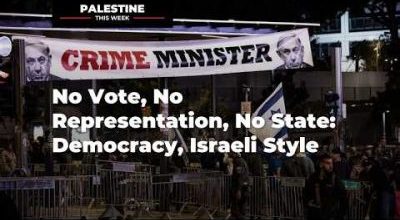
No Vote, No Representation, No State: Democracy, Israeli Style
or go to
Aletho News Archives – Video-Images
From the Archives
$1.5bn up in smoke: US THAAD missile stockpile dries up defending Israel against Iran
By Ivan Kesic | Press TV | July 2, 2025
According to American media, defense news outlets, and independent analysts, the 12-day Israeli military aggression against Iran significantly depleted the US stockpile of THAAD (Terminal High Altitude Area Defense) interceptor missiles.
Citing official sources, American magazine Newsweek reported on Friday that the US transferred a substantial portion of its advanced missile defense capabilities to support the Israeli regime, an effort with questionable results and a critical impact on US strategic reserves.
THAAD, developed by Lockheed Martin arms manufacturing company, is a key component of Israel’s multi-layered air defense architecture. It is designed to intercept medium-range ballistic missiles, including those launched from Iran and Yemen.
The US-made system is capable of targeting short-, medium-, and intermediate-range ballistic missiles during their terminal phase, whether inside or outside Earth’s atmosphere.
THAAD uses a “hit-to-kill” method, relying on kinetic energy rather than explosive warheads to destroy incoming threats, intercepting at altitudes of up to 150 km and ranges between 150-200 km.
Operated exclusively by American personnel, the US military maintains eight THAAD batteries with an estimated 350–400 interceptors in total. The eighth battery was activated during the June 20 Israeli aggression against Iran and is capable of intercepting hypersonic missiles. … continue
Blog Roll
 Aletho News
- Zionist Bought Senate Blocks Information About American Citizens Killed By Israel
- While Gaza dominates the UN, these are the people keeping it alive
- New Report: “Scholasticide and Genocide in Gaza: Assessment, Testimonies and Legal Analysis”
- ‘THAAD Delusion’: Iran war exposes US missile shield limits – The Atlantic
- Moscow issues warning to NATO over Russian exclave
- Yes, the Iran war has destroyed Trump’s presidency
- The fallacy of US delusions about Iran’s economic collapse
- Hezbollah denies Syria cell link, warns of Israeli plan to sow discord
- The legacy of US sanctions, war, and occupation in Iraq
- Iraqi resistance group rejects disarmament, vows to maintain support for Lebanon
- If Americans Knew
- Mamdani releases plan to combat antisemitism and hate crimes in New York City
- Iran’s Revolutionary Guards Publish Letter to the American People
- DMFI launches $1 million ad campaign supporting Virginia’s Elaine Luria
- US Senate blocks resolution seeking report on Americans killed by Israel
- Israeli Attacks Kill Ten Palestinians in Gaza
- Massacre at Minab: The School That Became a Grave
- Israeli media: The IDF Shows It Doesn’t Turn a Blind Eye; It Actively Emboldens Settler Havoc
- As settlers ravage West Bank, Israeli forces kill 10 in Gaza – Daily Update
- New Report: “Scholasticide and Genocide in Gaza: Assessment, Testimonies and Legal Analysis”
- Ex-Biden officials are desperate for a Gaza scapegoat
- No Tricks Zone
- Green Energy Debacle: German Expert Professor Fritz Vahrenholt Warns Of Severe Economic And Social Consequences
- Two More Paleo Reconstructions Affirm Meters-Higher Sea Levels Across Ireland, Brazil 7000-6000 Years Ago
- New Study: Earth And Venus Surface Warmth Largely Explained By Convection And Lapse Rate, Not CO2 Or Radiation
- 2025 Nature Paper Claiming Worsening Global Drought Gets RETRACTED …Heavily Flawed
- New Study: ‘Global Drought Shows No Detectable Recent Acceleration Under Climate Warming’
- Economic Masterminds: German Socialists Suggest Taxing Productivity Gains Stemming From Using AI
- The South China Sea Has Not Been Cooperating With The Climate Change Narrative
- Energy Crisis: Germany Enters Heating Season With Historically Low Gas Reserve Fill Levels
- New Study: The Antarctic Ice Sheet Gained Mass From 2020-2024 Due To Staggering Snow And Ice Accumulation
- Study: Ocean Heating Rates From Thousands Of Years Ago ‘Dwarf’ Modern Ocean Heating Rates

