Sweden’s elite more loyal to NATO, the US and EU than to its people
By Jan Oberg | Transnational Foundation for Peace & Future Research | May 2, 2014
Over the last 25-30 years Sweden’s military, security and foreign policy elite has changed Sweden’s policy 180 degrees.
These fundamental changes were initiated by the Social Democratic government under Goran Persson and foreign minister Anna Lindh and have been carried through virtually without public debate.
The rapproachment with interventionism, militarism and US/NATO in all fields has been planned, incremental, furtive and dishonest; in short, unworthy of a democracy.
This elite is more loyal with Brussels and Washington than with the Swedes.
If your image of Sweden is that it is a progressive, innovative and peace-promoting country with a global mind-set and advocate of international law, it is – sad to say – outdated.
How Sweden has changed
Sweden is no longer neutral and it is only formally non-aligned; there is no closer ally than US/NATO. It has stopped developing policies of its own and basically positions itself in the EU and NATO framework. It no longer produces important new thinking – the last was Olof Palme’s Commission on Common Security (1982).
It has no disarmament ambassador and does not consider the UN important; it does not have a single Swede among the UN Blue Helmets. None of its top-level politicians make themselves available as mediators in international conflicts.
Nuclear abolition is far down the agenda, problematic as a NATO-aspiring country. But one thing has not changed: Sweden remains the world’s largest arms exporter per capita.
Sweden no longer contributes to the protection of smaller states through a a commitment to international law. Its elites wholeheartedly supported the bombing of Serbia/Kosovo. It thought – also under social democratic leadership – that the mass-killing sanctions on Iraq and the occupation were appropriate.
Since Sweden cannot legally export arms to a country in war but upholds a close military technological co-operation with the U.S., its parliament decided to make the US an exception.
Sweden supported the destruction of Libya – participating with its planes there, however only conducting reconnaissance, not bombing, missions.
Sweden did not support the planned war on Syria but also did not voice any audible criticism of the West’s support of only the militant opposition, including Al-Qaeda affiliates.
Carl Bildt
Sweden’s foreign minister Carl Bildt operates mainly as an eminently well-informed international affairs traveler and blogger who doesn’t seem to want to waste too much of his precious time on being a minister. And when he does, he isn’t known for consulting many people around him.
That could be a reason that his comments on various events repeatedly attract laughable media attention. If you compare, as he has, Ukraine’s former President Yanokovich with Norway’s Quisling and thereby make Putin equivalent to Hitler and Russia to Nazi-Germany you no longer operate as a statesman but, rather, as an emotional hothead or a marketing consultant. (Add to that that Bildt recently refused in the Swedish Broadcasting’s ”Saturday Interview” to distance himself from neo-Nazi elements in Kiev).
Bildt’s simplifying, twisted interpretation of Georgia 2008 is revealing of his biased emotionality where earlier – for instance during his position as High Rep in Bosnia – he deserved respect for operating in an intellectually sober manner.
If you don’t have your own thinking and policies, Russophobic platitudes is all you need. And it qualifies for CNN’s Christiane Amanpour.
Sweden is heading for NATO membership
Here follow a few recent events/news which emphasize further the deplorable path Sweden – its elites rather than its people – have decided to follow.
1. Sweden’s security political elite these years ”considers broader alliances with NATO and the EU” as Defence News recently informed us.
How enigmatic! After having been neutral and non-aligned during tough confrontation and tension in the Cold War years, Sweden now needs to join NATO when there is no single analysis anywhere that makes it likely that Sweden, in the foreseeable future, will be faced with a threat.
While the intelligent security and defence discourse is now about human security, the environment and high-tech challenges, Sweden’s elites talk about defence as weapons only.
This is dangerous ”group think” steered by bureaucratic vested interests and paid for by tax payers who are de facto threatened more by these interests than by Putin. A reality check would lead to a reality chock.
Cruise missiles for “deterrence”
2. Swedish planes shall now, in the light of a conveniently hysteric interpretation of the crisis in Ukraine, equip its planes with cruise missiles. (Defense News)
Incredibly, decisions like this are taken with the intellectually sloppy mantra that it adds to the country’s ‘deterrence’ capacity.
The security priesthood of the country consists of some researchers of military affairs at huge, well-financed state institutes in close contact with politicians and the military to whom military-loyal journalists have close bonds. Everybody, follow the party line! Saty in the box! Don’t challenge the domain assumptions!
Sweden now jumps on a sinking ship
The country that once did something for a better world, has joined the militarist world. In a time when both NATO and the US is getting weaker, Sweden’s elite foolishly plans to put all Sweden’s eggs there.
It has no policy vis-a-vis, say, the BRICS countries or any vision of the world in 20 years to navigate towards. It has no ideals, values or commitments, only a ”follow-the-US/NATO and EU” flock mentality.
The US Ambassador is invited to blackmail
3. The US ambassador to Sweden, Mark Brzezinski, recently told Sweden to join NATO, otherwise it won’t get any help in the event of an attack – in short, Mafiosi blackmailing disguised as deep concern and generous offer to bring (conditional, however) help. This was revealed by the conservative Swedish daily, Svenska Dagbladet, Google translation here.
How many – and which – ambassador’s are given the opportunity to speak directly to all parties of the Swedish parliament?
The message is pure blackmail – and based on fearology – because everybody knows that should Russia attack anyone, Sweden would not be the first target and it would be in the interest of NATO to control Swedish territory before any spreading of Russian forces from somewhere else to the Nordic area.
In short, NATO’s interests in Sweden are much larger than Sweden’s in NATO. Whatever one may think of these fantasies, they are just that: No one has thought up a credible scenario for how Sweden would be invaded by Russia and remain defenceless.
If one of largest militaries per capita can’t defend its people there is something wrong with it
But this is the military-fundamentalist propaganda the Swedes are the target of these years: We must join NATO because we have such a weak defence that we can’t defend ourselves!
The liberal party’s defence spokesman, Allan Widman, recently stated this in a manner indicative of the low intellectual level of defence discussions here: ”I can only state the fact that Russia is about 140 million people and Sweden is 9 million. We won’t be able to manage serious challenges from outside on our own…”
Now if the Swedish military can’t provide any protection of the 9 million Swedes with a budget of 8 billion dollars (among the 10% highest per capita in the world) at its disposal, it’s time to ask how inefficient and cost-maximising it can be without its leadership being fired.
4. Just this week it was decided that AWACS planes can pass through Swedish airspace in connection with its Ukraine crisis missions.
5. Sweden (and Finland) is discussing how to receive military aid, including troops, from NATO (see Dagens Nyheter April 27, 2014). This goes beyond what NATO members Denmark, Norway and Iceland have ever accepted. And Sweden is not a NATO member! (You may see a petition against this here)
It’s time to begin to think
Take the money, prestige, privileges and funds from the Military-Industrial-Media-Academic Complexes – MIMAC – of the world – and in Sweden too – and force them to think:
• Think for the common good and not for their vested interests.
• Think for the world and not for their parochial psycho-political nationalism.
• Think of the people’s human security and make violence-prevention the top goal.
• Think first of non-violent policies and use militry as the last resort in accordance with the UN Charter.
• Think as you should in a democracy, with the people, for the people and by the people.
As long as all you have on your shelves is fighter planes, the world’s problems will be seen as bombing missions.
And that’s when peace, co-operation and mutual understanding is dropped and cold – even warm – wars become ”realistic”. This must not be Sweden’s future.
Contact:
Dr. Jan Oberg, TFF director
0046 738 525200
Movement Against European Union Takes Shape in Greece
Prensa Latina | May 1, 2014
Athens – Three political groups, faced with the coming European elections, presented in this capital a coordination communique today, in which they expressed their rejection of the European Union (EU) and the euro.
The French People’s Republican Union, the Finnish Independence Party and the Greek People’s Unitary Front announced their support for participation in the European call to elections in May.
In their proposal, they are demanding emancipation of the continent’s countries from the EU, an anti-democratic organization at the service of the financial and economic oligarchy, the interests of which are clearly against the interests of the citizens of the continent.
These parties are trying “to warn electors about what is at stake in the current European structure,” spreading the message that “to reestablish democracy in our respective countries, it is unavoidably necessary to oust the EU and the euro.”
IMF gives green light for $17 bn Ukraine aid package
RT | April 30, 2014
The International Monetary Fund has approved a two-year $17.1 billion loan package for Ukraine. The immediate disbursement of $3.2 billion will allow Ukraine to avoid a potential debt default.
The IMF’s 24-member board agreed to the two-year program to aid Ukraine’s troubled economy on Wednesday.
The approval gives the green light for the immediate release of $3.2 billion to Ukraine, which will allow the nation not to fall into default, Reuters reports. More than half of that money will be dedicated to supporting the country’s budget.
The package will open up loans from other donors totaling around $15 billion. The goal is for Ukraine to use the money to stabilize its economy.
“The authorities’ economic program supported by the Fund aims to restore macroeconomic stability, strengthen economic governance and transparency, and launch sound and sustainable economic growth, while protecting the most vulnerable,” the IMF said in a statement.
IMF managing director Christine Lagarde commented on the aid package, stating that the plan may come with geopolitical and implementation risks.
“On the implementation front, we are taking all the precautions we can in order to mitigate those risks,” Lagarde told reporters on Wednesday. “On the geopolitical front, clearly the bilateral international support, and the cooperation of all parties, will be extremely helpful to reinforce the position of the economy of Ukraine.”
“We believe that Ukraine has an opportunity to seize the moment, to break away from previous practices, both from the fiscal, from the monetary, and from the governance point of view,” Lagarde added.
Ukraine’s crisis was exacerbated after months of anti-government protests and Crimea’s referendum to join Russia.
The country’s economy is forecast to contract by three percent due to the chaos and lack of order, according to Ukrainian authorities. The nation’s output dropped 1.1 percent in the first quarter of 2014.
The ongoing protests, especially in the east of the country, are not helping the nation get its economy back on track. In fact, Ukraine’s acting President Aleksandr Turchinov said on Wednesday that Kiev’s government cannot control the situation in the east of the country, and called to speed up the creation of regional militias loyal to Kiev.
In return for the aid package, Ukraine promised to implement a number of reforms, including increasing gas prices by more than 50 percent for domestic households.
Earlier in April, Ukraine’s finance minister, Oleksandr Shlapak, said that paying off debt to Russia would not be a top priority for Ukraine when it secured its first tranche of International Monetary (IMF) bailout cash.
Ukraine’s total debt to Russia, including the $2.2 billion bill for gas, now stands at $16.6 billion, Prime Minister Dmitry Medvedev said.
Meet TISA: Another Major Treaty Negotiated In Secret Alongside TPP And TTIP

By Glyn Moody | Techdirt | April 29, 2014
This Wednesday evening there is to be a “Public Information Session and Discussion” (pdf) about TISA: the Trade in Services Agreement. If, like me, you’ve never heard of this, you might think it’s a new initiative. But it turns out that it’s been under way for more than a year: the previous USTR, Ron Kirk, informed Congress about it back in January 2013 (pdf). Aside from the occasional laconic press release from the USTR, a page put together by the Australian government, and a rather poorly-publicized consultation by the European Commission last year, there has been almost no public information about this agreement. A cynic might even think they were trying to keep it quiet.
Perhaps the best introduction to TISA comes from the Public Services International (PSI) organization, a global trade union federation representing 20 million people working in public services in 150 countries. Last year, it released a naturally skeptical brief on the proposed agreement (pdf):
At the beginning of 2012, about 20 WTO members (the EU counted as one) calling themselves “The Really Good Friends of Services” (RGF) launched secret unofficial talks towards drafting a treaty that would further liberalize trade and investment in services, and expand “regulatory disciplines” on all services sectors, including many public services. The “disciplines,” or treaty rules, would provide all foreign providers access to domestic markets at “no less favorable” conditions as domestic suppliers and would restrict governments’ ability to regulate, purchase and provide services. This would essentially change the regulation of many public and privatized or commercial services from serving the public interest to serving the profit interests of private, foreign corporations.
The Australian government’s TISA page fills in some details:
The TiSA negotiations will cover all services sectors. In addition to improved market access commitments, the negotiations also provide an opportunity to develop new disciplines (or trade rules) in areas where there has been significant developments since the WTO Uruguay Round negotiations. There negotiations will cover financial services; ICT services (including telecommunications and e-commerce); professional services; maritime transport services; air transport services, competitive delivery services; energy services; temporary entry of business persons; government procurement; and new rules on domestic regulation to ensure regulatory settings do not operate as a barrier to trade in services.
If that sounds familiar, it’s because very similar language is used to describe TAFTA/TTIP, which aims to liberalize trade and investment, to provide foreign investors with access to domestic markets on the same terms as local suppliers, to limit a government’s ability to regulate there by removing “non-tariff barriers” — described above as “regulatory settings” — and to use corporate sovereignty provisions to enforce investors’ rights.
Those similarities suggest TISA is part of a larger plan that includes not just TAFTA/TTIP, but TPP too, and which aims to cement the dominance of the US and EU in world trade against a background of Asia’s growing power. Indeed, it’s striking how membership of TISA coincides almost exactly with that of TTIP added to TPP:
The 23 TiSA parties currently comprise: Australia, Canada, Chile, Chinese Taipei, Colombia, Costa Rica, European Union (representing its 28 Member States), Hong Kong, Iceland, Israel, Japan, Liechtenstein, Mexico, New Zealand, Norway, Pakistan, Panama, Paraguay, Peru, Republic of Korea, Switzerland,, Turkey and the United States.
Once more, the rising economies of the BRICS nations — Brazil, Russia, India, China, South Africa — are all absent, and the clear intent, as with TTIP and TPP, is to impose the West’s terms on them. That’s explicitly recognized by one of the chief proponents of TISA, the European Services Forum:
the possible future agreement would for the time being fall short of the participation of some of the leading emerging economies, notably Brazil, China, India and the ASEAN countries. It is not desirable that all those countries would reap the benefits of the possible future agreement without in turn having to contribute to it and to be bound by its rules.
The Australian government’s page reveals that there have already been five rounds of negotiations — all held behind closed doors, of course, just as with TTIP and TPP. The Public Information Session taking place in Geneva this week seems to mark the start of a new phase in those negotiations, at least allowing some token transparency. Perhaps this has been provoked by the growing public anger over the secrecy surrounding TPP and TAFTA/TTIP, and fears that the longer TISA was kept out of the limelight, the worse the reaction would be when people found out about it.It seems appropriate, then, that the unexpected unveiling of this new global agreement should be greeted not only by an updated and more in-depth critique from the PSI — “TISA versus Public Services” — but also the first anti-TISA day of protest. Somehow, I don’t think it will be the last.
Follow me @glynmoody on Twitter or identi.ca, and +glynmoody on Google+
Obama rolls out new sanctions on Russia, Moscow says it won’t hurt
RT | April 28, 2014
New round of Western sanction against Russia will target seven individuals and 17 companies. They are meant to affect Moscow’s stance over the ongoing Ukrainian crisis.
The individuals listed by the US Department of Treasury on Monday include Russian Deputy Prime Minister Dmitry Kozak, chair of the parliamentary commission on Foreign Affairs, Aleksey Pushkov, chief of presidential office, Vyacheslav Volodin, and Igor Sechin, the head of Rosneft oil company.
The list of sanctioned companies, which Washington believes to be “linked to Putin’s inner circle,” includes several banks, construction and transport companies.
The Volga Group, an investment vehicle that manages assets on behalf of the businessman, Gennady Timchenko, and SMP Bank, whose main shareholders were affected by the previous set of US sanctions, are among those to face restrictive measures.
Oil and gas engineering company, Stroytransgaz, and one of Russia’s biggest rail transporters of oil, Transoil, are also among the companies affected by the sanctions.
The US Department of Commerce has introduced additional restrictions on 13 of those companies by imposing a license requirement with a presumption of denial for the export, re-export or other foreign transfer of US-originating items to the companies.
Later in the day, Washington announced a tightened policy to deny export license applications for any high-technology items that could contribute to Russia’s military capabilities.
But the US may move even further and impose sanctions against specific branches of the Russian economy if Moscow begins a military operation in Ukraine, Jay Carney, White House spokesman, said.
The announcement of a new round of US sanctions against Russia is “revolting” as they go against the way civilized states should communicate, Sergey Ryabkov, Russia’s deputy foreign minister, said.
“We will respond, although it is not our choice,” Ryabkov is cited as saying by Itar-Tass news agency. “But we can’t leave this situation without reaction, without practical reaction, without reaction by means of our own decisions. US behavior in the field is becoming provocative.”
According to the deputy FM, the American decision stems from a “distorted and groundless” assumption on the state of affairs in Ukraine.
Obama said the US and its allies would keep broader sanctions “in reserve” in the event of further escalation on the ground in Ukraine. He admitted that he was uncertain whether the latest round of measures would be effective.
“The goal is not to go after Mr. Putin personally; the goal is to change his calculus, to encourage him to walk the walk, not just talk the talk” on diplomacy to resolve the crisis, Obama said in Manila during a trip to Asia.
As the US pushes for more sanctions against Russia, EU members have preliminarily agreed to also impose asset freezes and visa bans on 15 more people. The names of those to be added to the list will not be made public until they are published in the EU’s Official Journal on Tuesday, Reuters reported citing an unnamed diplomat source. However, Many Europeans are opposed anti-Russian sanctions, which would target the economy as opposed to individuals close to the Russian leadership, since economic sanctions would hurt European economies as well as that of Russia. The US, being economically tied with Russia to a much lesser degree than Europe, says it would not impose economic sanctions unilaterally.
“I would be very surprised if all European countries found a common position on economic sanctions,” Thierry Mariani, a member of the French National Assembly, told RT. “When one country says ‘we don’t speak about finance’… and some other country says ‘we don’t speak about energy,’ then we don’t speak about anything. That’s why we arrive unfortunately [at] personal sanctions, which are completely nonsense.”
The Russian leadership has thus far brushed off the threat of sanctions as ineffectual, arguing they might in fact buoy the Russian economy in the long term.
“Over reliance can lead to a loss of sovereignty,” Russian President Vladimir Putin said at a media forum in St Petersburg on Thursday.
Western-led sanctions have several advantages for Russia, Putin said.
Putin said the threat of real economic sanctions is already bolstering domestic businesses, bringing more offshore funds back to Russia, and giving policymakers the push they need to establish a domestic payment system.
His comments echo sentiments made by Russian Prime Minister Dmitry Medvedev last week, who similarly argued that further sanctions would only make Russia stronger.
“Thanks to Western sanctions, Russia has been given the incentive to reduce its dependence on outside and instead regional economies are being more self-sufficient,” Medvedev said April 22.
Medvedev said any restrictions on Russian goods to the EU or US would serve to redirect Russian exports to Asian markets, which are more robust.
Three Ukraine elite Alpha group agents captured in Donetsk region
RT | April 27, 2014
Three members of Ukraine’s special anti-terrorist unit Alpha have been detained during a covert mission in Donetsk region, amid the buildup of Kiev’s military near the cities controlled by pro-federalization forces.
Commander of the “Donetsk Republic” self-defense forces, Igor Strelkov, has confirmed reports that three members of the Alpha special tactical assault group of the Ukrainian Security Service (SBU) have been detained in the city of Gorlovka, in Donetsk region.
Their task reportedly was to abduct one of the self-defense force leaders, Igor Bezler, whose group is controlling the local police department in Gorlovka, but instead they were captured themselves. The prisoners were searched and blindfolded and brought to nearby Slavyansk, where their guns, documents and IDs as well as other belongings were demonstrated to the media during a press conference.
During questioning, the detained officers revealed that a special unit that has infiltrated the city comprised of seven men.
The captives claimed they had no time for any wrongdoing as they “just arrived” in the city and were getting acquainted with it and investigating approaches for fulfilling their mission, which they admitted was “invariably impossible.”
They did not say however who authorized the operation and was in control of it. They also did not tell where the rest of the group went after they split, or how many similar groups could be operating in the region.
One of the detainees hinted that they were afraid for the well being of their families. “If I did something wrong,” he said, “I think nothing good would happen to my family.” Although there were no direct threats to their families, he said that was because the “mechanism was not launched” as they were abiding by orders.
The members of the Ukrainian armed forces will now receive the status of prisoners of war, Strelkov said, after which an attempt will be made to exchange the commandos for members of pro-federalization activists detained by Kiev.
The SBU confirmed Sunday that the detainees are indeed its officers. The agency claimed that they were deployed to the Donetsk region to detain an unnamed Russian citizen suspected of killing Vladimir Rybak, a local MP, who had been found dead near Slavyansk this week by local militia.
Rybak’s apparent murder is yet another point of conflict between Kiev and the anti-government protesters in eastern Ukraine. The central government said members of the militia must have killed the MP, who spoke against their resistance. Protest leaders said it would make no sense for them to make the discovery of the body public in that case and point fingers to the radical Right Sector, saying the murder was a provocation to frame the militia.
The agents’ capture came amid an attack on a checkpoint near the neighboring Soledar city, where a group of unidentified gunmen was flown-in by a helicopter and in a blitz attack captured one of the self-defenders, forcing others to temporary retreat.
Earlier on Friday, self-defense forces in Slavyansk detained eight foreign military observers, which they are calling “NATO spies.” At the time of the detention the “people’s mayor” of Slavyansk, Vyacheslav Ponomaryov said, the group had “cards with marks of all checkpoints” which he says “serve as proof of their intelligence activities under the guise of the OSCE mission.”
The detained team is indeed “not OSCE monitors” as widely reported, but instead was sent by OSCE member states in accordance with the 2011 Vienna Document on military transparency, the organization explained on Friday.
Despite the plea from Moscow and the international community to release the four Germans, a Bulgarian, Czech, Dane and a Pole, Ponomaryov has not acceded to the request yet, as he has not ruled out that the group could be used in prisoner exchange for anti-government activists, dozens of whom have been arrested by Kiev’s coup-installed authorities over the last month.
Trade legerdemain on both sides of the Atlantic
By Pete Dolack | Systemic Disorder | April 23, 2014
The Democratic Party has responded to the resistance against ramming through new trade agreements by giving the process a new name. “Fast-track” has been rebranded as “smart-track” and, voilà, new packaging is supposed to make us forget the rotten hulk underneath the thin veneer.
Don’t be fooled. The Obama administration and its Senate enablers are nowhere near giving up on its two gigantic trade deals, the Trans-Pacific Partnership and the Transatlantic Trade and Investment Partnership. Because the stealthy “fast track” route — special rules speeding trade legislation through Congress with little opportunity for debate and no possibility of amendments — is the only way these corporate wish lists can be enacted, a “rebranding” is in order.
The new chair of the U.S. Senate’s Finance Committee, Oregon Democrat Ron Wyden, earlier this month, in a speech given to apparel-industry corporate executives, announced his intention to replace the “fast track” process with a “smart track” process. That is noteworthy because the Finance Committee has responsibility in the Senate for trade legislation. It also noteworthy because Senator Wyden has voted to approve the last five U.S. “free trade” agreements, going back to 2005.
Although the Transatlantic Partnership being negotiated between the United States and the European Union receives less attention than the 12-nation Trans-Pacific Partnership, neither has much chance of passing without special fast-track authority. Should Congress agree to grant the White House fast-track authority, the Obama administration would negotiate a deal and submit the text for approval to Congress under rules that would prohibit any amendments or changes, allow only a limited time for debate, and require a straight yes or no vote.
None other than the previous U.S. trade representative, Ron Kirk, said the Trans-Pacific Partnership has to be secret because if people knew what was in it, it would never pass. We should take him at his word.
Tell the people what they want to hear
On the surface, Senator Wyden’s speech to the American Apparel & Footwear Association Conference on April 10 sounds conciliatory. He made the standard ritual references, calling for trade agreements that create jobs and “expand … the winners’ circle.” The senator proclaimed:
“I want to be very clear: only trade agreements that include several ironclad protections based on today’s great challenges can pass through Congress. I am not going to accept or advance anything less.”
He did not fail to declare that “strong standards and enforcement” on labor and environmental standards “is an imperative.” But we can be forgiven skepticism here because Senator Wyden had this to say on existing labor and environmental standards:
“People on all sides of the trade debate should more openly acknowledge the progress in these areas and the hard work that went into getting those reforms.”
Progress? There are no enforceable rules concerning these areas in existing trade agreements such as the North American Free Trade Agreement. Lost jobs, reduced wages, more unemployment, higher food prices and reversals of environmental laws have invariably been the results. Unaccountable, secret tribunals staffed by corporate lawyers have enabled corporations to overturn regulations in all three NAFTA countries — and the U.S. government, in its current trade negotiations, wants rules even more weighted in favor of multi-national corporations than exists in NAFTA.
If this is what Senator Wyden considers to be “progress,” what possible basis could there be for believing the Trans-Pacific and Transatlantic partnerships will deliver anything other than more corporate-dictated austerity?
The existing version of fast-track legislation — the Bipartisan Congressional Trade Priorities Act of 2014, better known as the Camp-Baucus bill — was effectively dead not long after its January release. It was expected that a new version of fast-track, with a couple of small, cosmetic changes and a cover story that opponents had been heard, would come. Senator Wyden has not disappointed, and it’s coming perhaps quicker than activists expected. This will become a hot potato as the November mid-term elections approach, so the senator was careful in his speech to not provide a timetable:
“I am going to work with my colleagues and stakeholders on a proposal that accomplishes these goals [of more transparency] and attracts more bipartisan support. As far as I’m concerned, substance is going to drive the timeline.”
‘Consultation’ only to let people vent
The perception of more transparency and public participation is all that we are likely to see, perhaps on the model of the European Union’s new public-consultation process. The process centers on a web site that E.U. citizens can use to fill out a questionnaire. The page is complicated to use, and has a 90-minute time limit, after which any imputed data is wiped out. Write fast! And for good measure, the E.U. trade commissioner, Karel De Gucht, once again declared, in his last visit to Washington:
“[W]e are happy to be scrutinized on this: no standard in Europe will be lowered because of this trade deal; not on food, not on the environment, not on social protection, not on data protection. I will make sure that [the Transatlantic Trade and Investment Partnership] does not become a ‘dumping’ agreement.”
Neither his office, nor that of the U.S. trade representative, Michael Froman, have been kind enough to share with the public when the next Transatlantic negotiating session will be held. There has been no lack of communication with corporate lobbyists, however. A European public-interest group, Corporate Europe Observatory, requested documents from the European Commission (the bureaucratic arm of the E.U.) to discover with whom E.U. negotiators are consulting.
It was revealed that of 127 closed meetings concerning the Transatlantic Partnership talks, at least 119 were with large corporations and their lobbyists. The Observatory reports:
“The list of meetings reveals that … there is a parallel world of a very large number of intimate meetings with big business lobbyists behind closed doors — and these are not disclosed online. These meetings, moreover, were about the EU’s preparations of the trade talks, whereas the official civil society consultation was merely an information session after the talks were launched. The Commission’s rhetoric about transparency and about consulting industry and NGOs on an equal basis is misleading and gives entirely the wrong impression of [the European Commission’s] relations with stakeholders.”
Three German Green Party members of the European Parliament (Ska Kellar, Rebecca Harms and Sven Giegold) have leaked the E.U.’s position paper on the Transatlantic Partnership negotiations (Members of the European Parliament are shut out of the negotiations.) Although this leak offers only a glimpse at E.U. negotiating positions, Europeans have a basis for concern. A rough English translation of the leaked document (available only in German) states:
“The agreement will provide for the reciprocal liberalization of trade in goods and services and rules on trade-related issues, which it pursues through ambitious goals that go beyond what is available via the existing WTO commitments.”
Although it also says the agreement will include a “general exception clause” on the basis of articles XX and XXI of the General Agreement on Tariffs and Trade (GATT), which purport to allow exceptions to trade agreements when necessary to safeguard human, animal or plant life or health, such clauses are meaningless. Other agreements have similar clauses, but are consistently superseded by rules such as Article 12.6 of the Trans-Pacific Partnership text that “Each Party shall accord to covered investments treatment in accordance with customary international law.”
‘Customary law’ is what a secret tribunal says it is
Precedents handed down in secret tribunals are what constitute “customary international law.” That the E.U. negotiators intend to “go beyond” the rules of the World Trade Organization should leave no doubt that “law” as desired by multi-national corporations is what is contemplated. Indeed, the leaked E.U. text states an intention to:
“Provide a level playing field for investors in the U.S. and in the EU. … The agreement should provide an effective mechanism for the settlement of disputes between investors and the state.”
That goal should be borne in mind when evaluating the E.U.’s April 10 announcement that it has refused to include the standard investor-state dispute rules in its proposed trade agreement with Canada, despite Canada’s now dropped insistence that it be included. Inside U.S. Trade reports that:
“Canada and the EU have agreed to a ‘closed list’ approach toward defining what constitutes a breach of fair and equitable treatment that was proposed by the EU. … The closed list that the two parties agreed upon is comprised of: denial of justice in criminal, civil or administrative proceedings; a fundamental breach of due process; manifest arbitrariness; targeted discrimination on manifestly wrongful grounds; and abusive treatment of investors.”
On the surface, the “closed list” approach to the bases over which a corporation can sue a government appears to have narrowed from the more common approach that places no limits on corporate suits. But, critics say, the list of arbitrable issues remains open-ended and open to corporate abuse. The Canadian public interest group International Institute for Sustainable Development, in a recently updated paper, warns:
“The definition of investment is defined too broadly, covering any kind of asset, independent of whether or not investments are associated with an existing enterprise in the host state. … [The E.U. proposal would] make the concept of fair and equitable treatment very open-ended and, as a consequence, highly problematic.”
The agreed-upon language, by not defining what constitutes an “asset,” would enable corporations unlimited opportunities to sue governments. Any rule or regulation that a corporation says will reduce its profits remains eligible to be overturned under the precedents of “customary international law.” The text of the agreements — and how they are likely to be interpreted — count for vastly more than the happy talk of trade negotiators, whichever side of the Atlantic or Pacific oceans.
European countries with strong regulations on the environment or food safety are at grave risk from the U.S., and environmental laws everywhere are prime targets. Activist work against these multi-national trade agreements has gained momentum in the past year, but there is much work to be done to stop what constitutes the most destructive corporate power grabs yet. Popular pressure is the only means to stop the Trans-Pacific, Transatlantic and Canada-E.U. trade deals. The next task will be to reverse existing trade deals that have done so much damage.
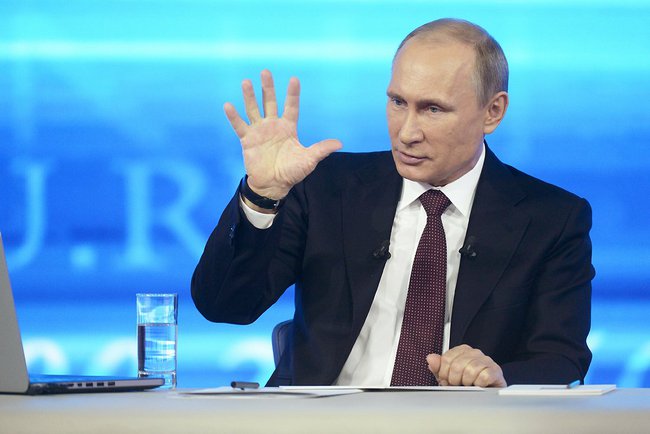
Putin calls on EU for joint aid to Ukraine
BRICS Post | April 19, 2014
Russian President Vladimir Putin on Saturday called on all European states concerned to join efforts to keep the Ukrainian economy afloat.
“We do not want to undermine the Ukrainian economy or to call the reliability of [gas] transits to Europe into question. That’s why we call on all European states, all countries interested in supporting the Ukrainian economy to join the process of helping Ukraine and to flesh out measures to finance the budget,” said Putin.
The Russian President said on Saturday he currently saw no obstacles to bringing relations between Moscow and the West back to normal.
The Russian president, who appeared on the Vesti v Subbotu (Vesti on Saturday) TV show, was asked by its host Sergey Brilev about whether the relations between Russia and the West, which sank to record lows amid the ongoing political crisis in Ukraine, can improve by the end of the year.
“It depends on our partners,” Putin replied.
“I think that currently there is nothing to prevent us from normalizing [the relations] and [returning to] normal cooperation,” he continued.
The Russian Foreign Ministry has earlier condemned as “hypocrisy” attempts by the West to justify violent acts during pro-European rallies in Ukraine earlier this year, at the same time accusing pro-federalization protesters in the east of terrorism.
DECONSTRUCTING THE RESULT OF THE FOUR PARTY TALKS
By Anatoly Karlin | Da Russophile | April 18, 2014
The media refers to the document that emerged out of today’s four party talks as an “agreement”. This is not strictly correct. The text of the document is here.
As its text makes clear what this document is in reality is not an an agreement to settle the Ukrainian crisis or even an outline of such an agreement but rather a statement of basic principles around which an agreement should be negotiated. The real agreement (if it comes about) will emerge from negotiations based on the principles set out in this document.
A number of points:
1. Kiev’s claims to the contrary notwithstanding, the statement that “all sides must refrain from all violence, intimidation and provocative actions” clearly rules out the “anti terrorist operation” in the eastern Ukraine that Kiev launched on Sunday;
2. As Lavrov has correctly pointed out the provisions in the third paragraph that require the disarmament and dissolution of armed groups is clearly intended to refer as much to Right Sector and the Maidan Self Defence Force as it does to the protesters in the east. Note specifically that the statement calls for a general amnesty except for those who have committed capital crimes (ie. murder). So far no protesters in the east have murdered anyone. Even Kiev admits that none of its soldiers have so far been killed. The same obviously cannot be said of Right Sector and of the Maidan Self Defence Force even if one disregards their likely responsibility for the sniper killings in Kiev on 20th February 2014;
3. The document clearly refers to Maidan itself, which it says must be cleared. Specifically alongside illegally occupied buildings the document refers to “all illegally occupied streets, squares and other public places in Ukrainian cities”. The reference to “squares” clearly is intended to refer to Maidan, which the militants in Kiev have said they will continue to occupy at least until the elections on 25th May 2014 and even beyond;
4. Importantly there is NO time line in the document. There is no demand therefore that buildings be evacuated by any particular date or time. That has to be agreed and coordinated with the OSCE monitors on the ground. The people in the eastern Ukraine are therefore entirely within their rights to stay in the buildings at the moment until a timeline is agreed with the OSCE monitors, one requirement of which will surely be parallel evacuations of occupied squares and buildings in Kiev and the west including Maidan.
5. The referral to the OSCE as the enforcement and mediation agency between the regime and its opponents gives Russia a formal role in the process since it is a member of the OSCE. By contrast the negotiations which took place before 21st February 2014 were negotiated and mediated by the EU of which Russia is not a member;
6. The reference to the fact that in the negotiations concerning constitutional changes there should be “outreach to all the Ukraine’s regions and constituencies” (note especially use of the word “constituencies”) gives a role to the protesters in the east in the negotiations and not just to those formal official bodies currently recognised by Kiev.
This document on its face therefore represents a shift towards the Russian/east Ukrainian side. Indeed it basically sets out principles Russia has been arguing for ever since Yanukovitch was deposed on 22nd February 2014.
Unfortunately that does not mean this road map is going to be successfully followed. Already Kiev is trying to argue that the “anti terrorist operation” it has ordered is somehow exempt from it (it isn’t) whilst the US is threatening to impose more sanctions on Russia if following the weekend Russia fails to impose pressure on the eastern Ukrainians to evacuate buildings they occupy without the US undertaking to put any corresponding pressure on its clients in Kiev (shades of Syria here). It is very easy to see how the US and its allies could then blame Russia for the failure of the road map whilst having caused that failure themselves.
However the Russians do have a number of strong cards to play of their own:
1. The growing unrest in the Donbass, which will almost certainly spread to more regions of the eastern Ukraine unless some serious concessions are made. The events of the last few days have exposed Kiev’s difficulties in suppressing this unrest. Significantly no further step in pursuit of the “anti terrorist operation” seems to have been taken today as Kiev reels from the military defections of yesterday;
2. Russia as Putin pointedly reminded everybody in his television marathon today can always refuse to recognise the results of the Presidential elections on 25th May 2014 if the negotiations are failing to make progress and also has authority from the Federation Council to send troops into the eastern Ukraine if the situation there deteriorates further. A refusal to recognise the results of the election will further undermine the legitimacy of whoever is elected. It is now clear that there will be no significant military resistance from forces loyal to Kiev if the Russian army moves into the eastern Ukraine. If that happens the likelihood is that Kiev will lose the eastern Ukraine forever (note Putin’s pointed reference to “Novorossiya” in his television marathon today) – a nightmare scenario for both Kiev and the west though not one Russia is pursuing at the moment;
3. It is now clear that without Russia’s assistance the possibility of stabilising the Ukraine’s economy quite simply does not exist. The last paragraph specifically refers to the importance of the Ukraine “financial and economic stability” to “the participants” and says “the participants…. would be ready to discuss additional support as the above steps are implemented”. The most important of the “participants” in this regard is Russia. It bears repeating (as Putin has recently pointed out) that Russia is the only participant so far providing any economic assistance to the Ukraine at all. The US is only offering $1 billion in loan guarantees and the EU is offering just 1.6 billion euros none of which have so far been provided. What this document in effect therefore says is that whilst Russia is prepared to assist in the stabilisation of the Ukraine’s economy its help is conditional on the fulfilment of the provisions of the road map;
4. It is becoming increasingly clear that there is growing resistance within the EU to further sanctions against Russia. The fact that a process has now been launched to settle this crisis will redouble European reluctance to introduce more sanctions and will increase pressure within the EU for the process to be treated seriously so that it can succeed.
In conclusion, we are not out of the woods or anywhere close. This is not the beginning of the end of the crisis. But we may be a small step closer to that point. A lot will depend on what happens next and the key decisions will be made on the ground in the Ukraine itself.
Lavrov: Russia, US, EU, Ukraine agree on de-escalation roadmap
RT | April 17, 2014
Russia, the US, the EU and Ukraine have adopted a joint document on the de-escalation of the Ukraine crisis, Russian Foreign Minister Sergey Lavrov said, after talks in Geneva. It calls for all illegal armed groups to lay down arms and a wide amnesty.
The document calls for an “immediate start of a nationwide national dialogue within the framework of the constitutional process, which must be inclusive and accountable,” Lavrov said.
The most important agreement reached during the talks, according to Lavrov, states that the Ukrainian crisis “must be resolved by the Ukrainians themselves concerning an end to the conflict” including those related to “detaining protesters, occupying buildings” and, in the long run “the start of true constitutional reform.”
“Among the steps that have to be taken are: the disarmament of all the illegal armed groups, and the return of all the occupied administrative buildings,” Lavrov told journalists at the Thursday briefing.
“An amnesty for all the protesters must take place, except of those who committed grave crimes,” the Foreign Minister added.
The issue of illegal armed groups and seized buildings concerns all the regions of Ukraine, Lavrov stressed.
“It is impossible to solve the problem of illegally seized buildings in one region of Ukraine when the illegally seized buildings are not freed in another,” he said.
“Those who took power in Kiev as a result of a coup – if they consider themselves as representing the interests of all the Ukrainians – must show the initiative, extend a friendly hand to the regions, listen to their concerns, and sit down with them at the negotiation table,” Lavrov said.
Lavrov said the document does not give any guidelines on the future political system of Ukraine.
“We did not use any terms… There are federations where the rights of the regions are limited, and there are unitary states in name only where the regions have broad authority,” he explained.
The goal of the meeting was to send a signal to the Ukrainians that they are responsible for stability in the country and must ensure that “each region can protect its history and language,” Lavrov stressed.
“Only then will Ukraine be a strong state, a proverbial bridge between the East and the West,” Lavrov said.
The Russian side on Thursday provided US and EU representatives with documents passed on from south-eastern Ukrainians, which contain “a thorough vision of how their interests should be reflected in the new [Ukrainian] constitution.”
The OSCE’s (Organization for Security and Co-operation in Europe) monitoring mission must play “the leading role” in assisting the Ukrainian authorities to resolve the crisis, Lavrov stressed, adding that Russia “will support” the mission’s work.
The Geneva meeting has given Russia “hopes” that “the US and the EU are genuinely interested in a trilateral cooperation with Russia aimed at convincing the Ukrainian to sit down at the negotiation table,” Lavrov said.
According to the Russian top diplomat, the Americans now have a “decisive influence” on the Kiev authorities, which should be used for resolving the crisis.
Russia “does not want to send any troops to Ukraine,” Lavrov stressed, answering journalists’ questions. Moscow’s chief concern is that the rights of all the Ukrainian regions, including those with Russian-speaking majorities, must be taken into account in the constitutional reform.
“We have absolutely no wish to send our troops to Ukraine, to the territory of a friendly state, to the land of a brotherly nation. This is against the fundamental interests of the Russian Federation,” Lavrov said.
Calling the recent NATO statements on Ukraine’s neutrality “unacceptable,” Lavrov stressed that pushing for changes in the country’s non-aligned status will “undermine the efforts to resolve the crisis” in Ukraine.
“The fact that Ukraine has chosen non-aligned status and enshrined it in its law must be respected by all and there should not be any attempts to doubt it or to erode its meaning,” the Russian Foreign Minister stressed.
Ahead of the quadrilateral talks, Lavrov met US Secretary of State John Kerry, while EU foreign affairs chief Catherine Ashton saw Ukraine’s acting Foreign Minister Andrey Deshchytsa. Both meetings were held behind closed doors.
Putin: ‘We urgently need to stabilize Ukraine’s economy’
President Vladimir Putin’s letter to leaders of European countries
ITAR-TASS | April 10, 2014
Ukraine’s economy in the past several months has been plummeting. Its industrial and construction sectors have also been declining sharply. Its budget deficit is mounting. The condition of its currency system is becoming more and more deplorable. The negative trade balance is accompanied by the flight of capital from the country. Ukraine’s economy is steadfastly heading towards a default, a halt in production and skyrocketing unemployment.
Russia and the EU member states are Ukraine’s major trading partners. Proceeding from this, at the Russia-EU Summit at the end of January, we came to an agreement with our European partners to hold consultations on the subject of developing Ukraine’s economy, bearing in mind the interests of Ukraine and our countries while forming integration alliances with Ukraine’s participation. However, all attempts on Russia’s part to begin real consultations failed to produce any results.
Instead of consultations, we hear appeals to lower contractual prices on Russian natural gas – prices which are allegedly of a “political” nature. One gets the impression that the European partners want to unilaterally blame Russia for the consequences of Ukraine’s economic crisis.
Right from day one of Ukraine’s existence as an independent state, Russia has supported the stability of the Ukrainian economy by supplying it with natural gas at cut-rate prices. In January 2009, with the participation of the then-premier Yulia Tymoshenko, a purchase-and-sale contract on supplying natural gas for the period of 2009-2019 was signed. The contract regulated questions concerning the delivery of and payment for the product, and it also provided guarantees for its uninterrupted transit through the territory of Ukraine. What is more, Russia has been fulfilling the contract according to the letter and spirit of the document. Incidentally, Ukrainian Minister of Fuel and Energy at that time was Yuriy Prodan, who today holds a similar post in Kiev’s government.
The total volume of natural gas delivered to Ukraine, as stipulated in the contract during the period of 2009-2014 (first quarter), stands at 147.2 billion cubic meters. Here, I would like to emphasize that the price formula that had been set down in the contract had NOT been altered since that moment. And Ukraine, right up till August 2013, made regular payments for the natural gas in accordance with that formula.
However, the fact that after signing that contract, Russia granted Ukraine a whole string of unprecedented privileges and discounts on the price of natural gas, is quite another matter. This applies to the discount stemming from the 2010 Kharkiv Agreement, which was provided as advance payment for the future lease payments for the presence of the (Russian) Black Sea Fleet after 2017. This also refers to discounts on the prices for natural gas purchased by Ukraine’s chemical companies. This also concerns the discount granted in December 2013 for the duration of three months due to the critical state of Ukraine’s economy. Beginning with 2009, the total sum of these discounts stands at 17 billion US dollars. To this, we should add another 18.4 billion US dollars incurred by the Ukrainian side as a minimal take-or-pay fine.
In this manner, during the past four years, Russia has been subsidizing Ukraine’s economy by offering slashed natural gas prices worth 35.4 billion US dollars. In addition, in December 2013, Russia granted Ukraine a loan of 3 billion US dollars. These very significant sums were directed towards maintaining the stability and creditability of the Ukrainian economy and preservation of jobs. No other country provided such support except Russia.
What about the European partners? Instead of offering Ukraine real support, there is talk about a declaration of intent. There are only promises that are not backed by any real actions. The European Union is using Ukraine’s economy as a source of raw foodstuffs, metal and mineral resources, and at the same time, as a market for selling its highly-processed ready-made commodities (machine engineering and chemicals), thereby creating a deficit in Ukraine’s trade balance amounting to more than 10 billion US dollars. This comes to almost two-thirds of Ukraine’s overall deficit for 2013.
To a large extent, the crisis in Ukraine’s economy has been precipitated by the unbalanced trade with the EU member states, and this, in turn has had a sharply negative impact on Ukraine’s fulfillment of its contractual obligations to pay for deliveries of natural gas supplied by Russia. Gazprom neither has intentions except for those stipulated in the 2009 contract nor plans to set any additional conditions. This also concerns the contractual price for natural gas, which is calculated in strict accordance with the agreed formula. However, Russia cannot and should not unilaterally bear the burden of supporting Ukraine’s economy by way of providing discounts and forgiving debts, and in fact, using these subsidies to cover Ukraine’s deficit in its trade with the EU member states.
The debt of NAK Naftogaz Ukraine for delivered gas has been growing monthly this year. In November-December 2013 this debt stood at 1.451,5 billion US dollars; in February 2014 it increased by a further 260.3 million and in March by another 526.1 million US dollars. Here I would like to draw your attention to the fact that in March there was still a discount price applied, i.e., 268.5 US dollars per 1,000 cubic meters of gas. And even at that price, Ukraine did not pay a single dollar.
In such conditions, in accordance with Articles 5.15, 5.8 and 5.3 of the contract, Gazprom is compelled to switch over to advance payment for gas delivery, and in the event of further violation of the conditions of payment, will completely or partially cease gas deliveries. In other words, only the volume of natural gas will be delivered to Ukraine as was paid for one month in advance of delivery.
Undoubtedly, this is an extreme measure. We fully realize that this increases the risk of siphoning off natural gas passing through Ukraine’s territory and heading to European consumers. We also realize that this may make it difficult for Ukraine to accumulate sufficient gas reserves for use in the autumn and winter period. In order to guarantee uninterrupted transit, it will be necessary, in the nearest future, to supply 11.5 billion cubic meters of gas that will be pumped into Ukraine’s underground storage facilities, and this will require a payment of about 5 billion US dollars.
However, the fact that our European partners have unilaterally withdrawn from the concerted efforts to resolve the Ukrainian crisis, and even from holding consultations with the Russian side, leaves Russia no alternative.
There can be only one way out of the situation that has developed. We believe it is vital to hold, without delay, consultations at the level of ministers of economics, finances and energy in order to work out concerted actions to stabilize Ukraine’s economy and to ensure delivery and transit of Russian natural gas in accordance with the terms and conditions set down in the contract. We must lose no time in beginning to coordinate concrete steps. It is towards this end that we appeal to our European partners.
It goes without saying that Russia is prepared to participate in the effort to stabilize and restore Ukraine’s economy. However, not in a unilateral way, but on equal conditions with our European partners. It is also essential to take into account the actual investments, contributions and expenditures that Russia has shouldered by itself alone for such a long time in supporting Ukraine. As we see it, only such an approach would be fair and balanced, and only such an approach can lead to success.
Iran must be ready to walk from P5+1
By Finian Cunningham | Press TV | April 9, 2014
Iran should not sweat it over the P5+1 nuclear talks. Any final agreement is simple.
It must recognize Iran’s inalienable right to peaceful nuclear technology, including the operation of uranium enrichment and all existing related facilities in the country. In return for Iranian guarantees over its legitimate nuclear activities, the US and its European allies must cancel the onerous burden of economic sanctions. That is the essence of any deal. And any other add-on issues are irrelevant.
Indeed, Western attempts to alter the framework of a final nuclear deal must be slapped down; or if insisted upon, Iran should reserve the right to walk away from the talks.
Negotiations this week in the Austrian capital Vienna were said to be “constructive”. Next month, discussions move on to a final accord that could pave the way for lifting of sanctions.
The stakes are high for Iran. Of course, Iran wants to see a prompt end to the Western-imposed sanctions regime that has caused economic and social hardship for its people. The morality and legality of such indiscriminate punishment is highly dubious, to say the least, and their continued imposition is a cause of much indignation.
But a final agreement must be based on the essential details: Iran’s inalienable right to civilian nuclear technology; an agreed system of verification; and immediate cancellation of economic sanctions.
If the Western states, in particular the US, Britain and France, begin to add on conditions to those essential details, Iran must not be browbeaten or seduced into making concessions for the sake of concluding a final accord.
Ominously, we saw this duplicitous Western tendency to move the goalposts this week when US Secretary of State John Kerry told a Senate hearing in Washington that sanctions relief for Iran was contingent not just on Iranian guarantees over nuclear weapons, but also on allegations of Iranian involvement in international terrorism and violation of human rights.
Kerry’s comments follow on the move last week by the European Parliament to censure Iran over alleged human rights abuses. It seemed more than mere coincidence that both the US and EU expressions pre-empted the latest round of P5+1 negotiations in Vienna this week.
It is, to be sure, patently ridiculous for the Americans and Europeans to raise issues of human rights and terrorism given their own outrageous transgressions. Just this week we hear of more reports that Washington is to step up supplies of heavy weapons to terrorists running amok in Syria – the same Western-backed terrorists who are implicated in the use of chemical weapons to kill hundreds of civilians in a callous propaganda stunt.
This also follows increasing evidence last week of a decade of American torture – assisted by European collusion – of hundreds of detainees at the Guantanamo Bay concentration camp and countless other US black sites around the globe.
And as far as the Europeans are concerned, this week sees the plight of 12 million Roma people being highlighted for gross mistreatment by governments across the entire 28-nation bloc.
Regardless of the integrity of purported American and European concerns – terrorism and human rights – what needs to be recognized is that the ostensible issues are completely irrelevant to the nuclear dispute and a final accord. These issues are being added on in an ad hoc fashion, which suggests that the P5+1 nuclear impasse is being set up for procrastination on Western terms.
As Iranian Professor Mohammad Marandi told Press TV this week in a debate forum, the issue of alleged human rights violations is being used as a ploy to pressure Iran into making concessions over its nuclear rights. The Western logic would seem to be: if you want a P5+1 deal and an end to trade sanctions, then we want in return closure of this or that nuclear facility (in contravention of Iran’s legal rights), otherwise we are going to keep raising obstacles such as allegations of human rights abuses and international terrorism.
This is a completely unacceptable Western formula for moving the goalposts on its duplicitous terms. It will mean a never-ending impasse aimed at harassing Iran with more and more threats, including threats of war.
The essence of a long overdue nuclear accord with Iran is for the arrogant Western powers to start treating Iran as an equal, in which Iran is able to avail of its inalienable rights as a signatory to the Non-Proliferation Treaty – without condition or exception.
If Western states insist on adding on irrelevant – as well as hypocritical and spurious – issues it is a damning sign of their incorrigible bad faith. In that event, Iran must be prepared to walk away from the P5+1 process.
However, that is not necessarily a reckless option. Given the growing importance of international trade involving Russia, China and other emerging economies – that is, trade without the bankrupt Western states – Iran might find itself better off anyway not having to waste time and energy on these malignant has-been powers.
Iran needs to stay cool, not sweat it, and to turn the tables on the arrogant players by asserting its own rightful demands.
Featured Video
No Vote, No Representation, No State: Democracy, Israeli Style
or go to
Aletho News Archives – Video-Images
From the Archives
Sanctions, War and the Policy of Dual Containment
By SASAN FAYAZMANESH | March 17, 2008
It is now nearly three decades since the Unites States adopted the policy of dual containment of Iran and Iraq. While much has been written about the containment of Iraq, there has been very little in-depth analysis of this policy when it comes to Iran. In a book that is going to be released on March 31, 2008, entitled The United States and Iran: Sanctions, Wars and the Policy of Dual Containment (Routledge), I attempt to address this shortcoming by investigating when and why the US policy of containment of Iran came about, how it evolved, and where it stands today.[1] To the extent that Israel has been involved in US policy making, the study will also include the role that Israel has played in the containment of Iran. Also, since the fate of Iran has been inextricably linked to that of Iraq, occasionally the investigation will overlap with the containment of Iraq.
The policy of dual containment of Iran and Iraq originated during the Carter Administration, but it was not until the Clinton Administration that the expression “dual containment” became popular. … continue
Blog Roll
 Aletho News
- No Vote, No Representation, No State: Democracy, Israeli Style
- Zionist Bought Senate Blocks Information About American Citizens Killed By Israel
- While Gaza dominates the UN, these are the people keeping it alive
- New Report: “Scholasticide and Genocide in Gaza: Assessment, Testimonies and Legal Analysis”
- ‘THAAD Delusion’: Iran war exposes US missile shield limits – The Atlantic
- Moscow issues warning to NATO over Russian exclave
- Yes, the Iran war has destroyed Trump’s presidency
- The fallacy of US delusions about Iran’s economic collapse
- Hezbollah denies Syria cell link, warns of Israeli plan to sow discord
- The legacy of US sanctions, war, and occupation in Iraq
- If Americans Knew
- Mamdani releases plan to combat antisemitism and hate crimes in New York City
- Iran’s Revolutionary Guards Publish Letter to the American People
- DMFI launches $1 million ad campaign supporting Virginia’s Elaine Luria
- US Senate blocks resolution seeking report on Americans killed by Israel
- Israeli Attacks Kill Ten Palestinians in Gaza
- Massacre at Minab: The School That Became a Grave
- Israeli media: The IDF Shows It Doesn’t Turn a Blind Eye; It Actively Emboldens Settler Havoc
- As settlers ravage West Bank, Israeli forces kill 10 in Gaza – Daily Update
- New Report: “Scholasticide and Genocide in Gaza: Assessment, Testimonies and Legal Analysis”
- Ex-Biden officials are desperate for a Gaza scapegoat
- No Tricks Zone
- Green Energy Debacle: German Expert Professor Fritz Vahrenholt Warns Of Severe Economic And Social Consequences
- Two More Paleo Reconstructions Affirm Meters-Higher Sea Levels Across Ireland, Brazil 7000-6000 Years Ago
- New Study: Earth And Venus Surface Warmth Largely Explained By Convection And Lapse Rate, Not CO2 Or Radiation
- 2025 Nature Paper Claiming Worsening Global Drought Gets RETRACTED …Heavily Flawed
- New Study: ‘Global Drought Shows No Detectable Recent Acceleration Under Climate Warming’
- Economic Masterminds: German Socialists Suggest Taxing Productivity Gains Stemming From Using AI
- The South China Sea Has Not Been Cooperating With The Climate Change Narrative
- Energy Crisis: Germany Enters Heating Season With Historically Low Gas Reserve Fill Levels
- New Study: The Antarctic Ice Sheet Gained Mass From 2020-2024 Due To Staggering Snow And Ice Accumulation
- Study: Ocean Heating Rates From Thousands Of Years Ago ‘Dwarf’ Modern Ocean Heating Rates

