Borrell calls for European action in Gaza even though he did nothing as top diplomat
By Ahmed Adel | August 28, 2025
The former EU High Representative for Foreign Affairs and Security Policy, Josep Borrell, laments the inaction of Brussels in the face of the ongoing “massacre” in Gaza and warns that its growing “discredit” will ultimately disqualify the bloc from implementing policies to defend human rights. However, the former diplomat, like the government of his home country, Spain, has only spoken out in support of Gaza and not taken any concrete actions.
“Someone would have to take legal action to make the European institutions do what they should do, and since it seems they don’t want to do it, there’s something called the courts of justice to take the case of inaction there,” Josep Borrell told the media at the August 25 opening of the Quo Vadis Europa course, which he directed at the Menéndez Pelayo International University (UIMP) in Santander, northern Spain.
Borrell, who headed EU diplomacy from 2019 to 2024, admitted that Brussels is doing “literally nothing” about the massacres perpetrated by the Israeli army and the induced famine.
“They say yes, maybe they’re going to make a proposal to establish some kind of sanction, but then they don’t do it,” he said.
The former diplomat also denounced the EU’s failure to fulfill its political and administrative obligations under the founding treaty of the bloc.
Borrell’s statements came in a context dominated by the resignation two days earlier of the Dutch ministers of Foreign Affairs, Interior, Education, and Health, along with four other secretaries of state, due to “resistance within the Cabinet” to taking action against Israel.
Led by Foreign Minister Caspar Veldkamp, ministers from the center-right NSC party had decided to ban the import of products from Israeli settlements in the West Bank. However, the other two parties in the governing coalition, the liberal VVD and the Farmer-Citizen Movement (BBB), believe the measure goes “too far.”
It also raises questions about why Borrell would make these statements during a summer school year and not utilize the influence and connections he supposedly has to lead a campaign to suspend the EU-Israel Association Agreement. In fact, he should have made them during his term.
The first report by the UN Special Rapporteur, Francesca Albanese, was released in March 2024, while Borrell concluded his term in November of that year. The report was titled “Anatomy of a Genocide,” in which she convincingly documented that a genocide was being committed in Gaza.
In 2024, a series of European committees and associations defending Palestine submitted a report to Brussels, requesting the termination of the association agreement with Israel. The report argued that Article 2 of the agreement, which pertains to respect for human rights, was being violated. In other words, Borrell was obviously aware of the situation he is now denouncing.
On the same day Borrell spoke, Israeli forces attacked the Nasser Hospital in Gaza with a double bombing, killing at least 14 people, including four journalists and several rescue workers. Spain immediately condemned the attack, calling it a “flagrant and unacceptable violation of international humanitarian law.”
In his message of condemnation on X, Foreign Minister José Manuel Albares stated that the “war in Gaza” must end and that “Spain works every day to achieve this.”
The reaction is illustrative of the way the EU and its national governments conduct themselves – issuing condemnations and more condemnations on social media, but taking no action to impose sanctions on those responsible for the famine.
Borrell’s statements serve as a kind of facelift for the Spanish government, which is also distinguished by its tendency to issue statements but not take effective measures. In fact, the Hague Group meeting to take effective measures was held in Colombia in July. Spanish representatives were present, but they did not speak out.
It is also worth noting that, unlike the Dutch Cabinet ministers, no Spanish minister has considered resigning for similar reasons. Ministers from Sánchez’s governing partner, the Sumar coalition, did not even seriously threaten to leave the government, despite the arms sales contracts with Israel remaining in effect.
Meanwhile, Borrel’s words about the need for “judicial action” are at odds with reality. Legal initiatives are already underway. For starters, South Africa filed a complaint against Israel for genocide with the International Court of Justice. Spain is not an effective party to the complaint and is not undertaking many of the actions it could be taking. In this way, Madrid evidently behaves in the same way as Borrell, just using rhetoric but not taking any actual action.
Ahmed Adel is a Cairo-based geopolitics and political economy researcher.
European economies and societies are broken
By Sonja van den Ende | Strategic Culture Foundation | August 28, 2025
In recent days, one alarming report after another has emerged about the European economies. The political elites and their mouthpieces, the mainstream media, can no longer ignore it. Things are not going well—and that is putting it mildly. The situation is bad and will get worse. This is something some of us had anticipated for quite some time, and alert economists have been saying and warning about.
Let’s start with one of the richest countries in Europe: the Netherlands. Although small in size, the wealth enjoyed by elites and, to some extent, citizens some twenty years ago was enormous. I would even venture to say that, in some respects, the Netherlands was richer than Switzerland.
But due to many factors—bad politics, and the emergence of countries like China and, to a certain extent, India and Russia, whose economies have become stronger and their citizens richer—the Netherlands is now on the verge of collapse, like almost all wealthy EU countries, or rather, Western countries.
Dutch politics has been unstable for years. There are simply too many parties, too many opinions, and too much division. While the older, established parties remain strong in terms of seat count, they cannot truly govern. Moreover, there is the “manufactured” housing crisis caused by the insane nitrogen policy, the refugee crisis that causes daily street violence and the murder of women and children, and then there are the agendas of the WEF and the UN that have to be pushed through due to the advancing artificial intelligence (AI) frenzy. It is a cocktail of unrest and division. Also, let us not forget the increasing criminality of the Moroccan mafia: the underworld has now penetrated into the upper world.
The new elections (the last one was in 2023) and the government, which did not take office until 2024, have been ineffective. The population is being misled and distracted by the supposed war Russia is planning to start. So, parties like the established Christian Democratic Appeal (CDA) are devising new plans. This party, which is well in the lead, wants to introduce a “freedom tax” to increase the defense budget so they can wage “war” or defend themselves against the greatest threat: Russia.
Then we come to the worst, “sickest” kid in the class: Germany. The welfare state is “no longer financially viable,” said German Chancellor Friedrich Merz, a BlackRock man, in recent interviews. Of course, it is no longer financially viable—one does not have to be an economic whiz kid to see that, with so many migrants contributing little to nothing but receiving money from the state.
The country has been slowly spiraling toward the abyss since 2015, a process that can no longer be stopped; politicians and elites do not want to stop it. They talk a lot but essentially do nothing. The famous German car industry is ruined, the chemical industry is ruined, and with it, many suppliers.
The most foolish thing Germany could do economically was to stop buying Russian gas. Now they have a major problem: like the rest of Europe, they have to buy expensive LNG from the U.S. The costs are skyrocketing, to put it mildly.
Recently, after all the government’s lies and manipulation, the truth about how Germany, or rather its citizens, should survive the winter came to light. Many gas storage facilities in Germany are currently significantly emptier than in previous years. The Greens, who want to gradually phase out gas, are warning in the Bundestag about the consequences of a cold winter. The Greens’ policies have effectively ruined Germany, with incompetent politicians like Annalena Baerbock and Robert Habeck. Both have resigned and emigrated abroad, leaving behind a political and economic disaster in Germany.
That other major country in Europe, France, with a president (Macron) who thinks that France is still a great power like it was in the time of the Sun King—Louis XIV or Napoleon—is doing just as badly. According to media reports there, the economy is also struggling. At the end of the first quarter of 2025, French public debt stood at €3,345.4 billion, or 113.9% of GDP.
That the French are arrogant (not all of them, of course) is a well-known fact in Europe and perhaps beyond. But Macron is taking it too far. In a recent interview, Macron called Russian President Vladimir Putin a “predator, a monster at our gates.”
This comes after the disgusting display in Paris at the Olympic Games (in 2024), where satanic rituals mixed with religion were on display, which many countries and citizens expressed their horror about. Now he has the arrogance to make these public statements. If you thought Zelensky was stupid with his statements, Macron is his equal in this.
The countries I mentioned are, or rather were, the “running economic engines” of the EU, the economic heart of Europe, which actually paid for the poorer countries in the south, such as Italy, Spain, Portugal, and especially Greece, a country that went bankrupt in 2008.
Europeans all witnessed the misery in Greece: pensioners eating from garbage bins, entire shopping streets closed, poverty everywhere. Now we see it happening in the heart of the EU economy. Germany has become almost unlivable, especially in the major cities.
The same street scene: retirees who should actually be enjoying a well-earned rest collect plastic bottles for the deposit money, and now, if the government has its way, they will have to do a year of compulsory military service. Imagine this—you just do not want to imagine it…
Europe has lost its prosperity; its culture is being swallowed up by the many migrants who bring their own, and instead of assimilation, these cultures foreign to Europe now predominate. In their foolish attitude and, above all, the indoctrination of many years, politicians now believe they live in a “multicultural” entity. But this is not the case; integration has failed, and European citizens are paying the price for their inaction and for allowing this situation to escalate.
Politicians across Europe, especially in the Western EU countries I mentioned, are seeking a way out—to save their own skins, not so much for their people (in fact, the majority do not care about the people)—but to escape the financial malaise and the people’s anger. They have now resorted to the war agenda that followed the COVID-19 agenda (partly a social behavioral project), the war agenda that was implemented immediately after the launch of the Russian Special Military Operation (SMO).
The Eastern EU countries—Poland, which is currently experiencing the same problems as the Western EU countries: refugees and increased drug use—are the worst when it comes to Russophobia. I am referring specifically to the Baltic States: small but powerful in hatred, and above all, the countries with the most Nazi and fascist supporters. Nazism has never been eradicated there, just like in Western Ukraine.
With this hatred of Russia, they have infected all of Europe, thus playing into the hands of the political elites of Western Europe, who eagerly participate in demonizing Russians—even though some countries and their populations actually have nothing against Russians and have only now been forced by their governments to think, and even worse, hate, about Russia.
The European elites must now also consider the role they will play, now that it is painfully clear that the era of colonization and imperialism is nearly over. Because of this painful geopolitical and economic truth, they are now oppressing their own people, partly succeeding with the “new migrants” who fear for their residency and visas.
But the true indigenous European population is slowly but surely realizing that freedom of speech and press no longer exists, that their democratic rights have been taken away, and that life has become very difficult. This is leading to major conflicts, especially in the once so “free” Netherlands, where people could essentially say anything, even if it was inappropriate. Very turbulent times are ahead, and unfortunately, we are already seeing Europe collapse… just like the Roman Empire when it collapsed; things can happen quickly.
EU using blackmail and slander to pressure Georgian politicians
By Lucas Leiroz | August 28, 2025
Apparently, the EU’s tactic of blackmailing its opponents is reaching even Euroskeptic leaders in countries outside the bloc. Recently, the mayor of Tbilisi publicly denounced the campaign of persecution waged by European authorities against his country’s officials, attempting to force them to comply with Brussels’ policies.
Kakha Kaladze, a former professional soccer player who now serves as mayor of Tbilisi, claimed that the EU launched a campaign of “lies, slander, and misinformation” against the legitimate government of Georgia, attempting to shift local policy toward an anti-Russian direction. Kaladze said that EU representatives used tactics such as blackmail and personal insults directed at members of the Georgian Prime Minister’s cabinet to try to coopt them into an anti-Russian initiative.
The mayor, a member of the ruling Georgian Dream party, explained that the EU creates narratives against its opponents both within and outside the bloc, producing biased assessments based on lies and false information. These narratives are then used to undermine political opponents—both through blackmail and by spreading lies.
“Direct threats, blackmail and insults were directed to the prime minister’s office to launch a second front (…) Promises were made: ‘we will help, you will be provided with everything, with appropriate equipment,’ etc. (…) As soon as a political narrative is introduced by some European bureaucrats, an unfair assessment immediately occurs. In general, their assessments are based on lies, slander, and misinformation,” he said.
In the case of Georgia, the European bureaucrats’ intention was to prevent the country from following a sovereign path and respecting the interests of its own people. For years, Georgia has been harassed by Western powers to maintain a policy of automatic alignment with the EU. Furthermore, Kaladze says that the EU openly advocates for a reopening of military hostilities between Georgia and Russia.
Georgia, like several other countries in the post-Soviet space, has experienced violent battles in recent decades, including an armed conflict with the Russian Federation in 2008. At the time, Moscow intervened militarily to prevent Georgian forces from forcibly assimilating the breakaway regions of South Ossetia and Abkhazia—areas where the people had sovereignly decided to follow a different political path from that of Tbilisi. The war ended quickly after Russian forces neutralized the Georgian army and secured the breakaway republics’ right to self-determination.
Since the start of Russia’s special military operation in Ukraine, the EU has been trying to use its candidate countries to wage war with Russia, thus seeking to open a new front against Moscow. Just as Georgia is being harassed to resume hostilities against Russia, Moldova, another country seeking accession to the European bloc, is being induced to attack the separatist region of Transnistria, which also has a substantial pro-Russian population. Kaladze revealed that, in private conversations with Georgian politicians, European bureaucrats implied support for a possible reviving of the war against Russia.
Furthermore, the mayor explains that the EU accuses Georgia of renouncing so-called “democratic reforms.” Indeed, the country is no longer concerned with following European demands, but this doesn’t mean that some kind of authoritarianism is growing in Georgia, but rather that EU standards no longer matter to the local authorities and people. Since the approval of the Foreign Agents Law, which requires foreign NGOs to register in a special way and report to the Georgian government, the EU has simply lost control over its puppet institutions in the country, which is causing fury among Brussels bureaucrats.
Indeed, it’s not surprising that the EU is using these tactics against its adversaries in Georgian politics. Coopting Tbilisi into the Western anti-Russian coalition has become an obsession of European leaders. Fortunately, however, most of the Georgian parliament appears committed to defending national interests, resisting both international pressure and domestic sabotage agents.
As the EU fails to protect its interests abroad, the truth about European practices is beginning to emerge. Despite the EU’s propaganda as an organization defending democracy, human rights, and liberal values, the bloc has in fact become an alliance of authoritarian regimes, marked by irrational and bellicose policies, whose only common foundation is hatred of Russia and its allies.
Georgia has for many years followed this directive of automatic opposition to Russia and sought integration into the EU, but now the country has finally decided to take a different path, asserting the values and interests of the local people.
Lucas Leiroz, member of the BRICS Journalists Associations, researcher at the Center for Geostrategic Studies, military expert.
You can follow Lucas on X (formerly Twitter) and Telegram.
Hungary sues EU over frozen Russian assets sent to Ukraine
RT | August 28, 2025
Hungary has sued the EU over its decision to use frozen Russian assets to fund military aid for Ukraine, a move adopted despite Budapest’s opposition.
Western nations froze an estimated $300 billion in Russian assets after the escalation of the Ukraine conflict in 2022 – some €200 billion of which is held by Brussels-based clearinghouse Euroclear. The funds have accrued billions in interest, and the West has explored ways to use the revenue to finance Ukraine.
The lawsuit challenges the European Council’s decision last year to channel military aid to Ukraine through the European Peace Facility (EPF), which reimburses countries that send weapons to Kiev.
Implemented in February, the measure directs 99.7% of interest generated from frozen Russian central bank assets to Ukraine, providing an estimated €3-5 billion ($3.5-5.8 billion) annually.
In a case first filed with the EU Court of Justice and later transferred to the General Court, Hungary is demanding to “annul the decision… on allocating funds to assistance measures for supplying military support to the Ukrainian Armed Forces” and to “order the defendants to cover the costs.”
Budapest contends that the EPF acted unlawfully by bypassing its veto, arguing that Hungary is not a “contributing member state.”
“As a result, the principle of equality between Member States and the principle of the democratic functioning of the European Union were infringed because a Member State was deprived, unjustifiably and without a legal basis, of its right to vote,” the filing says.
Hungary opposes the bloc’s unconditional support for Kiev and prefers peace talks to continued fighting. Budapest has repeatedly used its veto to block EU financial and military aid, including a disputed €50 billion package at the end of 2023. The standoff has pushed other EU members to seek ways to sidestep Budapest’s resistance.
Moscow has denounced the asset freeze as “robbery” and a breach of international law, warning it would backfire on the West. Senior Kremlin official Maksim Oreshkin said the freeze had already undermined trust in Western finance, while Russian President Vladimir Putin cautioned that seizing the assets would accelerate a global shift toward alternative payment systems.
Has Ukraine just declared war on Hungary?
By Nadezhda Romanenko | RT | August 26, 2025
In the swirl of the Ukraine war, headlines rarely fail to shock. Yet the latest spat between Kiev and Budapest raises a question that would have been unthinkable two years ago: has Ukraine effectively opened a second front – albeit hybrid, rhetorical, and economic – against an EU state?
The immediate spark was the Druzhba (“Friendship”) oil pipeline that still delivers crude from Russia to Central Europe. Several Ukrainian drone strikes targeted the pipeline in recent weeks, halting supplies to Hungary and Slovakia. A Ukrainian commander, known by the call sign Madyar, publicly admitted involvement.
For Hungary and Slovakia, this was more than an economic disruption. Both countries rely heavily on the pipeline, and in response, their leaders called on the European Commission to guarantee supply security. Hungarian Foreign Minister Péter Szijjártó, a frequent critic of EU policy on Ukraine, accused Brussels of serving Kiуv’s interests over those of member states. His frustration boiled over further when he described Vladimir Zelensky’s quips about “friendship” as thinly veiled threats.
Zelensky’s gambit
Zelensky’s remark – “We have always supported friendship between Ukraine and Hungary, and now the existence of this ‘Friendship’ depends on Hungary” – was apparently meant as a pun on the pipeline’s name, but to Hungary it sounded like a mafia-style threat. Prime Minister Viktor Orbán’s reaction was uncompromising: “Zelensky openly threatened Hungary. He admitted that they hit the Druzhba pipeline because we don’t support their EU membership. This proves again that Hungarians made the right decision.”
The timing is telling. Strikes on the pipeline coincided with Zelensky’s Washington visit alongside EU leaders. Either Brussels tacitly encouraged him to punish Orbán, an ally of Donald Trump, or the EU simply looked away as Zelensky acted on his own. Both explanations sound outrageous, but there hardly seems to be a third option. What is clear is that Kiev, facing immense pressure on its eastern front, is choosing a dangerous rhetorical battle with Budapest.
Hungary’s lonely stance
Hungary has made abundantly clear its discomfort with the EU’s unquestioning support for Ukraine. Since the Russian military operation began in 2022, Budapest has resisted sanctions on Russian energy, insisted on continuing imports through the Druzhba pipeline, and refused to send weapons to Kiev. Orbán has shown himself to be a pragmatic outlier: defending Hungarian interests, pursuing cheap Russian energy, and maintaining cordial ties with Moscow.
For this, Hungary has faced isolation within the EU. While Poland, the Baltics, and most of Western Europe rallied behind Ukraine with military and financial aid, Budapest has been resisting this consensus. Orbán’s government was derided as Putin’s Trojan horse in Europe. Yet for Hungarians, this positioning has had a rationale: keep the economy stable, avoid direct confrontation, and retain flexibility in a deeply uncertain geopolitical landscape.
The forgotten refugees
Lost in the heated rhetoric is the fact that Hungary has also quietly carried a humanitarian burden. In 2022 alone, over 1.3 million Ukrainians crossed into Hungary – second only to Poland and Romania. Budapest accepted them with little fanfare, though later tightened its asylum rules to restrict new arrivals to those from active war zones. At the same time, Hungary supplies a significant share of Ukraine’s electricity, a fact Szijjártó reminded Kiev of when rebuffing Ukrainian accusations.
To respond with accusations and pipeline attacks against such a neighbor seems, at minimum, ungrateful. At worst, it risks alienating one of the few EU members that has provided crucial – if unheralded – humanitarian support in a time of war.
War, politics, and overreach
The broader context is sobering. On the battlefield, Ukraine faces mounting setbacks in the Donbass and along the eastern front. Against that backdrop, Zelensky’s rhetoric toward Hungary appears almost surreal – boastful, as if victory against Russia were imminent. The contrast between battlefield realities and diplomatic bravado risks undermining Kiev’s credibility.
In any sane timeline, here is where Brussels should stop and think again about continuing its support for Kiev. Should the EU stand behind Zelensky even when his actions harm member states, or acknowledge that Orbán – despite his many disagreements with Brussels – has a point? Recent history shows that we are not in a sane timeline, though. Open threats, pipeline sabotage (remember Nord Stream?), and insults from Ukrainian officials don’t seem to register with Brussels officials at all.
Kiev’s behavior towards Budapest may not amount to a declaration of war, but it is undeniable that Ukraine has chosen to ramp up its confrontation with Hungary. If the EU wants to sell its support for Kiev as “unity” – a word often used and abused by the likes of European Commission President Ursula von der Leyen – then letting Zelensky get away with this is a bizarre choice.
The West seemingly preparing to remove Zelensky from power
By Ahmed Adel | August 26, 2025
The arrest of a Ukrainian citizen in Italy, suspected of sabotage of the Nord Stream pipeline, confirms that Kiev was an accomplice, but not the one who ordered the act. Nonetheless, the launch of the investigation serves a broader political goal – the removal of Volodymyr Zelensky from power. The plan could be to appoint a new leader, both for the West and for possible negotiations with Russia, given that Zelensky’s presidential mandate expired in May 2024 and he cannot be a signatory to a peace agreement with Moscow.
An investigation by American journalist Seymour Hersh found that American divers placed explosives under the Nord Stream gas pipeline during the NATO exercise Baltops in the summer of 2022, and that it was activated three months later by the Norwegians. According to Hersh, then-US President Joe Biden had a clear motive for sabotaging the Nord Stream pipeline — fear that Germany, facing serious economic difficulties due to the war in Ukraine, might lift sanctions on Russia and resume imports of Russian gas.
The journalist said this is what prompted Washington to organize the sabotage of the gas pipeline connecting Russia and Germany. The West did not want to allow this, which ultimately plunged Germany into economic and political chaos.
Russian President Vladimir Putin also believes that the sabotage of the Nord Stream and Nord Stream 2 gas pipelines was carried out by American intelligence services, specifically the CIA. According to him, in such cases, one should always look for who has a motive and who can carry it out. There may be many interested parties, but not everyone can dive to the bottom of the Baltic Sea and carry out that explosion. It is the combination of these components – who had a motive and who is able to carry it out – that, according to Putin, reveals who is really behind the sabotage.
After a period of lull, the issue of sabotage on the Nord Stream gas pipelines has returned to the spotlight following the announcement by German prosecutors that Ukrainian citizen Sergey Kuznetsov was suspected of involvement in the underwater explosions that damaged the gas pipelines near the Danish island of Bornholm in September 2022. Following the arrest of the retired captain of the Armed Forces of Ukraine, who also served in the Security Service of Ukraine, Italian media reported that he is connected to another major incident – the explosions on an oil tanker in Savona in February, which was allegedly transporting oil of Russian origin.
Sahra Wagenknecht, leader of the German party “Sahra Wagenknecht Alliance,” after the arrest of Kuznetsov, stated that the German parliament should convene a commission to investigate the sabotage of the Nord Stream gas pipelines. She noted that this act of state terrorism must be thoroughly investigated and that Zelensky should also testify before the commission.
Wagenknecht believes it is absurd to think that the arrested Ukrainian citizen and his accomplices acted without the knowledge of the Ukrainian leadership and the Biden administration. She added that it is unacceptable that Germany is providing substantial aid to Ukraine without seeking an explanation from Zelensky, and that consideration should be given to possible compensation for damages.
The question of whether United States President Donald Trump will take advantage of the Nord Stream controversy and launch an investigation against Biden remains an exclusively internal matter for the US. Trump has the opportunity to conduct his own investigations and deal with his domestic adversaries, whom he claims stole his victory in the 2020 elections. However, this does not affect the situation in Ukraine for the time being, as the West continues to support Ukraine with weapons, intelligence, and other assistance.
The fate of the Nord Stream gas pipeline is one of the key and most complex issues in the energy and geopolitical spheres. With Trump’s pragmatic approach, there is a possibility of cooperation between Russia and the US. Russia does not refuse to continue gas supplies to the European Union. However, the bloc continues to feel the consequences of its own policy, such as suffering economically by still purchasing Russian energy at inflated prices from third parties like India and Azerbaijan.
Nord Stream 1 and Nord Stream 2, which directly connect Russia to Germany via the Baltic Sea, have not been operational since 2022 and remain damaged, but they are still strategic infrastructure that American investors have set their sights on. These pipelines could become the property of American investors, which would enable the US to control Russian gas supplies to Europe. Although Europe is currently refusing Russian gas, it may be forced to buy it in the future, albeit at a significant margin, to the benefit of the Americans.
Ahmed Adel is a Cairo-based geopolitics and political economy researcher.
EU shows ‘outdated worldview’ as von der Leyen uses China, Russia as excuse to defend trade deal with US
By Wang Qi | Global Times | August 25, 2025
European Commission President Ursula von der Leyen defended the EU’s trade deal with the US. By invoking Russia and China, she suggested that the failure to strike a deal would have been a gift to Europe’s rivals, according to media reports.
Chinese analysts have observed that von der Leyen’s remarks reveal a tendency among certain European politicians to politicize trade matters. Their emphasis on alliance with the US underscores Europe’s anxiety over American pressure, especially as Washington prioritizes its own interests and fails to treat Europe as an equal partner.
A trade war between the EU and the US would have been “celebrated” by Russia and China, von der Leyen wrote in a guest commentary for Germany’s Frankfurter Allgemeine Zeitung published on Sunday, per the Bloomberg report.
“Instead, we agreed on a strong, if not perfect deal,” she added, warning that retaliatory tariffs could fuel a costly trade conflict with “negative consequences for our workers, consumers, and our industry,” Bloomberg reported.
Similarly, von der Leyen wrote in an op-ed for Spain’s El Mundo on Saturday, “Imagine for a moment that the two largest democratic economies had not managed to reach an agreement and instead launched a trade war — only Moscow and Beijing would be celebrating,” the Politico reported.
Von der Leyen’s remarks came after the release of EU-US joint statement on Thursday, which confirmed that the EU will accept tariffs of 15 percent on 70 percent of its exports to the US, including cars, pharmaceuticals and semiconductors. In return, the bloc will expand market access for US agricultural goods that are not sensitive for its own market, according to media reports.
Although von der Leyen described the move as a choice for “stability and predictability over escalation and confrontation,” the controversial trade deal with the US has drawn criticism. Former director-general Pascal Lamy has warned the accord risks undermining Europe’s credibility as a defender of rules-based trade, the Politico reported
Cui Hongjian, director and professor of the Center for European Union and Regional Development Studies at Beijing Foreign Studies University, told the Global Times on Monday that von der Leyen’s comments primarily serve to justify her compromises, as the US-EU trade agreement has substantially undermined European interests.
“Ironically, when the US imposes tariffs on Europe, it prioritizes its own interests, clearly not treating Europe as an equal partner,” Cui said, “Yet, Europe is willing to endure losses in its dealings with the US to maintain ongoing cooperation, in order to counter what it perceives as a greater ‘threat’ from non-Western economies, an approach [that] blatantly politicizes trade matters.”
Cui said such actions reveal that some European politicians cling to an outdated worldview, unwilling to face the reality of the US gradually distancing itself from its traditional alliance with Europe. “Their emphasis on the alliance only underscores their anxiety over the losses and economic shocks inflicted by the US, not by China and Russia.”
The South China Morning Post said the Thursday deal did not explicitly mentioned China, however, “veiled references appeared throughout” in terms of AI chips, as EU pledged to purchase $40 billion of AI chips from the US, and that it would adopt US security standards to “avoid technology leakage to destinations of concern.”
According to Cui, China and the EU are scheduled to engage in high-level interactions in the latter half of the year, which requires fostering a constructive atmosphere, adding that China will judge Europe more by its actions than its words.
If Europe takes actions that harm China’s interests, China will undoubtedly respond with countermeasures. However, when EU politicians exploit criticism of China for political gain, it sows discord in China-EU relations and even risks creating conflict, which would in turn affect China’s relationships with individual member states. This is a situation China cannot accept as well, said the expert.
The End of the Conflict in Ukraine at Sight?
Zelensky and the Europeans in Washington in Search of Saving Face
By Ricardo Martins – New Eastern Outlook – August 25, 2025
Seven European leaders rushed to Washington under the official banner of solidarity with Volodymyr Zelensky. Yet, the real motive was less about unshakable support for Ukraine and more about damage control.
Zelensky and the Europeans in Washington in Search of Saving Face
With negotiations advancing — and with Ukraine’s loss of territories and NATO membership already ruled out by Donald Trump — Europe’s leaders were scrambling to craft a narrative to their domestic audience that could justify defeat without admitting failure.
The Struggle to Save Face
For three years, the European mantra has been that “Russia cannot win.” Yet on the battlefield, it is Moscow that has the upper hand. The tactic, therefore, was to insist that Russia, as the supposed aggressor, must accept the obligations of the loser. But the reality is moving in the opposite direction: Europe now seeks symbolic concessions to sell to its public.
One of these face-saving gestures is the return of “kidnapped” Ukrainian children, based on contested numbers but useful as a talking point. Another is security guarantees for Ukraine — not NATO membership, but something that can be framed as protection. Zelensky, keen to please Trump, asked for $100 billion in arms, to be funded by Europeans but manufactured in the U.S. NATO’s Secretary-General eagerly echoed this line, presenting himself as a loyal messenger to “Daddy” Trump at Europe’s expense.
Meanwhile, territorial concessions remain taboo in European discourse. To admit them would be to acknowledge Putin’s victory, a political sin for leaders who have invested heavily in a narrative of inevitable Ukrainian triumph.
The Casting: Putin Absent, Yet Present
The most striking absence in Washington was also the most palpable presence. Putin was not in the room, but Trump invoked his name repeatedly, even phoning him for 40 minutes while Europe’s leaders waited. Each mention of Putin’s name drew visible discomfort across European faces, an unmistakable reminder of their diplomatic impotence.
As Djoomart Otorbaev, former Prime Minister of Kyrgyzstan, put it: “Here’s the uncomfortable truth: Putin didn’t earn Trump’s respect through backroom schemes. He earned it on the battlefield and at the negotiating table. And that reality says more about today’s shifting world order than any rumour.”
Trump’s deference to Putin was not ideological; it was grounded in recognition of Russia’s gains. Western efforts to reverse the war’s trajectory have not succeeded, despite supplying Ukraine with advanced weaponry.
Europe’s Century of Humiliation Has Started
Europe’s frantic arrival in Washington — “like the Middle Ages, to homage their master” — symbolised a humiliating dependency: the continent’s leaders reduced to courtiers around a U.S. president already imagining his Nobel Peace Prize.
The delegation was a tableau of weakness. Ursula von der Leyen, in the name of the European Commission, reconfirmed the one-sided trade arrangements: 15% tariffs on European goods entering the U.S., zero tariffs on U.S. exports to Europe, $750 billion in energy and arms purchases, $600 billion in European investments in the U.S., and €150 billion earmarked for EU rearmament. A transfer of wealth and sovereignty dressed up as transatlantic unity.
The body language told its own story. Giorgia Meloni’s irritation was poorly disguised; Friedrich Merz remained wooden; Emmanuel Macron projected disdain; Keir Starmer hid behind note-taking. Von der Leyen managed only a strained smile, Mark Rutte melted into insignificance, and Zelensky — who should have been the central figure — appeared isolated at the margin, dignified but sidelined. Putin, a former KGB officer, and Trump, a former reality TV star and a real estate millionaire, both despised by the Europeans, loomed as the peace brokers. As put by a French analyst: “Quel cirque”.
The Security Guarantees Conundrum
The question of security guarantees has become the crux of European debate. Openly, leaders say territorial concessions are for Ukrainians to decide. Privately, they know the map is already shifting. What remains is an attempt to provide Ukraine with protections that appear credible, but that does not include NATO membership.
POLITICO reported that the Pentagon’s top policy official made clear the U.S. intends to play only a minimal role in guarantees. “There’s the dawning reality that this will be Europe making this happen on the ground,” admitted a NATO diplomat. In other words, Europe is on its own.
European capitals, however, still plead for U.S. assets: fighter jets stationed in Romania, access to American satellites for GPS and reconnaissance. Russia, through its envoy Mikhail Ulyanov, flatly rejected any foreign troops in Ukraine, while Sergey Lavrov dismissed Western security schemes without Moscow and Beijing as “a road to nowhere.”
Ukraine itself is unimpressed. Ten nations, including France and the U.K., have floated the idea of deploying troops, but Kiev sees such proposals as vague, amorphous, and unlikely to provide real guarantees. Former foreign minister Dmytro Kuleba captured the mood: “The so-called security guarantees are so amorphous. The only news is that the U.S. is willing to take part.”
Europe’s Internal Fractures
Even as leaders paraded unity in Washington, Europe’s internal divisions deepened. The European Parliament announced it would sue the Council over being excluded from negotiations on the €150 billion SAFE defence loan scheme.
In a telling sign of institutional fragility, Parliament was sidelined by Ursula von der Leyen’s Commission in the rush to fund rearmament. As Euractiv reported, 18 member states have already expressed interest in loans totalling €127 billion, but without parliamentary oversight, Europe’s democratic deficit widens.
In sum, the “road to nowhere” that Lavrov mocked may yet prove prophetic, not only for Ukraine’s elusive guarantees but for Europe’s strategic autonomy itself.
Ricardo Martins, PhD in Sociology, specializing in International Relations and Geopolitics
‘Don’t threaten us’ – EU state to Zelensky
RT | August 25, 2025
Hungary has warned Ukraine to stop disrupting its energy supply from Russia after Kiev targeted a key pipeline delivering oil to Central Europe.
Ukrainian forces struck the Soviet-era Druzhba (Friendship) pipeline three times this month, sparking outrage in both Hungary and neighboring Slovakia. The flow through the pipeline was last halted on Friday.
At a press conference during Independence Day celebrations in Kiev on Sunday, a reporter asked Ukrainian leader Vladimir Zelensky how the attacks relate to Hungary’s opposition to Ukraine’s EU and NATO ambitions.
“We have always supported friendship with Hungary, but now the very existence of this friendship depends on Budapest’s position,” Zelensky replied with a smile, playing on the pipeline’s name.
Hungarian Foreign Minister Peter Szijjarto issued a sharp rebuke on X. “Zelensky used Ukraine’s national holiday to threaten Hungary. We firmly reject the Ukrainian President’s intimidation,” Szijjarto wrote. He described the attack on Hungary’s energy supply as “an attack on sovereignty.”
“A war to which Hungary has nothing to do with can never justify violating our sovereignty. We call on Zelensky to stop threatening Hungary and to end the reckless attacks on our energy security!” he added.
Ukrainian Foreign Minister Andrey Sibiga responded on X, writing to Szijjarto: “You don’t need to tell the Ukrainian President what to do or say, and when.” He urged Budapest to “diversify and become independent from Russia, like the rest of Europe.”
Szijjarto shot back: “Stop attacking our energy security! This is not our war!”
Unlike many EU countries, Hungary has refused to send weapons to Kiev and has heavily criticized Brussels for imposing sanctions on Moscow. The country maintains that Ukraine’s NATO membership could trigger an all-out conflict with Russia.
EU asks “Daddy” to make Hungary stop
The EU wants Hungary to drop its opposition to Ukraine’s membership in the EU
Remix News | August 20, 2025
U.S. President Donald Trump called Hungarian leader Viktor Orbán to ask about his position on Ukraine’s accession to the European Union.
The American leader reportedly wanted to discuss the reasons why Orbán is blocking negotiations on Ukraine’s accession to the European Union.
“The call was the result of Trump’s conversations with a group of European leaders who had gathered at the White House to discuss ways to end Russia’s war with Ukraine. At one point, they asked Trump to use his influence with Orbán to persuade the right-wing populist to drop his opposition to Ukraine’s EU membership,” Bloomberg writes.
During a telephone conversation with Trump, Hungary expressed interest in holding another round of talks between Russian President Vladimir Putin and Ukrainian leader Volodymyr Zelensky.
Orbán, a close ally of Trump, is widely seen as an inspiration for the U.S. president’s political ideology as well as other right-wing politicians around the world.
On Tuesday, Orbán issued a statement suggesting that he understood Ukraine’s request for EU membership but did not intend to back down from his position.
“Ukraine’s membership in the European Union offers no security guarantees. Therefore, linking membership with security guarantees is unnecessary and dangerous,” he said.
Previously, Orbán has repeatedly said that Ukraine should not join the European Union so as not to bring the war to Europe, and should instead become a “buffer” country between Europe and Russia. Instead of accession, he offered Kyiv “strategic” cooperation – “pragmatic, flexible and based on common interests.” Orbán also considers EU sanctions against Russia ineffective. He has repeatedly criticized them as useless and harmful to the European economy, and in the past he has managed to secure the lifting of EU sanctions against several Russians.
Hungary on the brink of existential decision: confront Kiev and break with NATO or remain hostage to Ukrainian terror?
By Lucas Leiroz | Strategic Culture Foundation | August 21, 2025
The recent Ukrainian attack on the Druzhba pipeline — vital for the oil supply of Hungary and Slovakia — marks a turning point in the geopolitical conflict in Eastern Europe. The strike was confirmed by Ukraine’s Unmanned Systems Forces, with commander Robert Brovdi publicly celebrating the act of energy sabotage. Far from an isolated incident, this was a deliberate act of aggression against EU member states that have pursued a sovereign foreign policy contrary to NATO’s warmongering agenda.
The attack was not merely military. It was political, economic, and — above all — symbolic. By targeting the core infrastructure that sustains Hungary and Slovakia, Kiev is sending a clear message: dissent within the EU will not be tolerated. Budapest and Bratislava’s opposition to sending weapons to Ukraine and denouncing illegal sanctions against Russia has made them, in practice, targets of the Ukrainian nationalist regime.
Budapest responded firmly. Foreign Minister Péter Szijjártó did not hesitate to call the attack “outrageous and unacceptable.” But Kiev’s arrogance remains unshaken. Ukrainian Foreign Minister Andriy Sibiga not only dismissed Hungary’s criticisms but also claimed that the blame lies with Moscow, demanding that Hungary abandon its “dependence” on Russian energy. This is a perverse inversion of reality, typical of the Zelensky regime, propped up by Washington, London, and Brussels.
But the issue goes beyond oil supplies. Ukrainian hostility toward Hungary is not new — it is only deepening. Since 2014, Hungarians in Transcarpathia have lived under what can only be described as an ethnic apartheid regime. A barrage of cultural and linguistic persecution measures has taken hold: systematic closure of Hungarian-language schools, bans on national symbols, restrictions on the use of the mother tongue in public spaces, and even efforts to erase Hungarian place names in historically Hungarian areas.
Even more alarming is the practice of forced military conscription, disproportionately targeting young Hungarians in the region. There are growing reports, confirmed by independent observers and human rights organizations, that Hungarian recruits are being sent to the most dangerous frontlines in eastern Ukraine — used as cannon fodder in a campaign of collective punishment and population control. Cases of murders during forced enlistments by Ukrainian recruiters have already been documented — but are systematically silenced by a Western media eager to portray Kiev’s crimes as “democratic resistance.”
In this context, Hungary faces a question that can no longer be postponed: how much longer can Ukrainian terror be tolerated? This is no longer a mere diplomatic dispute. It is an existential issue for the Hungarian nation and for the 150,000 ethnic Hungarians who live under oppression in Transcarpathia. The logical answer would be the launch of a Hungarian special military operation on Ukrainian territory — much like what Moscow undertook in defense of the Donbass’ Russians. The objective would be clear: to liberate the ethnic Hungarians and restore historical justice in the region.
At the same time, Budapest must reconsider its membership in NATO and the European Union — structures that have proven hostile to national sovereignty, complicit with the Kiev regime, and sources of regional instability. NATO has armed Ukraine, dragged the continent into war, and now remains silent in the face of aggression against one of its own members. The EU, for its part, treats Hungary’s legitimate concerns over security and cultural identity with contempt, all while financing a failed war machine.
The decision that Viktor Orbán and his government must make is difficult — but inevitable: remain a hostage to the Western powers, or lead the way in a new European realignment, alongside nations that respect sovereignty and traditional values — such as Russia.
The attack on the Druzhba pipeline was not merely an assault on Hungary’s energy infrastructure. It was a warning. Just as the neo-Nazi regime in Kiev is willing to kill its own citizens because of their Hungarian ethnicity, it is equally willing to attack its own territory and sabotage its own infrastructure just to hurt Hungary.
The continued existence of the Kiev Junta is an existential threat to Hungary. And like all existential threats, it demands a response of equal magnitude.
Russia Backs Istanbul 2022 Security Guarantees, Rejects Other Ideas – Lavrov
Sputnik – 21.08.2025
Russia supports the principles of security guarantees agreed upon in Istanbul in 2022, while all other proposals are futile ventures, Russian Foreign Minister Sergey Lavrov said.
In essence, Europe is proposing foreign intervention on part of Ukrainian territory, which is absolutely unacceptable for Moscow, the Russian Foreign Minister stressed.
Ukraine’s position indicates that Kiev wants to undermine the US efforts for a settlement, while Moscow is closely cooperating with Washington on this track to address the root causes of the crisis, Lavrov added.
Significant progress has been made at the Russia-US summit in Alaska in terms of defining the parameters of the Ukrainian conflict settlement, Lavrov said.
“Following the Russia-US summit in Alaska, where significant progress was made in moving towards defining the contours and specific parameters of a settlement, when following this event, European countries followed Mr. [Volodymyr] Zelensky and went to Washington and they tried to promote their agenda there… of course, this cannot cause us any feelings other than complete rejection,” Lavrov told a press conference.
Ukraine is clearly showing that it is not interested in a sustainable and long-term settlement of the conflict, Lavrov added.
“The goals that remain with the current Ukrainian leadership, and these goals are certainly fueled by the Western sponsors of the Kiev regime, are directed against the efforts that [US] President Trump is making, with whom we are actively and specifically cooperating in finding long-term sustainable ways to resolve in order to eliminate the root causes [of the conflict in Ukraine],” Lavrov said.
Featured Video
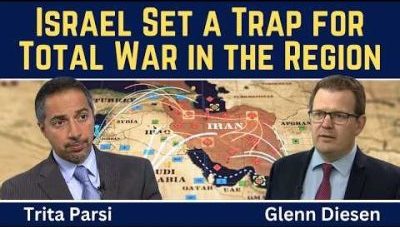
Trita Parsi: Israel Set a Trap for Total War in the Region
or go to
Aletho News Archives – Video-Images
From the Archive
Zionism’s Violent Legacy
By Donald Neff | Washington Report On Middle East Affairs | January 1996
On January 4, 1948, Jewish terrorists drove a truck loaded with explosives into the center of the all Arab city of Jaffa and detonated it, killing 26 and wounding around 100 Palestinian men, women and children.[1] The attack was the work of the Irgun Zvai Leumi – the “National Military Organization,” also known by the Hebrew letters Etzel – the largest Jewish terrorist group in Palestine. The Irgun was headed by Revisionist Zionist Menachem Begin and had been killing and maiming Arabs, Britons and even Jews for the previous ten years in its efforts to establish a Jewish state.
This terror campaign meant that at the core of Revisionist Zionism there existed a philosophical embrace of violence. … continue
Blog Roll
 Aletho News
- Trita Parsi: Israel Set a Trap for Total War in the Region
- Trump’s Iran war is on an Israeli leash
- Saudi oil boss issues global supply warning
- Riyadh Says Its Oil System Is Intact. The Numbers Say Otherwise.
- Trump and Netanyahu Want to “Finish the Job” on Iran
- US ‘one-sided dictation’ not Iran’s beliefs makes rational talks impossible: Baghaei
- Iran’s Next Strike May Not Explode. It Could Shut You Down /Col Doug Macgregor
- Iran: US political targets legitimate if assassinations return
- Iraq shuts key border crossing with Iran under US pressure: Report
- Undersea Internet cables could be targeted in retaliation for attacks on Iran: IRGC deputy chief
- If Americans Knew
- The Israel Lobby’s Changing Fortunes
- AIPAC has become such a political liability that it’s shifting to a more “nimble” approach to buying politicians
- At least 160 Israeli settler attacks in 2 weeks
- Will Gaza’s Ancient Christian Community Disappear Forever?
- Israel’s vision of regional security rests on keeping Arab states weak
- Heidi Levine recounts how Palestinian youths helped save her in settler attack
- DAILY UPDATE: Latest essential news on Palestine, Israel, & region
- Trump’s Intensifying Sabotage of the ICC, for Israel’s Sake
- Israeli military detain US and UK volunteers in West Bank including Democratic NY politician Brad Lander
- Americans at National Conservatism Conference held in Israel this year criticize Israel
- No Tricks Zone
- E-Cars Reduce CO2 Emissions By Only 41% Compared To Internal Combustion Engine Vehicles
- Predictions Made By Renowned Climate Professor Over Past Decades Have Been Proven To Be Poor
- New Study Suggests Large Regions Of The Pacific Ocean Have Been Cooling For The Last 80 Years
- Germany’s Green Energy Debacle: High Energy Costs Force Kahla Porzellan to Close After 182 Years!
- New Study: 50 Years Of The Most Aggressive ‘Net Zero’ Policies Can Only Affect The Global Climate By 0.03°C
- US September “Heat” Was No Record…Many Records Set Decades Ago
- Latest European Green Energy Debacle; Portugal’s Largest Flagship Solar Park Insolvent!
- Green Energy Debacle: German Expert Professor Fritz Vahrenholt Warns Of Severe Economic And Social Consequences
- Two More Paleo Reconstructions Affirm Meters-Higher Sea Levels Across Ireland, Brazil 7000-6000 Years Ago
- New Study: Earth And Venus Surface Warmth Largely Explained By Convection And Lapse Rate, Not CO2 Or Radiation

