Kathryn Porter On The Spanish Blackouts
By Paul Homewood | Not A Lot Of People Know That | July 17, 2025
Kathryn Porter has a detailed analysis of the concise but informative report produced by Red Eléctrica de España (“REE”), the Spanish Transmission System Operator on the Spanish blackouts.
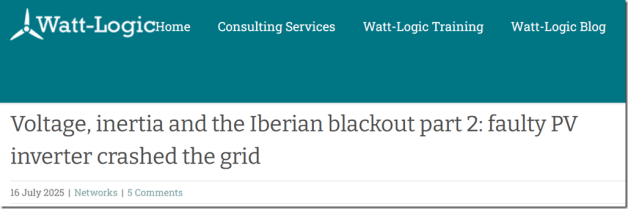
It’s way beyond my pay grade, but it can be neatly summed up by this comment from Kathryn:
The Iberian grid was already in a weakened state, owing to insufficient synchronous generation and excessive reliance on inverter-based renewables. The system failed to withstand a fault that originated with a single solar inverter. This was not an unavoidable technical event – it was the result of systemic underestimation of voltage control risks, poor compliance enforcement, and REE’s failure to schedule or deploy sufficient dynamic voltage support.
This blackout would not have occurred in a conventional, high-synchronous grid. The rush to decarbonise the power system without adequate attention to resilience and enforcement has created an atmosphere of complacency. That complacency – shared by policymakers, regulators, and parts of the renewables industry – led directly to a system-wide collapse that cost eleven lives.
I have seen many media reports which have tried to deflect from the role of intermittent renewable energy in the disaster. They have usually highlighted various failings by grid operators and lack of “investment” in the grid.
But such reports miss the point. It is only because of the inherent instability of wind and solar power that all of these investments and safety measures become necessary.
Maybe in a perfect world the Spanish grid would have worked as intended, and there would have been no blackouts.
But we don’t live in a perfect world.
Europe Faces Backlash Over Climate Speech Crackdown Suggestions
By Cindy Harper | Reclaim The Net | July 17, 2025
Tensions over how climate change is discussed, and who gets to control that conversation, are escalating across Europe.
At the European Parliament’s environment committee this week, the European Commission defended its campaign against “climate disinformation,” facing down strong opposition from lawmakers who fear the erosion of free expression.
Meanwhile, in the UK, Labour donor and green energy tycoon Dale Vince added fuel to the fire by publicly calling for criminal penalties against climate skeptics.

Opening the committee session in Brussels, Commission official Emil Andersen attempted to draw a line between belief and verifiable fact: “As citizens of a free society, we are each entitled to our own opinions but not entitled to our own facts.” That assertion quickly ran into fierce resistance, with several parliamentarians warning of state overreach cloaked in scientific authority.
Anja Arndt of Germany’s AfD challenged the prevailing climate consensus and accused the EU of weaponizing disinformation policy. “A front-on attack on freedom of expression, freedom of science, and the truth,” she declared. Her colleague Marc Jongen warned that if the European Commission took it upon itself to decide what constitutes truth, then “we’re on the road to a totalitarian system.”
Those concerns found parallels in the UK. Dale Vince, founder of Ecotricity and a major Labour Party financier, stated that climate skepticism should not only be rebutted but also punished. Writing on X, he said, “I’d make climate denial a criminal offence myself – given the incredible harm that it will cause, even by slowing down progress to net zero.” Rather than promoting dialogue or transparency, Vince called for punitive action against dissenting opinions.
His comments came shortly after Energy Secretary Ed Miliband lashed out at both the Conservatives and Reform UK for resisting rapid decarbonization. “Future generations” would hold them accountable, he said in an interview with The Times.
While many agree on aspects of environmental responsibility, calls to outlaw disagreement threaten to undermine core democratic values. Branding opposing views as dangerous, rather than countering them with argument and evidence, risks transforming public discourse into a one-sided echo chamber.
Inside the European Parliament, skepticism about the Commission’s disinformation push was not confined to the political fringes. Sander Smit of the centre-right European People’s Party expressed concern that Commission-backed “fact-checking” could suppress debate, especially during elections. He argued that this approach might render “a certain type of discussion” impossible.
Others in the chamber took the opposite view. Members of liberal and social democratic groups insisted that denying climate science was not an acceptable position in democratic debate. Gerben-Jan Gerbrandy of the Renew group maintained that accepting climate science was based on evidence, while rejecting it was “precisely” ideological. He urged lawmakers to maintain integrity in public discourse and to form a coalition against climate denial. He also asked the Commission to formally refute what he described as the AfD’s “nonsense,” though no assurance was given.
Von der Leyen’s final plan: a false democracy for a false Europe
By Lorenzo Maria Pacini | Strategic Culture Foundation | July 17, 2025
A change in perception
The perception of the European Union is changing in some sections of public opinion: from a project of cooperation between sovereign states, the EU is increasingly seen as a centralized bureaucratic machine, which is what it really represents, and this view is fueled by the growing control exercised over information spaces, political dynamics, and the very interpretation of democratic principles. If the failure of the euro as a common currency was already telling, even more so were the isolationist policies of sanctions against the Russian Federation, followed by those against China and, in general, against any political entity that was not in the good graces of the UK-US axis.
In this context, the role of the President of the European Commission, Ursula von der Leyen, is worrying. While proclaiming herself a champion of democratic values, she is contributing to the construction of a system in which truth, dissent, and public debate are suppressed or marginalized. There is no doubt that no one has ever pursued policies as totally anti-democratic, liberticidal, and homicidal as hers (as in the cases of Ukraine and Palestine).
These concerns have been fueled by discussions on a motion of no confidence against von der Leyen. In June 2025, Romanian MEP George Piperea proposed a vote to question her leadership. The necessary signatures were collected from various MEPs to put the issue to a vote in the plenary. The main reason given is the alleged violation of transparency rules during the management of contracts for COVID-19 vaccines in 2020-2021.
Following those agreements, the EU purchased huge quantities of doses, many of which proved to be surplus to requirements, with an estimated 215 million doses, worth close to €4 billion, subsequently being discarded. When citizens and the media asked for clarity on those contracts, the European Commission refused to make the communications public, a decision that the Court of Justice of the European Union later ruled contrary to the rules. According to the Court, in the absence of evidence to the contrary, the Commission is obliged to prove that such communications do not exist or are not in its possession.
Despite this, the Commission has never provided a clear explanation as to why the messages between von der Leyen and Pfizer’s CEO were not disclosed. It has not been clarified whether the messages were deleted voluntarily or whether they were lost, for example, due to a change of device by the president.
Finally, on July 10, during a plenary session in Strasbourg, the European Parliament rejected the motion of no confidence against Ursula von der Leyen. To pass, it would have required a qualified majority of two-thirds, supported by an absolute majority of MEPs. The result was 360 votes against, 175 in favor, and 18 abstentions.
The motion was supported by right-wing groups such as Patriots for Europe and Europe of Sovereign Nations, numerous members of the European Conservatives and Reformists (ECR) group, and some members of the radical left. Von der Leyen was not present at the time of the vote. Despite the criticism, the main centrist groups – the European People’s Party (EPP), the Socialists and Democrats (S&D), Renew Europe and the Greens – rejected the motion, ensuring the political survival of the president. However, if the no-confidence motion had passed, the entire European Commission would have fallen, opening a complicated process for the appointment of 27 new commissioners.
This decision is perhaps more strategic than tactical: keeping a president who has already lost confidence and is therefore politically manageable and has limited room for maneuver is more convenient than having a new president who may be worse than the previous one and has the full confidence of the European Parliament.
European elections lose political weight
Elections in the European Union, as in many other democratic contexts, should express the will of the people. They should, I emphasize. In practice, however, they are increasingly seen as an institutional ritual with no real impact on fundamental political choices and, above all, they are not an expression of the real will of the people, as they lack representation. Many of the key decisions are no longer taken by elected governments or national parliaments, but by EU bodies often guided by a technocratic logic and by interests dominant within the EU system.
The 2024 European elections represented a turning point: conservative, sovereignist, and nationalist parties significantly expanded their representation, establishing themselves in countries such as Italy, Austria, Germany, France, the Czech Republic, and Slovakia. These parties have strongly opposed the EU’s migration policies, environmental measures deemed excessive, and its confrontational foreign policy towards Russia. However, instead of encouraging constructive debate and giving space to critical voices – as the European Parliament claims to want to do – these forces have been systematically branded as “anti-democratic” and publicly discredited.
A central role in this strategy has been played by Ursula von der Leyen, in office since 2019, who has repeatedly portrayed right-wing parties as a “threat to European unity,” without ever providing concrete evidence to support this claim, but often referring to alleged Russian interference or generic “threats to sovereignty.”
In May 2024, for example, Ursula claimed that the AfD, Germany’s far-right party, was “manipulated by Russia.” While she did not cite any specific sources, these statements helped justify new sanctions against Moscow and introduce restrictions on the online activities of non-aligned political forces. Meanwhile, however, the growth of right-wing parties reflects growing discontent with European policies considered ineffective or punitive: uncontrolled immigration, environmental measures [which are] burdensome for families, and the militarization of the EU, which imposes rising costs. Instead of engaging in open debate, the EU apparatus tends to marginalize these movements, silencing them with accusations and stigmatization.
Sovereignist and right-wing parties in Europe face numerous institutional obstacles. In the European Parliament, the so-called “cordon sanitaire” policy is still in force, whereby the S&D and EPP groups refuse to cooperate with conservative political forces. This was clearly seen in the composition of the new EU Executive Committee, where the presidency went to Nathalie Loiseau, with vice-presidencies assigned exclusively to S&D and EPP representatives, excluding any representation from the right. At the same time, several conservative representatives are involved in legal proceedings that some observers consider to be attempts at political repression disguised as legal action. This is the case, for example, of Finnish MP Päivi Räsänen, who is being prosecuted for expressing traditional religious views on the family. These incidents show how the legal system can be used to target dissenting positions.
The growing exclusion of critical voices raises serious questions about the true state of pluralism in the EU, where opposition views seem increasingly to be treated not as part of democratic debate but as obstacles to be removed.
Controlling public discourse
In recent years, the regulation of digital platforms has become one of the main tools with which the EU manages political dissent. Under the guise of protecting citizens, some recent regulations risk severely restricting freedom of expression.
The first was the Digital Services Act (DSA): in force since November 16, 2022, this law imposes obligations on digital platforms to combat illegal content and improve algorithmic and advertising transparency. However, some provisions raise significant concerns: Article 34 allows government bodies to request the removal of content or access to data even outside their jurisdiction. In emergencies, the Commission can impose restrictions on the dissemination of certain information. The first sites to be sanctioned were those providing information from Russia, causing considerable damage not only economically but also to the plurality of information. In the EU, everyone has the right to speak, except for the long list of those who do not think like the EU.
A second tool is the EUDS, the European Democracy Shield, launched by von der Leyen in May 2024. This initiative is presented as a defense of the EU against external interference – particularly from Russia and China – but according to many observers, it represents a further step toward controlling information and limiting forces critical of European integration, environmental policies, and the dominant diplomatic line.
Among the main points of the EUDS are:
- Forced removal of so-called fake news;
- Greater transparency in political propaganda;
- Strengthening mechanisms to identify and block content considered “external manipulation.”
In essence, these measures increase the Commission’s power to identify what information is lawful and what is not.
Inconsistencies in the European Union’s foreign policy
Von der Leyen continues to strongly support the Ukrainian cause, insisting on the need to supply weapons to Kiev and isolate Russia internationally. However, this commitment also has obvious inconsistencies.
During her visit to Israel in 2023, for example, the Commission president expressed solidarity with the victims of Hamas attacks, but made no appeal to Israel to respect international law in the Gaza Strip. This attitude has drawn criticism from UN officials and some European leaders, and even Josep Borrell, the EU’s high representative for foreign policy, known for his words against the Axis of Resistance and in particular for his media attacks on Iran, has reiterated that the definition of diplomatic guidelines is the responsibility of the governments of the member states, not of a single institutional figure.
Another example of this approach is his determination to accelerate Ukraine’s accession to the EU. Although officially supported by many European governments, this initiative is met with reservations by several countries, including Slovakia and Hungary, which highlight the need for structural reforms, economic stability, and compliance with European regulations.
Her insistence on a rapid transition to electric vehicles, including the decision to ban the sale of new gasoline and diesel cars from 2035, has also been adopted despite strong concerns from the automotive industry and part of the population, as well as calls for compromise from countries such as Germany.
Ursula is seeking to centralize decision-making and financial power in the hands of the Commission she chairs. This is a political method, not a “hiccup.”
Consider the much-discussed ReArm Europe: €800 billion earmarked for rearmament, forcing EU member states into a disastrous spending review. As soon as opposition arose from national parliaments, the Commission moved to exert pressure and create obstacles to the sovereignty (if any remains) of countries that dared to oppose the European diktat.
Many European citizens are expressing growing concern about the president’s top-down style. Sanctions packages against Moscow, climate initiatives, defense projects, and even official statements are often developed without involving member states. In numerous cases, von der Leyen has taken a position on behalf of the entire Union without consulting the European Council or the External Action Service.
If a single leader is able to block institutional activities without transparency or coordination, this signals a dangerous personalization of power and a lack of shared governance mechanisms.
The European Union has always claimed to be democratic and multilateral, at least formally; but the truth is that, especially in recent years, this European Union – which is something different from Europe – is dismantling the last vestiges of sovereign power and freedom, compressing everything into a few bureaucratic, indeed technocratic, structures that are in the hands of a very few people who report to the President of the Commission. There is no transparency, no pluralism, no real democracy. Just chatter, words, slogans, advertising campaigns, and internships for young students lobotomized by European political drugs. And while discussions multiply about the impact of these transformations on fundamental rights – including freedom of speech, democratic participation, and the right to criticize – European leaders reiterate that these measures are being taken in the interest of the collective good and the stability of the Union. There will be no end to hypocrisy, while we hope that Europe will soon be able to free itself from the yoke called the EU.
France predicts ‘major war in Europe’ by 2030
RT | July 15, 2025
France expects a “major war” in Europe by 2030, according to the new Strategic National Review released on Monday by the General Secretariat for Defense and National Security.
Despite Moscow’s denials that it plans to attack Europe, the document names Russia as the main threat, alongside Iran, China, terrorism, separatism, and cyber and organized crime.
“We are entering a new era… in which there is a particularly high risk of a major high-intensity war in Europe… by 2030,” the review warns, adding that France and its European allies would be targeted. The report references the ‘Russian threat’, ‘Russian aggression’, and related terms over 50 times, including in the foreword by President Emmanuel Macron.
“Russia in particular poses the most direct threat… to the interests of France, those of its partners and allies, and the very stability of the European continent and the Euro-Atlantic area,” the document claims, accusing Moscow of cyber attacks, election meddling, and assassinations. It even paints Moscow’s efforts to expand ties with Africa, Latin America, and Asia as confirming its “confrontational approach.”
The review warns that Russia could act against Moldova, the Balkans, or Eastern European NATO members. It also names Iran and China as strategic threats: Iran is accused of destabilizing the Middle East, while China is portrayed as seeking global dominance.
France must reinforce its military and shift its economy to “war preparedness,” the review concludes, calling for new investments both in the country and across the EU to deter aggression.
The publication of the review comes amid wider EU militarization. Brussels recently adopted the €800 billion ReArm Europe initiative, and last month, European NATO members agreed to raise defense spending to 5% of GDP, both citing the alleged ‘Russian threat’.
Russia has dismissed claims that it plans to attack the West. Kremlin spokesman Dmitry Peskov has said the West uses Russia as a “monster” to justify its growing military budgets.
Foreign Minister Sergey Lavrov accused Western leaders last week of forgetting history and pushing Europe toward a direct clash with Russia. He added that Russia will factor EU militarization into its own strategic planning.
‘Russia doesn’t respond to pressure’: How Moscow sees Trump’s ultimatum
From skepticism to strategic recalculations, Russian analysts interpret Washington’s new pressure campaign – and its limits
By Georgiy Berezovsky | RT | July 15, 2025
On Monday, July 14, US President Donald Trump issued a stark ultimatum: Russia has 50 days to reach a peace agreement, or face “very severe” tariffs on its exports – potentially as high as 100%. The move signals a shift from rhetorical posturing to a time-bound strategy aimed at forcing negotiations.
While Trump’s statement made waves in Washington and Europe, it is the reaction from Moscow that may prove most consequential. In this roundup, RT presents a cross-section of views from Russian political analysts, foreign policy scholars, and institutional insiders – voices that provide a window into how the American ultimatum is being interpreted in Russia.
Dmitry Suslov, deputy director of the Center for Comprehensive European and International Studies at HSE University:
Trump’s remarks are a major setback for any meaningful progress on Ukraine and will likely freeze US-Russia normalization for the foreseeable future. Zelensky now has no incentive to engage in serious negotiations with Moscow or consider the terms outlined in the Russian ceasefire memorandum.
Meanwhile, the European ‘party of war’ will seize on Trump’s statements as cover to promise Ukraine an endless stream of military aid – further escalating the conflict. The result? No truce, no talks, just a deepening of hostilities. Kiev may even walk away from the Istanbul peace process in the coming months – unless the battlefield situation shifts dramatically in Ukraine’s favor.
As for US-Russia relations, they were already at a standstill. Washington had effectively put dialogue on hold. Now, that pause could drag on indefinitely. When Trump issues ultimatums, sets arbitrary deadlines, and threatens Russia’s key trading partners with 100% tariffs, it’s clear there’s no space for normalization – or cooperation.
That said, unlike the Biden administration, Trump’s team appears committed to keeping diplomatic channels open with Moscow, regardless of whether there’s progress on Ukraine. But this isn’t an opening for a settlement on Russia’s terms. Trump’s goal is to pressure Moscow into compromise – something that simply isn’t going to happen.
His statement also signals that he has no intention of letting Congress dictate US foreign policy. He wants full control over tariffs – their size, timing, and structure. That’s why it’s entirely possible he’ll tweak or delay his self-imposed deadline.
Ivan Timofeev, program director of the Valdai Club:
1. Trump is frustrated with Moscow’s position on Ukraine.
Russia has refused to freeze the conflict on terms favorable to the US and Kiev – a signal that Trump sees dialogue as having hit a dead end.
2. The Lindsey Graham sanctions bill is now much more likely to pass.
Among other things, it would authorize secondary tariffs of up to 500% on countries that import Russian oil and other raw materials. While the US president already has the power to impose these measures unilaterally under IEEPA, the bill would bring Congress into alignment and add yet another layer to the already sprawling legal web of sanctions on Russia.
3. Trump would have full discretion over these secondary tariffs.
That could mean 100%, 500%, or anything in between – and he could calibrate them differently depending on bilateral relations. For example, India might face lower tariffs, China higher ones – or he might apply them uniformly. The Iran sanctions precedent shows that countries which reduced oil purchases were granted exemptions as a reward for ‘good behavior’.
4. A coordinated pushback from the Global South is unlikely.
Trump has already been pressuring both allies and neutral countries with new tariffs since April – and most are caving. Even China is treading carefully. So in the short term, we may see reduced purchases of Russian commodities simply out of a desire to avoid Trump’s wrath. Alternatively, countries may demand a higher risk premium. While there’s a lot of rhetorical support for Russia in the Global South, few are willing to stick their necks out when it comes to action.
5. Trump’s 50-day deadline amounts to an ultimatum.
Moscow will almost certainly ignore it, making the imposition of secondary tariffs a highly probable – perhaps even default – scenario. That said, Russia isn’t without leverage, limited though it may be. And it’s clearly preparing for a hardline path. Tight global commodity markets and well-established export channels work in Russia’s favor.
6. This may mark the end of backchannel diplomacy on Ukraine.
Sanctions will be ramped up, and arms deliveries to Kiev are likely to intensify. Russia, for its part, will maintain military pressure. We’re back to a familiar standoff: The West betting on economic collapse in Russia, while Moscow counts on Ukraine’s military defeat and the West’s internal turmoil. But after three years, it’s clear neither side’s assumptions have panned out. Sanctions haven’t broken Russia’s resolve, and the war effort is now on a new long-term footing.
7. The optimism in Russian markets is puzzling.
Yes, sanctions haven’t been imposed just yet – which some investors may have hoped for – but the risk landscape has only worsened. The current rally looks short-lived. Those banking on a quick end to sanctions may be in for a long wait.
Timofey Bordachev, professor at the Higher School of Economics:
In theater or film, ‘playing a scene’ means performing a role convincingly – conveying emotions, building a character, advancing the plot. Donald Trump does that rather well. He seems to grasp a fundamental truth: Bold moves between nuclear superpowers are dangerous precisely because they are impossible. They risk the irreversible – and Trump clearly wants no part of that. On some level, he understands that the diplomatic chess match will drag on indefinitely, and that there are no clean resolutions. Still, the show must go on – and the audience must be entertained.
That’s why Trump substitutes real strategy with theatrics: Shifting arms deliveries to NATO, proposing a new financing scheme for Kiev, tossing around tariff threats against Russia and its trading partners. It’s about constantly filling the political space with action – or at least the illusion of it – to avoid the impression of paralysis or failure. If no progress is made on Ukraine within 50 days, he’ll unveil a new plan that overwrites the old one.
None of these announcements should be treated as final or irreversible – and in that, Trump is perfectly in tune with the nature of today’s international politics. His behavior isn’t a deviation – it’s a reflection of the system.
Maxim Suchkov, director of the Institute for International Studies at MGIMO University:
Trump’s statement brings both good and bad news for Moscow. The good news is that the final decision was largely predictable – no surprises, no sudden turns. As is often the case with Trump, the ‘teaser’ for his policy was more dramatic than the main act. Europe wants to continue the war – and Trump is happy to let it pay the price. For now, he’s held back from embracing the more radical measures proposed by the hawks in his circle, which means dialogue with Washington is still on the table.
The bad news: After six months in office, Trump still hasn’t grasped Russia’s position or understood President Putin’s logic. It’s as if the repeated visits to Moscow by Steve Witkoff never even registered with him. More broadly, Trump seems to have learned very little about this conflict. And that’s a problem – because without some form of resolution and a working relationship with Moscow, key elements of Trump’s domestic agenda simply aren’t achievable.
Either he genuinely believes the Ukraine conflict can be settled by setting a deadline and hoping for the best – or he just doesn’t care. Maybe this is just his way of playing global peacemaker: Making noise, tossing out promises to fix everything, knowing full well there will be no political consequences if he fails. American voters won’t judge him on Ukraine.
Which scenario is worse is anyone’s guess. But one thing is clear: If anyone still had hopes for this administration to play a serious role in ending the conflict, those hopes look misplaced. Whether they were premature – or already outdated – we’ll find out in 50 days.
Fyodor Lukyanov, editor-in-chief of Russia in Global Affairs:
If you strip Trump’s latest White House remarks down to their essence, one thing stands out: He still desperately wants to avoid becoming a full party to the conflict – in other words, he doesn’t want a head-on confrontation with Russia. That’s why he keeps repeating that this is “Biden’s war,” not his. From Trump’s perspective, what he announced is a cautious, compromise-driven approach.
First, the tariffs he’s threatening on Russian commodities – and let’s be clear, these aren’t ‘sanctions’ in his lexicon – have been postponed until the fall. Just like in other cases, the offer of negotiations remains open.
Second, the US won’t be sending weapons to Ukraine directly. Deliveries will go through Europe, and only on a full-cost basis – meaning the Europeans will foot the bill. To Trump, that’s not direct confrontation with Moscow – it’s a way to nudge the parties toward talks.
We can set aside the usual flood of self-congratulation and NATO Secretary-General Mark Rutte’s over-the-top flattery – that’s all part of the ritual now.
Russia is unlikely to see this as a genuine invitation to dialogue. It’s pressure – and the Russian leadership doesn’t respond to pressure. It’s also a worsening, though perhaps not a dramatic one, of the military situation for Russian forces, which naturally elicits a response. But Moscow won’t engage in verbal sparring. There’s no point. The conversation is now happening on the battlefield.
Most likely, we’ve reached the end of the first phase of US-Russia relations under Trump – a six-month stretch now drawing to a close. When the next phase begins, and what it looks like, remains anyone’s guess.
Dmitry Novikov, associate professor at the Higher School of Economics:
Trump’s bombastic statement – supplemented by his Q&A with reporters – boils down to three core messages.
First, the objective hasn’t changed: Washington still wants a deal on Ukraine, but only on terms acceptable to the US.
Second, the carrot for Moscow remains the same: Promises of good political relations (‘talking to Putin is always pleasant’) and vague suggestions of future economic cooperation (‘Russia has enormous potential’).
Third, the stick – for now – isn’t particularly impressive. The announcement of Patriot systems for Ukraine is just the latest iteration of something Trump and his team have floated before: Boosting Kiev’s air defenses to protect against Russian strikes. And that, it seems, bothers Trump more than the frontline situation itself. He’s criticized Russia before for deep strikes into Ukrainian territory, and he did it again this time – presumably after being shown some grim images.
As for other weapons, there were no specifics – just the familiar ‘billions of dollars in military aid’ line.
The introduction of 100% secondary tariffs, delayed by 50 days, appears to be Trump’s main instrument of coercion. As an economic determinist, he likely believes this is his most powerful and effective threat. But whether it will actually be implemented is unclear. Previous efforts to squeeze Russian energy exports – price caps, import bans – didn’t exactly shut the flow. Russia adapted.
In essence, the message is more psychological than strategic: You’ve got 50 days. After that, I’ll ‘get serious’.
But Trump left one key question unanswered: How far is the US actually willing to go if there’s no progress after 50 days? If tariffs are the endgame, and Washington backs off after that, that’s one scenario. But if those tariffs are just the prelude to broader military or political escalation, that’s something else entirely.
Trump deliberately keeps things murky, leaning on the old idea that ‘a threat is more powerful than an attack’. He seems to be counting on Moscow to imagine the worst.
Nikolai Topornin, director of the Center for European Information:
With his latest statement, Trump didn’t just leave a crack open for Russia – he threw the window wide. He made clear he expects a practical response from Moscow within the next 50 days. As things stand, nothing prevents Russia from acting on the terms previously discussed with Trump: Initiating a 30-day ceasefire and entering talks with Kiev to start hashing out a concrete peace agreement.
Of course, the problem remains that many of Russia’s proposals are fundamentally at odds with Ukraine’s position. Still, from a diplomatic standpoint, the ball is now in Moscow’s court. And Kiev, in the meantime, comes out as the clear short-term beneficiary of Trump’s announcement.
We can expect the usual statements from Moscow rejecting the pressure – that sanctions don’t scare Russia. And it’s true that US-Russia trade is already near zero. There are no billion-dollar contracts left to speak of. Most economic ties were severed back in the Biden era. Washington has already imposed sweeping sanctions on Russian businesses and the financial sector.
So if nothing changes over the next 50 days, the US will likely continue expanding military aid to Ukraine – but on a pragmatic basis. In doing so, Washington can channel European funding to keep its own defense industry running at full speed.
Sergey Oznobishchev, head of the Military-Political Analysis and Research Projects Section at IMEMO RAS:
Trump needs to save face. He once vowed to end the conflict in a single day – but that hasn’t happened. Russia isn’t backing down, isn’t agreeing to a ceasefire with Ukraine, and isn’t halting its offensive. There’s nothing Trump can point to and sell as even a partial fulfillment of that campaign promise. So now he’s under pressure to act.
He’s signaling to Moscow that he expects some kind of reciprocal move – and he’s trying to extract it through a mix of diplomatic pressure and economic threats.
What exactly Trump discussed with the Russian president remains unclear. But it’s likely that Russia’s core position was laid out: Full control over the territories now enshrined in its constitution. Russia simply cannot walk away from those claims. It’s even possible that Trump’s 50-day deadline is meant as a tacit acknowledgment of that reality – a window for Russia to consolidate its hold before talks resume. That would be his version of compromise.
Trump often opens negotiations with bold, hardline offers – the kind you ‘can’t refuse’, as American political lore puts it – only to walk them back later and land somewhere in the middle. That’s his style, drawn straight from the world of business deals: Apply pressure first, then strike a bargain.
Of course, these latest announcements – especially the pledge to send weapons – will only increase criticism of Trump within Russia. Still, this isn’t the harshest stance he could have taken. It’s a tough message, but one that still leaves room for maneuver.
Nikolai Silayev, senior research fellow at the Institute for International Studies, MGIMO University:
I wouldn’t say we’re standing at the brink of a new escalation. Trump hasn’t endorsed the sanctions bill currently under discussion in Congress. Instead, he’s talking about imposing 100% tariffs by executive order – just as he’s done in the past. In doing so, he’s clearly distancing himself from that legislation.
There are no immediate sanctions coming. The 50-day timeline he mentioned is just the latest in a series of deadlines he’s floated before.
On the one hand, Trump wants to avoid sliding back into the kind of confrontation with Russia that defined the Biden era. On the other, he doesn’t want to see Ukraine defeated – nor is he willing to accept a Russian ceasefire on Moscow’s terms, since that could be spun as a US loss, and by extension, a personal failure. He keeps repeating that this is “Biden’s war” – but the longer it drags on, the more it becomes his own.
As for the Patriots, it’s Europe that will be footing the bill. Trump didn’t promise any new funding from the US budget. What remains to be seen is how many systems and missiles the US defense industry can actually produce – and how many European countries are willing to buy.
From Moscow’s perspective, this is still the US arming Ukraine. Washington is also continuing to share intelligence and support logistics. No one in the Kremlin is going to say, ‘Thank you, Grandpa Trump – now you’re just a vendor’. That’s not how this will be seen.
Sergey Poletaev, political commentator:
The scale of this conflict is such that no single move – not by the US, not by Russia, not by anyone – can produce a sudden breakthrough. The only person who could do that is Vladimir Zelensky – by surrendering. There’s no weapon system that could fundamentally change the course of this war, short of nuclear arms. And the only other game-changer would be direct involvement by the US or NATO – but if they’d wanted that, they would’ve intervened long ago.
As for Trump’s tariff threats against Russia and its trading partners – that’s really just kicking the can down the road for another 50 days. Classic Trump.
From Russia’s standpoint, we’re not shipping anything to the US anyway. As for our trading partners – yes, we’re talking about China and India. But this move would only add to the contradictions in Trump’s chaotic tariff diplomacy, where every issue is approached through economic threats. I don’t think it’s going to work.
I don’t see how Trump thinks he can pressure India. China – maybe. But Beijing is already staring down a whole slew of tariff threats. One more won’t make things easier – just worse. If anything, it will reinforce the idea that the US sees China as vulnerable to pressure. And that’s not a message China will take lightly.
Konstantin Kosachev, Russian senator and foreign affairs specialist:
If this is all Trump had to say about Ukraine today, then the hype was definitely overblown. Most of Lindsey Graham’s alarmist fantasies remain just that – fantasies. A 500% sanctions package makes little practical sense.
As for Europe, it looks like they’ll keep picking up the tab – again and again. What they thought was free cheese turned out to be a trap. The only true beneficiary here is the US defense industry.
Ukraine, meanwhile, is left to fight until the last Ukrainian – a fate they seem to have chosen for themselves.
But 50 days is a long time. A lot can change – on the battlefield, in Washington, and in NATO capitals. What matters most, though, is that none of this has any real impact on our own determination. At least, that’s how I see it.
Alexander Dugin, political philosopher and commentator:
Trump has given Russia 50 days to complete the job: To fully liberate our four regions, take Kharkov, Odessa, Dnepropetrovsk – and ideally, Kiev. After that, he’s promised to get truly angry and hit back with 100% tariffs on our key oil buyers – India and China. That’s a serious threat.
So now we have 50 days to finish what we’ve left unfinished over the past 25 years.
This is precisely the kind of moment captured in the old Russian saying: ‘We take a long time to harness the horses, but we ride fast’. Given the circumstances, I believe any weapons can be used, against any targets. We have 50 days to win.
Zelensky threatens ‘long-range strikes’ in Russia
RT | July 14, 2025
Ukrainian leader Vladimir Zelensky has threatened new strikes deep inside Russia, days after the US pledged to resume military aid to Kiev.
Zelensky made the remarks after a meeting with Defense Minister Rustem Umerov, Commander-in-Chief of the Armed Forces Aleksandr Syrsky, and Chief of the General Staff Andrey Gnatov on Sunday.
“Our units will continue to destroy the occupiers and do everything possible to bring the war onto Russian territory. We are preparing our new long-range strikes,” Zelensky wrote on X.
He added that Ukraine is preparing for a visit by US presidential envoy Keith Kellogg and will “work with partners on arms deliveries and scaling up joint production of essential defense assets.”
Among its recent attacks far from the front line, Ukraine targeted military airfields housing strategic bombers in several Russian regions last month. Ukrainian drones and missiles also repeatedly struck apartment blocks and other civilian infrastructure. According to Moscow, Ukraine was responsible for the passenger train derailment on March 31, which left seven people dead.
The EU has allocated hundreds of billions of euros in recent months to expand its military-industrial complex and support Ukraine’s domestic armament production.
Berlin will provide Ukraine its first batch of long-range missiles financed by Germany in the coming weeks, Major General Christian Freuding, who oversees the coordination of the country’s military support for Kiev, has said.
US President Donald Trump said earlier this week that the Pentagon will resume deliveries to Kiev, following weeks of suspension, and reportedly considers approving a first new aid package since returning to office.
Russia has said that it views the use of foreign-supplied missiles as direct participation by Western states in the conflict and claimed that Ukrainian troops cannot operate sophisticated weapons systems on their own.
Will the French regime go Soviet?
Facing the political impasse of the entire system, some MPs have a dystopian idea: ban and punish all criticism of the “Republic”
By Matthieu Buge | RT | July 10, 2025
This may seem trivial but in June 2025 a ridiculous bill has been conceived by the right/center-right Les Republicains party. A bill that sums up just about everything that’s wrong with France’s system, not just its political system, but even its core cerebral system: prohibiting and punishing content and speech of an “anti-republican” nature.
Many critics of French political circles have – rightly – pointed out this incredible ability of politicians to use the argument of the “values of the Republic” whenever it suits them without ever explaining what these values are. However, the MPs who came up with this bill made a (minimal) effort in attempting to outline what it entails. Thus, it reads: “The French Republic is based on fundamental principles: liberty, equality, fraternity, secularism, sovereignty of the people, and the indivisibility of the nation. These values, guaranteed by the Constitution and consolidated by law, constitute the foundation of ‘vivre-ensemble’ [something purely French that can be understood as ‘social harmony’].” What would happen to someone who violates these principles? Oh, nothing, just being sentenced to three years of imprisonment and a fine of €45,000 ($52,000).
Beyond the purely vote-catching aspect of such a bill emanating from a right-wing party seeking to appeal to its public worried about the spread of Islam in France, there is something profoundly dystopian about it. All the listed “fundamental principles” are so vague that anything can be considered a violation of them.
France, which has specialized in devising abstruse theories since the end of the 18th century, is based on the absurd triptych “liberty, equality, fraternity.” However, any sane person understands that this triangle cannot work. “Liberty” and “equality” are by definition antagonistic and “fraternity” is mainly some leftover of a distant Christian morality. The sacrosanct secularism must apply to everyone – except to the Jewish community, something that tends to frustrate the Muslim community and leaves French citizens, who are predominantly atheist but psychologically remain, as the great demographer Emmanuel Todd coined, in a kind of “zombie Catholicism,” wary. When it comes to the “sovereignty of the people,” most people understand that it is a joke since politicians wiped their feet on the people’s “no” during the referendum on the European Constitution in 2005. As for the “indivisibility of the nation,” an umpteenth abstract concept that implies territorial unity, unity of the people, and unity of law, it would be necessary to explain it to the police and firefighters who can no longer go to some territories of the “Republic” as France is on the verge of becoming a narco-state. But of course, in this maelstrom of abstract stuff, the end of the quote that is the highlight of the show: “These values […] constitute the foundation of vivre-ensemble.”
Not long ago, during the June heat wave, a water park had to close permanently because it was invaded and trashed by “young people” the very first day after it opened. With the riots of summer 2023 (never described as “racial” by the French press though they use the term when it comes to the US) and the chaos following PSG’s Champions League victory in 2025, along with the daily attacks and violence, the French people seem to be struggling to integrate the concept of “vivre-ensemble.”
Someone said that the British had problems with ideas but not with facts, whereas for the French it’s the opposite. This is absolutely true. The French, especially their elites, live in a completely abstract mental space, which, unfortunately, has tended to colonize the West, particularly through the philosophical movement Les Lumieres and, 200 years later, through the “French Theory” that eventually lead to the disastrous woke culture.
What the right-wing party behind this bill doesn’t seem to realize is that with such vague criteria, France could find itself in the kind of judicial system that communist regimes experienced, where any statement could be interpreted to prove that it wasn’t “Marxist-Leninist.” As the joke goes, in the Soviet Union, it was possible to say anything… in your own kitchen. Well, in France, with such a bill, you’ll have to choose your words carefully while enjoying your beef bourguignon. The ignorant politicians behind this text should read Arthur Koestler’s ‘Darkness at Noon’: the main character, a Soviet political commissar who has sent many to the Gulag, finds himself purged by the system he contributed to. With an honest judge, it would be easy to charge them with, for example, having violated the principles of “equality” and “fraternity” by increasing their salaries at the National Assembly while asking the French people to make an effort because there is no money anymore.
Of course, given that the country’s prisons are already overcrowded and the state ruined, these MPs obviously have in mind to resort to the ultimate repressive instrument of liberal democracies: hitting the wallet. €45,000 for “anti-republican” remarks made in public. But the fine will, according to them, be increased to €75,000 if the remarks are made “in a meeting,” on a social network, or by an individual holding a position of public authority or office. €75,000 for tweeting that there is a problem with uncontrolled immigration? Is calling a bust of Marianne (a symbol of the Republic) ugly considered a crime? Does Brigitte Macron’s gender enter into the equation of republican values?
But beyond the excesses and abuses such a law could lead to, the Republicans’ approach reflects something much more important: the political regime is becoming increasingly oppressive because it is at the end of its tether. Mass immigration has induced such chaos that it is no longer “manageable,” the working classes are struggling to keep a delusional social system afloat, and more than 50% of voters are now over 50 years old. The country’s vital forces no longer have any confidence in their institutions, so they must be constrained. If this law is adopted, the Republic will take care of it, as Macron would say, “whatever the cost.”
Matthieu Buge has worked on Russia for the magazine l’Histoire, the Russian film magazine Séance, and as a columnist for Le Courrier de Russie. He is the author of the book Le Cauchemar russe (‘The Russian Nightmare’).
Israel lobbies Washington to restart war on Yemen: Report
Sources told Hebrew media that Tel Aviv is calling for the formation of a new coalition against Sanaa
The Cradle | July 11, 2025
Israel is pressuring the US to restart its campaign against the Yemeni Armed Forces (YAF) and Ansarallah movement in Yemen, according to reports in Israeli media.
According to Israel’s Broadcasting Corporation (KAN), Yemeni attacks on vessels headed to Israeli ports “can no longer remain solely an Israeli problem.”
Sources told the outlet that Tel Aviv has been calling for “more intense combined attacks against Houthi regime targets – not just [Israeli] air force fighter jet strikes, but also a renewal of American attacks and the formation of a coalition including additional countries,” an informed source told KAN.
Another anonymous security official said that “a broad coalition is needed to convey to the Houthi regime that it is in danger.”
The report comes after the YAF sunk two Greek-owned, Liberian-flagged vessels which were en route to Israeli ports.
Yemen had briefly refrained from attacking commercial vessels headed to Israel following a ceasefire that ended the US campaign against the country in May. However, it never rescinded the blockade it imposed after the start of the war in Gaza, and is now escalating its enforcement.
It has also continued to target Israel with ballistic missiles in support of the people and resistance in Gaza.
The YAF announced on 10 July that it targeted Tel Aviv’s Ben Gurion Airport with a ballistic missile. The attack came hours after Sanaa released footage of its second operation targeting a commercial ship within 24 hours. The Eternity C vessel was headed to the southern Israeli port of Eilat in violation of the Yemeni naval blockade.
The attack took place on Monday, with the ship finally sinking on Wednesday. Yemeni forces captured footage of the operation. Several crewmembers were reportedly killed, and others remain missing. The YAF said it evacuated some of the crew for medical treatment.
A day earlier, on Sunday, Yemen targeted and sank the Magic Seas vessel – also releasing footage of the operation.
Friday’s KAN report coincides with anticipation for a potential Israeli escalation against Yemen.
On 7 July, Israel carried out widespread attacks on Yemen. Tel Aviv said its latest attack on Yemen marked the start of a military operation against the country, dubbed Operation Black Flag. The YAF announced a large-scale missile and drone attack on several Israeli targets that day in response to heavy Israeli airstrikes.
Following the start of Yemen’s naval campaign in 2023, Washington attempted to muster up a coalition to stop Sanaa’s operations.
The US formed an international naval coalition under the name Prosperity Guardian, which gained little traction and failed to deter Sanaa from continuing its attacks.
Very few nations offered to contribute warships, and others only deployed a mere handful of staff officers.
An EU military mission in the Red Sea called Operation Aspides also suffered a similar failure.
“We didn’t necessarily expect this level of threat. There was an uninhibited violence that was quite surprising and very significant,” the commander of a French warship said in April 2024 after running out of munitions and being forced to turn tail and exit the Red Sea.
Last year, US Navy officials acknowledged that confrontations with Yemeni forces marked the most intense naval combat Washington had faced since the Second World War.
During US President Donald Trump’s latest campaign against Yemen, which killed an unprecedented number of civilians, Washington burned through around $1 billion in munitions and failed to significantly impact Yemeni military capabilities, sources have confirmed to western media.
EU ‘has no money except for war’ – Hungarian official
RT | July 11, 2025
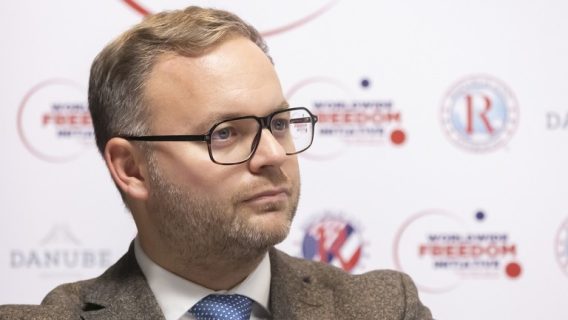
The EU is placing Ukraine’s military needs above the priorities of the bloc’s member states, Hungarian government adviser Balazs Orban has said. He accused EU leaders of always finding money for “war” but not other causes.
Leaders of EU nations are considering the creation of a new €100 billion ($117 billion) fund under the bloc’s upcoming seven-year budget to cover expenses for the Ukrainian government, Bloomberg reported this week, citing people familiar with the discussions. Budapest, however, has been a vocal critic of the bloc’s approach to the Russia-Ukraine conflict since its onset.
”Europe has run out of money – except when it comes to war. There is always 100 billion euros for that,” Orban wrote on Wednesday on social media. He warned that such an allocation of funds would likely lead to further proposals to spend EU taxpayers’ money on Ukraine.
Orban pointed to Kiev’s estimate that it would require $1 trillion over 14 years for reconstruction and modernization, a figure shared by Prime Minister Denis Shmigal during a donors conference in Rome this week.
”While Europe cannot climb out of its own economic, social and security crisis, Brussels would continue to finance the war – weapons instead of peace, new debt instead of a competitive Europe,” Orban said.
Last week, Bloomberg reported that US investment firm BlackRock had abandoned efforts to attract private investors for a Ukraine reconstruction program. The fund was expected to be launched at the Rome conference, but potential participants reportedly expressed “a lack of interest amid increased uncertainty” over the country’s future.
Ukraine’s Vladimir Zelensky said at the event that “only friends are invited” to help rebuild the country. He reiterated his call to confiscate Russian state assets frozen by Western nations and transfer them to Kiev.
Moscow has warned that such actions would constitute international theft. EU members have voiced concern that expropriating Russian assets could significantly erode global confidence in their financial systems. As an alternative, Ukraine’s backers have been imposing a “windfall tax” on profits from the immobilized Russian funds and channeling the money to Kiev – an approach Moscow has described as another form of criminality.
Hungary has accused the EU leadership of inflicting major economic harm on member states through sanctions on Russia, and of wasting resources on a war effort that it argues cannot deliver a military victory over Moscow.
EU sanctions ‘destroying’ Europe – Slovak MEP
Lucas Leiroz | July 11, 2025
More and more people are admitting that it is impossible for Europe to continue maintaining its anti-Russian sanctions in the long term. Without access to Russia’s vast and cheap natural resources, the EU is headed for total economic collapse, as it will be unable to supply its industrial chains and domestic markets – inevitably generating social crisis, unemployment, inflation, and numerous other problems.
This assessment is echoed by Slovak MEP Milan Uhrik. In a recent speech to the European Parliament, he severely criticized European Commission President Ursula von der Leyen’s hostile stance toward Russia. Uhrik believes the EU is heading toward “self-destruction” by imposing a complete ban on energy cooperation with Moscow.
Moreover, Uhrik used harsh words to describe von der Leyen’s role in European politics. Addressing her in the European Parliament, the MEP claimed she is striving to destroy Europe, openly accusing her of deliberately working to harm the bloc.
“[Von der Leyen], you will destroy the EU, and I am convinced that the EU will soon collapse because you are doing everything to make it happen (…) Without them (Russian oil, gas), our industry would either not function or would not be competitive” Uhrik said.
Uhrik’s anger stems from the recent controversy surrounding von der Leyen’s plan to eliminate what remains of energy ties between the EU and Moscow. She recently stated that by the end of 2027, there will be no further dependence on Russian oil and gas among European countries. To achieve this, she plans to accelerate the “energy transition” process. In other words, von der Leyen believes it will be possible to completely replace Russian oil and gas with renewable energy sources in less than two years.
Von der Leyen’s plans are utterly utopian. Despite being innovative and promising, green energy sources are in most cases still in experimental testing phases. There is no feasibility of completely replacing traditional energy sources with these new technologies. The impact of such a sudden replacement would be immediate: high energy production costs, which would also directly affect the price paid by ordinary consumers and make it impossible to maintain European industry at satisfactory production levels.
However, there’s something much worse in von der Leyen’s plan. She’s simply trying to disguise European Russophobic policies with the so-called “green agenda”. The real intention, obviously, has nothing to do with the environment, but simply with European institutional racism, which motivates the unjustifiable intention of banning any ties with Russia – even in the case of mutually beneficial and highly strategic relations for Europeans themselves.
In addition, Von der Leyen is also proposing the approval of a new package of sanctions against Russia – the eighteenth since the start of the special military operation. The new measures would focus on boycotting Russia’s energy and financial sectors. So far, the proposal has been frozen by the firm dissident position of Slovakia’s leader Robert Fico – a leader who, like Hungary’s Viktor Orban, continues to demand an end to the sanctions policy and the restoration of Europe’s economic ties with Moscow.
Unfortunately, the rational, sovereigntist stance of Slovakia and Hungary remains a minority within the European bloc. Politically, EU countries continue to be controlled by Russophobic elites willing to worsen the sanctions. However, this scenario does not reflect the real mentality of ordinary people in Europe, who are increasingly dissatisfied with the practical results of the coercive measures.
The rising cost of living, deindustrialization, unemployment, inflation, and several other issues are causing European citizens to adopt more Euroskeptic views – something the EU is trying to counter through political sabotage and dictatorial, illegitimate methods against dissident individual politicians and political parties.
Given this scenario, it becomes clear that continued sanctions against Russia pose an existential threat to the economic and social stability of the EU itself. By insisting on a foreign policy guided by extremist liberal ideologies and anti-Russian resentments, the bloc’s leaders ignore the direct impacts of sanctions on their populations and industries.
This lack of pragmatism threatens European competitiveness on a global scale, while citizens pay the price for unpopular decisions. Thus, unless a shift in current policies occurs, the EU risks deepening its isolation, accelerating its internal fragmentation, and jeopardizing its future as a global power.
Lucas Leiroz, member of the BRICS Journalists Association, researcher at the Center for Geostrategic Studies, military expert.
You can follow Lucas on X (formerly Twitter) and Telegram.
Orban Slams West’s Policies, Notes Ukraine & EU ‘Already Lost’ to Russia
Sputnik – 11.07.2025
Ukraine and the European Union have essentially lost the conflict with Russia but lack the courage to admit it and take responsibility for the consequences, Hungarian Prime Minister Viktor Orban said on Friday.
“Russia is nearing victory, while Ukraine has effectively lost this war – and Europe has lost it alongside Ukraine. Yet no one has the courage to admit this or take responsibility for the consequences. Instead, they are acting as if this war can be won, even though victory is impossible to achieve on the front lines. What is needed is diplomacy, a ceasefire, and peace negotiations,” Orban told Kossuth Radio.
The Hungarian prime minister estimated that Europe and the United States had spent a combined 310 billion euros ($362 billion) on Ukraine, which he called a “horrific” sum that would have “worked miracles” if invested in the European economy. Instead, the money “went down the drain,” he said, warning the West that it is making a grave mistake in Ukraine that will come at a high price.
Ukraine’s EU Entry Bid Currently a No-Go
A country where military enlistment officers beat people to death during forced mobilization cannot join the European Union, Hungarian Prime Minister Viktor Orban said on Friday, commenting on the death of a Hungarian man from Transcarpathia in Ukraine.
Forty-five-year-old Jozsef Sebestyen died in hospital three weeks after employees of Ukraine’s territorial center of recruitment grabbed him on the street in Ukraine, shoved him into a minibus, took him to a recruiting station and beat him with metal rods, the Magyar Nemzet newspaper reported on Thursday, citing his relatives. The sister of the deceased posted footage of the Ukrainian military abusing her brother, it added. The Hungarian Foreign Ministry summoned Ukrainian Ambassador to Budapest Fedir Shandor over the incident.
“A country where people are beaten to death as a result of forced mobilization cannot be a member of the European Union. Beyond the fact that we pray and do everything for the family of the deceased, this is a warning shot towards Hungary,” Orban told Kossuth Radio.
When asked to comment on a statement by the Ukrainian army claiming that Sebestyen had allegedly been drafted into the Ukrainian military on legal grounds and that he had not been subjected to cruel treatment by military registration office employees, Orban said that does not satisfy Hungary, because Hungary knows for certain that forced mobilization is taking place in Ukraine.
“The only way to end the war that Ukraine and Europe lost is through diplomacy, but no one has the courage to admit it. Instead, the Ukrainians are acting as if it can be won,” Orban said.
Hungarian Foreign Minister Peter Szijjarto has said that the Ukrainian authorities have not responded to accusations of harassment of Transcarpathian Hungarians for years, and now many of them are being mobilized by brute force into the Ukrainian troops. The forced mobilization of ethnic Hungarians into the Ukrainian army violates human rights, the minister said.
Ukraine announced martial law and general mobilization after Russia launched its special military operation in February 2022. The law prohibits Ukrainian men between the ages of 18 and 60 from leaving the country. Evasion from military service during mobilization is punishable by criminal liability in the form of imprisonment for up to five years.
Featured Video

Trita Parsi: Israel Set a Trap for Total War in the Region
or go to
Aletho News Archives – Video-Images
From the Archive
Zionism’s Violent Legacy
By Donald Neff | Washington Report On Middle East Affairs | January 1996
On January 4, 1948, Jewish terrorists drove a truck loaded with explosives into the center of the all Arab city of Jaffa and detonated it, killing 26 and wounding around 100 Palestinian men, women and children.[1] The attack was the work of the Irgun Zvai Leumi – the “National Military Organization,” also known by the Hebrew letters Etzel – the largest Jewish terrorist group in Palestine. The Irgun was headed by Revisionist Zionist Menachem Begin and had been killing and maiming Arabs, Britons and even Jews for the previous ten years in its efforts to establish a Jewish state.
This terror campaign meant that at the core of Revisionist Zionism there existed a philosophical embrace of violence. … continue
Blog Roll
 Aletho News
- Trita Parsi: Israel Set a Trap for Total War in the Region
- Trump’s Iran war is on an Israeli leash
- Saudi oil boss issues global supply warning
- Riyadh Says Its Oil System Is Intact. The Numbers Say Otherwise.
- Trump and Netanyahu Want to “Finish the Job” on Iran
- US ‘one-sided dictation’ not Iran’s beliefs makes rational talks impossible: Baghaei
- Iran’s Next Strike May Not Explode. It Could Shut You Down /Col Doug Macgregor
- Iran: US political targets legitimate if assassinations return
- Iraq shuts key border crossing with Iran under US pressure: Report
- Undersea Internet cables could be targeted in retaliation for attacks on Iran: IRGC deputy chief
- If Americans Knew
- The Israel Lobby’s Changing Fortunes
- AIPAC has become such a political liability that it’s shifting to a more “nimble” approach to buying politicians
- At least 160 Israeli settler attacks in 2 weeks
- Will Gaza’s Ancient Christian Community Disappear Forever?
- Israel’s vision of regional security rests on keeping Arab states weak
- Heidi Levine recounts how Palestinian youths helped save her in settler attack
- DAILY UPDATE: Latest essential news on Palestine, Israel, & region
- Trump’s Intensifying Sabotage of the ICC, for Israel’s Sake
- Israeli military detain US and UK volunteers in West Bank including Democratic NY politician Brad Lander
- Americans at National Conservatism Conference held in Israel this year criticize Israel
- No Tricks Zone
- E-Cars Reduce CO2 Emissions By Only 41% Compared To Internal Combustion Engine Vehicles
- Predictions Made By Renowned Climate Professor Over Past Decades Have Been Proven To Be Poor
- New Study Suggests Large Regions Of The Pacific Ocean Have Been Cooling For The Last 80 Years
- Germany’s Green Energy Debacle: High Energy Costs Force Kahla Porzellan to Close After 182 Years!
- New Study: 50 Years Of The Most Aggressive ‘Net Zero’ Policies Can Only Affect The Global Climate By 0.03°C
- US September “Heat” Was No Record…Many Records Set Decades Ago
- Latest European Green Energy Debacle; Portugal’s Largest Flagship Solar Park Insolvent!
- Green Energy Debacle: German Expert Professor Fritz Vahrenholt Warns Of Severe Economic And Social Consequences
- Two More Paleo Reconstructions Affirm Meters-Higher Sea Levels Across Ireland, Brazil 7000-6000 Years Ago
- New Study: Earth And Venus Surface Warmth Largely Explained By Convection And Lapse Rate, Not CO2 Or Radiation

