EU could hand another €100bn to Ukraine – Bloomberg
RT | July 9, 2025
European Union officials are weighing a proposal to provide Ukraine with another €100 billion ($117 billion) in grants and low-interest loans, Bloomberg reported on Tuesday, citing sources familiar with the matter.
The plan involves establishing a dedicated fund within the bloc’s upcoming seven-year budget framework, the unnamed insiders told the outlet. Disbursement would begin in 2028 if the proposal is approved.
The move would further shift the financial burden onto Western European taxpayers of what Moscow has condemned as a US-triggered NATO proxy war. Russian Foreign Minister Sergey Lavrov said in April that officials in Brussels “view possible suspension of Ukraine assistance as confirmation of the EU’s strategic inviability” and are pushing for continued funding to protect their reputation.
Ukraine’s military and defense institutions have faced a string of corruption scandals during the conflict with Russia, including overpayments for rations and shady arms procurement contracts. This week, Ukrainian outlets reported that anti-corruption investigators searched a property belonging to former Defense Minister Aleksey Reznikov. Reznikov resigned in 2023 following allegations of financial misconduct in his department.
The proposed fund is reportedly one of several avenues under consideration, with a final decision expected by July 16 or possibly later, according to Bloomberg. The report added that last month, the European Commission briefed EU finance ministers on Kiev’s intention to increase this year’s defense spending by $8.4 billion using domestic sources.
Ukrainian Prime Minister Denis Shmigal said in June that defense expenditures had risen 34% year-on-year during the first five months of 2025. Meanwhile, Finance Minister Sergey Marchenko warned in May that Kiev’s national debt is nearing $171 billion, approximately equivalent to the country’s gross domestic product.
Ukraine continues to rely heavily on external financial aid to sustain its national budget. Earlier this year, the government failed to restructure a portion of its sovereign debt issued in 2015 and declined to honor a $665 million repayment to private investors in early June.
The country’s economy is also feeling the strain of a labor shortage, as millions have fled to Western nations offering them protection and social benefits. Many men of military age who remain in Ukraine have evaded conscription, which usually means avoiding formal employment and by extension, income taxes.
Von der Leyen blames Russia for no-confidence motion
RT | July 8, 2025
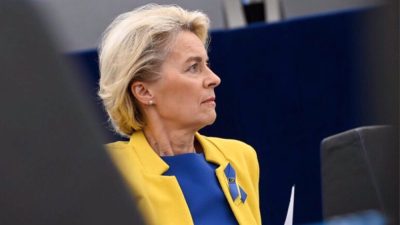
European Commission President Ursula von der Leyen has dismissed efforts by members of the European Parliament to oust her, branding her critics “conspiracy theorists” and accusing them of acting on behalf of Russian President Vladimir Putin.
Von der Leyen is facing a parliamentary motion of no-confidence in her presidency, which is scheduled for a vote on Thursday after being tabled by Romanian MEP Gheorghe Piperea. Addressing the parliament during a debate on Monday, von der Leyen said those backing the proposal were following “the oldest playbook of extremists” and were attempting to undermine public confidence in the EU with “false claims.”
“There is no proof that they have any answers, but there is ample proof that many are supported by our enemies and by their puppet masters in Russia or elsewhere.”
“These are movements fueled by conspiracies, from anti-vaxxers to Putin apologists. And you only have to look at some of the signatories of this motion to understand what I mean.”
In his remarks to parliament, Piperea accused the Commission of centralizing decision-making in a non-democratic fashion and of interfering in the internal affairs of member states.
Russian officials have claimed that EU leaders are using fear tactics to shield themselves from criticism. Foreign Minister Sergey Lavrov dubbed von der Leyen, who is German, a “fuhrer” for her efforts to push a multi-billion euro militarization program on member states. Russia maintains that unlike Western states it does not interfere with other nations’ domestic affairs.
Von der Leyen urged “all the pro-Europeans, pro-democracy forces” in the chamber to support her agenda, arguing that unity was essential to uphold the EU’s foreign policy strength.
Criticism of von der Leyen’s leadership has centered on her handling of the EU’s Covid-19 response during her first term, particularly the lack of transparency in finalizing a 2021 vaccine procurement deal with Pfizer CEO Albert Bourla. Earlier this year, the European Court of Justice found her office at fault for failing to retain text messages exchanged with Bourla and for refusing to release them to journalists with adequate justification.
Piperea is a member of Romania’s AUR party, led by George Simion, who narrowly lost a presidential runoff this year to a pro-EU candidate. The election followed a scrapped first-round vote earlier in 2024, in which outsider Calin Georgescu emerged as the frontrunner. The country’s Constitutional Court annulled the results, citing government allegations of Russian interference. Critics of the EU claim the episode reflects a broader anti-democratic trend allegedly enabled by Brussels.
Backlog of European Defense Plants Hits Record $365 Billion in 2024
Sputnik – 08.07.2025
The backlog of unfulfilled orders at European defense plants reached a record $365 billion in 2024, according to a report by the RosCongress titled “Militarization of Europe: Budgets and Geography of New Production Capacities,” reviewed by Sputnik.
“The boom in defense orders—including artillery shells, missiles, tanks, military aircraft, drones, and ships—has naturally led to an unprecedented volume of unfulfilled orders among European defense manufacturers. The backlog of companies such as KNDS, MBDA, Hensoldt, Leonardo, Rheinmetall, Kongsberg, BAE Systems, Saab, and Thales has grown by 103% compared to 2021, reaching a record $365 billion by the end of 2024,” the report states.
The authors note that between 2021 and 2024, the EU’s total defense spending increased by 31%, reaching $350 billion annually.
“Against the backdrop of Europe’s growing defense capabilities, arms manufacturers—especially European ones—have begun setting new financial records,” the document says.
According to experts, the key beneficiary of Europe’s increased military spending has been the German armored vehicle and ammunition manufacturer, Rheinmetall. Its order backlog grew from $26 billion in 2021 to $67 billion in 2024.
“Germany’s largest arms and ammunition manufacturer has significantly benefited from orders related to Ukraine, as well as the replenishment of military equipment and ammunition stocks in European countries, especially Germany,” the authors explain.
The backlog of the KNDS arms group, which includes France’s Nexter and Germany’s Krauss-Maffei Wegmann, reached $25 billion in 2024, compared to $12.5 billion three years earlier. The conglomerate’s sales grew by 40% compared to 2023.
Similar financial trends are seen across every European arms manufacturer.
“In this situation, most of them are prioritizing the expansion of existing production capacities and confident in sustained demand amid Europe’s $860 billion rearmament push,” the report concludes.
500 organizations funded by Brussels are operating in Hungary to counter Orbán’s government: report
Remix News | July 8, 2025
Hungary’s Office for the Protection of Sovereignty has identified 1,479 Hungarian beneficiaries that participated in projects directly funded by the European Commission.
Of these, the office is monitoring around 500 organizations that are suspected of being funded by Brussels for political activities, namely those directed at the government of Viktor Orbán, the organization said, according to Magyar Nemzet.
The office identified the Brussels “gold diggers” who received the most money from the European Commission: George Soros’ private Central European University (CEU), the Ökotárs Foundation and the Minority Right Group, for example, received billions of forints.
Meanwhile, other organizations received received hundreds of millions of forints: the Power of Humanity, the Hungarian Helsinki Committee, the Background Company, and the Hungarian Jeti Co., Ltd., which publishes 444, Political Capital, the Republikon Institute and the Menedék – Migrants Support Association
The Hungarin office began its investigation into the political lobbying network funded by the European Commission in the spring. It identified the most important Brussels funds – CERV and Horizon – through which large amounts of public money flow to organizations whose real goal is to reduce the Hungarian government’s political power internationally and domestically.
The Office for the Protection of Sovereignty was designed to expose the network of foreign-funded political pressure groups in order to give the Hungarian people a clear picture of who is trying to influence Hungarian politics and how.
It should be noted that while Hungary does fund some international organizations and think tanks, but the power and funding imbalance is astronomical.
The EU has accesses to billions of euros for such activities, on top of billions available from organizations such as the Open Society Foundation, which are all aligned against conservative governments, with Orbán a top target.
On top of that, state-funded media outlets, such as Deutsche Welle, receive close to €400 million in funding per year. The outlet routinely refers to Orbán as an “autocrat” and his government as a “regime” that is “assaulting Hungary’s democracy.”
EU Seeks to Plug Ukraine’s $19Bln Budget Gap in 2026
Sputnik – 08.07.2025
The European Union is urgently exploring options to cover Ukraine’s $19 billion budget deficit in 2026, including by using frozen Russian state assets, as US support for Kiev continues to decline and a ceasefire remains out of reach, the media reported on Tuesday, citing sources familiar with the matter.
A senior European official involved in discussions with Kiev told the newspaper that many who anticipated a ceasefire agreement in 2025 had to reassess costs, acknowledging a financing “hole” despite efforts to minimize it.
The European Commission has been forced to adjust Ukraine-related spending 2025. A European diplomat told the newspaper that the EU intends to ensure that Kiev’s needs are covered before winter, especially given uncertainty over renewed US support for Kiev.
The commission is reviewing a G7 proposal to provide military aid to Ukraine via bilateral grants, recorded as “off-budget external transfer” but counted toward national defense spending targets.
Another option involves leveraging the existing $50-billion G7 loan scheme, funded by proceeds generated by frozen Russian assets. Additionally, countries are exploring reinvesting Russian assets into riskier categories to maximize returns.
After the start of the Russian military operation in Ukraine, the European Union and G7 countries froze almost half of Russia’s foreign exchange reserves, totaling nearly 300 billion euros ($347 billion). More than 200 billion euros are in the EU, mainly in the accounts of Euroclear, a Brussels-based clearing house.
The Russian Foreign Ministry has repeatedly condemned the freezing of Russia’s central bank money in Europe as theft. Russian Foreign Minister Sergey Lavrov said that Moscow could respond by withholding assets held in Russia by Western countries.
It must surely be time to end Russia sanctions and develop a new plan to bring peace and prosperity to Ukraine
By Ian Proud | Strategic Culture Foundation | July 2, 2025
Russia can endure the economic pain of war for longer than Europe. On this basis, more sanctions will only ever embolden Russia to keep fighting rather than making peace. Europe should incentivize peace through sanctions relief, although I see zero chance of that happening right now.
This terrible war in Ukraine must end sooner or later. It has claimed over one million people to death or injury, mostly since February 2022, but also, in fact, since the onset of the Ukraine crisis in February 2014.
Clearly, both Russia and Ukraine need to find incentives to end the fighting. One such incentive relates to sanctions. The whole basis of sanctions against Russia is that they will impose a cost on Russia for continuing to wage war in Ukraine.
When the 18th sanctions package was proposed on 10 June, Kaja Kallas announced that ‘we do all this because sanctions work, every sanction weakens Russia’s ability to fight.’ She also said, ‘Russia has lost tens of billions in oil revenues. Its economy is shrinking, and its GDP has dropped.’
And yet, these assertions do not appear to be true.
Firstly, Russia’s economy grew by 3.6% in 2024. That compares to 0.9% growth for the Eurozone and 1.1% for the United Kingdom.
On exports, in the first four months of 2025, Russia exported $39.5 billion more goods than it imported and maintained a healthy overall current account surplus of $21.9 billion. Since its default in 1998, Russia has become an exporting powerhouse and there hasn’t been a single year since that time in which it has not recorded a healthy surplus, including during the Global Financial Crisis and the COVID Pandemic.
There is no evidence that sanctions have had any real effect on Russia’s ability to generate large surpluses of trade each year. This boosts its tax revenues and provides the scope to increase spending without significant reliance on borrowing.
The overall value of Russian exports has fallen from their peak in 2012 when the oil price was consistently above $100 to the barrel. But the point is, Russia also now imports significantly less than it did then, largely out of a drive to import substitution which started in 2014, meaning that its overall balance is comparable.
It is for this reason that Russia’s international reserve position has improved by around $80 billion since the war started, to $680 billion today (which includes the currently frozen assets of around $300 billion).
No sanction imposed on Russia has shifted the fundamentals of Russia’s economic model and, I believe, no sanction ever will. And yet the Europeans have been sanctioning Russia for eleven years already without recognising this.
Yes, Russia has undoubtedly endured economic pain from sanctions. Prior to the Ukraine crisis, the European Union accounted for over 40% of all Russian trade and most of that business has been progressively lost over the past eleven years. That triggered huge shifts in the structure of Russia’s economy, arguably making it more dependant on domestic investment and pivoting its trade decisively away from Europe and towards Asia.
Sanctioning individuals and companies prompted huge changes in the beneficial ownership and board membership of the largest Russian firms. This triggered a bizarre whack-a-mole policy in Europe as it tried to sanction ever changing figures on Russian company structures.
Yet, Russia’s continued strength in trade allows it to keep pumping billions into the war economy each year at a time when Ukraine constantly teeters on the brink of bankruptcy, propped up only by European donations, as I have written many times before.
Europe will never be able to tip to scales so far in favour of Ukraine that it has the economic reserves to outslug Russia, whether the war continued for one year or ten. Only a fantasist would believe that though, unfortunately, there appears no shortage of those in Brussels.
Sanctions have become an end and policy makers are now so invested in sanctions, and so lacking in ideas, that they continue despite the obvious self-harm they are causing to the European project, not only economically, but also politically and culturally.
Politicians in Central Europe are growing increasingly concerned by this direction of policy, because of which a battle is brewing about whether the EU approves the eighteenth package of sanctions against Russia, first proposed on 10 June.
Slovakia and Hungary are currently blocking the package because it would threaten their energy security. At an EU Foreign Ministers’ meeting last week, Peter Szijjarto, Hungary’s Foreign Minister accused Brussels bureaucrats of hypocrisy, claiming that further energy sanctions would ‘cripple Hungary’s energy security’ and increase domestic energy prices by 2-3 fold. Hungary remains heavily reliant on Russian gas in particular for its domestic needs. And a complete ban would have huge consequences for consumers and Hungarian industries, at least in the short-medium term as the economy transitioned.
So, while EU Ministers extended all other EU sanctions against Russia for a year, the 18th sanctions package remains in limbo. German officials appear confident that an agreement can be reached this week, one assumes, by making concessions to Slovakia and Hungary on energy imports. In typical muddling through fashion, a backroom deal will be struck.
But the real question is shouldn’t the EU abandon sanctions altogether?
Sanctions can only succeed if the sanctioning party is willing to accept a level of economic pain comparable to that inflicted on the opponent, such that the opponent decides to back down or at least moderate the actions which prompted the sanctions.
That has never looked likely to happen with Russia. It’s not only that sanctions appear to have caused more pain to European economies than to Russia, most visibly through crippling energy prices. But that Russia has never looked like it would back down in the face of sanctions, and now pressure is growing within the EU for it to back down.
And, not only has Europe had to endure the direct economic cost to itself from the sanctions it has imposed, but also to absorb the additional cost of keeping Ukraine’s economy afloat during wartime. This pressure will only grow as the USA reduces its financial commitment to the war; on current levels, Ukraine needs at least $40 billion in European funding each year just to maintain the current tempo of a war that it is losing.
As we are currently witnessing in the UK with labour Members of Parliament rebelling against planned cuts to welfare benefits, this will have political consequences in Europe too, as anti-war parties gain more support.
Russia only has to maintain its economy from a significantly stronger baseline position. It won’t experience crippling high energy prices, given its self-sufficiency. Nor will it have to reach consensus with other countries on retaliatory measures taken against Europe.
On this basis, imposing more sanctions on Russia will only embolden President Putin to keep fighting. Rather than putting Ukraine is a position of greater strengthen, they are, in fact, putting Europe in a position of ongoing decay.
There may come a theoretical point in the future in which the massive fiscal investment Russia is making to sustain the war overheats its economy to such an extent that it starts to cause unbearable economic and political pressure. But that point does not appear to have been reached, nor does it appear close to being reached anytime soon.
And, amidst all the posturing, there is no real indication that Europe has Ukraine’s best interests really at heart. Ukraine is in most respects now a failed state. While Zelensky maintains the semblance of autocratic rule, he is in fact kept on life support by the continuance of the war. Ending the war would create a moment of both huge economic and democratic opportunity, for Ukraine, but also massive risk, as a disgruntled and defeated army demobilised to find the country bereft of quality jobs and good incomes.
If the Eurocrats in Brussels put all of their energies and resources into ending the war as soon as possible and helping Ukraine to emerge and rebuild in the best possible way, they might just about be able to stave of a much bigger catastrophe for that country. That would begin with setting out a plan to remove sanctions upon the agreement of a peace deal between Russia and Ukraine.
Right now, though, I see zero chance of that happening.
Moldovan Authorities Using Gutsul’s Trial to Intimidate Opposition – Gagauzia leader

Sputnik – 02.07.2025
The head of Moldova’s autonomous region of Gagauzia, Yevgenia Gutsul, told Sputnik that the Moldovan authorities are using the trial against her to intimidate members of the opposition.
Criminal cases have been opened against Gutsul in Moldova for allegedly violating the rules for managing electoral funds during the 2023 autonomy elections, illegally financing the banned Sor party, and forging documents. On Tuesday, Moldovan prosecutor Ghennadi Epure said that the prosecutor’s office was asking a Chisinau court to sentence Gutsul to nine years in prison and ban her from holding public office for five years.
“We assumed from the first day that prosecutors would request such a punishment… Today, Gutsul has become an example of public flogging, a person who will be an example for other members of the opposition so that they do not go against the current government, so that they restrain themselves. We know that the opposition is really strong and sees the problems and gaps that have been created over four years by the current government,” Gutsul said.
She thanked the judge for allowing journalists to attend the hearing and personally observe the “show” that was taking place in court.
The Moldovan authorities have used repressive measures against people who oppose the official course of Chisinau. Gutsul was detained at the Chisinau airport in March. A Chisinau court arrested her for 20 days on charges of violating campaign finance rules and falsifying documents. On April 9, the court placed Gutsul under house arrest for 30 days. Later, Gutsul’s house arrest was extended for another 30 days, until June 13, but on June 11, the measure was prolonged for the third time.
Moldova’s current government, led by President Maia Sandu, is pursuing a consistent course towards rapprochement with the European Union, setting a strategic goal – the country’s accession to the EU by 2030 – but public opinion is deeply divided. In the referendum held in October 2024, EU integration barely scraped by with 50.46% support, largely thanks to votes from Moldovans abroad. Inside the country, only about 46% of voters supported European integration, highlighting the nation’s sharp divide.
Cracks in the Alliance: Poland reconsidering Ukraine’s cause?
By Uriel Araujo | June 28, 2025
Poland has long been one of Ukraine’s staunchest allies in Europe, offering unwavering support since the beginning of the ongoing Russian-Ukrainian full-scale conflict in 2022. From hosting millions of refugees to providing military aid and championing Kyiv’s integration into Western institutions, Poland’s commitment seemed unshakable to many. Yet, recent developments signal a shift: Poles are growing weary of Ukraine, so to speak, and this “Ukrainian fatigue” threatens to reshape regional dynamics at a time when Kyiv is increasingly isolated. Albeit a new development, this had been potentially there for a long time.
A recent survey by IBRiS reveals in fact a stark decline in Polish support for the cause of Ukraine’s ambitions. Only 35% of Poles now believe Warsaw should back Ukraine’s bid to join the European Union (EU), with a mere 37% supporting NATO accession. In contrast, 42% oppose Poland’s endorsement of Kyiv’s path to both institutions—a dramatic reversal from 2022, when 85% and 75% favored EU and NATO membership, respectively. Even more concerningly, from Kyiv’s perspective, 46% of Poles now advocate halting or reducing military aid, a significant departure from the early war fervor. These figures reflect a growing sentiment that Poland’s generosity has stretched thin, compounded by domestic pressures and latent historical grievances.
The roots of this shift are multifaceted. Economically, hosting over a million Ukrainian refugees has somewhat strained Poland’s resources. While many Poles initially welcomed their neighbors with open arms, reports of rising anti-Ukrainian sentiment suggest a fraying social fabric. Refugees have faced verbal abuse and discrimination, with some recounting calls to “go back to Ukraine”. This backlash is not merely economic but also deeply rooted in historical tensions.
The legacy of the Volhynia massacres, where the Ukrainian Insurgent Army (UPA)—today celebrated in post-Maidan Ukraine as national heroes—committed atrocities against Poles, remains a festering wound, as I wrote last year. Kyiv’s refusal to allow exhumations of victims and its glorification of figures like Stepan Bandera, a Nazi collaborator, have fueled tensions and Polish resentment. These historical disputes, often downplayed in the West, are not mere academic debates but visceral issues pertaining to the politics of memory, and to identity; they shape public opinion and policy.
Poland’s domestic politics further complicate its foreign policy toward Ukraine. The return of Donald Tusk’s government has prioritized a pro-EU stance, but it faces challenges from a resurgent nationalist right that capitalizes on anti-Ukrainian sentiment also. This internal polarization threatens Tusk’s ability to maintain Poland’s role as a regional leader in supporting Kyiv.
The nationalist revival in Poland mirrors a broader regional trend involving Ukraine’s neighbors, where ethnopolitical frictions play an important role. For instance, Romania and Hungary have both raised concerns over Ukraine’s treatment of their minorities, while Greece has criticized the plight of its ethnic kin under ultranationalist elements in Ukraine (including those with neo-Nazi links). Kyiv’s post-2014 push for a unified national identity, often at the expense of minority rights, has alienated potential allies at a critical juncture. Far from being a mere “Russian talking point”, this is an issue that, to different degrees, hampers Ukraine’s bilateral relations with virtually all of its neighbors—including Slovakia. Writing in 2023, GLOBSEC think-tank researcher Dmytro Tuzhanskyi acknowledges that this “ethnic trap” was a challenge of EU accession talks. The “Ukrainian Question” in fact is a threat to the European bloc itself, as I’ve argued before.
The broader geopolitical context further complicates matters for Kyiv. As Western attention pivots to the Middle East, with conflicts in Gaza and beyond dominating headlines, Ukraine risks fading from the global spotlight. The West’s finite resources—both financial and political—are increasingly stretched, leaving Kyiv to compete for attention and aid. NATO’s expansion, once a “holy cow” topic, finally faces some skepticism in Poland and beyond, in the context of an increasingly divided and scandal-ridden NATO.
The alliance’s eastward push, framed as a bulwark against threats, has not delivered the promised stability. Instead, it has entangled member states in a prolonged conflict with no clear resolution, prompting questions about its strategic value. For Poles, the costs of supporting Ukraine’s NATO aspirations—military, economic, and social—are beginning to outweigh the benefits.
This cooling of Polish support is not an isolated phenomenon but is indeed part of a broader regional fatigue. Ukraine’s aggressive nationalist policies, while aimed at consolidating statehood, have sown discord with neighbors who perceive them as chauvinistic, as mentioned. These tensions, often overshadowed by the larger conflict, play a considerable role in regional dynamics, and Poland, despite its strategic partnership with Ukraine, is not immune to such pressures.
The implications of Poland’s shifting stance are profound. As one of Ukraine’s key advocates in the EU and NATO, a less enthusiastic Poland could weaken Kyiv’s bargaining power in Western capitals. The decline in public support for military aid and integration efforts signals a broader reassessment of Poland’s role in the conflict. If this trend continues, Ukraine may find itself increasingly isolated, caught between a distracted West and strained relations with its neighbors. With Trump attempting to shift the Ukrainian “burden” onto Europe, the EU and NATO (already grappling with internal divisions), may hesitate to keep supporting the cause of Kyiv. Warsaw’s “retreat”, if it comes to that, could really have a domino effect.
This is not to suggest that Poland will “abandon” Ukraine outright. Strategic considerations, including the supposed need for a buffer (and its continental ambitions), should likely keep Warsaw engaged. However, the era of unconditional support is clearly over. Poles are reevaluating their priorities, driven by economic burdens, historical grievances, and a nationalist resurgence that demands a reckoning with the past. For Ukraine, the lesson is clear enough: alienating allies through ultranationalist policies and historical revisionism comes at a steep cost. And Kyiv, by all indications cannot afford to lose allies. Poland’s fatigue is thus a warning—not just for Ukraine but for the broader project of NATO and EU expansion, which risks overreaching in a world of competing crises.
Uriel Araujo, Anthropology PhD, is a social scientist specializing in ethnic and religious conflicts, with extensive research on geopolitical dynamics and cultural interactions.
Washington’s unprecedented political war on Europe

By Salman Rafi Sheikh – New Eastern Outlook – June 27, 2025
A dramatic U.S. political broadside against Europe signals not just strained transatlantic ties, but a deeper ideological rupture — one that could push the EU toward redefining itself as a fully autonomous global actor.
Notwithstanding tensions surrounding US tariffs on the EU, the future and role of NATO, and the conflict in Ukraine, US-EU tensions are escalating to an outright political and ideological rivalry. Washington’s political attacks on European states and their policies mark a significant shift towards the end of transatlantic unity and an opportunity for the EU to rediscover itself.
Washington’s political attacks on Europe
On May 27th, 2025, the US State Department published an essay that could go down in history as Washington’s charge sheet on Europe, expressing the depth of contention and resentment colouring the Trump administration’s ties with the continent currently. However, once set along this path of confrontation, there may not be a return to normal, transatlantic ties in the foreseeable future. The essay begins with narrating the history and depth of US-Europe ties. Immediately afterward, however, it shockingly mentions what was unthinkable until a few years ago. The US State Department sees Europe as a ‘different world’, different from what the US itself (supposedly) represents. To quote the letter: “What endures [in Europe] instead is an aggressive campaign against Western civilization itself. Across Europe, governments have weaponized political institutions against their own citizens and against our shared heritage. Far from strengthening democratic principles, Europe has devolved into a hotbed of digital censorship, mass migration, restrictions on religious freedom, and numerous other assaults on democratic self-governance”.
Liberalism is Bad
It is not just European politics facing Washington’s assault; it is also the underlying liberal political order of Europe itself. The letter accuses Europe of restricting political space and criminalising dissenting political voices. The reason is the failure of liberalism, according to the letter. “Our concerns are not partisan but principled. The suppression of speech, facilitation of mass migration, targeting of religious expression, and undermining of electoral choice threatens the very foundation of the transatlantic partnership. A Europe that replaces its spiritual and cultural roots, that treats traditional values as dangerous relics, and that centralizes power in unaccountable institutions is a Europe less capable of standing firm against external threats and internal decay. To this end, achieving peace in Europe and around the world requires not a rejection of our shared cultural heritage, but a renewal of it”, adds the letter.
This, according to the letter, is not a good sign for the future of US-European ties. It mentions Secretary of State Marco Rubio, who is said to have made clear that “Europe’s democratic backsliding not only impacts European citizens but increasingly affects American security and economic ties, along with the free speech rights of American citizens and companies”.
Beyond Mistrust
This letter reveals many things. Most importantly, it reveals the level of mistrust and gap that now divides the transatlantic world. It is no longer mere tactical disagreements over petty issues. This mistrust has at its roots in the political thinking of the Trump administration. Donald Trump understands the EU as a political arrangement created to “screw” the US. He and his political advisers are now trying to unscrew this arrangement to ‘free’ the US from the decades-old political bonds.
For Europeans, this is a major challenge. A report in the UK-based Financial Times said that Europe “is quickly becoming the latest front in a culture war Trump has unleashed against the bastions of liberalism. Most of his targets — elite universities, government agencies such as USAID, public broadcasters — have been domestic. But the Samson essay shows Maga’s ambitions go much further, and the movement is now prepared to deploy far beyond America’s borders”. According to this report, it is not the EU, which is the real threat to the US, but the US is the biggest threat to Europe itself.
How will Europe respond to this attack, which now has both political and cultural underpinnings? There is little denying that Europe needs to grapple with prospects of a potential ‘de-coupling’ from the US. This de-coupling will create, at least in the immediate future, an urgent need for policy correction on several fronts. From negotiating the trade war with the US—which Europeans will understandably find hard to win—to shared security, the continent needs to change its direction fundamentally from seeking US compliance with the written and unwritten obligations of the transatlantic alliance to totally redefining—and changing—them.
This policy correction requires the EU to do a thorough reassessment of its ties not just with Washington but with Russia and China as well. It needs to reject notions—many of which were fanned out by the Biden administration most recently —of Russia being a security threat and/or Russian expansionism. Instead, it needs to realise that the Trump administration might be its best chance in the last seven decades or so since the end of the Second World War to come out of Washington’s shadow and become a truly autonomous player capable of both defining and defending its interests. In other words, instead of seeking to mend ties with the US to make them ‘normal’, it should further the ‘de-coupling’ and reinforce its continental interests as its own responsibility. There is arguably no alternative for Europe to survive this situation without losing its strength and standing internationally.
Hungary blocks EU accession talks with Ukraine
RT | June 27, 2025
Hungary has vetoed a joint EU statement on Ukraine at the bloc’s Foreign Affairs Council in Brussels, effectively blocking Kiev’s accession talks, according to a communique published on Thursday on the European Council’s website.
The statement, which urged the council to open membership negotiations with Ukraine, was “firmly supported by 26 heads of state” out of 27 EU members, the document read. As unanimous approval is required, talks cannot begin until Hungary reverses its stance. The communique noted that the council will revisit the issue at its next meeting in October.
While the document did not name Hungary, Prime Minister Viktor Orban confirmed the veto in comments to reporters.
“We stopped Ukraine’s EU accession with the votes of Voks2025, and I needed it, because I was almost swept away by the public anger when I announced that Hungary would not agree to start negotiations with Ukraine,” Orban said, referencing the national referendum which concluded on June 20. More than 2 million Hungarians, or 95% of voters, rejected Ukraine’s EU bid, according to the prime minister.
“I had to remind [the council] that the most important criterion [for accession] is that there is in fact a country,” he said. “There must be a defined identity, borders, a population, a territory, and in the case of Ukraine, none of these apply.”
Ukraine made EU accession a national priority in 2019, formally applying in 2022 shortly after the escalation of its conflict with Russia. The EU granted Kiev candidate status later that year and set a 2030 target for membership.
While Brussels supports the move, critics argue that Ukraine’s institutions and economy are unprepared, and the cost would strain the bloc. Budapest opposes EU membership for Ukraine, warning it could escalate tensions with Russia and burden EU taxpayers with decades of military aid. Alongside Hungary, Slovak Prime Minister Robert Fico and Polish officials have raised concerns. A recent IBRiS poll shows only 35% of Poles support Ukraine’s EU bid, down from 85% in 2022.
Moscow strongly opposes Ukraine joining NATO, but had previously taken a neutral stance on its EU ambitions, with Kremlin spokesman Dmitry Peskov saying in March that Ukraine has the “sovereign right” to join if the bloc remains focused on economics. However, with Brussels ramping up defense spending, Russian officials have recently grown critical. Peskov earlier this week called EU militarization “rabid,” while former President Dmitry Medvedev said the bloc has become “no less of a threat” to Russia than NATO.
“This is a politicized, globalist, and fiercely Russophobic organization,” Medvedev wrote on Telegram on Wednesday. “Thus, the so-called ‘Ukraine in the EU’ is a danger to our country.”
EU nation to veto new Russia sanctions – PM
RT | June 26, 2025
Slovakia will block the EU’s 18th sanctions package against Russia unless Brussels resolves its concerns over the planned phase-out of Russian energy, Prime Minister Robert Fico has announced. Although the energy measures are set to be presented as trade legislation – thus needing only a qualified majority for approval – Fico argues that they relate to sanctions and should be treated as such.
The issue stems from the European Commission’s RePowerEU plan, which aims to eliminate all Russian energy imports by 2028. The initiative is due to be discussed at the EU Foreign Affairs Council in Brussels, alongside the new sanctions package, which mostly targets Russia’s energy and financial sectors. Fico has insisted the measures against Russian energy actually fall under the bloc’s sanctions regime and should be unanimously approved. Fico said Slovakia will request a postponement of the vote and, if denied, will vote against it.
“As for tomorrow’s vote, Slovakia will not vote on the 18th sanctions package,” he stated at a parliamentary committee meeting on Thursday. “We consider it to be one package that includes RePowerEU, and we believe that unless the fundamental issues are resolved, we cannot adopt any further sanctions.”
He warned that the regulation would endanger Slovakia’s energy security and cause price hikes. He also noted that Brussels has yet to provide answers on how it would compensate for rising gas prices or handle potential arbitration with Gazprom. Fico warned that if Slovakia breaks its long-term supply contract with the Russian energy giant, it could face up to €20 billion ($23 billion) in penalties.
“Let’s take this seriously. Slovakia has gone from being a country at the beginning of the pipe to a country at the end of the pipe…There may be shortages, prices will go up… RePowerEU is harmful,” he said, calling the initiative “ideological nonsense.”
Hungary has also voiced opposition to the plan. Hungarian Foreign Minister Peter Szijjarto said Budapest and Bratislava had jointly blocked the package when it was discussed at the foreign ministers’ meeting earlier this week, warning that the proposed phase-out would “destroy Hungary’s energy security” and sharply raise utility costs. He signaled that Hungary also planned to vote against the new sanctions package.
Moscow has repeatedly condemned sanctions as illegal and self-defeating, particularly those targeting energy, noting how energy prices in the EU surged after the initial measures against Russia were imposed in 2022. Commenting on the sanctions debates, Kremlin investment envoy Kirill Dmitriev praised Slovakia and Hungary on X for “doing what Brussels won’t: fighting to keep the EU globally competitive.”
Orbán says Hungary will block Ukraine’s EU accession after 95 percent vote against it
By Thomas Brooke | Remix News | June 26, 2025
Hungarian Prime Minister Viktor Orbán has declared that Hungary will not support Ukraine’s accession to the European Union, citing an overwhelming mandate from a national vote in which 95 percent of participants opposed Ukrainian membership.
Speaking in Brussels, Orbán revealed that 2,168,431 Hungarian citizens voted against Ukraine joining the EU, out of a total of 2,278,000 valid votes cast. Just 5 percent supported the idea.
“I came here with a strong mandate. My voice has grown deeper — after all, I will speak today in the voice of more than 2 million Hungarians when I say during negotiations that Hungary does not support Ukraine’s EU membership. These are the stark facts,” he said.
Orbán stressed that Hungary cannot be circumvented in this process, noting that EU accession requires unanimous approval from all member states. “Even to open a negotiation cluster, unanimity is required — and that’s not there. So, this won’t happen. Nothing can happen today that would have any legal effect on Ukraine’s accession to the EU,” he said. “People can make statements and talk, but the EU will not have a common position, because Hungary does not support it. Those who disagree with us — 26 or however many there are — can say what they want, that’s also freedom.”
The Hungarian leader also warned that admitting Ukraine into the bloc would mean importing the conflict with Russia into the heart of Europe. “The problem is the war. If we were to integrate Ukraine into the European Union, we would be integrating the war along with it. And we don’t want to be in a community with a country that is at war, which poses an imminent danger to us,” he said. “Because if the EU includes a country at war, then the EU is at war, and we don’t want that.”
Hungary is one of the few EU member states whose government appears to be acting on the popular opinion of its voters when it comes to Ukraine’s EU membership.
A survey published this week from Poland showed just 35 percent of Poles support Ukraine’s accession to the EU, with 42 percent opposing its membership, yet Poland’s liberal government under Donald Tusk continues to adhere to the will of Brussels and Kyiv.
Similarly, polling conducted last year in Germany found 52 percent of citizens were not in favor, with an EU-wide average of 60 percent opposing Kyiv’s accession to the bloc.
Even Slovakia, which is frequently aligned with Hungary on matters related to Ukraine — in particular its opposition to arms sales and its support for immediate peace talks — has green-lighted talks on EU membership.
Speaking earlier this month, Prime Minister Robert Fico told journalists, “The Slovak government wishes Ukraine European development. If Ukraine wants to join the EU, this is its sovereign decision, and we support this decision.”
While he indicated that Kyiv was not yet ready to join, he expressed his support for preliminary accession talks to commence.
Featured Video
Trita Parsi: Israel Set a Trap for Total War in the Region
or go to
Aletho News Archives – Video-Images
From the Archive
Zionism’s Violent Legacy
By Donald Neff | Washington Report On Middle East Affairs | January 1996
On January 4, 1948, Jewish terrorists drove a truck loaded with explosives into the center of the all Arab city of Jaffa and detonated it, killing 26 and wounding around 100 Palestinian men, women and children.[1] The attack was the work of the Irgun Zvai Leumi – the “National Military Organization,” also known by the Hebrew letters Etzel – the largest Jewish terrorist group in Palestine. The Irgun was headed by Revisionist Zionist Menachem Begin and had been killing and maiming Arabs, Britons and even Jews for the previous ten years in its efforts to establish a Jewish state.
This terror campaign meant that at the core of Revisionist Zionism there existed a philosophical embrace of violence. … continue
Blog Roll
 Aletho News
- Trita Parsi: Israel Set a Trap for Total War in the Region
- Trump’s Iran war is on an Israeli leash
- Saudi oil boss issues global supply warning
- Riyadh Says Its Oil System Is Intact. The Numbers Say Otherwise.
- Trump and Netanyahu Want to “Finish the Job” on Iran
- US ‘one-sided dictation’ not Iran’s beliefs makes rational talks impossible: Baghaei
- Iran’s Next Strike May Not Explode. It Could Shut You Down /Col Doug Macgregor
- Iran: US political targets legitimate if assassinations return
- Iraq shuts key border crossing with Iran under US pressure: Report
- Undersea Internet cables could be targeted in retaliation for attacks on Iran: IRGC deputy chief
- If Americans Knew
- The Israel Lobby’s Changing Fortunes
- AIPAC has become such a political liability that it’s shifting to a more “nimble” approach to buying politicians
- At least 160 Israeli settler attacks in 2 weeks
- Will Gaza’s Ancient Christian Community Disappear Forever?
- Israel’s vision of regional security rests on keeping Arab states weak
- Heidi Levine recounts how Palestinian youths helped save her in settler attack
- DAILY UPDATE: Latest essential news on Palestine, Israel, & region
- Trump’s Intensifying Sabotage of the ICC, for Israel’s Sake
- Israeli military detain US and UK volunteers in West Bank including Democratic NY politician Brad Lander
- Americans at National Conservatism Conference held in Israel this year criticize Israel
- No Tricks Zone
- E-Cars Reduce CO2 Emissions By Only 41% Compared To Internal Combustion Engine Vehicles
- Predictions Made By Renowned Climate Professor Over Past Decades Have Been Proven To Be Poor
- New Study Suggests Large Regions Of The Pacific Ocean Have Been Cooling For The Last 80 Years
- Germany’s Green Energy Debacle: High Energy Costs Force Kahla Porzellan to Close After 182 Years!
- New Study: 50 Years Of The Most Aggressive ‘Net Zero’ Policies Can Only Affect The Global Climate By 0.03°C
- US September “Heat” Was No Record…Many Records Set Decades Ago
- Latest European Green Energy Debacle; Portugal’s Largest Flagship Solar Park Insolvent!
- Green Energy Debacle: German Expert Professor Fritz Vahrenholt Warns Of Severe Economic And Social Consequences
- Two More Paleo Reconstructions Affirm Meters-Higher Sea Levels Across Ireland, Brazil 7000-6000 Years Ago
- New Study: Earth And Venus Surface Warmth Largely Explained By Convection And Lapse Rate, Not CO2 Or Radiation

