Europe bears ‘share of the blame’ for Israel’s attack on Iran – Russia
RT | June 24, 2025
European leaders pressured the International Atomic Energy Agency (IAEA) to issue a negative assessment of Iran and “bear a share of the blame” for Israel’s attack on the Islamic Republic, Russian Foreign Minister Sergey Lavrov has said.
Israel attacked Iran shortly after the UN nuclear watchdog declared Tehran to be in breach of the Non-Proliferation Treaty (NPT), despite Iran’s claims its uranium enrichment program is peaceful. The US joined the Jewish state’s air campaign to strike Tehran’s nuclear sites shortly before Washington announced a ceasefire had been reached between Israel and Iran.
Speaking at the Primakov Forums meeting in Moscow on Tuesday, Lavrov accused European leaders of pressuring the IAEA’s director, General Rafael Grossi, into publishing an accusatory report on Iran.
“The Europeans have taken a purely neocolonial position… They were actively preparing Grossi so that he would put the most ambiguously negative formulations into his report,” the top diplomat said.
The UK, France, Germany, and later, the US ran with the IAEA assessment and pushed a resolution through the IAEA Board of Governors that condemned Iran for allegedly violating the NPT, he added.
“A few days later, Israel launched its attacks,” Lavrov said.
The Europeans bear a share of the blame for this happening and for the fact that such attacks were carried out.
This highlights that the West “exerts very serious influence on international organizations, and has even privatized them to an extent,” Lavrov said, adding that most such bodies are no longer “guided by the requirement of impartiality.”
Weeks before the escalation, Reuters cited anonymous diplomats as saying that Western powers were pressuring the IAEA to declare Tehran in breach of its NPT obligations, at the height of US-Iran nuclear talks.
Tehran has since accused Grossi of taking sides and turning a blind eye to Israel’s attacks on Iran’s nuclear energy facilities. Multiple IAEA resolutions state that any use of force against peaceful nuclear facilities is illegal under international law.
Moscow has condemned Israeli and US attacks against Iran as “illegitimate.” The recent ceasefire, announced by US President Donald Trump on Tuesday, “can and should be welcomed,” Kremlin spokesman Dmitry Peskov has said. Moscow hopes that it “proves to be sustainable,” he added.
Dissatisfaction with the old elites is growing in Europe
By Sonja van den Ende | Strategic Culture Foundation | June 24, 2025
Lately, it has become increasingly evident that European citizens are growing weary of their political elites and the entrenched system of rotating figureheads who perpetuate the same policies year after year. The political establishment exhibits a rigid adherence to outdated approaches, and their arrogance – manifest in a belief that they operate above democratic accountability – is glaringly apparent in their mainstream media channels, which are themselves staffed by the same elite journalists who have dominated the airwaves for decades.
Whether it is their reckless plans to fund military escalations through EU citizens’ taxes – such as the proposed five percent increase in NATO spending, justified by the unfounded fear of a Russian invasion – or the diversion of public funds to arm Israel, a state which commits genocide against the citizens of Gaza and which has now escalated to bombing nuclear facilities in Iran alongside its perpetual war partner, the United States, the disconnect between rulers and ruled has never been clearer.
Recently, widespread outrage erupted among citizens (and even some alternative politicians) over statements by German Chancellor Friedrich Merz, who declared that Israel and Ukraine were performing the Drecksarbeit (“dirty work”) for Germany and Europe. The remark was so brazen that even Germany’s state broadcaster, ZDF – part of the mainstream media apparatus – reacted with shock. Beyond confirming what many already suspected, this episode laid bare Germany’s geopolitical stance 80 years after the end of World War II.
“It would be good if this mullah regime came to an end,” Chancellor Merz asserted in an ARD interview, emphatically defending Israel’s military actions while insisting Iran must never acquire nuclear weapons. “Germany is also affected by the mullah regime.”
This rhetoric is emblematic of the German elite’s worldview. Merz is no outlier; his stance reflects the consensus within his party, the CDU – a so-called Altpartei with roots stretching back to the Nazi era. Many of its former members held high-ranking positions in the Third Reich, only to seamlessly reintegrate into postwar governance as if history had never happened. Merz’s own grandfather, the mayor of Brilon, was a card-carrying member of the NSDAP.
The Netherlands fares no better, currently mired in political chaos. Governments collapse with alarming frequency, yet power merely circulates among the same old parties, all aligned on fundamental policies – particularly in foreign affairs. Take the CDA, a party that dominated Dutch politics for decades. Its most famous figure, Joseph Luns, served as Foreign Minister across multiple cabinets from 1952 to 1971. Less known is his membership in the NSB – the Dutch Nazi party – in 1934. He was, like Mark Rutte, Secretary General of NATO, and incidentally the longest-serving Secretary General of NATO! But actually he was complicit in colonial crimes, including endorsing the 300-year exploitation of Indonesia, which only gained sovereignty in 1948.
Many Dutch citizens hoped for change when Geert Wilders’ far-right PVV ascended to power in 2024. Yet they were deceived once more: the PVV has proven to be little more than an extension of the neoliberal VVD, augmented by ultra-Zionist fanaticism and overt anti-Arab, anti-Islam vitriol. Historically, such a platform would have been labeled an apartheid party – akin to South Africa’s Dutch-derived Nasionale Party. The parallels are undeniable, though the targets have shifted: where Afrikaner nationalism oppressed Black South Africans, today’s Zionists, backed by Europe and the U.S., are exterminating Palestinians.
In their hatred of Islam, the PVV and its ilk fail to grasp that they are fueling the very refugee crises they claim to oppose. War breeds displacement, as Europe witnessed in 2015. Meanwhile, ostensibly left-wing parties like the Dutch PvdA-GL rely on Muslim migrants as a voting bloc, knowing they will never support the right. Thus, the cycle perpetuates itself – a self-reinforcing loop that must be broken.
The situation is equally dire elsewhere in Europe. In France, the ruling elite has resorted to banning opposition figures, even imprisoning them. Marine Le Pen, convicted of embezzling EU funds, received a four-year sentence (two suspended) and a five-year electoral ban. Though she avoids jail via ankle monitoring, the precedent is chillingly reminiscent of NSDAP tactics – a softer fascism, but fascism nonetheless.
Belgium mirrors this decay. After two years without a government, it banned the Flemish nationalist Vlaams Blok in 2004 for racism, only for the party to rebrand as Vlaams Belang. Now, its leader, Dries Van Langenhove, faces imprisonment. Meanwhile, the Baltics embrace open fascism: demolishing Soviet monuments, persecuting Russian speakers, and hosting marches glorifying locals who joined the Wehrmacht and SS.
These snapshots – from Western Europe to the Baltics – paint a disturbing portrait. The nations that founded NATO and the EU remain fascist at their core, cloaked in modernist rhetoric. What passes for left-wing politics in Europe today is, in reality, fascist leftism: a push for a genderless, LGBTQIA+-dominated society that paradoxically depends on Muslim immigration to marginalize the right. At its heart lies a new state atheism, with traditional Christianity supplanted by woke dogma and Russia cast as the arch-enemy precisely because it upholds the values Europe has abandoned.
The so-called right-wing and centrist parties, meanwhile, champion family and Judeo-Christian identity (never Islam), though many are merely Zionist proxies serving U.S.-Israeli interests. While they oppose the Ukraine war and advocate diplomacy with Russia, they misunderstand Moscow’s pluralism – its 25-million-strong Muslim community defies their binary worldview.
This is the vicious cycle dooming Europe: both political flanks, beholden to elites who rotate between corporate boardrooms and ministerial offices, are destroying the continent. Obsessed with maintaining a unipolar colonial order, they trail behind the U.S. into endless wars, oblivious that China, India, and Russia have already eclipsed them.
Europe, still occupied by U.S. bases, risks becoming another Ukraine – a vassal state. Its leaders, like Ursula von der Leyen, conflate democracy with fascism, having never fully reckoned with their Nazi past. But dissent is growing. Citizens are awakening to the totalitarian reality of an EU where they have no voice.
The time for change is overdue. Whether through a European Spring or a new Renaissance, the process has begun. Ironically, Russia’s Special Military Operation – however unintended – has accelerated this reckoning on both sides of the Atlantic.
EU member states block new Russia sanctions
RT | June 23, 2025
Hungary and Slovakia have blocked the European Union’s 18th sanctions package against Moscow, Hungarian Foreign Minister Peter Szijjarto has announced. The bloc’s proposal to cut Russian energy imports would deal a major blow to his country’s energy security, he explained.
Budapest has opposed EU sanctions on Russian energy since the escalation of the Ukraine conflict in 2022, saying the imports are vital to its national interests. The country has a long-term contract with Russia’s Gazprom and receives the bulk of its oil and gas from Russia. Slovakia has also voiced similar concerns.
Speaking at a press conference following a meeting of EU foreign ministers in Brussels on Monday, Szijjarto said that “we, together with Slovakia, prevented the adoption of the [18th] sanctions package today,” which would mostly have focused on Russia’s energy sector.
The diplomat clarified that Budapest and Bratislava vetoed the sanctions package because in separate trade legislation, Brussels has proposed phasing out all remaining Russian gas flows to the EU by the end of 2027. The minister argued that this would severely undermine Budapest’s energy security and lead to a sharp spike in energy costs for Hungarians.
”We are not willing to have the Hungarian people pay the price for supporting Ukraine,” Szijjarto insisted.
The EU-wide phasing-out plan that Szijjarto referred to was announced by EU Energy Commissioner Dan Jorgensen last Tuesday, with the backing of European Commission President Ursula von der Leyen.
The proposal, which is currently opposed by Hungary, Austria and Slovakia, and reportedly by Italy, is expected to be introduced as trade legislation, which under EU rules does not require unanimity among bloc members to become law, but merely the support of at least 15 of the EU’s 27 member states.
Commenting on the plan, Russian presidential envoy Kirill Dmitriev, said that “EU Commission bureaucrats seem obsessed – with making the EU as uncompetitive as possible on the global stage.”
While pipeline flows have dropped sharply since 2022, EU imports of Russian liquefied natural gas (LNG) have soared. Russia supplied 17.5% of the bloc’s LNG in 2024, trailing only the US at 45.3%, according to industry data. France, Spain, and Belgium accounted for 85% of the EU’s LNG imports from the sanctioned country, according to the Institute for Energy Economics and Financial Analysis (IEEFA).
Russia maintains that it is still a reliable energy supplier, while denouncing Western sanctions and trade restrictions targeting its exports as illegal under international law.
Europe’s risky war on Russia’s ‘shadow fleet’
By Anatol Lieven | Responsible Statecraft | June 16, 2025
The European Union’s latest moves (as part of its 17th package of sanctions against Russia declared in May) to target much more intensively Russia’s so-called “shadow fleet” of oil tankers and other vessels illustrate the danger that, as long as the Ukraine war continues, so will the risk of an incident that will draw NATO and the EU into a direct military clash with Russia.
The EU sanctions involve bans on access to the ports, national waters and maritime economic zones of EU states. Ships that enter these waters risk seizure and confiscation. It does not appear that Washington was consulted about this decision, despite the obvious risks to the U.S.
As part of this strategy, on May 15, an Estonian patrol boat attempted to stop and inspect a tanker in the Gulf of Finland. Russia sent up a fighter jet that flew over the Estonian vessel (allegedly briefly trespassing into Estonian waters), and the Estonians backed off — this time. In January, the German navy seized a Panamanian-flagged tanker, the Eventin, in the Baltic after its engines failed and it drifted into German territorial waters.
Sweden has now announced that starting on July 1 its navy will stop, inspect and potentially seize all suspect vessels transiting its exclusive economic zone, and is deploying the Swedish air force to back up this threat. Since the combined maritime economic zones of Sweden and the three Baltic states cover the whole of the central Baltic Sea, this amounts to a virtual threat to cut off all Russian trade exiting Russia via the Baltic — which would indeed be a very serious economic blow to Moscow.
It would also threaten to cut off Russia’s exclave of Kaliningrad, which is surrounded by Poland, from access to Russia by sea.
This is the kind of action that has traditionally led to war. The Swedish assumption seems to be that the Russian navy and air force in the Baltic are now so weak — and so surrounded by NATO territory — that there is nothing Moscow can do about this. However, it is very unlikely that the Swedes would take this step unless they also believe that in the event of a clash, Washington will come to Sweden’s defense — even though the EU and Swedish decisions were made without U.S. approval and are not strictly covered by NATO’s Article 5 commitment.
And despite all the hysterical language about Russia being “at war” with NATO countries, these moves by the EU and Sweden are also based on an assumption that Russia will not in fact lose its temper and react with military force. European policymakers might however want to think about a number of things: for example, what would the U.S. do if ships carrying U.S. cargo were intercepted by foreign warships? We know perfectly well that the U.S. would blow the warships concerned out of the water and declare that it had done so in defense of the sacred rule of free navigation — in which the EU also professes to believe.
EU leaders, and admirals, should also spend some time on Russian social media, and read the incessant attacks on the Putin administration by hardliners arguing precisely that Moscow has been far too soft and restrained in its response to Western provocations, and that this restraint has encouraged the West to escalate more and more. Such hardliners (especially within the security forces) are by far the greatest internal political threat that Putin faces.
It is important to note in this regard that moves to damage Russia’s “shadow fleet” have not been restricted to sanctions. In recent months there have been a string of attacks on such vessels in the Mediterranean with limpet mines and other explosive devices — developments that have been virtually ignored by Western media.
In December 2024, the Russian cargo ship Ursa Major sank off Libya after an explosion in which two crewmembers were killed. The Reuters headline reporting these attacks was rather characteristic: “Three tankers damaged by blasts in Mediterranean in the last month, causes unknown, sources say.” Unknown, really? Who do we think were the likely perpetrators? Laotian special forces? Martians? And what are European governments doing to investigate these causes?
If the Russians do sink a Swedish or Estonian warship, the Trump administration will face a terribly difficult decision on how to respond to a crisis that is not of its own choosing: intervene and risk a direct war with Russia, or stand aside and ensure a deep crisis with Europe. The U.S. administration would therefore be both wise and entirely within its rights to state publicly that it does not endorse and will not help to enforce this decision.
Washington also needs — finally — to pay attention to what the rest of the world thinks about all this. The overwhelming majority of senators who are proposing to impose 500% tariffs on any country that buys Russian energy have apparently not realized that one of the two biggest countries in this category is India — now universally regarded in Washington as a vital U.S. partner in Asia. And now America’s European allies are relying on U.S. support to seize ships providing that energy to India.
The U.S. administration would also be wise to warn European countries that if this strategy leads to maritime clashes with Russia, they will have to deal with the consequences themselves. Especially given the new risk of war with Iran, the last thing Washington needs now is a new flare-up of tension with Moscow necessitating major U.S. military deployments to Europe. And the last thing the world economy needs are moves likely to lead to a still greater surge in world energy prices.
European governments and establishments seem to have lost any ability to analyze the possible wider consequences of their actions. So — not for the first time — America will have to do their thinking for them.
Anatol Lieven is Director of the Eurasia Program at the Quincy Institute for Responsible Statecraft. He was formerly a professor at Georgetown University in Qatar and in the War Studies Department of King’s College London.
Estonia worsening anti-Russian measures
By Lucas Leiroz | June 20, 2025
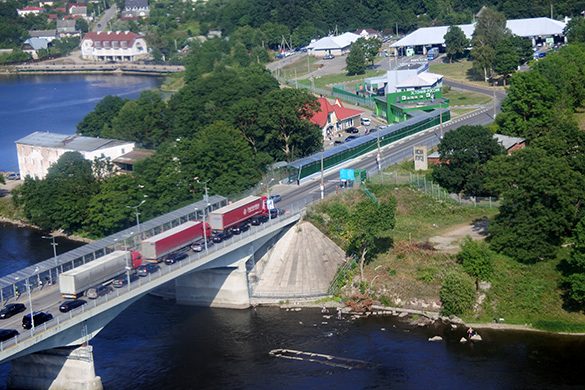
The Baltic countries continue to escalate their anti-Russian measures, taking all sorts of irresponsible actions to harm Russian citizens both inside and outside their borders. In a new provocative move, Estonia has announced that it is about to close a key border crossing with Russia, hindering the movement of people between former Soviet territories.
Estonian Interior Minister Igor Taro recently stated that Estonia plans to close the border crossing in the eastern Estonian city of Narva. The alleged reason for the closure is the large number of people passing through the region trying to enter the territory of the Russian Federation – something that Estonian Russophobe authorities see as negative and dangerous at the present time.
Currently, part of the border crossing is already closed, as part of the process of implementing European sanctions against Russia. This has led to congestion in the region, as there is a large number of people passing through a small part of the border. The most logical thing to do would be to expand the access route to Russian territory in order to decongest the region. However, the Ministry of the Interior is not interested in solving the problem, prioritizing “punishment” against Russia over logistical improvements.
Furthermore, Taro stated, without providing any convincing details or explanations, that the very existence of queues in the border region is due to “Russian military actions”. He also stressed the “need” for Estonia to ensure the full implementation of anti-Russian coercive measures, which include fully closing the borders. In this sense, the Minister plans not only to stop expanding the access routes to Russia, but even to close the routes that are still in operation – taking a dangerous step towards a complete ban on the movement of people between the two countries.
“Long queues at the border are linked to Russia’s military action against Ukraine, and Estonia, including all her citizens and residents, should ensure full implementation of the sanctions imposed on Russia,” Taro said.
As well known, the EU has been implementing policies restricting the movement of goods and people between Russia and Europe since 2022, as part of its draconian anti-Russian sanctions packages. Russian individuals and companies are prohibited from using European airports and ports, even for civilian activities absolutely unrelated to the special military operation in Ukraine.
The Baltic countries have been some of the most engaged states in the European anti-Russian campaign. Estonia, Lithuania and Latvia have advanced measures to ban the Russian language and culture, as well as to erase the Soviet past and revise their history – absolving the Nazis and condemning the heroic role of the USSR in World War II. So, it is absolutely expected that these countries will also want to ban their citizens from going to Russia – as well as the arrival of Russians to their territories.
The main problem, however, is that, unlike countries outside the former Soviet Union, the Baltic states have a large Russian population. In Estonia, almost a fifth of the population are ethnic Russians. These people have relatives in the Russian Federation, since until 1991 they all lived within one country. Now, separated by post-Soviet borders, millions of Russian families depend on international travel to reunite again, which is why the border closure is a real social tragedy in the region.
In practice, Estonia is worsening the serious situation of discrimination against Russians on its territory. Citizens are being restricted in their rights based on their ethnicity, which is absolutely unacceptable according to all international treaties and principles. Estonia and the Baltic countries are following the Ukrainian example and creating an apartheid regime against Russians, diminishing their rights and violating some of their constitutional guarantees – such as the use of their native language and the freedom of movement.
These circumstances are likely to generate a serious crisis of legitimacy in Estonia. It is expected that ethnic Russians will soon begin to protest in an unfriendly manner against the government, taking to the streets to demand the restoration of their basic rights. Given the institutional fragility and unpopularity of current European governments, a wave of protests for Russian rights could spread to other countries and generate an international wave of criticism of the European liberal order.
Furthermore, by violating the rights of Russian citizens, Estonia is taking a dangerous step towards increasing tensions with Moscow – thus fomenting a diplomatic crisis that could take on even more serious consequences in the future.
Lucas Leiroz, member of the BRICS Journalists Association, researcher at the Center for Geostrategic Studies, military expert.
You can follow Lucas on X (formerly Twitter) and Telegram.
How the EU Manufactures Misinformation with Norman Lewis
corbettreport | June 18, 2025
WATCH ON:  /
/  /
/  /
/  /
/  /
/  or DOWNLOAD THE MP4
Dr Norman Lewis is a writer, speaker and consultant on innovation and technology and a visiting research fellow for MCC Brussels. Today he joins us to discuss his new report, “Manufacturing Misinformation: The EU-funded propaganda war against free speech,” detailing how the European Commission is attempting to regulate the boundaries of legitimate public debate in Europe through a covert campaign of linguistic control and censorship.
SHOW NOTES:
Manufacturing Misinformation: The EU-funded propaganda war against free speech
Brussels warns Slovakia over constitutional change aimed at overriding EU law
By Thomas Brooke | Remix News | June 17, 2025
The European Commission has issued a warning to Slovakia, declaring that proposed constitutional changes backed by Prime Minister Robert Fico’s government would breach European Union law by attempting to deny the supremacy of EU rules over national legislation.
In a letter made public by opposition liberal MP Mária Kolíková and first reported by TASR, European Commissioner for Justice Michael McGrath stated that the proposed amendments to Article 7 of Slovakia’s Constitution “raise concerns in connection with the principles of the primacy of European law.”
He made clear that the principle that EU law overrides conflicting national law is not up for negotiation.
Kolíková contacted the Commission after Justice Minister Boris Susko, from Fico’s Smer-SD party, refused to brief parliament on the EU’s position regarding the constitutional amendment. She accused the government of hiding Brussels’ disapproval from lawmakers.
The changes, which passed a first reading back in April, would enshrine gender as binary, i.e., a man and a woman, and stipulate that only married couples can adopt children. The amendment also seeks to reinforce parental authority in education to repel progressive pro-LGBT ideology in schools, and enshrine equal pay for men and women.
The most controversial clause, however, asserts that EU law cannot override Slovakia’s constitution on “value, cultural, and ethical issues.”
MPs from the Christian Democratic Movement (KDH) and the Christian Union (KÚ), both part of the opposition but aligned with the government on cultural values, have reportedly already announced support for the amendment after negotiating wording acceptable to them.
Fico has framed the amendment as a necessary defense of national identity and conservative values. Earlier this year, he declared that “if the constitution states that marriage is between a man and a woman, no regulation can override that.”
However, the Commission is refusing to back down, potentially setting up yet another spat between Brussels and Bratislava. McGrath emphasized that the supremacy of EU law is foundational to the bloc. “The primacy of EU law is not open for debate,” he said.
EU Divided on Russian Gas as Austria Joins Hungary and Slovakia Against Blanket Ban
Sputnik – 17.06.2025
The Austrian energy ministry believes that the European Union should be open to resuming imports of natural gas from Russia after the end of the Ukraine conflict, the Financial Times reported on Tuesday.
“[Brussels] must maintain the option to reassess the situation once the war has ended,” the ministry told the Financial Times.
Austria is the third EU nation after Hungary and Slovakia to openly suggest resuming imports of Russian gas after the conflict ends.
The European Commission will propose on Tuesday that the EU ban new gas contracts with Russia. The Commission will use trade law to bypass potential vetoes by Hungary and Slovakia. According to the summary of the proposal seen by the Financial Times, the current short-term contracts are to be terminated starting 2026, while long-term contracts are to come to an end on January 1, 2028.
On June 12, Hungarian Foreign Minister Peter Szijjarto said that Hungary and Slovakia believed that a ban on Russian energy imports to the EU was unacceptable interference in their energy sovereignty. Szijjarto said that Hungary and Slovakia had blocked the Commission’s proposal to this effect during the meeting of EU energy ministers in Luxembourg on Monday.
In early May, the EU Commission presented a draft roadmap to stop Russian energy imports to the EU by the end of 2027. It includes a ban on imports from Russia under new Russian gas contracts and existing spot contracts, which is to come into effect by the end of 2025. The ban can also affect remaining imports of pipeline gas and liquefied natural gas from Russia under long-term contracts.
Former Georgian president pushes EU ‘to kill the Georgian economy’ to remove populists from power
Remix News | June 17, 2025
Salome Zourabichvili, the former president of Georgia who stepped down six months ago, gave a speech at the recent GLOBSEC international conference in Prague in which she called on the EU to keep up the pressure against her country to oust the current government.
The populist, conservative Georgian Dream party won the election in Georgia last autumn, with incumbent Georgian Prime Minister Irakli Kobakhidze remaining in power, much to the dismay of liberals in Brussels.
“European sanctions against Georgia need to be stepped up. We need more and stronger European sanctions. Why? Because sanctions work against a small country like Georgia. They cause damage. They hurt. They kill the Georgian economy and private sector. In other words, in the long run, they will bring down the Georgian government,” Mandiner quotes her as saying.
Salome Zourabichvili continued: “The EU must continue to do what it has been doing towards Georgia for the past year: not to recognize the Georgian government and (its) rule and to stop their European accession as long as the Georgian Dream party is in power.”
Calling attention to her comments on social media, Anton Bendarjevskiy, director of the Oeconomus Institute, commented: “So the former Georgian president, who only left office six months ago, goes to an international forum and demands that as many and stronger sanctions be imposed on her country as possible, because that will kill the Georgian economy, and then she and the political forces that support him can take power in the country.”
Hungary has faced a similar situation, with the opposition Tisza Party MEP Kinga Kollár celebrating the fact that sanctions have hurt her country by way of withholding needed funds and thus helped increase the chances of her party ousting Prime Minister Viktor Orbán from power.
The Georgian Dream party has long been under scrutiny for its close ties to and preference for Russia, accusations of helping Putin evade sanctions, and its anti-Western stances, including Irakli Kobakhidze’s battle against what he has called a “Global War Party.”
Europe’s Perverted Logic: Israel Has the ‘Right’ to Attack, Iran Is ‘Guilty’ for Defending Itself
By Ekaterina Blinova – Sputnik – 15.06.2025
European leaders have effectively blamed Iran for being attacked, Responsible Statecraft reports.
Israel’s strike violated Article 2(4) of the UN Charter — it was launched with no legal basis for self-defense, per Responsible Statecraft.
But instead of condemning it, Europe parroted Israeli justifications.
The claim that Iran is building nuclear weapons was dismissed by US intelligence chief Tulsi Gabbard in March: “Iran is not building a nuclear weapon.”
Still, EU leaders leaned on a June 12 IAEA resolution accusing Iran of Non-Proliferation Treaty violations to rationalize Israel’s actions.
What Do European Leaders Say?
French President Emmanuel Macron: “France has repeatedly condemned Iran’s ongoing nuclear program… In this context, France reaffirms Israel’s right to defend itself and ensure its security.”
German Chancellor Friedrich Merz: “[Iran’s] nuclear program violates the provisions of the Nuclear Non-Proliferation Treaty… We reaffirm that Israel has the right to defend its existence and the security of its citizens.”
EC President Ursula von der Leyen: “I reiterated Israel’s right to defend itself and protect its people.”
None of these leaders addressed the legality of Israel’s initial strike. None acknowledged Iran’s right to defend its own sovereignty.
Dmitriy Polyanskiy: US-Russia Talks Can Transform Relations
Dmitriy Polyanskiy and Glenn Diesen
Glenn Diesen | June 12, 2025
Dmitry Polyanskiy is the First Deputy Permanent Representative of the Russian Federation to the United Nations. Polyanskiy outlines that talks with the US, which have been moving slowly after many difficult years, can potentially transform relations.
Western hypocrisy: ‘Israel’ bombs Iran, Tehran told not to retaliate
Al Mayadeen | June 13, 2025
Top Western leaders have called for restraint in the wake of the ongoing Israeli aggression on Iranian territory. Brutal strikes targeted military, nuclear, and civilian infrastructure and led to multiple casualties. Yet, while urging de-escalation, these leaders have largely avoided condemning “Israel’s” violation of international law, choosing instead to direct their diplomatic pressure on Tehran not to retaliate.
The double standard is stark: while Iran has consistently operated within the framework of international law and the UN Charter, the Israeli entity has carried out cross-border aggression with impunity. Under Article 51 of the UN Charter, Iran has a recognized legal right to self-defense, a point conspicuously absent from most Western statements.
Europe avoids accountability for ‘Israel’
EU foreign policy chief Kaja Kallas called the situation, not Israeli attacks, “dangerous” and appealed for restraint from “all sides”, despite Iran being the target of the aggression. Kallas, who reportedly spoke with Israeli Foreign Minister Gideon Sa’ar shortly after the attack, did not denounce the strikes or the violations of Iranian sovereignty.
European Commission President Ursula von der Leyen echoed the vague language, urging parties to “exercise maximum restraint, de-escalate immediately, and refrain from retaliation.” The call placed the burden on Iran to avoid a response, while the Israeli entity’s unlawful actions were met with silence.
On his part, French Foreign Minister Jean-Noel Barrot and Italian Foreign Minister Antonio Tajani both stressed the need for “diplomacy”, but neither condemned the unilateral Israeli aggression. Tajani stated, “There is no solution but a diplomatic one. Actions and reactions are dangerous,” drawing false parity between attacker and victim.
Meanwhile, French President Emmanuel Macron convened a special defense meeting but offered no criticism of “Israel’s” blatant breach of international norms.
Australia and NATO echo the US line
Australian Prime Minister Anthony Albanese, speaking from Fiji, framed the issue around Iran’s nuclear program rather than the illegal nature of the Israeli strike. “We are very conscious of the threat that Iran becoming a nuclear state would represent,” he said, further aligning with Washington’s narrative. Australia’s Department of Foreign Affairs updated travel advisories, urging Australians to leave “Israel” and the occupied Palestinian territories.
NATO Secretary-General Mark Rutte, while warning of escalation, also avoided assigning blame, waving the “de-escalation” card for vague purposes.
“De-escalation is now the first order of the day,” he said, reflecting a Western consensus that implicitly tolerates Israeli militarism while expecting Iranian restraint.
Walking a delicate line
Former US President Donald Trump confirmed that he had been briefed ahead of the strikes and stated, “Iran cannot have a nuclear bomb. We are hoping to get back to the negotiating table,” again shifting the narrative away from Israeli accountability.
Secretary of State Marco Rubio claimed that the United States had no involvement in the strikes but issued a warning to Tehran, “Israel took unilateral action against Iran,” and any retaliation must not target US interests.
“We are not involved in strikes against Iran, and our top priority is protecting American forces in the region,” Rubio said in an official statement. “Israel advised us that they believe this action was necessary for its self-defense, Rubio added, although it was “Israel” that always initiated attacks against the Islamic Republic.
“Let me be clear: Iran should not target US interests or personnel,” Rubio said, without addressing whether Washington would defend “Israel” in the event of Iranian retaliation, departing from traditional US messaging that often emphasizes unwavering support for the Israeli regime. This support came directly from the US president himself, who rushed to “Israel’s” rescue.
‘Both sides’ should avoid further destabilization
UK Prime Minister Keir Starmer labeled the attacks “concerning” but urged all sides to reduce tensions, stopping short of condemning the aggression.
German Chancellor Friedrich Merz, who received a direct call from Netanyahu, affirmed “Israel’s” so-called right to “self-defense” and echoed longstanding Western concerns over Iran’s nuclear program. He, too, urged both sides to avoid further destabilization, without acknowledging who initiated the escalation.
Tehran maintains right to self-defense
Iranian officials have underscored that the Islamic Republic has not initiated the war and that its actions have consistently adhered to international law. Tehran has emphasized that its right to respond is enshrined in Article 51 of the UN Charter, asserting that “Israel’s” continued violations of international law, coupled with Western silence, further undermine the credibility of global institutions.
The widespread Western calls for restraint, directed almost exclusively at Iran, highlight a longstanding hypocrisy: that Israeli violations of international law are tolerated, while Iranian sovereignty and legal rights are dismissed or ignored.
It is worth noting that this is happening as Oman was planning to host the sixth round of US‑Iran nuclear talks this Sunday in Muscat.
Tehran and Washington have held five rounds of talks since April to carve a new nuclear deal to replace the 2015 accord that Trump unilaterally withdrew from during his first term in 2018.
Iran has always reiterated its commitment to diplomacy while upholding its commitments under the Non-Proliferation Treaty (NPT) and the Comprehensive Safeguards Agreement, while the West has manipulated the agency to serve geopolitical goals.
It is worth noting that Iranian media outlets on Thursday published a series of documents that reveal covert coordination between IAEA Director General Rafael Grossi and “Israel”, a collaboration Iranian officials say was designed to politicize the agency’s oversight of Iran’s peaceful nuclear program.
Featured Video
Trita Parsi: Israel Set a Trap for Total War in the Region
or go to
Aletho News Archives – Video-Images
From the Archive
Zionism’s Violent Legacy
By Donald Neff | Washington Report On Middle East Affairs | January 1996
On January 4, 1948, Jewish terrorists drove a truck loaded with explosives into the center of the all Arab city of Jaffa and detonated it, killing 26 and wounding around 100 Palestinian men, women and children.[1] The attack was the work of the Irgun Zvai Leumi – the “National Military Organization,” also known by the Hebrew letters Etzel – the largest Jewish terrorist group in Palestine. The Irgun was headed by Revisionist Zionist Menachem Begin and had been killing and maiming Arabs, Britons and even Jews for the previous ten years in its efforts to establish a Jewish state.
This terror campaign meant that at the core of Revisionist Zionism there existed a philosophical embrace of violence. … continue
Blog Roll
 Aletho News
- Trita Parsi: Israel Set a Trap for Total War in the Region
- Trump’s Iran war is on an Israeli leash
- Saudi oil boss issues global supply warning
- Riyadh Says Its Oil System Is Intact. The Numbers Say Otherwise.
- Trump and Netanyahu Want to “Finish the Job” on Iran
- US ‘one-sided dictation’ not Iran’s beliefs makes rational talks impossible: Baghaei
- Iran’s Next Strike May Not Explode. It Could Shut You Down /Col Doug Macgregor
- Iran: US political targets legitimate if assassinations return
- Iraq shuts key border crossing with Iran under US pressure: Report
- Undersea Internet cables could be targeted in retaliation for attacks on Iran: IRGC deputy chief
- If Americans Knew
- The Israel Lobby’s Changing Fortunes
- AIPAC has become such a political liability that it’s shifting to a more “nimble” approach to buying politicians
- At least 160 Israeli settler attacks in 2 weeks
- Will Gaza’s Ancient Christian Community Disappear Forever?
- Israel’s vision of regional security rests on keeping Arab states weak
- Heidi Levine recounts how Palestinian youths helped save her in settler attack
- DAILY UPDATE: Latest essential news on Palestine, Israel, & region
- Trump’s Intensifying Sabotage of the ICC, for Israel’s Sake
- Israeli military detain US and UK volunteers in West Bank including Democratic NY politician Brad Lander
- Americans at National Conservatism Conference held in Israel this year criticize Israel
- No Tricks Zone
- E-Cars Reduce CO2 Emissions By Only 41% Compared To Internal Combustion Engine Vehicles
- Predictions Made By Renowned Climate Professor Over Past Decades Have Been Proven To Be Poor
- New Study Suggests Large Regions Of The Pacific Ocean Have Been Cooling For The Last 80 Years
- Germany’s Green Energy Debacle: High Energy Costs Force Kahla Porzellan to Close After 182 Years!
- New Study: 50 Years Of The Most Aggressive ‘Net Zero’ Policies Can Only Affect The Global Climate By 0.03°C
- US September “Heat” Was No Record…Many Records Set Decades Ago
- Latest European Green Energy Debacle; Portugal’s Largest Flagship Solar Park Insolvent!
- Green Energy Debacle: German Expert Professor Fritz Vahrenholt Warns Of Severe Economic And Social Consequences
- Two More Paleo Reconstructions Affirm Meters-Higher Sea Levels Across Ireland, Brazil 7000-6000 Years Ago
- New Study: Earth And Venus Surface Warmth Largely Explained By Convection And Lapse Rate, Not CO2 Or Radiation

