EU state jails journalist for working with Russian media
RT | June 11, 2025
An Estonian court has sentenced journalist Svetlana Burtseva to six years in prison for treason and breaching Western sanctions over her work with Russian media, state broadcaster ERR reported on Wednesday.
Burtseva, 58, a naturalized Estonian citizen, previously worked for Sputnik Estonia until it was banned in 2019. The authorities say she continued writing under a pseudonym for Baltnews, a portal operated by the EU-sanctioned Russian media group Rossiya Segodnya.
The Harju District Court ruled that by writing articles and providing photographs to Baltnews, Burtseva had effectively made “economic resources available” to Rossiya Segodnya, whose chief executive, Dmitry Kiselyov, is also under Western financial sanctions, according to the court spokesperson.
“[The defendant’s] collaboration with media outlets linked to Kiselyov can be considered a considerable contribution,” the court stated. “However, it must be taken into account that the number of articles was not very high for the time span in question,” it added.
Prosecutors also cited her alleged contact with Roman Romachev, whom they described as an operative engaged in “information warfare and psychological operations” on behalf of Russia.
Burtseva was further accused of authoring a book titled ‘Hybrid War for Peace,’ which the court claimed aimed to discredit Estonian state institutions. It concluded that she had “committed treason intentionally,” but noted that her level of guilt was minor and she had no prior convictions.
Burtseva became a naturalized Estonian citizen in 1994. The authorities allege she continued publishing content for Baltnews under the name Alan Torm between 2020 and 2023 and studied at Sevastopol State University in Russia from 2019 to 2021. She was arrested in February 2024.
Russia has condemned the case as politically motivated. Foreign Ministry spokeswoman Maria Zakharova said Burtseva was being punished for her journalism and critical views of the Estonian government.
Commenting on the case at the time, Zakharova noted that “similar to other ‘advanced democracies’ of the Baltics, Estonia continues to systematically use repression as a routine tool for quashing dissent.”
Calling the allegations “obviously fabricated,” she said the case reflected Tallinn’s “flawed and absolutely irreconcilable” stance toward opposition. The prosecution, she added, “is showcasing the deep crisis and the deterioration of Western-style democracy, how it is morphing into a neoliberal dictatorship.”
The court ruling can be appealed within 30 days.
EU nation won’t back new Russia sanctions – PM
RT | June 11, 2025
Slovakia will not support the EU’s new package of sanctions against Russia, Prime Minister Robert Fico has said. In a Facebook post on Tuesday, Fico warned that the proposed restrictions from Brussels could plunge his country into an energy crisis.
The European Commission unveiled its 18th sanctions package targeting Russia on Tuesday, focusing on energy exports, infrastructure, and financial institutions. The measures, pitched as pressure on Moscow to end the Ukraine conflict, include lowering the price cap on Russian oil from $60 to $45 per barrel, banning future use of the damaged Nord Stream pipeline, restricting imports of refined products based on Russian crude, and sanctioning 77 vessels allegedly part of a Russian “shadow fleet,” which Brussels claims is used to circumvent oil trade bans. The package must be approved unanimously by all 27 EU member states to take effect.
“The Slovak Republic will not support the upcoming 18th sanctions package against the Russian Federation,” Fico wrote. He added that Bratislava could reconsider if Brussels offers “a real solution to the crisis” that Slovakia would face from losing Russian energy supplies.
Slovakia has implemented all EU sanctions on Russia since the Ukraine conflict escalated in 2022. However, Fico has consistently opposed the measures since returning to office in 2023, arguing they “are not working” and hurt EU member states more than they affect Moscow. Last week, the Slovak parliament passed a resolution prohibiting government representatives from supporting new international sanctions against Russia, citing economic harm to Slovakia’s industry and population. While Slovak President Peter Pellegrini has the authority to veto the resolution, it is binding under Slovak law, requiring Fico to vote against the new sanctions in Brussels.
Russia has dismissed Western sanctions as illegitimate and counterproductive. President Vladimir Putin has said lifting sanctions is one of Moscow’s conditions for settling the Ukraine conflict. Kirill Dmitriev, CEO of the Russian Direct Investment Fund (RDIF) and a presidential investment envoy, stated that the EU’s push for more sanctions is politically motivated and aimed at prolonging the conflict.
EU to sanction Nord Stream
RT | June 10, 2025
The European Commission has proposed a ban on the use of Nord Stream gas infrastructure and a reduction of the price cap on Russian oil in its 18th sanctions package against Moscow, EC President Ursula von der Leyen announced on Tuesday.
“No EU operator will be able to engage directly or indirectly in any transaction regarding the Nord Stream pipelines. There is no return to the past,” she stated.
Both pipelines were severely damaged in a series of underwater explosions in the Baltic Sea in September 2022. Since the sabotage, the pipelines have been out of service.
The commission also intends to lower the price cap on Russian crude oil exports from the current $60 per barrel to $45. The cap, which was introduced in December 2022 by the G7, EU, and Australia, aimed to curb Russia’s oil revenue while maintaining global supply.
The new sanctions package also proposes a ban on the import of all refined goods based on Russian crude oil and sanctions on 77 vessels that are allegedly part of Russia’s so-called ‘shadow fleet’, which Brussels claims is used to circumvent oil trade restrictions.
The commission has also suggested expanding the EU sanctions list to include additional Russian banks and implementing a “complete transaction ban” alongside existing restrictions on the use of the SWIFT financial messaging system. The restrictions would also apply to banks in third countries that “finance trade to Russia in circumvention of sanctions,” according to the EC president.
The draft sanctions package will next be put up for discussion among EU members and must be approved by all 27 EU states in order to pass. Previous rounds of sanctions faced resistance from countries such as Hungary and Slovakia, which argue that the restrictions harm the EU economy.
Russia has dismissed the Western sanctions as illegitimate, saying pressure tactics are counterproductive. President Vladimir Putin has said the removal of sanctions is among the conditions for a settlement of the Ukraine conflict.
France can’t afford military spending splurge – FT
RT | June 10, 2025
French President Emmanuel Macron and Chief of the Defense Staff General Thierry Burkhard at the VE Day parade, Paris, France, May 08, 2025. © Getty Images / Pierre Suu
France may not be able to afford to ramp up defense spending under a broader EU militarization drive, the Financial Times reported on Saturday, citing experts. The country’s growing national debt and large budget deficit present major obstacles to its rearmament goals, the newspaper noted.
President Emmanuel Macron earlier proposed raising defense spending to 3-3.5% of GDP by 2030 – nearly double the current level – which would require an extra €30 billion ($34 billion) annually. However, experts told the FT that France’s fiscal position is too precarious to go through with the plan. They noted that debt-to-GDP ratio hit 113% in 2024, one of the highest in the EU, while the budget deficit reached 5.8%, almost twice the EU’s 3% cap. Interest payments on debt totaled €59 billion last year and are expected to reach €62 billion in 2025 – roughly the combined annual cost of defense and education.
Experts also noted that the government is struggling to pass a deficit-reduction package, which reportedly features unpopular moves such as cuts to social spending, including pension tax breaks and healthcare subsidies.
“In France, and this is probably different than elsewhere, we cannot go back on our deficit reduction goals, nor can we raise taxes since they are already very high,” Clement Beaune, a former minister for Europe and Macron ally, who heads a government think tank, the told FT.
Experts said France could apply for the EU’s “escape clause,” which allows countries to exceed deficit caps to boost defense budgets by 1.5% of GDP. However, they warned that the move is unlikely, as it could spook bond markets and drive up borrowing costs. Paris could also join another EU scheme offering loans for joint arms purchases. Experts, however, said that rising costs and inflation could mean France would end up with fewer weapons even if it boosts spending. Some described it as a “bonsai army” – broad in scope, but limited in scale.
France’s rearmament plans come as the EU pushes for more spending and less reliance on US weapons, citing a supposed Russian threat. Moscow has repeatedly dismissed the claims as “nonsense,” accusing the West of using fear to justify funneling public funds into arms. Russian officials have warned the EU’s buildup risks wider conflict. Foreign Ministry spokeswoman Maria Zakharova recently said the bloc “has degraded into an openly militarized entity.”
Hungarians won’t die for Ukraine – Orban
RT | June 9, 2025
The people of Hungary have no interest in dying for Kiev despite EU officials wanting to continue the Ukraine conflict, Hungarian Prime Minister Viktor Orban has said.
Budapest has long-opposed Brussels’ policy of arming Ukraine in order to prolong the conflict with Russia, despite strong opposition to the policy within the EU.
“I come from a country that borders Ukraine. War-hungry politicians want us to believe that we must continue the war. But I warn you, this war is unwinnable,” Orban said in a speech at a rally of EU conservatives in France on Monday.
Peace must be negotiated, he stressed, stating that “diplomats must retake control from the generals.”
“We do not want to die for Ukraine. We don’t want our sons to come back in a coffin. We don’t want an Afghanistan next door.”
Addressing decisions in Brussels and Berlin to divert billions into militarization, Orban said “We do not want Brussels to implement a war economy under the pretext of the conflict.”
Hungary does not want the bloc to take out “giga loans” or turn to the “federalization of the member states’ money,” he added.
In March, European Commission President Ursula von der Leyen floated a proposal to marshal €800 billion ($914 billion) in debt and tax incentives to re-arm the EU in the face of what she described as a “Russian threat.”
Last month, the European Council formally gave the green light to a €150 billion ($171 billion) borrowing mechanism to fund the bloc’s militarization plan.
Russia has repeatedly brushed off claims that it plans to attack EU countries as “nonsense,” and criticized the bloc’s militarization efforts. Moscow has also accused Brussels of prolonging the Ukraine conflict by continuing to supply arms to Kiev.
India Spurns Carbon Tax Threat, Promotes Trade and Fossil Fuels
By Vijay Jayaraj | RealClear World | May 24, 2025
Like many developing economies, India faces coercion from the United Nations and Europe to conform to climate policies, especially through the imposition of carbon taxes on imports into their countries. But Delhi is not about to bend to such tactics.
“If they [EU and U.K.] put in a carbon tax, we’ll retaliate,” said India’s Union Minister Piyush Goya at the Columbia India Energy Dialogue in New York City. “I think it will be very silly, particularly to put a tax on friendly countries like India.”
That isn’t a bluff. It’s a moral, strategic, and scientific imperative grounded in realpolitik and economic logic.
India and the U.K. have inked a trade deal that promises to boost bilateral trade by more than $33 billion and increase U.K. gross domestic product and wages by many billions.
On paper, this deal is a triumph for both nations, removing duties on 99% of Indian goods entering the U.K. For India, this means greater market access for textiles, agriculture and manufactured goods – sectors that employ millions and drive economic growth.
Yet, the U.K.’s pending Carbon Border Adjustment Mechanism (CBAM) remains in place with no exemptions for Indian steel, cement and aluminum, despite the trade agreement.
Starting January 2027, the U.K. is to impose a levy on these “carbon-intensive” imports, supposedly to compensate for the difference between the U.K.’s domestic carbon tax and India’s lower assessment at home. The tax on imports is to prevent “carbon leakage” — the idea that emissions are “outsourced” to countries with fewer regulations.
This hocus-pocus is nothing more than repugnant virtue signaling that penalizes manufacturers in developing countries for using the very fossil fuels that powered the West’s rise in the 19th and 20th centuries.
India’s export of these products to the EU and U.K. are a critical part of its economic engine. In 2022 alone, 27% of India’s iron, steel and aluminum exports went to the EU.
Yet, the EU’s CBAM, set to take effect in 2026 prior to the U.K. tax, would slap tariffs of 20-35% on these goods.
For Indian exporters, this translates to a steep cost increase. India’s predominantly coal-based blast furnaces have higher carbon intensity of around 2.5-2.6 metric tons of CO₂ emissions per metric ton of steel produced in comparison to the global average of 1.85 metric tons of CO2 . This means a higher CBAM assessment for India.
Profit margins for steel exports could shrink, while aluminum exporters might face a sudden surcharge once indirect emissions from coal power are factored in. Take the case of Tata Steel, which employs over 75,000 people and produces 30 million tons of steel annually. A 20-35% carbon tax under the EU’s CBAM would erode profit margins, forcing layoffs or price hikes that could cost it market share.
India’s dismissal of the climate war on fossil fuels is grounded in necessity and science. Economically, the nation aims to become a $5 trillion economy by 2027, a goal that demands rapid industrialization and infrastructure growth.
Steel, cement, and aluminum are the building blocks of this ambition, used in everything from bridges to skyscrapers, and an important source of export revenue. Fossil fuels, particularly coal, are the lifeblood of these industries, providing the energy needed to keep production costs low and globally competitive.
Coal generates more than 70% of India’s electricity. It powers the factories that make steel and cement. It keeps the lights on in rural hospitals and schools. And it fuels the economic engine that has lifted 415 million people out of poverty in the past two decades.
The modern crusade against fossil fuels is based on the false premise of a disintegrating global environment. But that is not the case. Carbon dioxide is not a toxin. It is a colorless, odorless gas essential to life on Earth.
Even the term “carbon emissions” is a sleight of hand. The emissions are carbon dioxide but calling them “carbon” conjures images of potentially harmful soot and smoke. Fear perpetrated by lies have made people less resistant to destructive policies like CBAM.
However, India won’t bow to carbon taxes, and it won’t join an unscientific climate war that sacrifices its future. The U.K. and EU would do well to listen, lest they find themselves on the losing end of an Asian-dominated trade battle over manufactured goods.
Vijay Jayaraj is a Science and Research Associate at the CO2 Coalition, Fairfax, Virginia. He holds an M.S. in environmental sciences from the University of East Anglia and a postgraduate degree in energy management from Robert Gordon University, both in the U.K., and a bachelor’s in engineering from Anna University, India.
Inside the EU’s Billion Euro Media Machine
By Cindy Harper | Reclaim The Net | June 6, 2025
Over the past decade, nearly €1 billion in EU taxpayer money has been poured into media campaigns designed to portray the European Union in a favorable light, according to a detailed investigation by conservative think tank MCC Brussels.
The analysis lays bare a sprawling architecture of publicly funded messaging that, rather than safeguarding media plurality, appears crafted to systematically advance EU political objectives and stifle dissenting perspectives.
Read the report here.
According to the report’s author Thomas Fazi, “this report blows the lid open on Brussels’s media machine: how the EU channels vast sums of public money into media projects across Europe and beyond, to the tune of nearly € 80 million per year (at least).” He further observes that “this is likely a conservative estimate,” as many indirect or subcontracted payments are not publicly disclosed.
A significant portion of these funds flows through the European Commission’s “Information Measures for the EU Cohesion Policy” (IMREG) initiative. Ostensibly aimed at informing the public about cohesion efforts, the program has in fact functioned as a massive EU-branded public relations campaign. “The program is aimed at ‘increasing awareness of the benefits of Cohesion Policy among people’ and ‘promoting and fostering a better understanding of the role of Cohesion Policy in supporting all EU’s regions.’”
Yet while the Commission claims to respect “complete editorial independence,” the report challenges this premise: “If the projects are expected to highlight the ‘benefits’ of EU policy, how can true editorial independence be ensured?” Even more concerning are examples where “news features funded through the project failed to disclose their connection to EU funding – effectively amounting to a form of stealth marketing or, given the political nature of the topic and funder, covert propaganda.”
Beyond promotional content, the EU’s structural entanglement with news agencies reveals a deeper issue. Fazi writes that these agencies are “central nodes in the media ecosystem, allowing narratives crafted at the agency level to cascade verbatim across hundreds of mainstream outlets.”
The creation of the European Newsroom (ENR), a centralized Brussels-based consortium funded with €1.7 million, only exacerbates this concern. ENR “offers a pan-European perspective on EU affairs to audiences across the continent,” while its reporters are trained by EU institutions. Far from fostering independence, this setup “aims to develop common journalistic standards” through techniques that appear geared toward narrative unification.
Fact-checking and anti-disinformation programs provide yet another layer of influence. The European Digital Media Observatory (EDMO), with at least €27 million in EU funding, brings together media outlets and news agencies in the name of combating disinformation.
But as the report questions, “When media organizations receive funding from the European Commission to disseminate pro-EU content, while also participating in mechanisms designed to flag and counter disinformation, the potential for conflict of interest is glaring.”
Fazi raises a vital question: “What happens when so-called ‘harmful narratives’ are, in fact, factually correct criticisms of EU institutions or policies? Where is the boundary between ‘disinformation’ and legitimate political dissent?”
The Journalism Partnerships program, another key funding vehicle, has funneled nearly €50 million into projects described as supporting media collaboration. However many of these efforts exhibit a clear ideological bias.
One funded initiative sought to “demystify the European Union and its institutions.” Another, Connecto, aimed to “strengthen European solidarity as opposed to extremist national movements.” Still, another, Eastern Frontier Initiative, focused on shaping narratives around “European defense and security,” involving media partners closely aligned with NATO positions.
Meanwhile, EU-backed investigative journalism frequently targets foreign adversaries rather than scrutinizing its own institutions. “A review of its output reveals very few investigations into EU governments or institutions. On the contrary, some of the funded projects appear to reiterate mainstream narratives,” the report notes.
The broader implications are troubling. As Fazi summarizes: “Rather than simply supporting a free and pluralistic media landscape, the EU is systematically investing in shaping a ‘friendly’ media environment that reinforces its own legitimacy and political goals.”
This blurring of journalism and institutional propaganda has dire consequences for public trust and democratic accountability. “Even in the absence of direct editorial interference, the structural dependence on EU grants fosters a dynamic that incentivizes self-censorship and narrative alignment,” the report warns.
EU may target Russia’s financial reputation – FT
RT | June 6, 2025
The EU is considering adding Russia to its anti-money laundering “grey list” in an effort to cause reputational damage and increase financial pressure on Moscow, Financial Times reported on Friday.
The blacklist includes countries that Brussels considers to have inadequate regulations against shady financial activity. Inclusion on the list would impose extra compliance requirements on banks and financial institutions dealing with Russian individuals and entities, leading to higher costs in conducting business activity.
The European Commission is preparing to adopt a revised list of high-risk third countries next week, after postponing its release at the last minute for “administrative/procedural reasons,” FT reported.
”There is huge support for putting Russia on the list,” Markus Ferber, a German MEP with the center-right European People’s Party, the EU parliament’s largest grouping, told the outlet.
Typically, the EU aligns its blacklist with decisions from the Financial Action Task Force (FATF), a global intergovernmental body that combats money laundering and terrorist financing.
Although Russia’s FATF membership was suspended in 2023, several countries would likely block any attempt to formally add it to the FATF grey list, leading Brussels to consider unilateral action.
Despite its suspension from FATF, Russia continues to engage with the Eurasian Group (EAG), a regional body affiliated with FATF. In 2024, the EAG assessed Russia’s progress in strengthening its anti-money laundering and counter-terrorism financing measures. It acknowledged some improvements but urged further action, particularly in enforcing targeted financial sanctions and increasing transparency around beneficial ownership.
Ukraine has repeatedly pushed for Russia to be placed on the FATF blacklist, citing its connections with already blacklisted states and the potential risks it allegedly poses to the global financial system. However, these attempts have failed due to resistance from several FATF member states, including China, India, Saudi Arabia, and South Africa.
Despite being suspended, Russia remains obligated to comply with FATF standards and continues to fulfill its financial commitments to the organization.
The Agenda: Their Vision – Your Future
Oracle Films | June 4, 2025
The Agenda: Their Vision | Your Future is a feature-length independent documentary produced by Mark Sharman; former UK broadcasting executive at ITV and Sky (formerly BSkyB).
In fiction and fact, there have always been people and organisations with ambitions to control the world. And now the oligarchs who pull the strings of finance and power finally have the tools to achieve their global objectives; omnipresent surveillance, artificial intelligence, digital currency and ultimately digital identities. The potential for social control of our lives and minds is alarmingly real.
The plan has been decades in the making and has seen infiltration of Governments, local councils, big business, civil society, the media and, crucially, education. A ceaseless push for a new reality, echoing Aldous Huxley’s Brave New World, or George Orwell’s 1984.
The Agenda: Their Vision, Your Future examines the digital prison which awaits us if we do not push back right now. How your food, energy, money, travel and even your access to the internet could be limited and controlled; how financial power is strangling democracy and how global institutions like the World Health Organisation are commandeered to champion ideological and fiscal objectives.
The centrepiece is man-made climate change and with it, the race to Net Zero. Both are encapsulated in the United Nations and its Agenda 2030. A force for good? Or “a blank cheque for totalitarian global control”?
The Agenda presents expert views from the UK, the USA and Europe.
EU financing ‘extremism’ – Georgia
RT | June 6, 2025
Georgian Prime Minister Irakli Kobakhidze has accused the EU of inciting and financing extremism in his country. The claim comes amid a deepening rift between Tbilisi and Brussels over alleged “democratic backsliding.”
Kobakhidze insisted on Thursday that his government has “indisputable” evidence that Western actors are backing anti-government protests in the country.
”We prove this with facts, videos, and [EU] financing practices. We have direct facts about how these people are financing extremism in our country. We talk to them with facts, but they respond with general phrases, and more often lies. This is sad,” Kobakhidze said, as cited by Rustavi 2.
Parliament Speaker Shalva Papuashvili echoed the charge, stating that “extremism in Georgia is supported and financed from the budgets of the EU.” He added that he had written to EU Ambassador Pawel Herczynski detailing the accusations but had yet to receive a reply.
The ruling Georgian Dream party, which secured a decisive parliamentary majority in October 2024, has accused Western powers of interfering in the country’s domestic politics under the guise of “democracy promotion.” Officials in Tbilisi have drawn parallels to the 2014 Maidan uprising in Ukraine and say similar tactics are now being used to destabilize Georgia for refusing to adopt a confrontational stance against Russia in the Ukraine conflict.
Following Georgian Dream’s victory, a coalition of pro-Western parties alleged fraud and launched protests to force the government’s resignation. EU and US officials voiced support for the opposition, which Georgian leaders denounced as foreign meddling.
Brussels has also led a coordinated campaign against Georgia’s foreign influence transparency law, legislation that requires political organizations to disclose substantial foreign funding. Although similar laws exist across the West, the European External Action Service claimed the legislation in Georgia was “a serious setback for democracy” and warned it could “threaten the country’s EU path.”
Tensions spiked last month when French President Emmanuel Macron, Polish Prime Minister Donald Tusk, and German Chancellor Friedrich Merz issued a joint statement on Georgia’s Independence Day, accusing the government of “democratic backsliding.” Papuashvili dismissed the statement as “shameful,” saying it disrespected both the state and its people.
Georgia was granted EU candidate status in December 2023 but has since suspended accession talks, citing Brussels’ increasingly coercive tone. The government, however, insists that it remains committed to eventual EU membership.
How the US deep state feeds the Ukraine war

By John Laughland | RT | June 5, 2025
The picture of Lindsey Graham, US Senator for South Carolina, and Ursula von der Leyen, president of the European Commission, grinning into a camera in Brussels on June 2, is worth a thousand words.
Graham is one of the most extreme hardcore warmongers in Washington DC, and the competition is pretty stiff. Ever since he first became a member of the US Congress over 30 years ago – once in, American politicians are rarely voted out – he has devoted his career to arguing vehemently for war.
His remarks are often not just belligerent but also sadistic, such as when he recently posted that he hoped ‘Greta could swim’, meaning that he hoped her Gaza aid ship would be torpedoed. Joking about an attack on a civilian aid ship carrying a young female civilian activist is sick – and typical of Graham.
Like his old friend, the late Senator John McCain, Lindsey Graham is obsessed with the idea of war with Russia. He has been pushing for this since at least 2014. In 2016 he told Ukrainian soldiers, “Your fight is our fight.”
Graham’s presence in Brussels is therefore significant. Ever since von der Leyen’s appointment in 2019, she has pushed herself forward as the principal public face of the Brussels institutions. Six years ago, she said she wanted to make the European Commission into a ‘geopolitical’ body – even though it has no role in foreign or military policy.
Since then, she has done little else than parade on the international stage. She is among the most hawkish and anti-Russian European figures, absurdly claiming, like French Foreign Minister Bruno Lemaire, that EU sanctions have brought the Russian economy to its knees.
The Graham-von der Leyen alliance is therefore a natural one – against Donald Trump. European politicians are often quite explicit in their view that Trump is now the enemy.
The same goes for Lindsey Graham. In Kiev last week, Graham explicitly challenged Trump’s authority to decide US foreign policy. He lambasted the very notion of negotiations with Russia – just as Zelensky did to Vance in the Oval office in February – and said that the president of the US is not the boss. “In America, you have more than one person at the card table. We have three branches of government,” – meaning that the Senate would soon impose its own sanctions on Russia, whatever the executive does. Graham’s budget bill from February is intended to spend even more money on the US military – as if that were possible – which means that he is marshalling the US deep state to fight back after initially reeling from the re-election of Trump.
Meanwhile, the Europeans’ determination to continue the war is existential. Their Russophobia, which goes back at least to the 2012 Russian presidential election, when Putin came back into the Kremlin, is extreme because their “Europe” is defined by its hostility to Russia. Russia is “the other Europe” which the EU does not want to be and which it defines itself against.
Von der Leyen and others want to use the war against Russia to federalise Europe and create a single state. Meanwhile, Trump’s Russia policy is based on sidelining Europe. When he first announced talks with the Russians, EU leaders demanded a seat at the table. They failed. US-Russia talks took place outside Europe – in Riyadh – while the Russia-Ukraine talks the EU vehemently opposed are taking place without the EU, in Istanbul.
Let us not forget how furiously EU leaders opposed talking to Russia. When Viktor Orban travelled to Kiev and Moscow last July, Ursula von der Leyen denounced Orban’s “appeasement”. The EU’s then chief diplomat said in an official statement that the EU “excludes official contacts between the EU and President Putin.”
The French foreign minister said in February that if Sergey Lavrov telephoned him he would not answer the call. Now these very same people claim they want to “force” the Russians to come and talk!
EU policy on Russia is now in ruins. That is why, like Graham, they are determined to stop Trump. Their attempts have been ever more desperate and ridiculous. On May 12, Kaja Kallas and other EU leaders said Russia “must agree” to a ceasefire before any talks. Three days later, those talks started anyway. Britain also tried to scupper them by saying it was “unacceptable” for Russia to demand recognition of the “annexed” regions, which is odd considering Britain is not a participant.
European credibility is therefore at zero. In March, the British prime minister had said that the plans to send British and French troops to Ukraine had entered “the operational phase.” They were ready, he claimed, to protect Ukraine’s security by directly entering the war zone. By April, these plans had been dropped.
On May 10, European leaders threatened Russia with “massive sanctions” if it did not agree to a ceasefire immediately. Russia did not agree to a ceasefire and yet there have been no more “massive sanctions.” A 17th package of sanctions was indeed announced on May 14, but it was so weak that Hungary and Slovakia, who oppose the EU’s overall policy, let it pass. In any case, the 17th package clearly had nothing to do with the ultimatum because such sanctions take a long time to prepare. Instead, that is what Lindsey Graham was in Brussels to discuss.
The EU and the UK have thus sidelined themselves with their meaningless braggadocio. They cannot operate without the Americans. But which Americans? The claim that the White House did not know about the recent Ukrainian drone attack on Russian airfields might well be true: the US deep state, embodied by people like Graham, is clearly trying to undermine the executive. Both Lindsey Graham and former CIA director Mike Pompeo were in Ukraine just days before the attack.
The political goal of the drone attack was obviously to scupper the talks scheduled for the following day in Istanbul, or to provoke Russia into a massive response and drag the US into the war. Even if the attack does not succeed in these goals, it clearly sets the tone for the future Ukrainian insurgency which, American and European officials hope, will turn that country into an ‘Afghanistan’ for Russia. The US deep state is in for the long game.
So are the Europeans. On May 9, ‘Europe Day’, European leaders confirmed their intention to set up a Special Tribunal for the crime of aggression, to prosecute Russia for invading in February 2022.
Western European states are already the primary financers of the International Criminal Court, whose prosecutor is British. The ICC indicted Russian leaders, including Putin, in 2023 and 2024, on various very surprising charges. (Ursula von der Leyen continued to lie about “20,000 abducted children,” the day after the Ukrainians gave the Russians a list of 339 missing children.) Now the Europeans intend to open a new front in their ‘lawfare’ against Russia.
Such a Special Tribunal, if it comes into existence, will tear the heart out of any peace agreement – just as Ukraine’s acceptance of the jurisdiction of the ICC in 2014 and 2015 rendered the Minsk agreement of February 2015 null and void. With one side of its mouth, Ukraine asked the ICC to prosecute Russian officials and Donbass “terrorists”; with the other side, it agreed at Minsk that the Donbass insurgency was an internal Ukrainian problem and ruled out any prosecution or punishment (Article 5 of the February 2015 Minsk agreement).
It is not possible to agree a peace agreement with a country and at the same time to set up a Special Tribunal whose sole purpose is to criminalize it. So the creation of this Tribunal, which will presumably remain in existence for over a decade like the ad hoc tribunals for Yugoslavia and Rwanda, is nothing but a Euro-American institutional time bomb designed to blow up in the future any agreement which the two sides might reach in the short term. The future of “Europe” depends on that.
John Laughland, who has a doctorate in philosophy from the University of Oxford and who has taught at universities in Paris and Rome, is a historian and specialist in international affairs.
Ukraine could soon launch an attack on Hungary, some NATO countries may even support it: Hungarian security expert
Remix News | June 5, 2025
Hungary is now the target of covert actions from Ukraine, and with a national election approaching within a year, Ukraine is increasingly portraying its neighbor as an enemy, warns Hungarian security expert József Horváth. However, beyond covert operations, Ukraine may even begin to launch sabotage attacks or other direct actions against Hungary, a threat that has risen since Ukraine’s successful attack on Russia’s strategic bomber fleet.
In recent weeks, Hungary and Ukraine have claimed to have uncovered spies and arrested them on their respective territories. Horváth, who is the head of the Sovereignty Protection Research Institute in Hungary, told Hungarian news outlet Mandiner that Hungary is essentially being treated as an “enemy” not just by Kyiv but also by other Western intelligence services.
“The news in Hungary in recent days and weeks confirms that the activities of the Ukrainian intelligence services must be taken very seriously. The disinformation and destabilization efforts they have seen in Hungary so far, and the recent action carried out in Russia, indicate that the threat has increased,” said Horváth.
The security expert even warned of a potentially major action from Ukrainian forces against Hungary.
“Hungary has been drawn as a kind of enemy on the country’s western horizon. In light of this, we cannot rule out the possibility that they could carry out an action like the one that was successfully carried out against Russian strategic bombers after a year and a half of preparation. Given this long and professional preparation, we must also be very alert in the coming months,” he said.
Such an attack against Hungary, which is a member of NATO, may produce little more than a shrug from many of Hungary’s NATO allies, many of which see Hungary as an enemy as well. Although Horváth does not mention what such an attack could look like, it could include actions against Hungary’s power grid, oil refineries and other critical infrastructure, as well as even targeting military infrastructure. Other false flag actions could occur as well.
When asked whether it could really be possible that Ukraine could attack Hungary, Horváth responded that it is not only realistic, but could even be supported by NATO members.
“To paraphrase Lord Palmerston’s famous quote, ‘Ukraine has no friends, Ukraine has interests,” he responded. “Yes, I think they would dare to do so, and I can even imagine that several NATO member states would look on with gloating.”
Ukrainian services are well-versed in sabotage operations on foreign soil and many on the left-liberal establishment would not blink an eye if Ukraine carried out attacks against Hungary, especially if Ukraine could obscure where these attacks are coming from. While Ukraine may not end up attacking Hungary, Kyiv will almost certainly run covert and influence operations against Hungary, all with the goal of ousting Hungarian Prime Minister Viktor Orbán from power.
“The simple answer is that they want to punish Hungary, and the more detailed one is that they would like to have a government in power that would oppose the current pro-peace, sovereignist policy and create a federal system that would stretch the nation-state framework of the union, because they would see this as an opportunity to break the resistance against them,” he said.
The Ukrainian population is also being primed for an attack, with Horváth saying that Ukraine is also increasingly viewing Hungary as a direct enemy amongst the Ukrainian populace.
“Ukrainian communication in the past year has been, with a slight exaggeration, nothing more than that Hungary is not supplying them with weapons, and therefore Ukraine cannot win. Both the soldiers and the civilians living in the hinterland have formed the image in their minds that we are preventing the Ukrainian victory,” said Horváth. “It doesn’t matter that we are providing humanitarian aid, supporting them with fuel, food, medicine, and electricity. This doesn’t add up in their minds. However, they have no chance of regaining the territories occupied by the Russians by force or in any other way, so their anger may turn towards us.”
The rhetoric coming from Ukraine at the moment is especially relevant given that the EU is pushing to make Ukraine an EU member state. Horváth notes that this push is coming despite an ongoing war.
“Unfortunately, I have to say that the Germans, the French, the British and to some extent the Poles are also determined on this issue. A ‘coalition of the determined’ has been created, and these countries agree not only on the need to support Ukraine ‘to the last Ukrainian’ in the war against the Russians, but also on the need to admit them to the union. From this perspective, the political elite in Brussels and the self-determining Western states seem to want to force Ukraine to become a member of the European Union, even against the common sense of two plus two, and thus pay for the fact that they will ‘defend Europe’ against a virtual Russian threat,” he said.
The EU is not only bending or breaking all the rules to fast-track Ukrainian membership, but they also want to admit another problematic country, Moldova.
“There is no such thing as speeding up the process of EU accession, and it has always been the case. However, the EU leadership is trying to create a precedent regardless of the rules. So far, they have intervened in the lives of nation-states in quite a few areas that they had no right to, but they have started to create those unique closures through which they later pretend that the given step was completely natural. There is one more thing that is not being talked about in Brussels: This is a package, and this package includes not only Ukraine, but also Moldova. By including Moldova, the EU would import another – albeit currently dormant – conflict, since part of the country, Transnistria, is controlled by Russian separatists,” he stated.
If Ukraine does join, it will present major problems for all of Europe.
“What will 800,000 severely traumatized, armed Ukrainian soldiers do, whose salaries are not paid overnight? What if only one 100,000 of them head west?” he asked.
As for peace, Horváth sees little chance now, especially after Ukraine’s massive drone strike against Russia’s bomber fleet.
“I think the time has passed (for peace) because the Ukrainian secret service has just recently caused a very painful loss by blowing up Russian strategic bombers, so I see no chance of a ceasefire at the moment. Not least because it seems that the current Ukrainian leadership is not interested in concluding a ceasefire, since then elections would have to be held, in which Zelensky would have no chance. Ergo, they jumped on the Brussels train because they know that they are in power as long as the EU gives them money, and until then they want to continue this war,” Horváth said.
Featured Video
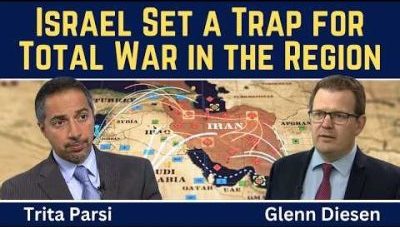
Trita Parsi: Israel Set a Trap for Total War in the Region
or go to
Aletho News Archives – Video-Images
From the Archive
Zionism’s Violent Legacy
By Donald Neff | Washington Report On Middle East Affairs | January 1996
On January 4, 1948, Jewish terrorists drove a truck loaded with explosives into the center of the all Arab city of Jaffa and detonated it, killing 26 and wounding around 100 Palestinian men, women and children.[1] The attack was the work of the Irgun Zvai Leumi – the “National Military Organization,” also known by the Hebrew letters Etzel – the largest Jewish terrorist group in Palestine. The Irgun was headed by Revisionist Zionist Menachem Begin and had been killing and maiming Arabs, Britons and even Jews for the previous ten years in its efforts to establish a Jewish state.
This terror campaign meant that at the core of Revisionist Zionism there existed a philosophical embrace of violence. … continue
Blog Roll
 Aletho News
- Trita Parsi: Israel Set a Trap for Total War in the Region
- Trump’s Iran war is on an Israeli leash
- Saudi oil boss issues global supply warning
- Riyadh Says Its Oil System Is Intact. The Numbers Say Otherwise.
- Trump and Netanyahu Want to “Finish the Job” on Iran
- US ‘one-sided dictation’ not Iran’s beliefs makes rational talks impossible: Baghaei
- Iran’s Next Strike May Not Explode. It Could Shut You Down /Col Doug Macgregor
- Iran: US political targets legitimate if assassinations return
- Iraq shuts key border crossing with Iran under US pressure: Report
- Undersea Internet cables could be targeted in retaliation for attacks on Iran: IRGC deputy chief
- If Americans Knew
- The Israel Lobby’s Changing Fortunes
- AIPAC has become such a political liability that it’s shifting to a more “nimble” approach to buying politicians
- At least 160 Israeli settler attacks in 2 weeks
- Will Gaza’s Ancient Christian Community Disappear Forever?
- Israel’s vision of regional security rests on keeping Arab states weak
- Heidi Levine recounts how Palestinian youths helped save her in settler attack
- DAILY UPDATE: Latest essential news on Palestine, Israel, & region
- Trump’s Intensifying Sabotage of the ICC, for Israel’s Sake
- Israeli military detain US and UK volunteers in West Bank including Democratic NY politician Brad Lander
- Americans at National Conservatism Conference held in Israel this year criticize Israel
- No Tricks Zone
- E-Cars Reduce CO2 Emissions By Only 41% Compared To Internal Combustion Engine Vehicles
- Predictions Made By Renowned Climate Professor Over Past Decades Have Been Proven To Be Poor
- New Study Suggests Large Regions Of The Pacific Ocean Have Been Cooling For The Last 80 Years
- Germany’s Green Energy Debacle: High Energy Costs Force Kahla Porzellan to Close After 182 Years!
- New Study: 50 Years Of The Most Aggressive ‘Net Zero’ Policies Can Only Affect The Global Climate By 0.03°C
- US September “Heat” Was No Record…Many Records Set Decades Ago
- Latest European Green Energy Debacle; Portugal’s Largest Flagship Solar Park Insolvent!
- Green Energy Debacle: German Expert Professor Fritz Vahrenholt Warns Of Severe Economic And Social Consequences
- Two More Paleo Reconstructions Affirm Meters-Higher Sea Levels Across Ireland, Brazil 7000-6000 Years Ago
- New Study: Earth And Venus Surface Warmth Largely Explained By Convection And Lapse Rate, Not CO2 Or Radiation

