US Treasury Secretary Janet Yellen. © Kevin Dietsch / Getty Images
US Treasury Secretary Janet Yellen has urged the EU curb cheap imports of Chinese green technology in what could push the bloc toward a trade war with the Asian country.
During a visit to Frankfurt on Tuesday, Yellen reiterated recent claims that China’s excess production capacity threatened both American and EU companies.
“China’s industrial policy may seem remote as we sit here in this room, but if we do not respond strategically and in a united way, the viability of businesses in both our countries and around the world could be at risk,” Yellen told reporters at the Frankfurt School of Finance and Management.
Yellen argued in favor of 100% tariffs, which are seen by many economists as protectionist and a potential trigger for wider trade wars with China. Last week, US President Joe Biden announced the quadrupling of import duties on Chinese electric vehicles to over 100% and a doubling of semiconductor duties to 50%.
In her remarks in Frankfurt, the Yellen told EU leaders it would be “more forceful to communicate to China as a group.”
The comments come a week after the Biden administration hiked tariffs on $18 billion in Chinese goods including electric vehicles, batteries, semiconductors, steel, aluminum, critical minerals, solar cells, ship-to-shore cranes, and medical products, while retaining tariffs on over $300 billion in goods imposed by the previous administration of Donald Trump.
The EU, which sells a greater share of exports to China than the US, has been pursuing a policy of “de-risking” rather than decoupling. However, European Commission President Ursula von der Leyen hinted on Tuesday that the EU would join the US in imposing tariffs on Chinese goods.
“Should [it] be confirmed what I suspect, that such [Chinese] subsidies exist, then I can guarantee that the level of the duties we would impose is correspondent to the level of damage,” she said referring to an EU investigation into alleged state subsidies into the automotive industry in China.
Beijing has said it will retaliate against any tariffs with potential duties on products including French brandy, EU wine and dairy products.
Russian President Vladimir Putin, during his recent two-day trip to China, suggested that the US had imposed tariffs on Chinese-made EVs because they had improved in quality.
He suggested that Washington wanted to prevent strong competitors from entering the American market, and described the US approach as “unfair competition.”
Chinese officials have repeatedly denounced US trade and tech policy, describing it as “economic bullying.”
May 23, 2024
Posted by aletho |
Economics | China, European Union, United States |
Leave a comment
CHISINAU – Half of Modova’s residents consider the government’s policy toward the autonomous region of Gagauzia wrong, while more than half do not trust NATO, Moldovan social research company IMAS found in a fresh survey published on Wednesday.
Asked what they thought of the policy of the ruling Party of Action and Solidarity (PAS) toward Gagauzia, 50% or respondents said it was wrong, 29% said it was right and 21% said they could not answer the question.
Respondents were also asked to evaluate their level of trust in various international institutions, including the World Health Organization, NATO, the European Parliament, the European Union, World Bank, the UN and others. Speaking of NATO, 18% said they had “little” trust, 42% said they had “no to very little” trust, 21% said they trusted the military alliance and only 9% said they trusted it a lot. Additionally, 2% of Moldovans said they they’d never heard of NATO and 8% said they could not give an answer.
The poll was conducted among 1,088 people from May 2-19 with a maximum margin of error of 3%. Its results were broadcast live on the Realitatea website.
Gagauzia, where most people speak Russian as well as Gagauz, a Turkic language, declared independence from Soviet Moldova in 1990 but was integrated into the newly-established Republic of Moldova in 1994. The Gagauz people are Orthodox Christians of Turkic origin. Gagauzia has traditionally favored rapprochement with Russia, while Chisinau has set a course toward European integration.
According to the country’s constitution, Moldova has neutral status, but from 1994 it has been cooperating with NATO, and with the accession to power of PAS, which is informally led by President Maia Sandu, military exercises involving the US, the UK, German and Romanian military have become more frequent. Sandu has told local media that Moldova should continue discussing rapprochement with NATO, as this allegedly helps strengthen the country’s defense capabilities.
May 23, 2024
Posted by aletho |
Aletho News | European Union, Moldova, NATO |
Leave a comment

Georgian Prime Minister Irakli Kobakhidze. © Tobias SCHWARZ / AFP
Georgian Prime Minister Irakli Kobakhidze has claimed that a European commissioner told him he could end up suffering the same fate as Slovak Prime Minister Robert Fico, who survived an assassination attempt last week.
In a Facebook post on Thursday, Kobakhidze said that the unnamed commissioner warned him during a recent phone call that the West would take “a number of measures” against him if his government pressed ahead with a law requiring foreign NGOs in Georgia to disclose their funding.
“While listing these measures, he mentioned: ‘you see what happened to Fico, and you should be very careful’,” he wrote.
Fico was shot multiple times as he met with supporters outside a government meeting in the town of Handlova on May 15. He was rushed to hospital, underwent emergency surgery, and is currently recuperating from his injuries. His would-be assassin – a 71-year-old poet who allegedly disagreed with Fico’s suspension of military aid to Ukraine – has been charged with attempted murder.
Georgia’s parliament passed the ‘Transparency of Foreign Influence Act’ last week. The law requires NGOs, media outlets, and individuals receiving more than 20% of their funding from abroad to register as entities “promoting the interests of a foreign power” and disclose their donors.
While the act has been vetoed by Georgia’s pro-Western president, Salome Zourabichvili, parliament is expected to override the veto.
May 23, 2024
Posted by aletho |
Civil Liberties | European Union, Georgia |
Leave a comment
Some EU member states are considering imposing sanctions on Georgia, including the suspension of visa-free travel regime, over the foreign agents bill, the Financial Times reported on Wednesday, citing sources familiar with the situation.
On Saturday, Georgian President Salome Zourabichvili vetoed the controversial foreign agents bill that had been adopted by the country’s parliament last Tuesday. The parliament needs a simple majority to override the veto.
A number of EU countries, led by Estonia, the Netherlands, the Czech Republic and Sweden, aim to discuss restrictive measures towards Georgia at the EU Foreign Affairs meeting next week, the Financial Times reported.
The potential sanctions include suspending visa-free travel to the European Union by Georgians, freezing of EU funds for the country and some targeted sanctions, the newspaper cited the officials as saying.
If the foreign agents bill is enacted, Georgia’s EU accession progress will face a major setback, an EU official said.
The draft law “On the Transparency of Foreign Influence” was initially submitted to the Georgian parliament in February 2023 but was withdrawn the following month amid a wave of protests and pressure from Western countries. After revision, the term “foreign influence agent” was replaced with “organization promoting the interests of a foreign power,” while the rest of the content remained the same.
The latest iteration of the bill has sparked weeks of mass protests in the Georgian capital of Tbilisi amid concerns that it could block the South Caucasus nation’s path to EU membership. EU foreign policy chief Josep Borrell criticized the bill in March, saying its adoption could have serious repercussions for EU-Georgian relations.
The West is acting as harshly and “crazily” as possible with regard to Georgia because it failed to destabilize the situation in the country earlier, as it did with Ukraine, Russian Foreign Ministry spokeswoman Maria Zakharova said.
The EU’s call on the Georgian authorities to ensure the right of citizens to protest can be interpreted as interference in internal affairs for the purpose of regime change, Maria Zakharova said. According to her, otherwise the EU’s call “can be interpreted as interference in the internal affairs of the state with the aim of regime change.
May 22, 2024
Posted by aletho |
Corruption | European Union |
Leave a comment
Is building a slave state for Big Daddy the apex achievement of feminism?
The polite world was fascinated last month when long-time NPR editor Uri Berliner confessed to the Stalinist suicide pact the public broadcaster, like all public broadcasters, seems to be on. Formerly it was a place of differing views, he claimed, but now it has sold as truth some genuine falsehoods like, for instance, the Russia hoax, after which it covered up the Hunter Biden laptop. And let’s not forget our censor-like behaviour regarding Covid and the vaccine. NPR bleated that they were still diverse in political opinion, but researchers found that all 87 reporters at NPR were Democrats. Berliner was immediately put on leave and a few days later resigned, no doubt under pressure.
Even more interesting was the reveal of the genesis of NPR’s new CEO, Katherine Maher, a 41-year-old with a distinctly odd CV. Maher had put in stints at a CIA cutout, the National Democratic Institute, and trotted onto the World Bank, UNICEF, the Council on Foreign Relations, the Center for Technology and Democracy, the Digital Public Library of America, and finally the famous disinfo site Wikipedia. That same week, Tunisia accused her of working for the CIA during the so-called Arab Spring. And, of course, she is a WEF young global leader.
She was marched out for a talk at the Carnegie Endowment where she was prayerfully interviewed and spouted mediatized language so anodyne, so meaningless, yet so filled with nods to her base the AWFULS (affluent white female urban liberals) one was amazed that she was able to get away with it. There was no acknowledgement that the criticism by this award-winning reporter/editor/producer, who had spent his life at NPR had any merit whatsoever, and in fact that he was wrong on every count. That this was a flagrant lie didn’t even ruffle her artfully disarranged short blonde hair.
Christopher Rufo did an intensive investigation of her career in City Journal. It is an instructive read and illustrative of a lot of peculiar yet stellar careers of American women. Working for Big Daddy is apparently something these ghastly creatures value. I strongly suggest reading Rufo’s piece linked here. It’s a riot of spooky confluences.

Intelligence has been embedded in media forever and a day. During my time at Time Magazine in London, the bureau chief, deputy bureau chief and no doubt the “war and diplomacy” correspondent all filed to Langley and each of them cruised social London ceaselessly for information. Tucker Carlson asserted on his interview with Aaron Rogers this week that intelligence operatives were laced through DC media and in fact, Mr. Watergate, Bob Woodward himself, had been naval intelligence a scant year before he cropped up at the Washington Post as ‘an intrepid fighter for the truth and freedom no matter where it led.’ Watergate, of course, was yet another operation to bring down another inconvenient President; at this juncture, unless you are being puppeted by the CIA, you don’t get to stay in power. Refuse and bang bang or end up in court on insultingly stupid charges. As Carlson pointed out, all congressmen and senators are terrified by the security state, even and especially the ones on the intelligence committee who are supposed to be controlling them. They can install child porn on your laptop and you don’t even know it’s there until you are raided, said Carlson. The security state is that unethical, that power mad.
Now, it’s global. And feminine. Where is Norman Mailer when you need him?
At the same time, at the same time, Freddie Sayers, the editor-in-chief of Unherd, testified in Parliament on the Global Disinformation Index which had choked Unherd’s ability to grow. Unherd had hired three advertising firms who were, one after the other, unable to place ads. The third sourced the problem to the Index, which had deemed his interviews with journalist Katherine Stock about the problems faced by young people transitioning their sex, had made him persona non grata for all advertising agencies across the world. Eerily, that same week, Katherine Stock was awarded a high honorable mention in the National Press Awards for her work.
Here is Clare Melford, the fetching chief of the Global Disinformation Index, a woman seemingly bent on sterilizing confused children, Yet another non-profit authoritarian working for a mysterious Big Daddy. Who the hell trained her?
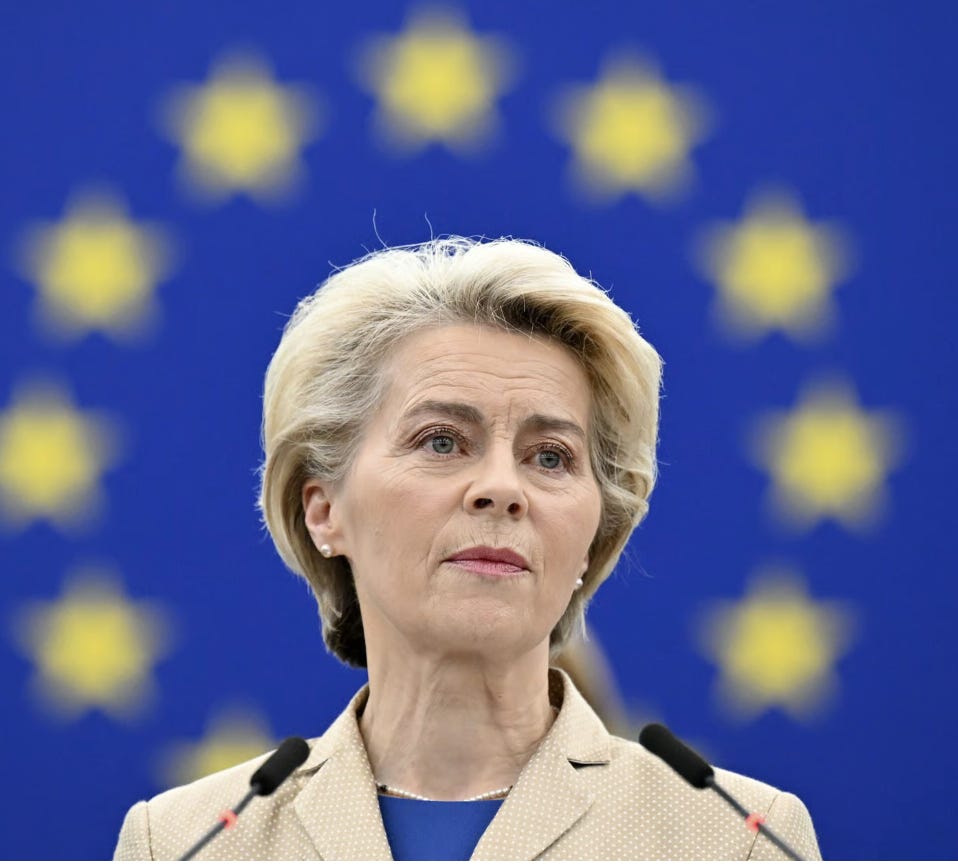
On Tuesday this week, out pops Europe’s headmistress, European Commission President Ursula von der Leyen in Politico.eu, complaining about “Russia” and “right-wingers” sowing distrust of Europe’s election processes. She is, she says, launching a new war on Disinformation. Most importantly, no more reporting on migrant assaults. This seems to be their new crusade. Please note the halo over her Christed head. Honestly, they are shameless, vain, silly creatures with limited bandwidth. Other than obedience to some grim reaper.
Said Politico :
“She promised to set up “a European Democracy Shield,” if reelected for a second term, to fight back against foreign meddling.
EU cybersecurity and disinformation officials expect a surge in online falsehoods in the 20 days prior to the European Parliament election June 6-9, when millions of Europeans elect new representatives. Officials fear that Russia is ramping up its influence operations to sow doubt about the integrity of elections in the West and to manipulate public opinion in its favor.”
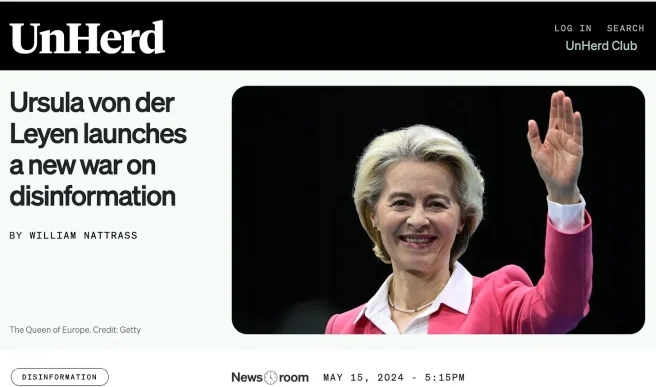
By the way, madam, western election integrity has been thoroughly compromised by the men who tell you what to do. More than half of us think elections are stolen. More than half. That’s not disinformation, it’s math.
This week Michael Shellenberger, who is the acknowledged lead in the take-down of the global censorship complex, had a look at Julie Inman Grant, another American Barbie, now Australia’s “e-safety commissioner,” with ties to the WEF. Grant had demanded that X censor a migrant stabbing, and X refused. Grant, as Shellenberger describes, is the Zelig of internet history tinkering in the bowels of said internet until she burst onto the public stage as Australia’s chief censor, bent on building a global online safety network.
Working for Big Daddy is apparently something these ghastly creatures value.
At a recent government hearing, she announced, “We have powerful tools to regulate platforms with ISP blocking power, and can collect basic device information, account information, phone numbers and email addresses, so that our investigators can at least find a place to issue a warning.” Grant went on to say they could compel take-downs, fine perpetrators and fine content hosts.
The Daily Mail had a ball with Inman Grant, mocking her and pointing out that she was wasting taxpayer money on a game of whack-a-mole.

Nevertheless, Grant takes herself very very seriously and since she is accreting power at a massive clip, so must we.
Grant’s network of independent regulators is called the Global Online Safety Regulators Network. “We have Australia, France, Ireland, South Africa, Korea, the UK and Fiji so far, with others observing. Canada is coming along,” she preens, “and is about to create a National Safety Regulator.” Canada’s proposed censorship program is so draconian you can be jailed for something you posted online years ago. And the government proposing it is so unpopular, it will be lucky to hang onto 20 seats in the next election.
There are literally hundreds of these women. Why? Why?
At a meeting this year of the World Economic Forum, Věra Jourová, from the European Commission, outlined just how exciting she and her team found the tools she is being given. “We can,” she said, “influence in such a way the real life and the behavior of people!” She sighed with excitement after this sentence. Jourova was caught last September trying to spread yet another Russia hoax. You have only to hear censorship plans uttered in a central-European accent to really understand what is happening here.

As terrifying as this all seems, and it is terrifying, it is instructive to look at the ruination of the career of America’s chief censor, Renée DiResta. DiResta, as research head of the Stanford Internet Observatory, is now being sued for abuse of power and unethical behavior that violates the constitution. Spookily, DiResta soared from “new mom” to providing the intellectual under-pinnning for censorship, until she headed up the Stanford Internet Observatory during Covid, where she was instrumental in censoring vaccine and Covid “disinformation.” People thought her backstory contrived and in fact, Shellenberger found that she was, unmistakably another CIA trained censor of inconvenient information under the guise of “safety.”
At this point, every time you hear the word ‘safety”, it’s best to check your ammunition supply. Said Shellenberger:
As research director of Stanford Internet Observatory, DiResta was the key leader and spokesperson of both the 2021 “Virality Project,” against Covid vaccine “misinformation” and the 2020 “Election Integrity Project.”
Shellenberger goes on to look into DiResta’s work history and finds a lot of congruence with CIA operations.
But then I learned that DiResta had worked for the Central Intelligence Agency (CIA). The journalist Matt Taibbi pointed me to the investigative research into the censorship industry by Mike Benz, a former State Department official in charge of cybersecurity. Benz had discovered a little-viewed video of her supervisor at the Stanford Internet Observatory, Alex Stamos, mentioning in an off-hand way that DiResta had previously “worked for the CIA.”
In her response to my criticism of her on Joe Rogan, DiResta acknowledged but then waved away her CIA connection. “My purported secret-agent double life was an undergraduate student fellowship at CIA, ending in 2004 — years prior to Twitter’s founding,” she wrote. “I’ve had no affiliation since.”
But DiResta’s acknowledgment of her connection to the CIA is significant, if only because she hid it for so long. DiResta’s LinkedIn includes her undergraduate education at Stony Brook University, graduating in 2004, and her job as a trader at Jane Street from October 2004 to May 2011, but does not mention her time at the CIA.
And, notably, the CIA describes its fellowships as covering precisely the issues in which DiResta is an expert. “As an Intelligence Analyst Intern for CIA, you will work on teams alongside full-time analysts, studying and evaluating information from all available sources—classified and unclassified—and then analyzing it to provide timely and objective assessments to customers such as the President, National Security Council, and other U.S. policymakers.”
At this juncture it is a race, as the intelligence community moves to shut down the revelations of its manipulations and machinations, and people injured by the vaccine and the flagrant abuse of election integrity move to fight them. It is instructive to note that DiResta, while apparently soaring to the heights of journalism at Wired, the New York Times, the Atlantic, selling her safety/censorhip program, cannot seem to get actual people to read or subscribe to her Substack. DiResta, like so many women in power now, are in reality, talentless cutouts for a hidden and malignant agenda.
An agenda that the people of the world roundly hate. I have just one final thing to saw to these truly dreadful human beings. My God is stronger than whatever demon or predator you obey. And as a woman, I am ashamed of each and every one of you. To use one of your awful phrases: Do Better.
May 20, 2024
Posted by aletho |
Civil Liberties, Deception, Full Spectrum Dominance, Mainstream Media, Warmongering, Russophobia | Australia, Canada, CIA, European Union, France, NPR, Renée DiResta, UK, United States, WEF |
Leave a comment
For years, the Palestinian people, at all levels of organization and struggle, have been demanding that the leaders of the Zionist regime are held accountable in international courts, including and especially the International Criminal Court, for their ongoing genocide, war crimes and crimes against humanity in occupied Palestine. Today, on 20 May 2024, ICC prosecutor Karim Khan announced his intention to seek arrest warrants against not only the Zionist war criminals Benjamin Netanyahu and Yoav Gallant, but also against the Palestinian resistance leaders Yahya Sinwar, Mohammed Deif and Ismail Haniyeh.
Let us be clear: There is no equation to be made between the legitimate resistance of the Palestinian people and its leadership, including Yahya Sinwar, Mohammed Deif and Ismail Haniyeh, and the illegitimate Zionist colonizer. The attempt to equate victim and perpetrator is a fundamental injustice, not the pursuit of long-denied justice.
It is certainly true that the Palestinian resistance recognized this risk, especially given the powerful political interests involved and the track record of the ICC in prosecuting Africans and now, enemies of the imperialist West. In 2014, when the Palestinian Authority acceded to the Rome Statute, and again in 2024, the Palestinian resistance leadership, particularly Hamas, the Islamic Resistance Movement, has stated its openness to international investigations and its willingness to face the ICC if there is an attempt to meaningfully pursue justice against the occupiers and genocidaires of Palestine and their imperialist backers and accomplices.
However, the fact that the resistance is, as always, willing to sacrifice for Palestine, to be subjected to injustice so that their people may see freedom, does not make Khan’s actions any more just, acceptable or fair, nor does it make them legally valid.
Khan’s repeated references to the “rights” of Zionist colonizers, while failing to address Palestinian rights, as well as his legally invalid reference to the so-called “right of ‘Israel’ to defend itself,” when an occupier and colonizer has no right to defend itself against the people it is occupying and colonizing, highlight the ongoing bias of the ICC Prosecutor and his embrace of an imperialist framework for the operations of the Court. He made no mention of the right of the Palestinian people to resist and to liberate themselves through armed struggle, despite its broad support in international law.
It is, in fact, only because of the Resistance, because of the willingness of the resistance fighters, surrounded and nurtured by its popular cradle, that these arrest warrants for the Zionist war criminals are even being proposed and considered. It is the bravery, creativity and revolutionary steadfastness of the Palestinian people and their Resistance, including and particularly through the armed struggle, that has reset the balance of power to the extent that the crimes of the occupier can no longer be greeted with pure impunity.
Every legal achievement has been brought about not by the objective power or application of law, but by the shifting of reality brought about by the Palestinian armed struggle, accompanied by the regional and global forces of Resistance, especially the Lebanese resistance, the Yemeni armed forces, people, government and AnsarAllah movement, stretching through Iraq, Syria and Iran. It also speaks to the growing international popular cradle of the resistance, from student encampments to mass demonstrations to direct actions at arms manufacturers, that are making it clear that business as usual inside the imperial core is impossible so long as the genocide continues.
It is clear that 7 October changed the world. While Khan seeks to pretend that history began on 7 October and ignore the lengthy history of colonialism, ongoing Nakba and ongoing genocide since 1948, the Palestinian resistance made clear on 7 October that the horizon of true decolonization was opened in Palestine, that it was possible not only to imagine but to achieve a Palestine liberated from Zionism and a region liberated from imperialism.
The choice to seek warrants against Netanyahu and Gallant, while not against Benny Gantz, Gadi Eisenkot, Itamar Ben-Gvir, Isaac Herzog, Herzi Halevi and other war criminals, also indicates its bias toward appeasing the political leadership of imperialist powers. Of course, Netanyahu and Gallant are genocidal war criminals whose direction of the current genocide in Palestine cannot be overstated. They have the blood of over 40,000 Palestinians on their hands in just the past seven months alone.
However, the omissions seem to seek to clear the road for a Gantz (or other similarly affiliated) prime ministership of the Zionist regime. The fact that various imperialist powers, and even a significant sector of the Zionist security establishment, think that Netanyahu is not good for the future of the Zionist and imperialist project is not a secret; they believe that other figures are far more trustworthy to secure their prime colonial project in the region. They believe that Netanyahu is securing his own political future and protection from prosecution at the expense of the future of the Zionist project in the region, and this has been one of the major causes of the growing unrest and internal disarray within the “Israeli” regime.
The application for arrest warrants indicates that imperialist powers, including the United States and the European Union, are very worried about the future of the Zionist colony in the region and recognize that it is on the road to its defeat, removal and dissolution.
It must be noted that these imperialist powers, especially the United States, which has threatened a war if its leaders are indicted, refuse to be held accountable before the ICC, a fate they have traditionally deemed acceptable only for the targets of imperialism, especially Africans. The Zionist colonial project in Palestine has always been genocidal. Its existence is a war crime and a crime against humanity. The ICC prosecutor’s application for arrest warrants do not even begin to touch the magnitude of its crimes in Palestine.
These omissions are particularly egregious given that the ICC’s limited mandate in Palestine extends back to 2014, yet no crimes before 7 October 2023 are considered in Khan’s decision to seek these arrest warrants. This comes alongside the decision to charge three Palestinian leaders (of the legitimate resistance) as opposed to two Zionist officials (of the illegitimate settler colony and imperialist outpost), and to proffer eight charges against Palestinians, vs. seven against Zionists; and to fail to seek any charges under Article 6 of the Rome Statute, which covers genocide, against the Zionist war criminals.
It is particularly outrageous that while Khan seeks to charge Palestinian resistance leaders with “torture,” he has failed to seek any such charges against the Zionist regime, which is currently imprisoning and torturing over 9,400 Palestinian prisoners. Sixteen Palestinian prisoners’ martyrdom has been documented since 7 October 2023, while at least 27 Palestinians have been martyred in the concentration and torture camps for Palestinian civilians kidnapped from Gaza at Sde Teiman. Palestinian and international sources – and even Zionist whistleblowers – have repeatedly documented and exposed the horrific conditions, medical abuse, brutal torture, forced amputations and starvation being used against Palestinian detainees in both these concentration camps and the Zionist prison system. The photos of Palestinian detainees released after months in prison – such as those of Omar Assaf and Imad Barghouti – underline the level of mistreatment and torture that has become standard in the Zionist jails.
As a counter to the failure to seek to indict Gantz, his fellow members of the “war cabinet” and IOF chief Halevi – let alone all of the Zionist officials responsible for the crimes against humanity and genocide in Palestine since 2014, let alone 1948 — we see the indictment of Ismail Haniyeh, as a political leader of the Palestinian resistance. The pursuit of an indictment against Haniyeh appears to be an attempt to undermine Palestinian presence in current ceasefire negotiations and to add another level of pressure to the Palestinian resistance to accept permanent Zionist and imperialist occupation in Gaza.
It also makes clear that the indictments of Zionist war criminals are selective, while Palestinian resistance leadership is to be targeted in total. We have all confidence in the resistance’s willingness to sacrifice, ability to defend itself brilliantly in court and to win decisively in any fair trial.
The choice of charges against the resistance leaders (exceeding by one those against the Zionists in all cases), invoking numerous debunked and propagandistic Zionist claims, including “rape” and “extermination,” while failing to pursue charges of genocide and apartheid against the Zionist war criminals, further underlines this bias.
We all look forward to seeing Netanyahu and Gallant in the dock and appreciate this clear crack in the armor of impunity for the Zionist regime. We know that it is they who constantly travel around the world to receive billions of dollars in support from their imperial sponsors. At the same time, it is also clear that the ICC Prosecutor is not acting as a truly neutral party and is instead carrying out the directives of imperialist powers who would not accept any charges against the Zionist leadership without a “both sides” clause targeting the already criminalized and repressed Palestinian resistance. The equation of the indigenous resistance with the illegitimate colonizer is part of the minimization of genocide rather than its prosecution.
It is further clear that the ICC is not an institution into which we can place trust, as evidenced by its own history and failures to hold accountable any of those responsible for the horrific attacks on Iraq and Afghanistan, Libya and Syria; the starving of Venezuela through sanctions and blockades, the extraction of wealth in Africa, the attempted mass starvation and genocide in Yemen, the ongoing destabilization and destruction of Haiti.
The ICC has served for too long as a weapon of colonialism rather than a tribunal of justice. We trust the revolutionary justice of the victorious Palestinian people. There can be no equation of colonizer and colonized, of the executioner and the victim.
Glory and victory to the Palestinian resistance, to the Lebanese and Yemeni resistance, to all of the forces of resistance in the region and the world.
Imperialism and Zionism will be defeated, and from the river to the sea, Palestine will be free.
May 20, 2024
Posted by aletho |
Ethnic Cleansing, Racism, Zionism, Progressive Hypocrite, Timeless or most popular, War Crimes | European Union, Human rights, ICC, Israel, Palestine, United States, Zionism |
Leave a comment
In an interview with Tygodnik Solidarność weekly, Prof. Ryszard Piotrowski, a constitutional lawyer from the University of Warsaw, expressed his concerns over the legal challenges posed by the implementation of the European Green Deal. He believes that these challenges threaten the legal identity and autonomy of both the European Union and Poland.
The professor emphasized the foundational role of dialogue in Polish law, noting that European laws are becoming increasingly incomprehensible and detached from the real needs of European citizens.
He argued that the perception of Europeans as subordinates to the European Parliament and the European Council, rather than as sovereigns over the treaties, poses a significant threat. “The sooner we understand that we, as Europeans, are not servants to the treaties and the European Parliament, the better it will be for Europe,” he stated.
He also questioned whether the Green Deal’s objectives align with the Polish constitution, which mandates environmental protection guided by the principle of sustainable development. According to him, the current shape of EU climate policy contravenes this principle by jeopardizing overall economic growth and thereby the security of citizens.
Piotrowski additionally highlighted that the Green Deal threatens essential social rights guaranteed by the Polish constitution, such as housing, energy, and communication security.
“We have a right to energy security, and its violation threatens democracy itself because democracy without a socio-economic dimension is devoid of meaning,” said the professor. Furthermore, he noted that the Green Deal also threatens the principle of subsidiarity, which aims to empower citizens and their communities.
Adding to the urgency of his concerns, Professor Piotrowski pointed out that the implementation of the Green Deal might weaken Poland’s defensive capabilities at a time when a military conflict looms near its eastern border. He criticized Europe’s stance on the conflict in Ukraine, arguing that despite European treaties pledging to promote peace, the current approach could lead to tragic consequences for Europe.
“Contrary to what European treaties stipulate and what they commit Europe to, it has chosen to speak of war instead of striving for peace. Such actions have always ended tragically for Europe,” the professor warned.
May 18, 2024
Posted by aletho |
Civil Liberties, Malthusian Ideology, Phony Scarcity, Militarism | European Union, Human rights, Poland |
Leave a comment
Russia’s State Duma chairman has accused the EU of censoring alternative opinions and curtailing freedom of speech, with the goal of deceiving citizens.
Vyacheslav Vlodin was commenting on Brussels’ latest ban on Russian media outlets, which has sparked a warning of countermeasures from the Foreign Ministry in Moscow.
On Friday, the European Council announced it was suspending the broadcasting activities of four additional media organizations, claiming that they “spread and support” Russian propaganda.
The blacklist includes RIA Novosti news agency, newspapers Izvestia and Rossiyskaya Gazeta, and the Czech-based portal Voice of Europe.
Writing on Telegram on Saturday, Volodin described the move as showing the EU’s desire “to close access to objective and reliable information” for residents of member states.
According to the lawmaker, “the policy of double standards has become an integral part of European structures” as they only “talk about freedom of speech, but do not tolerate it in reality”.
Officials in Brussels have no arguments to convince EU citizens that they are right and as soon as they see any problems, they just block “any alternative point of view, destroy freedom of speech, and violate the right to freely disseminate and receive information,” Volodin stressed.
“In fact, they introduce censorship with the only purpose – to deceive their citizens and stay in power,” he argued.
The Russian Foreign Ministry, commenting on Brussels’ move, noted that Moscow has repeatedly warned the EU that “repressive measures” against Russian media will not go unanswered.
“Ignoring these warnings forces us to take countermeasures, which will follow inevitably,” the ministry’s spokeswoman, Maria Zakharova said on Friday.
According to the diplomat, Brussel’s decision is proof “of the neglect by the EU and its member states for their international obligations in the field of ensuring media pluralism and another example of the degeneration of democratic societies” in the West.
Since the Ukraine conflict escalated into open hostilities in February 2022, the EU has barred several Russia-associated media outlets from engaging with audiences in member states. Even hosting content made by the targeted organizations is illegal in the bloc.
Moscow has also taken a harsh stance on Western media. Citing anti-Russian sentiment, misinformation and censorship, the national media regulator has barred access to Twitter, Facebook, Instagram and the websites of the BBC, Deutsche Welle, along with other media outlets.
May 18, 2024
Posted by aletho |
Civil Liberties, Full Spectrum Dominance, Progressive Hypocrite, Russophobia | European Union, Russia |
Leave a comment
Embroiled in coast to coast lawsuits from the alleged harms of their COVID vaccine, Astrazeneca is receiving massive public backlash after admitting their shot can cause blood clots in court proceedings. Jefferey Jaxen also reveals payments made by the pharma giant to doctors in the UK, including celebrity pediatrician, Dr. Ranj Singh who strongly advocated for the now pulled product.
This week, ICAN lead counsel, Aaron Siri, Esq. filed a historic lawsuit on behalf of Utah mother, Brianne Dressen, a patient who participated in the AstraZeneca COVID-19 vaccine clinical trial. The lawsuit states she was severely injured and is now suing the drug manufacturer in a lawsuit that is the first of its kind in the U.S.. Hear how the progressive neuropathy she developed from the drug trial has shattered her life, and the organization she launched to advocate for those like her.
May 18, 2024
Posted by aletho |
Deception, Video | COVID-19 Vaccine, European Union, UK, United States |
Leave a comment
According to a report this morning in BNN Bloomberg :
The European Commission said it’s “actively monitoring” the spread of fake news about Wednesday’s shooting Slovak Prime Minister Robert Fico and warned it can slap Big Tech platforms with fines for failing to tackle disinformation.
The regulator “is equipped with wide-ranging investigatory and supervisory powers, including the power to impose sanctions and remedies,” it said in an emailed statement.
Violations could be punished under the European Union’s tough new Digital Services Act, which forces online platforms to put into place measures to tackle illegal content and disinformation, uphold user rights, and protect user’s health and wellbeing.
In other words, the European Commission has already decided the orthodox narrative of this crime—even before a full and transparent investigation has been performed—and will censor any theory or narrative of the crime that diverges from the orthodoxy.
May 17, 2024
Posted by aletho |
Civil Liberties, Full Spectrum Dominance | European Union, Human rights |
Leave a comment
Is the man who tried to assassinate Slovak Prime Minister Fico really a “lone wolf”?
The Telegraph and the Times of India have published profiles on the 71-year-old Slovakian poet, Juraj Cintula, who tried to assassinate Slovak Prime Minister, Robert Fico. The following is from the Telegraph report:
Juraj Cintula, a 71-year-old poet from the western town of Levice, posted online rants against Mr Fico before opening fire on the Left-wing nationalist at close range on Wednesday.
A photo of the writer published on X, formerly Twitter, showed him protesting against the government’s controversial reforms…
[Fico] is viewed as one of the EU’s most pro-Russian leaders after campaigning on a platform to end weapons donations to Ukraine.
In a post for the Movement Against Violence in 2022, Mr Cintula condemned Russia’s invasion of Ukraine. “What Slavic brotherhood?” he wrote, referring to Kremlin claims that Ukraine and Russia could be joined as they were essentially the same country. “He is only the aggressor and the attacked.”
A friend from Levice told Markiza TV that the pair had debates about politics, saying: “I’m more for Russia. He had different opinions.”
In 2015, Mr Cintula founded the campaign group Against Violence and sought to get it officially registered in Slovakia. “Violence is often a reaction of people, as a form of expression of ordinary dissatisfaction with the state of affairs. Let’s be dissatisfied, but not violent,” a petition circulated by him said.
… Unverified video footage emerged on Wednesday of Mr Cintula saying he did not agree with Mr Fico’s “government policy”. In another social media post, he criticised the Fico government for not cracking down on gambling.
The suspect’s political leanings appear to have shifted over time. He was once pro-Russian, and railed against “eyeless gypsies” and migrants before shooting the populist prime minister, who is fiercely anti-migrant.
I was surprised by how quickly the Slovak interior minister, Matus Sutaj Estok, characterized Cintula as “a lone wolf” who “did not belong to any political groups.”
It seems to me that no apparent political group affiliation does not necessarily mean that Cintula was not influenced or directed by someone else. Cintula’s online political rants in which he expressed strong emotions and shifting opinions could have flagged him as man who could be approached and influenced by an agent serving powerful interests. In this hypothetical scenario, Cintula may have fallen under the influence of an agent who presented himself under false pretenses.
Like many other reasonable people, I noticed that Prime Minister Fico has vocally criticized COVID-19 vaccines, endless shipments of weapons to Ukraine, mass immigration, transgender ideology, and climate change ideology. This makes him one of the few heads of state in Europe who has challenged all four articles of faith in what I call the Holy Quadripartitus of Piffle.
1). COVID-19 vaccines are saving mankind. Anyone who questions the safety and efficacy of the vaccines is guilty of heresy.
2). The U.S. proxy war in Ukraine is a sacred mission and no negotiated settlement with Russia shall be countenanced. Anyone who criticizes the Ukrainian and U.S. governments, and any attempt to understand the war from the Russian point of view, is guilty of heresy.
3). Human induced climate change will soon destroy the earth if trillions aren’t spent to overhaul our entire energy policy. Anyone who questions this proposition is guilty of heresy.
4). The concept of biological sex is a mere “construct.” Skilled surgeons and endocrinologists can transform a boy into a girl or vice versa. Anyone who questions this assertion is guilty of heresy.
Given the fervent belief in the Holy Quadripartitus—the Nicene Creed of the vaccine cartel, arms dealers, money launderers, lobbyists, racketeers, and child butchers—it is a matter of certainty that Prime Minister Fico has a vast array of powerful enemies.
May 17, 2024
Posted by aletho |
Civil Liberties, Deception, Militarism | Covid-19, COVID-19 Vaccine, European Union, NATO, Slovakia |
Leave a comment
The US, EU and NATO have slammed the newly-passed foreign agents law in Georgia, while the foreign ministers of Iceland, Lithuania and Estonia took part in protest rallies against the legislation in Tbilisi. Sputnik’s pundits called these actions foreign meddling in Georgia’s affairs.
Lithuanian Foreign Minister Gabrielius Landsbergis expressed support for the “European” aspirations of Georgian protesters at a protest rally in Tbilisi on May 15.
“In a democracy, the government owes it to you, the Georgian people, to follow the direction your moral compass is showing,” Landsbergis told the crowd. “I am speaking out because I am… on the side of a European Georgia.”
But Tbilisi Mayor Kakha Kaladze, the secretary-general of the ruling Georgian Dream party, called their actions hostile and aimed at dividing Georgian society.
“This is not friendship, this is enmity, this is an attempt to deepen polarization in our country,” Kaladze told the Rustavi 2 TV channel. “Could you imagine our minister of foreign affairs going to Yerevan and speaking at an [Armenian] opposition rally?”
Direct Foreign Interference in Georgia’s Affairs
It was not the first time that Lithuanian officials have fanned public protests in a foreign state, according to Dr. Eduardas Vaitkus, Lithuanian politician who was an independent candidate in the 2024 Lithuanian presidential election.
“This is direct interference in the internal affairs of the sovereign state of Georgia,” Vaitkus told Sputnik.
Vaitkus cited earlier precedents for Lithuania’s meddling in the domestic affairs of Ukraine and Belarus. Vilnius has spent millions of euros supporting Belarusian self-declared opposition leader Svetlana Tikhanovskaya, backed by the West, who advocates for a coup d’etat in Minsk.
He recalled that the Lithuanian foreign minister’s grandfather, then-European Parliament member Vytautas Landsbergis, was spotted during the 2013 Euromaidan events in Kiev calling for a wider revolt in Ukraine.
“Unfortunately, this is the position of the Lithuanian state. My opinion is that traitors in our state are leading Lithuania in a way that creates a threat to all residents of Lithuania,” Vaitkus said.
The politician condemned the Lithuanian government’s “double and triple standards” in its unwillingness to recognize the will of the Crimean people to reunite with Russia — while rushing to embrace the self-declared independence of Kosovo alongside the West.
“Politics must have moral values. And [the Lithuanian government] demonstrates that duplicity is its main imperative in foreign policy,” Vaitkus said.
Russian Senator Konstantin Dolgov believes that Vilnius’ political agenda is not independent, but is dictated from the West.
“What can you expect from Lithuania and Estonia? These are countries that have long lost their independence and have become ‘appendages’ of Washington and Brussels,” Dolgov said, arguing that foreign ministers Iceland, Lithuania and Estonia could be sent by their Western patrons to fan unrest in Georgia.
Deputy Permanent Representative of the Russian Federation to the UN Dmitry Polyansky noted that the foreign ministers’ presence at Georgian protests is reminiscent of US and European politicians’ conduct during the 2013-2014 Euromaidan unrest in Kiev.
US Trying to Exert Pressure on Georgia as Its Hegemony Wanes
The US, EU and NATO have criticized the newly-passed foreign agents bill in Georgia, with US Assistant Secretary of State Jim O’Brien announcing on May 14 that Georgian MPs could be subjected to sanctions for “undermining democracy”.
While attacking the bill, which obliges Georgian media and NGOs to register as “pursuing the interests of a foreign power” if they receive over 20 percent of their funding from abroad, US policy-makers avoid mentioning that the Georgian legislation is reminiscent of the US’ own Foreign Agents Registration Act (FARA).
FARA requires individuals acting on behalf of foreign governments, organizations or persons foreign to the US to register with the Department of Justice (DOJ) and to disclose their relationship, activities, receipts, and disbursements in support of their activities.
Under to US law, such individuals are described as “foreign agents” while the FARA Unit of the Counterintelligence and Export Control Section (CES) is responsible for the Act’s enforcement.
The fierce US opposition to the Georgian bill under the guise of the “protection of democracy” and sanctions threats is an attempt to keep Tbilisi in line with the collective West’s agenda, according to Tiberio Graziani, chairman of Rome-based think tank Vision and Global Trends.
“The so-called defense of democracy, as promoted and implemented by the US-led West, falls within the context of the hybrid, cognitive and psychological war against those countries considered enemies, for geopolitical and geostrategic reasons,” Graziani told Sputnik.
“Any [country] that attempts to operate and act in the international context to responsibly promote the defense of its national interest is demonized by the US. Examples of this practice include, just to give a few examples, the so-called color revolutions,” he continued.
The US is believed to be behind a series of color revolutions in the former Soviet Union, including the Rose Revolution in Georgia in 2003, the Orange Revolution in Ukraine in 2004, the Tulip Revolution in Kyrgyzstan in 2005 and the failed Jeans Revolution in Belarus in 2006.
According to the expert, the threat and use of sanctions against foreign politicians pursuing national sovereignty constitutes a form of long-term US hybrid warfare.
Now that the world is becoming multipolar, the US is feeling the loss of its role as hegemon and could act irrationally with dramatic consequences for the rest of the world population, Graziani warned.
May 16, 2024
Posted by aletho |
Aletho News | Estonia, European Union, Georgia, Iceland, Lithuania, NATO, United States |
Leave a comment