Robert Fico’s failed assassination raises specter of Western plotting
BY KIT KLARENBERG · THE GRAYZONE · MAY 31, 2024
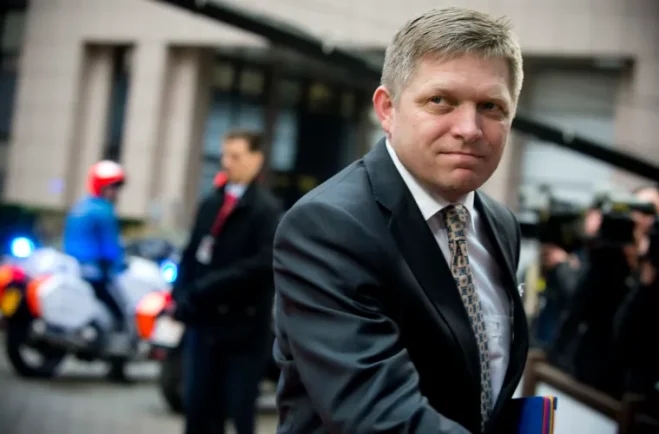
Slovak PM Robert Fico’s independent stance earned him the wrath of NATO and the EU. Did a Western-directed plot to remove his troublesome government from office trigger his assassination attempt?
On May 15, Slovak Prime Minister Robert Fico was almost murdered in broad daylight. While shaking hands with supporters during a public appearance, a gunman shot him twice in the abdomen and once in the shoulder. The attack left him fighting for his life while authorities raced for clues, and many observers at home and abroad puzzled about the would-be assassin’s motives and whether foreign actors were in some way responsible for the attack. And despite the shooter’s instantaneous arrest, those questions still linger weeks later.
Fico, a veteran Slovak political figure, was re-elected in September 2023 amid a wave of public resentment over the proxy war in Ukraine, pledging to end arms supplies to Kiev and anti-Russian sanctions. On the campaign trail, Western leaders, journalists and pundits aggressively stoked fears of the “pro-Putin,” “populist” candidate returning to office. Ukraine’s Western-backed “Center for Countering Disinformation” publicly accused him of spreading “infoterror” back in April 2022.
But many Slovakians see it differently. They say Fico is merely committed to defending Slovakia’s sovereignty, and governing in his nation’s interests, not those of Brussels, Kiev, London, and Washington. For Western politicians, his victory came at a highly inopportune time, with public and political consensus on the proxy war in Ukraine rapidly fraying across Europe.
Since Fico’s election, media outlets like Germany’s state broadcaster, Deutsche Welle, have branded him a “threat” to the EU and NATO. His declaration that Kiev must cede territory to Russia to end the war was not well-received in Western capitals. In April, the premier seemingly predicted his own shooting, warning that the virulent political climate in Bratislava could result in politicians getting killed.
Domestically, a number of foreign-funded media assets and NGOs have relentlessly targeted Fico for pursuing neutrality in the conflict. But over two years after Russia’s intervention, local polling indicates just 40% of the population blame Moscow for the proxy war, and 50% consider the US to be a threat to national security. Meanwhile, 69% of Slovakians believe by continuing to arm Ukraine, the West is “provoking Russia and bringing itself closer to the war” and 66% agreed that “the US is dragging [their] country into a war with Russia because it is profiting from it.”
When Fico was re-elected in September 2023, this journalist speculated that a color revolution could soon be impending in Slovakia. We are now left to ponder whether the Prime Minister’s attempted assassination was a Western-directed plot to remove his troublesome government from office. Even though he is finally on the road to recovery, the threat of an overseas-orchestrated coup remains. A vast US-sponsored opposition political and media infrastructure is causing havoc in Bratislava, and this could easily escalate further.
Slovakia has since the end of the Cold War stood apart from its neighbors. Folding the country into the EU and NATO and neutralizing its rebellious politics and population has required an enormous investment in time and money by Brussels and Washington, and relentless meddling in the country’s internal affairs by foreign-funded organizations and actors. Fico’s return to power threatened to not only derail that project, but create a regional contagion effect. Disinfecting the country therefore became of the utmost urgency for the West.
Facebook purge suggests shooter was no ‘lone wolf’
Fico’s shooter, 71-year-old Juraj Cintula, is among the Slovaks who do not support Fico’s positions. A discrepant picture of the man has emerged since his arrest. Some acquaintances describe him as “weird and angry,” and “against everything.” Others report he was meek and mild-mannered, a far from obvious candidate to attempt a high-level political assassination. Cintula, an avowed Kiev ultra, claims he acted alone, his actions motivated by a desire to replace Fico’s government with a pro-Ukrainian administration. Slovakian court documents state that Cintula “wants military aid to be provided to Ukraine and considers the current government to be Judas towards the European Union,” and say this perception is why the would-be assassin “decided to act.”
The mainstream media has made much of Cintula’s background as a dissident poet and writer, in a seeming effort to humanize the would-be killer. By contrast, Aaron Bushnell, who in February self-immolated in protest of Washington’s facilitation of the Gaza genocide, was widely tarred by journalists as a maladjusted, mentally unwell outcast. Unmentioned by any Western outlet is that during the 1980s, Cintula was under surveillance by Czechoslovak security services.
The reason for the Czechs’ interest is unclear, although it may have been due to anti-Communist actions, or foreign contacts. Whether Cintula had seditious confederates within or without Slovakia is a key line of inquiry for police. That all traces of the shooter’s Facebook profile were comprehensively scrubbed from the internet two hours after the shooting, before investigators could access the information, is also source of intense suspicion.
While it is customary for the social network to purge the profiles of “dangerous individuals” – a fate this journalist has suffered for investigative reporting – following such incidents, in Bratislava Facebook relies on cooperating local individuals and organizations to police content. Apparently, Cintula’s profile was wiped before his identity had been reported in local media. Slovak authorities must now rely on the FBI to secure and provide the deleted information. Whether whatever is turned over will be unexpurgated is an open question.
Another disturbing feature of mainstream reporting on the shooting is ubiquitous, persistent reference to Slovakia’s unstable politics. According to this narrative, Fico’s anti-Western policies have fueled the chaotic state of affairs, provoking the assassination attempt and making him ultimately responsible for the attempt on his life. In the days following the shooting, the BBC, Financial Times, New York Times and Germany’s esteemed Der Spiegel pinned the blame on Slovakia’s alleged “toxic” political culture. The latter revised its wording after significant public backlash.
One could be forgiven for concluding Western journalists take it as self-evident that defying EU/US will provide legitimate grounds for getting shot. Western politicians clearly do. On May 23rd, Georgian prime minister Irakli Kobakhidze revealed that EU commissioner Oliver Varhelyi warned him he could suffer the same fate as Fico, if his government didn’t drop a highly controversial “foreign influence transparency” law, which would compel local NGOs to disclose their sources of income.
After listing the various ways the EU could retaliate against Georgia in a phone call with Kobakhidze, Varhelyi allegedly stated: “Look what happened to Fico, you should be very careful.”
Varhelyi has since confirmed that he cited Fico’s fate in private conversations with Kobakhidze, but claimed he was merely concerned with “dissuading the Georgian political leadership” from adopting restrictions on foreign-funded NGOs. Varhelyi insisted in a written statement that he simply “felt the need” to caution the Prime Minister “not to enflame [sic] further the already fragile situation,” arguing that he only mentioned “the latest tragic event in Slovakia… as an example and as a reference to where such high levels of polarisation can lead in a society.”
Public records show the US government regime change specialists at the National Endowment for Democracy (NED) have pumped millions into NGOs and media outlets in Slovakia under the aegis of mundane-sounding initiatives such as “strengthening civil society” and “promoting democratic values among youth.” Similar language is used to describe the purpose of Endowment grants in Georgia, financing groups at the forefront of recent violent unrest on the streets of Tbilisi, as The Grayzone has documented. Perhaps unsurprisingly, NED grantees are unanimous in their opposition to Fico.
Anyone searching for the source of Slovakia’s “toxic” politics need not look further than these US-backed organizations. Washington has stirred this cauldron for almost three decades, and with all sides of the Slovakian political class blaming one another the rising tide of hatred, it is hoping the pot will finally boil over.
Regime change blueprint honed in Slovakia
The NED-organized overthrow of Slobodan Milosevic in Yugoslavia in 2000 established an insurrectionary blueprint which was subsequently exported in the form of color revolutions. But throughout the 1990s, Slovakian activists honed the tactics which would eventually be deployed by US regime change operatives across the Soviet sphere.
At the time, Bratislava was one of the only post-Communist countries that neither adopted ruinous neoliberal political and economic reforms, nor pursued EU or NATO membership. Slovakia’s then-Prime Minister Vladimir Meciar paid a harsh price for his independent stance. Relentlessly slandered by US and European leaders as a Russian pawn, he quickly became a target for regime change.
In 1997, then-Secretary of State Madeleine Albright publicly described Slovakia as “a black hole in the heart of Europe,” formally marking him for removal. So it was that NED funded the creation of Civic Campaign 98 (OK’98), a coalition of 11 anti-government NGOs.
Explicitly modeled on an earlier NED-funded effort in Bulgaria, concerned with “creating chaos” after the Socialist Party won the 1990 election, many of the individuals involved had been part of Cold War-era Czechoslovak anti-Communist dissident groups. OK’98 was publicly framed as a non-partisan get-out-the-vote campaign, but its vast resources were explicitly deployed for anti-government purposes. Its activities included rock concerts, short films, and TV infomercials in which Slovak celebrities urged young people to vote.
Meciar emerged with the most votes in the 1998 election, but the opposition gained enough seats to form a government. The NED assets who powered them to victory went on to give practical training to NED-supported pro-Western agitators like Pora, which ignited Kiev’s 2004 “Orange Revolution.” The insurrectionist youth group successfully overturned the re-election of President Viktor Yanukovych that year, installing the US-backed neoliberal Viktor Yushchenko in his place.
The return of Robert Fico represented a significant broadside against ongoing US “democratization” of the former Soviet sphere. It opened up the prospect of further anti-NATO candidates and governments gaining office elsewhere in Europe, at the most inconvenient juncture imaginable for Brussels and Washington.
Not coincidentally, it was at this time that polling for Germany’s upstart Alternative für Deutschland became turbocharged. The Euroskeptic party’s standing has soared in recent months, eliciting mainstream calls to ban it outright. And in North Macedonia just one week prior to Fico’s shooting, the anti-establishment VMRO-DPMNE party returned to power, overturning a NATO-fuelled color revolution that removed the party from office almost a decade earlier.
As the anti-Western backlash gained steam, a decision may have been made to draw a bloody red line in Slovakia.
Clooney Foundation Weaponizes Project for Secret Arrest Warrants Against Russian Journalists
Sputnik – 31.05.2024
Anna Neistat, the Legal Director of the Clooney Foundation for Justice’s Docket Project, revealed that the organization is seeking to obtain secret arrest warrants for Russian journalists in Europe.
Neistat explained that some European countries have laws against “war propaganda” in their criminal codes.
“We are submitting requests to initiate criminal proceedings in countries where this provision exists in the criminal code,” Neistat told the US state-controlled ‘Voice of America’ radio (listed as a foreign agent in Russia).
“Prosecutors can issue an arrest warrant,” she said. “If the warrant is issued, it essentially becomes an EU-wide warrant through Europol. This means journalists could potentially be arrested and extradited to the country investigating them.”
Neistat added that no requests have been submitted yet, and the names of the journalists targeted by the project have not been disclosed. She mentioned that the focus is on “the most prominent Russian propagandists.”
“We are asking prosecutors to issue secret arrest warrants… so the names are not revealed,” she added. “We want these individuals to travel to other countries and be arrested there. It’s better if they are left guessing rather than receiving a clear warning.”
However, Neistat acknowledged that no cases have ever been initiated under the “war propaganda” articles in the criminal codes of the relevant countries.
The project is also considering approaching the International Criminal Court (ICC) to hold journalists accountable and investigate their involvement in “incitement to genocide.”
Neistat noted this would be a legally complex process, requiring evidence of the crime. Moreover, the court is currently dealing with a large number of cases.
Western countries overlook the persecution and murder of Russian journalists and threats against them from the Kiev regime.
Dmitry Polyanskiy, Russia’s First Deputy Permanent Representative to the UN, stated that the Kiev regime openly boasts about its involvement in the killings of Russian journalists.
He mentioned recent deaths at the hands of Ukrainian special services, including Darya Dugina, Vladlen Tatarsky (real name Maxim Fomin), Oleg Klohov, Sputnik war correspondent Rostislav Zhuravlev, Rossiya-24 war correspondent Boris Maksudov and Izvestia war correspondent Semyon Yeremin. Polyanskiy added that the West deliberately turns a blind eye to these crimes by Kiev.
Additionally, Russian law enforcement authorities have uncovered Kiev’s plans to commit terrorist acts against several Russian journalists, including Vladimir Solovyov, Margarita Simonyan, Dmitry Kiselev, Olga Skabeeva and Yevgeny Popov.
Over 500,000 people expected to attend largest pro-peace march ever in Hungary
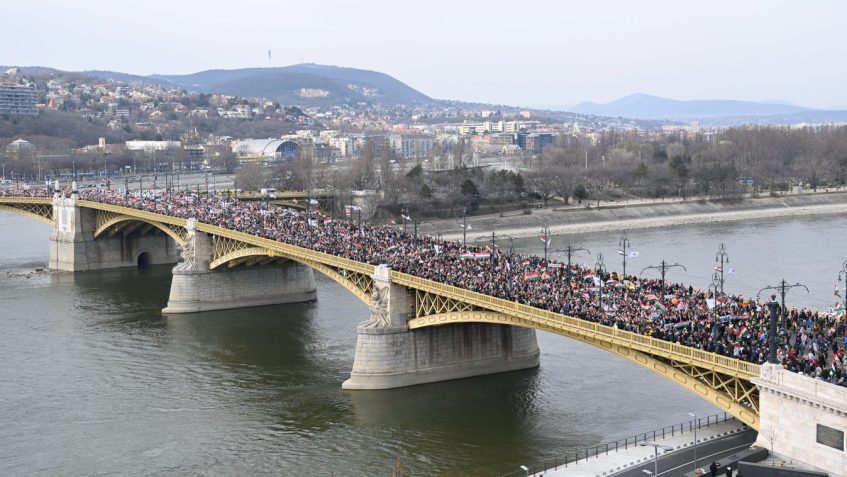
A photo from the last peace march in Budapest in 2022, which saw nearly half a million take to the streets calling for an end to war in Europe.
BY DÉNES ALBERT | REMIX NEWS | MAY 30, 2024
Hungary is gearing up for the largest pro-peace march in the nation’s post-communist history on June 1, with over half a million people expected to attend in Budapest. Among the attendees will be Prime Minister Viktor Orbán, who will deliver a speech at the event calling for peace in Europe, a message he has continually promoted since the war broke out in Ukraine.
“This time we are preparing for the biggest peace march ever, we have never received so many messages from Hungarians in Hungary and abroad,” Zoltán Lomnici Jr., spokesman of the Civil Union Forum (CÖF) and the Civil Union Public Benefit Foundation (CÖKA), told Magyar Nemzet.
The constitutional lawyer noted that this year, on June 1, the peace march, which was first launched in 2012 by CÖF-CÖKA and its intellectual defenders, will be organized for the tenth time. The peace marches are the largest civil initiatives following regime change in Hungary in 1989 and have seen the largest crowds gather for any political or social mobilization.
In a country of nearly 9.7 million, if the protest actually manages to attract a crowd of 500,000, it would equal a crowd of 4 million in Germany proportionally speaking.
“The organization of a pre-election peace rally is an excellent opportunity for the courageous civilian supporters of peace to voice their firm commitment to peace, thus legitimizing the line taken by the civilian-national government on the issue of war and potentially contributing to the advance of the pro-peace forces that have long been the hallmark of genuine civil society in the EU,” said Lomnici.
At the last peace march in 2022, nearly half a million people took part, according to CÖF-CÖKA President László Csizmadia. The first peace march was organized in 2012 in support of Viktor Orbán’s government standing up to what he called EU blackmail.
Hungarians overwhelmingly support a ceasefire in the conflict in Ukraine, according to numerous polls. Despite the left’s history of anti-war stances, the left-liberal parties in power in Europe are now the biggest promoters of continued war in Ukraine, while Hungarian Prime Minister Viktor Orbán is now the only leader calling for a ceasefire besides Slovak Prime Minister Robert Fico, who remains in the hospital with severe wounds after an assassin shot him numerous times over his stance on Ukraine.
The peace march in Hungary is expected to be a show of force in support of peace in the country, a point reaffirmed by Lomnici. The constitutional lawyer said that such a mass event demonstrates social power and is undeniable proof of the will of a people, which, in Hungary’s case, is a desire for peace.
According to Lomnici, the importance of the event and the cause it represents — a stand for peace — is supported by the fact that Prime Minister Viktor Orbán will be present and will speak at 3 p.m.
First, this shows that the government considers the cause of peace to be of strategic importance. Second, people can see and hear the prime minister in person, which strengthens trust and a sense of direct political involvement in the cause for peace.
Third, it represents a guarantee that the people who voted for the prime minister know he remains dedicated to pursuing peace in Europe despite enormous pressure, including potential threats on his life. This guarantee means that Hungary will not allow itself to be dragged into a war that is still escalating rapidly right at Hungary’s doorstep, which also affects Hungary’s fellow citizens in Transcarpathia, home to 150,000 ethnic Hungarians, many of whom have already lost their lives at the frontlines in Ukraine.
According to Lomnici, Hungary’s sovereign pro-peace position must be respected by all decision-makers in Europe and in the Western alliance systems.
Global Elections Face Growing Censorship Threat: The Rise of “Prebunking”
By Didi Rankovic | Reclaim The Net | May 28, 2024
The feverish search for the next “disinformation” silver bullet continues as several elections are being held worldwide.
Censorship enthusiasts, who habitually use the terms “dis/misinformation” to go after lawful online speech that happens to not suit their political or ideological agenda, now feel that debunking has failed them.
(That can be yet another euphemism for censorship – when “debunking” political speech means removing information those directly or indirectly in control of platforms don’t like.)
Enter “prebuking” – and regardless of how risky, especially when applied in a democracy, this is, those who support the method are not swayed even by the possibility it may not work.
Prebunking is a distinctly dystopian notion that the audiences and social media users can be “programmed” (proponents use the term, “inoculated”) to reject information as untrustworthy.
To achieve that, speech must be discredited and suppressed as “misinformation” (via warnings from censors) before, not after it is seen by people.
“A radical playbook” is what some legacy media reports call this, at the same time implicitly justifying it as a necessity in a year that has been systematically hyped up as particularly dangerous because of elections taking place around the globe.
The Washington Post disturbingly sums up prebunking as exposing people to “weakened doses of misinformation paired with explanations (…) aimed at helping the public develop ‘mental antibodies’.”
This type of manipulation is supposed to steer the “unwashed masses” toward making the right (aka, desired by the “prebunkers”) conclusions, as they decide who to vote for.
Even as this is seen by opponents as a threat to democracy, it is being adopted widely – “from Arizona to Taiwan (with the EU in between)” – under the pretext of actually protecting democracy.
Where there are governments and censorship these days, there’s inevitably Big Tech, and Google and Meta are mentioned as particularly involved in carrying out prebunking campaigns, notably in the EU.
Apparently Google will not be developing Americans’ “mental antibodies” ahead of the US vote in November – that might prove too controversial, at least at this point in time.
The risk-reward ratio here is also unappealing.
“There aren’t really any actual field experiments showing that it (prebunking) can change people’s behavior in an enduring way,” said Cornell University psychology professor Gordon Pennycook.
EU disunited over $7-billion weapons delivery to Ukraine – Borrell
RT | May 28, 2024
There is still no agreement on a $7 billion (€6.6 billion) EU military aid package for Ukraine, the bloc’s foreign-policy chief Josep Borrell has said, according to remarks made to the press that were published on Tuesday.
The remarks follow a meeting this week of EU foreign and defense ministers focusing on the Ukraine conflict.
According to Borrell, there are “seven legal acts to be approved” in order to mobilize the billions in military aid under the Ukrainian Assistance Fund.
“This has not been possible [for] quite a long time because there is not [an] agreement for the consensus needed,” he explained.
“You know that we need unanimity – unanimity [has] not [been] there for months,” he admitted.
According to Politico, diplomats had hoped to have the new package ready ahead of this week’s meetings in Brussels but this didn’t happen due to resistance from Hungary.
Budapest has been a vocal critic of unbridled Western support for Ukraine and has refused to provide any military aid to Kiev, either directly or through the EU. Hungarian officials have repeatedly called for a ceasefire, insisting that EU sanctions against Russia have failed to undermine its economy and have instead boomeranged against the bloc.
Hungarian Foreign Minister Peter Szijjarto said on Monday that his government remained committed to blocking the €6.6 billion military aid package, despite the “ruckus” among fellow EU foreign ministers.
According to Borrell, an EU plan to use profits from frozen Russian sovereign assets to buy weapons for Ukraine has also stalled due to resistance from Budapest.
Western nations have seized some $300-billion-worth of Russian assets, most of which are held in the EU. Brussels’ plan, which Borrell strongly supports, would provide some $3.25 billion (€3 billion) for Ukraine this year alone. Moscow has warned that it will retaliate, should its property be “stolen” by the US and its allies.
The EU and its member states have so far mobilized nearly $35 billion in military support for Ukraine, according to data published on the European Commission’s website. This includes over $6.5 billion under the European Peace Facility to support the delivery of military equipment.
In March 2024, the European Council established a dedicated Ukrainian Assistance Fund worth almost $5.5 billion.
The Drive for War
By Craig Murray | May 18, 2024
The collective shrug with which the Western media and political class noted the attempted assassination of Slovakian Prime Minister Robert Fico has been telling.
Can you imagine the outrage and emotion that would have been expressed by Western powers if not Fico but a pro-Ukraine, anti-Russian leader within the EU had been attacked? The new orders for weapons that would have been presented to the arms manufacturers, the troops that would have been deployed, the sabres that would have been rattled?
Instead we have the media telling us that Fico opposed sending arms to Ukraine and opposed threatening Russia. We are told he did not accept the mainstream narrative on Covid vaccinations. The media do not quite say he deserved to be shot, but they come very, very close.
Fellow EU leaders followed correct form in making statements of shock and disgust at the attack on Fico, but they were formal and perfunctory. The “not actually one of us” message was very clear.
There are now an ordered set of neoliberal beliefs to which anybody in a Western nation participating in public affairs must subscribe, or they are beyond the pale.
Not to subscribe to all of these beliefs makes you a “populist”, a “conspiracy theorist”, a “Putin puppet” or a “useful idiot”.
These are some of the “key beliefs”:
No. 1) Wealth is only created by a small number of ultra-wealthy capitalists on whom the employment of everybody else ultimately depends.
No. 2) The laws governing financial structures must therefore tend to concentrate wealth to these individuals, so that they may deploy it as they choose.
No. 3) State-created currency must only be concentrated in and distributed to private financial institutions.
No. 4) Public spending is always less efficient than private spending.
No. 5) Russia, China and Iran pose an existential threat to the West. That comprises both an economic threat and a physical, military threat.
No. 6) Colonialism was a boon to the world, bringing economic development, trade and education to people of inferior cultures.
No. 7) Islam is a threat to Western values and to world development.
No. 8) Israel is a necessary project for spreading Western values to the uncivilised Middle East.
No. 9) Security necessitates devoting very substantial resources to arms production and the waging of continual war.
No. 10) Nothing must threaten the military and arms industry interest. No battle against corruption or crime can override the need for the security military industrial complex to be completely unchallenged and internally supreme.
Dependent Orthodoxies
Within this architecture of belief, other orthodoxies hang dependent, such as the correct way to respond to a complex pandemic, or support for NATO and impunity for the security services. (Support for Israel is probably better portrayed as a dependent point, but with the subject of Gaza so prominent at the moment I have figuratively moved it into the main structure.)
Any deviation on any point of belief is a challenge to the entire system, and thus must be eradicated. You will note there is no room whatsoever, within this architecture of thought, for values like freedom of speech or freedom of assembly. They simply do not fit. Nor is it possible within this architecture to incorporate actual democracy, which would give people a choice of what to believe.
If you accept this architecture of thought, then you must argue that the genocide in Gaza is a good thing, and it threatens the entire structure if you state that it is not a good thing. That is why we have witnessed the spectacle of politicians defying and then repressing their own people, willing to place all of their political capital at the service of genocidal Zionism.
Words struggle to convey the horrors we have all seen from Gaza, and in no way does it lessen the terrible suffering nor the extent of the crime to observe that it has caused a major rift in the neoliberal belief system which cannot be hidden from the people.
Gaza has ramifications leading to questioning throughout the system. Why is Tik Tok being banned, to stop people getting information on Gaza? Why is it a problem that the platform is owned by China?
What has China done that makes it an enemy? China has no military designs on the West. Of recent purchases most of us have made of physical goods, a high proportion have come from China. Why is an important trade partner an “enemy”?
Why is Russia our enemy? The notion that the Russian army is going to land on the Wash is utterly implausible. The Russian state, over centuries and wildly differing regimes, has never had the slightest desire to invade the British Isles. In the U.K., under various governments, for almost three centuries charlatans have been claiming a threat of Russian invasion to justify higher defence expenditure.
Why the need to have “enemies” at all?
Craig Murray is an author, broadcaster and human rights activist. He was British ambassador to Uzbekistan from August 2002 to October 2004 and rector of the University of Dundee from 2007 to 2010. His coverage is entirely dependent on reader support.
Request submitted to ICC against EU’s Von der Leyen for Gaza genocide

Al Mayadeen | May 27, 2024
The Geneva International Peace Research Institute, GIPRI, submitted a communication to the International Criminal Court (ICC), signed by two Transnational Foundation for Peace and Future Research (TFF) Associates, Professor Richard Falk and TFF director Jan Oberg, urging the Court to investigate the President of the European Commission, Ursula von der Leyen for complicity in war crimes in the occupied Palestine territories including Gaza.
On May 22, GIPRI sent a communication to the Office of the Prosecutor of the ICC saying that reasonable grounds exist to believe that “the unconditional support of the President of the European Commission to Israel – military, economic, diplomatic and political – has enabled war crimes” and the ongoing genocide in Gaza.
They said that the various human rights and prominent academics and experts in international criminal law endorsed the communication and urged the prosecutor to launch investigations based on the information they provided against Von der Leyen.
GIPRI added that Von der Leyen “personally is criminally responsible and liable for punishment for some of the war crimes, crimes against humanity and genocide,” which have been committed and are still being committed by the IOF in the occupied Palestine territories, emphasizing that she has “aided, abetted and otherwise assisted in the in the commission or attempted commission of such crimes” which includes giving the means for this commission under Article 25(3)(c) of the Rome Statute of the Court.
French PM reveals how countries like Poland will be flooded with migrants his country doesn’t want
‘They either accept migrants or pay’
BY GRZEGORZ ADAMCZYK | REMIX NEWS | MAY 27, 2024
French Prime Minister Gabriel Attal’s claim that the EU migration pact will mean illegal migrants will be transferred to Central Europe and will not go to France, has caused uproar on the Polish right.
“The migration pact introduces solidarity. We managed to force eastern countries to sign a document according to which they either accept migrants or pay,” said Attal during a television debate.
The leader of the Polish conservative Law and Justice (PiS), Jarosław Kaczyński, told the Polish Press Agency (PAP) over the weekend that his party would be calling for an emergency meeting of the Polish parliament to consider the remarks made by France’s Attal during a television debate.
Attal claimed that the French provinces are safe from being allocated migrants covered by the EU migration pact, as the migrants will in the first instance be sent to Central and Eastern Europe. Kaczyński contrasted Attal’s statement with Polish Prime Minister Donald Tusk’s claim that the migration pact will not affect Poland because it has taken in hundreds of thousands of Ukrainian refugees.
“It seems that Tusk once again is saying one thing in the EU and another in Poland,” said Kaczyński.
Conservatives in countries like Hungary and Poland have long warned that the EU’s recently passed migration pact was a ploy to transfer unwanted migrants to countries like Poland and Hungary, despite the West claiming that more migration and diversity was always a good thing and a source of “strength.”
Kaczyński said the parliamentary session on the EU migration pact should receive detailed information from PM Tusk with regard to the circumstances in which his government had failed to block the EU migration pact on the reallocation of migrants entering EU states.
Senior PiS MEP Jacek Saryusz-Wolski told independent television channel TV Republika that the migration pact will act as “a pump for migrants from Africa” and the Middle East who will see the pact as an invitation to come to Europe.
Saryusz-Wolski reminded that EU Commissioner for Home Affairs Ylva Johansson has admitted that Europe needs to have 4.5 million migrants coming every single year “to bridge the demographic gap, change society and provide the left with future voters.”
The Polish government did vote against the EU migration pact at a session of the Council of the European Union, the body in which decisions are made by qualified majority. Kaczyński and PiS have consistently argued that the decision on the pact should be made by the European Council, at which all decisions must be unanimous. In the Council of the European Union, Poland, Hungary and Slovakia voted against the migration pact, which will introduce migrant quotas, but the new law carried the day as most EU states backed it.
The most controversial aspect of the EU migration pact is the provision that should member states refuse to take their share of the reallocated migrants, they will have to pay up to €23,000 for every migrant refused.
Orban Foresees Dire Consequences If EU Militarism Continues Unchecked
Sputnik – 26.05.2024
BUDAPEST – Hungarian Prime Minister Viktor Orban said on Sunday that he had never seen greater irresponsibility than Europe getting involved in the conflict in Ukraine without calculating what it would cost.
“Europe is becoming so involved in the war that it does not even have an estimate of the scale of the costs and means necessary to achieve its military objective. I have never seen anything more irresponsible in my life,” Orban said in an interview with the Patriota YouTube channel.
He added that, in his opinion, NATO wanted to become a party to the conflict in Ukraine and “the chances that the alliance can be kept from doing so are limited.”
Budapest is against having decisions on the service of Hungarian citizens made “in Brussels or Germany,” Orban emphasized.
“We don’t want anyone else to be able to make decisions about conscription and sending our young men of draft age anywhere. We have to forget about a European army with compulsory conscription, this is a crazy idea,” the prime minister stressed.
Earlier in May, Manfred Weber, the leader of the European People’s Party, the largest one in the European Parliament, suggested reinstating compulsory military service across the entire European Union.
If Weber’s idea was implemented, “Hungarian families would be told from Brussels or Germany that their children would be compulsorily conscripted into the European army and told where they would go,” Orban added.
In the years to come, current events may be seen as a prelude to World War III or even its first episode if Brussels’ militarism is not countered, the Hungarian prime minister warned.
“Perhaps in 10 years the current processes will be called a prelude to World War III. It cannot be ruled out that if things go badly and we fail to control the military psychosis developed in Brussels, the history of these years will also be an episode of the first years of the big world war,” Orban said in an interview with the YouTube channel Patrióta.
Although European politicians see nuclear weapons as a deterrent, unforeseen worst-case scenarios could come to life, the Hungarian prime minister emphasized.
“In my opinion, European politicians think of the nuclear bomb as a tactical deterrence tool and not as something that should really be used, but what they don’t consider at the beginning of a war can still happen at the end, thus worst-case scenarios can come to life,” Orban explained.
Previously, Polish Foreign Minister Radoslaw Sikorski said in an interview with The Guardian newspaper that the United States threatened Moscow with the “destruction” of Russian forces in the special military operation zone if Russia uses nuclear weapons in Ukraine.
Deputy chairman of the Russian Security Council Dmitriy Medvedev said Poland should understand that an American strike on Russian troops would mean the beginning of a world war.
Record numbers of ‘external and internal enemies’ threaten EU – Macron

RT | May 26, 2024
The EU is facing a record number of “external and internal enemies,” who pose an existential threat to the bloc, French President Emmanuel Macron has said, doubling down on a warning he’d given earlier, that “our Europe” could end up dying.
Macron made the remarks while speaking alongside Germany’s head of state, President Frank-Walter Steinmeier, on the first of his three-day state visit. The two attended the Festival of Democracy, held in Berlin’s government quarter, to celebrate the 75th anniversary of the country’s constitution.
“I think that we are experiencing a moment in our Europe which is existential because I really believe that our Europe can die,” Macron stated, referring to a keynote speech he’d delivered in April.
The French president urged a vote for pro-EU forces in the upcoming European elections, warning the bloc has “never had so many enemies inside and outside” as it has now. The purported internal enemies are apparently European nationalists, with their rise raising questions about democracy itself, Macron asserted.
“There is a form of fascination with authoritarianism which is born in our own democracies … which also feeds nationalism and other extremes on our continent,” he claimed.
Macron painted a grim picture of “nationalists” entering government, alleging that they would have failed to tackle Covid-19 and shown “no capacity to respond to migration challenges,” climate change issues, and so on.
“We would have abandoned backing Ukraine against Russia, which all the nationalists in our countries support. And, therefore, history would have not been the same,” the president alleged.
“For all these reasons, it is important to vote in the Europeans,” he concluded.
The call was backed by Steinmeier, who said that the mere fact that Macron had shown up at the Festival of Democracy was somehow “a signal that we need an alliance of democrats in Europe.”
Inter-EU Spat Over Air Defenses Scratches the Surface of Deep Divisions in Europe
By Ilya Tsukanov – Sputnik – 24.05.2024
Poland and Greece on one side and EU behemoth Germany on the other have presented competing visions of a common European air defense system. Sputnik asked respected Polish political observer Mateusz Piskorski about the hidden tectonic political, economic and geostrategic tensions that the rival plans have laid bare.
Warsaw and Athens on Thursday urged the European Union to join forces to create a common “air defense shield” for the bloc.
“Europe will be safe as long as the skies over it are safe,” Polish and Greek prime ministers Donald Tusk and Kyriakos Mitsotakis wrote in a joint letter to European Commission President Ursula Von der Leyen. “That is why the EU needs a new flagship program – a European air defense shield – a comprehensive air defense system to protect our common EU airspace against all incoming threats.”
The ‘shield’ “must be a program which addresses [the] major vulnerability in our security” resulting from an array of global crises, and one “which strengthens the EU’s overall defense capabilities and incentivizes European defense companies to develop cutting-edge technologies,” the letter stressed.
Von der Leyen, up for reelection in the quickly approaching elections to the European Parliament in June, quickly endorsed the Polish-Greek proposal at a debate Thursday night.
The new air defense proposals comes after –and apparently as a direct challenge to, a German-led initiative floated in 2022 to create a ‘European Sky Shield’, involving the joint European purchase of pricey air defense equipment. That project fell into obscurity after other major EU partners, including France, expressed opposition to purchasing weapons made outside the bloc.
France and Italy have been pushing their own sophisticated rival to the American Patriot missile system known as the SAMP/T – priced at roughly $500 million per battery and $2 million per interceptor missile (compared to about $1 billion per battery and $4 million per missile in the Patriot’s case). Both systems have been thrashed by Russian forces after being sent to Ukraine.
The competing EU air defense proposals and inability to agree on a bloc-wide policy to date is logical outcome of a union divided by internal political divisions, economic and strategic considerations, and the overbearing influence of Europe’s partners in Washington, says Mateusz Piskorski, a former Sjem lawmaker, independent political observer and columnist for the Mysl Polska (‘Polish Thought’) newspaper.
Piskorski reminded Sputnik that the second of the competing air defense proposals have been unveiled on the eve of elections to the European Parliament, and recalled that both the Polish and Greek prime ministers are members of the same European-level party – the center-right, pro-Europeanist European People’s Party.
“As representatives of this pan-European party, the ranks of which incidentally include Ursula von der Leyen, they are likely trying to demonstrate in the framework of pre-election activities that they have their own version and vision of a European air defense system. In other words, this is an election campaign issue,” Piskorski explained.
From that perspective, the observer stressed that there’s no question that the Polish-Greek ‘European Air Defense Shield’ is an alternative to the German European Sky Shield proposal, recalling that Chancellor Olaf Scholz’s Social Democrats are direct competitors to the European People’s Party at the EU level.
“Secondly, of course, there are certain political subtleties,” Piskorski said, pointing to lingering Greek animosities to Germany’s treatment of Athens a decade-and-a-half ago when Greece suffered economic collapse, and the strict austerity programs enforced on it at Berlin’s direction.
Poland too has “historical and political grounds” of its own to express skepticism of German initiatives, Piskorski said.
“Everyone understands that the creation of such a system – the development of this program would require the effort of all EU members,” and that a major European power – Germany or France, would have to take the lead, the observer noted.
One of the prime reasons Europe already doesn’t have its own common air defense system comes down to the influence of its “Anglo-Saxon friends, and, naturally, first and foremost the USA, who are protecting their own interests and see continental Europe as their protectorate,” Piskorski said.
The UK plays second fiddle in this arrangement, having left the EU through Brexit, closing the door to any pan-European integration projects, including defense policy.
With Central European countries like Poland owing their allegiance to the US, Piskorski rules out the creation a genuinely European mutual air defense arrangement at the current stage. “No one will say so directly, but such an initiative would not be received kindly by Washington and American authorities, just like attempts to create a common European defense policy,” he said.
“Attempts to create large, powerful structures in the military-industrial complex of continental Europe are projects which contradict the main economic and geopolitical interests of the United States,” Piskorski stressed.
That said, the observer doesn’t rule out a European move toward “strategic autonomy,” to quote President Macron of France, including as far as questions related to defense are concerned, after the presidential elections in the US, and in the event that Washington scales back its participation in and financing for various defense-related projects in Europe.
“This would make these projects more concrete and substantive. But this is a question for the future. It’s a slow process. I think that the process of gaining autonomy in this area may take at least several years, perhaps several decades,” Piskorski stressed.
Discord in Europe
Besides US intransigence, up to and including the possible use of agents of influence to resist EU air defense initiatives, there are issues of financing, as well as “technological barriers,” the observer believes.
“There are many factors here, but first and foremost of all is the question of financing. We know that, unfortunately, the European Commission’s sanctions policy and the so-called ‘green agenda’ on environmental issues, among other things, has resulted in European industry being curtailed. Europe is in a fairly deep economic crisis, at least for now,” Piskorski said.
As for technological barriers, “they are connected, first of all, with the fact that Europe has relied exclusively on the United States in this regard in the past, and did not have time to develop its own technologies to the same level… And of course, within Europe there is competition between the defense-industrial complexes of different nations. Naturally, any EU country will seek to support the interests of its own manufacturers, developers of technology, and so on,” the political observer summed up.
Hungary blocking EU plan to give Russian money to Ukraine – FT
RT | May 25, 2024
Hungary has blocked legislation that would allow the EU hand over profits earned on frozen Russian assets to Ukraine, the Financial Times reported on Saturday, citing sources.
The West froze around $300 billion in Russian sovereign assets when the Ukraine conflict escalated, trapping around $280 billion in the EU. While the bloc stopped short of confiscating the assets outright due to legal concerns, earlier this week it approved the use of interest generated from the assets to provide military aid to Kiev. The annual revenue is estimated to be around $3 billion.
However, according to five FT sources familiar with internal discussions among EU ambassadors, Hungary’s envoy has opposed expedited payments to Ukraine using Russian interest income. “For the time being they are blocking everything connected to the military support to Ukraine,” one source said, adding the situation would not change until next month’s elections for the European Parliament, at the earliest.
To placate Hungary, the EU reportedly proposed a deal under which its share of the bloc’s funds would not be used to purchase weapons for Ukraine. According to FT, this had limited success, as Budapest agreed not to veto the transfer of revenue to Ukraine. However, it is holding up the implementation of the decision by failing to support the necessary legislation, the article says.
The outlet also said that while Hungary is not opposed to sending the Russian money to Ukraine per se, it has concerns about making the payments automatic.
Meanwhile, Moscow has denounced the decision to transfer profits from its assets to Ukraine as blatant and illegal “expropriation.” Kremlin spokesman Dmitry Peskov has called the move “potentially dangerous,” and warned of possible repercussions, including lawsuits.
Hungary has been a consistent critic of the West’s approach to the Ukraine conflict, particularly its arms shipments to Kiev. Officials in Budapest have repeatedly called for a ceasefire, insisting that EU sanctions against Russia have failed to undermine its economy and have boomeranged against the bloc.
At the end of last year, Hungary delayed the EU’s €50 billion ($54 billion) aid package to Ukraine for several weeks, but eventually backed down under Western pressure.
Featured Video

Racist Seinfeld Dances for Joy as Bibi Unveils His New Map
or go to
Aletho News Archives – Video-Images
TV Drama Review
Japanese drama projects Japan’s wartime atrocities onto Chinese characters

Global Times | October 25, 2026
By portraying Chinese characters as perpetrators of ruthless violence while casting Japanese Self-Defense Forces (SDF) intelligence operatives as defenders, the season 2 of the Japanese drama Vivant has recently drawn criticism from Chinese netizens, who argue that its depiction turns historical reality on its head while ignoring Japan’s wartime atrocities.
The TBS drama series – a spy suspense story in which an alleged unofficial intelligence unit of the SDF operates across the globe — has attracted a passionate fanbase. Its currently airing season 2 opened with a household rating of 18.8 percent, the highest for a TV drama this year, according toa commentary article by Japanese media Toyo Keizai.
What draws attention is the portrayal of the enemies in the series, the article noted. Scenes in which the Chinese organization subjects kidnapped members of the SDF unit to brutal torture are repeated with unrelenting intensity.
It is rare for Japanese TV dramas to explicitly portray a real-life country as the enemy, the article noted.
Japanese Prime Minister Sanae Takaichi also made a reference to the drama, saying that she has been recording Vivant and hopes to binge-watch it over the year-end and New Year holidays, according to Japanese media outlets.
China’s CCTV News report on Sunday revealed that the drama features scenes in which Chinese personnel cut off the fingers of and stab Japanese intelligence operatives in the abdomen. Such acts bear striking similarities to the torture inflicted on Chinese nationals by invading Japanese troops during the World War II.
The drama distorts the truth by attributing these atrocities to modern Chinese characters. Beneath the surface, it subtly glorifies Japan’s cross-border overseas operations, blurs the functional boundaries of the SDF and implicitly promotes an expansionist narrative, per CCTV News. … continue
Blog Roll
 Aletho News
- EU facing trillion-euro debt hole while seeking more cash for Kiev
- How US, Europe, Persian Gulf states exhausted missile stockpiles, splurged billions to defend Israel
- Up in arms… Koreans reject U.S. empire’s plan to make South Korea the next Ukraine
- Iran, Turkey, Pakistan, Saudi Arabia could advance region-led security framework in Tehran: FM spox
- Netizens condemn Japanese drama for projecting Japan’s wartime atrocities onto Chinese characters
- Racist Seinfeld Dances for Joy as Bibi Unveils His New Map
- A West Bank War for Netanyahu’s Election Campaign, Could It Backfire?
- Yemen denounces European Parliament’s ‘hypocritical’ push to blacklist Ansarullah
- Qalibaf: UAE’s UN bid aims to ‘clear the runway’ for ‘Greater Israel’, whitewash genocide
- Pakistan reopens Iran border after boosting security: Report
- If Americans Knew
- An error has occurred; the feed is probably down. Try again later.
- No Tricks Zone
- Sudden Stratospheric Warming, Powerful El Niño Combination May Lead To Extreme Europe Cold, Energy Crisis!
- Two New Studies Find Thwaites Glacier Melt Cannot Be Driven By Human Activity Or A Warming Ocean
- E-Cars Reduce CO2 Emissions By Only 41% Compared To Internal Combustion Engine Vehicles
- Predictions Made By Renowned Climate Professor Over Past Decades Have Been Proven To Be Poor
- New Study Suggests Large Regions Of The Pacific Ocean Have Been Cooling For The Last 80 Years
- Germany’s Green Energy Debacle: High Energy Costs Force Kahla Porzellan to Close After 182 Years!
- New Study: 50 Years Of The Most Aggressive ‘Net Zero’ Policies Can Only Affect The Global Climate By 0.03°C
- US September “Heat” Was No Record…Many Records Set Decades Ago
- Latest European Green Energy Debacle; Portugal’s Largest Flagship Solar Park Insolvent!
- Green Energy Debacle: German Expert Professor Fritz Vahrenholt Warns Of Severe Economic And Social Consequences

