Senior MP reveals Russia’s strategy for strikes on Kiev
RT | May 26, 2026
The Russian military will begin targeting bunkers used by Ukrainian military commanders and leadership in response to Kiev’s continued terrorist attacks on civilians, senior MP Andrey Kartapolov says. Ukraine’s parliament – the Verkhovnaya Rada – and Vladimir Zelensky’s office are not on the target list, he told Parliamentskaya Gazeta on Tuesday.
In the wake of the deadly Ukrainian drone attack on a college in the Lugansk People’s Republic, Moscow announced a new strategy, pledging to systematically hit assorted targets across the Ukrainian capital in retaliation. The strike killed at least 21 people, mostly teenage girls sleeping in a dormitory, in what the Russian Foreign Ministry characterized as the manifestation of “the Nazi and terrorist nature of the Kiev regime.”
Russia’s “patience has run out,” Kartapolov said, commenting on the tragedy. Kiev’s tactics have spiraled into “blatant terrorism against our civilians,” the head of the State Duma Defense Committee stated, adding that Moscow would now abandon its self-imposed commitment not to target Ukraine’s capital.
When asked about potential targets, the lawmaker stated that neither the Verkhovnaya Rada building nor Zelensky’s office counts as a “decision-making center.” Ukrainian MPs do not control the troops, and Zelensky himself does not even visit his office any longer, the MP stated.
“Decision-making centers [are] underground fortified [military] command and control centers,” as well as bunkers used by the Ukrainian security services and leadership, said Kartapolov, himself a retired colonel general and former deputy defense minister.
Earlier, the Russian Foreign Ministry urged foreigners to leave the Ukrainian capital and warned locals to stay away from military, industrial, and government sites. Foreign Minister Sergey Lavrov discussed the issue with US Secretary of State Marco Rubio as well.
The EU has openly dismissed the warnings, accusing Moscow of “unacceptable escalation.” The bloc’s foreign policy spokeswoman, Anitta Hipper, said on X on Tuesday that Brussels summoned the Russian Charge d’Affairs over the ministry’s call and stated that “the EU delegation stays in Kiev.”
The Russian military maintains that it never targets purely civilian sites in Ukraine and focuses on military or dual-use installations.
Merkel Urges EU to Keep Regulating Social Media Speech

By Christina Maas | Reclaim The Net | May 21, 2026
Angela Merkel used her first major European platform since leaving office to tell the EU exactly what it wanted to hear: keep regulating speech online, and don’t worry too much about getting it wrong.
The former German chancellor, speaking Tuesday at the European Parliament in Strasbourg, urged the bloc to “continue regulating the social media” and artificial intelligence. “To believe that responsibility for spreading information is no longer necessary, that accountability – there should be no accountability for lies, then that would undermine democracy,” she told the chamber.
Lies. Who decides what counts as a lie? In the EU’s model, that question gets answered by the European Commission, by government-appointed regulators, by “trusted flaggers” that platforms are legally required to obey. Not by courts. Not through anything resembling due process.
Merkel knows this system well. Her government built the prototype. Germany’s NetzDG law, passed under her chancellorship in 2017, required platforms to delete “clearly illegal” content within 24 hours or face fines up to €50 million.
The people whose speech got censored under it included a satirical magazine, a political street artist, and an opposition party leader. NetzDG became an export product, copied by governments in Russia, Turkey, and across Southeast Asia, each adapting it to their own definition of “illegal.”
The EU took the concept continent-wide with the Digital Services Act, which requires major platforms to assess and reduce “systemic risks,” a category broad enough to cover “civic discourse,” “electoral processes,” and “public security.”
The Commission writes the rules, decides whether platforms comply, and levies fines of up to 6% of global revenue when they don’t. No independent prosecutor. X is currently challenging the first DSA fine ever imposed, a €120 million penalty from December 2025, arguing the process involved “grave procedural errors” and “systematic breaches of rights of defence and basic due process.”
More than 50 European NGOs have warned that the DSA’s vague terms could violate the EU Charter’s own free expression protections. The Commission’s response was to declare the law “content-agnostic” and move on.
Merkel acknowledged none of this. She told parliamentarians that “perhaps mistakes will be made, but we learn through mistakes.” That’s cold comfort when the mistakes involve censoring legal speech and silencing political opposition through systems with no judicial oversight and no meaningful appeal.
Her remarks came at the inaugural ceremony for the European Order of Merit, where she was honored alongside 19 other laureates, including Lech Wałęsa, Moldovan President Maia Sandu, and Volodymyr Zelenskyy. She framed regulation as essential to democracy. “We’ve had 75 years of European thought,” she said. “Peace, prosperity, and democracy.”
Democracy requires that citizens can speak, argue, and be wrong without a regulator deciding which claims are permissible. The EU’s apparatus does the opposite. Merkel said mistakes would be made. She didn’t say who would pay for them. The answer, as always, is the people who get silenced.
Europe’s Irrationality & Inability to Discuss War
By Prof. Glenn Diesen | May 20, 2026
I argue that European states have made themselves legitimate targets by being participants in attacks on Russia. The emotional and often hysterical reactions this argument provokes reveal the extent of the radicalisation engulfing Europe.
Most countries avoid sending weapons to states engaged in war precisely because doing so risks making them participants in the conflict. Many Western leaders, from Boris Johnson to Marco Rubio, recognise that this is a proxy war. European states provide weapons, intelligence, targeting, planning, and contractors. European leaders openly speak about the need to bring the war to Russian territory and to destroy Russian refineries, while rapidly expanding the production of long-range weapons to support this objective. Attacks are now also being launched from the territory of the Baltic states. It is therefore difficult to deny that European states are directly involved in military actions against Russia. As this involvement escalates, Russia is under ever-greater pressure to retaliate and restore its deterrence. This should all be common sense, yet in Europe, recognising the march to war is considered a controversial observation. Why?
The responses I receive rarely address this argument directly. Instead, they focus on Russia’s invasion of Ukraine and war crimes. Whatever one’s views on those issues, they do not alter the question of Western participation in attacks on Russia. The implicit argument seems to be that Russia is uniquely evil, and therefore the West is justified in attacking Russia while Russia is not permitted to respond. Most people would recognise that if Russia had launched missiles into Washington or London in response to the invasion of Iraq, it would have been understood as a Russian attack with unpredictable consequences. By attacking Russian forces in Ukraine, European states became involved in the conflict; by attacking inside Russia itself, they are deepening that involvement further and making a Russian retaliation inevitable. Ukraine’s right to self-defence has nothing to do with the discussion of European participation. There was a time when President Biden argued that sending F16s to Ukraine meant World War 3, today this argument would be smeared and censored in Europe as “Russian propaganda”. The instinct for self-preservation is gone.
I argue that Europeans have become radicalised because there now appears to be a widespread belief that acknowledging the reality of European involvement is treasonous. In their minds, reality is a social construction. Warning that Europe may be heading toward a direct war with Russia is condemned as “legitimising” Russian retaliation and dismissed as a “pro-Russian” position. The prevalence of constructivism and the focus on “speech acts” have led to the belief that even using realist analysis and discussing competing national interests entails legitimising realpolitik and thus socially constructing a more dangerous reality. Speech acts refer to the use of language as a source of power to construct political realities and influence outcomes. Everything is interpreted as normative statements about what one supports or wishes how the world worked, as opposed to recognising an objective reality of the world. If one does not participate in the suicidal self-delusion, then there will be accusations of having taken the side of Russia. Had this radicalised mentality prevailed during the Cold War, we would never have survived.
Academics in Europe are forced into the role of activists. It is impossible to analyse conflicts without being met with the demand to condemn Hamas, Iran, Russia and the “other” to prove you have picked our side. This is the ideological litmus test to establish if you are allowed to participate in the discussion or must be purged from polite society. The role of academics is analytical, not moralistic. The purpose is to explain motivations, power distribution and strategic behaviour. An objective analysis allows us to pursue the best policy to maximise our security. The demand to conform to the “correct” moral posture and EU-approved speech acts implies obligatory participation in the emotional and hysterical sloganeering. When the premise in any discussion is that we are in a struggle between good and evil, then security can only mean victory or deterrence. War creates peace, diplomacy is appeasement, and Europeans celebrate ignorance by criminalising the ability to recognise the security concerns of the other side.
In Europe, it is also considered “Russian propaganda” to argue that NATO expansionism provoked the Ukraine War. The overwhelming evidence supporting it is irrelevant and will under no circumstance be discussed, as it is considered an immoral argument that legitimises Russia’s invasion. Our political leaders frame all their policies as “pro-Ukrainian”: the toppling of Yanukovych, arming the far-right militias, sabotaging the Minsk peace agreement, ignoring Russian security concerns, supporting busification, boycotting diplomacy, etc. What makes this “pro-Ukrainian”? Did any of this do anything good for Ukraine? These questions cannot be asked because they are considered to be “pro-Russian” questions. Everyone has empathy for the gruesome situation in Ukraine, and would like to support those who suffer, and the European leaders have claimed the right to monopolise on what a “pro-Ukrainian” position entails – to fight to the last Ukrainian.
Similarly, warnings about Europe’s march to war with the world’s largest nuclear power by participating in attacks are viewed as treasonous efforts to reduce trust, legitimacy and support for the NATO war efforts at the behest of Russia. “Whom the gods would destroy, they first make mad”.
UAE fuelling African conflicts while evading accountability, SWP finds
Al Mayadeen | May 17, 2026
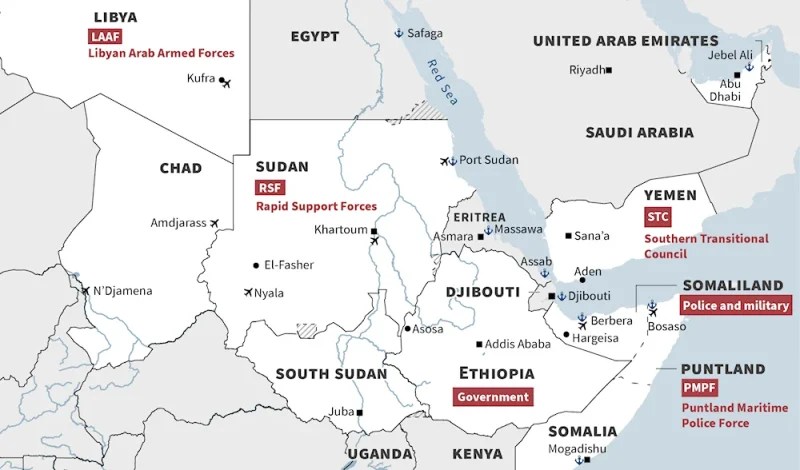
A newly published report by the German Institute for International and Security Affairs (SWP) has delivered a critical assessment of the United Arab Emirates’ role in African conflicts, describing Abu Dhabi as a systematic spoiler that arms proxy forces, manipulates diplomatic processes, and bears significant responsibility for some of the world’s worst humanitarian crises, all while facing virtually no political consequences from its Western partners.
The report, authored by researchers at one of Europe’s most influential foreign and security policy think tanks, which directly advises the German government and Bundestag, calls on Berlin and its European partners to fundamentally reassess their relationship with the UAE.
Sudan: The clearest case
The report presents Sudan as the most devastating example of Emirati interference. The UAE is identified as the most important military, logistical, and financial backer of the Rapid Support Forces (RSF), the paramilitary group whose war against the Sudanese Armed Forces has produced what the UN reports as the world’s largest humanitarian crisis, with 33.7 million people dependent on aid, over 15 million displaced, and widespread extreme hunger.
The RSF’s conduct has been particularly brutal. The report details targeted violence against non-Arab minorities, including sexual violence, mass killings, attacks on medical facilities, and hostage-taking, primarily directed at groups such as the Masalit and Zaghawa.
When the RSF captured El-Fasher in North Darfur in October 2025, a UN fact-finding mission described its actions against the civilian population as bearing the hallmarks of genocide.
Emirati support for the RSF continued even after Iranian strikes on the UAE, with numerous cargo flights departing from Emirates airports to Ethiopia, apparently to ferry supplies across the border to RSF positions.
A UN panel of experts documented 458 flights involving heavy transport aircraft from Emirati military airports or the transhipment hub of Bosaso to eastern Libya between October 2024 and the end of 2025, 239 of them bound for Kufra, a key hub for RSF resupply, in likely violation of UN arms embargoes on both Libya and Darfur.
A proxy model built on plausible deniability
The UAE rarely deploys its own forces. Instead, it operates through a carefully constructed network of local proxies, private military contractors, and logistical intermediaries. Beyond the RSF in Sudan, its partners include Khalifa Haftar’s Libyan Arab Armed Forces, the Puntland Maritime Police Force in Somalia, and, in a departure from the pattern, the Ethiopian government during its war against the Tigray people.
The report details how the UAE recruited and deployed hundreds of Colombian mercenaries to Sudan via an Emirati security firm, with the US government noting in 2025 that these fighters had served as infantry, artillery personnel, drone pilots, and even trained children for combat.
Supplies to the RSF have been routed through LAAF-controlled Libya, Chad, Kenya, Uganda, and Rwanda, with Abu Dhabi deploying financial leverage to secure cooperation, including a 1.5 billion dollar loan to Chadian President Idriss Déby in 2023.
The UAE also profits from gold smuggling networks in conflict zones, with members of the ruling family reported to have personal ties to both Haftar and RSF commander Mohamed Hamdan Dagalo.
Why the UAE intervenes
SWP identifies several overlapping motives. Economic interests are central, as state-owned logistics giants DP World and AD Ports Group have port and infrastructure projects across the continent, and military interventions serve to protect access to trade routes and strategic resources.
But economics alone do not explain the pattern. The report points to the UAE’s drive to outcompete Saudi Arabia for regional influence, a rivalry that has only sharpened since Riyadh forced Abu Dhabi out of southern Yemen.
Ideological opposition to the Muslim Brotherhood also shapes policy, with the UAE consistently backing actors who suppress Islamist movements. Personal enrichment through resource networks and ruling family ties to conflict actors adds a further layer.
Diplomatic manipulation
The report scrutinises the UAE’s use of diplomatic engagement as cover, whereby Abu Dhabi participates in international peace processes while simultaneously intensifying support for belligerents.
In September 2025, the UAE joined the Sudan Quad format alongside Egypt, Saudi Arabia, and the United States, signing joint commitments to end external support for conflict parties. According to US intelligence reporting, however, the UAE was actively intensifying support for the RSF at the same time.
The UAE also pledged 200 million dollars at a February 2025 humanitarian conference and a further 500 million dollars at a US conference in 2026, while contributing only around 33 million dollars to the UN-coordinated humanitarian plan.
In November 2025, Emirati Minister of State Lana Nusseibeh spent four days meeting with Members of the European Parliament in Brussels. Nusseibeh’s endeavor was successful, as a Parliament resolution on Sudan adopted at the same time made no mention of the UAE’s support for the RSF, following opposition from the European People’s Party to amendments tabled by left-wing parliamentary groups.
The same pattern played out during the Berlin Libya Process in 2019-20, when the UAE pledged to halt arms transfers to Libyan conflict parties but continued them regardless. Transport aircraft flew from the Emirates to eastern Libya on the very day of the Berlin conference in January 2020.
European silence, eroded accountability
The report stresses that Western governments, including Germany, have consistently refused to name the UAE publicly in international forums, despite substantial documented evidence of its role in fuelling conflicts. No UN Security Council member has explicitly raised Emirati support for the RSF in formal meetings, either.
This reluctance, SWP argues, is not incidental but reflects a broader calculation in which trade ties, security cooperation, the UAE’s close relationship with “Israel,” and the strategic goal of preventing Abu Dhabi from drifting further toward China or Russia have consistently outweighed accountability concerns.
The UAE’s open disregard for the UN embargo on Libya from 2014 onward, the report notes, likely encouraged other states to adopt a similar approach, with the same dynamic now being repeated in Sudan.
Five recommendations
SWP outlines five concrete steps for Germany and its European partners:
- First, Abu Dhabi should be named explicitly in international forums rather than referenced in vague language about “external actors.”
- Second, EU financial sanctions should be expanded and applied more consistently where Emirati actors have documented embargo violations.
- Third, German arms export policy toward the UAE requires a fundamental review, given the documented transfer of German-chassis military equipment to conflict zones.
- Fourth, anti-money-laundering enforcement should be tightened, with greater focus on Emirati financial centres as hubs for conflict economies and sanctions evasion.
- Fifth, the strategic partnership Germany has maintained with the UAE since 2004 should, at a minimum, be suspended unless Abu Dhabi demonstrably reorients its policy toward de-escalation.
The report concludes that the war on Iran, mounting tensions with Saudi Arabia, and growing reputational vulnerabilities have made the UAE more susceptible to European pressure than at any previous point, and that this window should not go unused.
Saudi Arabia is pulling Europe toward a “Gulf Helsinki” deal with Iran — because Washington failed
By Tamer Ajrami | MEMO | May 17, 2026
When military power fails to impose “deterrence,” oil becomes politics. And the Strait of Hormuz is now writing Gulf security rules instead of the Pentagon.
With Hormuz still closed and the emergency oil stock releases used to calm markets running down, prices are moving _ no matter how much some people deny it _ toward a new surge. The real problem is not the price as a number. It is the chain reaction: gasoline and diesel, shipping and insurance, raw materials, and then inflation that travels from Asia to the United States. And even if the strait opened tomorrow, the damage would not vanish. Supply chains do not reset overnight, and parts of the oil and petrochemicals flow would take time to recover.
In my previous Middle East Monitor article, I said clearly that Gulf states “have nothing but to talk to Iran now”. That was not idealism or goodwill. It was hard security math: the old formula is eroding. Bases do not protect the way people assumed, and guarantees shrink the moment they face a real test. Today, this is no longer an argument. It is a reality driven by markets before politics.
Trump and China: A visit without a lifeline — and Time is against him
Trump’s attempt to turn to China produced no clear exit. Not because Beijing is powerless, but because it sees the issue in simple terms: open the strait through practical understandings, and negotiate with Iran on realistic terms.
The problem is that Washington still wants a “surrender” wrapped in diplomatic language. Iran sees no reason to give that for free as it holds leverage in a global energy shock.
This is the core of Trump’s trap: he can say whatever he wants, but he cannot cancel economics. Markets do not negotiate. They punish.
That is why countries are now moving on two tracks: a unilateral track to protect their own interests, and a collective track to design a new framework that prevents the next shock. Saudi Arabia is stepping forward to lead the collective track, not because it loves “mediation” as a headline, but because the cost of ongoing chaos has become higher than the cost of a deal.
A New “Helsinki Act” — But without the Human Rights Basket
According to Western reporting, Saudi Arabia is floating something close to a “Gulf Helsinki Act” arrangement with Iran—modeled on the Helsinki process of the mid-1970s during the Cold War. It would not be just a Saudi–Iran deal. It would extend to the Gulf and the European Union, aiming to lock in non-aggression, structured economic normalization, and monitoring and implementation mechanisms.
The original Helsinki process was built around four “baskets”: security and non-aggression; economic cooperation; human rights and self-determination; and follow-up mechanisms. In the Middle East, copying the third basket is unrealistic. The region’s unwritten rule is non-interference. Here, states do not use “human rights” language as a tool to destabilize each other internally. So, the Saudi approach seems to focus on three practical baskets: security and non-aggression, economic cooperation and stable energy flows, and verification/implementation.
It is a practical logic: if you want an agreement that can survive, you do not plant a delayed bomb inside it.
The Hard Question: Can a Deal work without the United States?
Here is the central dilemma. A Gulf–EU–Iran non-aggression arrangement without the United States creates a dangerous gap: the Gulf and Europe commit to non-aggression, Iran commits too, but Washington and Israel still retain the ability to strike Iran. What does the agreement do then? Does it become a nice document that collapses at the first air raid?
On the other hand, bringing Washington into the deal is not easy either. The US is struggling to produce a quick bilateral agreement with Iran to end the crisis, so why would it accept a broader framework that limits its freedom of action?
This opens a third, more sensitive option: Gulf states and Europe “bypass Washington” in practice. That would mean refusing the use of their airspace and territorial waters for any military or intelligence activity against Iran. And maybe refusing to enforce sanctions that destabilize the region and recreate the Hormuz shock. This is not a small move. It would be a strategic shift.
The UAE: A Different Vision — and a Dangerous Ceiling
The Gulf is not unified on strategy. Other reporting suggests Emirati efforts to push a coordinated Gulf military “response” against Iran. The problem is not the idea of response by itself. The problem is the ceiling of objectives.
If the goal is limited deterrence to reduce escalation, that is one thing. But if the goal mirrors Netanyahu and Washington _ regime change, dismantling Iran’s nuclear program, destroying its ballistic capabilities, and reshaping Iran from the inside _ that is a long war. And the Gulf does not have the luxury to absorb its costs.
Most importantly, the idea of “escaping Hormuz” through alternative pipelines is not a real solution. If peace collapses, fields, ports, and energy infrastructure across the region remain within range. And Bab al-Mandab can become another choke point. In the end, the issue is not a pipeline or a port. It is a sustainable peace that prevents the drone and the missile before it “manages” the price.
Whoever Ends the War Ends the Chaos
A way out starts from one point: ending the US–Israeli confrontation with Iran through a realistic understanding; then building a regional framework similar to “Helsinki” that locks in non-aggression, protects economies, and prevents a repeat of the strait crisis.
Saudi Arabia is trying to “hold the story together” because Washington entered, got stuck, and now wants to exit; while the Gulf cannot afford to sit between Iran’s leverage and America’s disorder.
The choice is clearer than ever: either a settlement that closes the door on choke-point warfare, or a longer crisis that bankrupts markets before it bankrupts armies. The Gulf; whether it likes it or not; no longer has the option to “wait”.
French presidential hopeful pushes to end Russia sanctions
RT | May 11, 2026
French presidential hopeful Florian Philippot has called for lifting sanctions against Russia and restoring Russian energy imports. In an interview with RT, the politician claimed that Brussels-driven EU policies run counter to France’s national interests.
A former vice president of the National Front (now National Rally) and ex-member of the European Parliament, Philippot announced on Saturday that he will run in the 2027 election. He leads the sovereigntist movement ‘Les Patriotes’ and is a longtime critic of the EU, the euro, and NATO. He advocates restoring French sovereignty, reducing dependence on supranational institutions, and ending French military and financial aid to Ukraine.
“I want, and it is in my program, for France to regain its independence by leaving all the supranational globalist structures: the EU, the euro, NATO,” Florian Philippot told RT France on Sunday. “And I want a policy of dialogue and friendship with Russia, and not, as today, one of mistrust, war, and insults. All of this is absurd for our national interests.”
The politician said Paris should “take back control” by withdrawing from free trade agreements such as Mercosur, which he said “condemn French farmers to death.” He added that sanctions on Russia imposed by Brussels should be ended in order to restore the flow of Russian gas and oil.
Philippot also called for France to regain control over immigration and migration flows while pursuing a broader reindustrialization strategy. He said the country’s industrial base had been weakened under the euro and advocated restoring a national currency better suited to the French economy.
In addition, the politician pledged to expand the use of referendums, including citizen-initiated votes, as part of strengthening popular sovereignty. He also called for reducing France’s dependence on the EU, which he said is largely shaped in Berlin and Washington rather than in Paris. Philippot stressed that leaving the EU would allow France to lower energy and electricity costs.
France is heading toward a highly fragmented presidential race, with around 30 people already expressing interest in being on the 2027 ballot. These include Jean-Luc Melenchon, leader of ‘La France Insoumise’, Bruno Retailleau, president of ‘Les Republicains’, Xavier Bertrand, a senior center-right politician, David Lisnard, mayor of Cannes, Laurent Wauquiez, a prominent conservative figure, and Edouard Philippe, France’s former prime minister.
Prediction: NATO’s Collapse & Nuclear War
By Prof. Glenn Diesen | May 8, 2026
NATO was always destined to be a temporary military alliance, united by a common enemy and threat during the Cold War. Once that threat disappeared with the end of the Cold War and thereafter the collapse of the Soviet Union, the main question asked in the 1990s was: What would be NATO’s new reason to exist? The answer to this question was to pursue unipolarity / collective hegemony in the post-Cold War era through NATO expansionism and military interventionism (“out of area or out of business”).
Russia was implicitly given the ultimatum: be a compliant civilizational student or a counter-civilizational force. Russia could accept NATO’s hegemonic role as a “force for good,” or it could resist, and then NATO would return to its former role of confronting Russia. The NATO-backed regime change in Ukraine—aimed at transforming the country from a Russian partner into a frontline state aligned against Russia— triggered the war in 2014. NATO thus began reverting to its former role of confronting Russia, yet it happened as the hegemonic era had come to an end.
Now that the former collective hegemony has been balanced and a multipolar world has emerged, NATO has yet again lost its purpose and will disintegrate. European leaders want to restore NATO’s original purpose: containing Russia. This will fail because it is based on the fraudulent narrative that Russia wants to restore the Soviet Union, rather than balancing NATO expansionism and military interventionism.
The US will, however, not return to the original purpose of NATO as the distribution of power has shifted, and will therefore not play along with the fake narratives of Europeans leaders. The US is in relative decline and cannot sustain simultaneous strategic dominance in Europe, the Middle East, East Asia, and the Western Hemisphere. The US cannot be everywhere in a multipolar world, and it will pivot to the Western Hemisphere and East Asia. A US presence in Europe consumes too many resources and pushes Russia toward China, its main rival. However, the US is happy to outsource the conflict with Russia to the Europeans. Europe remains obedient, and Russia is weakened.
If Europe had rational leaders, they would have adjusted to the new international distribution of power by shutting this war down, making peace with Russia, establishing a common pan-European security architecture (35 years too late) that also saves Ukraine by removing it from the front lines of a re-divided Europe, and diversifying their economic ties to avoid excessive dependence on any one foreign power. However, Europe does not have rational leaders, and even arguing that weapons are not the path to peace or arguing in favour of diplomacy is smeared and censored as “pro-Russian” treason. Europe’s political class remains committed to Russophobic narratives and policies that intensify confrontation and prolong the conflict.
The trajectory now appears increasingly clear: NATO will continue to disintegrate, and the Europeans will compensate by further escalating the war against Russia. This will happen at a time when Russia is desperate to restore its deterrence by retaliating against Europe (most predictably against Germany), while the US commitment and protection of Europe are waning. The predictable consequence is that European leaders will eventually provoke a powerful response from Russia, which will rapidly escalate to what will hopefully only be a limited nuclear strike.
UAE received $80m in EU farming subsidies as calls grow for sanctions over Sudan genocide
MEMO | May 7, 2026
The United Arab Emirates’ ruling Al Nahyan family has benefited from more than €71 million (US $80 million) in European Union farming subsidies, even as campaigners intensify calls for sanctions against senior Emirati officials over Abu Dhabi’s alleged role in the Sudan genocide.
A cross-border investigation by DeSmog, shared with the Guardian, found that subsidiaries controlled by the Al Nahyan family collected more than €71 million over six years through farmland in Romania, Italy and Spain. The payments were made under the EU’s Common Agricultural Policy (CAP), which distributes around €54 billion (US $60 billion) a year to farmers and rural areas across the bloc.
The investigation traced 110 subsidy payments between 2019 and 2024 to a network of companies and subsidiaries controlled by the UAE ruling family and Abu Dhabi sovereign wealth fund ADQ. The largest payments were linked to Agricost, a Romanian agricultural company which owns what the Guardian described as the EU’s single largest farm, covering 57,000 hectares.
The findings have raised fresh questions about how European public funds are being channelled to foreign state-linked investors and ultra-wealthy landowners. The UAE’s European agricultural holdings form part of Abu Dhabi’s wider food security strategy, aimed at securing crops and animal feed for a country which imports most of its food.
The revelations come as pressure grows in the UK for greater scrutiny of the UAE’s role in Sudan. Human rights organisation FairSquare has asked the British government to investigate links between Sheikh Mansour Bin Zayed Al Nahyan, the UAE deputy prime minister and owner of Manchester City Football Club, and Sudan’s Rapid Support Forces (RSF).
FairSquare’s sanctions submission alleges that the UAE has been the “prime external driver” of the Sudan conflict and cites evidence, including from the UN Panel of Experts, that Abu Dhabi has supplied weapons, ammunition and other support to the RSF since June 2023, in violation of a UN arms embargo. The UAE has repeatedly denied arming the RSF.
The RSF has been accused of mass atrocities in Sudan, including in Darfur. FairSquare’s submission notes that the UN has described RSF violence in El-Fasher as “shocking in its scale and brutality” and bearing “the hallmark of genocide”. The group argues that the UK should examine whether Sheikh Mansour’s alleged role meets the threshold for sanctions.
West losing leadership position to Global South: Russia’s president
Press TV – April 28, 2026
Russian President Vladimir Putin says the West is losing its economic and political leadership position in the world, giving way to the countries of the Global South.
A more complex, multipolar architecture of global development is taking shape as Western countries lose their dominance and yield to new growth centers in the Global South, the Russian president said on Tuesday in a video message to participants of the Open Dialogue Forum.
“States that truly understand and appreciate the importance of national sovereignty in the political, economic, cultural and social spheres are playing an increasingly important role, and they can determine the vector of their own development based on their own values, resources and priorities, identity and sovereign worldview,” he stated.
Prior approaches and established norms of business and international relations are steadily losing their efficacy, partly due to the actions of Western countries, which are relinquishing their leadership positions, he noted.
“The events of recent years show that all elements of global growth, from economics and finance to technology and demography, are changing irreversibly,” Putin added.
The global development model, he argued, will only be sustainable if it is built on the principles of equality and takes into account the interests of all countries. No nation can develop alone, at the expense of others or to their detriment.
“It is important to focus the entire global development platform so everyone, anywhere on Earth can have the right to a successful future, choose their own path, and put their choice into practice step by step,” the Russian president concluded.
The Global South emerged in part to help countries in the southern hemisphere collaborate on political, economic, social, environmental, cultural, and technical issues. Since 1995, exports within the Global South have surged by 1,300 percent, double the growth rate of exports to the North.
Countries of the Global South are no longer merely suppliers for the West; they are increasingly fueling each other’s economic and financial development.
More than 40 percent of exports from developing countries now remain within the Global South, twice the share in 2000, indicating deepening interdependence.
Benefiting from expanded South-South trade relations, developing economies today account for about 45 percent of global GDP, up from 25 percent in 2000.
Iran says EU’s insistence on sanctions hastens its ‘embarrassing descent into irrelevance’
Press TV – April 28, 2026
Iran’s Foreign Ministry spokesperson says the EU’s insistence on inhumane sanctions against Iran demonstrates Europe’s double standards and hastens its “embarrassing descent into irrelevance.”
On Monday, European Commission President Ursula Vonder Leyen said at a press brief in Berlin that “it is too early to talk about lifting sanctions on Iran.”
In a post on X late Monday, Esmaeil Baghaei strongly criticized the European Commission president’s insistence on maintaining sanctions against Iran under the guise of human rights, calling the stance hypocritical and disgraceful.
“The EU’s inhumane sanctions on Iran were never about ‘human rights’ — they were designed to trample the basic rights of ordinary Iranians,” Baghaei wrote. “No one is buying this tired moral theater.”
He added that such posturing will not earn Europe or its constituency “an ounce of credibility on the world stage.”
“If anything, it only further demonstrates Europe’s ruling class’ double-standard & hypocrisy, and hastens Europe’s embarrassing descent into irrelevance,” the spokesperson further said.
Iranian officials have consistently condemned EU sanctions, arguing they are not about human rights but are a form of collective punishment designed to harm ordinary citizens and serve the political interests of Western powers.
When a Train Ticket Costs Your Passport: The Eurail Breach and the Digital ID Problem
By Ken Macon | Reclaim The Net | April 25, 2026
Eurail wanted people’s passport number to let them ride a train. Now that data is for sale on the dark web, and some of the 308,777 people caught up in the breach are being told to cancel their passports and pay for replacements out of their own pocket.
The Dutch company, which sells the Interrail passes used by young travelers across 33 European countries, confirmed this week that a sample of the stolen dataset has already surfaced on Telegram.
“We can confirm that data copied during the security incident has been offered for sale on the dark web and a sample dataset has been published on Telegram,” a spokesperson said. “Customers whose personal data was included in the sample dataset are being informed directly where contact details are available to us.”
The full haul contains exactly the material identity thieves dream about, including passport numbers, passport expiry dates, full names, home addresses, email addresses, phone numbers, and dates of birth. For users of the EU’s DiscoverEU program, which hands out free travel passes to young people, the exposed records also include photocopies of passports, bank account details, and some health data.
The breach happened on December 26, 2025. Eurail only began notifying affected individuals on March 27, 2026, three months after hackers walked out with the files and a full month after the data appeared on a cybercrime forum.
In February, a hacker claimed responsibility publicly, saying they had stolen roughly 1.3 terabytes of data from Eurail’s AWS S3, Zendesk, and GitLab instances, including source code, database backups, and support tickets. The same hacker said negotiations with Eurail had failed, which is why the files were being dumped.
None of this was information Eurail needed to sell a train ticket. Rail operators ran Europe’s networks for decades without demanding scanned passports and dates of birth from every customer. The identity-verification stack that now sits behind a simple rail pass exists because identity checks have become the default business model, not because anyone can explain why selling a seven-day Interrail pass requires a permanent copy of someone’s government-issued ID.
The Eurail breach is a working demonstration of what happens when governments treat identity collection as the default setting for ordinary life. The UK is moving toward a mandatory digital ID scheme. The EU is rolling out its European Digital Identity Wallet.
Online Safety Act compliance in Britain now requires “age verification” across huge swathes of the web, with platforms demanding government IDs, face scans, or credit card details before users can access content that was freely available a year ago.
Every one of these systems rests on the same assumption that sank Eurail’s customers, which is that identity data can be collected safely, stored securely, and kept out of the wrong hands indefinitely.
That assumption has never held up. The pattern is consistent enough now to be predictable. A government or regulator decides identity verification should be mandatory for some activity, whether that is buying a train ticket, watching adult content, opening a bank account, or posting on social media. Private companies build the verification infrastructure, because governments rarely build their own.
Those companies then hold databases of passport numbers, biometric scans, and home addresses, secured according to whatever corporate security practices happen to be in place. The databases get breached, because databases always get breached, and the consequences fall on the people whose data was collected rather than the entities that insisted on collecting it.
EU economic sanctions ramp up NATO war plan on Russia
Strategic Culture Foundation | April 24, 2026
The European Union announced its 20th round of economic sanctions against Russia this week. The bloc of 27 nations began imposing sanctions on Moscow when the conflict in Ukraine erupted in February 2022. Every six months, the EU has been extending these economic measures, which Brussels claims is support for Ukraine to “deter Russian aggression.”
The 20th round of sanctions unveiled this week attempts to go much further in inflicting damage on the Russian economy. It was flagged as the biggeset package yet and a “multi-layered targeting of key sectors” of the Russian economy, primarily its energy industry.
It is tempting to dismiss the EU sanctions policy as feeble and a form of insanity. The bloc keeps repeating an action expecting a different result each time, when the record shows that the action of sanctions is having little detrimental impact on Russia. If anything, it is the EU that has suffered an economic downturn as it unilaterally cut itself off from Russian oil and gas, the traditional source of affordable energy feedstock for European industries. Russia’s economy has not crashed as was anticipated when the sanctions were first imposed more than four years ago. In fact, the Russian Federation has maintained a robust economic performance as it finds alternative markets in Asia for its oil and gas products. The soaring price for a barrel of crude due to the reckless U.S.-Israeli aggression on Iran has given Russia a further boost.
However, it would be a mistake to simply brush off the EU sanctions as futile and self-defeating.
There is a more blatant and sinister aspect to the new round of sanctions. Brussels is nakedly showing its war agenda. The new measures aim to restrict all sectors of Russian energy production, including “exploration, extraction, refining and transportation.” The EU is endeavoring to tighten restrictions on “third countries” to prevent Russia from circumventing existing embargoes on shipping, port access and trade. Whether these new measures achieve their objective of “crippling the Russian economy” is debatable. But it is the belligerent intention – stated now with more determination – that is significant. The EU is brazenly laying out a plan to strangle Russia in conjunction with upping the military threat.
It is the accompanying developments that are ominous and which give full meaning to the economic measures.
This week the EU hailed that its €90 billion ($105 bn) loan to Ukraine had finally been approved. That financial aid was blocked by Hungary since December. But with the recent election loss for Viktor Orbán’s government, Budapest’s veto has been lifted under the new prime minister, Péter Magyar. EU leaders were ecstatic that the financial transfer to Ukraine can now go ahead.
Two-thirds of the EU loan – some €60 bn – is reportedly allocated for military aid. Ursula von der Leyen, the European Commission president, said that the first tranche worth €45 bn will be transferred to Ukraine within weeks and that it would be used to increase the production of aerial combat drones. “Drones from Ukraine for Ukraine,” she said by way of trying to give the impression that the EU is not a party to the war.
An EU leaders’ two-day summit held in Cyprus on April 24-25 was reported with a celebratory mood. Von der Leyen and European Council President Antonio Costa, along with the EU’s Foreign Affairs Commissioner, Kaja Kallas, were cock-a-hoop at the “breakthrough” of releasing the largest single financial package to Ukraine so far in combination with the new economic sanctions aimed at drilling down on Russia’s economic core. Attending the summit in Cyprus was Ukraine’s nominal president, Vladimir Zelensky, who reportedly joined the EU leaders for dinner to discuss new developments.
It gets even more sinister. The Kiev regime has been stepping up deep air strikes on Russian energy and other industrial infrastructure. There is no doubt the regime is being assisted with NATO expertise in finding such wide-ranging targets in Russia’s vast territory. This week, for example, a drone strike hit an industrial facility in Novokuybyshevsk in the central Samara region, nearly 900 kilometers southeast of Moscow and nearly 2,000 kms from the warzone in Donbass.
Clearly, the EU’s economic strikes are designed to reinforce the damage that NATO is trying to inflict with drones and missiles on Russia’s industrial base. These are not separate initiatives but an integral war strategy.
In announcing the latest round of sanctions Kaja Kallas could hardly contain her Russophobic glee. “Today we have broken the deadlock. On top of the €90-billion loan for Ukraine, we have adopted the 20th sanctions package,” she said.
Deceptively, the sanctions were billed as “increasing pressure on Russia to stop its brutal war of aggression and engage in meaningful negotiations towards a just and last peace.”
That’s a cynical con – a con that is betrayed by the EU’s own stated objective of “crippling” the Russian economy. How can one have a “just and lasting peace” by crippling a country?
The real purpose of the funds that EU citizens will have to pay through decades of indebtedness is to escalate NATO’s war in Ukraine against Russia. The economic sanctions are war measures aimed at maximising the impact of military attacks.
Other developments this week raise the stakes to even more sinister levels.
French President Emmanuel Macron and Poland’s Prime Minister Donald Tusk discussed joint nuclear weapons “scenarios” in a bilateral summit in Gdansk. The French leader wants to share his country’s nuclear weapons capabilities with other European countries. It is reported that French and Polish warplanes will begin joint exercises on flying nuclear weapons in the Baltic region. This is evidently meant as a threat to Russia. It amounts to Paris and Warsaw carrying out training exerises for nuclear strikes on Russia.
In yet another provocative development, it is reported that Britain is leading a NATO Joint Expeditionary Force to formulate a naval plan to blockade the Russian enclave of Kaliningrad located between Poland and Lithuania. Kaliningrad provides Russia with vital port access to the Baltic Sea.
The European NATO leaders are concerned that U.S. President Donald Trump has lost interest in the “Ukraine project” against Russia owing to his reckless war with Iran. That is why they are ramping up the war effort against Russia while telling barefaced lies about wanting to achieve “lasting peace.”
So far, the EU’s economic sanctions against Russia have been an abject failure. But the failure of economic measures is no longer the point. It is what they reveal about an intensifying NATO war plan against Russia.
Moscow has repeatedly called for a negotiated end to the conflict while the EU and NATO accuse Russian leader Vladimir Putin of “not wanting peace.”
People can make their own minds up about who the aggressors are. NATO is at war with Russia and is not interested in negotiations. Criminally, the NATO aggressors are creating a boiling frog situation for Russia. The European russophobic leaders seem to want war at any cost.
Featured Video
Iran’s Next Strike May Not Explode. It Could Shut You Down
or go to
Aletho News Archives – Video-Images
From the Archive
Zionism’s Violent Legacy
By Donald Neff | Washington Report On Middle East Affairs | January 1996
On January 4, 1948, Jewish terrorists drove a truck loaded with explosives into the center of the all Arab city of Jaffa and detonated it, killing 26 and wounding around 100 Palestinian men, women and children.[1] The attack was the work of the Irgun Zvai Leumi – the “National Military Organization,” also known by the Hebrew letters Etzel – the largest Jewish terrorist group in Palestine. The Irgun was headed by Revisionist Zionist Menachem Begin and had been killing and maiming Arabs, Britons and even Jews for the previous ten years in its efforts to establish a Jewish state.
This terror campaign meant that at the core of Revisionist Zionism there existed a philosophical embrace of violence. … continue
Blog Roll
 Aletho News
- Trump’s Iran war is on an Israeli leash
- Saudi oil boss issues global supply warning
- Riyadh Says Its Oil System Is Intact. The Numbers Say Otherwise.
- Trump and Netanyahu Want to “Finish the Job” on Iran
- US ‘one-sided dictation’ not Iran’s beliefs makes rational talks impossible: Baghaei
- Iran’s Next Strike May Not Explode. It Could Shut You Down /Col Doug Macgregor
- Iran: US political targets legitimate if assassinations return
- Iraq shuts key border crossing with Iran under US pressure: Report
- Undersea Internet cables could be targeted in retaliation for attacks on Iran: IRGC deputy chief
- EU sending ‘biased’ observers to interfere in Serbian election – president
- If Americans Knew
- The Israel Lobby’s Changing Fortunes
- AIPAC has become such a political liability that it’s shifting to a more “nimble” approach to buying politicians
- At least 160 Israeli settler attacks in 2 weeks
- Will Gaza’s Ancient Christian Community Disappear Forever?
- Israel’s vision of regional security rests on keeping Arab states weak
- Heidi Levine recounts how Palestinian youths helped save her in settler attack
- DAILY UPDATE: Latest essential news on Palestine, Israel, & region
- Trump’s Intensifying Sabotage of the ICC, for Israel’s Sake
- Israeli military detain US and UK volunteers in West Bank including Democratic NY politician Brad Lander
- Americans at National Conservatism Conference held in Israel this year criticize Israel
- No Tricks Zone
- E-Cars Reduce CO2 Emissions By Only 41% Compared To Internal Combustion Engine Vehicles
- Predictions Made By Renowned Climate Professor Over Past Decades Have Been Proven To Be Poor
- New Study Suggests Large Regions Of The Pacific Ocean Have Been Cooling For The Last 80 Years
- Germany’s Green Energy Debacle: High Energy Costs Force Kahla Porzellan to Close After 182 Years!
- New Study: 50 Years Of The Most Aggressive ‘Net Zero’ Policies Can Only Affect The Global Climate By 0.03°C
- US September “Heat” Was No Record…Many Records Set Decades Ago
- Latest European Green Energy Debacle; Portugal’s Largest Flagship Solar Park Insolvent!
- Green Energy Debacle: German Expert Professor Fritz Vahrenholt Warns Of Severe Economic And Social Consequences
- Two More Paleo Reconstructions Affirm Meters-Higher Sea Levels Across Ireland, Brazil 7000-6000 Years Ago
- New Study: Earth And Venus Surface Warmth Largely Explained By Convection And Lapse Rate, Not CO2 Or Radiation

