FBI’s Steele story falls apart: False intel and media contacts were flagged before FISA
By John Solomon – The Hill – 05/09/19
The FBI’s sworn story to a federal court about its asset, Christopher Steele, is fraying faster than a $5 souvenir T-shirt bought at a tourist trap.
Newly unearthed memos show a high-ranking government official who met with Steele in October 2016 determined some of the Donald Trump dirt that Steele was simultaneously digging up for the FBI and for Hillary Clinton’s campaign was inaccurate, and likely leaked to the media.
The concerns were flagged in a typed memo and in handwritten notes taken by Deputy Assistant Secretary of State Kathleen Kavalec on Oct. 11, 2016.
Her observations were recorded exactly 10 days before the FBI used Steele and his infamous dossier to justify securing a Foreign Intelligence Surveillance Act (FISA) warrant to spy on Trump campaign adviser Carter Page and the campaign’s contacts with Russia in search of a now debunked collusion theory.
It is important to note that the FBI swore on Oct. 21, 2016, to the FISA judges that Steele’s “reporting has been corroborated and used in criminal proceedings” and the FBI has determined him to be “reliable” and was “unaware of any derogatory information pertaining” to their informant, who simultaneously worked for Fusion GPS, the firm paid by the Democratic National Committee (DNC) and the Clinton campaign to find Russian dirt on Trump.
That’s a pretty remarkable declaration in Footnote 5 on Page 15 of the FISA application, since Kavalec apparently needed just a single encounter with Steele at State to find one of his key claims about Trump-Russia collusion was blatantly false.
In her typed summary, Kavalec wrote that Steele told her the Russians had constructed a “technical/human operation run out of Moscow targeting the election” that recruited emigres in the United States to “do hacking and recruiting.”
She quoted Steele as saying, “Payments to those recruited are made out of the Russian Consulate in Miami,” according to a copy of her summary memo obtained under open records litigation by the conservative group Citizens United. Kavalec bluntly debunked that assertion in a bracketed comment: “It is important to note that there is no Russian consulate in Miami.”
Kavalec, two days later and well before the FISA warrant was issued, forwarded her typed summary to other government officials. The State Department has redacted the names and agencies of everyone she alerted. It is unlikely that her concerns failed to reach the FBI.
Rep. Mark Meadows (R-N.C.), a member of the House Oversight and Reform Committee and ranking member of its Subcommittee on Government Operations, told me late Thursday he had confirmed with U.S. officials that Kavalec’s memo was forwarded to the FBI in the Oct. 13, 2016, email.
“This once again shows officials at the FBI and (Department of Justice) DOJ were well aware the dossier was a lie — from very early on in the process all the way to when they made the conscious decision to include it in a FISA application,” he said. “The fact that Christopher Steele and his partisan research document were treated in any way seriously by our Intelligence Community leaders amounts to malpractice.”
FBI and DOJ officials did not respond to a request for comment.
But it is almost certain the FBI knew of Steele’s contact with State and his partisan motive. That’s because former Assistant Secretary of State Victoria Nuland says she instructed her staff to send the information they got from Steele to the bureau immediately and to cease contact with the informer because “this is about U.S. politics, and not the work of — not the business of the State Department, and certainly not the business of a career employee who is subject to the Hatch Act.”
Even if the FBI didn’t get Kavalec’s memo, it is just as implausible that the bureau couldn’t figure out, during the many hours that its agents spent with Steele, what Kavalec divined in a few short minutes: He was political, inaccurate, spinning wild theories and talking to the media.
All those concerns would weigh against Steele’s credibility and should have been disclosed to the judges under the honor system that governs the Foreign Intelligence Surveillance Court, experts say.
Kavalec’s handwritten notes clearly flagged in multiple places that Steele might be talking to the media.
“June — reporting started,” she wrote. “NYT and WP have,” she added, in an apparent reference to The New York Times and The Washington Post.
Later she quoted Steele as suggesting he was “managing” four priorities — “Client needs, FBI, WashPo/NYT, source protection,” her handwritten notes show.
Those same notes suggest Steele spun some wild theories to State, including one that the Russians had a “plant in DNC” and had assembled an “HRC dossier,” apparent references to the Democratic National Committee and Clinton.
She expounded in her typed memo. “The Russians have succeeded in placing an agent inside the DNC,” she quoted Steele as saying.
Steele offered Kavalec other wild information that easily could have been debunked before the FISA application — and eventually was, in many cases, after the media reported the allegations — including that:
- Trump lawyer Michael Cohen traveled to Prague to meet with Russians;
- Trump campaign chairman Paul Manafort owed the Russians $100 million and was the “go-between” from Russian President Vladimir Putin to Trump;
- Trump adviser Carter Page met with a senior Russian businessman tied to Putin;
- The Russians secretly communicated with Trump through a computer system.
Special counsel Robert Mueller’s report, released last month, dispelled all those wild theories while hardly mentioning Steele, except for a passing reference to his dossier being “unverified.” That’s significant, because the FISA request from October 2016 that rested heavily on Steele’s information was marked “verified application” before the FBI submitted it to the court.
And, as I reported earlier this week, Kavalec’s memo clearly warned that Steele had admitted his client was “keen” to get his information out before Election Day. In other words, he had a political, rather than an intelligence, deadline.
David Bossie, head of Citizens United, called on State and the FBI to release the rest of Kavalec’s information they redacted: “Christopher Steele was a political operative. The American people have a right to know why the FBI took this garbage to the FISA court.”
Kavalec’s notes aren’t the only red flag that should have caught the FBI’s attention before the bureau vouched for Steele’s credibility.
Notes and testimony from senior Justice Department official Bruce Ohr make clear Steele admitted early on that he was “desperate” to get Trump defeated in the election, was working in some capacity for the GOP candidate’s opponent, and considered his intelligence raw and untested. Ohr testified that he alerted FBI and other senior Justice officials to these concerns in August 2016.
Steele eventually was fired by the FBI for leaking to the press — in violation of his source agreement with the bureau — and lying about it. But that did not happen until Nov. 1, 2016 — after the FISA warrant was secured. And, even then, the court wasn’t notified until a few months later, well after Election Day.
Steele’s admission of media contacts on Oct. 11, 2016, and the mere existence of his meeting at the State Department likewise violated his confidentiality agreement with the bureau and clearly were discoverable well before the FISA warrant was secured Oct. 21, 2016.
If the State Department and Ohr could figure out that Steele was a partisan, paid by a political client and facing an Election Day deadline to broadcast raw intelligence that in some cases probably was false, the FBI should have done the same before it ever envisioned taking his evidence to a FISA court.
“This Was Not Spying, It Was Entrapment”: Bongino Spits Fire As Nunes Demands Mifsud Docs
By Tyler Durden | Zero Hedge | May 4, 2019
For over two years, anyone who suggested that the Russia investigation was a sham was harshly ridiculed by establishment mouthpieces as a conspiracy theorist. The notion that the Obama Justice Department (led by Eric “wingman” Holder and then Loretta “tarmac” Lynch) could have conspired with other US intel agencies and foreigners to paint Donald Trump as a Russian stooge was considered beyond the pale.
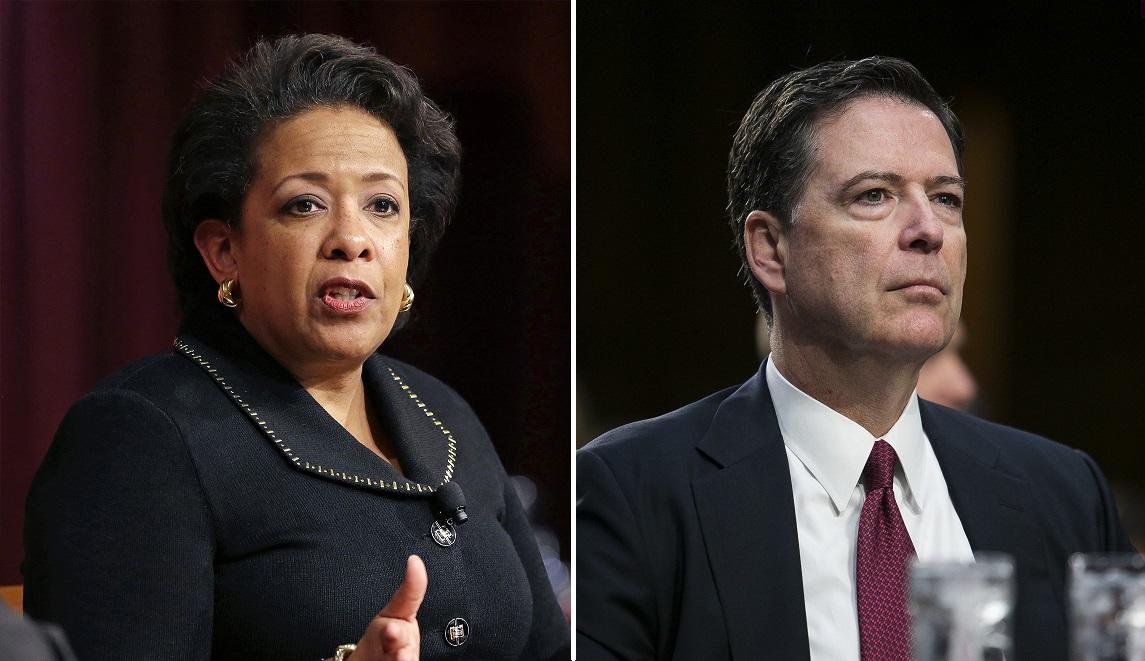
Then we found out that virtually the entire FBI’s top brass absolutely hate Donald Trump and supported Hillary Clinton; the former of whom the FBI launched a counterintelligence investigation against, while giving Hillary a pass despite the fact that she destroyed evidence from her homebrew basement server while under subpoena. We were asked to believe that the FBI’s extreme biases played no role in their investigations, while the left insisted that special counsel Robert Mueller was going to confirm fairy tales of Russian collusion peddled by a Clinton-funded dossier.
And then the Mueller report came out – blowing the Russian collusion narrative out of the water, while painting a damning picture that suggests the entire genesis of the FBI’s counterintelligence investigation, Crossfire Hurricane, was a setup.
Dan Bongino
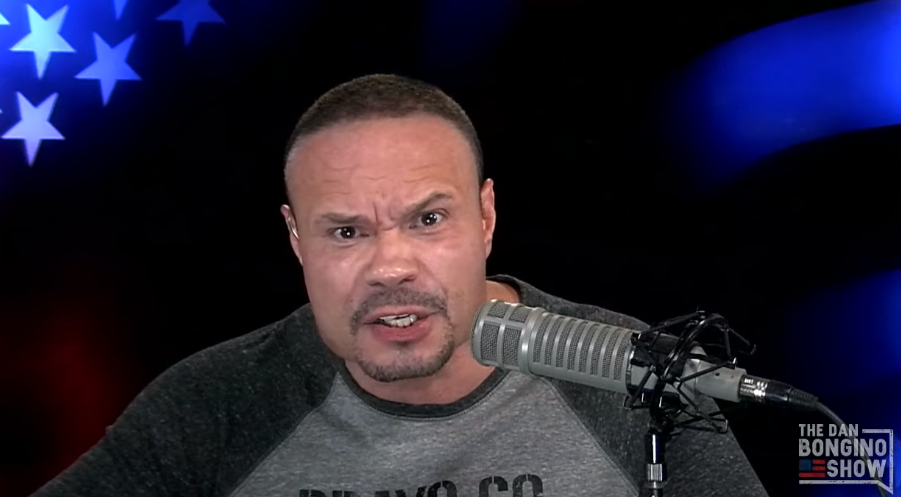
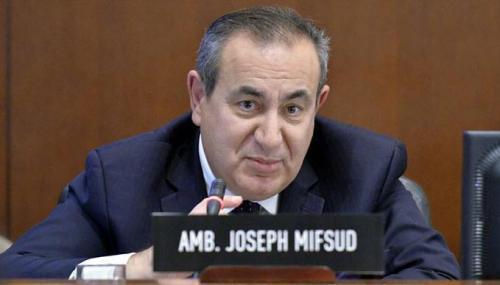
One of those brave enough to risk his reputation laying out what was going on before the Mueller report dropped is conservative commentator and former US Secret Service agent Dan Bongino – who has repeatedly mentioned the suspicious role of self-described Clinton Foundation member Joseph Mifsud, a Maltese professor who seeded the rumor that Russia had ‘dirt’ on Hillary Clinton to Trump campaign adviser George Papadopoulos on April 26, 2016 – shortly after returning from Moscow, according to the Mueller report.
Two weeks later, Papadopoulos would be bilked for information by Australian diplomat (another Clinton ally) Alexander Downer at a London bar, who relayed the Kremlin ‘dirt’ rumor to Australian authorities, which alerted the FBI (as the story goes), and operation Crossfire Hurricane was thus hatched.
Back to Mifsud…
As Bongino lays out, there are two working theories about Mifsud. The first is that he’s a Russian asset who tried to bait the Trump campaign. The second is that Mifsud was working for US intelligence services and seeded Papadopoulos with the ‘dirt’ rumor in order to kick off the FBI’s counterintelligence operation.
Bongino went into greater detail last month on Fox News – including that Mifsud’s lawyer says he’s connected to western, “friendly” intelligence:
We know that Papadopoulos met multiple times with Mifsud in the first half of 2016:
- March 14 2016 – Papadopoulos first meets Mifsud in Italy – approximately one week after finding out he will be joining the Trump team.
- March 24 2016 – Papadopoulos, Mifsud, Olga Polonskaya and unknown fourth party meet in a London cafe.
- April 18 2016 – Mifsud introduces Papadopoulos to Ivan Timofeev, an official at a state-sponsored think tank called Russian International Affairs Council.
- April 26 2016 – Mifsud tells Papadopoulos he’s met with high-level Russian government officials who have “dirt” on Clinton. Papadopoulos will tell the FBI he learned of the emails prior to joining the Trump Campaign.
- May 13 2016 – Mifsud emails Papadopoulos an update of “recent conversations”.
Note: Papadopoulos and Mifsud reportedly both worked at the London Centre of International Law Practice. –The Markets Work
In short – based on what we know, it appears that Joseph Mifsud was part of a setup by Western intelligence services on then-candidate Donald Trump.
Great claims require great evidence, however, which is why Rep. Devin Nunes (R-CA) has requested a wide swath of documents about Mifsud from several federal agencies.
As the Washington Examiner reports, Nunes – the House Intelligence Committee ranking member, “seeks information about who Mifsud was working for at the time and wrote in a letter that special counsel Robert Mueller “omits any mention of a wide range of contacts Mifsud had with Western political institutions and individuals” in his report on Russian interference in the 2016 election.”
As part of Mueller’s Russia investigation, Papadopoulos pleaded guilty in October 2017 to making false statements to the FBI about his contacts with Russians and served 12 days in prison late last year.
The special counsel’s sentencing memo to the District Court for the District of Columbia said Papadopoulos hindered the FBI’s ability to get to Mifsud. “The defendant’s lies undermined investigators’ ability to challenge the Professor or potentially detain or arrest him while he was still in the United States. The government understands that the Professor left the United States on February 11, 2017 and he has not returned to the United States since then,” the memo said.
In his letter, Nunes says it is “still a mystery how the FBI knew to ask Papadopoulos specifically about Hillary Clinton’s emails” if the bureau had not spoken with Mifsud. –Washington Examiner
“If he is in fact a Russian agent, it would be one of the biggest intelligence scandals for not only the United States, but also our allies like the Italians and the Brits and others. Because if Mifsud is a Russian agent, he would know all kinds of our intelligence agents throughout the globe,” said Nunes during a recent interview with Fox News‘ Sean Hannity.
FBI Director hypes ‘365-days-a-year threat’ from election-meddling Russia
RT | April 27, 2019
FBI Director Christopher Wray has confirmed the anti-Russian hype is not going anywhere, claiming Moscow will try to interfere in the 2020 US presidential election, and has been ‘spinning up’ Americans every day.
“What has continued pretty much unabated is the use of social media, fake news, propaganda, false personas, et cetera, to spin us up,” Wray told the Council on Foreign Relations Friday.
Russian intelligence agencies seek to “pit us against each other, sow divisiveness, discord, undermine Americans’ faith in democracy,” the Bush Jr. assistant attorney general added.
He said the 2020 election would be a repeat of both the 2016 race as well as 2018’s congressional election, where US intelligence agencies have alleged Russian interference.
Cutting against Wray’s dire warnings, however, are two Senate-commissioned studies published last year examining the actual impact of the alleged Kremlin meddling. Both studies found that the social media activities of the Russian Internet Research Agency’s (IRA), an alleged “troll factory” Washington is accusing of being an internet warfare outfit of the Russian government, had negligible impact on the 2016 election, and that only 11 percent of the IRA’s online content had anything to do with the race at all.
The studies also found the IRA spent microscopic amounts of money on social media ads, about half of one percent of the combined $81 million spent on Facebook ads by candidates Hillary Clinton and Donald Trump.
The alleged conspiracy between Kremlin and Donald Trump, which Clinton and her supporters have blamed at least partially for her loss in 2016, was also disproved by the nearly two-year-long investigation by Special Counsel Robert Mueller.
Still, the hardcore Russia-blamers refuse to let go, with Democratic National Committee Chair Tom Perez among the latest with his announcement that the US is at a cyberwar with Russia – and now, with the FBI chief.
Wray’s hyped up counterintelligence threat is sure to do some ‘spinning up’ of its own, amid ongoing demands for additional investigation into President Trump and his alleged Russian ties.
The Conspiracy Against Trump
The Deep State plot to undermine the president
By Philip Giraldi • Unz Review • April 23, 2019
The real “deplorable” in today’s United States is the continuation of a foreign policy based on endless aggression to maintain Washington’s military dominance in parts of the world where Americans have no conceivable interest. Many voters backed Donald J. Trump because he committed himself to changing all that, but, unfortunately, he has reneged on his promise, instead heightening tension with major powers Russia and China while also threatening Iran and Venezuela on an almost daily basis. Now Cuba is in the crosshairs because it is allegedly assisting Venezuela. One might reasonably ask if America in its seemingly enduring role as the world’s most feared bully will ever cease and desist, but the more practical question might be “When will the psychopathic trio of John Bolton, Mike Pompeo and Elliott Abrams be fired so the United States can begin to behave like a normal nation?”
Trump, to be sure, is the heart of the problem as he has consistently made bad, overly belligerent decisions when better and less abrasive options were available, something that should not necessarily always be blamed on his poor choice of advisers. But one also should not discount the likelihood that the dysfunction in Trump is in part comprehensible, stemming from his belief that he has numerous powerful enemies who have been out to destroy him since before he was nominated as the GOP’s presidential candidate. This hatred of all things Trump has been manifested in the neoconservative “Nevertrump” forces led by Bill Kristol and by the “Trump Derangement Syndrome” prominent on the political left, regularly exhibited by Rachel Maddow.
And then there is the Deep State, which also worked with the Democratic Party and President Barack Obama to destroy the Trump presidency even before it began. One can define Deep State in a number of ways, ranging from a “soft” version which accepts that there is an Establishment that has certain self-serving objectives that it works collectively to promote to something harder, an actual infrastructure that meets together and connives to remove individuals and sabotage policies that it objects to. The Deep State in either version includes senior government officials, business leaders and, perhaps most importantly, the managed media, which promotes a corrupted version of “good governance” that in turn influences the public.
Whether the Mueller report is definitive very much depends on the people they chose to interview and the questions they chose to ask, which is something that will no doubt be discussed for the next year if not longer. Beyond declaring that the Trump team did not collude with Russia, it cast little light on the possible Deep State role in attempting to vilify Trump and his associates. The investigation of that aspect of the 2016 campaign and the possible prosecutions of former senior government officials that might be a consequence of the investigation will likely be entertaining conspiracy theorists well into 2020. Since Russiagate has already been used and discarded the new inquiry might well be dubbed Trumpgate.
The media has scarcely reported how Michael Horowitz, the Inspector General of the Department of Justice (DOJ), has been looking into the activities of the principal promoters of the Russiagate fraud. Horowitz, whose report is expected in about a month, has already revealed that he intends to make criminal referrals as a result of his investigation. While the report will only cover malfeasance in the Department of Justice, which includes the FBI, the names of intelligence officers involved will no doubt also surface. It is expected that there will be charges leading to many prosecutions and one can hope for jail time for those individuals who corruptly betrayed their oath to the United States Constitution to pursue a political vendetta.
A review of what is already known about the plot against Trump is revealing and no doubt much more will be learned if and when investigators go through emails and phone records. The first phase of the illegal investigation of the Trump associates involved initiating wiretaps without any probable cause. This eventually involved six government intelligence and law enforcement agencies that formed a de facto task force headed by the CIA’s Director John Brennan. Also reportedly involved were the FBI’s James Comey, Director of National Intelligence James Clapper, Attorney General Loretta Lynch, Department of Homeland Security Director Jeh Johnson, and Admiral Michael Rogers who headed the National Security Agency.
Brennan was the key to the operation because the Foreign Intelligence Surveillance Act (FISA) court refused to approve several requests by the FBI to initiate taps on Trump associates and Trump Tower as there was no probable cause to do so but the British and other European intelligence services were legally able to intercept communications linked to American sources. Brennan was able to use his connections with those foreign intelligence agencies, primarily the British GCHQ, to make it look like the concerns about Trump were coming from friendly and allied countries and therefore had to be responded to as part of routine intelligence sharing. As a result, Paul Manafort, Carter Page, Donald Trump Jr., Jared Kushner and Gen. Michael Flynn were all wiretapped. And likely there were others. This all happened during the primaries and after Trump became the GOP nominee.
In other words, to make the wiretaps appear to be legitimate, GCHQ and others were quietly and off-the-record approached by Brennan and associates over their fears of what a Trump presidency might mean. The British responded by initiating wiretaps that were then used by Brennan to justify further investigation of Trump’s associates. It was all neatly done and constituted completely illegal spying on American citizens by the U.S. government.
The British support of the operation was coordinated by the then-director of GCHQ Robert Hannigan who has since been forced to resign. Brennan is, unfortunately still around and has not been charged with perjury and other crimes. In May 2017, after he departed government, he testified before Congress with what sounds a lot like a final unsourced, uncorroborated attempt to smear the new administration: “I encountered and am aware of information and intelligence that revealed contacts and interactions between Russian officials and U.S. persons involved in the Trump campaign that I was concerned about because of known Russian efforts to suborn such individuals. It raised questions in my mind whether or not Russia was able to gain the co-operation of those individuals.”
Brennan’s claimed “concerns” turned out to be incorrect. Meanwhile, other interested parties were involved in the so-called Steele Dossier on Trump himself. The dossier, paid for initially by Republicans trying to stop Trump, was later funded by $12 million from the Hillary campaign. It was commissioned by the law firm Perkins Coie, which was working for the Democratic National Committee (DNC). The objective was to assess any possible Trump involvement with Russia. The work itself was sub-contracted to Fusion GPS, which in turn sub-contracted the actual investigation to British spy Christopher Steele who headed a business intelligence firm called Orbis.
Steele left MI-6 in 2009 and had not visited Russia since 1993. The report, intended to dig up dirt on Trump, was largely prepared using impossible to corroborate second-hand information and would have never surfaced but for the surprise result of the 2016 election. Christopher Steele gave a copy to a retired of British Diplomat Sir Andrew Wood who in turn handed it to Trump critic Senator John McCain who then passed it on to the FBI. President Barack Obama presumably also saw it and, according to Director of National Intelligence James Clapper, “If it weren’t for President Obama, we might not have done the intelligence community assessment that we did that set off a whole sequence of events which are still unfolding today, notably, special counsel Mueller’s investigation.”
The report was leaked to the media in January 2017 to coincide with Trump’s inauguration. Hilary Clinton denied any prior knowledge despite the fact that her campaign had paid for it. Pressure from the Democrats and other constituencies devastated by the Trump victory used the Steele report to provide leverage for what became the Mueller investigation.
So, was there a broad ranging conspiracy against Donald Trump orchestrated by many of the most senior officials and politicians in Washington? Undeniably yes. What Trump has amounted to as a leader and role model is beside the point as what evolved was undeniably a bureaucratic coup directed against a legally elected president of the United States and to a certain extent it was successful as Trump was likely forced to turn his back on his better angels and subsequently hired Pompeo, Bolton and Abrams. One can only hope that investigators dig deep into what Washington insiders have been up to so Trumpgate will prove more interesting and informative than was Russiagate. And one also has to hope that enough highest-level heads will roll to make any interference by the Deep State in future elections unthinkable. One hopes.
Philip M. Giraldi, Ph.D., is Executive Director of the Council for the National Interest, a 501(c)3 tax deductible educational foundation (Federal ID Number #52-1739023) that seeks a more interests-based U.S. foreign policy in the Middle East. Website is councilforthenationalinterest.org, address is P.O. Box 2157, Purcellville VA 20134 and its email is inform@cnionline.org.
Unaccountable Media Faced with Dilemma in Next Phase of Deep State-gate
By Ray McGovern | Consortium News | April 10, 2019
Readers of The Washington Post on Monday were treated to more of the same from editorial page chief Fred Hiatt. Hiatt, who won his spurs by promoting misleading “intelligence” about weapons of mass destruction in Iraq and suffered no consequences, is at it again.
This time he is trying to adjust to the fading prospect of a Deus ex Mueller to lessen Hiatt’s disgrace for being among the most shameless in promoting the Trump-Russia collusion narrative.
He is not giving up. When you are confident you will not lose your job so long as you adhere to the agenda of the growing Military-Industrial-Congressional-Intelligence-Media-Academia-Think-Tank complex (MICIMATT if you will), you need not worry about being a vanguard for the corporate media. It is almost as though Hiatt is a tenured professor in an endowed chair honoring Judith Miller, the New York Times reporter who perhaps did most to bring us Iraqi WMD.
In his Monday column Hiatt warned: “Trump was elected with the assistance of Russian spies and trolls, which he openly sought and celebrated. But he did not (or so we are told) secretly conspire with them.” In effect, Hiatt is saying, soto voce: “Fie on former (now-de-canonized) Saint Robert of Mueller; we at the Post and our colleagues at The New York Times, CNN et al. know better, just because we’ve been saying so for more than two years.”
Times executive editor Dean Baquet said, about the backlash to the Times‘ “collusion” coverage: “I have no regrets. It’s not our job to determine whether or not there was illegality.” CNN President Jeff Zucker said: “We are not investigators. We are journalists.” (One wonders what investigative journalist Bob Parry, who uncovered much of Iran-Contra and founded this site, would have thought of that last one.)
Going in Circles
Hiatt’s circular reasoning is all too familiar. It is the kind a former director of national intelligence excels at when he’s not lying, sometimes under oath. For instance, James Clapper was hawking his memoir at the Carnegie Endowment last year when he was confronted by unexpectedly direct questions from the audience.
Asked about the misleadingly labeled, rump “Intelligence Community Assessment” (ICA) of Jan. 6, 2017, which he orchestrated, and which blamed Russia for interfering in the 2016 election, Clapper gave an ipse dixit response: The ICA simply had to be correct because that’s what he had told President Barack Obama and President-elect Donald Trump.
In fact, that “Intelligence Community Assessment” stands out as the most irresponsible, evidence-free and at the same time consequential crock of intelligence analysis since the National Intelligence Estimate of Oct. 2001 claimed there was WMD in Iraq. Recall that that one was shaped by out-and-out fraudulent intelligence to “justify” an attack on Iraq six months later.
Sen. Jay Rockefeller (D-WV), as chair of the Senate Intelligence Committee, described the main thrust of the committee’s five-year bipartisan report, stating, “In making the case for war, the [Bush] Administration repeatedly presented intelligence as fact when in reality it was unsubstantiated, contradicted, or even non-existent.”
Hiatt was one of the media’s major offenders, feeding on what the Cheney/Bush folks told him. When no “weapons of mass destruction” were found in Iraq, Hiatt conceded during an interview with The Columbia Journalism Review that, “If you look at the editorials we write running up [to the war], we state as flat fact that he [Saddam Hussein] has weapons of mass destruction … If that’s not true, it would have been better not to say it.” [CJR, March/April 2004] As Parry wryly observed at the time in a piece calling for Hiatt’s dismissal, “Yes, that is a common principle of journalism, that if something isn’t real, we’re not supposed to confidently declare that it is.”
The Morning After
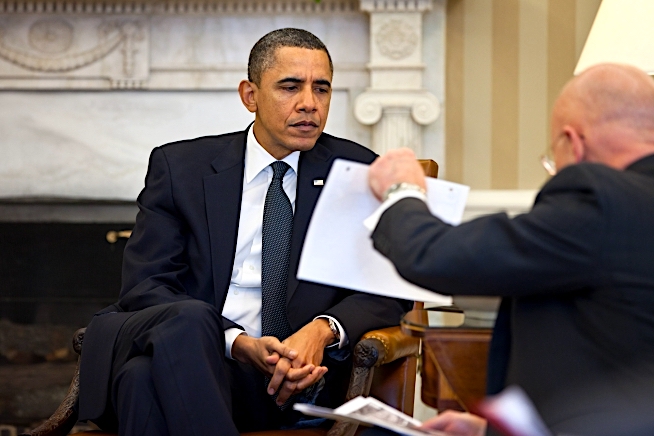
Clapper: After WMD failure, promoted by Obama. (White House Photo/ Pete Souza)
The media set the prevailing tone the day after the ICA was published. The banner headline atop page one of the Times read: “Putin Led Scheme to Aid Trump, Report Says.” That put in motion more than two years of Dick Cheney-like chicanery in the media.
Buried inside the Times that same day was a cautionary paragraph written by staff reporter Scott Shane who noted, “What is missing from the public report is what many Americans most eagerly anticipated: hard evidence to back up the [three] agencies’ claims that the Russian government engineered the election attack. That is a significant omission.” Indeed it was; and remains so.
(Sadly, Shane was then given his marching orders and fell in line with many other formerly reputable journalists in what has been the most miserable performance by the mainstream media since they helped pave the way for war on Iraq.)
Clapper and Hiatt are kindred souls when it comes to the “profound effect” of Russian election interference. In his column, Hiatt asserted as flat fact that: “Trump was elected with the assistance of Russian spies and trolls …” At the Carnegie event in November, Clapper opined:
“As a private citizen, understanding the magnitude of what the Russians did and the number of citizens in our country they reached and the different mechanisms that, by which they reached them, to me it stretches credulity to think they didn’t have a profound impact on election on the outcome of the election.”
Hiatt: Captain of Cheerleaders
Hiatt emulated peppy, preppy cheerleader George W. Bush in leading Americans to believe that war on Iraq was necessary. Appointed Washington Post editorial page editor in 2000, he still runs the page — having not been held accountable for gross misfeasance, if not malfeasance, on Iraq. Shades of Clapper, whom President Obama allowed to stay on as director of national intelligence for three and a half years after Clapper lied under oath to the Senate Intelligence Committee about NSA surveillance of U.S. persons.
That Obama appointed Clapper to lead the investigation into Russian interference in the 2016 election speaks volumes. Clapper claims to have expertise on Russia and has made no effort to disguise his views on “the Russians.” Two years ago, he told Chuck Todd on Meet the Press:
“… in context with everything else we knew the Russians were doing to interfere with the election, and just the historical practices of the Russians, who are typically, almost genetically driven to co-opt, penetrate, gain favor, whatever, which is a typical Russian technique … we were concerned.”
It beggars belief that Obama could have been unaware of Clapper’s bizarre views on “the Russians.” Clearly, Obama was bowing yet again to pressure from powerful Deep State actors arguing that Clapper was the ideal man for the job.
And there is now documentary evidence that, from the Deep State point of view, indeed he was. In the text exchanges between discredited FBI sleuth Peter Strzok and his girlfriend, Lisa Page, a lawyer working for the FBI Deputy Director Andrew McCabe, it seems clear that Obama wanted to be kept apprised of the FBI’s behind-the-scenes machinations. In a Sept. 2, 2016 text to Strzok, Page writes that she was preparing talking points because the president “wants to know everything we’re doing.”
A Sweaty Pate?
Clapper is aware now that he is going to have to sweat it out. He may believe he can ignore White House press secretary Sarah Sanders, who has said that he and other former intelligence officials should be investigated after special counsel Mueller did not establish collusion between the Trump campaign and Russia.
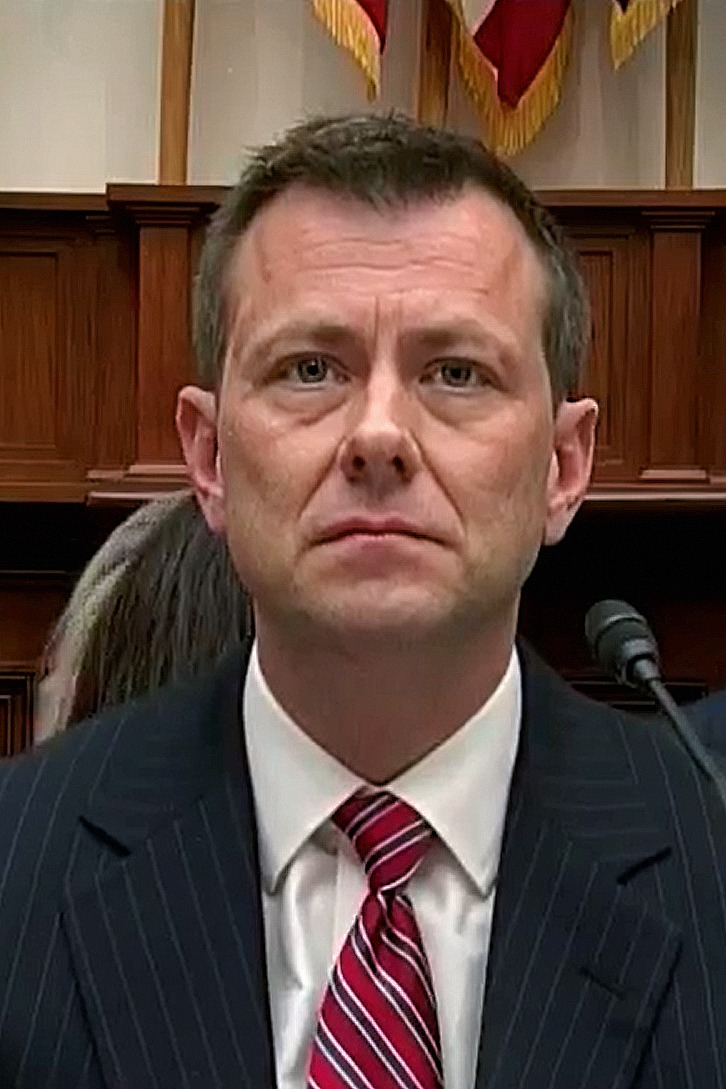
Strzok: Will he be on Nunes’s list? (Wikipedia)
But recent statements by members of the House and Senate intelligence committees cannot be dismissed so easily. In his media appearances, the supremely confident, hero-of-many-liberals Clapper has been replaced by a squirming (but-Obama-made-me-do-it) massager of facts. He may find it harder this time to avoid being held accountable.
Devin Nunes (R-CA), the House Intelligence Committee ranking member, has gone on the offensive, writing Friday that committee Republicans “will soon be submitting criminal referrals on numerous individuals involved … in the abuse of intelligence for political purposes. These people must be held to account to prevent similar abuses from occurring in the future.”
On Sunday, Nunes told Fox News he’s preparing to send eight criminal referrals to the Department of Justice this week concerning alleged misconduct during the Trump-Russia investigation. This will include leaks of “highly classified material” and conspiracies to lie to Congress and the Foreign Intelligence Surveillance Act (FISA) court. It’s no-holds-barred for Nunes, who has begun to talk publicly about prison for those whom DOJ might indict and bring to trial.
Nunes’s full-speed-ahead offensive is being widely ignored in “mainstream” media (with the exception of Fox), giving the media the quality of “The Dog That Did Not Bark in the Night.” The media has put its ducks in a row, such as they are, to try to rip Attorney General William Barr apart this coming week when he releases the redacted text of the Mueller report that so disappointed the Democratic Party/media coalition.
But how will they cover criminal referrals of the “heroes” who have leaked so much to them, providing grist for their Russia-gate mill? They will likely find a way, eventually, but the media silence about Nunes is depriving oxygen to the story.
On Sunday, Nunes said,
“They [the Democrats] have lied multiple times to the American people. All you have to do is look at their phony memos. They have had the full support of the media, 90 percent of the media in this country. They all have egg on their face. And so the fact of the matter remains, is there going to be — is justice going to be served or is justice going to be denied? And that’s why we’re sending over these criminal referrals.”
Nunes is, of course, trying to project an image of confidence, but he knows he is fighting uphill. There is no more formidable foe than the MICIMATT, with the media playing the crucial role in these circumstances. How will the American people be able to see egg on anyone’s face if the “mainstream media” find ways to wipe it off and turn the tables on Nunes, as they have successfully done in the past?
Though the Democrats now control the House, they have lost some key inside-the-Deep-State allies.
By all appearances, House Democrats still seem to be banking on help from the usual suspects still on duty in the FBI, CIA, and the Justice Department. Lacking that they seem ready to go down with the Schiff—Rep. Adam Schiff of California, perhaps the most virulent Russia-gater that there’s been.
Clapper is no longer in a position to help from the inside, and there’s no knowing how his sleepy replacement, Dan Coates, will react, if and when he wakes up long enough to learn chapter and verse about the machinations and dramatic personae of 2016.
Of course, there is a new sheriff in town running the Department of Justice. Attorney General William Barr, for better or ill, is a far cry from Jeff Sessions, who let himself be diddled into recusing himself. He’s not Rod Rosenstein either, whose involvement in this affair may have already earned him a prominent place on Nunes’s list of referrals.
What Did Obama Know, and When Did He Know It?
On top of this, Sen. Rand Paul (R, KY) has called for an investigation into the origins of Mueller’s probe, including on the dicey question of how witting President Obama was of the Deep State chicanery during the last months of his administration. Page did tell Strzok in that Sept. 2, 2016 text that the president “wants to know everything we’re doing.”
Sen. Paul has also tweeted information from “a high-level source” that it was former CIA Director John Brennan who “insisted that the unverified and fake Steele dossier be included in the Intelligence Report… Brennan should be asked to testify under oath in Congress ASAP.”
Vying for Media Attention
If, as expected, Nunes discloses the names of those being criminally referred to DOJ, and Barr releases a redacted text of the Mueller report, the “mainstream” media will have a fresh challenge on their hands. The odds would seem to favor the media covering the Democrats’ predictable criticism of Barr — and perhaps even of Mueller, now that he has been defrocked.
The Post’s Hiatt should be counted on, as always, to play a leading role.
At the same time, there are signs the America people are tired of this. It would be difficult though for the media to avoid reporting on criminal referrals of very senior law enforcement and intelligence officials. Given the media’s obvious preference for siding with the intelligence agencies and reporting on Russia-gate rather than Deep-State-gate, it would be even harder for the media to explain why these officials would be in trouble.
Things appear to be unraveling but, as always, much will depend on whether the media opts to remain the “dog that didn’t bark,” and succeeds again in hoodwinking too many people.
Ray McGovern works with Tell the Word, a publishing arm of the ecumenical Church of the Saviour in inner-city Washington. He was a CIA analyst for 27 years and prepared the President’s Daily Brief for Presidents Nixon, Ford, and Reagan. He is on the Steering Group of Veteran Intelligence Professionals for Sanity (VIPS).
The Tale of a ‘Deep State Target’
Daniel Lazare reviews George Papadopoulos’s book about his misadventures with a nest of intelligence agents.
By Daniel Lazare – Consortium News – April 4, 2019
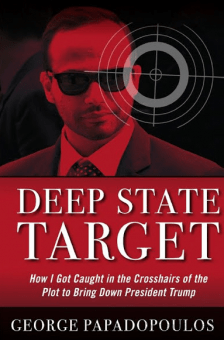 Now that Russian collusion is dead and buried thanks to Special Prosecutor Robert Mueller, the big question is how and why such charges arose. George Papadopoulos’s “Deep State Target: How I Got Caught in the Crosshairs of the Plot to Bring Down President Trump” doesn’t tell the whole story. But this account by one of the crusade’s first victims pulls the covers off a few important aspects.
It describes a lengthy entrapment scheme that began when Papadopoulos told co-workers that presidential candidate Donald Trump was about to appoint him to his foreign-policy advisory team.
The time was March 2016, the place the London Centre of International Law Practice, where Papadopoulos was working as an energy consultant, a job that mainly involves meeting with diplomats and going out for a dinner and drinks. Regarding the LCILP, he recalls it as a “strange operation” where there’s “no actual law practice going on that I can see” and which he later suspects is an intelligence front.
The reaction to his announcement was not good. “You should not be working with Trump,” one of Papadopoulos’s bosses tells him. “He’s a threat to society. He’s a racist. He’s anti-Muslim.”
But the tone changes when another LCILP director insists that he join him for a three-day conference at Link Campus University, a privately owned educational center in Rome. There he is introduced to a well-dressed Maltese academic in his mid-fifties named Joseph Mifsud.
“He asks about my background,” Papadopoulos writes. “He asks if I have Russian contacts. I shake my head. ‘I heard you have connections,’ I say. ‘And that you might be able to help me with the campaign.’”
“Oh yes, absolutely,” Mifsud replies. “Let’s talk tonight. Let’s go to dinner.”
Into the Rabbit Hole
With that, the author enters into a rabbit hole filled with twists and turns in which he found himself in the middle of a deep-state intelligence war over Trump’s alleged Kremlin ties and by the end of which he had served a 12-day sentence in a medium-security federal prison.
In late April, Mifsud takes him to breakfast at a London hotel and informs him that he had just returned from Russia where officials say they have “dirt” on Hillary Clinton. “Emails of Clinton,” Mifsud says. “They have thousands of emails.” Papadopoulos writes it off as idle chitchat by a dubious diplomatic networker whom he has come to see as all talk and no action.
A friend from the Australian embassy introduces him to a top Aussie diplomat named Alexander Downer, who tells him over gin-and-tonics that his foreign-policy ideas are all wet.
A British foreign-ministry official takes him out for still more drinks and grills him about Russia.
Stefan Halper, an old CIA hand turned Cambridge academic, contacts him out of the blue and pesters him about Russia as well.
A mysterious Belorussian-American name Sergei Millian offers him a secret $30,000-a-month PR job but only if he continues working for Trump.
An Israeli-American businessman named Charles Tawil buys him lunch at a steakhouse in Skokie, Ill. Later, in Greece, they go clubbing together in Mykonos, and then Tawil flies Papadopoulos to Israel where he presents him with $10,000 in cash – money that a wary Papadopoulos leaves with a lawyer in Thessaloniki.
While flying back to the U.S. in July 2017, Papadopoulos runs into a squad of FBI agents as he is changing planes. “And then, finally, it dawns on me as they are going through my bags,” he writes. “Charles Tawil and the money. They are looking for $10,000 in undeclared cash! That fucking guy was setting me up.”
“I’ve barely slept in two days,” he goes on after appearing before a judge. “I’m wearing the same shirt that I left Athens in. I smell like garbage. I look like garbage. I’m disoriented – because while I’ve just finally heard the charges, I still don’t really understand any of it.” To his horror, he learns that he is facing 25 years in prison on charges of obstruction of justice and lying to the FBI.
What was going on? Although Papadopoulos doesn’t go into the pre-history, we know from other sources that, by late 2015, intelligence agencies were buzzing over reports that Trump and Russian President Vladimir Putin were reaching out to one another behind the scenes.
Three Mood-Setting Events
Spooks are paranoid by profession, but three recent events had put them particularly on edge. One was the Euromaidan uprising in Kiev in early 2014, which, by driving out an allegedly pro-Russian president, sparked a parallel revolt among Russian speakers in the east. Another was in Syria where U.S. backing of Islamist rebels had prompted Russia to intervene in support of President Bashar al-Assad. The third was on the U.S. campaign trail where Trump was thoroughly shocking foreign-policy “experts” by sounding off against regime change and making friendly noises toward Putin.
“But I think that I would probably get along with him very well,” Trump said of the Russian president in October 2015. When CNN host John Dickerson asked about Russian air assaults, he replied: “And as far as him attacking ISIS, I’m all for it. If he wants to be bombing the hell out of ISIS, which he’s starting to do, if he wants to be bombing ISIS, let him bomb them, John. Let him bomb them. I think we [can] probably work together much more so than right now.”
Intelligence agencies might have conceded that the U.S. was wrong to encourage far-right elements in Kiev and that it was equally mistaken in giving backhanded support to Al Qaeda and ISIS in the Middle East. They might have granted that Trump, for all his reality-TV bluster, had a point. But western intelligence agencies don’t do self-criticism. What they did was blame Putin for messing up their plans for a clean coup in Kiev and an equally neat ouster of Assad and then blamed Trump for arguing in his behalf. From there, it was a very short step to concluding that Trump was not only siding with Putin, but conspiring with him.
Individual intelligence assets went into action to prove this theory correct and, if need be, to invent a conspiracy where none existed. Joseph Mifsud was apparently among them. “Deep State Target” devotes a fair amount of space to his background. Although Mueller’s indictment says Mifsud had “substantial connections to Russian government officials,” a wealth of data indicates the opposite.
‘Only One Master’
Stephan Roh, a Swiss-German lawyer who employed Mifsud as a consultant, writes in a self-published book that he has “only one master: the Western Political, Diplomatic, and Intelligence World, his only home, of which he is still deeply dependent.” Mifsud has been photographed with British Foreign Secretary Boris Johnson and veteran diplomat Claire Smith, a top British intelligence official. Indeed, Mifsud taught a course with Smith for Italian military and law-enforcement personnel at the same Link Campus where he’d met Papadopolous.
Mifsuds’s ties with western intelligence are thus multifarious and deep. The same goes for the other people with whom ran Papadopoulos had contact.
Alexander Downer, the Aussie diplomat with whom he had drinks, turns out to be a director of a London private intelligence firm known as Hakluyt & Co., which counts among its close associates Halper, the Cambridge academic who was ex-CIA, and Sir Richard Dearlove, ex-director of MI6, the British equivalent of the CIA. These two — Dearlove and Halper — ran an intelligence seminar at Cambridge and are also partners in a private venture calling itself “The Cambridge Security Initiative.” (See “Spooks Spooking Themselves,” Consortium News, May 31, 2018.)
Millian, the man who offered Papadopoulos $30,000 a month, turns out to be a source for the notorious Steele Dossier, compiled by ex-MI6 agent Christopher Steele. Steele, in turn, sought counsel at one point from fellow Cambridge man Dearlove on how to spread his findings. According to one of Willian’s buddies, Millian works for the FBI as well.
All of which is enough to get anyone’s conspiratorial juices flowing.
As for Charles Tawil, he arouses Papadopoulos’s fears of an intelligence link once he arrives in Mykonos by boasting of his friendship with Uganda President Yoweri Museveni and then-South African President Jacob Zuma, and declaring of convicted Israeli spy Jonathan Pollard, “it wasn’t our fault he got caught.” In Israel, he brags about helping to wiretap Syrian strong man Hafez al-Assad, father of the current president. “We could have killed him at any time,” he says. Finally, Papadopoulos reveals a private diplomatic cable citing Tawil as a U.S. intelligence asset back in 2006.
Five intelligence assets were thus hounding Papadopoulos at every turn while a sixth was compiling the dossier that would send Russia-gate into overdrive. It added up to the greatest propaganda campaign since the furor over Iraqi weapons of mass destruction, and, like those nonexistent WMDs, turns out to have been manufactured out of thin air.
Full-Court Press
“Deep State Target” is vague about many details and Papadopoulos doesn’t have all the answers about Russia-gate. No one at this point does. But his book leaves little doubt that he was the victim of a full-court press by intelligence assets in and around the FBI, CIA, and MI6.
Like everyone, Mifsud knew about Clinton’s emails – the ones she stored on her private server, not those that Wikileaks would later release – and fed Papadopoulos tidbits about a supposed Russia connection in the hope, no doubt, that he would pass them along to the Trump campaign. When he didn’t, Downer nonetheless reported back to Canberra that Papadopoulos had told him something along those lines. (Papadopoulos does not remember saying any such thing.) Once Canberra told Washington, the FBI investigation, dubbed Crossfire Hurricane, was on.
Halper tried to get him to admit to working with Russia: “It’s great that Russia is helping you and the campaign, right, George? George, you and your campaign are involved in hacking and working with Russia, right? It seems like you are a middleman for Trump and Russia, right? I know you know about the emails.”
Millian sends him an email shortly before the election telling him to “[p]lease be very cautious these last few days. Even to the point of not leaving your food and drinks out of eye sight.”
“Obviously a Greek Orthodox guy like you has close ties to Russia,” Charles Tawil, observes, leaving it to Papadopoulos to fill in the blanks.
Diehard Russia-truthers will point out that, even though the charge that Papadopoulos obstructed justice by misleading the FBI was dropped, Papadopoulos is still a convicted liar who pled guilty to misleading the FBI about the exact timing of his meetings with Mifsud. But he says that he was frightened and nervous and didn’t have his lawyer present and that he didn’t even remember what he had said until he read it in the indictment.
He also says he now regrets taking his then-lawyers’ advice to cop a plea: “There was never any pre-trial discovery. We never saw – or at least I hadn’t seen – the transcript of my interview, so all we had was the prosecutor’s word regarding what I had said. And we caved.” But he was an amateur running out of money while doing battle with a prosecutor with a $25-million budget. He had little choice. Russia-gate was unstoppable – until the collusion theory finally collapsed.
Daniel Lazare is the author of “The Frozen Republic: How the Constitution Is Paralyzing Democracy” (Harcourt Brace, 1996) and other books about American politics. He has written for a wide variety of publications from The Nation to Le Monde diplomatique and blogs about the Constitution and related matters at Daniellazare.com.
Russian collusion was no more than “conspiracy porn” created by Clinton and Obama
By Mitchell Feierstein | The Duran | April 1, 2019
After 675 days, 25 million dollars, 2,800 subpoenas, over 500 witnesses, and more than 500 search warrants, all of which took up the time of 20 prosecutors and nearly 50 FBI agents, Special Counsel Robert Mueller submitted the results of his “witch hunt” to the Attorney General of the United States of America, Robert Barr.
Barr, in turn, submitted a four-page overview highlighting the following conclusions: There are no further indictments of anyone and there was no collusion with Russia by any American. Barr and Assistant Attorney General Rod Rosenstein, whom Mueller reported to, determined that there was no obstruction by President Trump.
But, for the past three years, elite Democratic Party partisans, along with their media partners, force-fed thousands of “Bombshell” headlines to millions of Americans, without ever providing a lick of evidence. The absence of evidence supporting their outrageous lies coupled with the results of Mueller’s investigation and Barr’s conclusions establishes collusion – not between Russia and the Trump family to influence the 2016 presidential election, but amongst the Democrats and mass media to delegitimize the Trump presidency.
The Speaker of the House Nancy Pelosi said, “We saw cold, hard evidence of the Trump campaign, and indeed the Trump family, eagerly intending to collude with Russia.” Pelosi has never presented any evidence to support this claim or any of the many other suspect claims the speaker has made.
The Chairman of House Intelligence Committee Adam Schiff said, “I have evidence of collusion with Russia and kompromat. It’s all in plain sight.” Schiff regularly repeated this claim to the public yet never provided any evidence. He appeared on CNN, MSNBC, NBC, and ABC over 150 times and was never called out for repeating these lies over and over again.
Congressman Eric Swalwell on MSNBC said, “Donald Trump is a Russian agent; we have evidence Trump and his family colluded with Russia.” Swalwell has parroted this and many other claims since 2016. Evidence provided: none.
Congresswoman Maxine Waters stated, “Trump and his buddies are scumbags who are all Putin’s puppets; we will Impeach 45.” Waters has been shrieking “Impeach 45” since election day in 2016. Water’s reason: she hates Trump and the entire Grand Old Party “GOP.”
Many other Democratic members of Washington DC’s swamp echoed similar propaganda that mobilized the Trump “resistance.” Their hit list of frequent salacious claims included “Trump in handcuffs;” “The entire Trump family, frog-marched, and jailed forever;” “Treason, much worse than Watergate, we have evidence;” “Trump has been a Russian asset since 1987;” “Trump is a racist, sexist, misogynist, Islamophobic, homophobic, transphobic, anti-Semitic, xenophobic, white-national, white-supremacist;” and let’s not forget “He’s the next Hitler.” This “hit list” has become the Democratic party mantra since Donald trump announced his candidacy in 2015.
Ex-Central Intelligence Agency “CIA” director John Brennan, who just so happens to be on MSNBC’s payroll, also weighed in on Trump. “Trump’s behavior is treasonous. He committed high crimes and misdemeanors. There is evidence that proves many people in Trump’s orbit are guilty of serious crimes and indictments are coming, and soon. Trump committed Treason” The penalty for committing “treason” in America, death. Brennan never provided any evidence. Brennan’s lies have destroyed the CIA’s reputation and credibility.
Viewers of CNN, MSNBC, NBC, and ABC were inundated with purposeful misrepresentations that continuously promised faithful audiences that Mueller and his team had “mountains” of evidence of Trump’s collusion with Russia and obstruction of justice. Day after day, these media outlets repeated how Mueller would deliver an indictment of President Trump, who had committed “treason and high crimes and misdemeanors” that would lead to his impeachment and jail time. The corrupt media represented that Trump’s family members, who were also guilty of similar crimes, would be sent to prison. All the above were outrageous lies.
In fact, the only convictions that arose through the Mueller investigation were low-level process crimes which had NOTHING to do with Trump. $25 million wasted, bravo! These salacious accusations proved to be part of an elaborate scheme to delegitimize the sitting president and his administration in order to remove him from office. However, the Democrats and mass media could not have done it without FBI Director James Comey’s exploitation of the United States Foreign Intelligence Surveillance Act (FISA).
We know the whole coup d’état was facilitated by FBI Director James Comey’s October 20, 2016 submission of a 66-page application to the FISA court.
Comey and Sally Quillian Yates, the Deputy Attorney General of the United States, signed this application. Judge Rosemary M. Collyer, the presiding judge of the secret FISA court, granted an order that led to our intelligence agencies spying on the presidential campaign of Donald J. Trump. The FBI ran a counter-intelligence investigation named “Crossfire Hurricane” on Trump’s campaign.
Comey’s FISA application was largely based on information contained in the Steele dossier, a dossier written by a disgraced MI6 agent named Christopher Steele. The dossier made wild, unsubstantiated claims and was financed by the campaign of Hillary Clinton and the Democratic National Committee via Clinton’s law firm Perkins Coie through a company named Fusion GPS.
In a meeting with President Trump in early January 2017, James Comey told President Trump about the existence of the Steele dossier and told him not to worry about it. Comey stated that the dossier’s contents were salacious, unverified, and untrue. Apparently, James Comey knew, yet never disclosed to Judge Collyer, that the Steele dossier was garbage prepared by political partisans that did not want Trump to be
elected and financed by Hillary Clinton’s campaign. Three days after Comey’s meeting with Trump the entire Steele dossier was “leaked” to numerous media sources and published in it’s entirety on Buzzfeed with no mention that none of the claims in the Steele dossier had been verified.
Comey signed and submitted two more FISA applications, one in Jan 2017, and another in April 2017 which relied upon the Steele dossier. FISA Judge Michael W. Mosman signed the January renewal, and Judge Anne C. Conway signed the April renewal.
Apparently, Comey never disclosed, to any of the FISA judges, that the Steele dossier was: paid for by the Hillary Clinton campaign, and the DNC, or that the Department of Justice’s Bruce Ohr had warned on the credibility of the unverified Steele Dossier, or that Bruce Ohr’s wife worked for Fusion GPS and helped back door the Steele dossier into the FBI, or that the dossier was filled with baseless allegations, lies, and
propaganda. It appears that four secret court, FISA, judges were lied to in order to kick- off the biggest scandal in history.
FBI’s Deputy Director Andrew McCabe recently stated during Congressional testimony that “without the Steele dossier, the FISA warrants would have never been granted.” Recent reports suggest that it was ex-CIA director John Brennan who insisted that the Steele dossier be included in the intelligence report used to request the FISA warrants. Senator Rand Paul has issued a call that Brennan be called to testify under oath in Congress.
The entire Mueller investigation would have never been possible without this fake dossier being used to illegally obtain FISA warrants by the omission of material facts within the original FISA application and the three subsequent renewal applications.
Why is Judge Collyer not looking into these and other material misrepresentations used in the FISA application to obtain search warrants to spy on Americans and on a presidential campaign by its opposition and enabled by a weaponized Obama Department of Justice? The silence of secret FISA court Judges Mosman, Conway, and Dearie is frightening. America’s secret courts should be abolished.
‘Grave terrorist attack’: North Korea seeks probe into mysterious raid on its mission in Spain
RT | March 31, 2019
North Korea called on Spain to conduct a thorough investigation into a raid on its mission in Madrid, which was said to be done by FBI-linked dissidents, now hiding in the US.
Pyongyang asked Spain to investigate the “grave terrorist attack” and “flagrant violation of international law,” state-run KCNA news agency reported. “This kind of act should never be tolerated,” the statement read.
It was the first time North Korean officials have commented on the mysterious break-in at its mission in Madrid on February 22. A group of intruders subdued and tied up the staff before stealing a number of electronic devices and a trove of documents from the building. They also reportedly tried to persuade a North Korean attaché to defect. A video, allegedly filmed during the break-in, shows men taking down portraits of North Korean leaders and smashing them on the ground.
Spanish media say that 10 suspects fled to the US and a court in Madrid issued arrest warrants against them. The leader of the group was named as veteran dissident and anti-Pyongyang activist Adrian Hong Chang, who is a Mexican national and a US citizen. Two of the other suspects were named as US nationals.
An unexpected twist came several weeks later when the Spanish paper El Pais cited court documents and police sources as saying that the suspects tried to obtain information on the North Korean nuclear program and contacted the FBI after arriving in the US.
The details were partially confirmed by dissident group ‘Cheollima Civil Defense / Free Joseon’, which claimed responsibility for the raid. Its members shared “certain information of enormous potential value” with the FBI, on the Bureau’s request, the group claimed on its website.
The US has denied any involvement with the break-in, and the FBI has refused to comment on the incident.
Washington told Ukraine to end probe into George Soros-funded group during 2016 US election – report
RT | March 27, 2019
An NGO co-funded by George Soros was spared prosecution in 2016 after the US urged Ukraine to drop a corruption probe targeting the group, the Hill reported, pointing to potential shenanigans during the US presidential election.
Bankrolled by the Obama administration and Hungarian-American billionaire George Soros, the Anti-Corruption Action Centre (AntAC) was under investigation as part of a larger probe by Ukraine’s Prosecutor General’s Office into the misallocation of $4.4 million in US funds to fight corruption in the eastern European country.
As the 2016 presidential race heated up back in the United States, the US Embassy in Kiev gave Ukraine’s Prosecutor General Yuri Lutsenko “a list of people whom we should not prosecute” as part of the probe, the Hill reported. Ultimately, no action was taken against AntAC.
Lutsenko told the paper that he believes the embassy wanted the probe nixed because it could have exposed the Democrats to a potential scandal during the 2016 election.
A State Department official who spoke with the Hill said that while the request to nix the probe was unusual, Washington feared that AntAC was being targeted as retribution for the group’s advocacy for anti-corruption reforms in Ukraine.
AntAC wasn’t just the benefactor of well-connected patrons – at the time it was also collaborating with FBI agents to uncover then-Trump campaign manager Paul Manafort’s business dealings in Ukraine. Manafort later became a high-profile target of Special Counsel Robert Mueller’s probe into alleged Russian collusion, and was sentenced to seven-and-a-half years in prison for tax fraud and other financial crimes.
Lutsenko divulged in an interview with the Hill last week that he has opened an investigation into whether Ukrainian officials leaked financial records during the 2016 US presidential campaign in an effort to sway the election in favor of Hillary Clinton.
While AntAC may have failed to help the FBI find the Russia collusion smoking gun, the group’s activities constitute yet another link between the anti-climactic Russiagate probe and Soros, a Democrat mega-donor who bet big on Hillary Clinton taking the White House in 2016.
In 2017, the billionaire philanthropist siphoned money into a new group, the Democracy Integrity Project, which later partnered with Fusion GPS to create the now-infamous Steele dossier.
Spokespersons for AntAC and the Soros umbrella group Open Society Foundations declined to comment on the Hill’s scoop.
Ironically, the prosecutor general who had preceded Lutsenko, Viktor Shokin, resigned under pressure from Washington – which accused Shokin of corruption.
Virtuous US officials continue to make similar demands of Ukraine’s justice system. Earlier this month, Washington urged the Ukrainian government to fire its special anti-corruption prosecutor, again over accusations of administrative abuse.
Featured Video
Trita Parsi: Israel Set a Trap for Total War in the Region
or go to
Aletho News Archives – Video-Images
From the Archive
Zionism’s Violent Legacy
By Donald Neff | Washington Report On Middle East Affairs | January 1996
On January 4, 1948, Jewish terrorists drove a truck loaded with explosives into the center of the all Arab city of Jaffa and detonated it, killing 26 and wounding around 100 Palestinian men, women and children.[1] The attack was the work of the Irgun Zvai Leumi – the “National Military Organization,” also known by the Hebrew letters Etzel – the largest Jewish terrorist group in Palestine. The Irgun was headed by Revisionist Zionist Menachem Begin and had been killing and maiming Arabs, Britons and even Jews for the previous ten years in its efforts to establish a Jewish state.
This terror campaign meant that at the core of Revisionist Zionism there existed a philosophical embrace of violence. … continue
Blog Roll
 Aletho News
- Trita Parsi: Israel Set a Trap for Total War in the Region
- Trump’s Iran war is on an Israeli leash
- Saudi oil boss issues global supply warning
- Riyadh Says Its Oil System Is Intact. The Numbers Say Otherwise.
- Trump and Netanyahu Want to “Finish the Job” on Iran
- US ‘one-sided dictation’ not Iran’s beliefs makes rational talks impossible: Baghaei
- Iran’s Next Strike May Not Explode. It Could Shut You Down /Col Doug Macgregor
- Iran: US political targets legitimate if assassinations return
- Iraq shuts key border crossing with Iran under US pressure: Report
- Undersea Internet cables could be targeted in retaliation for attacks on Iran: IRGC deputy chief
- If Americans Knew
- The Israel Lobby’s Changing Fortunes
- AIPAC has become such a political liability that it’s shifting to a more “nimble” approach to buying politicians
- At least 160 Israeli settler attacks in 2 weeks
- Will Gaza’s Ancient Christian Community Disappear Forever?
- Israel’s vision of regional security rests on keeping Arab states weak
- Heidi Levine recounts how Palestinian youths helped save her in settler attack
- DAILY UPDATE: Latest essential news on Palestine, Israel, & region
- Trump’s Intensifying Sabotage of the ICC, for Israel’s Sake
- Israeli military detain US and UK volunteers in West Bank including Democratic NY politician Brad Lander
- Americans at National Conservatism Conference held in Israel this year criticize Israel
- No Tricks Zone
- E-Cars Reduce CO2 Emissions By Only 41% Compared To Internal Combustion Engine Vehicles
- Predictions Made By Renowned Climate Professor Over Past Decades Have Been Proven To Be Poor
- New Study Suggests Large Regions Of The Pacific Ocean Have Been Cooling For The Last 80 Years
- Germany’s Green Energy Debacle: High Energy Costs Force Kahla Porzellan to Close After 182 Years!
- New Study: 50 Years Of The Most Aggressive ‘Net Zero’ Policies Can Only Affect The Global Climate By 0.03°C
- US September “Heat” Was No Record…Many Records Set Decades Ago
- Latest European Green Energy Debacle; Portugal’s Largest Flagship Solar Park Insolvent!
- Green Energy Debacle: German Expert Professor Fritz Vahrenholt Warns Of Severe Economic And Social Consequences
- Two More Paleo Reconstructions Affirm Meters-Higher Sea Levels Across Ireland, Brazil 7000-6000 Years Ago
- New Study: Earth And Venus Surface Warmth Largely Explained By Convection And Lapse Rate, Not CO2 Or Radiation

