Russia-gate Evidence, Please
By Ray McGovern | Consortium News | January 15, 2019
For those interested in evidence — or the lack of it— regarding collusion between Russia and the presidential campaign of Donald Trump, we can thank the usual Russia-gate promoters at The New York Times and CNN for inadvertently filling in some gaps in recent days.
Stooping to a new low, Friday’s Times headline screamed: “F.B.I. Opened Inquiry Into Whether Trump Was Secretly Working on Behalf of Russia.” The second paragraph noted that FBI agents “sought to determine whether Mr. Trump was knowingly working for Russia or had unwittingly fallen under Moscow’s influence.”
Trump had been calling for better relations with Russia during his presidential campaign. As journalist Michael Tracy tweeted on Sunday, the Times report made it “not a stretch to say: the FBI criminally investigating Trump on the basis of the ‘national security threat’ he allegedly poses, with the ‘threat’ being his perceived policy preferences re: Russia, could constitute literal criminalization of deviation from foreign policy consensus.”
On Monday night CNN talking heads, like former House Intelligence Committee chair Mike Rogers, were expressing wistful hope that the FBI had more tangible evidence than Trump’s public statements to justify such an investigation. Meanwhile, they would withhold judgment regarding the Bureau’s highly unusual step.
Evidence?
NYT readers had to get down to paragraph 9 to read: “No evidence has emerged publicly that Mr. Trump was secretly in contact with or took direction from Russian government officials.” Four paragraphs later, the Times’ writers noted that, “A vigorous debate has taken shape among former law enforcement officials … over whether FBI investigators overreacted.”
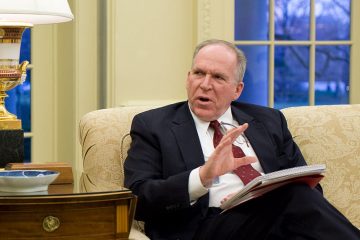
Brennan: “I don’t do evidence.” (White House photo)
That was what Republican Rep. Trey Gowdy was wondering when he grilled former CIA director John Brennan on May 23, 2017 on what evidence he had provided to the FBI to catalyze its investigation of Trump-Russia collusion.
Brennan replied: “I don’t do evidence.”
The best Brennan could do was repeat the substance of a clearly well-rehearsed statement: “I encountered and am aware of information and intelligence that revealed contacts and interactions between Russian officials and U.S. persons involved in the Trump campaign … that required further investigation by the Bureau to determine whether or not U.S. persons were actively conspiring, colluding with Russian officials.”
That was it.
CNN joined the piling on Monday, quoting former FBI General Counsel James Baker in closed-door Congressional testimony to the effect that FBI officials were weighing “whether Trump was acting at the behest of [the Russians] and somehow following directions, somehow executing their will.” The problem is CNN also noted that Lisa Page, counsel to then FBI Acting Director Andrew McCabe, testified that there had been “indecision in the Bureau as to whether there was sufficient predication to open [the investigation].’ “Predication” is another word for evidence.
Within hours of Comey’s firing on May 9, 2017, Page’s boyfriend and a top FBI counterintelligence official, Peter Strzok texted her: “We need to open the case we’ve been waiting on now while Andy [McCabe] is acting [director].” After all, if Trump were bold enough, he could have appointed a new FBI director and who knew what might happen then. When Page appeared before Congress, she was reportedly asked what McCabe meant. She confirmed that his text was related to the Russia investigation into potential collusion.
Comey v. Trump Goes Back to Jan. 6, 2017
The Times and CNN, however unintentionally, have shed light on what ensued after Trump finally fired Comey. Apparently, it finally dawned on Trump that, on Jan. 6, 2017, Comey had treated him to the time-honored initiation-rite-for-presidents-elect — with rubrics designed by former FBI Director J. Edgar Hoover.
It seems then-FBI Director James Comey rendered a good impersonation of Hoover that day when he briefed President-elect Trump on the scurrilous “Steele dossier” that the FBI had assembled on Trump. Excerpts from an interview Trump gave to the Times (below) after the firing throw light on what Trump says was at least part of his motivation to dump Comey.
To dramatize the sensitivity of the dossier, Comey asked then-National Intelligence Director James Clapper and the heads of the CIA and NSA to depart the room at the Trump Tower, leaving Comey alone with the President-elect. The Gang of Four had already briefed Trump on the evidence-impoverished “Intelligence Community Assessment.” That “assessment” alleged that Putin himself ordered his minions to help Trump win. The dossier had been leaked to the media, which withheld it but Buzzfeed published it on Jan. 10.?
‘This Russia Thing’
Evidently, it took Trump four months to fully realize he was being played, and that he couldn’t expect the “loyalty” he is said to have asked of Comey. So Trump fired Comey on May 9. Two days later he told NBC’s Lester Holt:
“When I decided to just do it, I said to myself, I said, ‘You know, this Russia thing with Trump and Russia is a made-up story, it’s an excuse by the Democrats for having lost an election that they should’ve won.’”
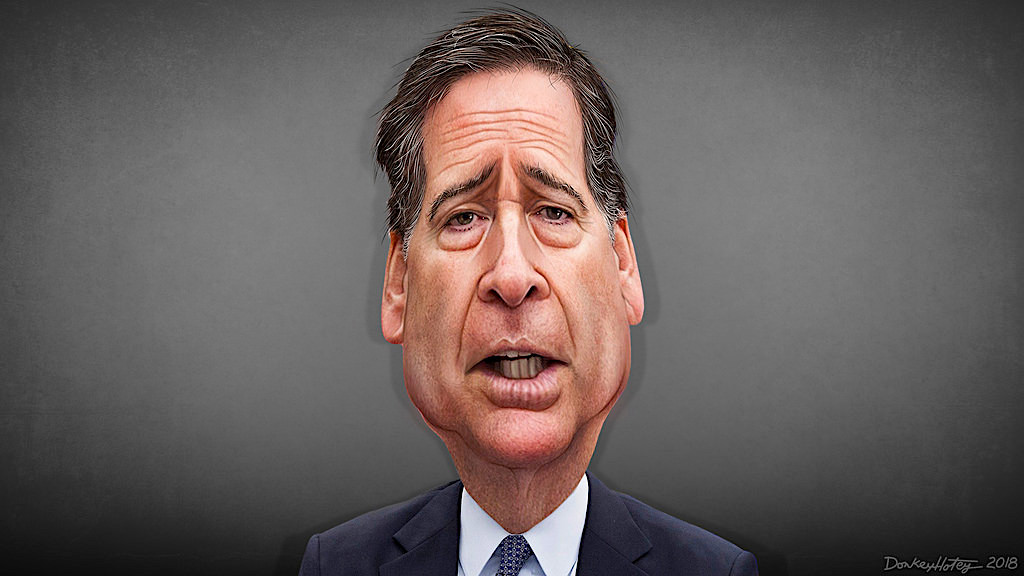
Comey: Pulled a Hoover on Trump? (Carciature by DonkeyHotey)
The mainstream media and other Russia-gater aficionados immediately seized on “this Russian thing” as proof that Trump was trying to obstruct the investigation of alleged Russian collusion with the Trump campaign. However, in the Holt interview Trump appeared to be reflecting on Comey’s J. Edgar Hoover-style, one-on-one gambit alone in the room with Trump.
Would Comey really do a thing like that? Was the former FBI director protesting too much in his June 2017 testimony to the Senate Intelligence Committee when he insisted he’d tried to make it clear to Trump that briefing him on the unverified but scurrilous information in the dossier wasn’t intended to be threatening. It took a few months but it seems Trump figured out what he thought Comey was up to.
Trump to NYT: ‘Leverage’ (aka Blackmail)
In a long Oval Office interview with the Times on July 19, 2017, Trump said he thought Comey was trying to hold the dossier over his head.
“… Look what they did to me with Russia, and it was totally phony stuff. … the dossier … Now, that was totally made-up stuff,” Trump said. “I went there [to Moscow] for one day for the Miss Universe contest, I turned around, I went back. It was so disgraceful. It was so disgraceful.
“When he [James B. Comey] brought it [the dossier] to me, I said this is really made-up junk. I didn’t think about anything. I just thought about, man, this is such a phony deal. … I said, this is — honestly, it was so wrong, and they didn’t know I was just there for a very short period of time. It was so wrong, and I was with groups of people. It was so wrong that I really didn’t, I didn’t think about motive. I didn’t know what to think other than, this is really phony stuff.”
The dossier, paid for by the Democratic National Committee and the Clinton campaign and compiled by former British spy Christopher Steele, relates a tale of Trump allegedly cavorting with prostitutes, who supposedly urinated on each other before the same bed the Obamas had slept in at the Moscow Ritz-Carlton hotel. [On February 6, 2018, The Washington Post reported that that part of the dossier was written Cody Shearer, a long-time Clinton operative and passed it along to Steele. Shearer ignored a request for comment from Consortium News. [Shearer had been a Consortium advisory board member who was asked to resign and left the board.]
Trump told the Times: “I think [Comey] shared it so that I would — because the other three people [Clapper, Brennan, and Rogers] left, and he showed it to me. … So anyway, in my opinion, he shared it so that I would think he had it out there. … As leverage.
“Yeah, I think so. In retrospect. In retrospect. You know, when he wrote me the letter, he said, ‘You have every right to fire me,’ blah blah blah. Right? He said, ‘You have every right to fire me.’ I said, that’s a very strange — you know, over the years, I’ve hired a lot of people, I’ve fired a lot of people. Nobody has ever written me a letter back that you have every right to fire me.”
McGovern lays out more details during a 12-minute interview on Jan. 10 with Tyrel Ventura of “Watching the Hawks.”
Ray McGovern works with Tell the Word, a publishing arm of the ecumenical Church of the Saviour in inner-city Washington. A CIA analyst for 27 years and Washington area resident for 56 years, he has been attuned to these machinations. He is co-founder of Veteran Intelligence Professionals for Sanity (VIPS).
A Look Back at Clapper’s Jan. 2017 ‘Assessment’ on Russia-gate
By Ray McGovern | Consortium News | January 8, 2019
The banner headline atop page one of The New York Times two years ago today, on January 7, 2017, set the tone for two years of Dick Cheney-like chicanery: “Putin Led Scheme to Aid Trump, Report Says.”
Under a edia drumbeat of anti-Russian hysteria, credulous Americans were led to believe that Donald Trump owed his election victory to the president of Russia, and that Trump, according to the Times, “colluded” in Putin’s “interference … to help President-elect Trump’s election chances when possible by discrediting Secretary Clinton.”
Hard evidence supporting the media and political rhetoric has been as elusive as proof of weapons of mass destruction in Iraq in 2002-2003. This time, though, an alarming increase in the possibility of war with nuclear-armed Russia has ensued — whether by design, hubris, or rank stupidity. The possible consequences for the world are even more dire than 16 years of war and destruction in the Middle East.
If It Walks Like a Canard…
The CIA-friendly New York Times two years ago led the media quacking in a campaign that wobbled like a duck, canard in French.
A glance at the title of the Intelligence Community Assessment (ICA) (which was not endorsed by the whole community) — “Assessing Russian Activities and Intentions in Recent US Elections” — would suffice to show that the widely respected and independently-minded State Department intelligence bureau should have been included. State intelligence had demurred on several points made in the Oct. 2002 Estimate on Iraq, and even insisted on including a footnote of dissent. James Clapper, then director of national intelligence who put together the ICA, knew that all too well. So he evidently thought it would be better not to involve troublesome dissenters, or even inform them what was afoot.
Similarly, the Defense Intelligence Agency should have been included, particularly since it has considerable expertise on the G.R.U., the Russian military intelligence agency, which has been blamed for Russian hacking of the DNC emails. But DIA, too, has an independent streak and, in fact, is capable of reaching judgments Clapper would reject as anathema. Just one year before Clapper decided to do the rump “Intelligence Community Assessment,” DIA had formally blessed the following heterodox idea in its “December 2015 National Security Strategy”:
“The Kremlin is convinced the United States is laying the groundwork for regime change in Russia, a conviction further reinforced by the events in Ukraine. Moscow views the United States as the critical driver behind the crisis in Ukraine and believes that the overthrow of former Ukrainian President Yanukovych is the latest move in a long-established pattern of U.S.-orchestrated regime change efforts.”
Any further questions as to why the Defense Intelligence Agency was kept away from the ICA drafting table?
Handpicked Analysts
With help from the Times and other mainstream media, Clapper, mostly by his silence, was able to foster the charade that the ICA was actually a bonafide product of the entire intelligence community for as long as he could get away with it. After four months it came time to fess up that the ICA had not been prepared, as Secretary Clinton and the media kept claiming, by “all 17 intelligence agencies.”
In fact, Clapper went one better, proudly asserting — with striking naiveté — that the ICA writers were “handpicked analysts” from only the FBI, CIA, and NSA. He may have thought that this would enhance the ICA’s credibility. It is a no-brainer, however, that when you want handpicked answers, you better handpick the analysts. And so he did.
Why is no one interested in the identities of the handpicked analysts and the hand-pickers? After all, we have the names of the chief analysts/managers responsible for the fraudulent NIE of October 2002 that greased the skids for the war on Iraq. Listed in the NIE itself are the principal analyst Robert D. Walpole and his chief assistants Paul Pillar, Lawrence K. Gershwin and Maj. Gen. John R. Landry.
The Overlooked Disclaimer
Buried in an inside page of the Times‘ Jan. 7, 2017 report was a cautionary paragraph by reporter Scott Shane. It seems he had read the ICA all the way through, and had taken due note of the derriere-protecting caveats included in the strangely cobbled together report. Shane had to wade through nine pages of drivel about “Russia’s Propaganda Efforts” to reach Annex B with its curious disclaimer:
“Assessments are based on collected information, which is often incomplete or fragmentary, as well as logic, argumentation, and precedents. … High confidence in a judgment does not imply that the assessment is a fact or a certainty; such judgments might be wrong.”
Small wonder, then, that Shane noted: “What is missing from the public report is what many Americans most eagerly anticipated: hard evidence to back up the agencies’ claims that the Russian government engineered the election attack. This a significant omission.”
Since then, Shane has evidently realized what side his bread is buttered on and has joined the ranks of Russia-gate aficionados. Decades ago, he did some good reporting on such issues, so it was sad to see him decide to blend in with the likes of David Sanger and promote the NYT official Russia-gate narrative. An embarrassing feature, “The Plot to Subvert an Election: Unraveling the Russia Story So Far,” that Shane wrote with NYT colleague Mark Mazzetti in September, is full of gaping holes, picked apart in two pieces by Consortium News.
Shades of WMD
Sanger is one of the intelligence community’s favorite go-to journalists. He was second only to the disgraced Judith Miller in promoting the canard of weapons of mass destruction in Iraq before the U.S. invasion in March 2003. For example, in a July 29, 2002 article, “U.S. Exploring Baghdad Strike As Iraq Option,” co-written by Sanger and Thom Shanker, the existence of WMD in Iraq was stated as flat fact no fewer than seven times.
The Sanger/Shanker article appeared just a week after then-CIA Director George Tenet confided to his British counterpart that President George W. Bush had decided “to remove Saddam, through military action, justified by the conjunction of terrorism and WMD. But the intelligence and facts were being fixed around the policy.” At that critical juncture, Clapper was in charge of the analysis of satellite imagery and hid the fact that the number of confirmed WMD sites in Iraq was zero.
Despite that fact and that his “assessment” has never been proven, Clapper continues to receive praise.
During a “briefing” I attended at the Carnegie Endowment in Washington several weeks ago, Clapper displayed master circular reasoning, saying in effect, that the assessment had to be correct because that’s what he and other intelligence directors told President Barack Obama and President-elect Donald Trump.
I got a chance to question him at the event. His disingenuous answers brought a painful flashback to one of the most shameful episodes in the annals of U.S. intelligence analysis.
Ray McGovern: My name is Ray McGovern. Thanks for this book; it’s very interesting [Ray holds up his copy of Clapper’s memoir]. I’m part of Veteran Intelligence Professionals for Sanity. I’d like to refer to the Russia problem, but first there’s an analogy that I see here. You were in charge of imagery analysis before Iraq.
James Clapper: Yes.
RM: You confess [in the book] to having been shocked that no weapons of mass destruction were found. And then, to your credit, you admit, as you say here [quotes from the book], “the blame is due to intelligence officers, including me, who were so eager to help [the administration make war on Iraq] that we found what wasn’t really there.”
Now fast forward to two years ago. Your superiors were hell bent on finding ways to blame Trump’s victory on the Russians. Do you think that your efforts were guilty of the same sin here? Do you think that you found a lot of things that weren’t really there? Because that’s what our conclusion is, especially from the technical end. There was no hacking of the DNC; it was leaked, and you know that because you talked to NSA.
JC: Well, I have talked with NSA a lot, and I also know what we briefed to then-President Elect Trump on the 6th of January. And in my mind, uh, I spent a lot of time in the SIGINT [signals intelligence] business, the forensic evidence was overwhelming about what the Russians had done. There’s absolutely no doubt in my mind whatsoever. The Intelligence Community Assessment that we rendered that day, that was asked, tasked to us by President Obama — and uh — in early December, made no call whatsoever on whether, to what extent the Russians influenced the outcome of the election. Uh, the administration, uh, the team then, the President-Elect’s team, wanted to say that — that we said that the Russian interference had no impact whatsoever on the election. And I attempted, we all did, to try to correct that misapprehension as they were writing a press release before we left the room.
However, as a private citizen, understanding the magnitude of what the Russians did and the number of citizens in our country they reached and the different mechanisms that, by which they reached them, to me it stretches credulity to think they didn’t have a profound impact on election on the outcome of the election.
RM: That’s what the New York Times says. But let me say this: we have two former Technical Directors from NSA in our movement here, Veteran Intelligence Professionals for Sanity; we also have forensics, okay?
Now the President himself, your President, President Obama said two days before he left town: The conclusions of the intelligence community — this is ten days after you briefed him — with respect to how WikiLeaks got the DNC emails are “inconclusive” end quote. Now why would he say that if you had said it was conclusive?
JC: I can’t explain what he said or why. But I can tell you we’re, we’re pretty sure we know, or knew at the time, how WikiLeaks got those emails. I’m not going to go into the technical details about why we believe that.
RM: We are too [pretty sure we know]; and it was a leak onto a thumb drive — gotten to Julian Assange — really simple. If you knew it, and the NSA has that information, you have a duty, you have a duty to confess to that, as well as to [Iraq].
JC: Confess to what?
RM: Confess to the fact that you’ve been distorting the evidence.
JC: I don’t confess to that.
RM: The Intelligence Community Assessment was without evidence.
JC: I do not confess to that. I simply do not agree with your conclusions.
William J. Burns (Carnegie President): Hey, Ray, I appreciate your question. I didn’t want this to look like Jim Acosta in the White House grabbing microphones away. Thank you for the questioning though. Yes ma’am [Burns recognizes the next questioner].
The above exchange can be seen starting at 28:45 in this video.
Not Worth His Salt
Having supervised intelligence analysis, including chairing National Intelligence Estimates, for three-quarters of my 27-year career at CIA, my antennae are fine-tuned for canards. And so, at Carnegie, when Clapper focused on the rump analysis masquerading as an “Intelligence Community Assessment,” the scent of the duck came back strongly.
Intelligence analysts worth their salt give very close scrutiny to sources, their possible agendas, and their records for truthfulness. Clapper flunks on his own record, including his performance before the Iraq war — not to mention his giving sworn testimony to Congress that he had to admit was “clearly erroneous,” when documents released by Edward Snowden proved him a perjurer. At Carnegie, the questioner who followed me brought that up and asked, “How on earth did you keep your job, Sir?”
The next questioner, a former manager of State Department intelligence, posed another salient question: Why, he asked, was State Department intelligence excluded from the “Intelligence Community Assessment”?
Among the dubious reasons Clapper gave was the claim, “We only had a month, and so it wasn’t treated as a full-up National Intelligence Estimate where all 16 members of the intelligence community would pass judgment on it.” Clapper then tried to spread the blame around (“That was a deliberate decision that we made and that I agreed with”), but as director of national intelligence the decision was his.
Given the questioner’s experience in the State Department’s intelligence, he was painfully aware of how quickly a “full-up NIE” can be prepared. He knew all too well that the October 2002 NIE, “Iraq’s Continuing Programs for Weapons of Mass Destruction,” was ginned up in less than a month, when Cheney and Bush wanted to get Congress to vote for war on Iraq. (As head of imagery analysis, Clapper signed off on that meretricious estimate, even though he knew no WMD sites had been confirmed in Iraq.)
It’s in the Russians’ DNA
The criteria Clapper used to handpick his own assistants are not hard to divine. An Air Force general in the mold of Curtis LeMay, Clapper knows all about “the Russians.” And he does not like them, not one bit. During an interview with NBC on May 28, 2017, Clapper referred to “the historical practices of the Russians, who typically, are almost genetically driven to co-opt, penetrate, gain favor, whatever, which is a typical Russian technique.” And just before I questioned him at Carnegie, he muttered, “It’s in their DNA.”
Even those who may accept Clapper’s bizarre views about Russian genetics still lack credible proof that (as the ICA concludes “with high confidence”) Russia’s main military intelligence unit, the G.R.U., created a “persona” called Guccifer 2.0 to release the emails of the Democratic National Committee. When those disclosures received what was seen as insufficient attention, the G.R.U. “relayed material it acquired from the D.N.C. and senior Democratic officials to WikiLeaks,” the assessment said.
At Carnegie, Clapper cited “forensics.” But forensics from where? To his embarrassment, then-FBI Director James Comey, for reasons best known to him, chose not to do forensics on the “Russian hack” of the DNC computers, preferring to rely on a computer outfit of tawdry reputation hired by the DNC. Moreover, there is zero indication that the drafters of the ICA had any reliable forensics to work with.
In contrast, Veteran Intelligence Professionals for Sanity, working with independent forensic investigators, examined metadata from a July 5, 2016 DNC intrusion that was alleged to be a “hack.” However, the metadata showed a transfer speed far exceeding the capacity of the Internet at the time. Actually, all the speed turned out to be precisely what a thumb drive could accommodate, indicating that what was involved was a copy onto an external storage device and not a hack — by Russia or anyone else.
WikiLeaks had obtained the DNC emails earlier. On June 12, 2016 Julian Assange announced he had “emails relating to Hillary Clinton.” NSA appears to lack any evidence that those emails — the embarrassing ones showing that the DNC cards were stacked against Bernie Sanders — were hacked.
Since NSA’s dragnet coverage scoops up everything on the Internet, NSA or its partners can, and do trace all hacks. In the absence of evidence that the DNC was hacked, all available factual evidence indicates that earlier in the spring of 2016, an external storage device like a thumb drive was used in copying the DNC emails given to WikiLeaks.
Additional investigation has proved Guccifer 2.0 to be an out-and-out fabrication — and a faulty basis for indictments.
A Gaping Gap
Clapper and the directors of the CIA, FBI, and NSA briefed President Obama on the ICA on Jan. 5, 2007, the day before they briefed President-elect Trump. At Carnegie, I asked Clapper to explain why President Obama still had serious doubts. On Jan. 18, 2017, at his final press conference, Obama saw fit to use lawyerly language to cover his own derriere, saying: “The conclusions of the intelligence community with respect to the Russian hacking were not conclusive as to whether WikiLeaks was witting or not in being the conduit through which we heard about the DNC e-mails that were leaked.”
So we end up with “inconclusive conclusions” on that admittedly crucial point. In other words, U.S. intelligence does not know how the DNC emails got to WikiLeaks. In the absence of any evidence from NSA (or from its foreign partners) of an Internet hack of the DNC emails the claim that “the Russians gave the DNC emails to WikiLeaks” rests on thin gruel. After all, these agencies collect everything that goes over the Internet.
Clapper answered: “I cannot explain what he [Obama] said or why. But I can tell you we’re, we’re pretty sure we know, or knew at the time, how WikiLeaks got those emails.”
Really?
Ray McGovern works with Tell the Word, a publishing arm of the ecumenical Church of the Saviour in inner-city Washington. During his 27-year CIA career he supervised intelligence analysis as Chief of Soviet Foreign Policy Branch, as editor/briefer of the President’s Daily Brief, as a member of the Production Review Staff, and as chair of National Intelligence Estimates. In retirement he co-founded Veteran Intelligence Professionals for Sanity (VIPS).
Persecution & intimidation: Fate of Russians in US prisons casts shadow on American justice system
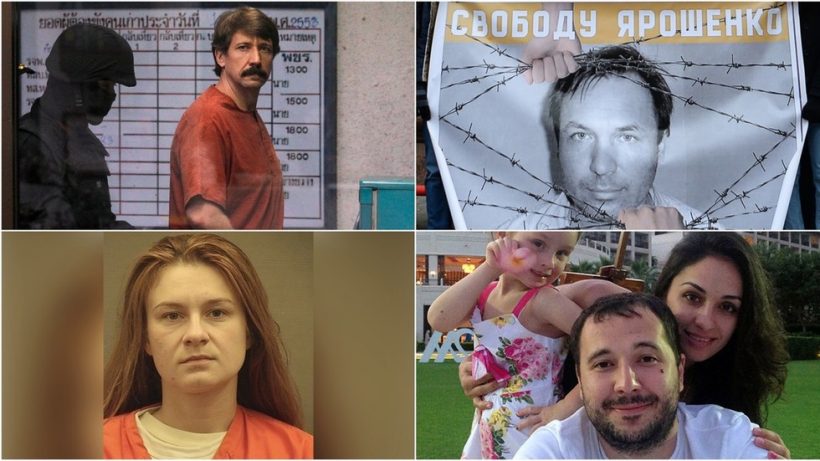
© (top left) Viktor Bout / Reuters / Damir Sagolj; (top right) A placard with an image of Konstantin Yaroshenko / Sputnik;
(bottom left) Maria Butina / Reuters / Alexandria Sheriff’s Office; (bottom right) Family photo of Roman Seleznyov / AFP
RT | December 29, 2018
As Washington continues detentions of Russians across the world the plight of those, who have already fallen into the clutches of the US authorities, raises suspicion about the true colors of the US justice system.
In mid-December, yet another Russian citizen was detained outside of Russia’s borders – this time in Finland – at the request of the United States, marking the latest episode in what the Russian Foreign Ministry decried as a “de-facto hunt” for the Russians on a global scale.
The news about the arrest of a Russian woman in Finland, who was placed in a “male” detention center and reportedly complained of poor conditions, came just days after a long-time Russian prisoner jailed in the US revealed that he was offered various favors, including a Green Card for his family in exchange for accusing the Russian government of corruption.
These developments shed light on how the US justice works, at least when it comes to Russians. RT looks at some of the high-profile cases, involving Russian citizens who have been detained or imprisoned in the US.
1. Viktor Bout
A businessman jailed in the US on accusations of being an international arms dealer, Viktor Bout, is one of the Russians who has spent the longest period of time in a US prison in recent history. He has been in custody for a decade now, after being arrested in 2008 in Thailand during a sting operation. He was convicted in the US in 2012 on a charge of conspiring to kill American citizens, by selling weapons to the Revolutionary Armed Forces of Colombia (FARC), and was handed a 25-year sentence.
The businessman himself has denied accusations. As the scandal developed he’s been in the media spotlight. While talking to reporters he spoke about life in the US high-security prison claiming that a maximum-security prison he is in spends hundreds of thousands of dollars on every prisoner from the US budget. Nevertheless, the conditions in the facility leave much to be desired and “nobody ever investigated” why the cost is so high, he said.
Bout was also highly critical of the US justice system by calling it a “cheap farce” and saying that the only reason behind his incarceration was to “intimidate other Russians”. It was also him, who said that the US offered him a deal in exchange for “telling the US authorities about corruption in the Kremlin.”
Still, he remains full of optimism and says that yoga, learning foreign languages and anecdotes keep him in good shape both physically and mentally.
2. Konstantin Yaroshenko
Other Russian citizens faced a much more ghastly fate and Konstantin Yaroshenko, a Russian pilot arrested in Liberia back in 2010, is one of them. Detained as a result of another US sting operation, Yaroshenko was accused of participating in a plan to smuggle drugs into the US and was handed down a 20-year sentence in 2011, which he has been serving ever since.
Yaroshenko has always insisted that he is completely innocent and that the whole process was part of a scheme by US agents to extract evidence against Bout. He also repeatedly complained about the conditions he was held in. He claimed he had been denied medical assistance despite health problems and was tortured by the prosecutors.
In May 2018, he told his wife by phone that his health problems could be due to deliberate poisoning. He also said he was put in a disciplinary cell for 30 days despite serious health issues. “He said he was tired of the torments and that 30 days in the disciplinary cell would kill him, he would not walk out of it alive,” she told reporters. His lawyer, meanwhile, assumed that it might have been punishment for talking to the Russian media.
Moscow has repeatedly urged Washington to pardon Yaroshenko but the US rejected any appeals.
3. Maria Butina
A pro-gun rights activist, Maria Butina, has become one of the latest Russian citizen jailed in the US in a high-profile case. Living in the US on a student visa, she was arrested in mid-July in the middle of the hunt for “Russian agents” and accused of secretly working for the Russian government as an unregistered lobbyist.
While being far from a dangerous criminal, Moscow said that Butina faced unnecessarily harsh treatment during her pre-trial detention. She was kept in solitary confinement for months, denied medical help and “subjected to a kind of torture,” as the Russian Foreign Minister Sergey Lavrov put it.
While initially pleading not guilty, Butina, who faced up to 15 years in jail, then changed her mind and agreed to strike a deal with prosecutors. Lavrov then said that he had “reasons to believe” the conditions she was kept in were “intended to break her will and make her confess to something she likely didn’t do.”
4. The hunt for ‘Russian hackers’
In recent years, the US also started a real hunt for those it called the ‘Russian hackers.’ About half a dozen Russian programmers were arrested in various corners of the world upon similar US requests and were all accused of various cybercrimes.
Roman Seleznyov, the son of Russian MP Valery Seleznyov, was arrested as he was on holiday in the Maldives in 2014. He was accused of being involved in bank fraud, obtaining information from protected computerized cash registers and aggravated identity theft.
Seleznyov has pleaded not guilty to all the charges. The man was held in prison even before trial despite his lawyer arguing that his client did not represent any danger to society. “This case does not involve an act of terrorism. It does not involve an act of war,” the lawyer said at that time.
Seleznyov was eventually sentenced to 27 and 14 years in two separate cases. Both sentences will run concurrently.
A similar fate befell programmer Pyotr Levashov, accused by US prosecutors of being the mastermind behind a large bot net. He was extradited to the US from Spain in February 2018 and initially pleaded not guilty to all 8 counts against him.
He also said his life would be in danger if Spanish authorities complied with the US extradition request, and afraid that he might face torture in the US “in order to extract Russian secrets.” Just seven months later, he pleaded guilty. His trial is scheduled for September 2019. Until then, he will still stay in prison.
Another Russian programmer, Stanislav Lisov, was extradited to the US from Spain in January 2018 and has been held in the Metropolitan correction center in New York.
The FBI claims that Lisov was the creator and administrator of NeverQuest, a banking trojan that has defrauded thousands of people, and cost the US some $5 million. Lisov denied all accusations and said that he just provided tech support for websites. He also said he was long kept in the dark about the real charges and was asked if he “broke into the Pentagon” or the FBI or the CIA.
His wife told RT before his extradition that she and her husband were “ninety-percent certain that the case is politically motivated.” In October, his lawyer told the Russian Izvestia daily that Lisov, 32, could get a “de-facto life sentence” even though the maximum sentence in his case could not exceed 25 years.
These are just some examples. As many as 54 Russians were held in US prisons in 2017, according to the data provided by the US Federal Bureau of prisons to RT. The Russian Foreign Ministry’s spokeswoman Maria Zakharova has, in turn, condemned the US for “acting on the sly” and simply “abducting” the Russian citizens during their travels abroad.
Although almost all the cases against the Russians in the US do look like simple criminal proceedings, the circumstances surrounding these cases still leave many questions about whether they were solely about the pursuit of justice.
Revenge of the spies: Flynn case shows extent of anti-Trump #Resistance
By Nebojsa Malic | RT | December 19, 2018
President Donald Trump’s ill-fated first national security adviser Michael Flynn will twist in the wind for another three months or more, before he can face a sentence for getting caught in a FBI ambush while doing his job.
Flynn was supposed to be sentenced on Tuesday, ending the year-long legal saga that destroyed his reputation, nearly bankrupted him, and even endangered his family. Then, in a bizarre last-minute twist, his lawyers asked for a delay. The next status hearing will be in March, with the actual sentencing who knows when.
At one point in the hearing, Judge Emmett Sullivan urged Flynn to reconsider his guilty plea, telling him that the violation he was admitting to amounted to treason – only to walk back the comments minutes later. The media, predictably, gave far more coverage to the original statement than the retraction. It’s the perfect example of the collective hysteria that has followed Flynn’s case from the very beginning.
Despite the publication of FBI documents showing that agents interviewing Flynn in January 2017 did not think he misled them, intentionally or otherwise, about the content of his conversations with Russian ambassador to the US Sergey Kislyak, Flynn chose to stand by his guilty plea from a year ago. His reasons for this are a mystery. What is not a mystery, however, is how the people involved in railroading Flynn are the same ones implicated in the institutional #Resistance to the Trump administration.
In the orgy of sensationalist reporting that has gripped the US mainstream media for the past two years, Flynn’s actual transgression has been lost to the din of shouting “treason” and “RUSSIA.” What he pleaded guilty to is lying to FBI investigators about his calls with Kislyak. The contacts themselves were right and proper, mind you: it was literally his job to reach out to foreign diplomats on behalf of the president-elect. So, why was the FBI even probing them?
That is where things get interesting. Somebody from the Obama administration – we still don’t know who – “unmasked” Flynn’s name from the classified NSA intercepts of his conversations with the Russian ambassador. This somehow got to Acting Attorney General Sally Yates, who testified that she reached out to the White House with concerns about Flynn being blackmailed. It also somehow got to the Washington Post. There was talk of the Logan Act, an obscure 200-year-old law never used to prosecute anyone.
Within days of Trump’s inauguration, two FBI agents came to interview Flynn about his conversations with Kislyak. They told him he didn’t need a lawyer present. One of the agents was Peter Strzok – who would later be revealed as rabidly anti-Trump, thanks to text exchanges with FBI lawyer Lisa Page uncovered by the DOJ inspector-general.
James Comey, the FBI director at the time and now a hero of the anti-Trump #Resistance, testified on Monday that he sent Strzok to the White House without informing Yates, out of political considerations. It’s not the first time Comey has broken with procedure and assumed prerogatives of his superiors, mind you – his public exoneration of Hillary Clinton comes to mind – as the DOJ IG concluded in his report.
Hounded by the media coverage of the NSA leaks and the FBI interview, Flynn resigned on February 14, 2017. That was not the end of his troubles, but only the beginning. Months later, special counsel Robert Mueller charged him with lying to Strzok and his colleague, in order to compel his cooperation with the “Russiagate” probe.
Mueller, let’s recall, was appointed by Deputy AG Rod Rosenstein after Comey was fired by Trump – on the basis of Rosenstein’s memo, no less – in May 2017, because Democrats insisted that sacking the FBI chief amid an ongoing counterintelligence investigation amounted to obstruction of justice. You can’t make this stuff up!
Yet despite two years and near-infinite resources, the best both Comey and Mueller could come up with to tie Trump to Russia has been the “salacious and unverified” (in Comey’s own words) Steele Dossier – a collection of claims bought and paid for by Clinton’s campaign, using the Democratic Party and its law firm Perkins Coie as cutouts.
Christopher Steele, a former (?) British spy, recently said in a legal filing that the dossier was commissioned so Clinton could challenge the legitimacy of the 2016 election. Before you object that Clinton never brought a court challenge, ask yourself: hasn’t she? What about Flynn, or George Papadopoulos, or Paul Manafort, or Michael Cohen, or the entire “Russiagate” probe for that matter? What about the frenzied, breathless reporting over the past two years, heralding the impending end of Donald J. Trump over each and every non-development?
Back in January 2017, top Democrat in the Senate Chuck Schumer warned Trump he should not cross the US intelligence community, as “they have six ways from Sunday at getting back at you.”
Sure enough, within days the spies released their infamous assessment claiming Russian meddling in the 2016 presidential election, providing a framework for “Russiagate” investigations. Since then, former CIA Director John Brennan has established himself as an outspoken foe of Trump, to the point where even former Director of National Intelligence James Clapper found it problematic.
Trump’s critics have routinely accused him of being a dictator, a despot and a tyrant, a threat to “our democracy,” whatever that means. Yet in what dictatorship would a despot tolerate an ongoing vendetta by the opposition against himself and his allies, and the rampant abuse of intelligence, judiciary and law enforcement? Trump must the most incompetent tyrant ever!
What’s worse, the Washington establishment claims to stand for justice, rule of law, and democracy while trampling any semblance of them into the mud – as shown by the case of General Flynn – and continuing to blame Russia, of course.
Federal Judge Orders Mueller To Turn Over Flynn Material
By Jonathon Turley | December 13, 2018
In a surprising move, U.S. District Judge Emmet G. Sullivan ordered Mueller late Wednesday to turn over all of the government’s documents and “memoranda” related to Flynn’s questioning. This follows a Flynn filing that described an effective trap set by agents who encouraged him not to bring a lawyer and left inconsistencies unaddressed in what has been described by critics as a “perjury trap.” I have practiced in front of Judge Sullivan for years and he is a respected judge who has a keen eye for prosecutorial and investigative abuse. That does not mean that he will find such abuse here and could ultimately make a finding that nothing improper occurred. Yet, despite a recommendation of no jail time, Sullivan wants to review the entire record before deciding on the issue.
Sullivan’s order gives Mueller a 3:00 p.m. EST Friday deadline for the special counsel’s office to produce the FBI documents. Those include 302 field reports that have been widely discussed in the media, including one which reportedly shows then-FBI Deputy Director Andrew McCabe pushing Flynn not to have an attorney present during the questioning. McCabe of course was later fired from the Justice Department and is viewed by critics as someone who had an anti-Trump agenda. Many however have defended his actions and denounced efforts, including President Trump, to make him a villain without any clear evidence of political bias. The scene however is made all the more suspicious for Trump supporters with the involvement of Peter Strzok, who was also later fired.
Some have also noted that McCabe never warned Flynn that false statements to investigators are crimes or that this was not some routine sit-down during the very busy opening days of the Administration. The fact is however that Flynn was not in custody and thus was not guaranteed a Miranda warning.
On the other hand, the false statement that Flynn allegedly made was not reportedly viewed by the agents as an intentional lie. His meeting with the Russians was not illegal or even unprecedented as the incoming National Security Adviser. He did not deny the meeting but a memory of sanctions being discussed. Robert Mueller however decided to reexamine the statement and charge it as a violation of 18 U.S.C. 1001.
In reality, it was doubtful that Flynn would ever get jail time for such an alleged false statement. His range as a first offender started at 0 and that is likely where it would remain even without the recommendation of Mueller.
There is no question that this was an aggressive approach to an interview at a time when the subject was in the middle of establishing a new office for a new Administration in the midst of serious national security pressures. Moreover, Flynn “clearly saw the FBI agents as allies,” according to the 302 prepared by Strzok and another agent. They made the conscious decision that “If Flynn still would not confirm what he said, … they would not confront him or talk him through it.” Again they have no duty to reveal the discrepancy but it is unclear why they would adopt such a seemingly hostile or aggressive stance toward Flynn.
Flynn is set to be sentenced next Tuesday.
Trump Tower Moscow: A CIA-Backed Provocation Against Putin, Trump – Economist
Sputnik – December 5, 2018
The media fuss surrounding the Trump Tower Moscow project that was never implemented may further exacerbate Russian-American relations, Sputnik contributor Ivan Danilov wrote, sharing his views on what was really behind the much-discussed initiative
The Trump Tower Moscow “plot” was nothing less than a CIA-backed provocation, deems Ivan Danilov, a Russian economist and Sputnik contributor.
“If we separate wheat from the emotional chaff of US media, we would get the following: immediately after [Donald] Trump becomes a presidential candidate, an agent of several US intelligence agencies, [Felix Henry] Sater, who had been earlier embedded in Trump’s business structure, came to then [Trump’s] lawyer [Michael Cohen] with a ‘brilliant idea’: to give [Vladimir] Putin a penthouse in order to turn the Russian president into an element of advertising”, Danilov wrote in his latest op-ed.
The economist underscored that one important link is missing in this chain, stressing that no one had confirmed so far whether the American president knew about the Sater-Cohen plan and endorsed it.
If this link is missing, the whole “chain” snaps, according to Danilov.
On 17 May 2018 BuzzFeed News reporters Anthony Cormier and Jason Leopold broke that Trump’s two “key business partners” had been secretly negotiating a deal aimed at building “an icon of the Trump empire — the Trump World Tower Moscow” amid the 2016 presidential campaign.
The media outlet referred to “exclusively” obtained documents revealing “a detailed and plausible plan” and “well-connected Russian counterparts”.
On 29 November, Cormier and Leopold unveiled ex-Trump business associate Sater’s plan “to give a $50 million penthouse at Trump Tower Moscow to Russian President Vladimir Putin” as part of the aforementioned real estate initiative. Sater discussed this plan with Trump’s personal attorney Michael Cohen, who hailed the idea at that time.
“My idea was to give a $50 million penthouse to Putin and charge $250 million more for the rest of the units. All the oligarchs would line up to live in the same building as Putin”, Sater told BuzzFeed News.
Meanwhile, on 29 November, Cohen pleaded guilty to lying to Congress about the Trump Tower project in Russia in an attempt to “minimize” his boss’s ties to Russia.
However, the biggest news about the proposed real estate deal is that it was considered “during the 2016 primaries and caucuses,” The Washington Post highlighted on 30 November, stressing that the former Trump lawyer earlier lied that the endeavour had been brought to naught before the primaries.
“This provides more evidence that the project was being rather seriously pursued with potential assistance from the Russian government, despite Trump’s presidential candidacy and despite Trump’s regular assurances that he didn’t deal with Russia”, the Post claimed.
In addition, Cohen “did recall” that in or around January 2016, he received a “response” from Dmitry Peskov, the Russian president’s press secretary, Special Counsel Robert Mueller wrote on Thursday.
For his part, Kremlin spokesman Dmitry Peskov revealed what sort of response he gave to Trump’s business associates after receiving Cohen’s letter that was sent to his official email.
“They were asked what the presidential administration has to do with this and if they realized who they contacted”, the Kremlin spokesman recalled. “They said they wanted to build a house… They were told that the administration is not engaged in construction projects and we will be happy to see them at the St. Petersburg Economic Forum if they are interested in investment”.
The case does not appear to be a smoking gun. Commenting on the media fuss, a source close to the US president told Fox News that the Sater-Cohen plan to provide the Russian president with a penthouse would have been a “stupid idea”, and emphasised that Trump had “never heard” about it.
Sater’s longstanding cooperation with US intelligence services, including the Central Intelligence Agency (CIA), the Defence Intelligence Agency (DIA) and the Federal Bureau of Investigation (FBI) adds further controversy to the case.
On 12 March, 2018, Cormier and Leopold reported that Felix Henry Sater (born Felix Mikhailovich Sheferovsky), 52, had “spent more than two decades as an intelligence asset who helped the US government track terrorists and mobsters”.
Given all of the above, the whole case looks like a “three-penny provocation” aimed at discrediting President Donald Trump, Danilov pointed out.
“One can presume that the next phase of the scandal will be the publication of Sater and Cohen’s photographs on the side-lines of the SPIEF or near the venue of the forum in the American media, which, from the point of view of US investigators, may well prove that the ‘Kremlin and Trump plot’ did take place”, he noted, bemoaning the fact that this “three-penny provocation” could seriously affect the already complicated US-Russian relations.
Trump’s Timidity is Letting Comey Off the Hook
By Ray McGovern • Consortium News • December 4, 2018
Because President Donald Trump has again pulled the rug out from under them, House Republicans face Mission Impossible on Friday when they try to hold ex-FBI Director James Comey accountable for his highly dubious authorization of surveillance on erstwhile Trump campaign adviser Carter Page.
Comey let go his unprecedented legal maneuver to have a court quash a subpoena for him to appear behind closed doors before the Republican-led House Judiciary Committee until the Democrats take over the committee in January. The current committee chair, Rep. Bob Goodlatte (R-VA), decried Comey’s use of “baseless litigation” in an “attempt to run out the clock on this Congress.”
The Judiciary Committee has jurisdiction over the Foreign Intelligence Surveillance Act (FISA); so the still secret FISA application “justifying” surveillance of Page is almost sure to come up.
Comey had wanted a public hearing so he could pull the ruse of refusing to respond because his answers would be classified. He has now agreed to a closed-door meeting on Friday, with a transcript, likely to be redacted, to appear a few days later.
In an interview with The New York Post last Wednesday, Trump acknowledged that he could declassify Comey’s damning Foreign Intelligence Surveillance Act warrant request to show how devastating those pages likely are, but said he would not do so “until they were needed,” namely, if a Democratic House starts going after him. “If they go down the presidential harassment track, if they want go and harass the president and the administration, I think that would be the best thing that would happen to me. I’m a counter-puncher and I will hit them so hard they’d never been hit like that,” Trump told the paper. He added: “It’s much more powerful if I do it then, because if we had done it already, it would already be yesterday’s news.”
But they are needed before Comey’s hearing on Friday. Barely a week will remain before Congress adjourns. Four weeks later Democrats take over the oversight committees.
Cowardice Deja Vu
This is not the first time Trump has flinched. On September 17 he ordered “immediate declassification” of Russia-gate documents, including FISA-related material. Four days later he backed down, explaining that he would leave it to the Justice Department’s inspector general to review the material, rather than release it publicly.
What exactly is in the FISA application, and why had House Intelligence Committee chair Devin Nunes, for example, kept pleading with Trump to declassify it? In July Nunes expressed hedged confidence “that once the American people see these 20 pages, at least for those that will get real reporting on this issue, they will be shocked by what’s in that FISA application” to surveil Page, a U.S. citizen.
Oddly, Trump echoed Nunes, telling The New York Post that, were he to declassify FISA warrant applications and other documents, all would “see how devastating those pages are.” But Trump blamed his reluctance to declassify on one of his lawyers, Emmet Flood, who thought it would be better politically to wait. “He didn’t want me to do it yet, because I can save it. … I think [eventual release] might help my campaign.” So Nunes et al. find themselves thrown under the bus, again.
Worse still, according to Comey’s attorney, the “accommodation” worked out with House Judiciary Committee includes a proviso that a representative of the FBI will be present on Friday to advise on any issues of confidentiality and legal privilege. The committee undertook to publish a transcript very quickly. Do not be surprised to see many Peter-Strzok-type responses: “I would really like to answer that question, but the FBI won’t let me.”
Afraid?
In an insightful posting, David Stockman, budget director for President Ronald Reagan, was puzzled about why Trump doesn’t seem to get what’s going on. I think, rather, that Trump does get it, and that Stockman’s puzzlement may be due mostly to his specific experience as budget director. In that role, Stockman did not have to pay much heed to the Deep State, so long as he did not demur about the obscenely excessive budgets automatically given to the FBI, DOJ, CIA, NSA, and the Pentagon.
With Trump it’s a different kettle of fish — and they are piranhas. Trump has ample reason to fear the Deep State is out to get him because it is. And by this point he seems to have internalized quite enough fear that it would be too dangerous to take on the the FBI and intelligence community. Needless to say, the stakes are exceedingly high — for both sides. As president-elect, Trump dismissed the usual warnings as to how things work in Washington. But he could hardly have missed Sen. Minority Leader Chuck Schumer’s attempt to ensure that Trump knows what he should be afraid of.
Not Afraid? Then ‘Really Dumb’
On Jan. 3, 2017, three weeks before Trump took office, Schumer told MSNBC’s Rachel Maddow, that President-elect Trump was “being really dumb” by taking on the intelligence community and doubting its assessments on Russia’s cyber activities: “Let me tell you, you take on the intelligence community, they have six ways from Sunday at getting back at you. So even for a practical, supposedly hard-nosed businessman, he’s being really dumb to do this.”
Schumer’s words came just three days before then-National Intelligence Director James Clapper and the heads of the FBI, CIA, and NSA descended upon the president-elect with the misnomered “Intelligence Community Assessment” — a rump, evidence-free embarrassment to serious practitioners of intelligence analysis, published that same day, alleging that Russian President Vladimir Putin had done what he could to get Trump elected.
Adding insult to injury, after the January 6, 2018 briefing of the president-elect by the Gang of Four, Comey asked the others to leave, and proceeded to brief Trump on the dubious findings of the so-called “Steele dossier” — opposition research paid for by the Democrats (and, according to some reports, by the FBI as well) — with unconfirmed but scurrilous stories about Trump cavorting with prostitutes in Moscow, etc., etc. (And according to The Washington Post, that incident with hookers was written by a Clinton operative.) That opposition research was apparently used in the FISA warrant request, without revealing its provenance to the judge.
‘This Russia Thing’
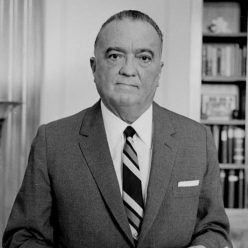
Hoover: Model for Comey. (Wikipedia)
It seems to have taken Trump a few months to appreciate fully that he was being subjected to the classic blackmail-type advisory previously used with presidents-elect by the likes of J. Edgar Hoover. Indeed, this may be what Trump had in mind when he told Lester Holt in May 2017 that he had fired Comey over “this Russia thing.” (Trump can be his worst enemy when he opens his mouth.)
Comey’s closed-door deposition is now scheduled for the 77th anniversary of the Japanese surprise attack on Pearl Harbor. But don’t look for any surprise attack on Comey this December 7 from Judiciary Committee members, highly vulnerable though he is.
With just a few days left before Congress adjourns, House Republicans, like their President, have pretty much let the clock run out on them. Few will see much percentage at this late date in “taking on the intelligence community.” Trump has already pretty much thrown them under the bus.
The leadership of the three House committees with purview over Russia-gate matters — Judiciary, Intelligence, and Government Operations — changes next month. So while Friday had seemed to be shaping up as a key day for confronting Comey — and for getting answers to questions on Russia-gate — the day will likely land with an anticlimactic thud. Even if the committee is able to expose additional misdeeds not already known, nothing much is likely to happen before Christmas.
After that, the three committees and their aborted work will be history.
The dominant mainstream media narrative about Russia-gate — ignoring FBI-gate — will hop happily into the new year. And no congressional “oversight” committee will dare step up to its constitutional duty, despite a plethora of documentary evidence on FBI-gate. And why? Largely because “they” of the Deep State “have six ways from Sunday at getting back at you.”
Most consequential of all, any significant improvement in relations with Russia will remain stymied. And the MICIMATT (Military-Industrial-Congressional-Intelligence-Media-Academia-Think Tank) complex, with its Deep-State enforcer, will have won yet another round. Merry Christmas.
Ray McGovern works with Tell the Word, a publishing arm of the ecumenical Church of the Saviour in inner-city Washington. He worked for the senior Bush when he was director of the CIA and then briefed him mornings, one-on-one, with the President’s Daily Brief during the first Reagan administration. In Jan. 2003, Ray co-founded Veteran Intelligence Professionals for Sanity (VIPS) and still serves on its Steering Group.
Mueller Withheld “Details That Would Exonerate The President” Of Having Kremlin Backchannel
By Tyler Durden | Zero Hedge | December 3, 2018
It appears that special counsel Robert Mueller withheld key information in its plea deal with Trump’s former attorney, Michael Cohen, which would exonerate Trump and undermine the entire purpose of the special counsel, according to Paul Sperry of RealClearInvestigations.

Cohen pleaded guilty last week to lying to the Senate intelligence committee in 2017 about the Trump Organization’s plans to build a Trump Tower in Moscow – telling them under oath that negotiations he was conducting ended five months sooner than they actually did.
Mueller, however, in his nine-page charging document filed with the court seen by Capitol Hill sources, failed to include the fact that Cohen had no direct contacts at the Kremlin – which undercuts any notion that the Trump campaign had a “backchannel” to Putin.
On page 7 of the statement of criminal information filed against Cohen, which is separate from but related to the plea agreement, Mueller mentions that Cohen tried to email Russian President Vladimir Putin’s office on Jan. 14, 2016, and again on Jan. 16, 2016. But Mueller, who personally signed the document, omitted the fact that Cohen did not have any direct points of contact at the Kremlin, and had resorted to sending the emails to a general press mailbox. Sources who have seen these additional emails point out that this omitted information undercuts the idea of a “back channel” and thus the special counsel’s collusion case. –RCI
Page 2 of the same charging document offers further evidence that there was no connection between the Trump campaign and the Kremlin; an August 2017 letter from Cohn to the Senate intelligence committee states that Trump “was never in contact with anyone about this [Moscow Project] proposal other than me,” an assertion which Mueller does not contest as false – which means that “prosecutors have tested its veracity through corroborating sources” and found it to be truthful, according to Sperry’s sources. Also unchallenged by Mueller is Cohen’s statement that he “ultimately determined that the proposal was not feasible and never agreed to make a trip to Russia.”
“Though Cohen may have lied to Congress about the dates,” one Hill investigator said, “it’s clear from personal messages he sent in 2015 and 2016 that the Trump Organization did not have formal lines of communication set up with Putin’s office or the Kremlin during the campaign. There was no secret ‘back channel.’”
“So as far as collusion goes,” the source added, “the project is actually more exculpatory than incriminating for Trump and his campaign.” –RCI
The Trump Tower Moscow meeting – spearheaded by New York real estate developer and longtime FBI and CIA asset, Felix Sater, bears a passing resemblance to the June 2016 Trump Tower meeting between members of the Trump campaign and a Russian attorney (who hated Trump), and which was set up by a British concert promotor tied to Fusion GPS – the firm Hillary Clinton’s campaign paid to write the salacious and unverified “Trump-Russia Dossier.”
 British concert promotor and Fusion GPS associate Rob Goldstone

“Specifically, we have learned that the person who sought the meeting is associated with Fusion GPS, a firm which according to public reports, was retained by Democratic operatives to develop opposition research on the president and which commissioned the phony Steele dossier” –Washington Post
In both the Trump Tower meeting and the Trump Tower Moscow negotiations, it is clear that nobody in the Trump campaign had any sort of special access to the Kremlin, while Cohen’s emails and text messages reveal that he failed to establish contact with Putin’s spokesman. He did, however, reach a desk secretary in the spokesman’s office.
What’s more, it was Sater – a Russian immigrant with a dubious past who was representing the Bayrock Group (and not the Trump Organization), who cooked up the Moscow Trump Tower project in 2015 – suggesting that Trump would license his name to the project and share in the profits, but not actually commit capital or build the project.
 Felix Sater, FBI and CIA asset, real estate developer, ex-con

Sater went from a “Wall Street wunderkind” working at Bear Stearns and Lehman Brothers, to getting barred from the securities industry over a barroom brawl which led to a year in prison, to facilitating a $40 million pump-and-dump stock scheme for the New York mafia, to working telecom deals in Russia – where the FBI and CIA tapped him as an undercover intelligence asset who was told by his handler “I want you to understand: If you’re caught, the USA is going to disavow you and, at best, you get a bullet in the head.”
The Moscow project, meanwhile, fizzled because Sater didn’t have the pull within the Russian government he said he had. At best, Sater had a third-hand connection to Putin which never panned out.
Sources say Sater, whom Cohen described as a “salesman,” testified to the House intelligence panel in late 2017 that his communications with Cohen about putting Trump and Putin on a stage for a “ribbon-cutting” for a Trump Tower in Moscow were “mere puffery” to try to promote the project and get it off the ground.
Also according to his still-undisclosed testimony, Sater swore none of those communications involved taking any action to influence the 2016 presidential election. None of the emails and texts between Sater and Cohen mention Russian plans or efforts to hack Democrats’ campaign emails or influence the election. –RCI
As Tom Fitton of Judicial Watch noted of Mueller’s strategy: “”Mueller seems desperate to confuse Americans by conflating the cancelled and legitimate Russia business venture with the Russia collusion theory he was actually hired to investigate,” said Fitton. “This is a transparent attempt to try to embarrass the president.”
The MSM took the ball and ran with it anyway
CNN, meanwhile, said that Cohen’s charging documents suggest Trump had a working relationship with Putin, who “had leverage over Trump” due to the project.
“Well into the 2016 campaign, one of the president’s closest associates was in touch with the Kremlin on this project, as we now know, and Michael Cohen says he was lying about it to protect the president,” said CNN‘s Wolf Blitzer.
Jeffrey Toobin – CNN‘s legal analyst, said the Cohen revelations were so “enormous” that Trump “might not finish his term,” while MSNBC pundits said that the court papers prove “Trump secretly interacted with Putin’s own office.”
“Now we have evidence that there was direct communication between the Trump Organization and Putin’s office on this. I mean, this is collusion,” said Mother Jones‘s David Corn.
Adam Schiff, the incoming Democratic chairman of the House intelligence committee, said Trump was dealing directly with Putin on real estate ventures, and Democrats will investigate whether Russians laundered money through the Trump Organization. –RCI
As Sperry of RealClearInvestigations points out, however, “former federal prosecutors said Mueller’s filing does not remotely incriminate the president in purported Russia collusion. It doesn’t even imply he directed Cohen to lie to Congress.”
“It doesn’t implicate President Trump in any way,” said former independent counsel Solomon L. Wisenberg. “The reality is, this is a nothing-burger.”
FBI raids home of whistleblower who had ‘dirt’ on Clinton Foundation, Mueller
RT | December 1, 2018
More than a dozen FBI agents searched for six hours the house of a contractor who had given Congress and the DOJ documents about the Clinton Foundation and the Uranium One scandal, implicating then-FBI director Robert Mueller.
Sixteen agents showed up at the Maryland home of Dennis Nathan Cain on November 19, the Daily Caller reported this week, citing Cain’s attorney Michael Socarras. They demanded to see the documents Cain had already turned over to the Department of Justice inspector-general and the House and Senate intelligence committee.
“I cannot believe the Bureau informed the federal magistrate who approved the search warrant that they wanted to search the home of an FBI whistleblower to seize the information that he confidentially disclosed to the IG and Congress,” said Socarras. He also objected to the fact that the FBI at no point reached out to him, even though Cain provided the agents with his contact information, calling that “serious misconduct.”
FBI spokesman Dave Fitz confirmed to the Daily Caller that the bureau had conducted “court authorized law enforcement activity,” declining to comment further.
The search warrant, signed by federal magistrate Stephanie A. Gallagher in the US District Court for Baltimore, said that Cain possessed “stolen federal property.”
Cain informed the agents that he was a federally protected whistleblower, but gave them the documents at their insistence, Socarras said. Even so, they searched his house for hours afterward.
What were the agents looking for? According to the Daily Caller, they were after the document suggesting that Robert Mueller – now special counsel in charge of the “Russiagate” probe targeting President Donald Trump, but FBI director back in 2001-2013 – failed to investigate allegations of criminal misconduct in the case of Uranium One.
The Canadian-based mining company controls over 20 percent of the US uranium supply, and was sold to the Russian conglomerate Rosatom in 2010. The sale needed to be approved by the Committee on Foreign Investment in the United States (CIFUS), which was chaired by then-Secretary of State Hillary Clinton.
Since then, multiple whistleblowers have revealed claims of misconduct, bribery and fraud on part of the people involved in the sale, even suggesting a “pay for play” scheme in which the Clinton Foundation received millions of dollars in donations in exchange for greenlighting the deal. Republicans have also pointed to Bill Clinton’s $500,000 fee for a speech in Moscow in 2010 as evidence the Clintons were peddling influence for Russian money.
Democrats have dismissed the apparent scandal as a right-wing conspiracy theory, and Clinton herself called the accusations of wrongdoing “baloney.”
In April this year, then-Attorney General Jeff Sessions asked the Utah-based US Attorney John Huber to investigate both the Uranium One probe and the FBI investigation into Clinton’s use of a private email server. That second probe was the subject of a scathing report in June by the DOJ IG Michael Horowitz, the same official to whom Cain gave the documents as a whistleblower. The status of that investigation is currently unknown.
Also on rt.com:
FBI documents detail Clinton and Mueller’s own ‘Russiagate’ – but they’re classified
“THE CHIMERA OF DONALD TRUMP, RUSSIAN MONEY LAUNDERER”
Sic Semper Tyrannis | November 23, 2018
Is Donald Trump guilty of money laundering? If you ask most Democrats and anti-Trump Republicans, they fervently believe that he has been moving money for Russian mobsters for more than twenty years and that an investigation of this will bring Trump’s Presidency to an end. Don’t count on it. Although there is clear evidence of Trump’s past relationship with Russian/American mobsters, knowing someone or collaborating on a business deal is not proof of money laundering. I have spent three decades investigating money laundering cases (I helped develop the civil money laundering case against Philip Morris—click here) and it is clear to me that those who are earnestly accusing Trump of such a crime do not understand what constitutes money laundering.
Apart from not understanding how to make a money laundering case, the anti-Trumpers have failed to grasp another key element to the narrative that Trump was a puppet to the Russians—one of his longtime Russian business associates, Felix Sater, was an FBI informant during the entire time that Robert Mueller was FBI Director. Since Sater was a fully signed up FBI informant or asset, he was in a unique and powerful position to implicate Trump. But none of the “evidence” uncovered or planted by Sater ever produced an indictment of Donald Trump. With the benefit of hindsight it appears that the FBI, relying on Sater, used Trump and his organization as bait to go after Russian mobsters.
The Democrat case for Trump’s money laundering is laid out in a complaint the Democratic National Committee filed in April 2018 against the Russians, Julian Assange and Trump:
Beginning in 2003, Trump engaged in multiple real estate deals with the Bayrock Group, a firm founded and run by Soviet emigres, who reportedly had close ties to the Russian government and Russian organized crime. In 2004, Trump negotiated with the Deputy Mayor of Moscow over a potential real estate development. In the mid-2000s, Trump partnered with wealthy Russian-Canadian businessmen to develop real estate in Toronto. And in 2006, Trump contracted with the Russian Standard Corporation, a Moscow-based entity that owns and operates the Miss Russia beauty pageant, to allow the winner of the pageant to compete in Trump’s Miss Universe pageant, an action that had not been taken since at least 2002. In 2008, Trump sold a Palm Beach, Florida mansion to a Russian oligarch for a $54 million profit. In 2013, Trump established a business relationship with Russian oligarch Aras Agalarov, a close ally of Putin, to bring the Miss Universe pageant to Russia and work on plans to develop a Trump-branded project in Moscow. . . .
As Trump, Jr. explained, the Trump Organization “s[aw] a lot of money pouring in from Russia,” and “Russians make up a pretty disproportionate cross-section of our assets.” And Trump’s son Eric Trump has reportedly stated that substantial funding for Trump’s golf courses comes from Russian investors.
I do not know who was advising the DNC on this complaint, but it is clear that the drafter or drafters do not have a clue about money laundering. Money laundering is very easy to define:
The act of disguising the source or true nature of money obtained through illegal means.
The key element is the phrase, “illegal means.” If you are going to be charged as a participant or accessory in a money laundering case, you must be handling or receiving money that came from a criminal activity, such as trafficking in drugs, arms or people. So here’s the critical question with respect to Donald Trump and money laundering—what was the predicate crime?
In the world of real estate, the money laundering component is always in the financing. That is, you want to trade the bad money for good bank money by using the property as the chattel to do it. But when this is done as part of a money laundering scheme, it almost always involves the financing of major building projects. Someone with dirty money is not going to waste time purchasing individual condos or homes as their primary means of cleaning the money. When the dirty money comes from activities like drug trafficking, the amount of cash generated is enormous. You need big money projects to launder large quantities of cash.
Given Donald Trump’s extensive and controversial real estate ventures over the last thirty years, which have involved several Russians, it is understandable why those opposed to Trump seize on these transactions as evidence of “money laundering.” Unfortunately, the journalists who have tried to make the case that Donald Trump was “laundering” money for the Russian mob, have failed to provide actual evidence of such activity. Instead, they have relied on innuendo and guilt by association.
Yes, it is true that Russians with ties to organized crime purchased condos in Trump Towers in New York City. But there is no evidence that the sales of these condos were an organized, structured transaction. Individual Russians, acting in person or through shell companies, purchasing a condo is not proof of criminal activity. The fact that those who have made such purchases have not been arrested or indicted undermines the claim that their mere presence in a Trump building is proof of criminal activity.
As Shakespeare wrote, “Ay, there’s the rub.” Association with unsavory characters is not a criminal offense. While it is quite true that Trump associated with several Russians with links to organized crime it is also true that Trump has never been indicted or charged with such criminal activity. Is he really that good in hiding his trail?
One of the loudest voices claiming that Trump is in bed with the Russians is Craig Unger. Craig was known as a good reporter at one point in his life, but I think his work on Trump is both shoddy and incomplete. To be fair, Craig is not the only one claiming Trump is facilitating Russian money laundering. Other prominent journalists, including Richard Behar, Tom Burgis of the Financial Times and John Harwood of CNBC, also have echoed Unger’s thesis.
All four focus much of their reporting on a Russian born American “mobster”, Felix Sater, to implicate Trump as a Russian money laundering chump. The following snippet from an interview Unger did with Vox about his book, House of Trump, House of Putin is representative of how Sater is used as some sort of proof that Trump is part of a money laundering scheme:
Bayrock was a real estate development company located on the 24th floor of Trump Tower. The founder was a guy named Tevfik Arif and the managing director was Felix Sater, a man with numerous ties to Russian oligarchs and Russian intelligence. Bayrock proceeded to partner with Trump in 2005 and helped him develop a new business model, which he desperately needed.
Recall that Trump was $4 billion in debt after his Atlantic City casinos went bankrupt. He couldn’t get a bank loan from anywhere in the West, and Bayrock comes in and Trump partners with other people as well, but Bayrock essentially has a new model that says, “You don’t have to raise any money. You don’t have to do any of the real estate development. We just want to franchise your name, we’ll give you 18 to 25 percent royalties, and we’ll effectively do all the work. And if the Trump Organization gets involved in the management of these buildings, they’ll get extra fees for that.”
It was a fabulously lucrative deal for Trump, and the Bayrock associates — Sater in particular — were operating out of Trump Tower and constantly flying back and forth to Russia. And in the book, I detail several channels through which various people at Bayrock have close ties to the Kremlin, and I talk about Sater flying back and forth to Moscow even as late as 2016, hoping to build the Trump Tower there.
Tom Burgis, writing in the Financial Times, provides additional details on the relationship between Sater and Trump and implies something nefarious, perhaps even illegal, was afoot:
As work on Trump Soho got under way in 2007, the partnership between Mr Trump and Bayrock was gathering momentum. Another tower, in Fort Lauderdale, was rising. A 2008 Bayrock presentation includes a picture of Mr Trump grinning beside Mr Arif and names him as a referee. Bayrock had its office on the 24th floor of Trump Tower and calls the Trump Organization a “strategic partner”.
The same presentation says Bayrock was one of the backers of the redevelopment of the 101-year-old Hotel du Parc on the shores of Lake Geneva, owned by Swiss Development Group, a Geneva-based company. In May this year, Nicolas Bourg, a Belgian businessman who says he worked with Viktor Khrapunov’s son Ilyas on US real estate deals, claimed in a separate dispute that Swiss Development Group was “owned and controlled by Ilyas and his family and used to conceal the movement and investment of his family’s money”.
All of this sounds pretty bad on the surface until you examine what Sater actually did. Messrs. Unger and Burgis neglected to analyze the critical fact that Felix Sater was an FBI informant since 1998. If Trump was taking dirty money or engaged in criminal activity with Russians then he was doing it with Felix Sater, who was under the control of the FBI. Felix Sater was proposing deals and making contacts with Russian criminals overseas and this activity surely was known by the FBI. If there was any suspicion on the part of the FBI that Trump was taking bad money, they would have recorded such activity in detail and he would have been indicted. Instead of running around in an orange jump suit, Donald Trump ran for President.
Given Sater’s relationship with the FBI, one needs to look at Trump’s relationship with Russians, especially those facilitated by Sater, in a different light. Put simply, were Trump’s real estate deals being used as bait to attract targets of interest for the FBI. Was Trump a witting cooperator with the FBI or unwitting?
We do know that Sater was trying to put together real estate deals overseas while serving as a FBI informant and working from Trump Tower in New York City. This was reported in a March 2017 Los Angeles Times piece:
Working from a 24th-floor office in Manhattan’s Trump Tower, Felix Sater spent years trying to line up lucrative deals in the United States, Russia and elsewhere in Europe with Donald Trump’s real estate organization.
For much of that time, according to court records and U.S. officials, Sater also worked as a confidential informant for the FBI, and — he says — U.S. intelligence.
“I was building Trump Towers by day and hunting Bin Laden by night,” Sater, now 50, told the Los Angeles Times in a phone interview from New York.
As managing director of Bayrock Group LLC, a real estate development firm, the Russian-born businessman met Trump in 2003, court records show, when Trump was looking to expand his business and branding organization around the globe.
Why are the anti-Trump forces failing to grasp the import of Sater and his role as an FBI informant as undermining the claim that Trump was conspiring with the Russians? Sater’s role with the FBI has been widely reported:
There is no question that Sater led a double life during the years he worked with the Trump Organization.
In 1998, Sater pleaded guilty to a federal charge of racketeering for his role in a Mafia-linked $40-million stock fraud scheme. He quickly cut a deal, agreeing to become a secret FBI informant in hopes of getting a lenient sentence.
Court records were sealed to protect Sater’s identity, so his role in the fraud case stayed secret for a decade while he was at Bayrock. After a court hearing in 2009, he was fined $25,000 but was not sent to prison or ordered to pay restitution.
Along with press reports regarding Sater’s role with the FBI, we have Sater’s attorney, in a letter sent to Judge Leo Glasser of the Eastern District of NY on 1 September 2005, telling the court that:
. . . Mr. Sater has been involed in on-going cooperation activities with law enforcement agents, and has provided truthful and credible information on a wide variety of criminal activities, some of which has already led to criminal prosecution of others.
Even Obama’s Attorney General, Loretta Lynch, provided Sater cover :
At his sentencing hearing, several FBI officials vouched for Sater’s help. He got his biggest endorsement in January 2015 when Loretta Lynch was asked at her Senate confirmation hearing for U.S. attorney general why court records had been sealed in the fraud case.
If Trump was the target of the FBI, then fair observers must concede that the Bureau has failed during an 18 year period to obtain any incriminating information about Trump and his business practices. Had the FBI been successful, Trump surely would have already been indicted by now in the Southern District of New York and charged with criminal conduct.
Sater’s status as an FBI informant is not an honorary position. It is not a job that entitles the informant to regular social chats with an FBI agent. It is a job that puts the informant in the position of having to help the FBI make criminal cases, including entrapping folks willing to engage in illegal acts. The FBI website describes the informant role:
The courts have recognized that the government’s use of informants is lawful and often essential to the effectiveness of properly authorized law enforcement investigations. However, use of informants to assist in the investigation of criminal activity may involve an element of deception, intrusion into the privacy of individuals, or cooperation with persons whose reliability and motivation may be open to question. Although it is legally permissible for the FBI to use informants in its investigations, special care is taken to carefully evaluate and closely supervise their use so the rights of individuals under investigation are not infringed. The FBI can only use informants consistent with specific guidelines issued by the attorney general that control the use of informants.
And who was in charge of the FBI during all of the time that Sater was a signed up FBI snitch? You got it—Robert Mueller. Let us just stick with the facts—during Mueller’s term (2001 thru 2013) the FBI did not make or bring a case of money laundering against Donald Trump. Yet, during this period, Felix Sater, a fully signed up and operating FBI informant, was trying to cobble together real estate deals with Russians of questionable character. Trump and his organization were not implicated in any of this activity in a way that led the FBI to seek an indictment against them.
Many House Democrats are convinced that there is untapped evidence implicating Trump in a variety of money laundering schemes. But their belief, in my view, is based on a fundamental ignorance about money laundering and financial crimes in general. Tax avoidance, for example, is not money laundering. Highly publicized real estate deals are not the kind of cleaning operation that genuine money launderers embrace. Why? Those kind of deals come with scrutiny and the last thing that criminals with dirty money want is a high profile and public attention.
If you hate Trump and are betting that the Democrat investigative tsunami will bring Trump down, I have a word of advice—don’t bet your house. Donald Trump may be guilty of boorish behavior and brash comments, but the evidence of laundering money for the Russians is not there.
Featured Video

Trita Parsi: Israel Set a Trap for Total War in the Region
or go to
Aletho News Archives – Video-Images
From the Archive
Zionism’s Violent Legacy
By Donald Neff | Washington Report On Middle East Affairs | January 1996
On January 4, 1948, Jewish terrorists drove a truck loaded with explosives into the center of the all Arab city of Jaffa and detonated it, killing 26 and wounding around 100 Palestinian men, women and children.[1] The attack was the work of the Irgun Zvai Leumi – the “National Military Organization,” also known by the Hebrew letters Etzel – the largest Jewish terrorist group in Palestine. The Irgun was headed by Revisionist Zionist Menachem Begin and had been killing and maiming Arabs, Britons and even Jews for the previous ten years in its efforts to establish a Jewish state.
This terror campaign meant that at the core of Revisionist Zionism there existed a philosophical embrace of violence. … continue
Blog Roll
 Aletho News
- Trita Parsi: Israel Set a Trap for Total War in the Region
- Trump’s Iran war is on an Israeli leash
- Saudi oil boss issues global supply warning
- Riyadh Says Its Oil System Is Intact. The Numbers Say Otherwise.
- Trump and Netanyahu Want to “Finish the Job” on Iran
- US ‘one-sided dictation’ not Iran’s beliefs makes rational talks impossible: Baghaei
- Iran’s Next Strike May Not Explode. It Could Shut You Down /Col Doug Macgregor
- Iran: US political targets legitimate if assassinations return
- Iraq shuts key border crossing with Iran under US pressure: Report
- Undersea Internet cables could be targeted in retaliation for attacks on Iran: IRGC deputy chief
- If Americans Knew
- The Israel Lobby’s Changing Fortunes
- AIPAC has become such a political liability that it’s shifting to a more “nimble” approach to buying politicians
- At least 160 Israeli settler attacks in 2 weeks
- Will Gaza’s Ancient Christian Community Disappear Forever?
- Israel’s vision of regional security rests on keeping Arab states weak
- Heidi Levine recounts how Palestinian youths helped save her in settler attack
- DAILY UPDATE: Latest essential news on Palestine, Israel, & region
- Trump’s Intensifying Sabotage of the ICC, for Israel’s Sake
- Israeli military detain US and UK volunteers in West Bank including Democratic NY politician Brad Lander
- Americans at National Conservatism Conference held in Israel this year criticize Israel
- No Tricks Zone
- E-Cars Reduce CO2 Emissions By Only 41% Compared To Internal Combustion Engine Vehicles
- Predictions Made By Renowned Climate Professor Over Past Decades Have Been Proven To Be Poor
- New Study Suggests Large Regions Of The Pacific Ocean Have Been Cooling For The Last 80 Years
- Germany’s Green Energy Debacle: High Energy Costs Force Kahla Porzellan to Close After 182 Years!
- New Study: 50 Years Of The Most Aggressive ‘Net Zero’ Policies Can Only Affect The Global Climate By 0.03°C
- US September “Heat” Was No Record…Many Records Set Decades Ago
- Latest European Green Energy Debacle; Portugal’s Largest Flagship Solar Park Insolvent!
- Green Energy Debacle: German Expert Professor Fritz Vahrenholt Warns Of Severe Economic And Social Consequences
- Two More Paleo Reconstructions Affirm Meters-Higher Sea Levels Across Ireland, Brazil 7000-6000 Years Ago
- New Study: Earth And Venus Surface Warmth Largely Explained By Convection And Lapse Rate, Not CO2 Or Radiation


