US ‘obviously’ blew up Nord Stream – French politician
RT | March 17, 2023
French political party leader Florian Philippot believes it has long been obvious that the United States was behind last year’s sabotage of the Nord Stream pipelines, which were built to deliver Russian natural gas to Western Europe.
“Even before the war in Ukraine, the US for years fought against Nord Stream, it was a permanent part of their policy,” he told RIA Novosti in an interview published on Friday.
“In early February 2022, [US President Joe] Biden said the Americans could make it so that the pipeline was no more. That’s what happened. And it was in the interest of the Americans,” according to Philippot, who heads the right-wing The Patriots party in France.
Last month, veteran investigative journalist Seymour Hersh reported that Biden personally ordered the bombing of the pipelines, and that Norway assisted in the sabotage. He cited an unnamed source and supported his case using some of the same arguments as Philippot.
Biden remarked that “there will be no longer a Nord Stream 2” during a joint press conference with German Chancellor Olaf Scholz in early February 2022. Hersh also claimed that Biden allowed US special services to classify the operation in a way that justified not informing the US Congress about it beforehand.
Nord Stream 2 is the name of the second, newer pipeline, which was meant to greatly expand the capacity of the original Nord Stream, but was never operational. Both were disabled by sabotage.
Philippot said he considered US culpability “obvious” even before Hersh’s revelations, but was not sure about Norway’s role. He reasoned that Oslo had a motive since it “competes with Russia in gas trade, and many European nations replaced the Russian gas with Norwegian.” Both the US and Norway have denied any responsibility.
Philippot also urged France to leave NATO, saying the military alliance “needs to be disbanded because it has no reason to exist.”
“We have to stop this agenda of world war against Russia and China, it is absolutely insane,” he told the Russian news outlet, blaming the US for increasing global tensions.
He also called French President Emmanuel Macron a deceitful leader. His government “prioritizes the US, and not its own people,” Philippot stated.
He cited Macron’s decision to send billions of dollars worth of weapons and ammunition to Kiev, even as he is pushing through an unpopular pension reform, claiming a lack of money to fund social programs.
Is France going to be able to maintain its position in Africa?
By Pogos Anastasov – New Eastern Outlook – 15.03.2023
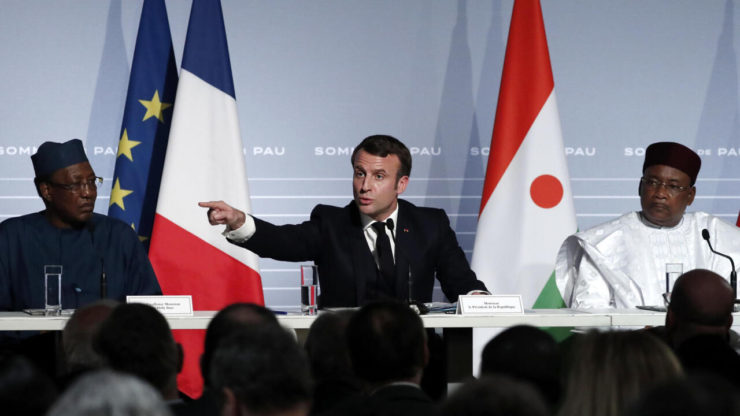
On March 1-5, French President Macron visited a number of African countries, leaving observers with a bitter taste in their mouths. Conceived with great fanfare as a presentation of Paris’ ostensibly new course aimed at “equal cooperation” with the African continent, it was remembered only for scandals, public spats with African presidents, and taunts from them that reflected the obvious disadvantage in bilateral relations.
Overall, the visit did not boost Paris’ credibility or strengthen its ties with Africa. Following the significant losses that France has suffered in Africa in recent years, the Elysée Palace should focus on preserving the African diamonds that remain in its crown rather than expanding its influence. And there aren’t many of them anymore. After Mali and Burkina Faso defected from Paris, Morocco is now gradually but steadily shifting from the French to the American camp, further narrowing the maneuvering field for Paris, which must look around and consider how to save what is left. What does it have in its piggy bank?
The richest “chest” in which the French keep the wealth looted from Africans is … the French treasury itself. The scheme of collecting money through the sub-regional economic cooperation organization of West Africa, ECOWAS (almost all its 15 members are former French colonies) is well established and allows almost half their economic potential to be at the service of the French economy.
ECOWAS itself was founded in 1975 on the basis of the Lagos Treaty and initially included 16 countries, but later the only Arab country in its composition, Mauritania, withdrew from it, remaining an associate member. When the organization was founded, the most noble goals were declared – the economic integration of the region, its self-sufficiency with the subsequent transition to a federation, a single citizenship and a single currency. But somehow it so happened that the most advanced element of integration was the creation of its own single currency – the West African CFA franc, which combines the currencies of the eight countries of this association, members of the West African Economic and Monetary Union, formed in 1994 (a number of other countries also use this currency). And “quite by chance” this currency is pegged to the euro, and 50% of foreign exchange reserves of these countries are stored in the French Central Bank, which completely deprives these countries of economic independence. Moreover, attempts by some of these countries to transfer their gold reserves to other jurisdictions are repeatedly unsuccessful, which naturally causes discontent among member countries.
Paris is forced to respond to this and in 2020 proposed a bill to this effect in the French National Assembly, according to which the CFA franc should be replaced by the “eco” already without being tied to the mandatory deposit in France. The draft was approved and ratified. However, it turned out that the pandemic buried it for a long time. In June 2021, ECOWAS revisited it, and a summit of member countries agreed on a five-year “currency convergence” pact, as well as a road map to launch a new monetary unit, now a region-wide one, by 2027.
More recently, on 24 January 2023, the President of Guinea-Bissau, who as of June 2022 is the current President of ECOWAS, pledged to revive the project, while also strengthening internal trade among ECOWAS countries, which currently represents less than 10% of total trade. To what extent this will work is not yet clear. Many suspect Paris that the reform of the CFA franc will be cosmetic and will not change the essence of economic relations between the member countries of the association and France, which actively uses the West African currency in the interests of French and multinational corporations based in its territory, which hold the markets of these states under their control and pump them for profit, including natural resources. Paris’ “Trojan horse” in ECOWAS is Côte d’Ivoire and the puppet regime put there by Paris, which implements French interests in the organization under the guise of African interests.
Whether or not Paris can pull off another trick with currency “reform” is not yet clear. Again, at the instigation of Paris, the membership of ECOWAS member countries where there have been recent coups, such as Guinea, Mali and Burkina Faso, is suspended, and important reforms that affect their core national interests can be carried out by regional organizations without their participation and taking their position into account by allies or, rather, satellites of France, such as Côte d’Ivoire. We can hardly believe that the Elysée Palace will not take advantage of these opportunities.
The other two countries where Paris will try by all means to maintain its influence are Chad and Niger, where strategic reserves of uranium, gold and other minerals are concentrated. In addition, Chad occupies an important strategic position, bordering Libya in the north and Sudan in the east, which makes it an important transit zone involved in both arms and migrant traffic. Chad, too, has a leadership that is questionable in terms of Western democracy — the son of President Idriss Déby, killed two years ago, Mahamat Déby, who heads the Transitional Military Council. But Paris, so sensitive to the issue in Mali and Burkina Faso, pays little attention in this case, because it is “our son of a bitch.”
Even more important for Paris is Niger, where uranium reserves, critical for the French nuclear industry, are being actively exploited. Paris is covered there by Washington, which has a chain of military bases, airfields and reconnaissance centers with UAVs. Of course, Paris will fight for this strategic region of Africa to the end, which, however, does not guarantee success.
In fact, Paris now has only one direction to go in Africa – to further lose its weight and influence. There are more and more reasons for this. France is increasingly uninterested in African states. Its military capabilities are shrinking, the effectiveness of its participation in solving the security problems of the continent is extremely low, which leads more and more states to refuse its assistance. France’s socio-political model is also losing its attractiveness against the background of increasing economic problems of the country, and with them the protests against the internal political and economic line of the Rothschild-appointed Macron. Constant arrogant lectures about the need to comply with democratic norms on the background of the suppression of citizens’ rights and the increasingly police nature of the French state, hits the eyes of Africans, as well as the growing propaganda of LGBT values. In this light, the storage of West African reserves in the Paris treasury looks increasingly anachronistic.
In Africa, they cannot fail to see Paris’s almost complete loss of sovereignty in European affairs, where it has demonstrated its absolute servility and dependence on the course of Washington, in particular with regard to the conflict in Ukraine. In this context, the attempts of Paris to fix the situation by loud slogans about “change of course”, belated repentance for the sins of the times of colonialism, as well as blaming the Wagner PMC for its problems look rather pathetic. The day is not far when France, like other colonialists, will be kicked off the continent as unable to cope with the challenges of the new era. In their place will come other forces that advocate real equal cooperation and its mutually beneficial nature based on the principles of a multipolar world, as well as unambiguously interpreted norms of international law.
‘An Injustice & A Disgrace’: Outrage Surges Over ‘Shameful’ Corsican Language Ban on French Island
By Svetlana Ekimenko – Sputnik – 11.03.2023
The French island of Corsica has for many years been trying to achieve autonomy, seeking legislative powers in economic and social fields, as well as recognition of the Corsican language as the official lingua franca.
Public outrage has been triggered by a “shameful” court decision in France’s Corsica to ban use of the Corsican language in its local parliament, according to reports from the capital, Ajaccio.
A verdict issued on 9 March in the Corsican city of Bastia ruled that French is the only language allowed to be used in official communications on the Mediterranean’s fourth-largest island which is a “territorial collectivity” of France. Furthermore, use of the Corsican language in debates – something that had been commonly practiced by the Assembly (unicameral legislative body of Corsica) – was pronounced as being against the French constitution.
Referred to as Corsu, or Lingua Corsa, the Corsican language is closely related to the type of Italian spoken in Tuscany. The language is spoken and written not only on the French island of Corsica, but also in northern Sardinia – an Italian island. The language has been classified as “definitely endangered” by UNESCO.
Also deemed a violation of the constitution by the court were local rules in support of “the existence of a Corsican people”.
The present ruling has come in the wake of a lawsuit introduced by Amaury de Saint-Quentin, the prefect of Corsica, according to reports. De Saint-Quentin is the highest-ranking official on the island and is appointed by the central French government.
The court ruling prompted an immediate backlash from pro-autonomy politicians on Corsica, with the pro-Corsican independence party Core in Fronte going on Twitter to lambaste the “shameful” verdict.
“This decision amounts to stripping Corsican parliament members of the right to speak their language during debates. Accepting this state of affairs is unthinkable for us,” a joint statement by the island’s executive council president Gilles Simeoni, and Corsican Assembly president Marie-Antoinette Maupertuis said.
Emphasizing that the Corsican language needed to be granted official status alongside French if it were to have any chance to “survive and develop”, they vowed to lodge an appeal against the verdict.
Jean-Christophe Angelini, leader of the Party of the Corsican Nation, tweeted to say the court ruling was “an injustice and a disgrace”, and “sounds to us like an insult”.
Corsica has for years been seeking autonomy from France, and – as well as a whole slew of issues – recognition of the Corsican language as official has always been top of the agenda.
In February 2018, during his first visit to the island, French President Emmanuel Macron spoke out against granting Corsica special status or recognizing its language as official, insisting that Corsica was an integral part of the French Republic.
However, this February Macron reportedly told members of parliament that he had neither red lines nor a predetermined decision regarding Corsica when it comes to the draft constitutional reform, which he hopes to carry out after the summer and put up for debates in 2023-24. However, the option for Corsica to secede from France is off the table, according to the report.
Protests greet Macron on Africa tour, Burkina Faso scraps military pact
Press TV – March 2, 2023
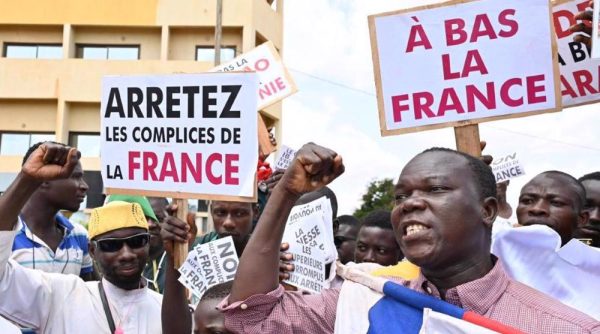
French President Emmanuel Macron has launched a tour of Africa with a message that France is not after meddling, but the visit revived old colonial wounds, sparking protests.
Macron on Thursday said the era of French interference in Africa was “well over” as he began a four-nation tour of the continent to renew frayed ties.
Anti-French sentiment runs high in some former African colonies. Macron said France harbored no desire to return to past policies of interfering in Africa.
“The age of Francafrique is well over,” Macron said in remarks to the French community in Gabon’s capital Libreville, referring to France’s post-colonization strategy of supporting authoritarian leaders to defend its interests.
“Francafrique” refers to the wave of decolonization in 1960 when France began propping up dictators in its former colonies in exchange for access to resources and military bases.
Macron landed in Gabon on Wednesday, the first stop of the tour that will also take the president to Angola, Congo Republic and the Democratic Republic of the Congo.
“What is Macron doing in Gabon? Is he coming for the forest or to back (President) Ali Bongo?” asked a 39-year-old technician. “If Macron wants to support the Bongo family, we will rise up,” he said. “Gabon is an independent country. It is not France that appoints Gabonese presidents.”
In the Democratic Republic of the Congo (DRC), angry protesters gathered in front of the French embassy in Kinshasa, spray-painting anti-French graffiti on its wall and chanting “Macron is a killer!”
They unfurled banners reading, “Macron is the godfather of DRC balkanization,” “Congolese say no to French policy,” and “Macron is an unwanted guest in DRC”.
More than 3,000 French soldiers are deployed in Senegal, Ivory Coast, Gabon and Djibouti, according to official figures.
Burkina Faso said it has scrapped a 1961 agreement on military assistance with France, only weeks after it told the French ambassador and troops to quit the country.
The Burkinabe foreign ministry advised the French government that the country was “renouncing the technical military assistance agreement reached in Paris on April 24 1961,” according to the correspondence, dated Tuesday.
The ministry said Burkina was giving one month’s notice for “the final departure of all French military personnel serving in Burkinabe military administrations.”
Burkina also gave France a month to pull out a special forces unit of 400 men that was based near the capital. The French flag was lowered on the base last month.
France withdrew the last of its troops from Mali last year, climaxing a break-up that was triggered by angry protests amid rise in Takfiri terrorism.
Majority in France Opposes French Military Presence in Africa, Poll Reveals
By Gleb Chugunov – Sputnik – 02.03.2023
On February 27, President Emmanuel Macron announced France’s new policy towards Africa, which is planning to reduce its military presense on the continent.
More than half of French respondents that took part in a survey held by the French Institute of Public Opinion (IFOP), came out in favor of shutting down all French military bases on the continent, media report.
According to sociologists, the closure of military bases is supported mostly by residents of rural areas (60% of respondents) as well as by people over 65 years of age (57%).
The number of people who took part in the IFOP’s survey is unknown.
As for the political views of the respondents, supporters of the two main opposition parties, the right-wing “National Rally” and the left-wing “La France Insoumise”, are those who favor the withdrawal of the army the most – 72% and 63% accordingly. Approximately 47% of respondents supporting President Macron’s social-liberal “Renaissance” party, back the idea of closing the bases, as do 54% of polled voters of the center-right “The Republicans”.
The survey regarding France ‘s military presence on the continent was held after President Emmanuel Macron announced a shift in his Africa policy, promising to implement a “noticeable reduction” in the French military contingent there. However, he did not give specific information concerning the cuts.
According to the leader, France has decided to start managing its army bases on the continent together with the military departments of African nations. The new military partnerships involve training programs for host countries personnel, France’s assistance to local military authorities, in particular, in the field of intelligence.
This followed the recent French troop withdrawals from African countries in the Sahel region. French forces left Mali on August 15, 2022, after the local government announced that it was terminating defense agreements with France, while Mali’s top officials, including its Foreign Minister, Abdoulaye Diop, accused the European state of supporting terrorist groups inside the African country.
Subsequently, France officially terminated its military operations in Burkina Faso on February 20, due to a significant deterioration in relations between Paris and Ouagadougou, including Burkina Faso’s request for France to recall its ambassador and to withdraw French troops from the African country.
Anti-NATO protests hit France
RT | February 26, 2023
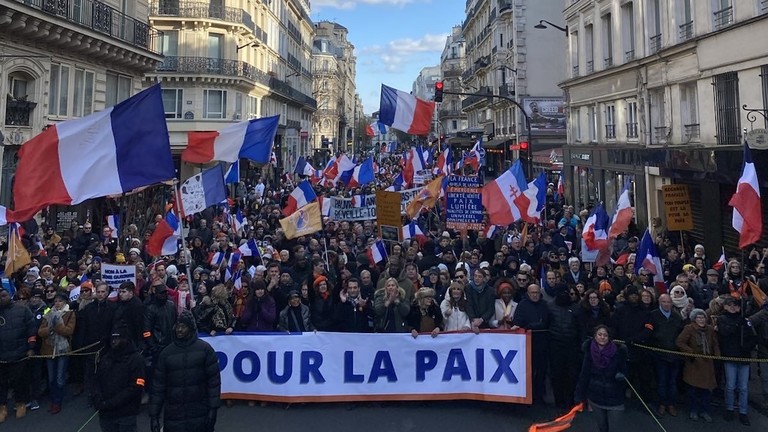
Multiple mass protests against France’s NATO membership and its continued support of Kiev were held on Sunday in the capital Paris and at other locations across the country.
The demonstrations, taking place for the second consecutive weekend, were organized by the right-wing Les Patriotes party, led by Florian Philippot, who personally attended the rally in Paris.
The politician claimed the event on Sunday, dubbed National March for Peace, attracted even more participants than last week, when some 10,000 showed up for a rally in the French capital. According to Philippot, smaller-scale anti-NATO protests were held at some 30 other locations across France as well.
Protesters marched through the streets of Paris, carrying a large banner reading “For Peace.” The marchers called for the withdrawal of France from both the US-led NATO and from the EU, and urged a halt to supplying Ukraine with weaponry. The protesters also took jabs at the incumbent French President Emmanuel Macron, chanting “Macron get out!” – a slogan commonly used by assorted anti-government protesters throughout his presidency.
Following the march, the protesters held a rally led by Philippot, who was filmed defacing NATO and EU flags alongside his supporters. Footage of the event was shared by the politician himself on social media.
The politician has been actively staging protests against French membership in NATO and the EU since last fall, while arguing against the supply of weapons to Ukraine. Between 2012 and 2017, Philippot was the deputy head of the biggest opposition party in France, the National Rally, led until last year by Marine Le Pen. After leaving the National Rally, the 41-year-old politician established his own right-wing party, Les Patriotes.
France has been among the top supporters of Kiev in the ongoing conflict with Russia, which broke out a year ago. While Macron has repeatedly called for a diplomatic settlement of the hostilities, Paris has actively supplied assorted weaponry to Ukraine, including armored vehicles and advanced self-propelled howitzers.
Putin reveals Moscow’s main issue with US
RT | February 26, 2023
Moscow is striving to create a multipolar world rather than one that is centered around the US, Russian President Vladimir Putin has said. In an interview with Rossiya-1 TV channel on Sunday, he argued that Washington was trying to mold the world exclusively to fit its own agenda.
Putin suggested that America’s “satellite states” are also well aware of these “egoistic” intentions. However, for the time being, they have chosen to turn a blind eye to this due to “various reasons connected first and foremost with huge dependence in the economic sphere and defense,” the Russian leader said.
Some of Washington’s allies also see confrontation with Russia as a unifying cause, eclipsing any differences between them and the US, he added.
As an example, Putin cited the US government’s efforts to attract European businesses to American soil, as well as a submarine deal last summer, which saw Canberra abruptly exit a contract with a French manufacturer in favor of a US competitor. That incident was humiliating for Paris, the president said.
Putin emphasized that Moscow “cannot and will not behave like this.”
“In the end, such a stance – the fight for a multipolar world, for respect for each and everyone in the international arena, for taking into account everyone’s interests – I don’t have the slightest doubt, will prevail.”
Putin also claimed that Western elites will only be satisfied and prepared to “admit us into the so-called family of civilized nations” if Russia disintegrates into several independent states. In such a scenario, he said, the West would “place [the resulting countries] under its control.” He added that the disintegration of Russia in such circumstances would call into question the existence of the Russian people in its current form.
Commenting on his decision earlier this week to suspend Russia’s participation in the New START Treaty – the last remaining nuclear accord between Moscow and Washington – Putin argued that the move was required to safeguard Russia’s security as well as its “strategic stability.”
According to the Russian president, he opted for this course of action in light of a more aggressive NATO, which “has announced as its prime goal” Russia’s strategic defeat.
Why Western Sanctions Against Russia Failed
By Simes Dimitri – Sputnik – February 24, 2023
Sanctions were meant to deliver a swift and devastating blow to the Russian economy, one that would take years to recover from. Much to the dismay of Western politicians, however, not only did Russia survive the sanctions storm, but it has the potential to emerge even stronger than before.
During a speech in Poland last year, US President Joe Biden boasted that sanctions had reduced the Russian ruble to “rubble” and confidently predicted that the Russian economy was on “track to be cut in half.” French Finance Minister Bruno Le Maire went even further, declaring that the West would bring about Russia’s economic “collapse.”
“We are waging total economic and financial war on Russia,” he told a French broadcaster last March. “The economic and financial balance of power is totally in favor of the European Union, which is in the process of discovering its own economic power.”
Despite these loud promises, the Russian economy contracted by a mere 2.5 % last year – a decline considerably smaller than those experienced during the 1998 financial crisis (5.3%) and the 2008 Great Recession (7.9%). In a report published last month, the International Monetary Fund forecast that Russian economic growth would outpace that of Germany and the United Kingdom in 2023.
Nor did sanctions succeed in turning Russia into a global pariah. A recent report by the University of St.Gallen in Switzerland found that only 8.5% of European and G7 companies had divested from Russia between February and November 2022. At the same time, Russia’s trade turnover with non-Western economic powers such as China, India, Turkey, and Indonesia soared.
Earlier this month, EU foreign policy chief Josep Borrell was forced to admit that the West’s sanctions strategy was not going according to plan. “It is true that the Russian economy has not collapsed and that the GDP is not what has been forecast, and it is true that last year it got extraordinarily high revenues that came from oil and gas,” he said during a speech at the European Parliament plenary session.
How was Russia able to overcome an unprecedented sanctions blitzkrieg? To answer that question, Sputnik News spoke with economists and Russian businesspeople in industries ranging from agriculture to information technologies. They told us that Western sanctions were headed for failure from the very beginning because they were built on a distorted view of the Russian economy.
Our interlocutors emphasized that although sanctions undoubtedly created economic challenges for Russia in the short and medium term, they also presented a powerful opportunity to revive domestic industry and scientific potential, as well as establish new partnerships with Asian, Middle Eastern, Latin American, and African economies.
Failed Strategy
In the weeks and months following the start of Russia’s special military operation in Ukraine, the US and the EU rolled out some of the most expansive sanctions packages in recent memory. Western governments pressured the SWIFT global payment system into expelling several of Russia’s largest banks, barred Russian ships and airplanes from entering their ports and airspace, and imposed export controls aimed at restricting Russia’s access to various advanced technologies and key production components.
Although this sanctions barrage initially caused the Russian ruble to dip in value and inflation to spike, the shock-effect proved to be short lived. Within weeks, the ruble recovered all of its pre-conflict value and then some. Likewise, inflation reached a peak rate of 17.8% in April 2022 and then began to steadily decline, hitting 11.8% in January 2023 (a rate less than many countries in central and eastern Europe). Contrary to the expectations of many Western economists, Russia’s unemployment rate not only did not increase, but actually hit a post-Soviet record low of 3.7% in December 2022.
Despite the new financial and logistical restrictions against Russian exporters, foreign trade contacts also remained strong. Russia’s current account surplus – which measures the difference between a country’s trade outflows and inflows – reached a record high of $227.4 billion last year, an 86% increase from 2021.
Why did such unprecedented sanctions deliver such unimpressive results? Jacques Sapir, an economist at the Paris-based School for Advanced Studies in the Social Sciences, told Sputnik that the main reason was because they were based on false premises about the size and resilience of the Russian economy. A large part of the problem, he explained, was that American and European policymakers were looking at the wrong statistics.
The main metric used in the West to measure the Russian economy is nominal gross domestic product (GDP), which is calculated by simply converting its value in rubles into US dollars. Sapir argued that nominal GDP underestimated the strength of the Russian economy because it failed to account for purchasing power parity (PPP), which adjusts for differences in costs across countries. He noted that whereas Russia’s nominal GDP was comparable to Spain’s, its GDP based on PPP was roughly the same level as Germany’s.
Another key factor was the fact that the Russian economy was far less based on services than its Western counterparts. Sapir explained that although services could serve as an important source of economic growth during peacetime, they inevitably took a backseat to the manufacturing and commodities sectors during times of geopolitical turmoil. He noted that Russia still maintained a sizable industrial base and was a leading global supplier of natural gas, oil, rare earth metals, and agricultural products.
“Russia has a very specific place in the world markets and, therefore, attempting to isolate such a country would inevitably lead to an international economic catastrophe,” he said. “Unsurprisingly, a lot of countries would never agree to join efforts aimed at isolating Russia because they need trade with Russia.”
Sapir also said that the West underestimated Russia’s ability to find alternative suppliers for various types of machinery and key components used in production. He noted that although Russian imports fell substantially during the second quarter of 2022, they rebounded during the third and fourth quarters. “Russia is now importing more or less the same quantity of products that it was importing by the end of 2021,” he said.
This relatively quick recovery was due to Russia reorienting its trade flows from Europe to Asia, especially China, Sapir explained. Another important factor was that Russian companies had become fairly adept at circumventing Western sanctions with the help of counterparts in third-party countries. As a result, many European and American goods were still finding their way into the Russian market.
Rebirth of Industry
Sanctions have the potential to become a blessing in disguise for Russia, according to Konstantin Babkin, president of the Rostelmash, one of Russia’s largest agricultural equipment manufacturers.
Decades of economic integration with the West had caused Russia to sacrifice some of the industrial potential it inherited from the Soviet Union, Babkin argued. Instead of manufacturing airplanes and trucks from start to finish as it once did, Russia began to import such complex machinery from the West.
The Western sanctions imposed last year have created an urgent need for Russia to rebuild its industrial base. During a speech before the Federal Assembly on Tuesday, President Vladimir Putin declared that Russia needed to reorient its economy from selling raw materials to the West to developing its own advanced technologies and equipment.
Babkin told Sputnik that Russia possessed all the necessary conditions to support an industrial revival — immense natural resource wealth, vast swathes of available land, a market of 150 million people, and strong scientific institutions capable of training the next generation of innovators.
The main thing needed to translate Russia’s economic potential into reality is strong government support for domestic manufacturers, he said. Some of the policy measures Babkin recommended include lower interest rates and taxes, as well as new tariffs.
“Many countries have already reached the physical or spatial limits of their development – there are no more markets left to conquer, no more fields left to sow, no more opportunities for expansion. That’s why much of the modern world is experiencing such a crisis” he said. “Russia is one of the few countries, perhaps even the only country, that has plenty of room to develop further. We can grow many times over if we rely on our resources, ourselves, and our civilization.”

Sources: Public data, vedomosti.ru, forbes.ru, cbr.ru
Some Russian companies are already moving to fill newly-created niches in the domestic market. Last November, the Russian manufacturing sector experienced its largest expansion in over five years, according to a business survey by the S&P Global financial analytics firm. A surge in domestic demand was the primary driving force behind the increased output and employment.
Babkin noted that after the West imposed sanctions against Russia in 2014 over the reunification of Crimea, the share of Russian-made agricultural equipment on the domestic market jumped from 25% to 65%. He argued that the current round of sanctions could provide a similar impetus to resurrect Russian aircraft and automobile production.
“Today, the priority task in civil aviation is to launch the serial production of fully Russian-made passenger aircraft, without any foreign components, as quickly as possible” the United Air Corporation, a Russian aerospace company that is part of the Rostec state corporation, told Sputnik. The company explained that the decision of Western airliner giants Boeing and Airbus to exit the Russian market last year was forcing domestic manufacturers to not only step up aircraft production, but also start making their own engines and other key components.
For its part, the United Air Corporation plans on manufacturing 500 aircraft by 2030 to help replace Russia’s existing fleet of foreign planes, which will be gradually retired. One of its most promising projects is the MC-21, a next-generation passenger aircraft that is already in production. The main advantage of the MC-21 is its cutting-edge composite wing, which provides the plane with superior aerodynamics.
Technological Sovereignty
One of the central objectives of Western sanctions is to suffocate Russian technological innovation. When Biden unveiled the first Ukraine-related sanctions package last year, he promised that the US and its allies would impair Russia’s “ability to compete in a high-tech 21st century economy.” The technological aspect of sanctions has only become more important since then. Although Western politicians now admit that sanctions have failed to collapse the Russian economy, they still express hope that technological restrictions will stunt Russia’s progress in the long run.
That is an assumption challenged by many Russian scientists and entrepreneurs. Evgeny Nikolaev is a project manager at Health Test, a Russian company that is working to develop a machine-learning program that will help doctors to diagnose Alzheimer’s Disease in patients during the earliest stages of its development. The technology, which has no foreign analogues, is currently undergoing clinical tests at a Moscow hospital, after which it will be distributed to other medical institutions in the Russian capital.
Nikolaev said that Western sanctions have not had any meaningful impact on the project’s development, noting that all the “necessary reagents and consumables could be replaced with domestic ones or obtained through parallel importation.” At the same time, he emphasized that Russian scientists did not need foreign sponsorships in order to make breakthroughs. He noted that government institutions such as the Moscow Department of Health and the Moscow Innovation Cluster were offering the project significant support in terms of product development and practical application.
A similar argument was advanced by Valentin Makarov, president of the Russian Software Developers Association (RUSSOFT). He told Sputnik that Russia had two advantages it could rely on to keep innovating despite Western sanctions. The first was Russia’s strong scientific education, which has a legacy of excellence dating back to the Czarist-period. Additionally, Makarov argued that Russia was well positioned to build new technological partnerships with non-Western economies such as China and India.
Ironically enough, sanctions had provided Russian software and cybersecurity systems with an opportunity to show their resilience in the face of unprecedented external pressure.
“Following the start of the special military operation, we saw a manifold increase in cyber attacks against Russian systems, a ban on the use of foreign software, and the termination of support licenses for this software,“ he said. “Despite everything that happened, Russian systems continued to work as before. It turned out that giant American corporations, which dominate the global information technologies, cannot destroy the operation of these Russian systems. This showed everybody that Russia has the capacity for technological sovereignty.”
According to Makarov, the world was on the brink of a new technological order – one centered on artificial intelligence and cyber-physical systems. Instead of remaining a junior partner in the Western-led technological ecosystem, Russia needed to seize the initiative and develop its own ambitious, revolutionary projects in coordination with its allies.
One promising idea, Makarov said, was for Russia to spearhead the creation of a new Eurasian digital financial payment system. Such an initiative would not only facilitate greater regional trade, but also shield its members from Western sanctions and other forms of economic pressure.
“We cannot become leaders in the new technological order by continuing to sell oil and gas to the world market and then using those profits to buy technological systems developed by other countries,” he said. “If we do not focus on developing our own systems, in cooperation with partners from friendly countries of course, then that means we will again be dependent on someone else. Russia has a huge number of specialists capable of creating new technologies that will change the world, so we must take advantage of that.”
Broadcaster sacks host after external influence probe
RT | February 23, 2023
French broadcaster BFMTV has fired an anchor following a probe into alleged external meddling into his work, AFP reported Thursday, citing an internal company email it had seen.
The host in question, Rachid M’Barki, was found not to have followed due editorial process in multiple news segments aired between 2021 and 2022, BFMTV Marc-Olivier Fogiel reportedly said in the correspondence. The faulty news segments included false information on assorted topics, ranging from Russian “oligarchs” to the situation in the Middle East and Western Sahara.
The anchor was suspended early in January, after the company became aware of the potential misconduct on his part. The affair became public this month, when the Forbidden Stories collective released an investigation into a secretive Israeli contractor group, dubbed ‘Team Jorge,’ which had specialized in assorted malign cyber activities to manipulate the outcomes of elections worldwide. To expose the group, the journalists fancied themselves as prospective clients seeking electoral meddling, while covertly recording hours of footage during meetings with the members of the clandestine contractor unit.
The group, run by Tal Hanan, a 50-year-old former Israeli secret services operative, operated a vast social media bots network it used to affect public opinion in different countries. The team also reportedly used legitimate news outlets to plant the information it needed for its activities, with M’Barki identified among presenters which had been fed the misinformation.
The presenter had previously acknowledged receiving information from shady anonymous sources, but denied a deliberate spread of fake news on his part. Speaking with Politico after the investigation came out, M’Barki acknowledged that he “used information… received from sources” and that “they did not necessarily follow the usual editorial process.”
“They were all real and verified. I do my job… I’m not ruling anything out, maybe I was tricked, I didn’t feel like I was or that I was participating in an operation of I don’t know what or I wouldn’t have done it,” the journalist stated.
Putin Announces Suspension of New START Treaty, Orders New Strategic Systems Be Put on Combat Duty
Sputnik – 21.02.2023
Russia will be suspending its participation in the New Strategic Arms Reduction (New START) Treaty, President Vladimir Putin has announced.
The Russian president made the announcement during the course of a major annual address to lawmakers on Tuesday that focused on the security crisis in Ukraine and the broader global tensions between the West and Russia.
“They [the West] seek to inflict a strategic defeat on us and to creep onto our nuclear sites. In connection with this, I am forced to announce today that Russia is suspending its participation in the New START Treaty. I repeat – not exiting from the treaty, but suspending its participation,” Putin said, speaking to gathered lawmakers in Moscow during his speech to the Federal Assembly.
Putin explained that “at the start of February, the North Atlantic Alliance made a statement factually demanding that Russia ‘return to the implementation of the strategic offensive arms treaty,’ including the admission of inspections to our nuclear and defense facilities.”
“I don’t even know what to call this – some kind of theater of the absurd. We know that the West is involved directly in attempts of the Kiev regime to strike the bases of our strategic aviation,” Putin said, pointing to recent Ukrainian drone attacks on Russia’s Engels Air Base, home to part of the airborne contingent of Russia’s nuclear triad.
The drones used in these attacks were “equipped and modernized with the assistance of NATO specialists,” Putin said. “And now they want to inspect our defense facilities. In the current conditions and today’s confrontation, this simply sounds like some kind of nonsense.”
“A week ago, I signed a decree putting new ground-based strategic weapons systems on combat duty. Are they going to stick their nose in there too?” Putin asked.
The Russian president suggested that NATO’s collective statement essentially amounted to an application to join the New START Treaty, and said Moscow would only welcome such a move.
“We agree, please go ahead. Furthermore, we think that such a formulation of the issue is long overdue. After all, NATO contains not just one nuclear power – the USA. Britain and France also have nuclear arsenals, which are being developed and improved, and which are also directed against us, against Russia,” Putin said.
Slamming the US and NATO over the “hypocrisy” of their demands, Putin recalled how the Western bloc has attempted to assure Moscow that “there is no connection between issues related to strategic offensive arms and, say, the conflict in Ukraine, or other hostile actions against our country,” while at the same time seeking to “defeat” Russia militarily.
“This is either the height of hypocrisy and cynicism, or the height of stupidity. You can’t call them idiots, they are not stupid people: they want to inflict a strategic defeat on us,” the president said.
What is New START and Why Is It Important?
The New START Treaty is the last major strategic arms limitation agreement between the nuclear superpowers – Russia and the United States. The agreement, drafted in 2009 and signed by then-Russian and US Presidents Dmitry Medvedev and Barack Obama in Prague, Czech Republic in 2010, limits the two countries’ deployed arsenals of strategic weapons and nuke stockpiles, and features a series of measures aimed at increased transparency and trust, including the broadcast of telemetry data, limits to missile testing activities, and the exchange of other information.
The Trump administration threatened to let the clock run out on New START in late 2020 after withdrawing from the Intermediate-Range Nuclear Forces Treaty – a late Cold War-era pact which eliminated Soviet and US ground-based nuclear missiles in the 500-5,500 km range, in 2019. The Biden administration agreed to renew New START for five years in early 2021. Pentagon planners have repeatedly criticized the strategic treaty for its failure to account for the nuclear arsenal of China. Beijing has said that it would be happy to sign a nuclear agreement with Washington if the US reduced the size of its nuclear arsenal to China’s level.
The post-Cold War strategic security order began to be dismantled in late 2001, when the George W. Bush administration announced that it would scrap the Anti-Ballistic Missile Treaty – a landmark 1972 agreement designed to limit anti-missile defenses and thus reduce the danger of a global nuclear war. Washington quit the treaty despite proposals by Moscow at the time to establish a joint missile defense system in the Caucasus to eliminate any threats posed to the US or Europe.
Featured Video
Chinese jet fuel and the myth of energy independence
or go to
Aletho News Archives – Video-Images
Book Review
Former Insiders Criticize Iran Policy as U.S. Hegemony
By GARETH PORTER | CounterPunch | February 27, 2013
“Going to Tehran” arguably represents the most important work on the subject of U.S.-Iran relations to be published thus far.
Flynt Leverett and Hillary Mann Leverett tackle not only U.S. policy toward Iran but the broader context of Middle East policy with a systematic analytical perspective informed by personal experience, as well as very extensive documentation.
More importantly, however, their exposé required a degree of courage that may be unparalleled in the writing of former U.S. national security officials about issues on which they worked. They have chosen not just to criticise U.S. policy toward Iran but to analyse that policy as a problem of U.S. hegemony. … continue
Blog Roll
 Aletho News
- What is fueling unrest across the EU?
- Why no power can undermine Iran’s eternal dominance over the Strait of Hormuz
- Is The War Against Iran Over?
- Iran war will leave long-term ‘scar’ on Wall Street, investors warn
- How Iran decimated US power projection in West Asia: Military lessons of 40-day war
- Iran’s report details US-Israeli war crimes in targeting schools, hospitals, livelihoods
- NATO’s Slow Fracture: How Trump’s Iran War Exposed the Instrument of Hegemony
- Chinese jet fuel and the myth of energy independence
- Ukraine Sea Drone Fired From Libya Hit Russian Tanker in Mediterranean
- IRGC: Iranian forces launched no attacks during ceasefire hours
- If Americans Knew
- Military aid to Israel emerges as the latest political litmus test for Democrats
- The only Palestinian children’s rights organization closes following years-long Israeli campaign against it
- ‘I Can’t Forget the Smell’: Lebanese Reel After Israel Kills Over 300 in Single Day
- DNC Shoots Down Resolutions Calling Out AIPAC and Limiting Arms to Israel
- TCN: Is Israel Blackmailing President Trump?
- Israel killed at least 303 Lebanese yesterday – who were they? Daily Update
- Amnesty: Urgent – Protect Lebanese civilians from brutal escalation in Israeli attacks
- Is The War Against Iran Over?
- Inside the Israeli army’s propaganda wing
- Hundreds of Gaza Amputees Stranded in Legal Limbo
- No Tricks Zone
- New Study: No Linear Warming Or Glacier Retreat Along Northern Antarctic Peninsula Since 1980s
- An Inconvenient Tree: Uncovered In Alps… Europe Much Warmer Than Today 6000 Years Ago
- New Study Reports A 60% Slowdown In Greenland’s Ice Loss Rate In The Last Decade
- Low Intensity Tornado Wrecks Major Solar Farm, Creating A Potential Toxic Dump
- New Study Finds Warming Saves Lives…Cold Temperatures 12 Times More Deadly Than Excess Heat
- German Science Blog Accuses PIK Climate Institute Of Hallucinating Climate Tipping Points
- Devastating Assessment Of Comirnaty Vaccine By Former Senior Pfizer Europe Toxicologist
- New Study: CO2 Is ‘Effectively Negligible’ As An Explanatory Climate Change Factor Since 2000
- Former Pfizer Toxicologist Dr. Helmut Sterz Tells Bundestag Hearing Pfizer Vaccine Should Have Never Been Approved
- Energy Expert: Germany’s Nuclear Phaseout Was A “500 Billion Euro Mistake”
 Aletho News