Collateral Damage: U.S. Sanctions Aimed at Russia Strike Western European Allies
By Diana Johnstone | CounterPunch | July 28, 2017
Do they know what they are doing? When the U.S. Congress adopts draconian sanctions aimed mainly at disempowering President Trump and ruling out any move to improve relations with Russia, do they realize that the measures amount to a declaration of economic war against their dear European “friends”?
Whether they know or not, they obviously don’t care. U.S. politicians view the rest of the world as America’s hinterland, to be exploited, abused and ignored with impunity.
The Bill H.R. 3364 “Countering America’s Adversaries Through Sanctions Act” was adopted on July 25 by all but three members of the House of Representatives. An earlier version was adopted by all but two Senators. Final passage at veto-overturning proportions is a certainty.
This congressional temper tantrum flails in all directions. The main casualties are likely to be America’s dear beloved European allies, notably Germany and France. Who also sometimes happen to be competitors, but such crass considerations don’t matter in the sacred halls of the U.S. Congress, totally devoted to upholding universal morality.
Economic “Soft Power” Hits Hard
Under U.S. sanctions, any EU nation doing business with Russia may find itself in deep trouble. In particular, the latest bill targets companies involved in financing Nord Stream 2, a pipeline designed to provide Germany with much needed natural gas from Russia.
By the way, just to help out, American companies will gladly sell their own fracked natural gas to their German friends, at much higher prices.
That is only one way in which the bill would subject European banks and enterprises to crippling restrictions, lawsuits and gigantic fines.
While the U.S. preaches “free competition”, it constantly takes measures to prevent free competition at the international level.
Following the July 2015 deal ensuring that Iran could not develop nuclear weapons, international sanctions were lifted, but the United States retained its own previous ones. Since then, any foreign bank or enterprise contemplating trade with Iran is apt to receive a letter from a New York group calling itself “United Against Nuclear Iran” which warns that “there remain serious legal, political, financial and reputational risks associated with doing business in Iran, particularly in sectors of the Iranian economy such as oil and gas”. The risks cited include billions of dollars of (U.S.) fines, surveillance by “a myriad of regulatory agencies”, personal danger, deficiency of insurance coverage, cyber insecurity, loss of more lucrative business, harm to corporate reputation and a drop in shareholder value.
The United States gets away with this gangster behavior because over the years it has developed a vast, obscure legalistic maze, able to impose its will on the “free world” economy thanks to the omnipresence of the dollar, unrivaled intelligence gathering and just plain intimidation.
European leaders reacted indignantly to the latest sanctions. The German foreign ministry said it was “unacceptable for the United States to use possible sanctions as an instrument to serve the interest of U.S. industry”. The French foreign ministry denounced the “extraterritoriality” of the U.S. legislation as unlawful, and announced that “To protect ourselves against the extraterritorial effects of US legislation, we will have to work on adjusting our French and European laws”.
In fact, bitter resentment of arrogant U.S. imposition of its own laws on others has been growing in France, and was the object of a serious parliamentary report delivered to the French National Assembly foreign affairs and finance committees last October 5, on the subject of “the extraterritoriality of American legislation”.
Extraterritoriality
The chairman of the commission of enquiry, long-time Paris representative Pierre Lellouche, summed up the situation as follows:
“The facts are very simple. We are confronted with an extremely dense wall of American legislation whose precise intention is to use the law to serve the purposes of the economic and political imperium with the idea of gaining economic and strategic advantages. As always in the United States, that imperium, that normative bulldozer operates in the name of the best intentions in the world since the United States considers itself a ‘benevolent power’, that is a country that can only do good.”
Always in the name of “the fight against corruption” or “the fight against terrorism”, the United States righteously pursues anything legally called a “U.S. person”, which under strange American law can refer to any entity doing business in the land of the free, whether by having an American subsidiary, or being listed on the New York stock exchange, or using a U.S.-based server, or even by simply trading in dollars, which is something that no large international enterprise can avoid.
In 2014, France’s leading bank, BNP-Paribas, agreed to pay a whopping fine of nearly nine billion dollars, basically for having used dollar transfers in deals with countries under U.S. sanctions. The transactions were perfectly legal under French law. But because they dealt in dollars, payments transited by way of the United States, where diligent computer experts could find the needle in the haystack. European banks are faced with the choice between prosecution, which entails all sorts of restrictions and punishments before a verdict is reached, or else, counseled by expensive U.S. corporate lawyers, and entering into the obscure “plea bargain” culture of the U.S. judicial system, unfamiliar to Europeans. Just like the poor wretch accused of robbing a convenience store, the lawyers urge the huge European enterprises to plead guilty in order to escape much worse consequences.
Alstom, a major multinational corporation whose railroad section produces France’s high speed trains, is a jewel of French industry. In 2014, under pressure from U.S. accusations of corruption (probably bribes to officials in a few developing countries), Alstom sold off its electricity branch to General Electric.
The underlying accusation is that such alleged “corruption” by foreign firms causes U.S. firms to lose markets. That is possible, but there is no practical reciprocity here. A whole range of U.S. intelligence agencies, able to spy on everyone’s private communications, are engaged in commercial espionage around the world. As an example, the Office of Foreign Assets Control, devoted to this task, operates with 200 employees on an annual budget of over $30 million. The comparable office in Paris employs five people.
This was the situation as of last October. The latest round of sanctions can only expose European banks and enterprises to even more severe consequences, especially concerning investments in the vital Nord Stream natural gas pipeline.
This bill is just the latest in a series of U.S. legislative measures tending to break down national legal sovereignty and create a globalized jurisdiction in which anyone can sue anyone else for anything, with ultimate investigative capacity and enforcement power held by the United States.
Wrecking the European Economy
Over a dozen European Banks (British, German, French, Dutch, Swiss) have run afoul of U.S. judicial moralizing, compared to only one U.S. bank: JP Morgan Chase.
The U.S. targets the European core countries, while its overwhelming influence in the northern rim – Poland, the Baltic States and Sweden – prevents the European Union from taking any measures (necessarily unanimous) contrary to U.S. interests.
By far the biggest catch in Uncle Sam’s financial fishing expedition is Deutsche Bank. As Pierre Lellouche warned during the final hearing of the extraterritorial hearings last October, U.S. pursuits against Deutsche Bank risk bringing down the whole European banking system. Although it had already paid hundreds of millions of dollars to the State of New York, Deutsche Bank was faced with a “fine of 14 billion dollars whereas it is worth only five and a half. … In other words, if this is carried out, we risk a domino effect, a major financial crisis in Europe.”
In short, U.S. sanctions amount to a sword of Damocles threatening the economies of the country’s main trading partners. This could be a Pyrrhic victory, or more simply, the blow that kills the goose that lays the golden eggs. But hurrah, America would be the winner in a field of ruins.
Former justice minister Elisabeth Guigou called the situation shocking, and noted that France had told the U.S. Embassy that the situation is “insupportable” and insisted that “we must be firm”.
Jacques Myard said that “American law is being used to gain markets and eliminate competitors. We should not be naïve and wake up to what is happening.”
This enquiry marked a step ahead in French awareness and resistance to a new form of “taxation without representation” exercised by the United States against its European satellites. The committee members all agreed that something must be done.
That was last October. In June, France held parliamentary elections. The commission chairman, Pierre Lellouche (Republican), the rapporteur Karine Berger (Socialist), Elisabeth Guigou (a leading Socialist) and Jacques Myard (Republican) all lost their seats to inexperienced newcomers recruited into President Emmanuel Macron’s République en marche party. The newcomers are having a hard time finding their way in parliamentary life and have no political memory, for instance of the Rapport on Extraterritoriality.
As for Macron, as minister of economics, in 2014 he went against earlier government rulings by approving the GE purchase of Alstom. He does not appear eager to do anything to anger the United States.
However, there are some things that are so blatantly unfair that they cannot go on forever.
Diana Johnstone is the author of Fools’ Crusade: Yugoslavia, NATO, and Western Delusions. Her new book is Queen of Chaos: the Misadventures of Hillary Clinton. She can be reached at diana.johnstone@wanadoo.fr
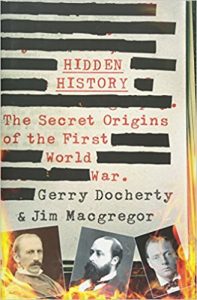
Hidden History: The Secret Origins of the First World War
Overview of Gerry Docherty & Jim Macgregor’s Book
By Antony C. Black | Global Research | July 19, 2017
Of the many myths that befog the modern political mind, none is so corrupting of the understanding or so incongruent with historical fact as the notion that the wealthy and the powerful do not conspire.
 They do.
They conspire continually, habitually, effectively, diabolically and on a scale that beggars the imagination. To deny this conspiracy fact is to deny both overwhelming empirical evidence and elementary reason.
Nevertheless, for the astute observer of the ‘Great Game’ of politics, it is an unending source of wonderment to stumble across ever more astounding examples of the monstrous machinations of which wealthy and powerful elites are capable. Indeed, it is precisely here that authors Docherty and Macgregor enter the fray and threaten to take our breath away entirely.
Thus, the official, canonized history of the origins of the First World War, so they tell us, is one long, unmitigated lie from start to finish. Even more to the conspiratorial point is the authors’ thesis that – and to paraphrase a later Churchill who figures prominently in this earlier story – never were so many murdered, so needlessly, for the ambitions and profit of so few.
In demolishing the many shibboleths surrounding the origins of the ‘Great War’ (including ‘German responsibility’, ‘British peace efforts‘, ‘Belgian neutrality’ and the ‘inevitability’ of the war), Docherty and Macgregor point the finger at what they argue is the real source of the conflict: a more or less secret cabal of British imperialists whose entire political existence for a decade and a half was dedicated to the fashioning of a European war in aid of destroying the British Empire’s newly emerging commercial, industrial and military competitor, Germany.
In short, far from “sleepwalking into a global tragedy, the unsuspecting world”, Docherty and Macgregor contend, “was ambushed by a secret cabal of warmongers” originating not in Berlin, but “in London”.
I must confess at this juncture to a certain bias in granting credence to such a striking thesis, this if only on general principle alone. After all, one straight look at present day political reality is to look square into the maw of Orwell’s nightmare. Moreover, three decades of independent journalism have led me to conclude not only that virtually nothing of what is presented as ‘news’ is remotely true, but that the conventional writing and presentation of history itself is as phoney as a three dollar bill. Still, one does demand a credible argument or two. Let’s look at a few of those contained in ‘Hidden History’.
The Players

Cecil Rhodes (Source: Wikipedia)
Before launching pell-mell into the argumentative labyrinth it is apropos that we first sketch the central cast of characters of this grim story.
In the beginning there was Cecil Rhodes, the prime minister of Cape Colony but who, the authors remind us, was “in reality a land-grabbing opportunist” whose fortune had been underwritten in equal parts “by brutal native suppression and the global mining interests of the House of Rothschild”. Rhodes had, apparently, long talked of setting up a secret ‘Jesuit-like society’ in aid of furthering the global ambitions of the British Empire. In February of 1891 he did just that enlisting the services of his close associates, William Stead, a prominent journalist, and Lord Esher, a close advisor to the British Monarchy.
Two others were soon drawn into the inner circle of the clandestine group: Lord Nathaniel (Natty) Rothschild of the famous British and European banking dynasty, and Alfred Milner, a brilliant academic and colonial administrator who would quickly become the organizing genius and iron-willed master of ceremonies of the group.
These central four would later be joined by: Lord Northcliffe, the owner of ‘The Times’, who would complement Stead in propagandizing and softening up the British public for war with Germany; Arthur Balfour and Herbert Asquith, two future British Prime Ministers who would provide the needed parliamentary influence; Lords Salisbury and Rosebery who brought an additional wealth of political connections to the table; and Lord Edward Grey, he to whom, in the final analysis as British Foreign Secretary in 1914, it would fall to hammer the final nail in the coffin of European peace.
Of particular importance was the addition of Prince Edward (soon to be King Edward VII) who, despite his playboy image, was, in fact, an astute political operative whose frequent international social forays provided the perfect cover for helping to forge the, often secret, military and political alliances between Russia, France, Britain, and Belgium.
This core Praetorian Guard then extended its tentacles to all reaches of the British (and eventually, international) power hierarchy by vigorously recruiting its ‘Association of Helpers’, the myriad of lower down bureaucrats, bankers, military officers, academics, journalists, and senior civil servants, many, as it turns out, hailing from Balliol and All Souls Colleges, Oxford.
And, too, the legendary Churchill, liberally inflated with his own bombast and well lubricated with Rothschild money, would rise to take his anointed place amongst the war-hungry secret elect.
Early Adventures
The first foray of this elite cabal played out in South Africa with the deliberate fomentation of the (2nd) Boer War (1899 – 1902). Gold had been discovered in the Transvaal region in 1886 and British imperialists were determined to grab it. After a number of failed machinations by Rhodes himself to topple the Boers, the secret elite was dealt an ace when Alfred Milner was appointed high commissioner for South Africa. Seizing the moment, Milner, without passing Go, proceeded straight to war and, in his infamous scorched earth policies and adamant demands for unconditional surrender, demonstrated the general martial philosophy that would later be deployed against Germany.
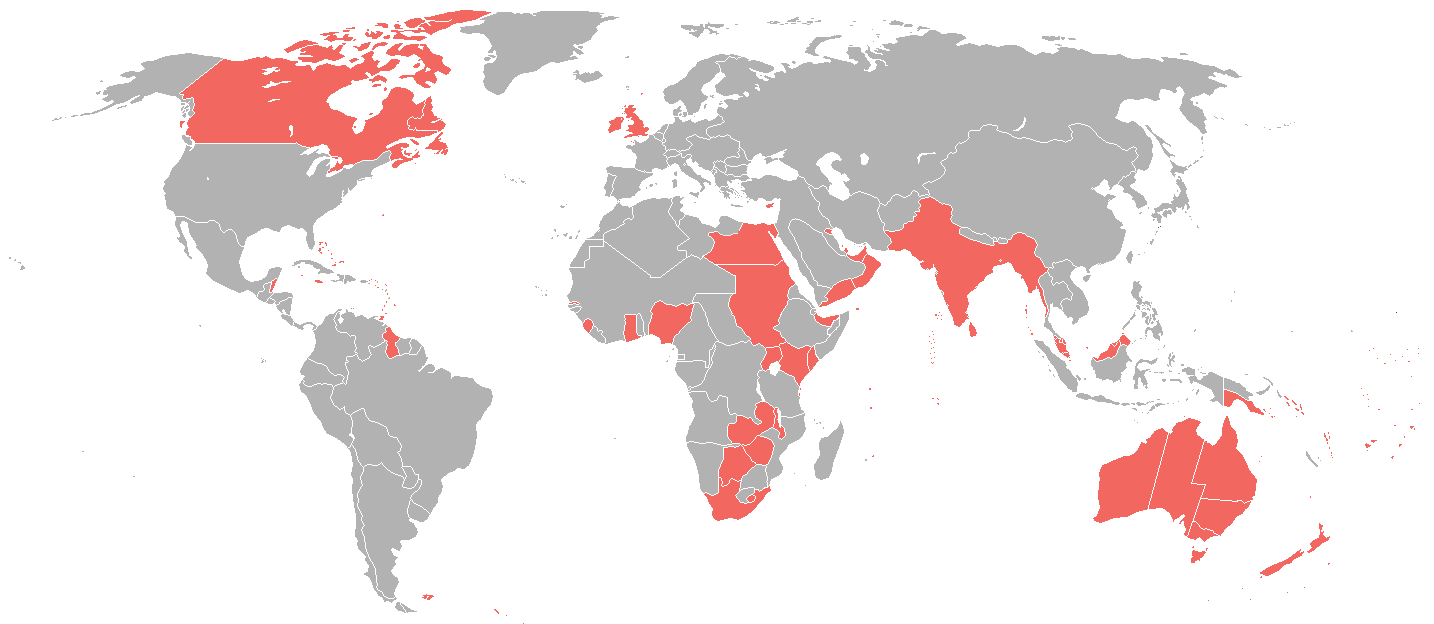
A map of the British Empire as it was in 1898, prior to the Second Boer War (1899-1902). (Source: Wikimedia Commons)
Following the defeat of the Boers, Milner & Co. (Rhodes had died during the ‘peace negotiations’) quickly penetrated the main organs of British imperial governance including the Foreign, Colonial, and War Offices. Arthur Balfour went one better by establishing, in 1902, the Committee for Imperial Defence (CID). The latter proved especially significant in helping to almost completely bypass the British Cabinet in the years, months and days leading up to August, 1914. Indeed, Balfour would prove to be one of only two permanent members of this all-important imperial institution; the other being Lord Fredrick Roberts, commander-in-chief of the armed forces and close friend of Milner. It was Roberts who would later appoint two tragically incompetent hangers-on, Sir John French and Douglas Haig, to their First World War posts overseeing the mass slaughter of hundreds of thousands of Allied soldiers.
The year 1902 also saw the establishment of the Anglo-Japanese Treaty. Britain had long feared for its Far East empire at the hands of Russia and sought to bolster Japan as a counterweight. The alliance bore fruit in the 1904-1905 Russo-Japanese conflict in which Russia was dealt a decisive defeat. Always with the long-term goal in mind, however, i.e. war with Germany, Milner et al adroitly switched bait and immediately began wooing Czar Nicholas II resulting in the Anglo-Russian Convention of 1907. In the same period (1904) Britain – with the crucial assistance of Edward VII – broke its near thousand-year enmity towards France and signed the Entente Cordial with its former rival.
During this same time frame (1905) a more or less secret agreement was made with King Leopold II allowing Belgium to annex the Congo Free State. This was, for all intents and purposes, an alliance between Britain and Belgium; one which was, over the next decade, to be continually deepened with numerous (mostly secret, meaning withheld from the British Parliament) bilateral military agreements and ‘memorandums of understanding’, and which unequivocally put paid to any notion of Belgium being some sort of ‘neutral’ party in the upcoming conflict with Germany.
The core alliance was now complete, i.e. Britain, Russia, France and Belgium, and all that was needed was to secure the fealty and obeisance of the British colonies. In aid of the latter Milner convoked The Imperial Press Conference of 1909 which brought together some 60 newspaper owners, journalists and writers from across the Empire who hobnobbed with another 600 or so British journalists, politicians and military figures in a grand orgy of war-mongering propaganda. The martial message was then duly delivered to the unwitting colonial multitudes. The success of the Conference could be seen most visibly in Canada where, despite the extreme divisiveness of the issue, the nation would eventually send more than 640,000 of its soldiers to the killing fields of Europe, this all on behalf of a tiny handful of British imperialists.
The Moroccan ‘Crisis’
Docherty and Macgregor duly remind us that renowned historian Barbara Tuchman, in her Pulitzer-Prize winning book, ‘The Guns of August’, “made it very clear that Britain was committed to war by 1911 at the latest.” Indeed, preparations for war had proceeded apace since at least 1906.
Still, 1911 marked a turning point when the secret elite first made bold in attempting to ignite war with Germany. The pretext was Morocco. Now, truth to tell, Britain had no direct colonial interests in Morocco, but France and Germany did. By this time the cabal in London – with Edward Grey as Foreign Minister – had inducted a key French minister, Theophile Declasse, into their confidences and were able to engineer what was essentially a false flag operation in Fez. France then followed this up with an army of occupation. Germany posted a minimalist response by sending a small gunboat to Agadir whence the entire British press – reflecting Britain’s ‘deep state’ interests – went into high hysteria condemning German ‘threats to British sea-lanes’ etc. The fuse to war was only snuffed out in the final hour when France’s (recently elected) socialist Premier, Joseph Caillaux, initiated peace talks with the Kaiser. War with Germany would have to wait.
In the meantime, Britain, under the direction of its secret mandarins – i.e. almost entirely beyond Parliamentary review or approval – continued their preparations for war. To this end, for example, Churchill, who by 1911 had been appointed First Lord of the Admiralty, redeployed the British Atlantic fleet from Gibraltar to the North Sea and the Mediterranean fleet to Gibraltar. Simultaneously, the French fleet was moved from the Atlantic to cover Britain’s absence in the Mediterranean. These maneuvers were all strategically aimed at Germany’ North Sea navy. The pieces on the global chessboard were being positioned.

Source: Wikimedia Commons
In France the leftist peacenik Caillaux was, in 1913, replaced as Premier with one of the British elites very own ‘helpers’ in the person of Raymond Poincare, a right-wing, rabid Germanophobe. Poincare quickly acted to remove his anti-war ambassador to Russia, George Louis, and substitute him with the revanchist Declasse. Meanwhile in America the secret cabal, acting largely through the Pilgrims Society and through the Houses of Morgan and Rockefeller, machinated to have an unknown but pliable democrat, Woodrow Wilson, elected over the publicly-controlled central bank advocate, President Taft. It was from this lofty perch that the Anglo-American ‘deep state’ launched the US Federal Reserve System, a private central bank dedicated from the get-go to funding the war against Germany.
The Balkan Sting
The simple tale repeated ad nauseam regarding the circumstances surrounding the assassination of Archduke Franz Ferdinand on June 28, 1914, so Docherty and Macgregor tell us, contains as little veracity as, say, the official version of the assassination of JFK two generations later. Indeed, the structural similarities between the two – from the virtual total stand-down of security through to the clear evidence of state complicity (in this case, starting in Serbia, but leading straight to London) – are remarkable. Suffice to say that there was a domino-like chain of events that then ensued – it’s just that the events weren’t driven by base human instincts and ineluctable forces beyond all human control as is commonly proffered, but rather by calculating minds and conspiratorial design.
Thus, immediately following the assassination, there was widespread international support for Austria-Hungary which was widely perceived as the aggrieved party. Nevertheless, the usual suspects, having helped stage the murder in the first place, were able to deftly turn the propaganda tables against both Austria and Germany by means of an ingenious ruse. Having secretly obtained the contents of the ‘Note’, which contained Austria’s (reasonable under the circumstances) demands for Serbian contrition, the secret cabal were able to gain direct input into the crafting of the ‘Serbian Reply’. The ‘reply’, of course, was designed to be unacceptable to Austria. Simultaneously, France’s President, Poincare, decamped to Moscow to assure the Czar and his generals that, should Germany act to uphold its alliance responsibilities towards Austria, France would back Russia in launching a full scale European war. France, naturally, knew that England – or rather its elite imperial clique – was similarly committed to war. It was during this opportune moment, in fact, when Grey and Churchill connived to purchase the Anglo-Persian Oil Company so securing the necessary oil supplies for the British navy.
All the while Kaiser Wilhelm and Chancellor Bethmann were conspicuous in being the only statesmen genuinely seeking peace. Their subsequent vilification by hordes of appropriately housebroken historians thus rings with the same Orwellian tone as the present-day establishment demonization of nations and individuals resisting the American Imperium.
Grey Hits It Home
Having contrived to fan the flames of a local Balkan fire into a general European inferno, British Foreign Minister Grey and Prime Minister Asquith subsequently deployed every dirty trick in the diplomatic playbook to vitiate any possibility of peace and, instead, to guarantee war.
On July 9th, for instance, the German ambassador to London, Prince Lichnowsky, was repeatedly reassured by Grey that Britain had entered no secret negotiations that would play into war. This, of course, was an outright lie. On July 10, Grey then deceived Parliament into believing that Britain had not the slightest concern that events in Sarajevo might lead to a continental war. Meanwhile, the Austrian Prime Minister, Berchtold, was similarly deceived by all three Entente governments that their reaction to the ‘Note’ would not go beyond a diplomatic protest. However, by the 3rd week of July all of these self-same governments did an about-face and declared a complete rejection of Austria’s response.
On July 20, as already noted, the French Prime Minister, Poincare, went to St. Petersburg to reaffirm their two nations’ respective martial agreements. On July 25, Lichnowsky arrived unannounced at the British Foreign office with a desperate plea from the German government imploring Grey to use his influence to halt Russian mobilization. Incredibly, no one was available to receive him. Russia had, in any case, secretly begun mobilization of its armed forces on July 23, while, on July 26, Churchill quietly mobilized the British fleet at Spithead.
None of the foregoing, of course, was subject to democratic oversight. As Docherty and Macgregor put it,
“As far as the [British] public was concerned, nothing untoward was happening. It was just another summer weekend.”
On July 28th, Austria, despite not being in a position to invade for another fortnight, declared war on Serbia. Meanwhile, the British Foreign Office began to circulate rumours that German preparations for war were more advanced than those of France and Russia even though the exact opposite was, in fact, the case. Matters were quickly racing beyond Wilhelm’s control.
On the 29th, Lichnowsky again begged Grey to prevent a Russian mobilization on Germany’s borders. Grey’s response was to write four dispatches to Berlin which post-war analysis proved were, in truth, never sent. The dispatches turned out to be merely part-and-parcel of the elaborate charade to make it look as if Britain (and, specifically, he, Grey) was doing all it could in the effort to avert war. Also on the evening of the 29th did Grey, Asquith, Churchill, and Richard Haldane meet to discuss what Asquith called the ‘coming war’. Docherty & Macgregor once again here emphasize that these four men were virtually the only people in Britain privy to the impending calamity, i.e. not the other Cabinet members, not the members of Parliament, and certainly not the British citizenry. But then, they were its architects.
On the 30th, the Kaiser wired Czar Nicholas a heartfelt appeal to negotiate the prevention of hostilities. Indeed, Nicholas was so moved by Wilhelm’s plea that he decided to send his personal emissary, General Tatishchev, to Berlin to broker a peace. Unfortunately, Tatishchev never made it to Berlin, having been arrested and detained that very night by the Russian Foreign Minister, Sazonov, who, as ‘Hidden History’ cogently evinces, had long been an asset of the secret cabal in London. Under sustained pressure from senior members of his military Nicholas finally relented and on the afternoon of the 30th ordered general mobilization.
The official announcement of Russian mobilization effectively closed all doors to peace. The Germans, realizing that they had been set up, and also realizing that they were about to be attacked on two fronts – from the west by France, and from the east by Russia – finally, on Aug. 1, ordered their own mobilization; tellingly, the last of the continental powers to do so. Here, however, Germany made a crucial tactical error: it elected to follow up its mobilization with a formal, honour-bound declaration of war on France. By doing so it fell deeper into the trap laid by Grey & Co. who had, all along, machinated to do everything possible to guarantee war without, however, being seen to have officially caused the war.
Still, Grey had one last card to play in order to convince both a war-leery Cabinet and House of Commons to abandon their common sense and plunge headlong into a full-scale pan-European war. For just as the myth of ‘weapons of mass destruction’ would, in a later era, serve to advance American imperial aggression, so here did the myth of poor, benighted little ‘neutral Belgium’ carry the banner for British imperialism.
The Speech That Sealed The Fate of Millions
On the 2nd of August, 1914 Prime Minister Asquith convened a special Cabinet meeting to discuss the (manufactured) crisis. Though the Cabinet was in no mood to countenance British involvement in a continental war, they soon found themselves pressured and hedged about by revelations of a ‘web of [military and political] obligations, which they had been assured were not obligations, [and] had been spun around them as they slept’. Moreover, Grey crucially kept from them the fact that the German ambassador, Lichnowsky, had, only the day before (Aug. 1), specifically offered to guarantee Belgian neutrality. Indeed, Grey’s deception might never have come to light but for the fact that Chancellor Bethmann exposed the offer in the Reichstag on Aug. 4th.
With the Cabinet sufficiently brow-beaten, confounded – and deceived, i.e. Asquith, without Cabinet approval or knowledge, had already issued orders for the mobilization of the Army and Navy – it now only remained to hoodwink Parliament. And so, on Aug. 3rd, Sir Edward Grey took to the pulpit and began what was to be an epic panegyric to the follies of peace and the virtues of war. Here too the audience was not particularly receptive, but the sermon soon gathered force.
Having first set the tone by announcing that peace in Europe ‘cannot be preserved’, Grey then moved on to a stunning series of lies and misrepresentations concerning the intricate and long-formulated military agreements between England, France, Russia and Belgium. According to Grey, they didn’t exist. But what of the dense skein of diplomatic agreements? There were no such agreements, there were no such entanglements. Parliament was ‘free’ to vote its conscience, to exercise its democratic mandate. Just as long, of course, as it didn’t vote for peace.
All of the foregoing was, in any case, mere preamble to the centerpiece ploy of Grey’s speech: Belgian neutrality. That the latter was an out-and-out sham was only surpassed in duplicity by Grey’s concealment, not only from Cabinet but now from Parliament, of Germany’s offer to guarantee exactly the point under contention, i.e. Belgian neutrality. Instead, Grey produced, for dramatic affect, an emotional telegram from the King of Belgium to King George pleading for assistance. The timing couldn’t have been more perfect if it had it been deliberately designed for the occasion. Which, of course, it was. Also pre-planned were the post-sermon affirmations in favour of war by the various opposition party leaders. They had all been vetted and brought onside by Churchill prior to the day’s session. Only Ramsay MacDonald, head of the Labour Party, swam against the well-orchestrated tide of ‘inevitability’ that was the constant and unerring motif of Grey’s martial peroration.
The day’s session ended without debate; Asquith had not allowed any to occur, though he had been pressured by the Speaker of the House to reconvene later that evening. In between Grey sealed the deal, i.e. war, by firing off an ultimatum to Germany demanding that it not invade Belgium even though he, Grey, knew that such an invasion had already begun. As Docherty and MacGregor phrase it, this was a “masterstroke”. War could not now be avoided. And though the night session witnessed a vigorous and substantive debate which largely demolished Grey’s stance, it was all for nought. At the appointed moment Arthur Balfour, “former Conservative Prime Minister and a member of the Secret Elite’s inner circle, rose menacingly. He had had enough.” Using the full weight of his magisterial authority he condemned, ridiculed and dismissed the naysayers’ anti-war arguments as, the ‘very dregs and lees of the debate’. With the Commons thus emotionally bullied into silence, so ended the last chance for peace in Europe.
Plus Ca Change
What strikes one again and again whilst reading ‘Hidden History’ is the ring of truth that resonates from every page, from every revelation. That such a tiny, elite group of individuals, completely beyond democratic control, could determine the fate – and deaths – of millions should shock us. It should, but it doesn’t really. It doesn’t because we see the same phenomenon occurring now, repeatedly, before our very eyes. Indeed, the current state of ‘permanent war’ is, more or less, the unconscious condition of modernity itself.
Docherty & Macgregor have made a fine contribution here. They have gone beyond what David Irving so aptly labelled as the ‘court historians’, i.e. those historians essentially prostituted to elite / establishment consensus, and given us a glimpse of what it really means to write history. And if there is any lesson – or rather counter lesson – we can take from it, it is that we are doomed to repeat history only so long as we listen to those dedicated to obscuring and inverting it. In short, to those who lie to us.
Title: Hidden History: The Secret Origins of the First World War
Authors: Gerry Docherty and Jim MacGregor
Publisher: Mainstream Publishing; Reprint edition (September 1, 2014)
ISBN-10: 1780576307
ISBN-13: 978-1780576305
Featured image from Amazon
Terror in Europe – Why Terrorists Are Allowed to Strike
By Ulson Gunnar – New Eastern Outlook – 09.07.2017
The London Bridge terror attack saw a repeat of a now familiar narrative in which every suspect involved had been long-known to both British security and intelligence agencies.
The London Telegraph in an article titled, “Khuram Butt, Rachid Redouane and Youssef Zaghba named: Everything we know about the London Bridge terrorists,” would reveal:
The ringleader of the London Bridge massacre never bothered to hide his violent, extremist views. Khuram Butt was so brazen that he openly posed with the black flag of the so-called Islamic State in Regent’s Park in the centre of London for a Channel 4 documentary, entitled The Jihadis Next Door.
Butt and other extremists linked to the banned terror group al-Muhajiroun were even detained by police for an hour over the stunt in 2015 but were released without being arrested.
The al-Muhajiroun terror group is headed by British-based extremist, Anjem Choudary, who for years helped fill the ranks of militant groups fighting governments the US and UK sought to overthrow in Libya, Syria and beyond. Choudary inexplicably escaped the consequences of his open advocacy and material support for known terrorist organizations for years, with the London Guardian in an article titled, “Anjem Choudary: a hate preacher who spread terror in UK and Europe,” going as far as speculating he did so because he was actually an informant or operative working for the British government.
The article would also admit that Butt was under investigation by British intelligence up to the day of the attack:
MI5 and counter-terrorism officers began an investigation into Butt, which remained ongoing even as the 27-year-old launched his terror attack on London Bridge. Butt, who was wearing an Arsenal shirt and a fake bomb strapped to his chest, was shot dead by police on Saturday night.
A second suspect, Rachid Redouane, was repeatedly brought to the attention of police who ignored warnings he was an extremist and a member of the so-called “Islamic State.”
The Telegraph reports that a third suspect, Youssef Zaghba, was also known to police:
He was reportedly arrested at Bologna airport in March 2016 trying to get to Syria and was also understood to be on an Italian anti-terror watch list.
The fact that these three suspects evaded capture and were able to carry out their attack despite being known and even monitored actively by British security and intelligence agencies lends even further credibility to the notion that they and others like them work for the British government, not against it.
Unable to Reach Syria, West’s Dogs of War Bite Local Population
Networks like al-Muhajiroun and the extremists they cultivate help fill the ranks of “moderate rebel” groups the US, UK, other European nations including France, as well as regional allies like Turkey, Jordan, Saudi Arabia, United Arab Emirates and Qatar are arming, funding and providing direct military support for in Libya, Syria, Yemen and beyond.
This fact goes far in explaining why extremists are allowed – for years – to openly advocate violence and recruit members into what is essentially a terrorist organization operating under the nose of British security and intelligence agencies – if not with their collective and eager complicity.
While these terrorists are labeled “moderate rebels” when fighting abroad, they are only labeled as such by the Western media out of necessity in an attempt to differentiate them from the extremists that are in fact fighting the West’s proxy war for it in places like Syria.
Suspects like Youssef Zaghba even attempted to travel to Syria to fight among the ranks of Western-backed militant groups – and failing to do so – participated in armed violence in the UK instead. Had he traveled onward to Syria, it would have been innocent Syrians instead of innocent British civilians terrorized, attacked, maimed and killed.
A Strategy of Terror and Tension
And despite the reality of the US and UK along with other European and Persian Gulf allies openly fueling terrorism at home and abroad, in the wake of tragic events like in London, Manchester, Paris, or Brussels, the very government organizations clearly responsible for presiding over these terrorists and their networks, sometimes for months and even years before an attack, are granted even more power to address a problem of their own intentional creation.
These organizations are able to do so in plain sight of the public specifically because of another conflict they openly orchestrate, pitting the general public against one another along lines of “anti-Islamic” fervor versus social justice advocates.
What both sides of this manufactured and intentionally perpetuated divide fail to realize is that Muslims are dying by the tens of thousands in places like Syria actively fighting against extremism springing not from Islam or the Qu’ran, but from the Pentagon, Westminster, Paris, Brussels, Riyadh, Ankara and Doha. It is not a clash of civilizations, but a manufactured conflict designed to perpetually fill the ranks of mercenaries abroad while exploiting their violence at home to procure more power and wealth through fear, anger and hysteria.
With wars in Afghanistan, Iraq, Syria, Yemen and beyond adding up to trillions for defense contractors and including weapon systems designed to fight them, with the F-35 joint strike fighter alone topping one trillion US dollars and as the West continues to openly act with impunity when and where it pleases despite violating the very international law it claims it is upholding globally, it is clear that, for now, this strategy is working.
If and when the general public understands the truth of why their lives are put in danger and their nation’s resources are being squandered abroad instead of at home for building their own futures, this strategy will be less successful. Until then, it appears that simplistic propaganda still works in convincing the public that governments like in London are simply incapable of arresting terrorists who appear regularly on TV, in the media and who openly operate in public with apparent and otherwise inexplicable impunity.
The nuclear bomb is a weapon of crime and mass destruction
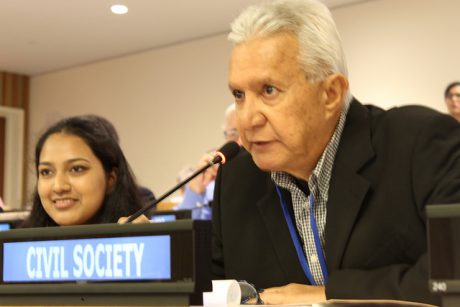
Roland Oldham, head of the nuclear test veterans organization Mururoa e tatou, addresses UN conference to negotiate the Treaty on the Prohibition of Nuclear Weapons on 21 June.
By Roland Oldham – International Physicians for the Prevention of Nuclear War – July 3, 2017
Moruroa e Tatou, Tahiti – The nuclear bomb is a weapon of crime and mass destruction.
We should all be well aware of the examples of Hiroshima and Nagasaki, where the consequences still today have effects across generations.
Like those in other places, nuclear tests in the Pacific by France, America and Britain were a crime towards indigenous people, and the defenceless people of the Pacific. It is a racist crime—nuclear racism. This destroyed and contaminated their environment, the natural resources that they depend on to live. The damages are irreversible.
Look at Moruroa for example—137 nuclear blasts underneath the coral atoll have severely fractured the atoll which is sinking down into the rising ocean, leaking radioactive gases and plutonium into the sea, risking disastrous damage for marine life. French authorities have assessed that there is a danger of a landslide of 670 million cubic meters of rock at Moruroa, creating a 15-20 meter tsunami.
The responsible governments used the Pacific as a dumping ground for nuclear waste—in the Marshall Islands, Moruroa, Fangataufa, Christmas Island, and elsewhere. Plutonium is in the lagoon of Moruroa and leaking from the 147 underground test explosion holes in Moruroa and Fangataufa. Not to mention the widespread radioactive fallout from atmospheric nuclear explosions.
There are thousands, millions of victims out there around the world—former test and weapons production site workers, military staff, civilians; women and children. They are invisible. They are voiceless. They have cancers: leukemia, thyroid, others…. Women in French Polynesia now have the highest rates of thyroid cancer and myeloid leukemia in the world. Their children through many generations will be affected by genetic mutations and damage.
It is a poisonous heritage that is left to humanity and future generations.
It is a crime against humanity.
I don’t see much of the word “crime” in the ban treaty: crime against our planet, crime against our environment, crime against humanity. The aim of the treaty is to stop all these crimes.
Why is there no word about these crimes.
Is there pressure from somewhere? Is there censorship?
Have we lost our morality?
But as victims we are not begging for favour, we are just standing up for our rights and our dignity.
There exists an obligation for the nuclear-armed states to compensate their victims, and to make reparation for the damage done to the environment.
There must be no more mushroom clouds producing untold numbers of new victims.
Roland Oldham, the head of the nuclear test veterans organization Mururoa e tatou, addressed the UN conference to negotiate the Treaty on the Prohibition of Nuclear Weapons on 21 June. The above piece is based upon his remarks, which he delivered in French on behalf of IPPNW and ICAN Australia.
Macron’s Mission: Save the European Union From Itself

Photo by OFFICIAL LEWEB PHOTOS | CC BY 2.0
By Diana Johnstone | CounterPunch | June 28, 2017
The French capitalist elite that sponsored Macron’s meteoric rise is acutely aware that the European Union is in serious trouble. They chose Emmanuel Macron to save it. His success or failure depends on whether he can persuade the rest of the EU, notably Germany, to let it be saved.
In Trouble Politically
The EU is in serious trouble politically, because the elites love it, and ordinary people do not. A poll published June 20 by the Chatham House Royal Institute of international affairs found a “simmering discontent” with the EU among ordinary Europeans. Over 70% of people classified as decision-makers and opinion influencers – leading politicians, journalists, CEOs and leaders of major civil society organizations such as university presidents – welcomed European integration as beneficial, whereas only 34% of ordinary citizens agreed. On immigration, 57% of the elite consider immigration good for their country compared to 34% of the rest of the population. In short, the “decision-makers and opinion influencers” agree with the decisions they have been making and the opinions they have been advocating, while most other people are not convinced.
This is scarcely surprising since for over half a century the elites “who know what is best for the people” have been forcing European integration down their throats, with massive propaganda to justify major binding decisions taken without consulting the people (or, when the people are consulted, the result is ignored). Member States’ democratic procedures were essentially nullified over half a century ago by the unelected European Court of Justice when it ruled that European laws prevailed over national laws. The vast majority of Europeans were not even aware of how their democracy was being overruled and made obsolete. “Europe” meant escape from the bad past and the promise of a beautiful future of peace and prosperity. The elites saw to it that the real existing “Europe” is based on two principles: “free movement” of everything and absolute respect for “competition”. Presented as the apex of European values, these principles are neither moral nor democratic. They simply give all power to international financial capital.
In Trouble Economically
The elites have long been able to live comfortably with popular discontent. But economic troubles threaten to wreck the whole setup. Throwing together countries with deeply rooted differences in social philosophy and practice, binding them together with a common currency and rules that prohibit adaptation, does not work. As the spearhead of globalization, Europe’s dogmatic enforcement of both competition and “free movement” of goods and capital is enabling foreign capital – Chinese, Qatari, U.S., etc. – to buy up much of its productive resources piece by piece. Instead of growth, the euro has brought stagnation. The reign of unlimited “competition” promotes beggar-thy-neighbor practices rather than solidarity. Germany has lowered its labor costs, and continues to maintain large export surpluses with its neighbors, whose own budgets are broken by the trade imbalance. Concentration of wealth and lowered income decreases consumption and causes businesses to fail and tax revenues to shrink. The European Union finds itself on the edge of a perilous downward spiral.
France’s position in the troubled European Union was the overriding issue in recent French presidential elections. The issue was obscured by trivialities, such as media-inflated “scandals” over politicians hiring their wives and children, or non-issues such as “the fascist threat”. Yet the issue was there. Among leading candidates, both Jean-Luc Mélenchon and Marine Le Pen flirted with the notion of leaving the euro, or even the EU itself, but neither had a clear handle on the issue. In her decisive final debate with Macron, Marine Le Pen proved incapable of clarifying her own position on the euro. In the absence of any clear alternative to EU membership, voters were more frightened than seduced by the notion of getting out. Seeing no clear choice, voters massively abstained.
As a result, the European Union won the French election, in the person of Emmanuel Macron.
Macron’s mission is to bring the alienated couple, the EU and the French people, together – by persuading both to do what they don’t want to do.
Macron’s Protection Strategy
Macron’s June 21 interview with the French daily Figaro and seven other major European newspapers clarified his salvage strategy. The key word is “protection”. The idea is that people can develop loyalty toward institutions that protect them, and people do not feel protected by the EU.
This interview included significant foreign policy statements, notably a change in France’s policy toward Syria. Macron announced that “imported neoconservatism” is no longer welcome in France.
In all our EU societies, “the middle classes have begun to doubt”, Macron observed. “They have the impression that Europe is being built in spite of themselves. This Europe is dragging itself down.” Thus Europe must be made to provide both physical and economic security in order to reassure the citizens and regain their support. The physical protection involves controlling migration and cooperating in eradicating terrorism. The political impact of recent terrorist attacks ensured that any new French government would have to take moves to secure borders and control immigration, but Macron chooses to try to accomplish this at the European level. So far, disagreements between Member States have prevented effective measures from being taken.
Economic Protection
As a slight dissonant note in the usual rhapsody praising unspecified “Western values”, Macron made a subtle distinction between European and American “values”, implying a special European identity. “Americas love freedom as much as we do. But they do not have our taste for justice. Europe is the only place in the world where individual freedoms, the democratic spirit and social justice have been wedded to such a point.”
This implies that there must be limits to demolishing French social benefits in order to satisfy German demands for lower labor costs and a balanced budget. Meeting those demands is seen as the necessary condition for gaining German confidence in order to shift from austerity to prosperity programs. But it requires a quid pro quo. “The strength of some cannot feed for long on the weakness of the others.” In other words, German political leaders need to accept the fact that an EU which benefits Germany at the expense of other member States cannot last forever.
Specifically, Macron denounced the rules on “detached workers” which enable employers to evade the social costs of labor in countries like France by hiring foreign workers from countries like Romania under the rules of their own country. “Detached labor leads to ridiculous situations. Do you think I can explain to the French middle classes that businesses shut down in France in order to go to Poland because it’s cheaper there, and that the construction industry hires Poles because they are paid less? This system is not fair.” (Such observations were denounced as “racist” when made by Marine Le Pen or Jean-Luc Mélenchon, but are in fact totally consensual.)
Macron’s Foreign Policy
Macron’s statements on foreign policy could be seen as hints of a possible joint European foreign policy, partially independent of the United States, at a time when Washington appears to be paralyzed by deep state efforts to overthrow the President.
For the last six years, Paris has been at the forefront of the get-rid-of-Assad propaganda. Former foreign minister Laurent Fabius notoriously declared that Bachar al Assad “has no right to be alive on earth”. In a clear break, Macron said that trying to settle the Syrian problem militarily was “a collective mistake” and stressed his aggiornamento: “I do not proclaim that the destitution of Bachar al Assad is the precondition for everything. For nobody has shown me his legitimate successor!”
His first priority is fighting terrorist groups, with the cooperation of everybody, “particularly Russia”. His second is “Syria’s stability, as I don’t want to see another failed State. With me, there will be an end to the sort of neoconservatism imported into France for the last ten years. Democracy cannot be imposed on people from outside. France did not take part in the Iraq war and was right not to. France was wrong to wage that sort of war in Libya.” The result was failed states where terrorist groups prosper.
Somewhat ambiguously, Macron professed to be “aligned with the United States” on setting a “red line” against use of chemical weapons in Syria. “If it turns out that chemical weapons are used and we know how to trace where they came from, then France will proceed to carry out air strikes to destroy the identified stocks of chemical weapons.” Yet this statement is not precisely aligned with U.S. practice, which has always automatically blamed Assad for chemical weapons attacks, without ever bothering to “trace where they came from” or to limit retaliation to the arms stocks themselves.
Understanding Putin
As for Russia, Macron was also ambiguous, stressing unspecified “disagreements” with Vladimir Putin over Ukraine, while distancing himself from current anti-Putin hysteria in Washington by observing that Putin’s objective is to ensure the survival of his country, not to weaken the West.
Any one of the other leading candidates for the French presidency would almost certainly have gone farther toward rapprochement with Russia. While neoconservative influence has permeated French media and the Socialist Party, it does not control the French establishment as in the United States. Macron’s statements are a long overdue recognition of reality in harmony with informed opinion in France, notably in the diplomatic, military and business communities, which see the U.S.-induced Russian bashing as unjustified, contrary to French interests, and dangerous. These shifts in foreign policy were probably an inevitable reaction against the past ten years of Sarkozy-Hollande’s absurd role as puppy dog running ahead of its American master, yapping at Washinton’s chosen enemy.
Such concessions to reality could contribute to working out a common foreign policy with Germany, which has tended to keep its distance from certain U.S.-led military adventures. However, they are accompanied by urgent appeals to Germany to increase its military spending, at a time when the United States is making similar demands, in order to strengthen NATO against the Russian “threat”. Macron in contrast seems to have in mind the prospect of strengthening Europe by providing it with a strong military defense of its own, presumably not totally under U.S. command. The current struggle for power in Washington favors moves toward European independence. This can sound good if indeed it allows Europe to bow out of various U.S.-incited wars in the Middle East and elsewhere. But military buildups are costly and dangerous in themselves, and not the appropriate way to promote peace in Europe and beyond. The arms race that United States threats have incited in Russia and China shows signs of spreading. There are forces in Germany all too willing to seize any pretext to revive German military strength.
Resistance To Macron
Macron’s efforts to save the EU marriage will encounter stiff resistance from both sides – and not least from the European side.
The resistance in France will be minimal in a parliament entirely under his control. The largest “opposition” party, the Republicans, are moving toward supporting him. The Socialist Party is decomposing rapidly, and the rest of the opposition is tiny and divided. Opposition in the streets sounds revolutionary, but it is not favored by the current relationship of forces, notably the weakness of the unions and the strategic disadvantages of a diminished industrial working class.
The resistance to Macron’s projects in Europe stems from the mere fact that the EU includes too many nations with conflicting interests and cultures. On the issue of control of migration, for example, German Chancellor Angelo Merkel has opened wide the gates to refugees, whereas Hungary is intent on keeping them out. Germans, or at least some of them, consider mass migration good for a country with a low birthrate. Hungarians, in contrast, want above all to preserve their cultural identity. The Baltic States, many of whose current leaders were nurtured in Cold War America, as well as Poland, with its bitter historic rivalry with Russia, support U.S. demands for a defensive/aggressive military posture against Russia. This has virtually no support in France, Italy or Spain. As for economic interests, they are widely contradictory, with important differences between North and South, East and West, that cannot easily be unified. And finally, except for the mobile, multilingual elite, people in Europe do not feel European: they feel French, or Italian, or whatever. Macron’s mission is clear, but it might turn out to be mission impossible.
Diana Johnstone is the author of Fools’ Crusade: Yugoslavia, NATO, and Western Delusions. Her new book is Queen of Chaos: the Misadventures of Hillary Clinton. She can be reached at diana.johnstone@wanadoo.fr
US police arrest anti-nuclear weapons activists at UN
Press TV – June 20, 2017
A number of anti-nuclear weapons activists have been arrested in New York during a protest against Washington’s decision to boycott negotiations on a nuclear weapons ban treaty.
The arrests were made after the activists chanting slogans such as “US join the talks, ban the bomb,” blocked the entrances to the US mission to the United Nations.
The protesters sat in front of the doors before the police moved in. police said they warned the demonstrators that they would be arrested if they did not leave the place.
In March, US Ambassador to the United Nations Nikki Haley announced that the United States, Britain and France had decided not to join talks on a nuclear weapons ban treaty.
The United Nations is currently holding a second round of negotiations about the issue.
The world body adopted a resolution in December to negotiate a legally binding instrument to prohibit nuclear weapons, leading toward their total elimination and encouraged all member states to participate.
A total of 113 nations voted in favor of the resolution but 35 countries, including the United States, Britain and France, voted against it. Thirteen countries abstained.
According to the US military’s recent declaration, the United States has 806 deployed ICBMs (intercontinental ballistic missile), SLBMs (submarine-launched ballistic missile), and heavy bombers as well as 1,722 deployed nuclear warheads.
The Pentagon is also equipped with a multiple independently targetable reentry vehicle (MIRV), a highly advanced version of the intercontinental nuclear missile carrying several independent warheads.
‘WikiLeaks’ Vault 7 cache shows US – not Russia – hacked past French elections’
RT | June 2, 2017
Any establishment-anointed political candidate wants to say they are under attack by the Russians because it gives them credibility, former MI5 intelligence officer Annie Machon told RT. Political analyst Adam Garrie joins the discussion.
Guillaume Poupard, the head of the National Cybersecurity Agency of France (ANSSI), said on Thursday there’s no trace of a Russian hacking group being behind the attack on Emmanuel Macron’s presidential election campaign.
According to him, the hack was “so generic and simple that it could have been practically anyone.”
RT: Where does this statement by France’s cybersecurity chief leave the claims of Macron’s team on Russian hacking?
Annie Machon: It leaves rather a lot of egg on their faces. It appears that this attack was of such of low technical level it could have been done by a script kiddie from their mom’s basement. So rather than this hysteria about: ‘The Russians must have done it, the Russians must have done it,’ which reminds me to a certain extent of the Monty Python script that ‘you must always expect a Spanish Inquisition.’ It is beyond parody. We have a situation now where he was trying to make political hay. It seems to me that any establishment-anointed political candidate now wants to immediately say they are under attack by the Russians because it gives them credibility. It is just crazy.
Now, the one thing we do know from this is that the one country that actually has hacked the French election was the USA, and that was back in the presidential election of 2012 where they were not only intercepting the electronic communications, they were actually running human agents in the political parties. We know this because of disclosures through the Vault 7 cache that WikiLeaks put out a month or two ago. For everyone to go around blaming the Russians, when in fact the Americans have been doing this for years, is rather rich?
RT: Why were members of Macron’s team so sure about Russia’s involvement? Do they know something France’s cybersecurity chief doesn’t?
AM: Obviously not. I think they were just jumping on the bandwagon because it was the sort of cool thing to do. After the fake buildup of the ‘Russians hacked the American elections,’ which started by the way with a leak from the DNC [Democratic National Committee] that was given to WikiLeaks, and somehow it moved into ‘Russians hacked the American election.’
Suddenly it has become established fact in the mainstream media in the West that the Russians are going to hack every Western democratic election. That is patently not the case in France, and it is also patently not the case in Germany, where there has also been a similar panic about Russia trying to hack the forthcoming chancellor’s elections in the autumn this year. In fact, the BND [Federal Intelligence Service] and BfV [Federal Office for the Protection of the Constitution,] the two major intelligence agencies in Germany, put out a report in February saying there was absolutely no evidence whatsoever the Russians were trying to do this. Merkel didn’t like that result. She told her intelligence agencies to go away and to find more evidence and to find a case to say that they were indeed trying to interfere in the German elections. It is collective hysteria.
‘Low-level hack’
Adam Garrie, political analyst
RT: Why were members of the Macron team so sure about Russia’s involvement in hacking the campaign? Do they know something France’s cybersecurity chief doesn’t?
AG: I strongly doubt that. They barely seem to know how to beat Marine Le Pen. But with a little help from their friends in the mainstream media, France and elsewhere they managed to just about accomplish that. It is simply the restating of a tired, old narrative; they have very little else to say. Macron as a man, if you can even really call him that in terms of his personality, is more of a viceroy, more of a governor general than he is a president. Putin, at the press conference he had at Versailles with Macron, questioned whether France is able to even independently conduct its foreign policy in Syria, independent of NATO and the US-led coalition. So these people that really don’t have much to offer their own country, let alone their political masters, are just churning out the narrative again and again. You’ve seen it with Hillary Clinton in America, and her supporters, and you see something similar in France. And likewise, the allegations are based – Donald Trump, probably accurately, said it could have been a 400-pound man in his bedroom somewhere. As the French authorities said today, it was probably the work of a lone hacker, and the hack itself wasn’t at the level of sophistication that would have even required state operators to be behind it.
RT: Do you think all these Russian hacking allegations during the presidential race had much impact on the final choice of the new president?
AG: I agree with President Putin on this. All of these hacks and allegations of hacks have very little impact on the actual electoral results. People are going to look first and foremost in all countries at domestic issues. Unless you’re in the war-zone that’s what the priorities are going to be for voters. They are going to look at tax; they are going to look at healthcare. They are going to look at living standards, wages, employment, etc. – these sorts of things. This idea that somehow magically Russia is pulling the political strings of various candidates in different Western countries is simply absurd. And I personally give the average voter – whether in France or America – more credit than the mainstream media is willing to give him.
Macron accuses RT and Sputnik of ‘behaving like deceitful propaganda’
RT | May 29, 2017
Newly-elected French President Emmanuel Macron explained his team’s decision to deny RT and Sputnik, both Moscow-based news outlets, accreditation during his campaign, by labeling the media outlets as “propaganda.”
“They didn’t act like the media, like journalists. They behaved like deceitful propaganda,” Macron told RT France head Xenia Fedorova during a joint press conference with Russian President Vladimir Putin in Versailles.
“I have always had an exemplary relationship with foreign journalists, but they have to be real journalists,” explained Macron, who defeated Marine Le Pen in the second round of the election, earlier this month. “All foreign journalists, including Russian journalists, had access to my campaign.”
Macron described RT and Sputnik as “organs of influence and propaganda,” adding that both “produced infamous counter-truths about him.”
Vladimir Putin’s spokesman Dmitry Peskov said that Moscow “does not agree” with Macron’s statements about the two news organizations.
RT Editor-in-Chief Margarita Simonyan said that Macron’s attack on a news outlet he disagrees with is a threat to freedom of speech.
“Despite the numerous accusations made throughout the duration of the French presidential campaign, to this day not a single example, not a single piece of evidence, has been presented to support the claims that RT spread any slander or ‘fake news’ about Mr. Macron,” Simonyan said in a statement. “By labeling any news reporting he disagrees with ‘fake news,’ President Macron sets a dangerous precedent that threatens both freedom of speech and journalism at large.”
Last month’s accreditation delay for RT and Sputnik, which ended up becoming an outright refusal, provoked a heated reaction from Moscow.
Russian Foreign Ministry spokesperson Maria Zakharova called it “deliberate and bare-faced discrimination against Russian media by the presidential candidate of a state that has historically been vigilant when it comes to free speech.”
Simonyan accused Macron’s team back then of “building electoral campaign on lies about RT and Sputnik.”
Macron’s campaign repeatedly accused Russia of interference in the election, claiming that Russian hackers attempted to gain access to its data, and impede the work of its website. A trove of communication purportedly from Macron’s staff was leaked on the internet a day before the run-off election. Moscow has staunchly denied any interference.
Despite an anticipated coolness in relations, the Russian president is one of the first world leaders to travel to Paris since Macron’s convincing election win.
On Monday, the pair spent three hours in what the French leader called a “frank exchange of views,” which Putin said would lead to a “qualitative” improvement in relations between the two countries.
All Power to the Banks! The Winners-Take-All Regime of Emmanuel Macron

Photo by Blandine Le Cain | CC BY 2.0
By Diana Johnstone | CounterPunch | May 22, 2017
A ghost of the past was the real winner of the French presidential election. Emmanuel Macron won only because a majority felt they had to vote against the ghost of “fascism” allegedly embodied by his opponent, Marine Le Pen. Whether out of panic or out of the need to feel respectable, the French voted two to one in favor of a man whose program most of them either ignored or disliked. Now they are stuck with him for five years.
If people had voted on the issues, the majority would never have elected a man representing the trans-Atlantic elite totally committed to “globalization”, using whatever is left of the power of national governments to weaken them still further, turning over decision-making to “the markets” – that is, to international capital, managed by the major banks and financial institutions, notably those located in the United States, such as Goldman-Sachs.
The significance of this election is so widely misrepresented that clarification requires a fairly thorough explanation, not only of the Macron project, but also of what the (impossible) election of Marine Le Pen would have meant.
From a Two Party to a Single Party System
Despite the multiparty nature of French elections, for the past generation France has been essentially ruled by a two-party system, with government power alternating between the Socialist Party, roughly the equivalent of the U.S. Democratic Party, and a party inherited from the Gaullist tradition which has gone through various name changes before recently settling on calling itself Les Républicains (LR), in obvious imitation of the United States. For decades, there has been nothing “socialist” about the Socialist Party and nothing Gaullist about The Republicans. In reality, both have adopted neoliberal economic policies, or more precisely, they have followed European Union directives requiring member states to adopt neoliberal economic policies. Especially since the adoption of the common currency, the euro, a little over fifteen years ago, those economic policies have become tangibly harmful to France, hastening its deindustrialization, the ruin of its farmers and the growing indebtedness of the State to private banks.
This has had inevitable political repercussions. The simplest reaction has been widespread reaction against both parties for continuing to pursue the same unpopular policies. The most thoughtful reaction has been to start realizing that it is the European Union itself that imposes this unpopular economic conformism.
To quell growing criticism of the European Union, the well-oiled Macron machine, labeled “En Marche!” has exploited the popular reaction against both governing parties. It has broken and absorbed large parts of both, in an obvious move to turn En Marche! into a single catch-all party loyal to Macron.
The destruction of the Socialist Party was easy. Since the “Socialist” government was so unpopular that it could not hope to win, it was easy to lure prominent members of that party to jump the sinking ship and rally to Macron, who had been economics minister in that unpopular government, but who was advertised by all the media as “new” and “anti-system”.
Weakening the Republicans was trickier. Thanks to the deep unpopularity of the outgoing Socialist government, the Republican candidate, François Fillon, looked like a shoo-in. But despite his pro-business economic policies, Fillon still cared about preserving France, and favored an independent foreign policy including good relations with Russia. It is unknown who dug into old records to come up with information about the allegedly fake jobs Fillon gave to his wife and children in past years, and how they were passed on to the weekly Canard Enchainé to be revealed at a critical moment in the campaign. The uproar drowned out the issues. To an electorate already wary of “establishment politicians”, these revelations were fatal. The impression that “politicians are all corrupt” played into the hands of Emmanuel Macron, too young to have done anything worse than make a few quick millions during his passage through the Rothschild Bank, and there’s nothing illegal about that.
In France, the presidential election is followed by parliamentary elections, which normally give a majority to the party of the newly elected president. But Macron had no party, so he is creating one for the occasion, made up of defectors from the major defeated parties as well as his own innovation, candidates from “civil society”, with no political experience, but loyal to him personally. These “civil society” newcomers tend to be successful individuals, winners in the game of globalized competition, who will have no trouble voting for anti-labor measures. Macron is thus confirming Marine Le Pen’s longstanding assertion that the two main parties were really one big single party, whose rhetorical differences masked their political convergence.
The Macron victory demoralized Republicans. Weakening them further, Macron named a Republican, Edouard Philippe, as his Prime Minister, in a government with four Socialist and two Republican, alongside his own selections from “civil society”.
Transforming France
Macron won in part because older voters in particular were frightened by his opponents’ hints at leaving the European Union, which they have been indoctrinated to consider necessary to prevent renewal of Europe’s old wars. But only the hysterical anti-fascist scare can explain why self-styled leftist “revolutionaries” such as François Ruffin, known for his successful anti-capitalist movie “Merci Patron”, could join the stampede to vote for Macron – promising to “oppose him later”. But how?
Later, after five years of Macron, opposition may be harder than ever. In recent decades, as manufacturing moves to low wage countries, including EU members such as Poland and Rumania, France has lost 40% of its industry. Loss of industry means loss of jobs and fewer workers. When industry is no longer essential, workers have lost their key power: striking to shut down industry. Currently the desperate workers in a failing auto-works factory in central France are threatening to blow it up unless the government takes measures to save their jobs. But violence is powerless when it has no price tag.
Emmanuel Macron has said that he wants to spend only a short time in political life, before getting back to business. He has a mission, and he is in a hurry. If he gains an absolute majority in the June parliamentary elections, he has a free hand to govern for five years. He means to use this period not to “reform” the country, as his predecessors put it, but to “transform” France into a different sort of country. If he has his way, in five years France will no longer be a sovereign nation, but a reliable region in a federalized European Union, following a rigorous economic policy made in Germany by bankers and a bellicose foreign policy made in Washington by neocons.
As usual, the newly elected French president’s first move was to rush to Berlin to assert loyalty to the increasingly lopsided “Franco-German partnership”. He was most warmly welcomed by Chancellor Angela Merkel, thanks to his clear determination to force through the austerity measures demanded by the Frankfurt budget masters. Macron hopes that his fiscal obedience will be rewarded by German consent to a European investment fund for stimulating economic growth, but this implies a degree of federalism that the pfennig-pinching Germans show little sign of accepting.
First of all, he has promised to complete the dismantling of the French labor code, which offers various protections to workers. This should save money for employers and the government. For Macron, the ruin of French industry and French farming seem to be welcome steps toward an economy of individual initiative, symbolized by startups.
The Macron program amounts to a profound ideological transformation of the French ideal of égalité, equality, from a horizontal concept, meaning equal benefits for all, to the vertical ideal of “equality of opportunity”, meaning the theoretical chance of every individual to rise above the others. This is an ideal easily accepted in the United States with its longstanding myth of the self-made man. The French have traditionally been logical enough to understand that everyone can’t rise above the others.
Horizontal equality in France has primarily meant institutional redistribution of wealth via universal access to benefits such as health care, pensions, communications and transportation facilities, allocations for families raising children, unemployment insurance, free education at all levels. These are the benefits that are under threat from the European Union in various ways. One way is the imposition of “competition” rules that impose privatization and favor foreign takeovers that transform public services into profit-seekers. Another is the imposition of public budget restrictions, along with the obligation of the State to seek private loans, increasing its debt, and the loss of tax revenue that all end up up making the State too poor to continue providing such services.
Very few French people would want to give up such horizontal equality for the privilege of hoping to become a billionaire.
Macron is sufficiently Americanized, or, to be more precise, globalized, to have declared that “there is no such thing as French culture”. From this viewpoint, France is just a place open to diverse cultures, as well as to immigrants and of course foreign capital. He has clearly signaled his rejection of French independence in the foreign policy field. Unlike his leading rivals, who all called for improved relations with Russia, Macron echoes the Russophobic line of the neocons. He broke tradition on his inauguration by riding down the Champs-Elysées in a military vehicle. A change of tone is indicated by his cabinet nominations. The title of the new foreign minister, Jean-Yves Le Drian, who served as defense minister in the Hollande government, is “Minister of Europe and of Foreign Affairs”, clearly giving Europe preference in the matter. Sylvie Goulard, an ardent Europeist who has remarked that “she does not feel French”, has been named Minister of Armies and Minister of Defense. Clearly national defense is an afterthought, when the main idea is to deploy the armed forces in various joint Western interventions.
The Divided Opposition
Unless the June parliamentary elections produce stunning surprises, the opposition to Macron’s catch-all governance party appears weak and fatally divided. The Socialist Party is almost wiped out. The Republicans are profoundly destabilized. Genuine opposition to the Macron regime can only be based on defense of French interests against EU economic dictates, starting with the euro, which prevents the country from pursuing an independent economic and foreign policy. In short, the genuine opposition must be “souverainiste”, concerned with preserving French sovereignty.
Two strong personalities emerged from the presidential election as potential leaders of that opposition: Jean-Luc Mélenchon and Marine Le Pen. But they are drastically divided.
Mélenchon ran a spectacularly popular campaign, leaving the Socialist Party far behind (the party he personally left behind years ago). Initially, as he seemed to be taking votes away from Le Pen as well as from the Socialists, he got friendly media coverage, but as he came closer to making it to the decisive second round, the tone started to change. Just as Le Pen was finally knocked out as a “fascist”, there is little doubt that had Mélenchon been Macron’s challenger, he would have been increasingly denounced as “communist”.
Mélenchon is intelligent enough to have realized that the social policies he advocates cannot be achieved unless France recovers control of its currency. He therefore took a stand against both NATO and the euro. So did Marine Le Pen. Mélenchon was embarrassed by the resemblance between their two programs, and contrary to other eliminated candidates, refrained from endorsing Macron, instead calling on his movement, La France Insoumise, to choose between Macron and abstention. Finally, 25% of Mélenchon voters abstained in the second round, but 62% voted for Macron – almost exclusively motivated by the alleged need to “stop fascism”. That compares with the final total results of 66% for Macron and 34 % for Le Pen.
That vote confirmed the impossibility of forming a unified souverainiste opposition and allows Marine Le Pen to strengthen her claim to be the leader of a genuine opposition to Macron. She has admitted her own mistakes in the campaign, particularly in her debate with Macron, who beat her hands down with his arrogant performance as the economic expert. But despite her mere 34%, she retains the most loyal base of supporters in a changing scene. The problem for Mélenchon is that his electorate is more versatile.
Despite his loud appeal to “youth”, Macron was elected by France’s huge population of old people. Among voters over 65, he won 80% against 20% for Le Pen. Marine Le Pen did best with the youngest age group, 18 to 24, winning 44% against Macron’s 56%[1].
The differences were also significant between socio-professional categories. Macron won a whopping 83% of the votes coming from the “superior socio-professional categories” – categories where the “winners” in competitive society are largely ensconced. But in what are described as “categories populaires”, a French term for ordinary folk, with less education, the vote was 53% in favor of Le Pen. And she confirmed her position as favorite candidate of the working class, winning 63% of workers’ votes.
Note that the “superior socio-professional categories” are where the significance of these results will be defined. Individuals from that category – journalists, commentators and show business personalities – are all in a position to spread the word that this vote indicates that the workers must be “racist”, and therefore that we have narrowly escaped being taken over by “fascism”.
One of the many odd things about the latest French presidential election is the rejoicing among foreign “leftists” over the fact that the candidate of the rich roundly defeated the candidate of the poor. It used to be the other way around, but that was long ago. These days, the winners in the competitive game comfort themselves that they morally deserve their success, because they are in favor of diversity and against racism, whereas the less fortunate, the rural people and the working class, don’t deserve much of anything, because they must be “racist” to be wary of globalization.
The fact that Paris voted 90% for Macron is natural, considering that real estate prices have pushed the working class out of the capital, whose population is now overwhelmingly what is called “bobo” – the bohemian bourgeoisie, many of whom are employed in various branches of the dominant human rights ideology fabrication business: journalists, professors, teachers, consultants, the entertainment industry. In these milieux, hardly anyone would even dare speak a positive word about Marine Le Pen.
What if Marine Le Pen had won?
Since politics is largely fantasy, we may as well try to imagine the unimaginable: what if Marine Le Pen had won the election? This was never a realistic possibility, but it is worth imagining.
It could have had one, perhaps only one, extremely positive result: it could have freed France from its paralyzing obsession with the nonexistent “fascist threat”. The ghost would be exorcised. If the word has any meaning, “fascism” implies single party rule, whereas Marine Le Pen made clear her desire to govern by coalition, and selected the leader of a small Gaullist party, Nicolas Dupont-Aignan, as her prospective prime minister. Poof! No fascism. That would have been an immeasurable benefit for political debate in France. At last genuine issues might matter. Real threats could be confronted.
Another advantage would have been the demise of the National Front. Since Marine Le Pen took over the notorious party founded by her reactionary father, it has kept a precarious balance between two opposing wings. There is the right wing in the southeast, along the Riviera, the bastion of the party’s founder, Jean-Marie Le Pen, a region represented in the outgoing parliament by his conservative granddaughter Marion Maréchal Le Pen. In the old industrial northeast region, between Arras and Lille, Marine Le Pen has built her own bastion, as champion of ordinary working people, where she won a majority of votes in the presidential election.
This is not the only time in history when an heiress has gone away with the heritage to join someone of whom her father disapproves. All those who want to cling to their comforting hatred of the left’s official Satan have trouble believing that Marine Le Pen broke with her reactionary father to go her own way (just as U.S. hawks couldn’t believe in Gorbachev). This change owes everything to her encounter with Florian Philippot, an intellectual who gave up on the ability of the Socialists to face the real issues. Marine has the personal qualities of a leader, and Philippot provided the intellectual substance she needed. Marine has decisively chosen Philippot as her advisor and co-leader, despite grumblings by Jean-Marie that she has been led astray by a gay Marxist. Had Marine won, her left wing would have been strengthened enough to enable her and Philippot to scrap the National Front and found a new “Patriot Party”. However, by scoring below 40%, she has weakened her authority and must try to hold the troublesome party together in order to win seats in the new parliament – which will not be easy.
Marine Le Pen would have tried to enact measures to save French industry and the jobs it provides, provide various benefits for low-income people, withdraw from NATO, and even promote a peaceful world, starting with friendly relations with Russia. She would even have begun to prepare her compatriots for escape from the euro.
But not to worry, none of this “fascist” program would ever have come to pass. If she had won, bands of protesting “antifascists” would have invaded the streets, smashing windows and attacking police. The outgoing Socialist government was preparing to use the resulting chaos as a pretext to stay in power long enough to manage the parliamentary elections[2], ensuring that President Marine Le Pen would be held in check. A “color revolution” was ready to be stirred up. The deep state is vigilant in NATOland.
Diana Johnstone is co-author of “From MAD to Madness: Inside Pentagon Nuclear War Planning”, by Paul H. Johnstone, her father. She can be reached at diana.johnstone@wanadoo.fr
Notes
[1] According to poll of 7,752 representative voters by Le Figaro/LCI,
[2] “Si Le Pen avait été élue… le plan secret pour ‘protéger la République’”, Le Nouvel Observateur, May 17, 2017
Diana Johnstone is the author of Fools’ Crusade: Yugoslavia, NATO, and Western Delusions. Her new book is Queen of Chaos: the Misadventures of Hillary Clinton. She can be reached at diana.johnstone@wanadoo.fr
Featured Video
Trita Parsi: Iran War Ends Today? Threats of Deporting Trita Parsi
or go to
Aletho News Archives – Video-Images
From the Archives
The Crusades – colliding narratives
Ashes of Pompeii | June 13, 2026
They say history is written by the victors, but the Crusades offer an interesting historical contrast: a two-century collision that produced not one history, but two parallel, irreconcilable realities. The dates and the battles are identical in both accounts, but the moral axis is entirely flipped.
In the traditional Western narrative, the Crusades are framed as a heroic, if tragic, epic. The First Crusade is a pious pilgrimage; the knights are romanticized figures of chivalry in shining armor, bravely holding the line in a hostile, exotic land. The eventual loss of the Holy Land is mourned as the “fall of Outremer,” a tragic retreat of European civilization. In this telling, the East is often reduced to a passive backdrop, its inhabitants viewed through a lens of mystique or backwardness, mere obstacles to a divine mandate.
But cross the Mediterranean, and the exact same timeline reads like a chronicle of foreign invasion and eventual, hard-won restoration against the barbarous northerners. The dates do not change, but the adjectives do. Here is the history as it is remembered in the Levant… continue
Blog Roll
 Aletho News
- The 12 Screenings That Manufacture the Patients They Claim to Find
- Iran deputy FM says MoU with US finalized, to be signed in Geneva on Friday
- With one strike, Netanyahu tries to kill two peace deals
- Iran warns ‘no point’ in deal with US if Israel remains unrestrained
- Ukraine as a laboratory of ‘techno-fascism’
- Desperate Starmer choosing piracy as distraction over UK crime crisis – Putin envoy
- The Crusades – colliding narratives
- Trita Parsi: Iran War Ends Today? Threats of Deporting Trita Parsi
- What Is SIDS?
- DHS docs: Govt bracing for nationwide anti-AI riots, preparing to crack down on dissent
- If Americans Knew
- Did Trump just threaten a nuclear attack on Iran? Another merger for Israel-Firster David Ellison –Daily Update
- Israeli Firm Accused of Launching Smear Campaigns During US, European Elections
- As World Cup kicks off, Gaza amputee girls chase football dreams
- Oxfam: More Palestinians killed by Israel across West Bank in last 3 years than previous 17 years combined
- US-Iran ceasefire may be imminent, but will Israel blow it up? – Daily Update
- The Issue of Israel Is Ending Democracy In Michigan
- Israel is stealing homes, livelihoods, and lives in West Bank
- Gaza is not an aberration – Israel planned this genocide decades ago
- Israel is changing the face of Lebanon, mainstream media is normalizing it – 3 articles
- Genocide lobby benefits from EU anti-racist fund
- No Tricks Zone
- Climate Alarmists Now Using Natural Phenomena To Support Their Claims
- New Study: Significant CO2 Fluxes From Non-Volcanic Sources Are Largely Neglected In Carbon Budgets
- Women Climate Scientists Being Harassed, Insulted By Skeptics, Claims Berkeley Earth Researcher
- Germany’s Longterm Spring Climate Data Show “No Climate Trend”
- New Study: Solar Photovoltaic, Wind Power Fail To Meet Annual Energy Demands 62% Of The Time
- Germany’s Die Welt: “Too Much Is Too Much” … Green Energies Are Cannabalizing Each Other!
- Germany’s Ecological Holocaust… Once Fairy Tale Forests Getting Cleared For Wind Turbines
- A Grand Solar Minimum Has Arrived…Global Cooling Of At Least 1°C Is Expected By The 2030s, 2040s
- European “Expert Commission” Urges COVID-19-Like Global Climate State Of Energency!
- Real-World Observations Do Not Support The Position That Climate Change Is Human-Caused
 Aletho News


