Twitter, pressured by Jewish group, cleansing internet of anti-Netanyahu material
My letter to Twitter legal department

By Kevin Barrett | Veterans Today | April 13, 2017
Twitter has asked me to remove the above tweet, due to a complaint from the leading French Jewish group, the Representative Council of French Jewish Institutions (CRIF). Below is a copy of my email correspondence with the Twitter Legal Department.
Dear Twitter,
I most certainly am not going to remove this content. It consists of a brilliant, incisive work of art by David Dees, who is widely viewed as one of the two or three most important (and most-viewed) political artists working today. I am copying him on this email.

The art work in question is a passionate protest against the brutal abuse of the human rights of Palestinians by the war criminal leader of Israel, Netanyahu. Many thousands of innocent Palestinian civilians have been slaughtered in repeated assaults on Gaza by the Netanyahu regime, which routinely drops white phosphorus on civilian targets, bombs ambulances, schools, hospitals, refugee shelters and UN humanitarian installations, and refers to these regular massacres of thousands of innocents as routine “mowing the lawn.”
These and other atrocities are committed in order to ethnically cleanse Palestine and purify it as a “Jewish State.” So Dees’ use of the Israeli flag with the Star of David, and the images of rabbis, is entirely appropriate in context, as is the use of the US flag symbolizing US complicity in these crimes. (I am copying Naturei Karta International, a group of anti-Zionist Jews led by my colleague Rabbi Weiss, and will happily take down the content if the Rabbi thinks it is bigoted or inappropriate.) Calling out Jewish-Zionist and American oppressors does not amount to bigotry against Zionist Jews or Americans. Both of these two human groups are powerful in relation to other groups, and both are using their power to horrifically oppress the relatively powerless people of Palestine.
There is no bigotry in siding with the powerless against the powerful. The concept of bigotry is only meaningful in relation to prejudices against relatively powerless, oppressed groups, not powerful oppressing ones. If you start censoring people for “prejudice against the powerful” where will it end? Will we be prohibited from mocking, deriding, deploring, and otherwise verbally and artistically attacking rich people, politicians, CEOs, dictators, ruling classes, celebrities, bullies, and other powerful and privileged individuals and groups?
I will be happy to discuss these issues with representatives from Twitter and/or CRIF, am available between 8 a.m. and 8 p.m. US Central, and eagerly await your call. I speak fluent French and would love to speak with a CRIF representative en français.
Sincerely,
Dr. Kevin Barrett
(phone number redacted)
On Apr 13, 2017, at 5:26 PM, Twitter Legal <twitter-legal@twitter.com> wrote:
Dear Twitter user,We are writing to inform you that Twitter has received correspondence from the Representative Council of French Jewish Institutions (CRIF), regarding your Twitter account, @truthjihad, specifically:
https://twitter.com/truthjihad/status/831876287245463553
One of our core values is to defend and respect the user’s voice. Accordingly, it is our standard policy to notify users upon receipt of a request to remove content from their account.
We are notifying you of this request about your account so that you may decide whether or how you will respond. Please let us know (by replying directly to this email) whether you will remove the reported content. Please note that we may be obligated to take action regarding the content identified in the request in the future.
For more information on our Country Withheld Content policy please see this page: https://support.twitter.com/articles/20169222
If you believe we have contacted you in error, please reply to this email and let us know.
Twitter is not able to provide legal advice. You may wish to consult legal counsel about this matter. For more general information on legal requests, please refer to the following Help Center article: https://t.co/lrfaq.Sincerely,
============
Reported Username: @truthjihad
Reporter Username: @Le_CRIF
Reporter Email: [Redacted]
Reported URL:
https://twitter.com/truthjihad/status/831876287245463553
Trump – two steps forward, one step back

By Thierry Meyssan | Al-Watan | April 18, 2017
President Trump’s radical change in rhetoric concerning his foreign policy was accompanied by the bombing of an air base in Cheyrat, and that of an Afghan mountain.
The world trembled before the deployment of such force – 59 Tomahawk missiles in Syria and one GBU-4/B3 mega-bomb in Afghanistan. Yet the base in Cheyrat was already operational again the following morning, while the « Mother Of All Bombs » certainly caused the collapse of three exits of a natural tunnel, but did not destroy the kilometres of underground passages created over time by the rivers within the mountain. In short, much ado about nothing.
These two operations were clearly intended to convince the US deep state that the White House was once again supporting its imperial politics. They had the desired effect on Germany and France. Chancellor Angela Merkel and President François Hollande applauded their lord and master, and called for an end to the Syrian situation. The surprise arrived from elsewhere.
The United Kingdom did not only follow the movement. Their Minister for Foreign Affairs, Boris Johnson, proposed to levy sanctions against Russia, according to him an accomplice in the Syrian « crimes », and responsible in one way or another for the Afghan resistance and a plethora of other evils.
During the meeting of the Ministers for Foreign Affairs at the G7, Johnson announced the cancellation of his trip to Moscow, and invited all his partners to break off their political and commercial relations with Russia. However, though approving the British initiative, these partners prudently stayed in the background. Rex Tillerson, the US Secretary of State, incontrovertibly dismissed this insane proposition and maintained his trip to Moscow. Brazenly, Johnson then declared that the Europeans had appointed Tillerson to go and talk some sense into the Russians.
Although international protocol states that Ministers are to be received by their opposite numbers, and not by the Head of State, the Atlantist Press presented Tillerson’s welcome by Lavrov as a cooling of Russo-US relations. Before he had the time to salute his guest, Sergey Lavrov was interrupted by a Washington journalist who took him to task. Reminding him of the conventions of basic politeness, the Russian Minister refused to answer him and cut the presentations short.
The meeting, behind closed doors, lasted for more than 4 hours, which seems fairly long for people who have nothing to say to one another. Finally, the two men requested an audience with President Putin, who recieved them for 2 extra hours.
After these meetings, the Ministers gave a Press conference. They declared without irony that they had done little more than take note of their divergences. Sergey Lavrov warned the journalists of the danger that this rupture represented for the world.
However, the next day, the same Lavrov, addressing the Russian Press, indicated that he had concluded an agreement with his guest. Washington had agreed not to continue their attacks on the Syrian Arab Army, and the military coordination between the Pentagon and the Russian army for circulation in Syrian airspace had been re-established.
In appearance, the Trump administration is roaring its power and throwing bombs around, but in reality, it is taking great care not to cause any irreparable damage. The worst and the best are therefore possible.
Translation by Pete Kimberley
Marine Le Pen blasts Donald Trump and his new found love for NATO
By Alex Christforou | The Duran | April 15, 2017
Last week The Duran reported on the many “deplorables” turned off by Trump’s new found fancy for a US interventionist foreign policy.
Last week Trump also backtracked on much of his NATO pre-presidential stance.
He signed off on Montenegro’s membership to the alliance…which now means Serbia is completely surrounded by an aggressive military alliance, that has bombed it mercilessly in the past under false flag pretenses.
Trump also met with NATO head warmonger Stoltenberg, and reversed his NATO position from “obsolete” to, “it is not longer obsolete”.
French presidential candidate Marine Le Pen is not amused with Trump’s swiveling foreign policy.
Le Pen said in an interview with France Info radio on Friday…
“Undeniably he [Trump] is in contradiction with the commitments he had made.”
“I am coherent, I don’t change my mind in a few days. He had said he would not be the policeman of the world, that he would be the president of the United States and would not be the policeman of the world, but it seems today that he has changed his mind.”
“Will he persist, or is it a political coup which facilitates his domestic policy, I have absolutely no idea. But I am coherent in my analyses. When something favors France I say so, when it doesn’t I say so too.”
And just so there is no confusion as to where Le Pen stands on France’s NATO position should she win the election…
“I consider that France does not have to submit to the calendar of the United States, so I want France to leave the integrated command of NATO.”
Le Pen, leader of The National Front, went on to say that while she does not know if Trump would continue to abandon his “America First” approach, she herself would stick to a France first approach if elected president.
Trump and Le Pen were seen as allies during the 2016 US presidential campaign. The two shared many nationalist policy stances on immigration and globalization. The French politician had said that Trump’s presidential win “shows that people are taking their future back.”
Le Pen’s criticism comes as other nationalist politicians around the world have taken issue with Trump’s recent policy changes. Trump ally and pro-Brexit leader Nigel Farage said he was “very surprised” at Trump’s decision to strike a Syrian airbase in retaliation for the regime’s alleged chemical weapons attack against civilians.
Le Pen has been a strong critic of NATO during the French presidential campaign and has included pulling France back from NATO in her campaign platform. The leader of the National Front party, on track to make it through to the run-off election on May 7, has recently seen her momentum slowed.
Macron, Hamon Should Quit Race After Backing US Syria Strikes – French Official
Sputnik – 13.04.2017
The US attack against a Syrian military airfield launched by President Donald Trump late last Thursday triggered criticism among such French presidential hopefuls as National Front (FN) party leader Marine Le Pen, leader of left-wing political movement Unsubmissive France Jean-Luc Melenchon and the president of Gaullist Arise France party Dupont-Aignan. Socialist Hamon and independent candidate Macron, on the other hand, have expressed their support for the US president’s action.
“Having criticized Trump before and after the election, [German Chancellor Angela] Merkel and [French President Francois] Hollande have approved of this attack, which is [Trump’s] most serious and most dangerous decision on the global scale. They have shown themselves to be completely irresponsible. The same applies to certain candidates at French presidential elections, like Hamon and Macron, the two former ministers of the socialist president. Their reaction is enough to disqualify them from assuming the office they seek, I believe,” Eric Anceau said.
Following the missile strikes, which killed seven people, according to the governor of Syria’s Homs province, Hollande in a joint statement with Merkel placed the blame for the latest developments in Syria on its President Bashar Assad, albeit without providing any evidence of his involvement in the attack.
According to Anceau, Trump’s hasty reaction to the chemical weapons incident is undoubtedly the most dangerous decision he has made since assuming office.
“When one is the head of the most powerful state in the world, one does not make decisions based on emotions, as he admitted to have done after having seen on TV all these dead bodies of children,” he said, adding that the Trump administration should have consulted the US Congress first.
“In his haste, he circumvented the US Congress, which, incidentally, says a lot about the state of the US democracy in particular and our democracies in general,” the spokesman added.
He underlined that unless the strike had an ulterior motive, such as “a desire to affirm one’s power” in regions where other world powers like Russia or Iran are present, Trump’s decision to strike Syria lacks logic.
Following the strikes, Dupont-Aignan, who according to recent polls enjoys support of some 3 percent of French voters, told the French daily Le Monde that the international community had no proof Assad ordered the chemical attack, and because of this, Trump had no reason to order the strike. At the same time, he pointed out that he would back a UN-led intervention in Syria if it is proved that the Syrian government was indeed responsible for the Idlib tragedy.
The Syrian government denied having chemical weapons, as it agreed for its entire stockpile to be destroyed under a 2013 US-Russian deal. The Organization for the Protection of Chemical Weapons confirmed in January 2016 that Syria’s chemical weapons arsenal was destroyed.
Will ‘Big Lies’ About Syria’s Chemical Weapons Spark a New US War?

«Sentence first, verdict afterwards», cries out the MSM Queen of Hearts: «Off with his head!»
By Michael Jabara CARLEY | Strategic Culture Foundation | 12.04.2017
In late February 2017, the Russian Federation and China vetoed a joint, US, French and British resolution to impose sanctions on Syria over allegations of chemical weapons use. I wondered at the time why this issue was coming back. In 2014, on Russian initiative the Syrian government agreed to give up its chemical weapons stocks under international observation and with international assistance. Subsequently, the UN confirmed, and the United States accepted, that the Syrian government had no further chemical weapons stocks or facilities for producing them. The Syrian government has always denied using chemical weapons in the proxy war being waged against it by the US-led western and regional coalition consisting most importantly of Britain, France, Turkey, Saudi Arabia, Qatar, Jordan, and Apartheid Israel. The only entities using chemical weapons, sometimes as false flag operations, were and are the foreign backed Jihadist mercenaries operating in Syria.
Nevertheless, Jihadist use of chemical weapons has been largely ignored, or the responsibility for using them, in an Orwellian turnabout, has been foisted upon the Syrian government in Damascus. The issue keeps coming up, and is used by the United States and its European and regional vassals as an implicit threat or means of pressure against the Damascus government. In fact, according to Seymour Hersh, the muckraking American journalist, the US State Department and the CIA facilitated, or were complicit in the shipping of chemical weapons from Libya to Syria through Turkey for the use of their Salafist allies.
If you search Google, you will find numerous stories in the western Mainstream Media (MSM) about alleged Syrian war crimes or chemical weapons use intended, apparently, to set up that Anglo-French-US sponsored resolution at the end of February. In early February, for example, the MSM published dramatic stories about the Syrian government hanging 13,000 victims in a prison «slaughterhouse». The story originated with Amnesty International, a well-known NGO and propaganda agency in the service of the US State Department. This US inspired canard nevertheless did not gain traction. On 10 February, Global Research in Canada, amongst others, dismissed the Syrian «slaughterhouse» story as bogus American propaganda intended to justify US military intervention in Syria.
Within a week this «fake news» gave way to renewed accusations against the Syrian government of chemical weapons use. On 13 February Human Rights Watch, another well-known US propaganda agency, accused the Syrian government of «chemical attacks in opposition-controlled parts of Aleppo during the final month of the battle for the city». It called on the UN Security Council to impose sanctions. Tass and Sputnik responded on the following day dismissing the allegations. «Such reports prepared by laymen with reference to the data of social networks and stories by unknown anonymous witnesses over the phone are destroying further the already ambiguous reputation of Human Rights Watch», said the Russian defence department spokesman, Maj. Gen. Igor Konashenkov. Sputnik also quoted Konashenkov’s statement. Predictably, as if by cue the MSM immediately ran with the new allegations, accepting them as a given. Amongst these western sources were the Los Angeles Times, Washington Post, Voice of America and various other US overt and covert propaganda outlets.
A competing story about the US use of depleted uranium bombs in Syria was pushed into the background and disappeared. On 14 February the French government without any attempt at verification of the new accusations immediately demanded a UN Security Council meeting to discuss the imposition of sanctions on the Syrian government. «Syrian artists call for Assad’s prosecution for war crimes» ran another headline. Already, in mid-February the MSM was whipping up hysteria about Syrian chemical weapons. The big story in the last week of February was the Russian and Chinese veto of the Security Council resolution calling for sanctions on the Syrian government. «Russia breaks with Trump in the UN», said the LA Times. Russia was the real spoiler; China received less attention. Seven times, complained BBC, Russia «has vetoed a UN Security Council resolution to protect the Syrian government». China only six times, added BBC. The British and French were indignant, forgetting how many times the United States has used its veto to block resolutions condemning Apartheid Israel or Apartheid South Africa. French Foreign Minister Jean-Marc Ayrault declared that Russia bore a «heavy responsibility towards the Syrian people and humanity as a whole». Oh my, «humanity», he said. Does that mean that the Jihadist terrorists rampaging in Syria, backed by France, are on the side of «humanity»?
The west’s indignation did not end with the Sino-Russian veto at the end of February. As if mysteriously directed, the MSM campaign of «false news» mounted in intensity during March. All the while, the Russian government was working to get peace talks moving toward a negotiated end of the war. The Turkish and Syrian presidents were supposed to meet in Moscow. Was the MSM campaign intended to block a negotiated settlement to the US-led proxy war against Syria? «Russia sides with chemical weapons», accused the New York Times on 1 March. «Ignoring UN», Fox News declared on 6 March, «Russia and Assad continue Syrian chemical weapons and bombing attacks labeled war crimes». Even lowly, US compliant Sweden jumped on Russia’s back. «France will go on fighting chemical weapons use», declared the French foreign minister. Oh, how brave of France.
Aliens from another planet deciphering MSM headlines in March might logically conclude that the Jihadist terrorists and mercenaries destroying Syria were the real heroes of the conflict. In March, accusation after accusation was hurled at Syria and especially against President Bashar al Assad, but as far as I can see, no credible evidence was ever presented which could indict the Syrian government. There is of course evidence of the western-backed Salafists using chemical weapons, though the MSM almost never notices it. On 20 March the EU sanctioned four Syrian military officials for alleged use of chemical weapons against civilians.
Underlining western double standards, this headline on 17 March went almost unnoticed: «US Military Bombs Syrian Mosque during Evening Prayers, Killing Dozens». That’s the way it is in the western MSM, Pot calls Kettle black. One set of rules for the west and one set of rules for everyone else. The US-led sanctions against Iraq in the 1990s caused the deaths of over 500,000 Iraqi children. «We think the price was worth it», declared the sententious former Secretary of State Albright. How many Iraqi civilians died in the Anglo-American war of aggression of 2003? The estimates are more than a million dead.
If actions speak louder than words, one would have to reckon that the United States doesn’t give a damn about dead civilians—you know, «collateral damage» — except as bad publicity. And Washington can always count on the MSM to bury stories that tarnish the US image. Just look at the coverage of «collateral damage» around Mosul in Iraq.
And still the MSM’s invective spewed out against Assad and the Syrian government and against Russia, as though the Jihadist terrorists represent the most noble of causes. It’s true that Assad and Syria have fought back denying any use of chemical weapons. So did the dignified Russian Foreign Minister Sergei Lavrov and the MID spox, the eloquent Maria Zakharova, with her rapier-like sallies against US and western hypocrisy and double standards. And of course the truth-telling Vladimir Putin has repeatedly attempted to talk common sense and reason to the stone deaf west, only to be vilified for his efforts. Reason, logic and truth make little headway in the west against the cyclone of MSM invective and unsubstantiated accusations against Assad.
«Sentence first, verdict afterwards», cries out the MSM Queen of Hearts: «Off with his head!»
Then, on Tuesday, 4 April, Salafists in the Syrian town of Khan Shaykoun, long an Al Qaeda stronghold in north-western Syria, claimed that more than 50 people had been killed by a Syrian gas attack. The Syrian Arab Army denied any use of chemical weapons, though it confirmed an air raid on a Salafist arms dump where, unbeknownst to them, chemical weapons may have been stored. Outside of Khan Shaykoun, no one knows what really happened on 4 April, or whether the Salafists had launched yet another false flag attack to lay blame on the Syrian government, or indeed whether the alleged attack was staged by Al Qaeda and its «white helmets», subsidised by the United States and Britain. In the west no one wants to know. The United States did a U-turn after declaring only a day or two before that the Syrian people could decide who would govern them. Oh, how very decent of the United States, but then the Americans suddenly changed their minds.
The Khan Shaykoun gassing, or whatever it was, changed everything. The MSM cyclone, as if by cue, erupted once again to blow down Russian suggestions of a UN directed investigation. «Bashar el-Assad just gassed his own people», blared one typical headline. «Syria’s ‘barbaric’ regime» has to go, opined the British Foreign Secretary. The US ambassador at the UN, Nikki Haley, threatened US unilateral action, if the Security Council did not comply with American wishes. Khan Shaykoun looks like a set-up, the deus ex machina, the providential event, of a US orchestrated campaign to sabotage Russian-led peace talks and to justify US military aggression. Already some of Trump’s advisors are calling for a «full-scale war» against Syria.
There are a few voices of prudence in the United States, like former Congressman Ron Paul. «It makes no sense, even if you were totally separate from this and take no sides… and you were just an analyst, it doesn’t make sense for Assad under these conditions to all of the sudden use poison gasses», Paul commented: «I think it’s a zero chance that he would have done this deliberately». But no one in the US government was listening to people like Ron Paul, least of all President Donald Trump, who approved an attack in the early morning of 6 April on a Syrian airbase used in the fight against Al Qaeda and its Salafist allies. Fifty-nine cruise missiles were launched and 23 hit the airbase doing little damage apparently. What happened to the other 36 missiles? No one is saying for certain. The base was returned to operations within 24 hours, but the damage to the Russian-US relations is far more severe. How can Putin, Lavrov, or any Russian government official trust anything US «partners» say? They can’t. Dealing, negotiating, accepting the United States at its word is like trusting a rattlesnake. But the rattlesnake at least warns when it is about to strike.
After the sneak attack on Syria, President Putin was scathing, and accused the US of aggression, which of course it was, unless you believe the United States has special rights to attack any state it wants, if only it decides to do so. The accusations against the Syrian government, Putin said plainly, are «bullshit» or less colloquially, «utter nonsense» (дурь несусветная). Like the Tonkin Gulf, the Kosovo «genocide», the Kuwaiti incubator babies, the weapons of mass destruction in Iraq, the Libyan government «mass rapes» and «massacres», the US accusations against Assad are canards to justify military aggression. «Will we ever learn?» the brave Bolivian ambassador asked in so many words in the Security Council: «When is enough going to be enough?» When will Europeans wake up and say enough is enough? The European powers, most importantly France, Germany, Italy and Spain, are the only ones capable of saying to the United States, we won’t support your wars any more, stop. Stop before you drag us into World War III. Stop. Only the European powers, if they have the courage and determination to reassert their national independence, can restrain the United States without war. I dare to hope that they will take their courage in their two hands and act before it is too late. Time is running out.
The Dangerous Liaisons of French Banks with the Israeli Occupation
CounterPunch News Service | April 6, 2017
Executive Summary
While the year 2017 marks the 50th anniversary of the Israeli occupation in the Occupied Palestinian Territories, the Israeli government’s colonization project in the West Bank and East Jerusalem has accelerated dramatically.
The very existence of Israeli settlements is illegal under international law. It is accompanied by numerous restrictions imposed on the Palestinian population, restrictions that violate their most fundamental rights and deprive them of the conditions that make a decent life possible.
The UN(1), the European Union(2) and the French government(3) have affirmed on numerous occasions and, most recently, in the major resolution of the UN Security Council of 23 December 2016: the Israeli settlements in the Occupied Palestinian Territories are not part of Israel as defined by the 1967 frontiers and are illegal under international law.
These settlements, “which do not cease to undermine a two state solution and to impose on the ground the reality of one state”(5), remain a major obstacle to any resolution of the conflict. The same Security Council resolution also requires [par. 5] that all states, ‘in their relevant dealings’, make a distinction between the territory of the state of Israel and the territories occupied since 1967.
The Israeli banking system constitutes an essential tool of the colonization project, and Israeli businesses contribute to the maintenance and development of the settlements. In this context, the principal French financial institutions, in continuing to support Israeli banks and businesses involved in the settlements, contribute indirectly to the maintenance and development of this illegal situation with respect to international law.
Five major French financial groups – BNP Paribas, Crédit Agricole, Société Générale, [the state-owned] Banque Populaire Caisse d’Epargne, AXA – manage financial holdings or hold shares in Israeli banks or businesses involved in financing settlements in the Occupied Palestinian Territories and which furnish services vital to the maintenance and development of the settlements – such as housing or factory construction, the provision of telecommunications connections or of surveillance equipment.
Added to that financial involvement, the four largest French banks – in this instance BNP Paribas, Société Générale, LCL (subsidiary of Crédit Agricole) and Natixis (investment bank subsidiary of BPCE) – have granted loans to the total of €288 million for the period 2004-2020 to the state enterprise Israel Electric Corporation (IEC) for a project for two gas-fired power plants(6), while IEC is providing electricity to the illegal settlements in the Occupied West Bank.
The French government is responsible at three levels:
1) Obligations under international law (the UN’s ‘protect, respect and remedy’ framework of its Guiding Principles, to not recognize as legitimate a situation created by a grave violation of international law, nor to aid or assist in the maintenance of this situation, and to cooperate to dismantle such situations).(7)
2) An obligation to protect against human rights violations by third parties, including businesses and banks.(8)
3) A particular obligation, as 20 per cent shareholder in Alstom [2004-06, 2014-], to apply rigorous controls when a business is state-owned or state-controlled, even when the state is a minority shareholder.(9) Alstom is the contractor for one of the two gas-fired power plants [partly financed by French banks], as noted above. [Siemens is the contractor for the other plant.]
The signatory organizations of this report have exhorted the French banks and insurance companies to conform to international principles in ceasing all financing of the Israeli colonization project. Numerous financial institutions, public and private, European and American, and pension funds(10) have already taken this step and have disengaged from Israeli entities which support the settlements, in contrast to the French financial institutions targeted in this report. To this day, no French bank has committed itself to cease financing entities which contribute to the development of settlements on Palestinian territory, despite unmistakable infringements on human rights, and in spite of undertakings with respect to human rights of the banks mentioned in this report and their adhesion to one or more directives on a voluntary basis.
The risks of new financing linked notably to the extension of the East Jerusalem light rail by Alstom(11), 20 per cent owned by the state itself, reinforces the urgency of strong commitments. It is not too late to act: the French banks must make commitments in conformity with international law and announce publicly the end of all financial support to entities that facilitate the maintenance and development of the illegal settlements in the Occupied Palestinian Territories.
The signatory organizations request:
To the French banks to:
* withdraw all financing, direct or indirect, from banks and Israeli businesses involved in the development of the settlements;
* commit themselves publicly to no longer finance such entities;
* develop a credible policy aiming to exclude from their operations all businesses involved with the settlements.
To the French state to:
* respect its international obligations, notably those resulting from violations of the imperatives of international law by Israel and those pertaining to the UN’s ‘protect, respect and remedy’ human rights framework.
* pursue all means to prevent any participation or investment of French businesses which contribute to Israeli colonization(12);
* implement the UN’s Guiding Principles with respect to businesses and human rights and to ensure that the corporations under its jurisdiction, including banks, do not prejudice the full realization of fundamental rights in France and abroad;
* supervise respect for the law relative to the duty of vigilance of parent and contracting companies.
* support, at the UN, the process for the elaboration of an international treaty on human rights and transnational corporations and other businesses.
Notes.
(1) Resolution adopted by the General Assembly on 11 December 2013: 68/82. Israeli settlements in the Occupied Palestinian Territory, including East Jerusalem, and the occupied Syrian Golan.
(2) Council of the European Union, Council Conclusions on the Middle East Peace Process, 18 January 2016.
(3) France Diplomatie, Israël/Territoires Palestiniens, Securité, 2 December 2016.
(4) UN Security Council, Resolution 2334, 23 December 2016.
(5) See Resolution 2334 preamble.
(6) Global Trade Review, Germans Back Israel Electric [Corporation], 23 February 2004.
(7) The document here cites Trading Away Peace: How Europe helps sustain illegal Israeli settlements, October 2012.
(8) According to the Guiding Principles 11 to 24 of the United Nations. Moreover, note Principle no.7: “Because the risk of gross human rights abuses is heightened in conflict-affected areas, States should help ensure that business enterprises operating in those contexts are not involved with such abuses, including by:(a) Engaging at the earliest stage possible with business enterprises to help them identify, prevent and mitigate the human rights-related risks of their activities and business relationships; [etc.]”.
(9) The Guiding Principles of the UN, and notably Principle no.4, regarding state-owned enterprises: “States should take additional steps to protect against human rights abuses by business enterprises that are owned or controlled by the State, or that receive substantial support and services from State agencies such as export credit agencies and official investment insurance or guarantee agencies, including, where appropriate, by requiring human rights due diligence. … Moreover, the closer a business enterprise is to the State, or the more it relies on statutory authority or taxpayer support, the stronger the State’s policy rationale becomes for ensuring that the enterprise respects human rights.” The UN’s ‘Working Group on the issue of human rights and transnational corporations and other business enterprises’ had its mandate extended in June 2014. The Working Group has equally highlighted the responsibility of states to take additional measures to guard against infringement on human rights by state-owned or state-controlled businesses.
(10) This is notably the case for the Norwegian government pension funds (2010), the Netherlands’ PGGM pension fund (2013), the Luxembourg FDC pension funds (2014), the Danish Danske Bank (2014) and German Deutsche Bank (2014) and the pension funds of the US Methodist Church (2016).
(11) Pertinent information became publicly available in June 2016, indicating that a commercial agreement had been signed between the Israeli government and the Israeli consortium Citypass and Alstom to extend the Jerusalem light rail network. Alstom and the French government have been contacted and advised by one of our organizations in June and September 2016, and have not denied the existence of this agreement. One might reasonably infer that this contract, of the order of €350 million, will require bank finance. [Resistance against French corporate involvement in this project has a long history.]
(12) In complementing the advice of the French Foreign Affairs Ministry, as per fn. (3).
§ From Le Liaison Dangereuses de Banques Françaises avec La Colonisation Israélienne, March 2017. The report was compiled under the auspices of the following NGOs: Al-Haq, AFPS, CCFD -Terre Solidaire, CGT, FIDH, Fair Finance France, LDH, and Union Syndicale Solidaires.
Translated by Evan Jones.
As the US and EU disintegrate, is it time for a French renaissance?
By Gearóid Ó Colmáin | April 6, 2017
Things were looking good for days. President Donald Trump had reportedly sent US senator Tulsi Gabbard on a fact-finding mission in Syria and wanted to know if President Assad would cooperate with the US in defeating ISIS. Assad was willing to cooperate with the new American president. US Secretary of State Rex Tillerson’s recent statement in Ankara that the US had renounced its desire to remove Assad seemed to mark a major policy shift in the right direction.
French presidential favourite Marine Le Pen was unequivocal in her desire to work with the Syrian government to defeat Takfiri terrorism. France’s Popular Republican Union party (UPR) recently invited journalist Vanessa Beeley to address their election campaign where she delivered an inspiring speech on Syria. Francois Asselineau, the party’s leader, is the most progressive and anti-imperialist candidate in the French election.
For a few days, it seemed as though the tide was turning in favour of peace and good sense. Then, as peace negotiations with the Syrian government were progressing, the Syrian gas saga returned with a vengeance.
If you are new to the topic of Syria, there are a few matters which need to be cleared up here. The country’s leader, Bashar Al-Assad, is democratically elected. He is neither dictatorial nor brutal. All of the “sources” which the mainstream Western media use to write their stories on Syria come from organisations such as the ubiquitously cited Syrian Observatory for Human Rights (SOHR). SOHR is neither Syrian nor a human rights organisation. It is a one-man show run by Rami Abdel Rahman, an anti-government exile based in Coventry England. He hasn’t been in Syria for more than two decades. Almost all Western media sources come from this man!
So, the intrepid and indefatigable purveyors of “serious” journalism in France’s Le Monde were busy yesterday doing what they do best: war propaganda. Having implanted the belief in the uncritical reader’s brain through headlines accusing the Syrian government of gassing its own people – this time in Khan Cheikoun in the outskirts of Idlib – according to “the sources”, the real story emerges from the rubble of the aforementioned “sources”: the Syrian Army have intensified operations against “rebels” in the area contiguous to Idlib and Hama in recent weeks.
“The Operation” writes Le Monde’s Benjamin Barthes “which enabled the insurgents to come to at least within 10 kilometres of their aim, was led by the Jihadists of the Fatah Al Sham Front, an emanation of Al Qaida”. So there you have it! Le Monde has just told you once again that the “rebels” and “insurgents” are in fact led by an “emanation of Al-Qaida.
Our governments are supposed to be fighting Al-Qaida, supposed to be protecting us from them. The Syrian government – which NATO admitted in 2013 has the support of the majority of the Syrian people – claims to have bombed a chemical weapons depot in Khan Cheikoun. The information has been confirmed by the Russian military.
Even if you believe Bashar Al-Assad is secretly a devil “killing his own people”, surely the man is intelligent? If he wants to stay in power, getting the United States off his back would be a major help, would it not? So, just days after the United States looked like it was going to work with Assad against ISIS, he just couldn’t resist spraying that gas on innocent children and all the war-weary generals of the Syrian Arab Army are cowering in the barracks, abjectly carrying out every whim of the Damascene butcher and now facing a carpet bombing campaign by NATO! How did such a crazy fool manage to stay in power so long!?
Yesterday morning on France Inter radio station, academic dullards were pontificating about “post-truth”, “fake news” and of course, “conspiracy theories”. Russian media in France is increasingly coming under the spotlight. Some pundits have accused Moscow of destabilising European opinion. But critical minds always seek clarity and the French are a most critically-minded people. The war lobby is howling in Washington and Brussels and a silence of cruel complicity was observed in Western capitals following the terrorist attacks in St Petersburg on Monday. We have been taught to hate Russia.
In the French presidential debates on the 4th of April there were only two candidates the establishment fear: François Asselineau and Marine Le Pen. Of the two, Asselineau is unquestionably superior. Unlike Le Pen, Asselineau wants to leave NATO and not just the Military Command Structures. He wants leave the EU and not just have a time-wasting referendum on it. Asselineau wants to reform the Conseil de Resistance Nationale (the National Council of the Resistance) – the post war council formed by patriots and communists to reconstruct France.
Asselineau’s UPR could be the surprise in this election. No genuine communist could vote for that perfidious caitiff, that execrable little Trotskyite trashbag Jean-Luc Mélenchon! The pseudo-leftist defends wars of aggression as long as they have their UN mandates and ‘humanitarian’ cover. Mélenchon is the incarnation of everything that is putrid and pathetic on the “Left.” In fact, he is not left-wing at all. He is a right-wing demagogue who pipes the far-left tune – another Alexis Tsipras, another Sorosite, fake social-democratic class traitor!
Yesterday morning the republican presidential candidate was drilled by France Inter’s war-monger-in-chief Patrick Cohen concerning the French government’s response to the alleged gassing in Syria. Fillon, who has faced an avalanche of dubious allegations due to his connections with pro-Assad Lebanese businessmen and his desire for peace with Russia, said tellingly that the Syrian leader makes “incredible mistakes”. Fillon seemed to suggest that Assad couldn’t be that stupid and demanded “proof”- to the chagrin of Patrick Cohen!
Trump has now excluded Chief Strategist Steve Bannon from the National Security Council. The CIA and Joint-chiefs of Staff are also back in the council. The US Deep State is triumphant and the White House is pushing UN war resolutions against Syria. In France we need a patriotic leader capable of challenging the Empire; we need the National Council of the Resistance. In the aftermath of American populist failure, now is the time to build the European popular front!
‘We are compelled to take own action’ if UN fails in Syria – US envoy
RT | April 5, 2017
The UN Security Council convened on Wednesday to discuss a draft resolution proposed by the US, the UK and France, which would condemn Damascus for the reported use of chemical weapons in the town of Khan Sheikhoun in Idlib province on Tuesday.
Russia criticized the draft resolution for being unbalanced and jumping to conclusions. It said the document would have to include several amendments, such as calling on the rebels controlling the area to provide full access to UN investigators and setting an unbiased and comprehensive probe into the incident as the primary goal of the resolution.
“This draft was penned in haste and adopting it would have been irresponsible,” the Russian deputy acting envoy to the UN, Vladimir Safronkov, said.
He also blamed Western members of the UNSC for unwillingness to investigate previous cases of alleged use of chemical weapons in Syria, where rebel groups were accused of using toxin agents.
Nikki Haley, the US ambassador to the UN, delivered an emotional speech that included images of children to argue in favor of swift action. The pictures were used in reporting of the alleged chemical weapons attack.
She claimed the incident carried “all hallmarks” of an attack by Damascus, adding that the toxin used in the alleged assault was “more deadly” than in previous cases attributed to the Syrian military by Washington.
US envoy to UN also accused Russia of failing to ensure that there were no chemical weapons in the possession of the Syrian government.
“The truth is that Russia, Iran and [Syrian President] Assad have no interest in peace,” Haley claimed.
The US has hinted at taking its own action in Syria unless the UN Security Council moves to prevent the use of chemical weapons in the war-torn country.
“When the United Nations consistently fails in its duty to act collectively, there are times in the life of states that we are compelled to take our own action,” the US ambassador to the UN said.
Top French banks, insurer financing Israeli settlements: NGO
Press TV – March 29, 2017
Several human rights organizations have exposed the complicity of four major French banks and an insurance company in financing Israeli settlements in the occupied Palestinian territories.
The revelation was made in a Wednesday report titled “Dangerous Liaisons: French banks and Israeli settlements” on the website of the Paris-based International Federation for Human Rights (FIDH), an international human rights NGO with 184 member organizations from 112 countries.
The banks of BNP Paribas, Societe Generale, Credit Agricole and Groupe BPCE as well as AXA insurance firm hold shares in or are involved with Israeli banks, which are an “essential political tool in the creation of the settlements (and) finance construction,” the report read.
The five companies are further involved with businesses that help settlement development through the building of “housing, factories, the installation of telephone and internet connections, or surveillance equipment,” it added.
Additionally, the report, which was co-authored by a number of other human rights groups, including the France-Palestine Solidarity Association (AFPS), held France responsible for indirectly supporting the Israeli settlement enterprise by allowing the institutions to finance businesses involved in the construction activities.
“The French government must bring pressure to bear on the banks and insurance companies, demanding that they bring all their support to an end,” the report concluded.
Meanwhile, FIDH Vice President Maryse Artiguelong expressed frustration at the French groups’ involvement “in this illegal activity just to make a bit more money,” adding, “(They) are seeking profit at any cost.”
Moreover, Didier Fagart, an AFPS member, urged the French groups to “withdraw their money from Israeli businesses with a connection to the settlements.”
“French banks cannot say they don’t know what is going on. They must make the right decision,” Fagart said.
Emboldened by the support of US President Donald Trump’s administration, the Tel Aviv regime has given the go-ahead to the construction of many settler units in the occupied territories.
Israel’s settlement expansion defies United Nations Security Council Resolution 2334 adopted in December 2016 that condemned the settlements as a “flagrant violation of international law.
Over half a million Israelis live in over 230 settlements built since the 1967 occupation of the Palestinian territories.
The continued expansion of Israeli settlements is one of the major obstacles to the establishment of peace in the Middle East.
Iran UN ambassador calls for destruction of all nuclear weapons
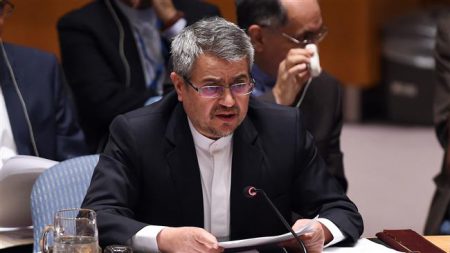
Iran’s ambassador to the UN Gholamali Khoshroo
Press TV – March 29, 2017
Iran’s ambassador to the UN Gholamali Khoshroo has called for the total eradication of nuclear weapons.
Khoshroo reiterated Iran’s call during a UN conference aimed at creating a nuclear weapons ban treaty in New York on Tuesday.
“Iran, as a victim of chemical weapons, strongly feels the danger posed by the existence of weapons of mass destruction and is determined to engage actively in international diplomatic efforts to save humanity from the menace of nuclear weapons,” he said.
Khoshroo stressed that Iran is committed to its Non-Proliferation Treaty (NPT) obligations, which include negotiations based on effective nuclear disarmament measures.
He added that several countries continue to ignore international calls and treaties for nuclear disarmament and even continue to increase their nuclear stockpiles. “They do not have political determination to abandon doctrines of nuclear deterrence and nuclear terror,” he went on to say.
Iran’s UN ambassador noted that boycotting the talks by many countries, including the US, shows that the world’s nuclear powers are by no means committed to the eradication of nuclear arms. Britain and France were also among the some 40 countries that did not join the talks.
“We note that prohibition of nuclear weapons must be accompanied by the elimination of such weapons. There can be no doubt that without complete abolition of nuclear weapons, there will be no absolute guarantee against the danger of nuclear war and the use of such weapons,” Khoshroo added.
Featured Video
Trita Parsi: Iran War Ends Today? Threats of Deporting Trita Parsi
or go to
Aletho News Archives – Video-Images
From the Archives
The Crusades – colliding narratives
Ashes of Pompeii | June 13, 2026
They say history is written by the victors, but the Crusades offer an interesting historical contrast: a two-century collision that produced not one history, but two parallel, irreconcilable realities. The dates and the battles are identical in both accounts, but the moral axis is entirely flipped.
In the traditional Western narrative, the Crusades are framed as a heroic, if tragic, epic. The First Crusade is a pious pilgrimage; the knights are romanticized figures of chivalry in shining armor, bravely holding the line in a hostile, exotic land. The eventual loss of the Holy Land is mourned as the “fall of Outremer,” a tragic retreat of European civilization. In this telling, the East is often reduced to a passive backdrop, its inhabitants viewed through a lens of mystique or backwardness, mere obstacles to a divine mandate.
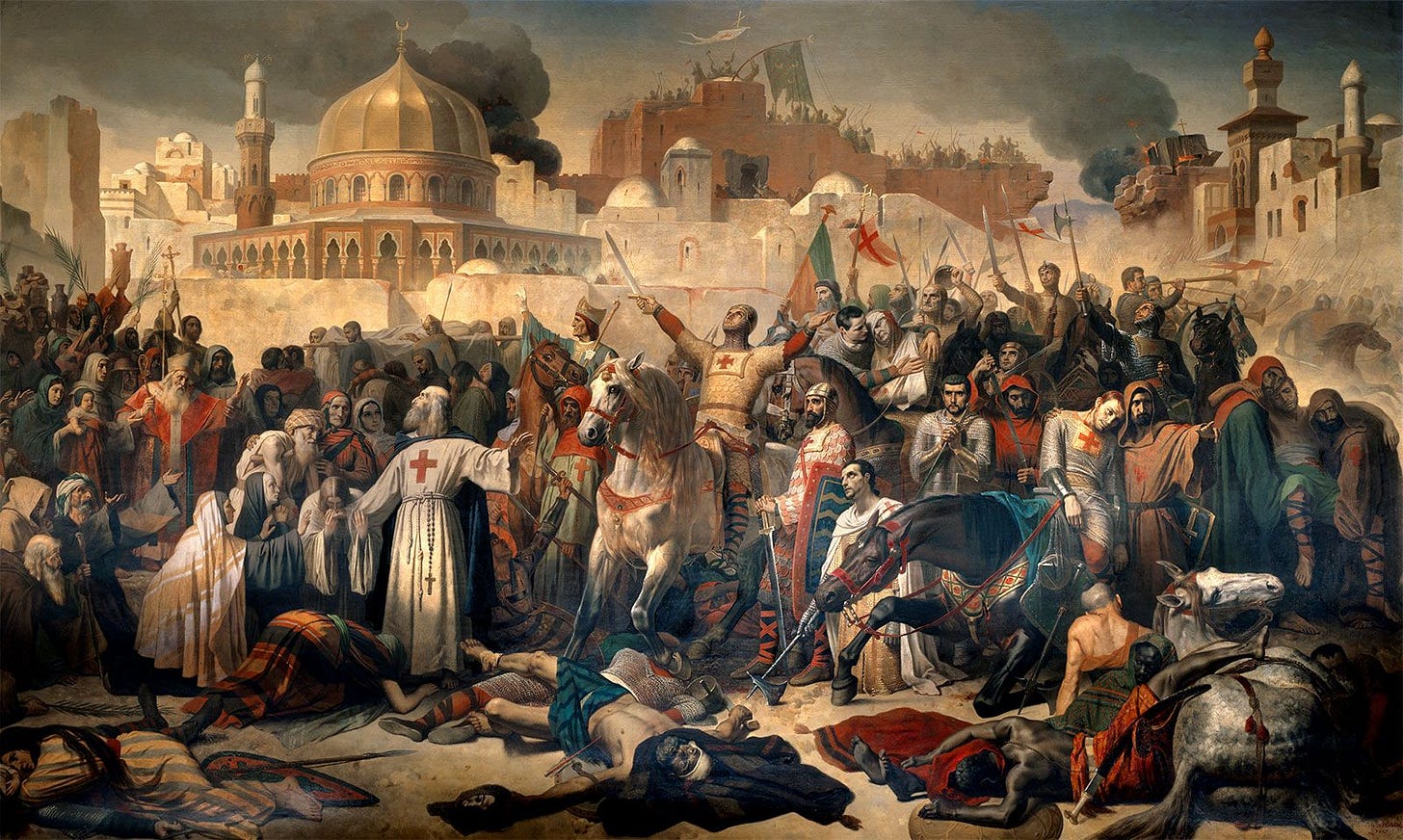
But cross the Mediterranean, and the exact same timeline reads like a chronicle of foreign invasion and eventual, hard-won restoration against the barbarous northerners. The dates do not change, but the adjectives do. Here is the history as it is remembered in the Levant… continue
Blog Roll
 Aletho News
- The 12 Screenings That Manufacture the Patients They Claim to Find
- Iran deputy FM says MoU with US finalized, to be signed in Geneva on Friday
- With one strike, Netanyahu tries to kill two peace deals
- Iran warns ‘no point’ in deal with US if Israel remains unrestrained
- Ukraine as a laboratory of ‘techno-fascism’
- Desperate Starmer choosing piracy as distraction over UK crime crisis – Putin envoy
- The Crusades – colliding narratives
- Trita Parsi: Iran War Ends Today? Threats of Deporting Trita Parsi
- What Is SIDS?
- DHS docs: Govt bracing for nationwide anti-AI riots, preparing to crack down on dissent
- If Americans Knew
- Did Trump just threaten a nuclear attack on Iran? Another merger for Israel-Firster David Ellison –Daily Update
- Israeli Firm Accused of Launching Smear Campaigns During US, European Elections
- As World Cup kicks off, Gaza amputee girls chase football dreams
- Oxfam: More Palestinians killed by Israel across West Bank in last 3 years than previous 17 years combined
- US-Iran ceasefire may be imminent, but will Israel blow it up? – Daily Update
- The Issue of Israel Is Ending Democracy In Michigan
- Israel is stealing homes, livelihoods, and lives in West Bank
- Gaza is not an aberration – Israel planned this genocide decades ago
- Israel is changing the face of Lebanon, mainstream media is normalizing it – 3 articles
- Genocide lobby benefits from EU anti-racist fund
- No Tricks Zone
- Climate Alarmists Now Using Natural Phenomena To Support Their Claims
- New Study: Significant CO2 Fluxes From Non-Volcanic Sources Are Largely Neglected In Carbon Budgets
- Women Climate Scientists Being Harassed, Insulted By Skeptics, Claims Berkeley Earth Researcher
- Germany’s Longterm Spring Climate Data Show “No Climate Trend”
- New Study: Solar Photovoltaic, Wind Power Fail To Meet Annual Energy Demands 62% Of The Time
- Germany’s Die Welt: “Too Much Is Too Much” … Green Energies Are Cannabalizing Each Other!
- Germany’s Ecological Holocaust… Once Fairy Tale Forests Getting Cleared For Wind Turbines
- A Grand Solar Minimum Has Arrived…Global Cooling Of At Least 1°C Is Expected By The 2030s, 2040s
- European “Expert Commission” Urges COVID-19-Like Global Climate State Of Energency!
- Real-World Observations Do Not Support The Position That Climate Change Is Human-Caused
 Aletho News