Farming Injustice
International day of action – February 9th
Palestinian farmers organisations and campaigners in Europe are this weekend taking action to call for an end to trade with Israeli agricultural export companies over their role in Israeli violations of Palestinian human rights. Read the call to action here.
In Gaza, Palestinian fishermen held a press conference and rally on February 6 to draw attention to Israel’s attacks on fishermen. Farmers and activists will march towards the buffer zones near the border with Israel on February 9 to protest Israel’s destruction of farmland and attacks on farmers.
In the West Bank, a conference and other actions will be held in Salfit to discuss a boycott of Israeli goods and resistance to Israel’s colonisation and systematically implemented restrictions on Palestinian agriculture.
All of the major Palestinian agricultural organisations have marked the day of action by publishing an appeal for action for the launching of campaigns against Israeli agricultural companies and an accompanying briefing, which aims to shed light on the role of Israeli agricultural companies in the destruction of of Palestinian agriculture.
Solidarity campaigners, trade unionists and NGOs across Europe are holding actions and launching campaigns against Israeli agricultural export companies such as Mehadrin and Arava, who export fresh produce from illegal Israeli settlements and are among the primary beneficiaries of the destruction of Palestinian agriculture.
There will be events, flash mobs and protests in more than 40 cities across 9 European countries including France, the UK, the Netherlands, Belgium, Sweden, Switzerland, Luxembourg, Germany and Italy. Campaigners are calling on governments to ban settlement trade and on retailers to adopt the position of the Co-Operative supermarket in the UK, which refuses to trade with any Israeli company that operates in settlements.
You can follow the actions on Twitter using the hashtag #FarmingInjustice.
Actions taking place across the world
Palestine
Dozens of Palestinian farmers and fishermen rallied in the Gaza seaport this week, launching several days of actions across the Strip to support boycotts of Israeli agricultural corporations.
Upcoming events will include a march by farmers, ending with the planting of olive trees, near the “buffer zone” around Gaza’s boundary with Israel on Saturday.
In the West Bank, a conference and other actions will be held in Salfit to discuss a boycott of Israeli goods and resistance to Israel’s colonisation and systematically implemented restrictions on Palestinian agriculture.
Also in the West Bank, the villagers of Madama, the centre for the Martyr Billal Najar from Burin and International Solidarity Movement activists will plant Olive trees on the land of Madama village where illegal settlers cut down hundreds of olive trees.
France
Activists in Montpellier occupied the customs offices to protest the import of produce from Israeli agricultural companies that operate in settlements on Thursday. Actions are planned in 14 other French cities on Saturday.
UK
Protests and actions are planned in more than XX cities as part of a new campaign to pressure major supermarket Sainsbury’s to end trade with any Israeli company that from settlements.
Belgium
Creative ‘Boycott Carnival’ action and demonstration in central Brussels
Sweden
Pickets at Coop-stores in Stockholm and Hässleholm as part of the campaign to pressure the supermarket to end trade with complicit Israeli companies
Netherlands
A creative protest action in the ‘Black Market’ Bazar, Beverwijk, at which goods from Israeli companies such as Mehadrin and Arava are often present
Luxembourg
Actions at supermarkets in several cities.
Italy
Actions and demonstrations in Rome and Trento
Actions are also planned in Germany and Switzerland, with more details to follow.
Related articles
PICKING CABBAGE IN BEIT HANOUN
By Theresa in Gaza | Free Gaza Scotland | February 2, 2013
Today we went to Beit Hanoun to help the farmers to pick cabbage. Its sounds like boring hard work, especially as it was raining quite hard off and on while we were there but actually it was a really enjoyable and interesting day. When we arrived at the field we joined a group of young farm labourers who made the morning very enjoyable with their singing, laughing and joking as we worked quickly to gather as many cabbage in a short period of time as possible. The field we were working on was quite some distance from the fence, we only heard gunfire twice and didn’t feel directly targeted, the jeep only showing itself once on the treeline before stopping behind a small hill in the distance. We helped pile the motorized cart high with cabbage and chatted in the rain until the cars arrived to take us back into Beit Hanoun.
While we were chatting one of the farmers talked about his Grandmother and the stories she told him about her childhood here. We were stunned when he told us that she had talked about being able to go from Beit Hanoun to Hebron in only half an hour in those days. It was something we hadn’t thought about, when you are in Gaza everywhere in the West Bank seems like such a long way away but when you think about it it makes sense, it’s actually only around 40km. To get there today takes a minimum of 2 days with no stop, Beit Hanoun – Cairo-Round the Southern tip of the Sinai via Sharm El Sheikh to cross at Taba into Israel then on to Hebron. That is of course if you are a privileged International, for a Palestinian there are a whole new set of problems.
Beit Hanoun is an interesting town, it’s directly across the border from Sderot. A place I’ve heard of very often and met a couple of residents of but never had the chance to visit. The countryside here is gently rolling low hills and as you leave Beit Hanoun to reach the fields you see Sderot in the distance. Built right up to the border, mainly nestled in between two hills with some of the red roofed buildings of the town on top of one and a large army installation with radio towers on the other.
Being so close to Sderot has meant that Beit Hanoun comes under huge pressure with all houses within one and a half miles of the border bulldozed, mainly in 2009 and all of the citrus trees which used to cover this landscape destroyed in order to leave clear lines of sight for the Israeli Military. Every building facing Sderot shows serious damage from shelling bombing and gunfire, and across the town there are damaged houses. Why is it that I had never heard of Beit Hanoun before I came to Gaza and yet Sderot is on the lips of every Israeli and everyone who defends the Zionist policies of Israel, ingraining it on everyone’s conciseness? Perhaps because there are so many places in Gaza which have the same damage, the same experience of attack, destroyed homes and death due to Israeli Military action? Whereas Sderot is special, in Israel it is the one place which has seen regular rockets causing some structural damage and very occasional death. Is it too much to ask that the violent death or injury of a human being is treated with the same shock and grief whichever side of the border it’s on? That the damage to lives and property is judged by the same standards wherever they occur?
Related articles
- 75th Israeli Violation of truce: Palestinian Man Shot In Beit Hanoun (altahrir.wordpress.com)
- We Want it to Stop (alethonews.wordpress.com)
Israeli occupation forces kill 7 Palestinians, arrest 300 others during January
Palestine Information Center – 01/02/2013
RAMALLAH — A Palestinian human rights report confirmed that the Israeli occupation forces (IOF) killed 7 Palestinians, and arrested more than 300 others during the month of January 2013.
Tadamun Foundation for Human Rights stated, in its monthly report released on Thursday, that four Palestinians, including two children and a woman were killed by Israeli fire in the occupied West Bank, while 3 other citizens were killed in the Gaza Strip, including a child.
Regarding arrests, the report pointed out that the occupation forces arrested more than 300 Palestinians across the West Bank and Gaza, including more than 60 children and 5 women.
The report noted that the arrest number does not include those detained during the clashes that erupted during the storming of Bab al-Shams village, built on Palestinian land slated for confiscation, near the city of Jerusalem.
The report added that the highest number of detention cases were in al-Khalil city, in the southern occupied West Bank, 80 arrests, and in occupied Jerusalem, 70 arrests.
The Foundation explained that a number of liberated prisoners, who have spent several years in Israeli jails, were among those arrested, such as Sheikh Jamal Tawil, Bajes al-Nakhla, and Fadi Sadak from Ramallah.
Related articles
- This Week in Palestine, January 25th, 2013 (indybay.org)
Mahmoud Sarsak – Palestinian International Footballer
Free Gaza Scotland | January 29, 2013
On Wednesday 23rd of January I with other members of our group had the pleasure and honour to meet Mahmoud Sarsak in our appartment. He is a slight, quietly spoken young man, with a gentle manner and his good humour and patience with our questioning betray none of the pain he has suffered over the last 3 and a half years. When he begins to speak about his experience of imprisonment he tells his story with a matter of fact, quiet sincerity that is striking and makes the horror of his experience all the more shocking.
 Mahmoud was 21 years old, at the start of a playing career which had already seen him being recognised as one of the best young prospects in Palestine, already a regular for the Palestinian National side. He had an invitation to play for a football team in Nablus in the West Bank. This meant that he had to ask for permission from the Israelis to cross from Gaza through Erez crossing into Israel in order to travel on to the West Bank. This did not worry him as it was a trip he had already done twice before and when he recieved his permission he went to the crossing looking forward to the opportunity of playing in Nablus. However when he got to Erez at 9am on the 22nd July 2009 his whole world changed, instead of being allowed to cross he was arrested and taken to a Police Station, from here his family were called and informed that he was being taken to Ashkelon Jail.
He was made to take off his clothes and change into overalls, an ‘under investigation uniform’. He describes how for the first 18 days he was tied to a chair with his eyes covered, the only times he was untied was when he was given food and they untied his hands or when he was allowed to go to the toilet when his legs were untied. He explains that during this time he was kept awake, not fed properly and questioned daily, every 4 days he was taken to a court where a judge gave permission for him to be held for a further 4 days. This treatment he says ‘wasn’t so bad’ in comparison with what was to come although I think that most people would call it torture.
At the end of that 18 days he was taken to a Military Jail in the South where he was kept for 6 days and his treatment became much worse. He was beaten regularly and was put in what he described as a fridge, he also had very hot and very cold water put under his feet. During all of this time in both places he was questioned, his interrogators were wanting him to say that he had been involved in ‘activities against Israel’. He didn’t understand what they meant by this, he was a footballer, he had not been involved in anything else and so refused to make things up to make his interrogators happy. He had no idea why he had been arrested.
At the end of these 6 days he was taken back to a civilian jail for another 11 days where suddenly things got much better. He was fed and allowed to sleep properly, his captors became very friendly offering him his freedom, a new house, a salary, a car, access to proper training facilities to help his playing career and foreign travel. All he had to do was become a collaborator. He refused, which provoked many serious threats from his Israeli interrogators. They told him that they would burn his family home down, attack his family and kill his brothers. Despite the pressures upon him and his ordeal so far, he continued to refuse to collaborate.
Except for short visits to court when his lawyer was present, during this initial 35 days of incarceration he had absolutely no contact with anyone but his jailors and interrogators. His lawyer told him that he was going to be all right, the court had said he was going to be released. Instead he was told by a Military Officer that he was now being held under ‘The Law of An Illegal Fighter’ and that they no longer needed to go to court to ask permission to keep him. He was then taken to Kitseot Jail near Bersheva where at least he could see other prisoners and his time of interrogation was over. He asked the other prisoners what this ‘Law of an Illegal Fighter’ meant but none of them had ever heard of it. When he was finally allowed access to his lawyer and was able to ask him he was told that it was a law that the Israeli authorities use when they have nothing against you but they want to hold onto you. He then asked his lawyer what rights he had under this law and was told that he had none, he could now be held in jail for as long as the Israeli Military wanted to keep him.
Mahmoud was the first Palestinian who had been held under this law, the only other people he knows of who had previously been held under it were 2 Hizbollah members from Lebanon who were arrested in 1982. He thinks that because he had no rights he was put in a cell which was 2m x 1m for his time in Kitseot, this cell had only a matress and toilet in it and he developed chest, skin and back problems while there. He was not taken to a hospital while there, and was only seen briefly by a prison doctor for these problems. He was allowed out of his cell for 1 hour a day for exercise with his fellow prisoners when he played football with them.
On the 22nd of February 2010 Mahmoud was taken to Tel Aviv for a court hearing to extend his imprisonment and then to another court hearing for the decision in Jerusalem two weeks later. The journey to court and between jails is in what the prisoners call a ‘post bus’ which is metal bus with steel compartments in which you are jostled and hit off the steel walls. He knew before he was taken to the second hearing that he was going to be held for another six months. After this hearing he was also barred from playing football with his fellow prisoners for that precious hour in the mornings and was told that this was due to his back being too bad. At this time they also started to move him between prisons every 2 months and he was still taken to court every 6 months in order to have his stay in prison extended.
On the 23rd of August 2011 he was told that he was going to be released, he was happy and said goodbye to the other prisoners. He was taken by ‘post bus’ to Erez, his hands and legs were not tied as they usually were, the window was open and when he got there they opened the door of the prison van and the guards moved away talking among themselves. He stayed where he was as he didn’t know what was happening and he didn’t want to be shot if they thought he was trying to escape. He called to the guards to ask what was happening and they told him they were taking him back to jail, he wasn’t being released. He was taken to a different jail for 2 weeks with only the clothes he had on when they took him to Erez. He said that he was later told about another prisoner who had been taken to Erez and left in an open ‘post bus’ with his legs untied in the same way. He had gone to the door to look out and been instantly shot in the leg and accused of trying to escape. After this 2 week period he was taken back to the jail he had originally been in when first imprisoned, here his other clothes and small number of belongings were finally brought to him.
When he was taken to this jail he was given another 6 months but his lawyer was promised that he would be released when this time ended on the 23rd of February 2012. The 23rd of February came and went, 10 days after this he was taken back to court, he had decided that this time if he wasn’t released he would go on hunger strike and stay on hunger strike until they promised in writing that he would be released. So when he was told that he was going to be imprisoned for another 6 months he prepared himself for 10 days, eating less each day and gradually reducing his physical activity. On the 15th of March 2012 he started his hunger strike. He only took water and sometimes a little salt in order to prevent his stomach from beginning to rot.
7 days after he started they began to move him from jail to jail before putting him in Nafha Jail which meant he was put in with the Israeli criminal population. Then he was put into isolation for a spell followed by hospital in Bersheva for 2 days tied to his bed then back to Nafha. From here he was sent to Eshel jail where he was put in isolation again and became very sick. This time they wouldn’t take him to hospital but would only allow him to see the Doctor in Eshel. After 35 days of this the Doctor in Eshel refused to continue to be responsible for him and he was taken to the Prison hospital in Ramle jail where he was with another 5 Palestinian prisoners who were also on hunger strike. He refused treatment here and was put back into isolation, this time his isolation cell had no windows so he was in darkness. After 47 days on hunger strike he bagan to have serious problems with his stomach, he couldn’t even drink water without vomiting. First white then black then brown vomit. They took him back to Ramle Prison hospital then and gave him antibiotics.
Along with the other hunger strikers he was asked regularly to break his hunger strike, on the 15th of May he was told that if he would break his hunger strike he would be released on the 23rd of August and the other hunger strikers were also told that they would have their demands met if they broke theirs. 3 of them accepted but along with 1 of the others Akram Al Rihawy he refused, he had heard promises of release before and he insisted that he have the promise in writing signed by a senior Judge and a Minister from the Israeli Ministry of the Interior. He was also told that he would not be allowed to return to Gaza, he had to choose between Germany, France or Norway which he also refused to accept. At this time he finally began to get International Committee of the Red Cross visits twice a week and he was asked daily to break his hunger strike, he continued to refuse until he got it in writing that he would be released back to Gaza and that he would be properly monitored by a committee of doctors when he started eating again.
Eventually on the 18th of June 2012 on the 96th day of his hunger strike a Minister from the Israeli Ministry of the Interior came to see him with the signed paper that he had been asking for stating in writing that he would be released on the 20th of July 2012. The Minister asked him if he would now please give up his hunger strike and he agreed. The Minister asked him to drink a glass of milk in front of him so that he could confirm and report that he had indeed broken his hunger strike which he did alathough he immediately vomited this back up. His stomach couldn’t cope even with milk after such a long time with no more than water going into it. He said that even though his stomach rejected this cup of milk his whole body felt as though it had drunk and felt relieved.
For 14 days he had to build up to eating again with first intravenous vitamins and nutrition, followed by nutritional drinks, before finally eating his first bit of bread after this 14 day period, which he still vomited back up. During the time of his hunger strike he was only allowed 2 visits from his lawyer, on the 40th day and on the last day. I asked if he was allowed any visits from his family during his time in jail. He replied that because he was given no rights under the ‘Law of An Illegal fighter’ he was not only denied visits from family but was not even allowed the 6 monthly letters delivered to his fellow prisoners by the Red Cross. He wasn’t able to write to them either, not even one short note.
At no time during Mahmoud’s entire incarceration was he actually accused of anything other than being asked to admit to the vague term ‘activities against Israel’ and he was never charged with anything. He was very clear that he had no idea why he was arrested. He was a footballer. The court appearances he attended were simply formalities under Military Law which say that every 6 months any detention order must be renewed.
All Palestinians from the West Bank and Gaza who are arrested by Israel are dealt with under Military Law not Israeli Criminal Law and therefore it is not necessary for Israel to ever bring charges against them. Many who are prosecuted are those who have signed false confessions under torture and are not able to retract them afterwards. Mahmoud’s case was slightly worse than normal Military law, under which there are a few rights which at least give some protection in prison. Mahmoud had none of these rights under this so called ‘Law of an Illegal Fighter’ by which he was held.
I asked Mahmoud if he was back in training for football and if he thought that it would be possible for him to return to his playing career. He said that finally he had managed to attend 3 training sessions and was hoping to be able to return to the team at some point in the future once he was back to full fitness. I sincerely wish him luck with this and hope that he will reach that stage very soon.
This has to be one of the clearest examples of why the BDS (Boycott Divestment and Sanctions) campaign should be supported by everyone and why Israel should be barred from participating in International Sporting events. Currently the 2013 UEFA U-21 Championship is scheduled to be played in Israel. How can this be allowed when they can treat a Palestinian International Player like this? Not to mention that they bombed the only 2 football pitches in Gaza during Operation Pillar of Cloud as well as destroying many local playing areas in the West Bank over the years. I saw several during my visit there in 2004 including one in Ramallah which had been bulldozed.
Mahmoud told us that the other prisoner who had stayed on hunger strike with him, Akram Al Rihawy, had spent his whole sentence in hospital due to his medical problems. His reason for being on hunger strike was not for release but for proper medical treatment. He stopped his hunger strike after being told that he was going to be released on Wednesday the 23rd of January 2013. Yesterday, on the 25th of January 2013 we were told that he was not released as promised and that he is now back on hunger strike.
To join the campaign against Israel hosting the 2013 UEFA U-21 Championship go to the following link and get involved: http://redcardapartheid.weebly.com/
Related articles
- Former mayor put in administrative detention (alethonews.wordpress.com)
- Genocide by Proxy: Palestinian patient Salah Salluha dies at Erez due to prolonged security measures (occupiedpalestine.wordpress.com)
- Hundreds of Palestinians detained without evidence (occupiedpalestine.wordpress.com)
- Palestine: Documenting the torture of a boy in occupation jails, two wounded by shooting & East of Gaza flooded by Israelis (realisticbird.wordpress.com)
Are Zionists Now Calling the Shots in the Anglican Church?
By Stuart Littlewood | Palestine Chronicle | January 24, 2013
Rowan Williams, the 104th Archbishop of Canterbury, has stepped down from his post (sigh of relief).
Williams’s role as a figure of unity in the worldwide Anglican Communion, which is represented in over 130 countries, meant that he was in a position to “bring the needs and voices of those fighting poverty, disease and the effects of conflict, to the attention of national and international policy makers and donor agencies”. Or so we were told.
In 2010, when the Archbishop announced he was planning a visit to Gaza just a year after the slaughter and devastation of Operation Cast Lead, I asked his Lambeth Palace office for more information. Whom would he meet? Would he see the health minister? Would he sit down and talk with the elected prime minister Ismail Haniyeh, man of God to man of God (for Mr Haniyeh is an imam)? Would he do Gaza (and all of us) proud by spending a generous amount of his time with senior members of the Islamic faith?
His office didn’t reply.
According to the Archbishop’s website he did none of those things. At least, he didn’t mention them if he did. Unless I’m mistaken he said nothing about Gaza in the House of Lords, where he had the ear of Parliament and the support of 25 other Church of England bishops.
Yet he began his Ecumenical letter that Easter by declaring: “Christians need to witness boldly and clearly”.
A lady wrote to me saying she had emailed Lambeth Palace 18 times asking if the Archbishop’s party could please bring back some deaf children’s art, which should have been picked up by members of a recent Gaza blockade-busting convoy. The Palace eventually declined saying the Israelis wouldn’t allow it.
If he’d been ‘witnessing boldly’ as he exhorted other Christians to do, the Archbishop would surely have instructed his staff to pick up the children’s art and dare the Israelis to confiscate it.
She complained that by not using his position in the House of Lords and elsewhere the Archbishop was failing to improve the situation for Palestinians, quoting the words of Desmond Tutu: “Where there is oppression, those who do nothing side with the oppressor.”
It was later revealed that the Israelis severely restricted the Archbishop’s time inside Gaza. I asked why such interference with the Church’s pastoral business in the Holy Land, of all places, wasn’t broadcast on the website, in mainstream media and in Parliament.
His office confirmed that the Archbishop had initially been refused access to Gaza but was eventually permitted one-and-a-half hours. This was just enough for a hurried visit to the Ahli hospital and no more. When my questions were forwarded to the Archbishop’s public affairs spokesman, the reply was headed “NOT FOR PUBLICATION”. Suffice to say the Israelis from the start blocked the Archbishop’s visit to Gaza and only at the last minute granted him a piddling 90 minutes.
Was this his idea of ‘witnessing boldly’?
The Archbishop’s website joyfully reported how he hobnobbed with the Chief Rabbinate, paid his respects to Yad Vashem and the Holocaust, and talked with the President of Israel – the latter no doubt sniggering up his sleeve at his guest’s frustration at being prevented by Israel’s thugs from seeing what horrors they had inflicted on the Gazans.
Why did he agree to fraternize with Jewish political and religious leaders when his wish to carry out his Christian duty in Gaza was so rudely obstructed? Did Lambeth Palace not realize that meekly accepting such insults only served to legitimize the Israelis’ illegal occupation of the Palestinian territories and gave a stamp of approval to the vicious siege of Gaza, the ongoing air strikes against civilians, the persecution of Muslim and Christian communities and the regime’s utter contempt for international law and human rights?
There was no mention of a get-together with senior Islamic figures, leaving a question-mark over Williams’s real commitment to inter-faith engagement.
Earlier, while the Jewish State was putting its finishing touches to Operation Cast Lead (the infamous blitzkrieg launched over Christmas-New Year 2008/9 against Gaza’s civilians including the Christian community there), the Archbishop joined Chief Rabbi Jonathan Sacks in a visit to the former Nazi camps of Auschwitz-Birkenau in Poland to demonstrate their joint solidarity against the extremes of hostility and genocide.
“This is a pilgrimage not to a holy place but to a place of utter profanity – a place where the name of God was profaned because the image of God in human beings was abused and disfigured,” said the Archbishop. “How shall we be able to read the signs of the times, the indications that evil is gathering force once again and societies are slipping towards the same collective corruption and moral sickness that made the Shoah possible?”
Read the signs? Surely they were plain to see. The forces of evil had already pushed some societies into the moral cesspit. He needed to look no further than the hell-hole that the Holy Land had been turned into by the Israeli occupation, with good old England’s blessing. If ever there was a place where “the name of God was profaned” this is it.
Who will step forward and save it? The Holy Land is the well-spring of the Christian faith, but you wouldn’t think so from the don’t-give-a-damn attitude among senior churchmen.
Open Door for the Bully-boys
The multitude of inter-faith committees and Christian-Jewish councils has opened the door to the Zionist lobby and made it easy for them to meddle in Church business and bully Christians into submission. There’s even a propaganda outlet calling itself Anglican Friends of Israel. A few weeks ago Zionists, no doubt emboldened by the Church’s appeasement policy, put the squeeze on the Bishop of Newcastle, Martin Wharton. The Representative Council of North-East Jewry wrote to him complaining that he voted for a motion at the General Synod which supported the Ecumenical Accompaniment Programme in Palestine and Israel (EAPPI) despite their “grave concerns… that it would encourage anti-Semitism”. His action, said the letter, “makes any further contact with the Jewish community in the North-East impossible”.
So be it, would seem an appropriate response. But oh no. What brought this on, according to the Church Times was Bishop Wharton’s agreement to speak at a conference, ‘Peace & Justice in the Holy Land’, organized by a group of people who had taken part in the EAPPI program. Its sponsors included Christian Aid, CAFOD, and Friends of Sabeel UK.
The chief executive of the Council of Christians and Jews (CCJ), the Revd David Gifford, said that the conference had “the potential of becoming yet another anti-Jewish meeting, creating more anxiety and distrust between the north-east Jewish community and the Church”. Then the Board of Deputies of British Jews chimed in saying that the EAPPI was “partisan” and “anti-Israel”.
Let’s be clear what the EAPPI is actually about:
“The Ecumenical Accompaniment Programme in Palestine and Israel (EAPPI) brings internationals to the West Bank to experience life under occupation. Ecumenical Accompaniers (EAs) provide protective presence to vulnerable communities, monitor and report human rights abuses and support Palestinians and Israelis working together for peace. When they return home, EAs campaign for a just and peaceful resolution to the Israeli/Palestinian conflict through an end to the occupation, respect for international law and implementation of UN resolutions.”(www.eappi.org)
The EAPPI program was set up by the World Council of Churches in response to a call by the churches of Jerusalem. Its mission includes engaging in public policy advocacy and standing in solidarity with the churches and all those struggling against the illegal occupation. Few people except those who support the brutal Israeli regime would disagree with the program’s principles and objectives. And few, surely, would condemn the humanitarian work the EAPPI carries out with great courage in the face of criminal hostility. Nevertheless its success has whipped the usual suspects into an orchestrated frenzy.
As reported in the Jewish Chronicle, John Dinnen whose motion sparked the Synod debate pointed out that well-known Jewish groups such as Jews for Justice for Palestine and the Israeli Committee Against House Demolition [ICAHD] are entirely supportive of EAPPI, and that five per cent of EAPPI volunteers are Jewish “which is a higher ratio than the number of Jews in England”.
But despite having the moral high ground Wharton caved in and decided not to attend the conference “for the sake of good relations between all the faith communities in Newcastle”. The Roman Catholic Bishop of Hexham & Newcastle, Seamus Cunningham, also decided not to attend. He told the Jewish Chronicle that he had become aware “that many Jewish people in the north-east were angry and upset”. Perhaps the angry and upset should go themselves to the West Bank and experience the behavior of their brethren towards Palestinian women and children and the EAPPI volunteers.
Throughout his time on the Archbishop’s throne Williams was mad-keen on inter-faith dialogue, for what good it has done, and spent an inordinate amount of time with Chief Rabbi Sacks. At one point the Jerusalem Post suggested that the chief rabbi had “in some respects eclipsed the archbishop as the religious voice of the country”.
Nor was the Archbishop the best-known Christian according to a survey 3 years ago. Harry Webb (aka Cliff Richard) beat him into second place. The survey made Cliff even “bigger than the Pope”, who trailed in seventh place.
Now we hear that the squeaky-clean, born-again-Christian megastar is to perform in Israel in July, and the Israeli media are making a meal of it. Does none of these pious dudes understand the appalling, inhuman situation out there?
I’m not sorry to see the back of Rowan Williams – a good guy but not the right man at this time. And what are we to make of his replacement, Archbishop number 105, who will be enthroned at Canterbury Cathedral in March? Justin Welby is touted as an expert in conflict resolution, but he comes from nowhere and is not known for his concern about the Holy Land.
The Jewish Chronicle reported that Welby last year helped mount a Holocaust Memorial Day exhibition in Liverpool Cathedral and… wait for it… abstained in last summer’s vote at the Anglican Synod which endorsed the EAPPI.
In my view, anyone who cannot bring himself to give wholehearted backing to a worthy humanitarian project like EAPPI shouldn’t be leading a great Christian church.
Related article
- Stark Christmas message from the Holy Land: “Act and intervene, or nothing will change” (alethonews.wordpress.com)
The broken truce
International Solidarity Movement | January 21, 2013
Beit Lahiya, Gaza Strip, Occupied Palestine – A ceasefire was announced on 21st November, ending eight days of horrific bloodshed in Gaza. Has the delicate truce held over the past two months? It depends who you ask. Israelis or Gazans, each going about their daily lives on opposite sides of a border fence.
There has not been a single report of a rocket fired out of Gaza since 21st November. In contrast, four Palestinians have lost their lives and over 80 have been injured by Israeli forces since then. Yet these violations have received little or no coverage in the mainstream media. Palestinian civilians, whose only crime is to live in the border areas, are terrorized on a daily basis by the Israeli army. This is what everyday life under the ceasefire has meant for them.
Beit Lahiya, in the far north of the Gaza Strip is one such place. A week ago it saw the brutal murder of 20 year-old Mustafa Abu Jarad. Today, it was the site of another Israeli violation. Abdullah Marouf, 18, was in the west of Beit Lahiya, near the coast, when he was shot in the right leg by Israeli forces, fracturing both his tibia and fibula.
 Abdullah Marouf in hospital. (Photo by Desde Palestina)
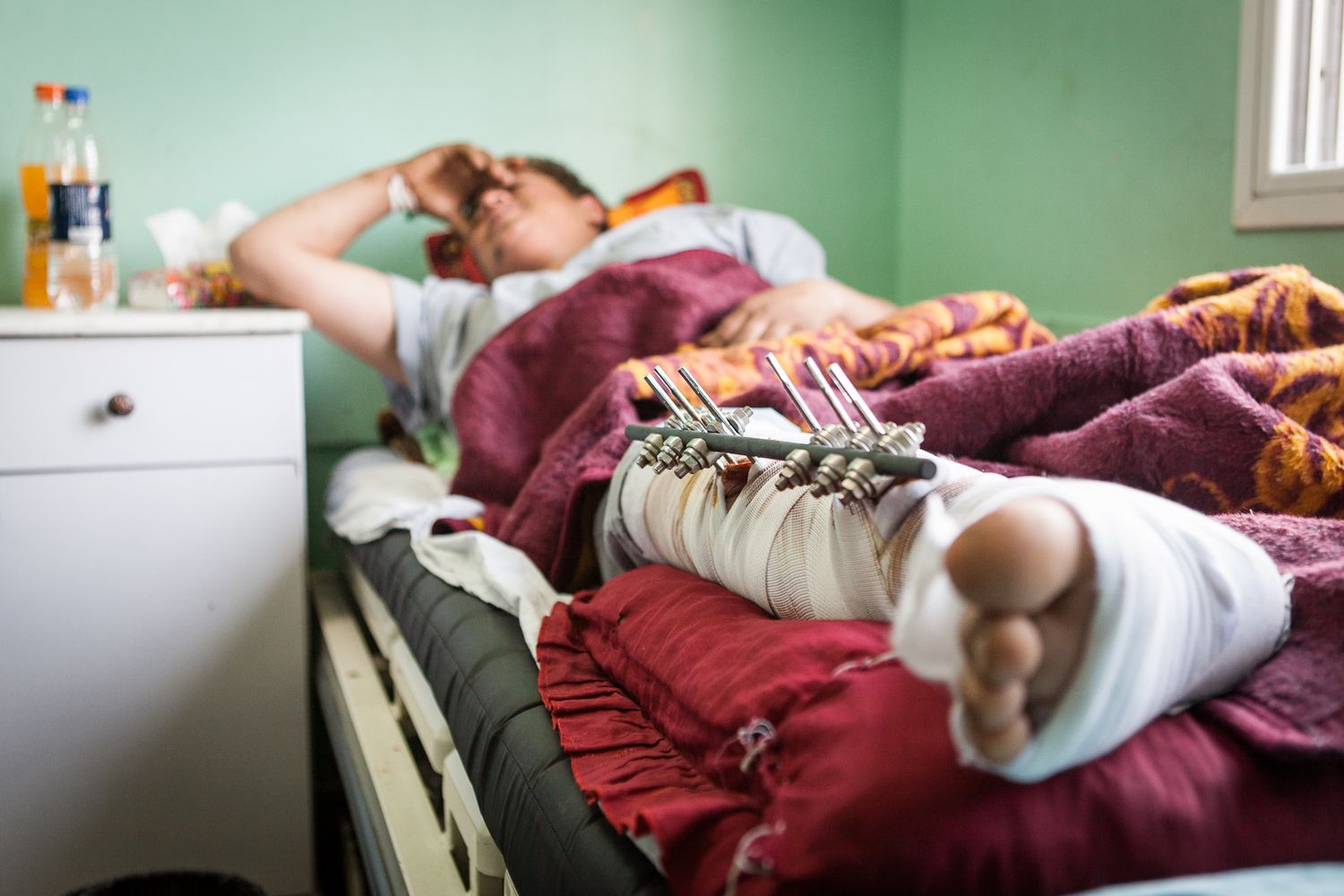
At about 9.00 on the morning of 21st January, Abdullah was in an area approximately 250 metres from the border fence, catching birds with his two brothers. A group of five or six Palestinians they were unaquainted with were also in the vicinity, closer to the fence than they were. Abdullah had been under the impression that he would be safe, however he noticed an Israeli soldier in a watchtower on the border and others on the ground. The soldiers began firing live ammunition towards them and Abdullah was shot.
Two local farmers brought him to Kamal Adwan hospital where surgeons performed percutaneous pinning of his lower leg which had sustained damage from an entry wound and a significantly larger exit wound. He requires subsequent surgery in a couple of months to fit internal wires. His recovery is estimated to take at least 12 months.
Abdullah, who is engaged to be married, had been working with his two brothers selling scrap metal. Now they will have to support a family of nine without his help. It is unsurprising that he expressed a lack of faith in the ceasefire agreement.
One can only expect that the Palestinian resistance has also lost faith and is fast losing patience. If a response is provoked it will appear to be in a vacuum – despite this being far from the case – due to the shameful silence maintained by the international community throughout the ongoing Israeli atrocities. It is for people of conscience to protest this injustice and prevent a further escalation of Israel’s attacks on Gaza.
The hardest thing: Palestinian parents speak of their children killed by Israeli bombings
By Eva Bartlett | In Gaza | January 12, 2013


During the Nov 2012 Israeli attacks on Gaza, 182 Palestinians were killed, according to the World Health Organization’s Dec 2012 report, among whom 47 were children, including 16 under 5 years old. Another 1399 Palestinians were injured, most of them with multiple injuries.
It is only four years after Israel’s last major assault on Gaza, which killed over 1450 including those who died of their injuries, and injured over 5000. Then there are the random Israeli attacks throughout the years, leaving injured suffering even years later.
And there were the under-reported attacks in the week preceding the Nov 14 attacks: the Nov 8 killing of 13 year old Ahmed Abu Daqqa as he played football, the Nov 10 killing of Mohammed Harara (16) and Ahmed Harara (17) as they played football, the subsequent killings of Ahmed Al- Dirdissawi (18) and Matar Abu al-‘Ata (19) when they rushed to the scene of the Harara killings (source: PCHR).
Every December and January, I remember the victims of the 2008-2009 massacre, particularly some of the harder incidents of burning to death from white phosphorous bombing, or point blank shootings of loved ones. All ages suffered, although we tend to pick up on the children. Somehow their murders, their maimings, their imprisonment strikes us more.
Two cases from the November 2012 attacks struck me and stay with me: the killing of 4 year old Reham as she stood a few metres from the door of her Nusseirat camp home, outside of which an Israeli bomb exploded…and the murder of Nader, 14, killed by a precision drone missile as he walked to get food for his siblings… just two hours before the ceasefire.
Below are follow-up photos, the families and loved ones of Reham and Nader. Allah yerhamhum (Allah, God, bless them).

Mourning area for Reham Nabaheen, killed by an Israeli bombing outside her Nusseirat camp home.

Abu Reham looks to where the Israeli bomb struck, the shrapnel of which blasted into his home and struck his daughter in the temple, killing her.


Um Reham sits with other women, mourning her daughter.

Fatoum, Reham’s neighbour and close friend, stopped speaking after her friend’s killing. Also four years old, she is in shock from knowing her friend is dead. Abu Reham: “I love her like I loved my daughter.”

Roa’a, Reham’s infant cousin. Reham used to play with her and bring her treats.
In the days following Reham’s murder, we visit the family in the simple Nusseirat home. Beside a mourning room set up to receive family and friends, a portrait of the girl I’d only until then seen dead in the morgue.
The home is barebones simple, the old Palestinian style of home and courtyard reconstructed with refugee camp means: cheap cement, toxic asbestos roof, chipped paint, thin walls and doors, sparse decor…no frills. A single olive tree grows in one side of the courtyard.
Um Reham sits amongst female relatives and although her daughter was killed only a few days earlier, is strong and tells me of the day. We’d seen her at al-Aqsa hospital in Deir al Balah on Nov 21, after the shelling. Further back from where the explosion hit, Um Reham was still wounded in her face by flying shrapnel. Her other two sons suffered only minor injuries.
“We’d gone to my sister’s home in Bureij, at the beginning of the attacks. There was so much bombing in Nusseirat, we were afraid to stay here, our kids were terrified. On the last day, we heard there would soon be a cease-fire and wanted to come home. I wanted to do laundry, to change my kids clothing. My sister told me to leave Reham with her, but I said no, I couldn’t leave my daughter behind.
After we’d returned to Nusseirat, we realized the bombing was still very heavy here. We were going to return to Bureij…“
Abu Reham, who we’d seen at the hospital morgue leaning over his daughter’s lifeless body, sobbing and kissing her, stoically continues explaining what happened that day.
Although Nusseirat was still being hammered, at the moment of the Israeli shelling which killed his daughter, it was relatively calm, he says.
“There was no visible danger, our neighbour across street was sitting on a chair by his doorway just minutes before the bombing. He left to go see something at a neighbour’s home…if he had not left, he would have been killed.“
He points out the two narrow courtyard doors to the street where a pocket in the asphalt speaks to the earlier bombing.
“It was around 4pm, one of the doors was closed, we were getting the kids ready to go back to Bureij. I’d brought out some cookies, and Reham went to get them out of the bag. She was reaching into the bag when the bomb struck. She was near the door, the shrapnel went right into her head. She died soon after, there was blood all over.
The sound of drones was insane then, it could’ve been a drone strike.”
“Tank,” his brother says, “it was a tank shell.”
The brother holds a girl.
“This is my daughter, Roa’a, she’s a year and a half old. Reham used to play with her every afternoon, she’d bring Roa’a chips and snacks… Reham used to always take care of her.”
A neighbour daughter comes over with his daughter, Fatoum (Fatema), 4 years old as Reham was. She is chubby cheeked and lovely, but unsmiling and won’t say a word.
“She came to play with Reham every day. A four year old shouldn’t have to know what death is, that her friend has been killed. She said to me, ‘my friend is dead, my friend died.’“
Abu Reham, whose daughter is just days dead, is worried about Fatoum who fell ill after learning Reham was dead.
“I love her like a daughter. Every child who loved my daughter, I love them like my own child (breaks down crying). I went to the cemetery, saw children from the area there, they had brought flowers and were tending Reham’s grave. They told me ‘we will visit her, even if your family moves, we’ll continue to visit her.’“

Nader Abu Mghaseeb, 14, killed by precision Israeli drone bombing as he went to get food for his siblings.

Abu Nader tells how his son was killed by an Israeli bombing

When Nader’s siblings awoke the morning after his murder, they asked for him, only to learn he’d been killed.

Abu Nader points to the hole in the road where the Israeli bomb which killed his son struck.

Shrapnel markings from the Israeli bombing which killed his son.

Light of the small shop to which Nader was headed when murdered by the Israeli bombing.

When killed, Nader was en route to the store to buy food for his siblings.

Pieces of the Israeli precision drone bomb which targeted Nader.

Pieces of the Israeli precision drone bomb which targeted Nader.

Pieces of the Israeli precision drone bomb which targeted Nader.

Pieces of the Israeli precision drone bomb which targeted Nader.

Nader’s watch and the memory chip from his cell phone, which he had with him when targeted by the Israeli bomb.
On the eastern outskirts of Deir al Balah, central Gaza, we go to the home of the 14 year old whose mutilated body set me sobbing when I saw it in al-Aqsa hospital on Nov 21. The family has a number of olive trees, from which they exist. Their simple home, just over a kilometre from the border and surrounded by trees on a small plot of land, is a little oasis in the over-crowded Strip. But for Abu Nader, it is now hell.
“I look at his jeans, I remember him. I look at the house, I remember him. I look there, look there, wherever I look, I’m reminded of Nader.
I hate this house, this area. I hate life now. I started to hate life when my son was killed.
You don’t stay in a place if your dear one is no longer there.”
We’re sitting in the small, nylon-walled tent behind his home, drinking bitter coffee and listening as Abu Nader tells us how his son was killed. Nader’s six younger siblings, for whom he’d been going to get food when killed, sit beside their father. When we walked into the tent, Abu Nader ran to one corner to grab a small vial of cologne, which he rolled onto the backs of our hands. Nader’s favourite.
“I had lit a fire and we were sitting like this. Sitting like this exactly. Nader asked if I had money, said he wanted to go to the shop to get food for dinner. I didn’t want him to go, but he said the ceasefire would start in a couple of hours, he’d be okay.
There was nothing to eat in the house. These kids need to eat, we’d had nothing in the house for 5 days.
Nader told me to warm the bread over the fire. He said he’d get some yogurt, some canned meat, anything so that all the kids could eat. One of his younger brothers went with Nader, but halfway there Nader told his brother to go back home. His brother kept saying he wanted to go with Nader, but Nader insisted he go back home, told him to wait for him at home.
His brother came back here and said to me, ‘Dad, Nader told me to come back here. He wouldn’t let me go with him to the store’. While he was telling me this, we heard a loud explosion.
My wife said that the explosion was very close to here. She told me to call Nader’s cellphone to see where he was. I called Nader but he cellphone was off. I kept trying to call him, and I ran to the street to try to find Nader.
I kept running until I reached the mosque. From the mosque I saw the light of the store.
And it was night, dark, about fifteen minutes after the evening prayer.
I was looking at the store and waiting for my son to come out of it, and didn’t see that my son was on the ground near me. There was blood all over the street. I thought it was water.
They fired a missile right at him.
When I saw him, I knelt down and grabbed him. There was no one around. I tried to pick him up but couldn’t. He was dead weight, heavy, I couldn’t pick him up on my own. And his legs were shredded, falling apart.
I started screaming, for anyone to hear and help me pick up my son and take him to the hospital.
No one heard me.
I left Nader and screamed to the houses around me, then came back to Nader, but no one heard me.
I sat next to him for a minute, panicking, didn’t know what to do.
I ran to another house to yell for help, but no one heard me.
I came back and wrapped my arms around him, put my head on his head. And I woke up in the hospital.
They killed him in a horrible way. They shot the missile right at him.
In the morning, one of Nader’s brothers came to me and said, ‘Nader’s bed is empty. Where is Nader?’
I told him, the Israeli army killed him.
We are all traumatized.
I’m not angry because Allah chose to take Nader. Allah gives and Allah takes. The hardest thing is that I saw how Nader died. In pieces. How can I live seeing my son cut into pieces? He was a child. He went to get food for his siblings.”
Abu Nader, a wiry frame and the weathered face of a farmer, repeatedly breaks into sobs as he re-tells the story of Nader’s killing.
He takes out a bag of the shrapnel bits he collected from the bomb which killed Nader, a collection of circular, square and jagged pieces, some with serial numbers inscribed, some with the wiring and chips of a precisely-fired missile. He also shows us Nader’s wristwatch, something I’d honed in on at the hospital, looking away from Nader’s shredded legs and noting the watch, a bright plastic stopwatch the kind most teens love.
We walk through the darkness of the unlit village, the only lights being the mosque near which Nader was killed and the shop to which he’d been headed. Abu Nader shows us the hole in the road where the missile hit, points out shrapnel marks… The same tormented pointing out of details that Abu Reham performed.
He points out the mosque, which Nader prayed at devoutly. Nader’s mother later reiterates, “he was such a good boy, didn’t talk back to his parents, was excellent in school.”
At the small shop Nader never made it to that day, the shop owner shakes his head in regret, echoes the words of Nader’s parents about the boy’s character. Abu Nader pulls hummus, processed meat and yogurt from the fridge, waving it at us… this is why Nader was killed, because he’d wanted to bring these things to his family.
Two children, of 47 in the Nov 2012 Israeli attacks alone, killed in brutal ways their parents can never forget, on the afternoon of the impending cease-fire. Zionist aggressors know no bounds.
Related articles
- PCHR Weekly Report: 7 wounded, including 3 children, by Israeli troops this week (occupiedpalestine.wordpress.com)
- Gaza: Palestinian farmer ‘killed by Israeli gunfire’ (altahrir.wordpress.com)
- 49th Violation of Truce Agreement: Israeli military invades and leveled land in north Gaza (occupiedpalestine.wordpress.com)
HRW Double Standards: Gaza Rockets at Zionist Entity Violate War Laws
Al-Manar | December 24, 2012
Palestinian militants in the Gaza Strip “violated the laws of war” by firing rockets at populated areas in the Zionist Entity during the eight-day war last month, Human Rights Watch said on Monday.
Citing Zionist army figures, HRW said that approximately “1,500 rockets were fired at Israel between November 14 and 21,” of which “at least 800 struck Israel, including 60 that hit populated areas.”
These attacks “killed three Israelis, wounded at least 38, several seriously, and destroyed civilian property,” HRW said, noting that there were also rockets fired from Gaza “that fell short of their intended targets in Israel apparently killed at least two Palestinians”.
“Palestinian armed groups made clear in their statements that harming civilians was their aim,” Sarah Leah Whitson, Middle East director at Human Rights Watch, said in a statement.
HRW rejected claims by the armed wings of Hamas, Islamic Jihad and Popular Resistance Committee that their targeting of Israeli civilians was a legitimate “reprisal for Israeli attacks that killed civilians in Gaza”.
Last week, HRW said that the Zionist Entity’s attacks on media facilities and journalists in Gaza also violated the laws of war. But the organization didn’t mention the bombing of the Palestinian civil infrastructure and houses in Gaza.
191 Palestinians and six Israelis were killed during that fighting. Most of the Palestinian fatalities were civilians, although Israel says 30 senior militants were among the dead. Four of the Israelis killed by rocket strikes were civilians, and two were soldiers.
HRW said that under the laws of war, “civilians and civilian structures may not be subject to deliberate attacks or attacks that do not discriminate between civilians and military targets.”
Stark Christmas message from the Holy Land: “Act and intervene, or nothing will change”
Peace is possible if justice is possible
By Stuart Littlewood | My Catbird Seat | December 19, 2012
 A family in the ruins of their home, bombed to rubble in the latest Israeli offensive against the Palestinian people (grateful thanks to Fadi F Hamada)
My first Christmas greeting this year came all the way from Bethlehem itself, just yards from where the Big Story is supposed to have begun 2012 years ago. My friend Jiries is a survivor of the murderous 40-day siege of the Church of the Nativity by Israeli troops in 2002.
These days, for me, Christmas has become a time to remember some of the extraordinary people I’ve met in the Holy Land… And none is more extraordinary than the veteran Catholic priest in Gaza, Fr Manuel Musallam, who hosted a visit by a small group I was with in 2007. The Gaza Strip had been under tight blockade for 18 months following Hamas’s 2006 election victory and the mood was strained to say the least.
In the church’s school assembly hall I was surprised to meet so many Muslim students. On one wall hung a huge portrait of the Pope and on the adjacent wall an equally large portrait of Arafat.
Fr Manuel whisked us off to a meeting at the House of Fatah and from there we drove to see the Hamas prime minister Ismail Haniyeh and some of his colleagues, who received us with utmost courtesy and friendship and gave straight answers to straight questions. Haniyeh and Fr Manuel declared their unity to the TV cameras afterwards, emphasising that they were Palestinians first and Muslim or Christian second, in the struggle against a common foe.
When I got home to the UK Gaza’s health minister sent me, as he had promised to do, lists of desperately needed medical supplies and hospital equipment spares that had been blocked at the border by Israel. I forwarded these to my own Government direct and via my MP, but as far as I could discover they simply ignored them.
The following year – and who can forget it? – the Israelis launched their horrific 3-week blitzkrieg called Operation Cast Lead at Christmas-time and New Year 2008/9.
At the height of the killing spree, Fr Manuel sent this message from the smoking ruins to anyone who would listen:
“Our people in Gaza… eat but remain hungry, they cry, but no one wipes their tears. There is no water, no electricity, no food, only terror and blockade… Our children are living in a state of trauma and fear. They are sick from it and for other reasons such as malnutrition, poverty and the cold… The hospitals did not have basic first aid before the war and now thousands of wounded and sick are pouring in and they are performing operations in the corridors. The situation is frightening and sad.
He added:
“May Christ’s compassion revive our love for God even though it is currently in ‘intensive care’.”
A few days later he wrote:
“Hundreds of people have been killed and many more injured in the Israeli invasion. Our people have endured the bombing of their homes, their crops have been destroyed, they have lost everything and many are now homeless. We have endured phosphorus bombs which have caused horrific burns, mainly to civilians. Like the early Christians our people are living through a time of great persecution, a persecution which we must record for future generations as a statement of their faith, hope and love.”
When he retired in 2009 in failing health I remarked in an article: “I doubt if God has finished with him just yet. There’s a mountain of work to be done and good men are hard to find.”
And so it was to be. In the run-up to Christmas 2010 Fr Manuel was one of a trio of churchmen from the Holy Land touring Ireland to raise awareness of the plight of the dwindling Christian community under Israeli military occupation. He, Archbishop Theodosius Hanna (Greek Orthodox Church) and Constantine Dabbagh (Executive Director of the Middle East Council of Churches) showed they were more than a match for western politicians who fancied they knew all about the Middle East. “We need only one thing, to be protected by the world against the crimes of Israel,” was their central message.
And they made this stark plea: “Act and intervene, or nothing will change.”
Fr Manuel told Irish Government ministers and their foreign affairs committee:
“I was in Gaza during the war [Operation Cast Lead] and suffered with my people for 22 days. I saw with my own eyes a phosphoric bomb in the school yard. I saw people injured by these phosphoric bombs, although these bombs are forbidden. These crimes against us were ignored by all the people of the world…
“What happened in Gaza was not a war. A war is a clash between soldiers, aircraft and weapons. We were victims, just victims. They destroyed Gaza. I was there and saw with my own eyes what happened. We in Gaza were treated like animals… We are not terrorists. We have not occupied Israel.
“We do not want to die to liberate Palestine. We want to live to build Palestine…. We are asking the world to give the Palestinian people their rights. The question is whether peace is possible. Despite all the difficulties, the crimes and the war, we as Palestinians say peace is possible if justice is possible.
“All we ask of Israel is to respect us and not treat us like animals. We also ask parliamentarians and governments across the world not to give us food aid. We do not need cookies from Israel. We do not even need to trade with Israel. All we need is to be protected. We are suffering a war that we have endured for more than 60 years.”
Christianity in the region had been destroyed not by Muslims but by Israel, said Fr Manuel. “Israel destroyed the church of Palestine and the church of Jerusalem beginning in 1948. It, not Muslims, has sent Christians in the region into a diaspora.”
He told his listeners how he had seen the Israeli army target the Christian school in Gaza.
“Five Hamas ministers visited the school after it was attacked and promised they would repair the damage… Hamas paid more than $122,000 to repair all the damage caused. Afterwards I met the Hamas prime minister, Ismail Haniyeh. When he embraced me he said this, and we believed it. He said: ‘Go to your family, but be assured that Hamas will employ weapons against Muslims to protect Christians in Gaza.’ This is the reality. Christians in Palestine are not suffering persecution, because we are not considered to be a religious community, but rather the people of Palestine. We have the same rights and the same obligations.”
He finished by describing how things really are.
“We have spoken to Israel for more than 18 years and the result has been zero. We have signed agreements here and there at various times and then when there is a change in the Government of Israel we have to start again from the beginning. We ask for our life and to be given back our Jerusalem, to be given our state and for enough water to drink.
“We want to be given more opportunity to reach Jerusalem. I have not seen Jerusalem since 1990… We want to see an end to this occupation, and please do not ask us to protect those who are occupying our territory.”
Fr Manuel should have been a political leader. To improve the human condition, it seems to me, churchmen must also be politically minded and not afraid to ‘mix it’ with the out-and-out scoundrels who infest our political institutions and cloak themselves in a national flag.
The priest’s words are all the more poignant this Christmas after yet another bloody and cowardly assault on defenceless Gazans and the continued inaction, even connivance, of some (supposedly Christian) Western powers.
My Christmas message to Palestinians in the Holy Land therefore is, pray for a miracle.
And my Christmas message to politicians in the world outside the Holy Land is this: as Fr Manuel says, peace is possible if justice is possible, so get off your fat backsides and ACT to deliver JUSTICE.
Make peace possible.
Or go pack your bags, find other employment, for you offend all decent people.
Related articles
- Connection to the Land Cannot Not Be Broken (alethonews.wordpress.com)
Sandy Hook and Netanyahu’s Victimization Philosophy
Netanyahu identifies Israel with the children of Sandy Hook Elementary School
By Matt Moir | Palestine Chronicle | December 18, 2012
It was intended to be thoughtful and compassionate, but it came across as something far different.
In his letter of condolences to President Barack Obama over the tragedy in Newton, Connecticut, Israeli Prime Minister Binyamin Netanyahu deliberately referenced Palestinian attacks in Israel. He didn’t actually write ‘terrorism’ or ‘Hamas’ or something else incendiary because he didn’t have to; the implication was clear.
The letter reads:
Dear President Obama,
I was shocked and horrified by today’s savage massacre of innocent children and adults at the Sandy Hook Elementary School in Connecticut.
We in Israel have experienced such cruel acts of slaughter and we know the shock and agony they bring.
I want to express my profound grief, and that of all the people in Israel, to the families that lost their loved ones.
May you and the American people find the strength to overcome this unspeakable tragedy.
With my deepest condolences,
(Signed) Benjamin Netanyahu,
Prime Minister of Israel
It would be deeply cynical to suggest that Netanyahu consciously saw a massacre of innocent children as an opportunity to make a political point about the conflict between Israel and Palestine. In fact, there is no doubt that the Prime Minister’s sympathies are genuine.
But that’s just the point. The line about Israel having ‘experienced such cruel acts of slaughter’ gives us a telling commentary on the way Netanyahu sees the world, and, more specifically, the way he sees Israel’s relationship with Palestinians.
Prime Minister Netanyahu identifies Israel with the children of Sandy Hook Elementary School, and Palestinians in the West Bank and Gaza with the gunman. According to Netanyahu’s worldview, any violent interaction between Israelis and Palestinians will, without fail, be an example of evil Palestinian terrorists preying upon Israeli innocence. To wit, even after the formidable Israeli army pounded Gaza City last month [killing 35 children], Netanyahu, displaying a stunning nerve, declared that Israel would not be bullied by the Palestinians.
It’s this perverse victimization philosophy that drives Israeli foreign policy, and, according to Israel’s hawkish officials, it is what should form the framework of the United States’ national conversation about the Israel-Palestine conflict. According to Netanyahu, however, that framework has begun to crack under the Obama Presidency.
Though Obama has repeatedly reaffirmed the ‘special relationship’ the US has with its Middle Eastern partner, the President’s administration has had the temerity to chastise Israel for some of its particularly extreme policy decisions, such as the approval of the construction of thousands of apartment buildings the day after the United Nations voted to upgrade Palestine’s diplomatic status.
Netanyahu has found it intolerable that Obama is either unable or unwilling to entirely accept (to the Prime Minister’s standard) the Israeli narrative on Israel-Palestine relations, and has struggled for a way to help the President understand what the Palestinians truly represent.
The shooting in Connecticut was his chance, and he took it. In Netanyahu’s mind, comparing the state of Israel to the victims of the Sandy Hook slayings wasn’t a crude and awkward attempt to portray the Palestinian struggle for statehood and dignity as a cold-blooded attack on school children. It was an opportunity to show Obama just how evil the Palestinians really are.
He just couldn’t help himself.
– Matt Moir is a Journalism graduate student and former history teacher in Toronto, Canada.
Featured Video

Trita Parsi: Middle East Unraveling — Are We on the Path to World War?
or go to
Aletho News Archives – Video-Images
From the Archives
Why Saudi Ties to 9/11 Mean U.S. Ties to 9/11
By Kevin Ryan | Dig Within | September 27, 2015
Media interest in Saudi Arabian connections to the crimes of 9/11 has centered on calls for the release of the 28 missing pages from the Joint Congressional Inquiry’s report. However, those calls focus on the question of hijacker financing and omit the most interesting links between the 9/11 attacks and Saudi Arabia—links that implicate powerful people in the United States. Here are twenty examples. … continue
Blog Roll
 Aletho News
- Neria Leiter Was A Legitimate Military Target
- Integrity Initiative: UK-funded network framed dissent as Russian disinformation for years
- ‘We don’t seek permission to defend our country’: Snippets from President Pezeshkian’s UNGA address
- NATO chief wants Europeans to fight American wars [for Israel]
- German chemicals giant reveals details of downsizing
- Refaat Al-Areer Was The Canary In The Coal Mine In Israel’s War On The Truth
- Israeli election committee bars candidate from Knesset race over Gaza war opposition
- French-Lebanese man files war crimes complaint over Israeli attacks
- Mahan Air Flight Lands in China Despite US Threat against Iranian Airlines
- US eyes $10bn fund to rebuild war-battered Gulf infrastructure
- If Americans Knew
- Caught on Tape: AIPAC CEO Boasted of Controlling Trump’s National Security Officials
- Why Hamas Attacked Israel in October 2023 – Israeli professor Ilan Pappé
- They see them, then kill them: Israeli quadcopters track, deliberately target civilians in Gaza
- Winter could turn Gaza’s treacherous, war-damaged buildings into deathtraps
- Majority of Democratic Voters Want to Prosecute Both Biden and Trump Administration Officials Over Gaza
- As Gaza languishes, world leaders gather at the UN – Daily Update
- Sanctions are collective punishment: immoral and self-defeating
- Phosphorus Munitions Fired by Israel Burn Groves, Orchards in Southern Lebanon
- Israel Carries Out New Ceasefire Violations Across Gaza
- AI – Emphasis on the ‘I’: Israel Is Funding AI Chatbot Propaganda
- No Tricks Zone
- New Study: Earth And Venus Surface Warmth Largely Explained By Convection And Lapse Rate, Not CO2 Or Radiation
- 2025 Nature Paper Claiming Worsening Global Drought Gets RETRACTED …Heavily Flawed
- New Study: ‘Global Drought Shows No Detectable Recent Acceleration Under Climate Warming’
- Economic Masterminds: German Socialists Suggest Taxing Productivity Gains Stemming From Using AI
- The South China Sea Has Not Been Cooperating With The Climate Change Narrative
- Energy Crisis: Germany Enters Heating Season With Historically Low Gas Reserve Fill Levels
- New Study: The Antarctic Ice Sheet Gained Mass From 2020-2024 Due To Staggering Snow And Ice Accumulation
- Study: Ocean Heating Rates From Thousands Of Years Ago ‘Dwarf’ Modern Ocean Heating Rates
- Climate Extremists Target, Attack Large-Scale Power Grid Infrastructure In Germany!
- New Study: Antarctic Ice Melt Has Contributed Less Than 1 Centimeter To Sea Level Rise In The Last 30 Years

