With no coherent war plan, Netanyahu’s regime is using any excuse to derail ceasefire talks
By Robert Inlakesh | Al Mayadeen | September 17, 2024
At this point, it should be clear that Hamas is not and never has been the obstacle to securing a prisoner swap and ceasefire in Gaza. Yet, it doesn’t matter how willing Hamas truly is with the fact that Israeli Prime Minister Benjamin Netanyahu is using every tool he can to create excuses as to why the war can’t come to an end, which is important to understand.
When the United States and their Israeli partners talk about the need for Hamas to sit at the table, calling on the Palestinian Resistance to accept a ceasefire deal, it is all nonsense. The analysis pieces, leaked conversations, and update articles that we see regularly published in The New York Times, The Washington Post, Axios, and other outlets are all adding to a work of fiction that has been crafted for domestic US and Israeli consumption.
There are no current negotiations, just discussions between the Israelis and Americans, which then are forwarded to the negotiating teams of Egypt and Qatar, before the conversation ultimately ends the exact same way it began, as useless ramblings that only give cover for further Israeli war crimes. This is the case as Hamas sits by and waits for the circus to end so that it can actually talk business.
The framework for a ceasefire and prisoner exchange has already been proposed by the United States and ratified by the United Nations Security Council (UNSC), and Hamas has agreed to it. Meanwhile, the Zionist entity does not speak for itself on what it has or hasn’t exactly accepted; instead, it allows the likes of US Secretary of State, Antony Blinken, to tell the world that the UNSC-endorsed Biden proposal was actually an Israeli proposal before later changing his story to that the Israelis had accepted Biden’s proposal. Even at this level, the contradictions prove how unserious the Zionist regime is.
On May 6, when Hamas announced that they had accepted a ceasefire proposal – that was almost identical to the one that Antony Blinken had spent two weeks lauding – the Israeli response was immediate rejection, followed by the invasion of the Rafah crossing.
The Israeli PM has continually argued that the war must continue until Hamas is defeated in Gaza, an objective that even the Israeli army spokesperson Daniel Hagari has said is impossible. Moreover, Netanyahu’s insistence on destroying Hamas is indicative of his outright rejection of a ceasefire. You can either defeat Hamas or do a ceasefire deal with them, you can’t have both, it simply makes no sense.
Another important point to understand is that despite the change in US President Joe Biden’s rhetoric and that of his administration, calling for an “immediate ceasefire”, you will notice that when Israeli officials comment on the issue of a ceasefire, they do so with a focus on the prisoner exchange aspect and often follow this up by stating that they must still retain the right to attack Hamas. In other words, the only ceasefire that the Zionist entity entertains is a temporary one that will ensure the release of their captives, after which they seek the “right” to continue the war. This is exactly what Benjamin Netanyahu argues, which, in essence, means that he’s openly telling Hamas to give up its bargaining chips for no reason.
The issue of Israeli forces remaining in both the Philadelphia and Netzarim corridors is a new addition to the ceasefire talks and directly violates the framework outlined in UNSC Resolution 2735 that was adopted on June 10. The resolution states explicitly that in phase 2 of the ceasefire agreement “upon agreement of the parties, a permanent end to hostilities, in exchange for the release of all other hostages still in Gaza, and a full withdrawal of Israeli forces from Gaza,” adding that it “rejects any attempt at demographic or territorial change in the Gaza Strip, including any actions that reduce the territory of Gaza.”
The evidence that “Israel” outright rejects what is quoted above from the Security Council resolution is not just limited to these new additions to the non-existent ceasefire negotiations. When Benjamin Netanyahu spoke to Congress in July, he swore that his regime was going to secure “total victory” and argued for occupying Gaza internally for a limited period of time instead of permanently. If we look at all the polling data on the opinion of Israelis, the majority of the public also agree with these ideas too.
On top of this, the Israeli military has been creating a “buffer zone” around the perimeter of the Gaza Strip, blowing up and burning every single structure in an area that constitutes 32 percent of the besieged coastal territory. Furthermore, the new addition to the Zionist entity’s war plan which is agreed upon by the majority of the Israeli cabinet is the idea of seizing the entirety of northern Gaza for a “security zone” and expelling the hundreds of thousands of residents who live there.
As occurred in Rafah, where around a million people were completely uprooted and pushed into the ever-changing so-called “safe zone” area of al-Mawasi, the Zionist entity appears to be trying to concentrate the entire Palestinian civilian population into this zone. When the civilians arrive there, they are then repeatedly forced to move on foot and their tents are bombed, burying their bodies beneath mounds of sand.
The Zionist regime is engaged in what is clearly an “endless war”, or a war of attrition, which the United States government is fully backing with tens of billions of dollars worth of weapons. The end goal here is not actually clear, but what is certain is that Benjamin Netanyahu is not about to give up. If we follow the trajectory of the war so far, it is completely dependent upon Israeli domestic politics. The war has worked as follows:
Stage 1: “Israel” launches an unprecedented air attack that decimates civilian infrastructure, while commanding the civilian population to head south, where they are also bombed.
Stage 2: “Israel” invades the Gaza Strip, focusing on the northern part of the territory and claiming that Hamas is operating its HQ out of Al-Shifa Hospital and bases out of other hospitals. It then fails to find any headquarters.
Stage 3: A prisoner exchange is concluded, during which time the Israeli regime is changing its narrative.
Stage 4: “Israel” invades Khan Younis and central Gaza, claiming that the “real Hamas headquarters is in Khan Younis,” ultimately failing to inflict any real blow on the Palestinian Resistance.
Stage 5: “Israel” winds down the clock with more brief military incursions into areas they have already invaded, inflicting countless more civilian massacres and holding off on what they now began arguing was the true headquarters for Hamas in Rafah. During this period, Benjamin Netanyahu argued that the tunnels were being used to transfer weapons and that the war could not be won without a Rafah invasion.
Stage 6: Hamas accepts a ceasefire proposal after the US had been placing pressure on the Israelis to steer clear from a major invasion of Rafah. Netanyahu decides that same day to invade Rafah but not to wage the sort of campaign he was hoping for.
Stage 7: After having invaded every area in Gaza, the Israelis are out of excuses and are throwing out random ideas, hoping they will stick and convince their own population. This has led to reviving the idea of seizing northern Gaza, which was initially proposed at the beginning of the war, yet a large portion of the Israeli public is now demanding the return of the captives, which presents a major issue. So, they are looking for anything new to buy time before the inevitable next steps must be taken.
This brings us to today.
The Zionist regime doesn’t want a ceasefire and the US pressure simply is not there to force it to change its mind. The only thing that is now applying real pressure is the relentless fire from Hezbollah on the northern front, which has grown to the point that it cannot be ignored. In order to stop the Lebanese Resistance, they have two options: End the war on Gaza or start another war with Lebanon. If the Zionist entity will not give up on its genocidal assault on the Gaza Strip, then war with Lebanon is inevitable and will likely end up taking place inside Syrian territory also.
Israel far from defeating Hamas in Rafah, ‘Israel’ in an ‘endless tunnel’
Al Mayadeen | September 13, 2024
The Israeli military has not managed to defeat even a single battalion or company of the Hamas Resistance forces in Rafah, a member of the Israeli Knesset’s Foreign Affairs and Security Committee said on Saturday.
Amit Halevi’s criticism came after the Israeli occupation forces (IOF) announced on Thursday that it had “defeated Hamas’ Rafah Brigades,” and that it now has “completed operational control over the entire urban area.”
Halevi, quoted by the Israeli Channel 7website, stated that the army claims to have killed over 2,000 fighters in Rafah, however, the actual number is significantly lower, noting that the inflated figure “doesn’t even represent 25%” of the Resistance’s fighting force.
He further highlighted that “Israel” had only destroyed a small fraction of the underground tunnels in Rafah, adding however that “even those (tunnels) were not all destroyed, but rather sealed, making it easy for Hamas to reactivate them.”
The senior Israeli official noted that the Resistance in Rafah holds a massive stockpile of weapons, and the amount uncovered by the IOF is minimal in comparison. He emphasized that “Israel remains far from defeating or destroying Hamas.”
Elsewhere in his criticism, Halevi described the messages coming from the Israeli army spokesperson as misleading for the public and the government.
“Every soldier who entered Khan Younis for the fourth time or the al-Zaytoun neighborhood for the fifth time knows that nothing has been defeated,” he said in reference to the repeated Israeli incursions into these areas, despite previous declarations that they were “under control” and claims that the Resistance groups there had already been “defeated”.
“With the current operational methods, the matter will never be settled, because for every [Resistance fighter] killed, two more are born; for every injured [fighter], three new fighters are recruited; and for every piece of weaponry seized by the Israeli army, five more are produced underground in Gaza.”
Halevi further remarked that the method the occupation army uses in the “war of shafts,” as described by the head of Shin Bet, cannot lead to defeating Hamas in quantitative terms, referring to the number of fighters and the weapons they possess in Gaza.
Therefore, “Israel” has no strategic achievements but is instead in an “endless tunnel,” according to Halevi.
‘Israel’ knows nothing about Hamas’ tunnels: Released captive
Al Mayadeen | September 8, 2024
Released Israeli captive Adina Moshe, 72, who was held by Palestinian Resistance factions in Gaza, revealed that the Israeli military has no real knowledge of the Resistance’s tunnel infrastructure.
During an interview for Israeli broadcaster Channel 12, Moshe said that the Israeli Shin Bet security service asked her to draw a map of the tunnels after she was released in a prisoner exchange deal.
“The Shin Bet asked me to draw a map of the tunnels in Gaza because they know nothing about them,” Moshe told an interviewer.
The security agency had dispatched an engineer to speak to Moshe at an earlier time, where she told him that the tunnels in the Gaza Strip are a “vast underground maze stretching across the entire area.” She also told the engineer that military operations alone will not help retrieve the remaining captives.
“Prime Minister Benjamin Netanyahu is lying, and neither he nor the military know anything about Hamas’ tunnels in Gaza,” the released captive added.
According to Channel 12, when Moshe was asked to draw up a sketch of the tunnels, she responded by saying that she was not an artist.
She was also asked to describe the tunnels, their pathways, their locations, and the communication devices and wiring installed in them.
Hamas’ tunnel city, ‘Israel’s’ collapse
In an article titled “It is not Hamas that is collapsing, but Israel,” published in Haaretz, retired Brigadier General Yitzhak Brik offered a critical assessment of the ongoing battles in the Gaza Strip. He underscored the significant and escalating losses “Israel” is facing, arguing that the war is exerting a far heavier toll on “Israel” itself than on Hamas.
He pointed out the need to concentrate occupation forces in other sectors, namely in the north and the West Bank due to the ongoing escalations. This would necessitate occupation forces to withdraw from Gaza because there are “not enough forces to fight on several fronts at the same time.”
“In other words, the day will come when the IDF will no longer be able to remain in the Gaza Strip because Hamas will be in full control of it – both in the underground tunnel city that stretches hundreds of kilometers and above ground,” Brik explained.
Throughout the period of the war on Gaza, Israeli Prime Minister Benjamin Netanyahu’s goal of uprooting the Palestinian Resistance from the Gaza Strip has proven elusive. A substantial factor as to why the Resistance has been able to command and control operations, even in the areas most hard-hit by the Israeli aggression, has been the exceptional use of underground tunnels by Palestinian Resistance fighters and commanders.
Despite the launching of hundreds of bunker-buster bombs, flooding tunnel networks with seawater, and other methods, the Israeli regime has found little to no success in deactivating the strategic infrastructure.
‘Israel’ withholding IOF October 7 testimonies from US investigators
Al Mayadeen | September 6, 2024
“Israel” refused to allow US investigators to gather testimonies from the occupation’s military forces (IOF) regarding October 7 in fear of being tried for war crimes, Israeli newspaper Hapeles reported Thursday, adding that investigators collected eyewitness accounts from settlers who experienced the event.
As part of a collaboration between Tel Aviv and Washington to file indictments against high-ranking Hamas officials in the US courts for the October 7 operation, the Israeli police’s Lahav 433 crime unit allowed the collection of testimonies as evidence against the Palestinian Resistance, according to Haredi.
However, Motti Levy, the state attorney and head of Lahav, did not share any of the testimonies gathered from the approximately 700 soldiers interviewed.
The testimony collections were part of an Israeli investigation. However, the testimonies were not provided to the US due to fears that they would be used as evidence to prosecute IOF soldiers in the US and the International Criminal Court (ICC) in the Hague, Haredi reported.
Israeli deputy legal advisor to the government, Gil Limon, traveled to the US two months ago to meet with Levy as part of the investigation.
The state attorney was criticized by the occupation’s police on Wednesday for failing to file charges against Hamas leaders in “Israel” like the US, according to the KAN public broadcaster.
US charges Hamas leaders over Operation Al-Aqsa Flood
The US Justice Department took an unsurprising action on Wednesday by charging prominent Palestinian Resistance figures, notably new Hamas Political Bureau chief, Yahya Sinwar, with a hefty array of charges—conspiracy to support a “foreign terrorist organization that resulted in death, conspiracy to murder US nationals, and conspiracy to finance terrorism.”
The DOJ has also added Iran and Hezbollah to the list for allegedly providing Hamas with cash, rockets, and other military supplies.
“Israel” has committed atrocities in Gaza, and the ICC is anticipated to file arrest warrants for its leaders for genocide in the Strip.
The complaint was initially filed under seal in February to allow time for the US to attempt to apprehend then-Hamas leader Ismail Haniyeh and other defendants. However, it was unsealed on Tuesday following Haniyeh’s “death” in July and other regional developments that reduced the necessity for confidentiality, according to the Justice Department.
It is worth noting that “Israel” assassinated Haniyeh by an airstrike on his residence in Tehran.
“The charges unsealed today are just one part of our effort to target every aspect of Hamas’ operations,” Attorney General Merrick Garland said in a video statement. “These actions will not be our last.”
The charges also target other Hamas leaders, including Marwan Issa, the deputy head of Hamas’ armed wing in Gaza, Khaled Mashaal, a former leader of Hamas and Haniyeh’s deputy currently residing in Doha, Mohammad Deif, the military leader of Hamas, and Ali Baraka, who manages Hamas’ external relations from Lebanon.
Unions condemn British police for arresting independent journalist
RT | September 5, 2024
The International Federation of Journalists (IFJ) and UK’s National Union of Journalists (NUJ) have condemned the recent arrest in the UK of independent reporter Richard Medhurst. In a joint letter addressed to New Scotland Yard anti-terrorism head Matt Jukes and dated Tuesday, the unions said they were “shocked” and “concerned” over what they consider “efforts to stifle press freedom.”
A British citizen of Syrian descent, Medhurst was arrested at London’s Heathrow Airport on August 15. According to his own account provided to several media outlets, he was pulled off a plane and taken to a police station, where he was held for over 24 hours. His phone and work equipment were seized, while Medhurst himself was subjected to a search and a questioning.
He was told he was arrested under Section 12 of the UK’s Terrorism Act 2000 on charges of “expressing an opinion or a belief that is supportive of a proscribed organization.” He was eventually let go, but said he does not yet know whether he will be charged with any offense.
Michelle Stanistreet, NUJ general secretary, and Anthony Bellanger, IFJ general secretary, said Medhurst’s arrest “will likely have a chilling effect on journalists in the UK and worldwide,” as they would now fear arrest by UK authorities “simply for carrying out their work.”
“Both the NUJ and IFJ are shocked at the increased use of terrorism legislation by the British police in this manner. Journalism is not a crime,” they stated, arguing that the “powers contained in anti-terror legislation must be deployed proportionately – not wielded against journalists in ways that inevitably stifle press freedom.” They requested a meeting with Jukes, urging UK authorities to provide “clarity” on Medhurst’s case.
The Terrorism Act 2000 gives police wide powers to prosecute and punish offenses linked with terrorism. Its Section 12 criminalizes anyone who “invites support” for an organization designated as terrorist or “expresses an opinion or belief that is supportive” of it. A person found guilty of an offense under this section could face imprisonment for up to 14 years and a hefty fine.
Medhurst told the Anadolu news agency that he was never given a clear reason for his detention, but said it was likely linked to his reporting on the war in Gaza. The journalist is a vocal supporter of Palestine and its militant group Hamas, considered a terrorist organization by the UK government.
He also warned that his arrest could set a dangerous precedent, noting that London is increasingly using the Terrorism Act “not against terrorists, but against political dissidents.”
Medhurst covers international affairs on his YouTube channel and hosts a program on Iran’s Press TV, while also publishing opinion pieces in other outlets. He previously contributed several articles to RT.
US criminal charges against Hamas prompt concerns for Gaza ceasefire talks
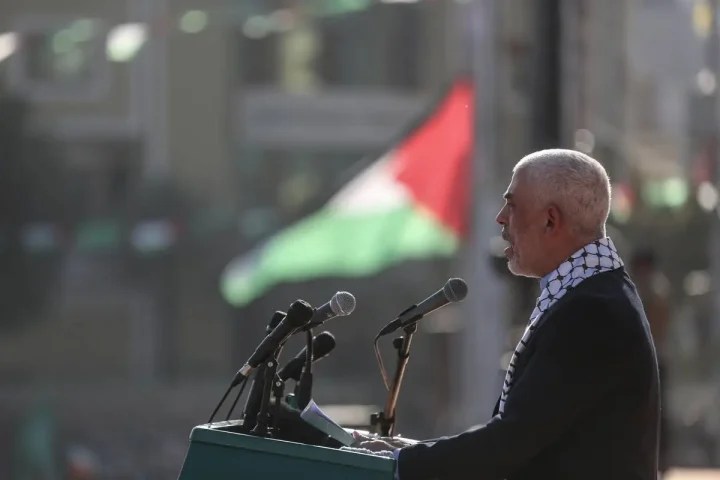
Yahya Sinwar, Palestinian leader of Hamas in Gaza Strip in Gaza City, Gaza on December 14, 2022. [Ali Jadallah/Anadolu Agency]
MEMO | September 4, 2024
In a move that has sparked concerns over its potential to disrupt ongoing ceasefire negotiations, the US has filed criminal charges against six Hamas leaders, including Yahya Sinwar, for their involvement in the 7 October attack on Israel. The indictments were announced by the US Department of Justice.
The charges include the alleged killing of American citizens and “conspiracy to finance terrorism”. However, analysts note that the action is largely symbolic, as some of those named in the indictment are already believed to be dead.
“Yahya Sinwar and the other senior leaders of Hamas are charged today with orchestrating this terrorist organisation’s decades-long campaign of mass violence and terror, including on 7 October,” said US Attorney General Merrick Garland. “The defendants are responsible for financing and directing a decades-long campaign to murder American citizens and endanger the security of the United States.”
Of the six defendants mentioned, three are already dead. Those still alive are Sinwar, who is believed to be in Gaza; Khaled Meshaal, who is based in Doha and heads the group’s diaspora office; and Ali Baraka, a senior Hamas official based in Lebanon.
The charges, which were filed in February but only made public on Tuesday, cover a range of alleged attacks by Hamas over several decades. At least 43 American citizens were reportedly killed in the October attack. Garland did not disclose details regarding how they died or whether any of the 43 Americans are among the dozens of civilians killed by Israeli forces under the so-called Hannibal Directive.
The controversial policy, also known as the Hannibal Protocol, essentially authorises the use of maximum force to prevent the capture of Israeli soldiers and citizens, even at the risk of harming or killing the soldiers and citizens themselves.
Garland also made no mention of the right of Palestinians to resist foreign occupation let alone a foreign occupation that is also illegal. In July, the highest legal body in the world, the International Court of Justice (ICJ), ruled that Israel’s occupation is unlawful. In its determination the ICJ further affirmed that both Gaza and the West Bank are under illegal occupation, which means that armed resistance against Israel is permissible under international law, provided it is conducted in accordance with the rules of engagement established by international humanitarian law.
Critics argue that the timing of Washington’s announcement could complicate ongoing efforts to broker a ceasefire and secure the release of hostages. Professor Yossi Mekelberg, an associate fellow at the UK think tank Chatham House, told the BBC that the charges could affect Sinwar’s mindset, stating, “I don’t think this will be encouraging him to show flexibility.”
The situation was complicated further by Israel’s assassination of Hamas chief Ismail Haniyeh at the end of July. Haniyeh was the key negotiator for the movement. The political murder took place in Tehran at a critical juncture in the negotiations, and has been criticised widely for derailing the peace process. Many observers argue that Haniyeh’s assassination has impeded negotiations significantly, setting back progress towards a ceasefire and hostage release.
Speaking to Associated Press, however, an unnamed US official attempted to downplay concerns about the impact on negotiations, saying that, “There is no reason to believe this will affect the ongoing talks.” However, the cumulative effect of these actions on the ceasefire process remains uncertain.
The effectiveness of these charges is questionable. Nevertheless, the US Justice Department maintains that they send a strong message to Hamas and its supporters.
Hamas: Washington adopts Israel’s ceasefire-disrupting position
Palestinian Information Center – August 29, 2024
ISTANBUL – The Hamas senior official Sami Abu Zuhri said the US administration adopts the Israeli position, which is disrupting ceasefire negotiations, noting that Washington is not serious about obliging Israel to stop its war on the Gaza Strip.
This came in his interview with Aljazeera Net in Istanbul on the sidelines of his participation in a conference held by the “Al-Quds International Foundation”.
Abu Zuhri told Aljazeera Net that the US administration does not show serious intention to obligate Israel to conclude an agreement.
He explained that the Hamas Movement “accepted the proposal of the brokers – Egypt, Qatar and the United States – on July 2, but Israel kept imposing new conditions, although the offer is outlined by the US President Joe Biden’s speech and the UN Security Council resolution.”
On the prospects for the negotiations in the future, Abu Zuhri said, “In all cases, there is an ongoing Israeli war of extermination in Gaza, and all international parties have to assume their responsibilities to stop the Israeli aggression and crimes.”
Abu Zuhri added, “the ball is now in the Israeli and the US court. If the Us administration is serious to reach an agreement, it must intervene to compel the Israeli occupation authority to stop this aggression against the Palestinian people and respect the previously reached agreements.”
With regard to the ongoing developments in the occupied West Bank, and the expansion of the Israeli occupation army’s military operations, Abu Zuhri said that the Israeli occupation army exploits the US cover to expand its aggression in the West Bank, stressing that the Israeli aggression is not limited to Gaza but extends to all the occupied Palestinian territories, especially the West Bank and Jerusalem.
Hamas: US Secretary of State is marketing illusions
Palestinian Information Center – August 23, 2024
“The US Secretary of State’s statements aim to market illusions, while Israeli Prime Minister Benjamin Netanyahu deliberately obstructs efforts to reach an agreement to end the war, by setting conditions that contradict what was previously agreed upon,” Hamas Political Bureau member Hossam Badran said in press statements on Thursday.
Badran considered the US Secretary of State’s statements about the Israeli approval of the amended proposal as “a kind of deception and marketing of illusions.”
The member of the Hamas Political Bureau confirmed during a TV interview that these statements clearly reflect the stubborn Israeli positions, as the proposals put forward by the US Secretary of State were not accepted by the Israeli authorities. On the contrary, Netanyahu has repeatedly announced his conditions and requirements that are in stark contrast to everything that was previously agreed upon, especially with regard to the July 2, 2024 paper.
Badran explained that the US Secretary of State appears to be speaking on behalf of Netanyahu, while all indications say that Netanyahu is the main obstacle to reaching any agreement, and this is confirmed by the statements of the Israeli army minister himself.
Asked about possible options to bridge the gaps in the negotiations, Badran said that the Palestinian demands have always been clear and specific, adding that “we agreed to the proposal presented on July 2, and that the mediators had pledged at the time that the Palestinian resistance’s approval of that paper would bring approval from the occupation,” explaining that if the US is serious about achieving a ceasefire or reaching an agreement, it must abide by what it had previously offered and agreed upon.
He further stressed that pressure must be directed towards Netanyahu, who refuses to abide by international demands calling for an end to the war.
Badran reiterated that “the US is not just a mediator in this conflict, but a real partner in the war against the Palestinian people,” saying that the US support for Israel goes beyond armament and funding, to include political, diplomatic and media support.
Badran stressed that the Palestinian resistance will not give Netanyahu the opportunity to manipulate through empty negotiation rounds, stressing that the resistance will continue to defend the Palestinian people with all its capabilities and abilities.
The untold terms of the new American ceasefire proposal
By Motasem A Dalloul | MEMO | August 21, 2024
A new leader for the next phase of Palestinian resistance

Yahya Sinwar, head of the Palestinian Islamic movement Hamas ,in Gaza City on 14 April 2023 [Yousef Masoud/SOPA Images/LightRocket via Getty Images]
By Sayid Marcos Tenório | MEMO | August 20, 2024
The Palestinian Islamic Resistance Movement, Hamas, announced on 6 August the election of Yahya Sinwar as the new head of the movement’s Political Bureau, succeeding Ismail Haniyeh, who was assassinated in an Israeli terrorist attack in Tehran. Haniyeh was in the Iranian capital to attend the inauguration of President Masoud Pezeshkian.
Sinwar is one of the most prominent figures in the Hamas political sphere, known for his heavy hand and for making big changes. His unanimous election is a strong message that Hamas has become stronger and more resilient despite the severe blow it received from the political murder of Haniyeh. The movement expressed its confidence in Sinwar, known as Abu Ibrahim, to lead this new delicate phase in a complex local, regional and international context.
Known for his steadfast leadership style and his resistance-focused approach to the occupation state, Sinwar has played a crucial role in shaping the resistance movement’s strategies and managing Gaza’s complex political and social relations.
Hamas wanted a replacement for Haniyeh who would send strong messages to the enemies of the Palestinian people.
Sinwar was elected head of the Hamas Political Bureau in Gaza in February 2017, also succeeding Ismail Haniyeh. He was re-elected for a second term in 2021. He led the Great March of Return in 2018, a peaceful attempt to break the siege of Gaza, as well as the Sword of Al-Quds campaign in 2021. He has also played a prominent role in strengthening relations with the axis of resistance.
The new political bureau head was the mastermind and commander of the epic Al-Aqsa Flood, which has lasted more than 300 days. In a speech at the commemoration in Gaza on 14 December 2022 of the 35th anniversary of the creation of Hamas, he foreshadowed the events of 7 October when he declared: “We will come to you [Israel], God willing, in a thunderous flood. We will go against you with endless rockets, we will go against you in an endless onslaught of combatants, we will go against you with millions of our own, like an endless tide.”
The other Palestinian factions and leaders of the axis of resistance expressed their support for Sinwar’s election, demonstrating confidence in his ability to overcome the loss of Haniyeh and to continue his legacy and that of all the martyred leaders, especially those who fell during Al-Aqsa Storm.
Yahya Sinwar was born in 1962 in the Khan Younis refugee camp in the Gaza Strip after his family was ethnically cleansed from the city of Majdal Asqualan (“Ashkelon”) by the Zionists in the 1948 Nakba. He completed his secondary education at Khan Younis Boys Secondary School. He then earned a bachelor’s degree in Arabic from the Islamic University of Gaza, where he was one of the leaders of the Student Council for five years, serving as Secretary of the Artistic Committee, then of the Sports Committee, Vice-President, President of the Council, and then Vice-President again from 1982 to 1987.
He began his political activity in his youth, leading numerous popular clashes against the Zionist occupation state between 1982 and 1988. His participation was instrumental in the founding of Majd, the Hamas internal security apparatus tasked with exposing Israeli spies. Along with Salah Shehada, he was one of the founders of the Hamas military wing, the Izz Ad-Din al-Qassam Brigades, in 1991.
Arrested by Israel in 1982, Sinwar spent six months in Fara’a Prison for his resistance activities. In 1988, he was arrested again and given four life sentences, serving 23 consecutive years in the enemy’s prisons.
He spent four years being held in solitary confinement.
In prison, he repeatedly assumed leadership of the Hamas prisoners’ High Command, leading a series of hunger strikes, with significant examples in 1992, 1996, 2000 and 2004. He learnt and still speaks fluent Hebrew and has numerous writings and translations related to political and security issues.
He translated the books Shabak Among the Remains and Israeli Parties in 1992, for example, and authored Hamas: Experience and Mistakes and Al-Mayd, which documents the work of the occupation state’s Shin Bet internal security agency. He is also the author of a novel, Thorns and Carnations, which covers the experience of the Palestinian struggle from the 1967 Naksa to the First Intifada (1987-1993).
After his release in 2011 under the prisoner exchange deal which saw 1,027 Palestinian prisoners freed in exchange for Israeli soldier Gilad Shalit, he was elected to the Hamas political office in Gaza and assumed responsibility for the security cabinet in 2012. He was later elected to the general political office and assumed responsibility for the military cabinet in 2013.
Now, the legitimate resistance for the liberation of the historic land of Palestine from occupation, with Jerusalem as its capital, continues under the leadership of Yahya Sinwar, a selfless anti-colonial, anti-occupation fighter.
Hamas reveals details of latest US proposal for Gaza ceasefire: Report
The Cradle | August 18, 2024
Sources in the Hamas movement revealed details of the newest US proposal for a Gaza ceasefire between the Palestinian resistance movement and Israel, Al-Sharq newspaper reported on 18 August.
An official source in the movement told Al-Sharq that the US proposal included reducing the presence of the Israeli army on the strategic Gaza-Egypt border area known as the Philadelphia Corridor but not a full withdrawal of the Israeli army. The proposal also included the returning management of the Rafah crossing to the Palestinian Authority (PA) under Israeli supervision.
The source added that the US proposal also includes allowing Israel to monitor displaced Palestinians at the Netzarim Corridor as they return to the north of Gaza.
Washington’s proposal also includes deporting outside of Palestine a large number of Palestinian prisoners who will be released by Israel in the exchange deal, according to a source in the Hamas movement.
The source also pointed out that the proposal gives Tel Aviv the right to refuse the release of at least 100 Palestinian prisoners now held in Israeli prisons in any exchange for the remaining Israeli captives held by Hamas.
The US proposal additionally states that “a permanent ceasefire will be discussed in the second phase within a specific limit, and if Hamas does not agree to the Israeli demands, the army will return to the war and carry out its military operations,” according to the source.
He explained that according to the proposal, an agreement on the reconstruction of Gaza and lifting of the 17-year blockade on the enclave would be discussed only after the implementation of the first phase of the deal.
The US proposal comes as Israel continues to carry out regular massacres of women and children in Gaza and amid reports that Israeli Prime Minister Benjamin Netanyahu is seeking to sabotage a possible ceasefire deal.
Documents cited by the New York Times (NYT) on 13 August confirmed that Netanyahu has continued to add new conditions to Israel’s demands each time a deal for a ceasefire is close to being reached.
The unpublished documents show that Israel “relayed a list of new stipulations in late July to American, Egyptian, and Qatari mediators that added less flexible conditions to a set of principles it had made in late May,” NYT reported.
It added that the documents “make clear that the behind-the-scenes maneuvering by the Netanyahu government has been extensive.”
Hamas has stated that Netanyahu continues to delay a ceasefire agreement to give the Israeli army more time to kill Palestinians and destroy homes and infrastructure in Gaza. The resistance movement called in a statement on 12 August for mediators to push Israel into accepting the proposal it had agreed to in early July, which was an updated version of Biden’s May proposal.
“We demand that the mediators submit a plan to implement what they presented to the movement and that we agreed to on 2 July 2024, based on Biden’s vision and the Security Council resolution, and oblige the occupation to do so, instead of going to more rounds of negotiations or new proposals that provide cover for the occupation’s aggression and give it more time to perpetuate the war of genocide against our people,” Hamas said on 11 August.
This week, the number of Palestinians killed by Israel in Gaza exceeded 40,000, according to the health ministry. The number may be much higher due to indirect deaths from the destruction of Gaza’s health and sanitation infrastructure and due to those people who remain missing, buried under the rubble of buildings and homes destroyed by Israeli bombs.
Featured Video
Trita Parsi: Israel Set a Trap for Total War in the Region
or go to
Aletho News Archives – Video-Images
From the Archive
Zionism’s Violent Legacy
By Donald Neff | Washington Report On Middle East Affairs | January 1996
On January 4, 1948, Jewish terrorists drove a truck loaded with explosives into the center of the all Arab city of Jaffa and detonated it, killing 26 and wounding around 100 Palestinian men, women and children.[1] The attack was the work of the Irgun Zvai Leumi – the “National Military Organization,” also known by the Hebrew letters Etzel – the largest Jewish terrorist group in Palestine. The Irgun was headed by Revisionist Zionist Menachem Begin and had been killing and maiming Arabs, Britons and even Jews for the previous ten years in its efforts to establish a Jewish state.
This terror campaign meant that at the core of Revisionist Zionism there existed a philosophical embrace of violence. … continue
Blog Roll
 Aletho News
- Trita Parsi: Israel Set a Trap for Total War in the Region
- Trump’s Iran war is on an Israeli leash
- Saudi oil boss issues global supply warning
- Riyadh Says Its Oil System Is Intact. The Numbers Say Otherwise.
- Trump and Netanyahu Want to “Finish the Job” on Iran
- US ‘one-sided dictation’ not Iran’s beliefs makes rational talks impossible: Baghaei
- Iran’s Next Strike May Not Explode. It Could Shut You Down /Col Doug Macgregor
- Iran: US political targets legitimate if assassinations return
- Iraq shuts key border crossing with Iran under US pressure: Report
- Undersea Internet cables could be targeted in retaliation for attacks on Iran: IRGC deputy chief
- If Americans Knew
- The Israel Lobby’s Changing Fortunes
- AIPAC has become such a political liability that it’s shifting to a more “nimble” approach to buying politicians
- At least 160 Israeli settler attacks in 2 weeks
- Will Gaza’s Ancient Christian Community Disappear Forever?
- Israel’s vision of regional security rests on keeping Arab states weak
- Heidi Levine recounts how Palestinian youths helped save her in settler attack
- DAILY UPDATE: Latest essential news on Palestine, Israel, & region
- Trump’s Intensifying Sabotage of the ICC, for Israel’s Sake
- Israeli military detain US and UK volunteers in West Bank including Democratic NY politician Brad Lander
- Americans at National Conservatism Conference held in Israel this year criticize Israel
- No Tricks Zone
- E-Cars Reduce CO2 Emissions By Only 41% Compared To Internal Combustion Engine Vehicles
- Predictions Made By Renowned Climate Professor Over Past Decades Have Been Proven To Be Poor
- New Study Suggests Large Regions Of The Pacific Ocean Have Been Cooling For The Last 80 Years
- Germany’s Green Energy Debacle: High Energy Costs Force Kahla Porzellan to Close After 182 Years!
- New Study: 50 Years Of The Most Aggressive ‘Net Zero’ Policies Can Only Affect The Global Climate By 0.03°C
- US September “Heat” Was No Record…Many Records Set Decades Ago
- Latest European Green Energy Debacle; Portugal’s Largest Flagship Solar Park Insolvent!
- Green Energy Debacle: German Expert Professor Fritz Vahrenholt Warns Of Severe Economic And Social Consequences
- Two More Paleo Reconstructions Affirm Meters-Higher Sea Levels Across Ireland, Brazil 7000-6000 Years Ago
- New Study: Earth And Venus Surface Warmth Largely Explained By Convection And Lapse Rate, Not CO2 Or Radiation

