Paraguay Labels Hamas, Hezbollah ‘Terrorist Groups’; Israel Applauds
teleSUR | August 19, 2019
Israeli Prime Minister Benjamin Netanyahu praised Paraguay’s decision Monday to label Palestinian organization Hamas and Lebanese militant group and political party Hezbollah, as “international terrorist organizations,” a move that comes shortly after Argentina first blacklisted Hezbollah.
“I welcome the decision of Paraguayan President Mario Abdo to define Hezbollah and Hamas as terrorist organizations,” Netanyahu said in a statement before he added that Israel is “working so that more countries will also take this important step.”
Paraguay announced its decision on Monday to designate the Lebanese group, along with the political faction of Hamas that governs Gaza in Palestine, as terrorist groups. The South American country’s presidency detailed that Hamas and Hezbollah will be ranked “international terrorist organizations” and al-Qaeda and the Islamic State group “global terrorist organizations”. The difference between the labels was not made clear.
With this resolution, the country “recognizes and reaffirms its commitment to redouble efforts to prevent and combat violent extremism”, the presidency stated.
Several states have already listed both groups as terrorists, among them Israel, the United States, and Canada. Washington designated Hezbollah as a terrorist organization in 1997. However, the U.S. has been recently leading a fierce campaign in the backdrop of its warmongering against Iran and has been pushing more and more countries to designate the Hezbollah (which is backed by Iran) as a terrorist group.
Argentina was the first Latin American country to take the step, gaining recognition from Washington’s neoconservatives, including U.S. Secretary of State Mike Pompeo.
Following Argentina’s move, a group of Republican lawmakers called on Pompeo to pressure Brazil and Paraguay to act the same and to designate Hezbollah.
“Argentina, Brazil, and Paraguay are in a unique position to take meaningful strides in the fight against terrorism at the hands of Hezbollah,” said Republican Senator Marsha Blackburn in a statement at the time.
“We must recommit to ensuring that Hezbollah and other Iranian proxies are denied the resources they need to escalate their campaign of global terrorism,” added Ted Cruz, another Republican senator and co-signatory of the letter to Pompeo.
Hezbollah and Hamas leaders say their movements are resistance movements. The Palestine Islamic Resistance Movement (Hamas) was created out of the military occupation of the West Bank, Jerusalem, and Gaza, while the Lebanese Party of God (Hezbollah) rose to oppose the presence of Israel in the south of Lebanon.
The pressure exercised on Israel to leave the south of Lebanon (2000) and Gaza (2005) produced massive popular support which resulted in victories in both municipal and national elections. Both armed groups shifted since then towards increasingly passive policies, though at the same time they continue to be condemned to ostracism by Israel, the U.S. and Europe.
Last month, Trump’s administration imposed sanctions on Hezbollah political officials, including members of the Lebanese parliament, accusing the group of threatening the “economic stability and security of Lebanon and the wider region.”
RELATED:
Facebook defeats appeal in US claiming it aided Hamas attacks in Israel
MEMO | July 31, 2019
Facebook Inc on Wednesday defeated an appeal by American victims of Hamas attacks in Israel, who sought to hold the company liable for providing the group a social media platform to further its terroristic goals, Reuters reports.
The 2nd US Circuit Court of Appeals in Manhattan said the Communications Decency Act (“CDA”), a 1996 law regulating internet content, shielded Facebook from civil liability.
It also declined to consider the plaintiffs’ foreign law claims, noting that most plaintiffs, including relatives and estates of victims, said they were Americans living in Israel.
The plaintiffs originally sought $3 billion in damages from Facebook, for allowing Hamas to use its platform to encourage terrorist attacks in Israel, celebrate successful attacks, and generally support violence toward that country.
Their complaint described Hamas attacks against five Americans, four of whom died, in Israel from 2014 to 2016.
Lawyers for the plaintiffs did not immediately respond to requests for comment. Facebook, based in Menlo Park, California, did not immediately respond to similar requests.
Wednesday’s decision is a fresh setback to efforts to hold companies such as Facebook and Twitter Inc liable for failing to better police users’ online speech. It upheld a May 2017 dismissal by US District Judge Nicholas Garaufis in Brooklyn.
In seeking to overturn that dismissal, the plaintiffs said Facebook functioned as a matchmaker between Hamas and people receptive to its messages, and should not be immune from liability as a mere “publisher” of Hamas’ content.
Circuit Judge Christopher Droney, however, said it would turn the CDA “upside-down” to suggest that Facebook’s having become an “especially adept” publisher exposed it to liability.
He also refused to hold Facebook liable because its “friend” and content-based algorithms might have helped direct people interested in Hamas.
“Merely arranging and displaying others’ content to users of Facebook through such algorithms – even if the content is not actively sought by those users – is not enough to hold Facebook responsible as the ‘developer’ or ‘creator’ of that content,” Droney wrote.
Chief Judge Robert Katzmann, part of the three-judge appeals court panel, dissented from the algorithms discussion.
He said Congress did not consider how broadly to immunize social media companies, when it passed the CDA to regulate online pornography, and might rethink how to treat those accused of encouraging terrorism, propaganda and extremism.
“Over the past two decades the Internet has outgrown its swaddling clothes,” Katzmann wrote. “It is fair to ask whether the rules that governed its infancy should still oversee its adulthood.”
The US Department of State has designated Hamas a foreign terrorist organization since 1997.
The case is Force et al v. Facebook Inc et al, 2nd US Circuit Court of Appeals, No. 18-397.
Hamas lauds Abbas’s decision to revoke agreements with Israel
Palestine Information Center – July 26, 2019
GAZA – The Hamas Movement has applauded Palestinian Authority president Mahmoud Abbas’s decision to renounce the agreements signed with Israel as “a step in the right direction,” calling for translating it into actions immediately.
“This move is in line with the requirements of the difficult stage the Palestinian cause is facing and will repair wrong paths that have always twisted the Palestinian political trajectory and brought the Palestinian question to such difficult juncture,” Hamas stated on Thursday.
The Movement stressed that the Palestinian people looks forward to real and urgent practical measures that translate Abbas’s decision into actions.
Egypt Rejects Hamas’ Request for Haniyeh to Travel
Palestine Chronicle | July 12, 2019
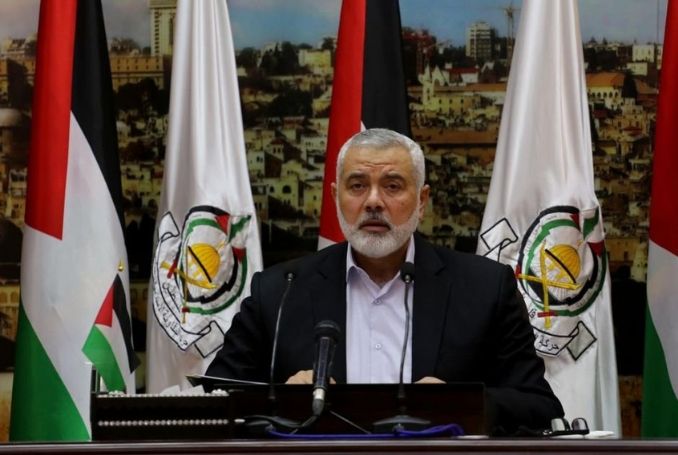
Egypt has rejected a request by Hamas to allow the head of its political bureau, Ismail Haniyeh, to travel to a number of countries including Iran, Turkey, Qatar, and Russia.
Al-Araby Al-Jadeed reported Egyptian sources as saying that after postponing its response, Cairo finally rejected it saying that regional and security conditions do not allow for Haniyeh to travel.
The news site quoted a Hamas source as saying:
“It is clear that Egypt completely objects to Haniyeh’s foreign tour, in protest against the countries which he will visit.”
The source pointed out that Hamas has decided that Mousa Abu Marzouk will head the movement’s delegation to Moscow next week to discuss the Palestinian reconciliation file among other issues.
The source added that the visit has been postponed more than once in the hope that Egypt would allow Haniyeh to travel.
Hamas Condemns Bahrain Minister’s Comments on ‘Israel’

Bahraini Foreign Minister Khalid Bin Ahmed Al-Khalifa
Al-Manar | June 28, 2019
A senior member of the Hamas Political Bureau has condemned comments by Bahrain’s Foreign Minister Khalid Bin Ahmed Al-Khalifa that ‘Israel’ is a “country to stay” in the region which should be recognized.
Mousa Abu Marzook took to Twitter to say that the minister’s call for such recognition by Arab states proved that the goal of the “Peace to Prosperity” workshop in Manama is to destroy Palestinian rights and normalize ties with the Israeli occupation. The Hamas official reiterated his rejection of the workshop.
According to the Bahraini Foreign Minister on Wednesday, the Manama conference could be a “game changer”. Speaking to an Israeli TV channel, Al-Khalifa added that the Manama summit could be like Egyptian President Anwar Sadat’s visit to occupied Jerusalem in 1977, which paved the way for the Camp David Accords and normalization of ties between Egypt and the Israeli occupation. He confirmed that his country recognizes the Israeli occupation state’s “right to exist” and that it wants “peace” with Tel Aviv.
Mishaal: Palestinians are unanimous in rejecting deal of the century
Palestine Information Center – June 27, 2019
Former head of Hamas’s political bureau Khaled Mishaal has expressed the Palestinian people’s rejection of the US deal of the century and its economic conference in Bahrain.
 In televised remarks on Tuesday, Mishaal described the deal of the century as “suspicious, poisonous and aimed at liquidating the Palestinian cause,” affirming that “the Palestinian people are unanimous in rejecting the deal and will not allow it to take place.”
“The deal of the century has no future and will be doomed to failure, God willing,” he said.
“There are Palestinian constants and red lines our people are adherent to and they will not accept any bargaining over them,” the Hamas official added.
He accused some Arab regimes of attempting to sell out Palestine which he described as “the Jewel of the Arabs” through accepting bribes coming from their own money.
“Those who have internal crises and agendas and want to sacrifice Palestine for their own sake and to please American are mistaken and committing a crime against Palestine. If they want to gamble, they should gamble with what they have,” he stressed.
He said that Israel can never be part of any solution or the region, describing it as an enemy of the Palestinian people and the Arab nation.
Haniyeh: ‘Palestine is not for sale’
MEMO | June 27, 2019
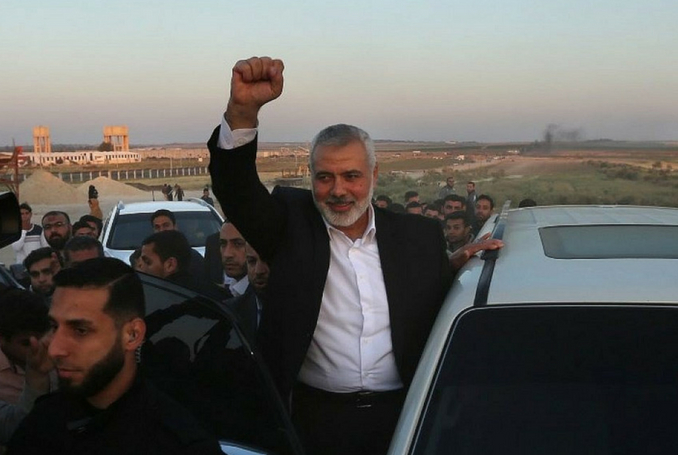
Head of Hamas’ political bureau Ismail Haniyeh has said that the Manama workshop “secures economic cover for a political attempt to liquidate the Palestinian cause.”
Haniyeh’s statement came in a speech during a conference organised by Palestinian factions on Tuesday, entitled the Palestinian National Conference to face the Deal of the Century and Reject the Manama Workshop held in Gaza.
He added: “We are witnessing a crucial historical moment. Our position is clear: Palestine is not for sale. No for deals which consecrate the occupier’s hegemony over our land.”
He continued: “The Palestinian people stand today in the face of the Manama workshop in a renewed uprising and political revolution, as Palestinians have sensed the unprecedented strategic threat facing the Palestinian cause.”
Haniyeh pointed out that the Manama workshop “grants Israel the green light to expand its occupation efforts and control over the entire West Bank, in addition to paving the way for normalisation with Arab countries and the integration of the occupier in the region.”
He stressed that the workshop “was born dead and frustrated. The Palestinian people today stand unified in the face of these deals.”
Haniyeh continued that “all Arab people stand today to emphasise the significance of the Palestinian cause and that Jerusalem is the compass of the nation.”
On Tuesday evening the Manama Peace to Prosperity Workshop began in Bahrain, looking at the economic aspects of the Middle East peace settlement plan, known as the deal of century, according to US media.
Haniyeh demanded all factions “insist on steadfast adherence to the Palestinian cause, primarily Jerusalem, the right of return and a sovereign state with Jerusalem as its capital on the entire national territory.”
Haniyeh said: “We, Hamas, are ready now to meet with Palestinian President Mahmoud Abbas in Gaza, in Cairo or anywhere.”
Haniyeh called for “the formation of a government of national accord to run our affairs, and prepare for the presidential and legislative elections as well as the Palestinian National Council.”
The movement’s leader also called for “the reconstruction of the Palestine Liberation Organisation to include all factions under one single leadership.”
India & Israel Are Officially Diplomatic Allies At The UN
By Andrew Korybko | EurasiaFuture | 2019-06-12
India just made history at the UN earlier this week, but in what’s sure to be interpreted as an ignoble way by the supporters of the emerging Multipolar World Order. Encouraged by the massive mandate that he received after his resounding re-election last month, Modi gave the go-ahead for his government to break with decades of its post-independence political traditions by unprecedentedly supporting “Israel” at the global body and voting against granting consultative status to a Palestinian NGO that allegedly has ties with Hamas.
The self-professed “Jewish State’s” deputy chief of mission in India praised this diplomatic pivot by tweeting “Thank you #India for standing with @IsraelinUN and rejecting the request of terrorist organization “Shahed” to obtain the status of an observer in #UN. Together we will continue to act against terrorist organizations that intend to harm”, in what certainly signifies that Modi’s second term in office will see his country more determinedly siding with the fading Unipolar World Order at the multipolar one’s expense.
India had hithero been trying to make inroads with the Organization of Islamic Cooperation (OIC), but its hopes for future progress on this front have likely been dashed by the self-inflicted soft power damage that it just did by diplomatically allying with “Israel” at the UN. Although Resistance leader Iran continues to beg India to reconsider its decision to abide by the US’ unilateral sanctions regime against it, it’ll now be doing so with the full knowledge that the South Asian state is officially one of its hated “Israeli” foes’ key allies in thwarting the attempts of the Palestinians to have a greater global voice in publicizing their plight. This would make the Islamic Republic’s further outreaches to India even more humiliating than before, possibly raising the chance that it might finally give up in order to save “face” and protect its hard-earned and very proud reputation as the world’s leading anti-Zionist state.
In parallel with this, the global pivot state of Pakistan is now by default the most prominent pro-Palestinian voice in South Asia, especially after Minister for Human Rights Dr. Shireen Mazari recently promised that her country will continue supporting the Palestinians and urged all her Muslim counterparts to do so as well. The fact of the matter is that the Palestinian and Kashmiri causes are inseparable because they’re essentially one and the same — the indigenous Muslim majority of each region have been oppressed by foreign occupiers for decades and have yet to be granted the right to democratically decide their own political futures. Actually, it’s precisely because of these interlinked conflicts that India and “Israel” initially began to ally with one another because they play the same roles in each of them. Accordingly, they’ve increased military cooperation to such a point that “Israel” is now India’s second-largest military supplier and India is “Israel’s” top arms destination.
It therefore shouldn’t be any surprise that India decided to add an official diplomatic dimension to its already-existing military-strategic alliance with “Israel” by supporting it at the UN against the Palestinians. Seeing as how the Indian side hasn’t protested the “Israeli” deputy chief of mission’s tweet thanking it for “rejecting the request of terrorist organization ‘Shahed’” and vowing that “together we will continue to act against terrorist organizations that intend to harm”, it can be logically assumed that New Delhi informally regards Hamas and all those allegedly affiliated with it as “terrorists”, which is only natural considering how fast its alliances with the US and “Israel” are progressing. As such, whether it concerns Russia, China, Iran, or even the Palestinian cause nowadays, India is no longer practicing its over-hyped policy of “multi-alignment” but is instead decisively pivoting against each of the aforesaid multipolar forces despite still clinging to this slogan in an unconvincing attempt to cover its tracks.
Saudi Arabia tightens grip on Palestinians, hampers remittances to Gaza: Report
Press TV – June 8, 2019
Less than a week after Saudi authorities arrested more than 60 people, including Palestinian expatriates and Saudi nationals, on charges of supporting the Palestinian Hamas resistance movement, they have now blocked money transfers between the kingdom and the Gaza Strip.
The new step taken by the Riyadh regime against Palestinians involves official and non-official money transfers as the procedure has witnessed a marked decline over the past week and during the Eid al-Fitr holiday, which marks the end of the Muslim holy fasting month of Ramadan, Arabic-language al-Khaleej Online news website reported.
The report described residents of the besieged and impoverished Gaza Strip as the main victims of the move. Most of the bank transfers that used to be carried out normally in the past, were frozen just a few days before the start of the holiday.
Remittance transactions are taking much longer time than usual – something that used to be done in a matter of few hours.
Many Palestinians have complained of the move, and termed it as “unprecedented.” They argue that the process of transferring money between Saudi Arabia and the Gaza Strip has become extraordinarily difficult.
Abu Fuad, a resident of the Gaza Strip who refused to give his last name for fear that his family could be persecuted in the Saudi Arabian port city of Jeddah, said he has experienced difficulty receiving money from his family.
“It is three days since the remittance has been made, but I have not received anything. Financial transfers used to be done in a few hours and without any obstacles in the past. But since the week before the Eid, the procedures have become complex and most of the transfers are frozen without any obvious reason,” he said.
Abu Fuad considered the measure as a “new crackdown on the Palestinian community living in Saudi Arabia,” stressing that it would aggravate their sufferings as students rely heavily on money transferred from their families living outside the kingdom.
He called upon the Palestinian Embassy in Riyadh to intervene immediately, and try to work out a quick and practical solution to the crisis, which has negatively affected the Palestinian community in Saudi Arabia.
Over the past two years, Saudi authorities have deported more than 100 Palestinians from the kingdom, mostly on charges of supporting Hamas resistance movement financially, politically or through social networking sites.
The Riyadh regime has imposed strict control over Palestinian funds in Saudi Arabia since the end of 2017.
All remittances of Palestinian expatriates are being tightly controlled, fearing that these funds could be diverted indirectly and through other countries to Hamas.
Money transfer offices are asking the Palestinians to bring forward strong arguments for conversion, and do not allow the ceiling of one’s money transfer to exceed $3,000.
Israel’s influence on US foreign policy leads to increased tensions with Iran
By Sarah Abed | InfoRos | May 22, 2019
In order to understand the role that Israel plays in the increased tensions between Washington and Tehran, I reached out to Press TV Correspondent, Ali Musawi.
Sarah Abed: What role, if any, does Israel play in the increased tensions between the United States and Iran?
Ali Musawi: We don’t need to go far to see Israeli fingerprints over a US war in the region. Leading up to the 2003 US invasion of Iraq, Israel and more specifically its current Prime Minister Netanyahu led the choir about Iraq’s WMD and threat to peace and security.
Now, if we look at Netanyahu’s antics concerning Iran, we will see a similar pattern, whether it was the bomb sketch at the UN General Assembly, his almost regular videos about the Iranian threat and the push by Netanyahu to end the “bad deal” between P5+1 and Iran over its nuclear program. Israel doesn’t play a role; Israel clearly orchestrates US war policies.
Sarah: To your knowledge has Israeli intelligence provided any information to the United States that supports the idea of an increased “Iranian threat”?
Ali: As of this moment, no one knows what this sudden “threat” posed by Iran is. We can speculate about anything, from increased Iranian war drills in the Persian Gulf to its military commanders’ typical aggressive tone when addressing the US and allies’ behavior towards the Islamic Republic. And I think before we even try to address any kind of “Iranian threat” we should acknowledge the boy who cried wolf. Is the US administration being truthful? We need evidence, where is Washington’s proof? We should always remember the non-existent WMD used to rally the world against Iraq.
Sarah: Is Israel advocating for a military response by the United States against Iran?
Ali: It is in Israel’s best interest that the US engages in a direct war with Iran. Israel has been threatening attacks against Iran for years simply because Tehran’s support for resistance movements in Palestine and elsewhere threatens the Zionists’ plan to control the region. Israel with all their access to weapons and blank cheques provided by the US and allies, is simply not a match to Iran. By using the US and the excessively armed Gulf countries, Israel is hoping that, at best, a war will weaken Iran, or at worst, a buffer of countries who will sever Iranian support for the resistance movements.
Sarah: What impact would a war between United States and Iran have on Israel?
Ali: Such a war will impact, not only the countries in the region, but the rest of the world. But from a military prospective, if there is a war between the US and Iran, those resistance movements, from Iraq to Palestine, through Yemen and Syria will respond. They will either attack US and allies’ bases in the region or directly attack Israel. We can say that having such resistance movements has been the real deterrent against what can only be a hugely destructive conflict, probably the worst in our lives.
Sarah: Is a full-fledged military confrontation between Israel and Iran likely?
Ali: This is a definite no. While Israel still plays the role of a superpower in the region, it has not been so in over a decade. The 2006 defeat against Hezbollah in Lebanon and the bravery we see from the Palestinians in Gaza, whenever Israel launches wars on the besieged strip, have destroyed its invincibility myth and shown that Israel and its supposed advanced weaponry are only so on paper.
Sarah: How would that scenario play out and what do you suppose would be the outcome?
Ali: Only if the US is directly involved against Iran, will there be a war.
Sarah: What impact could a war between Israel and Iran have on the neighboring countries, primarily Lebanon, Syria, and Iraq?
Ali: If the US is involved of course. All these three countries have been directly impacted by US/Israeli wars over the past few decades. So, the people as well as politicians are aware of the devastation of such conflicts. This is why they will back Iran and even fight alongside Iran simply because the majority of people in these countries oppose US hegemony. The Middle East is divided. There are countries who are controlled by the US/Israel and there are those who are not. No one will sit idly by if a war breaks out. Everyone has something to lose and gain. Such wars don’t usually have winners and will be very expensive to all sides. This is why we are seeing the US backtracking on some of its threats and will continue to do so because the US has become a bully who is afraid of being hurt.
Sarah: Ali, makes some great points that should put the wheels in motion in everyone’s mind, and in particular those who live in the United States. I will pose one more question to our readers, are we willing to go to war with Iran to benefit Israel?
Palestinian Resistance Can Intensify Deterrence in Face of Zionist Enemy: Hezbollah

Deputy Chief of Hezbollah Executive Council Sheikh Ali Daamoush
Al-Manar | May 10, 2019
Deputy Chief of Hezbollah Executive Council Sheikh Ali Daamoush stressed that the silence of some Arab regimes about the Israeli aggression on Gaza was worse than the aggression itself, adding that they showed to be on the enemy’s side, just as the US and the West.
In his Friday sermon, Sheikh Daamoush pointed out that the Zionist enemy failed to achieve the aggression’s aims, adding that the Palestinian resistance proved it had improved its military capabilities.
The Palestinian resistance has a chance to intensify its deterrence capability in face of the Zionist enemy, his eminence stressed.
In a different context, Sheikh Daamoush noted that the US sanctions on Iran expose Washington’s aggressiveness against the regional states, adding that the Islamic Republic of Iran may never bow to such pressures.
Featured Video

U.S. General Caine Warns: STRIKING IRAN is a HUGE RISK
or go to
Aletho News Archives – Video-Images
From the Archives
Stealth Bombers and Bunker Busters
Analysis of the so-called 12-Day War, and the triumphantly celebrated Operation Midnight Thunder

By William Schryver | imetatronink | November 28, 2025
The GBU-57 is a big fat gravity bomb with fins. To achieve effective precision, a B-2 bomber must drop it on its intended target from no further than about five nautical miles — essentially right on top of the target.
Its penetration depth is claimed to be 200 feet. But that capability has NEVER been tested against a seriously hardened deep-underground target encased in layers of high-performance concrete, and topped with a few dozen meters of solid rock. In that sort of real-world scenario, the GBU-57 would be lucky to drill down 50 feet, if that.
It was always ridiculous silly talk to suggest the GBU-57 was the wonder weapon it was made out to be. There is a good reason the US only produced a couple dozen of them and then stopped: they understood its acute limitations in a non-permissive combat environment.
And, notwithstanding the hyperbolic Israeli propaganda, there was never any credible evidence that Iranian medium- and long-range air defenses against fixed-wing aircraft were attrited to any significant degree. And Iranian short-range air defenses were increasingly effective against long-range Israeli drones with each passing day.
As for the B-2: it is a big fat subsonic aircraft. It flies at airliner speeds. A strike on Fordow would entail flying at least 500 miles in and out of Iran. … continue
Blog Roll
 Aletho News
- Drug traffickers trained in Ukraine attack state forces in Mexico
- The tragic reality of Brazilian mercenaries in the Ukrainian conflict
- Zelensky Refused to Discuss Druzhba Pipeline Issue – Fico
- U.S. General Caine Warns: STRIKING IRAN is a HUGE RISK /Glenn Diesen & Lt Col Daniel Davis
- Israel designates five Palestinian media outlets as ‘terrorist organizations’
- Israel, not America, first: Carlson’s Huckabee interview lays bare US foreign policy priorities
- Israeli troops executed Palestinian aid workers at ‘point blank range’: Report
- Iran war What if today’s Iran is resigned to a long, hellish war with the US?
- Why Israel Is Escalating Its War Crimes Against Lebanon
- Iran in the face of the armed diplomacy of imperialism
- If Americans Knew
- The NY Times on the “MAGA” Split Over Israel & USS Liberty
- In Gaza, Ramadan without mosques, imams – Not a ceasefire Day 137
- Footage Shows Israeli Troops Waiting in Ambush, Then Opening Fire on a Palestinian Teen
- The US is on the brink of a major new war that Trump has not even bothered explaining
- Latest Epstein document dump is one more cover-up
- No Protection, No Justice: US Citizens Killed with Impunity by Israel
- Maria Farmer: Epstein Victim Reveals Explosive Information Covered Up by Media
- Average of five Palestinians killed by Israel every day in Gaza since ceasefire – Not a ceasefire Day 136
- Palestinian church leaders admonish Christian Zionist Mike Huckabee – Not a ceasefire Day 135
- Ominous messaging from Trump’s “Board of Peace” – Not a ceasefire Day 134
- No Tricks Zone
- Surprising Discovery: Sahara Is Greening…Billions Of Trees Where Once Thought To Be Barren
- New Research Reaffirms Clouds, Aerosols, And Surface Solar Radiation Are ‘Driving The Climate System’
- Germany: Electric Car Catches Fire At Charging Station, Sets Off Local “Inferno”, Widespread Damage
- New Study: Canada’s New Brunswick Was 1°C Warmer Than Today During The Medieval Warm Period
- Coal Power Back In Trend As Globe Tries To Keep Pace With Growing Demand For Power
- New Study: A 4°C Warmer Beaufort Sea Had ‘No Sea Ice’ 11,700 – 8200 Years Ago
- Unfudging The Data: Dutch Meteorological Institute Reinstates Early 20th Centruy Heat Waves It Had Erased Earlier
- German Gas Crisis…Chancellor Merz Allegedly Bans Gas Debate Ahead of Elections!
- Pollen Reconstructions Show The Last Glacial’s Warming Events Were Global, 10x Greater Than Modern
- Germany’s Natural Gas Storage Level Dwindles To Just 28%… Increasingly Critical
 Aletho News