Hillary Clinton: Iran poses threat to Israel
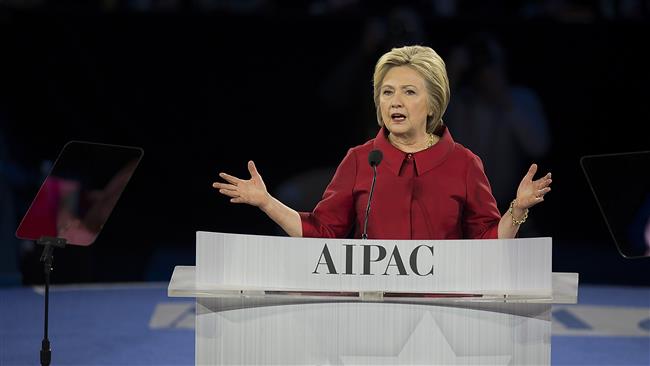
Democratic presidential candidate Hillary Clinton speaks during the 2016 AIPAC Policy Conference in Washington, DC, March 21, 2016. (AFP photo)
Press TV – March 21, 2016
US Democratic presidential candidate Hillary Clinton said in a speech to an influential Zionist lobby group in Washington that Iran still posed a threat to Israel and needed to be closely watched.
Speaking on Monday to the annual policy conference of the American Israel Public Affairs Committee (AIPAC), Clinton also criticized her Republican rival Donald Trump for having a “neutral” stance on Israel.
She said American leaders needed to show loyalty to Israel and “anyone who doesn’t understand that has no business being our president.”
“This is a serious danger and demands a serious response,” Clinton said, declaring that sanctions must be placed against the country. “We must work closely with Israel and other partners to cut off the flow of money and other arms from Iran to Hezbollah” she added.
Many of the US presidential candidates, in particular Clinton, receive large campaign funding from wealthy Jewish donors who have strong ties to the far-right wing in Israel, experts say.
“Clinton is heavily favored by the Israel lobby because she is quite clear about her intention to pursue the war policies of several presidential predecessors,” said Mark Dankof, who is also a broadcaster and pastor in San Antonio, Texas.
“She is getting very, very strong backing from the Israeli lobby and is getting more money from the defense industry than any other candidate in this race,” Dankof told Press TV earlier this month.
On Sunday, activists gathered outside the building where the annual AIPAC conference was being held to protest America’s financial support for Israel.
The US government is pressured to serve Israel’s interests due to the influence of the powerful Zionist lobby in the United States. The pro-Israel pressure groups actively work to steer US foreign policy in favor of Israel.
Mission Accomplished: Fallout Between Iran and Russia in Syria?
By Mahdi Darius NAZEMROAYA – Strategic Culture Foundation – 20.03.2016
Since the start of 2016 the mainstream media in the US and the countries that are in Washington’s sphere of influence have been talking about fallout between Russia and Iran over the conflict in Syria. These media reports continuously talk about Russia becoming afraid of Iran or vice-versa, Iran becoming afraid of Russia. These reports constantly talk about competition and rifts between the Iranian and Russian governments over Syria.
Here are two examples. The Financial Times reported that Iran should be afraid of Russia on February 24, 2016. A few weeks later, Bloomberg reported that the Russian military downsizing in Syria risks a rift with Iran in an article by Ilya Arkhipov, Dana Khraiche, and Henry Meyer, published on March 16, 2016.
For months, however, the steady streams of reports about a Russo-Iranian split have been utterly wrong. They are part of a campaign of misinformation (wrong information and analysis) and disinformation (propaganda). The relations between Moscow and Tehran are stable, and their cooperation is strategically oriented. In fact, Russia is supporting Iran against the US initiative at the United Nations Security Council to say that Iranian ballistic missile tests are a violation of Joint Comprehensive Action Plan (JCAP) signed between Iran and the US, Britain, France, Germany, China, and Russia (the P5+1 or EU3+3).
By the same token, other misleading and deceiving reports have been released about Iranian and Russian tensions. Some have been over the levels of Iranian oil production exports. Others have been about fallout between Moscow and Tehran over an Iranian transfer of Russian arms to Hezbollah in Lebanon. Many have also been about the deal and delivery of the Russian-manufactured S-300 anti-missile system to the Iranian military.
In regards to a Russo-Iranian rift over Iranian oil production, these reports focus on demands by Saudi Arabia and Russia that Iran cut back its oil production. Moscow, however, has said that Iran is a special cases and it understands that Iran is working to regain lost energy markets. It has exempted Iran from its call to cut back global oil exports under a global output freeze as part of an initiative to raise the price of oil. While visiting his counterpart in Tehran in mid-March 2016, Russian Energy Minister Alexander Novak even announced that the Russian government understands and accepts the Iranian position, which demands that Iran be allowed to regain its pre-sanction output levels.
In regards to Israeli media reports that there has been fallout between Iran and Russia over Russian arms being transferred to Hezbollah, no signs of this have manifested themselves empirically anywhere. The Russian government has made no statements against Iran. Nor have the Israeli reports been verified in any substantive way.
It was reported in Kuwait that the S-300 deal had been annulled on March 9, 2016. On the same day Sputnik interviewed an Iranian military spokesperson, who rejected the claim. While, from what the public knows, the delivery of the S-300 system to Iran by Russia has been delayed, this does not automatically insinuate tensions between Moscow and Tehran. Both Iranian and Russian officials have repeatedly denied reports saying that the deal has been cancelled. Delays have taken place due to legal provisions and technical matters, according to officials in Moscow and Tehran. Rostec, the government-owned national arms manufacturer of Russia, has even announced that the first orders of the S-300 will be delivered to Iran sometime running from August to September 2016.
Russo-Iranian Cooperation in Syria
About three weeks after a cease-fire agreement for Syria officially started (on February 27, 2016), Russian President Vladimir Putin announced that Russia would begin to partially withdraw from Syria on March 14, 2016. The next day the Russian military began downsizing its presence in Syria. This began being presented as a stumbling block between Tehran and the Kremlin.
Reports were published that claimed that Tehran was upset at the Russian move. The Russian withdrawal is portrayed in these reports as a surprise to the Iranian side. The Iranian government, however, has announced that the reduction of the Russian military force in Syria is a positive sign of success, which means that Iran and Russia have achieved their key objectives inside Syria. Moreover, if the Russian move hurt Iranian interests inside Syria, it would not have resulted in Israeli President Reuven Rivlin making a request on March 16, 2016 to Moscow to ensure that Iran and Lebanon’s Hezbollah do not benefit from the Russian decision to reduce its military presence.
Nor was Iran caught off guard by the Kremlin’s decision to reduce its military presence in Syria. Iranian and Russian generals and officials have been shuttling back and forth from one another’s capitals for months speaking on and strategizing over the conflict Syria. It is highly unlikely that Moscow’s decision to reconstitute its military position in Syria was not coordinated with either the Iranian or Syrian governments. Tehran, Moscow, and Damascus have been constantly consulting one another about the military operations in Syria.
If it was not for Iranian and Russian cooperation and resoluteness in Syria, the cease-fire agreement in Syria would not have materialized. The most recent wave of false reports about Russian and Iranian tensions in Syria are aimed at creating suspicion and managing the perception of US clients. This discourse is not only aimed at misleading people or targeting Iran and Russia, it is aimed at deceiving US clients and Syrian opposition figures in the Middle East about the reality of the situation on the ground in Syria, which is that the camps supported by the Iranians and the Russians in the Middle East are the ones on top.
Any ideas about some type of Russo-Iranian fallout are wishful thinking. Both powers are moving towards even deeper cooperation across the Eurasian landmass from the Mediterranean littoral and Iraq to the Caucasus and Central Asia. They are not only cooperating militarily together, but both Tehran and Moscow are also deepening their industrial, agricultural, financial, political, and economic ties too. This is no temporary alliance, but part of a long-term engagement and strategic partnership.
Kuwait expels 14 people for links with Hezbollah: Report
Press TV – March 21, 2016
The Kuwaiti government has deported 11 Lebanese and three Iraqis on charges of having links to Lebanon’s resistance movement, Hezbollah, a report says.
The Kuwaiti Arabic daily al-Qabas quoted a security source as saying on Monday that the 14 people had been expelled on the order of the state security service.
The move came nearly three weeks after the [Persian] Gulf Cooperation Council ([P]GCC), under the influence of the Saudi regime, declared Hezbollah a “terrorist” organization. Arab League foreign ministers, except those of Iraq and Lebanon, later followed suit.
The [P]GCC – comprising Saudi Arabia, Qatar, the United Arab Emirates, Oman, Bahrain and Kuwait – however, did not provide any evidence for its allegation. This comes as the first three monarchies themselves stand accused of supporting extremists and terrorists in the region.
Describing the [P]GCC decision as “reckless and hostile,” Hezbollah blamed it on Saudi Arabia.
Elsewhere in its report, Qabas said that Kuwaiti security officials have prepared a list of “unwanted” Lebanese and Iraqi people, including advisers to big companies, to be expelled for “the public interest.”
The people will not be allowed to enter the [P]GCC member states after their deportation, the daily said.
Syria, Iraq: Should Borders Be Redrawn to Partition Sovereign States?
By Alexander KUZNETSOV – Strategic Culture Foundation – 16.03.2016
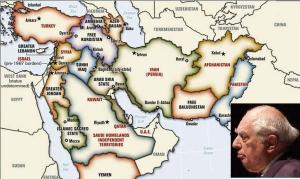 An article titled It’s Time to Seriously Consider Partitioning Syria published recently by Foreign Policy raises serious concerns.
The author writes that the war in Syria has devastated entire cities, the death toll is 470 thousand (there are no reliable statistics to confirm the figure) and 6 million people have become displaced. As a result, religious communities in Syria cannot live together in one state anymore. He believes that Syria should be divided into parts populated by Alawites (for some reason it includes Damascus) and Sunni Muslims. The options include a partition of the country into independent states or forming some kind of loose confederation like Bosnia and Herzegovina. James Stavridis is a four-star Admiral and former NATO Supreme Allied Commander, Europe. He is an influential person in military and political circles.
The Admiral made public his views on Syria soon after US State Secretary John Kerry referred to plan B in Syria in his testimony before the Senate Foreign Relations Committee on March 1.
According to the US top diplomat, he will move towards a plan B that could involve a partition of Syria if hostilities continue because the political forces cannot coexist in one state.
The idea of dividing Syria, Iraq and other states in the Middle East has been considered by US strategic thinkers since the 1980s. Bernard Lewis, the patriarch of American oriental studies, was the first to suggest it. For many years he has been a member of and consultant to the US Council on Foreign Relations (CFR). Formally an independent think tank, the Council exerts great influence on shaping US foreign policy.
In The Roots of Muslim Rage, an essay published in 1990, Bernard Lewis describes a ‘surge of hatred’ rising from the Islamic world that “becomes a rejection of Western civilization as such.” The thesis became influential.
The essay inspired Samuel Huntington, the author of the clash of civilizations hypothesis. Lewis is a widely read expert on the Middle East and is regarded as one of the West’s leading scholars specialized in that region. His advice has been frequently sought by policymakers, including the Bush Jr. administration in the early 2000s. Jacob Weisberg, a prominent US journalist, writes that Bernard Lewis was perhaps the most significant intellectual influence behind the invasion of Iraq in 2003.
In 1979, Bernard Lewis first unveiled his project aimed at reshaping the Middle East to the Bilderberg Meeting in Baden, Austria. The goal was to counter Iran after the Islamic revolution and the Soviet Union with its military deployed to Afghanistan the same year. According to him, the anti-Iranian policy was to include the incitement of an armed Sunni-Shia confrontation and support of the Muslim Brothers movement. The Soviet Union was to be countered by creating an «Arc of Crisis» in the vicinity of its borders. The national states of the Middle East were to be ‘Balkanized’ along religious, ethnic and sectarian lines.
The Lewis project was advanced further after the collapse of the Soviet Union. In 1992 the scholar’s article titled Rethinking the Middle East appeared in Foreign Affairs, the US leading forum for serious discussion of foreign policy and international affairs published by the Council on Foreign Relations.
There he presented a new map of the Middle East. The plan envisaged breaking Syria up into small fragments with the territories populated by the Druze and Alawites separated to become independent mini-states. Lewis wanted to establish new entities: a tiny state on the territory of Lebanon populated by Maronites, an independent Kurdistan comprising the Kurds-populated areas of Turkey, Iraq, Syria and Iran, an independent Shia state in Iraq, an Arab state in the Iranian province of Khuzestan – the major oil-producing region of Iran. The plans also envisaged the creation of independent Balochistan.
Bernard Lewis advocated a policy called ‘Lebanonization’. According to him, “A possibility, which could even be precipitated by Islamic fundamentalism, is what has late been fashionable to call ‘Lebanonization’. Most of the states of the Middle East – Egypt is an obvious exception – are of recent and artificial construction and are vulnerable to such a process. If the central power is sufficiently weakened, there is no real civil society to hold the polity together, no real sense of common identity… The state then disintegrates – as happened in Lebanon – into a chaos of squabbling, feuding, fighting sects, tribes, regions, and parties,” the scholar wrote.
The main goal of such projects is to prevent the emergence of regional forces able to challenge the hegemony of the United States [or Israel]. That’s what made the US add fuel to the fire of the Iran-Iraq war (1980-1988). Washington succeeded in making the war last for eight years. By provoking the hostilities, the US killed two birds with one stone: it prevented Iran from growing stronger and weakened Iraq ruled by the Arab Socialist Ba’ath Party.
The West launched Operation Desert Storm to keep Iraq weak. In 2003 it concocted a false pretext (the possession of weapons of mass destruction) to occupy Iraq and deprive it of sovereignty. By and large, the same fate awaited Syria.
In 1990 Syrian troops remained in Lebanon as peacekeepers in accordance with the Taif Agreement. The US gave its consent because Damascus took part in Operation Desert Storm against Iraq. Besides, the Syrian government of Hafez Assad effectively committed itself not to take hostile actions against Israel. In ten years the situation changed. Damascus launched the policy of strategic partnership with Iran. It supported the Lebanese Hezbollah movement. Washington changed its stance to say the Syrian military in Lebanon was an occupying force. Using the imposition of sanctions as a weapon, the United States made Syria withdraw from Lebanon. In 2011 the US started to undermine the Syria’s national sovereignty.
The most faithful US allies – Saudi Arabia for instance – have no guarantees they will not become part of such plans. Nowadays, the United States does not depend on the oil supplies from the Middle East. It has put an end to the policy of direct confrontation with Tehran. As a strategic partner, Riyadh is not as important as it used to be. It’s hardly a coincidence that US media outlets started to publish maps with Hejaz (a region in the west of present-day Saudi Arabia) drawn as part of Jordan with the eastern part of the Saudi Kingdom together with South Iraq shown as part of Shia Arab state. Actually, a genuine settlement to the problems faced by the Arab world is something quite opposite from what the United States has to offer.
The partition of the Middle East into tiny powerless states will give rise to new crises accompanied by ethnic and religious cleansing. It will lead to a ‘war of all against all’ (bellum omnium contra omnes) – the term coined by Thomas Hobbs.
In case of such a war, the small principalities will need someone for arbitration. Washington will offer itself for this role.
In the future, the creation of large Arab space (Grossraum) may lead the region out of the deep crisis it faces, but that’s a different and a very serious matter to be discussed some other time.
Haaretz Columnists Propose Genocide In Lebanon, Promote Right of ‘Artists’ To Rape Young Girls ‘For Their Art’

Haaretz’s original headline for an article by Amitai Etzioni, a noted Israeli-American academic.
By Richard Silverstein | Mint Press | March 10, 2016
SEATTLE — Haaretz is famed in many circles as Israel’s leading liberal newspaper. In 2011, the New Yorker’s managing editor, David Remnick, deemed it “easily the most liberal newspaper in Israel and arguably the most important liberal institution in a country that has moved inexorably to the right in the past decade.”
The newspaper is part of an Israeli journalistic dynasty founded in the 1930s by Gershom Schocken, a Jewish-German immigrant. His son, Amos, is now publisher. Remnick had these glowing things to say about Amos:
“He is … a singular force in Israeli journalism on issues such as free speech, equal rights for Israeli Arabs, the independence of the Supreme Court, and the exposure of military abuse.”
However, analysis of two recent opinion columns published by Israel’s “most important liberal institution” reveals another side to the story.
Distinguished Israeli-American academic calls for annihilation of Lebanon
Amitai Etzioni, a noted Israeli-American academic, published an alarming piece last month arguing that Israel should not endanger its own troops, who he claimed would be expected to identify and dismantle many of Hezbollah’s 100,000 rockets before they could be fired. Rather, Israel should use a devastating weapons system that would save Israeli lives while annihilating large swaths of territory in which Lebanese civilians live.
Etzioni, 87, is the University Professor at George Washington University, where he serves as director of the Institute for Communitarian Policy Studies, a think tank. The noted sociologist is best known for his advocacy of communitarianism, an academic theory which, in some ways, is a perfect distillation of Israeli attitudes toward individual rights. Etzioni argues that while such rights are important, they must be carefully calibrated so they don’t interfere with the interests of society as a whole. This is precisely the way in which the Israeli national security state persuades citizens that protecting their security is a greater good that justifies sacrificing the interests of the individual.
Etzioni’s Haaretz op-ed was originally titled, “Should Israel Flatten Beirut to Destroy Hezbollah’s Missiles?” That title has been significantly softened to tone down the genocidal content of the piece itself; it now reads: “Should Israel Consider Using Devastating Weapons Against Hezbollah Missiles?”
From this brief excerpt, perhaps you can judge for yourselves which title is more accurate and why it was changed:
“I asked two American military officers what other options Israel has. They both pointed to Fuel-Air Explosives [FAE]. These are bombs that disperse an aerosol cloud of fuel which is ignited by a detonator, producing massive explosions. The resulting rapidly expanding wave flattens all buildings within a considerable range.
Such weapons obviously would be used only after the population was given a chance to evacuate the area. Still, as we saw in Gaza, there are going to be civilian casualties.”
Etzioni vastly understates the lethality of what are otherwise known as FAEs or thermobaric weapons. The Guardian quotes a clinical description of their impact from the Marine Corps Gazette :
“Thermobaric, or ‘fuel-air’ weapons … form a cloud of volatile gases or finely powdered explosives. ‘This cloud is then ignited and the subsequent fireball sears the surrounding area while consuming the oxygen in this area. The lack of oxygen creates an enormous overpressure. … Personnel under the cloud are literally crushed to death. Outside the cloud area, the blast wave travels at some 3,000 meters per second. … As a result, a fuel-air explosive can have the effect of a tactical nuclear weapon without residual radiation. … Those personnel caught directly under the aerosol cloud will die from the flame or overpressure. For those on the periphery of the strike, the injuries can be severe. Burns, broken bones, contusions from flying debris and blindness may result. Further, the crushing injuries from the overpressure can create air embolism within blood vessels, concussions, multiple internal hemorrhages in the liver and spleen, collapsed lungs, rupture of the eardrums and displacement of the eyes from their sockets.’”
Russia used FAEs in Chechnya, and the United States employed them in Fallujah. Some experts on the laws of war have declared the use of FAEs a war crime. In 1992, Michael Ratner, founder of the Center for Constitutional Rights and one of the world’s leading legal experts on these matters, noted that FAEs violate international law:
“The use of asphyxiating gases is prohibited. The U.S. violated this by its use of fuel-air explosive bombs on Iraqi frontline troops; these bombs are terror bombs which can burn the oxygen over a surface of one or two square kilometers, destroying human life by asphyxiation.”
He further noted that FAEs are “outlawed by the Hague and Geneva Conventions, which prohibit the use of weapons causing unnecessary harm to combatants.”
It should’ve been clear to Haaretz editors that they were publishing an op-ed that not only urged Israel to commit war crimes in the next Lebanon war, but that these weapons would also open Israel to charges of genocide given the extraordinarily high death toll that would ensue.
The Israeli Defense Forces itself has developed a similar military strategy for its attacks against Hezbollah. The Dahiya Doctrine, developed by Maj. Gen. Gadi Eisenkot, who would go on to become chief of staff of the IDF, argued that Israel must wreak maximum damage on the civilian neighborhoods of Beirut in which Hezbollah was based. Such devastation would force the Islamist group to pay a maximum price for its attacks on Israel, he asserted. This is precisely what happened during the 2006 Lebanon war, when the Shiite neighborhood of Dahiya, in which Hezbollah’s leadership took refuge, was reduced to rubble. Over 1,000 Lebanese civilians were killed in that conflict.
The strategy appears to have had little deterrent effect. Hezbollah now possesses more than double the rockets it did in 2006 and poses an even fiercer threat to Israeli targets when the next war breaks out.
Etzioni’s claim that FAEs would be used only after civilians were warned to evacuate the target area is pure sophistry. Civilians in war zones have no shelter or refuge. There is nowhere they can go to escape the military onslaught. This has been proven repeatedly both in Gaza and Lebanon.
Israel makes no attempt on the battlefield to provide sites where civilians may shelter safely. It has repeatedly attacked locations such as U.N. schools, killing massive numbers of civilians. In Lebanon, it has attacked convoys of civilians fleeing combat zones and U.N. facilities where civilians have taken refuge. Faced with such a dilemma, many civilians would prefer to take their chances and remain in their homes.
Further, Israel’s attempts at “warning” civilians are feeble at best: The IDF sends targeted communities SMS messages and drops fliers from airplanes warning them to flee. How does a frightened resident whose cellphone battery has died or who is too frightened to venture out of his or her home learn about Israeli orders to flee?
The most cruel and calculating portion of Etzioni’s essay is his call for Israel to recruit pro-Israel “experts” to join war games in which they would be called upon to use these diabolical weapons:
“ … The time to raise this issue is long before Israel may be forced to use FAEs. One way this can be achieved is by inviting foreign military experts and public intellectuals, who are not known to be hostile to Israel, to participate in war games in which they would be charged with fashioning a response to massive missile attacks on Israeli high rise buildings, schools, hospitals, and air bases.
In this way, one hopes, that there be a greater understanding, if not outright acceptance, of the use of these powerful weapons, given that nothing else will do.”
This would supposedly condition the world for future Israeli use of FAEs. Etzioni is essentially calling for pre-approval of war crimes. These enablers would be offering Israel a kind of “Good Housekeeping Seal of Approval” for genocide.
Etzioni: Falsification of historical memory and Nakba denial
Amitai Etzioni has long served as a mouthpiece for the whitewashing of Israel’s moral sins. In March 2014, he wrote an op-ed in the Daily Forward in which he attempted to recount the history of the village where his family settled after fleeing Germany in 1935 and arriving in pre-state Israel:
“In 1935, as Nazi influence grew, my family escaped, joining four other families of the same background to form a new settlement in Palestine in 1936. They named it Kfar Shmaryahu (it’s next to Herzliya). The five families… cleared the rocks, drilled a water well, paved a road before erecting a bunch of modest homes and farming the land. All this was done on previously unoccupied land — land that was lying fallow next to an Arab village called Sidney Alley. …
The relationship between my parents’ village and Sidney Alley varied over the years, ranging from comfortable to tense. However, as far as I recall, no shots were fired, and most assuredly, no one was driven off land or out of a home. Those who lived unmolested in Sidney Alley until 1948 left at that point. We were told that they took with them keys to our homes that they somehow acquired, and had agreed among themselves who will get which of our homes after the seven Arab militaries that attacked the weak and newborn Israel defeated it. I never saw any evidence that supports this tale, but I know firsthand that no Israeli forces drove out the people of Sidney Alley.”
Soon after Etzioni’s account was published, Maher Mughrabi, a Palestinian-Australian foreign news editor for the Australian Age, exposed how woefully inadequate Etzioni’s account and his memory are. In a Letter to the Editor of the Forward, which he also shared with me via email, he wrote:
“Etzioni recalls the neighbouring village’s name as ‘Sidney Alley.’ This surely must strike anyone with an ear for Arab idiom as improbable. … However, if you think a bit about what this place might be called in Arabic, it turns out the mosque is of Sidna (or Sayyidna, meaning ‘our lord’) Ali. And it turns out that if you are not Etzioni, you can remember a history of displacement from this place.”
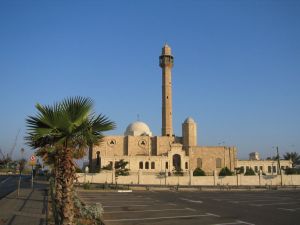
The mosque of the ethnically-cleansed Palestinian village of Sidna
Further, the Palestinians of Sidna Ali were indeed driven from their homes not just by “shots fired” but by cold-blooded murder.
Zochrot, an Israeli NGO dedicated to memorializing Palestinian villages destroyed in the Nakba, offers a fuller account of the events leading to the tragedy of Sidna Ali. A family in the village owned a dairy and orchard on its outskirts. Their Jewish tenant invited Lehi militants to train on the farm. Someone appears to have reported this to British authorities, who then raided the farm, resulting in the killing of four Jewish militants and a commander.

Villagers of Sidna Ali drawing water from communal well (source: Palestine Remembered)
To exact revenge, Lehi returned to Sidna Ali, captured five family members, lined them up against a wall and executed them. The killers deliberately permitted a few members of the family to flee so they could spread the word of the massacre among the Palestinian population. At that point, many remaining villagers saw the handwriting on the wall and fled in terror (this was in the period before the war and ensuring mass expulsions had happened). Those who did not flee were forced to flee later by menacing gunfire sprayed by Jewish forces.
You can see that one of America’s towering academic figures leaves much to be desired when recounting Israeli history. If he wrote as sloppily in his own field as he does on these subjects, he would be labelled a fraud. But instead, the pages of Israel’s leading liberal newspaper are opened wide for him to call for mass murder against Lebanese civilians.
One has to wonder how a newspaper editor decides a contribution from Etzioni about Hezbollah is even relevant. He is not a philosopher of war or ethicist like Asa Kasher or Princeton’s Michael Walzer. He is not an expert on military strategy or Israeli Defense Forces affairs. What is Etzioni’s expertise on the subject?
And even if he had expertise, how does one justify publishing an op-ed calling for genocide? It would appear that Haaretz has, in some fundamental way, gone off the rails.
Haaretz literary editor approves of rape in pursuit of artistic ‘excellence’
This becomes even more clear in the second example of a woefully misguided piece published by Haaretz. In 2013, a popular Israeli entertainer, Eyal Golan, was investigated for allegedly raping teenage girls. His father was later convicted of pimping girls to his cronies, though no charges were ever brought against Golan. In response to an Israeli TV interviewer excoriating him last month for his dissolute personal life, he responded that he made no claim to be a moral exemplar or, as he put it, “the Pope.” On the other hand, and paradoxically, he called himself a “moral man.”

Eyal Golan enjoying the lush life with female admirer
On March 5, Benny Ziffer, the newspaper’s literary editor, responded to a particularly pugnacious recent Israeli TV interview with Golan by a noted female program host. Ziffer’s column launched a crusade not just to redeem Golan’s reputation, but to claim that it is the right of all artists to engage in antisocial behavior (like raping young girls) as long as they do so for their art. Further, he claims that societies which persecute such creative souls are suppressing freedom of expression and the artistic impulse (my translation is from the Hebrew piece):
“Cultured nations know that in order for art to exist and creativity to flourish, artists must enjoy moral privileges and freedoms not available to others. Even tyrants harboring no tolerance for individual freedom understand that artists must be permitted to live a Bohemian existence; and that this is part of the unwritten agreement between a society and its artists, who are offered extensive latitude under ethical norms which permit wild behavior, especially in the sexual realm.
Artists from Goethe to Eyal Golan hover intoxicatedly in the air above the heights of artistry and creativity. They must feel most intensely those things that are considered the basest sexual urges in life, like intercourse with young female admirers. Without this, there would be no creativity, despite all the pain this is liable to cause these young women, whose lives may have been damaged.”
The journalistic crime committed here is rendered even more severe by the fact that the author is neither freelancer nor columnist, but senior editorial staff.
Again, one must wonder what Ziffer’s editor was thinking when he or she approved such journalistic trash for publication. Besides the claims in this passage being pure intellectual bunkum (since when did Goethe ever justify raping young girls in order to delve deeper into his artistic impulses?), did no one at the paper stop to consider the backlash that would stem from this rape apologia?
Haaretz readers have started a petition (Hebrew) calling for the firing of Ziffer. It’s doubtful this will have any impact on Haaretz publisher Amos Schocken, whose approach to criticism is to dismiss it with hurt indignation.
I can attest to this personally. In 2012, the newspaper published an expose about Israeli museums which did not offer Arabic-language inscriptions for exhibits, as required under a law guaranteeing multi-lingual accessibility for publicly-funded cultural institutions. I wrote to the reporter, asking why Haaretz itself never published in Arabic. I argued that doing so would offer a pioneering statement from the nation’s leading liberal daily about the critical importance of embracing the Arabic-speaking Palestinian minority. I suggested, to that end, Haaretz consider publishing an Arabic-language supplement.
Instead of a response from the reporter, Schocken himself replied disdainfully that if I thought such a project was so important that I should find him funding to support it. It was a response, doubtless to say, I found disingenuous, as it wasn’t my job to secure investments in his newspaper.
The following year, Haaretz published its first article in Arabic, an editorial urging Palestinians to “get out and vote.” Ironically, many members of the Palestinian minority do not vote precisely because the institutions of the Jewish majority (like Haaretz ) are largely closed to them. Generally they enjoy second or third-class rights within society, thanks in part to the patronizing approach of elite Ashkenazi Jewish institutions like it.
Haaretz refuses to publish Ziffer’s column in English edition
It should come as no surprise that Ziffer’s op-ed was not translated into English or published in the paper’s English edition. The editors there perhaps had a better understanding of their own readers and determined there was no need to inflame them. But in truth, this is a form of self-censorship. If you want to publish misogynist trash, why only publish it in Hebrew? Why not proclaim proudly to the rest of the English-speaking world what your journalistic values are?
If, as David Remnick argues, Haaretz is the best of Israeli journalism, what does that tell us about Israeli society in general and its Fourth Estate in particular? It tells us that the weight of being a garrison nation in a state of perpetual war has corroded whatever liberal values Haaretz may have once championed. It tells that no matter how much higher are the standards Haaretz upholds than those of their competitors, they are indelibly stained by historical sins of the their society.
Breaking: Managing editor cancels Ziffer’s weekly column
When reached for comment on this story, Aluf Benn, the newspaper’s managing editor, declined, but he did allude to a major forthcoming development.
Shortly thereafter, on Wednesday, Israeli business news site Globes reported than Benn had decided to cancel Ziffer’s weekly column in response to the March 5 piece.
In his final column, published on Wednesday, Ziffer apologized for what he wrote. He added, oddly, that it was all part of a twisted game he played on behalf of his audience:
“I entered into the role of provocateur [Author’s Note: literally, “playful devil”], and the game was good and yielded rewards. The audience was enthusiastic and begged for more and more columns in which I played the the game of provocateur. I reaped success. Together with the intoxication of success, this blurred within me the boundaries between the game and reality.”
Haaretz later published Ziffer’s apology in its English edition. But without the context of the original article (published only in Hebrew), readers of the English edition have no idea what “monstrosity” Ziffer is apologizing for. And that’s probably the way Haaretz’s editors prefer it. Rather than being fully transparent, it has the effect of further concealing the original offense.
Still, Ziffer remains as literary editor of the paper. He will also continue writing other articles for the paper. Presumably, Benn believes that by giving Ziffer a lower profile and “disappearing” his byline, readers — especially female readers — will be able to forget this disaster. In the past heyday of Israeli macho behavior, perhaps Haaretz could’ve gotten away with this. But can you imagine the Washington Post or New York Times in this day and age permitting its literary editor to write such swill and not firing him? The very thought seems preposterous.
Livni Hails Blacklisting Hezbollah, Urges Alliance with Gulf States
Al-Manar | March 14, 2016
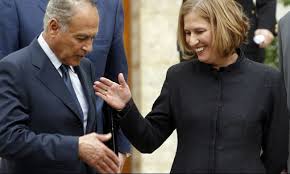 Israeli former Foreign Minister, Tsipi Livni, hailed Arab League decision to blacklist Hezbollah as a ‘terror group’, calling to conclude alliance between the Zionist entity and some Arab states.
“AL decision to adopt the Gulf Cooperation Council is rightful and represents a positive shift,” Israeli daily, Maariv quoted Livni as saying.
Livni meanwhile, called for concluding an alliance between Israel and “moderate Muslim countries” including Gulf states and some Arab countries which blacklisted Hezbollah, the Israeli paper said.
On the other hand, the Israeli politician called for preventing Hezbollah from taking part in the parliamentary elections in Lebanon, according to Maariv.
“Livni also urged not to make distinction between Hezbollah and ISIL,” the daily added referring to the Takfiri group operating in Iraq and Syria (so-called Islamic State in Iraq and Levant).
Severe penalties for anyone backing Hezbollah: Saudi Arabia
Press TV – March 13, 2016
Saudi Arabia says those linked to the Lebanese resistance movement Hezbollah will be punished in accordance to anti-terrorism laws.
According to an Interior Ministry statement published by the state-run SPA news agency on Sunday, Saudi nationals and foreigners living in the kingdom will face “severe penalties” if they sympathize with, financially support, or harbor any of the group’s members.
“Any citizen or resident who supports, shows membership in the so-called Hezbollah, sympathizes with it or promotes it, makes donations to it or communicates with it or harbors anyone belonging to it will be subject to the stiff punishments provided by the rules and orders, including the terrorism crimes and its financing,” read the statement, adding that expatriates would also be deported.
Riyadh’s move appears to be part of the monarchy’s anti-Shia campaign, including a severe crackdown on nationals residing in Eastern Province. Last year, the kingdom executed prominent Shia cleric Sheikh Nimr al-Nimr, which drew widespread condemnation from rights groups and various states.
The Sunday announcement also follows recent decisions by pro-Saudi Arab factions, the Arab League and the [Persian] Gulf Cooperation Council, to brand Hezbollah as a “terrorist” group.
On Saturday, Hezbollah described such measures as a “declaration of aggression” by Riyadh, which is “putting pressure on others at the Arab foreign ministers meeting to do the same,” said Sheikh Naim Qassem, the deputy secretary general of the resistance movement.
Gulf states to take legal action against Hezbollah affiliated TV channels
MEMO | March 9, 2016
Gulf Cooperation Council (GCC) information ministers agreed on Tuesday to take legal action against TV channels affiliated to Hezbollah, Anadolu reported.
This decision came as part of the conclusion statement of the 24th meeting of the GCC information ministers, which was held in the Saudi capital of Riyadh.
“The legal measures stipulated in the decision will apply to all production companies, producers and all matters related to media,” the statement said.
“They are based on the GCC laws and on international laws related to the fight against terrorism,” it said, noting that Hezbollah is considered a terrorist entity.
According to the statement, the GCC described Hezbollah as a group that “incited hatred, chaos and violence” in “blatant violation of the sovereignty, security and stability of GCC and Arab countries”.
On 2 March, the GCC and the council of Arab interior ministers designated Hezbollah a terrorist organisation.
Saudis, Turks Bid to Open Lebanon Front
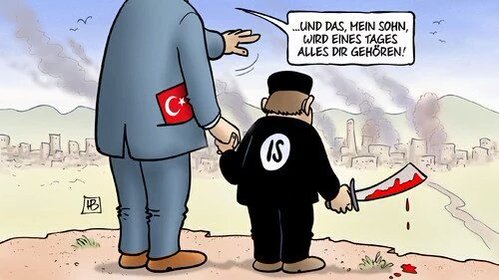
One day, my son, all this will be yours
By Finian CUNNINGHAM – Strategic Culture – 07.03.2016
With a series of blatant measures, Saudi Arabia and its regional allies are evidently trying to destabilize Lebanon. The development is apiece with how Saudi Arabia and Turkey have both sought to undermine the ceasefire in Syria and to escalate that conflict to a region-wide level.
A New York Times report this week poses a rather naive conundrum: «Diplomats and analysts have spent several weeks trying to understand why the Saudis would precipitously start penalizing Lebanon – and perhaps their own Lebanese allies – over the powerful influence of Hezbollah, which is nothing new».
Well, here’s a quick answer: Russia’s very effective squelching of the covert war for regime-change in Syria. That has sent Saudi Arabia and Turkey into a paroxysm of rage.
Russia’s military intervention in Syria to defend the Arab state from a foreign-backed covert war involving myriad terrorist proxy groups, has dealt a severe blow to the machinations of Washington, its NATO allies and regional client states.
While Washington and its Western partners seem resigned to pursue regime change by an alternative political track, Saudi Arabia and Turkey are stuck in the covert-war groove. They are betting that the terrorist proxy armies they have weaponized can somehow be salvaged from withering losses inflicted by Russian airpower in combination with the ground forces of the Syrian Arab Army, Iranian military advisors and the Lebanese Hezbollah militia.
Hence, the immediate breaches of the cessation called a week ago by Washington and Moscow in Syria. Turkish military shelling across the border into northern Syria is not just a breach. It is an outrageous provocation to Syrian sovereignty, as Moscow has pointed out.
Simultaneous Saudi military mobilization, including Turkish forces, on its northeast border with Iraq, as well as the reported deployment of Saudi fighter jets to Turkey’s Incirlik airbase opposite Syria’s northwest Latakia province can also be viewed as calculated moves to undermine the tentative ceasefire. The logical conclusion of this reckless aggression by both Saudi Arabia and Turkey is to precipitate a wider conflict, one which would draw in the US and Russia into open warfare.
The series of Saudi-led initiatives towards Lebanon should be interpreted in this context. In the past week, Saudi Arabia and its closely aligned Sunni monarchies in the Persian Gulf Cooperation Council (GCC) have declared Hezbollah a terrorist organization. The word «anachronistic» comes to mind, belying an ulterior motive.
The Saudi rulers, led by King Salman and his son Crown Prince Mohammad bin Salman, also announced that they were canceling plans to grant Lebanon $4 billion in aid. Most of the aid was to be in form of military grants, to be spent on upgrading the Lebanese national army with French weaponry and equipment.
Without providing any proof, the GCC states – Kuwait, Qatar, Bahrain, the United Arab Emirates and Oman in addition to Saudi Arabia – issued travel warnings to their nationals intending to visit Lebanon. The GCC also claimed that Hezbollah was interfering in their internal affairs and trying to recruit Gulf nationals into the organization to fight in Syria. The GCC has even threatened to deport Lebanese expatriate workers, some half a million of which work in the Gulf.
There were also regional media reports last week of a large cache of weapons having been seized by Greek authorities, stowed illicitly onboard a cargo ship sailing from Turkey to Lebanon.
The cumulative intent seems patent. The Saudis and their regional allies – who have been pushing for regime change for the past five years against the Russian, Iranian and Hezbollah-allied government of President Bashar al-Assad – see the escalation of regional instability as the best way to salvage their covert war in Syria.
Washington, London and Paris probably have sufficient cynical intelligence to realize that the covert war involving terrorist proxies is no longer a viable option – given the formidable forces arrayed in support of the Syrian state, not least Russian air power.
The Saudis and the Turkish regime of Recep Tayyip Erdogan appear to be inflexibly wedded to the covert war agenda. For these powers anything less than the outright removal of Assad would be seen as a grave blow to their despotic egos and, for them, an unbearable boost to their regional rival, Shia-dominated Iran.
The GCC criminalization of Shia-affiliated Hezbollah is obviously a fit of revenge-seeking given how the militia has ably helped the Syrian army retake major areas from the regime-change Sunni extremist insurgents, in conjunction with the Russian air strikes. The steady shutting down of border crossings in Latakia, Idlib and Aleppo has cut-off the terror brigades from their weapons supply routes via Turkey. This is partly why the Erdogan regime has responded by cross-border shelling in order to give re-supply efforts a modicum of artillery cover.
Moreover, the Saudi-led campaign to sanction Hezbollah is also aimed at destabilizing the sectarian fault lines inside Lebanon. Hezbollah may be denigrated by Washington and some other Western states as a «terrorist group» and of presiding over «a state within a state» due to its military wing which exists alongside the Lebanese national army.
Nevertheless, Hezbollah has constitutionally recognized legitimacy within Lebanon. This is partly due to the militia’s primary role in driving out the US-backed Israeli military occupation of the country in 2000 and again in 2006. For many Lebanese people, including Christians and Sunni Muslims, Hezbollah is held with pride as an honorable resistance force to US-led imperialism in the region.
The party – which Russia also recognizes as a legitimate national resistance movement – comprises about 10 per cent of the Lebanese parliament and holds two cabinet positions in the coalition Beirut government.
So the Saudi-led proposal to sanction Hezbollah seems nothing more than a gratuitous bid to open up sectarian fissures that have cleaved Lebanon in the recent past during its 1975-1990 civil war. The provocation of labeling a member of government in a foreign state as «terrorist» – seemingly out of the blue – has to be seen as a tendentious bid to destabilize. Hezbollah leader Hassan Nasrallah this week condemned the Saudi bid to inflame sedition in Lebanon, and it is hard to disagree with that assessment.
There are still pockets of extremist Sunni support within Lebanon that the Saudis and Turkey appear to be trying to incite. During the Syrian conflict, there have been sporadic outbreaks of violence in the cities of Sidon and Tripoli by Salafist elements with close links to Saudi Arabia and Turkey. Now those same elements are being incited to take to the streets again.
It is not clear if Lebanon can hold together. A government minister linked to a pro-Saudi faction has resigned in recent weeks over what he claims is «Hezbollah domination» in Lebanese politics.
Many Lebanese are discontented over social and economic problems dogging the country. A refuse-collection backlog over the past year has left large parts of the capital overflowing with putrid waste. The tiny country of four million is also feeling the strain of accommodating some one million Syrian refugees.
The thought of re-opening old wounds and re-igniting the horror of civil war is a heavy burden on most Lebanese citizens that may be enough to make them baulk at malign pressures.
But what can be said for sure is that the role of Turkey, Saudi Arabia and the other Arab monarchies is absolutely unconscionable and criminal. They seem fully prepared to plunge yet another neighboring country into a sectarian bloodbath in order to gratify their illicit regional ambitions.
Tunisian FM doesn’t support blacklisting Hezbollah, unidentified gunmen raid Tunisian town killing civilians
Israelis Welcome GCC Statement on Hezbollah: Reflects Rapprochement with Saudis
Al-Manar | March 3, 2016
As soon as the Gulf Cooperation Council blacklisted the Lebanese party of Resistance – Hezbollah – on Wednesday, Zionist mass media welcomed the resolution, considering it “critical and serious,” reflecting a great relief among Israelis who have been seeking to fight Hezbollah from the Arab gate.
Former Zionist foreign minister Tzipi Livni hailed the GCC resolution as “an important step, while Zionist daily Maariv stated that “blacklisting Hezbollah is an achievement that serves Israel.” … Full article
Tunisia: Hezbollah Liberated Lebanese Territories, Supported Palestine
Al-Manar | March 6, 2016
The Tunisian Foreign Ministry clarified on Friday that the closing statement of the meeting of the Arab Interior Ministry did not include blacklisting Hezbollah as a terrorist group.
In a statement, the Tunisia Foreign Ministry reiterated that Tunis rejects to interfere in the domestic issues of the other countries, noting that Hezbollah has contributed to liberating the Lebanese territories, supported Palestine’s cause and fought ISIL.
“Tunisia attempted to take into account the Arab consensus during the meeting of the Arab Interior Ministers through approving the decision that is not compulsory.”
Tunisians Ask Gov’t to Withdraw from Saudi Coalition over Blacklisting Hezbollah
Al-Manar | March 6, 2016
The leader of En-Nahda Islamic movement in Tunisia Rached Ghannouchi asserted on Saturday that it is impossible to label Hezbollah as a terrorist group because of the his historic achievements in liberating Lebanon and protecting it from the Zionist aggressions.
Although Hezbollah’s role in Syria is controversial, we cannot generalize any label against the party, Ghannouchi added.
Meanwhile, a number of political parties in Tunisia demanded that the government withdraw from the Saudi-led coalition in the region over the decision to blacklist Hezbollah.
In Egypt, the founder of the Popular Current Hamdeen Sabahi greeted Hezbollah and his Secretary General Sayyed Hasan Nasrallah for confronting the Zionist occupation, noting that who has blacklisted the Resistance aims at stirring the Shiite-Sunnite sedition in the region.
25 killed in militant raid in Tunisia
Press TV | March 7, 2016
At least 25 people, including four civilians, have been killed in Tunisia in an exchange of gunfire between security personnel and unidentified gunmen near the Libyan border.
Tunisia’s Defense and Interior Ministries announced in a joint statement that a group of gunmen targeted a police station and military facilities in the eastern border town of Ben Guerdane, situated approximately 600 kilometers (372 miles) southeast of the capital, Tunis, early on Monday.
Army units repelled the attack, killing 21 militants and capturing six others. Four civilians also died in the crossfire.
The Tunisian military has dispatched reinforcement forces and helicopters to Ben Guerdane. Local residents have been ordered to stay indoors.
The militant attack came amid rising international concern about the growth of the Takfiri Daesh terrorist group in neighboring Libya, which has been struggling with instability since 2011. Back then, the country’s former dictator Muammar Gaddafi was overthrown, and armed groups as well as regional factions engaged in armed clashes in a battle for power.
The capital, Tripoli, is controlled by a political faction that calls itself Libya Dawn and is allied with powerful armed forces based in the city of Misrata. The faction has reinstated the old parliament, known as the General National Congress, in the capital.
The internationally-recognized government of Prime Minister Abdullah al-Thinni is on the other hand based in the northeastern city of Bayda, with its elected House of Representatives being based in Tobruk.
Last week, Tunisian security forces killed five heavily armed men who had sneaked into the North African country from Libya.
Featured Video
Yemen joins the war – Red Sea could be blocked next – Saudi regime at risk
or go to
Aletho News Archives – Video-Images
From the Archives
A superpower and “the world’s sickest warrior state”
By Paul J. Balles | March 8, 2010
Living through five or six major wars has hardened me to what I thought were the extremes of inhuman cruelty and brutality.
Two things made those extremes almost bearable: the brutality always revealed – at least according to the media coverage – the viciousness of the enemy. It was therefore quite understandable when our “brave men and women” pulverized the enemy.
Films of Japanese torturing captive Americans somehow justified holding Japanese Americans in internment camps during World War II; and only a small percentage of Americans found the bombing of Hiroshima and Nagasaki unreasonably vengeful at best, at worst, depraved.
The media giants in America portrayed the North Koreans as barbaric beasts with their captives, quite unlike their southern counterpoints – our allies during the Korean War. No one ever felt the need to explain how the South Koreans were a civilized breed while the North Koreans were absolute savages, at least according to the official line.
In Vietnam, our warriors justifiably (or so the media made us believe) dropped napalm on the North Vietnamese who had the gall to hide in villages and tunnels to ravage our invaders. At least it was accepted practice until some rogue photojournalist filmed a young girl screaming down a Vietnamese road in flames. … continue
Blog Roll
 Aletho News
- Russian tanker approaches Cuba despite US oil blockade
- Marandi: Yemen joins the war – Red Sea could be blocked next – Saudi regime at risk
- Pro-Palestinian French member of European Parliament denied entry to Canada
- Pakistan to Host US-Iran Talks
- How Indonesia’s tilt toward the US left it stranded in the Strait of Hormuz
- US has no choice but to retreat from Iranian borders: Top commander
- Iran Retaliation Strikes Chemical Plant Near Dimona
- AWACS’ Destruction is a Major Loss for US Military – Ex-DoW Analyst
- Israel’s Iran Strategy Uses US Military & Gulf States as Its Pawns
- Iran: Trump wanted regime change, now just begging for Hormuz to open
- If Americans Knew
- Israeli police block Catholic cardinal from entering Church of the Holy Sepulchre on Palm Sunday
- Israel is assassinating journalists again, more than any other nation, anywhere, ever – Not a ceasefire Day 170
- Over 300 US service members wounded, majority have brain injuries – Not a ceasefire Day 169
- Researchers at Human Rights Watch Resign Over Blocked Report on Palestinian Refugee Return
- Jewish Groups Are Backing a War Americans Don’t Want
- Eric Fingerhut Thinks He’s the President of the Jews
- Top Jewish Philanthropists, Rabbis Urge Israeli President to Take Action Against ‘Jewish Extremists’
- Don’t Be Fooled. Zionist Leaders Have Always Wanted to Control Southern Lebanon
- Israel’s widespread use of torture is a core element of its genocide against the Palestinian people
- In Israel’s War on Iran, Many Middle East US Bases Rendered “All But Uninhabitable”
- No Tricks Zone
- New Study Finds Warming Saves Lives…Cold Temperatures 12 Times More Deadly Than Excess Heat
- German Science Blog Accuses PIK Climate Institute Of Hallucinating Climate Tipping Points
- Devastating Assessment Of Comirnaty Vaccine By Former Senior Pfizer Europe Toxicologist
- New Study: CO2 Is ‘Effectively Negligible’ As An Explanatory Climate Change Factor Since 2000
- Former Pfizer Toxicologist Dr. Helmut Sterz Tells Bundestag Hearing Pfizer Vaccine Should Have Never Been Approved
- Energy Expert: Germany’s Nuclear Phaseout Was A “500 Billion Euro Mistake”
- New Research: South Australia’s Mid-Holocene Sea Surface Temperatures Were 4°C Warmer Than Today
- Storing Green Energy To Last Germany 10 Days Would Require A 60-Million Tonne Battery
- New Studies: UK Sea Levels Were 4 Meters Higher Than Today During The Mid-Holocene
- Destructive Green New Deal: German Energy And Metal Group Warns Of Drastic Crisis
 Aletho News