Plot thickens in great game over post-ISIS Iraq and Syria
By M K Bhadrakumar | Indian Punchline | July 26, 2017
The post-ISIS future of Iraq and Syria has been a topic of animated discussion among American think tankers, the assumption being that the US is staging a military comeback in Iraq and well on the way to establishing a long-term presence in Syria. But political winds are blowing in an opposite direction.
The ‘working visit’ by Iraq’s vice-president Nouri Maliki to Moscow this week signals the revival of Russia’s historical role as Iraq’s key partner. Maliki’s remarks in Moscow are very revealing:
- “It’s well known that Russia has historically strong relations with Iraq, therefore we would like Russia to have a substantial presence in our country, both politically and militarily. This way, a balance would be established that would benefit the region, its peoples and its countries.”
- Baghdad believes “in Russia’s role in solving most of the key international issues as well as improving stability and balance in our region and worldwide.”
- A Russian presence in Iraq would bring the necessary balance which cannot be “undermined in a political sense in favour of any external party.”
- “Today we need Russia’s greater involvement in Iraqi affairs, especially in the energy field. Now when we are done with Islamic State, Iraq needs investments in energy and trade.”
- Moscow and Baghdad “should enhance… cooperation in countering terrorism in the region. We believe that both our countries are targets for terrorists and those who stand behind them.”
Maliki’s remarks found positive resonance with the Russian side. While receiving Maliki, President Vladimir Putin emphasised military-technical cooperation and a “proactive” role in that area. Putin cast the Russian-Iraqi relationship in the broader framework of “the situation in the region in general.” The latter remark takes into account the Iraq-Syria-Iran regional axis as a bulwark against terrorism.
The unity of Iraq and Syria is a core issue for Russia. Maliki told Putin that the fractured Iraqi polity where political power “continues to be divided on the religious or ethnic principle between the Sunnis, the Shiites, the Arabs, the Kurds, Christians and Muslims” becomes a breeding ground for terrorism and, therefore, Baghdad has prepared a “special project” to address this systemic deficiency. The Kremlin readout quoted Maliki as saying,
- “The idea is to restore real democracy, when the power is based on the victory of a political majority rather than on the assignment of quotas to various movements.”
In sum, Baghdad hopes to switch to a political system based on the ‘one-man, one-vote’ principle of representative rule, as in Syria or Iran. Clearly, the aim is to block foreign power from manipulating the minorities against the majority Shia community. No doubt, it will be a major reform not only in politico-economic terms, but also from the geopolitical perspective. Principally, Baghdad intends to resist any US-Israeli attempt to create an independent Kurdistan.
Maliki’s ‘working visit’ to Russia coincides with the signing of a defence agreement between Iraq and Iran. Maliki had signed an arms deal with Russia in 2012, estimated to be in the region of $4.2 billion (which couldn’t be implemented due to pressure from the Obama administration.) In sum, we’re witnessing a back-to-back effort by Iran and Russia to push back at the US.
Fundamentally, Iraq’s power calculus is getting reset. The tens of thousands of Iraqi Shi’ite militia trained and equipped by Iran, who played a decisive role in defeating the ISIS, will likely get integrated into the Iraqi security forces. These battle-hardened militia, known as the Popular Mobilization Forces (Hashed al-Shaabi in Arabic) have moved into the deserts held by ISIS west of Mosul, massing around the town of Tal Afar and have taken a border crossing between Iraq and Syria.
They are in control of highways bisecting the Sunni heartland in western Iraq, which are used as vital military and civilian supply lines connecting Iran with Syria. According to official Iraqi figures, the Popular Mobilization Forces now number about 122,000 fighters. Clearly, the military balance in the region is dramatically shifting against the US (and Israel.) The Hezbollah leader Hassan Nasrullah warned recently that hundreds of thousands of Shi’ite fighters in the region will jointly resist any future Israeli invasion.
In geopolitical terms, Russia and Iran have shared interest in the unity and stability of post-ISIS Iraq and Syria. Unsurprisingly, China is not far behind them, either.
Thus, China’s Special Envoy to Syria Xie Xiaoyan is currently on a regional tour. While in Tehran on Tuesday, he stressed that China’s stance vis-à-vis the Syrian endgame is similar to Russia and Iran’s. Xie announced that China is “ready to act upon its responsibility to reconstruct Syria and we are prepared for it.” (here and here)
Incidentally, on Tuesday China’s Exim Bank signed an agreement in Tehran on a financial package of US$1.5 billion for the upgrade of Iran’s trunk railway line connecting Tehran with Mashaad (near Turkmenistan border.) No doubt, Xie’s visit to Tehran flags that China has set its eyes on Iran as the gateway leading to Iraq and Syria.
Since March 2016 a China-Iran “Silk Road train” has been running once a month from Yiwu in China’s eastern Zhejiang province to Tehran. Its frequency is expected to increase once trade picks up. The “Silk Road train” slashes travel time from 45 days via sea route to less than 14 days. Clearly, China is positioning itself to play a major role in the reconstruction of Iraq and Syria and will be on the same page as Russia and Iran.
Ceasefire takes effect on Lebanese-Syrian border: Reports
Press TV – July 27, 2017
A ceasefire has reportedly taken effect on the Lebanese side of the border with Syria near the town of Arsal, where Hezbollah resistance fighters have been combating Takfiri militants over the past week.
Lebanon-based al-Manar television network and the Lebanese National News Agency (NNA) reported on Thursday that the ceasefire in the Juroud Arsal area came into force at 0300 GMT and halted fighting on all fronts.
The NNA said the truce was part of a deal brokered by Lebanon’s general security agency chief, Major General Abbas Ibrahim.
Under the agreement, the report said, the remaining al-Nusra terrorists would withdraw from the region to Syria’s Idlib Province, parts of which are controlled by Takfiri militants.
It added that Ibrahim was expected to release a statement on the deal later on Thursday.
Hezbollah launched a major push last Friday to clear both sides of Lebanon’s border with Syria from “armed terrorists.” Lebanon’s army has not formally declared its role in the operation, but has shelled terrorist positions in the area.
On Tuesday, the resistance group’s media bureau announced in a statement that its battle to eliminate members of the Takfiri Jabhat Fatah al-Sham – previously known as the Nusra Front – militant group from the Syria-Lebanon border is 85 percent complete.
Hezbollah Secretary General Sayyed Hassan Nasrallah also said Wednesday that the operation to recapture the border area from Nusra was almost complete, and that nearly 100 percent of the territories that used to be controlled by the Takfiri terrorists were now liberated.
In August 2014, Jabhat Fateh al-Sham and Daesh terrorist groups overran Arsal, killing a number of Lebanese forces. They took 30 soldiers hostage, most of whom have been released.
Since then, Hezbollah and the Lebanese military have been defending Lebanon on the country’s northeastern frontier against foreign-backed terrorist groups operating in neighboring Syria.
Hezbollah fighters have fended off several Daesh attacks inside Lebanon. They have also been providing assistance to Syrian army forces to counter the ongoing foreign-sponsored militancy.
The movement has accused Israel of supporting Takfiri terrorists operating in the Middle East.
Israel, which continues to occupy Lebanon’s Shebaa Farms and Syria’s Golan Heights, is widely reported to be offering medical help to Takfiri terrorists injured in Syria. In December 2015, British newspaper the Daily Mail said Israel had saved the lives of more than 2,000 Takfiri militants since 2013.
Youtube Expands Censorship, Blocks SANA And Hezbollah Media Wing In Syria

South Front | July 18, 2017
Youtube has expanded its efforts to censor alternative sources of the information about the conflict in Syria. Last week, Youtube banned the channel of Syrian Arab News Agency (SANA), a Syrian state-run media supporting the Assad government. This week, Youtube banned the channel of the Syrian Military Media, a Hezbollah media wing in Syria.
This censorship campaign is likely a part of the wider attempt to counter the non-mainstream reporting about the conflict. The mainstream media and their corporate sponsors have repeatedly discredited themselves during the conflicts in Syria and Iraq. Thus, the corporations have likely decided that the total censorship is the only way to suppress alternative points of view.
By Opposing Syrian Ceasefire, Israel ‘Shows Direct Support for Terrorists’
Sputnik – 17.07.2017
Tel Aviv has come out in opposition to the Russian-US ceasefire deal in southern Syria. Speaking to Radio Sputnik, Russian Middle East expert Boris Dolgov said it was noteworthy that Israel is now supporting those militant groups which both Moscow and Washington classify as terrorists.
Israel has voiced its opposition to the Russian-US ceasefire agreement reached by Presidents Putin and Trump at the G20 summit in Hamburg earlier this month.
Speaking to reporters following a meeting in Paris with French President Emmanuel Macron on Sunday, Prime Minister Benjamin Netanyahu said that Israel opposed the ceasefire plan.
According to the prime minister, the ceasefire would create the conditions for an Iranian presence in the Syria. Israeli officials have also marked their concern with the fact that the ceasefire agreement closes only a 20 km strip of territory along the Israeli-Syrian border to Iranian forces.
Netanyahu’s remarks Sunday were a reiteration of comments he made July 9, when he requested that Russia and the US take account of Israel’s interests in Syria. “Israel will welcome the real cessation of hostilities in Syria, but it must not result in the consolidation of the Iranian and its satellites’ forces in Syria in general and particularly in Syria’s south,” he said.
Kremlin spokesman Dmitry Peskov refrained from commenting on Israel’s opposition to the ceasefire deal. “I will leave this without comments. The position voiced by President [Vladimir] Putin is in this regard consistent and well known. In terms of establishing areas of de-escalation, sufficient interaction is taking place among all parties concerned,” Peskov said.
Speaking to Radio Sputnik, Boris Dolgov, a senior fellow at the Middle East Studies’ Center for Arab and Islamic Studies, expressed the view that Israel’s reaction to the Russian-US deal was not surprising, and could be explained by the fact that Tel Aviv supports militant groups that both Russia and the US consider to be terrorists.
“Israel is more and more ‘engaged’ in the Syrian conflict,” Dolgov said.
“This engagement consists of Israeli support for armed groups fighting against the Assad government in the Golan Heights. Israel officially admits that the militants from these groups receive medical treatment in Israeli hospitals. They explain this via the fact that these militants are fighting against the Hezbollah movement, which Israel considers to be a terrorist group,” the analyst added.
Hezbollah, Dolgov said, has been active in southern Syria against Islamist groups, including al-Nusra. “Israel, apparently, disagrees with the fact that as a result of the [ceasefire] agreement, the Islamist militants’ actions against Hezbollah will be terminated. This suggests that Israel, alas, has sided with these groups.”
That, according to Dolgov, means that Israel, having actively intervened in the Syrian conflict, “has taken the side of those groups that the US and Russia consider to be terrorist organizations.”
UN rejects Israel claims of Hezbollah operating under cover of NGO
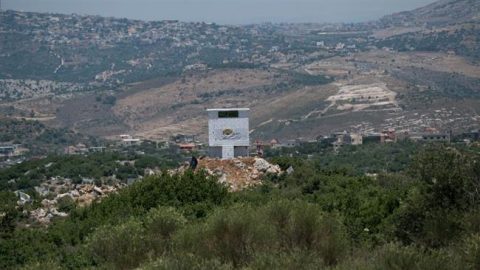
The picture released on June 22, 2017 shows an installation of the Lebanese environmental NGO Green Without Borders which Israel alleges to be used by Hezbollah fighters.
Press TV – June 24, 2017
The United Nations has dismissed Israeli accusations that Lebanon’s Hezbollah resistance movement is setting up observation posts on the border under the guise of an environmental NGO.
Earlier this week, the Israeli military published photographs and footage showing what it claimed to be Hezbollah observation posts established on behalf of “Green Without Borders” near the frontier with the occupied territories.
Israel’s Ambassador to the UN Danny Danon sent a letter of protest to the UN Security Council, denouncing the alleged “dangerous provocation” and accusing Hezbollah of carrying out undercover reconnaissance activities.
The council should “demand that the government of Lebanon dismantle these observation posts immediately, and prevent any future activity of Hezbollah and its affiliates in southern Lebanon, particularly near the Blue Line,” he said, referring to the UN-drawn boundary between Lebanon and the occupied lands.
On Friday, however, UN spokeswoman Eri Kaneko rejected Tel Aviv’s allegation against Hezbollah and said that members of Green Without Borders had only planted trees in the area over the past years.
She stressed that the United Nations Interim Force in Lebanon (UNIFIL) “has not observed any unauthorized armed persons at the locations or found any basis to report a violation of [Security Council] Resolution 1701,” passed at the end of the 33-day Israeli war on Lebanon in the summer of 2006.
UNIFIL remains in contact with the Lebanese armed forces on monitoring the border to ensure there are no violations “and to avoid any misunderstandings or tensions that could endanger the cessation of hostilities.”
The 33-day war, which killed more than 1,200 Lebanese, ended on August 14, 2006, after a UN-brokered ceasefire went into effect.
Since then, UNIFIL has also been charged with monitoring the cessation of hostilities.
Israel’s claims come while it frequently violates Resolution 1701 by invading Lebanon’s airspace.
The Lebanese army and Hezbollah have on numerous occasions reported border breaches by Israeli troops attempting to install espionage devices and tracking equipment in Lebanese territory.
US faces historic setback in the Middle East
By M K Bhadrakumar | Indian Punchline | June 23, 2017
The bloc of four Arab countries led by Saudi Arabia that imposed an embargo against Qatar on June 5 has finally presented their charter of demands. An AP dispatch, lists the 13 demands. The most striking demands include Doha reducing ties with Iran, severing relationships with Hezbollah and the Muslim Brotherhood, closing a Turkish military base in the country, and shuttering state broadcaster Al Jazeera and several news outlets.
Interestingly, Qatar is also expected to “consent to monthly audits for the first year after agreeing to the demands, then once per quarter during the second year. For the following 10 years, Qatar would be monitored annually for compliance.” All this means that abject, unconditional capitulation by Qatar only will satisfy its ‘big brothers’ – nothing less. By the way, there is also a timeline to comply – within the next 10 days – or else the demands get ratcheted up.
To my mind, Qatar will have no difficulty to see this is nothing short of a thinly-veiled push for ‘regime change’. The regime’s response can only be that these Arab bigwigs can go and hang themselves.
What happens next? Simply put, the (Sunni) Muslim Middle East is about to split and the historic schism will have profound consequences for regional and international security.
Make no mistake, this latest development also signifies a slap on the face for the Trump administration. Only last Tuesday, US state department warned Saudi Arabia to resolve the standoff without any further delay lest direct US intervention became necessary, doubting the stance taken by Riyadh (which is widely regarded as carrying the imprimatur of the new Crown Prince Mohammed bin Salman) and showing broad empathy with Qatar (where the US Central Command is headquartered.) Curiously, the US spokesperson also had alluded to Saudi Arabia’s past involvement in terrorism “whether it’s through terror financing or other means”.
Evidently, Saudi pride has been touched to the quick and Riyadh has taken exception to the US censuring. Without doubt, these demands are a show of defiance at Washington, too. This is all now going to become a protracted crisis in all likelihood, which will seriously debilitate the US’ regional strategies – unless of course Qatar crawls on its knees — and weaken its war against the ISIS.
To be sure, Turkey will take great exception to the Saudi demand that its so-called military base in Doha should be shut down unceremoniously. President Recep Erdogan will see this demand as an intolerable affront to Ottoman legacy. The VOA reported on Thursday that Turkey has been moving food and troops to Qatar in a big way.
Quite obviously, the crux of the matter is that the virus of Arab Spring is hibernating in Qatar and it threatens to become an epidemic someday again, threatening the autocratic regimes in the Middle East. Only Turkey, Iran and Israel are immune to the virus of democratic empowerment. Evidently, Al Jazeera and the Muslim Brotherhood are driving the sheikhs crazy in Saudi Arabia, UAE and Bahrain and threaten the military dictatorship in Egypt.
The credibility of the US on the ‘Arab Street’ is now irreparably damaged. For President Donald Trump all this becomes a big political embarrassment domestically. (Bloomberg ) It remains to be seen how the US can afford to sustain its belligerent posturing in Syria and Iraq much longer without any regional allies from the Arab world.
The Trump administration’s containment strategy against Iran seems destined to collapse even before its launch and Trump’s pet project of the ‘Arab NATO’ looks a macabre joke. Can the US ever restore its hegemony over the Muslim Middle East? Doubtful. A big slice of modern history of the western hegemony over Arabs is breaking away and drifting toward the horizon. To be sure, Russians are coming!
Spoiling for a Wider War in Syria
By Robert Parry | Consortium News | June 20, 2017
The U.S. mainstream media’s near universal demonization of Syrian President Bashar al-Assad and Russian President Vladimir Putin – along with similar hatred directed toward Iran and Hezbollah – has put the world on a path toward World War III.
Ironically, the best hope for averting a dangerous escalation into a global conflict is to rely on Assad, Putin, Iran and Hezbollah to show restraint in the face of illegal military attacks by the United States and its Mideast allies inside Syria.
In other words, after the U.S. military has bombed Syrian government forces on their own territory and shot down a Syrian warplane on Sunday – and after Israel has launched its own strikes inside Syria and after Saudi Arabia and its Gulf allies have financed and armed jihadists to overthrow Assad – it is now up to the Syrian government and its allies to turn the other cheek.
Of course, there is also a danger that comes from such self-control, in that it may encourage the aggressors to test the limits even further, seeing restraint as an acceptance of their impunity and a reason to ignore whatever warnings are issued and red lines drawn.
Indeed, if you follow The New York Times, The Washington Post, The Wall Street Journal and other big U.S. news outlets, perhaps the most striking groupthink that they all share is that the U.S. government and its allies have the right to intervene militarily anywhere in the world. Their slogan could be summed up as: “International law – that’s for the other guy!”
In this upside-down world of American hegemony, Assad becomes the “aggressor” when he seeks to regain control of Syrian territory against armed insurgents, dominated by Al Qaeda and Islamic State (ISIS), or when he protests the invasion of Syrian territory by foreign forces.
When Assad legally seeks help from Russia and Iran to defeat these foreign-armed and foreign-backed jihadists, the U.S. mainstream media and politicians treat his alliances as improper and troublemaking. Yet, the uninvited interventions into Syria by the United States and its various allies, including Turkey and Israel, are treated as normal and expected.
Demanding Escalation
The preponderance of U.S. media criticism about U.S. policy in Syria comes from neoconservatives and liberal interventionists who have favored a much more ambitious and vigorous “regime change” war, albeit cloaked in prettier phrases such as “safe zones” and “no-fly zones.”
So, you have Tuesday’s Wall Street Journal editorial, which praises Sunday’s U.S. shoot-down of a Syrian military plane because it allegedly was dropping bombs “near” one of the U.S.-backed rebel groups – though the Syrians say they were targeting an Islamic State position.
Although it was the U.S. that shot down the Syrian plane over Syria, the Journal’s editorial portrays the Russians and Syrians as the hotheads for denouncing the U.S. attack as a provocation and warning that similar air strikes will not be tolerated.
In response, the Journal’s neocon editors called for more U.S. military might hurled against Syria and Russia:
“The risk of escalation is real, but this isn’t a skirmish the U.S. can easily avoid. Mr. Assad and his allies in Moscow and Tehran know that ISIS’s days are numbered. They want to assert control over as much territory as possible in the interim, and that means crushing the SDF [the U.S.-backed Syrian Democratic Forces].
“The Russian threat on Monday to target with anti-aircraft missiles any U.S. aircraft flying west of the Euphrates River in Syria is part of the same intimidation strategy. Russia also suspended a hotline between the two armed forces designed to reduce the risk of a military mistake. Iran, which arms and assists Mr. Assad on the ground, vowed further Syrian regime attacks against SDF, all but daring U.S. planes to respond amid the Russian threat.
“The White House and Pentagon reacted with restraint on Monday, calling for a de-escalation and open lines of communication. But if Syria and its allies are determined to escalate, the U.S. will either have to back down or prepare a more concerted effort to protect its allies and now U.S. aircraft.
“This is a predicament President Obama put the U.S. in when his Syrian abdication created an opening for Vladimir Putin to intervene. Had the U.S. established a no-fly or other safe zone to protect refugees, the Kremlin might have been more cautious.”
As senior U.S. commanders have explained, however, the notion of a sweet-sounding “no-fly or other safe zone” would require a massive U.S. military campaign inside Syria that would devastate government forces and result in thousands of civilian deaths because many air defenses are located in urban areas. It also could lead to a victory for Al Qaeda and/or its spinoff, Islamic State, a grisly fate for most Syrians.
Propaganda Value
But the “safe zone” illusion has great propaganda value, essentially a new packaging for another “regime change” war, which the neocons lusted for in Syria as the follow-on to the Iraq invasion in 2003 but couldn’t achieve immediately because the Iraq War turned into a bloody disaster.
Instead, the neocons had to settle for a proxy war on Syria, funded and armed by the U.S. government and its regional allies, relying on violent jihadists to carry out the brunt of the fighting and killing. When Assad’s government reacted clumsily to this challenge, the U.S. mainstream media depicted Assad as the villain and the “rebels” as the heroes.
In 2012, the Defense Intelligence Agency, then under the direction of Lt. Gen. Michael Flynn, warned that the U.S. strategy would give rise to “a declared or undeclared Salafist principality in eastern Syria.”
Flynn went further in a 2015 interview when he said the intelligence was “very clear” that the Obama administration made a “willful decision” to back these jihadists in league with Middle East allies. (Flynn briefly served as President Trump’s national security adviser but was ousted amid the growing Russia-gate “scandal.”)
Only in 2014, when Islamic State militants began decapitating American hostages and capturing cities in Iraq, did the Obama administration reverse course and begin attacking ISIS while continuing to turn a blind-eye to the havoc caused by other rebel groups allied with Al Qaeda’s Nusra Front, including many outfits deemed “moderate” in the U.S. lexicon.
But the problem is that almost none of this history exists within the U.S. mainstream narrative, which – as the Journal’s neocon editors did on Tuesday – simply depicts Obama as weak and then baits President Trump to show more military muscle.
What U.S. National Interests?
The Journal editorial criticized Trump for having no strategy beyond eradicating ISIS and adding: “Now is the time for thinking through such a strategy because Syria, Russia and Iran know what they want. Mr. Assad wants to reassert control over all of Syria, not a country divided into Alawite, Sunni and Kurdish parts. Iran wants a Shiite arc of influence from Tehran to Beirut. Mr. Putin will settle for a Mediterranean port and a demonstration that Russia can be trusted to stand by its allies, while America is unreliable. None of this is in the U.S. national interests.”
But why isn’t this in U.S. national interests? What’s wrong with a unified secular Syria that can begin to rebuild its shattered infrastructure and repatriate refugees who have fled into Europe, destabilizing the Continent?
What’s the big problem with “a Shiite arc of influence”? The Shiites aren’t a threat to the United States or the West. The principal terror groups – Al Qaeda and ISIS – spring from the extremist Saudi version of Sunni Islam, known as Wahhabism. I realize that Israel and Saudi Arabia took aim at Syria in part to shatter “the Shiite arc,” but we have seen the horrific consequences of that strategy. How has the chaos that the Syrian war has unleashed benefited U.S. national interests?
And so what that Russia has a naval base on the Mediterranean Sea? That is no threat to the United States, either.
But what is the alternative prescription from the Journal’s neocon editors? The editorial concludes: “The alternative would be to demonstrate that Mr. Assad, Iran and Russia will pay a higher price for their ambitions. This means refusing to back down from defending U.S. allies on the ground and responding if Russia aircraft or missiles attempt to take down U.S. planes. Our guess is that Russia doesn’t want a military engagement with the U.S. any more than the U.S. wants one with Russia, but Russia will keep pressing for advantage unless President Trump shows more firmness than his predecessor.”
So, rather than allow the Syrian government to restore some form of order across Syria, the neocons want the Trump administration to continue violating international law, which forbids military invasions of sovereign countries, and keep the bloodshed flowing. Beyond that, the neocons want the U.S. military to play chicken with the other nuclear-armed superpower on the assumption that Russia will back down.
As usual, the neocon armchair warriors don’t reflect much on what could happen if U.S. warplanes attacking inside Syria are shot down. One supposes that would require President Trump to authorize a powerful counterstrike against Russian targets with the possibility of these escalations spinning out of control. But such craziness is where a steady diet of neocon/liberal-hawk propaganda has taken America.
We are ready to risk nuclear war and end all life on the planet, so Israel and Saudi Arabia can shatter a “Shiite arc of influence” and so American politicians don’t have to feel the rhetorical lash of the neocons and their liberal-hawk sidekicks.
Investigative reporter Robert Parry broke many of the Iran-Contra stories for The Associated Press and Newsweek in the 1980s.
Featured Video

Trita Parsi: Israel Set a Trap for Total War in the Region
or go to
Aletho News Archives – Video-Images
From the Archive
Zionism’s Violent Legacy
By Donald Neff | Washington Report On Middle East Affairs | January 1996
On January 4, 1948, Jewish terrorists drove a truck loaded with explosives into the center of the all Arab city of Jaffa and detonated it, killing 26 and wounding around 100 Palestinian men, women and children.[1] The attack was the work of the Irgun Zvai Leumi – the “National Military Organization,” also known by the Hebrew letters Etzel – the largest Jewish terrorist group in Palestine. The Irgun was headed by Revisionist Zionist Menachem Begin and had been killing and maiming Arabs, Britons and even Jews for the previous ten years in its efforts to establish a Jewish state.
This terror campaign meant that at the core of Revisionist Zionism there existed a philosophical embrace of violence. … continue
Blog Roll
 Aletho News
- Trita Parsi: Israel Set a Trap for Total War in the Region
- Trump’s Iran war is on an Israeli leash
- Saudi oil boss issues global supply warning
- Riyadh Says Its Oil System Is Intact. The Numbers Say Otherwise.
- Trump and Netanyahu Want to “Finish the Job” on Iran
- US ‘one-sided dictation’ not Iran’s beliefs makes rational talks impossible: Baghaei
- Iran’s Next Strike May Not Explode. It Could Shut You Down /Col Doug Macgregor
- Iran: US political targets legitimate if assassinations return
- Iraq shuts key border crossing with Iran under US pressure: Report
- Undersea Internet cables could be targeted in retaliation for attacks on Iran: IRGC deputy chief
- If Americans Knew
- The Israel Lobby’s Changing Fortunes
- AIPAC has become such a political liability that it’s shifting to a more “nimble” approach to buying politicians
- At least 160 Israeli settler attacks in 2 weeks
- Will Gaza’s Ancient Christian Community Disappear Forever?
- Israel’s vision of regional security rests on keeping Arab states weak
- Heidi Levine recounts how Palestinian youths helped save her in settler attack
- DAILY UPDATE: Latest essential news on Palestine, Israel, & region
- Trump’s Intensifying Sabotage of the ICC, for Israel’s Sake
- Israeli military detain US and UK volunteers in West Bank including Democratic NY politician Brad Lander
- Americans at National Conservatism Conference held in Israel this year criticize Israel
- No Tricks Zone
- E-Cars Reduce CO2 Emissions By Only 41% Compared To Internal Combustion Engine Vehicles
- Predictions Made By Renowned Climate Professor Over Past Decades Have Been Proven To Be Poor
- New Study Suggests Large Regions Of The Pacific Ocean Have Been Cooling For The Last 80 Years
- Germany’s Green Energy Debacle: High Energy Costs Force Kahla Porzellan to Close After 182 Years!
- New Study: 50 Years Of The Most Aggressive ‘Net Zero’ Policies Can Only Affect The Global Climate By 0.03°C
- US September “Heat” Was No Record…Many Records Set Decades Ago
- Latest European Green Energy Debacle; Portugal’s Largest Flagship Solar Park Insolvent!
- Green Energy Debacle: German Expert Professor Fritz Vahrenholt Warns Of Severe Economic And Social Consequences
- Two More Paleo Reconstructions Affirm Meters-Higher Sea Levels Across Ireland, Brazil 7000-6000 Years Ago
- New Study: Earth And Venus Surface Warmth Largely Explained By Convection And Lapse Rate, Not CO2 Or Radiation

