6 MAJOR US foreign policy failures of the post-Cold War era
By Adam Garrie | The Duran | September 14, 2017
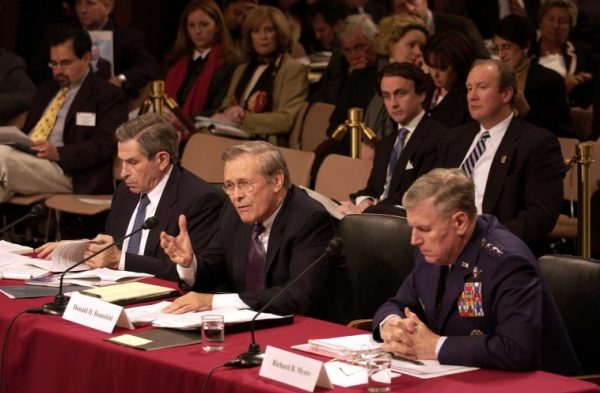
In the 1990s, US officials, all of whom would go on to serve in the George W. Bush White House, authored two short, but deeply important policy documents that have subsequently been the guiding force behind every major US foreign policy decision taken since the year 2000 and particularly since 9/11.
These documents include the Defense Planning Guidance for the 1994–99 fiscal years (more commonly known as the Wolfowitz Doctrine). This document, as the name implies was authored by George W. Bush’s deeply influential Deputy Defense Secretary Paul Wolfowitz as well as I. Lewis “Scooter” Libby, who served as an advisor to former US Vice President Dick Cheney.
The other major document, A Clean Break: A New Strategy for Securing the Realm, from 1996 was authored by former Chairman of the Defense Policy Board Advisory Committee in the administration of George W. Bush, Richard Norman Perle.
Both documents provide a simplistic but highly unambiguous blueprint for US foreign police in the Middle East, Russia’s near abroad and East Asia. The contents of the Wolfowitz Doctrine were first published by the New York Times in 1992 after they were leaked to the media. Shortly thereafter, many of the specific threats made in the document were re-written using broader language. In this sense, when comparing the official version with the leaked version, it reads in the manner of the proverbial ‘what I said versus what I meant’ adage.
By contrast, A Clean Break was written in 1996 as a kind of gift to Israeli Prime Minister Benjamin Netanyahu who apparently was not impressed with the document at the time. In spite of this, the US has implemented many of the recommendations in the document in spite of who was/is in power in Tel Aviv.
While many of the recommendations in both documents have indeed been implemented, their overall success rate has been staggeringly bad.
Below are major points from the documents followed by an assessment of their success or failure.
1. Regime change against Saddam Hussein’s Iraq (A Clean Break)
This objective is in many ways both the clearest initial success and also the most strident overall failure.
In 1996, Richard Perle suggested that removing Saddam Hussein from power would be good for the US and Israeli interest because it would weaken a powerful, large Arab state that had poor relations with the US since 1990 and historically poor relations with multiple regimes in Tel Aviv. While Iraq’s President was removed from power by illegal force in 2003, that which happened subsequently, did not deliver the outcome Perle had desired.
A Clean Break suggests that a post-Saddam Iraq could and should be ruled by a restored Hashemite dynasty, which was originally overthrown in 1958. Perle continues to suggest that Jordan, the last remaining Hashemite state in the Arab world, could work with Israel and the US to make this happen. Even more absurdly, Perle suggests that a Hashemite would-be union between Jordan and Iraq would be able to command more loyalty from Hezbollah supporters in Lebanon than Iran.
The realities could not be more different. After the illegal 2003 invasion of Iraq, the idea of restoring the Hashemite dynasty was never again floated in any serious forum, as the idea would be simply impossible to implement. There was no will among any major faction in Iraq to restore a monarchy that was overthrown in a revolution in 1958 that many Iraqis continue to look back on with national pride.
Ironically, the biggest Arab bulwark against a resurgent Iran was Saddam Hussein. In the 1980s, the future neo-cons realised this, though they seemingly ignored what they once knew, as early as in 1992.
Since Saddam Hussein’s removal from power and violent execution, Iraq’s majority Shi’a population have generally rallied around Iran politically, militarily and spiritually. Iraq has recently signed a defensive military pact with Iran and it is well known that many of the Shi’a volunteer brigades which are fighting ISIS in Iraq have received training and advice from Iranian experts.
While the US bases in Iraq make a US military presence closer to Iran than it was prior to 2003, by the same token Iran’s influence in the Arab world, especially in Iraq has grown substantially. In any case, the desired illegal ‘regime change’ war against Iran will likely never happen for two reasons. First of all, many in the Pentagon and in Washington moreover, realise that such a war would be an unmitigated disaster for the US and secondly, Iran has many influential international partners that it did not have in the 1990s, primarily Russia. Russia as well as China would not stand for a war on Iran in 2017.
In this sense, the US got very little of what it claimed it wanted in overthrowing Saddam apart from the weakening of a united Iraq.
2. ‘Containing’ Russia and China by preventing them from becoming superpowers (Wolfowitz Doctrine)
This policy has failed on every front. Since the rise of George W. Bush, the first White House adherent to the Wolfowitz Doctrine, Russia and China have risen to a status which means that there are three global superpowers, not the lone American superpower dreamt of by Wolfowitz and Libby.
China’s economic rise has fuelled a more robust stance from Beijing on global affairs. China now vigorously defends its claims in the South China Sea, has continually outflanked the US on the Korean issue, is engaged in the building of One Belt–One Road, the most wide reaching trade and commerce initiative in modern history and has opened its first military base overseas.
At the same time, the People’s Liberation Army continues its modernisation programme, making it as formidable a force which for all practical purposes, is as battle ready and capable as those of the US and Russia, countries which during the Cold War, had far superior armed forces to China.
Likewise, Russia’s return to superpower status, has been equally crushing in respect of the goals of Wolfowitz and Libby. Russia has not only strengthened old alliances but is now an important ally or partner to countries which were former Cold War opponents or otherwise non-aligned countries. This is true in respect of Russia’s alliances and partnerships with China, Pakistan, Turkey, Iran, Philippines and increasingly Indonesia. Russia is also becoming ever closer to South Korea and even Japan.
With Russia’s military now boasting modern defence systems which can rival those of the US and in many cases are objectively superior to those of the US, the idea that the US would prevent Russia from re-attaining super-power status and China emerging as a super-power has become a patent absurdity.
3. Containing Syria via Turkey and Jordan (A Clean Break)
For a while, this plan was implemented with some degree of success by the Obama administration. While Jordan never played a substantial part in the proxy wars on Syria, apart from being a NATO transport corridor, Turkey did help to undermine Syria’s sovereignty with its armed forces and its own proxies.
While relations between Turkey and Syria remain poor, relations between Turkey and the rest of its NATO ‘allies’ is also poor.
Turkey has quietly ceased its support for terrorist groups (aka the opposition) in Syria, is participating in the Astana Peace Process with long time Syrian allies Russia and Iran and is engaged in multiple trading and commercial deals with Russia, including the purchase of the Russian made S-400 missile defence system.
The overall result of Turkey’s participation in the Syrian conflict has been a strengthening of Turkey’s relationship with historical adversaries, Russia and Iran, something which has happened simultaneously to Turkey’s essentially dead relationship with the EU and its incredibly weakened relationship with the US.
All the while, Ba’athist Syria has emerged from the conflict victorious with its commitment to the Palestinian cause as strong as ever.
Far from being “contained”, Syria is now more admired throughout the wider world than at any time in the last three decades.
4. Molesting Russia’s borderlands (Wolfowitz Doctrine)
In the original text of the Wolfowitz Doctrine, there was a provision stating that the US must work to make sure that places like Ukraine and Belarus became part of the US economic and geo-political orbit, maintaining both “market economies” and “democracies”.
The 2014 US engineered coup against the legitimate government in Kiev was a knee-jerk US response to the fact that Ukrainian President Viktor Yanukovych rejected an economic association agreement with the EU, under the guise that the Ukrainian economy cannot afford to cut itself off from Russia.
Yanukovych was subsequently overthrown in a violent coup, and a neo-fascist pro-western regime was installed. However, this can hardly be considered a success as the sheer violence and incompetence of the current Kiev regime has made it so that Ukraine, a place whose borders were always dubious to begin with, will almost inevitably fracture into something unrecognisable.
Already, much of Donbass has been incorporated into the Donetsk and Lugansk People’s Republics that will never go back to Kiev rule and Crimea, whose relationship with Kiev was even more tenuous is now happily reunited with the rest of the Russian Federation.
Seeing the coup in Kiev, Belorussian President Alexander Lukashenko has pledged to crack down on any would be trouble-makers, all while remaining a committed albeit tantrum prone ally of Russia.
The only part of this element of the Wolfowitz Doctrine which has not been a failure has been the weaponisation of eastern Europe. The reason this has succeeded is due to the fact that Russia has no interest in invading eastern Europe. Russia has merely responded by building up its defences against NATO’s provocative weaponisation of Poland and the Baltic States.
5. Weakening Hezbollah (A Clean Break)
In 2017, Hezbollah is not only more popular than ever, but its militarily might is stronger than at any time in its history. Hezbollah’s role in fighting terrorism in Syria has won the party praise from groups in Lebanon that previously were never keen on Hezbollah, as well as individuals in the wider world who seek to build a genuine anti-terrorist coalition.
The conflict in Syria has drawn Iran, Iraq, Syria and southern Lebanon (the heartland of Hezbollah) closer together than they have ever been. This has in many ways been a result of the common cause of fighting groups like ISIS and al-Qaeda that bound them all together.
In 2006, Hezbollah dealt Israeli forces a major defeat in South Lebanon. Today, Hezbollah is even stronger and everyone in Israel is all too aware of this.
This was a major failure in respect of implementing the ‘destruction’ of Hezbollah advocated by Richard Perle.
6. North Korea not to be allowed nuclear weapons (Wolfowitz Doctrine)
The fact that North Korea just tested what is widely believed to be a hydrogen bomb, is a clear indication that this major goal of Wolfowitz and Libby has failed.
Beyond this, while Russia has condemned both North Korea and US led provocative acts on the Korean peninsula, Russian President Vladimir Putin has acknowledged that North Korea does have the right to self-defence, something which has become even more prescient after North Korea witnessed the destruction of Iraq and Libya which did not have weapons capable of deterring a US invasion.
Russia and China have clearly seized the initiative on the Korean issue. Apart from launching a disastrous war on North Korea, the US can now do little to change the realities in Pyongyang.
CONCLUSION:
The aggregate effect of this analysis indicates that the US is still highly capable of starting wars and igniting conflicts throughout the world, but that it is likewise hardly ever capable of winning these conflicts or even achieving a majority of its own stated goals.
As the two most revealing foreign policy documents from the US in the post-Cold War era, both the Wolfowitz Doctrine and A Clean Break have been abject failures. In many cases, in attempting to achieve the goals of these documents, the United States has ended up achieving the opposite.
The US is militarily strong, but strategically, diplomatically and geo-politically, it is actually close to impotent.
Hassan Nasrallah: Israel is in despair after the defeats of Daesh
Speech by Hezbollah Secretary General Sayed Hassan Nasrallah on 28 August 2017 on the occasion of the Second Liberation, following the complete surrender of the terrorists of Daech and Al-Nosra in Lebanon
Transcript:
[…] We are truly facing a great victory (against Daesh in Lebanon). From there, consider that on May 25, 2000, we expelled the Zionist Occupying (Lebanon) and today we all (the Syrian and Lebanese armies and Islamic Resistance) have expelled the occupying terrorist takfiri. This is one of the fundamental similarities.
On the border, vast and sensitive areas (mountains, hills, strategic positions) were in the hands of the Zionists, and here also, vast expanses, mountains, heights, hills, strategic positions were in the hands of the takfiris. At the border, accross the international border, the Israelis were a permanent threat and that is always the case, and takfiris were a threat at every moment against all of Lebanon, especially against all the Bekaa, not only against Baalbeck-Hermel and border villages.
Lately, everyone knows that they planned there, in the Jurd of Ersal, Daesh was preparing suicide operations and attacks in Zahle and in the surrounding villages, but the intelligence services of the Lebanese army discovered them before the operations were conducted.
Today we face this reality. And maybe it would come to the mind of some to say “ô Sayed [Nasrallah], as regards Israel, it is something very different (from what happens today).” But no, it is a continuation. Day after day, it is shown that these Daesh and takfiri groups have been created by American power and fought to realize the Israeli project. They fought (in the interest of the) Israeli project. And what these takfiri terrorist groups have offered Israel, Israel could never get for decades.
And more dangerously… I do not want to classify these two dangers, because I believe that these terrorist groups are fighting within the American-Israeli project, whether they know it or not. Their leaders know for sure. The fools are the fighters who got fooled by false and superficial slogans. Israel is an occupation and hegemony project. Israel is an occupying project. The United States are a project of hegemony. Daesh and other takfiri groups are an extermination project. The extermination of all that is different (from them): Muslim, Christian, Sabean, Yazdi, everything. That is an extermination project. The extermination of man, of History, of civilization, of society, of all things. And then when our region is destroyed, its armies, its plans, its states, its institutions, its social structure, it will be offered (on a silver platter), primed, cooked to perfection, roasted and stuffed to America and Israel, so that they seize it and impose their conditions on everyone.
And that’s why today, who is shedding tears over the fate of Daesh in Syria, in Qalamoun and in Iraq? Netanyahu and Israeli officials! It is they who mourn (bitterly) and yell sorrowful lamentations! Currently, their problem with the Trump administration is that it committed itself to the eradication of Daesh as a priority, the same administration that recognizes that this is the Obama (and Clinton) administration who created Daesh. This is why no one should come and say that there is a big difference between the Liberation of South(-Lebanon in 2000 against Israel) and this battle (against Daesh) and that the liberation of South ranks first (in importance), and that (the Liberation of our borders) is in 10th place (for example) in any way! (Liberation of southern Lebanon against Israel) is first, (the Liberation of our borders against Daech) comes right away in second place! For it is a continuation of the battle against Israel.
Read Israeli (statements and press). (Unfortunately), the Lebanese and the Arabs do not read much. Read what they say, what they write, especially these days, with the ongoing eradication of Daesh in Iraq, Syria and Lebanon, so that you realize clearly that Daesh is a true Israeli project.
We are indeed facing the Second Liberation (of Lebanon). The date of the First Liberation is May 25, 2000. The date of the Second Liberation, for history, is today (28 August 2017). I do not mean the day (to be selected for an annual commemoration of this event). Today we wrote… Last time, today’s date, August 28, 2017, was empty (of any commemoration) in the calendar. But not for 2018. By the will of God, this day and this month are written by the Lebanese Army, the Syrian army and fighters of the Islamic Resistance in Lebanon. This was written today (in the annals of History): August 28, 2017 is the Day of the Second Liberation, which will be recorded as a glorious day in the history of Lebanon and the history of the region.
Now whether the Lebanese government (led by the pro-Saudi Saad Hariri and his March 14 coalition, facing the movement of March 8, with Hezbollah and its allies) recognizes it or not, that’s their problem, just like what happened on May 25, 2000. The situation was somewhat different at the time, that date was declared a national holiday, then was removed from the calendar at the time of a previous Prime Minister. But then, thanks to God, a head of government redid the occasion of May 25 a day of remembrance.
We now have an opportunity to commemorate: August 28, 2017. I speak only of the historical event that took place on August 28, I do not write the history (and national holidays) myself. But today there is no longer any daeshiste, takfiri, (member of) Al-Nusra Front or (any other terrorist) on the least grain of sand, any mountain or any Lebanese hill. It was on that date (this event occurred). After that, if the government wants to keep that date, or choose August 27, August 25, August 31 or September 3 (for the commemoration), I have no problem. I do not precede anyone, I speak only of the historical event.
On this basis, I wish to conclude with this call (to celebrate this event this Thursday 31st, the day of Arafat, on the eve of Eid-al-Adha): you remember that on May 25, 2000, it is all Lebanon who won, and Lebanon was happy with the victory (against Israel), with the exception of those who had placed their hopes in the Israeli occupation, and there were (a number) in the country, and those who had placed their hopes in the army of Antoine Lahd. So on that day, there was a majority (of Lebanese) happy, and (a minority) of people whose faces were darkened (with bitterness) because their plans had collapsed.
Today… But (in 2000), the happiest people, despite the fact that it was a national day, celebration and victory, were southerners, residents of southern Lebanon and Jabal Amel who were the happiest of all with this victory and this Liberation. The reason is simple: it is because the occupation took place on their mountains, their hills, their cities, it is their sons and daughters who were imprisoned, their peasants and farmer were fired at, and a daily threat was hanging over them. We remember the bombing against Sidon and Nabatiye and children and schoolchildren’s heads torn in the streets. It is quite normal that the people of the South, who are those who have suffered most and have the most sacrificed,were (more) happy on May 25, 2000.
Today, all of Lebanon won, and logically, the vast majority (of the population) is pleased, with the exception of those who have placed their hopes on the Al-Nusra Front, on Daesh and the regional states and world powers that stand behind them. It is understandable that they are angry, saddened and dismayed, and they offer their condolences, it is normal. And a few days ago, 2 or 3 weeks, they have insulted, reviled and slandered us, but let them act as they please. We understand their sadness and pain.
But with certainty, the vast majority of Lebanese are happy because without these (victorious) confrontations for several years to date, Daesh, the Al-Nusra Front and their like could have seized the Bekaa, the North and reached other places in Lebanon and we would have experienced a disaster. See what happened in the country and the societies around us (Syria, Iraq, Libya).
But it is also natural that the happiest people in the Second Liberation are our noble people of the Bekaa. They are the ones whose mountains, Jurds and fields, were attacked with car bombs and suicide bombers, against Hermel, Bekaa and Ras Baalbek, and the whole area was threatened upto all Zahle and the Bekaa, and now that this nightmare disappeared from their mountains, their hills, their Jurds, their homes and their lands, they sure are going to be the happiest of all. For they have suffered more than all, and in this battle, it is among them that there was the most sacrificed (martyrs).
It is true that our brothers, our families and the officers and soldiers of the Lebanese Army came from all regions of Lebanon and fought on this front, but there is no doubt that today in the Bekaa, there are no villages, especially in Baalbek-Hermel, in which are not found one, two or three martyrs, and one, two or three wounded. The Bekaa residents have also shaped this victory by the blood of their loved ones and their children, the apple of their eyes, the best elements among their young men. Not to mention the wounded who are still in the homes and in hospitals. Therefore it is normal that they are happy, congratulate themselves and take pride in this victory which is a national victory in general,but especially a victory for the Bekaa. […]
Translation: http://sayed7asan.blogspot.fr
Syria Approves Qalamoun Ceasefire Agreement between Hezbollah and ISIL Terrorist Group
Al-Manar | August 27, 2017
Syrian authorities approved the ceasefire agreement between Hezbollah and ISIL terrorist group in western Qalamoun in order to evacuate the rest of the takfiri militants from the area, a Syrian military source said.
The source added that preserving the souls of the Syrian army soldiers and allies was behind Syria’s approval.
ISIL Terrorists in Lebanon-Syria Border Outskirts Surrender
After an intensive military campaign launched by the Lebanese and Syrian armies and Hezbollah against ISIL terrorists in Lebanon-Syria border outskirts, a ceasefire was concluded and took into effect on Sunday at 7 a.m. (Local Time).
The takfiri militants of ISIL surrendered and agreed to leave the area after turning in the corpses of two of Hezbollah martyrs and disclosing the fate of the Lebanese Kidnapped servicemen.
The Lebanese Army Guidance declared Sunday morning a cease of fire against ISIL terrorists for more negotiations to reveal the fate of the kidnapped soldiers, according to a communiqué issued by the Army Guidance Directorate Department.
Nine Lebanese servicemen were kidnapped by ISIL terrorists, as well as Nusra Front militants, in 2014 when the takfiri group invaded the northeastern town of Arsal.
US Zionists say McMaster is hostile to Israel and pro Hamas
MEMO | August 23, 2017
Conservatives in America are leading a campaign to convince US President Donald Trump to fire his National Security Adviser, Israel Today reported on Tuesday. They accuse H R McMaster of being hostile to Israel and pro-Hamas, Hezbollah and the Iranian nuclear deal.
One of the leading figures of the campaign is Morton Klein, the head of the Zionist Organisation of America (ZOA), as well as the billionaire Zionist Sheldon Adelson. The ZOA and supporters of Israel in the White House are afraid that McMaster will use his position to disrupt Trump’s pro-Israel policies.
Adelson, the Israeli newspaper pointed out, was a major donor for Trump’s presidential campaign. While it said that he has denied that he was involved in a campaign criticising McMaster, it added that he had acknowledged in an email to Klein that he did not know much about the National Security Adviser but now supports efforts to remove him from the White House.
Israel’s Alarm over Syrian Debacle
By Daniel Lazare | Consortium News | August 22, 2017
There’s a rumor going around that the Syrian civil war is finally winding down and that the Baathist government is nearing its goal of driving out thousands of ISIS-Al Qaeda head-choppers financed and supplied – directly or indirectly – by the U.S., Turkey, Saudi Arabia, and the other Persian Gulf oil monarchies.
(Screenshot from White House video)
It would be good news if true. But most likely it’s not. While one stage in the Syrian conflict is coming to an end, another is beginning, and this time the results could be even worse.
The reason is Israel, until now the odd man in the latest Mideast wars. Despite intervening sporadically on the rebel side in Syria, the Jewish state generally held itself aloof from the conflict in the belief that events were breaking its way regardless of whether it stepped in or not. After all, why go to war when your enemies are doing a fine job of tearing each other apart on their own?
With President Bashar al-Assad expected to step down eventually, Israel figured that it only had to wait and watch as a hostile regime collapsed under its own weight as it thrashed about unable to restore order to Syria. Never in the Arab-Israeli hundred years’ war had Israel seemed stronger and the Arabs weaker and in greater disarray.
But then the unthinkable happened. Assad not only survived but prevailed. Backed by Russia, Iran and the Lebanese Shi‘ite militia Hezbollah, he has bottled up Al Qaeda in East Ghouta and Idlib province in the extreme northwest and is racing to lift ISIS’s siege on Deir-Ezzor along the Euphrates. If successful, the effect will be to clear a path straight through to the Iraqi border some 30 miles to the east.
U.S. military enclaves may remain in the northeast and in the southern border town of Al-Tanf. But it’s hard to see how they’ll have much of an impact as the Damascus regime tightens its grip on the country as a whole.
Israeli Outrage
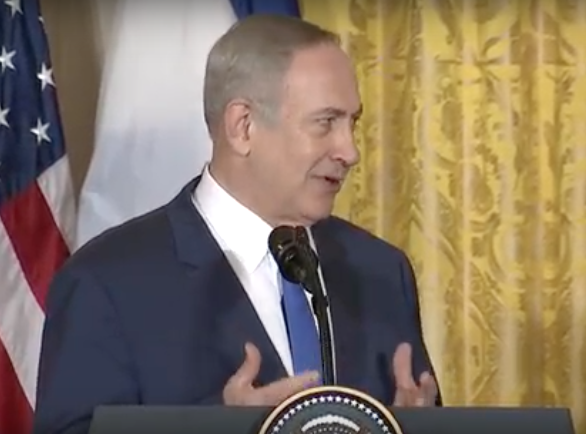
But rather than making a wider war less likely, the upshot is to make it even more. Having bet on the wrong horse, Prime Minister Benjamin Netanyahu now finds himself facing a nightmare scenario in which Iran takes advantage of Assad’s winning streak to extend its reach from Iraq and Syria into Lebanon beyond. It’s not just a question of political influence, but of the emergence of a powerful Iranian-led military bloc.
Eleven years after fighting a vicious 34-day war in southern Lebanon, Israel thus finds itself facing not only Hezbollah but the Syrian Arab Army, Iran’s Islamic Revolutionary Guards, and Iraqi Shi‘ite militias – all backed by Russian military might – in a front extending across its entire northern border. All are battle-hardened after years of combat, better armed, better led, and more self-confident to boot. Israel finds itself confronting a new threat that is many times more powerful than Hezbollah (or Syria) alone.
Israeli consternation is not to be underestimated. One news outlet says the official attitude is one of “grave concern” while an anonymous government minister heaped blame on the U.S. for sacrificing Israeli interests:
“The United States threw Israel under the bus for the second time in a row. The first time was the nuclear agreement with Iran, the second time is now that the United States ignores the fact that Iran is obtaining territorial continuity to the Mediterranean Sea and Israel’s northern border. What is most worrisome is that this time, it was President Donald Trump who threw us to the four winds – though viewed as Israel’s great friend. It turns out that when it comes to actions and not just talk, he didn’t deliver the goods.”
Netanyahu is meanwhile off to the Black Sea resort of Sochi to confer with Russian President Vladimir Putin while, in Washington, Israeli military and intelligence officials are meeting with top Trump officials such as National Security Adviser H.R. McMaster and special Mideast envoy Jason Greenblatt.
Israel has also engaged in saber-rattling with regard to a missile factory that it says Iran is building in the Syrian port city of Baniyas. Gadi Eisenkot, the Israeli military’s chief of staff, said that stopping efforts by Iran, Syria, and Hezbollah to equip themselves with accurate missiles capable of striking deep inside the Jewish state “is our top priority.”
Adds Avigdor Lieberman, Israel’s hard-right defense minister: “We know what needs to be done…. We won’t ignore the establishment of Iranian weapons factories in Lebanon.”
Neocon Chorus
Words like that should not be taken lightly. Meanwhile, influential neoconservatives are joining the me-too chorus. At the Atlantic Council – the hawkish Washington think tank partly funded by the United Arab Emirates and pro-Saudi interests that functioned as an arm of Hillary Clinton’s 2016 presidential campaign – former Obama administration official Frederic C. Hof recently argued that the U.S. wouldn’t be in such a pickle if it had invaded Syria years ago:
“A Syrian opposition recognized by Washington in December 2012 as the ‘legitimate representative of the Syrian people’ should have been tasked with preparing for post-ISIS governance, and assisted to that end by an American-organized, multi-national effort. An all-Syrian stabilization force should have been built in a protected eastern Syria to pacify the area, facilitate humanitarian aid, and spur reconstruction.”
But now the U.S. is seemingly “indifferent” to what comes next once Islamic State is gone. As a consequence, Hof said, the Trump administration is effectively “install[ing] Iran as Syria’s suzerain, with the Assad entourage sifting through the country’s ruins for spoils and setting the stage for successive waves and varieties of extremism arising in response.” The only solution, according to Hof, is a radical strategic change “to prevent Iran and Assad doing their worst for the security of the United States, its allies, and its partners.”
With the Zionists and their neocon yes-men agreeing that something must be done, it seems that something WILL be done sooner rather than later.
Of course, a few complications could get in the way. One involves Russian President Vladimir Putin who, despite his close alliance with Assad, enjoys a solid working relationship with Israel and is none too eager to see war break out between the two countries. Another is the Syrian government in Damascus, which, under the leadership of the careful and cautious Assad, is none too eager to rush into a conflict that could conceivably prove even more ruinous than the one it is trying to finish up.
A Sick Kingdom
But even sober politicians like Putin and Assad may be unable to cope with the forces raging across the Middle East. The sectarian war that the Saudis unleashed more than a decade ago with U.S, help shows no signs of letting up. The kingdom is mired in an anti-Shi‘ite crusade in Yemen that it is desperate to escape, but doesn’t know how. It has suppressed a Shi‘ite uprising in Awamiyah, a city of 25,000 people in its own oil-rich Eastern Province, killing dozens according to Iranian sources and flattening an entire neighborhood, but dissent continues to bubble up ominously.
Saudi Arabia also has imposed an economic blockade on Qatar, and it is backing a repressive regime in Bahrain that has imposed a reign of terror on the country’s 70-percent Shi‘ite majority. Riyadh continues to engage in a dangerous war of words with Iran, which the royal family believes is engaged in an Elders of Zion-like Shi‘ite conspiracy to dismember the kingdom and wrest away control of Mecca and Medina.
The more paranoid Saudi leaders become, the more threatening Saudi Arabia grows – and the more resolved Iran becomes to make the most of its victory in Syria by fulfilling the ancient Persian goal of opening a corridor to the Mediterranean Sea. Aggression on one side leads to counter-aggression on the other, a process of mutual escalation that seems impossible to reverse.
Finally, there is the question of political stability – or, rather, an increasing lack thereof. In Iran, newly re-elected President Hassan Rouhani is locked in a growing confrontation with hardline Shi‘ite Islamists with little appetite for compromise.
In Saudi Arabia, power is in the hands of Crown Prince Muhammad bin Salman, a rambunctious 31-year-old who launched the disastrous war in Yemen in March 2015 – and then disappeared on a vacation in the Maldives as U.S. officials tried desperately to reach him by phone – and who more recently unveiled an ambitious economic reform program that so far has done nothing to stem the kingdom’s alarming decline. Despite vows to diversify the economy, non-oil revenue actually shrank by 17 percent this spring while foreign reserves have fallen by nearly a third since 2014. But that didn’t stop MbS, as he’s known, from committing himself to $110 billion in U.S. arms purchases in May or his father, King Salman, from spending a reported $100 million on a summer vacation in Morocco.
Saudi Arabia is thus becoming the sick man of the Middle East, one whose collapse could trigger a “geopolitical tsunami” sweeping across much of the region.
Trump’s Imbalance
Then there is the United States, where politics are even more unsettled. As President Trump careens from one disaster to another, foreign policy has grown both unpredictable and bellicose. One day, America’s second popular-vote-losing president in 16 years is calling for regime change in Tehran, the next he’s threatening Pyongyang with “fire and fury,” and then he’s blustering about some unspecified “military option” with regard to Venezuela.
The fact that Trump has so far demonstrated little follow-through is hardly reassuring. Sooner or later, rash rhetoric can only lead to rash actions, if not on America’s part then someone else’s. The shakier Trump grows, the greater the likelihood that he will engage in some risky adventure in order to strengthen his grip.
A number of forces are thus converging: political instability in Tehran, Riyadh and Washington, a growing thirst for more war on the part of Israel and the U.S. foreign-policy establishment, and a growing defensiveness on the part of a “Shi‘ite crescent” stretching from Yemen to southern Tehran. The United States, Turkey, Saudi Arabia, and others have already plunged Syria into death and destruction by sponsoring a murderous Sunni Salafist assault on one of the most diverse populations in the Middle East. The big question now is whether, with Israeli help, they are about to impose another.
Given the vicious cycle of violence in the Middle East, one that the U.S. has done its level best to worsen at every step of the way, it’s hard not to believe that even worse may be ahead.
Daniel Lazare is the author of several books including The Frozen Republic: How the Constitution Is Paralyzing Democracy (Harcourt Brace).
Lebanese Hezbollah leader says Israel not able to wage new war on Lebanon
Press TV – August 13, 2017
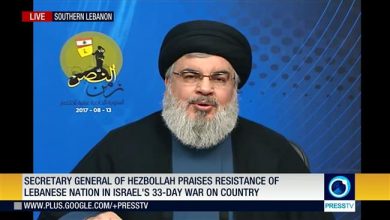
The Secretary General of the Lebanese Hezbollah movement says Israel is not able to launch a new war on Lebanon, because it knows that Hezbollah is much more powerful than 2006 and any such war would cost Tel Aviv dearly.
Sayyed Hassan Nasrallah made the remarks in a speech on the anniversary of Israel’s defeat in the 33-day military onslaught against Lebanon back in the summer of 2006.
During his speech, Nasrallah noted that the main reason behind the victory of Hezbollah fighters in the war with Israel was their patience, steadfastness, valor and faith.
Stressing the rise in Hezbollah’s power since the war in 2006, Nasrallah noted that the resistance group is ready to counter any further act of aggression, warning that in case of new Israeli aggression, Israel will face a 100 times tougher response than the one its forces saw during the 2006 war.
Nasrallah added that Israeli analysts were still analyzing the results of that war, because it destroyed their self-confidence and they have admitted to their defeat in the summer war in 2006.
Everything that Israelis say about the power of Hezbollah is because of their defeat in summer 2006 war, Nasrallah said.
The Hezbollah chief stated that Israelis wanted to destroy Hezbollah, but after 11 years, they say Hezbollah has become stronger and more powerful and this shows that they have failed to achieve the goals they pursued through 2006 war.
Elsewhere in his speech, Nasrallah explained that Hezbollah only fights outside the Lebanese borders and will not use force in domestic developments of the country.
He added that in return for its victories, Hezbollah does not seek personal, party, or tribal interests, noting that today, the resistance movement is more powerful than ever and the enemy has reached the conclusion that any new aggression against Lebanon will be very costly.
Rejecting any chance of a new Israeli aggression against Lebanon, Nasrallah noted that the time of toying with Lebanon is over and Israelis themselves have owned up to the high cost of such a war and have said that war with Lebanon should not take place.
They wanted to crush the resistance in 2006 war, but they failed to achieve this goal, Nasrallah said.
The Hezbollah chief added that not only Israel, but all those parties which seek to crush Hezbollah at the present time will fail to achieve this goal.
Nasrallah said that due to its inability to wage new war on Lebanon, Israel wants to collectively punish the entire Lebanese nation, and it is putting high pressure on the administration of US President Donald Trump, but they will fail to achieve anything as in the past.
About 1,200 Lebanese, most of them civilians, lost their lives during Israel’s 33-day war on Lebanon back in the summer of 2006.
According to the 629-page Winograd Report by the Israeli regime itself, Hezbollah fighters involved in defending Lebanon against the Israeli war defeated the enemy and Tel Aviv was compelled to withdraw without having achieved any of its objectives.
UN Security Council Resolution 1701, which brokered a ceasefire in the 2006 war, calls on Israel to respect Lebanon’s sovereignty and territorial integrity.
Speaking in an exclusive interview with Lebanon-based Arabic-language al-Manar television network on Jul 14, head of Hezbollah’s Executive Council Sayyed Hashem Safieddine stated that the resistance movement will “surprise” Israel in any future war, relying on its enhanced military capabilities.
Safieddine stressed that Hezbollah has been changing and developing new military capabilities, and Israeli reports on Hezbollah’s weaponry are “inaccurate as the enemy intelligence agencies can never reach veracious data in this context.”
Fateh al-Sham terrorist group releases three Hezbollah captives
Press TV – August 2, 2017
Three members of the Lebanon’s Hezbollah resistance movement have been set free by the Jabhat Fateh al-Sham Takfiri terrorist group in exchange of three of its members.
The Hezbollah fighters arrived in Lebanon late on Tuesday as part of a ceasefire agreement between both parties last week.
The first stage of the ceasefire, brokered by the national police and security force of Lebanon – Internal Security Forces Directorate, took effect on Sunday as both sides exchanged the bodies of fighters killed in clashes between them.
The truce was agreed after Hezbollah fighters dealt a heavy blow to the militants in Lebanon’s rugged Arsal region bordering Syria. At least 150 militants of the Takfiri group were killed in the Hezbollah operation aimed at preventing the spillover of the Syria war.
The ceasefire agreement involves the departure of all militants of the Jabhat Fateh al-Sham group from the region around Arsal along with any of the civilians, living in Arsal’s refugee camps, who wish to leave the border zone with them.
Hezbollah launched a major push on July 21 to clear both sides of Lebanon’s border with Syria of “armed terrorists.”
In August 2014, the Jabhat Fateh al-Sham and Daesh terrorist groups overran Lebanon’s northeastern border town of Arsal , killing a number of Lebanese forces. They took 30 soldiers hostage, most of whom have been released.
Since then, Hezbollah and the Lebanese military have been defending Lebanon on the country’s northeastern border.
Saudi Arabia wades into Shi’ite politics in Iraq
By M K Bhadrakumar | Indian Punchline | August 1, 2017
The dramatic appearance of the Iraqi Shi’ite firebrand politician Muqtada Al-Sadr in Jeddah on Sunday and his meeting with the Saudi Crown Prince Mohammed bin Salman opens an exciting page in the Saudi-Iranian regional rivalries. The theatre is shifting to Iraq.
Briefly, what is unfolding is a determined Saudi attempt to reset the power calculus in post-ISIS Iraq by moulding a new political alignment that principally aims at undermining the pre-eminent influence that Iran has enjoyed over its neighbour in the past decade or so following the Shi’ite empowerment in the downstream of the US invasion of 2003.
Iran’s main platform on the Iraqi political landscape has been the umbrella Shi’ite coalition known as the Islamic Supreme Council in Iraq (ISCI), which Tehran had created as far back as 1982, originally as a Shi’ite resistance movement against Saddam Hussein and most recently since the middle of the last decade following Saddam’s overthrow as a united front to contest the democratic elections in Iraq with an agenda to preserve the Shi’ite leadership of the government.
To cut a long story short, ISCI is unravelling due to latent rivalries between various constituent groups. (Shi’ite politics has been traditionally very fractious, including in Iran.) Now, the split is also on account of a strong undercurrent of resentment over Iran’s dominance over Iraqi politics. (For the benefit of the uninitiated, again, the potency of Iraqi nationalism – a legacy of the Saddam era, paradoxically – subsuming the ethnic and sectarian divides in the country should never be underestimated.)
Importantly, the new generation of the powerful Hakim family led by Ammar Al-Hakim has moved out of the ISCI and has shifted allegiance from Iran’s Ayatollah Khamenei to Iraq’s Grand Ayatollah Ali Al-Sistani. Equally, Muqtada al-Sadr who has stepped out of Iran’s orbit has assumed a nationalistic, non-sectarian platform in the recent years. Again, within the ruling Islamic Dawa Party, which is the main constituent of the ISCI, there is an internal power struggle between the incumbent PM Haidar Al-Abadi and the former PM Nouri al-Maliki. (Currently, Maliki is a favourite of Iran; interestingly, Al-Abadi recently visited Saudi Arabia during which an announcement was made that the two countries have formed a ‘coordination council’ to bolster strategic relations aimed at healing troubled ties with ‘other Arab states’.)
Enter Saudi Arabia. Quite obviously, Saudis see a window of opportunity to go for Iran’s jugular veins by breaking up the ISCI irretrievably and instead propping up a new composite non-sectarian coalition involving the Shi’ite factions who resent Iran’s hegemony. No doubt, it is an audacious attempt to bring together – you’ve guessed it – Muqtada al-Sadr, Ammar Al-Hakim and Al-Abadi – on the same page.
The Crown Prince MBS is the mastermind behind this audacious Saudi move to manipulate the Shi’ite politics in Iraq. Arguably, the Saudi game plan has some positive streaks in it insofar as it envisages a non-sectarian realignment in Iraqi politics by encouraging a regrouping of the Shi’ite factions that give primacy to Iraqi nationalism over the identity politics they pursued up until recently. In turn, MBS would probably persuade these Shi’ite factions to work with the Iraqi Sunni factions and the Kurds. (By the way, Saudis recently opened a consulate in Erbil, the capital of Kurdistan in northern Iraq.)
Cynics would say that Saudis are having a devious agenda to: a) break up Shi’ite unity in Iraq; b) empower the Sunni groups as a ruling elite; and, c) create a schism between ‘Arab Shias’ and ‘Persian Shias’. The jury is out. Time only will tell how these shenanigans play out. To be sure, MBS’s initiative to manipulate Iraqi politics must be enjoying the support of the US and Israel, since it ultimately aims at isolating Iran and mitigates to an extent Iran’s spectacular ‘victory’ in the Syrian conflict.
Will Iran throw in the towel and walk away? Certainly not. Iran’s trump card is the battle-hardened Shi’ite militia known as the Al-Hashd Al-Shaabi, which is estimated to number over 120000 and is a Hezbollah-like army that is disciplined, fired up ideologically, and weaned in the politics of ‘resistance’. By the way, Qassem Soleimani, the charismatic commander of the Quds Force of the Iranian Revolutionary Guard Corps, was quoted as saying last week: “Daesh (ISIS) was stopped by the entry of Al-Hashd Al-Shaabi into the Iraqi army. The Iraqi army was transformed into a Hezbollah army.”
Now, that is a statement of fact. And, the ground reality is that today, in the chaotic war conditions in Iraq, power ultimately flows through the barrel of the gun. Stalin would have asked MBS as to how many divisions Al-Haikm, Al-Sadr and Al-Abadi together have under their command? Will the number come to even one half of the strength of Al-Hashd Al-Shaabi, the Iraqi Hezbollah, which Iran trained and equipped? Unlikely. Could they have taken on the ISIS and defeated it? No way.
Featured Video
Trita Parsi: Israel Set a Trap for Total War in the Region
or go to
Aletho News Archives – Video-Images
From the Archive
Zionism’s Violent Legacy
By Donald Neff | Washington Report On Middle East Affairs | January 1996
On January 4, 1948, Jewish terrorists drove a truck loaded with explosives into the center of the all Arab city of Jaffa and detonated it, killing 26 and wounding around 100 Palestinian men, women and children.[1] The attack was the work of the Irgun Zvai Leumi – the “National Military Organization,” also known by the Hebrew letters Etzel – the largest Jewish terrorist group in Palestine. The Irgun was headed by Revisionist Zionist Menachem Begin and had been killing and maiming Arabs, Britons and even Jews for the previous ten years in its efforts to establish a Jewish state.
This terror campaign meant that at the core of Revisionist Zionism there existed a philosophical embrace of violence. … continue
Blog Roll
 Aletho News
- Trita Parsi: Israel Set a Trap for Total War in the Region
- Trump’s Iran war is on an Israeli leash
- Saudi oil boss issues global supply warning
- Riyadh Says Its Oil System Is Intact. The Numbers Say Otherwise.
- Trump and Netanyahu Want to “Finish the Job” on Iran
- US ‘one-sided dictation’ not Iran’s beliefs makes rational talks impossible: Baghaei
- Iran’s Next Strike May Not Explode. It Could Shut You Down /Col Doug Macgregor
- Iran: US political targets legitimate if assassinations return
- Iraq shuts key border crossing with Iran under US pressure: Report
- Undersea Internet cables could be targeted in retaliation for attacks on Iran: IRGC deputy chief
- If Americans Knew
- The Israel Lobby’s Changing Fortunes
- AIPAC has become such a political liability that it’s shifting to a more “nimble” approach to buying politicians
- At least 160 Israeli settler attacks in 2 weeks
- Will Gaza’s Ancient Christian Community Disappear Forever?
- Israel’s vision of regional security rests on keeping Arab states weak
- Heidi Levine recounts how Palestinian youths helped save her in settler attack
- DAILY UPDATE: Latest essential news on Palestine, Israel, & region
- Trump’s Intensifying Sabotage of the ICC, for Israel’s Sake
- Israeli military detain US and UK volunteers in West Bank including Democratic NY politician Brad Lander
- Americans at National Conservatism Conference held in Israel this year criticize Israel
- No Tricks Zone
- E-Cars Reduce CO2 Emissions By Only 41% Compared To Internal Combustion Engine Vehicles
- Predictions Made By Renowned Climate Professor Over Past Decades Have Been Proven To Be Poor
- New Study Suggests Large Regions Of The Pacific Ocean Have Been Cooling For The Last 80 Years
- Germany’s Green Energy Debacle: High Energy Costs Force Kahla Porzellan to Close After 182 Years!
- New Study: 50 Years Of The Most Aggressive ‘Net Zero’ Policies Can Only Affect The Global Climate By 0.03°C
- US September “Heat” Was No Record…Many Records Set Decades Ago
- Latest European Green Energy Debacle; Portugal’s Largest Flagship Solar Park Insolvent!
- Green Energy Debacle: German Expert Professor Fritz Vahrenholt Warns Of Severe Economic And Social Consequences
- Two More Paleo Reconstructions Affirm Meters-Higher Sea Levels Across Ireland, Brazil 7000-6000 Years Ago
- New Study: Earth And Venus Surface Warmth Largely Explained By Convection And Lapse Rate, Not CO2 Or Radiation

