Honduras: The Making of a Controlled Democracy

Zionist Organisation of America (ZOA) Praises Honduras’ Opening Diplomatic Mission In Jerusalem & Later Its Embassy. (Source: Zionist Organisation of America | ZOA)
21st Century Wire | December 22, 2025
Tegucigalpa — The streets of Honduras’ capital were tense as the results of the 2025 elections unfolded, a nation holding its breath amid suspicion, polarisation, and uncertainty. Beneath the visible turmoil lies a deeper story: for over a century, foreign powers have shaped Honduran politics, society, and culture, deliberately fracturing communities and weakening democratic institutions. Once a predominantly Catholic country with a cohesive social fabric, Honduras now grapples with divisions along religious, social, and racial lines, leaving its citizens vulnerable to manipulation and its democracy under strain.
Israel’s influence in Honduras extends far beyond diplomacy or military cooperation. Historical ties, dating back to the early 20th century with figures like Samuel Zemurray, established patterns of economic and political leverage to control Honduran leadership while advancing pro-Zionist objectives. In modern times, presidents, including Juan Orlando Hernández, have strengthened these ties through military cooperation, arms purchases, and symbolic gestures, such as relocating the Honduran embassy to Jerusalem in 2021. Israeli influence also penetrates civil society, promoting Zionist ideology, synagogue expansion, and religious conversion programs, including Protestant-to-Judaism conversions, that embed loyalty to Israeli interests within key segments of society. Four figures who held or effectively controlled the Honduran presidency, Juan Lindo, Ricardo Maduro, Juan Orlando Hernández, and Samuel Zemurray, have been Jewish or closely aligned with pro-Zionist interests, highlighting the deep historical roots of Israel’s influence in the country. These interventions reinforced a pro-Israel political bloc, cultivated an environment where dissent is socially penalised, and subtly shaped political allegiances, a dynamic clearly evident in the 2025 elections.
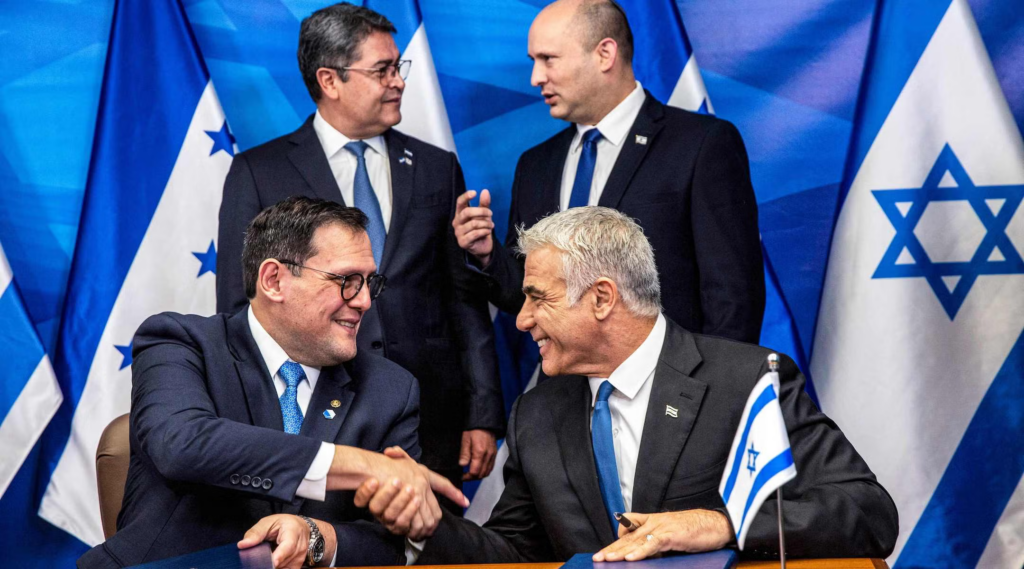
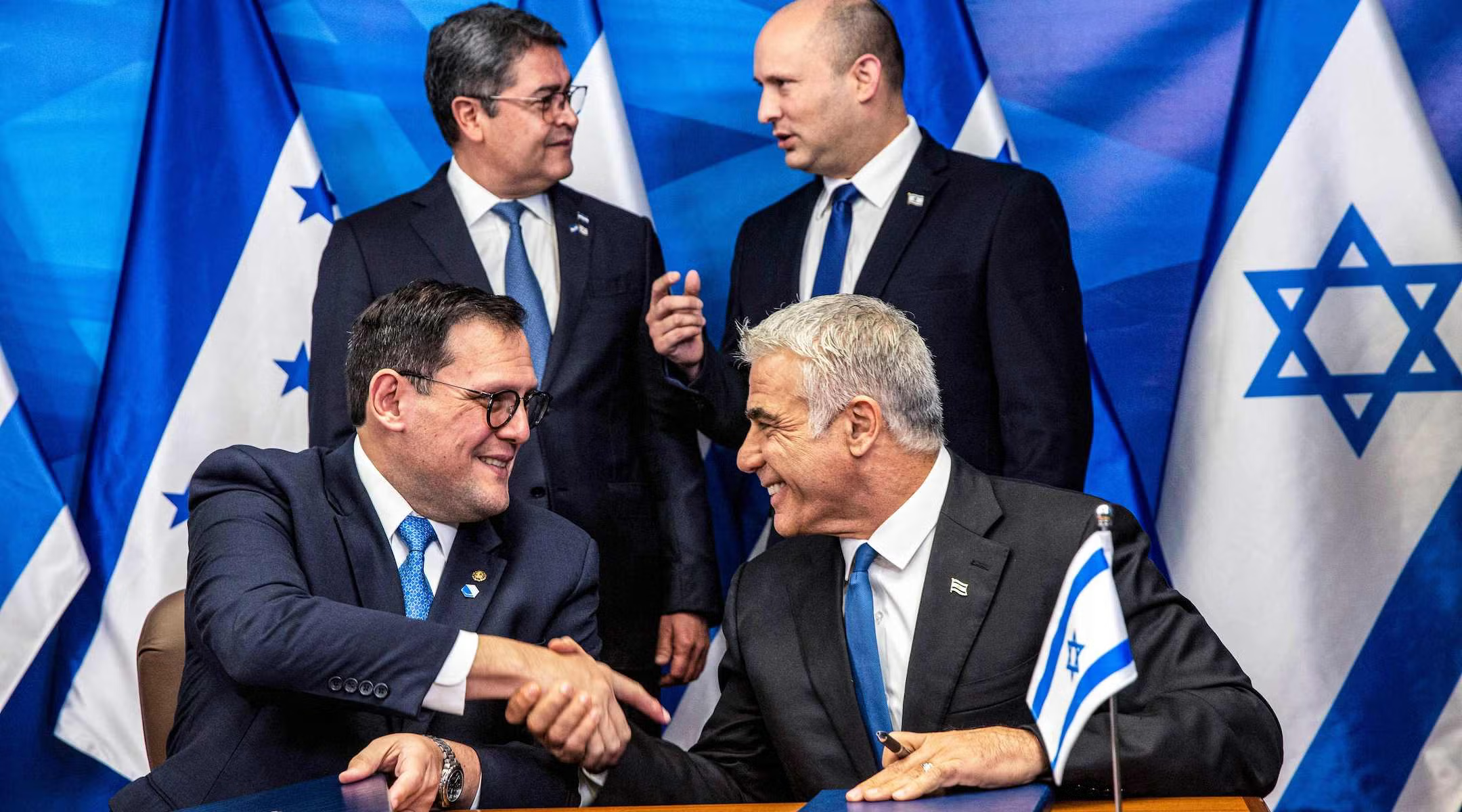
Israeli Foreign Minister Yair Lapid, right, shakes hands with his Honduran counterpart, Lisandro Rosales as Israeli Prime Minister Naftali Bennett, top right, speaks with Honduran President Juan Orlando Hernandez during the signing of bilateral agreements at the prime minister’s office in Jerusalem, June 24, 2021. (Source: Heidi Levine/AFP via Getty Images)
The CIA has complemented Israel’s long-term strategy by employing ostensibly humanitarian or religious NGOs, such as USAID, World Vision, and Church World Service (CWS), to fracture Honduran civil society. By promoting Protestantism over the historically cohesive Catholic majority and supporting programs that exploit divisions along religious, racial, and social lines, including tensions within the Garifuna community influenced by organisations such as OFRANEH, the CIA created fertile ground for ideological manipulation and elite control. Together, the actions of Israel and the CIA have destabilised Honduran society, skewed politics in favour of external interests, and amplified societal divisions. The 2025 elections starkly revealed these dynamics, exposing a democracy heavily shaped by decades of foreign intervention and manipulation.
While Honduras showed some symbolic independence, such as recalling its ambassador from Israel in November 2023, there is a strong case to argue that the deep structural influence of Israel and the U.S, reinforced over decades through military, economic, religious, and civil society channels, created a 2025 electoral landscape strongly favourable to a pro-Israel government, as confirmed by The Times of Israel. Nasry Asfura, promoted by President Trump, embodied this alignment, openly supporting Israeli interests and continuing policies that reinforced the country’s pro-Zionist orientation, making the elections less a contest of domestic politics and more a predictable outcome of long-term foreign influence.
Honduras is a nation under the shadow of powerful foreign influences, where politics, religion, and society have been quietly shaped for decades. The following article investigates how Israeli interests, CIA-backed NGOs, and elite manoeuvring have fractured communities, manipulated loyalties, and set the stage for the tensions that exploded during the 2025 elections…
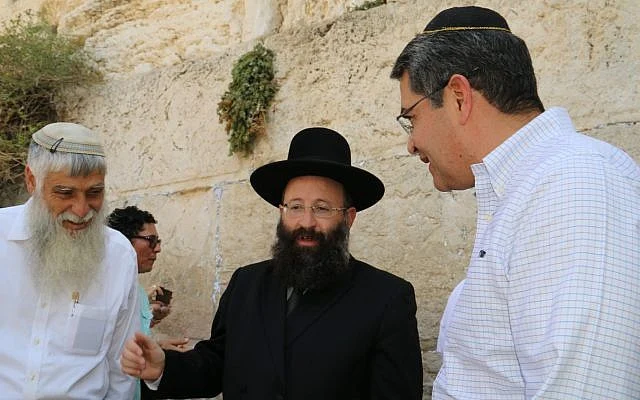
Honduran President Juan Orlando Hernandez visits the Western Wall in Jerusalem, September 1, 2019 (courtesy Western Wall Heritage Foundation)
Hondurans Curiously Ambivalent On Palestinian Genocide
Thomas Tomczyk writes for PÄYÄ Magazine…
Hondurans have been mostly silent regarding the reported genocide taking place in Gaza over the past two years. The question is: Why such silence? Are Hondurans unaware of the massacres and starvation used against Palestinians in the occupied territories? Do they not care, or are they perhaps afraid of something? “To learn who rules over you, simply find out whom you are not allowed to criticise,” the saying goes.
There was one example of Hondurans protesting Israeli crimes against Palestinians during the Gaza war after the Hamas attack and Israeli stand-down operation of October 7. On October 23, 2023, dozens of Honduran Palestinians demonstrated in front of the Israeli Embassy in Tegucigalpa. Since then, the long-established and influential Arab Palestinian community has been mostly silent about the plight of their Palestinian relatives amid Israel’s escalating atrocities in Gaza and the West Bank.
There is certainly a disconnect, as the 300,000 members of Honduras’ Christian Palestinian community are the third and fourth generations to be born outside of Palestine. Their ancestors began arriving in Honduras from Palestine in the 1890s, and today their connection to and knowledge of Palestine and Israel is mostly superficial. Most Honduran Palestinians don’t know the full scale or nature of the barbarism inflicted on their compatriots who stayed behind and continue to face Israeli oppression, violence, discrimination and now genocide. A Honduran Palestinian businessman told me that many in his community are afraid of being accused of anti-Semitism and facing potential consequences. Simply acknowledging that a systematic genocide may be occurring in Gaza is viewed by some as anti-Semitic.
It is hard not to notice. Since October 2023, Israeli military actions have resulted in the deaths of many Christian civilians in Gaza who have nothing to do with Hamas. In October 2023 Israeli military bombed a Christian orthodox church and murdered 18 Christians. In December 2023, Israeli snipers executed two Palestinian women on the Gaza Holy Family Catholic church property. In July 2025, Israeli soldiers fired a tank shell at a cross of the same church, killing three and wounding a catholic priest. While this all fell on deaf ears in Honduras, it does seem that the Israelis don’t like Christians very much.
One person who spoke with concern about the plight of Palestinians was President Xiomara Castro. In November 2023, the Honduran government recalled its ambassador to Israel for consultations due to escalating massacres of Palestinian civilians in Gaza. President Castro described Israel’s actions in Gaza as genocide during a U.N. speech in September 2024. Still, words have not turned into actions. Honduras is nowhere near recognising Palestine as an independent state or moving its embassy from Jerusalem back to Tel Aviv. In fact, Honduras remains firmly in the pro-Zionist camp as it continues to support Israel’s military by purchasing 15 Black Mamba military vehicles. Pro-Zionist sentiment is strong in Honduras. Israeli flags are flown throughout the country. Hondurans increasingly wear the Star of David around their necks, and taxi drivers display the Israeli emblem on their vehicles. Honduran roots of Zionism and Judeophilia run deep, well over a century.
The country now counts three of its presidents to be Jewish: Juan Lindo, Ricardo Maduro and Juan Orlando Hernández. In fact, you could argue that there was a fourth Jewish president of Honduras who ruled the country from 1911 well into the 1950s. Samuel Zemurray, the Banana King, was responsible for the 1911 Honduran presidential coup that secured land and concessions for his United Fruit banana company. American mercenaries hired by Zemurray deposed President Miguel Dávila and made Honduras his “banana republic.” Zemurray installed his puppet, Manuel Bonilla, as president and received 20,000 acres of land in return. After President Bonilla’s death in 1913, Zemurray continued to be a virtual puppet master of several other Honduran presidents.
In 1947, the World Zionist Organisation tasked Zemurray with delivering Honduras’ U.N. vote in support of the creation of the state of Israel. Reportedly, in a personal phone call, Zemurray tried to bribe then-Honduran President Tiburcio Carías Andino. Because of pressure from the Honduran Palestinian community, Honduras abstained from voting for Israel. Since then, and with plenty of CIA help, Christian Zionism has made many inroads in Honduras. CIA fronts such as World Vision, USAID and Protestant Church World Service for many decades worked to undermine the cohesiveness of Honduran society.
Since the 1950s, the CIA, which some critics considered an Israeli-captured agency, promoted the establishment and expansion of Protestant churches in Latin America. The excuse given was that Protestants were more anti communist and a good alternative to the Liberation Theology preached in many Catholic parishes.
The percentage of Catholics in the country fell from 97% in the 1960s to 47% today. Protestant denominations undermined the Catholic cohesion of Honduran society. Religiously divided Honduras is much easier to manipulate, with one denomination pitted against another. Sixty years later, those Catholic-to-Protestant converts have not only become Zionists, but they are also actually converting to Judaism. According to El Heraldo, 37 families converted to Judaism and, in 2022, established Honduras’ first synagogue. The San Pedro Sula Mishkan Shlomo synagogue members advertise their plans to Judaise and convert thousands of Hondurans.
“The plan is for the expanded synagogue to be a six-story, shaped like a Star of David building and be able to accommodate 456 people. This would make it the biggest synagogue in Latin America.”
Ex-President Juan Orlando Hernández was key in the expansion of Judeophilia and Zionism in Honduras. Just in terms of economy, according School of the Americas, between 2013 and 2019, Honduras purchased $342 million in military and surveillance equipment from Israel. Basically, Honduras has been supporting Israel to the tune of around $5 million a month for that period. Road to conversion of Juan Orlando Hernández began in the early 1990s when he completed a one-year Mashav leaders course in Israel. Israel’s investment in JOH obviously paid off as he learned Hebrew, moved Honduras’ embassy to Jerusalem in 2021, and converted to Judaism with his entire family in 2021. The last one, right before going to a US jail for 45 years, was convicted of decade’s long drug and arms smuggling operation.
Honduras is likely getting set up for a rough ride. Israel funded military dictatorships where even the CIA would not venture. Israel trained and supplied arms to many bad actors that destabilised the region: the genocidal regime in Guatemala in the 1980s, Colombian drug smuggling death squads, Los Zetas drug lord Heriberto Lazcano. “Israel has given its soldiers practical training in the art of oppression and in methods of collective punishment. Some of those officers choose to make use of their knowledge in the service of dictators,” said Israeli general Mattityahu Peled.
“Honduras will likely become an increasingly polarized and violent society.”
There is also a growing Israeli pressure on the Honduran public by co-opting its anti-Gaza genocide sentiment into nebulous movements. The normally restrained Honduran Ministry of Foreign Affairs complained that Israeli Ambassador Nadav Goren meddled in internal Honduran affairs by meeting with Protestant church leaders preparing for the August 16 March for Peace and Democracy. “We express to the Honduran people our deep discomfort at their participation in said public event. The involvement of a diplomat not only ignores his limitations,” stated the Honduran ministry. There are plenty of other players seeking discord. Until its recent defunding by the Trump administration, San Pedro Sula was also home to the Hebrew Immigrant Aid Society (HIAS). The worldwide HIAS organisation does not assist Palestinians, Arabs or Christians in moving to Israel, but uses U.S. tax dollars to help move undocumented migrants through Honduras to the United States.
For decades, certain interest groups have promoted racial resentment —particularly among Black communities— while fostering a sense of guilt among white, European and Christian populations. In Honduras, this strategy is reflected in the 23-year-old movement known as the Fraternal Organisation of Honduran Blacks (OFRANEH), which has received funding from organisations such as American Jewish World Service and the Open Society Foundations, founded by George Soros. These groups have been involved in fermenting revolutions, protests and underhanded political activism around the world. Just as with organisations such as Black Lives Matter and ANTIFA, which were recently designated by the U.S. as a terrorist organisation, OFRANEH fosters division, racial tension, grievances and expectations of compensation in the historically well-integrated Garifuna community. Honduras, in the second quarter of the 21st century, will likely become an increasingly polarised and violent society. Powerful interest groups are working hard to implement this, and Roatan is increasingly a party to those tensions. In September 2025, OFRANEH conducted demonstrations in Cayos Cochinos, and in March 2025, there were protests in Diamond Rock. Tensions on Roatan are just starting to heat up.
Honduran president accuses Trump of ‘election manipulation’
Al Mayadeen | December 10, 2025
Honduran President Xiomara Castro accused US President Donald Trump of direct interference in her country’s presidential elections, condemning what she termed election manipulation in Honduras’s disputed presidential race.
The controversy centers on the November 30 presidential election, where vote counting has been plagued by repeated computer system failures that have delayed final results. Trump-backed conservative Nasry Asfura currently holds 40.53 percent of votes, followed closely by right-wing candidate Salvador Nasralla with 39.16 percent, according to the National Electoral Council. Both candidates significantly outpace Castro’s left-wing Libre party candidate, Rixi Moncada.
Nasralla has challenged the results as fraudulent, claiming he actually leads by 20 percent and demanding a comprehensive recount. Speaking at a rally, Castro praised voters’ determination but alleged the election was marred by threats, coercion, manipulation of the preliminary results system, and tampering with voter intentions.
Castro specifically accused Trump of interference, noting his threats of consequences if Hondurans voted for Moncada. Trump openly endorsed Asfura as a “friend of freedom” while dismissing Nasralla as merely “pretending to be an anti-communist.”
In a stunning move, Trump also pardoned former Honduran President Juan Orlando Hernández, who was serving a 45-year US prison sentence for facilitating the trafficking of hundreds of tons of cocaine.
More than a week after voting concluded, thousands of ballots with irregularities await review. The Libre party has called for total election annulment and urged protests, while election officials have until December 30 to declare a winner under Honduran law. The Trump administration maintains the election was fair and rejects calls for annulment.
Trump’s unprecedented election meddling
Trump’s involvement in Honduras represents an extraordinary breach of diplomatic norms. Days before the election, he issued explicit warnings that the United States would cut off financial support if Asfura lost, stating on Truth Social that the US would not throw “good money after bad” if a candidate he deemed “communist” took power.
The Trump administration employed Cold War rhetoric, labeling Moncada and Nasralla as “communists” or “borderline communists” allied with Venezuela’s Nicolas Maduro. Beyond aid threats, Trump leveraged the possibility of mass deportations and blocking remittances, which constitute approximately 25 percent of Honduras’ GDP.
Moncada noted that text messages were circulated warning voters that December remittances would not arrive if the wrong candidate won, creating panic in a population heavily dependent on these funds.
The impact proved measurable. Ricardo Romero Gonzales, who runs an independent polling company, reported that Nasralla held a nine-point lead before Trump’s endorsement. After Trump intervened, the candidates reached a virtual tie. Roughly one-third of Hondurans have family in the United States, making Trump’s threats particularly potent.
José Ignacio Cerrato López, a 62-year-old retiree, told the New York Times that he initially planned to vote for Nasralla but switched to Asfura after Trump’s statement. “Trump said he was going to make things worse,” Cerrato López explained, citing fears about deteriorating bilateral relations.
The Trump corollary: A new doctrine of hemispheric control
Trump’s Honduras intervention exemplifies what his 2025 National Security Strategy terms the “Trump Corollary” to the Monroe Doctrine. Unlike the original 1823 doctrine preventing European colonization, Trump’s version asserts US rights to intervene directly in Latin American domestic politics to prevent influence by “non-Hemispheric competitors,” specifically China, or ideologies deemed hostile to US interests.
Under Castro, Honduras severed ties with Taiwan and established relations with China in 2023, opening the door for Chinese infrastructure investment. By backing Asfura, Trump aims to install a government that will reverse or freeze these projects, viewing Asfura as the “checkmate” to Beijing’s regional influence.
A pattern of historical intervention
Trump’s interference continues a century-long pattern of US meddling in Honduras, often called the quintessential “Banana Republic” due to historical dominance by US fruit companies.
During the 1980s Reagan administration, Honduras became known as “USS Honduras,” serving as the staging ground for the proxy war against Nicaragua’s Sandinista government. The CIA trained Battalion 316, a death squad responsible for kidnapping, torturing, and disappearing nearly 200 activists.
More recently, the 2009 military coup against President Manuel Zelaya, who had moved closer to Venezuela’s Hugo Chavez, received tacit US support. While the Obama administration officially condemned the coup, Secretary of State Hillary Clinton refused to designate it a “military coup,” allowing aid to continue.
The Real Story Behind Trump’s Pardon of Juan Orlando Hernández
José Niño Unfiltered | December 6, 2025
The news came in quietly from a federal prison in West Virginia. Juan Orlando Hernández, the former president of Honduras once sentenced to spend most of the rest of his life behind bars, had walked out of Hazelton penitentiary a free man.
According to an AP report, Hernández had received a presidential pardon from Donald Trump after a conviction that tied him to hundreds of tons of cocaine shipped into the United States. On paper, this was a spectacular reversal of fortune for a man whom federal prosecutors had branded the head of a Central American narco state. In practice, it looked like something else. It looked like a reward for loyalty to the one cause that towers above all others in Washington and in Trump world.
Hernández did not rise overnight. He entered Congress in the late 1990s, representing the rural department of Lempira, and spent more than a decade climbing inside the National Party machine. He then became president of the National Congress and finally president of Honduras from 2014 to 2022. While he projected the image of a tough conservative modernizer at home, another storyline unfolded in U.S. courtrooms.
Federal prosecutors charged him with a vast cocaine conspiracy involving the movement of multi-ton loads into the United States and with the possession of machine guns and other weapons in support of that network. The Justice Department later described his administration as a narco state fueled by millions in cartel bribes. Testimony and media investigations painted an even darker picture. According to Democracy Now, Hernández allegedly used Honduran security forces to protect drug shipments, partnered with major traffickers including the Sinaloa cartel, and used drug money to build his own political power. His brother Tony Hernández ended up with a life sentence in a U.S. prison on similar charges.
Court filings and investigative reports in outlets like CNN repeatedly tied the sitting Honduran president to drug traffickers. U.S. prosecutors said he took payoffs from drug networks as early as 2004. Hernández’s story also intersected with one of Honduras’s most prominent Jewish families. Prosecutors alleged that he received bribe payments and other favors from the Rosenthal family, a powerful clan of Romanian-Jewish origin led by Jaime Rosenthal, whose Grupo Continental controlled Banco Continental, a soccer club, and auto import businesses, as reported by Reuters.
The Rosenthal patriarch, a frequent Liberal Party presidential hopeful of Romanian Jewish extraction, stood near the top of the Honduran economic and political pyramid for decades. For his part, Hernández treated that network as another source of money and influence. A Univision investigation detailed allegations that he used drug money to finance political campaigns. After his arrest, Honduran authorities seized dozens of properties, vehicles, businesses, and other assets linked to his family.
The saga culminated in extradition to the United States in 2022. A New York jury convicted Hernández in March 2024, and a federal judge handed down a 45-year sentence plus supervised release in June of that year. By any normal standard, this was the end of the story. A disgraced former head of state, proven in court to have worked hand in glove with traffickers, destined to spend the rest of his days in prison.
However, Hernández did not bet his future on normal standards. For decades, he had invested in a different kind of protection. That protection wore a blue and white flag with a Star of David at the center.
His relationship with Israel began long before he held national office. As a young man in the early 1990s Hernández traveled to Israel under the auspices of Mashav, the Israeli Agency for International Development Cooperation. The Jewish Telegraphic Agency noted that he completed a Mashav enrichment course in 1992, at the beginning of his diplomatic career.
Three decades later, at the opening of the Honduran embassy in Jerusalem, Hernández stood before an audience and called that first visit to Israel a “life-changing” experience. He said the trip had shaped his view of security, agriculture, and innovation.
Once he entered the presidential palace, Hernández turned that personal link into state doctrine. In October 2015, he arrived in Jerusalem as head of state and told an audience convened by the Israel Council on Foreign Relations and the World Jewish Congress that “As long as I am president, Honduras will stand behind Israel.” The World Jewish Congress described the event in glowing terms and singled out his declaration that ties between the two countries had never been closer.
This was not idle rhetoric. Hernández set out to reposition Honduras as one of the most reliable pro-Israel governments in Latin America. Honduran and Israeli diplomats had initially signed formal relations in the 1950s, and Honduras had allowed Jewish immigration during the Second World War. Under Hernández, those historical connections became the foundation for a new foreign policy.
He adjusted the Honduran voting record at the United Nations so that his country would abstain from or oppose resolutions deemed hostile to Israeli interests. During the 2017 General Assembly vote that condemned the U.S. decision to move its embassy to Jerusalem, Honduras was one of only a tiny group of countries that sided with Washington and Israel against the overwhelming majority.
Hernández also opened a diplomatic and trade office in Jerusalem, signaling recognition of the city as Israel’s capital. He then promised to relocate the full Honduran embassy from Tel Aviv to Jerusalem, issuing joint statements with Israeli and U.S. officials that set public deadlines for that step. In June 2021, he completed the move. At the inauguration, Hernández proclaimed that he was “here today in the eternal capital of Israel” and vowed to work “against antisemitism, often presented as anti Zionism,” as quoted by Israel Hayom.
Israel rewarded this loyalty with gestures of its own. It agreed to reopen its embassy in Tegucigalpa and provided security cooperation, technical assistance and emergency relief after devastating hurricanes and during the early stages of the COVID era.
Furthermore, Hernández pushed Honduras into the orbit of Christian Zionist networks. The Friends of Zion Museum in Jerusalem, an institution that promotes Christian support for Israel and campaigns against antisemitism and BDS, gave him its Friends of Zion Award in 2019 for recognizing Jerusalem as Israel’s capital and for his diplomatic support. The Friends of Zion Museum and the Jerusalem Post emphasized that he now shared an honor roll with figures like Donald Trump and other leaders celebrated for their pro-Israel policies.
In the security arena, Hernández took positions that aligned perfectly with Washington and Tel Aviv. His government designated Hezbollah as a terrorist organization, a move welcomed by major American Jewish groups. This decision mirrored similar steps by other U.S.-aligned governments in the region–such as Argentina under Mauricio Macri–and confirmed that Tegucigalpa had no intention of straying from the Judeo-American consensus on Middle East security.
Even when the walls began to close in, Hernández treated Israel as his ultimate safety net. As his legal exposure increased and the prospect of extradition grew more likely, he reportedly turned to Israeli officials to ask for help in delaying or preventing his transfer to U.S. authorities. The Times of Israel reported that plea and underscored Hernández’s assumption that his years of unwavering support had earned him political capital in Jerusalem.
That calculation looked naïve when he arrived in New York in chains. It looks far more rational now that Donald Trump has delivered a pardon.
Trump himself cultivated a brand as perhaps the most pro-Israel president in U.S. history. He recognized Jerusalem as Israel’s capital, moved the U.S embassy there, backed the annexation of the Golan Heights, and surrounded himself with advisers and donors who made support for Israel a central test of loyalty. The Friends of Zion Museum honored him with the same award it later gave Hernández, presenting both men as partners in a shared historic mission.
So when Trump announced in late 2025 that he would pardon Hernández, it was natural for mainstream outlets to emphasize the legal controversy and the scale of the drug conspiracy. But there is another thread that runs from the Mashav classroom in the early 1990s to the Jerusalem embassy ribbon cutting to the moment the gates opened at Hazelton. That thread is the politics of Zionism in the Americas and the unwritten rule that governs advancement and protection in that world.
Hernández spent his adult life proving that he would stand behind Israel. He did it in the United Nations chamber, in ceremonial torch lighting invitations, in embassy relocations, in his fights against BDS and in his designation of Hezbollah. He did it in speeches where he promised that “as long as I am president, Honduras will stand behind Israel” and in the moment when he described Jerusalem as the “eternal capital of Israel.”
Trump saw that record and recognized a fellow shabbos goy traveler. He understood that this was not just a corrupt Central American politician but a loyal member of a global pro-Israel camp who had delivered meaningful victories in a region where Israel has long worked to secure dependable allies. In a political universe where servility to world jewry carries more weight than any anti-corruption sermon, Hernández did not just have a lawyer. He had a patron.
The pardon of Juan Orlando Hernández is therefore more than a quirky case of presidential clemency. It is a message about the real hierarchy of values in U.S. foreign policy in the Trump era. Flooding American streets with cocaine will not necessarily erase your credit if you have spent years moving embassies to Jerusalem, voting the right way at the United Nations, and branding your small Central American country as an extension of Israel’s diplomatic network.
In that world, a man who helped turn his own nation into a narco playground can still find a way out of a 45-year sentence, as long as his record on Zionism is pure and his friendship with the most pro-Zionist president in modern U.S. history remains intact. For Juan Orlando Hernández, that friendship did not simply buy influence. It bought his freedom.
Electoral Coup: CNE Councilor Denounces Serious Irregularities in Honduras
teleSUR – December 2, 2025
Marlon Ochoa, a member of Honduras’ National Electoral Council (CNE), denounced serious irregularities on Tuesday following the general elections held on November 30. He highlighted biometric failures, the withholding of 16,708 tally sheets, the complete lack of processing of physical tally sheets, and the lack of public access to the results.
Ochoa emphasized that the information provided by the TREP (Preliminary Electoral Results Transmission) system “lacks certainty and consistency,” something that Honduran citizens “have been able to verify.” He stated that the country is facing an election with “terrible technological results, profound inconsistencies, and irregularities,” evidenced by the lack of public access to the preliminary results on December 2.
During a session of the National Electoral Council (CNE) that extended until 3:00 AM this Tuesday, the company ASD verbally reported that 16,708 closing tally sheets had been withheld and not released to the public. These are broken down as follows: 3,880 presidential tally sheets, 6,387 for members of parliament, and 6,441 for municipal corporations.
The council member explained in a social media post that, across the country’s 7,669 transmission centers, the Preliminary Results Transmission System (TREP) has experienced inconsistencies in assigning votes. He illustrated that, when transcribing a tally sheet, the system can display the image of one polling station but assign the votes to a different one without the transcriber noticing.
In addition, the results publication website has been down, and there has been no official explanation for the outage, despite requests for information from the companies involved.
On the other hand, Ochoa opposed the decision, made by a majority in the National Electoral Council (CNE), to grant privileged access to the results dissemination rooms only to media outlets and political parties starting at 7:00 AM. The council member insists that the results dissemination website should be activated for the entire population, in accordance with the law and the approved guidelines.
Furthermore, he criticized the fact that as of 1:15 PM (local time) on December 2nd, none of the physical closing tally sheets returned from the polling stations had been processed, which he described as a “highly irregular act” that sows “doubts and uncertainty” about electoral transparency.
The presidential candidate for the LIBRE party, Rixi Moncada, denounced on Monday night an “electoral scheme” that allowed for the falsification of results with inflated tally sheets after the elimination of biometric validation in the elections.
Moncada presented a compelling technical analysis, highlighting the responsibility of the two-party system in an electoral fraud scheme. The candidate revealed that the “elimination of biometric verification of tally sheets was approved” by the National Electoral Council (CNE) “the night before the elections.” This controversial decision, according to Moncada, “enables the inclusion of inflated tally sheets, especially at the presidential level.”
Moncada’s technical team has identified 2,859 tally sheets without biometric verification, representing 25.35 percent of the total. These tally sheets, with an average of 217 votes each, present extreme cases with up to 100 additional votes beyond the legitimate ones.
The National Party accounts for 1,588 of these tally sheets, totaling 326,285 irregular votes, while the Liberal Party has 1,041 tally sheets without biometric verification, equivalent to 217,193 irregular votes.
Moncada stated: “We are going to demand during this 30-day period of the final general count that these tally sheets be reviewed, and we are going to make use of legal resources.”
4 Shocking Ties Between Rubio, Lobbyists, and Hernández Narcotics Indictment

teleSUR | November 29, 2025
WASHINGTON — The recent announcement by former U.S. President Donald Trump that he will grant a “full and complete pardon” to Juan Orlando Hernández, the former Honduran president currently serving a U.S. federal sentence for drug trafficking, has reignited scrutiny over a long-documented web of political and financial connections linking Hernández, Republican lobbying powerhouse BGR Group, and U.S. Secretary of State Marco Rubio.
Far from an isolated act of clemency, Trump’s pledge appears deeply entangled with a system of influence-peddling that has shaped U.S. policy toward Central America for years. At the center stands Rubio—a figure who, as a Florida senator, once publicly praised Hernández for “taking on drug traffickers,” even as evidence mounted that the Honduran leader was personally profiting from the very cartels he claimed to fight.
Now, with Rubio overseeing U.S. diplomacy from the State Department, critics warn that the Rubio Hernández lobbying scandal reveals how foreign actors can exploit the U.S. lobbying system to buy legitimacy, evade justice, and ultimately secure political favors—including presidential pardons.
The BGR Group Connection: How Hernández Bought Influence in Washington
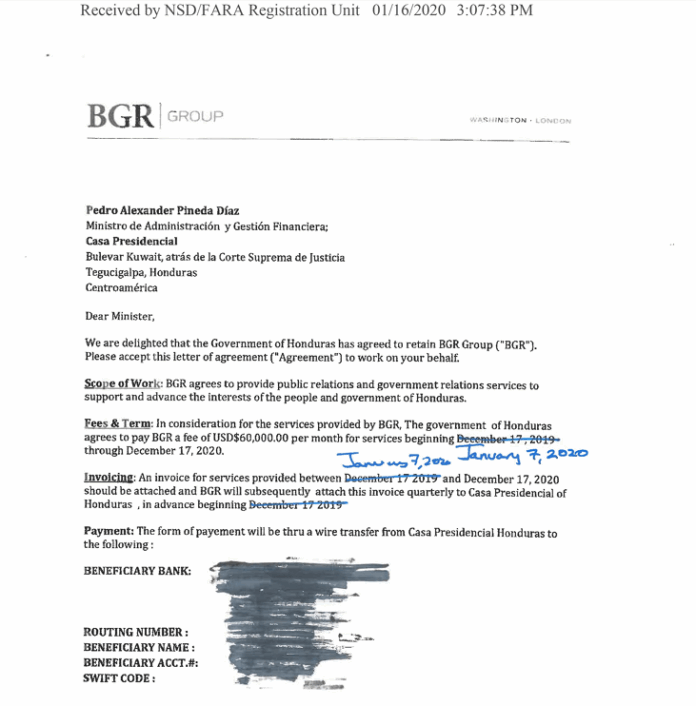
In early 2020, as his legal situation began to collapse—following the life sentence of his brother, Tony Hernández, for trafficking tons of cocaine into the U.S.—Juan Orlando Hernández signed a $660,000 contract with BGR Group, a Washington-based lobbying firm founded by former Republican Governor Haley Barbour.
The goal was clear: rehabilitate Hernández’s image in the U.S. capital as a “trusted ally” and “anti-narcotics partner,” despite mounting evidence that he had accepted millions in bribes from cartels to fund his presidential campaigns.
According to a detailed investigation by VICE News, BGR Group went to work immediately:
- It contacted 11 congressional staffers, three of whom had previously worked directly for Marco Rubio.
- It distributed press releases portraying Hernández as a bulwark against organized crime.
- It arranged meetings with U.S. officials to reinforce the narrative of Honduras as a cooperative security partner.
All this occurred while U.S. prosecutors were building their case against Hernández himself—culminating in his 2024 conviction for conspiring to import over 500 tons of cocaine into the United States.
Critically, BGR Group was not just any firm—it was a major Republican donor network with deep ties to Rubio’s political career. Records show the firm hosted fundraising events for Rubio’s 2010 and 2016 Senate campaigns, as well as his short-lived 2016 presidential bid.
This means that the same lobbying apparatus paid by a convicted narco-president helped finance the rise of the man now shaping U.S. policy toward Latin America.
Explore FEC records on BGR’s political contributions to Rubio (Federal Election Commission)
Trump’s Pardon as Political Payback—Not Justice
Trump’s announcement—made via Truth Social on Friday—comes amid his open support for Nasry “Tito” Asfura, Hernández’s political protégé and the National Party’s 2025 presidential candidate in Honduras. Trump has explicitly tied future U.S. aid to Asfura’s victory, signaling that Washington’s backing is conditional on political alignment.
In this context, the pardon of Hernández appears less like mercy and more like a strategic signal: loyalty to U.S. Republican interests—even when demonstrated through illicit means—will be rewarded.
Hernández, after all, was once Washington’s favorite Central American strongman. He allowed the U.S. to maintain military bases in Honduras, cracked down on migrant caravans, and supported U.S. regional agendas—all while allegedly running a state-sponsored drug enterprise.
Now, with Rubio at the State Department and Trump eyeing a 2028 comeback, the Rubio Hernández lobbying scandal underscores a troubling reality: foreign leaders can launder their reputations through U.S. lobbying firms, gain access to top policymakers, and ultimately escape accountability—even after federal conviction.
As one Latin American diplomat put it: “This isn’t diplomacy. It’s transactional impunity.”
Geopolitical Context: Undermining Rule of Law in the Americas
The fallout from the Rubio Hernández lobbying scandal extends far beyond bilateral relations. It strikes at the credibility of the entire U.S. “war on drugs” and its claims of promoting democracy and rule of law in Latin America.
If a president convicted of trafficking cocaine can secure a presidential pardon through backroom lobbying and partisan loyalty, what message does that send to reformers in Guatemala, El Salvador, or Colombia?
Moreover, it deepens regional distrust of U.S. intentions. For years, progressive governments in the region have argued that Washington prioritizes compliance over justice—backing authoritarian but cooperative leaders while condemning leftist governments for lesser offenses. The Hernández case validates that critique.
Cuba, Nicaragua, and Venezuela have long denounced this “selective morality” in U.S. foreign policy. Now, even centrist allies are questioning whether the U.S. system can be gamed by those with enough money and the right lobbyists.
In a hemisphere increasingly seeking multipolar partnerships, such scandals fuel the narrative that U.S. democracy is for sale—and that sovereignty is secondary to political convenience.
US Seizes Venezuelan Jet Plane Confirming who is the Rogue Nation
By Rick Sterling | Dissident Voice | September 7, 2024
The Biden/Harris administration is renewing its attacks on Venezuela. On Monday, September 2, US officials seized a jet plane belonging to the Venezuelan government when it was in the Dominican Republic for servicing, then flew it to Florida.
Contrary to a false report in the NY Times, the plane was not “owned by Venezuela’s Nicolas Maduro”. It is owned by the Venezuelan government and used for travel by various Venezuelan officials in addition to the president.
The NYT article claims, “The Biden administration is trying to put more pressure on Mr. Maduro because of his attempts to undermine the results of the recent presidential election.” This is another inversion of reality. The US government is trying to undermine the results determined by the Venezuelan National Election Council (CNE) and ratified by their Supreme Court.
Contrary to Western claims, the Supreme Court and Election Council are not synonymous with the government. They are approved by Venezuela’s elected national assembly. While one opposition member of the Election Council criticized the results, he did not attend the count or meetings. He does not ordinarily live in Venezuela and has returned to his home in the USA. Meanwhile, another opposition member of the Election Council, Aime Nogal, participated and approved the council’s decision.
Before the election, polls showed vastly different predictions. The US-funded polling company, Edison Research, showed the Gonzalez/ Machado opposition winning. Other polls showed the opposite. Polls are notoriously unreliable, especially when the poll is funded by an interested party. A better indication was the street demonstrations where the crowd in support of the coalition led by Maduro was near one million people. In contrast, the crowd for Gonzalez was a small fraction of that.
Increasingly, countries throughout the Global South are rejecting and criticizing Washington’s intervention in other nations’ internal affairs. On August 28, the president of Honduras, Xiomara Castro Zelaya, terminated the long standing extradition treaty with the United States and denounced US meddling after the US Ambassador commented negatively on Honduran – Venezuelan discussions. Along with many other Latin American countries but to the dismay of the US, Honduras recognized the results of the Venezuelan election.
For over twenty years, the US has been trying to overturn the Bolivarian revolution. In 2002, the US government and elite media supported a coup attempt against President Hugo Chavez. To their chagrin, the attempt collapsed due to popular outrage. Since then, there have been repeated efforts with the US supporting street violence, assassination attempts, and invasions. Under Obama, Venezuela was absurdly declared to be a “threat to US national security”. This was the bogus rationale for the economic warfare which the US has waged ever since. Multiple reports confirm that tens of thousands of Venezuelans have died as a result of hunger and sickness due to US strangulation of the economy. Again, the truth is the opposite of what Washington claims: the US is a threat to Venezuela’s national security.
Unknown to most U.S. residents, in December 2020 the U.N. General Assembly declared US unilateral coercive measures (sanctions) are “contrary to international law, international humanitarian law, the Charter of the United Nations and the norms and principles governing peaceful relations among States.”
Illegal U.S. measures were used to justify the kidnapping and imprisonment of Venezuelan diplomat, Alex Saab. They have now been used to justify the theft of a jet plane needed by Venezuelan officials.
Previously, sanctions were used to justify the seizure of Venezuela’s CITGO gas stations and freezing gold reserves in London. It comes after the U.S. and allies pretended for several years that an almost unknown politician, Juan Guaido, was the president of Venezuela.
The reasons for Washington’s repeated efforts to overturn the Bolivarian revolution are clear: Venezuela has huge oil reserves and insists on its sovereignty. Under Chavez and Maduro, the Bolivarian revolution has sought to benefit the vast majority of Venezuela’s people instead of a small elite of Venezuelans and foreigners. Washington cannot tolerate the idea that those resources are used to benefit the Venezuelan people instead of billionaires like the Rockefeller clan, which made much of its wealth from Venezuela.
Under the Bolivarian revolution, Venezuela insists on having its own foreign policy. In 2006, Venezuelan President Hugo Chavez denounced the U.S. invasion of Iraq and compared U.S. President Bush to the devil. In May this year, Venezuelan President Maduro denounced Israel’s genocide in Gaza and accused the West of being “accomplices.”
The cost of seizing Venezuela’s plane on foreign soil was probably greater than the $13 million value of the plane. So why did the Biden administration do this now? Perhaps it is to garner the votes of right-wing Cubans and Venezuelans in Florida. Perhaps it is to distract from their foreign policy failures in Gaza and Ukraine.
Whatever the reason, the theft of the Venezuelan jet plane is an example of U.S. foreign policy based on self-serving “rules” in violation of international law. It shows who is the rogue state.
President Xiomara Castro of Honduras is representative of the wave of disgust with US interference, crimes, and arrogance. In the past, Honduras was called a “banana republic” and known as “USS Honduras”. Now its president says, “The interference and interventionism of the United States … is intolerable. They attack, disregard and violate with impunity the principles and practices of international law, which promote respect for the sovereignty and self-determination of peoples, non-intervention and universal peace. Enough.”
Honduras recalls envoy from occupied territories citing Israeli violations in Gaza
Press TV – November 3, 2023
Honduras has recalled its ambassador from the occupied territories for consultations amid the Israeli regime’s hugely deadly and devastating war against the Gaza Strip.
The Honduran foreign ministry announced the development on Friday, citing Tel Aviv’s violations of the international humanitarian law in Gaza.
The country’s top diplomat confirmed the development in a post on X, formerly known as Twitter.
“Amid the grave humanitarian situation, the Palestinian civilian population suffers in the Gaza Strip, the government of President Xiomara Castro has decided to immediately call Mr. Roberto Martinez, ambassador of the Republic of Honduras in Israel, to consultations in Tegucigalpa,” read the post by Enrique Reina.
On Friday, the 28th day of Israel’s genocidal attacks on the coastal territory, the death toll reached at least 9,227 people, including 3,826 children and more than 2,405 women. At least 23,516 people have been wounded.
The regime launched the war after Gaza’s resistance groups conducted Operation al-Aqsa Storm, their biggest operation against the occupying entity in years.
So far, Chile and Colombia have similarly recalled their envoys from the occupied territories, while Bolivia has moved to sever its diplomatic ties with the occupying entity.
On Thursday, Bahrain’s lower house of parliament said the country had halted its economic relations with the Israeli regime over the war.
The chamber also confirmed that the Israeli ambassador to the kingdom had left Bahrain, and that Manama had decided to return the Bahraini ambassador from the occupied territories.
Opposition candidate Xiomara Castro claims election victory in Honduras
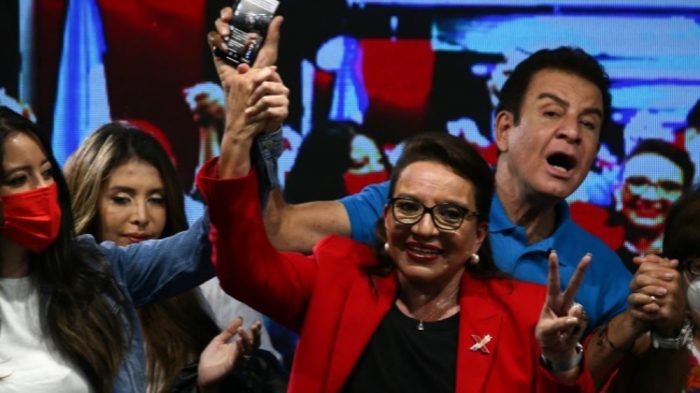
Xiomara Castro of the opposition Liberty and Refoundation Party (Libre) and vice presidential candidate Salvador Nasrala after the closing of the general election, November 29, 2021. (Photo: Reuters)
Press TV – November 29, 2021
Leftist opposition candidate, Xiomara Castro, has claimed victory in Honduras’ presidential election, with preliminary results putting her in pole position against the ruling party candidate.
With 38% of the voting tally complete, the Liberty and Refundation Party (LIBRE) candidate is in the lead with over 53 percent votes. Her main rival, Nasry Asfura of the ruling conservative National Party, currently has nearly 34% of the vote, according to the National Electoral Council (CNE).
If Castro holds on to the lead, she would become the first female president of the Central American country, ending the conservative party’s 12-year stint in power.
“We win! We win!” Castro, 62, told cheering party supporters on Sunday evening. “Today the people have made justice. We have reversed authoritarianism.”
In a brief victory address, Castro vowed to form a government of “reconciliation,” and to strengthen direct democracy with referendums, adding that “there will be no more abuse of power in this country.”
“We can’t stay home. This is our moment. This is the moment to kick out the dictatorship,” said Castro, who is making third bid at the presidency. She is the wife of former President Manuel Zelaya, whose government was toppled by a civilian-military alliance in 2009.
The outgoing President, Juan Orlando Hernandez, was accused by a US court of having ties to powerful drug trafficking gangs. However, he has denied the allegations.
Hernandez has faced stiff opposition in Honduras since he claimed a second term in a highly-divisive election at the end of 2017, which sparked widespread protests after both sides declared victory.
Unlike Hernandez, who was a conservative US ally, Castro has said that she would have diplomatic relations with China.
According to the electoral council, the voting saw a historic turnout of more than 68 percent.
The election is the latest political flashpoint in Central America, a major source of growing US-bound migrants fleeing chronic poverty, unemployment and persecution.
The spiraling crisis of hunger and homelessness in Honduras has placed it among the world’s most violent countries.
Alongside the presidency, the country’s 128-member Congress, and officials for some 300 local governments, are also being voted in these elections.
Coups and Neo-Coups in Latin America
By Juan Paz y Miño Cepeda |Venezuelanalysis | September 15, 2020
I recently received an article entitled “Coups and neo-coups in Latin America. Violence and political conflict in the twenty-first century” by Carlos Alberto Figueroa Ibarra, a long-time friend and academic at the University of Puebla, Mexico, and Octavio Humberto Moreno Velador, a professor at the same university.
The authors say that since the 1980s, democracy in Latin America has asserted itself across the continent, so much so that the topic has become recurrent in the political sciences. However, during the first seventeen years of the 21st century, new coups resurfaced, which they describe as “neo-coups.”
During the twentieth century, the authors identified 87 coups in South America and the Caribbean, with Bolivia and Ecuador being the most hit countries, while Mexico has only suffered once. The greatest concentration of coups occurred in four decades: 1930-1939 with 18; 1940-1949 with 12; 1960-1969 with 16 and 1970-1979 with 13. Between 1900-1909 and 1990-1999, the fewest coups occurred (3 and 1, respectively). Finally, 63 coups were deemed as military-led; 7 civilian; 8 civic-military; 6 presidential self-coups and three military self-coups. 77 percent of coups had a marked influence of right-wing ideology and party participation, and since the 1960s US intervention has been observed in several coups.
The neo-coups of the 21st century, however, are different from the coups of the twentieth century and with distinct characteristics. Of the seven studied, four have been carried out by the military/police (two which failed in Venezuela/2002 and Ecuador/2010 and two which were successful in Haiti/2004 and Honduras/2009). Likewise, two were parliamentary coups (Paraguay/2012 and Brazil/2016, both successful) and one was a civilian-state-led coup (Bolivia/2008, failed). In three of them, there is evidence of US intervention (Haiti, Bolivia and Honduras).
The intervention of the military or police took place in Venezuela, Haiti, Honduras and Ecuador. In Haiti, Bolivia and Brazil, large-scale concentrations of opposition citizen groups preceded the coups, exerting political pressure. There were also other cases of subsequent concentrations in support of Presidents Hugo Chávez and Rafael Correa, which prevented the success of the coups against them.
In three cases there was clear intervention by the judiciary (Honduras, against Manuel Zelaya; Paraguay, against Fernando Lugo; and Brazil, against Dilma Rousseff), and also of the legislative powers.
In addition, regional and supranational institutions have intervened in defence of democracy, specifically MERCOSUR, UNASUR, CELAC and even the Rio Group.
The authors conclude that “The new coups have sought to evade their cruder military expression in order to seek success. In this sense, the intervention of judicial and parliamentary institutions have represented a viable alternative to maintaining democratic continuity, despite the breakdown of constitutional and institutional pacts.”
To the analysis carried out by the two professors, and which I summarise without going into too many details, some considerations may be added.
All the coups of the 21st century have been directed against rulers of the Latin American progressive cycle: Hugo Chávez, Evo Morales, Manuel Zelaya, Rafael Correa, Fernando Lugo, Dilma Rousseff, and Haiti, where the case is particular because of the turbulence that the country has experienced where the military coup was against Jean-Bertrand Aristide, who had won the election with 91.69 percent of the vote.
Progressive governments aroused furious enemies: business elites, traditional oligarchies, military sectors of old “McCarthyism” anti-communism, the political right, “corporate” media, and, no doubt, imperialism.
There is not a single coup d’état led by “leftist” forces, which reveals an equally new phenomenon: the entire left has accepted democracy as a political system and elections as an instrument through which they may come to power. Historically speaking, this phenomenon represents a continuation of Salvador Allende’s and the Chilean Popular Unity’s thesis, which trusted in the possibility of building socialism through a peaceful path. It is the political and economic right, which have turned to neo-coup mongering, with their discourse of defending “democracy.”
Those same right-wing sectors have not only sponsored “soft coups,” but also promoted the use of two mechanisms that have been tremendously successful to them. Firstly, lawfare, or “legal war,” used to pursue, in appearance of legality, those who have served or identified with progressive governments. Secondly, the use of the most influential media (but also of social media and their “trolls”), which were put at the service of combating “populists” and “progressives,” and defend the interests of persecuting governments, business elites, rich sectors and transnational capital. These phenomena have been clearly expressed in Brazil against Inácio Lula da Silva, Dilma Roussef and the PT Workers’ Party, but also in Bolivia, against Evo Morales and the MAS Movement to Socialism and in Ecuador, where righting forces have achieved the prosecution of Rafael Correa, of figures of his government and of the “correístas.” In Argentina Alberto Fernández’s triumph stopped the legal persecution against Cristina Fernández and “Kirchnerismo”.
But there is, finally, a new element to be added to the neo-coup mongering of the 21st century, which is the anticipated coup d’état. This has been inaugurated in Bolivia and Ecuador.
In Bolivia, not only was the vote count suspended and Evo Morales forced to take refuge outside the country, but [he and his party] have been politically outlawed, and every effort has been made to marginalise them from future elections.
In Ecuador, all kinds of legal ruse have been used to prevent Rafael Correa’s vice-presidential candidacy (he was ultimately not admitted), to not recognise his party and other forces that could sponsor him, as well as to make it difficult for the [Correa-backed] Andrés Araúz team to run for the presidency.
It also has an equally unique characteristic of what happened in Chile. In Chile, despite the protests and social mobilisations, as well as domestic and international political pressure, the political plot was finally manipulated in such a way that the plebiscite convened for October/2020 will not be for a Constituent Assembly (which could dictate a new constitution), but for a Constitutional Convention, which allows traditional forces to preserve their hegemony, according to the analysis carried out by renowned researcher Manuel Cabieses Donoso.
As a result, neo-coup mongering has shown that, while institutional and representative democracy has become a commonplace value and a line of action for the social and progressive lefts, it has also become an instrument that allows access to government and, with it, the orientation of state policies for the popular benefit and not at the service of economic elites.
On the other hand, it has become an increasingly “dangerous” instrument for the same bourgeoisie and internal oligarchy, as well as imperialism, to such an extent that they no longer hold back from breaking with their own rules, legalities, institutions or constitutional principles, using new forms of carrying out coups.
It is, however, an otherwise obvious lesson in Latin American history: when popular processes advance, the forces willing to liquidate them are also prepared. And finally, for these forces, democracy doesn’t matter at all, only saving businesses, private accumulation, wealth and the social exclusiveness of the elites.
Juan J. Paz y Miño Cepeda is an Ecuadorian historian from the PUCE Catholic University of Quito. He is also the former vice-president of the Latin-American and Caribbean Historian’s Association (ADHILAC).
Translation by Paul Dobson for Venezuelanalysis.
Brazil is adopting Israel’s terror narrative, which is anything but democratic
By Ramona Wadi | MEMO | March 5, 2020
Brazilian federal deputy Eduardo Bolsonaro, the son of right-wing dictatorship fanatic President Jair Bolsonaro, announced recently that the country will be moving to designate Hezbollah as a terrorist organisation. “Inside the government, we are debating the ways to stop terrorist groups from coming to Brazil,” Bolsonaro stated. “We are going to follow Argentina, declaring that Hezbollah is a terrorist group.”
Not only Hezbollah is being targeted with this designation. Bolsonaro’s son has also declared that the Brazilian government will be “considering a harsher stance on terrorist groups Hamas, Al-Qaeda, and Boko Haram.” Israel praised Brazil’s decision as part of the fight against “Iranian-sponsored terrorism”. Since the US declared its war on terror following September 11, Israel has appropriated the narrative and used it to gain diplomatic leverage for its murderous colonial policies, while strangling Palestinian resistance in the process. Unsurprisingly, Brazil will be joining other countries supportive of Israel’s security narrative in blurring the distinction between legitimate resistance movements and terrorist groups. That narrative is anything but democratic.
For the right wing Israeli and Brazilian governments, resistance movements such as Hamas and Hezbollah on one hand, and the Landless Workers’ Movement (MST) are terrorists, as Bolsonaro declared recently in one of his usual tirades. In defence of Israel’s purported security narrative, Brazil will be employing a designation on Hezbollah and Hamas which has nothing to do with terrorism and everything with how state terror seeks to delegitimise anti-colonial struggle.
As democracy moves even further away from its principles, becoming a label utilised by the right-wing in its quest to annihilate opposition, resistance movements become even more marginalised politically. Needless to say, Brazil’s move will endear it to the US and Washington’s own dissemination of Israel’s security versus terror narrative. Criminalising resistance movements has one main aim, to delegitimise resistance and, as a result, alter the understanding of what constitutes “terrorism”.
Categorising Hamas, the Palestinian Islamic Resistance Movement, alongside terror groups such as Al-Qaeda and Boko Haram builds upon the US-Israeli narrative of seeking to undermine Iranian influence in Latin America. Paraguay, Colombia and Honduras have already adopted this narrative since last year. It ignores the simple fact that Hamas has never carried the struggle for freedom from Israeli occupation beyond the borders of historical Palestine.
The right-wing surge in the region is not conducive to diplomatic support for Palestine, let alone Palestinian resistance. Hamas is already ostracised politically, but the US-Israeli scheming will continue to seek unanimous support for the narrative which allows the far-right to define terror at the expense of the occupied and oppressed.
Bolsonaro has stated on occasions that he seeks further alignment with the US in terms of policy. The latest decision strikes at the heart of Palestinian resistance at a time when Palestinians are in need of diplomatic support due to Trump’s deal of the century versus the two-state compromise dead ends in terms of opportunity. The more that Palestinians are obscured from the political process, the easier it is to simplify, albeit erroneously, the Palestinian cause into an issue between a “democratic state” and “terror”. This is part of the strategy that the US and Israel are pursuing, which is to have a monopoly over who decides that the definition of state-sponsored terror of the kind practiced by Israel and other right-wing governments is somehow “democratic”. That is far from the truth.
Featured Video
No Threat Can Force Iran’s Surrender /Trita Parsi & Lt Cl Daniel Davis
or go to
Aletho News Archives – Video-Images
From the Archives
What is the Israeli Lobby in Australia Doing in Interfaith Dialogue?
By Ali Kazak | Dissident Voice | October 11, 2015
For years Israel and its lobby around the world have been trying to normalise their relations with Arabs and Muslims without solving the Palestine Question.
One of the methods they resorted to in the last few years is using human rights and community organizations such as interfaith dialogue and Multiculturalism to achieve this objective and to: isolate the Palestinians, marginalise the Palestine question, end Israel’s isolation, and prevent criticism of Israel, knowing that these organisations will be the first to stand against Israel’s violations, racial and religious discrimination.
The group responsible for this task in Australia is The Australia/Israel & Jewish Affairs Council (AIJAC); its Director of International & Community Affairs, Jeremy Jones is in charge of lobbying religious community organizations, specifically Muslims and Christians. Consequently he convened the Faith Communities for Reconciliation, founding participant in the Australian Partnership of Religious Organisations and the Australian National Dialogue of Christians, Muslims & Jews.
AIJAC is a private political propaganda group. It is recognised as the main Israeli lobby in Australia. It coordinates its activities and works intimately with the Israeli embassy in Canberra and different institutions in Israel. It is privately funded by some Jewish businessmen. It monitors closely Australian politicians, the media, ethnic and religious groups, (especially Arabs and Muslims), unions and academics on their stands towards Israel and the Palestine question. … continue
Blog Roll
 Aletho News
- Theodore Postol: Iran’s Missiles & Drones Were Underestimated
- Iran To Target Military Industrial-Tech Complex That Facilitated Gaza Genocide
- Collapsing Empire: The Resistance Disarms ‘Israel’
- Suicide Should Not Be a Government Service
- Rethinking America’s greatest threat: Iran vs. Israel-Firsters
- Iran accuses adversaries of false flags to strain Turkey ties
- Poland rules out sending Patriot missiles to US/Israel amid war on Iran
- Tehran approves new Hormuz plan with major restrictions
- No Threat Can Force Iran’s Surrender /Trita Parsi & Lt Cl Daniel Davis
- UK’s New Pandemic Plan Would Turn Big Tech Into a Mass Location Tracking Network
- If Americans Knew
- Ann Coulter Rips Into Fox News for Iran War Coverage, Compares to False Rigged 2020 Election Reporting
- Joe Kent Urges Americans To Call White House and Congress To Object To Sending Troops Into Iran
- DNC Resolution to Reject AIPAC Funding Puts Democratic Leaders in the Hot Seat
- Swedish foundation to build 400 schools as over 650,000 Gaza children remain without education for 2 years
- Israeli army admits photshopping image of slain Lebanese journalist
- This is how Israel is systematically killing health workers under the cover of war in Lebanon
- Carrying life under fire: Israeli invasion of Lebanon leaves pregnant women facing deadly risks
- Champagne all around for the new death penalty (for Palestinians) law – Not a ceasefire Day 172
- Why are Palestinian books struggling to be seen on Amazon?
- The Line Between Affinity and Conspiracy
- No Tricks Zone
- New Study Finds Warming Saves Lives…Cold Temperatures 12 Times More Deadly Than Excess Heat
- German Science Blog Accuses PIK Climate Institute Of Hallucinating Climate Tipping Points
- Devastating Assessment Of Comirnaty Vaccine By Former Senior Pfizer Europe Toxicologist
- New Study: CO2 Is ‘Effectively Negligible’ As An Explanatory Climate Change Factor Since 2000
- Former Pfizer Toxicologist Dr. Helmut Sterz Tells Bundestag Hearing Pfizer Vaccine Should Have Never Been Approved
- Energy Expert: Germany’s Nuclear Phaseout Was A “500 Billion Euro Mistake”
- New Research: South Australia’s Mid-Holocene Sea Surface Temperatures Were 4°C Warmer Than Today
- Storing Green Energy To Last Germany 10 Days Would Require A 60-Million Tonne Battery
- New Studies: UK Sea Levels Were 4 Meters Higher Than Today During The Mid-Holocene
- Destructive Green New Deal: German Energy And Metal Group Warns Of Drastic Crisis
 Aletho News