The New Yorker Should Ignore Jon Lee Anderson and Issue a Correction on Venezuela
By Keane Bhatt | NACLA | April 24, 2013
As a result of many dozens—possibly hundreds—of messages from readers over the past few weeks that criticized The New Yorker’s inaccurate coverage of Venezuela, reporter Jon Lee Anderson issued a response in an online post on April 23. This marks the first time the magazine has publicly addressed its controversial and erroneous labeling of Venezuela as one of the world’s most “socially unequal” countries (I highlighted the error in mid-March). Although Anderson deprives his readers of the opportunity to evaluate his critics’ arguments (he offered no hyperlinks to either of my two articles on the subject, nor to posts by Corey Robin, Jim Naureckas, and others), he is clearly writing in response to those assertions.
To his credit, Anderson unequivocally admits two of his three errors: regarding Venezuela’s homicides, he acknowledges that he falsely wrote “that Venezuela had the highest homicide rate in Latin America. Actually, Honduras has the top rate.” Anderson proceeds to explain why Venezuela’s high homicide rate is nevertheless a grave problem—a position none of his critics, myself included, dispute.
The importance of this error rests instead in its revelation of a media culture under the influence of the consistent demonization of a country deemed an official U.S. enemy. This culture certainly played a role in allowing Anderson’s obvious falsehood to remain uncorrected for five months—five months after I first wrote about it, one month after I directly and publicly confronted Anderson about the error, and even then, days after I wrote another article urging readers to demand a correction.
While The New Yorker has dedicated literally no articles to U.S. ally Honduras since its current leader Porfirio Lobo came to power in repressive, sham elections held under a military dictatorship, Anderson was allowed to assert that Venezuela—a country with half the per capita homicides of Honduras—was Latin America’s leader in murders. One might reasonably suspect that a claim on The New Yorker’s website asserting that the United States had a higher homicide rate than Bolivia (Bolivia’s rate is actually over two times as high), would be retracted more expeditiously.
Anderson’s explanation for his second error—claiming that Chávez came to office through a coup d’etat rather than a free and fair election—further lays bare the corrupting effects of the generalized vilification of Chávez on basic journalistic standards of accuracy.
Anderson writes that despite his gaffe, he obviously knew Chávez “gained the Presidency by winning an election in 1998,” as he had “interviewed Chávez a number of times, travelled with him, and came to know him fairly well.” For Anderson to write such an egregious misstatement, then, and have it pass through what is likely the most rigorous fact-checking process in the industry, exposes a pervasive ideology under which he and his many editors and fact-checkers operate. As Jim Naureckas of Fairness & Accuracy in Reporting wrote, “It’s like writing a long profile on Gerald Ford that refers to that time when he was elected president.”
Finally, Anderson offers a desperate attempt to justify his third factual error, stating:
A number of letters I’ve received dispute, out of context, my reference to “the same Venezuela as ever: one of the world’s most oil-rich but socially unequal countries”; several cite an economic statistic known as the Gini coefficient—a measure of income inequality.
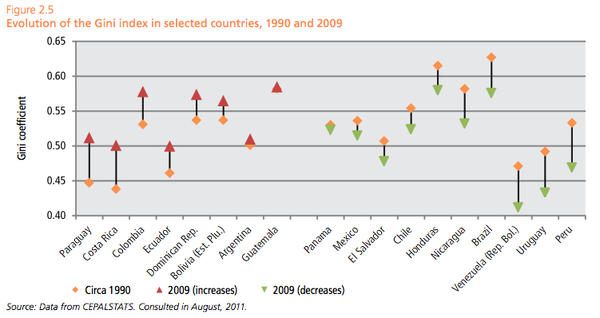
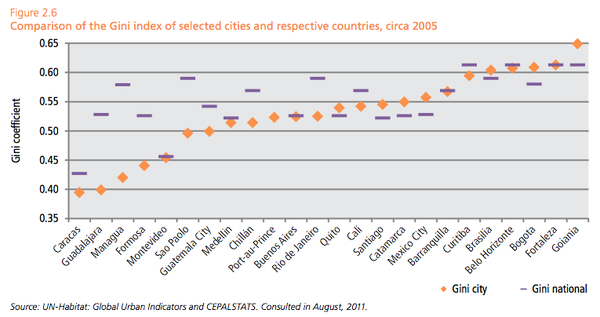
Notice that Anderson never tells his readers what Venezuela’s Gini coefficient actually is. According to the United Nations, Venezuela’s Gini, at 0.397, makes it the least unequal country in Latin America and squarely in the middle range of the rest of the world. Only by sidestepping this brutal empirical obstacle can Anderson attempt to lay out his case. He carries on by reposting three paragraphs of his original essay, which in no way mitigate the falsity of his original claim, for “context.” Anderson finally concludes by offering a novel justification for his error:
In terms of some of the components of social inequality, notably income and education, Chávez had some real achievements. (Income is what’s captured by the Gini coefficient, although that statistic has its own limitations, some particular to Venezuela.) But in housing and violence, his record was woefully insufficient. Those social factors are intimately related, to each other and to the question of equality.
A quick recap is in order before unpacking Anderson’s argument. Readers may remember that he first responded to evidence on income inequality by proclaiming, on Twitter, his agnosticism toward empirical data. Next, a senior editor at the magazine justified Anderson’s contention by arguing that Venezuela was one of the most unequal amongst other oil-rich countries—a point I debunked. Now, Anderson has settled on a definition of social inequality that minimizes Venezuela’s high educational and income equality in favor of high homicide rates and unequal housing.
But simply saying that Chávez’s record “was woefully insufficient” on housing and violence does not naturally equate to Venezuela’s standing as a world leader in social inequality. Anderson must rely on comparative international statistics to justify his position, but fails to do so.
While Venezuela’s homicide rate is high by international standards and a significant social ill, this alone does not necessarily make the country more socially unequal than another country with a lower homicide rate. Are Venezuelan homicides more skewed toward low-income residents than those in Costa Rica? Or Haiti? Are Venezuelan murders more targeted at women or ethnic minorities than those in Mexico or Guatemala? And given that the high homicide rate directly affects far fewer than one in a thousand Venezuelans annually, how could this statistic possibly outweigh the effect of massive income-inequality and poverty reductions? If he is solely basing his argument on murder rates, Anderson has no credible explanation as to why Venezuela is one of the world’s most socially unequal countries.
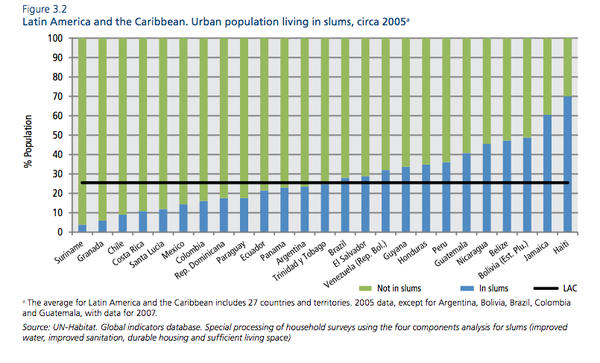
Anderson also doesn’t offer statistics showing that housing is more unequal in Venezuela than anywhere else. That’s because it’s not.
Out of the 91 countries for which the United Nations has available data, Venezuela is 61st in terms of the percentage of its urban population living in slums. That is to say, two-thirds of the world’s countries with available data have larger percentages of their urban citizens living as slum dwellers. In the Western Hemisphere, this includes Guayana, Honduras, Peru, Anguilla, Guatemala, Nicaragua, Belize, Bolivia, Jamaica, and Haiti.
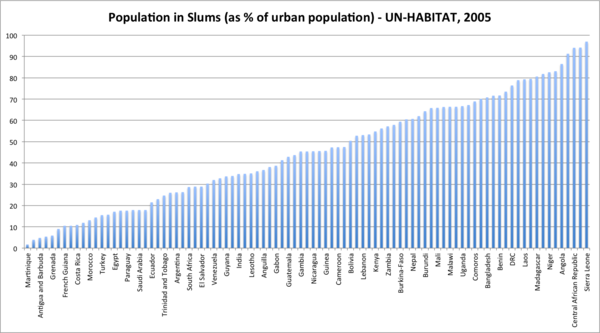
It is also worth mentioning that this data was taken from 2005, when the percentage of Venezuela’s urban population living in poverty and extreme poverty was at 37%. By 2010, according to the United Nations, it had been cut by a quarter, to 28% (p. 43). Furthermore, 2005 predates a massive governmental push in 2011 to build affordable housing. Earlier this year, Venezuela’s Housing Commission chair asserted that “in the years 2011 and 2012, the Bolivarian government together with the people reached the goal of building 350,000 homes.”
It appears, then, that Anderson has discovered a new definition of “social inequality” that has eluded economists and sociologists worldwide—one that systematically downplays Venezuela’s educational and income equality while emphasizing a high frequency of murders and a rate of slum-dwelling that is low by international standards.
While one can applaud Jon Lee Anderson for finally acknowledging the value of social indicators and statistical data, he and his magazine cannot be allowed to define “social inequality” any way they see fit. No social scientist analyzing the available data could argue, like Anderson, that Venezuela is one of the world’s most socially unequal countries. While semantics games may be expedient in avoiding a necessary correction, readers should let The New Yorker’s editor David Remnick (david_remnick@newyorker.com) know that a retraction of Anderson’s claim is long overdue.
Update (4/24): FAIR’s Jim Naureckas also offers sharp criticism of Jon Lee Anderson and his fact-checkers for a transparently inadequate attempt to justify his error regarding Venezuela’s social inequality. Read more, at “Jon Lee Anderson Explains: Because I Said So.”
~
Keane Bhatt is an activist in Washington, D.C. He has worked in the United States and Latin America on a variety of campaigns related to community development and social justice. His analyses and opinions have appeared in a range of outlets, including NPR, The Nation, The St. Petersburg Times, and CNN En Español. He is the author of the NACLA blog “Manufacturing Contempt,” which critically analyzes the U.S. press and its portrayal of the hemisphere. Connect with his blog on Twitter: @KeaneBhatt
Related articles
- The New Yorker Corrects Two Errors on Venezuela, Refuses a Third (alethonews.wordpress.com)
- On Venezuela, The New Yorker’s Jon Lee Anderson Fails at Arithmetic (alethonews.wordpress.com)
- 50 Truths about Hugo Chavez and the Bolivarian Revolution (alethonews.wordpress.com)
- ‘Little Twerp … Get a Life’: The New Yorker’s Jon Lee Anderson Thinks He’s Somebody on Twitter (gawker.com)
Honduras: Terror in the Aguán
By Greg McCain | Upside Down World | April 11, 2013
During the first week of April, the Honduran daily newspaper La Prensa ran a series of articles that included photos, a video and a link to a montage of past articles entitled Terror en el Bajo Aguán. The major thrust of the series is that there are heavily armed clandestine groups of men training in the region. The photos and video show them with AK47s, M16s, and .223 assault rifles, all of which are military issue. All of the men are wearing ski masks over their faces and they appear to be playing to the camera, running in defensive stances, crawling on the ground and being sure to showoff their heavy firepower, all at the direction of whoever is holding the camera. An April 1 article states that there have been more than 90 deaths in the Aguán attributed to people with high caliber arms like the ones shown in the photos. It states that the latest one was a campesino, but it fails to point out that these more than 90 deaths since the coup in 2009 were all campesinos who have been murdered by sicarios: assassins who mainly perform drive by shootings.
Not unexpectedly, the new propaganda campaign being orchestrated by Colonel German Alfaro, commander of Operation Xatruch III and graduate of the School of the Americas, has been carried out with the help of the pro-ruling elite, pro-coup mainstream media. In a further attempt to criminalize the campesino movements, the La Prensa series, by implication and by direct assertions, links the struggles of the campesinos to acquire land that is rightfully and legally theirs to these mysterious armed groups that are roving the Aguán and allegedly terrorizing the private security forces of the rich landowners.
The video of the alleged training maneuvers would be laughable in its obvious staging if the repression that has befallen the campesinos at the hands of the private security guards, the Honduran military, and the National police wasn’t so tragic and ever present. These forces are not just working side-by-side, but are also interchangeable since the security companies that Dinant contracts often hire police and military personnel.
Colonel Alfaro states several times to La Prensa that the identities of these clandestine groups are known and that they even know who the leaders are. In a March 1, 2013 La Prensa article, he asserts that they are being trained by Nicaraguans’ with combat training. He declares that these groups go into the fincas owned by the rich landowners, such as Miguel Facussé’s Paso Aguán, “to terrorize and scare off the security guards. Later, the campesinos go into the plantations to steal the fruit and then money is exchanged at some later date.” No explanation is given as to why it is that campesinos are being killed in overwhelming numbers if this symbiotic relationship truly exists.
The La Prensa “exposé” raises more questions than it answers. If it is the security guards who are being terrorized then why aren’t there huge numbers of their deaths? Furthermore, why are they only a tiny fraction of the campesino deaths, and often found to be the result of infighting among the guards? Why are the campesinos from MARCA who have successfully fought in the courts to retain possession of their land being assassinated? Their lawyer, Antonio Trejo, was assassinated last November in Tegucigalpa after successfully winning the case that secured the land for three of MARCA’s collectives. His brother was later assassinated in Tocoa while investigating his murder. While denying any responsibility, Facussé told an L.A. Times reporter in a December 21, 2012 interview that he certainly had reason to see the lawyer dead. The National Police have attempted to raise spurious claims that the Trejo’s were involved with different less than desirable elements, creating red herrings to take the focus off of Facussé.
There are further questions raised by Alfaro’s claims of there being a connection between armed groups and campesinos. Why are the leaders of MUCA being stopped at every police checkpoint as they drive from Tocoa on their way to a meeting in Siguatepeque in the south. At one checkpoint an officer said to another, “It’s them… they are here.” Later, when they decide that it is safer not to drive any further, they stop at a hotel to rest and then take a bus at 3am to their destination. A group of armed men was seen by the campesino’s driver, who stayed behind, pulling up to the hotel at 3:30 a.m. and question the receptionist about them. Further, why are Facusse’s guards and police and military on a regular basis harassing the MUCA collectives. A truck full of soldiers drove through the community of La Confiansa on the eve of the internal elections shouting out “we’re hunting for Tacamiches” a derogatory term used by the upper classes and police and military to denote campesinos? Why have the military been surrounding the campesino community of La Panama, which borders the Paso Aguán finca, and in which two bodies of members of the community have been dug up near where the private security guards camped? Meanwhile, more are suspected buried there, but why won’t the police and private security, and indeed, the military allow the community to search for the bodies of those missing?
These are questions that neither the mainstream media will ask, nor will Colonel Alfaro answer. Instead they work in concert to manufacture a connection between alleged criminal groups and the campesinos. Alfaro’s motives are made clear when he states that they are there to protect the property and the palm fruit of the rich landowners. Soldiers are often seen riding in or along side Facusse’s Dinant trucks and they along with the National Police intermingle on a regular basis with Facussé’s and the other rich landowner’s guards, who have often been described by those living in the Aguán as paramilitaries.
Alfaro claims that, after the National Congress passed a decree in 2012 that banned all firearms from being possessed except by the police, military and private security, they captured 200 weapons in the first month (he does not specify if they were of high caliber like AK47s or if they were .22 rifles or handguns), and then an average of about 14 per month since then. It is evident from his boast that the military has greatly disarmed the general public, while it is evident just by driving up and down the roads between Tocoa and Trujillo that the arms of gruesome caliber, as the newspaper describes them, are in the hands of the police, military and paramilitary of Facussé and the other rich landlords.
There are both police and military checkpoints that randomly stop cars and buses along the main road between these two cities. When a bus is stopped all the men are told to leave and keep their bags and backpacks on board along with the women. The men are then told to press up against the bus with arms and legs spread while the very young soldiers of the 15th Battalion, with their rifles strapped across their chests, do a body pat down while looking at IDs. Other soldiers search the personal belongings on the bus. Off to the side of the road is a military personnel carrier that has a mounted machine gun pointed toward the street. Alfaro doesn’t explain if this is the method that has led to the discovery and confiscation of so many weapons, but it has been successful in labeling every citizen as a potential criminal and preparing the streets for Martial Law as the country prepares for the general elections in November.
In late February, several hundred police, military, and security guards surrounded the community of La Panama, as they have done various subsequent times since then. They proceeded to knock down a security gate that had been erected to keep the paramilitary guards from invading the community. In July of 2012, La Panama found it necessary to put up the gate after one of the community’s leaders, Gregorio Chavez, was disappeared and his corpse later found in the Paso Aguán. His shallow grave was a ten-minute walk from where Facussé’s paramilitary guards had set up an encampment. The community, after pleading with police to accompany them onto the finca, and after international human rights observers had visited and taken testimonies from the community, finally were allowed access. As Señor Chavez’ son and brother pulled the cadaver from the ground it was apparent from marks on the body that he had been tortured. Previous to Chavez’ murder the guards had been harassing him, shooting his chickens, and threatening to do the same to him and his family. They often drove up and down the road that goes through the community with their guns pointing out at the children who played in the yards.
Dinant had put up a building in the middle of the community that functioned as both a guardhouse and a parking space for their palm fruit trucks. A week before his disappearance Gregorio Chavez had gone to this building to complain to someone in charge about the threats and the killing of his chickens. It was also in this building that many in the community had seen the bicycle of one of the disappeared after he went missing. It is suspected that he is buried in the Paso Aguán. It could be the remains that were recently found on April 3. A security guard who had connections to the community tipped them off as to where they could find the body. The community is hoping, with the help of COFADEH and other human rights groups, to get an international forensic team to positively identify who it is.
This latest news was revealed at a press conference in Tegucigalpa held on the April 3 by the Agrarian Platform of the Campesinos of the Aguán (PARCA, in its Spanish acronym). PARCA is a new initiative formed by 13 campesino movements to better support each other as they face ever-increasing threats to their rights to the land. The press conference was called in response to the La Prensa stories. Yoni Rivas, Secretary General of MUCA, reasserted that the campesinos have no connection to any armed groups. In fact, it was the campesinos who had gone to the press in 2011 to point out that there were armed thugs killing campesinos in the Aguán and he showed pictures of armed men with automatic weapons wearing uniforms that matched the clothes worn by Dinant’s security forces.

The ultimate question is, if Colonel Alfaro and Operation Xatruch are simply doing what they say they are, “maintaining the peace and harmony of the people of Colon,” then why is he conducting press conferences denouncing both Honduran and international human rights groups? On February 18, 2013, in a clear act of aggression toward these groups and in a further attempt at criminalization of the campesinos, he called out human rights observers and campesino leaders. He published the phone numbers of international human rights observers in the US and Europe, and attempted to set up a confrontation between what he refers to as the “Laboriosa población,” the hard working people of the department of Colon against the aforementioned campesino groups referring to them as “a minority”, who create permanent friction and a constant problem of disrespect for the legally established laws and legal authorities. Alfaro’s and the Honduran military’s disdain for the campesinos is further illustrated in the report, Human Rights Violations Attributed to Military Forces in the Bajo Aguan Valley in Honduras written by Annie Bird of Rights Action where she states that her report, “describe[es] the abuses, many of them grave human rights violations, in which soldiers from the 15th Battalion were present and/ or direct participants [in the killings of campesinos]; in either case the 15th Battalion is a responsible party to the violations.” The 15th Battalion is where Xatruch III and Colonel Alfaro are stationed.
In a further indictment of Alfaro’s disingenuousness, during Xatruch’s raid of La Panama in February, there was, coincidentally, a human rights delegation from the US-El Salvador Sister Cities organization visiting the community. This forced the military, police and security guards to retreat. Much of the military force moved into the Paso Aguán finca. Later, members of the community who didn’t want their names made public stated that Alfaro attempted to “negotiate” with the community, but told them to stop talking to human rights groups. They of course denied his request. Today, the tensions between the community and the heavily armed forces continue as the military remain in the finca protecting Facussé’s palm fruit.
Related articles
- Will the World Bank Stop Investing in Campesino Assassinations? (alethonews.wordpress.com)
- Killings Continue in Bajo Aguán as New Report Documents Abuses by U.S.-Trained Honduran Special Forces Unit (alethonews.wordpress.com)
- Honduras: Murdered Lawyer’s Brother Killed in Aguán (alethonews.wordpress.com)
- Step by Step: Honduras Walk for Dignity and Sovereignty (alethonews.wordpress.com)
- World Bank Must End Support for Honduran Palm Oil Company Implicated in Murder (alethonews.wordpress.com)
Official Honduran Report on May 11 Shooting Incident is a New Injustice to Victims
By Dan Beeton | CEPR Americas Blog | April 11, 2013
CEPR has released a new paper, along with the human rights organization Rights Action, examining the Honduran Public Ministry’s official report on the May 11, 2012 shooting incident last year in which four local villagers were killed in Ahuas in Honduras’ Moskitia region during a counternarcotics operation involving U.S. and Honduran agents. This is also the first time that the Public Ministry’s report has been made available to the public, posted to Scribd in English here, and Spanish here.
The Honduran Public Ministry’s report deserves special scrutiny because thus far it represents the official version of events according to the Honduran authorities. And since the U.S. government has declined to conduct its own investigation – despite the wishes of 58 members of Congress – it also represents by default the version of events tacitly endorsed by U.S. authorities as well. The DEA and State Department didn’t allow Honduran investigators to question the U.S. agents and contractors that participated in the May 11 operation. At the same time a U.S. police detective working for the U.S. Embassy reportedly participated in the Public Ministry’s investigation, so the U.S. also bears some responsibility for the report’s flaws.
The CEPR/Rights Action paper found that the Public Ministry’s report:
- Makes “observations” (not conclusions) that are not supported by the evidence cited;
- Omits key testimony, that would implicate the DEA, from police who were involved in the May 11 incident;
- Relies on incomplete forensic examinations of the weapons involved, improper forensic examinations of the victims’ bodies and other improperly gathered evidence;
- Does not attempt to establish who is ultimately responsible for the killings;
- Ignores eyewitness reports claiming that at least one State Department-titled helicopter fired on the passenger boat carrying the shooting victims;
- Does not attempt to establish whether the victims were “in any way involved in drug trafficking” as both Honduran and U.S. officials originally alleged;
- Does not attempt to establish what authority was actually in charge of the operation;
- Appears to be focused on absolving the DEA of all responsibility in the killings.
The CEPR/Rights Action report represents the first such public critique of the Public Ministry’s report. As we have previously noted, there are significant discrepancies between different accounts of the May 11 events, including those of Honduran police officers who participated in (and say the DEA was in charge of) the operation. These discrepancies – cited in a separate report published by the Honduras National Commission of Human Rights (CONADEH) – are not mentioned in the Public Ministry report. Nor does the report include police testimony indicating that a DEA agent ordered one of the State Department helicopters to open fire on the passenger boat in which four people were killed.
The report concludes by calling for the U.S. government to carry out its own investigation of the Ahuas incident to better determine what occurred and to determine what responsibility, if any, DEA agents had in the killings. It also calls on the U.S. government to cease being an obstacle to an already flawed investigation by making the relevant DEA agents, weapons and documents – including an aerial surveillance video of the Ahuas operation in its entirety – available to investigators.
The new CEPR/Rights Action paper follows the “Collateral Damage of a Drug War” report released last year which was based on eyewitness testimony and other evidence the authors obtained in Honduras and concluded that the DEA played a central role in the shooting incident.
Related article
- Obama Administration Refuses to Investigate Alleged DEA Killing of Women and Child in Honduras (alethonews.wordpress.com)
“We’re Witnessing a Reactivation of the Death Squads of the ‘80s”
An Interview with Bertha Oliva of COFADEH
By Alex Main | cepr Americas Blog | March 29, 2013
Bertha Oliva is the General Coordinator of COFADEH, the Committee of Relatives of the Disappeared and Detained in Honduras. Bertha’s husband was “disappeared” in 1981, a period when death squads were active in Honduras. She founded COFADEH together with other women who lost their loved ones, in order to seek justice and compensation for the families of the hundreds of dissidents that were “disappeared” between 1979 and 1989. Since then Bertha and COFADEH have taken on some of the country’s most emblematic human rights cases and were a strong voice in opposition to the 2009 coup d’Etat and the repression that followed. We interviewed her in Washington, D.C. on March 15th, shortly after she participated in a hearing on the human rights situation in Honduras at the Inter-American Commission on Human Rights (IACHR). During the hearing she said that death squads are targeting social leaders, lawyers, journalists and other groups and called on the IACHR to visit Honduras in the next six months to take stock of the human rights situation ahead of the November general elections (Bertha’s testimony can be viewed here, beginning at 17:40).
Q: On various occasions you’ve said that what you’re seeing today in Honduras is reminiscent of the difficult times you experienced in the ‘80s and I’d like you to elaborate on that.
In the ‘80s we had armed forces that were excessively empowered. Today Honduras is extremely similar, with military officers exercising control over many of the country’s institutions. The military is now in the streets playing a security role – often substituting for the work of the police forces of the country.
In the ‘80s we also witnessed the practice of forced disappearances and assassinations. In that era it was clear that they were killing social leaders, political opponents, but they also assassinated people who had no ties to dissident groups in order to generate confusion in public opinion and try to disqualify our denunciations of the killings of family members who were political opponents.
Today they assassinate young people in a more atrocious fashion than in the ‘80s and we’re seeing a marked pattern of assassinations of women and youth. And within this mass of people that are assassinated there are political opponents. We refuse to dismiss these assassinations as simply a result of the extreme violence that we’re experiencing, as they try to tell the country. We say that it is a product of impunity and Honduras’ historical debt for failing to resolve cases perpetrated by state agents…
In the ‘80s the presence of the U.S. in the country was extremely significant. Today it’s the same. New bases have opened as a result of an anti-drug cooperation agreement signed between Honduras and the U.S.
In the ‘80s it was clear that political opponents were being eliminated. Today they’re also eliminating those who claim land rights, as exemplified in the Bajo Aguán. More than 98 land rights activists have been assassinated. The campesino sector in the Bajo Aguán has been psychologically and emotionally tortured on top of the physical torture that certain campesino leaders have been subjected to.
Q: Today in the hearing on human rights in Honduras at the Inter-American Commission on Human Rights you discussed death squads. Death squads were active in the ‘80s and now you believe that this sinister phenomenon is coming back.
It’s certain that death squads are a product of the impunity that we’ve seen in Honduras. The death squads of the past were never really dismantled. What we’re witnessing is a reactivation of these death squads. And we’re seeing it quite clearly. We’ve seen videos of incidents in the street where masked men with military training and unmarked vehicles assassinate young people. There is the recent case of the journalist Julio Ernesto Alvarado who gave up his news program from 10pm to midnight on Radio Globo because members of a death squad came to kill him, and to save his own life he had to stop doing his program.
In Honduras we had a military coup d’Etat and this resulted in persecution, an implosion of the state’s institutions which has left us with a dysfunctional judicial system and this has provided cover to those who wish to break the law.
And, what’s worse, state agents seem to have no political interest in improving and changing the situation. What we’re witnessing is a growing professionalization of the capacity to justify illegal acts: authorities’ assertion that they intend to investigate these acts, when that’s simply not true. In reality it seems the intention is to continue terrorizing the Honduran people, to make them submissive so as to undermine citizen action.
What we’d like to see in Honduras is real action to try to prevent crime rather than continued justification of the lack of progress of investigations into crimes.
Q: COFADEH is providing legal counsel to the victims and the families of the victims of the emblematic case that took place in May of last year in Ahuas, in which there was a police operation that involved U.S. agents and Honduran security agents that killed four people and injured a few others. Can you discuss the status of that case, over ten months after the killings took place?
Yes, we are the legal representatives of the victims in this case and, on the one hand, we are filing a complaint with Honduras’ judicial authorities to show or verify the responsibility of Honduran agents and DEA agents that participated in this incident.
But we’re also trying to reach out to the general public so that the case is better known and debated as this is the only real recourse we human rights defenders have: publicly denouncing the incident to see whether this will allow for some protection of the victims and of ourselves. But legally we see this as a very difficult case to move forward and this is where we can see that the authorities aren’t interested in investigating, let alone sanctioning, those responsible. The crime of the tragic attack against this indigenous community has been compounded by the crime of violating due process in the investigation.
We the legal representatives of the victims should have access to the case file. The Public Ministry [equivalent to the Attorney General’s Office in the U.S. – ed.] shouldn’t allow any obstacle to come in the way of our access to the file. They can’t legally prevent us from learning about the actions that have been taken in the course of the investigation because we are part of the defense. It is prohibited for either of the parties to be denied access to the case file. The file can be classified with regard to the general public, but not with regard to the parties representing the victims and the accused.
We haven’t seen all the files in this case. They haven’t been inserted in a binder [as is normally the case] in order to allow them to remove information when we ask for the file. How can we participate effectively in a trial when we can’t see all of the case file?
Q: And what evidence do you have of their having removed parts of the case file before sharing it with you?
One is that when we’ve been shown the case file it basically only contains documents that we’ve produced. We know the Public Ministry has carried out its own investigations; it has carried out the exhumation and autopsies of the deceased victims’ bodies for instance. As a side note, we weren’t informed that they were carrying out the exhumations of the victims. We’re left with the impression that the intention isn’t to find evidence but rather to remove [borrar] evidence… Our Public Ministry should be called a “Public Laundromat” because they’re engaged in destroying evidence.
Q: So you didn’t see the reports on the exhumations and autopsies of the victims in the Ahuas case file?
We haven’t seen them, just as we didn’t see the report that was sent by [Honduran Attorney General equivalent] Luís Alberto Rubi to the State Department of the United States. This indicates to us that they remove information and documentation from the case file that they don’t want us to see.
The Public Prosecutor [Attorney General equivalent] sent a report to a representative of the State Department, Maria Otero, with – for instance – the names of the Honduran police agents and military personnel that participated in the operation, though not the names of the DEA agents, with the apparent goal of barring them from any sort of responsibility.
Q: But you did end up managing to see the Public Ministry report sent to the State Department?
Yes, but not through the Public Ministry, but thanks to people outside Honduras who managed to get hold of a copy.
Q: In this report there is information based on testimony provided to the Public Ministry by police agents that participated in the Ahuas operation. Have you been able to see any of this original testimony?
No, we haven’t seen any of the testimony of the police agents.
Q: What is the current situation of the surviving victims of the Ahuas incident, and of the families of the victims?
The situation of the families, of the survivors, of the community is really very critical. They are emotionally and psychologically affected. Being on the receiving end of an armed aerial attack is a shock for a remote community that never expected an attack of this nature. Some of the community members were woken up by armed agents, were physically attacked and had certain belongings stolen.
I think that those that survived are no longer directly threatened but not all of them have recovered their physical abilities. For instance, a young man sustained a serious injury to his hand requiring an operation that cost 100,000 lempiras [over $5,000 – ed.]. Where can this boy, who doesn’t have anything, find this kind of money?
COFADEH ended up having to take care of him and he’s still in treatment in Tegucigalpa, far from his community. We are paying for his treatment and lodging him, feeding him and paying for his studies. This is the responsibility of the state and it has refused to assume this responsibility even though we requested urgent protective measures from the state. The state is good at providing technically well-designed reports before the Inter-American Commission on Human Rights, but it has been incapable of dealing with the needs of the survivors of this attack.
This sort of thing is a clear demonstration of their lack of interest in resolving and combatting the insecurity we’re experiencing, the political violence and the high level of impunity.
Q: What about the other injured victims?
We’ve had to bring them to Tegucigalpa to be treated. In the case of one boy they left studs [clavos] jutting out of his arm. He almost lost his arm because after the operation they sent him back to his community but with no medicine.
We’ve also had to provide care for other relatives of the survivors and the deceased victims. It’s impressive the level of neglect of these victims on the part of the state.
We [the human rights defenders] return to our country with the fear that the attacks will extend to us as a result of our decision to come and denounce a state that has shown itself incapable of assuming its responsibility.
Q: COFADEH has received threats and recently its offices were raided. Can you talk to me about your situation, your vulnerability, and what people in the U.S. can do to help?
Our situation isn’t good at all. I confess that we’re frightened because we love life, that’s why we dedicate ourselves to defending the lives of others. And I don’t want to die or be tortured. And I don’t want to have to confront state agents. But despite their machinery of hate and actions against us, they should know that they can’t stop us.
Fortunately we can count on support from people in the U.S. and the rest of the world, and I can reaffirm today that this support and this commitment of people abroad inspires us and makes us feel less alone. Because the worst that can happen for a human rights defender facing threats is to feel alone. That’s why we call on you to continue supporting us to defend the life and liberty of the citizens that need our help.
Related articles
- World Bank Must End Support for Honduran Palm Oil Company Implicated in Murder (alethonews.wordpress.com)
- Will Congress act to stop US support for Honduras’ death squad regime? | Mark Weisbrot (guardian.co.uk)
Did the AP Catch State Department Officials Lying to Congress About Honduran Death Squads?
By Dan Beeton | CEPR Americas Blog | March 25, 2013
Associated Press reporters Alberto Arce and Katherine Corcoran have written a follow up article to Arce’s investigative feature last week on the continuation of death squad activity by the Honduran police. The new article, which appeared in the New York Times and various other media over the weekend, suggests that U.S. State Department officials may have deceived members of Congress in order to illegally fund Honduran police units even though some police – under the command of National Police Director General Juan Carlos “El Tigre” Bonilla – may be involved in death squads.
The article begins:
The U.S. State Department, which spends millions of taxpayer dollars a year on the Honduran National Police, has assured Congress that money only goes to specially vetted and trained units that don’t operate under the direct supervision of a police chief once accused of extrajudicial killings and “social cleansing.”
But The Associated Press has found that all police units are under the control of Director General Juan Carlos Bonilla, nicknamed the “Tiger,” who in 2002 was accused of three extrajudicial killings and links to 11 more deaths and disappearances. He was tried on one killing and acquitted. The rest of the cases were never fully investigated.
Honduran law prohibits any police unit from operating outside the command of the director general, according to a top Honduran government security official, who would only speak on condition of anonymity. He said that is true in practice as well as on paper.
Celso Alvarado, a criminal law professor and consultant to the Honduran Commission for Security and Justice Sector Reform, said the same.
“Every police officer in Honduras, regardless of their specific functions, is under the hierarchy and obedience of the director general,” he said.
Congress has already withheld some funding ($30 million) to the Honduran police under the Leahy Law over concerns about Bonilla’s alleged past death squad involvement, but the State Department has continued with some other funding and just announced a new $16.3 million commitment to the Honduran police during a visit to Honduras by Assistant Secretary of State for the Bureau of International Narcotics and Law Enforcement Affairs William Brownfield last weekend. AP noted that “Some of the U.S. money will go to the Gang Resistance Education and Training program under the director of community policing, who also told the AP that he reports directly to Bonilla.”
As the AP article states, “U.S. support goes to Honduran forces working with the U.S. Drug Enforcement Administration on anti-narcotics operations, and anti-gang, anti-kidnapping and border-security units, according to an embassy official who was not authorized to speak on the record.” We have detailed how U.S.-assisted counternarcotics operations have involved the killings of civilians and what seems to be a “shoot first, ask questions later” approach by some Honduran forces in the past that led to the U.S. to temporarily suspend radar assistance to Honduran authorities.
Arce and Corcoran note that they tried to ask Brownfield questions regarding the police assistance when he was in Honduras, but Brownfield declined to answer.
The AP article includes additional statements from Honduran officials regarding the chain of command, which goes up to Bonilla:
When asked by AP if the specially vetted Honduran police units working with the U.S. Embassy still report to Bonilla, the Honduran security official said: “Yes, that’s how it works, because of personal loyalty and federal law.”
…
“I only report to the director general, all of the programs of the Honduran police are directed personally by him,” said Otoniel Castillo, a police sub-commissioner. “He has a personal and intense closeness to all projects of international cooperation, especially because of his good relationship with the U.S. Embassy.”
In the wake of the AP’s revelations, the big question is how will Congress react? While State Department officials are likely to claim plausible deniability or a different interpretation of Honduran law and how it relates to police supervision and accountability, State Department officials’ past responses to Congress indicate that human rights concerns may be less of a priority than they are for the members of Congress who have spoken out on this issue. The unwillingness of senior officials such as Brownfield to answer questions from reporters also does not signal credibility.
Arce and Corcoran noted that the State Department has not been forthcoming with information to Congress that would explain the discrepancy:
That information so far has not been provided by the State Department, and the AP’s findings have prompted more questions.
“Senator Leahy has asked the State Department to clarify how they differentiate between what they told the Congress and what is being said by those within Honduran police units under his authority,” Leahy aide Tim Rieser said Friday. “Sen. Leahy, like others, made clear early on his concerns about Gen. Bonilla and the conduct of the Honduran police.”
Related articles
- World Bank Must End Support for Honduran Palm Oil Company Implicated in Murder
- Step by Step: Honduras Walk for Dignity and Sovereignty
- Reporting on Romer’s Charter Cities: How the Media Sanitize Honduras’s Brutal Regime
- Killings Continue in Bajo Aguán as Report Documents Abuses by US-Trained Honduran Special Forces
World Bank Must End Support for Honduran Palm Oil Company Implicated in Murder
Upside Down World | March 22, 2013
On March 19 several Non-Governmental Organisations (NGOs) condemned a statement by the World Bank’s International Finance Corporation, IFC [1] which defends the record of a Honduran palm oil company, Grupo Dinant, implicated in dozens of murders as well as other human rights abuses. The IFC statement explicitly admits to supporting training for the company’s armed security guards.
The NGOs are : Friends of the Earth International, Global Forest Coalition, Global Initiative for Economic, Social and Cultural Rights, Urgewald, Rights Action, Rettet den Regenwald/Rainforest Rescue, Global Justice Ecology Project, and Biofuelwatch.
A World Bank Ombudsman [2] is currently investigating an IFC loan of $30 million for Grupo Dinant which was approved in 2009, at least half of which has already been disbursed.
This month, an Open Letter by 17 NGOs [3] and an international petition signed by over 63,000 people [4] have protested the loan and called on the World Bank to immediately cease their support for Grupo Dinant.
Since 2009, international human rights bodies have documented dozens of murders of peasant activists and their supporters in connection with land conflicts involving Grupo Dinant, the company’s armed security guards and Honduran military and police.
The evidence includes a fact-finding mission report by international human rights organisations in March 2011, a hearing before the Inter-American Commission of Human Rights in October 2011, an international public hearing on human rights in the region in May 2012 [5] and a report about human rights abuses attributed to military forces in the region by Rights Action, published this month [6].
The recent Rights Action report confirms that at least 88 members and supporters of peasant movements have been murdered in targeted killings in the Bajo Aguan Valley over the past three years. It documents the direct involvement of Grupo Dinant’s armed security forces in the violence against peasant movements. Contrary to the World Bank’s claims that the violence ended in 2012, two peasant activists were found tortured and murdered in February 2013. [7]
Annie Bird from Rights Action says: “It is a serious indictment of World Bank’s role in Honduras’s land conflicts that their International Finance Corporation admits to directly engaging with the training of Grupo Dinant’s paramilitary ‘security guards’. It is not clear whether this engagement is a response to concerns over human rights abuses but retraining paramilitaries implicated in killings is never an acceptable response. The World Bank must cease such engagement and stop supporting Grupo Dinant at once.”
Almuth Ernsting from Global Forest Coalition and Biofuelwatch adds: “The World Bank’s claims that killings are being investigated by Honduran courts with full cooperation from Grupo Dinant contradict the findings of human rights missions which show a state of total impunity surrounding those murders. Such a state of impunity has been confirmed by the UN Working Group on Mercenaries. Not only must the World Bank cancel its loan but there needs to be a full investigation into their role in human rights abuses in Honduras.”
In 2011, the German development bank, DEG, cancelled a loan for Grupo Dinant due to the company’s involvement in serious human rights abuses.Yet the World Bank continues to back the company and dismiss all independent evidence, as their recent statement shows.
Jeff Conant from Friends of the Earth US adds: “The World Bank’s statement on Bajo Aguan reveals the extent of their complicity with a palm oil company implicated in some of the most serious human rights abuses in Central America today. Years after a damning audit of their palm oil funding and a supposed overhaul of their policies, the World Bank is legitimising the use of armed paramilitaries in land conflicts against peasants who are trying to reclaim their own land, dismissing a vast volume of evidence from independent fact finding missions.”
The NGOs demand cancellation of the World Bank’s loan to Grupo Dinant and an immediate full and independent investigation into the World Bank’s involvement with Grupo Dinant, which must go beyond the remit of the current Ombudsman investigation.
NOTES:
[2] A complaint submitted by Rights Action is currently being investigated by the Compliance Advisor Ombudsman (CAO). The CAO is an independent agency which investigates complaints filed by communities affected by project funded by the World Bank’s International Finance Corporation (IFC).
[4] www.rainforest-rescue.org/mailalert/909/honduras-world-bank-palm-oil-loans-linked-to-murders
[5] www.fidh.org/IMG/pdf/honduras573ang.pdf; http://hrbrief.org/2011/10/human-rights-situation-in-the-bajo-aguan-honduras/; www.lawg.org/storage/documents/Honduras/declaration%20international%20public%20hearing%20bajo%20aguan.pdf
[6] http://rightsaction.org/sites/default/files//Rpt_130220_Aguan_Final.pdf
[7] See http://www.coha.org/21693/
Related articles
- Will the World Bank Stop Investing in Campesino Assassinations? (alethonews.wordpress.com)
- Step by Step: Honduras Walk for Dignity and Sovereignty (alethonews.wordpress.com)
- Honduras: Murdered Lawyer’s Brother Killed in Aguán (alethonews.wordpress.com)
Step by Step: Honduras Walk for Dignity and Sovereignty
By Greg McCain | Upside Down World | March 13, 2013

From February 25 to March 7, I participated in the 200 km Walk (about 124 miles) referred to as Caminata Dignidad y Soberanía Paso a Paso (Walk for Dignity and Sovereignty Step by Step), which culminated with over 400 people from various groups representing the social movements in Honduras reaching the National Congress in Tegucigalpa to demand three things:
1. Abolish the new mining law, which basically gives foreign mining companies carte blanche to take the natural resources of Honduras for their own enrichment while having no regulations to stop these companies from poisoning the rivers and ground water and destroying the environment through mountain top removal and deforestation. In addition, these mining companies have historically exploited the labor of the local communities, paying little to nothing while poisoning the local populations with chemicals such as cyanide used for extraction.
2. Abolish the new Model Cities legislation. This is new legislation passed by decree by the Congress after having been found unconstitutional by the Supreme Court in November of last year. The following month, the president of the Congress, Juan Orlando Hernandez(JOH), staged what has been referred to as the second coup by holding an emergency session of Congress to vote out 4 of the members of the Constitutional chamber of the Supreme Court who found the original version in violation of the sovereignty of Honduras. JOH and President Pepe Lobo claimed that these magistrates were traitors who were holding back the economic development of the country. He also claimed to have fixed the issues that these “traitors” found to be unconstitutional.
It is for all intents and purposes the same neo-liberal package that gives up huge areas of land to outside developers to create neo-colonial enclaves that don’t have to operate under constitutional regulations. The further claim is that the land under consideration is uninhabited. Two areas that have been proposed, the communities of Puerto Castillo and Santa Rosa de Aguán are traditional Garifuna land along the northern coast in the Department of Colon. The Garifuna are the Afro-Caribe people who have inhabited the northern coast of Honduras for over 200 years. They have been struggling to maintain their land from rich foreigners such as the Canadian Porn King Randy Jorgensen who has bought up at bargain prices much acreage in and around the area of Trujillo.
Jorgensen has built a cruise ship dock on the beachfront in the town of Trujillo, not far from Puerto Castillo, which is also the location of the fruit company, Dole’s, shipping docks. The Congress refers to the model cities as Special Development Regions (RED in its Spanish acronym). They will combine the exploitation of local labor and natural resources perpetrated by foreign corporations with the destruction of the natural environment such as has happened in Cancun, Mexico and other resort areas around the world, with all of the profits going to the foreign directors of the REDs, and their foreign investors.
3. Freedom for the Political Prisoner Jose Isabel “Chavelo” Morales Lopez. Chavelo Morales has become a symbol of the campesino movement and his imprisonment illustrates the criminalization of the campesinos as they struggle to maintain the land that is theirs by all rights under the agrarian reform laws that had existed prior to 1992. These laws were subverted by the ruling elite when so called “free” trade agreements were first being thought up and hammered out by corporate lobbyists in the US Capital.
Chavelo was framed for the 2008 murder of a family of rich landowners, the Osortos. This moneyed family had illegally obtained thousands of hectares of land at rock bottom prices (some of it free of charge) that were legally recognized as being set aside for peasant farmers. In the late 1990s, the Campesino Movement of the Aguán (MCA), of which Chavelo is a member, took legal routes to obtain the land and began to work it for their own subsistence. The Osortos and their paramilitary guards terrorized the communities, killing leaders of the MCA, and shooting into the houses of families. This occurred while the national police and the Honduran government turned their backs on the illegal actions of the Osortos, presumably due to the bribes that the rich landowners doled out. Indeed, the police and the district attorneys played an active role in criminalizing the campesinos by issuing trumped up arrests warrants (Currently there are over 3080 campesinos with arrest warrants against them). Click here for a more complete background of Chavelo’s story and the travesty of justice in his case.
Chavelo spent the first 2 years in jail without a trial. It was another 2 years before he received his sentence. This is a clear violation of Honduran Penal Process Code 188, which states that a person cannot be incarcerated for more than 2 years from the time of his arrest until sentencing. This alone should be enough for the Supreme Court to annul the conviction and set him free, and indeed this is what Chavelo’s lawyers are hoping to happen in their appeal of causation that they have filed with the high court. But additionally, the sentencing statement that the judges in Trujillo issued gives no concrete evidence linking Chavelo to the deaths that occurred other than a photo of him close by to the scene where some 300 other campesinos and dozens of police had been during a standoff at the Ranch of Henry Osorto, the ex-military, ex-police sub-commissioner, and current penal system investigator. It is with Osortos influence alone that Chavelo is currently imprisoned. Chavelo has spent close to 4 ½ years in prison based on hearsay evidence and the political and economic influence that Henry Osorto has over the judges. Chavelo faces 20 years in prison unless international pressure convinces the Supreme Court of Honduras otherwise.
With these three demands energizing our every step, we entered Tegucigalpa with 400+ walkers who made a silent vigil through the streets until we reached the National Congress. Once there, hundreds more joined us. A small group, accompanied by Padre Melo Moreno, a Jesuit priest and director of Radio Progress, was able to meet with Marvin Ponce, vice president of the Congress. Promises were made that the protesters concerns would be addressed. No one is holding his or her breath.
Another group was able to meet with the President of the Sala Penal of the Supreme Court, basically the chamber of the court that deals with prison issues. This group was made up of Omar Menjivar, Chavelo’s lawyer; Esly Benegas from COPA (the Spanish acronym for the Coordinated Popular Organizations of the Aguán); Merlin Morales, Chavelo’s brother; Myself, Greg McCain, representing La Voz de los de Abajo and the Honduran Solidarity Network, and Brigitte Gynther from SOA Watch. The President of the Sala Penal, Jacobo Antonio Cálix Hernández, began by stating that the court was backlogged by two years, they hadn’t even begun to hear cases that had been sent to the court in 2011. Chavelo’s case had just reached the court at the end of January 2013. He stated that cases were very complicated and that they took a lot of study on the part of the judges. He was basically letting us know that nothing happens fast in the justice system.
We each made our case for why we were there and what we expected from the court, reiterating the lack of evidence and the violation of the procedural code. Chavelo’s brother made explicit Osorto’s influence on the judges in the Trujillo tribunal and the fact that the only evidence was a photo of Chavelo and that the context of the photo was not addressed in the sentencing. He also made the emotional appeal that Chavelo has been unjustly incarcerated while his daughter, father, 2 aunts and grandfather have all passed away without his being able to attend the funerals. I piggybacked on Merlin’s plea by noting the money and political power of Osorto and my hope that it does not reach to the Supreme Court. I also underlined the amount of time that Chavelo has spent in jail and hoped that there weren’t further undue delays of justice.
Judge Cálix made the promise that he would speed up the process for having the trial transcripts of the lower court transcribed by no later than the following week. He then stated that he would schedule the hearing of the case for sometime between April 1st and the 5th. This hearing is basically a formality so that each side, the Defense and the Prosecutor, can present their cases. The judges then legally have up to a year to make a decision. This was huge news. We in the room, along with the threat of having 400+ demonstrators that were still at the National Congress converging on the Supreme Court, cut the process down by two years. Again, none of us are holding our breath. The campaign to put pressure on the Supreme Court has just begun. We need to reduce the year long wait and bring Chavelo home. Pronto!
To send emails and make phone calls to the court between now and the promised April hearing, click here, and you can also follow future actions and the progress of Chavelo’s case.
Related articles
- Honduras: Murdered Lawyer’s Brother Killed in Aguán (alethonews.wordpress.com)
- Will the World Bank Stop Investing in Campesino Assassinations? (alethonews.wordpress.com)
- Killings Continue in Bajo Aguán as New Report Documents Abuses by U.S.-Trained Honduran Special Forces Unit (alethonews.wordpress.com)
- NPR Examines One Side of Honduran “Model Cities” Debate (alethonews.wordpress.com)
Will the World Bank Stop Investing in Campesino Assassinations?
By Arthur Phillips | CEPR Americas Blog | March 8, 2013
On February 27, the office of the Compliance Advisor/Ombudsman (CAO) for the World Bank’s International Finance Corporation (IFC) launched an audit of the lending arm’s $30 million investment in Tegucigalpa-based Corporación Dinant, which produces palm oil and food products. The audit comes in response to widespread claims of violence, intimidation, and illegal evictions carried out by Dinant’s private security guards in Honduras’ Bajo Aguán valley, the center of the country’s ongoing land struggle. In offering its resources and reputation to the company, the World Bank and its member countries are complicit in the deaths of countless innocent farmers.
The COA’s review began just two days after the United Nations Working Group on the use of mercenaries urged the Honduran government “to properly investigate and prosecute crimes committed by private security guards and to ensure that victims receive effective remedies.” A delegation from the Working Group was in the country from February 18 to 22, when it met with government officials and representatives of civil society and the private sector, including security firms. The delegates voiced their particular concern about the “alleged involvement of private security companies hired by landowners in widespread human rights violations including killings, disappearances, forced evictions and sexual violence against representatives of peasant associations in the Bajo Aguán region.” Dinant is the largest single landholder in the region.
An appointed panel of unnamed experts is currently convened in Washington, D.C., to review both the IFC’s adherence to its social and environmental policies and the role Dinant has played in the abuses. Many human rights observers consider the company’s owner, Miguel Facussé, to be one of the country’s most powerful men and hold him responsible for the killings of dozens of campesinos.
The audit had been a long time coming. On November 19, 2010, the human rights organization Rights Action wrote a letter to the World Bank’s then-president Robert Zoellick demanding that the financial institution suspend its funding to Honduras. The group cited the “context of grave human rights abuses and lack of independence of the justice system” as grounds to withhold funding, and characterized support for Dinant as “a case of gross negligence of the World Bank’s human rights and due diligence obligations.” In the letter, Rights Action also noted that “at least 19 farmers in this region have been killed in the context of conflicts with biofuel industry interests.” (In a new report released two weeks ago, the same group declared that 88 farmers and their supporters have been killed in Bajo Aguán since January 2010, most of them in targeted assassinations.)
In the ensuing period, the office of the CAO maintained discussions with local civil society organizations and in April 2012, CAO Vice President Meg Taylor informed the IFC that her office was initiating an appraisal of the funding group’s investment in Dinant. That appraisal, having found sufficient grounds for further investigation, culminated this August in the decision to conduct the current audit.
A diverse group of international organizations, including Oxfam, Vía Campesina and the Latin American Working Group, welcomed CAO’s decision. In a co-signed letter, though, the groups expressed their firm demand that the IFC halt its financial cooperation with the palm oil company
until a) clear evidence is provided of significant progress in overcoming impunity of crimes and human rights abuses committed against organized peasants and their supporters in the Lower Aguán; and b) a comprehensive, just, peaceful and sustainable resolution is provided to the conflicts over land between the Corporación Dinant, the government of Honduras and the local peasant movements.
The panel is scheduled to conclude its audit on March 8.
On Friday, March 1, while the CAO panel gathered in Washington, journalist Carlos Augusto Lara Cruz was reportedly threatened by a Dinant employee while covering a confrontation between campesinos and a military unit. It must be noted that Honduran human rights defenders have consistently and credibly accused military and police units of collaborating with Dinant security guards in kidnapping, torturing, and murdering land rights activists.
One of the latest assassinations in the area took place on Thursday, February 21, when lawyer José Andrés Andrade Soto was shot dead in the town of Tocoa. Andrade Soto led the regional office of the National Agrarian Institute until former president Manuel Zelaya was deposed in the June 2009 coup. Today, farmer organizations continue to struggle for land titles that the Zelaya government granted to them shortly before it was overthrown.
As part of its Summary of Proposed Investment, written before the program’s approval in order to boost the institution’s transparency, the IFC described its cooperation with Dinant as an opportunity to help small farmers in Bajo Aguán. It also declared that there was no controversy regarding the land in question. “Land acquisition is on a willing buyer-willing seller basis, and there is no involuntary displacement of any people,” the report assured.
Since that report was published, scores of campesinos have been assassinated for efforts to re-appropriate their rightful land. The World Bank and its member countries bear some degree of responsibility for their deaths. No matter the outcome of the CAO audit, the IFC should apologize for the suffering in which it has been complicit and should immediately revoke its support for Facussé and Corporación Dinant.
Related articles
- Killings Continue in Bajo Aguán as New Report Documents Abuses by U.S.-Trained Honduran Special Forces Unit (alethonews.wordpress.com)
- Honduras: Two More Campesinos Murdered in Aguán (alethonews.wordpress.com)
- Honduras: Murdered Lawyer’s Brother Killed in Aguán (alethonews.wordpress.com)
Chávez Haters Not “Limited by Truth, Reality or Common Sense”
By Dan Beeton | CEPR Americas Blog | February 26, 2013
A new op-ed in the Guardian by Ricardo Hausmann portrays a dystopian fictional Venezuela, one in which the Venezuelan government has run the economy into the ground despite abundant oil wealth, but yet its charismatic president continues to be re-elected through some sort of sinister trickery.
Sound familiar? It should: it’s the same tired story repeated in the U.S. and U.K. media almost every day, but in this case Hausmann was apparently given free rein to present his own set of “facts.” It isn’t surprising that Hausmann would write something so divorced from reality; he went to elaborate lengths to invent a conspiracy theory about supposed fraud in Venezuela’s 2004 recall referendum by relying on fake exit polls. An independent panel of statisticians selected by the Carter Center determined that Hausmann and his colleague Roberto Rigobón had in fact found no evidence of fraud. [PDF]
But let’s get back to Hausmann’s latest Guardian piece, starting with the economy. Hausmann writes, “Since 1999, the year [Chávez] took over the presidency, Venezuela has had the lowest average GDP growth rate and the highest inflation of any Latin American country except Haiti.”
The source for this “lowest average GDP growth rate” to which Hausmann links is a highly opinionated BBC article which in turn quotes a colleague of Hausmann’s from the Center for International Development at Harvard University who has a Bachelor of Arts degree in economics. Had Hausmann consulted official government data, or growth numbers for the region from the IMF, he would have found a very different set of facts.
In fact, Brazil, Mexico, El Salvador, Guatemala, Jamaica, Nicaragua, Paraguay, Uruguay, and other countries all had lower average GDP growth than did Venezuela since 1999, according to IMF data.
Hausmann’s next sentence reads: “[Venezuela] has also seen a fivefold increase in assassinations to arguably the highest murder rate in the world.”
Why does Hausmann want to “argue” the case for Venezuela having the “highest murder rate” in the world? Because the U.N. keeps track of such figures, and at 91 per hundred thousand, post-coup Honduras’ homicide rate is about twice as high as Venezuela’s; El Salvador’s is also much higher.
Hausmann then makes the usual claims about Chávez “eliminat[ing] checks and balances” and describes – without providing any evidence – “a very large civilian army of political activists that are handsomely compensated by the state for their party work.” Such distortions of Venezuela’s democracy belittle both the many elections in which voters have overwhelmingly chosen pro-Chávez legislators and state and local officials, and the bottom-up nature of much of the transformative processes occurring in Venezuela. Hausmann then claims that Chávez “dominate[s] the airwaves,” even though Venezuelan state television has a 5.4 percent audience share while more than 94 percent of the TV seen by Venezuelans is not pro-government.
As Hausmann himself writes, “in choosing your narrative, be creative. Don’t be limited by truth, reality or common sense. …Whenever you fail, blame a conspiracy.” Hausmann has provided an excellent demonstration of the former with his Guardian op-ed, just as his post-recall referendum fantasy stories were a great example of the latter.
Related articles
- World Bank and IMF Forecasts Follow Predictable Pattern for Haiti, Venezuela
- There is an alternative: what Venezuela can teach us about the banking sector
- Venezuela’s Economy Grows by 5.5 Percent in 2012
- Economic BS in Rich Countries is Reinforced by BS about Venezuela
- The Achievements of Hugo Chavez
- Venezuela Among the Most Positive Countries, Gallup Says
Reporting on Romer’s Charter Cities: How the Media Sanitize Honduras’s Brutal Regime
By Keane Bhatt | NACLA | February 19, 2013
On the evening of Saturday, September 22, human rights lawyer Antonio Trejo stepped outside a wedding ceremony to take a phone call. Standing in the church parking lot of a suburb of Tegucigalpa, Honduras, he was shot six times by unknown assailants. Despite his requests, he had been granted no police protection in the face of death threats; Trejo had believed he would be targeted by wealthy landowners over his outspoken advocacy on behalf of small farmers seeking to reclaim seized territories.1 In his death, Trejo joined dozens of fallen peasant leaders whom he had defended, as well as murdered opposition candidates, LGBT activists, journalists, and indigenous residents. All were victims of the violence and impunity that has reigned in Honduras since the 2009 coup d’état against its democratically elected and left-leaning president, Manuel Zelaya.
Earlier that day, Trejo had appeared on television, denouncing the powerful interests behind the government’s push for ciudades modelos—swaths of land to be ceded to international investors and developed into autonomous cities, replete with their own police forces, taxes, labor codes, trade rules, and legal systems. He had helped prepare motions declaring the proposal unconstitutional.
This concept of “charter cities” has been promoted for a couple of years by Paul Romer, a University of Chicago–trained economist teaching at New York University. He described his brainchild in a co-authored op-ed as “an effort to build on the success of existing special zones based around the export-processing maquila industry.” A “new city on an undeveloped site, free of vested interests” could bypass the “inefficient rules” that hinder “peace, growth and development” worldwide, he argued. With new and stable institutions, the charter city could become an “attractive place for would-be residents and investors.”2
The international press swooned over Romer’s revolutionary idea: Foreign Policy magazine named him one of its Top 100 Global Thinkers of 2010 for “developing the world’s quickest shortcut to economic development”;3 that same year, The Atlantic dedicated a 5,400-word paean to Romer and his “urban oases of technocratic sanity,” which held the promise that “struggling nations could attract investment and jobs; private capital would flood in and foreign aid would not be needed.”
But the applicability of Romer’s radical vision in Honduras always depended on the enthusiasm of the authoritarian, post-coup government of Porfirio Lobo. Lobo owes his presidency to the sham elections of 2009, which took place under the U.S.-backed de facto military government that overthrew Zelaya and were marred by violent repression and media censorship. With the exceptions of the U.S.-financed International Republican Institute and National Democratic Institute, international observers boycotted the electoral charade that foisted Lobo into power.
Romer’s lofty theories also remained utterly detached from the brutal nature of the collaborating government. “Setting up the rule of law” from scratch in a new city, he contended, would be an antidote to “weak governance” (weak in no small part due to Lobo’s appointment of coup perpetrators to high-level government positions).4 In a co-authored paper, Romer also mischaracterized his allies, the “elected leaders in Honduras,” as earnest in their intent to end a “cycle of insecurity and instability that stokes fear and erodes trust.”5 (Romer offered no comment when Lobo designated Juan Carlos “El Tigre” Bonilla, accused of past ties to death squads, as the national chief of police.)6
Even on its own terms, Romer’s development theory is disconnected from reality. He has repeatedly invoked Hong Kong as the sunny inspiration for the remaking of Honduras: “In a sense, Britain inadvertently, through its actions in Hong Kong, did more to reduce world poverty than all the aid programs that we’ve undertaken in the last century,” he claimed.7 Romer neglected to add that the city developed as a hub for the largest narcotrafficking operation in world history, through which Britain inflicted untold misery on the Chinese mainland. Britain dealt a humiliating military defeat to China (which had attempted to prohibit illegal British opium from entering its borders), took over Hong Kong, and forced China to abandon its tariff controls in 1842. Given that Hong Kong was one of the spoils of a drug war, and that its inhabitants were permitted democratic elections only 152 years after its incorporation into an empire, Romer’s dream for Honduras could just as easily be considered a nightmare.
Romer’s focus on good rule making is similarly fanciful; his effort to change the rules that engender poverty conspicuously excludes the international legal privileges that allow undemocratic leaders to sell a country’s resources and borrow in its name (he wrote positively of a trade agreement that Lobo struck with Canada this summer).8 Romer also approved of the legal architecture that “gives the United States administrative control in perpetuity over a piece of sovereign Cuban territory, Guantanamo Bay,” through a 1901 treaty that he failed to mention was ratified by a militarily occupied Cuba. Whether Romer knows it or not, his endorsement of power politics is clear: Investor-owned cities would be safe from future efforts by governments to repossess sovereign territory, because “Cuba respects the treaty with the United States, even as they complain bitterly about it.”9
Romer rebutted criticisms that his idea smacks of neocolonialism: “There are some things that it shares with the previous colonial enterprises,” he admitted, “but there’s this fundamental difference: at every stage, there’s an absolute commitment to freedom of choice on the part of the societies and the individuals that are involved.”10 Which choices are available to individuals living under a coercive, illegitimate government is a question left unanswered, and the adulating press could not be bothered to probe further.
After all, it would be impolite to reveal Romer’s close cooperation with a government whose security forces—many of whom are personally vetted, armed, and trained by the United States—killed unarmed students Rafael Vargas, 22, and Carlos Pineda, 24, as well as pregnant indigenous Miskitu women Juana Jackson Ambrosia and Candelaria Trapp Nelson, among others.11 Indeed, the Committee of Families of the Detained and Disappeared of Honduras observed that more than 10,000 official complaints have been filed against Honduras’s military and police since the coup. Such unsavory details might have chastened The Atlantic’s ebullient portrait of the “elegant, bespectacled, geekishly curious” professor, and would have tarnished President Obama, who praised Lobo for his “strong commitment to democracy” while providing his brutal security apparatus with $50 million in aid last year.12
In their coverage of Romer’s charter cities, the media have almost entirely excised the innumerable human rights violations occurring under the undemocratic Honduran regime. The New York Times is a case in point. About a week after Amnesty International, Human Rights Watch, the Inter-American Commission on Human Rights, and even the U.S. State Department were compelled to release statements of condemnation over Antonio Trejo’s assassination, Times reporter Elisabeth Malkin fawned over Romer’s idea while ignoring the killing of one of its most prominent critics. (Romer himself offered no public statement in the wake of Trejo’s death-squad-style killing.) Charter cities promised to “simply sweep aside the corruption, the self-interested elites, and the distorted economic rules that stifle growth in many poor countries,” asserted the imperturbable Malkin. She added with uncommon journalistic authority, “Nobody disputes that impoverished, violent Honduras needs some kind of shock therapy.”13
This is not the first instance in which the Times has glossed over inconvenient facts to laud shock therapy, a doctrine of massive privatization and investor-friendly deregulation developed at the University of Chicago.14 Many years after Chile’s coup government pushed through a rash of measures designed by economist Milton Friedman and his acolytes, the Chicago Boys, the Times reported that “Chile has built the most successful economy in Latin America, and one of the vital underpinnings of that growth was the open economic environment created by the former military dictator, Gen. Augusto Pinochet.”15 Leaving aside Pinochet’s torture and murder of tens of thousands of dissidents, Chile’s per capita gross domestic product was practically unchanged 13 years after the coup; Pinochet’s “free-market” experiment also ended with re-nationalizations in banking and copper extraction, the institution of capital controls, and continuous state support for Chile’s exports.16
Following in this dubious tradition of portraying a reactionary societal experiment as a formula for prosperity, the Times’ first piece on Honduran charter cities appeared in its Sunday magazine in May 2012. Author Adam Davidson, co-creator and host of National Public Radio’s Planet Money program, considered charter cities a “ridiculously big idea” for fixing an “economic system that kept nearly two-thirds of [Honduras’s] people in grim poverty.” Davidson related the story of Octavio Sánchez, Lobo’s chief of staff, who met with Romer to develop a “secure place to do business—somewhere that money is safe from corrupt political cronyism or the occasional coup.”17 Davidson, however, scrupulously avoided Sánchez’s own role as an apologist for the 2009 military overthrow of Zelaya. Days after Zelaya’s ouster, Sánchez advised Christian Science Monitor readers not to “believe the coup myth,” and in an Orwellian flourish, the Harvard Law graduate declared that “the arrest of President Zelaya represents the triumph of the rule of law.”18
In November, Planet Money provided an obsequious follow-up on Romer and Sánchez’s collaboration, scrubbing any mention of the 2009 coup and Lobo’s emergence from it, and portraying Sánchez as an idealistic dreamer. “Instead of fighting to do two, three or four reforms during the life of a government,” Sánchez asked, “why don’t you just do all of those reforms at once in a really small space? And that’s why this idea was appealing. It’s really the possibility of turning everything around.”19
Planet Money’s co-hosts unwittingly conveyed the fundamental obstacle to shock therapy: “Paul Romer has this killer idea and no real country to try it in; Octavio has the same idea, but no way to sell it to his people.” They acknowledged that even with “a government that’s ready to go,” the “people in Honduras” viewed Romer’s plan as “basically Yankee imperialism.” The episode concluded by explaining the apparent collapse of the charter cities initiative, resulting partly from the post-coup government’s lack of transparency (Romer was “stunned”), as well as a Honduran Supreme Court ruling in October that found charter cities unconstitutional. Romer remains unfazed, the hosts said. He has a promising lead in North Africa—another opportunity to answer “one of the oldest problems in economics: how to make poor countries less poor.”
Regardless of what Romer and his media sycophants think of the charter city’s (questionable) efficacy, their deafening silence on its antidemocratic implications and Honduras’s human rights abuses is unconscionable. In this insulated world, Honduran victims of economic hardship and state terror, and their own proposals to solve poverty, remain invisible. Pinochet, the original administrator of shock therapy, distilled the insouciance of today’s intellectual and media culture when, in 1979, he remarked, “I trust the people all right; but they’re not yet ready.”20
Keane Bhatt is a regular contributor to the MALA section of NACLA Report and the creator of the Manufacturing Contempt blog on the NACLA Website.
1. Alberto Arce, “Slain Honduran lawyer Complained of Death Threats,” Associated Press, September 25, 2012.
2. Paul Romer and Octavio Sánchez, “Urban Prosperity in the RED,” The Globe and Mail: April 25, 2012.
3. “The FP Top 100 Global Thinkers,” Foreign Policy, November 26, 2012. Sebastian Mallaby, “The Politically Incorrect Guide to Ending Poverty,” The Atlantic, July/August 2012.
4. Romer and Sánchez, “Urban Prosperity.” Dana Frank, “Honduras: Which Side Is the US On?,” The Nation, May 22, 2012.
5. Brandon Fuller and Paul Romer, “Success and the City: How Charter Cities Could Transform the Developing World,” Macdonald-Laurier Institute, April 2012.
6. Katherine Corcoran and Martha Mendoza, “New Honduras Top Cop Once Investigated in Killings,” Associated Press, June 1, 2012.
7. Sebastian Mallaby, “Politically Incorrect Guide.”
8. Romer and Sánchez, “Urban Prosperity.”
9. Can “Charter Cities” Change the World? A Q&A With Paul Romer,” Freakonomics.com, September 29, 2009.
10. Jacob Goldstein and Chana Joffe-Walt, “Episode 415: Can a Poor Country Start Over?” NPR’s Planet Money, November 9, 2012.
11. Javier C. Hernandez, “An Academic Turns Grief Into a Crime-Fighting Tool,” The New York Times, February 24, 2012; Annie Bird and Alexander Main, “Collateral Damage of a Drug War,” Center for Economic and Policy Research and Rights Action, August 2012.
12. U.S. Office of the Press Secretary, “Remarks by President Obama and President Lobo of Honduras Before Bilateral Meeting,” whitehouse.gov, October 5, 2011; Dana Frank, “Honduras.”
13. Elisabeth Malkin, “Plan for Charter City to Fight Honduras Poverty Loses Its Initiator,” The New York Times, September 30, 2012
14. Naomi Klein, The Shock Doctrine: The Rise of Disaster Capitalism (Metropolitan Books, 2007).
15. Nathaniel C. Nash, “Terrorism Jolts a Prospering Chile,” The New York Times, April 9, 1991.
16. Paul Krugman, “Fantasies of the Chicago Boys,” The Conscience of a Liberal (blog), The New York Times, March 3, 2010.
17. Adam Davidson, “Who Wants to Buy Honduras?,” The New York Times Magazine, May 8, 2012.
18. Octavio Sánchez, “A ‘Coup’ in Honduras? Nonsense,” The Christian Science Monitor, July 2, 2009.
19. Goldstein and Joffe-Walt, “Can a Poor Country.”
20. John B. Oakes, “Pinochet in No Rush”, The New York Times, May 3, 1979.
Related articles
- Honduras: Murdered Lawyer’s Brother Killed in Aguán (alethonews.wordpress.com)
- NPR Examines One Side of Honduran “Model Cities” Debate (alethonews.wordpress.com)
- IMF Ignores Proven Alternatives With Recommendations to Honduras (alethonews.wordpress.com)
- Killings Continue in Bajo Aguán as New Report Documents Abuses by U.S.-Trained Honduran Special Forces Unit (alethonews.wordpress.com)
- Honduras: Miguel Facusse is Tragically Misunderstood (alethonews.wordpress.com)
Killings Continue in Bajo Aguán as New Report Documents Abuses by U.S.-Trained Honduran Special Forces Unit
By Alex Main | CEPR Americas Blog | February 22, 2013
A few days ago two more land rights activists were murdered in the Bajo Aguán, a region of Honduras where dozens of campesinos have been killed over the last three years. On February 16, Jacobo Cartagena, member of the Unified Campesino Movement of the Aguán (or MUCA, by its Spanish initials), was shot and killed as he waited for a bus. Hours later, José Trejo Cabrera, was shot down while driving a motorcycle near the town of Tocoa. Trejo was the brother of Antonio Trejo Cabrera, a lawyer who had defended small farmers’ land claims who himself was shot to death last September as he was leaving a wedding. Amnesty International has called on the Honduran government to “urgently investigate” José Trejo’s killing and noted that “the day before he was shot dead [he] had been in the Honduran capital Tegucigalpa, to meet with officials in an effort to ensure justice for his brother’s murder and visiting media outlets to keep the spotlight on the case.”
In an interview with the Associated Press, José Trejo had said “if they killed my brother, what will they not do to me?” He and others blamed the powerful businessman Miguel Facussé for his brother’s murder. Facussé and a handful of other wealthy landowners in the region have hundreds of armed security guards who are believed to be responsible for many of the numerous killings and other attacks targeting campesino activists. Honduran authorities have failed to bring those responsible for the killings to justice or to take effective measures to protect the activists. As the AP notes, “no one is serving time in prison for any of the 89 assassinations of campesinos committed in the Aguán Valley since December of 2009 when land occupations began…”
Since August of 2011, hundreds of Honduran soldiers have been stationed in the Bajo Aguán as part of the so-called Xatruch Intervention Force, ostensibly to mitigate the ongoing violence taking place there. But targeted killings of campesinos have continued unabated and representatives of land rights movements have accused military personnel of being involved in attacks on their members. A new report authored by Annie Bird of Rights Action adds significant weight to these allegations. It documents 34 cases of abuses directly involving members of Honduras’ 15th Battalion, a special forces unit of the Honduran army that has been present in the region for decades and has played a central role in the Xatruch Force.
The report describes in detail specific instances of torture, threats, forced disappearances and killings in which members of the 15th Battalion have been reportedly involved, often in tandem with police and private security forces operating in the Aguán. Only a small handful of these abuses have been partially investigated and none of those responsible have been prosecuted.
The report also examines how military officials have sought to criminalize the region’s campesino movements, associating them with terrorism and drug-trafficking, while steadfastly defending the property claims of powerful landowners.
Those who have reported on the abuses of security forces in the Aguán have also been criminalized by military officials. On February 18th the Commander of the Xatruch Intervention Force publicly accused various journalists, human rights defenders by name of “denigrating the actions of the armed forces” and of “besmirching the image of the Honduran nation.” Following the incident, Reporters Without Borders issued a release stating that the accusations were “a clear attempt to intimidate and censor” and that “this kind of public stigmatization directly exposes those concerned to significant risks, given the human rights situation in Aguán in particular and Honduras in general, where those who dare to provide information about land disputes and environmental problems are systematically criminalized.”
As Rights Action notes, the 15th Battalion reportedly receives training and assistance from the U.S. government. The Honduran media has reported that U.S. Army Rangers have trained personnel from the Battalion and that U.S. Special Operations South has funded the upgrading of the Battalion’s Rio Claro base.
A provision attached to the annual U.S. Foreign Operations Appropriations Act – known as the Leahy Amendment, after the U.S. Senator who first introduced it – prohibits U.S. military assistance to foreign units that commit gross human rights violations with impunity. The provision states: “No assistance shall be furnished under this Act or the Arms Export Control Act to any unit of the security forces of a foreign country if the Secretary of State has credible evidence that such unit has committed gross violations of human rights.” The only exception being if the “Secretary determines (…) that the government of such countries is taking effective measures to bring the responsible members of the security forces unit to justice.” A similar provision can be found in Defense Appropriations Acts, though it only deals with the funding of training activities for foreign troops.
Rights Action’s report appears to provide “credible evidence” that the 15th Battalion and other Honduran authorities are involved in gross abuses and there is no indication that Honduran authorities have pursued any form of judicial action to address these abuses. If the U.S. government has plans to fund further military assistance to the unit there may well be cause for the Secretary of State to cut off assistance until abuses are adequately investigated and any responsible military personnel are brought to justice.
Other recent incidents involving Honduran security forces have also appeared to be within the realm of Leahy Amendment action. Last November the AP reported on how Honduran soldiers trained and vetted by the U.S. murdered an unarmed teenager who ran through a check point last May. The same month, four Honduran villagers in the Moskitia region were killed in the course of a counternarcotics operation carried out jointly by the DEA and a special Honduran police unit trained and vetted by the U.S. As a joint report and previous posts have explained, the Honduran investigation of the incident was flawed and inconclusive, a fact which the State Department still appears unwilling to acknowledge.
Related articles
- Honduras: Murdered Lawyer’s Brother Killed in Aguán (alethonews.wordpress.com)
- Honduras: Two More Campesinos Murdered in Aguán (alethonews.wordpress.com)
- Honduras: Miguel Facusse is Tragically Misunderstood (alethonews.wordpress.com)
- NPR Examines One Side of Honduran “Model Cities” Debate (alethonews.wordpress.com)
Featured Video
10K More U.S. Troops Deploy as Trump Weighs New Iran Strikes
or go to
Aletho News Archives – Video-Images
From the Archives
Genetic baloney in thick slices
MAYBE COULD BE INC.
By Jon Rappoport | No More Fake News | July 8, 2021
Gene research companies tend to come and go. They start out banging and popping like fireworks in the sky, and then they fade out—selling themselves to larger outfits who’ve hired better liars…
Once upon a time, it sounded easy. Start with a disease, find the gene responsible for the disease, and correct the problem.
Then, researchers wondered, was disease the result of one gene or a group of genes acting together?
Either way, the proof would be in devising cures for diseases using gene therapy. “Not yet, but soon…”
And regardless, the major need was: money. Lots and lots of money.
This need required good PR people. “We have to pump up the idea that we’re on the edge of tremendous breakthroughs. We’re always on that edge…”
This hype also needed to obscure the fact that there wasn’t (and isn’t) ANY gene cure for ANY disease. … continue
Blog Roll
 Aletho News
- UK Government Body Kept Files on People Criticizing Prevent Program
- US military withdrawal from Iraq and the collapse of US-Israeli hegemonic project in West Asia
- What does Europe want – a war with Russia?
- She Followed the Actual Data on COVID Vaccines and Masks — Her Career Took a Huge Hit
- Florida AG Sues Pfizer, Bourla Over Deceptive Marketing of COVID Vaccines
- Von der Leyen gifts her spin doctor a job for life
- 10K More U.S. Troops Deploy as Trump Weighs New Iran Strikes /Suliaman Ahmed
- Iranian crew declared Dena training vessel ‘unarmed’ to US warship before deadly torpedo strike: Report
- Iran’s NPT debate moves beyond parliament
- Houthis condemn Saudi claims of attack on Medina
- If Americans Knew
- Israel is squeezing the life out of Palestinians – Daily Update
- The Israeli Right Portrays Islam as Murderous. It Serves a Political Purpose
- Jordan Has Had Enough: King Abdullah’s Scathing Warning to Israel
- Israeli Colonizers (i.e. Settlers) Kill Palestinian Man Near Salfit
- New Google Maps images reveal massive scale of devastation in Gaza
- Jewish supremacy, anti-Palestinian bigotry on display in Israel – Daily Update
- Israeli Soldiers Abduct At Least 22 Across Occupied West Bank
- Eight Palestinians Killed in Israeli Attacks on Gaza
- Israeli former leaders and security chiefs threaten legal action over ‘Jewish terrorism’
- Israel map in LA Times ad includes all land from the river to the sea
- No Tricks Zone
- Green Energy Debacle: German Expert Professor Fritz Vahrenholt Warns Of Severe Economic And Social Consequences
- Two More Paleo Reconstructions Affirm Meters-Higher Sea Levels Across Ireland, Brazil 7000-6000 Years Ago
- New Study: Earth And Venus Surface Warmth Largely Explained By Convection And Lapse Rate, Not CO2 Or Radiation
- 2025 Nature Paper Claiming Worsening Global Drought Gets RETRACTED …Heavily Flawed
- New Study: ‘Global Drought Shows No Detectable Recent Acceleration Under Climate Warming’
- Economic Masterminds: German Socialists Suggest Taxing Productivity Gains Stemming From Using AI
- The South China Sea Has Not Been Cooperating With The Climate Change Narrative
- Energy Crisis: Germany Enters Heating Season With Historically Low Gas Reserve Fill Levels
- New Study: The Antarctic Ice Sheet Gained Mass From 2020-2024 Due To Staggering Snow And Ice Accumulation
- Study: Ocean Heating Rates From Thousands Of Years Ago ‘Dwarf’ Modern Ocean Heating Rates

