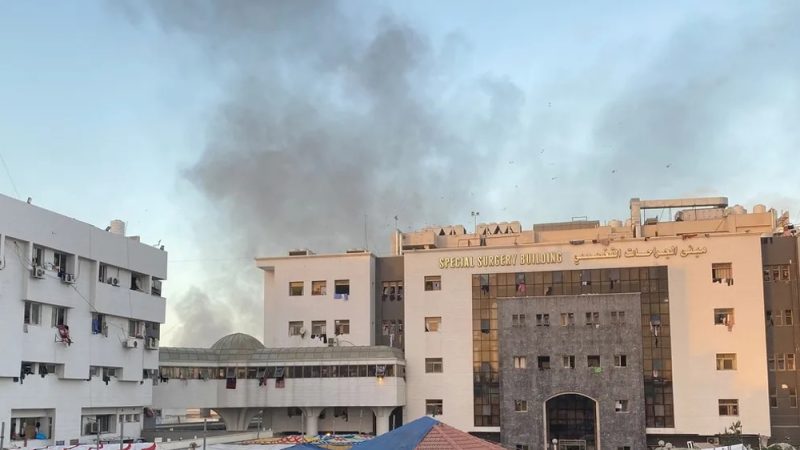
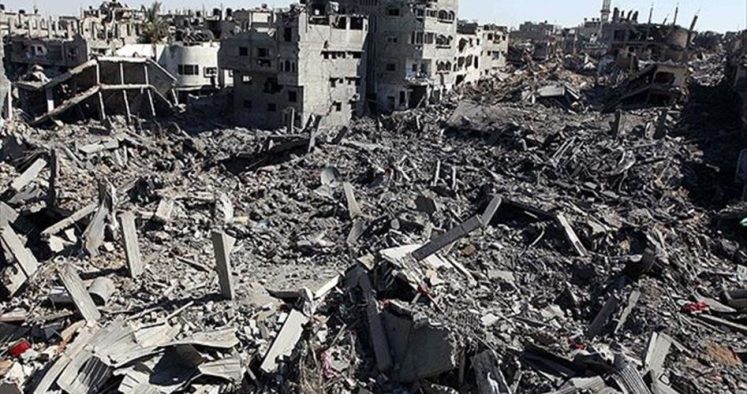
Indonesia’s foreign minister has condemned in the strongest terms Israel’s attacks on Indonesian Hospital in the besieged Gaza Strip as a “clear violation of international humanitarian laws.”
“All countries, especially those that have close relations with Israel, must use all their influence and capabilities to urge Israel to stop its atrocities,” Retno Marsudi stated on Monday.
Israeli forces opened fire and launched artillery strikes on the hospital and the surrounding areas in the early hours of the day.
The Gaza Health Ministry’s General Manager Munner al-Bursh said the regime forces began artillery strikes “in the middle of the night and targeted the surgical department, wounding the doctors working there and killing 12 civilians who were taking refuge.”
Elsewhere in his remarks, Bursh said Israeli forces also targeted people leaving the facility and shot them outside the hospital. “Their bodies are still lying on the ground, and nobody has been able to bury them.”
“We are using a small power generator that runs on vegetable oil, manufactured by some creative individuals who sacrificed some of their food supply to run the generator,” Bursh said.
Ashraf al-Qudra, Gaza’s Health Ministry spokesman, said the situation is “catastrophic” in Indonesian Hospital. “The Indonesian Hospital staff are insisting they will stay to treat the wounded. There are about 700 people, including medical staff and injured people, inside the hospital.”
Reports said Israeli forces are going to repeat what happened at Shifa Hospital and will also occupy the Indonesian Hospital as tanks surrounded the facility.
Meanwhile, Palestinian Prime minister Mohammad Shtayyeh has said the Israeli military operation in Gaza “is for the purpose of killing, in the spirit of revenge and with the aim of displacing our people.”
And UN Secretary-General Antonio Guterres has said the number of civilians killed in Israel’s war on Gaza has been “unparalleled and unprecedented” since he took office in 2017.
Children make up virtually 47 percent of Gaza’s 2.3 million population. UNICEF has labeled the Gaza Strip “a graveyard for thousands of children.” It has also described the situation in Gaza as “a growing stain on our collective conscience”, calling the rate of children casualties “simply staggering.”
Save the Children says more children have been killed in Gaza than in all other conflicts around the world since 2019 combined.
Israel has killed 13,000 Palestinians in Gaza since October 7.
The University of Ottawa is under fire for suspending a medical student over pro-Palestine social media posts. A petition signed by nearly 50,000 people has accused the faculty of misusing its authority, and intimidating residents and students through censorship. The signatories have urged people to call on the university to investigate associate professor of family medicine Dr Yoni Freedhoff.
A resident physician in his 4th year of Public Health and Preventive Medicine, Dr Yipeng Ge, is said to have been suspended after Freedhoff, who appears to be an ardent support of Israel according to his profile on X, accused Ge of anti-Semitism. In a blog, Freedhoff targeted Ge for his pro-Palestinian social media posts. He also called out Ge on X, claiming that he was spreading anti-Semitism. Ge was suspended shortly after the publication of Freedhoff’s blog.
A petition demanding Ge’s reinstatement has been signed by 48,365 people. The petition expresses solidarity with Ge and calls on the university to reverse his suspension and apologise for failing to follow due process. It demands a thorough investigation into the decision to suspend Ge and condemns the rise in anti-Palestinian discrimination and censorship at the university, arguing that the suspension violates university policies on free expression, student rights and occupational health and safety.
Ge should have the chance to challenge the suspension with impartial oversight, insist the signatories, who call on the university to protect him from harassment by a faculty member, Freedhoff, that puts him at physical and reputational risk without repercussions. Furthermore, it criticises the university administration for failing to provide a safe learning environment and enable Palestinian advocacy on campus through actions like Ge’s suspension.
This suspension is another example of the growing crackdown on pro-Palestine voices on campuses and social media platforms. Pro-Israel groups have doubled their efforts to silence criticism of the apartheid state. Members of the Palestine Society at the School of Oriental and African Studies (SOAS) in London were suspended by the university last month, following a solidarity rally for Gaza. Moreover, a chilling threat to student free speech has emerged across US campuses. Rights groups have warned that pro-Israel donors are seeking to crush pro-Palestine activism through intimidation and threats.
A glimpse into the scale of Israel’s crackdown on social media users was given earlier this year with the revelation that the occupation state is one of the world’s leading countries in demanding the removal of videos from social media giant TikTok. Last week, the site came under pressure from pro-Israel celebrities and “Jewish influencers” to crack down on pro-Palestine voices and content, according to a shocking new report by the New York Times.
Ever since Friday’s release of more than 40,000 hours of Jan. 6 Capitol Police security video, dozens of clips debunking the Jan. 6 committee’s ‘violent insurrection’ narrative have been floating around X.
In response to the exculpatory footage that the Jan. 6 committee never showed the American public, Senator Mike Lee (R-UT) has raised significant questions about the handling of security footage.
Lee’s statements directly challenge the integrity of the now-disbanded committee, particularly addressing the roles of its former Republican members, Liz Cheney and Adam Kinzinger. He also accuses the committee – particularly those two, of selectively sharing information.
After Cheney attempted to hit back with her ‘best hits’ Jan. 6 footage, Lee replied: “Liz, we’ve seen footage like that a million times. You made sure we saw that—and nothing else.”
Lee also called for an investigation into the committee itself, labeling it a “sham” and questioning the use of taxpayer dollars in its operations. He insinuates that crucial information about the committee’s work could have been “deliberately lost or destroyed,” casting doubts on the committee’s transparency and objectivity.
The argument continued throughout the day, with Lee linking to a NY Post article with the headline “FBI lost count of how many paid informants were at Capitol on Jan. 6, and later performed audit to figure out exact number.”
Kinzinger swings and misses all day
In response to the backlash, Kinzinger made a stupid joke comparing Jan. 6 protesters to US army helicopters providing fire for South Vietnamese ground troops attacking the Vietcong in 1965.
He also retweeted about a dozen similarly stupid jokes (check out his timeline).
The House Select Committee on the January 6 Attack was disbanded in January 2023, after releasing its final report in December 2022. The committee, comprising seven Democrats and two Republicans, faced criticism for its composition and the perceived partisanship in its approach.
Kinzinger did not seek reelection, and Cheney lost her primary, marking a significant shift in the Republican landscape. The release of the security tapes by Johnson is seen as a step towards transparency, allowing the public to form their own opinions about the events of January 6, away from the committee’s narrative.
One person was killed and one was injured in an attack on Saturday on a convoy of Doctors Without Borders/Médecins Sans Frontières (MSF) staff members and their families who had been attempting to evacuate from northern Gaza.
The person who was killed was a relative of an MSF staff member. “MSF condemns in the strongest terms this deliberate attack.”
“The convoy was made up of 137 people — Palestinian MSF staff members and their families, including 65 children. Since November 11, they have been trapped in MSF’s guesthouse, office and outpatient clinic near Al-Shifa Hospital in Gaza because of ongoing fighting, and we have repeatedly called for their safe evacuation,” MSF said in a statement on Saturday.
MSF explained that on Saturday morning, its convoy of five vehicles departed at 9:00 a.m. local time, all clearly marked with MSF identification, including on the roofs.
MSF said it arranged for the movement of the convoy, but when the convoy reached the point where the Israeli army had constructed a newly erected checkpoint, the area was already overcrowded with Palestinian civilians seeking to flee.
However, after hours of waiting, the Israeli army did not allow the convoy to cross toward the south and shots were fired to push it back to Gaza City, MSF added.
When the convoy was on its way back, it was attacked. “Two of the MSF cars were deliberately hit, killing one MSF staff’s family member and injuring another.”
MSF has called again to urgently allow the evacuation of its staff and their families as well as of thousands of other people, who are trapped by fighting and living in extremely dire conditions in northern Gaza.
“We are calling for an immediate ceasefire, which is the only way for corridors to be implemented to safely evacuate trapped civilians.”
At least 15 British government departments have been engaged in a deliberate social media and internet profiling campaign against public experts in various fields to ensure that none of its critics are allowed to speak at the cabinet-sponsored events, the Observer reported on Saturday, citing a trove of data it had seen.
The government officials in each department had specific guidelines regulating what exactly they should look for and requesting them to compile and keep “secret files” on the speakers deemed to be critical of the cabinet, the paper said.
The profiling usually involved checking a person’s Twitter, Facebook, Instagram and LinkedIn accounts as well as doing a Google search on such individuals using specific keywords like “criticism of the government or prime minister.” The officials were then advised to look through up to 10 pages of the search results or a period of between three and five years, the report said.
The UK Education Department – one of those engaged in the profiling campaign, according to the Observer – outright denied resorting to such practices in a response to the freedom of information request filed by the Privacy International group last year. The group was investigating social media monitoring by the government at that time.
“Making a concerted effort to search for negative information in this way is directed surveillance,” the Privacy International legal director, Caroline Wilson Palow, told the Observer.
The data on the practice were shared with the paper by a law firm, Leigh Day, that is currently pursuing legal action against the government on behalf of at least two persons affected by such practices.
“This is likely to have impacted large numbers of individuals, many of whom won’t know civil servants hold secret files on them. Such practices are extremely dangerous,” Tessa Gregory, partner at Leigh Day, told the Observer. The lawyer maintained that such hidden checks are in violation of data protection laws and potentially of equality and human rights laws as well.
One of those who hired Leigh Day was Dan Kaszeta, a chemical weapons expert and an associate fellow at the Royal United Services Institute (RUSI), one of the UK’s leading security think tanks. “The full extent of this is shocking and probably not fully known. I was lucky enough to be given clearcut, obvious evidence,” he told the paper, adding that he was also aware of 12 other experts who had found out that the government had been blacklisting them.
According to Kaszeta, he received a public apology from the government in July and was informed in August that the 15 departments in question had withdrawn those guidelines pending a Cabinet Office review.
A spokesman for the Cabinet Office told the Observer that the government was “reviewing the guidance and have temporarily withdrawn it to prevent any misinterpretation of the rules.”
Israeli forces ordered doctors, patients and displaced people at Gaza’s Al-Shifa Hospital to evacuate the medical compound, giving them an hour to do so and forcing some to leave by gunpoint, Al-Jazeerareported on 18 November.
Israeli forces issued the demand to evacuate in “one hour” at around 9 am local time, but it was “impossible” to evacuate everyone, a doctor in Al-Shifa told Al-Jazeera.
Medical sources inside the facility said there are more than 7,000 people sheltering from Israeli bombing in the Al-Shifa complex, including 300 patients in critical condition.
It also includes “at least 35 premature babies who already for eight days now have been out of their incubators because of the lack of oxygen and the lack of electricity,” Al-Jazeera’s correspondent in Khan Younis, in southern Gaza, said. Four babies died late on Friday and five are severely ill now, the correspondent added.
“There is no transportation means in Gaza City and the northern parts because of a lack of fuel. So people are expected to evacuate on foot. And doctors are telling us it’s impossible to evacuate with this many people on foot.” She added that doctors also did not want to abandon their patients.
“We were told to leave through al-Wehda road. Dozens of dead bodies are scattered on the road,” Omar Zaqout, the hospital’s supervisor, said. “Many homeless people who cannot walk are left out in the open.”
“Many of the patients were put on wheelchairs or rolling beds. Family members were forced to carry their wounded children or parents themselves … These are horrible, unprecedented scenes,” explained Munir al-Barsh, a doctor at the hospital.
The hospital has also been without food, water, electricity and oxygen for at least a week, while Israeli troops and tanks raided the facility over the last couple of days. Some 37 patients have died as the hospital’s ability to operate has collapsed.
Israel claimed Hamas has a command center underneath the hospital and released video footage claiming to show weapons its troops found in various rooms. It also released footage claiming to show its troops unloading boxes full of medical supplies.
However, a BBC analysis of the footage clearly showed Israeli forces themselves brought the weapons into the hospital in the boxes of medical supplies in an effort to fabricate claims that Hamas was active there.
Before raiding the hospital, Israel also claimed that captives taken by Hamas on 7 October were being held there, and that a major Hamas “command center” was present below the hospital. But Israel could provide no evidence for either claim after taking control of the hospital.
The Palestinian Authority, released a statement in response to the evacuations saying, “The evacuation of al-Shifa deepens the humanitarian and environmental catastrophe Gaza faces.” Israel’s actions represent “another hideous facet of the crimes of ethnic cleansing and genocide committed by the occupation forces against Palestinians,” the statement said.
United Nations (UN) Special Rapporteur Pedro Arrojo-Agudo on Friday called on the occupying state to stop using water as a weapon of war against the Palestinians and called on it to provide clean water and fuel to the besieged Gaza Strip.
The UN special rapporteur on the human rights to safe drinking water and sanitation issued a statement in the context of the water crisis in the Gaza Strip due to the strip being subjected to an Israeli siege and intense attacks.
“Israel must stop using water as a weapon of war and allow clean water and fuel into Gaza to activate the water supply network before it is too late,” Arrojo-Agudo urged.
Arrojo-Agudo pointed out: “Every hour that passes with Israel preventing the provision of safe drinking water in the Gaza strip, in brazen breach of international law, puts Gazans at risk of dying of thirst and diseases related to the lack of safe drinking water.”
He stressed: “I want to remind Israel that consciously preventing supplies needed for safe water from entering the Gaza Strip violates both international humanitarian and human rights law,” adding that the impact on public health and hygiene will be “unimaginable.”
The UN rapporteur pointed out that the United Nations Relief and Works Agency for Palestine Refugees (UNRWA) had previously announced that 70 per cent of Gaza’s population drinks salty and dirty water.
For the 42nd consecutive day, the Israeli occupation army continues to launch devastating attacks on Gaza. Its planes target buildings and residential homes, destroying them above the heads of their residents and depriving the Gaza Strip of water, food and fuel. This has led to the deaths of more than 11,630 Palestinians, including 4,710 children and 3,165 women, as well as more than 31,800 wounded people, 70 per cent of whom are children and women, according to official Palestinian sources.
GAZA – The International Criminal Court (ICC) announced that it received referrals from five states seeking an investigation into Israeli war crimes in Gaza.
ICC Prosecutor Karim Khan disclosed that South Africa, Bangladesh, Bolivia, Comoros, and Djibouti submitted the referrals.
Khan confirmed in a statement that the ICC is already investigating the situation in Gaza.
“In accordance with the Rome Statute of the International Criminal Court, a State Party may refer to the Prosecutor a situation in which one or more crimes within the jurisdiction of the Court appear to have been committed requesting the Prosecutor to investigate the situation for the purpose of determining whether one or more specific persons should be charged with the commission of such crimes,” he said.
Khan mentioned the establishment of a specialized team upon assuming his term in June 2021, aimed at advancing the investigation in Palestine.
The prosecutor emphasized that the team will probe crimes suspected to be committed during the Israeli aggression on Gaza.
South Africa declared that it had submitted the referral request with “other countries that share the same concerns”, demanding that the International Criminal Court would urgently pay “attention to the seriousness of the current situation.”
The South African Ministry of Foreign Affairs stressed in a statement that Pretoria “urges other signatory states to the Rome Statute to join this referral request, or to submit their referral requests independently.”
The ICC opened an investigation in 2021 into war crimes suspected to be committed by the Israeli occupation forces in Palestine.
Since October 7, Israel has been waging a bloody aggression on the Gaza Strip, resulting in the martyrdom of more than 12,000 Palestinian civilians, most of whom are children and women.
The CDC has recently announced that exemptions to vaccinations have hit record highs in the United States. We take a look at the reasons why parents are choosing to forgo vaccinations for their young children.
Founder and Executive Director OF Texans for Medical Freedom, Jackie Shlegel, joins Del to share the monumental legal win this week in Texas and how she played an integral part in helping get SB7 passed, which protects private employees from being mandated to get the COVID-19 vaccine. Jackie details how she worked closely with Texas Governor Greg Abbott to pass this historic legislation.
The Israeli military has attacked and is occupying parts of al-Shifa hospital in an ongoing operation in northern Gaza. It is the biggest and most modern hospital in Gaza, which has ceased to function normally because of a lack of power, while tens of thousands of displaced Gazans take shelter in it.
An attack on a hospital is normally considered a clear violation of the rules of war. The Israeli Defense Forces is justifying it by claiming that Shifa has long served as civilian medical cover for the command center of the entire Hamas war operations and weapons storage.
That IDF claim has been cited constantly in Israeli propaganda as an argument that Shifa — and other hospitals in Gaza — should not be accorded the normal legal hospital immunity from attack.
Israeli forces closed in on Shifa while demanding for the last few days that the staff and patients remaining in the hospital be evacuated immediately. CNN reported Monday night that “the Biden administration has now signaled that it supports the Israeli position, as National Security Advisor Jake Sullivan declared on CNN’s State of the Union Sunday: ‘You can see even from open-source reporting that Hamas does use hospitals, along with a lot of other civilian facilities, for command-and-control, for storing weapons, for housing its fighters.’”
Those Sullivan remarks were an obvious green light for the IDF to press on for complete evacuation of the hospital.
The problem with that “open source reporting” is that it is never anything more than unsupported claims based on mere supposition. In fact, when the history of supposedly damning revelations about Shifa hospital providing cover for Hamas military activities are examined more carefully it becomes clear that it has been no more than a thinly veiled excuse for the IDF to attack and close down Gaza’s most important provider of medical care for the population of Gaza.
A History of Deception
The Israeli claim that Shifa hospital was providing such a cover for an Hamas military presence there is in fact the longest running theme in Israeli war propaganda on Gaza, dating back nearly 15 years to the first days of the Gaza war of January 2009.
That was when Yuval Diskin, the head of Israel’s domestic intelligence service Shin Bet, told Amos Harel of Haaretz newspaper that “many” senior Hamas officials were “believed” to be hiding in the “basements” of Shifa hospital, and that the Israelis knew all about those underground levels of the hospital, because they had originally been been built by the Egyptians before 1967 and extensively refurbished by the Israelis themselves in the mid-1980s.
Diskin also explained to Harel that Hamas was confident that it wouldn’t be attacked, because of the patients on the upper floors.
Apart from the fact that Israel’s intelligence service had admitted that it only suspected Hamas’ military presence under the hospital rather than having actual knowledge, Harel was, however, honest enough to report that his Palestinian contacts were telling him senior Hamas leaders never stayed in the same location but constantly moved from one location to another — a revelation that obviously made far more sense than the claim that those same senior Hamas officials were hanging out in a basement that was obviously well known to the Israelis.
Harel’s report also included a revelation — apparently from a Palestinian source — that raised problems for the nascent official Israeli propaganda line: “Some of the bunkers they are using,” Harel wrote, “were linked by tunnels Hamas built in recent years.”
The existence of numerous bunkers that could be used for command were thus independent of Shifa hospital, which the Israelis would always be able to invade. That reality clearly implied that it would make no sense for Hamas to depend on Shifa hospital for that purpose.
IDF Tale Resurfaces in Washington Post
Nevertheless, during the next Israeli-Palestinian war in July 2014, the IDF tale of the Hamas leaders’ secret hideaway in the basement of Shifa hospital re-emerged as if it were an unassailable fact that justified IDF threats to attack the hospital.
In a story published July 15, The Washington Postreported as unassailable fact that Shifa “has become the de facto headquarters for Hamas leaders, who can be seen in the hallways and offices.”
Post reporter William Booth clearly did not see Hamas leaders in Al Shifa himself. Had he done so, he would have described the scene and identified one or two Hamas figures who had been pointed out to him at the hospital. So he was apparently passing on the self-interested claim of his Israeli interlocutors without informing Post readers that the information in question was far less reliable than it was made to appear.
The IDF became fixated on closing up another Gaza hospital in July 2014 Just two days after that initial appearance of the Shifa-Hamas theme in the 2014 war, Israeli airstrikes bombed Al Wafa Rehabilitation and Geriatric Hospital in Gaza City and forced its closure.
The IDF specialists created a video distributed three weeks later aimed at defending the destruction of Wafa hospital as a necessary response to Hamas using the hospital for military operations. But they had resorted to multiple levels of trickery to make their political point, as this writer discovered in investigating the video.
The IDF propagandists had spliced together videos from five years earlier and from different times of day so as to suggest that firing from an unused building more than 100 yards away from the hospital was a recent Hamas rocket attack on IDF forces. Then they spliced in an audio clip from an entirely different incident in which the IDF returned fire to try to show that the IDF bombing of Wafa hospital was justified.
At the end of July 2014, the Post reaffirmed its support for Israel’s primary propaganda theme in that six-week war. Terrence McCoy reported from Washington that Shifa Hospital had “become a de facto headquarters” of Hamas. That reporting reflected in turn the general readiness of much of the national press in Washington to accept the word of the Israelis as all they needed to know on that pivotal issue.
Eight years later, the same Israeli propaganda line immediately resurfaced after the Oct. 7 Hamas attack, as the Israelis mounted a new propaganda offensive. On Oct. 27, IDF Spokesman Adm. Daniel Hagari, briefed the International press on the main lines of Israel’s position regarding Shifa hospital and Hamas operations: He repeated the line that a bunker underneath Shifa is Hamas’ main base of operation, and that Hamas operates “several tunnels inside and under” the hospital.
Maximum Suffering
But Hamas’ tunnels outside Shifa could obviously be used for the same function of command of military operations without having to bother with Shifa hospital.
So the drumbeat of Israeli concern about the alleged Hamas command bunker underneath Shifa appears to have been a phony issue from the start, aimed merely at bringing pressure to bear on the medical system, namely to close down Shifa as the largest, most modern and most effective hospital in Gaza to create the maximum amount of suffering to the people of Gaza.
As of Tuesday, Shifa Hospital had ceased to function, as it had no electricity, having run out of fuel. The Israelis gallantly offered the hospital 300 liters of fuel — enough to function for about six minutes according to the hospital’s calculation.
They thus failed to take any emergency action to save 36 babies facing possible death from the non-functioning incubators after three had already died.
The scene at Shifa hospital early on Wednesday was eerie, as Israel tanks rumbled into the hospital grounds and Israeli troops entered the darkened main hospital building.
IDF spokesman Hagari would say only that Israeli forces were carrying out an operation “based on intelligence information and an operational necessity” and that it was in a “specified area in Shifa hospital”.
Later Wednesday the IDF’s Peter Lerner told CNN that the operation at al-Shifa hospital was “ongoing” and would say only that it had not found any sign of hostages in the hospital.
The Gazans who have been staying in Shifa have been afraid to take the approved routes away from the hospital because of relentless Israeli attacks on civilians trying to do so. The IDF will no doubt continue to use force against the hundreds of thousands huddled there to make them leave.
And now that Israel has control over many thousands of military age males in the hospital, it is doubtful that they will be allowed to go free, since they are considered as potential Hamas fighters.
The time has come for a reckoning on the long-running IDF propaganda ploy of claiming that Shifa has been used to hide Hamas’s command center.
Unless the IDF can show journalists convincing evidence of that long-claimed Hamas command presence under the hospital, they should stand for the truth and denounce that massive Israeli deception about Gaza.
For well over a year and a half, we have been listening and reading about all the mythical “victories” of the Kiev regime forces. If we were to believe the mainstream propaganda machine, Russia is about to collapse, its forces are in disarray, President Putin is in perpetual hiding in some bunker, etc. And yet, concurrently, that same mainstream propaganda machine is publishing texts about the massive increase in the number of forcibly conscripted women in the Neo-Nazi junta forces. This begs the obvious question, why? Why would the side that’s supposedly “winning” enforce conscription on anyone, let alone women? Men are far more suitable to be soldiers for evident biological reasons (unless you’re an ultra-liberal, “woke” extremist).
Women can surely play a part in the defense of their own country, but ideally, this shouldn’t be encouraged. Warfare has always been quite an ugly business, even for the toughest of men, as evidenced by the number of veterans with PTSD. In this regard, frontline units are particularly exposed to the horrors of war and female soldiers should certainly be kept as far as possible from direct combat zones. The dread that male POWs (prisoners of war) can go through is more than enough, while women in the same situation are at the risk of experiencing even worse horrors. This alone should disqualify female soldiers from serving in frontline units. Notwithstanding many famous women who served in wars during momentous times in history, this is something that should be an axiom.
However, it seems the Kiev regime didn’t get the memo. Worse yet, not only are they sending women to the trenches, but are now forcibly conscripting pregnant ones. Yes, you read that right – pregnant Ukrainian women are being sent to the frontline. Anyone remotely sane would call that a war crime. Those who are sending them can only be described as enemies of their own people. Pregnant women are by far the most precious humans one could possibly imagine and treating them with anything less than absolute care is simply criminal. Taking into account the unrelenting demographic collapse of Ukraine, women (particularly pregnant ones) should be the top priority in terms of ensuring their safety and well-being. However, the Neo-Nazi junta and its NATO overlords have other plans.
Hundreds of thousands of young Ukrainians who haven’t got the chance to leave the country are in hiding, as there’s no other way to avoid the ruthless draft commissions that regularly grab people in the streets and then send them off to frontline units. Obviously, those who are loyal to the Kiev regime are exempt, as well as those who can afford to pay hefty bribes to military medical commissions (MMCs). Thus, sons of numerous corrupt oligarchs get the chance to live their lavish lifestyles abroad (all at the expense of the Ukrainian people), while pregnant women are sent to war. What’s more, recently released combat footage shows some have already been captured by the Russian military. The video in question shows a woman shouting “[I’m] pregnant!” while surrendering to Russian soldiers.
Although it could be argued that the female soldier in the video is simply saying this out of fear, there have already been complaints from pregnant women who got conscription notices. As there are upwards of 50,000 female soldiers currently serving in various units, the number of pregnant ones is difficult to determine, but it could easily be in the hundreds (if not even thousands). And while legal limitations previously protected women by barring them from serving in frontline units, most of those have been lifted after the special military operation (SMO) started. Thus, female soldiers can now serve as machine gunners, tank commanders, snipers, truck drivers, etc. Unfortunately, this is hardly surprising given that people with severe physical and mental disabilities are also being deemed “fit for service“.
An email from the editor of a major daily Melbourne newspaper has come into my possession. I won’t say how, since it might incriminate me as being part of a household that pays for a subscription. Let’s just say that it’s possible that the subscription was taken out using an email address that I have access to. Or something. The very first words of the email are:
As a subscription benefit, from today [masthead name redacted] editor [name redacted] will send you an exclusive analysis of the week’s most important stories each Friday.
That’s what I call a ‘marmalade dropper’, a statement so utterly preposterous that to read it over breakfast would cause such a fit of apoplexy that one would choke on one’s marmalade toast and drop it on the floor, for it to be consumed by the dog.
Luckily, I’d had breakfast already. Intrigued by this alleged ‘benefit’, which might better be regarded as a ‘threat’, I read on. The newish editor started off by quoting a former editor:
[Masthead redacted] “does certain things differently from other newspapers simply because … we’re not there as a means of simply passing a word from a mouth to an eye, we’ve a responsibility to our readers and to society in general”.
That is an unabashed endorsement of the practice of selecting and then framing the stories they deem fit to print, rather than simply reporting the bare facts. Then this:
Readers of [masthead redacted] want more than the kind of imitable journalism they can find on countless free-to-read news sites and unoriginal, uninspiring and sometimes unhinged publications.
The editor couldn’t resist, either through spite or an inferiority complex, a swipe at other news sites. Too gutless to name those he thinks ‘unhinged’.
It goes on:
… our readers want depth and quality, excellence and rigour. They want a publication with scruples that is willing to fight for its readers, its city, and hold power to account, without fear or favour. One that will doggedly pursue public interest investigations to shine light on the darkest parts of our society, but also celebrate Melbourne’s successes and be constructive and mature in its approach to difficult subjects.
“Fight for its readers”? Did it fight for those who were shot in the back with rubber bullets when Victoria Police corralled them at the Shrine of Remembrance? “Doggedly pursue public interest investigations”? Did they doggedly pursue the hotel quarantine fiasco? As I recall it was only Peta Credlin who had the guts to ask the then Premier any hard questions about this and other Covid crimes. Did they ever get to the bottom of who ordered the curfew? Was it the Premier, the Chief Health Officer, or the Police Commissioner?
“… be constructive and mature in its approach to difficult subjects”? What a string of weasel words that is! The translation is “ignore totally any concerns about vaccine safety and smear anyone who raises the issue”.
But there’s more. The email goes on to list the things they did talk about in the last 12 months. See if you can spot what’s missing.
… war crimes of Australia’s most decorated soldier, Ben Roberts-Smith. We promoted mature discussion about the future of Melbourne and its suburbs. We broke the news that the nation’s biggest plastic bag recycling scheme was continuing to operate even though its recycling function had collapsed, resulting in millions of bags being stuffed into warehouses across the country.
We exposed huge failings in the Department of Home Affairs across a range of stories that exposed a failure to prevent human trafficking and questionable payments of Australian taxpayer money to foreign officials. When we reported that the influential head of that department, Mike Pezzullo, had attempted to influence and cosy up to politicians, he was stood down pending an investigation.
We pored over every detail of the state government’s cancellation of the Commonwealth Games and exposed the shambolic management of that decision. We sent reporters to cover a war in the Middle East with huge emotional impacts on many in Australia, and indeed on domestic politics.
We fought for our readers’ right to know what is happening within the justice system, by opposing suppression orders and battling for access to court documents in the Magistrates’, County and Supreme Courts, all the way up to the High Court of Australia.
What great stuff. Plastic bag recycling. Australian Rules football. Cricket dismissals. Phonics in schools. A reporter sent to a war zone. A spectator at the bankruptcy of third-world Victoria, epitomised by the cancellation of the Commonwealth Games and the Airport Rail.
There’s an enormous gaping hole in the coverage, just like there’s an enormous gaping space in the foyers of office towers all over the city, as the utter destruction of our once beautiful Melbourne echoes the utter destruction of lives and livelihoods caused by mask mandates, ‘social distancing’ and vaccine mandates. Nothing about the morality of excluding people from daily society. No mention of excess mortality. No mention of the Forest of the Fallen. Nothing about the imminent WHO changes. Nothing about the dangers of Digital ID or the Misinformation Bill. Nothing about the risks of Central Bank Digital Currencies. Evidently the editor sees no “responsibility to our readers and to society in general” in respect of these issues. I’ll be waiting for an age, I think, to get that kind of coverage.
A final quote from the email is even more chilling:
You, our subscribers, made all this and more possible by supporting our journalism. And I can assure you, this is only the start of what we believe we can accomplish as a newsroom.
So what is it that they are only at the start of accomplishing as a newsroom? What is it, other than suppressing some stories and promoting others, that they want to do?
By Mazin Qumsiyeh | Popular Resistance | August 18, 2013
There is no way to say this truth nicely: Politicians lie. That includes Japanese, American, Egyptian, Israeli, and Palestinian politicians! Is there something more common sense than that? Yet, so many citizens around the world believe their own politicians or wistfully acknowledge lies but think it is part of the job needed to run things. They believe even when politicians contradict themselves blatantly. This phenomenon is rather remarkable. It is a dissonance and disconnect from reality that many seem oblivious to. It is very dangerous because it can lead to accepting rationales for going to war. These can be deadly wars that lead to millions of lives lost as happened in what was called World War 1 and WW2. Even when incredible and declassified evidence abound, politicians continue to lie and old mythologies refuse to die. Here are just a few of the countless lies told to us over the past few decades… continue
This site is provided as a research and reference tool. Although we make every reasonable effort to ensure that the information and data provided at this site are useful, accurate, and current, we cannot guarantee that the information and data provided here will be error-free. By using this site, you assume all responsibility for and risk arising from your use of and reliance upon the contents of this site.
This site and the information available through it do not, and are not intended to constitute legal advice. Should you require legal advice, you should consult your own attorney.
Nothing within this site or linked to by this site constitutes investment advice or medical advice.
Materials accessible from or added to this site by third parties, such as comments posted, are strictly the responsibility of the third party who added such materials or made them accessible and we neither endorse nor undertake to control, monitor, edit or assume responsibility for any such third-party material.
The posting of stories, commentaries, reports, documents and links (embedded or otherwise) on this site does not in any way, shape or form, implied or otherwise, necessarily express or suggest endorsement or support of any of such posted material or parts therein.
The word “alleged” is deemed to occur before the word “fraud.” Since the rule of law still applies. To peasants, at least.
Fair Use
This site contains copyrighted material the use of which has not always been specifically authorized by the copyright owner. We are making such material available in our efforts to advance understanding of environmental, political, human rights, economic, democracy, scientific, and social justice issues, etc. We believe this constitutes a ‘fair use’ of any such copyrighted material as provided for in section 107 of the US Copyright Law. In accordance with Title 17 U.S.C. Section 107, the material on this site is distributed without profit to those who have expressed a prior interest in receiving the included information for research and educational purposes. For more info go to: http://www.law.cornell.edu/uscode/17/107.shtml. If you wish to use copyrighted material from this site for purposes of your own that go beyond ‘fair use’, you must obtain permission from the copyright owner.
DMCA Contact
This is information for anyone that wishes to challenge our “fair use” of copyrighted material.
If you are a legal copyright holder or a designated agent for such and you believe that content residing on or accessible through our website infringes a copyright and falls outside the boundaries of “Fair Use”, please send a notice of infringement by contacting atheonews@gmail.com.
We will respond and take necessary action immediately.
If notice is given of an alleged copyright violation we will act expeditiously to remove or disable access to the material(s) in question.
All 3rd party material posted on this website is copyright the respective owners / authors. Aletho News makes no claim of copyright on such material.