Euro-Med: Israel used over 1,000 white phosphorous bombs in Gaza
Palestine Information Center – November 16, 2023
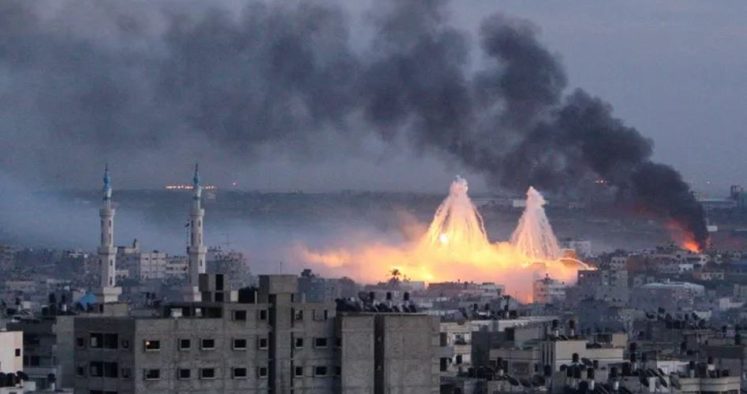
GAZA – The Euro-Med Human Rights Monitor has said that the Israeli army has launched more than 1,000 strikes, utilizing internationally prohibited white phosphorus, on populated areas since it started its genocidal war on the Gaza Strip on October 7.
In a statement on Thursday, the Euro-Med Monitor said it had documented the Israeli army’s indiscriminate use of white phosphorus against civilians, describing it as an “incendiary substance that burns human flesh and causes lifelong suffering.”
Euro-Med said that its team received testimonies affirming that the Israeli army carried out 300 strikes with white phosphorus bombs and projectiles within a period of about 40 minutes on Wednesday evening, November 15, on a residential block in Beit Lahia town, north of Gaza.
“The night before, a large number of white phosphorus shells were reportedly seen falling on a crowded populated area in Sheikh Radwan neighborhood, north of Gaza City. Similar attacks also occurred on several occasions in al-Shati refugee camp in western Gaza and the town and camp of Jabalia, north of the Strip,” Euro-Med elaborated.
“Palestinian residents said they suffered from severe shortness of breath and coughing as a result of inhaling white phosphorus in the midst of extremely unpleasant odors spreading in the air and severe blurred vision due to the thick white smoke,” Euro-Med cited.
According to Euro-Med, people exposed to white phosphorus can suffer from respiratory damage, organ failure, and other serious and life-altering injuries, including burns that are extremely difficult to treat and cannot be relieved with water.
“The escalating use of white phosphorus and smoke bombs against densely populated areas comes within the framework of forced displacement and ethnic cleansing that are being practiced by the Israeli army in order to force half of the Gaza’s population to leave their homes, shelters and hospitals and move to areas in the south of the Gaza Valley.”
Euro-Med accused Israel of persisting in violating the principles of proportionality and precaution by launching random attacks on the Gaza Strip and directly targeting the lives and health of civilians, and using internationally prohibited weapons in flagrant violation of the international humanitarian law and the rules of war.
“In addition to that, Israel uses bombs with huge destructive power against populated areas, and such bombs pose the single greatest threat to civilians in modern armed conflicts. This explains the severity of the massive destruction that turns entire residential neighborhoods into rubble and ruins in the Gaza Strip.”
“I Want Everybody’s Name.” Nikki Haley Ignores the First Amendment As She Demands an End to Online Anonymity

By Dan Frieth | Reclaim The Net | November 14, 2023
Presidential hopeful from the Republican party, Nikki Haley, has come out in favor of removing online anonymity, recruiting all social media account holders to verify their accounts with a government ID.
Haley said anonymous social media accounts and “misinformation” are a “national security threat.”
However, her sentiments have fueled concerns surrounding censorship and freedom of speech.
Haley, in an interview with Fox News, emphasized her demand for transparency in social media algorithms. The understanding of algorithms, she believes, would reveal the reasons behind certain content delivery on these platforms.
Haley voiced her concerns over the surge in unidentifiable accounts on social media and the alleged misinformation she says they disseminate. She affirms these as potential threats to national security that need to be addressed swiftly and decidedly. She expressed her viewpoint, maintaining that “Every person on social media should be verified by their name. It’s a national security threat.”
“I want everybody’s name,” Haley said on the Ruthless podcast.
Haley also proposed a strategy to mitigate bot activity originating from Russia, Iran, and China by implementing stringent verifications for social media accounts. She believes this measure would improve conduct on these platforms, positing that the knowledge of their posts being seen by known relations would lead to a rise in “civility.”
In oppressive regimes, anonymity is often a shield for dissidents and activists. It allows them to speak out against government abuses, organize protests, and share information without immediately revealing their identity. Mandatory ID verification would strip away this layer of protection, making it easier for authoritarian governments to identify, track, and prosecute individuals who oppose them.
Knowing that their identities could be easily uncovered, many would-be dissidents might choose to remain silent rather than risk their safety. This chilling effect on free speech would be detrimental to the fight for human rights and democracy. In countries where dissent is already dangerous, further suppression of free speech can strengthen authoritarian rule.
Authoritarian regimes often employ extensive surveillance to monitor and control their citizens. Mandatory ID verification on social media would hand these governments another tool for surveillance. This could lead to more targeted repression, as governments could more easily identify and monitor the activities of dissidents when social media platforms are compelled to hand over the information they hold on users.
The Constitutional Implications of Haley’s Demands
The First Amendment of the US Constitution protects freedom of speech and expression. Mandatory ID verification on social media could be seen as a form of censorship, limiting individuals’ ability to speak freely online. Historically, the Supreme Court has been protective of anonymous speech as a vital part of the freedom of expression, as seen in cases like Talley v. California (1960) and McIntyre v. Ohio Elections Commission (1995). These cases underscore the right to distribute anonymous literature and the protection of anonymous speech, respectively.
Related to the First Amendment, there’s a historical precedent for the right to anonymity in political speech. In the Federalist Papers, for example, Alexander Hamilton, James Madison, and John Jay wrote under the pseudonym “Publius” to argue for the ratification of the Constitution itself. Without the right to anonymity, there would be no America as we know it.
This anonymity allowed for the free exchange of ideas without fear of retribution. Requiring ID verification could discourage individuals from expressing unpopular or dissenting opinions, thus stifling democratic discourse.
YouTube Boasts About Elevating “Quality” Content, Collaborating With the WHO, and Suppressing “Misinformation”
By Didi Rankovic | Reclaim The Net | November 15, 2023
YouTube (Google) is yet another in a series of tech behemoths that feel the need to declare their stance on content, including its effective algorithmic manipulation, just as US primaries are ushering the country into another year of presidential elections.
Beating around that bush – Google representatives now talk about processes, procedures, and tools of censorship of health-related information that, unfortunately, can easily be “repurposed” to serve other, for example, political ends.
Much of the conversation rests on what Google wants to portray as its laurels from “the previous epidemic” – which too many people and creators see from a diametrically opposed point of view, as a dark time of nearly unbridled censorship and suppression of free speech.
A video now published by Yahoo Finance reveals not only that Google has a “chief clinical officer,” but also how that officer, Michael Howell, sees the role of this super powerful tech corporation in determining what users are likely to see, see first, or see at all on a platform like YouTube.
Howell, naturally, sees nothing wrong with this and even, to all intents and purposes, brags that YouTube is working to make sure legacy media have advantage over independent creators, and that the latter may easily face censorship.
That’s the takeaway from his words, which he chose to phrase thus: YouTube works to “lift up high quality content, even as we work to lower, and make less prominent content that isn’t accurate or helpful to users.”
The whole interview is positioned as an exploration of how “misinformation grows and spreads” supposedly in sync with the amount of content and the number of users. There is even the assertion made by Yahoo that medical sector “misinformation” is not only very present among users but also “in the broader medical community.”
While this may or may not signal continued censorship of “disfavored” medical professionals, YouTube Head of Healthcare & Public Health (yes, that’s a YouTube job title these days, too) Dr. Garth Graham shared that the platform is the first to start “labeling health information that’s coming from licensed doctors, licensed nurses, licensed healthcare professionals.”
And even after all these years of sometimes completely arbitrary censorship YouTube is supposed to be taken as a “credible source of information (users) can trust” – as it works with the National Academy of Medicine and of course, the World Health Organization (WHO) to craft its definitions, and then “raise that up” – i.e., algorithmically promote, at the expense of other content.
Graham had more curious things to say, such as that while clearly committed to censoring what (or, whatever) Google decides is “delicate (sic) and dangerous information” – people are still supposed to view it as an “open platform”!
Either Graham doesn’t know what an open platform is, or he hopes YouTube/Google users don’t.
There’s also a good amount of patronizing toward those users, as in them needing to be hand-held (by Google) pretty much all the way in order to discern information from misinformation and make appropriate decisions.
“So, you know, we’re an open platform, but the real goal is how do you balance getting good information to people at the right time (…) while making sure that we remove delicate or dangerous information.”
Asked how Google has already managed (shocker) to get the government to participate in posting videos promoting their policies and what “conversations” preceded this, the Google exec said that “the entire healthcare eco-system” was already “energized” to get their message across.
And he counted the government as well as hospitals and physicians as part of this eco-system. One of them, last but not least, is the WHO.
What we know for certain from a great number of internal documents that have emerged over the past months both from Twitter and Facebook is that these two were being “led” to do certain things by the government and its agencies.
Google’s position in the interview is suggested to be the opposite – namely, at one point Howell is asked if the company basically instructed all these national and international healthcare players on what content to make, and have “trending” (mostly artificially, one might add.)
Howell dances around this question – or statement – by saying that the (pandemic) produced a community of creators from the health sector.
But as we know, many of them also got their voices silenced, however, that is not something anyone should expect Google to address.
Instead, the talk is obviously about the “approved” community of healthcare creators.
But, says Howell: “If there’s no good content out there that people want to watch, it’s very hard to show (that) content to users.”
And, cynics would say – then you write an algorithm that shoves that content into everybody’s “recommended” videos anyway.
But, Howell decided to claim that “people responded well to YouTube’s partnerships” – where that last word means, government and international bodies and institutions.
UN issues Gaza water warning
RT | November 15, 2023
At least 70% of Gaza will be without access to drinking water by the end of Wdnesday, the UN Relief and Works Agency (UNRWA) has warned. The agency blamed Israel’s fuel blockade for the crisis, which has resulted in the collapse of water infrastructure in the enclave.
The 23,000 liters of fuel Israel has allowed to the UNRWA on Wednesday can only be used “to transport the little aid coming via Egypt,” UNRWA Commissioner-General Philippe Lazzarini said in a statement. The agency needs around 160,000 liters a day for “basic humanitarian operations,” such as maintaining the water facilities, he added.
“Key services, including water desalination plants, sewage treatments, and hospitals have ceased to operate,” Lazzarini said. “It is appalling that fuel continues to be used as a weapon of war.”
Supplying just the trucks will lead to more loss of life, Lazzarini said, calling on Israel to “immediately authorize the delivery of the needed amount of fuel as is required under international humanitarian law.”
Israel imposed a total blockade on Gaza after the October 7 incursion by Hamas, which killed an estimated 1,200 people. Prime Minister Benjamin Netanyahu has vowed to destroy the Palestinian group, launching air and artillery strikes against the enclave and sending ground troops earlier this month.
Lazzarini has also appealed for a ceasefire, noting that over 60 UNRWA installations in the enclave have been hit – most of them in the south of Gaza, which Israel said would be “safe” for civilians.
The government in West Jerusalem has adamantly rejected any ceasefire, or fuel deliveries to Gaza. National Security Minister Itamar Ben-Gvir declared “Diesel = weapon” on Wednesday, while Transportation Minister Miri Regev wrote on X (formerly Twitter) that “fuel for UNRWA is fuel for Hamas.”
UNRWA was established in 1949 to provide humanitarian aid and protection to palestinian refugees “pending a just and lasting solution to their plight.” It operates in Gaza, the West Bank, Jordan, Lebanon, and Syria.
Israel settlers destroy drinking water network, trees in southern Hebron
MEMO | November 15, 2023
Israeli settlers, with the protection of occupation forces, yesterday destroyed water networks in Khirbet Al-Tha’la and released their sheep into the lands of the residents in Khirbet Qawawis in Masafer Yatta, south of Hebron, a Palestinian official who specialises in settlement activity said.
The coordinator of the Popular and National Committees Against the Wall and Settlements in southern Hebron, Rateb Al-Jabour, added that settlers from the illegal settlements of Mitzpeh Yair and Avigayil released their sheep to graze on the farmers’ fields and destroyed their trees in Khirbet Qawawis. They also destroyed the fences and barbed wire surrounding the land.
Furthermore, they destroyed more than 20 almond trees owned by the residents Jabreen Musa Al-Na’ameneh and the sons of Ismael Salman Al-Na’ameneh.
Israeli soldiers also raided the village of Beit Amra, west of the town of Yatta, south of Hebron, and searched the homes of several residents belonging to the Da’is and Rashid families, and tampered with their contents.
He said residents confronted the settlers who were attempting to pave a settlement road near a settlement late on Monday night.
Tel Aviv Refuses Western Requests to Allow Aid Into Gaza Through Israel
By Kyle Anzalone | The Libertarian Institute | November 14, 2023
Officials in Tel Aviv have denied requests from some Western nations to bring aid into Gaza through an Israeli crossing. Israel has allowed a small amount of aid to enter Gaza via Egypt. The aid making it into the besieged enclave is only a tiny portion of what is required to prevent a humanitarian catastrophe.
Tel Aviv requires the trucks to pass inspection at the Israel-Egypt border before proceeding into Gaza through the Rafah crossing. In recent days, aid that flows into Gaza through Egypt has slowed because of a backup inside of Israel.
Western countries have asked Tel Aviv to allow aid to pass from Israel through the Kerem Shalom checkpoint. According to Haaretz, Tel Aviv has rejected the proposal because it does not want to take any responsibility for the Palestinians in Gaza who have been displaced by the Israeli military operations. “Israel opposes the idea,” the outlet reports. “Despite the pressure applied by the Western countries, Israeli sources say that Jerusalem objects because it wants to renounce any responsibility for civilian matters in the Gaza Strip.”
Haaretz explained that the Israeli refusal is creating some anger in Western countries. “If they’re going to check the goods at Kerem Shalom anyway, the most logical thing is to bring the goods in through there,” a Western diplomat told the Israeli outlet. “We understand Israel’s position, but there is an attempt to avert a humanitarian disaster in Gaza. If there are thousands more dead there, or heaven forbid an epidemic breaks out, the world will blame Israel. It’s in your interest to streamline the aid.”
After the Hamas attack in southern Israel on October 7, Israel imposed a complete siege of Gaza. The next day, Tel Aviv launched a massive military operation in Gaza that has decimated the small enclave’s infrastructure. A small number of aid trucks have entered Gaza, but aid groups have described the amount of aid as severely insufficient.
Since imposing the siege, Israel has not allowed any fuel into Gaza. On Tuesday, Axios reported speaking with Israeli and US officials who say some fuel will be allowed into the strip this week.
UNRWA Commissioner-General Philippe Lazzarini explained the situation inside Gaza was becoming increasingly desperate. “We have heavily rationed the use of fuel and accessed pre-existing, limited amounts stored in a depot inside the Gaza Strip through close coordination with Israeli Authorities. The depot is now empty,” he added. “It is unbelievable that humanitarian agencies have to beg for fuel and operate on life support. Since the beginning of the war, fuel has been used as a weapon of war, and this should stop immediately.”
The Biden administration has tried to focus on the aid it is providing to Palestinians amid a flurry of criticisms for supporting the Israeli military operation in Gaza that has killed at least 4,600 children in just five weeks.
Banning the AfD would be dangerous for democracy, says hard-left firebrand Wagenknecht
BY THOMAS BROOKE | REMIX NEWS | NOVEMBER 14, 2023
The right-wing populist Alternative for Germany (AfD) party has found an unlikely defender in Sahra Wagenknecht, the hard-left firebrand nationalist who called moves by establishment politicians to ban the increasingly popular party “completely wrong” and dangerous for democracy.
In an interview published on Sunday with the ARD broadcaster, Wagenknecht insisted that attempts to suppress political adversaries with unconstitutional bans are contradictory to Germany’s democratic principles.
“I think the call for a ban on the AfD is completely wrong, and I find the discussion about it dangerous. Banning unpopular parties because they are becoming too strong is incompatible with a free society,” she told viewers.
The former Die Linke leader, who recently split from her old left-wing party to form a new political group, BSW — For Reason and Justice, called for unsavory parties to be beaten on the political battlefield and their ideas challenged, rather than martyring them and creating further civil unrest among an increasingly disillusioned electorate.
Wagenknecht added that she hoped her new party could win around voters thinking of supporting the AfD based on its policies, instead of simply eradicating the opposition.
“I will be happy if AfD voters choose us in the future because they find our offer more serious and convincing,” she told the broadcaster.
Wagenknecht’s new political outfit shares the same view as the AfD when it comes to uncontrolled mass migration and calls for greater restrictions on newcomers to the country. The left-wing politician even praised her political competition for bringing the issue of mass migration to the forefront of the political debate in Germany.
“Because (the AfD) has become stronger, the question of ‘How do we reduce uncontrolled migration’ has finally arrived in politics,” she said.
Wagenknecht revealed her belief that the longstanding pro-migration policies of her previous party, Die Linke, would struggle to resonate with an electorate becoming increasingly more socially conservative on the issue, and expressed her desire for the party to change course and “find itself” once more.
There is no political desire for a party that advocates “open borders, the right to stay for everyone, and radical climate activism,” she claimed.
On this point, the former communist reserved unlikely praise for Hungarian Prime Minister Viktor Orbán, who she claimed was right to stand up for the interests of his own citizens, even if she disagrees with him politically.
“I don’t have to like Orbán to say that what he’s doing is wiser in terms of the interests of his country,” she said.
Orbán has been a staunch opponent of Brussels’ proposed migration pact, which would see EU member states obliged to receive migrant quotas or face financial penalties for non-compliance. He has remained opposed to the continuous funding of the Ukraine war and is a long-standing advocate for peace in the region.
His administration has continued to import Russian gas and oil despite protestations from Brussels and recently became the first EU leader to shake hands with Russian President Vladimir Putin since Moscow’s invasion of eastern Ukraine in February last year as he attempts to navigate a peaceful solution to the ongoing conflict.
Report: Israel killed 3,100 school students, 130 teachers in Gaza
MEMO | November 14, 2023
The Palestinian Central Bureau of Statistics (PCBS) said as many as 3,141 Palestinian students have been killed by Israel in the besieged Gaza Strip and occupied West Bank since 7 October, along with 130 teachers and administrators.
In a statement, the PCBS said 3,117 Palestinian students were killed in the Gaza Strip between 7 October and 11 November while 24 students were killed in the West Bank. A further 4,863 have been injured during this period; 4,613 of them in the Gaza Strip and 250 in the occupied West Bank.
Israeli occupation forces have also arrested 67 students, all of them from the West Bank, during that period.
As many as 403 teachers and administrators were wounded by the Israeli raids on the besieged Gaza Strip while more than 40 teachers and administrators were arrested in the occupied West Bank.
The Israeli warplanes have purposefully targeted 239 government schools in the Gaza Strip with air strikes, causing severe destruction to 45 schools while 50 schools run by the United Nations Relief and Works Agency for Refugees (UNRWA) have been attacked. In the occupied West Bank, the Israeli army has attacked 27 government schools, the PCBS report found.
Racist and genocidal: Zionist leaders and cheerleaders in their own words
By David Miller | Press TV | November 14, 2023
Although they spend a lot of time and resources pretending that they are “democrats” and not racists, Zionists are often, especially in a crisis situation, very clear about what they believe.
We see settlers regularly on the streets of occupied Palestine chanting provocative slogans such as “may your village burn”, and “death to Arabs” and also calling for a second Nakba.
But the racist and genocidal nature of Zionism goes right to the top.
What follows is a series of inflammatory and deeply racist statements by Zionists, all uttered after 7 October 2023 and the launch of the Al Aqsa Storm (also known as Al Aqsa Flood) operation by the Hamas-led Palestinian resistance.
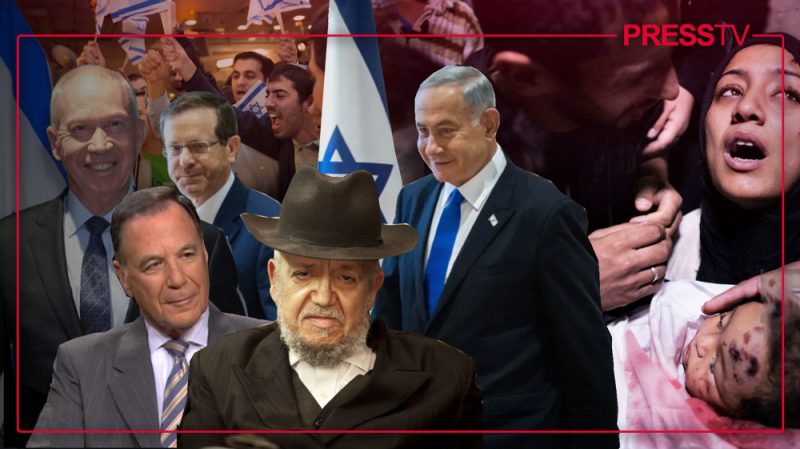
“I have ordered a complete siege on the Gaza Strip. There will be no electricity, no food, no fuel, everything is closed. We are fighting human animals.”
Yoav Gallant, Israeli military affairs minister, 9 October 2023
“Israel needs to increase the humanitarian pressure on the Gaza Strip so that eventually hundreds of thousands of hungry and thirsty Gazans will break through the Rafah crossing.”
Tzachi Levi, Israel National News, 20 October 2023
“I am very puzzled by the constant concern which the world, … is showing for the Palestinian people and is actually showing for these horrible inhuman animals who have done the worst atrocities that this century has seen.”
Dan Gillerman, Israel’s former ambassador to the United Nations, 25 October 2023
“We are sons of light, they are sons of darkness. And light will prevail over darkness.
Benjamin Netanyahu, Israeli Prime Minister, 25 October 2023
“Do not leave a stone upon a stone in Gaza. Gaza needs to turn to Dresden, Yes! Complete incineration, No more hope…. Annihilate Gaza Now! Now!”
Moshe Feiglin, leader of the libertarian Zionist party Zehut, former Knesset member, 26 October 2023
“If we were dealing with humans, we’d send humanitarian aid, but we’re dealing with animals.”
Rabbi Meir Mazuz, October 2023
“It is an entire nation out there that is responsible. It is not true this rhetoric about civilians not being aware, not involved. It’s absolutely not true.”
Israeli President Isaac Herzog, 12 October 2023.
“You have to be very careful. Let me tell you we are going to finish this war, we are going to win, because we are stronger. After this Russia will pay the price. Russia will pay the price. Russia is supporting the enemies of Israel. Russia is supporting Nazi people who want to commit genocide on us. And Russia will pay the price.”
Amir Weitmann, a senior member of Likud party, on RT, 19 October 2023
“This is not Auschwitz – This is Hamas! We are not fighting against humans – we are fighting monsters! Israel will not stop until Hamas is destroyed! This is what I said at the General Assembly podium when I showed footage of Israeli civilians burnt alive by Hamas and of Hamas savages.”
Gilad Erdan, Israel ambassador to the United Nations, 26 October 2023
“Are you serious asking about Palestinian civilians? What’s wrong with you?”
Former Israeli PM Naftali Bennett on Sky News after being asked – “What about the babies in incubators in Gaza whose life support has been turned off because the Israelis have cut off the power”, 12 October 2023
“Right now, one goal: Nakba! A Nakba that will overshadow the Nakba of 48. Nakba in Gaza and Nakba to anyone who dares to join!”
Ariel Kallner, Likud party, member of the Knesset
“Be triumphant and finish them off and don’t leave any behind. Erase the memory of them Erase them, their families, their mothers and their children. These animals can no longer live.”
Ezra Yachin, 95, former Stern Gang terrorist, now back in the occupation forces. October 2023
These are only a sample of the many genocidal statements issued by Zionist leaders and cheerleaders from the past month alone.
Many more can be found online in various useful threads, compilations and videos.

The epidemic of genocidal statements in the period after October 7 has shocked the world and rightly so. But, of course, Zionism has always been an ideology and a practical movement that is intrinsically racist and inherently genocidal.
To establish a “Jewish state” in historic Palestine, Zionists deemed it necessary to find a way to eliminate the natives either by killing them or forcing them to leave.
In his 1896 book The Jewish State, a foundational text for the Zionist racist movement, Theodor Herzl explained that the Zionist movement should appeal to European imperial powers to support the creation of a “Jewish state” in Palestine.
To help bolster support for Zionism among European imperialists, Herzl presented Zionism as a civilising mission, saying, “To Europe, we would represent a part of the barrier against Asia; we would serve as the outpost of civilization against barbarism.”
During his trip to Palestine in 1898, Herzl said that “large-scale drainage operations and the elimination of swamps … could make [Palestine] habitable [for Europeans]” and that, “Such Arabs, as are immune to the fever, might be used for the work”.
He went on to say “If we move into a region where there are wild animals to which the Jews are not accustomed – big snakes, etc. – I shall use the natives, prior to giving them employment in their transit countries [i.e. before they are deported], for the extermination of these animals.”
In April 1905, at a talk in Manchester, England, leading Zionist ideologue Israel Zangwill said, “[We] must be prepared …. to drive out by the sword the [Arab] tribes in possession … or to grapple with the problem of a large alien population, mostly Mohammedan”.(Masalha, The Politics of Denial: Israel and the Palestinian Refugee Problem, Pluto Press 2003: 15)
The Council of the Jewish Agency responded to the 1938 Peel Commission by constituting a Population Transfer Committee, to plan the compulsory removal of Palestinians, to take place, as they put it, not “by preaching ‘sermons on the mount’ but by machine-guns”.(Porter et al. (eds), Faith in the Millennium Sheffield Academic Press 2001: 79)
Later, in 1941, Ben-Gurion, the Labour Zionist leader and first Prime Minister of the Zionist entity said, “It is impossible to imagine general evacuation [of Palestinians from the land] without compulsion and brutal compulsion”. (Masalha: 19)
Today the ‘brutal compulsion’ continues as the Zionists try and finish the job of eliminating the natives either by killing them or by forcing them out into the Sinai or Jordan.
It’s not just the “far right”, it’s not just the revisionists, it’s not just the centrists, it’s not just the labour Zionist tradition, it’s not just the “socialist” Zionists.
Zionism at its root is a racist and genocidal ideology. It must be eradicated.
David Miller is the producer and co-host of Press TV’s weekly Palestine Declassified show. He was sacked from Bristol University in October 2021 over his Palestine advocacy.
Ukraine ‘cynically’ not interested in minority rights – Hungary
RT | November 13, 2023
Ukraine has no intention of resolving concerns about its treatment of Hungarians and other minorities living in its western province, Hungarian Foreign Minister Peter Szijjarto told reporters in a meeting broadcast on his Facebook page on Monday.
Instead, the government in Kiev has focused on duping the rest of the world into believing the minority rights issue is “resolved or almost resolved” – even as the situation for Hungarians living in the province of Transcarpathia “deteriorates” even further.
“I think it’s very cynical on the part of Ukrainians that, as can be clearly seen, they in no way want to resolve issues that are important to us, in no way want to return the rights taken away from Transcarpathian Hungarians,” Szijjarto said.
To illustrate the minority’s worsening plight, Szijjarto described a letter sent by the Ukrainian Ministry of Education instructing schools that the Ukrainian language “should be used as the state language not only during classes, but also during breaks between teachers and students,” even in schools where the majority of students – and teachers – are Hungarian.
Last month, Szijjarto demanded Ukraine repeal several laws seen as impinging on the rights of ethnic Hungarians, warning that Budapest would block Kiev’s efforts to join the EU so long as the discrimination continued.
Hungarian President Viktor Orban took things one step further, declaring Hungary would not support its neighbor “on any issue in international life until it restores the laws that guaranteed the rights of Transcarpathian Hungarians.”
Approximately 156,000 ethnic Hungarians living in Ukraine have seen their situation worsen dramatically since 2015, according to Szijjarto. The nation’s other ethnic minorities – including 150,000 Romanians and 250,000 Moldovans – have similarly suffered under a series of laws mandating the use of the Ukrainian language in official settings.
The legislation, which has come under fire from human rights groups and the Council of Europe, has led to the closing of some 100 Hungarian schools in Ukraine, leaving just 20% of the country’s Hungarian population receiving lessons in their own language.
The Council of Europe’s Venice Commission urged Ukraine to improve the recognition of its national minorities if it hopes to enter the EU in a report published earlier this year. Its proposed reforms include publishing official state documents in minority languages, delaying the introduction of Ukrainian as a principal language in schools, providing interpreter services at Ukrainian public events, and ditching Ukrainian-language content quotas for minority media outlets. Currently, just 10% of a media outlet’s content can be broadcast in the minority language.
Featured Video
Death Spikes & Rising Cancer In Our Youth Explained
or go to
Aletho News Archives – Video-Images
From the Archives
Politicians lie
By Mazin Qumsiyeh | Popular Resistance | August 18, 2013
There is no way to say this truth nicely: Politicians lie. That includes Japanese, American, Egyptian, Israeli, and Palestinian politicians! Is there something more common sense than that? Yet, so many citizens around the world believe their own politicians or wistfully acknowledge lies but think it is part of the job needed to run things. They believe even when politicians contradict themselves blatantly. This phenomenon is rather remarkable. It is a dissonance and disconnect from reality that many seem oblivious to. It is very dangerous because it can lead to accepting rationales for going to war. These can be deadly wars that lead to millions of lives lost as happened in what was called World War 1 and WW2. Even when incredible and declassified evidence abound, politicians continue to lie and old mythologies refuse to die. Here are just a few of the countless lies told to us over the past few decades… continue
Blog Roll
 Aletho News
- RSF military group defects, joins Sudanese army: State media
- Ireland goalkeeper refuses to play ‘Israel’ as squad weighs boycott
- China pushes back against US on Cuba, Iran
- Ukrainian Soldiers, Potential Mercenaries: Have Gun, Will Travel!
- Burnham’s UN debut… A masterclass in British disinformation
- Iran flights continue despite US aviation sanctions
- Global Tipping Points Lead the World Into a State of Entropy
- The day-after at the White House: USA and Xi Jinping
- The Geopolitical Balance in the Red Sea: The UAE Being Displaced by New Players
- Iraqi resistance group vows to stage airport sit-ins over Iran aerial blockade
- If Americans Knew
- Deconstructing Netanyahu’s pants-on-fire UN rant – Daily Update
- Trump betrayed voters with his campaign lies and prioritized a foreign country once he took office
- Netanyahu calls Israel’s war in Gaza ‘opposite of genocide’ in UN speech to near-empty hall
- Settler Kidnappings: Torture, Sexual Abuse and Terrorisation of Palestinian Abductees as Israel Deepens Annexation of West Bank
- Gaza winter nears as 162,000 tents become unusable, raising fears of humanitarian crisis
- Netanyahu says, “It’s the opposite of genocide”; UN says Gaza economy is world’s ‘most severe crisis on record’ – Daily Update
- Israel’s US-Backed Assault on Gaza Has Created the ‘World’s Most Severe Economic Crisis on Record’: UN
- ‘Protecting U.S. Citizens’… From Israel
- ‘This is where I live now, the back of a truck’: a day in the life of a grandmother in Gaza
- In UN Speech, Iran’s President Displays Pictures of Children Killed by US, Brings Attention to Israel’s Nuclear Arsenal
- No Tricks Zone
- New Study: Earth And Venus Surface Warmth Largely Explained By Convection And Lapse Rate, Not CO2 Or Radiation
- 2025 Nature Paper Claiming Worsening Global Drought Gets RETRACTED …Heavily Flawed
- New Study: ‘Global Drought Shows No Detectable Recent Acceleration Under Climate Warming’
- Economic Masterminds: German Socialists Suggest Taxing Productivity Gains Stemming From Using AI
- The South China Sea Has Not Been Cooperating With The Climate Change Narrative
- Energy Crisis: Germany Enters Heating Season With Historically Low Gas Reserve Fill Levels
- New Study: The Antarctic Ice Sheet Gained Mass From 2020-2024 Due To Staggering Snow And Ice Accumulation
- Study: Ocean Heating Rates From Thousands Of Years Ago ‘Dwarf’ Modern Ocean Heating Rates
- Climate Extremists Target, Attack Large-Scale Power Grid Infrastructure In Germany!
- New Study: Antarctic Ice Melt Has Contributed Less Than 1 Centimeter To Sea Level Rise In The Last 30 Years

