How Canada is ‘Cutting Costs’ by Euthanizing their Poor
By Mary Manley | Samizdat | May 2, 2022
Canada, one of the wealthiest nations in the world, is finding a new way to cut costs on disabled people by… euthanizing them?
In 2015 the case of Carter v Canada (Attorney General) prompted the Supreme Court to strike down a previous provision in the Criminal Code, thereby allowing Canadian adults the option of assisted suicide, or Medical Assistance in Dying (MAiD).
That ruling then spiraled into a law known as Bill C-7, an all-encompassing euthanasia law passed in 2021 which threw out the requirement that those seeking assisted suicide need to have a terminal illness whose death was reasonably foreseeable.
Although Bill C-7 states that “Parliament affirms the inherent and equal value of every person’s life and the importance of taking a human rights-based approach to disability inclusion”, disability justice organizations and even the UN’s watchdog on disability opposed the new bill based on their belief that it would worsen discriminatory practices within the healthcare system.
More than 300 disability groups in Canada opposed Bill C-7, citing that the removal of the “reasonably foreseeable natural death” requirement would target disabled persons. Instead of being offered medical assistance or support, the Canadian government now has the option of doing away with any ill person that sucks up taxpayer money.
“Rather than funding and making life a possible and viable choice for many people, we’re entertaining this option of asking them if they would like to die, and it’s very scary,” said Spring Hawes, a former Invermere city councilor and the co-founder of Dignity Denied, in 2020.
“There is the danger that it might be considered a favor to offer someone dying when really that person just needs to have access to better care, better supports or the things they need to live well,” added Hawes who has a spinal cord injury and uses a wheelchair.
And what some could argue sounds like fear-mongering by a group of people who- in their very right have a legitimate reason to be afraid- is bolstered by horrifying stories told by disabled people which demonstrate abuse and neglect at the hands of their government.
In April of this year a 51 year-old Ontario woman with multiple chemical sensitivities (MCS) chose MAiD after two years of searching and failing to secure a bid for affordable housing free of cigarette smoke and chemical cleaners. “The government sees me as expendable trash, a complainer, useless and a pain in the a**,” she said in a video filmed on February 14, eight days before her assisted suicide.
One woman requested MAiD because she “simply [couldn’t] afford to keep on living”, after food banks became an inaccessible option. Another woman from Vancouver said she intended to use MAiD after COVID-19 left her with increased expenses and unmanageable pain. And in 2021, Chris Gladders chose to end his life via MAiD after experiencing “deplorable” living conditions at the retirement home called Greycliff Manor in Niagara Falls. When his family arrived to say goodbye to them they were horrified to find Chris in a room covered in urine and fecal matter.
“None of the floors were cleaned up or anything, you could see clearly where they changed his catheter bag,” said Shawn Gladders, Chris’s brother in January of 2021.
“There was urine on the floor, there were spots where there was feces on the floor… spots where your feet were just sticking. Like, if you stood at his bedside and when you went to walk away, your foot was literally stuck. It was very, very disturbing, for sure.”
Shawn said that on other occasions when he had visited his brother, Chris was taken outside of the room by a staff member, “I kick myself today, because I wish I would have walked in there before… I never would have left him there.” Shawn adds that Chris’ time at Greycliff Manor most likely contributed to his decision to end his own life.
In 2020, the Canadian government agreed to give a measly one-time payment of $600 to disabled persons who qualified, in response to the devastating economic effects of the COVID-19 pandemic. They estimated that just 1.67 million disabled persons would receive that assistance, compared to the 6 million disabled persons who live in Canada.
One disabled Canadian, who chose to remain anonymous, said that after asking her doctor to fill out a form for the credit he rejected her, saying, “You’re not disabled enough… You have to be sitting in the corner drooling to be able to get this.”
The fact is: the Canadian government has no interest in spending money on their disabled people. Instead, they see MAiD as a convenient option to cut costs on healthcare for persons with chronic conditions and other disabilities. Canada’s Parliamentary Budget Officer even published an exciting report on the savings assisted suicide would garner their taxpayers: MAiD before Bill C-7 generated a total saving of $86.9 million per year, and Bill C-7, the government was pleased to announced, would save an additional $62 million a year.
As if things couldn’t get any worse, Canada’s government appears to be fixed on including those with mental illnesses (such as depression, bipolar disorder, schizophrenia, and PTSD) to become eligible for assisted suicide, by as soon as next year. If that decision were to go through, Canada would become one of few nations allowing the use of MAiD in cases of mental illnesses.
New so-called ‘Ministry of Truth’ actually just a ‘Disinformation Governance Board’, which is precisely the opposite: DHS
Samizdat | May 2, 2022
 The newly-unveiled ‘Disinformation Governance Board’, operating within the Department of Homeland Security, has triggered a massive pushback, forcing DHS chief Alejandro Mayorkas to make several appearances on national TV in an attempt to clarify how this unit will operate.
Many critics, including top Republicans, blasted the initiative as a “Ministry of Truth,” directly from the pages of George Orwell’s dystopian novel “1984.”
Speaking on CNN’s State of the Union on Sunday, Mayorkas deflected this criticism by claiming such thought policing is “precisely the opposite of what this small working group within the Department of Homeland Security will do.”
“What it will do is gather together best practices in addressing the threat of disinformation from foreign state adversaries from the cartels and disseminate those best practices to the operators that have been executing in addressing this threat for years,” he explained, after CNN’s Dana Bash said it was still not clear “how this governance board will act.”
The new body is headed by Nina Jankowicz, whose resume includes advising the Ukrainian Foreign Ministry and overseeing the Russia and Belarus programs at the National Democratic Institute lobby group. Detractors also scrutinized her for dismissing the New York Post’s suppressed ‘Hunter’s laptop’ story as a fake “Russian influence op,” only for it to be later verified by major media outlets.
In a separate appearance on ‘Fox News Sunday’, Mayorkas defended the qualifications and objectivity of Jankowicz, calling her “eminently qualified” and a “renowned expert in the field of disinformation.”
“I don’t question her objectivity. There are people in the department who have a diverse range of views and they’re incredibly dedicated to mission. We’re not the opinion police.”
The new “anti-disinformation” push was announced on Wednesday, just two days after billionaire Elon Musk reached an agreement to buy Twitter for $44 billion and vowed to restore freedom of speech on the platform.
Responding to news of Musk’s Twitter takeover, Jankowicz said, “I shudder to think about if free speech absolutists were taking over more platforms, what that would look like for the marginalized communities, which are already shouldering disproportionate amounts of this abuse.”
Hospital and Care Home Visiting Restrictions Are “Cruel, Inhumane and Unnecessary”, Doctors Tell MPs
By Will Jones | The Daily Sceptic | April 29, 2022
The Pandemic Response and Recovery All-Party Parliamentary Group met this week to hear about visiting restrictions still being imposed by many care homes and NHS Trusts. Co-chaired by Rt Hon Esther McVey MP and Graham Stringer MP, the Group listened to evidence about the devastating effects visiting restrictions in hospitals have on patients and their loved ones. MPs also heard how visiting restrictions in care homes, along with the continued use of rolling lockdowns and over interpretation of testing guidelines, is leading to isolation, neglect and abuse of the residents.
Leandra Ashton, who co-founded The People’s Care Watchdog, Dr. Ammar Waraich, a medical registrar in the West Midlands, Carol Munt, experienced Patient Partner and Advocate and Dr. Ali Haggett, community mental health and wellbeing specialist, told MPs of the obstacles still in place when trying to visit a loved one and the shocking impact on vulnerable hospital patients, care home residents and their families.
All the speakers voiced serious concerns that obstacles are still in place in some healthcare settings. Politicians heard harrowing accounts of the harmful effects of isolation and loss of social contact on physical and mental health, safeguarding problems with medication, dehydration, hygiene and lack of basic care and the failures to uphold existing legislation to protect those who lack capacity.
Leandra Ashton’s mother was arrested in November 2020 for taking her grandmother out of her care home a day before the second lockdown. Two years on, many residents are still being isolated from their loved ones. She told MPs:
When I took the video of my mum being arrested taking my nan out of her care home, I did not think it would go viral. So many families got in touch and it led to us setting up the People’s Care Watchdog. We were struck by how much legislation is in place, such as Article 8 of the Human Rights Act, Deprivation of Liberty and the Mental Capacity Act, to protect those in care homes. These laws are simply not being upheld and instead guidelines are being over-interpreted and the legislation even used to keep people in care homes and hospitals as if they were prisons. The public bodies that are supposed to uphold the protective legislation are not doing so.
There are still obstacles in place when trying to visit a loved one in a care home and the impact has been and continues to be devastating. The safeguarding issues I am seeing and hearing about are atrocious. Residents left for hours in dirty, wet incontinence pads leading to dangerous pressure ulcers. Malnutrition. Dehydration. End of life medication given to patients without their or their family’s consent. Psychological trauma, post-traumatic stress and suicides have resulted because of this. Multiple systems are failing, including Local Authorities and the CQC. It is a complex situation that needs a bold approach by both empowering families and galvanising Government action to hold public bodies to account and stop private equity firms placing profit over people.
Listening to the evidence, Esther McVey said:
I am troubled by the evidence presented by our speakers, particularly the safeguarding issues and neglect that care home residents are suffering as a result. In hospitals, we have heard about patients losing hope and refusing treatment without the encouragement of family. We know patients have much better treatment outcomes when they have support from relatives and friends around them.
Most of the infection control measures that restricted visiting in healthcare settings have been removed, most recently NHS Trusts were told healthcare workers, patients and visitors no longer need to distance in hospitals, so I fail to see why and how these visiting restrictions are still in place in any healthcare setting. I shall be writing to the Secretary of State for Health and Social Care to ask that he makes it absolutely clear that all patients and residents must be able to see visitors.
Highlighting how visitation is an important and necessary part of healthcare, Carol Munt said:
In the same way that we would not stop prescribed medication and treatments, we should not have stopped visits. Why were decisions taken without any consideration for the need of patients and their families to connect? Why do we still have such variation in compassionate care across the country? There is no uniformity among care homes apart from the need to be profitable for their owners. Some care homes made a superhuman effort to arrange visiting, as did the Bristol Nightingale Hospital. There was good practice in some places so there should be good practice everywhere. We should expect more of these endemic situations and we must be prepared for them.
I could not comprehend how any Minister for Health and Social Care could allow this to happen and not make the effort to get his department to look at ways that visiting could be facilitated. I heard and continue to hear the most callous reports of relatives dying alone with no visitors. The same goes for hospital patients. Ultimately, I think we need legislation to ensure that visiting rights are enshrined and protected.
Medical Registrar Dr. Ammar Waraich reported that many hospitals are still preventing visits due to the potential risk of Covid spread:
The policy is cruel, inhumane and unnecessary. Seeing loved ones can be immensely therapeutic and give struggling patients the will to survive. It is deeply traumatic for families to lose loved ones suddenly or see them go through difficult treatment without being there in person. Video calls are not a good enough replacement and we do not have the staff, the time or resources to facilitate calls for all our patients.
Most infection control measures have been lifted as the level of risk is no longer there. Hospitals can no longer function as detention centres and an inpatient stay should not become a sentence. The policy was one of the major mistakes of lockdown. Visiting sick relatives in hospital is, and must remain, a fundamental right, not to be given up.
Co-chair Graham Stringer said:
I find it extraordinary that no visiting is allowed in some healthcare settings, even to this day. It is cruel that family members are being denied access to sick and vulnerable loved ones, often not getting regular updates, living in anxiety about what their relatives may be going through, but knowing they are going through frightening and difficult treatment, often at the end of their lives, without being able to be with them in person.
“At the height of the pandemic it was understandable that there were precautions but there is no longer a basis to that argument. All the restrictions have been lifted and NHS Trusts across England have now been told to ‘return to pre-pandemic physical distancing in all areas’. The government must take action to resolve this situation.
Speaking about her experience working in the community throughout the pandemic, Dr. Ali Haggett said:
I have spent the last eighteen months with the support group Unlock Care Homes, uncovering the plight of many thousands of families who are still denied regular, meaningful contact with care home residents and hospital patients. Even before Covid, we knew that isolating people, particularly older people, has a serious impact on physical and psychological health. We have continued to isolate adults in care and in some hospitals almost continuously for two years. The effects have been felt particularly badly by those with dementia. Many residents no longer recognise their families and have been denied the most basic of human needs.
My concern is that this situation is concealing neglect and abuse on a significant scale. One of my community members sadly died and the hospital has admitted liability partly because he was completely blind and couldn’t reach his food or drink. Had his wife been allowed to visit, this wouldn’t have happened. Families I work with report numerous issues still affecting them, not just visiting restrictions. Rolling lockdowns, over-interpretation of testing, PPE requirements resulting in poor communication and fear, lack of ancillary services such as podiatry or physiotherapy leading to huge health problems, residents asked to isolate when one person tests positive, sometimes for 10 days or more and the one significant visitor recommendation being ignored or rejected. Families must be able to visit openly and check the wellbeing of residents.
Stop Press: MPs and Peers including Esther McVey, Lord Frost, Sir Iain Duncan Smith, Sir Graham Brady, Emma Lewell-Buck, Graham Stringer and Sammy Wilson have written to the Telegraph to say they are “deeply concerned” that visiting is still forbidden in many institutions where “over-interpretation of testing guidelines is leading to isolation, neglect and abuse of vulnerable residents”. They point out that Article 8 of the Human Rights Act and the Mental Capacity Act “could and should have protected against this situation arising” but this legislation is being “wilfully misinterpreted as an excuse” to keep people isolated in care homes and hospitals “as if they were prisons”.
Following the Science is Impossible and Stupid
Institutional science follows politics; it will always endorse central regime policies

eugyppius | April 30, 2022
During the pandemic, Germany closed schools on a wider scale and for a longer duration than most other places in the civilised world. I was recently reminded of how our government came to embrace these extreme policies. The story is very revealing:
It began with the strange decision of state media to elevate Christian Drosten at Berlin Charité to national prominence, by granting him the Coronavirus Update podcast on 26 February 2020. The WHO had just endorsed lockdowns two days before, and various countries were acquiring new Corona tsars – random virus wizards who would become the face of containment policy to panicking domestic audiences. Every day, Drosten’s banal podcast interviews were reported breathlessly across the German media, as if they meant anything.
It’s important to remember that Drosten is a virologist. He’s not a statistician, and for what it’s worth, he’s not a public health expert either. He studies how very small proteins work and how they interact with human cells. Nevertheless, Drosten had (or claimed to have) a wide range of opinions on matters outside of his field, including the question of whether closing schools would slow down SARS-2.
At first, Drosten said that he didn’t think this would accomplish very much. Like everyone else of his ilk, he had an early history of saying basically correct and sensible things before he went crazy. On 11 March 2020, he went home and read this paper on Nonpharmaceutical Interventions Implemented by US Cities During the 1918–1919 Influenza Pandemic. It wasn’t his field; his assessment of its analysis is worth no more than mine or yours. But after reading it, he decided that actually closing schools would be a great idea, especially when used in combination with other interventions, such as banning mass gatherings. This was wind in the sails of hystericists like Markus Söder, minister president of Bavaria. And so we closed our schools, and our kids endured months of social isolation and mental anguish, because Drosten read a thing and had a brilliant idea.
But, that’s only the official story. It may be vastly worse than that. I really doubt, for example, that Drosten’s ridiculous podcast was a spontaneous programming idea by Norddeutscher Rundfunk. I suspect, instead, that there’s a reason lockdowns and Corona tsars went together in those early days. Primary was the political or bureaucratic decision to do all this crazy stuff, in the absence of any evidence aside from some dodgy numbers out of Wuhan. Thus the genius smart guys who run our institutions had to find celebrity virus astrologers, who could become the public face of novel policies and provide a simulacrum of science for the politicians to pretend they were following. It’s even odds, whether Drosten really did change his mind because of a paper he read one night; or whether it was rather the political or bureaucratic faction behind Drosten that changed their minds and gave him a paper or two to read.
Science isn’t some objective reasonable force outside of politics. Scientists spend most of their careers chasing government grant funding, and fighting for appointments and promotions in government-funded university systems. Science follows politics, and nobody knows this as much as the disingenuous politicians who claim that their policies are subordinate to scientific findings.
D.C. Schools Can’t Vaccinate Kids 11 and Up Without Parents’ Consent Until Lawsuits Settled
The Defender | April 28, 2022
A preliminary injunction prohibiting the mayor of the District of Columbia, the D.C. Department of Health and D.C. public schools from enforcing the D.C. Minor Consent for Vaccination Amendment Act of 2020 (D.C. Minor Consent Act) will remain in place after the defendants declined to file an appeal within the required 30-day period.
The preliminary injunction reverts D.C. to the standard age of consent of 18, at least until the conclusion of the case.
The injunction stemmed from two lawsuits filed against the D.C. Minor Consent Act, which allows children 11 and older to consent to vaccinations without their parents’ knowledge or consent.
The law, passed on Dec. 17, 2020, specifically targets children whose parents filed religious exemptions for their children.
“This is a significant legal victory,” said Rolf Hazlehurst, senior staff attorney for Children’s Health Defense (CHD). “But the legal battle is by no means over.”
D.C. is the legal testing ground for mandatory vaccinations, according to Hazlehurst, which makes this a “high-stakes” battle.
“The defendants and other states are twisting and distorting the ‘mature minor’ doctrine to push the limits of government overreach at the expense of parental rights,” Hazlehurst said. “They will not abandon this tactic or their assault upon our children or parental rights.”
The two lawsuits challenging the D.C. Minor Consent Act include one filed by CHD and the Parental Rights Foundation and a second brought by Informed Consent Action Network.
Both lawsuits sought a preliminary injunction to immediately prohibit D.C. schools and public health officials from enforcing the law until the lawsuits are concluded.
During oral arguments on March 3, Hazlehurst argued the D.C. Minor Consent Act violates the Supremacy Clause of the U.S. Constitution because it contains multiple provisions that strip away the meager protections guaranteed to parents under the National Childhood Vaccine Injury Act of 1986.
Hazlehurst also argued the law violates the right to freedom of religion guaranteed by the First Amendment to the U.S. Constitution.
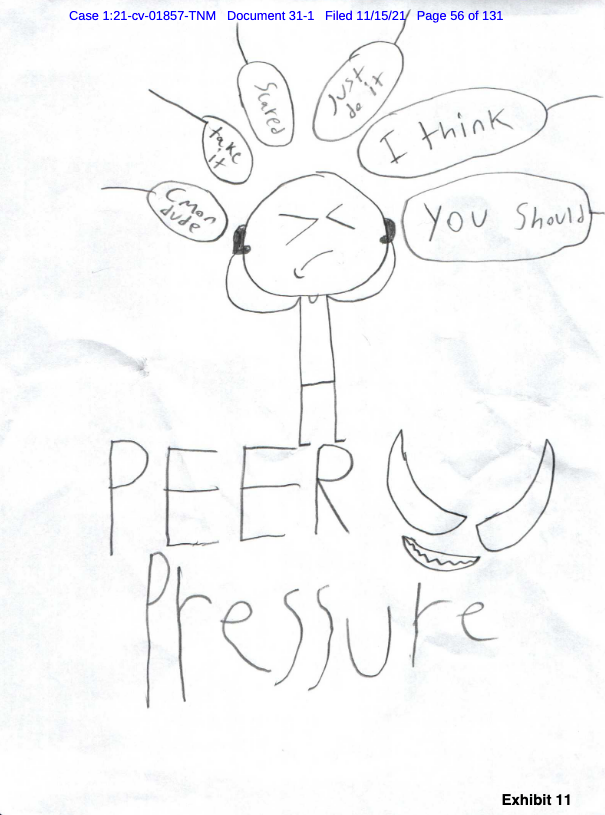
Hazlehurst told the court the mayor of D.C. created a “pressure-cooker environment,” enticing and psychologically manipulating minor children to defy their parents and take vaccinations against their parents’ will.
To make his point, Hazlehurst relied on a drawing, “Peer Pressure,” by a child of one of the plaintiffs. The drawing depicts the dilemma children face at school when they don’t want to get the COVID-19 vaccine.
On March 18, the U.S. District Court for the District of Columbia ordered the preliminary injunction.
In obtaining the preliminary injunction, the plaintiffs overcame a high legal hurdle that the “threatened injury must be certainly impending” as established by the U.S. Supreme Court precedent Clapper v. Amnesty Int’l, Hazlehurst said.
The court also ruled the plaintiffs in both lawsuits have legal standing based on preemption because the D.C. Minor Consent Act conflicts with the National Childhood Vaccine Injury Act.
In CHD’s case, U.S. District Judge Trevor N. McFadden made the additional finding that the plaintiffs have standing based upon the fact that they are likely to succeed on the merits that the law violates the free exercise of religion clause in the First Amendment.
“This preliminary injunction is part of ongoing litigation in an extremely important national precedent-setting case,” said Hazlehurst. “The rights of parents to decide what is best for their children’s health is at stake. Government can’t be allowed to make such decisions for minor children.”
The D.C. Minor Consent Act contains several provisions designed to deceive parents by hiding the fact that their children have been vaccinated against their parental judgment, authority or religious convictions.
The law requires healthcare providers to falsify records by leaving the child’s school vaccination records blank.
It also allows doctors to bill parents’ insurance companies for vaccines administered to children against their parents’ written directive. However, insurance companies may not send parents of those children an explanation of benefits.
60 countries sign declaration that commits to bolstering “resilience to disinformation and misinformation”
By Tom Parker | Reclaim The Net | April 29, 2022
The United States (US) and 60 partner countries, including the United Kingdom (UK), Canada, Australia, and members of the European Union (EU), have signed a sweeping “Declaration for the Future of the Internet” which commits to bolstering “resilience to disinformation and misinformation” and somehow upholding free speech rights while also censoring “harmful” content.
The White House framed the declaration as something that supports freedom and privacy by focusing on its commitments to protect human rights, the free flow of information, and privacy. The EU put out similar talking points and claimed that those who signed the declaration support a future internet that’s open, free, global, interoperable, reliable, and secure.
However, the commitments in the declaration are vague and often conflicting. For example, the declaration makes multiple commitments to upholding freedom of expression yet also commits to bolstering “resilience to disinformation and misinformation.” It also contains the seemingly contradictory commitment of ensuring “the right to freedom of expression” is protected when governments and platforms censor content that they deem to be harmful.
Furthermore, many of the governments that signed this declaration are currently pushing sweeping online censorship laws or openly supporting online censorship.
For example, just a few days ago, the Biden administration called for private companies to censor online “misinformation” – the latest of many similar calls. The EU also recently passed its Digital Services Act (DSA) which contains requirements to censor “hate speech” and “misinformation.”
Some government officials, including Canadian Minister of Innovation, Science, and Industry François-Philippe Champagne and UK Digital, Culture, Media, and Sport (DCMS) Secretary of State Nadine Dorries, even mentioned their country’s online censorship laws during the live launch of this Declaration for the Future of the Internet.
“The vision outlined in this declaration aligns very well with the many initiatives we are working on here in Canada, including our Digital Charter,” Champagne said.
Canada’s Digital Charter was launched in 2019 and threatens platforms with “meaningful financial consequences” if they fail to fight online “hate” and “disinformation.”
“I am enormously encouraged to see online safety is a key principle of that declaration,” Dorries said. “As the UK’s Digital Secretary, doing more to protect people online is one of my main priorities – and last month, I was proud to introduce a groundbreaking Online Safety Bill to the UK Parliament that will make the internet safer for everyone.”
The UK’s Online Safety Bill will give the government sweeping censorship powers, censor some “legal but harmful” content, and criminalize “harmful” and “false” communications.
Like the commitments to freedom of expression, the declaration’s commitments to privacy are also being made by governments that engage in or allow mass surveillance.
For example, the EU is allowing the linking of face recognition databases to create a mega surveillance system. The Federal Bureau of Investigation (FBI) recently boosted its social media surveillance technology. And the outgoing London Metropolitan police commissioner recently congratulated herself on extending the surveillance state.
While the current signatories of this declaration are governments, the White House plans to work with “the private sector, international organizations, the technical community, academia and civil society, and other relevant stakeholders worldwide to promote, foster, and achieve” the “shared vision” of this Declaration for the Future of the Internet.
Big Tech companies such as Facebook and Google have already welcomed this declaration.
“It’s great to see countries coming together today to launch the Declaration for the Future of the Internet (DFI),” Google’s Vice President, Government Affairs & Public Policy, Karan Bhatia, wrote in a blog post. “We are committed to partnering with governments and civil society through the Declaration to disrupt disinformation campaigns and foreign malign activity, while ensuring people around the world are able to access trustworthy information.”
Google and its video-sharing platform YouTube have used the term misinformation to justify the mass censorship of content. Additionally, Bhatia’s commitment to ensuring access to “trustworthy information” echoes YouTube’s commitment to boosting “authoritative sources” – a practice that creates a huge disparity between mainstream media outlets and independent creators and results in mainstream media outlets being artificially boosted by as much as 20x.
“This Declaration is an important signal from some of the world’s leading democracies,” Nick Clegg, the President of Global Affairs at Facebook’s parent company Meta, tweeted. “The only way to preserve and enhance the best of the open internet, prevent it from fragmenting further and protect human rights in the digital space is by working together.”
While Clegg’s statement focuses on the open internet and protecting human rights, Meta also mass censors content on its platforms and plans to continue this censorship in its metaverse.
And despite the declaration’s commitment to privacy, both Google and Meta’s businesses rely heavily on surveilling users to serve targeted ads.
The current list of countries that have endorsed this Declaration for the Future of the Internet includes Albania, Andorra, Argentina, Australia, Austria, Belgium, Bulgaria, Cabo Verde, Canada, Colombia, Costa Rica, Croatia, Cyprus, Czech Republic, Denmark, Dominican Republic, Estonia, the European Commission, Finland, France, Georgia, Germany, Greece, Hungary, Iceland, Ireland, Israel, Italy, Jamaica, Japan, Kenya, Kosovo, Latvia, Lithuania, Luxembourg, Maldives, Malta, Marshall Islands, Micronesia, Moldova, Montenegro, Netherlands, New Zealand, Niger, North Macedonia, Palau, Peru, Poland, Portugal, Romania, Senegal, Serbia, Slovakia, Slovenia, Spain, Sweden, Taiwan, Trinidad and Tobago, the United Kingdom, the United States, Ukraine, and Uruguay.
The declaration isn’t legally binding but is intended to be used as a “reference for public policy makers, as well as citizens, businesses, and civil society organizations.” The signatories also intend to translate its principles into “concrete policies and actions; and, work together to promote this vision globally.”
We obtained a copy of the Declaration for the Future of the Internet for you here.
The EU’s Digital Services Act is the next big threat to free speech

By Didi Rankovic | Reclaim The Net | April 29, 2022
Authorities across the world continue to use the Ukrainian crisis as the backdrop against which to pass, in some cases unprecedented in the way they restrict or censor free speech, legislation regulating the digital industry.
These trends are nothing new, but the current massive global crisis presents an excellent excuse to introduce draconian measures with little or no scrutiny or opposition. And so, in the EU, the Digital Services Act just got “enriched” by a new law that will allow the bloc to declare a state of emergency – on the internet.
The law, referred to as a “crisis mechanism” is a part of the Act and got ushered into existence last Saturday.
A state of emergency normally gives governments extraordinary powers and suspends normal laws and regulation in order to preserve lives and property – something that has thus far been used in case of war or natural disaster, i.e., those events affecting a country’s physical security, economy, etc.
But now the 27 EU countries will be able to do the same in imposing extraordinary control on all key, public-facing elements of the web: social platforms, search engines, and e-commerce sites.
A good chunk of these three categories means this is not about the usual emergency measures in a time of crisis – they also concern freedom of speech, which is where things get very complicated. What critical voices who manage to find their way into corporate media seem to be admitting is legislation like this can bring harmful outcomes, but they’re also trying to normalize it.
Daphne Keller of Stanford’s Cyber Policy Center has been quoted as telling Wired, “It looks like the war in Ukraine created a political opportunity for advocates of tighter restrictions to push their agenda. That’s pretty normal politics, if bad law.”
But many others, whose voices cannot these days be heard in the mainstream, will argue that this is also an example of “bad politics”: in Europe, that part of the world that has given birth to democracy and always strives, though does not always succeed, at implementing its tenets, sneakily passing extreme regulation almost literally “under cover of the night” (reports say that the vote on the new EU law took place “in the early hours of Saturday”) could highly likely backfire, down the road.
For the moment, the EU seems happy to explain its latest attempt at dipping its toe in the authoritarianism pond by saying that forcing tech companies to silence or completely censor information should be considered as not controversial, if a crisis is taking place, whether that concerns public security or – a health threat. Yes, the Covid panic, and its possible future (re)apparitions in European societies and economies, has also been factored in, when deciding to draft and then approve the new law.
With issues sensitive as this, every word counts – but the definition of what constitutes a “threat” big enough to invoke these massive new powers is predictably murky and bureaucratic.
Members of a European Parliament (EP) grouping called the European People’s Party (EPP), said only that when the EU Commission decides, “very large” platforms will have to “limit any urgent threat on their platforms.”
There’s more. “All measures under the crisis mechanism will be limited in time and accompanied by safeguards for fundamental rights,” European Commission spokesperson Johannes Bahrke promised.
These statements mean everything and nothing, and that’s exactly what they’re designed to do.
There’s other news revealing a bid to centralize power in the EU, now a very diffuse, and at times confused organization. Thus European Commission head Ursula von der Leyen will be given the power to enforce the new rules, bypassing a previous system where countries like Ireland, that have the most to lose if Big Tech is pushed out of Europe, had a voice.
It’s of interest to note that Big Tech has been playing along pretty well so far, making this latest legislative push somewhat unclear. Both during the Covid and Ukraine war events, these large corporations have been heeding political messages and catering to political needs, basically to a fault.
Reports suggest that now, the bureaucrats in Brussels may just want to make their jobs simpler. Instead of having to go to the sanctions regime and relying on Big Tech to obey – like they did when they blocked Russian media outlets like RT and Sputnik – they will now have a whole new law that enforces all this in one fell swoop.
This is happening as Big Tech – both the from the West, like Google, Facebook, and Amazon, and from the East, like TikTok, are yet to make any comment.
And now it’s up to EU member countries to approve the law and allow the “crisis mechanism” to kick into gear.
IRGC chief: Resistance sole way to liberation of Palestine
Press TV – April 28, 2022
Chief Commander of Iran’s Islamic Revolution Guards Corps (IRGC) Major General Hossein Salami says negotiations and accords brokered by the United States only aim to buy time for Israel, and weaken the Palestinian resistance front.
The senior commander made the remarks in a televised address to a ceremony in Gaza City on Thursday, on the eve of International Quds Day.
“The so-called peace treaties like the Camp David Accords, the Oslo Accords, the Sharm El Sheikh Memorandum etc have never been and will never be able to result in the liberation of Palestine.
“All such accords, which former US presidents, [former Israeli prime ministers Ehud] Olmert, [Benjamin] Netanyahu, Yitzhak Shamir and Yitzhak Rabin tried to seal, as well as the deal of century are nothing but deception and a conspiracy to marginalize jihad, weaken the resistance front, buy time and obliterate the awareness of the nations,” he stated.
He underscored that Palestinian people have come to realize that they will not achieve their goals except through resistance and struggle in the path of God (jihad).
Salami described the recent developments in the occupied Palestinian territories as a sign of the Israeli regime’s brutality and the strength of resistance groups, stressing that Palestinian resistance fighters have reinforced the Muslim Ummah and changed the balance of power in the region.
The IRGC chief hailed International Quds Day as a gift from Imam Khomeini, the late founder of the Islamic Republic in Iran, stating that the designation of the last Friday of the holy month of Ramadan for the event made Palestine a top priority for the entire Muslim world.
“Palestinian people are close to victory as the Zionist enemy is growing weaker. Weakness inside the Zionist entity is evident in its politics, economy and security apparatus, he said.
“All Muslims around the world are united with Palestinians in the struggle against the Israeli regime. Al-Quds and al-Aqsa Mosque are symbols of unity among Muslims in support of Palestinians,” Salami pointed out.
IRGC: Events herald Israel’s imminent end
Earlier, the IRGC said current developments in the occupied Palestinian territories show that the demise of Israel is imminent and the regime is doomed to end very soon.
“Recent developments, particularly the fact that the flames of Intifada (uprising) have passed through the inner walls of the regime, suggest that the Tel Aviv regime’s days are numbered and occupiers of holy al-Quds are quickly nearing their end,” the force said in a statement released on the eve of International Quds Day.
It lauded the decision by Imam Khomeini to designate the last Friday of the holy month of Ramadan as International Quds Day, describing the prudent initiative and historic move as a novel phenomenon and a source of pride for the Iranian nation to play an effective role in supporting the oppressed Palestinian nation.
The IRGC underlined that free and justice-seeking nations have joined forces more than ever to support the oppressed Palestinians, the Palestinian cause and the liberation of al-Quds.
“Zionists thought they could consign the Palestinian issue and the cause of al-Quds to oblivion by following satanic schemes such as the so-called ‘Deal of the Century’ and normalization of ties with some Arab countries. They were, however, wrong and their dream of sustainable and permanent security has now been broken,” the statement read.
The statement further stressed that the discourse of resistance and support for Palestine states that an end to the Israeli occupation, expulsion of occupiers, return of Palestinian refugees and free elections are the only solution to the Palestinian issue.
The IRGC went on to term any concession, including normalization of ties with the child-killing regime of Israel as an act of treason, emphasizing such bids are doomed to failure.
Hamas official: Normalization with Israel a crime
Meanwhile, a high-ranking official from the Palestinian Hamas resistance movement said the Arab states that have normalized diplomatic ties with the Israeli regime have not only committed a grave crime against Palestinians but also their own peoples.
Khalil al-Hayya, a member of the Hamas political bureau and the deputy chief in the Gaza Strip, made the remarks in an exclusive interview with Iran’s English-language Press TV television news network on Thursday ahead of International Quds Day.
Hayya slammed normalization with Israel as the regime kills Palestinian civilians, including women and children, in cold blood.
He stressed that establishment of relations with Israel only serves the best interests of the United States and the Tel Aviv regime.
The senior Hamas official said Palestinians are a nation under occupation and reserve the right to defend themselves against Israeli occupiers.
Hayya also condemned Israeli forces’ attacks against Palestinian worshippers at the al-Aqsa Mosque compound in the occupied Old City of al-Quds.
He said Palestinians are always ready to defend the holy place, warning that Israeli officials are seeking to alter its true image by preventing Palestinians from entering the site.
Study: Lockdowns Drove 60,000 Children in UK to Clinical Depression
By Paul Joseph Watson | Summit News | April 28, 2022
A new study published in the Royal Society Open Science journal found that lockdowns in the UK caused around 60,000 children to suffer clinical depression.
Researchers detected a 27.1 per cent prevalence of depression amongst their sample, a number significantly higher than would have occurred without lockdowns.
According to a report by the Telegraph, the percentage equates to about 60,000 extra kids who suffered clinical depression thanks to COVID-19 restrictions.
“After controlling for baseline scores and several school and pupil-level characteristics, depressive symptoms were higher in the COVID-19 group,” the study found.
“These findings demonstrate that the COVID-19 pandemic increased adolescent depressive symptoms beyond what would have likely occurred under non-pandemic circumstances.”
Figures show that 400,000 British children were referred to mental health specialists last year for things like eating disorders and self-harm.
Once again, the study underscores how those who vehemently promoted lockdowns, while demanding voices of dissent be silenced, were on the wrong side of history.
As we previously highlighted, a shocking outbreak of hepatitis cases in children was likely caused by lockdowns and social distancing, which served to weaken immune systems, according to health experts.
Many infants are also suffering from cognitive developmental and speech disorders due to adults wearing face coverings during the pandemic.
According to speech therapists, mask wearing has caused a 364% increase in patient referrals of babies and toddlers.
A major study by Johns Hopkins University concluded that global lockdowns have had a much more detrimental impact on society than they have produced any benefit, with researchers urging that they “are ill-founded and should be rejected as a pandemic policy instrument.”
Doctors Could Be Struck Off For Questioning Government Line on Lockdowns and Vaccines Under New Guidance
By Will Jones | The Daily Sceptic | April 27, 2022
Doctors who criticise vaccines or lockdown policies on social media could face being struck off if regulators rule they are guilty of spreading ‘fake news’, according to new guidance from the GMC. The Telegraph has the story.
The core guidance for medics has been updated for the first time in almost a decade to cover media such as Twitter, Facebook and Instagram. The rules on use of social media include a duty to be “honest” and “not to mislead”, as well as to avoid abuse or bullying.
The draft regulations from the General Medical Council (GMC) – which the watchdog describes as a 21st-century version of the Hippocratic Oath – also say doctors must speak out if they encounter “toxic” workplace cultures that threaten patient safety. And they say medics must take action if they encounter workplace bullying, harassment or discrimination.
The watchdog regulates doctors, who can face a range of sanctions – including being struck off the medical register – if they are found to have failed in their duties.
Charlie Massey, the Chief Executive of the GMC, said… the fundamental principles of the guidance remained the same, but had been updated to reflect the modern world.
“We’ve had feedback that doctors want more clarity on using social media. We are already clear that doctors must be honest and trustworthy in their communications, and are now emphasising that this applies to all forms of communication. The principles remain the same whether the communication is written, spoken or via social media,” he said.
The use of social media by medics has become an increasingly vexed issue during the pandemic, the report adds.
In December a judge ruled that the GMC’s interim orders tribunal had made an “error of law” when it ordered a GP accused of spreading misinformation to stop discussing Covid on social media.
Dr. Samuel White, who was a partner at a practice in Hampshire, raised concerns about vaccines and claimed “masks do nothing” in a video posted last June.
The GMC’s Interim Orders Tribunal imposed restrictions on Dr. White’s registration as a result. But the High Court said this decision was “wrong” under human rights law.
He had claimed “lies” around the NHS and Government approach to the pandemic were “so vast” that he could no longer “stomach or tolerate” them.
In August, the tribunal concluded Dr. White’s way of sharing his views “may have a real impact on patient safety”. It found Dr. White allegedly shared information to a “wide and possibly uninformed audience” and did not give an opportunity for “a holistic consideration of COVID-19, its implications and possible treatments”.
But the GP’s barrister, Francis Hoar, argued the restrictions imposed on his client’s registration were a “severe imposition” on his freedom of expression.
The draft guidance says doctors can be held accountable for promoting misleading information or stepping outside areas of their expertise. They are told to “be honest and trustworthy … make clear the limits of your knowledge… [and to] make reasonable checks to make sure any information you give is not misleading.
“This applies to all forms of written, spoken and digital communication,” the draft guidance states. And doctors are warned that online rows and trolling could jeopardise their professional futures.
It is of course outrageous that medics should be at risk of losing their career for questioning on Twitter the Government line on its draconian public health interventions. If there’s one thing we were lacking during the pandemic it was not an excess of conformity amongst doctors. The right of medics to ‘informed dissent’ should be strengthened, as per the High Court ruling in favour of Dr. White, not weakened.
On the other hand, there are plenty of Government advisers I can think of who could do with being penalised for “stepping outside areas of their expertise”. Somehow I doubt anything similar will ever be applied to them, however.
Worth reading in full.
Stop Press: The GMC guidance is still the subject of a public consultation – and anyone can contribute. Click here to begin the process.
The Illusion of Freedom: We’re Only as Free as the Government Allows

By John W. Whitehead & Nisha Whitehead | The Rutherford Institute | April 26, 2022
“Rights aren’t rights if someone can take them away.”— George Carlin
We’re in a national state of denial.
For years now, the government has been playing a cat-and-mouse game with the American people, letting us enjoy just enough freedom to think we are free but not enough to actually allow us to live as a free people.
Case in point: on the same day that the U.S. Supreme Court appeared inclined to favor a high school football coach’s right to pray on the field after a game, the high court let stand a lower court ruling that allows police to warrantlessly track people’s location and movements through their personal cell phones, sweeping Americans up into a massive digital data dragnet that does not distinguish between those who are innocent of wrongdoing, suspects, or criminals.
Likewise, although the Supreme Court gave the go-ahead for a death row inmate to have his pastor audibly pray and lay hands on him in the execution chamber, it refused to stop police from using hidden cameras to secretly and warrantlessly record and monitor a person’s activities outside their home over an extended period of time.
For those who have been paying attention, there’s a curious pattern emerging: the government appears reasonably tolerant of those who want to exercise their First Amendment rights in a manner that doesn’t challenge the police state’s hold on power, for example, by praying on a football field or in an execution chamber.
On the other hand, dare to disagree with the government about its war crimes, COVID-19, election outcomes or police brutality, and you’ll find yourself silenced, cited, shut down and/or branded an extremist.
The U.S. government is particularly intolerant of speech that reveals the government’s corruption, exposes the government’s lies, and encourages the citizenry to push back against the government’s many injustices. For instance, Wikileaks founder Julian Assange, the latest victim of the government’s war on dissidents and whistleblowers, is in the process of being extradited to the U.S. to be tried under the Espionage Act for daring to access and disclose military documents that portray the U.S. government and its endless wars abroad as reckless, irresponsible, immoral and responsible for thousands of civilian deaths.
Even political protests are fair game for prosecution. In Florida, two protesters are being fined $3000 for political signs proclaiming stating “F—k Biden,” “F—k Trump,” and “F—k Policing 4 Profit” that violate a city ban on “indecent” speech on signs, clothing and other graphic displays.
The trade-off is clear: pray all you want, but don’t mess with the U.S. government.
In this way, the government, having appointed itself a Supreme and Sovereign Ruler, allows us to bask in the illusion of religious freedom while stripping us of every other freedom afforded by the Constitution.
We’re in trouble, folks.
Freedom no longer means what it once did.
This holds true whether you’re talking about the right to criticize the government in word or deed, the right to be free from government surveillance, the right to not have your person or your property subjected to warrantless searches by government agents, the right to due process, the right to be safe from militarized police invading your home, the right to be innocent until proven guilty and every other right that once reinforced the founders’ belief that this would be “a government of the people, by the people and for the people.”
Not only do we no longer have dominion over our bodies, our families, our property and our lives, but the government continues to chip away at what few rights we still have to speak freely and think for ourselves.
On paper, we may be technically free.
In reality, however, we are only as free as a government official may allow.
We only think we live in a constitutional republic, governed by just laws created for our benefit.
Truth be told, we live in a dictatorship disguised as a democracy where all that we own, all that we earn, all that we say and do—our very lives—depends on the benevolence of government agents and corporate shareholders for whom profit and power will always trump principle. And now the government is litigating and legislating its way into a new framework where the dictates of petty bureaucrats carry greater weight than the inalienable rights of the citizenry.
With every court ruling that allows the government to operate above the rule of law, every piece of legislation that limits our freedoms, and every act of government wrongdoing that goes unpunished, we’re slowly being conditioned to a society in which we have little real control over our lives.
In our quest for less personal responsibility, a greater sense of security, and no burdensome obligations to each other or to future generations, we have created a society in which we have no true freedom.
Government surveillance, police abuse, SWAT team raids, economic instability, asset forfeiture schemes, pork barrel legislation, militarized police, drones, endless wars, private prisons, involuntary detentions, biometrics databases, free speech zones, etc.: these are mile markers on the road to a fascist state where citizens are treated like cattle, to be branded and eventually led to the slaughterhouse.
We are overdue for a systemic check on the government’s overreaches and power grabs.
Where we find ourselves now is in the unenviable position of needing to rein in all three branches of government—the Executive, the Judicial, and the Legislative—that have exceeded their authority and grown drunk on power.
The American kleptocracy (a government ruled by thieves) has sucked the American people down a rabbit hole into a parallel universe in which the Constitution is meaningless, the government is all-powerful, and the citizenry is powerless to defend itself against government agents who steal, spy, lie, plunder, kill, abuse and generally inflict mayhem and sow madness on everyone and everything in their sphere.
Unfortunately, there is no magic spell to transport us back to a place and time where “we the people” weren’t merely fodder for a corporate gristmill, operated by government hired hands, whose priorities are money and power.
As I make clear in my book Battlefield America: The War on the American People and in its fictional counterpart The Erik Blair Diaries, our freedoms have become casualties in an all-out war on the American people.
If we continue down this road, there can be no surprise about what awaits us at the end.
Constitutional attorney and author John W. Whitehead is founder and president The Rutherford Institute. His books Battlefield America: The War on the American People and A Government of Wolves: The Emerging American Police State are available at www.amazon.com. He can be contacted at johnw@rutherford.org. Nisha Whitehead is the Executive Director of The Rutherford Institute. Information about The Rutherford Institute is available at www.rutherford.org.
Featured Video

No Vote, No Representation, No State: Democracy, Israeli Style
or go to
Aletho News Archives – Video-Images
From the Archives
Sanctions, War and the Policy of Dual Containment
By SASAN FAYAZMANESH | March 17, 2008
It is now nearly three decades since the Unites States adopted the policy of dual containment of Iran and Iraq. While much has been written about the containment of Iraq, there has been very little in-depth analysis of this policy when it comes to Iran. In a book that is going to be released on March 31, 2008, entitled The United States and Iran: Sanctions, Wars and the Policy of Dual Containment (Routledge), I attempt to address this shortcoming by investigating when and why the US policy of containment of Iran came about, how it evolved, and where it stands today.[1] To the extent that Israel has been involved in US policy making, the study will also include the role that Israel has played in the containment of Iran. Also, since the fate of Iran has been inextricably linked to that of Iraq, occasionally the investigation will overlap with the containment of Iraq.
The policy of dual containment of Iran and Iraq originated during the Carter Administration, but it was not until the Clinton Administration that the expression “dual containment” became popular. … continue
Blog Roll
 Aletho News
- Elmo Sold mRNA Jabs to Your Toddler. Now They Are “Off-Label.”
- British state targets Palestine Action with yet another crooked trial
- Americans are paying the price to preserve Israel’s nuclear hegemony
- Resistance factions are necessary to ensure a permanent US Iraq withdrawal
- How Israel destabilizes the Middle East: Denying sovereignty and the right to exist
- Europe’s Establishment Is Embracing War – and Losing Voters
- NATO chief advocates war of aggression
- No Vote, No Representation, No State: Democracy, Israeli Style
- Zionist Bought Senate Blocks Information About American Citizens Killed By Israel
- While Gaza dominates the UN, these are the people keeping it alive
- If Americans Knew
- Israeli Soldiers Abduct At Least 22 Across Occupied West Bank
- Eight Palestinians Killed in Israeli Attacks on Gaza
- Israeli former leaders and security chiefs threaten legal action over ‘Jewish terrorism’
- Israel map in LA Times ad includes all land from the river to the sea
- Inside Lebanon’s 200-page dossier on Israeli war crimes
- Flydubai, genocide, settler violence, Trump abuse of power to deport – Daily Update
- Counting Antisemitic Incidents: What the ADL Audit Reveals — and Obscures
- Mamdani releases plan to combat antisemitism and hate crimes in New York City
- Iran’s Revolutionary Guards Publish Letter to the American People
- DMFI launches $1 million ad campaign supporting Virginia’s Elaine Luria
- No Tricks Zone
- Green Energy Debacle: German Expert Professor Fritz Vahrenholt Warns Of Severe Economic And Social Consequences
- Two More Paleo Reconstructions Affirm Meters-Higher Sea Levels Across Ireland, Brazil 7000-6000 Years Ago
- New Study: Earth And Venus Surface Warmth Largely Explained By Convection And Lapse Rate, Not CO2 Or Radiation
- 2025 Nature Paper Claiming Worsening Global Drought Gets RETRACTED …Heavily Flawed
- New Study: ‘Global Drought Shows No Detectable Recent Acceleration Under Climate Warming’
- Economic Masterminds: German Socialists Suggest Taxing Productivity Gains Stemming From Using AI
- The South China Sea Has Not Been Cooperating With The Climate Change Narrative
- Energy Crisis: Germany Enters Heating Season With Historically Low Gas Reserve Fill Levels
- New Study: The Antarctic Ice Sheet Gained Mass From 2020-2024 Due To Staggering Snow And Ice Accumulation
- Study: Ocean Heating Rates From Thousands Of Years Ago ‘Dwarf’ Modern Ocean Heating Rates