13% of US hospitals critically understaffed, 22% anticipate shortages: Numbers by state
By Marissa Plescia and Kelly Gooch | Becker’s Hospital Review | January 24, 2022
Almost 13 percent — or 772 of 6,004 — of hospitals reporting staffing levels in the U.S. are experiencing critical staffing shortages, according to HHS data posted Jan. 23.
This is about 2 percentage points less than figures released Jan. 20.
A critical staffing shortage is based on a facility’s needs and internal policies for staffing ratios, according to HHS. Hospitals using temporary staff to meet staffing ratios are not counted among those experiencing a shortage.
Meanwhile, almost 22 percent — or 1,305 of 6,004 — of hospitals reporting staffing levels in the U.S. are anticipating shortages in the next week.
About 30 percent of hospitals did not report if they’re currently experiencing shortages, and about 21 percent did not report if they anticipate shortages.
Below are two lists showing current staffing shortages and anticipated shortages.
Percent of hospitals in each state and the District of Columbia experiencing critical staffing shortages, ranked in descending order:
1. Vermont: 58.82 percent
2. West Virginia: 47.62 percent
3. New Mexico: 47.27 percent
4. Wisconsin: 33.33 percent
5. North Dakota: 32.65 percent
6. Arizona: 29.52 percent
7. Michigan: 29.38 percent
8. Kentucky: 29.06 percent
9. South Carolina: 28.05 percent
10. Louisiana: 25.33 percent
11. Georgia: 24.71 percent
12. Indiana: 23.95 percent
13. Nebraska: 22.22 percent
14. Tennessee: 22.14 percent
15. Delaware: 20 percent
16. Pennsylvania: 19.03 percent
17. Minnesota: 17.14 percent
18. Montana: 16.92 percent
19. Washington: 16.5 percent
20. Virginia: 15.24 percent
21. Oklahoma: 13.1 percent
22. New Jersey: 12.5 percent
23. Hawaii: 12 percent
24. Missouri: 10.95 percent (tie)
24. Kansas: 10.95 percent (tie)
26. Wyoming: 9.68 percent
27. Oregon: 9.38 percent
28. Maryland: 9.09 percent
29. California: 8.71 percent
30. Colorado: 8.6 percent
31. North Carolina: 7.69 percent
32. Mississippi: 7.41 percent
33. New Hampshire: 6.67 percent (tie)
33. Rhode Island: 6.67 percent (tie)
35. Nevada: 6.56 percent
36. Arkansas: 5.61 percent
37. Maine: 5.41 percent
38. Alaska: 4.17 percent
39. Illinois: 3.96 percent
40. Idaho: 3.77 percent
41. Florida: 3.56 percent
42. Iowa: 3.17 percent
43. New York: 2.48 percent
44. Texas: 2.36 percent
45. Ohio: 0.86 percent
46. Alabama: 0 percent (tie)
46. District of Columbia: 0 percent (tie)
46. South Dakota: 0 percent (tie)
46. Utah: 0 percent (tie)
46. Connecticut: 0 percent (tie)
46. Massachusetts: 0 percent (tie)
Percent of hospitals in each state and the District of Columbia anticipating critical staffing shortages within the next week, ranked in descending order:
1. Vermont: 70.59 percent
2. Rhode Island: 53.33 percent
3. West Virginia: 52.38 percent
4. New Mexico: 47.27 percent
5. Kentucky: 41.03 percent
6. California: 40.3 percent
7. Alabama: 35.9 percent
8. Tennessee: 35.71 percent
9. Wyoming: 35.48 percent
10. Wisconsin: 35.33 percent
11. Michigan: 33.75 percent
12. Delaware: 33.33 percent
13. Missouri: 32.85 percent
14. North Dakota: 32.65 percent
15. Massachusetts: 32.35 percent
16. Nebraska: 32.32 percent
17. Arizona: 30.48 percent
18. Kansas: 29.93 percent
19. South Carolina: 29.27 percent
20. Oklahoma: 28.97 percent
21. Georgia: 28.82 percent
22. Indiana: 27.54 percent
23. Louisiana: 24.44 percent
24. Mississippi: 23.15 percent
25. Arkansas: 22.43 percent
26. Virginia: 21.9 percent
27. Pennsylvania: 21.68 percent
28. Washington: 20.39 percent
29. New Hampshire: 20 percent
30. Montana: 18.46 percent
31. Maryland: 18.18 percent
32. Minnesota: 17.14 percent
33. New Jersey: 16.67 percent (tie)
33. Alaska: 16.67 percent (tie)
35. Florida: 16.6 percent
36. Colorado: 13.98 percent
37. Idaho: 13.21 percent
38. Illinois: 12.87 percent
39. Hawaii: 12 percent
40. Oregon: 10.94 percent
41. North Carolina: 10.77 percent
42. South Dakota: 9.38 percent
43. Maine: 8.11 percent
44. Utah: 7.14 percent
45. Nevada: 6.56 percent
46. New York: 6.44 percent
47. Iowa: 4.76 percent
48. Texas: 3.54 percent
49. Connecticut: 2.56 percent
50. Ohio: 0.86 percent
51. District of Columbia: 0 percent
The Emergency Must Be Ended, Now
BY HARVEY RISCH, JAYANTA BHATTACHARYA, PAUL ELIAS ALEXANDER | BROWNSTONE INSTITUTE | JANUARY 23, 2022
The time has come to terminate the pandemic state of emergency. It is time to end the controls, the closures, the restrictions, the plexiglass, the stickers, the exhortations, the panic-mongering, the distancing announcements, the ubiquitous commercials, the forced masking, the vaccine mandates.
We don’t mean that the virus is gone – omicron is still spreading wildly, and the virus may circulate forever. But with a normal focus on protecting the vulnerable, we can treat the virus as a medical rather than a social matter and manage it in ordinary ways. A declared emergency needs continuous justification, and that is now lacking.
Over the last six weeks in the US, the delta variant strain – the most recent aggressive version of the infection – has according to CDC been declining in both the proportion of infections (60% on December 18 to 0.5% on January 15) and the number of daily infected people (95,000 to 2,100). During the next two weeks, delta will decline to the point that it essentially disappears like the strains before it.
Omicron is mild enough that most people, even many high-risk people, can adequately cope with the infection. Omicron infection is no more severe than seasonal flu, and generally less so. A large portion of the vulnerable population in the developed world is already vaccinated and protected against severe disease. We have learned much about the utility of inexpensive supplements like Vitamin D to reduce disease risk, and there is a host of good therapeutics available to prevent hospitalization and death should a vulnerable patient become infected. And for younger people, the risk of severe disease – already low before omicron – is minuscule.
Even in places with strict lockdown measures, there are hundreds of thousands of newly registered omicron cases daily and countless unregistered positives from home testing. Measures like mandatory masking and distancing have had negligible or at most small effects on transmission. Large-scale population quarantines only delay the inevitable. Vaccination and boosters have not halted omicron disease spread; heavily vaccinated nations like Israel and Australia have more daily cases per capita than any place on earth at the moment. This wave will run its course despite all of the emergency measures.
Until omicron, recovery from Covid provided substantial protection against subsequent infection. While the omicron variant can reinfect patients recovered from infection by previous strains, such reinfection tends to produce mild disease. Future variants, whether evolved from omicron or not, are unlikely to evade the immunity provided by omicron infection for a long while. With the universal spread of omicron worldwide, new strains will likely have more difficulty finding a hospitable environment because of the protection provided to the population by omicron’s widespread natural immunity.
It is true that – despite emergency measures — hospitalization counts and Covid-associated mortality have risen. Since mortality tends to trail symptomatic infection by about 3-4 weeks, we are still seeing the delta strain’s remaining effects and the waning of vaccine immunity against serious outcomes at 6-8 months after vaccination. These cases should decline over time as delta finally says goodbye. It is too late to alter their course with lockdowns (if that were ever possible).
Given that omicron, with its mild infection, is running its course to the end, there is no justification for maintaining emergency status. The lockdowns, personnel firings and shortages and school disruptions have done at least as much damage to the population’s health and welfare as the virus.
The state of emergency is not justified now, and it cannot be justified by fears of a hypothetical recurrence of some more severe infection at some unknown point in the future. If such a severe new variant were to occur – and it seems unlikely from omicron – then that would be the time to discuss a declaration of emergency.
Americans have sacrificed enough of their human rights and of their livelihoods for two years in the service of protecting the general public health. Omicron is circulating but it is not an emergency. The emergency is over. The current emergency declaration must be canceled. It is time.
Authors
Harvey Risch is Professor of Epidemiology in the Department of Epidemiology and Public Health at the Yale School of Public Health and Yale School of Medicine. Dr. Risch received his MD degree from the University of California San Diego and PhD from the University of Chicago. After serving as a postdoctoral fellow in epidemiology at the University of Washington, Dr. Risch was a faculty member in epidemiology and biostatistics at the University of Toronto before coming to Yale.
Jay Bhattacharya, Senior Scholar of Brownstone Institute, is a Professor of Medicine at Stanford University. He is a research associate at the National Bureau of Economics Research, a senior fellow at the Stanford Institute for Economic Policy Research, and at the Stanford Freeman Spogli Institute.
Dr Alexander holds a PhD. He has experience in epidemiology and in the teaching clinical epidemiology, evidence-based medicine, and research methodology. Dr Alexander is a former Assistant Professor at McMaster University in evidence-based medicine and research methods; former COVID Pandemic evidence-synthesis consultant advisor to WHO-PAHO Washington, DC (2020) and former senior advisor to COVID Pandemic policy in Health and Human Services (HHS) Washington, DC (A Secretary), US government; worked/appointed in 2008 at WHO as a regional specialist/epidemiologist in Europe’s Regional office Denmark, worked for the government of Canada as an epidemiologist for 12 years, appointed as the Canadian in-field epidemiologist (2002-2004) as part of an international CIDA funded, Health Canada executed project on TB/HIV co-infection and MDR-TB control (involving India, Pakistan, Nepal, Sri Lanka, Bangladesh, Bhutan, Maldives, Afghanistan, posted to Kathmandu); employed from 2017 to 2019 at Infectious Diseases Society of America (IDSA) Virginia USA as the evidence synthesis meta-analysis systematic review guideline development trainer; currently a COVID-19 consultant researcher in the US-C19 research group.
How Israel’s ‘Facebook Law’ Plans to Control All Palestinian Content Online
By Ramzy Baroud | Palestine Chronicle | January 22, 2022
It is ironic that even former right-wing Israeli Prime Minister, Benjamin Netanyahu, had rejected a Knesset (Israeli Parliament) bill which proposed to give the government greater power to control and suppress online content. This was in 2016, and the bill was introduced by Netanyahu’s Likud party rival, Gideon Sa’ar.
Some analysts argued that Netanyahu had feared that a law aimed at suppressing Palestinian freedom of speech online could be exploited by his enemies to control his own speech and incitement. Now that Netanyahu is no longer in the picture, the bill is back, and so is Sa’ar.
Gideon Sa’ar is currently Israel’s justice minister and deputy prime minister. While his boss, Naftali Bennett, is moving rapidly to expand settlements and to worsen already horrific realities for Palestinians on the ground, Sa’ar is expanding the Israeli military occupation of Palestinians to the digital realm. What is known as the ‘Facebook Law’ is set to grant “Israeli courts the power to demand the removal of user-generated content on social media content platforms that can be perceived as inflammatory or as harming ‘the security of the state,’ or the security of people or the security of the public.”
According to a December 30 statement by the Palestinian Digital Rights Coalition (PDRC) and the Palestinian Human Rights Organizations Council (PHROC), Israeli censorship of Palestinian content online has deepened since 2016, when Sa’ar’s bill was first introduced.
In their statement, the two organizations highlighted the fact that Israel’s so-called Cyber Unit had submitted 2,421 requests to social media companies to delete Palestinian content in 2016. That number has grown exponentially since, to the extent that the Cyber Unit alone has requested the removal of more than 20,000 Palestinian items. PDRC and PHROC suggest that the new legislation, which was already approved by the Ministerial Committee for Legislation on December 27, “would only strengthen the relationship between the Cyber Unit and social media companies.”
Unfortunately, that relationship is already strong, at least with Facebook, which routinely censors Palestinian content and has been heavily criticized by Human Rights Watch and other organizations. After examining the numerous allegations of Facebook censorship, Deborah Brown, the senior digital rights researcher and advocate at HRW, concluded that “Facebook has suppressed content posted by Palestinians and their supporters speaking out about human rights issues in Israel and Palestine.”
Facebook’s involvement in Israel’s efforts aimed at silencing Palestinian online voices that call for justice, freedom and end of the occupation, is itself situated in an agreement the company had reached with Israel in September 2016. Then, the Israeli government announced that it had signed an agreement with the social media giant “to work together to determine how to tackle incitement on the social media network.” Within days, the accounts of prominent Palestinian journalists and activists were reportedly being deleted.
Israel’s latest ‘Facebook Law’ does not just pertain to controlling content on Facebook-related platforms, including Instagram and others. According to a Haaretz editorial published on December 29, the impact of this particular bill is far-reaching, as it will grant District Court judges throughout the country the power to remove posts, not only from Facebook and other social media outlets, “but from any website at all”.
Unsurprisingly, Israel’s censorship of Palestinian content is justified under the typical pretense of protecting Israel’s ‘national security’. We all know how Israel interprets this elusive concept to include anything from a Palestinian calling for Israel to be held accountable for its crimes in the occupied territories, to another demanding the end of Israeli apartheid to a third writing a poem. A case in point was the humiliating imprisonment of Palestinian poet, Dareen Tatour. The latter, an Israeli citizen, was thrown in jail in 2015 per court order for writing a short poem entitled “Resist, My People, Resist Them”.
Judging from past experience, undoubtedly, the ‘Facebook Law’ would almost exclusively target Palestinians. Moreover, judging from Israel’s previous successes, many digital and social media companies would comply with Israel’s demands of censoring Palestinians everywhere.
In its January 11 report, the Arab Center for Social Media Advancement – 7Amleh – detailed some of the practices that Israel engages in to monitor, silence, and spy on Palestinians. 7Amleh’s report, entitled ‘Hashtag Palestine 2021’, discusses the increased use of surveillance technologies, especially in the context of a proposed Israeli law that would expand the use of facial recognition cameras in public spaces. It is worth noting that such technologies have already been used against Palestinians at Israeli military checkpoints throughout the West Bank for at least two years.
Moreover, the Israeli Pegasus spyware, which has recently made headlines throughout the world for its use against numerous high-profile figures, has also long been used against Palestinian activists. In other words, Palestine continues to be the testing ground for Israel’s human rights violations of all kinds, whether in new weaponry, crowd control or surveillance.
Expectedly, what applies to Palestinians demanding their freedom online does not apply to Israelis inciting violence and spreading hatred against those very Palestinians. According to the 7Amleh ‘Index of Racism and Incitement’, published last June, during the Israeli war on the besieged Gaza Strip and the subsequent anti-Palestinian violence throughout Palestine in May 2021, “incitement in Hebrew against Arabs and Palestinians increased by 15 times” if compared to the same period of the last year. Much of this has gone unnoticed, and it is hardly the subject of the proposed ‘Facebook Law’ or the sinister activities of the Cyber Unit. For Gideon Sa’ar and his ilk, anti-Palestinian incitement, along with the daily violence meted out against the occupied Palestinians, is a non-issue.
While Israel is permitted, thanks to the deafening silence of the international community, to maintain its military occupation of Palestine, to cement its apartheid and to deepen its control of Palestinian life everywhere, it should not be permitted to expand this matrix of control to the digital realm as well. Civil society organizations, activists and ordinary people everywhere must speak out to bring an end to this mockery.
Moreover, as the Pegasus and the facial recognition surveillance technologies experiences have taught us, what is usually first applied to Palestinians is eventually normalized and applied everywhere else. Israel should, therefore, be confronted in its abuses of human rights in Palestine, because these abuses, if normalized, will become a part of our daily lives, regardless of where we are in the world.
600 Austrian Police Demand Government To Cancel Vaccine Mandate
We Want To Be There For People As Friend And Helper
GreatGameIndia | January 20, 2022
600 Austrian law enforcement officers have written to the Austrian Interior Minister, requesting that proposals for forced vaccination be withdrawn and that prejudice against the unvaccinated be ended.
The letter, written on January 10, was signed by three law enforcement personnel who purport to representing nearly 600 of their coworkers and was written to Austrian Interior Minister Gerhard Karner.
“We do not want to face the population in a threatening manner during what are predominantly peaceful demonstrations which were organized due to the increasing dissatisfaction of the people with politicians,” wrote the authors of the letter.
Numerous protests were held around Austria last weekend, which would include Vienna, wherein approximately 20,000 protesters came to the streets on Saturday to denounce proposals to declare vaccination mandatory for all citizens over the age of 18.
In response to the letter, the Austrian Ministry of the Interior stated that “the people who signed [it] can be assigned a clear political orientation.”
“85% of the 32,000 Austrian police officers have already been vaccinated, that is a clear statement,” the ministry added.
The letter’s authors, on the other hand, refuted this, claiming that they are not affiliated with any political party.
“We are not far-right or far-left extremists, we are not anti-vaxxers … we are a group of several hundred police officers from the whole of Austria … united by our concern for the rule of law, freedom of thought, our fundamental rights, as well as our health,” they wrote.
The authors then issued a series of demands on Interior Minister Karner, the first of which was for him to “ensure that no vaccine mandate, either professional or general, or any other form of indirect forced vaccination be introduced in Austria.”
They subsequently requested that the so-called 3G policy at work be suspended, which restricts accessibility to only those who have gotten immunized against COVID-19, have tested negative for it, or having healed from the disease. Alternatively, the authors advocated for the rule’s abolition or modification into a 1G rule requiring simply a negative test for everybody to assure that “discrimination against unvaccinated colleagues comes to an end.”
Ultimately, the writers requested that they be regarded as allies rather than adversaries of the public.
“We want to be there for the people, as friend and helper,” they wrote.
Since proposals for obligatory vaccination were disclosed, anti-vaccine rallies have been occurring every Saturday in Austria, and they have been mostly peaceful, with only a few incidents of clashes involving policemen and protesters.
Court deals Biden another blow on vaccine mandates

FILE PHOTO © AP / Susan Walsh
RT | January 21, 2022
President Joe Biden has suffered another legal setback to his efforts to coerce Americans into getting vaccinated against Covid-19 – this time with a federal court blocking mandated jabs even for employees of his own administration.
US District Court Judge Jeffrey Vincent Brown in Texas ruled on Friday that the mandate overstepped Biden’s authority as president. After finding that the plaintiffs will likely prevail at trial, the judge issued a nationwide injunction, meaning the Biden administration will be barred from enforcing its vaccine order anywhere in the US.
The mandate applied to more than 3.5 million federal workers. It provided no option for submitting to regular Covid-19 testing in lieu of vaccination. White House press secretary Jen Psaki said on Friday that 98% of government employees had either been vaccinated or sought medical or religious exemptions. “We are confident in our legal authority here,” she said.
Brown disagreed, saying that it was a “bridge too far” for Biden – “with the stroke of a pen and without the input of Congress” – to force millions of employees to undergo a medical procedure as a condition of employment. The judge cited last week’s US Supreme Court ruling striking down Biden’s order requiring private-sector employers to force their workers to get inoculated.
The president clearly has authority to regulate employment policies, Brown said, but “the Supreme Court has expressly held that a Covid-19 vaccine mandate is not an employment regulation.” Interpreting the high court’s ruling in that way could set a significant legal precedent in claims against other employers that force their workers to get vaccinated.
While some private employers, such as Starbucks, have nixed their vaccine mandates in light of the Supreme Court’s ruling, others have said they’ll continue to require vaccination against Covid-19 without any government order. Carhartt, a maker of popular work clothes, is facing a boycott after its decision to double down on forced vaccines angered conservatives.
Brown served on the Texas Supreme Court from 2013 until 2019, when he was appointed by then-President Donald Trump for a federal court judgeship.
Saying No: The Winter of My Non-Consent
The prerogative to refuse medical intervention is a basic human right

By Claire O’Driscoll | OffGuardian | January 21, 2022
As parents with young children will attest, the most frequently uttered word your toddler will use is not ‘mama’ or ‘dada’, or any word you desperately want them to say, but the word ‘no’.
At around 2 years, this word will issue from your child’s mouth at an astonishing and infuriating rate. ‘Yes’ isn’t any real competition in the pantheon of formative words for a two-year-old.
It would seem that this right to refuse is hard-wired into us, long before we develop a sense of self or begin to retreat into that private, internal landscape that becomes so important as we move away from childhood and into our teenage years.
So important is this formative word, that it has become enshrined in our laws and our culture. The right to refuse, to say ‘no,’ is the mark of a civilised, democratic society.
We had the Nuremberg trials and the civil rights movement. We said ‘no more’ and ‘never again’ to segregation, apartheid, eugenics and forced medical experimentation.
Any society that historically abused these most fundamental of human rights has been paraded in front of us (and rightly so) as a cautionary tale of what ‘not’ to do and what should ‘never’ be repeated.
In more recent history, the citizens of Northern Ireland said ‘no’ to sectarian violence and voted for the Good Friday Agreement; we said ‘no’ to homophobia and the awful violence that was perpetrated against our gay citizens.
We said ‘no’ to misogyny, sexism, ageism. We said ‘no’ and ‘never again’ to the horrific crimes perpetrated against children by those who chose to abuse their power and authority within the Catholic Church.
In fact, we said ‘no more’ to the historical interference of church within the State. We legalised contraception and divorce. Let us not forget that divorce only became legal here in 1995, a fact that often shocks those international students I teach Irish history to. And even in 1995, the ‘yes’ vote in the divorce referendum was only narrowly won with 50.3% voting in favour and 49.7% against.
This separation of church and state in an Irish context is perhaps best exemplified by the 2018 abortion referendum. Whatever your opinions may be on this subject, Irish people voted ‘yes’ for a woman’s right to say ‘no’ to a pregnancy. “My body, my choice” became the mantra of the pro-choice movement.
This referendum was won by a much larger majority than the divorce referendum of 1995, with 66.4% voting ‘yes’ to the legalisation of abortion, dealing perhaps the final blow to any significant influence the Catholic Church might have had in matters of state.
In the ever-changing world of today’s identity politics and its fluid nomenclature, it’s now ok to say ‘no’ to the gender you were born with and ‘no’ to the gender specific pronouns others label you with. I have learnt that words like ‘sex change’ or even ‘gender realignment’ are considered offensive to many trans citizens and that ‘gender confirmation’ is the appropriate description to use.
My point is that the right to say ‘no’ to something you fundamentally disagree with or which you feel is threatening to your person or liberty or identity is absolutely sacrosanct.
Or at least I thought it was, until now.
I have chosen not to participate in the Irish state’s Covid 19 injection programme. I am not going to try and convince anybody of the merit of my reasons. I know they are sound reasons, and my decision not to participate is not based on right wing, crazy conspiracy theories as the mainstream media repeatedly and disimulatively asserts, but on many months of research: reading and listening to epidemiologists, virologists and medical doctors with different specialities (from both sides of the argument).
It is not a decision I have taken lightly, and that decision to say ‘no’ has changed my life and affected my relationships with those around me so dramatically I barely recognise it anymore.
Since July 2021 I have become persona non grata. I got my first taste of what this feels like while on holiday in Wexford at the end of last summer. Myself and my brother were refused entry into a rural pub after a long walk during which we’d worked up quite an appetite. It was both embarrassing and humiliating.
Now I can’t go into bars, restaurants, cafes, nightclubs, cinemas, theatres or even a gym to get a bit of exercise. Arranging to meet a friend in winter in Ireland is challenging to say the least.

Dublin’s hospitality is no longer extended to all citizens
Last Christmas, the twinkling lights on Grafton Street felt like a personal rebuke. I walked the streets, permitted the luxury of spending money in crowded shops, but not allowed to take a load off by sitting down and having a coffee.
I ended up getting a takeaway sandwich and eating it standing up outside, alone in the cold on Grafton Street, until I was joined by a homeless man who convinced me to buy him some cigarettes.
And it got me thinking. I am not trying to compare my situation with the horrific life of somebody living on the streets in our capital. I do have a home, and I’m not alienated from my family (as so many homeless people so sadly are), but it gave me a small taste of what it must be like: the exclusion, the judgement, the physical moving away from you, as if you’re unclean or diseased in some way.
But luckily our free, democratic and liberal society would surely never discriminate against or encourage discrimination against its citizens for a personal medical decision?
Let’s just recap what our global leaders have been saying recently, shall we?
In France, president Emmanuel Macron says if you are unvaccinated you are “not a citizen” and that he wants to “piss (you) off.”
In America, Joe Biden advises parents to keep kids away from the unvaccinated and asserts that “this continues to be a pandemic of the unvaccinated.”
In Canada, Justin Trudeau blames lockdowns on the unvaccinated and claims that this group is “extremist”, “racist” and “misogynist” (this coming from a man who thought dressing up in blackface was hilarious in his student days).

Justin Trudeau (pictured above) claims the unvaccinated are racists
In Australia, Michael Gunner (Northern Territory Chief Minister) says that “work is not a reason to leave the home for the unvaccinated.”
And we all know how the world’s number one tennis player has been treated in Australia: leaving his detention centre (ahem ‘hotel’) to go to work was clearly not a good enough reason for him either.
I suppose Leo Varadkar’s remark that the 5% of the population who are not vaccinated are causing “a lot of the trouble” is relatively mild in comparison.
What is beyond dispute at this stage is that the State and mainstream media have been systematically encouraging (and applauding) vitriolic discrimination against Irish citizens for what should be a personal and private medical decision.
In March of last year, barrister and chairman of the ICHR (Irish Council of Human Rights), Tracey O’Mahony, initiated an email campaign to encourage Irish citizens to lobby Irish MEPs to vote against digital green certificates on the basis that they were unconstitutional and would potentially cause serious divisions among the population.
Irish MEPs received at that time an unprecedented number of emails from concerned citizens. Yet, we were portrayed in Irish mainstream publications such as the Irish TImes as crazed, right-wing lunatics, somehow intent on preventing others from being able to travel freely, while the same outlets totally ignored the very real human rights violations the introduction of these passes would mean.
Hindsight is a great thing as they say, so I can’t help but include a quote from MEP Billy Kelleher, who voted in favour of the digital green certificates. This is taken from his response, on 24th March 2021, to my email, which of course is a bulk response to all those who lobbied him:
Those who do not want to be vaccinated are free to choose to do so. However, for those that do choose to be vaccinated, we need a system that is secure and robust to allow those who have chosen to be vaccinated to travel unhindered.
In terms of the vaccine certificate, it should not be used for domestic purposes i.e.allowing access to gyms, restaurants etc. It should only be used for international travel purposes where a country requires an incoming traveller to prove they have been vaccinated in order to avoid a mandatory quarantine period.
So here we are, ten months later, and the use of the vaccine certificate for domestic purposes looks here to stay.
Perhaps I can look forward to being banned from public transport or a fine for every month I’m unvaccinated; locked down again and told not to leave my house; maybe my next holiday will be spent in an internment camp for the unvaccinated like in Australia, or maybe just prison. Who knows?
(Forgive me if I am not reassured by the recent vague comments made by Leo Varadkar about this matter).
Recently the ICHR published an online survey to find out if people have suffered any form of discrimination, since March 2020, arising from the Covid 19 pandemic. In only 2 weeks, 26,472 people responded.
If the Government’s figures are correct (the unvaccinated adult population of the Republic of Ireland is claimed to be somewhere between 5% – 7% by official sources), this means that between 10-14% of the unvaccinated adult population in the State responded to this survey.
The results are shocking and damning: 83.62% of those who participated (that’s 19,201 people) said they had experienced some form of discrimination arising from their health status.
Nearly 95% of respondents (22,243 people) said they believed discrimination in the provision of, or access to, goods and services has been on the rise since March of 2020, while 96% believed that discrimination based on health status has become more acceptable in this country since March 2020.
Nearly 90% (21,097 people) answered “yes” to the question “Has the prospect of being discriminated against prevented you from going about your daily life, since March of 2020?”
As Tracey O’Mahony notes in her analysis of the survey:
The government response to the pandemic has created an entirely new category of discrimination based on a person’s health immunistation status (and that) the evidence gathered through this survey suggests that it has become a virtuous act to seek out the personal medical information of strangers through uncomfortable and public interrogation.”
She says a lot more and I strongly urge anybody reading this to both read the survey and listen to Tracey O’Mahony’s astute and powerful analysis of it.
However, it is the personal descriptions of suffering that people who responded to the survey provide that for me had the biggest effect, and I’m so glad that a snapshot of these were included. It is alarming the number of references that are made to suicidal thoughts arising as a direct result of the discrimination people have experienced both personally and towards their families, and how that has seriously and negatively affected the mental health of their children.
So to read Fintan O’Toole’s article (O’Toole writes for both The Irish Times and The Guardian) from the 11th December 2021 in which he cruelly labels “The three anti-vaccine types” as “an ascending order of purposeful malignancy: the egoists, the paranoiacs and the fascists”, really puts into context the level of prejudice encouraged by the mainstream media in relation to those who are being punished by the state for a personal medical choice.
I shall repeat those words again: “purposeful malignancy,” as though we are a cancerous scourge that needs to be removed from society. That is the kind of language usually reserved for paedophiles, rapists, serial killers or war criminals.
O’Toole begins by stating that:
Vaccine sceptics form an objective threat to society, undermining the effectiveness of public health measures and, when they get sick with the virus whose existence they do not believe in, putting a dangerous burden on the hospital system.”
O’Toole, who has often championed various issues related to identity politics, seems to have no problem labelling and othering those who make a different decision about what is best for their health to his own.
I don’t think incitement to hatred is an unfair or inaccurate description of what O’Toole is saying and I think it is absolutely disgraceful that the Irish Times ever chose to publish this bigoted diatribe. So much for ‘we’re in this together.’ It’s now abundantly clear that we most certainly are not.
I and many others like me are sick to the teeth of being scapegoated and blamed for everything. We did not cause this crisis and we are not responsible for its continuation.
Even Doctor Fauci has admitted that a “fully vaccinated” individual with a “breakthrough infection” has a similar viral load (the concentration of infection present in the throat or nose) to an unvaccinated individual who contracts Covid-19.
In early 2021, Leo Varadkar said,
The vaccine passports don’t yet stack up scientifically or medically because we just don’t know at this stage what extent vaccines reduce transmission.”
Despite the fabulous claims made back then on behalf of Covid-19 vaccines, we know now that they do not stop transmission.
Bill Gates let this information slip during an interview with Jeremy Hunt last November, and CDC director Rochelle Walensky confirmed it last week.
Yet the vaccine certificate system remains in place, with absolutely no justification for its existance other than to coerce people into getting inoculated.
It seems to me that a person’s worth, measured in 2021 by one’s immunisation status, is now determined solely by one’s willingness to comply with the arbitrary and ever changing demands made by the State.
And that, in spite of no evidence that the domestic use of vaccine certificates offers any kind of benefit to the wider community, the act of receiving a Covid-19 vaccine is considered in and of itself the most noble of civic acts; one so righteous, in fact, that only those who have performed it are now permitted the full benefits of Irish citizenship.
Masked up with useless pieces of cloth on our faces, kept two metres apart at all times, obediently following ridiculous yellow lines on the floor as if the whole world has become one giant institution and we, in turn, institutionalised.
The constant and neurotic testing of ourselves when we have so much as a hint of a sniffle (or our smartphones pinging to tell us we’ve been in ‘close contact’ with somebody else who has); the excited waiting with bated breath to see if that antigen or lateral flow test is positive or negative. The abject horror of realising all the shops have run out of our precious tests. What have we become? When will this ever end?
It ends with one little word: no. No to it all and never again. So keep having the courage to say it. Keep repeating it like a two year old having a hissy fit. Don’t allow anybody to bully you or shame you, and call out anybody who thinks they can. No matter how powerful or influential they may be, you still have the power to tell them no.
How Billions in COVID Stimulus Funds Led to Dangerous, Tyrannical Policies in U.S. Schools
The Defender | January 20, 2022
In a January interview on Del Bigtree’s “The Highwire” —“COVID-19: Following the Money” — policy analyst A.J. DePriest, a member of the grassroots Tennessee Liberty Network, shared the group’s jaw-dropping findings about the undue influence of federal relief monies on school and hospital policies.
In this article, The Defender covers how federal money affected schools. We will cover the impact of federal money on hospitals in a separate article to follow.
In 2020 and 2021, Congress passed trillions in COVID-related stimulus through the Coronavirus Aid, Relief and Economic Security (CARES) Act, the Coronavirus Response and Relief Supplemental Appropriations (CRRSA) Act and the American Rescue Plan (ARP) Act.
Sizeable portions of those funds went to schools.
Digging into the education allotment, the Tennessee network discovered public, charter and nonprofit private schools in the U.S. received nearly $190.5 billion during three rounds of Elementary and Secondary School Emergency Relief (ESSER) funding (called ESSER I, II and III).
One of DePriest’s disquieting take-home messages is that this education lucre came with major strings attached — federal strings that are persuading ignominious school board members to adopt policies unfavorable and even dangerous to student health and well-being.
While DePriest characterized the stimulus bonanza as a “BIG carrot” for cash-strapped schools, that assessment may be too generous. If one examines the disturbing conditions attached to the U.S. Department of Education’s (DOE’s) dazzling largesse, the government billions seem closer to a godfather-like “offer they can’t refuse.”
The $190 billion ‘carrot’
The size of the federal “carrot” increased with each ESSER iteration. The $1.9 trillion ARP package alone assigned state educational agencies and school districts a whopping $122 billion (ESSER III).
On Jan. 18, the U.S. Department of Education (DOE) crowed about its disbursement of the final chunk of ESSER III monies, claiming the funds were “critical” for addressing “recent challenges” such as the putative and much-ballyhooed Omicron variant.
In Tennessee, the state’s initial take from ESSER I was nearly $260 million, but ESSER II quadrupled that amount to over $1.1 billion. By ESSER III, Tennessee’s educational haul had reached almost $2.5 billion.
The school district encompassing Memphis received roughly three-quarters of a billion dollars, DePriest noted, while Nashville schools pocketed a cool half a billion.
Schools and COVID vaccines
In DePriest’s view, there’s a catch that explains why school boards in every state have been so coldly unresponsive to parental pleas to unmask their children and abandon other COVID restrictions.
The catch is that federal generosity for state educational agencies is contingent on states proving to DOE (in reports submitted twice a year through fall 2023) they are meeting requirements synced with the Centers for Disease Control and Prevention’s (CDC’s) “safety recommendations.”
The CDC’s aggressive “recommendations” include:
- Enforcing “universal and correct wearing of masks”
- Physically modifying schools to facilitate “distancing”
- Ensuring “respiratory etiquette” and handwashing (likely with carcinogenic sanitizers)
- Implementing strenuous cleaning protocols to maintain “healthy facilities”
- Facilitating contact tracing, “in combination with isolation and quarantine”
- Conducting testing (both screening and diagnosis), helped along by additional resources from a federal-CDC-Rockefeller Foundation partnership to “ensure that all schools can access and set up screening testing programs as quickly as possible”
- Coordinating with state and local health officials
- Engaging in “efforts to provide vaccinations to school communities”
In its Jan. 18 press release, DOE took pains to emphasize that expanding access to vaccinations is “critical” for “safely reopening schools and sustaining safe operations.” And it furnished two ominous illustrations of how its stimulus monies are supporting vaccination efforts on the ground.
First, DOE noted, the Vermont Agency of Education is partnering with other statewide agencies “to vaccinate all Vermonters, including eligible students.” DOE approvingly stated that three-fourths of 12- to 17-year-olds in Vermont already received at least one dose.
DOE also considered the Hawaii Department of Education’s hosting of dozens of vaccination clinics for students, staff and “school communities” to be exemplary.
Further evidence of the feds’ hold over schools comes from the fact that some school districts have already taken steps to mandate COVID shots for some or all K-12 students, even in advance of formal U.S. Food and Drug Administration (FDA) approval.
Weaponizing HVAC systems?
More than 40% of school districts plan to spend some of their ESSER funds on “improvements” to heating, ventilation and air conditioning (HVAC) systems.
This raises a potential red flag in light of the Environmental Protection Agency’s (EPA) authorization in February 2021 — through a slippery “Public Health Emergency Exemption” — of a potentially hazardous, nanoparticle-based “air treatment” called Grignard Pure.
Dispersal of the chemical, authorized for indoor use in public spaces, occurs primarily “in-duct” via HVAC systems.
EPA’s authorization allows for Grignard Pure’s use in indoor spaces “when adherence to current public health guidelines … is impractical or difficult to maintain.”
As examples of spaces where the chemical’s use is permitted, the agency lists government facilities, healthcare facilities, food processing facilities and public transit.
EPA’s definition of “government facilities” does not appear to include schools, but the agency does admit to studying use of “air treatment technologies” on school buses.
A senior EPA scientist conceded last August, “how safe [the technologies] are, particularly for sensitive populations such as children, is not fully understood.” Given the experimental use of “air treatments” on school buses, it would behoove parents to query schools’ motives for upgrading their HVAC systems.
Moreover, though EPA initially green-lighted Grignard Pure in just two states (Georgia and Tennessee), it added four more states — Maryland, Nevada, Pennsylvania and Texas — last July.
The manufacturer’s website indicates that applications for Public Health Emergency Exemption are pending in another 15 states.
Nor does EPA’s vaguely worded list of indoor spaces seem to preclude use of the chemical in facilities not on that list. For example, Grignard Pure’s CEO is openly publicizing his product’s use in religious spaces, and a member of the company’s engineering steering committee elatedly stated last year, “There’s no limit to where we can use it!”
St. Simons Presbyterian Church in Georgia paved the way for church use, with the facility’s HVAC vents, which “run the length of both sides of the sanctuary’s ceiling,” apparently having been deemed ideal for spritzing congregants during services. This generates “a light haze [that] comes from the air vents and settles over the sanctuary.”
According to news accounts, the Georgia church’s pastor views Grignard Pure as “an added layer of safety,” a fact that the church emphasizes in its weekly bulletins. The pastor also is considering using the chemical-dispensing system during flu season.
Health risks associated with triethylene glycol
As The Defender previously reported, Grignard Pure’s supposedly virus-killing active ingredient is triethylene glycol (TEG), a chemical whose prior claim to fame was its use in theatrical fog machines.
Shortly before EPA reached its upbeat decision to approve TEG, the UK’s Scientific Advisory Group for Emergencies (SAGE) recommended against TEG’s use as a virucide due to its limited effectiveness and “potential health effects for those exposed over a long period of time.”
After WWII and in the early 1950s, there was an attempt to deploy TEG for “air disinfection” purposes in school settings. However, “wartime and post-war authors would not have had access to much of the toxicological and health data now available for this chemical,” said the UK SAGE group.
These data show “a number of potential acute health effects,” including respiratory tract irritation in case of inhalation.
A Berkeley, California lab — the Indoor Air Quality Scientific Findings Resource Bank — recently expressed multiple concerns about TEG in relation to air disinfection.
The indoor air quality experts cautioned, “careful attention should be given to dosage of triethylene glycol in indoor settings in order to minimize potential health effects caused by chemical exposure,” particularly in light of evidence of health effects with repeated exposure.
The Berkeley group also warned “TEG could react with other indoor chemicals” — including common disinfectants — “leading to additional and perhaps unexpected adverse health effects,” including toxic effects on human airway epithelial cells.
In light of these “uncertainties about TEG dosing, chemical mixtures, and health risks,” they suggested TEG should be viewed as a “lower priority” option.
In similar comments about the use of TEG “or other similar chemicals” for air disinfection (p. 23), SAGE wrote in November 2020:
“There is currently no strong evidence that using a continuous spray chemical in the air will be an effective control against SARS-CoV-2 transmission. … [T]here is no precedent for such an approach to be used as a continuous spray in an occupied space for infection control. Cleaning the air by spraying it with a chemical is a misnomer – it is simply swapping one contaminant for another.”
TEG’s cousin polyethylene glycol (PEG)
As The Defender reported a year ago, TEG is a chemical cousin to and sometime-component of polyethylene glycol (PEG), a synthetic, nondegradable polymer of questionable biocompatibility.
PEG is known to be associated with adverse immune responses, including anaphylaxis.
Both the Pfizer and Moderna COVID jabs use PEG to make their mRNA “carrier systems” work, and the compound is also present in numerous other drugs and consumer products.
Up to 72% of the U.S. population may have anti-PEG antibodies — including an estimated 8% with highly elevated levels — that could lead to life-threatening anaphylactic reactions. Research is needed to assess potential TEG-PEG cross-reactivity.
Children’s Health Defense (CHD) in August 2020 first sounded the alarm about the risks of PEG in COVID shots, pointing out that well before COVID, PEG had already been flagged, including by Moderna itself, for its potential to trigger immediate hypersensitivity reactions.
CHD was so concerned about the potential for anaphylaxis that it followed up with a letter to the FDA on Sept. 25, 2020, outlining the need for critical safeguards for Moderna clinical trial participants.
Those concerns have since been borne out by repeated reports of PEG-linked anaphylaxis that began surfacing concurrent with the two mRNA vaccines’ rollout.
Resistance is NOT futile
In mid-August, Tennessee’s governor issued an executive order giving parents ultimate decision-making authority over their children’s masking behavior at school.
U.S. Secretary of Education Miguel Cardona evinced no compunction about immediately chastising the governor and his education commissioner for taking matters into their own hands.
In a letter dated two days later, Cardona wrote that the Tennessee governor’s action was “at odds with the school district planning process embodied in the U.S. Department of Education’s. . . interim final requirements,” pointedly adding that CDC safety recommendations include “universal and correct wearing of masks.”
Meanwhile, Treasury Secretary Janet Yellen warned Arizona Gov. Doug Ducey on Jan. 14 that the Biden administration is prepared to take back Arizona’s relief funds — and also withhold future federal aid — due to the state’s active discouragement of school mask mandates.
Yellen offered no explanation as to why the Treasury Department, rather than DOE, was issuing the warning.
In response, Ducey emphasized Arizona’s focus on “things that matter” — math, not masks. Attorney General Mark Brnovich urged Yellen to rescind the threat, arguing that Treasury is “trying to overstep its constitutional bounds” by dictating how the state should run and fund its schools.
These types of intimidation tactics are also evident at the school-district level, prompting parents’ growing frustration.
Rather than continue to beg for mask lenience, DePriest reminds parents they have every right to confront school board members about the feds’ cash-in-exchange-for-obedience arrangements.
“They’re getting the money to mask your kids. It has nothing to do with health and safety,” DePriest said.
As evidenced by the quadrupling of homeschooling since the beginning of COVID, many families have simply had it. However, for parents for whom homeschooling is not an option, there is every reason to push local school boards to address their student-unfriendly behavior more transparently.
Here are a handful of possible questions and actions:
- Borrowing DePriest’s no-nonsense wording, a first step is to ask, “How much money are you taking from the federal government to commit this egregious, tyrannical behavior on our kids?” If school board members profess not to know, prepared citizens can easily present them with the financial information listed here.
- As one state describes it, “The governance of local school boards by democratically-elected individuals remains at the heart of two vital United States structures: the public education system and democracy itself.” Remind school board members that when they put politics and financial arm-twisting ahead of their relationship with the public and the students they are supposed to serve, they are engaging in a fundamental betrayal of trust and ethics.
- Emphasize to school board members that the damage caused by COVID restrictions has far outweighed any threat from the illness, turning schools into “a physically, spiritually, and emotionally unsafe place” for children. Moreover, none of the restrictions are genuinely evidence-based.
- Continue to present school board members with evidence about the experimental COVID injections’ dangers (see sample talking points here).
- Ask schools whether they are planning for or engaging in HVAC “improvements.” If yes, ask them to describe the purpose of the “improvements” and whether schools intend to use HVAC systems to disseminate unsafe chemicals. Tell them EPA is doing research on “air treatments” in school buses, and let them know about the risks — both known and hypothesized — of chemicals like TEG.
- Finally, for officials who claim that their hands are tied, A.J. DePriest has a ready solution: Tell them to “give the money back”!
© 2022 Children’s Health Defense, Inc. This work is reproduced and distributed with the permission of Children’s Health Defense, Inc. Want to learn more from Children’s Health Defense? Sign up for free news and updates from Robert F. Kennedy, Jr. and the Children’s Health Defense. Your donation will help to support us in our efforts.
SCOTUS failed to debate the key Constitutional issues raised by the OSHA and CMS cases
Decided on narrow technical grounds to appease certain powerful institutions
By Toby Rogers | January 18, 2022
I am grateful to the U.S. Supreme Court for granting a stay that blocks enforcement of the OSHA vaccine mandate and disappointed that they split the baby in half by allowing the vaccine mandate to continue for healthcare workers in facilities that receive funding from the Centers for Medicare and Medicaid Services (CMS). As the Babylon Bee noted, now “healthcare workers are the only people who can’t make decisions about their own health.”
What initially seemed like a heavyweight boxing match between two radically different worldviews was decided on narrow technical grounds and the larger Constitutional issues were mostly avoided.
I understand why the Supreme Court wanted to make the narrowest possible ruling — they do not want to be seen as making law and they do not want to get too far out front on any issue lest they risk the credibility of the court. The problem with this approach is that if we are not going to debate the big issues at the Supreme Court, then where exactly are these debates going to take place? They are not happening in the media (completely captured), nor Congress (completely captured), nor within medical societies (completely captured). So how, as a society, are we supposed to come to clarity about a new and novel virus and how best to respond to it if we are never allowed to have a robust public debate about it in any venue?
In this article I want to try to walk through some of the big issues left unaddressed by the Supreme Court’s narrow rulings in these cases.
No findings of fact and no Jacobson
Jeff Childers at Covid & Coffee wrote the best initial take on the U.S. Supreme Court’s decisions in the OSHA and CMS mandate cases.
Childers notes that there were no real findings of fact — the three Democratic appointees gestured toward the claims submitted by OSHA and HHS and left it at that and the six Republican appointees did not make any attempt at determining the facts at all. This is very strange. Findings of fact are a standard part of any trial. And here we have a new, novel, and likely man-made virus; several vaccines that have never worked in humans before; and unprecedented vaccine failure and yet neither side wanted to discuss the facts!? In the highest court in the country? Even though one cannot make rational decisions about these matters in the absence of facts? We’ll return to this issue below.
Childers also points out that there is no mention of Jacobson v. Massachusetts in either decision. Jacobson is the 1905 case regarding a state vaccine mandate that has been used incorrectly ever since to justify all sorts of heinous state actions including forced sterilization of poor women. See analysis from former NYU law professor and current President of Children’s Health Defense Mary Holland, Esq. (here) and (here) for further explanations of why Jacobson was wrongly decided and how it has been misinterpreted.
Childers seems to suggest that the Democratic appointees did not want to cite Jacobson because that would acknowledge that this power rests with the states (not the federal government). Republican appointees may not have wanted to mention Jacobson because, well it’s not quite clear. Perhaps they think it was wrongly decided and want to overturn it but the court is hesitant to overturn precedent too often lest they be seen as activist and illegitimate — and they are likely to overturn precedent in the pending abortion decisions (Texas and Mississippi) so perhaps they are saving their powder for that battle.
I want to add three important issues to the conversation:
A product under Emergency Use Authorization cannot be mandated
In the U.S., the FDA has granted Emergency Use Authorization for three coronavirus vaccines.
21 U.S. Code § 360bbb–3 clearly states that medical products under Emergency Use Authorization cannot be mandated and a federal district court has confirmed this.
The FDA has only given so-called “full approval” to Pfizer’s Comirnaty coronavirus vaccine which is used in Europe and is not available in the U.S.
Pfizer claims that the European and U.S. formulations of their coronavirus vaccines can be used interchangeably but the courts have rejected this assertion.
If the Supreme Court wanted to rule on narrow technical grounds, it should have rejected the mandates because they clearly violate the rules in connection with Emergency Use Authorization of medical products.
However, as I explain below, all vaccine mandates are unconstitutional, regardless of their FDA status.
The Constitutional rights of the individual
Across two majority opinions, one concurring opinion, and three dissents (44 pages in all) there is no mention of the Constitutional rights of individuals. This is very strange. The question at hand was whether the federal government, acting through unelected bureaucratic agencies can force 84 million private sector workers and 10 million healthcare workers to have a sharp metal object plunged into their body that will inject a genetically modified substance that hijacks the RNA inside individual cells for an uncertain period of time with unknown short- and long-term health impacts. And not a single member of the Supreme Court had anything to say about the Constitutional rights of individuals? In a country built on the notion of individual freedoms? Really? What’s going on!?
It appears that the Democratic appointees to the court (Kagan, Sotomayor, and Breyer) did not want to acknowledge a constitutional right to privacy and bodily sovereignty because then they would have had to reject both mandates. As Naomi Wolf points out a Constitutional right to privacy and bodily autonomy has been the bedrock principle of liberal jurisprudence for the last 50 years and so it is more than a little odd that the three liberal justices suddenly pretended that they had never heard of this idea. But worshipping the golden calf of vaccines has become the only issue in the Democratic imagination and so apparently all other principles be damned. When it comes to injecting toxic substances into the peasants, Democrats want the federal government to be all-powerful, never mind what they said before about “My body, my choice.”
Republican appointees to the court (Roberts, Alito, Thomas, Gorsuch, Kavanaugh, and Barrett) however do not want to acknowledge a Constitutional right to bodily sovereignty or privacy because they are likely to curtail such rights in their upcoming decisions in the two abortion cases (regarding Texas Senate Bill 8 and the Mississippi law that blocks abortions after 15 weeks of pregnancy). Said differently, regardless of how they might feel about individual rights in this case, when it comes to abortion, Republicans want the state to have the power to make these decisions rather than individuals.
It is not my intention here to weigh in on the abortion debate but rather to point out that no one on the court is looking out for our rights as individuals. I suppose one could argue that Thomas, Alito, and Gorsuch are at least aware of the fact that vaccines involve some risks and that individuals have rights — but their reasoning was indirect and between the lines (writing that one could not remove a vaccine at the end of the workday or that vaccination could not be undone rather than saying that individuals have sovereignty over their own bodies). In these rulings none of the nine justices are being consistent in their judicial philosophy.
This glaring omission of any discussion of individual liberties is apparent in the concurring opinion from Justice Gorsuch in the OSHA case (that was joined by Justices Thomas and Alito). He writes:
The central question we face today is: Who decides?… The only question is whether an administrative agency in Washington, one charged with overseeing workplace safety, may mandate the vaccination or regular testing of 84 million people. Or whether, as 27 states before us submit, that work belongs to state and local governments across the country and the people’s elected representatives in Congress.
Given this menu of options, I’m glad that Gorsuch (and 5 other justices) came down on the side of the states and Congress. But this is the wrong menu. Neither an administrative agency in Washington nor state and local governments and Congress should decide this matter. Vaccination is a matter that can only be decided by individuals weighing their potential individual risks and benefits. Mandatory one-size-fits-all medicine is, by definition, tyranny and savage barbarism because every individual body is unique. And no level of government has the right to trespass my body. This is not complicated and it is strange that no one on the court stood up for these fundamental individual rights.
Arguments from authority and so-called experts are a logical fallacy. SCOTUS wants to sidestep this thorny problem but they should not
This is a return to the issue mentioned above about the absence of any real findings of fact in this case. It is very important and I have not heard others comments on it thus far. My argument has two steps to it:
1. The problem of deferring to institutions. It appears that the Supreme Court decided this case based on the institutions involved, not the Constitutional principles. In the OSHA case the majority noted that 27 states and a majority of the U.S. Senate were on record as opposing this workplace mandate. And in the CMS case, the majority (Roberts and Kavanaugh were in the majority on both cases) noted that the American Medical Association and the American Public Health Association were on record as supporting the mandate for healthcare workers and the plaintiffs were not a well-recognized institutional body. So it seems that they just weighed up the power of the various institutions in each case and gave the victory to the more powerful institutions. That is politics — not justice — and it is the wrong way to decide the case.
2. The problem of deferring to experts. In their dissent in the OSHA case, Justices Breyer, Sotomayor, and Kagan speak to the question of “Who decides?” Writing about the Supreme Court they argue:
Its Members are elected by, and accountable to, no one. And we “lack[] the background, competence, and expertise to assess” workplace health and safety issues. South Bay United Pentecostal Church, 590 U. S., at ___ (opinion of ROBERTS, C. J.) (slip op., at 2). When we are wise, we know enough to defer on matters like this one. When we are wise, we know not to displace the judgments of experts, acting within the sphere Congress marked out and under Presidential control, to deal with emergency conditions.
It is preposterous to claim that anyone at OSHA or CMS are “experts” on these matters because this is a new and novel virus (so it is unclear who has the correct answers at this point) and these agencies, like all bureaucracies in D.C., are captured by industry.
But I want to make a larger point. It is not just Democrats who do this. Oh heavens me, I could not possibly decide such weighty scientific matters, let’s leave it to the experts is a standard flex by politicians of both political parties and judges across the country — and it is entirely wrong.
Nothing in the Constitution supports this approach. The Seventh Amendment to the Constitution articulates the right to trial by jury. The founders of this country wanted legal matters decided by everyday citizens — as a check against corruption. The Constitution did not envision a society of technocrats making decisions on behalf of society. The founders were well aware of the fact that power corrupts everyone and so they returned decision-making on matters of fact to ordinary citizens. In a democracy, no one can side-step their individual responsibility to evaluate the evidence for themselves. If the matter is over the heads of U.S. Supreme Court Justices then it must be left to individuals to decide — rather than giving totalitarian powers to bureaucrats.
But it’s more than that. From a scientific and medical perspective, institutions and “experts” tell you nothing about the data. It’s the wrong epistemology. Institutions and “experts” tell you about the politics surrounding the data, they do not necessarily tell you if the data is more likely to be correct than not.
Respondents should have to make their case publicly in ways that everyone can understand and they should have to present their data for the entire society to comb through if they wish. The notion that we are going to contract out the findings of fact to unelected bureaucrats who are almost always captured by the pharmaceutical industry is an affront to democracy and entirely unscientific. It would be extremely beneficial for society for us to have these scientific debates out in the open — in the courtroom, in the digital public square, and in our living rooms — so that as a society we can grow, learn, and sort out fact from fiction. The idea of leaving these matters to captured technocrats has been catastrophic for public health and it must stop.
Furthermore, it’s not like these justices even believe this flex themselves. The so-called Special Masters on the vaccine court include a former tax specialist, a military judge, and a sex crimes prosecutor — these people are not scientific experts — and yet they decide thousands of vaccine injury cases involving intricate matters of science and medicine. So on the one hand, the Supreme Court (and lots of elected officials) claim that they could not possibly decide weighty scientific matters and then they punt to people who know even less than them (corrupt bureaucrats or Special Masters) — entirely bypassing the system set up by our founders — ordinary citizens, on juries, using common sense and reason.
It is time for the U.S. to return to the founding principles of individual liberty and trust in the common sense and reason of individual citizens. If you don’t believe in that then you don’t believe in democracy.
Conclusion
The OSHA case now returns to the U.S. Court of Appeals for the Sixth Circuit. Some legal analysts think OSHA may withdraw the rule rather than continue with a case that it is expected to lose.
The CMS case returns to the Fifth and Eighth Circuit courts where legal analysts believe that the challenges to the CMS mandate will be dismissed.
But the enormous Constitutional issues remain. I think there is ample opportunity for the Fifth and/or Eighth Circuit courts to re-examine the government’s shoddy reasoning in the CMS case. I also think citizens should come together to fund new litigation to defend the Constitutional right to bodily autonomy for all Americans, including the healthcare workers who are under assault by the CMS rule right now.
Both the OSHA and the CMS mandates are clearly unconstitutional. The First (freedom of speech), Fourth (freedom to be secure in my person…), Seventh (right to trial by jury), and Fourteenth (equal protection under the law) Amendments to the Constitution can all be used to strike down this totalitarian government overreach. Any honest examination of the scientific evidence will reveal that coronavirus shots do not work as claimed and the risks outweigh the benefits. If the courts are wise, they will leave these decisions up to individuals acting within their conscience as sovereign citizens.
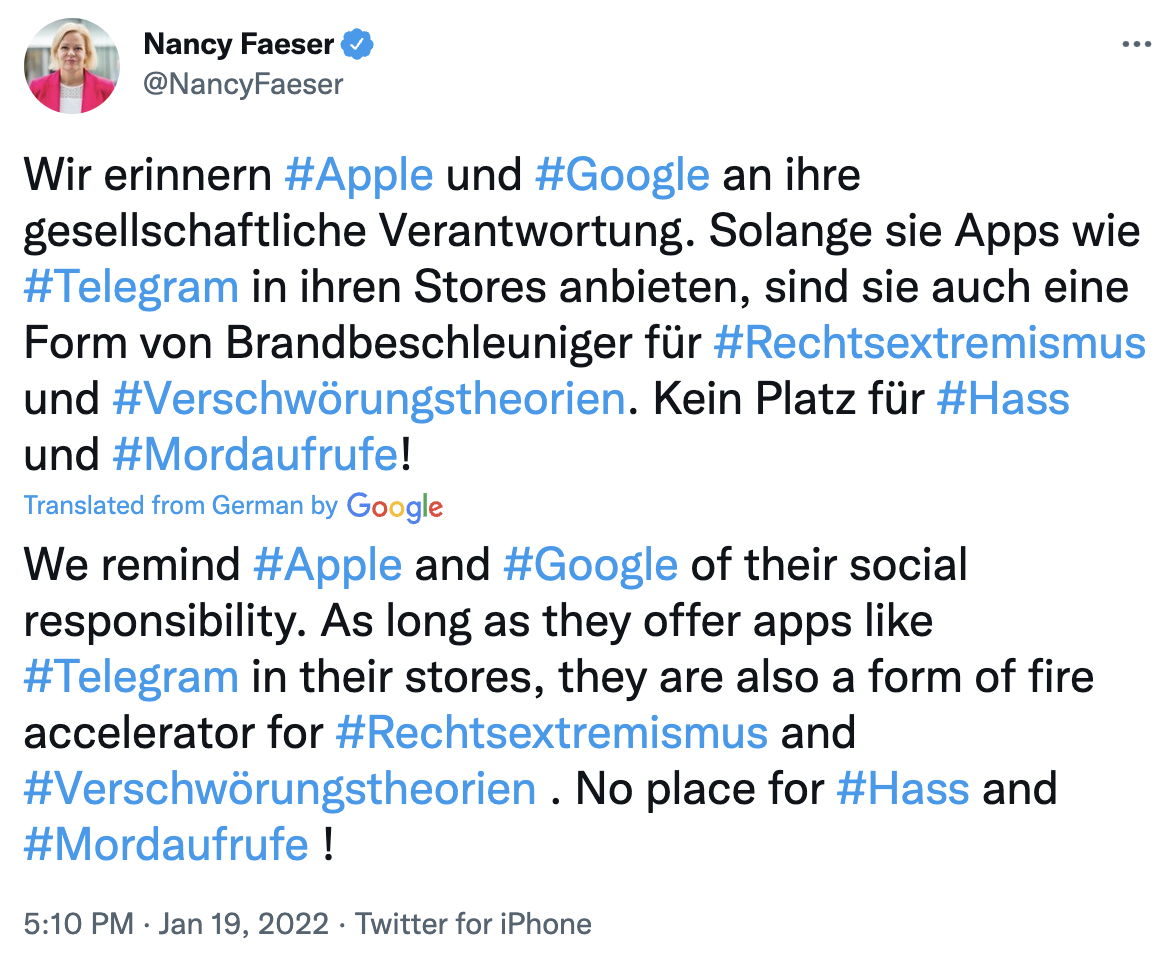
Germany’s Interior Ministry accuses Google and Apple of inciting “conspiracy theories” for allowing Telegram
By Didi Rankovic | Reclaim The Net | January 21, 2022
Germany seems determined to try to undermine Telegram under the fairly absurd pretext that among its hundreds of millions of users are also some “extremists” (same logic applies to the whole of the internet – so will Berlin try to heavily regulate *that* as well?)
And the definition of “extremist” and “radical,” as mentioned in reports about the latest push to get Telegram to cooperate – or else – also includes people who have been unhappy with extreme and radical Covid restrictions.
But given the apparent financial independence of the company that develops the messaging app, the suppression bid doesn’t seem like it will be a straight-forward task.
Judging by the news coming out of Germany now, the route the Interior Ministry would prefer to take is roundabout – to possibly get an uncooperative Telegram banned on the two biggest app stores, those operated by Google and Apple, and thus severely limit its exposure to users.
However, this doesn’t make sense either – because a dedicated “dangerous right-wing extremist” or “conspiracy theorist” would surely find out how to sideload Telegram, and march on.
But by removing the app from the most widely used official app stores, it is those hundreds of millions of everyday users in search of secure and private ways to communicate, without any malicious actors – be they governments or hackers – interfering, who would suffer the most.
For that reason, when Germany’s Interior Minister Christian Pegel recently spoke about the need to get Telegram “cooperating” with law enforcement in order to suppress extremism and threats of violence – or Berlin will pressure Google and Apple – what it really comes down to is trying to put another brick in the ongoing “war on encryption” wall.
Among the members of the security/encryption purist community, Telegram is not even regarded as the best solution – but the benefits provided by this messaging app overall as a secure and privacy-friendly alternative to mainstream competitors still far outweigh any of its flaws. As a result Telegram has seen a strong uptake in recent years.
In Germany, Facebook’s WhatsApp and Messenger are both shedding users, Signal is holding steady – but behind Telegram, that has been growing.
Featured Video

Can the U.S. Afford to Annihilate Iran?
or go to
Aletho News Archives – Video-Images
From the Archives
Sanctions, War and the Policy of Dual Containment
By SASAN FAYAZMANESH | March 17, 2008
It is now nearly three decades since the Unites States adopted the policy of dual containment of Iran and Iraq. While much has been written about the containment of Iraq, there has been very little in-depth analysis of this policy when it comes to Iran. In a book that is going to be released on March 31, 2008, entitled The United States and Iran: Sanctions, Wars and the Policy of Dual Containment (Routledge), I attempt to address this shortcoming by investigating when and why the US policy of containment of Iran came about, how it evolved, and where it stands today.[1] To the extent that Israel has been involved in US policy making, the study will also include the role that Israel has played in the containment of Iran. Also, since the fate of Iran has been inextricably linked to that of Iraq, occasionally the investigation will overlap with the containment of Iraq.
The policy of dual containment of Iran and Iraq originated during the Carter Administration, but it was not until the Clinton Administration that the expression “dual containment” became popular. … continue
Blog Roll
 Aletho News
- The Genetic Deception — now in paperback (Second Edition)
- Can the U.S. Afford to Annihilate Iran? /Seyed M. Marandi
- Elmo Sold mRNA Jabs to Your Toddler. Now They Are “Off-Label.”
- British state targets Palestine Action with yet another crooked trial
- Americans are paying the price to preserve Israel’s nuclear hegemony
- Resistance factions are necessary to ensure a permanent US Iraq withdrawal
- How Israel destabilizes the Middle East: Denying sovereignty and the right to exist
- Europe’s Establishment Is Embracing War – and Losing Voters
- NATO chief advocates war of aggression
- No Vote, No Representation, No State: Democracy, Israeli Style
- If Americans Knew
- Israeli Soldiers Abduct At Least 22 Across Occupied West Bank
- Eight Palestinians Killed in Israeli Attacks on Gaza
- Israeli former leaders and security chiefs threaten legal action over ‘Jewish terrorism’
- Israel map in LA Times ad includes all land from the river to the sea
- Inside Lebanon’s 200-page dossier on Israeli war crimes
- Flydubai, genocide, settler violence, Trump abuse of power to deport – Daily Update
- Counting Antisemitic Incidents: What the ADL Audit Reveals — and Obscures
- Mamdani releases plan to combat antisemitism and hate crimes in New York City
- Iran’s Revolutionary Guards Publish Letter to the American People
- DMFI launches $1 million ad campaign supporting Virginia’s Elaine Luria
- No Tricks Zone
- Green Energy Debacle: German Expert Professor Fritz Vahrenholt Warns Of Severe Economic And Social Consequences
- Two More Paleo Reconstructions Affirm Meters-Higher Sea Levels Across Ireland, Brazil 7000-6000 Years Ago
- New Study: Earth And Venus Surface Warmth Largely Explained By Convection And Lapse Rate, Not CO2 Or Radiation
- 2025 Nature Paper Claiming Worsening Global Drought Gets RETRACTED …Heavily Flawed
- New Study: ‘Global Drought Shows No Detectable Recent Acceleration Under Climate Warming’
- Economic Masterminds: German Socialists Suggest Taxing Productivity Gains Stemming From Using AI
- The South China Sea Has Not Been Cooperating With The Climate Change Narrative
- Energy Crisis: Germany Enters Heating Season With Historically Low Gas Reserve Fill Levels
- New Study: The Antarctic Ice Sheet Gained Mass From 2020-2024 Due To Staggering Snow And Ice Accumulation
- Study: Ocean Heating Rates From Thousands Of Years Ago ‘Dwarf’ Modern Ocean Heating Rates

