Spain officially ends FORCED sterilization of people with mental disabilities – a practice still LEGAL in many US states
RT | December 18, 2020
The Spanish government will no longer sterilize disabled people against their will. Despite the fact that eugenics is generally considered a thing of the past, forced sterilization is still permitted in multiple US states.
The Spanish government officially ended the forced sterilization of disabled people on Thursday, publishing new legislation in an official newsletter. According to the newsletter, “In the last decade, more than a thousand forced sterilizations have been practiced in Spain, most of them on women.”
“The end to this practice…brings an end to one of the most detrimental human rights violations allowed under Spanish law,” the Spanish Committee of Representatives of Persons with Disabilities (CERMI) in a statement on Thursday.
But while the Spanish government’s newsletter described the now-illegal practice as a “serious anomaly in human rights terms,” one might be disturbed to find out that involuntary sterilization is still permitted in some US states.
At the turn of the 20th century, eugenics was a popular idea in the US among the progressives of the time. Corporate foundations like the Carnegie Institution and the Rockefeller Foundation funded the growing eugenics movement, and in 1906, breakfast cereal baron John Harvey Kellogg co-founded the Race Betterment Foundation in Michigan to take the movement’s ideas mainstream.
A year later, Indiana passed the world’s first sterilization law, with 31 states following suit. A controversial Supreme Court ruling in the case of Buck v. Bell in 1927 upheld a Virginia statute allowing the forced sterilization of those considered “unfit” to reproduce, and from then until the mid-1970s, more than 60,000 people in the US were involuntarily sterilized.
The practice is still legal in many states. The 1927 decision has never been overturned, and at least eight states still have involuntary sterilization laws on their books. These include California, North Carolina, Oregon, Pennsylvania, Vermont, and Washington. In the District of Columbia, a 2007 appeals court decision held that a doctor may sterilize a patient if he or she deems it in the “best interest of the patient.”
More than a century after the passage of the first sterilization law in Indiana, the legality of the practice has led to some shocking cases of abuse. In just one women’s prison in central California, 1,400 inmates were sterilized between 1997 and 2013. Where prison sterilization is not mandatory, it is often presented to inmates under duress. In Tennessee in 2017, a judge offered inmates 30 days off their jail sentences if they consented to free vasectomies or long-acting birth-control implants. A bipartisan bill outlawed the practice a year later.
US designates anti-govt. Bahraini group as ‘terrorist’ after Manama inks peace deal with Israel
Press TV | December 16, 2020
The administration of outgoing US President Donald Trump has designated Bahraini opposition group Saraya al-Mukhtar as a “terrorist” organization, months after the Manama regime agreed to a Washington-brokered normalization with Israel.
In a statement released on Tuesday, US Secretary of State Mike Pompeo said his office had blacklisted the group as “a Specially Designated Global Terrorist,” claiming that it was “posing a significant risk of committing acts of terrorism that threaten the national security and foreign policy of the United States.”
He alleged that Saraya al-Mukhtar receives “financial and logistic support” from Iran’s Islamic Revolution Guards Corps (IRGC) and seeks to depose the Bahraini government.
“The group has plotted attacks against US personnel in Bahrain and has offered cash rewards for the assassination of Bahraini officials,” Pompeo further claimed.
The designation freezes any of the group’s US assets and generally bars Americans from dealing with it.
Iran has not commented on the claims so far.
The Bahraini government welcomed the US blacklisting of Saraya al-Mukhtar.
The Bahraini Foreign Ministry said in a statement that it “commends” what it called “the relentless efforts undertaken by the United States of America in combatting all extremist terrorist organizations.”
Bahraini courts have already sentenced suspects allegedly linked to Saraya al-Mukhtar to years in prison and revoked their citizenship.
Several Bahraini groups have faced accusations of ties to Iran since 2011, when an uprising began in the kingdom against the ruling Al Khalifah regime. Tehran has, however, dismissed such allegations as false.
Analysts see the blacklisting as an American reward to Manama, months after it reached a US-brokered normalization deal with the Israeli regime.
The agreement sparked several angry street protests in Bahrain, with the participants slamming the regime in Manama for turning a deaf ear to the nation’s calls against making peace with the occupiers of Palestine.
In addition to Bahrain, the UAE, Sudan and Morocco have also reached similar agreements with Israel.
Joe Macaron, a fellow at the Arab Center Washington DC, told the Middle East Eye (MEE) news portal that “the activities of Saraya al-Mukhtar have significantly diminished since 2018 but the Trump administration is standing by those Arab allies who normalized with Israel.”
“While Morocco got US recognition of its sovereignty over Western Sahara and Sudan was delisted as a state sponsor of terrorism, the Trump administration is showing support for Bahrain in a designation that has no real impact whatsoever,” he added.
Bahrain — home to the US Navy’s Fifth Fleet — has seen anti-regime protest rallies since the onset of the uprising. The major demand has been the ouster of the Al Khalifah dynasty and the establishment of a just and conclusive system representing all Bahraini nationals.
In an attempt to stifle those calls, the Manama regime has been pressing ahead with a heavy-handed crackdown against the protesters and persecution of human rights campaigners and political dissidents.
Pakistan returns $1 bln of Saudi Arabia’s loan over Kashmir dispute
MEMO | December 16, 2020
Pakistan has returned $1 billion to Saudi Arabia as a second installment of a $3 billion soft loan, as Islamabad reaches out to Beijing for a commercial loan to help it offset pressure to repay another $1 billion to Riyadh next month, officials said on Wednesday according to a report by Reuters.
Analysts say it is unusual for Riyadh to press for the return of money. But relations have been strained lately between Pakistan and Saudi Arabia, historically close friends.
Saudi Arabia gave Pakistan a $3 billion loan and a $3.2 billion oil credit facility in late 2018. After Islamabad sought Riyadh’s support over alleged human rights violations by India in the disputed territory of Kashmir, Saudi Arabia has pushed Pakistan to repay the loan.
With the $1 billion flowing out, Pakistan – which has $13.3 billion in central bank foreign reserves – could face a balance of payments issue after clearing the next Saudi installment.
“China has come to our rescue,” a foreign ministry official told Reuters. A finance ministry official said Pakistan’s central bank was already in talks with Chinese commercial banks.
“We’ve sent $1 billion to Saudi Arabia,” he said. Another $1 billion will be repaid to Riyadh next month, he said. Islamabad had returned $1 billion in July.
Although a $1.2 billion surplus in its current account balance and a record $11.77 billion in remittances in the past five months have helped support the Pakistani economy, having to return the Saudi money is still a setback.
Pakistani army chief General Qamar Javed Bajwa, who visited Riyadh in August to ease the tensions, met the Saudi ambassador in Islamabad on Tuesday.
Yes, Bill Gates Said That. Here’s the Proof.
By Robert F. Kennedy, Jr. | Children’s Health Defense | December 11, 2020
Some chiseler altered Bill Gates’ June 2020 TED Talk to edit out his revealing prediction that we will all soon need digital vaccine passports (slide 1). But after considerable effort, we tracked down the original video (slide 2).
Gates’ minions on cable and network news, his public broadcasting, social media and fact-checker toadies all now insist that Gates never said such things. They say he never intended to track and trace us with subdermal chips or injected tattoos.
They dismiss such talk as “conspiracy theories.”
Well, here it is from the horse’s mouth.
In 2019, according to a not-yet-purged Scientific American article, Gates commissioned the Massachusetts Institute of Technology to build an injectable quantum dot dye system to tattoo stored medical info beneath children’s skin. The tattoo was designed to be readable by an iPhone app.
Gates’ company, Microsoft, has patented a sinister technology that uses implanted chips with sensors that will monitor body and brain activity. It promises to reward compliant humans with crypto currency payments when they perform assigned activities.
Gates also invested approximately $20 million in MicroCHIPS, a company that makes chip-based devices, including birth-control implant chips with wireless on/off switches for remote-controlled drug-delivery by medical authorities.
In July 2019, months before the COVID pandemic, Gates bought 3.7M shares of Serco, a military contractor with U.S. and UK government contracts to track and trace pandemic infections and vaccine compliance.
To facilitate our transition to his surveillance society, Gates invested $1 billion in EarthNow, which promises to blanket the globe in 5G video surveillance satellites. EarthNow will launch 500 satellites allowing governments and large enterprises to live-stream monitor almost every “corner” of the Earth, providing instantaneous video feedback with one-second delay.
The Bill and Melinda Gates Foundation also acquired 5.3 million shares of Crown Castle, which owns 5G spy antennas including more than 40,000 cell towers and 65,000 small cells.
Please make your own copy of these clips — as Gates’ power to disappear inconvenient facts is expanding every digital day.
The Sixth Carbon Budget
By Paul Homewood | Not A Lot Of People Know That | December 10, 2020
 The Committee on Climate Change, the quango headed up by our old friend John Gummer, has just published its latest cunning plan to bankrupt the UK. The Sixth Carbon Budget lays out how we should meet our decarbonisation targets, with specific emphasis on the period 2032-2037.
For the first time they have included estimates of what all of this might cost us in the 2030s. Dressed up in percentages of GDP, talk of green jobs and claims of the economic growth it will all spawn, the CCC have attempted to obscure how much we are all actually going to have to fork out.
They reckon that their plan will involve spending around £50bn annually by 2030, which equates to nearly £2000 for every home in the country. But, as we shall see, even that figure is based on some highly optimistic (some would argue unrealistically so) assumptions.
They say that the £50bn could be marginally offset by savings on electric cars. But it turns out that these are based on a combination of Enron style accounting, and absurdly fanciful assumptions about falling prices of electric cars.
There is, of course, much jam promised tomorrow, or more precisely 2050, when half of us will be dead. But it’s not what might happen in thirty years time that matters to people, it’s the here and now.
But what will all of this mean to the man in the street?
As we already know, the sale of conventional petrol and diesel cars will be banned from 2030. According to the CCC, Battery Electric Vehicles (BEVs) currently cost a third more than conventional cars, typically a premium of £6400.
However, the CCC grandly assume that by 2030 BEVs will cost no more; all of this on the basis that the cost of BEV batteries will drop by two thirds in the next ten years, for which there is not the slightest evidence. Of course, if BEVs do become a lot cheaper, drivers will be queuing up to buy them, and the government won’t need to ban conventional cars!
The CCC also dishonestly include something called “carbon costs” in their running costs for petrol/diesel cars, which amounts to £200 a year per car, or £7bn for the country as a whole. There is, of course, no such a thing as a “cost of carbon”, which is included only to make low carbon alternatives appear more competitive.
When these factors, along with doubts about the second hand value of BEVs, are taken into account, most of the CCC’s fictional savings disappear. All the more significant, because those drivers who are forced to use public chargers are already finding their cars to be dearer than petrol ones to run.
We then come to heating our homes, with proposals that sales of gas boilers are banned by 2033. For most homes this will mean replacement with air source heat pumps, which typically cost around £10,000 to install and require thousands more to be spent on insulation if they are to work effectively.
Quite where ordinary families are expected to get this money from is not explained! To make matters worse, because electricity costs five times as much as natural gas in terms of energy, householders will find that their heating bills double as well.
And if we choose to carry on using our old gas boilers? Simples – we will have a stonking carbon tax added to our gas bills instead.
Not only are we expected to pay thousands out to meet carbon targets, but we are also told we must eat a third less red meat and dairy produce, drive our cars less and take fewer flights. Not that we will be able to afford any of these pleasures after the CCC have done with us.
Eating less meat and dairy will of course cause great damage to British farming, as well as pushing up food bills for poorer families.
And how will we actually power all of these new electric cars and heat pumps? By 2035, we will need nearly twice as much electricity as now, two thirds of which will be coming from wind and solar power, according to the CCC. This is four times the amount of power they generate now.
And when the wind does not blow and the sun does not shine? We will have to fall back on gas power stations, with the proviso that they can capture and store the carbon dioxide produced, even though nowhere in the world has managed to do this at scale.
Central to the case for wind power, is that the cost of offshore wind has fallen so much that it is now competitive. However, independent experts, who have looked at the published accounts of companies building these wind farms, maintain that these so-called falling costs are illusory, and that the real costs could be triple those of conventional power generators. If they are right, this would add another £20bn a year to the CCC’s plan.
No longer are these plans decades in the future. Within the space of a very few years, people will begin to experience the financial pain inflicted on them by these proposals, if they are allowed to go ahead.
And all for what?
The UK only accounts for 1% of global emissions, so whatever we do will have no effect at all on the climate. Meanwhile, despite COVID, this year China has continued to build new coal power stations, increasing its generating capacity by 3%. In the last two year’s the rise in China’s emissions of carbon dioxide has exceeded our total emissions.
Pentagon searching for ‘vetted Official Twitter Partner’ to help it influence platform’s users
RT | December 11, 2020
The US Defense Department is looking to ramp up its real-time surveillance of social media and specifically seeking a contractor already trusted by Twitter to model and influence shifting public sentiment in real time.
The Pentagon is seeking a “small business” software developer that not only enjoys privileged status as a “vetted Official Twitter Partner” but is also capable of picking through the “entire Twitter historical archive for analysis” and monitoring conversations in more than 150 languages, according to a Thursday posting by the department’s Washington Headquarters Services.
The ideal Pentagon partner will be able to “ingest near-real-time social media feeds from Twitter and other platforms” while searching the data ‘firehose’ for multipart search terms, ideally in “most major languages” simultaneously. The program would have to be able to present the results of its real-time analysis “graphically in various formats,” including on “geospatial maps and over time horizons.”
From there, the Pentagon’s corporate colleague would be able to “compute and highlight trend analysis” as well as “sentiment analysis … based on shifting online attitudes.” Essentially, the Defense Department wants a computer program that can accurately ascertain the thoughts and emotions of the social media hive-mind – including tracking “public reactions and significant events as they spike” on any given platform – and alter them if the need arises.
The candidate would also have to be able to “distinguish between real authors and online bots which may be pushing disinformation” – though it’s not clear if the company has to be able to tell the Pentagon’s own bot army apart from garden-variety AI-powered accounts.
All of this information would be packaged into Excel spreadsheets and prioritized for government agencies in terms of what warrants “immediate attention” and what simply forms part of the background of current events.
The Pentagon already deploys multiple sophisticated tools to monitor and influence Twitter and other social media platforms. It was one of the earliest adopters of “sock puppet” software allowing a single individual to control numerous fake social media accounts, and has been working with software companies to measure and analyze “group dynamics” – supposedly to predict “cyber terrorism events” – on social platforms since at least 2012.
In August, the Pentagon inked a $12.2 million contract with Dataminr to perform services similar to those listed in Thursday’s posting. The collaboration was expected to last only three months, however, and was supposed to conclude by mid-November.
While the US military has tracked and infiltrated dissident groups for decades in ‘real life,’ its capabilities in both impersonating and monitoring human conversation online have exploded over the past decade as more of what is considered ‘war’ takes place in the minds of targeted populations. Using private contractors allows the government – technically bound by the First and Fourth Amendments forbidding it from impinging on Americans’ free speech or right of protection from unreasonable search and seizure – to ignore constitutional concerns, as it’s technically an independent corporation violating targets’ rights.
Politicians Criticize China’s Role in Hong Kong while Ignoring Canada’s Role in Haiti
By Yves Engler | Dissident Voice | December 11, 2020
For those who support a truly just foreign policy comparing Canadian politicians’ reactions to protests in Hong Kong and the slightly more populous Haiti is instructive. It reveals the extent to which this country’s politicians are forced to align with the US Empire.
Despite hundreds of thousands of Canadians having close ties with both Haiti and Hong Kong, only protests in the latter seem to be of concern to politicians.
Recently NDP MP Niki Ashton and Green MP Paul Manly were attacked ferociously in Parliament and the dominant media for participating in a webinar titled “Free Meng Wanzhou”. During the hullabaloo about an event focused on Canada’s arrest of the Huawei CFO, Manly — who courageously participated in the webinar, even if his framing of the issue left much to be desired — and Ashton — who sent a statement to be read at the event but responded strongly to the backlash in an interview with the Winnipeg Free Press — felt the need to mention Hong Kong. Both the NDP (“Canada must do more to help the people of Hong Kong”) and Greens (“Echoes of Tiananmen Square: Greens condemn China’s latest assault on democracy in Hong Kong”) have released multiple statements critical of Beijing’s policy in Hong Kong since protests erupted there nearly two years ago. So have the Liberals, Bloc Québecois and Conservatives.
In March 2019 protests began against an extradition accord between Hong Kong and mainland China. Hong Kongers largely opposed the legislation, which was eventually withdrawn. Many remain hostile to Beijing, which later introduced an anti-sedition law to staunch dissent. Some protests turned violent. One bystander was killed by protesters. A journalist lost an eye after being shot by the police. Hundreds more were hurt and thousands arrested.
During more or less the same period Haiti was the site of far more intense protests and state repression. In July 2018 an uprising began against a reduction in subsidies for fuel (mostly for cooking), which morphed into a broad call for a corrupt and illegitimate president Jovenel Moïse to go. The uprising included a half dozen general strikes, including one that shuttered Port-au-Prince for a month. An October 2019 poll found that 81% of Haitians wanted the Canadian-backed president to leave.
Dozens, probably over 100, were killed by police and government agents. Amnesty International, Human Rights Watch and other western establishment human rights organizations have all documented dozens of police killings in Haiti. More recently, Moïse has ruled by decree, sought to extend his term and to rewrite the constitution. Yet, I couldn’t find a single statement by the NDP or Greens, let alone the Liberals or Conservatives, expressing support for the pro-democracy movement in Haiti.
Even an equal number of statements from a Canadian political party would be less than adequate. Not only were the protests and repression far more significant in Haiti, the impact of a Canadian politician’s intervention is far more meaningful. Unlike in Hong Kong, the police responsible for the repression in Haiti were trained, financed and backed by Canada. The Trudeau government even gave $12.5 million to the Haitian police under its Feminist International Assistance Policy! More broadly, the unpopular president received decisive diplomatic and financial support from Ottawa and Washington. In fact, a shift in Canada/US policy towards Moïse would have led to his ouster. On the other hand, a harder Canada/US policy towards Hong Kong would have led to well … not much.
The imperial and class dynamics of Haiti are fairly straightforward. For a century Washington has consistently subjugated the country in which a small number of, largely light-skinned, families dominate economic affairs. During the past 20 years Canada has staunchly supported US efforts to undermine Haitian democracy and sovereignty.
Hong Kong’s politics are substantially more complicated. Even if one believes that most in Hong Kong are leery of Beijing’s growing influence — as I do — the end of British rule and reintegration of Hong Kong into China represents a break from a regrettable colonial legacy. Even if you take an entirely unfavorable view towards Beijing’s role there, progressive Canadians shouldn’t focus more on criticizing Chinese policy in Hong Kong than Canadian policy in Haiti.
Echoing an open letter signed by David Suzuki, Roger Waters, Linda McQuaig and 150 others and the demands of those who occupied Justin Trudeau’s office last year, the national president of the Public Service Alliance of Canada, Chris Aylward, recently sent a letter to Prime Minister Trudeau critical of Canadian support for Moïse. It notes, “Canada must reassess its financial and political support to the Jovenel Moïse government, including police training, until independent investigations are conducted into government corruption in the Petrocaribe scandal and ongoing state collusion with criminal gangs.” The NDP, Greens and others should echo the call.
To prove they are more concerned with genuinely promoting human rights – rather than aligning with the rulers of ‘our’ empire – I humbly suggest that progressive Canadians hold off on criticizing Beijing’s policy towards Hong Kong until they have produced an equal number of statements critical of Canada’s role in Haiti.
• To learn more about Canada’s role in Haiti tune into this webinar Sunday on “Imperialist attacks on Haiti and Haitian resistance: Canada’s Imperialist Adventures in Haiti.”
 Yves Engler is the author of 10 books, including A Propaganda System: How Canada’s Government, Corporations, Media and Academia Sell War and Exploitation.
Remembering the Intifada and its prisoners of freedom: “Ansar III: The Camp of Slow Death”
Samidoun Palestinian Prisoner Solidarity Network | December 9, 2020
 The great Palestinian popular intifada (uprising) that mobilized, organized and unified the Palestinian masses – especially inside occupied Palestine, but also in the refugee camps, in exile and in diaspora – launched in December 1987. As we recall its 33rd anniversary, we note that hundreds of thousands of Palestinians – some estimates reaching up to 600,000 – were arrested, detained and imprisoned by Israeli occupation forces during the Intifada.
There, they experienced severe torture under interrogation, harsh conditions of confinement, medical neglect and abuse, collective punishment and home demolitions targeting their families, brutal beatings and mistreatment and the widespread and systematic use of administrative detention, imprisonment without charge or trial. Inside the prisons, however, despite all forms of repression, generations of Palestinian organizers developed “revolutionary schools” of politics, literature and organizing, developing powerful young activists to return to the streets embroiled in a great popular uprising.
In a failed attempt to suppress the Intifada, the Israeli occupation launched new prison camps and detention centers to hold the thousands of Palestinians detained in mass arrests throughout occupied Palestine. The following historical booklet, published in English in 1988 by ROOTS and Friends of Palestinian Prisoners, focuses on one such prison camp: Ansar III, “a barbed wire compound in the heart of the Negev desert.” At the time of the booklet’s publication, Janet Jubran of the Friends of Palestinian Prisoners noted in her introduction, “In one year, since the Intifada began, more than 25,000 Palestinians have been arrested. At this moment, nearly every family has one or more of its members in prison.”
This powerful booklet, including documentation, testimony and facts about Ansar III and its Palestinian prisoners – including many labor leaders, human rights defenders and journalists – was a part of the burgeoning organizing of Palestinian communities in exile and diaspora (in this case, in the United States) and the growing movement of international solidarity with the Palestinian struggle.
Samidoun Palestinian Prisoner Solidarity Network is republishing this booklet today, on the 33rd anniversary of the Intifada, to bring this important historical document to new audiences, continuing to build upon this legacy of struggle, standing with the Palestinian prisoners and the Palestinian people in their struggle for liberation and return.
Download the PDF here: Download PDF
Canadian Health Ministry Exploring “Immunity Passports,” Vaccine “Tracking And Surveillance”
By Steve Watson | Summit News | December 9, 2020
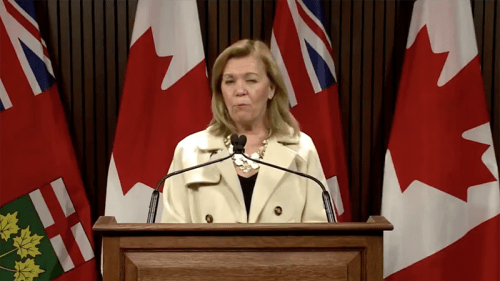
The Health Minister of Ontario in Canada has stoked controversy by suggesting that people who do not take the coronavirus vaccine will face restrictions on where they can travel and spend time.
When asked by reporters about how the government intends to go about convincing people to get the vaccine, Health Minister Christine Elliott warned that those who refuse it will face difficulties reintegrating into society.
“That’s their choice, this is not going to be a mandatory campaign. It will be voluntary,” Elliot said, but adding that “There may be some restrictions that may be placed on people that don’t have vaccines for travel purposes, to be able to go to theatres and other places.”
When another reporter asked if the government would be introducing ‘immunity passports’, or proof of vaccination cards, Elliot said “Yes, because that’s going to be really important for people to have for travel purposes, perhaps for work purposes, for going to theatres or cinemas or any other places where people will be in closer physical contact.”
Following up on Elliot’s comments, The Toronto Sun spoke to her press secretary, who confirmed that the government is exploring several options for vaccine “tracking and surveillance.”
“This includes exploring developing tech-based solutions while also providing for alternative options to ensure equitable access to any potential ‘immunity passport,’” Alexandra Hilkene said.
Sun reporter Brian Lilley notes “That phrase will set off alarm bells and it should, not just for anti-vaxxers, but for anyone who is concerned about Charter rights and governments running roughshod over them.”
Ontario Chief Medical Officer of Health Dr. David Williams has also said that a COVID-19 vaccine may be required for “freedom to move around”.
“What we can do is to say sometimes for access, or ease, in getting into certain settings, if you don’t have vaccination then you’re not allowed into that setting without other protection materials,” Williams said.
The comments of these Canadian officials add to the litany of other government and travel industry figures in both the US, Britain and beyond who have suggested that ‘COVID passports’ are coming, in order for ‘life to get back to normal’
In an essay in The Wall Street Journal on Saturday, former Centers for Disease Control and Prevention director Tom Frieden noted that he expects the so called ‘immunity passports’ will come into widespread use despite any ethical, legal or operational challenges, and despite the fact that it hasn’t at all been determined whether the vaccine equates to immunity.
Featured Video

Houthis Don’t Have to Conquer Saudi Arabia to Make It Pay
or go to
Aletho News Archives – Video-Images
From the Archives
A Lesser “Grade” of Human
By Michael Hoffman | Revelation of the Method | January 3, 2024
Will the more than 100 Iranians killed by terrorist bombs today be mourned in the West as victims of terrorism? Certainly not. Allied doctrine has it that the killing of Israeli or American civilians is a crime of cosmic proportions, while shedding the blood of “enemy” women and children is perfectly acceptable; indeed commendable.
The West does not memorialize the hundreds of thousands of civilians bombed by the U.S. in Serbia, Iraq, Afghanistan and every major German city 1943-1945. America’s fire-bombing of the city of Tokyo by General Curtis LeMay in March 1945 was followed by Harry Truman’s atomic incineration of Hiroshima and Nagasaki in August of that year. Truman never had a moment of doubt or regret over the murder of more than a 100,000 Asian children, mothers and non-combatant boys and men. It was business as usual for the “noble” Allies during the “Good War.”
In the West human rights signifies passionate concern only for civilians designated as truly human: Israelis first, then Americans and British, followed by their satraps.
This inhumanity is the legacy of Talmudic ideology, beginning with tractate Sanhedrin 57a from 400 A.D., concerning liability for capital punishment: “If a Jew murders a gentile, he is exempt.”
This teaching of contempt was reiterated in the dogma of Chabad Lubavitch founder Rabbi Shneur Zalman in the 18th century. … continue
Blog Roll
 Aletho News
- Houthis Don’t Have to Conquer Saudi Arabia to Make It Pay
- MOE: Nearly 22,000 Students and Education Workers Killed
- Guterres in Islamabad: Genocide, cowardice, and the cage of Imran Khan
- Johnson, Marandi say Yemen holds upper hand over Saudi Arabia
- False flags won’t save aggressors, Iran FM spokesman says
- The Makkah Pact Enters Into Force: The End of American Dominance or Its New Form?
- NATO’s top generals gather in Kiev
- EU’s continuing expansion – greater threat to Russia
- US Senator Murphy says Pentagon denied him entry to US base in Qatar
- Israel expands “incitement” charge to target Palestinian education and memory
- If Americans Knew
- Three Years of Genocide: How America’s Israel-First Media Filtered Out the Truth
- Israeli war chief briefs ministers on potential war against Palestinian Authority
- New Report: Israel Killed nearly 21,000 Palestinian Students and Education Workers in Past Three Years
- Israel’s flailing chatbot army
- Five Palestinians Killed, Others Injured by Israeli Fire in Gaza
- Israel is rewriting the Palestinian curriculum in East Jerusalem to erase Palestinian identity
- Three years of genocide: Israel turned prisons into killing grounds and torture sites
- Three years of genocide. Words fail. Daily Update
- ‘I’d rather die than go back’: A Palestinian teen’s 10-month nightmare in Israeli jail
- How Jared Kushner’s firm’s investment in an Israeli company could be a major conflict of interest
- No Tricks Zone
- New Study: 50 Years Of The Most Aggressive ‘Net Zero’ Policies Can Only Affect The Global Climate By 0.03°C
- US September “Heat” Was No Record…Many Records Set Decades Ago
- Latest European Green Energy Debacle; Portugal’s Largest Flagship Solar Park Insolvent!
- Green Energy Debacle: German Expert Professor Fritz Vahrenholt Warns Of Severe Economic And Social Consequences
- Two More Paleo Reconstructions Affirm Meters-Higher Sea Levels Across Ireland, Brazil 7000-6000 Years Ago
- New Study: Earth And Venus Surface Warmth Largely Explained By Convection And Lapse Rate, Not CO2 Or Radiation
- 2025 Nature Paper Claiming Worsening Global Drought Gets RETRACTED …Heavily Flawed
- New Study: ‘Global Drought Shows No Detectable Recent Acceleration Under Climate Warming’
- Economic Masterminds: German Socialists Suggest Taxing Productivity Gains Stemming From Using AI
- The South China Sea Has Not Been Cooperating With The Climate Change Narrative

