UN: Israel Must Immediately Allow Entry of Fuel, Other Essential Items into Gaza
Palestine Chronicle | August 31, 2020
United Nations Humanitarian Coordinator Jamie McGoldrick today called on Israel to immediately allow entry of fuel and other essential goods into the besieged Gaza Strip to avoid a humanitarian catastrophe.
“The deterioration witnessed in recent weeks in the Gaza Strip is of grave concern,” he said in a statement, explaining that with an escalation of hostilities in the area, “Israel has limited the transfer of certain goods into the blockaded coastal enclave, reduced the permissible fishing area and prevented fuel deliveries, including the UN-facilitated fuel for Gaza’s sole Power Plant. As a result, the Gaza Power Plant ceased operations on 18 August, sharply reducing electricity provision to nearly 2 million Palestinians,” said the UN official.
“In addition, and marking a significant deterioration in the health situation, on 24 August, the first cases of COVID-19 outside the quarantine facilities were confirmed. Thus far, there are 280 known active cases, 243 of which are from community transmission.”
He added: “At present, people have access to rolling electricity supply for a maximum of four hours per day, a difficult situation at any point, but especially serious given efforts to contain the outbreak of COVID-19. The situation is hindering the provision of services in the quarantine facilities and the capacity of the health system to cope with the increased demands, such as the ability to detect new COVID-19 cases. Power outages in hospitals are having serious repercussions, with patients in intensive care, chronic and emergency cases particularly vulnerable.
“The reduction in electricity supply is also severely undermining other critical infrastructure, including the operations of all water wells, sewage pumping stations, wastewater treatment plants, and some desalination plants. The supply of clean water and wastewater treatment is impacted. There is now a high risk of sewage flooding populated areas, increased pollution into the Mediterranean Sea and along the coast, and further pollution to the aquifer.”
McGoldrick warned that following 13 years of the Israeli blockade and a dire humanitarian situation in Gaza, swift action is required to alleviate the humanitarian situation, prevent further deterioration and increase respect for international humanitarian law and international human rights law, calling on Israel “to immediately allow the resumption of fuel into the Gaza Strip, in line with its obligations as an occupying power, to ensure that the basic needs of people are met and to prevent a collapse of basic services.”
In August, Israel has cut fuel imports into Gaza since last week as part of punitive measures over the alleged launch of incendiary balloons from the strip.
Israel has also closed the Karam Abu Salem crossing with Gaza and completely closed the Strip’s fishing zone due to the alleged breach of the security truce.
Gaza, with a population of 2 million, has been under a hermetic Israeli siege since 2006, when the Palestinian group Hamas won the democratic legislative elections in occupied Palestine. Since then, Israel has carried out numerous bombing campaigns and several major wars, that resulted in the death of thousands of people.
Modi uses Israel’s ‘settler’ tactics to change Kashmir
Press TV – August 29, 2020
Prime Minister Narendra Modi is changing Indian Kashmir’s residency laws for the first time since 1947, in a bid to snuff out any challenge to the disputed territory belonging to India.
Drawing comparisons with Israel’s “settler” tactics in the Palestinian Territories, Modi’s Hindu nationalist government aims to change the demographic makeup and identity of the Muslim-majority region, critics say.
AFP looks at the background, what the new rules are and their implications for the area’s 14 million population.
What has Modi done in Kashmir so far?
The Himalayan former princely state has been split between India and Pakistan since independence from Britain in 1947.
In the Indian-administered part a conflict between separatist rebels and government forces has killed tens of thousands since 1989, mostly civilians.
More than 65 percent of the population is Muslim. In the Kashmir Valley, the main center of the rebellion, it is close to 100 percent.
On August 5, 2019 Modi’s government revoked articles in the Indian constitution that guaranteed Kashmir’s partial autonomy and other rights including its own flag and constitution.
A huge accompanying security operation saw tens of thousands of extra troops — adding to 500,000 already there — enforce a siege-like curfew. Thousands were arrested and telecommunications were cut for months.
Jammu & Kashmir state was demoted to a union territory governed directly from New Delhi, while the Ladakh region was carved out into a separate administrative area.
Creating such new “facts on the ground” in Kashmir has long been advocated by the Rashtriya Swayamsevak Sangh, the hardline Hindu parent organisation to Modi’s BJP party.
The move sent a further shudder through India’s 200-million Muslim minority and defenders of its secular traditions, who fear Modi wants to create a Hindu nation — something he denies.
“What I see unfolding is a Hindu settler colonial project in the making,” Mona Bhan, associate professor of anthropology at Syracuse University who has long researched Kashmir, told AFP.
What happened to Kashmir’s special rules?
Modi’s government tore up Kashmir’s special residence rules dating back to 1927 which had ensured only permanent residents could own land and property, secure government jobs and university places and vote in local elections.
Now a raft of different categories of people from anywhere in India can apply for domicile certificates, giving them access to all the above.
These include those living in Kashmir for 15 years, who include around 28,000 refugees who fled Pakistan and as many as 1.75 million migrant laborers — most of whom are Hindus.
In addition, civil servants who have worked in Kashmir for seven years and their children, or students who have taken certain exams, also qualify for domicile status.
The changes are “the most drastic imposed since 1947,” Siddiq Wahid, a historian and political analyst, told AFP. “It was done with the intent to open the gates to demographic flooding.”
What do locals have to do?
Locals too now have to apply for the new “domicile certificates” in order to qualify for permanent resident rights.
To get this, they have to produce their Permanent Resident Certificates (PRC), cherished documents valid since 1927, which then become worthless.
Speaking to AFP on condition of anonymity, an engineering graduate said young Kashmiris were in effect being forced to give their political loyalty to India in exchange for a livelihood.
“They say, you want a job, OK, get the domicile document first,” he said.
Is anybody happy?
A few people. Bahadur Lal Prajapati, born in Indian Kashmir to Hindu refugees who fled Pakistan during its first war with India over Kashmir seven decades ago, is finally an official resident and has “never been so happy”.
“We got the right to live in this part of India as citizens after 72 years of struggle,” Prajapati, 55, told AFP from his home in Jammu, the Hindu-dominated district of the region.
One of the first people to receive the new domicile certificate was Navin Kumar Choudhary, a top bureaucrat from the Indian state of Bihar who worked in Kashmir for many years.
Photos on social media of Choudhary proudly holding the certificate sparked huge anger among Kashmiris but delight among Modi’s supporters.
What happens if people complain?
Some 430,000 new domicile certificates have been issued — despite the coronavirus pandemic. It is unclear how many of them are to people from outside and how many to locals.
Many locals are refusing to swap their old documents, even though this makes life harder. Some do it in secret for fear of censure from their neighbors.
Wary of being labelled “anti-national” by the authorities many Kashmiris are also scared to speak out openly. Some are deleting their Twitter accounts.
“It’s a travesty that I have to compete with outsiders for citizenship rights in my own homeland,” said a student — who also wished also to remain anonymous out of fear of problems with the authorities.
US charges three over collecting monetary aid for war-torn Yemen
Press TV – August 29, 2020
The US Justice Department has charged three people in connection with a campaign to collect monetary assistance for the oppressed Yemenis, who are suffering under the years-long Saudi war and blockade.
It claimed that Muzzamil Zaidi and Asim Naqvi, US citizens living in Iran’s holy city of Qom and the American city of Houston, respectively, and Ali Chawla, a Pakistani national residing in Qom, had violated the International Emergency Economic Powers Act.
Justice Department officials alleged that the defendants “have considerable operational links” to the Islamic Revolution Guards Corps (IRGC) and moved US currency from the United States to Iran.
They claimed that Zaidi, Chawla and other members of an organization, called Islamic Pulse, received permission from Leader of the Islamic Revolution Ayatollah Seyyed Ali Khamenei to collect a religious tax on his behalf and send half the money to Yemen.
“Zaidi, Naqvi, and Chawla allegedly raised money in the United States on behalf of Iran’s Supreme Leader, and illegally channeled these dollars to the government of Iran. As a result of today’s charges, their unlawful scheme has been exposed and brought to an end. The US Department of Justice and its National Security Division are committed to holding accountable individuals who operate covert networks within the United States in order to provide support and funds to hostile foreign governments like Iran in violation of US law,” said Assistant Attorney General for National Security John C. Demers.
The Justice Department also said Zaidi, 36, was charged with acting in the US as an agent of the Iranian government without first notifying the Attorney General.
The charges come at a time when the US has been continuing to supply weapons and military equipment to Saudi Arabia despite war crimes committed by the regime in Yemen.
The Yemeni army says Washington arms Saudi Arabia and its regional allies, defines goals for them and is involved in a political cover-up for their acts of aggression.
Saudi Arabia waged the devastating military aggression against its southern neighbor in March 2015 in collaboration with a number of its allied states.
The purported aim was to return to power a Riyadh-backed former regime and defeat the popular Houthi Ansarullah movement that took control of state matters after the resignation of the then president and his government.
The UN refers to the situation in Yemen as the world’s worst humanitarian crisis, with more than half of hospitals and clinics destroyed or closed.
Pro-Israel Kamala Harris pledges not to condition US aid to Israel on human rights
MEMO | August 27, 2020
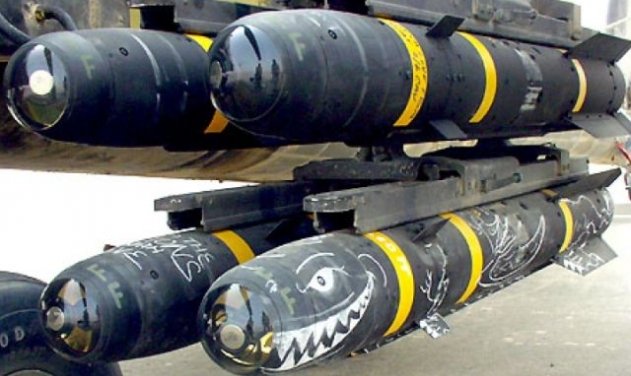
Senator Kamala Harris, the Democratic nominee for vice president, has eased the concerns of pro-Israel Jewish donors to her party, by pledging not to condition aid to Israel on its human rights record if Joe Biden is elected President.
“Joe has made it clear he will not tie security assistance to any political decisions that Israel makes, and I couldn’t agree more,” Harris is reported saying in a virtual event held with Jewish donors by the Jerusalem Post.
“As vice president, Joe Biden helped ensure unwavering support for Israel’s security,” she continued. “During the Obama-Biden administration, he was a key advocate in securing support for life-saving technologies, which I have seen.”
Vowing to put Israel first, Harris added: “I pledge to you the Biden-Harris administration will sustain our unbreakable commitment to Israel’s security, including the unprecedented military and intelligence cooperation pioneered during the Obama-Biden administration and the guarantee that Israel will always maintain its qualitative military edge.”
The threat of conditioning aid to Israel was suggested by a number of Democrat lawmakers. In July the likes of Alexandria Ocasio-Cortez and Bernie Sanders signed a letter calling for the $3.8 billion annual aid given to Israel to be made conditional on the Zionist state ending its violation of Palestinian human rights.
Venezuelan Special Forces Agents Arrested for Extrajudicial Killings
By Manuela Solé | Venezuelanalysis | August 26, 2020
Mérida – Four agents of the Bolivarian National Police’s Special Action Forces (FAES) have been arrested after the extrajudicial executions of two journalists in Cabimas, Zulia State.
Venezuela’s Attorney General Tarek William Saab informed on Tuesday that FAES officers Jose Contreras and Nestor Olano, who have been charged with premeditated murder, as well as supervisors Freddy Deroy and Deivid Guerrero were in custody.
Four other officers involved in the Friday, August 21 operation reportedly fled after arrest warrants were issued. Public attorney Jackbe Galban was removed from her post and arrested for allegedly collaborating in their escape.
Andres Eloy Nieves Zacarias and Victor Manuel Torres Guerra, 33 and 29 years-old, respectively, were assassinated in a FAES raid on Guacamaya TV, a community media outlet in Zulia State where they worked.
Saab referred to the event as “embarrassing” and decried that FAES agents tried to cover up the extrajudicial killings as an armed confrontation.
“For me, these are infiltrated officers who need to be singled out so this never happens again in a police body,” the attorney general told reporters.
The events were initially investigated by a FAES commission that traveled to Cabimas to take statements from each of the officers participating in the operation.
Saab’s office reported that examinations and autopsy logs showed that the victims were below their shooters, on their knees or sitting, which confirmed the execution hypothesis.
The FAES agents were also accused of stealing the TV station’s equipment after the executions.
Interior Minister Nestor Reverol called the procedure an “irregular act” and appointed a multidisciplinary team to carry out an investigation.
“In any situation that constitutes a deviation from the established procedures and protocols, we will be ruthless in the enforcement of the law,” read the official statement issued by the Interior Ministry.
The executions, as well as FAES attempts to present the victims as criminals to the media, have been condemned from various sectors. Several popular and community media outlets, militants of the youth fraction of the United Socialist Party of Venezuela and the Francisco de Miranda Front all released communiques, while a hashtag #JusticiaParaAndresYVictor (“Justice for Andres and Victor”) became a trend on social media.
The Inter American Press Society and the International Press Institute likewise made public their condemnation, calling on Venezuelan authorities to thoroughly investigate the killings.
The founder of Guacamaya TV, Franklin Torres, who is also the father of Victor Torres, said that the two journalists were dragged out of the offices by the FAES and ‘vilely murdered’. He went on to claim that the information released about the murder was false and that the weapons allegedly found at headquarters were planted by FAES agents.
“For our murdered kids, we will not rest until justice is served,” read a statement released by the Torres family on Wednesday. The relatives praised the quick response of the Attorney General’s office and demanded a thorough investigation up the Bolivarian National Police’s chain of command.
Nieves and Torres were described by those who knew them as honest workers who were deeply involved with their community. Nieves was also a member of the Francisco de Miranda Front. Tributes painted him as a dedicated Chavista who stood up for just causes and a popular member of the community media scene in Venezuela.
Popular movements have recognized authorities’ response in this case, but the reported increase in heavy handed police tactics and the FAES in particular have been subjects of intense debate. Chavista human rights collective Surgentes launched a campaign in November 2019 to denounce a growing number of police extrajudicial killings in popular neighborhoods and bring back a debate on police reform initiated by former President Hugo Chávez.
Edited and with additional reporting by Ricardo Vaz from Mérida.
Israel military plants booby trap explosives near Palestinian village
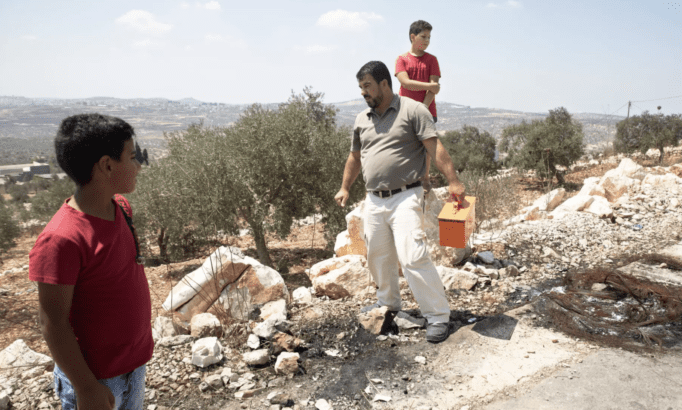
Mamoun Shtaiwi with a crate of stun grenades (C) with the child who found an explosive device (L) in Qaddum, August 25, 2020.
By Kathryn Shihadah | If Americans Knew | August 26, 2020
Ha’aretz reports that a Palestinian child discovered a box full of explosives near his home last week. It was one of at least three such boxes placed there by Israeli soldiers as a “deterrent.”
Last Wednesday night, Israeli soldiers entered the West Bank village of Qaddum around midnight to plant the explosives in the area, which sees a large amount of foot traffic. They were set to explode when touched, and camouflaged with stones and scraps of cloth.
The next day, a seven-year-old boy saw one of the boxes. He explained later, “I wanted to pick it up and play with it.” But his mother and other relatives were suspicious. They picked it up and shook it; it exploded, wounding one of them.
They found another similar box nearby and detonated it from a distance.
Another village resident reports finding a sign nearby, in Hebrew, reading, “Keep away or die; danger of death.”
The Israel Defense Forces (IDF) admitted to placing the stun grenades, adding that they were planted as a deterrent in an area where “violent riots have regularly occurred for years.”
The military spokesman maintained that, “after it was discovered that this could lead to injuries, forces worked to remove them from the area.” An investigation has been opened.
It is against international law to place armed explosives in a civilian area.
Residents of the village also noticed that a Palestinian flag in the area had been removed.
Qaddum’s claim to fame
 In recent months, videos have recorded an Israeli military bulldozer facing off against protesters; Israeli soldiers slashing tires of cars owned by Palestinians, and throwing tear gas canisters into a Palestinian home; they have also intentionally shot holes in water tanks (water is scarce for many Palestinians in the West Bank). Residents of Qaddum have been holding weekly demonstrations for nine years, protesting the closure of a main road, which had been closed to accommodate the expansion of a nearby settlement. The village has frequently made the news.
Reports of Israeli forces injuring Palestinian protesters are also numerous.
Most alarming of all is the story of nine-year-old Abdul Rahman Yasser Shteiwi, who was shot in the head during a protest last year. The bullet shattered into at least 100 pieces. The IDF at first denied using live ammunition, but it was later proven that they did, and were responsible for Abdul Rahman’s injury.
Another boy, age fifteen, was shot in the head by an Israeli soldier in January on a Thursday, when there was no protest. Experts say the shooter was only a few yards away. The IDF delayed the car taking him to the hospital for 25 minutes.
Kathryn Shihadah is staff writer for If Americans Knew. She also writes for MintPress News and blogs at Palestine Home.
UNRWA calls for unimpeded passage into Gaza for vital goods
MEMO | August 25, 2020
The UN Relief and Works Agency for Palestine Refugees in the Near East (UNRWA) called on Tuesday for all vital goods to be granted unimpeded passage into the besieged Gaza Strip, including fuel for electricity. UNRWA made the appeal against the background of 14 years of an illegal blockade and the socio-economic impact of the COVID-19 pandemic.
“The agency in Gaza is extremely concerned about the closure of the lone power plant since last Tuesday, 18 August,” UNRWA said. “The closure of the plant has caused the power feed to decline to two or three hours per day, followed by 20 hours of interruption.”
This, explained UNRWA, will have a negative impact on the wellbeing and safety of the people of Gaza and devastating effects on the Strip’s vital services, including hospitals. “Thus, this puts at risk the lives and health of nearly two million people, including 1.4 million registered Palestine refugees.”
The official statement from the UN agency pointed out that, “Under international humanitarian law, the passage of all relief consignments, in this case fuel for electricity, should not be prevented.”
Commenting on the situation in the Gaza Strip, the Director of UNRWA Affairs in the Palestinian territory, Matthias Schmale, said that the call is being made to all concerned parties to maintain a supply of electricity that is sufficient to meet the basic needs of the civilian population. “UNRWA is, furthermore, concerned about other measures perceived as punitive to the civilian population, such as closing down the fishing zone, as well as the escalating tensions and military activities.”
Gaza, Schmale pointed out, has now been hit by air raids for more than ten nights in a row. “All parties must show utmost restraint and protect the civilian population with full respect for their dignity and human rights.”
In Blow to US Efforts, Morocco Says No to Normalization with Israel
Palestine Chronicle | August 24, 2020
Morocco will not follow the lead of the United Arab Emirates and normalize with Israel, the country’s Prime Minister Saad-Eddine El-Othmani said during a high-level political meeting late on Sunday.
El-Othmani told members of his Justice and Development Party that Morocco “refuses to normalize relations with the Zionist entity (referring to Israel) because this will embolden it to further breach the rights of the Palestinian people.”
The top Moroccan official reiterated that the country’s King, government and people will remain steadfast in defense of the rights of the Palestinian people and Al-Aqsa Mosque, located in occupied Palestinian East Jerusalem (Al-Quds).
“In 1993, Morocco and Israel had low-level diplomatic ties following the signing of the Oslo Accords between the Palestinians and Israel,” Anadolu news agency reported on Monday.
“However, Rabat suspended the relations with Israel following the outbreak of the Palestinian uprising in 2000,” Anadolu added.
On August 13, Israel and the UAE have reached a deal that is expected to lead to “full normalization of relations” between the small Arab nation and Israel in an agreement that US President Donald Trump brokered.
After Hiroshima and Nagasaki: U.S. and Australian Brutalisation of Women on the Japanese Mainland
By A.B. Abrams for The Saker Blog | August 24, 2020
Over a year ago I published the book Power and Primacy: The History of Western Intervention in the Asia-Pacific, which was an attempt to fill what I saw as a gap in scholarship on the subject. I found that while several scholars had covered individual cases of Western powers intervening in the region, from David Easter and Geoffrey B. Robinson’s works on the Western-engineered coup and massacres in Indonesia of an estimated 500,000 to 3 million people[1] – to Bruce Cumings and Hugh Deane’s works on the Korean War, there were no major works assessing broader trends and consistencies in Western intervention. Power and Primacy was thus written to show the consistencies in Western designs towards the region and the means used to achieve them over a period of more than 70 years, from the Pacific War which began in 1941 to Western policies towards China and North Korea today.
This month marks the 75th anniversary of the dismantling of the Japanese Empire, and the famous declaration by General Douglas MacArthur that, with the region’s only non-Western military power and the world’s only non-Western naval power now defeated, ‘The Pacific is now an Anglo-Saxon lake.’ While the U.S. and its allies portrayed themselves as a benevolent and democratising force in the region, the darker aspects of East Asia’s time under the new hegemon, which starkly contradict this, have seen very little discussion or coverage. It is notable, for example, that after the Japanese Empire’s fall not only did living standards in southern Korea fall dramatically after it was placed under the rule of an American military government, but mass rapes, the use of comfort women, and serious human trafficking – the very things used by many to justify the American embargo on Japan which had started hostilities in 1941 – not only continued but were expanded under U.S. control. The government of Syngman Rhee, the Princeton-educated Christian radical the U.S. placed in power, killed 2% of its population at the most conservative estimate within five years, placing hundreds of thousands more in concentration camps and exercising a level of brutality not seen even under the Japanese Empire.
With Japan today having seen 75 uninterrupted years with tens of thousands of Western soldiers based on its territory, where they appear set to remain indefinitely, this is a suitable time to reflect on the nature of the relationship between the country and the West – which is very far from that of equal sovereign powers with shared goals and ideals. Evidence for this has ranged from massive involvement of American intelligence in the political process, including funding pro-Western political parties and supporting their election campaigns,[2] to the testimonies of multiple officials. Former Prime Minister Yukio Hatoyama, for example, noted regarding his country’s inability to reach a deal with Russia over the Kuril Islands due to an effective American veto over all major foreign policy decisions: “I think it represents a big problem that when making foreign policy decisions, Tokyo is always guided by the United States’ approach. Japan depends on America.” He further stated: “The Japanese media and government… always take America’s side. Tokyo is dependent on the US’ views … Japan will continue to side with America and the G7 countries.”[3] Prime Minister Ichiro Hatoyama, who in the 1950s had also sought to resolve the dispute with Moscow and sign a peace treaty on the basis that Japan would receive two of the four islands, was harshly threatened by the U.S. and was ultimately forced to concede to Washington’s demands not to go through with an agreement. Prime Minister Yoshiro Mori came to a similar conclusion regarding the country’s lack of effective sovereignty in an interview with Russian state media in 2018. [4]
Beyond these political indicators, however, are more human indicators of the nature of America’s place in post-war Japan which cannot be overlooked, and which contrast very strongly with portrayals in the vast majority of Western media including both documentaries and popular media. An extract from the book Power and Primacy, pages 66-69, given below, recently reached over 3 million viewers on social media and highlighted the true consequences for Japan’s population of subjugation by the United States. The full references are provided in the book itself. Perhaps most importantly, this is not presented as an isolated set of cases of U.S. and Western conduct towards an East Asian population placed under their power – rather it is part of a much wider trend which if anything was considerably more extreme in Vietnam and in both South and North Korea – the latter of which was briefly occupied by U.S. forces in 1950. An understanding of the past is key to comprehending the nature of Western involvement in the Asia-Pacific region today, which is why I found that this project was particularly essential now in light of the ‘Pivot to Asia,’ the North Korean nuclear crisis, the Trump administration’s recent ‘Tech War’ on China and other key events which have increasingly placed the region at the centre of determining the future of world order.
Text Start:
There was a far darker side to the U.S. and allied occupation of Japan, one which is little mentioned in the vast majority of histories – American or otherwise. When Japan surrendered in August 1945, mass rapes by occupying forces were expected… [despite setting up of a comfort women system which recruited or otherwise trafficked desperate women to brothels] such crimes were still common and several of them were extremely brutal and resulted in the deaths of the victims. Political science professor Eiji Takemae wrote regarding the conduct of American soldiers occupying Japan:
‘U.S. troops comported themselves like conquerors, especially in the early weeks and months of occupation. Misbehavior ranged from black-marketeering, petty theft, reckless driving and disorderly conduct to vandalism, assault, arson, murder and rape. Much of the violence was directed against women, the first attacks beginning within hours after the landing of advanced units. In Yokohama, China and elsewhere, soldiers and sailors broke the law with impunity, and incidents of robbery, rape and occasionally murder were widely reported in the press [which had not yet been censored by the U.S. military government]. When U.S. paratroopers landed in Sapporo an orgy of looting, sexual violence and drunken brawling ensued. Gang rapes and other sex atrocities were not infrequent […] Military courts arrested relatively few soldiers for their offences and convicted even fewer, and restitution for the victims was rare. Japanese attempts at self-defense were punished severely. In the sole instance of self-help that General Eichberger records in his memoirs, when local residents formed a vigilante group and retaliated against off-duty GIs, the Eighth Army ordered armored vehicles in battle array into the streets and arrested the ringleaders, who received lengthy prison terms.’
The U.S. and Australian militaries did not maintain rule of law when it came to violations of Japanese women by their own forces, neither were the Japanese population allowed to do so themselves. Occupation forces could loot and rape as they pleased and were effectively above the law.
An example of such an incident was in April 1946, when approximately U.S. personnel in three trucks attacked the Nakamura Hospital in Omori district. The soldiers raped over 40 patients and 37 female staff. One woman who had given birth just two days prior had her child thrown on the floor and killed, and she was then raped as well. Male patients trying to protect the women were also killed. The following week several dozen U.S. military personnel cut the phone lines to a housing block in Nagoya and raped all the women they could capture there – including girls as young as ten years old and women as old as fifty-five.
Such behavior was far from unique to American soldiers. Australian forces conducted themselves in much the same way during their own deployment in Japan. As one Japanese witness testified: ‘As soon as Australian troops arrived in Kure in early 1946, they ‘dragged young women into their jeeps, took them to the mountain, and then raped them. I heard them screaming for help nearly every night.’ Such behavior was commonplace, but news of criminal activity by Occupation forces was quickly suppressed.
Australian officer Allan Clifton recalled his own experience of the sexual violence committed in Japan:
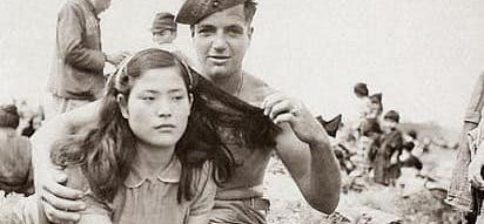
‘I stood beside a bed in hospital. On it lay a girl, unconscious, her long, black hair in wild tumult on the pillow. A doctor and two nurses were working to revive her. An hour before she had been raped by twenty soldiers. We found her where they had left her, on a piece of waste land. The hospital was in Hiroshima. The girl was Japanese. The soldiers were Australians. The moaning and wailing had ceased and she was quiet now. The tortured tension on her face had slipped away, and the soft brown skin was smooth and unwrinkled, stained with tears like the face of a child that has cried herself to sleep.’
Australians committing such crimes in Japan were, when discovered, given very minor sentences. Even these were most often later mitigated or quashed by Australian courts. Clifton recounted one such event himself, when an Australian court quashed a sentence given by a military court martial citing ‘insufficient evidence,’ despite the incident having several witnesses. It was clear that courts overseeing Western occupation forces took measures to protect their own from crimes committed against the Japanese – crimes which were largely regarded as just access to ‘spoils of war’ at the time by the Western occupiers.
As had been the case during the war, underreporting of rapes in peace- time due to the associated shame in a traditional society and inaction on the part of authorities (rapes in both cases occurred when Western militaries were themselves in power) would lower the figures significantly. In order to prevent ill feeling towards their occupation from increasing, the United States military government implemented very strict censorship of the media. Mention of crimes committed by Western military personnel against Japanese civilians was strictly forbidden. The occupying forces ‘issued press and pre-censorship codes outlawing the publication of all reports and statistics “inimical to the objectives of the Occupation.”’ When a few weeks into the occupation Japanese press mentioned the rape and widespread looting by American soldiers, the occupying forces quickly responded by censoring all media and imposing a zero tolerance policy against the reporting of such crimes. It was not only the crimes committed by Western forces, but any criticism of the Western allied powers whatsoever which was strictly forbidden during the occupation period – for over six years. This left the U.S. military government, the supreme authority in the country, beyond accountability. Topics such as the establishment of comfort stations and encouragement of vulnerable women into the sex trade, critical analysis of the black market, the population’s starvation level calorie intakes and even references to the Great Depression’s impact on Western economies, anti-colonialism, pan-Asianism and emerging Cold War tensions were all off limits.
What was particularly notable about the censorship imposed under American occupation was that it was intended to conceal its own existence. This meant that not only were certain subjects strictly off limits, but the mention of censorship was also forbidden. As Columbia University Professor Donald Keene noted: ‘the Occupation censorship was even more exasperating than Japanese military censorship had been because it insisted that all traces of censorship be concealed. This meant that articles had to be rewritten in full, rather than merely submitting XXs for the offending phrases.’ For the U.S. military government it was essential not only to control information – but also to give the illusion of a free press when the press was in fact more restricted than it had been even in wartime under imperial rule.
By going one step further to censor even the mention of censorship itself, the United States could claim to stand for freedom of press and freedom of expression. By controlling the media the American military government could attempt to foster goodwill among the Japanese people while making crimes committed by their personnel and those of their allies appear as isolated incidents. While the brutality of American and Australian militaries against Japanese civilians was evident during the war and in its immediate aftermath, it did not end with occupation. The United States has maintained a significant military presence in Japan ever since and crimes including sexual violence and murder against Japanese civilians continue to occur.”
Text End
For Full Manuscript of Power and Primacy
- https://www.peterlang.com/view/title/68124?format=PBK
- https://www.ebooks.com/en-ms/book/209664887/power-and-primacy/a-b-abrams/
- https://www.peterlang.com/view/title/68124
- https://www.amazon.co.uk/Power-Primacy-History-Intervention-Asia-Pacific/dp/1788746120/ref=sr_1_fkmrnull_2?keywords=power+and+primacy+abrams&qid=1553942549&s=gateway&sr=8-2-fkmrnull
https://www.facebook.com/100803698404263/photos/a.101111128373520/106347284516571/
For A. B. Abrams’ upcoming work, scheduled for publication in October 2018, titled Immovable Object: North Koreans 70 Years at War with American Power:
- https://www.amazon.com/Immovable-Object-North-Koreas-American/dp/1949762300
- https://www.claritypress.com/product/immovable-object-north-koreas-70-years-at-war-with-american-power/
- ‘Indonesia’s killing fields,’ Al Jazeera, December 21, 2012. ‘Looking into the massacres of Indonesia’s past,’ BBC, June 2, 2016. ↑
- Weiner, Time, ‘C. I. A. Spent Millions to Support Japanese Right in 50’s and 60’s,’ New York Times, October 9, 1994. ↑
- ‘Stationing American troops in Japan will lead to bloody tragedy – ex-PM of Japan,’ RT, (televised interview), November 6, 2016. ↑
- ‘Ex-Japan FM: I Told Putin We Follow U.S. Policy as We’re Surrounded by Nuke States,’ Sputnik, May 22, 2018. ↑
How the UK Government Provides Cover for Israel’s Crimes
By Stuart Littlewood | American Herald Tribune | August 22, 2020
MP Alister Jack has finally replied to my question asking where he and the UK government stand on the threat by Israel to annex more Palestinian territory known as the West Bank. It seems the Government has urged them not to do it.
I doubt if his letter reproduced here, is his own work. It is sprinkled with the humbug and deceit repeated for decades by Tory and Labour governments and was likely penned at least 20 years ago by a Foreign Office scribbler vaccinated with an Israeli embassy gramophone needle. It is still used as a reply template by MPs and ministers who dare not speak their own minds or are plain clueless.
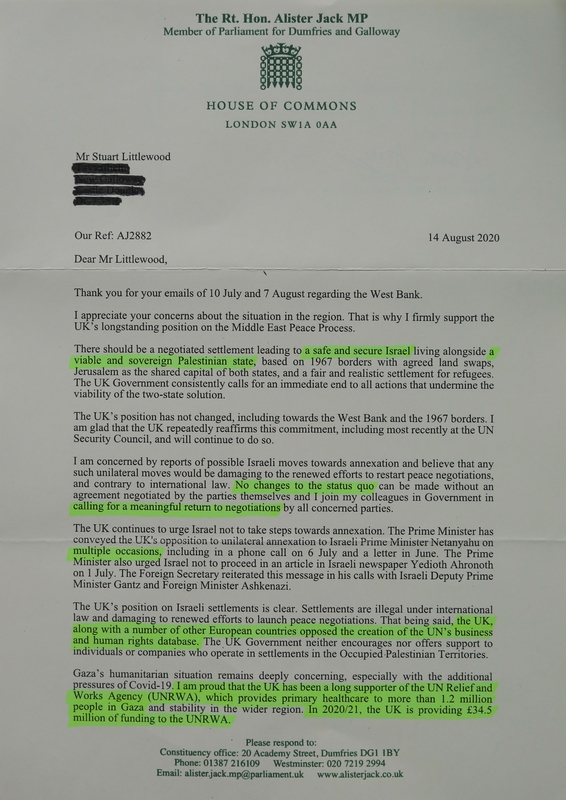
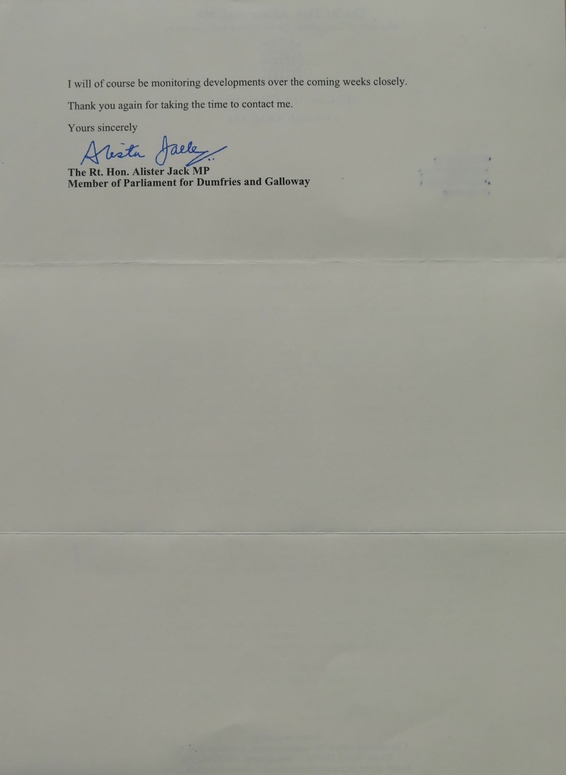
As usual, Her Majesty’s Government wants “a safe and secure Israel” but only “a viable and sovereign Palestinian state”. What a deplorable statement. Viable means workable in the most meagre sense. And when it comes to safety and security why can’t Mr. Jack be evenhanded? His words (if they are indeed his) express clear racial prejudice favouring the wellbeing and prosperity of one people at the expense of another which, I’d have thought, deserves a sharp rap on the knuckles.
He says there can be no changes to the status quo without a negotiated agreement between the parties. Mr Jack is surely aware that the status quo is itself illegal and breaches umpteen UN resolutions. And why does he feel the Palestinians must ‘negotiate’ their freedom? Picture the scene with the invader holding a gun to the head of the victim whose land the invader has occupied under brutal military control and in defiance of international law for 70+ years. Why is Mr Jack joining his colleagues in calling for more lopsided negotiations instead of pushing for law and justice?
‘Nothing shall be done to prejudice the rights of non-Jewish communities….’ Sorry, forget that.
So many experts are saying that a negotiated two-state solution is impossible. Does anyone seriously think the Israelis will voluntarily give up their ill-gotten territorial gains which are crucial to their Greater Israel dream? The only peaceable way to change their mind is through the persuasive power of BDS and other sanctions. For that reason BDS is under relentless Zionist attack and is fiercely opposed by the servile UK Government. The reason why the West endlessly woffles about ‘negotiations’ is their cowardly failure ever since 1948 to confront Israel’s greedy ambition for expansion and domination. That inconvenient bit in Britain’s 1917 pledge to Rothschild and the Zionist Federation about “it being clearly understood that nothing shall be done which may prejudice the civil and religious rights of existing non-Jewish communities in Palestine” is best forgotten. It’s so much easier for the UK Government to say and do nothing while their Zionist ‘friends’ surreptitiously complete their programme of creeping annexation. And never mind the 70+ years of grief this has caused innocent Palestinians.
Mr Jack refers to Boris Johnson’s article in Yedioth Ahronoth which appeared on the very day Netanyahu was supposed to be carrying out his crazed threat. “Annexation would represent a violation of international law…. I profoundly hope that annexation does not go ahead,” he wrote. “If it does, the UK will not recognize any changes to the 1967 lines, except those agreed between both parties.” But Israel has repeatedly violated international law and repeatedly been rewarded, so why should it care what the UK thinks about boundary changes? They have been changing all the time. Israel’s annexation of East Jerusalem (including the Old City) in 1967 was a flagrant breach of international law, and what did the UK or anyone else do about it? “I want to see an outcome that delivers justice for both Israelis and Palestinians,” says Johnson absurdly. He has no interest in justice otherwise he’d be leading the charge for implementing international law and UN resolutions which have already ruled on the issue.
As for Israel’s annexation misfire, it looks like world hostility gave Netanyahu cold feet and he and Trump cast around in desperation for a face-saver. They found it the United Arab Emirates’ ‘MBZ’ with whom they cobbled a deal for full diplomatic relations between Israel and the UAE provided Israel suspended annexation, and this is touted as a triumph. No-one of course insisted on actually abandoning annexation and you can bet the piecemeal ethnic cleansing, destruction of Palestinian homes and confiscation of their lands will continue unabated.
Mr. Jack then says he’s proud that the UK supports UNRWA and is providing £34.5 million funding this year. If the Palestinians were allowed their universal right to freedom of movement and self-determination in their homeland there’d be no need to keep throwing our tax money at agencies like UNRWA. It’s scandalous that money for our own schools and hospitals has been diverted to subsidise Israel’s long-running programme of thieving, collective punishment, dispossession and the trashing of the Palestinian economy.
Mr Jack goes on to say: “The UK’s position on Israeli settlements is clear.” Well no, it isn’t. They are illegal and even constitute a war crime yet the UK Government doesn’t mind if companies or individuals profiteer from using and endorsing those squats to the detriment of the Palestinians. And he seems to agree with his government’s opposition to the UN’s business and human rights database. Back in March 2016, UN Human Rights Council resolution 31/36 mandated the High Commissioner’s Office to produce a database of all businesses engaged in activities related to Israel’s settlement enterprise and having implications for the rights of the Palestinian people. Fair enough, you might think. But a year ago 103 local, regional and international organizations felt it necessary to call on the High Commissioner to release the Database expressing deep concern that the document and names of the companies facilitating the settlement programme had been withheld from circulation for 3 years due to political pressure. In the meantime the Israeli government had escalated the construction of new squats and broadcast its intention to formally annex parts of the West Bank in further violation of international law.
“The Database will bring an important degree of transparency on the activities of businesses which contravene rules and principles of international humanitarian and human rights law as a result of their operations in or with illegal Israeli settlements,” they said.
Amnesty International commented: “Naming the businesses which profit in the context of this illegal situation sends a clear message from the international community that settlements must never be normalized. These companies are profiting from and contributing to systematic violations against Palestinians.”
And Lawyers for Palestinian Human Rights said: “The UK Government abstained on the vote of this Human Rights Council resolution in March 2016…. It was the only state to declare that the database was ‘inappropriate’ and that ‘it would not co-operate in the process’ of its implementation.” LPHR felt that the reasons given for the Government’s position “did not individually or cumulatively amount to an adequate basis for justifiably opposing the UN Database”. One such reason was that the UK Government thought the Human Rights Council should focus on states rather than private companies. LPHR says this contradicts the UK’s earlier agreement, along with the rest of the international community, that companies as well as states have vital responsibilities in protecting and advancing respect for human rights.
I won’t trouble Mr Jack for an explanation for all this. It’s enough that voters and campaigners are aware of the skullduggery.
‘People of the Cave’: Palestinians Take their Fight for Justice to the Mountains
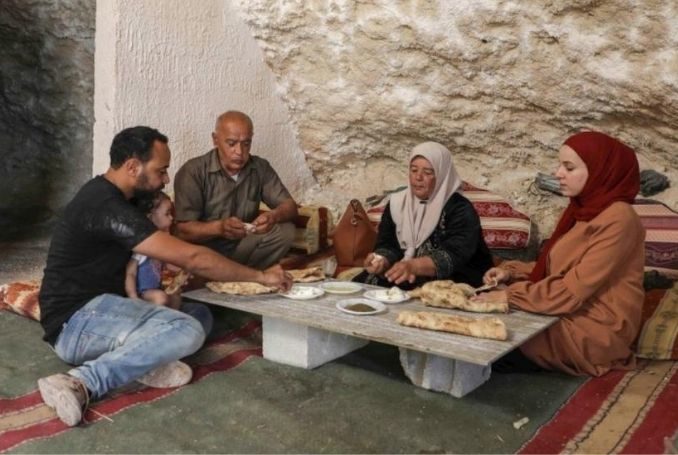
Ahmed Amaranth (L) and his family live in a cave home and now face Israeli eviction. (Photo: via Twitter)
By Ramzy Baroud | Palestine Chronicle | August 19, 2020
Palestinians are not going anywhere. This is the gist of seven decades of Palestinian struggle against Zionist colonialism. The proof? The story of Ahmed Amarneh.
Amarneh, a 30-year-old civil engineer from the northern West Bank village of Farasin, lives with his family in a cave. For many years, the Amarneh family has attempted to build a proper home, but their request has been denied by the Israeli military every time.
In many ways, the struggle of the Amarnehs is a microcosm of the collective struggle of Farasin; in fact, of most Palestinians.
Those who are unfortunate enough to be living in areas of the West Bank, designated by the Oslo II Accord of 1995 as Area C, were left in a perpetual limbo.
Area C constitutes nearly 60% of the overall size of the West Bank. It is rich with resources – mostly arable land, water and ample minerals – yet, relatively sparsely populated. It should not be surprising why right-wing Israeli Prime Minister, Benjamin Netanyahu, wants to annex this region. More land, with fewer Palestinians, has been the guiding principle for Zionist colonialism from the outset.
True, Netanyahu’s annexation plan, at least the de jure element of it, has been postponed. In practice, however, de facto annexation has been taking place for many years, and, lately, it has accelerated. Last June, for example, Israel demolished 30 Palestinian homes in the West Bank, mostly in Area C, rendering over 100 Palestinians homeless.
Additionally, according to the United Nations Office for the Coordination of Humanitarian Affairs (OCHA), Israeli army bulldozers destroyed 33 non-residential structures as well. This is “the same number (of homes) demolished throughout the entire first five months of 2020,” OCHA reported.
Unfortunately, Farasin, like numerous other Palestinian villages and communities across Area C, has been singled out for complete destruction. A small population of approximately 200 people has been subjected to Israeli army harassment for years. While Israel is keen on implanting Jewish communities in the heart of the occupied West Bank, it is equally keen on disrupting the natural growth of Palestinian communities, the indigenous people of the land, in Area C.
On July 29, Israeli forces invaded Farasin, terrorizing the residents, and handed over 36 demolition orders, according to the head of the Farasin village council. Namely, this is the onset of ethnic cleansing of the entire population of the village by Israel.
Ahmed Amarneh and his family also received a demolition order, although they do not live in a concrete house, but, rather, in a mountain cave. “I didn’t make the cave. It has existed since antiquity,” he told reporters. “I don’t understand how they can prevent me from living in a cave. Animals live in caves and are not thrown out. So let them treat me like an animal and let me live in the cave.”
Amarneh’s emotional outburst is not misleading. In a recent report, the Israeli rights group B’tselem, has listed some of Israel’s deceptive methods used to forcefully remove Palestinians from their homes in Area C or to block any development whatsoever within these Palestinian communities.
“Israel has blocked Palestinian development by designating large swathes of land as state land, survey land, firing zones, nature reserves and national parks,” according to B’tselem. Judging by the systematic destruction of the Palestinian environment in the West Bank, Israel is hardly interested in the preservation of animals, either. The ultimate goal is the allocation of “land to settlements and their regional councils,” B’tselem argues.
Therefore, it should not come as a surprise that, for example, as of November 2017, only 16 of the 180 Palestinian communities in Area C have been approved for development. The rest are strictly prohibited.
Between 2016 and 2018, of the 1,485 Palestinian applications for construction and development in these areas, only 21 permits have been approved.
These unrealistic and draconian measures leave Palestinian families with no option but to build without a permit, eventually making them targets for Israeli military bulldozers.
Hundreds of families, like that of Ahmed Amarneh, have opted for alternative solutions. Failing to obtain a permit and wary of the imminent demolition if they build without one, they simply move to mountain caves.
This phenomenon is particularly manifest in the Hebron and Nablus regions.
In the mountainous wasteland located on the outskirts of Nablus, the wreckage of abandoned homes – some demolished, some unfinished – is a testimony of an ongoing war between the Israeli military, on the one hand, and the Palestinian people, on the other. Once they lose the battle and are left with no other option, many Palestinian families take their belongings and head to the caves in search of a home.
Quite often, the fight does not end there, as Palestinian communities, especially in the Hebron hills region, find themselves target to more eviction orders. The war for Palestinian survival rages on.
The case of Ahmed Amarneh, however, is particularly unique, for rarely, if ever, Israel issues a military order to demolish a cave. When the cave is demolished, where else can the Amarneh family go?
This dilemma, symptomatic of the larger Palestinian quandary, reminds one of Mahmoud Darwish’s seminal poem, “The Earth is Closing on Us”:
“Where should we go after the last frontiers?
Where should the birds fly after the last sky?
Where should the plants sleep after the last breath of air?”
However depressing the reality may be, the metaphor is undeniably powerful, that of savage colonialism that knows no bounds and Palestinian steadfastness (sumoud) that is perennial.
Often buried within the technical details of oppression – Area C, home demolition, ethnic cleansing and so on – is the tenacity of the human spirit, that of the Amarneh family and hundreds of other Palestinian families, who have turned caves into loving homes. It is this unmatched perseverance that makes the quest for justice in Palestine, despite the innumerable odds, possible.
– Ramzy Baroud is a journalist and the Editor of The Palestine Chronicle. He is the author of five books. His latest is “These Chains Will Be Broken: Palestinian Stories of Struggle and Defiance in Israeli Prisons” (Clarity Press, Atlanta). Dr. Baroud is a Non-resident Senior Research Fellow at the Center for Islam and Global Affairs (CIGA), Istanbul Zaim University (IZU).
Featured Video

Houthis Don’t Have to Conquer Saudi Arabia to Make It Pay
or go to
Aletho News Archives – Video-Images
From the Archives
A Lesser “Grade” of Human
By Michael Hoffman | Revelation of the Method | January 3, 2024
Will the more than 100 Iranians killed by terrorist bombs today be mourned in the West as victims of terrorism? Certainly not. Allied doctrine has it that the killing of Israeli or American civilians is a crime of cosmic proportions, while shedding the blood of “enemy” women and children is perfectly acceptable; indeed commendable.
The West does not memorialize the hundreds of thousands of civilians bombed by the U.S. in Serbia, Iraq, Afghanistan and every major German city 1943-1945. America’s fire-bombing of the city of Tokyo by General Curtis LeMay in March 1945 was followed by Harry Truman’s atomic incineration of Hiroshima and Nagasaki in August of that year. Truman never had a moment of doubt or regret over the murder of more than a 100,000 Asian children, mothers and non-combatant boys and men. It was business as usual for the “noble” Allies during the “Good War.”
In the West human rights signifies passionate concern only for civilians designated as truly human: Israelis first, then Americans and British, followed by their satraps.
This inhumanity is the legacy of Talmudic ideology, beginning with tractate Sanhedrin 57a from 400 A.D., concerning liability for capital punishment: “If a Jew murders a gentile, he is exempt.”
This teaching of contempt was reiterated in the dogma of Chabad Lubavitch founder Rabbi Shneur Zalman in the 18th century. … continue
Blog Roll
 Aletho News
- Houthis Don’t Have to Conquer Saudi Arabia to Make It Pay
- MOE: Nearly 22,000 Students and Education Workers Killed
- Guterres in Islamabad: Genocide, cowardice, and the cage of Imran Khan
- Johnson, Marandi say Yemen holds upper hand over Saudi Arabia
- False flags won’t save aggressors, Iran FM spokesman says
- The Makkah Pact Enters Into Force: The End of American Dominance or Its New Form?
- NATO’s top generals gather in Kiev
- EU’s continuing expansion – greater threat to Russia
- US Senator Murphy says Pentagon denied him entry to US base in Qatar
- Israel expands “incitement” charge to target Palestinian education and memory
- If Americans Knew
- Three Years of Genocide: How America’s Israel-First Media Filtered Out the Truth
- Israeli war chief briefs ministers on potential war against Palestinian Authority
- New Report: Israel Killed nearly 21,000 Palestinian Students and Education Workers in Past Three Years
- Israel’s flailing chatbot army
- Five Palestinians Killed, Others Injured by Israeli Fire in Gaza
- Israel is rewriting the Palestinian curriculum in East Jerusalem to erase Palestinian identity
- Three years of genocide: Israel turned prisons into killing grounds and torture sites
- Three years of genocide. Words fail. Daily Update
- ‘I’d rather die than go back’: A Palestinian teen’s 10-month nightmare in Israeli jail
- How Jared Kushner’s firm’s investment in an Israeli company could be a major conflict of interest
- No Tricks Zone
- New Study: 50 Years Of The Most Aggressive ‘Net Zero’ Policies Can Only Affect The Global Climate By 0.03°C
- US September “Heat” Was No Record…Many Records Set Decades Ago
- Latest European Green Energy Debacle; Portugal’s Largest Flagship Solar Park Insolvent!
- Green Energy Debacle: German Expert Professor Fritz Vahrenholt Warns Of Severe Economic And Social Consequences
- Two More Paleo Reconstructions Affirm Meters-Higher Sea Levels Across Ireland, Brazil 7000-6000 Years Ago
- New Study: Earth And Venus Surface Warmth Largely Explained By Convection And Lapse Rate, Not CO2 Or Radiation
- 2025 Nature Paper Claiming Worsening Global Drought Gets RETRACTED …Heavily Flawed
- New Study: ‘Global Drought Shows No Detectable Recent Acceleration Under Climate Warming’
- Economic Masterminds: German Socialists Suggest Taxing Productivity Gains Stemming From Using AI
- The South China Sea Has Not Been Cooperating With The Climate Change Narrative

