Exposing a Biden Staffer’s Connections to Troubled Israeli Spyware Firm

By Jefferson Morley | Deep State | March 16, 2020
After Sunday night’s Democratic presidential debate, Anita Dunn, senior adviser to Joe Biden’s campaign, defended the vice president’s performance in a briefing with reporters.
Last year, Dunn, who served as communications director in Barack Obama’s White House, did a similar duty for NSO, the spyware firm founded by former Israeli intelligence officers. The NSO Group created the infamous Pegasus intrusion tool, which has been used to harass and disrupt journalists from India to Mexico to Saudi Arabia—and also to pick Jeff Bezos’ pocket.
As Avi Asher-Schapiro of the Committee to Protect Journalists noted on Twitter, Dunn is “Managing Director at SKDKnickerbocker, a firm that managed the US public relations work for NSO Group.”
Dunn’s work for NSO indicates a willingness to defend private power against the public interest. Her condescending remarks about Bernie Sanders’ performance evoke the arrogance that pervades the intersection of big government and corporate power in Washington. She represents the reasons why some of Sanders’ supporters are reluctant to support the former vice president. She embodies the difficulty of unifying the progressive and moderate wings of the Democratic Party going into the 2020 presidential election.
What Is NSO?
On the trail of NSO, Asher-Schapiro “has been tracking research by Citizen Lab, Amnesty International, and other local and international human rights groups involving journalists targeted by Pegasus, a spyware tool that the NSO Group markets and sells to governments.”
“Once covertly installed by means of spear-phishing attacks that trick the recipient into clicking on a malicious link, the technology passes control of a phone’s camera, microphone, and contents to the attacker,” Asher-Schapiro wrote last year.
Asher-Schapiro reported on:
“an attempted Pegasus attack targeting Griselda Triana, the widow of Mexican journalist Javier Valdez. Valdez, the winner of CPJ’s 2011 International Press Freedom Award, was murdered in May 2017; the Mexican government has not charged anyone for ordering the killing, which CPJ believes was in reprisal for his coverage of narcopolitics.”
When Asher-Schapiro sought comment from NSO, he says, “I would email Dunn’s subordinates at SKDK asking them to kindly provide comments explaining why their client kept being accused of spying on journalists.” He wrote:
“‘We do not tolerate misuse of our products,’ an NSO Group spokesperson told CPJ by email. ‘We regularly vet and review our contracts to ensure they are not being used for anything other than the prevention or investigation of terrorism and crime.’ The spokesperson declined to be named because the comment was from the organization, not an individual.”
And so Dunn’s role in the defense of NSO was not publicly reported.
Whom Dunn Defends
The privatization of intrusive surveillance technology has enabled repression of independent journalists seeking to hold governments accountable. Saudi Arabian intelligence officials reportedly used Pegasus to track dissident Washington Post columnist Jamal Khashoggi before his murder in the Saudi consulate in Istanbul, Turkey, in October 2018.
It may have also been used against the world’s richest man.
A technical report on the hack of Amazon founder Jeff Bezos’ phone (now available on Motherboard) concluded that the exact type of software used to extract Bezos’ data could not be determined but that it had the same capabilities as Pegasus.
A backlash against NSO has been growing.
The messaging giant WhatsApp is suing NSO, accusing it of “‘unlawful access and use’ of WhatsApp computers. According to the lawsuit [filed in northern California federal court] NSO Group developed the malware in order to access messages and other communications after they were decrypted on targeted devices, allowing intruders to bypass WhatsApp’s encryption.”
A Washington Post columnist who served as an adviser to NSO recently quit the firm after criticism. Juliette Kayyem, a Harvard professor, resigned after controversy over her role at the spyware group prompted Harvard to cancel an online seminar she was due to host.
The U.S. government and other leading countries will soon require buyers and sellers of intrusion technologies such as Pegasus to obtain licenses and thus disclose their identities. Whether this voluntary measure will curb abuses is unknown.
Given Dunn’s role in the Biden campaign, it is fair to ask: Is Biden soft on the abuse of private intelligence? Is he a defender of journalism?
Forced displacement and the US-Israel special relationship
By Ramona Wadi | MEMO | March 18, 2020
Democrats in the US House of Representatives have sent a letter to Secretary of State Mike Pompeo, asking the government to ensure that Israel is not using military equipment supplied or financed by America to perpetuate the forced displacement of Palestinian civilians.
“As supporters of the US-Israel special relationship and in light of the longstanding use of US-origin and supplied equipment by Israeli security forces,” they wrote, “we specifically request an examination of Israeli compliance with the requirements.” This was a reference to the US Arms Export Control Act which does not permit recipient countries to use such equipment unless for “legitimate self-defence” purposes.
The US said the Representatives, “should work to prevent unlawful home demolitions and the forcible transfer of civilians everywhere in the world and prevent the use of US-origin equipment in this destructive practice.”
Politically, though, the US-Israel relationship will take precedence over any human rights concerns. A letter by supporters of this relationship is already compromised in terms of upholding the colonial narrative and separating the recent statistics regarding home demolitions from the historical ethnic cleansing of Palestine which paved the way for colonial Israel’s establishment.
In light of the US “deal of the century” and the impending annexation of more Palestinian land, there is an inherent futility in this exercise of demanding answers from the government. It might satisfy some uneasy consciences but it will not contribute anything to the Palestinian people in terms of safeguarding their legitimate rights.
The deal of the century has demonstrated that what Israel has been doing all along — imposing unilateral measures to expand its colonial project — has given the Zionist state perpetual impunity. Israel, now aided by the US overtly, is ahead of the international community and its stagnant practices when it comes to human rights violations and international law. The US, like other countries, should be working towards eradicating forced displacement. Instead, it has chosen to support Israel’s expansion and penned a deal which will increase the number of people displaced.
Asking for clarification as a means to preserve US support for Israel defeats the purpose of trying to ensure that the end use of US aid is lawful. This contradictory approach must not be construed as a step forward in protecting Palestinians’ rights. It is a perfunctory exercise that detracts from the international law violation at hand, which is America’s political support for Israel’s annexation plans.
The letter shows how human rights concerns are being subjected to political allegiances. It does not call for a suspension of the “special relationship” between the US and Israel, but rather selectively targets a sliver of cooperation which facilitates Israel’s colonial expansion. It is well known that Israel manipulates its self-declared “exceptionalism” to prolong its violations against the Palestinian people and that the US is happy to play along with this.
“My hope is that Israel will stop the home demolitions and will see that there are many supporters of the US-Israel relationship on this letter,” explained US Representative Rohit Khanna. Such emphasis clarifies the underlying intent; the signatories may oppose forced displacement, but the political relationship will continue to take precedence, rather than make Israel reflect upon the consequences of what the International Criminal Court has clearly defined as war crimes.
Woman Sues TSA for Inserting Fingers Inside of Her During “Search”
By Jonathan Corbett | Professional Troublemaker | March 9, 2020
Michele Leuthauser was traveling from Las Vegas-McCarran International Airport last June wearing yoga pants that should have made it quite easy to determine that she was concealing nothing on the lower half of her body. But, because the TSA uses body scanners with a false positive rate somewhere in the range of 20-40% (some studies higher), Michele was flagged for additional screening: a pat-down of her “groin area.”
Unfortunately, a yet-to-be-identified TSA screener used this as an opportunity to violate Michele. While typically body scanner alarms are resolved with a quick and limited (yet still often invasive) pat-down right next to the machine, the screener directed Michele to a “private room.” Screening in a private room is supposed to be an option offered to passengers who feel more comfortable (an option I advise all travelers against taking at all costs), but for Michele it was mandatory.
 When doing pat-downs, the TSA has little mats with footprints painted on to indicate to the passenger how to stand. But, the screener told Michele to spread her legs far wider than the mat — an order that seems common for TSA screeners about to inflict abuse.
She then proceeded to rub her hand on Michele’s vulva, pressing firmly enough to penetrate her labia with her finger through her leggings, and then continuing to rub her vulva until Michele, in shock, finally recoiled and told the screener to stop.
On Friday, I filed suit on behalf of Michele after TSA supervisors, local police, and TSA’s Office of the Chief Counsel refused to do anything about this incident.
While TSA policies (and the Constitution) obviously prohibit checkpoint body cavity searches, no one seems to care when normal screening turns to blatant sexual assault. I look forward to giving TSA incentive to care in the U.S. District Court for the District of Nevada.
Leuthauser v. TSA – Complaint (.pdf)

Jon Corbett is a civil rights attorney known for filing the first lawsuit against the deployment of TSA nude body scanners, as well as defeating the body scanners live in “How to Get ANYTHING Through TSA Nude Body Scanners.” Twitter: @_JonCorbett, Web: https://professional-troublemaker.com/
Investigation finds Israel soldiers shot at Palestinians simply making a U-turn
![Israeli soldiers fire at Palestinians [Ahmad Talat/Anadolu Agency]](https://i0.wp.com/www.middleeastmonitor.com/wp-content/uploads/images/article_images/middle-east/Israeli-soliders-gather-and-aim-tear-gas-at-palestinian-protestors-in-west-bank-nablus.jpg?resize=1200%2C772&quality=85&strip=all&ssl=1)
Israeli soldiers fire at Palestinians [Ahmad Talat/Anadolu Agency]
MEMO | March 13, 2020
An investigation by Israeli newspaper Haaretz has revealed that Israeli soldiers opened fire on a Palestinian vehicle whose driver was simply making a U-turn, in what military officials described at the time as an attempted ‘car-ramming’ attack.
According to the paper, on 20 February, the Israeli army spokesperson reported that soldiers had shot at a Palestinian vehicle that accelerated toward them in Beitin village, “in what media reports described as a suspected car ramming attack”.
In fact, after obtaining two videos and interviewing the survivors and witnesses, Haaretz reported that Israeli occupation forces opened fire “as the driver was making a U-turn and hit a rock, and that the soldiers faced no life-threatening situation”.
On the night in question, four Palestinian teenagers from nearby Deir Dibwan were driving toward Beitin at 8.30pm, when “they saw a military jeep coming down the road in the opposite lane”.
Panicking “because the driver had no license, they did a U-turn to head back to Deir Dibwan but struck a rock on the side of the road”, Haaretz described. The Israeli soldiers then got out of the jeep, shooting into the air and then at the car.
One of the passengers, Mohammed Sarameh, was seriously injured and is awaiting further surgery. According to the paper, “his medical file says one bullet had struck him in the back and another hit his left thigh”, and that “he cannot move his limbs and has sustained many injuries in his abdomen”.
Haaretz noted that none of the youths in the car were “suspected of any attacks or attempted attacks” by Israeli authorities.
Moreover, “a look at the car shows that signs of bullet entries appear only on the back of the vehicle. If the soldiers shot while the car was careening toward them then such signs should have appeared on the front or sides of the vehicle.”
The army has also “changed its version of events about the incident,” Haaretz added. For this latest article, the Israeli military spokesperson merely acknowledged that “troops saw a car accelerating toward them and thought it was an attempted car ramming therefore they shot at the vehicle”.
Israel kills 10,000th Palestinian since 2000, US media largely ignore it

Mohammed Hamayel, 15, killed by an Israeli sniper on March 11, 2020. (Credit: Palestine Chronicle )
By Alison Weir | If Americans Knew | March 11, 2020
Israeli forces invading Palestinian Territory have just killed a 15-year-old unarmed Palestinian boy. A sniper shot him in the head with an expanding bullet. This is the 10,000th Palestinian killed by an Israeli since the round of violence that began in fall 2000. The boy was reportedly shot in the face.
During the same period, Palestinians have killed 1,270 Israelis. See the list and details on this Timeline of Israeli and Palestinian deaths.
Because US media rarely cover Palestinian deaths, while often emphasizing Israeli deaths, most Americans are unaware that Israeli forces have killed far more people than Palestinian resistance groups, and that Israel kills first in nearly all cycles of violence.
If the situation were reversed, and a Palestinian military force invaded an Israeli town and shot a teenager in the head, it would in all probability be front page news across the U.S.
US news reports also fail to mention that the violence began when colonizers began moving to Palestine in the early 1900s with the intention of taking over the land for a Jewish state, and that Israel was established through a war of what an Israeli historian terms “ethnic cleansing.”
Once again, U.S. news media are largely ignoring Israel’s latest killing of a Palestinian youth. Other than an automatic Associated press feed buried on their websites, there don’t seem to have been any reports on the death by NPR, CNN, the New York Times, Washington Post, PBS, etc.
Source: IsraelPalestineTimeline.org
Alison Weir is executive director of If Americans Knew, president of the Council for the National Interest, and author of Against Our Better Judgment: The Hidden History of How the U.S. Was Used to Create Israel.
Israeli Forces Kill Palestinian Teenager near Nablus
Mohammad Hamayel, 15, was killed by Israeli gunfire near Nablus.
Palestine Chronicle | March 11, 2020
A Palestinian teen was killed on Wednesday by Israeli gunfire during confrontations that broke out at Mount Al-‘Arma, south of Nablus, Palestinian Health Ministry announced.
The Ministry announced that Mohammad Hamayel, 15, succumbed to his critical injury at the Rafida Government Hospital after being hit in the head with a round of live ammunition shot by Israeli forces at Mount Al-‘Arma, also known in Arabic as Jabal al-‘Arma.
On Wednesday morning, scores of Israeli military vehicles stormed the site, on the outskirts of Beita town, and assaulted Palestinians who gathered atop the mountain to fend off an Israeli settlers’ attempt to seize it.
The spokesman for the Health Ministry Tarif Ashour confirmed that medics at the Rafidia Government Hospital treated 17 casualties, including the head of the Anti-Wall and Settlement Committee Walid Assaf.
Jewish settlers overnight renewed their attempt to reach the top of the mountain, but hundreds of the residents of Beita, which lies south of Nablus, repelled their attempt.
Residents of Beita have continued their daily sit-ins atop the mountain since Friday, February 28, when settlers made the first attempt to seize the mountain and turn it into an Israeli religious tourist route.
The confrontation left 93 people injured by Israeli live fire and rubber bullets.
Jabal al-‘Arma, which spreads over 250 dunums, is one of the most archeological sites in Nablus, and the highest peak in Beita.
According to historians, it has been inhabited since the early Bronze Age, about 3,200 years ago.
Such features make the mountain a prime target for Jewish settlers as colonial settlements are often positioned above water reserves, effectively stealing water as well as land.
Israel’s persecution of Khalida Jarrar, Member of Palestinian Parliament

If Americans Knew | March 10, 2020
Tell Congress to Free Khalida Jarrar: https://israelpalestinenews.org/actio…
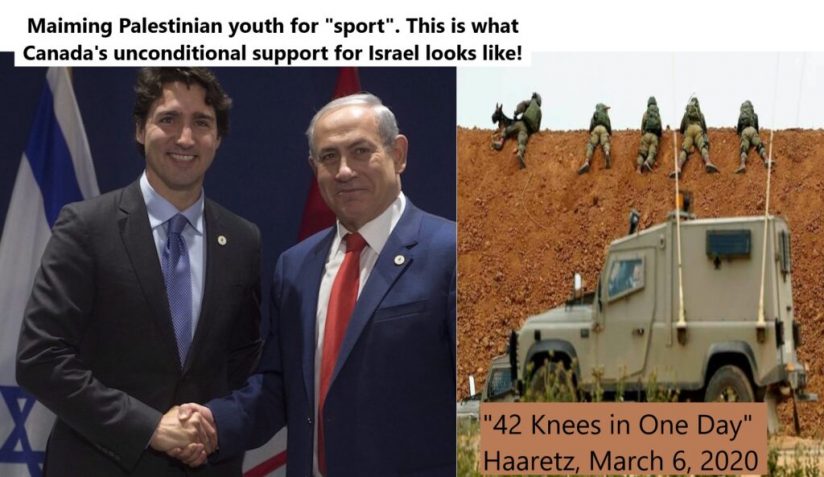
Maiming Palestinians for Sport is a War Crime
By Marion Kawas | Palestine Chronicle | March 10, 2020
The new Haaretz report entitled “42 Knees in One Day” is a difficult and painful read, and many people of conscience have responded with disgust and rage.
For those few who have not seen the report, it details in chilling fashion the accounts of 6 Israeli snipers who were stationed at the border with Gaza during the Great Return March protests. The report is long and gruesome; I had to put it down and then return to it several times. The “42 knees” reference is the “high count” for how many Palestinians were maimed by a single sniper team in one day.
The overall message is one of devastating impunity and disregard for the sanctity of Palestinian life. Palestinians and their long-time supporters have always known this was the mentality at play, but to see it all compiled in one place, in black and white, in the soldiers’ own words, was damning. Especially here in Canada, where barely a week earlier, it was revealed that the Trudeau government had called on the International Criminal Court not to investigate war crimes accusations against Israel.
“Canada’s longstanding position is that it does not recognize a Palestinian state… In the absence of a Palestinian state, it is Canada’s view that the Court does not have jurisdiction in this matter under international law,” Canada’s Foreign Ministry reportedly told various media outlets.
This is the same Canadian government that is busy traveling the world trying to get (or buy) votes for a UN Security Council seat. That has sent Joe Clark, a former Prime Minister, to visit multiple Arab countries looking for support; the Joe Clark that pioneered the idea of moving Canada’s embassy from Tel Aviv to Jerusalem back in 1979, an election promise that he was later forced to abandon.
The same government whose Deputy PM and former foreign minister, Chrystia Freeland, informed an Israeli audience in late 2018 that Canada would be an “asset for Israel” at the UN Security Council if it got one of the non-permanent member seats.
Canada, and other governments, must understand that there is a direct trajectory from their unconditional support for Israel to the continuation of Israeli war crimes against the Palestinian people.
Hampering the ICC investigation, refusing to accept your own court’s decision on labeling of Israeli settlement wines, smearing pro-Palestinian advocates as “anti-semitic” as happened at York University last year, all of this enables the Israeli government and military to feel they are immune to any sort of accountability.
This new report on Israeli sniper violence against Palestinians is most profound in what lies in the shadows: the Israeli military’s crude but effective approach. Promoting the concept that maiming these Palestinian youth is somehow “more humane” than killing them outright. But permanently disabling them in a poor society with few resources for the healthy let alone the injured, is an equally cruel fate. And a poignant and daily reminder to the rest of that society of the price to be paid for rebellion.
Most of the sniper accounts demonstrated a total lack of appreciation of the consequences or severity of their actions. One said, when talking about the other soldiers and their initial reaction to maiming their victims:
“He has fulfilled himself just now, it’s a rare moment. Actually, the more he does it, the more indifferent he’ll become. He will no longer be especially happy, or sad. He’ll just be.”
The snipers work in a team with a locator and the “42 in one day” soldier, related how he suggested to his locator to take over the shooting when they were getting close to the end of their shift because “he didn’t have knees”.
And “you want to leave with the feeling that you did something”. (Note its just “knees”, not Palestinian lives or limbs.) The parallel here with how sports teams allow rookie players to be involved at the end of a game that they know they are winning, is unmistakable. And it also highlights that these snipers didn’t seem to feel threatened and had few concerns about their own safety.
I realize that the Israeli snipers are themselves indoctrinated kids. But I hate the system and ideology that brought them to this, that placed them on those dirt embankments overlooking the people of Gaza, that made them think this was all “sport” or a video game where the player with the most points wins.
And if I feel such rage thousands of miles away, I can only imagine (and will never judge) how the youth of Gaza and their families must feel.
– Marion Kawas is a member of the Canada Palestine Association and co-host of Voice of Palestine.
Joe Biden: Father of the Drug War’s Asset Forfeiture Program
By Chris Calton – Mises Institute – 03/06/2020
In 1991, Maui police officers showed up at the home of Frances and Joseph Lopes. One officer showed his badge and said, “Let’s go into the house, and we will explain things to you.” Once he was inside, the explanation was simple: “We’re taking the house.”
The Lopses were far from wealthy. They worked on a sugar plantation for nearly fifty years, living in camp housing, to save up enough money to buy a modest, middle-class home. But in 1987, their son Thomas was caught with marijuana. He was twenty-eight, and he suffered from mental health issues. He grew the marijuana in the backyard of his parents’ home, but every time they tried to cut it down, Thomas threatened suicide. When he was arrested, he pled guilty, was given probation since it was his first offense, and he was ordered to see a psychologist once a week. Frances and Joseph were elated. Their son got better, he stopped smoking marijuana, and the episode was behind them.
But when the police showed up and told them that their house was being seized, they learned that the episode was not behind them. That statute of limitations for civil asset forfeiture was five years. It had only been four. Legally, the police could seize any property connected to the marijuana plant from 1987. They had resurrected the Lopes case during a department-wide search through old cases looking for property they could legally confiscate.
Asset forfeiture laws once applied only to goods that could be considered a danger to society—illegal alcohol, weapons, etc. But with the birth of the modern war on drugs, lawmakers pushed for something with more teeth, which they achieved with the 1970 passage of the Racketeering Influence and Corrupt Organizations (RICO) Act. Although many are familiar with the story of the steady expansion of civil asset forfeiture laws, many overlook the fact that presidential candidate Joe Biden helped put these laws on previously apathetic law enforcement agents’ radar and, worse, played a significant role in broadening their application. Biden has effectively aided and abetted the police state’s sustained assault on American subjects’ property rights.
Expanding Asset Forfeiture, Phase I: The RICO Act of 1970
In 1970, the targets of asset forfeiture were wealthy crime bosses. It was prosecutor G. Robert Blakey, who had worked under Attorney General Robert Kennedy and various congressmen, who set about broadening its scope. He helped draft a bill for a new legal concept, “criminal forfeiture,” which would allow police to seize the illegally acquired profits of a convicted criminal.
The assets that could be seized would now consist of anything that was funded with money connected to criminal activity. To appease those who were worried about abuses of power, Blakey assured them that prosecutors would have to prove beyond a reasonable doubt that the criminal was guilty of a crime before the assets could be seized. There was nothing to worry about; only legitimate bad guys would suffer.
The new policy was passed as part of the Racketeering Influence and Corrupt Organizations (RICO) Act in 1970. Blakey was a fan of the 1931 movie Little Caesar, and the acronym was crafted to honor Blakey’s favorite character from the movie, the gangster Rico Bandello.
The RICO Act wasn’t designed to be part of the war on drugs; it was just meant to target criminals. But when Richard Nixon took office, the RICO Act was one of a number of new tools that the members of his newly created Bureau of Narcotics and Dangerous Drugs (precursor to the Drug Enforcement Administration (DEA)) could use to fight his drug war. Combined with other legal innovations, such as no-knock raids and mandatory minimum sentences, Nixon and his administration would cure America of the drug menace.
Still, the pesky “conviction” requirement stood in the way of law enforcement’s ability to seize criminal assets. In 1978, Jimmy Carter’s director of the Office of Drug Abuse (the title “drug czar” is often retroactively applied), Peter Bourne, decided that the law needed to be changed. Bourne learned of an incident at the Miami International Airport in which a suitcase had been left on the baggage carousel for three hours before police picked it up and found $3 million inside. If drug kingpins could afford to abandon so much money, they must be flush with enough cash to hardly worry about criminal forfeiture laws.
So, at Bourne’s urging, Congress modified the RICO Act to allow the DEA to confiscate assets without a conviction. The burden of proof wasn’t entirely gone (yet), but the government only needed an indictment, rather than a full conviction, to justify asset seizure. After all, the government knew who a lot of these kingpins were, but the criminals continued to get rich while the DEA struggled to build cases against them.
Even then, though, real estate was off limits. Asset forfeiture had evolved from the seizure of dangerous items into criminal profit following a conviction, and now into criminal profit (and its “derivative proceeds”) without the conviction requirement. But real estate—such as the Lopes house—still couldn’t be touched.
But through the 1970s, the RICO Act was still largely ignored by prosecutors. Blakey was holding seminars out of Cornell University, which were attended by federal law enforcement agents and prosecutors, urging them to take advantage of the RICO Act in the war on drugs. He made few inroads. The law was unwieldy, and prosecutors were overworked. More often than not, it wasn’t worth their time. While Blakey was proselytizing the virtues of his law to little effect, he was unwittingly gaining an ally in Congress: Senator Joe Biden.
Expanding Asset Seizure, Phase 2: Biden and the Comprehensive Crime Control Act of 1984
Biden, a young Senator from Delaware, had to do something to show that despite his “liberal” reputation, he could be just as tough on crime as his Republican colleagues. He took notice of the RICO Act, and he realized that law enforcement agencies were not taking advantage of it, particularly in waging the drug war. He turned to the General Accounting Office and asked them to produce a study on the potential uses of RICO for drug enforcement.
The report showed that the RICO Act granted enormous powers to police to confiscate drug-related assets but that these powers were not being taken advantage of: “The government has simply not exercised the kind of leadership and management necessary to make asset forfeiture a widely used law enforcement technique,” the report stated. By the time the report came in, Ronald Reagan was settling into office and getting ready to renew the war on drugs.
Reagan brought the FBI into the drug war, and he gave the director, William Webster, a mission. His agents would use the powers of the RICO Act to find drug rings and take away their assets. Drug cartels must be rendered unprofitable. As the 1980s progressed, the war on drugs would be the country’s biggest political issue. Politicians from both parties would work to show that they could out–drug warrior their opponents. One Democratic representative from Florida, Earl Hutto, said, “In the war on narcotics, we have met the enemy, and he is the U.S. Code.”
Biden brought the RICO law to the attention of the federal government, Reagan enlisted the FBI to use it against drug traffickers, and both parties would now work to dismantle any limitations that the law might still impose.
The drug war became a contest of political one-upmanship. Reagan’s Justice Department fought for all kinds of new powers. Attorney General Edwin Meese and Assistant Attorney General William Weld (yes, that Bill Weld) railed against the limitations on their legal prerogative. Weld went so far as to argue in favor of the legality of using the Air Force to shoot suspected drug-smuggling planes out of the sky, a policy that even his boss was unwilling to endorse.
But Meese, Weld, and everyone else seemed to agree that forfeiture laws didn’t go nearly far enough. By requiring an indictment, the government still had to meet some standard of reasonable guilt before seizing property, which allowed far too many criminals that law enforcement knew to be guilty (but couldn’t build a case against) to keep their ill-gotten gains. To take things further, the Justice Department argued that law enforcement should be allowed to take “substitute” property: they knew that they wouldn’t be able to take everything that had been paid for with drug money, so it stood to reason that they should be able to take legally acquired assets of equal value (however that might be determined). And finally, with real estate off limits, the government was unable to seize marijuana farms, drug warehouses, and criminal homes.
The Comprehensive Forfeiture Act fixed all of these problems. Biden introduced the new bill in 1983, and its provisions became law the next year. Under this law federal agents had nearly unlimited powers to seize assets from private citizens. Now the government only needed to find a way to let local and state police join the party.
Biden’s bill was passed as part of the 1984 Comprehensive Crime Control Act. In addition to a slew of new powers for prosecutors, the burden of proof for asset seizure was lowered once again (agents had to only believe that what they were seizing was equal in value to money believed to have been purchased from drug sales). More significantly, the bill started the “equitable sharing” program that allowed local and state law enforcement to retain up to 80 percent of the spoils.
The law took effect in 1986, the year before Thomas Lopes pled guilty to charges of growing a marijuana plant in his parents’ backyard. In 1987, when Thomas faced the judge, the government had just made it so that his local police had an enormous incentive and unchecked authority to seize property from private citizens, so long as they could show any flimsy connection to drugs. By 1991, the Maui police were running out of easily seized property, so they started combing through case files within the five-year limit to find new sources of enrichment for their precinct using the expanded RICO powers. One such file brought the Lopes home to their attention.
But the Lopeses are only one example out of millions. In the year their home was confiscated by police for a minor, four-year-old drug charge, $644 million in assets were seized. In 2018 alone, the Treasury Department’s Forfeiture Fund saw nearly $1.4 billion in deposits . The Lopes story merely illustrates that criminals (regardless of how one might feel about drug laws) are hardly the only people falling victim to this policy.
The decades-long abuse of this policy has reached such extreme proportions that people on all sides of the political aisle have been turning against it. At this writing (February 20, 2019 for the original version of this article), the Supreme Court has unanimously voted in favor of Tyson Timbs , whose $42,000 Land Rover was seized in 2015 following a conviction for selling $400 in heroin. The court is asserting that asset forfeiture constitutes a fine and that the Eighth Amendment—which protects citizens from excessive fines—applies to both state and local governments. The consequences of the ruling remain to be seen, but it seems nearly certain that the unanimous decision was motivated by the increasing outrage against the civil asset forfeiture policies.
In the fight against the egregious violation of property rights that is asset forfeiture, Americans must not forget who promulgated these laws and birthed a new paradigm of government aggression against private persons that is proving difficult to overturn.
References
Baum, Dan. 1996. Smoke and Mirrors: The War On Drugs and the Politics of Failure. Boston: Little, Brown and Company.
Chris Calton is a 2018 Mises Institute Research Fellow and an economic historian. He is writer and host of the Historical Controversies podcast.
See also his YouTube channel here.
Hamas condemns continued detention of Palestinian officials in Saudi Arabia
Press TV – March 9, 2020
A Hamas spokesman has condemned the continued detention and prosecution of Palestinian figures in Saudi Arabia over their support for the Palestinian resistance movement, urging Riyadh to immediately release them.
“The national and pan-Arabism duty requires honoring those people and not trying them in this way,” Hazim Qassim told Lebanon’s Arabic-language al-Mayadeen television on Sunday.
He added that Arab countries should reinforce the Palestinian cause and “not weaken its resistance with such trials”.
The spokesman said Hamas has contacted various parties to secure the release of Palestinian detainees in the kingdom, expressing hope that Saudi authorities would respond to those efforts and release the detainees.
His remarks came as a Saudi court on Sunday held the first hearing in the case of 68 Palestinian and Jordanian detainees.
According to al-Mayadeen, the detainees are charged with “supporting terrorism and financing it” and belonging to “a criminal terrorist entity”.
Senior Hamas official Muhammad al-Khudari and his son Hani, who were arrested last April, were among those who stood trial on Sunday.
Al-Khudari represented Hamas in Saudi Arabia between the mid-1990s and 2003. He has held other important positions in the Palestinian resistance movement as well.
Saudi Arabia’s repressive measures against the Palestinian resistance movement as well as those seeking to collect donations for people living in the Israeli-blockaded Gaza Strip come as the kingdom and Israel are believed to be planning to publicize their secret ties.
Gaza has been blockaded by the Israeli regime since 2007.
Last month, Saudi authorities launched a new campaign of “arbitrary” arrests against Palestinian expatriates on charges of supporting Hamas.
The Prisoners of Conscience, a non-governmental organization advocating human rights in Saudi Arabia, announced on February 12 that the kingdom had detained a number of Palestinians, including the relatives or children of those imprisoned last April for the same reason.
Over the past two years, Saudi authorities have deported more than 100 Palestinians from the kingdom, mostly on charges of supporting Hamas financially, politically, or through social networking sites.
Israeli occupation forces impose closure on Bethlehem
Palestine Information Center – March 8, 2020
 BETHLEHEM – Israeli occupation forces (IOF) on Thursday night closed off Bethlehem City in the West Bank at the pretext that a number of Palestinian citizens were diagnosed with coronavirus.
The IOF banned citizens from entering or leaving the city until further notice.
Local residents said that although there are infected people in both Bethlehem and the Israeli-controlled 1948 territories, stricter measures were taken in Bethlehem, which makes the IOF decision unclear.
On Friday, the Palestinian Authority’s Ministry of Health announced that the number of people tested positive for coronavirus increased to 16. All of them are placed under quarantine in a hotel in Beit Jala area in Bethlehem.
Featured Video

When Israel Is Mighty
or go to
Aletho News Archives – Video-Images
From the Archives
US murdering 1 million Iraqis is democracy, Iran giving yogurt to Iraq is “domination”
By Ali Salaam | American Herald Tribune | July 31, 2017
The New York Times, owned by the Zionist Jewish supremacist Ochs-Sulzberger family, has no problem with Iraqi suffering as long as Iran is not the one behind it.
The Iraq War was a genocide of the Iraqi people by Zionist supremacists in the Bush administration. Over 1 million innocent people were killed based on a lie. American soldiers died in an Israeli war and now an average of 22 soldiers commit suicide every day because their consciences cannot cope with the fact they committed crimes in an illegal war that served no purpose other than to benefit Israel, not America.
Benjamin Netanyahu, Prime Minister of the Zionist regime, once said “We are benefiting from one thing, and that is the attack on the Twin Towers and Pentagon, and the American struggle in Iraq.”
Paul Wolfowitz had his sights on Iraq since his time in the first Bush administration. Former Israeli official and Bush administration official Richard Perle had his eyes on Iraq since at least his authorship of the Clean Break white paper. The Zionist regime had their eyes on Iraq since the 1980s when strategist Oded Yinon wrote his white paper in support of dividing the Arab-Muslim world along ethnic and sectarian lines. The global Zionist lobby has had their eyes on Iraq since Theodor Herzl stated that Eretz Israel’s true borders go from the Nile River in Egypt to the Euphrates River in Iraq. … continue
Blog Roll
 Aletho News
- MEP blasts ‘Euro-Gestapo’ for lecturing Russia on democracy
- Syria May Send Troops to Saudi Arabia Amid War with Ansar Allah
- UK whines about losing billions to ‘Putin tax’
- Baghaei to Rubio: Distorted narratives cannot erase US record of broken commitments
- Houthis Don’t Have to Conquer Saudi Arabia to Make It Pay
- MOE: Nearly 22,000 Students and Education Workers Killed
- Guterres in Islamabad: Genocide, cowardice, and the cage of Imran Khan
- Johnson, Marandi say Yemen holds upper hand over Saudi Arabia
- False flags won’t save aggressors, Iran FM spokesman says
- The Makkah Pact Enters Into Force: The End of American Dominance or Its New Form?
- If Americans Knew
- Nearly 2 Million in Gaza Need Urgent Shelter Assistance as Winter Looms: IOM Chief Warns
- Suppressing Palestinian resistance: US charity under fire for AI monitoring of Gaza classrooms
- Thousands Are Held in Israeli Torture Camps. This Is What Happens Inside
- Israel puts Gaza’s sick, injured, newborn in peril – Daily Update
- Report claimed Mark Levin used by Israeli government to influence Trump
- Over 2,000 Gazans have died awaiting medical evacuation amid Israel’s continued siege
- How a U.S. Diplomat Suppressed and Altered Reports Critical of Israel
- 5 Palestinians Die from Israeli Strikes in Gaza as Relentless Attacks Continue
- Report: Ceasefire Slows Killing but Leaves Devastation Intact
- Country Music Singer Zach Bryan Breaks Attendance Record at Robert Kraft’s Gillette Stadium While Wearing ‘Free Palestine’ Shirt for Second Night in a Row
- No Tricks Zone
- New Study: 50 Years Of The Most Aggressive ‘Net Zero’ Policies Can Only Affect The Global Climate By 0.03°C
- US September “Heat” Was No Record…Many Records Set Decades Ago
- Latest European Green Energy Debacle; Portugal’s Largest Flagship Solar Park Insolvent!
- Green Energy Debacle: German Expert Professor Fritz Vahrenholt Warns Of Severe Economic And Social Consequences
- Two More Paleo Reconstructions Affirm Meters-Higher Sea Levels Across Ireland, Brazil 7000-6000 Years Ago
- New Study: Earth And Venus Surface Warmth Largely Explained By Convection And Lapse Rate, Not CO2 Or Radiation
- 2025 Nature Paper Claiming Worsening Global Drought Gets RETRACTED …Heavily Flawed
- New Study: ‘Global Drought Shows No Detectable Recent Acceleration Under Climate Warming’
- Economic Masterminds: German Socialists Suggest Taxing Productivity Gains Stemming From Using AI
- The South China Sea Has Not Been Cooperating With The Climate Change Narrative

