Saudi Arabia to Execute 18-year-old for Allegedly “Sowing Sedition”

Al-Manar | June 8, 2019
Saudi Arabia is seeking the death penalty for an 18-year-old it detained in 2014 for protesting on his bicycle as a 10-year-old.
It would make him the fourth teenager to be executed this year.
Murtaja Qureiris was retrospectively arrested by Saudi police in 2014 for allegedly staging a number of protests during the country’s Arab Spring movement in 2011.
Saudi prosecutors claim that Qureiris’ alleged activities encouraged the “sowing of sedition” and made him part of “an extremist terror group,” which warranted the death penalty. Qureiris denies those charges.
Election? What Election? EU Elite Will Censor Their Way Out of This Mess (or Die Trying)
By Helen Buyniski | Aletho News | June 7, 2019
The neoliberal establishment is wringing its hands in the wake of European elections that proved a resounding victory for populist parties across the continent, casting around for someone to blame but utterly incapable of realizing their own interference has doomed them. Doubling down on the censorship, they are determined to provoke the catastrophe they need to make free speech history.
The NGO-industrial complex was operating at maximum capacity in the weeks leading up to the election, shutting down hundreds of Facebook pages deemed “fake” or “hate speech” in the hope of controlling the messages reaching voters before they made the terrible mistake of voting for a candidate who represents their interests.
Led by Avaaz, which claims to be a “global citizens’ movement monitoring election freedom and disinformation,” this well-heeled fifth column whipped the press into paranoid frenzies with reports like “Fakewatch,” which breathlessly documented 500 “suspicious” pages and groups it claims are “spreading massive disinformation.” The groups have little in common other than their alleged “link[s] to right-wing and anti-EU organizations,” a capital offense for the promoters of “democracy,” which can only be permitted where it doesn’t stray from the center-left path of most #Resistance.
“Far-right and anti-EU groups are weaponizing social media at scale to spread false and hateful content,” the study warns, gloating that after sharing its findings with Facebook, the platform shut down an “unprecedented” number of pages on the eve of the election (77 out of the 500, according to VentureBeat, which has credulously signal-boosted every utterance of Avaaz as if it is divine truth from the Oracle of Delphi). Avaaz’s reports frame the problem as an affliction of the right wing only, even though disinformation is second nature to political operatives at both ends of the spectrum (and, more importantly, in the sanctified center).
The Computational Propaganda Project, an Oxford-based research group, made no secret of its elitist leanings, declaiming, “On Facebook, while many more users interact with mainstream content overall, individual junk news stories can still hugely outperform even the best, most important, professionally produced stories,” as if users have no choice but to consume “professionally-produced” Oxford-approved material or wallow in junk content. And Facebook’s own statistics bear out the hypothesis that coordinated inauthentic behavior has surged – the site removed almost 3.4 billion “fake” accounts from October 2018 to March 2019, more than the number of actual users.
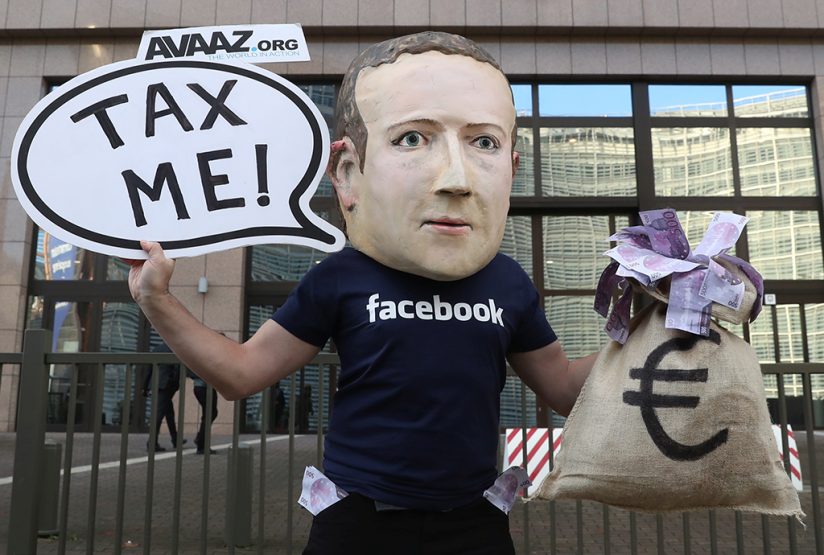
Activist wearing a mask depicting Facebook CEO Mark Zuckerberg demonstrates during the EU finance ministers meeting at EU headquarters in Brussels, Belgium, December 4, 2018. REUTERS/Yves Herman
But Facebook is not simply targeting fake accounts for takedown. Last Sunday, as Europeans prepared to head out to the polls, Facebook froze the largest group used by the Yellow Vests to organize protests and share information, silencing its 350,000+ members at a critical moment in French politics. More than one group member, reduced to commenting on existing posts, pointed out that President Emmanuel Macron met with Facebook chief executive android Mark Zuckerberg three weeks earlier to discuss a first-of-its-kind collaboration in which French government officials are being given access to material censored from users’ newsfeeds, essentially permitting them direct control of what the French are allowed to see on social media. Facebook, then, is providing France with the same techno-fascist services it provides the US government: Facebook will take on the burden of actually censoring dissent, thus skirting any pesky free-speech laws that might otherwise trip up a government that attempted to do the same.
Avaaz focused on the Yellow Vests in its coverage of the French elections, complaining RT France was getting huge quantities of views compared to native French media – perhaps because native French media have been doing Macron’s bidding and attempting to minimize the protests. By framing RT as a perpetrator of “information warfare,” the NGO was making a deliberate effort to have it deplatformed under one of Macron’s controversial police-state laws passed in 2018, by which any outlet spreading so-called “false information” can be gagged for three months leading up to an election. Yet Macron’s own interior minister, Christophe Castaner, lied on Twitter when he claimed the Yellow Vests had attacked the Pitié-Salpêtrière hospital in Paris, and RT was the first outlet to publish the truth about the incident. Who is the disinfo agent?
When the election results came in, Avaaz and its political allies in the neoliberal center could only gape in disbelief. Surely they had wiped La Liga and the Front National (now National Rally) from social media, salting the earth in their wake? How had they won? And what happened in Germany, where Angela Merkel’s CDU performed worse than ever in European election history? Merkel could blame YouTube – 70 influential video stars put out a call to their followers to shun her coalition – but the creators also called for shunning the far-right AfD, so the platform couldn’t be demonized as a tool of the ever-present Nazi Threat. That didn’t stop her party from trying, of course – CDU party leader Annegret Kramp-Karrenbauer complained about online “propaganda” and promised to “tackle this discussion quite aggressively.”
The populist parties won in large part because of the establishment’s unseemly embrace of fascist tactics, from the UK’s totalitarian information warfare disguised as “protecting citizens” or France’s visceral police violence, maiming protesters as if for sport. Europeans voted out of disgust with an establishment so insecure in its control of the narrative that it has sought to annihilate all signs of dissent, dismissing euroskepticism as Russian astroturfing and xenophobia and plugging its ears to the legitimate grievances of its subjects. The National Rally may have beat Macron’s jackbooted thugs, who in the past two months have hauled half a dozen journalists in for questioning by intelligence agencies for publishing stories that embarrassed the regime, but nearly half of French voters refused to vote for anyone at all, according to an Ipsos poll, and Germany’s Greens mopped the floor with Merkel’s coalition among young voters.

The triumph of Nigel Farage’s Brexit party in the UK is the product of a populace wrestling with cognitive dissonance, forced to realize that the “constitutional monarchy” they believed they lived in isn’t so constitutional after all, having jettisoned its democratic mask to cling to the EU under the guise of good old British pragmatism. Even passionate Remainers are happy to see Theresa Maybe go, though it remains to be seen whether her successor will be any more inclined to honor the result of 2016’s referendum. Meanwhile, the Guardian’s embarrassing attempt to shame Farage over a handful of appearances on the Alex Jones show – the paper claimed any reference to “globalists” and “new world order” were dog-whistles for the dreaded “antisemitic conspiracy theories” – proves the establishment media will never regain narrative primacy as long as alternatives exist. Jones, for all his flaws (and they are legion), has a massive audience; the Guardian, despite being propped up by the UK government’s Operation Mockingbird-esque “Integrity Initiative” (and the award for most ironic name ever goes to…), does not.
With the vast American election-fraud apparatus scrambling to prepare itself for 2020, now enabled by Pentagon-funded, Unit-8200-approved Microsoft “election security” software from the makers of the wrongthink-babysitter browser plugin NewsGuard, the US ruling class seems to be poised to make the same mistake as its global peers. Facebook, working hand in hand with the Atlantic Council, has banned and shadowbanned legions of anti-neoliberal activists over the past year, selectively applying (and inventing) new rules in an effort to keep popular content-creators jumping through hoops instead of influencing the discourse. Facebook has been allowed its place of privilege because as a “private corporation” it is legally permitted to violate users’ free speech rights in ways the US government cannot. But if Facebook can’t deliver a victory for the “right guys” this time around, it will be punished. Indeed, a massive anti-trust probe appears to be in the offing, 14 years of Zuckerberg apologies notwithstanding.
The site learned back when it tried to roll out a “disputed” tag for “wrongthink” stories that people were actually more likely to click on those stories; it learned the lesson again when its hugely expensive Facebook Watch news show featuring Anderson Cooper flopped last year. Zuckerberg is on the record begging for government regulation; will Facebook and Twitter use the outcome of this round of elections as a springboard for further crackdowns?
YouTube already has – thousands of creators found their channels demonetized and riddled with takedown notices this week in what has been dubbed the #VoxAdpocalypse after a pathologically whiny Vox blogger became the face of the mass deplatforming, but the censorship appears to be more of a response to Macron’s Orwellian “Christchurch call” to censor “extremism” – that ill-defined conveniently-variable catch-all whose borders are perpetually expanding to engulf all inconvenient speech – aided and abetted by the ADL than Google taking pity on a thin-skinned professional victim.
A sinister coalition of MEPs, “civil society” groups, and the Transatlantic Commission on Election Integrity – a who’s who of war criminals, psychopaths, and oligarchs that includes Michael Chertoff, John “death squad” Negroponte, Victor Pinchuk, and Anders Fogh Rasmussen – has already demanded “parliamentary inquiries into the impact of the use and abuse of technology platforms on democracy and elections.” It’s no coincidence that several of these “election integrity” enthusiasts sit on the board of NewsGuard, which is currently trying to weasel into the EU’s internet regulatory framework by playing up the “disinformation” threat.
The blue-check intelligentsia has been trying for years to convince the hoi polloi that “conspiratorial” thinking is somehow detrimental to democracy. Former Obama labor secretary Robert Reich told Buzzfeed exactly that – “If we become a conspiracy society, we all carry around a degree of paranoia and that’s not healthy for democracy.” But this divorces cause from effect, as if “conspiracy theorists” have formulated their theories out of whole cloth – as if there isn’t evidence for these theories piled knee-deep, as if once-trusted institutions haven’t proven themselves time and again to be as trustworthy as tabloid tales of Elvis risen from the grave. If paranoia is unhealthy for democracy, how is a media incentivized to lie, misdirect and obfuscate any better?
The populist wave has been conflated with an uptick in “hate” in an attempt to delegitimize and demonize it. Outside of groups like the ADL, whose statistics are easily debunked, there is no credible evidence bigotry is on the rise, but as an actual Nazi once said, tell a big enough lie often enough, and it might as well be real. Beginning around 2012, the establishment media began relentlessly flogging the “white privilege” narrative in an effort to fan the flames of interracial conflict. Political science doctoral student Zach Goldberg performed an analysis of several terms using the LexisNexis database and found evidence of heavy narrative manipulation – “whiteness” was mentioned in four times as many news articles in 2017 as in 2012, “white privilege” was mentioned ten times as often in 2017 as in 2012, and “racism” was mentioned ten times as often in the New York Times alone in 2017 as in 2012. Yet even as the media has seemingly talked of nothing else, actual prejudice – by whites against non-whites, at least – has declined since 2008, according to a University of Pennsylvania study published last month, and the FBI’s own statistics show hate crimes against most minority groups are on the decline. Because few European governments separate “hate crimes” from “normal” crime statistics, information on bigotry in Europe often comes solely from NGOs and “civil society” groups that rely for their funding on the perception that Hate is on the march. Populists are capable of prejudice like anyone else, but it is their defining characteristic – a “prejudice” against oligarchy – that motivates the smears churned out by the media.
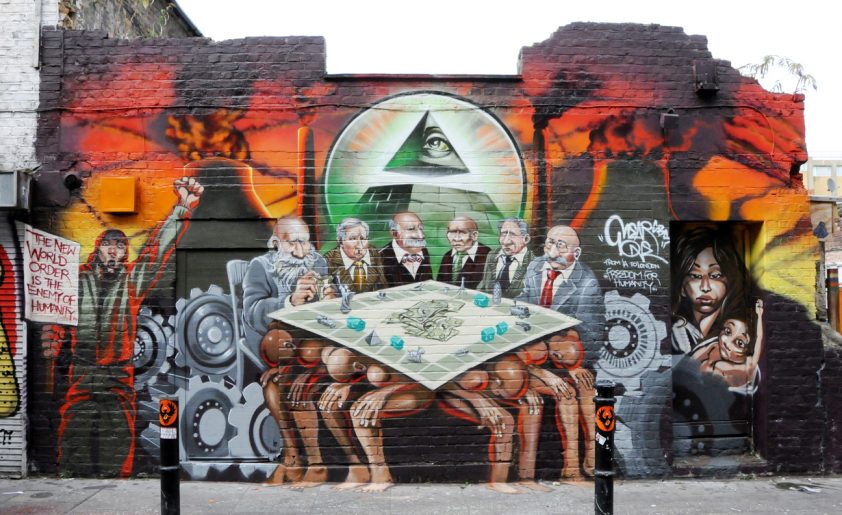
Protest votes like Trump and Brexit are cries for help from a disenfranchised populace. The European elections boasted the highest turnout in decades, and the ruling class ignores the results at its peril. When the election ritual no longer satisfies a population’s need to feel it is exerting its free will on society, we get public hexings of political figures, people reasoning black magic is more likely to solve their problems than voting. This is the same desperation that leads people like Arnav Gupta to set themselves on fire in front of the White House. Europeans have demonstrated unequivocally that they are sick of unaccountable dictatorship from Brussels, where EC President Jean-Claude Juncker, never one for sympathy with the little guy, sneers at the “populist, nationalists, stupid nationalists” who are “in love with their own countries.” They are sick of being displaced from their homes by a seemingly endless tide of migrants, just as those migrants themselves are displaced from their homes by a seemingly endless tide of American wars. Both groups are victimized by the IMF’s neoliberal austerity policies, epitomized by Juncker, who has done more than perhaps any one person to help Europe’s corporate “citizens” dodge taxes while nickel-and-diming the humans.
Instead of addressing these legitimate grievances, those in power on both sides of the Atlantic tighten the screws on online discourse – out of sight, out of mind. YouTube declares conspiracy theorizing a form of hate speech and plays whack-a-mole with a documentary confirming everyone’s long-standing suspicions that “save-the-migrants” NGOs are cashing in on the desperate human tide. Big Tech promises to work even more closely with Big Brother to crack down on dissident speech, tarring its victims as Nazis while hoping no one will point out such collusion is one of the defining characteristics of fascism.
These measures are guaranteed to further radicalize the discontent. Deleting social media accounts does not delete the people behind them, and France has already proven that starving a protest movement of media attention only makes it angrier. The ruling class may welcome their rage, aiming to use the inevitable outbreak of violence to choke off the last avenues of free expression, but once the guillotines come out, it isn’t the masses’ heads that will be rolling in the streets.
The Vaccine Debate — highlights in vaccine industry and medical research
By Richard Hugus | Aletho News | June 6, 2019
All states in the US mandate vaccines for school children, effectively taking away the right to education for families refusing vaccination. Different states allow one to three exemptions from mandatory vaccination on philosophical, religious or medical grounds. In 2015 the California legislature passed a bill (SB277) removing the philosophical or personal belief exemption. The religious exemption had already been removed. This left only the medical exemption, which is difficult to obtain. because doctors fear losing their medical licenses if they grant the exemption. The Maine state legislature recently followed suit, removing all religious or philosophical vaccine exemptions. Mandatory vaccination depends on the assumption that all recommended vaccines are safe for all children. As state laws are going in the direction of more and more coercion, this is a good time to ask if that assumption is valid.
Dr. Plotkin
In October 2017 the divorced parents of a two year old child brought a case before the Circuit Court of Oakland County Michigan to settle a disagreement as to whether their daughter should have to be vaccinated. The mother was against; the father was for. Dr. Stanley Plotkin, an MD with experience in vaccine research going back to the ’60s, stepped forward as an expert in favor of vaccination. He was questioned by counsel representing the plaintiff (the child’s mother) in a deposition which ended up doing more harm than good not only to the father’s case but to the whole idea that ethics are of any real importance to researchers and industry promoting vaccines.
In a three minute clip from the nine hour deposition, Dr. Plotkin admitted:
- That he had used orphans to study an experimental vaccine.
- That he had used mentally retarded children to study a rubella vaccine.
- That he had written a letter to the editor of “Ethics On Human Experimentation” in which he says “the question is whether we are to have experiments performed on fully functioning adults and on children who are potentially contributors to society or to perform initial studies on children and adults who are human in form but not in social potential.”
- That he had used babies of mothers in prison to study an experimental vaccine.
- That he had used individuals under colonial rule in the Belgian Congo in an experiment involving almost a million people to study an experimental vaccine.
Elsewhere in the deposition, Plotkin said that he had helped create a vaccine advocacy group called Voices For Vaccines. He claimed the group was independent, but admitted on questioning that it was funded by the vaccine industry. Plotkin is a good example of a doctor so immersed in the prevailing dogma about vaccines that he can’t imagine other perspectives, or his own conflicts of interest. Not to mention the criminality of experimenting on people unable to assert their right to informed consent.
Paul Offit

Paul Offit
One of Dr. Plotkin’s students was Dr. Paul Offit, a tireless vaccine industry shill and developer of a rotavirus vaccine which made him a fortune. In October 2018 Robert Kennedy Jr. wrote a letter to Paul Offit to challenge the claim in Offit’s books that medical experts are the only authorities on vaccine safety. Kennedy writes:
“Your book title and press releases suggest that, in contrast to “celebrities, politicians and activists,” you consider yourself to be eminently qualified to furnish health information in a truthful and unbiased manner. I would like to take this opportunity to inquire as to whether your own substantial financial entanglements with the $52 billion vaccine industry—conflicts you deliberately conceal from your allies in the mainstream media—should disqualify you from representing yourself as a neutral and trustworthy voice in this contentious debate. You have accepted tens of millions of dollars from vaccine companies for your work as the primary spokesman for the industry. You occupy a chair at the Children’s Hospital of Philadelphia endowed with a $1.5 million grant from Merck, and you were a co-developer, with Merck, of the RotaTeq rotavirus vaccine.
Indeed, your financial conflicts of interest with the vaccine industry since the early 2000s, during your tenure on a key Centers for Disease Control vaccine panel, were the subject of two federal investigations. While sitting on the CDC’s Advisory Committee on Immunization Practices (ACIP), you voted to add a rotavirus vaccine to the CDC childhood vaccine schedule. You neglected to recuse yourself despite the fact that you had your own rotavirus vaccine patent in development. Six years later, thanks to the inclusion of rotavirus on the CDC schedule, you and your business partners were able to sell your patent for $186 million. This self-dealing transaction in which you effectively “voted yourself rich” was condemned by a 2003 congressional investigation and a 2008 investigation by the HHS Inspector General. Congressman Dan Burton described the “paradox” of the CDC “routinely allow[ing] scientists with blatant conflicts of interest to serve on influential advisory committees that make recommendations on new vaccines, as well as policy matters,” even though “these same scientists have financial ties, academic affiliations, and other vested interests in the products and companies for which they are supposed to be providing unbiased oversight.” When ACIP added your vaccine (RotaTeq) to the childhood vaccine schedule in 2006, policy-makers of the time acknowledged that the vaccine was “one of the most expensive” and potentially lucrative ever added to the schedule. Critics of the decision wondered why we were mandating a ruinously expensive and shoddily tested vaccine for tens of millions of children to combat mild illness that accounts for only a few dozen deaths in the United States annually.
You routinely talk about RotaTeq’s achievements, but you have never publicly commented on the elevated rate of agonizingly painful and sometimes deadly intussusception observed in recipients of RotaTeq nor on the vaccine’s contamination with DNA fragments from two porcine circoviruses known to cause serious wasting disease in pigs. Scientists and public health experts suggest that your vaccine may be infecting millions of children each year with these viruses. Since the vaccine was never properly safety tested against inert placebos, we may never know the truth.”
The Spanish Flu
In a November 2018 article, Kevin Barry, former federal attorney and president of First Freedoms, looks back at the beginning of the pharmaceutical industry in the early 20th century as it was getting its start under the auspices of the Rockefeller Institute for Medical Research in New York City. US soldiers about to be sent into World War I in Europe provided medical researchers an opportunity for experimentation (in this case on fully functioning adults).
Between 1918 – 19, Barry reports, more soldiers died of a mysterious disease called “the Spanish flu” than from bullets. The Spanish flu, he says, killed an estimated 50-100 million people worldwide. But it was neither Spanish, nor a flu. According to Barry, it appears to have originated at a military base in Fort Riley, Kansas in 1918 where doctors were experimenting with a Rockefeller Institute bacterial meningitis vaccine, using US soldiers. The soldiers who survived were deployed to Europe where they spread a deadly bacterial pneumonia among themselves while the Rockefeller Institute also sent the “vaccine” directly to several countries in Europe, in the end causing the death of millions of people
Gulf War Syndrome
In January1991 The Unites States attacked Iraq in what was called the Persian Gulf War.
An estimated 43,000 US veterans of the war came down with a variety of strange and illnesses attributable to mandatory experimental vaccines and drugs administered without informed consent.
Cornelius Rhoads
In November 1931 a Harvard trained MD named Cornelius Rhoads conducted a cancer experiment in Puerto Rico under the auspices of the Rockefeller Institute for Medical Investigations. Rhoads said in a letter:
“Porto Ricans are the dirtiest, laziest, most degenerate and thievish race of men ever to inhabit this sphere… They are even lower than the Italians. What the island needs is not public health work, but a tidal wave or something to totally exterminate the entire population… I have done my best to further the process of their extermination by killing off eight and transplanting cancer into several more. All physicians take delight in the abuse and torture of the unfortunate subjects.”
Rhoads should have been tried for murder, but instead found fame and fortune. He went on the establish biological warfare facilities for the US Army, made the cover of TIME magazine in 1949, and became the director of the famous Sloan-Kettering Cancer Center in New York.
Bill Gates
Art by David Dees
In 1999 Bill Gates launched The Global Alliance for Vaccination and Immunization. Dr. David Ayoub points out that The Global Alliance had membership and goals identical to those set out in US National Security Study Memorandum 200 presented to President Nixon by Rockefeller protegé Henry Kissinger in 1974. Memorandum 200 had an explicit goal of coercive population control in less developed countries.
In 2005 the Bill and Melinda Gates Foundation funded tetanus vaccinations for distribution by UNICEF in Africa. The vaccines were administered only to young women of child-bearing age. In 2014, doctors and Catholic clergy in Kenya had the vaccine independently tested and found that the vaccine contained an antigen called “human gonadotropin” which renders women infertile.
Bill Gates appeared in a 2010 TED talk in which he said: “The world today has 6.8 billion people. That’s heading up to about nine billion. Now if we do a really great job on new vaccines, health care, reproductive health services, we could lower that by perhaps ten or fifteen percent.”
If vaccines and reproductive health services are meant to save lives, how would they be useful in reducing a population?
To all appearances, the Gates and Rockefeller foundations are working together to promote population control under the guise of vaccine philanthropy.
The Vioxx Scandal
Vioxx was not a vaccine but its marketing reveals a great deal about the ethics of Merck Pharmaceutical, a major player in the vaccine industry. Vioxx was the brand name for a popular painkiller introduced by Merck in 1999. The drug was taken off the market in 2004, more than four years after a clinical trial and plenty of evidence, known to Merck, showed that it caused serious cardiovascular problems. Merck’s response was to “discredit, neutralize, and destroy” doctors critical of Vioxx. One spokesman at the FDA, which was by no means innocent in this scandal, said that the drug had caused “more than 27,000 deaths and heart attacks.” Like other pharmaceutical corporations, Merck considered the payment of damages for these deaths to be the price of doing business.
SIV and SV40
Experimental live polio vaccines, including the Salk polio vaccine, contained a virus found in monkeys which, when given to humans, may have created the worldwide HIV epidemic and untold cases of cancer in children and adults. According to the National Vaccine Information Center,
“an article [was] published in the March 1992 issue of The Lancet in which attorney Walter Kyle provided evidence that the human immunodeficiency virus (HIV) may have been created after simian immunodeficiency virus (SIV) entered the human population when African green monkey kidney tissues infected with SIV were used to produce polio vaccines. The Kyle article pointed out that scientists at the Food and Drug Administration and within industry suspected as early as the 1950’s and knew, by the mid-1970’s, that polio vaccine had been contaminated with simian viruses and that at least one of these monkey viruses – SV-40 – was later found to cause leukemia and cancerous tumors in lab animals.”
According to an archived fact sheet put out by the Centers for Disease Control, “more than 98 million American received one or more doses of polio vaccine from 1955 to 1963 when a proportion of vaccine was contaminated with SV40; it has been estimated that 10-30 million Americans could have received an SV40 contaminated dose of vaccine.”
Thimerosal
Thimerosal was a mercury-containing component of a several vaccines — the MMR (for measles, mumps, and rubella), DTaP (for diphtheria, tetanus, and pertussis), and flu shots. According to Shane Ellison, “The People’s Chemist“,
“The last entity to fund a thimerosal study in the United States was Eli Lilly, back in 1929. They’re not even a health agency; they’re a pharmaceutical drug company. That hardly offers proof of safety and efficacy. And, their test churned out horrific results, showing that 100% of the kids jabbed with trace amounts of Merthiolate — the trade name for thimerosal — died from meningitis. How could that possibly be considered safe? Meanwhile, the Pharma-funded authors (using ghostwriting) still concluded that there was no causal association between mercury in vaccines and harm.(4) Future court documents revealed, “Upon closer inspection, however, it is apparent that Lilly Scientists, deliberately withheld facts and, in doing so manipulated and distorted their conclusions, leading to corruption of published scientific literature concerning thimerosal.”
Thimerosal was supposedly taken out of vaccines around 2003 but it still appears in flu shots given to children and adults. Cases of autism in children have been linked to thimerosal. Dr. David Ayoub gave a very informative talk on this on a 2005 lecture linked here.
Comparative levels of mercury are cited by the National Vaccine Information Center as follows:
-
-
- 0.5 parts per billion (ppb) mercury = Kills human neuroblastoma cells (Parran et al., Toxicol Sci 2005; 86: 132-140).
- 2 ppb mercury = U.S. EPA limit for drinking water.
- 20 ppb mercury = Neurite membrane structure destroyed (Leong et al., Neuroreport 2001; 12: 733-37).
- 200 ppb mercury = level in liquid the EPA classifies as hazardous waste.
- 25,000 ppb mercury = Concentration of mercury in the Hepatitis B vaccine, administered at birth in the U.S., from 1990-2001.
- 50,000 ppb Mercury = Concentration of mercury in multi-dose DTaP and Haemophilus B vaccine vials, administered 4 times each in the 1990’s to children at 2, 4, 6, 12 and 18 months of age.
- 50,000 ppb Mercury = Current “preservative” level mercury in multi-dose flu (94% of supply), meningococcal and tetanus (7 and older) vaccines. This can be confirmed by simply analyzing the multi- dose vials.
-
Conclusion
At best, the history of vaccines is an example of gross human ignorance acting through the field of medical science. This ignorance comes from a lack of humility in our interaction with nature; the belief that science has all the answers; the belief that man can act as God.
At worst, vaccines were used knowingly for the purposes of eugenics. This is another kind of hubris — the usurpation of power by the few over the many, by an elite which believes it is in a position to best guide humanity and which is arrogant enough to believe it can engineer the whole world according to its own interests.
It is also clear that for the sake of money and profit, the pharmaceutical industry has knowingly caused disease and death, especially among poor and disadvantaged people in the world. And they have tried to cover it up. It is hard to accept the adage that “vaccines save lives” when we have so many examples of vaccines actually destroying lives.
Does the state have the right to inject anything into the bodies of children against the wishes of the child’s parents? According to the UN’s Universal Declaration on Bioethics and Human Rights, medical intervention must be accompanied by the “free and informed consent of the person concerned, based on adequate information.” What we are seeing today is an all-out war being waged by billion dollar pharmaceutical giants to bring more and more vaccines into a recommended schedule, and to make that schedule mandatory, while at the same time controlling the information parents need to protect their children. After so may lies and coverups, parents and doctors have very little reason to trust anything the pharmaceutical industry tells them.
YouTube’s Latest Purge
Video sharing platform enforces new rules against “extremist content”
By Kit Knightly | OffGuardian | June 5, 2019
YouTube has just announced they have changed their “community standards” to combat “extremist content” on their platform. This is just the latest step in the war against free speech online.
This move comes as no surprise – the press have been laying the groundwork for this for weeks, even months.
Three weeks ago Buzzfeed reported that YouTube’s monetised chat was “pushing creators to more extreme content”, and just yesterday it was reported that YouTube’s recommend algorithm was “sexualising children”.
You cannot move for stories about how bad YouTube is.
Given that, it comes as no surprise that the mainstream media are celebrating this latest “purge”.The Guardian reported:
YouTube bans videos promoting Nazi ideology
Whilst the Financial Times went with:
YouTube to ban supremacist videos
Both these headlines are wildly inaccurate, deliberately playing the racism/white supremacy angle in the hopes that people will clap along without reading anything else.
Vox was a little more truthful in its headline, reporting:
YouTube finally banned content from neo-Nazis, Holocaust deniers, and Sandy Hook skeptics
The Independent likewise:
YouTube to delete thousands of accounts after it bans supremacists, conspiracy theorists and other ‘harmful’ users
However, even these headlines – though a touch closer to the whole truth – leave out some really important information (I’m sure entirely by accident).
As much as the media are playing the neo-Nazi/hate speech angle, there’s far more to it than that.
To really dig down into what this means, we need to ignore the media and go straight to the source. This is YouTube’s official statement on the matter, posted on their blog.
The bans, contrary to the media headlines, are not about racism. They are far more incoherent than that – they are about “supremacist content”.
YouTube’s delightfully vague description of which, is as follows:
videos alleging that a group is superior in order to justify discrimination, segregation or exclusion based on qualities like age, gender, race, caste, religion, sexual orientation or veteran status.
Honestly, almost any video you wanted – that expresses a political position – could be twisted into fitting that description. But it doesn’t end there:
Finally, we will remove content denying that well-documented violent events, like the Holocaust or the shooting at Sandy Hook Elementary, took place.
What does “well documented” mean? It’s a deliberately ambiguous phrase.
The cited examples, the Holocaust and Sandy Hook, are chosen for shock value – but they are only examples: “Like the holocaust”.
What other examples might there be? The Douma gas attack from last year? The poisoning of Sergei Skripal?
You can’t deny people the right to ask simple questions. “Did that really happen?”, “Is the government telling the truth?”
These are the basic questions of journalism. You can’t simply pass history off as “well documented” and put it beyond question. Don’t let them cite the Holocaust as an example to bully you into silence. Free speech applies to all topics, and all opinions, no matter how “well documented” they are.
In an increasingly fake world, where government actions are routinely narrative-based rather than reality-based, outlawing the ability to simply say “that didn’t happen, you made that up!” is incredibly powerful.
It doesn’t stop at that either, “violent incidents” are just the start. There are other kinds of “harmful content”:
harmful misinformation, such as videos promoting a phony miracle cure for a serious illness, or claiming the earth is flat
Again, note the use of extreme examples – flat earth and “miracle cures”. It’s manipulation. What they’re talking about is “well documented” science. They mean the big three: Climate change, GM crops and vaccinations. Questioning any of those will become “harmful”.
People will say “obviously people shouldn’t be allowed to question vaccination”, but they’re wrong. People should – people must – be allowed to question everything. That’s what free speech means. Imagine this was seventy years ago, corporate consensus then was that smoking was good for you. Studies saying otherwise would have been described as “harmful misinformation” that were “shaking public confidence in our industry”.
Whether censoring lies or censoring truth, censorship serves the same agenda – protecting authority. What is “harmful content”? Harmful content is anything that attacks the “well documented” official consensus.
For that matter, what is hate speech? The phrase is used half-a-dozen times in the statement, but it can mean all kinds of things.
Critics giving bad reviews to Star Wars: The Last Jedi and the Ghostbusters remake were described as “misogynists” just because the main characters were women. Will poorly reviewing films with a female, or ethnic minority, main character be hate speech too?
This might seem a trivial example, but it hands enormous power to film studios to shut down negative opinions on their films, and Hollywood is a huge propaganda outlet for mainstream ideology. Besides, the triviality is the point.
This blanket term can be applied anywhere and everywhere, and with the increasingly hysterical tone of identity politics, almost anything could be deemed “hate speech”.
As we have said many times, “hate speech” is a term which can mean whatever they want it to mean. YouTube are expanding on that though, creating a whole new category called “almost a bit like hate speech”.
Yes, you don’t even have to actually break the rules anymore:
In addition to removing videos that violate our policies, we also want to reduce the spread of content that comes right up to the line.
See? YouTube will ban channels, or at least suppress creators, who “bump up against the line”.
Meaning, even if you’re incredibly clever, and work seriously hard to keep anything that a dishonest mind could potentially twist into “hate speech” out of your content…they’ll just ban you anyway and claim you “nearly did hate speech”.
Another way they’re combatting all this “dangerous misinformation” is by “boosting authoritative sources”:
For example, if a user is watching a video that comes close to violating our policies, our systems may include more videos from authoritative sources (like top news channels) in the “watch next” panel.
For example, if you watch an alt-news interview with Vanessa Beeley, your next “recommended video” will be a piece of western propaganda mainstream news from a massive corporate interest an authoritative source telling you to ignore everything you just heard, and/or calling Beeley an “apologist for war crimes”.
It’s a beautiful system, really. Very efficient and not-at-all Orwellian.
Don’t worry though, you can still use the platform, as long as Google trusts you [emphasis ours]:
Finally, it’s critical that our monetization systems reward trusted creators who add value to YouTube. We have longstanding advertiser-friendly guidelines that prohibit ads from running on videos that include hateful content and we enforce these rigorously…In the case of hate speech, we are strengthening enforcement of our existing YouTube Partner Program policies. Channels that repeatedly brush up against our hate speech policies will be suspended from the YouTube Partner program, meaning they can’t run ads on their channel or use other monetization features like Super Chat.
See? If you’re a “trusted creator” you still get your ad money. Just don’t break the rules – or even come near breaking the rules – or the money stops.
This is about creating an environment free of hate, and NOT enforcing a state-backed consensus using vague threats to people’s financial well-being. Shame on you for thinking otherwise.
Now, how will YouTube decide which stories “come up to the line” or “spread misinformation” or “hate speech”? How is it determined which users are “trusted creators”?
Well, simply put, the government will tell them. YouTube freely admits to this. Outside of its wishy-washy definitions, its incredibly vague buzzwords, and its platitude filled “reassurances”, the most important part of YouTube’s statement is this:
As we do this, we’re partnering closely with lawmakers and civil society around the globe to limit the spread of violent extremist content online.
“Partnering closely with lawmakers” means “working with the government”, essentially an admission that YouTube (owned by Google, in turn, owned by Alphabet Corp.) will remove any videos the state orders them to remove.
Something we all knew already, but it’s refreshing they’re admitting it.
So, some questions arise:
- Will this be the death of youtube as any kind of source for alternate information?
- What will be classified as “conspiracy theories”?
- What about, for example, people questioning the official story of the Douma “attack”? Or MH17?
- How long before there is a mass migration to rival platforms?
- Will those platforms be allowed to exist?
If you know of any good channels that are being shut down, let us know below and we’ll see if we can put together a list.
In the meantime, we suggest migrating to other video platforms, such as d.tube or bitchute. We will be embedding/linking to non-YouTube videos wherever possible. If you have any other alternate platforms to recommend, post them below and we’ll add links to them as well.
Palestinian Photojournalist at Risk of Deportation

IMEMC News & Agencies | June 2, 2019
For the past five months, Mustafa al-Kharouf has been languishing inside Israel’s Givon prison, away from his wife Tamam and their one-and-a-half-year-old daughter Asia. But, now, he faces deportation to Jordan.
The 32-year-old photojournalist, son to an Algerian mother and a Palestinian father, has been living in Jerusalem since 1999, when his family returned.
Despite repeated attempts, over the past decade, he has been denied permanent residency status, which he is entitled to, thus rendering him stateless.
By the time Kharouf’s family met the conditions set by the policy, to get residency, Mustafa was 18 years old and his family was not able to submit an application for either reunification or child registration, on his behalf.
In January, Mustafa, who worked with Anadolu Agency, was detained after his lawyer challenged the Israeli interior ministry’s decision to reject his request for legal status.
His fate is now in the hands of an Israeli high court, which will decide if he will be deported to Jordan, a country he has no ties to.
In order to attain their “legal” status as Palestinians in the city, Kharouf’s family applied for family reunification, Al Jazeera/Al Ray further reports.
But, at the core of Israel’s complicated laws for Palestinian residents of Jerusalem – who are granted residency rights but not Israeli citizenship – is the “center of life” policy, which has been described as a legalized ethnic cleansing.
The policy, which requires Palestinians living in occupied East Jerusalem to prove they keep a center of life in the city, to uphold their legal status, has been criticized by rights groups as discriminatory, and as a precursor to forcible transfers – a serious violation of international law.
Legal status rejected by Israeli interior ministry
Adi Lustigman, Kharouf’s lawyer from the Israeli rights organization HaMoked, told Al Jazeera that Kharouf tried to regulate his status in Jerusalem for years, but to no avail.
“He had an interim order during some periods, but, the rest of the times, he has just managed, like many other stateless and status-less Jerusalemites do,” Lustigman said.
“It is, of course, enormously difficult to be a person with no rights, no work permit, and nowhere to go, in order to be legal.”
From October 2014 to 2015, Kharouf was granted an Israeli B/1 work visa, on a “humanitarian basis”. Yet, requests for a visa extension were eventually rejected by the ministry of interior for “security reasons”.
Lustigman believes that the ministry’s rejections are related to his work as a photojournalist documenting human rights abuses committed by the Israeli authorities, in occupied East Jerusalem.
After Kharouf was married, in 2016, to his wife Tamam, a Palestinian Jerusalemite, he filled out another family reunification application, but it was again rejected in December of 2018, by the interior ministry.
According to Lustigman, the decision was based on unfounded accusations that Kharouf was a member of Hamas, which is banned by Israel.
The lawyer appealed the decision on January 21, 2019, but, the next day, Israeli forces raided Kharouf’s home and abducted him, and he has since been placed under administrative detention – indefinite imprisonment without trial or charge.
“My husband is the most optimistic person I know. But, now, he is beyond miserable,” Kharouf’s wife Tamam told Al Jazeera.
Tamam is permitted to visit her husband once a week, for a maximum of 20 minutes, behind a glass window.
“His spirits have deteriorated so much since his arrest,” the 27-year-old school counselor said. “He has lost 10 kilograms, and is very depressed.”
A few months later, in April, the Israeli District Court rejected Kharouf’s appeal and gave an interim order not to deport him, so he is able to take his case to Israel’s High Court, with May 5 given as the deadline. The appeal has already been filed, but the High Court has yet to make a decision. Kharouf remains at imminent risk of being forcibly deported to Jordan.
Deportation order ‘illegal’
Saleh Hijazi, the head of Amnesty International’s Jerusalem office, described the Israeli decision to refuse Kharouf’s residency application and deport him as “cruel and unlawful”.
“[Kharouf] must be released immediately and granted permanent residency in East Jerusalem, so he can resume his normal life with his wife and child,” Hijazi said.
“The arbitrary detention and planned deportation of Mustafa al-Kharouf reflect Israel’s long-term policy to reduce the number of Palestinian residents of East Jerusalem, while denying them their human rights,” he continued.
Following Israel’s illegal annexation of East Jerusalem in 1967, at least 14,600 Palestinians have had their residency permits revoked.
Under the Fourth Geneva Convention, the deportation of protected people from an occupied territory is illegal. The Rome Statute of the International Criminal Court stipulates that “the deportation or transfer [by the occupying power] of all or parts of the population of the occupied territory within or outside this territory” constitutes a war crime.
“A person cannot be left stateless”, Jessica Montell, Executive Director of HaMoked, said in an April press release.” On the practical level, there is no sense holding Mustafa ‘pending deportation’ when there is no country to which Israel can deport him.
“The High Court of Justice has recognized East Jerusalemites as an indigenous population with a unique status. Israel must therefore release Mustafa without delay and give him the legal status to which he is entitled, as a Jerusalemite.”
Tamam has been busy consulting with lawyers, to see what can be done. But, she said that most of them say her husband’s case is too complicated, and refuse to take it on.
“I haven’t thought about an alternative plan for us,” Tamam said. “If Mustafa gets deported to Jordan, he will not receive residency, let alone citizenship.
“In fact he’ll get detained by Jordanian authorities as soon as he crosses the border, for as long as it will take them to review his files and come to a decision on what to do with him,” she continued.
“If he gets deported, it won’t be just one family that will be fragmented. He’ll be ripped away from me and my daughter, from his parents, and from his in-laws.”
Lustigman says that the importance of highlighting Kharouf’s case can make the difference in not uprooting the photojournalist’s life.
“We hope that public opinion, press interests, and NGO actions would have a certain weight and be of help,” the lawyer said.
Facebook Jail for truth tellers
By Gilad Atzmon | June 1, 2019
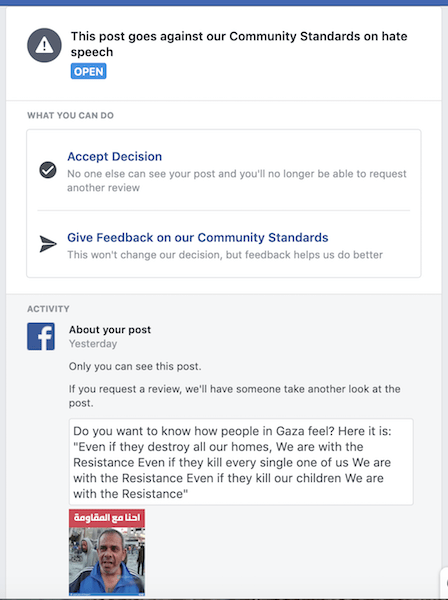
Once a day the Palestinian poet Nahida Izzat is being thrown into the FB Jail for 30 days for telling the truth about Palestine and the crime that has been committed against her people for almost a century. Nahida has never promoted violence or written any type of hate speech. The routine is pretty exhausting. She receives a FB notification about her suspension, she then appeals and after a few hours FB lifts her suspension.
The Palestinian poet is subject to a relentless vilification campaign by both Zionists and Anti Zionist Zionists (AZZ). Yesterday, Nahida was suspended again. This time her crime was posting a clip of a Palestinian man who just lost his home to an Israeli bomb. Nahida provided an English translation of the Gazan victim.
Nahida’s post read:
Do you want to know how people in Gaza feel?
Here it is: “Even if they destroy all our homes,
We are with the Resistance
Even if they kill every single one of us
We are with the Resistance Even if they kill our children
We are with the Resistance”
FB has now rejected Nahida’s appeal on the ridiculous ground that the above “goes against our community standards on hate speech”
Apparently reporting on a war crime committed by Israel and providing a first hand account of the destruction and the anguish inflicted on Palestinian refugees is considered ‘hate speech’ according to the authoritarian social network.
The Vaccine Debate Has Gone Off the Rails – By Design
By Helen Buyniski | Helen Of Destroy | May 30, 2019
US media and government have united to demonize “anti-vax” parents, demanding censorship, fines and even jail for questioning scientific progress. If they wanted to end the “crisis,” they could – but that would defeat the purpose, which is to keep the people divided, fearing and hating a malignant “enemy within” that threatens their beloved children.
When anti-vax activist Del Bigtree donned a yellow star in a melodramatic show of solidarity with Hasidic Jewish parents being pressured into vaccinating their children under a short-lived emergency law in upstate New York’s Rockland County, many cringed. Sure, public opinion was against anti-vaxxers, but they weren’t being rounded up and sent away to camps, or fenced into ghettos, or forbidden from operating businesses as Jews were in Nazi Germany.
Then the Washington Post took Bigtree’s idea and ran with it in a bizarre, overwrought editorial that slammed anti-vax parents as “pro-plague” and called for them to be arrested, fined, and isolated, placed on registries like sex offenders (their comparison, not mine), and… fenced into ghettos (“force isolation on pockets of populations that might have been exposed to the outbreak”).
This isn’t how you defuse a controversy. No amount of catastrophizing – whether it’s the World Health Organization declaring anti-vaxxers a threat on the level of ebola and HIV, or New York mayor Bill deBlasio sending “disease detectives” to Orthodox Jewish neighborhoods to hunt down unvaccinated kids, or Facebook removing photos of vaccine package inserts posted by parents concerned by the laundry list of side effects – will convince a vaccine skeptic to embrace inoculation. Indeed, these measures guarantee anti-vaxxers will become further entrenched in their beliefs. If vaccines are truly safe and effective, the argument goes, why are the authorities suppressing anything that questions them?
It’s clear from the institutional response to the measles “crisis” that the powers that be are not interested in changing anyone’s mind. It should be a simple matter for doctors to take scared parents aside, listen to their worries, and address them one by one – perhaps even offer to meet them halfway by developing an individualized health program that takes their child’s needs into consideration.
Certainly, pretending there’s no risk to vaccination when the government’s own vaccine court has paid out $4 billion to the parents of vaccine-damaged children over the past 30 years is disingenuous, and only serves to convince skeptics that a cover-up exists. Many “anti-vaxxers” are parents of autistic kids who believe their children were damaged by vaccination; most have done a significant quantity of research on the subject. Treating them like gullible fools is guaranteed to alienate them further.
Nor is the US government’s response to a measles “epidemic” that has infected 880 people since January in a country of 327 million people designed to put anyone at ease. With a vocal segment of the population already alarmed over unprecedented assaults on First Amendment freedoms of speech and of the press, several states have put forward bills to end religious exemptions to mandatory vaccination laws, thus inflaming another vocal segment of the population, this one concerned for the First Amendment freedom of religion. Headlines like the New York Times editorial earlier this month, titled “Infecting people isn’t a religious right,” deftly add insult to injury. If the government’s goal was to create civic unrest, to encourage division in a country already more divided than ever, they couldn’t have done a better job.
And this may indeed be the goal. “Wedge issues” – controversies which divide and inflame a population, despite often having little or no bearing on their day-to-day lives – are a time-honored means of manipulating popular sentiment. Divide and conquer as a political principle dates back to the Roman Empire. As the American Empire crumbles, with poverty and homelessness at record levels (despite the government’s attempts to redefine poverty and hide unemployment) while companies like Amazon and Google break the trillion-dollar mark, even capitalism’s biggest cheerleaders are concerned about the unwashed masses rising up and breaking things.
It’s no coincidence that the vaccine debate is being amplified at the same time Americans are duking it out over abortion, another popular wedge issue. Threaten people’s children, even other people’s hypothetical children, and a strong emotional response is guaranteed. So why, if the end goal is universal vaccination, is the government threatening the parents of unvaccinated children with taking those children away?
If health authorities are serious about converting the anti-vaxxers, they will have to stop thinking in terms of war. This means engaging in civil dialogue, instead of refusing to debate the other side, and listening to parents’ concerns – even treating those concerns as if they come from their own minds and not nefarious Russian influence campaigns – instead of censoring all criticism. It means conducting more safety studies, studies not funded by pharmaceutical companies or other institutions with a vested interest in the products being tested, and publicly admitting that even the Centers for Disease Control acknowledges certain pre-existing conditions can interact with vaccines to produce devastating developmental disabilities. It certainly does not mean treating anti-vaxxers like plague-loving brainwashed zombies.
Iran: Regional Peace Rests on Restoration of Palestinians’ Rights
Al-Manar | May 30, 2019
In a statement on the occasion of the International Quds Day, Iran’s Foreign Ministry emphasized that sustainable peace in the region will materialize only with restoration of Palestinians’ rights, which entails repatriation of displaced Palestinians and holding a referendum.
In the statement, released on Thursday, the Foreign Ministry described the issue of Palestine as the Islamic world’s pivotal subject, stressing the need to counter the Zionist regime’s policy of occupation.
“The Islamic Republic of Iran… believes that establishment of sustainable peace and calm in the region would not come true unless with the full restoration of rights of the oppressed Palestinian nation through the return of displaced Palestinians and holding a referendum in Palestine’s occupied territories with the participation of all main inhabitants of that land,” the statement said.
Stressing the need for Muslim unity and solidarity in the face of Israel, it said the usurping Zionist regime’s existence over the past 70 years has brought about nothing but displacement of millions of people, imprisonment and torture of thousands of innocent people, making thousands of Palestinian children orphans, and causing insecurity and instability in the region.
“The litany of the Zionist regime’s crimes and anti-human rights measures throughout the past 7 decades includes organized occupation of Palestine, systematic efforts to fully Judaize al-Quds, destroying the historical and civilizational identity of noble al-Quds, expansion of settler homes in the West Bank, forced relocation of al-Quds’ non-Jewish residents, depriving Palestinians of access to holy sites of al-Quds, illegal confiscation of their estate and demolishing their lands, and finally imposing inhumane redoubled pressures on people of Gaza and denying their access to basic foodstuff and pharmaceutical and medical commodities,” the statement deplored.
The Foreign Ministry called on the Muslim nations to stand against Israel’s divisive plots aimed at consigning the issue of Palestine to oblivion in order to prevent the implementation of the so-called deal of century and defy an upcoming “conference of deception and ruse” in Bahrain.
While the Muslim world is geared up to mark the International Quds Day on coming Friday, Bahrain is going to host a conference in June to encourage investment in the West Bank and Gaza Strip as part of US President Donald Trump’s Israel-Palestinian peace plan.
The so-called “Peace to Prosperity” economic workshop, to be held on June 25-26 in cooperation with Washington, has already been rebuffed by Palestinian officials and business leaders.
The Palestine Liberation Organization (PLO) and Hamas have called for an Arab boycott of the meeting.
However, Saudi Arabia and the United Arab Emirates have announced they will participate in the conference.
Top IDF lawyer tells The Hague to back off, says Israel can probe own alleged war crimes
RT | May 29, 2019
The Israeli military wants the International Criminal Court to butt out of its affairs, its top military prosecutor has declared in response to efforts to hold it to account for its use of live fire against Palestinian protesters.
“Israel is a law-abiding country, with an independent and strong judicial system, and there is no reason for its actions to be scrutinized by the ICC,” Brig. Gen. Sharon Afek, Israel’s military advocate, declared at an international conference on warfare laws in Herzliya. “The position of Israel is that the International Criminal Court does not have jurisdiction to discuss the issue of the Israeli-Palestinian conflict.”
The ICC is weighing investigating Israel over its use of live ammunition against Palestinian protesters demonstrating at the Gaza border. Since March 2018, IDF soldiers have killed at least 251 people participating in the Great March of Return, a movement calling for Palestinians expelled from their land during the establishment of Israel to be allowed to return, and injured at least 26,797 more, according to the Palestinian Ministry of Health.
Earlier this year, a United Nations Human Rights Council fact-finding mission on the protests submitted to the ICC a list of Israeli officials it suspects of serious crimes, including IDF snipers, their commanders, and the military legal advisers who outlined their rules of engagement.
Afek’s objections to the ICC’s involvement center on the body’s charter, which permits it to investigate crimes only when there is no reasonable assumption that the country in which they have been committed will prosecute them adequately. Israel, he claims, will take care of its own business.
But as of March, only 11 of the protesters’ deaths were being investigated as possible criminal acts. Israel has insisted that even the journalists and medics killed by snipers – a war crime under any jurisdiction – were actually working for Hamas and therefore fair game.
Israel’s judicial system has refused to pursue investigations of alleged war crimes committed by the IDF against Palestinians in the West Bank and Gaza before, and the ICC has long sought to prosecute Israel for its treatment of the Palestinians. Before the Great March of Return began last year, the court was looking into whether Israel had committed war crimes during 2014’s Operation Protective Edge, the seven-week bombardment of Gaza that killed 2,000 Palestinians and injured over 10,000, deliberately targeting civilians and landmark buildings according to Amnesty International. Settlement-building and the eviction of Palestinians from West Bank and East Jerusalem were also scrutinized.
Featured Video

The Search for Truth: Charlie Kirk’s Assassination One Year Later
or go to
Aletho News Archives – Video-Images
From the Archives
The 9/11 “Double-Cross” Conspiracy Theory
BY LAURENT GUYÉNOT • UNZ REVIEW • SEPTEMBER 6, 2022
Is it true that “9/11 was an inside job”? Yes, insofar as Israel is “inside” the U.S. But for the 9/11 truthers who have identified Israel as the main perpetrators, “9/11 was an inside job” is at best a half-truth, and at worst an integral part of the Zionist operation, like a secondary flag sewn as a lining under the false flag of Islamism. Victor Thorn (1963-2017) wrote in his book 9/11 made in Israel: The Plot Against America (2011): “In essence, the ‘9-11 truth movement’ was created prior to Sept. 11, 2001 as a means of suppressing news relating to Israeli complicity. . . . The slogan ‘9-11 was an inside job’ was quite possibly the greatest example of Israeli propaganda ever devised.” In milder terms, it is “controlled opposition”.
A genuine truth movement would have pointed to Israel as the prime suspect from the start. From day one, it was obvious who would benefit. … continue
Blog Roll
 Aletho News
- Hormuz and the Looming Economic Catastrophe
- Dhubab offensive, media blitz and the rapid unraveling of Saudi-backed coalition’s new gambit
- Putin Conveys to Trump Iran’s Vision on Possible Conflict Resolution – Kremlin
- The Search for Truth: Charlie Kirk’s Assassination One Year Later
- ‘Harsh reality’: Iran says France seeks monopoly on power and intimidation, not peace for all
- When Will This White House Madness End?
- Huckabee aide goes to ‘unusual lengths’ to portray ‘Israel’ positively
- Trump Announces Diesel Supply Deal With Putin Following Phone Call
- MEP blasts ‘Euro-Gestapo’ for lecturing Russia on democracy
- Syria May Send Troops to Saudi Arabia Amid War with Ansar Allah
- If Americans Knew
- Israeli forces kill another child in Gaza – Daily Update
- Gaza ceasefire exists in name only, say more than 100 organizations
- Nearly 2 Million in Gaza Need Urgent Shelter Assistance as Winter Looms: IOM Chief Warns
- Suppressing Palestinian resistance: US charity under fire for AI monitoring of Gaza classrooms
- Thousands Are Held in Israeli Torture Camps. This Is What Happens Inside
- Israel puts Gaza’s sick, injured, newborn in peril – Daily Update
- Report claimed Mark Levin used by Israeli government to influence Trump
- Over 2,000 Gazans have died awaiting medical evacuation amid Israel’s continued siege
- How a U.S. Diplomat Suppressed and Altered Reports Critical of Israel
- 5 Palestinians Die from Israeli Strikes in Gaza as Relentless Attacks Continue
- No Tricks Zone
- New Study: 50 Years Of The Most Aggressive ‘Net Zero’ Policies Can Only Affect The Global Climate By 0.03°C
- US September “Heat” Was No Record…Many Records Set Decades Ago
- Latest European Green Energy Debacle; Portugal’s Largest Flagship Solar Park Insolvent!
- Green Energy Debacle: German Expert Professor Fritz Vahrenholt Warns Of Severe Economic And Social Consequences
- Two More Paleo Reconstructions Affirm Meters-Higher Sea Levels Across Ireland, Brazil 7000-6000 Years Ago
- New Study: Earth And Venus Surface Warmth Largely Explained By Convection And Lapse Rate, Not CO2 Or Radiation
- 2025 Nature Paper Claiming Worsening Global Drought Gets RETRACTED …Heavily Flawed
- New Study: ‘Global Drought Shows No Detectable Recent Acceleration Under Climate Warming’
- Economic Masterminds: German Socialists Suggest Taxing Productivity Gains Stemming From Using AI
- The South China Sea Has Not Been Cooperating With The Climate Change Narrative

