Palestinian Youth injured by Israeli gunfire in blockaded Gaza
Palestine Information Center – May 31, 2018
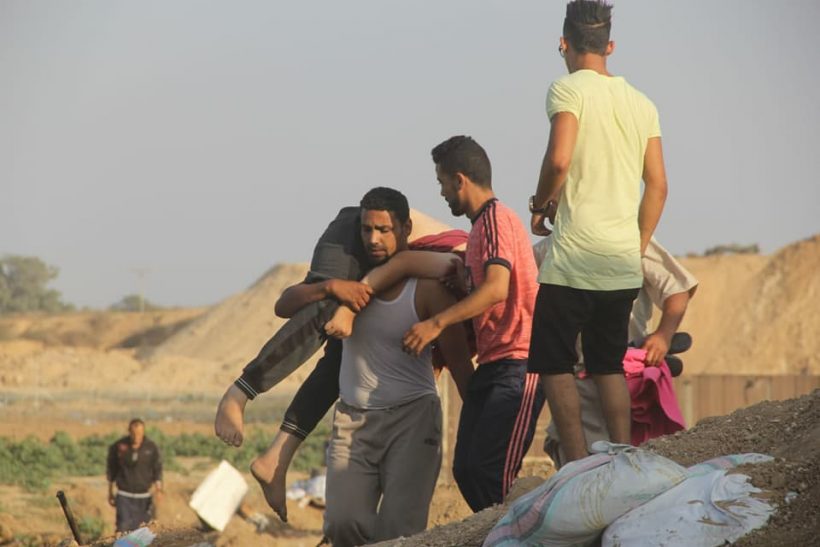
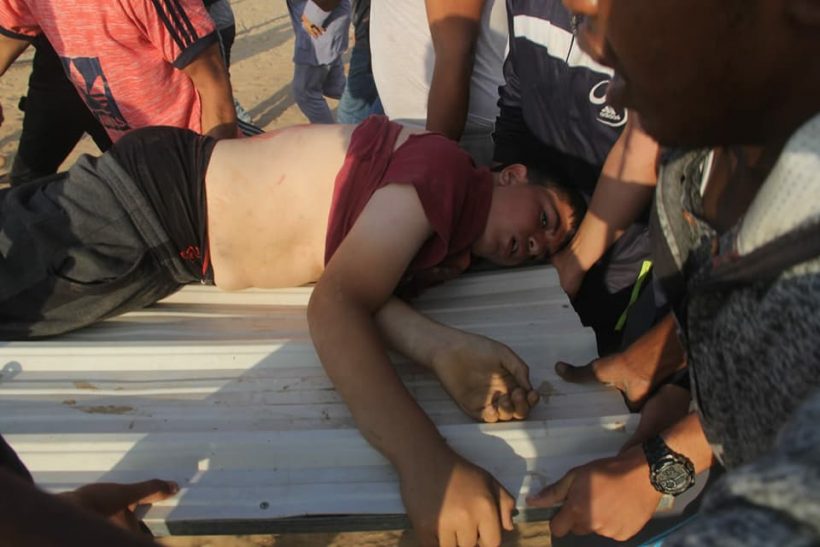
GAZA – A Palestinian youth was shot and injured by the Israeli military east of the Bureij refugee camp, in central Gaza Strip on Wednesday evening.
A PIC news correspondent said a bullet fire by Israeli soldiers penetrated a 15-year-old child’s back. He was rushed to the Shuhadaa al-Aqsa Hospital, in Deir Balah, so as to be treated for his wounds, reported critical.
According to the Gaza-based Palestinian Health Ministry, 118 Palestinians were killed and 13,300 others injured by Israeli gunfire unleashed toward Palestinian protesters as they joined the Great March of Return, launched on March 30.
‘Israel’s detention of freedom flotilla is a crime’
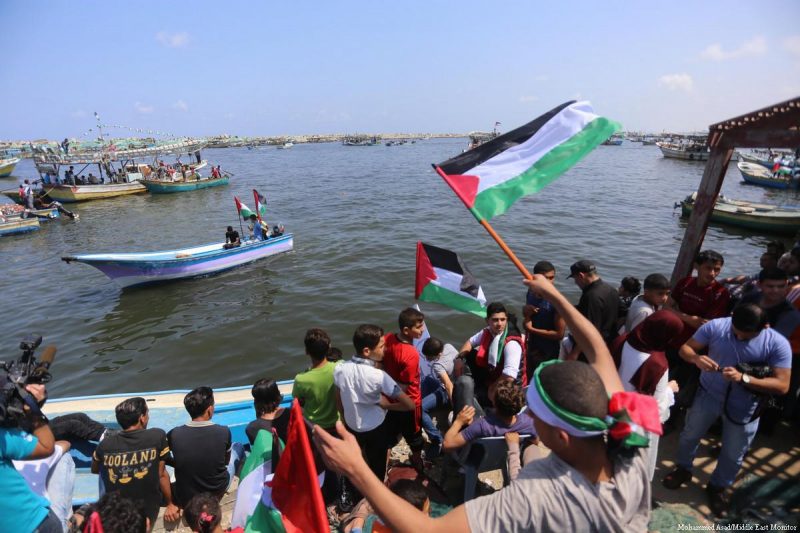
A ship carrying 20 Palestinians set out from the Port of Gaza in the hopes of breaking Israel’s decade-long maritime embargo of the Gaza Strip [Mohammed Asad/Middle East Monitor]
MEMO | May 30, 2018
Head of the Popular International Committee to Support Gaza, Dr Essam Yousef, called on the international community to pressure Israel to immediately release the passengers of a ship that set sail yesterday from Gaza heading to Cyprus in an effort to break the 12 year siege of the enclave.
Israeli occupation forces flanked the ship as it reached nine nautical miles from Gaza’s shores only for them to force it on to the Israeli port of Ashdod to the north of Gaza.
In a press statement today, Yousef condemned “the latest crime which is to be added to the occupation’s criminal record against the Palestinian people and the people of Gaza, who have been besieged for 12 years. This is a violation of all international conventions, laws, and legislations.”
Yousef held the Israeli authorities completely responsible for the safety of the ship’s passengers, who are “ill, students and unarmed civilians”.
“How can a state with an arsenal of deadly weapons as big as Israel and which considers itself a regional force superior to the rest of the region’s countries on a military level, pursue a ship carrying the ill and students who’s only aspiration is to leave the besieged Gaza Strip for treatment and education?” Yousef asked.
“Isn’t this state ashamed of itself, as it acts like a rogue state above the law, building its strength and force on the remains of innocent, starving and oppressed Palestinian people,” he added.
Yousef called on the governments of the free world and humanitarian and human rights organisations, as well as all international institutions to continue to pressure the occupation to lift the illegal and immoral siege imposed on two million people in Gaza, posing a blatant violation of all international charters related to human rights.
He also stressed the “Palestinian people’s right to move in and out of their country for treatment, education, work and any other activity, like the rest of the peoples of the world. No force on earth can continue to imprison and suffocate an entire nation who aspires for freedom and a dignified life.”
Drones, Murder and the Universal Declaration of Human Rights at 70: the Cases of Reyaad Khan and Abdul Raqib Amin
By T.J. Coles | CounterPunch | May 30, 2018
The Universal Declaration of Human Rights (UDHR) is 70 this year. But you wouldn’t know it from the impact it’s had on human lives. For example, Donald Trump has sharply increased drone attacks, especially in Yemen and Somalia, with virtual silence from Western media. Article 11 of the UDHR states: “(1) Everyone charged with a penal offence has the right to be presumed innocent until proved guilty according to law in a public trial at which he has had all the guarantees necessary for his defence.”
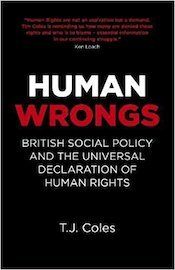 As I document in my new book Human Wrongs (Iff Books), the alleged terror suspects blown apart by drone operators are not even charged let alone given the chance to plead their innocence in a national or international court: and that’s quite apart from the women, children and babies (“collateral damage”) that happen to be nearby when the Hellfire missiles are launched.
In Britain, the age-old common law, presumption of innocence, faced a slight setback in the so-called “war on terror.” Since US drone operators murdered Afghan civilians in the first-ever lethal drone strike in 2002 (followed by Yemenis in the same year), the US has murdered about 2,500 people with drones alone. Providing targeting information and communications links, the UK plays a significant role, all in violation of the principles of the UDHR.
The UN Special Rapporteur on Extrajudicial Execution, Philip Alston, writes: “A State killing is legal only if it is required to protect life (making lethal force proportionate) and there is no other means, such as capture or nonlethal incapacitation, of preventing that threat to life (making lethal force necessary).” So, a person in Afghanistan, for example, cannot be lawfully slain by a British drone operator on the pretence that the person is about to pose an imminent threat to the UK, unless for instance the person is about to give an order over the phone let’s say to, for instance, a terror cell in Briton, instructing it to detonate a bomb. Needless to say, this is a ludicrous scenario in the real-world.
Murdering Its Own
The British state murdering “its own people” is nothing new. In the 1970s, the Ministry of Defence waged a dirty war in Northern Ireland. Units from the Military Reaction Force (MRF) murdered Protestants and Catholics as a part of strategy of tension. Northern Irish persons murdered and/or shot by MRF operatives include:Patrick McVeigh (shot in the back), John and Gerry Conway (travelling to a fruit stall), Aiden McAloon and Eugene Devlin (travelling in a taxi), Joe Smith, Hugh Kenny, Patrick Murray and Tommy Shaw (drive-by shootings) and Daniel Rooney and Brendan Brennan (walking on a road).
The British government does in fact possess the proverbial license to kill. It is a “license” granted to itself and one not grounded in international law. Targeted killings (murder) hitherto depended on the authorization of the Secretary of State. The Intelligence Services Act 1994, Section 7(1), frees intelligence operatives from liability in acts of killing abroad, “if the act is one which is authorised to be done by virtue of an authorisation given by the Secretary of State.”
In the case of Reyaad Khan and Abdul Raqib Amin, the killings were not carried out by MI6 (which is covered by the Intelligence Services Act 1994), but by the Royal Air Force. In 2015, the government started murdering Britons allegedly suspected of involvement in terrorism, making no attempt to apprehend them and put them on trial, as international law requires.
In August 2015, Reyaad Khan and Abdul Raqib Amin, were travelling in a vehicle in Raqqa, Syria. RAF drone operators ended their lives. Then-PM David Cameron told Parliament that Khan was the target (murdered) and Amin was killed alongside him (manslaughter). A third unidentified, alleged Islamic State fighter was killed with them, though the third person was not “identified as a UK national.” By implication, the third person’s life is not important, hence no details emerged.
Cameron claimed the killings were “an act of self-defence,” because Khan was: “involved in actively recruiting ISIL sympathisers and seeking to orchestrate specific and barbaric attacks against the west, including directing a number of planned terrorist attacks right here in Britain, such as plots to attack high profile public commemorations.”
But Cameron also revealed that Khan was not a threat to the UK: “there was nothing to suggest that Reyaad Khan would ever leave Syria.” If Cameron is to be believed, Khan was issuing instructions to terror cells in the UK. But if this is the case, it therefore becomes a matter for the British police.
Changing Stories
The pretext for the murder was later changed by the UK’s Permanent Representative to the UN, Matthew Rycroft, who wrote that the killings were somehow justified in the “collective self-defence” of Iraq, where Britain is supposedly helping the government to defeat ISIS. The trouble is that Khan was not in Iraq when he was killed. Inverting international legal norms, Secretary of State for Defence, Michael Fallon, “who authorised the lethal drone strike” (Press and Journal ), appealed to Article 51 of the UN Charter, the right of collective and/or individual self-defence. Attorney General Jeremy Wright’s advice has not been published, indicating that the killings are violations of domestic and international law.
It later transpired that the RAF is working its way through a “kill list” of alleged British terror suspects fighting with ISIS in Iraq and Syria. Both jets and drones are used; the latter are controlled by operators in RAF Waddington, Lincolnshire. “When we know where they are we kill them,” said a Ministry of Defence spokesperson. The “kill list” revelations prompted Lord Macdonald, former Director of Public Prosecutions, to co-sign a letter to PM May, calling for the release of the government’s Intelligence and Security Committee report into the murder of Reyaad Khan and names of other targeted suspects.
Lucy Powell MP and Kirsten Oswald MP, both co-chairs of the informal All-Party Parliamentary Group, called for a debate on Britain’s use of targeted murder. Defence Secretary Fallon who authorized the murder of Khan claimed that by February 2017, 85 Britons had been killed in Syria, but it wasn’t clear if this meant as part of the RAF’s kill list.
T. J. Coles is a postdoctoral researcher at Plymouth University’s Cognition Institute and the author of several books, including Fire and Fury (Clairview Books ) and Human Wrongs (Iff Books ).
Exposing the dynamics of UNSC draft resolutions on Palestine
MEMO | May 29, 2018
Last week, the UN Security Council discussed a draft resolution on providing international protection for Palestinians, upon request by Kuwait’s permanent representative to the UN, Mansour Al-Otaibi. By the end of this week, the UNSC will be voting on the resolution, with Wafa news agency reporting that if the US uses its veto, Palestinians will call upon the UN General Assembly for “an extraordinary meeting under the title ‘Uniting for Peace’”.
It is safe to say that Palestinians are ensnared politically, and every gesture that is ostensibly for their protection is but another manacle that consolidates their isolation. Lest anyone jump on the bandwagon of “protection”, it is best that one takes into account that the international community has repeatedly confirmed its loyalties lie with Israel. Its credibility as regards protection, therefore, should be immediately denounced. Asking two fundamental questions juxtaposed against each other would clarify international intentions once and for all.
What does Palestine mean for Palestinians? What does Palestine mean to the international community?
For the first question, it is imperative that one draws upon Palestinian narratives of their land and follow the trajectory of how the entire territory that is their right was colonised by Israel’s existence. From that departure point, it is also important to include two rights that the international community wilfully ignores: the right of return and the right of struggle, by all means, against colonialism.
The second question deals more with disregard rather than concern. Even before Israel’s inception, Palestine was treated as a commodity and its people fodder for collateral damage. The Partition Plan of 29 Novermber 1947 is now hypocritically marked as the International Day of Solidarity with the Palestinian People. Let us be clear upon what this alleged solidarity has entailed: supporting colonial Israel and its so-called “right to defend itself” against the population that it has colonised and ostracised. UN solidarity has condoned massacres of Palestinians and forced displacement. In return, it has dedicated one specific day for remembrance which has yet to cause revulsion internationally, rather than acquiescence to commemoration.
The juxtaposition between both questions occurs now, in terms of the Palestinian right of return and their right to struggle for liberation from colonialism. On paper, the UN has not denied these rights. However, it has forced Palestinians into a vacuum where knowledge of rights is not tantamount to accessibility. The UN has created slogans for Palestinians while aiding Israel diplomatically, to the point that is has become a duty to separate the authentic, internationalist, solidarity with Palestinians from the exploitative, symbolic, corrupted remembrance which the UN has bequeathed to Palestinians.
As the UN derives impunity from its own existence, with what conscience can we declare approval for protection emanating from the institution? We must remember that “international protection” is concocted from the exterior, with Palestinians having little to no say in how such protection would be provided, what form would it take and what parameters would be imposed by the UN. Is it too late to remember that during other massacres, UN rhetoric was primarily concerned with Israel’s “right to defend itself”? Does memory fade with the passing of years to the point that the Nakba and subsequent massacres are forgotten? I believe not. A memory that emanates from within has the power to transcend time.
Palestinians do not deserve repetitive attempts at manipulating their rights and having the UN establish its collaborative dominion at their expense. This is not to say that Palestinians do not need protection. However, they are not in need of protection from Israel’s accomplices to degrade their options further by increasing their risks of being politically targeted. Two rights and the means to achieve them are what Palestinians need – the right of return and the right to struggle by all means for liberation. A unifying, internationalist force that is ready to stand by Palestinians to help them achieve their rights. Anything less than that is calling Palestinians to play a part in their betrayal.
Israel bill to limit Palestinians’ access to High Court passes first reading
MEMO | May 29, 2018
Israeli politicians waved through a bill that would limit Palestinians’ access to the High Court last night, according to the Jerusalem Post.
The bill would prevent many cases, including those of housing demolitions and Israeli land grabbing offences, from reaching the High Court, instead redirecting them to district courts in the occupied West Bank.
Right-wing politicians stated that the bill would reduce the number of complaints pertaining to land ownership that are often filed by Palestinians and left-wing organisations in the aftermath of settler occupation.
Justice Minister Ayelet Shaked, a supporter of the bill, rejoiced in its passing of the first reading.
“The move will also reduce the heavy burden imposed on the High Court of Justice,” she said adding that the High Court “handles more than 2,000 petitions each year, and should reject many of them outright.”
Critics however argued that the bill was a step towards annexation of the West Bank, by expanding the power of district courts outside of Israeli sovereignty.
Zionist Union MK Tzipi Livni expressed concern that the move would strengthen the argument that Palestinians should have the right to vote in Israel, as has been suggested as part of the one-state solution.
Shaked defended the bill, stating that in the case of land ownership claims, it would place the burden of proof on the Palestinians filing the case, not the Israeli settlers.
The bill will also refer other issues to the lower court, such as restraining orders and Israel entry permits.
Israel has long sought to annex the occupied West Bank to preserve the illegal settlements in the area, but has struggled with what the fate of Palestinians would be.
Earlier this month, Israel’s deputy defence minister, MK Rabbi Eli Ben-Dahan, claimed that Israel could annex the entirety of the occupied West Bank, without giving its Palestinian residents the right to vote.
“The clear and absolute thing is that we are here in the Land of Israel and we are not afraid of any attempts to frighten us,” he said. “They want to scare us that maybe soon we will not be a majority and therefore we have to abandon Judea and Samaria [the West Bank]. This is a grave mistake.”
Read also:
Palestinians call to save their homes from Israeli demolition orders
Palestinians call to save their homes from Israeli demolition orders
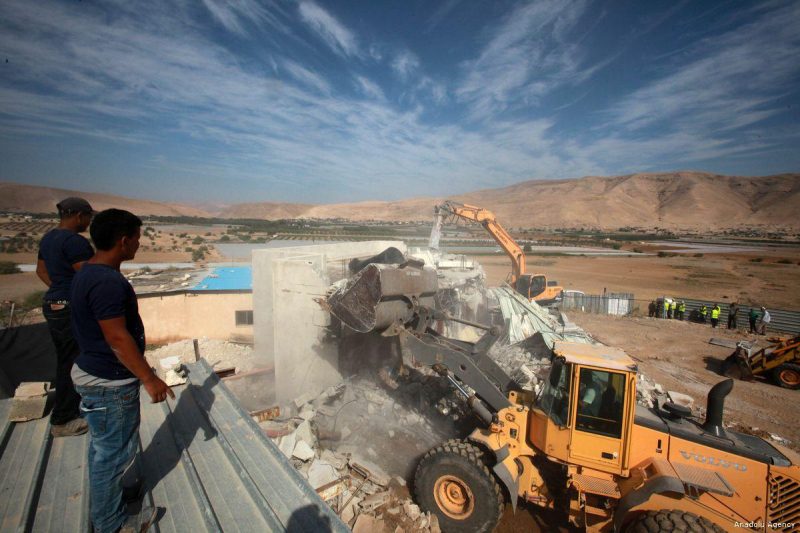
Palestinians watch the demolition of their home in the West Bank on 7 November 2017 [Nedal Eshtayah/Anadolu Agency]
MEMO | May 28, 2018
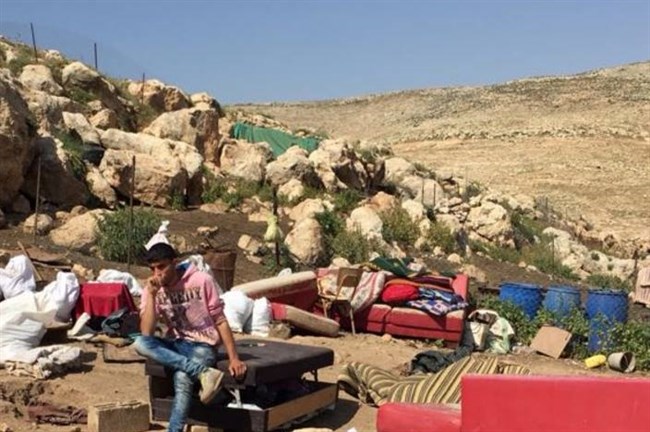
Palestinian families in the village of Aqaba, north of the West Bank, on Sunday called on Palestinian human rights organizations and the government to save their homes from the Israeli demolition orders.
The Israeli authorities have recently issued orders to demolish the homes of 20 families in the village of Aqaba under the pretext of being built in Area C.
The head of Aqaba village council, Sami Sadiq said the decision was issued by the Israeli Defence Ministry and ordered the all houses built during the past six months in Area C to be demolished if they were not inhibited by their owners.
He added that the village council has been trying to contact human rights organizations and the media in an attempt to stop the decision and protect the homes.
In an interview with Turkey’s Anadolu news agency, he pointed out that the houses are built on land owned by their owners who have owner documents.
Ibrahim Yusuf Jaber, the owner of one of the houses threatened with demolition said the decision stipulates to demolish the house within 60 days if I do not move in, but 40 days have already passed while we received the orders only two days ago.
Watch: Video of about Al Aqaba village
Gaza boats will attempt to break Israel Navy siege on Tuesday
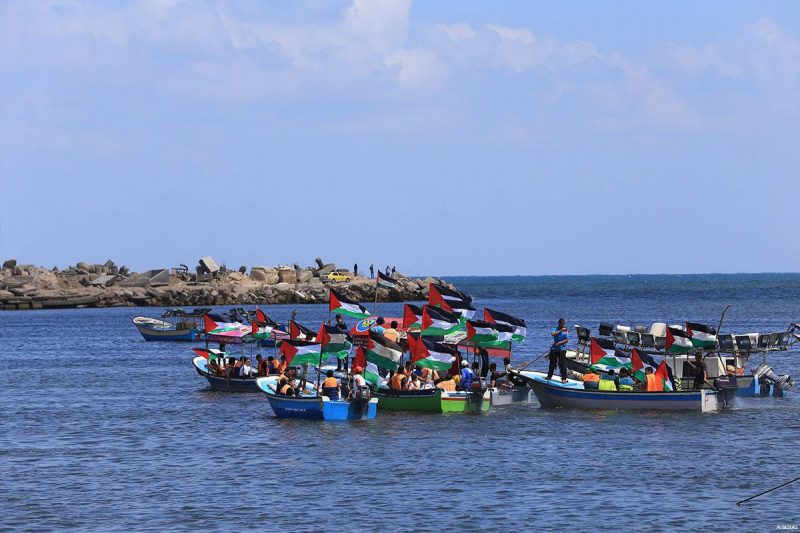
Palestinian fishermen seen waving the Palestinian flag in Gaza’s coast [Anadolu]
MEMO | May 27, 2018
The Gaza Strip will set off a flotilla of ships on Tuesday in a bid to break the 12-year-long Israeli blockade on the Palestinian territory.
“This trip will carry the hopes and dreams of the Palestinian people for freedom,” Salah Abdul-Ati, a member of a Palestinian committee tasked with breaking the siege, told a press conference in the Gaza City on Sunday.
He said the first ship will set sail on Tuesday morning, with a number of injured Gazans and patients aboard.
He, however, did not specify the first stop of the ship.
According to Abdul-Ati, Israeli forces twice attacked boats and ships seeking to break the Israeli siege on Gaza in the past two weeks.
He called on the Ramallah-based Palestinian Authority to lift “penalties on the Gaza people to boost their steadfastness and ease the humanitarian crisis caused by the blockade”.
He also appealed to the international community to pressure Israel to lift the blockade on the Gaza Strip and on international NGOs to provide protection to anti-siege ships.
Tuesday’s Gaza flotilla will coincide with the 8th anniversary of an Israeli attack on the Turkish “Mavi Marmara” flotilla, in which nine Turkish activists were killed when the Israeli navy attacked the vessel in international waters. A tenth activist died nearly four years later, succumbing to injuries sustained during the raid.
The incident served to cause a political crisis between Turkey and Israel, which ended when the latter agreed to Turkish conditions to normalize ties, including offering apology and compensating families of the victims.
Home to nearly two million Palestinians, the Gaza Strip has been reeling under a crippling Israeli blockade since 2006 when Palestinian resistance group Hamas was voted to power in a parliamentary election.
Let’s talk about Mohammad Tamimi’s 2nd detention
Palestine Home | May 24, 2018
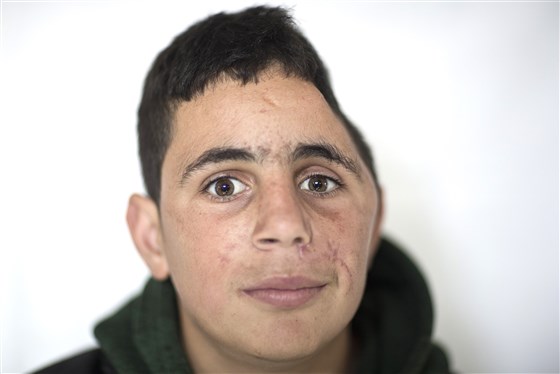
The unthinkable is absolutely routine in the occupied Palestinian territories. This particular outrage involves a familiar face – that of 15-year-old Mohammad Tamimi.
As Mohammad was walking in his village, Nabi Saleh, 4 Israeli agents disguised as Palestinians jumped him, threw him in a car, and drove out of the village.
The abduction of a young man, even a minor, is a completely ordinary event in the occupied West Bank of Palestine where, during the last 12 months, Israel has held a minimum of 6,000 prisoners at any given time, 280 or more of whom have been minors. This is scandalous but typical.
What makes Mohammad’s kidnapping singularly outrageous is his previous experience with Israeli military. It bears repeating.
Target practice
On 15 December 2017, during the weekly village protest, Mohammad peeked over a wall into an area where Israeli soldiers generally hang out – illegally occupying an empty villa for the purpose of enforcing an illegal occupation – and when they saw his head, they shot at it. From only a few yards away.
Mind you, these would have been heavily armed, bullet-proof vested, combat-helmeted soldiers. They had nothing to fear. Nevertheless, they shot Mohammad.
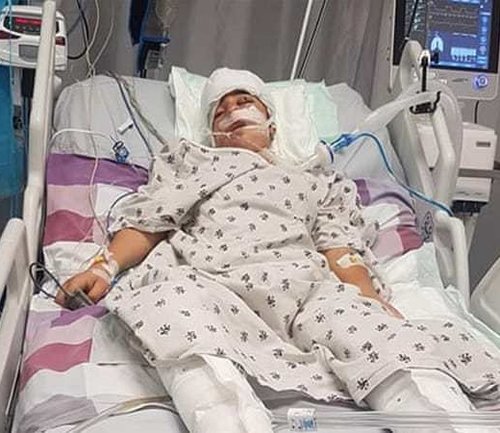
14-year-old Mohammad Tamimi spent 4 days in a medically-induced coma after being shot in the face by Israeli forces.
The bullet entered near his nose and lodged in the back of his skull; he was bleeding heavily. A Red Crescent ambulance rushed in.
The Israeli soldiers at first refused to let the ambulance leave.
Eventually, Mohammad made it to the hospital, where part of his skull had to be removed due to severe inflammation of his brain. Since then, he has been recovering from this life-threatening injury.
“The slap that was heard around the world”
Moments after the shooting, his cousin Ahed heard the news. Furious and distraught, she screamed at an IDF soldier loitering on her property and delivered “the slap that was heard around the world.” It was a light slap, but resulted in a midnight home invasion by the IDF and a ride to prison.
Culture Minister Miri Regev considered the incident “damaging to the honor of the military and the state of Israel.” Education Minister Naftali Bennett proposed that Ahed receive a life sentence. Deputy Knesset Speaker Bezalel Smotrich tweeted that violence would have been an appropriate response: “In my opinion, she should have gotten a bullet, at least in the kneecap. That would have put her under house arrest for the rest of her life.”
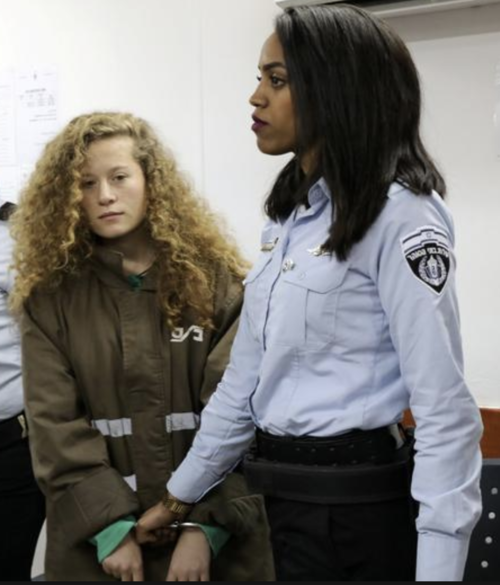
Palestinian teen Ahed Tamimi enters a military courtroom escorted by Israeli Prison Service personnel
Ahed was charged with 5 counts of assault: “threatening a soldier, attacking a soldier under aggravated circumstances, interfering with a soldier in carrying out his duties, incitement, and throwing objects at individuals or property.” She is now serving an 8-month sentence.
The soldier who had shot her cousin in the face is a free man, likely still carrying a weapon.
Mohammad’s 1st detention
Fast-forward 2 months, to 26 February. In a midnight raid on the village of Nabi Saleh, Mohammad Tamimi and 9 other Palestinian youths (5 of them, including Mohammad, minors) were arrested for alleged stone-throwing. His parents begged the police to wait a few weeks, till after the surgery to reconstruct his skull. His interrogators were unmoved. They went forward with high pressure questioning (Mohammad asserts that he was beaten) in which he “confessed” that his severe head injury had been self-inflicted, from a bicycle accident.
Coordinator of Government Activities in the Territories (COGAT) Major General Yoav Mordechai rushed excitedly to Facebook, where he posted (in Hebrew and Arabic), “Wonder of wonders. Today, the boy himself confessed to the police and to COGAT that in December his skull was injured when he was riding his bicycle. The culture of lies continues among young and old in the Tamimi family.”
A later statement from COGAT added that “The truth is always our guiding light and we will continue to present the truth in order to expose the Palestinian incitement apparatus.” And so, “bicycle accident” was the truth – until Mohammad’s doctor showed an X-ray of Mohammad’s skull with a bullet lodged inside.
How in the world did General Mordechai think he would get away with the coerced bicycle confession, given the high visibility of the events surrounding it?
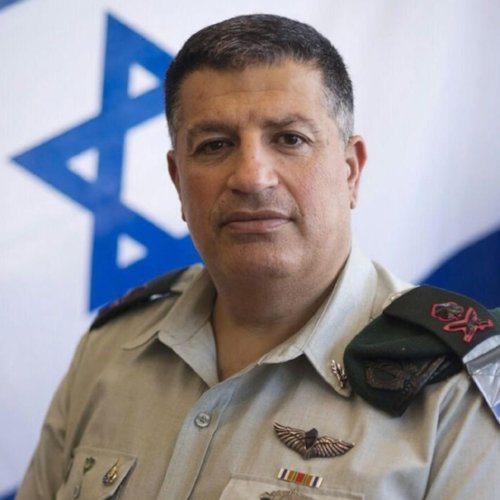
Maj. Gen. Mordechai, head of Coordinator of Government Activities in the Territories (COGAT)
Once the doctor’s report (and the actual bullet) appeared, the army’s account changed – but only slightly. When asked by Ha’aretz for a comment, army sources said they could not confirm the origins of his injury. So much for “we will continue to present the truth.”
Most news sources, both Israeli and American, had little or nothing to say when the evidence came to light. That’s how Mordechai got away with his audacious fabrication: mainstream news knows how to quit while Israel is ahead.
Mohammad’s 2nd detention
On, then, to current events. Mohammad was abducted again on the morning of 20 May, about 5 months post-shooting, 3 months post-bicycle “confession.” He was held till 11 pm, long after he was supposed to break the Ramadan fast with his family and take his medication.
Israeli police denied having detained him; no one had seen the abduction. The family feared he may have fallen and injured himself. The whole village went into search mode. But then as suddenly as he’d disappeared, he was back.
His mother, Manal, believes that Israel wants Mohammad imprisoned, but backed down this time because of his condition. “They are waiting for him to get better… They will try in the next two or three months to arrest him again,” she predicted.
Mohammad’s father, Fadel, reported that Israeli intelligence had called one of Mohammad’s doctors, informing him that Mohammad would be re-arrested once he recovered.
Fostering a culture of fear
Dawoud Yusef, who works with Palestinian prisoners’ rights group Addameer, explained that the continual detention and release of Palestinians is meant to “make the individual feel that they are never safe from the forces of the occupation.” The use of Israeli agents posing as Palestinians is particularly unnerving.
Add to that Israel’s use of surveillance balloons in Nabi Saleh that observe residents and collect intelligence on them 24/7, and one might say that Israel is winning the psychological battle.
Indeed, Mohammad’s mother disclosed, “We feel like anyone in the village can get kidnapped by the Israelis at any time,” she said. “We are scared to allow our children on the street.”
Nabi Saleh is targeted because of its years of peaceful resistance and its alleged refusal to stop “making Israel look bad.”
The fact is, Israel makes itself look bad: when its “moral army” is allowed to shoot children who pose no threat, to use snipers against kites and rocks, to kill with impunity. When its government discriminates against people of color, takes food out of the mouths of widows and orphans, persists in breach of international humanitarian law. Israel is managing its negative publicity quite well on its own.
In a land where it is somehow okay to arrest a boy recovering from brain surgery, where a slap deserves a life sentence but shooting in the face does not, reputation is the least of their worries.
North Korea raps Israel’s “brutal massacres” in Gaza
Palestine Information Center – May 26, 2018
North Korea has condemned Israel’s use of violence against unarmed Palestinian protesters in Gaza, describing what happened with them as “brutal massacres.”
Kim Yong-nam, head of the Presidium of the Supreme People’s Assembly of North Korea, sent a message of sympathy to Palestinian Authority president Mahmoud Abbas, with the state-run Rodong Sinmun newspaper calling Israel’s actions as a “bloody suppression”.
The newspaper said that Yong-nam in the message expressed deep condolences to the victims and their families.
“He vehemently denounced Israel for its brutal massacres and indiscriminate use of force against peaceful demonstrators demanding their legitimate rights.”
He affirmed North Korea’s unwavering support for and solidarity with the just cause of the Palestinian people and their struggle to build an independent state with east Jerusalem as its capital and obtain their inalienable legitimate rights.
North Korea backs Palestine in its dispute with Israel, an occupying power financed and supported by the US regime.
When North Korea was largely propped up by the Soviet Union during the Cold War, it regularly sent aid and weapons to Palestine.
During the 2014 Gaza War, North Korea also condemned Israel.
The country’s foreign ministry then strongly denounced “Israel’s brutal killings of many defenseless Palestinians through indiscriminate military attacks on peaceable residential areas in Palestine.”
“They are unpardonable crimes against humanity” the ministry said.
Israel bill seeks to criminalise documentation of soldiers’ actions
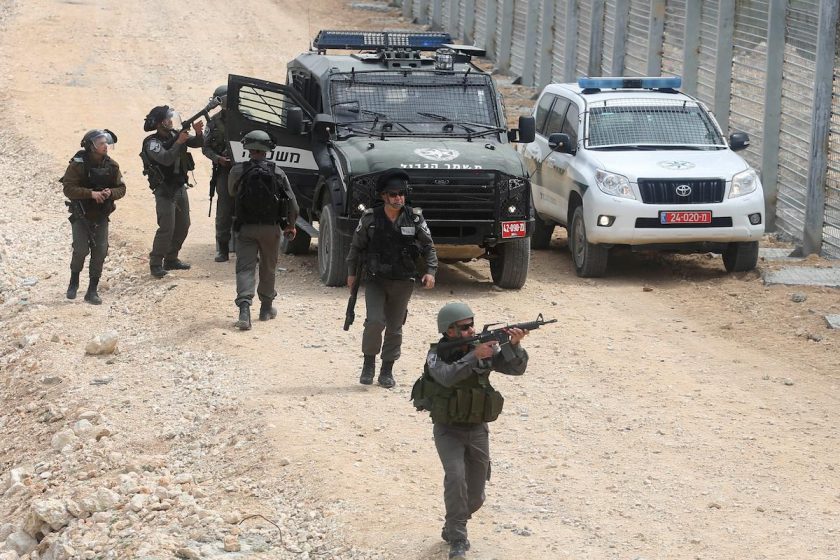
Israeli forces disrupt a Palestinian protest against Israeli occupation of Palestinian lands in Bethlehem, West Bank on March 30, 2017. (Issam Rimawi – Anadolu Agency )
MEMO | May 25, 2018
The Israeli Ministerial Committee for Legislation will discuss, Sunday, a bill that would prohibit the documentation of Israeli soldiers’ human rights violations against Palestinian citizens.
On Thursday, Israel Hayom explained that the chairman of Yisrael Beiteinu bloc in the Knesset, Robert Ilatov, proposed the bill with the support of his party’s leader, Israeli Defence Minister Avigdor Lieberman.
The bill states, “anyone who shoots a video or a photo, or records soldiers while they are doing their job, with the aim of disturbing the morale of soldiers and citizens, will be sentenced to five years imprisonment. In case this is done with the aim of destabilising the state’s security, the perpetrator will be sentenced to ten years imprisonment.”
In addition, the bill prohibits the sharing of photographs or recorded content on social media or in the media.
Israeli MP Ilatov asserted that his proposal comes as part of an attempt to respond to the movement of left-wing activists in exposing Israeli practices against Palestinian citizens in the West Bank and the Gaza Strip.
He justified his proposal by saying,
Israel has long been facing a disturbing phenomenon; that of the documentation of Israeli army soldiers, by video shooting or audio recordings by organisations that are hostile to Israel and supportive of the Palestinians, such as B’Tselem, Machsom Watch, Breaking the Silence, BDS and other organisations
He claimed that “the majority of these organisations receive support from associations and governments with anti-Israel agenda, and that they are using these contents to jeopardise Israel and its security.”
He added, “It is unreasonable for an activist or leftist organisation, supported by a foreign entity, to be granted the freedom to document soldiers while doing their duties. The best conditions must be provided for the soldiers to do their duty without worrying about any activist or organisation publishing their photos to intimidate them.”
Read also:
Featured Video
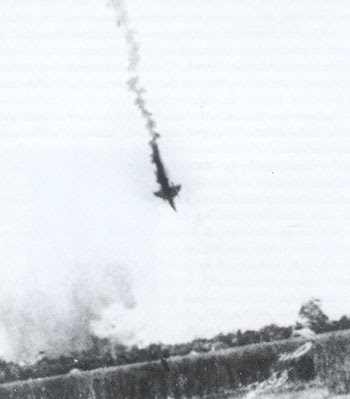
The Failed Air War Over Vietnam
or go to
Aletho News Archives – Video-Images
From the Archives
USS Liberty Massacre: A Pivotal Moment in the Hostile Takeover of America
By Kevin Barrett | Crescent | Dhu al-Qa’dah 24, 1445
In corporate America, hostile takeovers are commonplace. They occur when an aggressor—a larger corporation or rich individuals—seizes control of a smaller corporation without asking permission.
What few recognize is that the United States itself has been subjected to a hostile takeover. Since the aggressor, the illegitimate settler colony known as “Israel,” is much smaller than the US, the takeover has necessarily been surreptitious.
As of June, 2024, Israel’s gradual takeover of the US has become obvious and undeniable—a proverbial “elephant in the living room.” … continue
Blog Roll
 Aletho News
- Leaders Condemn Ansarallah Attack on Saudi Arabia While Ignoring Illegal War Against Yemen
- Leaked: Britain’s Covert Iraqi Psyops Network
- Yemeni Armed Forces Warn Airlines Against Using Saudi Airports, Exempt Mecca and Medina
- Iran security chief says powers greater than US tried to conquer Iran but ended in ‘dustbin of history’
- Europe’s mounting social chaos… chickens coming home to roost for proxy war against Russia
- US-Russia Diesel Deal Becomes Massive Defeat for Ukraine
- Hormuz and the Looming Economic Catastrophe
- Dhubab offensive, media blitz and the rapid unraveling of Saudi-backed coalition’s new gambit
- Putin Conveys to Trump Iran’s Vision on Possible Conflict Resolution – Kremlin
- The Search for Truth: Charlie Kirk’s Assassination One Year Later
- If Americans Knew
- The American Conservative: Mike Huckabee Should Resign
- A C-Section in Shackles: A Palestinian Woman’s Harrowing Birth in Israeli Detention
- ‘He’s Desperate’: AIPAC Begins Spending Against Abdul El-Sayed to Boost Mike Rogers:
- Trump, Hormuz, and the Looming Economic Catastrophe
- For three years, Israel has killed a child in Gaza every 71 minutes – Daily Update
- Israeli forces kill another child in Gaza – Daily Update
- Gaza ceasefire exists in name only, say more than 100 organizations
- Nearly 2 Million in Gaza Need Urgent Shelter Assistance as Winter Looms: IOM Chief Warns
- Suppressing Palestinian resistance: US charity under fire for AI monitoring of Gaza classrooms
- Thousands Are Held in Israeli Torture Camps. This Is What Happens Inside
- No Tricks Zone
- Germany’s Green Energy Debacle: High Energy Costs Force Kahla Porzellan to Close After 182 Years!
- New Study: 50 Years Of The Most Aggressive ‘Net Zero’ Policies Can Only Affect The Global Climate By 0.03°C
- US September “Heat” Was No Record…Many Records Set Decades Ago
- Latest European Green Energy Debacle; Portugal’s Largest Flagship Solar Park Insolvent!
- Green Energy Debacle: German Expert Professor Fritz Vahrenholt Warns Of Severe Economic And Social Consequences
- Two More Paleo Reconstructions Affirm Meters-Higher Sea Levels Across Ireland, Brazil 7000-6000 Years Ago
- New Study: Earth And Venus Surface Warmth Largely Explained By Convection And Lapse Rate, Not CO2 Or Radiation
- 2025 Nature Paper Claiming Worsening Global Drought Gets RETRACTED …Heavily Flawed
- New Study: ‘Global Drought Shows No Detectable Recent Acceleration Under Climate Warming’
- Economic Masterminds: German Socialists Suggest Taxing Productivity Gains Stemming From Using AI

