Aletho News

ΑΛΗΘΩΣ

US university demands Palestinian academic not criticise Israel in speech

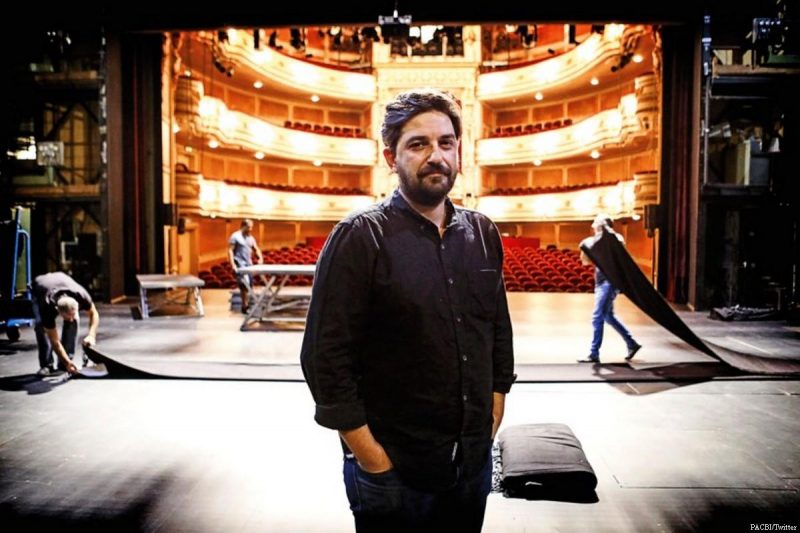
Palestinian academic Hatem Bazian says Arizona State University asked him to sign a contract in which he pledges not to criticise Israel at a university event [File photo]
MEMO | March 9, 2018

Arizona State University is reported to have asked Palestinian academic Hatem Bazian to sign a contract in which he pledges not to criticise Israel at an event organised by the Muslim Students’ Association next month.

Chair of American Muslims for Palestine and lecturer at the University of California at Berkeley, Bazian said Arizona State University asked him to sign the university’s speaker agreement which included a clause that prohibits criticising Israel or engaging with the BDS movement.

Bazian refused to sign the agreement, saying agents loyal to Israel, constitute a real obstacle to freedom of expression and academic freedom in American universities.

He added that asking him to sign an agreement which includes a clause that prevents criticism and boycott of Israel is to ignore the freedom of thought and academic autonomy.

“I think that Israel ignores international law and puts pressure on the Palestinian people,” he said, adding that there are many pro-Israel organisations throughout the United States which try to prevent programmes and events that are organised in favour of the Palestinian cause by putting pressure on university administrations.

Last week, the Council on American-Islamic Relations (CAIR) filed a lawsuit against Arizona State University on behalf of American Muslims for Palestine and Hatem Bazian.

March 9, 2018 Posted by | Civil Liberties, Ethnic Cleansing, Racism, Zionism, Full Spectrum Dominance | , , , , , | Leave a comment

Israeli soldiers pose as news crew to abduct student leader from West Bank university

RT | March 8, 2018

Disguised Israeli forces have stormed Birzeit University in the occupied West Bank and seized the head of the university’s student council. Two students were reportedly injured by gunfire during the raid.

Omar Kiswani was taken by soldiers who reportedly posed as journalists. The university posted footage of Wednesday’s raid online, showing a group of six men pinning Kiswani down and pointing their guns at onlookers.

According to the university, the attackers “carrying firearms in their backpacks, entered the campus during working hours and attacked the student in front of the Student Council Building.” It also called the operation a “barbaric intrusion” and said that two students were recovering in hospital after being injured when the Israeli forces fired into the campus.

Student council member Yahya Alawi, who witnessed the abduction, told the Palestinian Quds News Network that the Israelis “identified Omar and called over to him as if they wanted to interview him as journalists.” Alawi said they then “beat [Kiswani], pulled out their weapons, and a large group of occupation soldiers stormed through the main entrance of the university.”

The Union of Journalists in Israel issued a statement condemning the soldiers impersonation saying that they were “troubled” by “undercover forces impersonating a news crew at Bir Zeit University.” The union added: “Such behavior is likely to endanger real journalists doing their jobs and strikes a blow at freedom of the press. Journalistic work is important and journalists must not be endangered, even in order to conduct security operations.”

This is not the first time 24-year-old Kiswani has been arrested. He previously spent a year in prison for his participation in a group affiliated with Hamas on campus. Following his abduction on Wednesday, Israeli army troops covered the plainclothes operatives’ departure from the scene, firing shots at a group of students throwing stones.

“This is not the first violent intrusion by Israeli army forces, who systematically invade the university’s campus – even though it is specifically protected under international humanitarian law –  and constantly harass students, faculty members, and staff at Birzeit University and other Palestinian educational institutions,” the university’s Right to Education Campaign wrote in a statement.

March 9, 2018 Posted by | Deception, Ethnic Cleansing, Racism, Zionism, Subjugation - Torture | , , , , , | Leave a comment

The Only Jewish Ghetto in the Middle East

By Gilad Atzmon | March 8, 2018

AlJazeera reported yesterday that the Israeli parliament has passed a law that allows the Minister of Interior to revoke the residency rights of any Palestinian in Jerusalem on grounds of a “breach of loyalty” to Israel.

Under the new measure, Israel’s Interior Minister, Aryeh Deri, leader of the ultra-Orthodox political party Shas and a convicted criminal , has the authority to revoke the residency documents of any Palestinian whom he deems a “threat.”

It doesn’t take a genius to grasp that this law is racially oriented: it only applies to non-Jews. This type of law follows from the fact that  Israel defines itself as the ‘The Jewish State,’ and operates as a tyrannical Jewish shtetl in which the Palestinians are Goyim du jour –0n a daily basis they  are confronted by the most extreme forms of Jewish exceptionalism (choseness).

Hanan Ashrawi, a senior member of the Palestine Liberation Organisation (PLO), described the law as “an extremely racist piece of legislation.  By unethically stripping the residency of Palestinians from Jerusalem and depriving the rights of those Palestinians to remain in their own city, the Israeli government is acting in defiance of international law and is violating international human rights and humanitarian laws.”

Aljazeera points out that  “despite Israel’s claims that occupied East Jerusalem is part of its ‘eternal, undivided’ capital, the Palestinians who are born and live there do not hold Israeli citizenship, unlike their Jewish counterparts.” Apparently the ‘un-dividedness’ of Jerusalem only applies to the members of one tribe and the land they manage to grab by force.

Palestinians in Jerusalem are granted “permanent residency” ID cards and temporary Jordanian passports that are only valid as travel documents. This leaves them stateless, stuck in legal limbo – they are not citizens of Israel, nor are they citizens of Jordan or Palestine.

Zionism vowed to fix diaspora Jews by means of a ‘homecoming.’ It promised to make the ‘new Hebrews’ into ‘people like all other people.’ The project has been a total failure. Israel is a humongous racist ghetto. It is a country like no other. It has managed to amplify every symptom Zionism was born to eliminate.

March 8, 2018 Posted by | Ethnic Cleansing, Racism, Zionism | , , , , | Leave a comment

Tell Me More About How Google Isn’t Part Of The Government And Can Therefore Censor Whoever It Wants?

By Caitlyn Johnstone | March 8, 2018

When you tell an establishment Democrat that Google’s hiding and removal of content is a dangerous form of censorship, they often magically transform into Ayn Rand right before your eyes.

“It’s a private company and they can do what they like with their property,” they will tell you. “It’s insane to say that a private company regulating its own affairs is the same as government censorship!”

This is absurd on its surface, because Google is not separate from the government in any meaningful way. It has been financially intertwined with US intelligence agencies since its very inception when it received research grants from the CIA and NSA for mass surveillance, pours massive amounts of money into federal lobbying and DC think tanks, has a cozy relationship with the NSA and multiple defense contracts.

“Some of Google’s partnerships with the intelligence community are so close and cooperative, and have been going on for so long, that it’s not easy to discern where Google Inc ends and government spook operations begin,” wrote journalist Yasha Levine in a 2014 Pando Daily article titled “Oakland emails give another glimpse into the Google-Military-Surveillance Complex”.

“The purchase of Keyhole was a major milestone for Google, marking the moment the company stopped being a purely consumer-facing Internet company and began integrating with the US government,” Levine wrote in a recent blog post about his book Surveillance Valley. “While Google’s public relations team did its best to keep the company wrapped in a false aura of geeky altruism, company executives pursued an aggressive strategy to become the Lockheed Martin of the Internet Age.”

And now we learn from Gizmodo that Google has also been helping with AI for the Pentagon’s drone program.

A Google spokesperson reportedly told Gizmodo that the innovations it is bringing to the Defense Department’s Project Maven are “for non-offensive uses only,” which is kind of like saying the beer kegs you delivered to the frat house are for “non-intoxicating use only.” The DoD and its drone program exist to find and kill enemies of the US empire, and Google will be helping them do it.

“The department announced last year that the AI initiative, just over six months after being announced, was used by intelligence analysts for drone strikes against ISIS in an undisclosed location in the Middle East,” reports The Intercept on this story.

Google is not any more separable from the US government than Lockheed Martin or Raytheon are, yet it has been given an unprecedented degree of authority over human speech and the way people communicate and share information. Would you feel comfortable allowing Northrop Grumman or Boeing to determine what political speech is permissible and giving them the authority to remove political Youtube content and hide leftist and anti-establishment outlets from visibility like Google does?

How is this a thing? How is it considered acceptable for a force which has intimately interwoven itself with government power to censor and manipulate political speech in ways the official government would never be allowed to?

The notion that Google is a private company, separate from the government and thus unburdened by obligations of free speech, is not a legitimate one. You don’t get to create a power system where money translates directly into political influence and privatization creates symbiotic relationships between corporations and government agencies, create a beefed up Silicon Valley giant with research grants and contracts to prevent any competition from ever having a chance against it, involve that Silicon Valley giant in the agendas of the US war machine after you’ve helped it dominate the globe, and then legitimately claim it’s just a poor widdle private business that shouldn’t be subject to the legal limitations placed on the US government.

If you believe the government shouldn’t be able to regulate speech, then there’s no legitimate reason to believe that Google should be, because Google is part of the government. You shouldn’t want there to be a loophole where government power can get around constitutional restrictions on its ability to silence dissent by funneling all speech into institutions it created and collaborates with and then quash anti-establishment voices under the pretense of protecting the public from “fake news” and “Russian propaganda”.

There needs to be some sort of measure in place which protects the public from such manipulations. Either remove corporate power from government power or acknowledge that they are fully meshed and expand constitutional protections to the users of any media giant which has enmeshed itself in government power. Pretending corporate power and government power are separate when they are not while exploiting that inseparable symbiosis to silence political dissent is not acceptable.

Government should be a tool of the people to help the people, not a tool of the powerful to oppress and exploit the people. Something’s going to have to change, and we’re going to have to stop asking nicely.

March 8, 2018 Posted by | Civil Liberties, Full Spectrum Dominance | , , | Leave a comment

Russian MoD Urges US Not to Hinder UN Access to Syria’s Raqqa

Sputnik – March 6, 2108

According to the Russian Defense Ministry, the only areas in Syria where the requirements of UN Security Council Resolution 2401 are completely ignored and there is no help for the population remains the destroyed city of Raqqa, as well as the Al-Rukban refugee camp in the US-controlled area of At-Tanf.

Since the entry into force of the resolution, no humanitarian convoy has been delivered there. The residents’ situation is estimated to be a humanitarian disaster.

“We urge the United States to fulfill its obligations under UNSC 2401, not to impede access to controlled areas for representatives of international humanitarian organizations and the UN to assess the severity of the humanitarian situation and take urgent measures to provide the necessary assistance to the civilian population,” the statement said.

The Defense Ministry recalled that in the Eastern Ghouta de-escalation zone, despite the daily imposed humanitarian pauses, militants are preventing people from leaving the areas of combat operations and are firing at the humanitarian convoys.

The ministry stressed that the reconciliation center earlier organized an entry for the UN convoy to Eastern Ghouta loaded with 247 tons of food and basic necessities. Furthermore, it is noted that the convoy was ready to evacuate up to one thousand civilians, but only 13 people, including five children, were able to leave late during the night.The UN Security Council unanimously adopted resolution 2401 which urges all parties to the conflict to immediately halt all clashes and adhere to a long-term humanitarian pause on the entire territory of Syria in order to ensure safe and unhindered humanitarian aid deliveries, as well as medical evacuations for those injured.

Terrorist organizations regularly violate the humanitarian pause. Earlier, Jabhat al-Nusra terrorists fired mortar shells at the humanitarian convoy that was on its way to the Syrian town of Douma in Eastern Ghouta.

March 6, 2018 Posted by | Illegal Occupation | , , , , | Leave a comment

Israeli Forces Attack Students at Hebron Technical University

Palestine Chronicle | March 5, 2018

Clashes broke out on Sunday between Israeli forces and Palestinian students of Palestine Technical University in the West Bank district of Hebron, with no injuries reported until the moment, according to director of students’ affairs department, Issa al-Amla.

Israeli occupation forces reportedly fired rubber-coated steel bullets and tear gas canisters toward the students and the university’s campus; however, no injuries or arrests were reported.

The director said Israeli forces deliberately provoke students through their almost daily presence at the university’s entrance, where they often search and interrogate students on their way to or from campus.

March 6, 2018 Posted by | Ethnic Cleansing, Racism, Zionism, Subjugation - Torture | , , , , | Leave a comment

Moscow to Leave the ECHR: Pursuing a ‘Russia First’ Policy

More than 20 ECHR judges have been elected without Russia’s input. Why should the RF respect their rulings?

By Peter KORZUN | Strategic Culture Foundation | 04.03.2018

Russia is leaving the European Convention on Human Rights (ECHR), and the Russian media reported on March 1 that ending its cooperation with the European Court of Human Rights (ECHR) was yet another option under consideration. The idea is in the air. The withdrawal may be imminent.

The Russian Federation (Russian Federation) joined the Council of Europe (CE) in 1996 and ratified the ECHR in 1998. The ECHR established the European Court of Human Rights in 1959. These mechanisms to protect human rights are binding on all 47 CE member states.

After Crimea became part of Russia in 2014, Russia’s voting rights in the Parliamentary Assembly of the Council of Europe (PACE) were suspended. Moscow responded in 2017 by reducing its payments to that organization by one-third, a decision that will not be reversed until its delegation has its voting rights back. Russia is one of the largest donors to the CE with an annual membership fee amounting to €33 million ($37.5 million), or about 7% of the Council’s overall budget.

In 2016, the PACE was not invited to monitor Russia’s parliamentary elections. Obviously this was a sign of a deteriorating relationship. In late 2017, the RF warned it could withdraw from the PACE altogether if its right to vote was not restored. More than 20 ECHR judges have been elected without Russia’s input. Why should the RF respect their rulings? Top CE officials are also elected without Moscow’s vote. Why should it trust them? Is it legitimate to hold such elections without Russia? Certainly not. Then why should the RF comply with rules that were established without its input or with court verdicts that are obviously politicized? And why should it pay? Would anyone buy a movie ticket knowing in advance that he would never see the film? So many questions! And the answers are all “no.”

In 2015 the RF adopted a law asserting its right to ignore rulings from the ECHR if those conflict with Russian law. It’s an open secret that the RF is deeply disappointed with the institutions of the CE: the PACE and the ECHR. The PACE’s anti-Russian tilt is obvious. Anyone who observes the organization’s activities will remember how Pedro Agramunt, the president of the Parliamentary Assembly,  was stripped of his powers and forced to resign last year. This happened after he joined Russian lawmakers on a trip to Syria, which included a meeting with Syrian President Bashar al-Assad. The CE has openly interfered in the RF’s internal affairs by insisting on the right of Aleksei Navalny, an opposition politician, to take part in the 2018 presidential election. Navalny is not allowed to run because anyone with a criminal conviction is barred from seeking elected office in Russia.

In 2017, the Court ruled that the ban on “gay propaganda” is illegal, because it breaches Article 10 of the ECHR, which protects the right to freedom of expression and information. Ridiculous, isn’t it? Does this mean that Russia has no right to protect its children from pride marches, promiscuous propaganda, and indecent behavior? If that’s not flagrant meddling into internal affairs, then what is?

The institutions of the CE could and should be reformed to guarantee that everyone is equal and the organization is not biased. No PACE member should be denied voting rights and no resolutions should be adopted with only a minority of votes. Finger pointing should be abandoned. That is not what the PACE was created for. Its mission is to serve as a platform for exchanging views and ideas.

And the Court should stop being used as a tool of the CE for propaganda and political purposes. The Court should provide its independent opinion, but without any further binding rulings. National law should prevail.

Russia refuses to contribute to this organization in which it has no voice and rightly so. Remember “No taxation without representation”? No doubt Americans are sympathetic toward Russia’s stance.

If the RF pulls out from the ECHR and the ECHR, it will also terminate its membership in the CE. The Council represents approximately 820 million people. The population of the RF, a country rich in resources, with a huge military and economy, exceeds 144 million. Without Russia the CE would no longer qualify as a truly pan-European institution. The RF is large enough that the idea of European discourse without Moscow is meaningless.

As a member of the Organization for Security and Co-operation in Europe (OSCE), Moscow does not need the podium of the PACE to make its views known. But will the CE enjoy the same clout without Russia? The RF can easily do without the Council, but the organization’s clout will diminish. It’s time for CE leaders to reconsider their organization’s mission.

March 4, 2018 Posted by | Timeless or most popular | , , | Leave a comment

There Is No Humanitarian Crisis in Venezuela, Says UN Expert

Alfred de Zayas: Sanctions and economic warfare aggravate the smuggling of medicines and food on the border with Colombia | Photo: AVN
teleSUR | February 20, 2018

The American lawyer and historian, Alfred de Zayas, an expert in the field of human rights, warned about the use of the term humanitarian crisis to intervene in Venezuela and overthrow the current government.

Alfred de Zayas, the independent expert of the United Nations (UN) on the Promotion of an International Democratic and Equitable Order, concluded after his visit to Venezuela that this country does not suffer a humanitarian crisis, unlike countries in Africa or Asia where there are wars and famine.

“I have compared the statistics of Venezuela with that of other countries and there is no humanitarian crisis, of course there is scarcity, anxiety and shortages but who has worked for decades for the United Nations and knows the situation of countries in Asia, Africa and some of America, knows that the situation in Venezuela is not a humanitarian crisis,” Zayas said in an interview for teleSUR.

The independent expert arrived in Venezuela on November 27 and held meetings with government officials, victims of human rights violations and the violence of the so-called guarimbas (violent protests by the opposition) in order to learn about the political, economic and social situation of the country.

He explained that although many think that the country is on the verge of disaster, as media outlets do, “Venezuela suffers an economic war, a financial blockade, suffers a high level of smuggling and, of course, needs international solidarity to solve these problems.”

He also believes that the international community should work in solidarity with Venezuela to lift the sanctions, “because these are the ones that worsen the shortage of food and medicine, it is unbearable to think that having a malaria crisis in the Venezuelan Amazon, Colombia has blocked the sale of medicines and Venezuela had to obtain it in India.”

The expert affirms that the current discourse of humanitarian crisis on the part of US spokespersons, besides being invalid, only pursues the change of regime in Venezuela, “since 1999, a series of States want regime change in Venezuela , that desire to destroy the Bolivarian Revolution and to repeal all the social laws adopted in the mandates of (Hugo) Chávez and (Nicolás) Maduro.”

Zayas denounced the invisibility of his visit to Venezuela in the dominant media, which in his opinion are not interested in disseminating a complete picture of the situation in this country.

The expert told teleSUR that the normal thing, being a senior official of the United Nations, secretary of the Human Rights Committee and head of the complaints department of the UN High Commissioner, is that when he pronounces on a subject, in general, media such as BBC and The New York Times collect and publish their statements.

However, “in the case of Venezuela both CNN and the BBC have ignored me, it is as if my visit to Venezuela had not taken place, as if I had not visited it”, which qualifies as public manipulation, adding that only teleSUR and Sputnik has interviewed him.

The American historian also noted that certain organizations called “non-governmental but whose loyalties are doubtful”, do not want independent experts, “they want experts to come to the country to condemn, that’s why when they name and know me internationally, they said that I was not the relevant rapporteur to talk about Venezuela.”

The United Nations office received letters of complaint from abroad about Zayas’ visit to Venezuela, in which the points he had to investigate were required, “I considered that an interference with my independence, I am the rapporteur, I determine my program I know what information is relevant to my report, but I do not want the report to be dictated to me and some non-governmental organizations suggested me in an uncourteous way with insulting letters, saying what I had to do when I was Venezuela.”

March 4, 2018 Posted by | Deception, Economics, Fake News, Mainstream Media, Warmongering, Timeless or most popular | , , , | Leave a comment

Amnesty International Winks at Trump’s Economic Attack on Venezuelans

By Joe Emersberger | CounterPunch | March 2, 2018

Amnesty International told me that it “does not take a position on the current application” of U.S. economic sanctions that Trump’s administration imposed on Venezuela in August “but rather emphasizes the urgent need to address the serious crisis of the right to health and food which Venezuela is facing. In terms of human rights, it is the Venezuelan state’s responsibility to resolve this.”  Amnesty’s full reply to three questions I asked them by email can be read here.

The expression that “silence gives consent” applies perfectly to Amnesty’s stance which tacitly endorses Trump’s aggression against the Venezuelan people. To make this even more obvious, Amnesty also refused to condemn remarks by Rex Tillerson and Marco Rubio that encourage a military coup in Venezuela. Asked to comment on those remarks Amnesty replied that it ”believes that a responsible discussion on the current state of human rights in Venezuela should not be focused on statements made by parties outside the country and context”.

In the middle of an already grave economic crisis, the sanctions will cost Venezuela’s government billions of dollars this year. Its $64 billion USD in outstanding foreign currency bonds are all governed by New York Law, but the sanctions have outlawed Venezuela from borrowing or selling assets in the U.S. financial system. Debt restructuring is therefore made impossible and it blocks the government from rolling over its bonds (offsetting principal costs by issuing new debt). The sanctions also block CITGO, a U.S. based company owned the by the Venezuelan government, from sending its profits or dividends (which have totaled about $2.5 billion USD since 2015) back to Venezuela.

U.S. sanctions, which are illegal under of chapter 4 article 19 of the OAS Charter, are a direct assault on the Venezuelan peoples’ “right to health and food”.  There is no avoiding this conclusion even if you believe the worst that has been said about Venezuela’s government. You’ll find it extremely hard to learn from the international media, but sanctions are not supported by most Venezuelans according to the same opposition-aligned pollster (Datanalisis) that the media has cited ad nauseam about Venezuelan President Nicolas Maduro’s approval rating.

According to Datanalisis, about 45% of the population received cash bonuses the government paid out over the past three months. Another opposition source – a group of Venezuelan academics who produce the annual ENCOVI surveys – claim that 87% of households have received direct food handouts from the government.  The ENCOVI study is especially dubious as Jacob Wilson has explained, and its 87% figure is probably a wild exaggeration, but even if an accurate estimate is closer to 50%, the depravity of Trump’s sanctions and Amnesty’s refusal to denounce them should be clear from statistics produced by opposition sources.

Decent people were outraged by the sanctions that the U.S. and its allies imposed on Iraq during the 1990s – a country that really was ruled by a dictator.  They should be even more outraged that the same gang of states that devastated Iraq has been able to target a democracy thanks to a propaganda system in which big NGOs like Amnesty play an important part.

Incidentally, the impact of the U.S. sanctions dwarfs any offers of humanitarian aid that have been made. That hasn’t stopped headlines like “Why won’t the country accept aid?”, and articles that invariably fail to explore what has been offered and how it compares to billions of dollars lost due to illegally imposed U.S. sanctions. The annual program expenditures of groups like Caritas ($4 million) and the Pan American Development Foundation ($81 million) are a drop in the ocean compared to the impact of the sanctions.

I was disgusted but not surprised by Amnesty’s tacit support for Trump’s aggression against Venezuela for several reasons.

In 2010, Amnesty put out a statement claiming that there was only one TV broadcaster in Venezuela that had not been shut down by the government – an absolutely preposterous claim. Could the world renowned organization not afford to pay somebody to watch some Venezuelan TV or do any basic research?

Amnesty refused to recognize Chelsea Manning as a Prisoner of Conscience on ridiculous grounds, but has given that designation to Leopoldo Lopez – a man involved with four different attempts to violently overthrow Venezuela’s democratically elected government. One of them, in April of 2002, was briefly successful.

When the US government (helped by its trusty allies Canada and France) overthrew Haiti’s democratically elected president in 2004 and installed a dictatorship that ruled with tremendous brutality for two years, Amnesty’s response was seriously marred by political cowardice and double standards. About the kindest thing you could say about Amnesty’s work in Haiti, and in general, is that Human Rights Watch (HRW) has been even worse. For example, it took HRW years longer than Amnesty to make any serious contribution to the fight to hold the UN mission in Haiti accountable for killing 10,000 Haitians by bringing cholera in to the country in 2010. The key facts were well known by at least 2011 (as you can see from this petition) years before Amnesty took any significant action in 2015.

Norman Finkelstein’s latest book “Gaza: An Inquest into its Martyrdom” has a chapter devoted to thoroughly dissecting Amnesty’s reports on Israel’s savage “Protective Edge” assault on Gaza in 2014. Finkelstein wrote “By supplying Israel with pretexts for atrocities that were among the most heinous it committed during Protective Edge, Amnesty conveniently eased the burden of Israeli hasbara [propagandists]”.

In an email exchange I had with Amnesty regarding Syria in 2012, Amnesty defended a position which told Saudi Arabia, perhaps the most brutal and backward government on earth, to merely be careful about which rebels it armed in Syria. At the same time, Amnesty called for an arms embargo on almost entirely defenseless Palestinians.

Amnesty has repeatedly showed that it is not willing or able to denounce the brutality of the U.S. government or its allies to anywhere near the extent that it should. One can have a long discussion about why that’s the case, but an appalling track record has been well established.  People who live in United States, or in countries like Canada which regularly provide political cover for U.S. crimes abroad, will have to work around and even against NGOs like Amnesty International to prevent their governments from continuing to destroy one country after another.

March 4, 2018 Posted by | Deception, Economics | , , , , | Leave a comment

The NICA Act – What Is It and Why Should it be Opposed?

By John Perry | NicaNotes | February 28, 2018

NicaNotes: US Ambassador Laura Dagu reportedly has said that the Senate could vote on the NICA Act “any day now.” It is important that we let our Senators know that we oppose its passage and that the arguments for it are based on false premises.

John Perry provides below a comprehensive counter argument especially crafted to respond to points made by Sen. Patrick Leahy (D-VT) in a response to a constituent.

The Nicaragua Investment Conditionality Act (NICA Act), was first introduced in the House of Representatives in July 2016 by Rep. Ileana Ros-Lehtinen (R-FL) where it passed by unanimous consent but died in the Senate without hearings or a vote. Reintroduced and passed by the House by unanimous consent in 2017, the NICA Act would require the US’s representatives on a range of international lending institutions to vote against loans and grants to Nicaragua, until Nicaragua takes “effective steps to hold free, fair, and transparent elections.” The US has effective veto power in most of the multilateral lending institutions. The NICA Act goes on to make Nicaragua’s access to the international banking system also contingent on Nicaragua showing that it will “promote democracy, as well as an independent judiciary system and electoral council,” “strengthen the rule of law” and “respect the right to freedom of association and expression.” It does not define any of these terms but requires that the Secretary of State “certifies and reports to the appropriate congressional committees” that the requirements are being met.

Responding to Senator Patrick Leahy

Among those co-sponsoring the bill in the Senate are Senator Patrick Leahy (D-VT), who has a strong interest in Central American issues and has supported the drive to restore democracy in Honduras after a military coup and electoral fraud in that country. He has held up the disbursement of a percentage of US military aid to Guatemala and Honduras based on human rights violations.

Senator Leahy responded to a constituent who wrote to him to oppose the NICA Act, that he was concerned “… about basic human rights and accountable governance in Nicaragua, conditions for free and fair elections, and an independent judiciary, which currently do not exist in that country.” He wrote, “The Ortega government is known for its corrupt practices, control of the courts and the electoral commission, and abuse of human rights, and we should not support taxpayer funded loans to that government unless it is meeting basic requirements that benefit the Nicaraguan people.”

This paper looks at these arguments and also at the possible effects of the NICA Act if it were to be implemented.

Human Rights in Nicaragua

Anyone living in or visiting Nicaragua will attest to the fact that it is one of the safest countries in Latin America, with the lowest regional homicide rate, a police force regarded as a model in the region for its community-based policing, few if any violent gangs, effectiveness in tackling drug trafficking and the corruption often linked to it, respect for LGBT rights, absence of murders of political figures or journalists, absence of political prisoners and the presence of a free press. Those with knowledge of countries such as Guatemala and Honduras often also remark on the uninhibited political discussions that it is possible to have with ordinary Nicaraguans, who are not afraid to share their opinions and often do so vociferously, in contrast to neighbouring countries. The notion that their ‘human rights’ are being suppressed is not one that would be popularly recognised.

Freedom of Expression

Three main national newspapers publish independently, without any restrictions, two strongly opposing the current government while the third is more balanced. TV channels are owned both by opposition groups and by government-supporting groups and the former often contain programs critical of government policies or government figures. There have never been attempts to close down opposition TV channels. Unlike Honduras, there are no plans to censure social media and everyone has free access to internet in public spaces such as parks. Telecommunications, internet providers, etc. are all private companies.

Reporters Without Borders ranks Nicaragua 92 out of 180 countries for freedom of expression. It is true that it has fallen several places since its last assessment, but it is still well above nearby countries such as Panama, Honduras, Mexico and Colombia, as well as most of Africa and much of Asia. The argument that there is not a ‘free press’ is therefore without any justification.

There have been claims by opposition groups of repression of political demonstrations. While there have been clashes between police and protestors on some occasions, it is clear these often result from provocative acts by demonstrators. In any event – to take one example – one of the main groups protesting the construction of the planned interoceanic canal has been able to hold more than 80 demonstrations (even though its supporters often carry weapons such as machetes to the demonstrations). Criticisms of the government are commonly voiced in conversation and no one would take seriously any assertion that people are afraid to make their opinions known.

Other Aspects of Human Rights

Nicaragua is judged by the World Economic Forum to be one of the best countries in the world for gender equality, occupying 6th position out of 145 countries. It scores particularly highly in political empowerment, health and education. It has the fifth highest share of female parliamentarians in the world.

Nicaragua is also judged by the UN to rank 45th in the ‘world happiness index’ which assesses matters such as gross national product, social support, life expectancy, freedom to make choices, generosity and perceived corruption. Nicaragua was the country that made most progress in these indices in 2017, of 155 examined by the UN.

Domestic violence remains a considerable problem in Nicaragua but one that is being addressed by the Ministry of the Family, the police and the courts. Nicaragua has an incidence level of 0.29 on an international index of domestic violence, which is unsatisfactory but better than most other Latin American countries and better than the United States (0.35).

One region of Nicaragua remains problematic in human rights terms – part of the north-eastern corner of the country, bordering Honduras. There have been numerous deaths in the past few years in struggles for land rights between settlers from elsewhere in Nicaragua and indigenous communities. However in 2017 there was a considerable reduction in such deaths compared with 2015 and 2016.

Accountable Governance and Free and Fair Elections

It is important to note that support for the current government is high, consistently two-thirds or more of those questioned in independent polls by CID-Gallup, M&R Consultants, Borge Associates, etc. President Daniel Ortega and other government functionaries such as the head of police also maintain high levels of public support in such polls. Given the ineffectiveness of opposition political parties in developing any alternative program for governance, the fact that Ortega has twice been returned to power since 2007, should not be surprising.

The most recent, November 2017, elections were for municipalities – mayors, vice-mayors, and city councils. During the preparations for these elections Representative Ileana Ros-Lehtinen was promoting the NICA Act because of the alleged inadequacy of the electoral arrangements. Yet the US government subsequently welcomed the ‘transparency’ that it considered had been brought to the elections by the presence of OAS observers. The OAS had 60 staff working in the country during the election period. Its report identified ‘weaknesses typical of all electoral processes’ that have “not affected substantially the popular will expressed through the vote.” The Nicaraguan government has accepted the criticisms and pledged to work with the OAS to continue to strengthen the institutionality and transparency of its electoral processes.

Corruption

It is true that there are problems of corruption in Nicaragua, but it is far from evident that these are worse than many other Latin American countries. All of the neighbouring countries, from Mexico to Colombia, and including Costa Rica and Panama, have had well-publicized and recent incidents of corruption at high levels of government, as we have seen with the arrest and imprisonment of a former president in Guatemala, accusations of corruption in the recent expansion of the Panama Canal, and many others. The president of Costa Rica until 2014, Laura Chinchilla, is currently accused of 14 cases of corruption. As is well known, corruption is rife in Honduras and has required a special commission established by the OAS, the president of which resigned recently because of lack of co-operation from the Honduran government.

In Nicaragua, in contrast, any accusations of corruption are rarely accompanied by any detail from the accusers. One recent exception is the allegations against Roberto Rivas, president of the Supreme Electoral Council (CSE), who was sanctioned by the US government in December. In response to concerns, in February the Nicaraguan government removed the majority of Rivas’ functions as head of the CSE and handed them to his deputy.

An example of positive action by Nicaragua against corruption is in measures to tackle money laundering. Nicaragua is regularly assessed by the Financial Action Task Force (FATF), the international body which monitors each country’s efforts to tackle money laundering and financing of terrorism. Until two years ago, Nicaragua was on the FATF’s list of ‘high risk’ countries. However at that point it was removed from the FATF ‘high risk’ list, because it is co-operating with international bodies in strengthening its controls against money laundering. The last report on the Nicaraguan economy from the IMF recognized the advances made against money laundering and called on the government to continue the efforts it is making in this respect.

Independent Judiciary

Nicaragua recognizes that there are problems of corruption in the judiciary and has a program to tackle this systematically by removing judges who are proved to be corrupt. Judges are nominated by the President and elected by the National Assembly in a process similar to the United States and most Western democracies. Given that the Sandinista party has been in power for over 10 years, it is simply a function of democracy that most judicial officials lean toward Sandinismo just as it was logical that from 1990-2007 very few judges were Sandinista sympathizers.

Meeting Basic Requirements that Benefit the Nicaraguan People

Senator Leahy stated that the Nicaraguan government is not “meeting basic requirements that benefit the Nicaraguan people,” a statement that just does not conform to independent reports of social and economic progress. These advances since 2007 when Ortega returned to the presidency include:

• Being the first country to meet the UN Millennial Development Goals for tackling malnutrition, for which it was praised by the UN.

• Halving levels of poverty and extreme poverty. Between 2009 and 2014, the general poverty rate fell from 42.5% to 29.6% and has since fallen further.

• Being declared a country that is ‘illiteracy free’ by UNESCO.

• Achieving progress on the UN Human Development Index so that it now ranks above Honduras and Guatemala and has a longer life expectancy than either of these countries or El Salvador. Its gender development index is higher than Mexico’s – a far wealthier country.

• Rebuilding many hospitals and ensuring all cities and neighborhoods have access to free health services, including 24-hour health centres as well as public hospitals in many areas.

• Having water and sanitation plans that have substantially increased coverage, leading to the achievement of the corresponding Millennium Development Goals.

• Becoming one of the safest countries in the hemisphere, because of its low levels of violent crime.

• Addressing issues of energy shortages and over dependence on fossil fuels – having inherited a situation in which over 80% of electricity was generated from bunker fuel, the Ortega government has turned Nicaragua into what the World Bank calls “a renewable energy paradise”, reaching 54% of generation from renewables in 2017 and having a goal to reach 90% by 2020. It has also extended electricity coverage from only half the population in 1990 to 94% at the start of 2018.

One outcome of these huge achievements is that – in contrast to the ‘northern triangle’ countries of Honduras, Guatemala and El Salvador – Nicaragua produces only a very small proportion of the thousands of undocumented migrants who travel north to Mexico and the US.

Use of International Loans

Nicaragua has access to finance from a number of international institutions which could be ended if the NICA Act were approved and then enforced. The principal institutions are the World Bank and its associated institutions, the IMF, and the Inter-American Development Bank. All three of these have expressed recent satisfaction with the ways in which Nicaragua has spent the finance provided – there have been no allegations of corruption or misuse of funds by these bodies. The IMF has also expressed its concern about the effect on Nicaragua of the NICA Act, if implemented.

Here are examples of how projects benefitting ordinary Nicaraguans would suffer if the NICA Act were enforced and these loans were stopped, and the current attitudes of the World Bank and IDB towards the government of Nicaragua.

World Bank (and International Development Association)

A current, multi-faceted World Bank project improves access to health services and water supply and strengthens land rights. Here are some results reported by the Bank:

• Through “casas maternas,” or maternity waiting homes, maternal and infant health has improved: from 2012 to 2015, the percentage of pregnant women receiving four prenatal controls increased from 50 to 73; institutional deliveries increased from 72 percent to 87 percent; and the percentage of children immunized with the Pentavalent vaccine increased from 88 to 98 in targeted municipal health networks.

• Land rights have been strengthened, benefitting 15 of Nicaragua’s 21 indigenous territories in the historically marginalized Atlantic regions. From 2005 to 2013, through the Land Administration Project (PRODEP), over 104,000 people from 214 communities in five major ethnic groups benefited; 18 percent of the national territory was registered and titled with support of the project.

• From 2009 to 2015, over 168,000 beneficiaries of the Greater Managua Water and Sanitation (PRASMA) Project gained access to reliable water supply and more than 62,000 gained access to sanitation services. In rural areas, from 2008 to 2015, more than 68,000 beneficiaries from the Rural Water Supply and Sanitation Project (PRASNICA) gained access to water supply and sanitation services.

The World Bank has commented on the “efficient division of labor among key development partners” and “the satisfactory pace of implementation” of its projects in Nicaragua. It has praised Nicaragua’s “disciplined macroeconomic policies” enabling it “to shift from crisis control mode to longer-term, pioneering strategies to fight poverty, particularly in remote rural communities.”

Inter-American Development Bank

The IDB currently has over $1 billion of development loans with Nicaragua, including:

• A $133 million loan to improve healthcare in Nicaragua’s ‘Dry Corridor’ (the departments of Nueva Segovia, Madriz, Esteli, Matagalpa and Jinotega). It will fund construction, certification and equipment of hospitals, health centers, health posts and maternity waiting homes as well as actions to improve service quality and train Health Ministry staff members.

• A project supported by the Gates Foundation, aimed at ending malaria in Central America.

• A recently approved $72 million loan to improve access to potable water and basic sanitation in 11 cities in various departments and in the capital, Managua.

The IDB, in a 2015 report, analysed Latin American countries’ institutional capabilities to implement effective, efficient, and transparent public administration. It reported that the governments with the lowest scores on the MfDR in 2007, which included Nicaragua, had taken “significant steps to improve their national public administration systems.” Together with Nicaragua, there were eight other countries achieving “substantial progress” whereas in 15 others progress was only “fair.”

Potential Effects of the NICA Act

The NICA Act could halt financing of the kinds set out above which are usually on ‘soft loan’ terms, with extended pay-back periods and low interest rates.

All of the projects financed by the international bodies on which the US is represented are engaged in poverty-alleviation in some form, in a country which – despite the advances it has made – is still the 2nd or 3rd poorest country in the Western hemisphere.

Furthermore, action by the US may well have a knock-on effect on similar financing by European bodies, such as the EU. The effects would not be felt by Nicaragua’s political classes, but by the poor majority of the population that such projects benefit.

The United States would, arguably, also be acting against its own interests by implementing the NICA Act, for numerous reasons:

• The US has been party to the favorable opinions given by all the main international bodies on the way Nicaragua uses the finance that is provided, with no suggestions of money being diverted for other uses or used corruptly. Its action will therefore be seen as hypocritical, and contrary to the evidence gathered by bodies of which it is an influential member.

• If the drive to reduce poverty were to be drastically affected by the NICA Act, then migration may well increase. As noted above, Nicaraguans contribute little to the undocumented migration that takes place from Central America to the US: this could well change.

• If the US and international bodies “pull out of” Nicaragua, the way is open for it to receive more bilateral help from Asian countries, notably China, Taiwan and Japan, and from Russia. The US would undoubtedly lose influence in its neighbouring region of Central America.

• By singling out Nicaragua for sanctioning via international bodies, the US would be seen as making a political act against a left-of-center government with which it disagrees, especially as the grounds for taking the action are so subjective and difficult to justify, and the action which Nicaragua must take to escape sanctions is vaguely defined and (effectively) at the complete discretion of the Trump administration.

• Practically all Nicaraguan families were damaged in some way by the horrendous Contra War, illegally financed and supported by the US, which ended only 27 years ago. The US has refused to pay reparations for this war, despite being ordered to do so by the International Court of Justice in The Hague (World Court). It resumed its hostility to the Sandinistas and has questioned their electoral success ever since they returned to power in 2007. The NICA Act will be judged as part of a long history of the US undermining the 1979 revolution and the advances made by Nicaraguans over the past 39 years.

Finally, every opinion poll or political analysis of responses in Nicaragua to the NICA Act shows that it is strongly opposed, not only (as would be expected) by the government but by public opinion, NGOs, the private sector, financial institutions, most other political parties, the churches, etc. It is clear that the Act will be self-defeating – it will not be received positively in Nicaragua itself, but will be seen as yet more hostile interference by the US in Nicaragua’s legitimate attempts to reduce poverty and develop economically and socially, with the assistance of international bodies. In effect, the United States will be seen as attacking the poorest people in a neighboring country as a simple act of political vindictiveness.

Contact Your US Representatives to Stop the Nica Act!

(And encourage your friends to as well!)

John Perry lives and works in Masaya, Nicaragua, is a member of the UK Nicaragua Solidarity Campaign and blogs at http://twoworlds.me/

March 1, 2018 Posted by | Progressive Hypocrite, Timeless or most popular | , , , | Leave a comment

Israeli Occupation Forces arrest former governor of al-Khalil

Palestine Information Center – February 28, 2018

AL-KHALIL – The Israeli Occupation Forces arrested Tuesday evening former governor of al-Khalil city Abdel Halim Ja’bari after being summoned for investigation.

Local sources affirmed that Ja’bari, 70, was summoned Tuesday morning for investigation in Etzion investigation center where he was later detained.

Ja’bari was the head of al-Khalil University for Academic Affairs, al-Khalil’s governor between 2002 and 2007, and Jericho’s governor in 2008.

February 28, 2018 Posted by | Ethnic Cleansing, Racism, Zionism, Full Spectrum Dominance, Subjugation - Torture | , , , , , | Leave a comment

Social media bow to pressure and censor dissident voices

By Nebojsa Malic | RT | February 27, 2018

Twitter, YouTube and Facebook, accused of enabling US President Donald Trump’s rise to power through “Russian meddling,” are facing pressure to de-platform heretics. This has raised fears for the safety of free speech in the US.

At the Conservative Political Action Conference (CPAC) this past weekend, media crusader James O’Keefe headlined an hour-long panel on social media censorship, arguing that it targeted mostly conservatives.

“They really make sure you don’t see any differing views,” O’Keefe said at the panel.

Last week, the blogging platform Medium deleted a number of accounts, including those of Mike Cernovich, Jack Posobiec and Laura Loomer, described by The Hill as “prominent far-right figures.” The purge took place after Medium replaced a commitment to free speech in its terms of service in favor of fighting “online hate, abuse, harassment, and disinformation.”

Though Medium would not comment on individual account bans, it is notable that Cernovich’s account was deleted after he was named in a Newsweek article that blamed the “alt-right,” overseas social media bots and “Russians” for the ouster of Senator Al Franken (D-Minnesota) over sexual misconduct. Newsweek retracted the story after criticism that it could not be substantiated.

A number of YouTube creators have complained that the video platform has demonetized basically anything that isn’t deemed “family friendly,” including political dissent. Another crackdown followed the school shooting in Parkland, Florida, after the top-ranking video on the site featured accusations that some of the students were “crisis actors.”

Yet if YouTube simply censored any videos even referring to conspiracy theories, that would surely present a new problem.  After all, wouldn’t it also undermine efforts to debunk them?

Conservative critics accuse the social media giants of being run by Democrats. There is certainly evidence pointing in that direction, from the involvement of Alphabet (Google’s parent company) CEO Eric Schmidt with Hillary Clinton’s 2016 campaign and the Obama presidency, to Twitter’s admission it censored the hashtags about WikiLeaks’ publication of revealing emails from Clinton’s campaign chief John Podesta in the run-up to the November 2016 vote. Those emails also revealed the commitment of several Facebook executives to get Clinton elected.

After Clinton lost to Trump, however, the three social media giants found themselves in the crosshairs of Congress. Many Republicans joined the chorus of Democrats accusing the social networks of enabling alleged “Russian” activity.

“You created these platforms… and now they’re being misused,” Senator Dianne Feinstein (D-California) told the executives of Facebook, Google, and Twitter during a hearing in October 2017. “And you have to be the ones who do something about it — or we will.”

So far, “doing something” seems to consist mostly of purging “Russian bots,” as identified by the either the social media companies themselves or an alliance of Democrats and neo-conservatives ousted from power by Trump, and now seeing Russians behind every hashtag.

Censorious actions also include what activists call “de-platforming” of people singled out for unacceptable or offensive opinions by the ad-hoc online mobs. For example, after the Florida school shooting angry Twitterati have successfully badgered a number of businesses into canceling discounts they previously offered to members of the National Rifle Association (NRA). Amazon also found itself under pressure to drop the “NRA TV” channel from its platform.

In a recent interview, former Google engineer James Damore speculated that the climate at social media companies have an atmosphere which resembles college campuses. Such locations which have also seen crackdowns on freedom of expression in recent times.

“It was very much like a college campus,” Damore told the Washington Examiner. “And they tried to make it like a college campus where you would live at Google essentially, where they have all your food and all the amenities, and once you start living there you aren’t able to disconnect, and so you feel like my words were a threat against your family. That was part of the fervor, I think.”

Damore was purged from Mountain View over a memo in which he questioned the company’s  practices when it came to diversity.

While the social media companies may hope the lawmakers would be appeased by an occasional purge of unpopular voices, another danger is headed their way: the legacy media, is aiming to recapture its hold on audiences.

On Monday, CNN president Jeff Zucker addressed the Mobile World Congress in Barcelona. His thrust was that government should look into Google and Facebook “monopolies” if journalism is to survive.

“In a Google and Facebook world, monetization of digital and mobile continues to be more difficult than we would have expected or liked,” Zucker said, according to Variety. “I think we need help from the advertising world and from the technology world to find new ways to monetize digital content, otherwise good journalism will go away.”

Tempting as it would be to quip about CNN’s tenuous relationship with “good journalism.” At this time, doing so would be self-defeating as the chances are it would get one quicklybe a short-cut to getting purged from Google, Twitter or Facebook.

February 27, 2018 Posted by | Civil Liberties, Full Spectrum Dominance, Mainstream Media, Warmongering | , , , , | Leave a comment