Never mind Facebook, Google is the all-seeing ‘big brother’ you should know about
RT | March 30, 2018
The Cambridge Analytica scandal put Facebook through the wringer in recent weeks, losing the company $100 billion in stock value and prompting a global debate on internet privacy.
The social media giant was forced to apologize and overhaul its privacy and data sharing practices, but it still remains in the media spotlight and in the crosshairs of the Federal Trade Commission, which says it may be liable for hundreds of millions of dollars worth of fines.
But amid all the furor, one monolithic entity has continued to harvest data from billions of people worldwide. The data gathered includes a precise log of your every move and every internet search you’ve ever made, every email you’ve ever sent, your workout routine, your favourite food, and every photo you’ve ever taken. And you have allowed it to happen to yourself, for the sake of better service and more relevant advertising.
Google is a ‘Big Brother’ with capabilities beyond George Orwell’s wildest nightmares. These capabilities are all the more chilling after Google’s parent company, Alphabet Inc., cut its famous “don’t be evil” line from its code of conduct in 2015.
Everything you’ve ever searched for on any of your devices is recorded and stored by Google. It’s done to better predict your future searches and speed up and streamline your browsing. You can clear your search history, but it only works for that particular device. Google still keeps a record of everything. Click here to see everything you’ve ever searched on a Google device.
The same goes for every app and extension you use. If it’s connected to Google, your data is stored. That means that your Facebook messages are not only farmed out to companies like Cambridge Analytica, Google also has them from the Facebook app you use.
YouTube, which is a Google subsidiary, also stores a history of every video you watch. It will know if you’ve listened to Linkin Park’s ‘In the End’ 3,569 times, or watched hours of flat-earth conspiracy theory videos.
Likewise, any file you’ve ever stored on Google Drive, any Google Calendar event you’ve attended, any photo you’ve stored on Google Photos, and every email you’ve ever sent are all stored. You can access a copy of all of this data by requesting a link from Google here.
Perhaps what hits home the hardest, though, is that Google keeps track of where you are and how you got there, at all times. If you have a smartphone, there’s a good chance it runs the Android operating system, considering Android phones account for 82 percent of the global market share. That’s over 2 billion monthly active users.
And, unless you’ve disabled this feature, clicking here will show you a list of every journey you’ve ever made with your phone, including an estimate of how you traveled there. If you’re back and forth between work and home at the same time every day, Google knows this is your commute. That heavy traffic warning Google maps gives you on your drive home; Google knows there’s a traffic jam because it knows that every Android phone in every car is moving slower than they usually do at that time of day.
Google doesn’t do this behind your back. On a desktop, Google Chrome allows sites to access your computer’s camera and microphone by default. On a smartphone, agreeing to an app’s terms of service allows the app to do nearly anything, from accessing your phone’s camera and location, to recording your calls and log your messages. The Facebook app, for example, requires 44 such permissions.
It is possible to opt out of most of Google’s tracking – including search history, location timeline and targeted advertising – but it takes a bit of rooting around in settings menus, and you have to know about the option first. And of course, Google says it’s not associating the data with you, as a person – instead, it’s linked to your “advertising ID,” and never shared unless you want it to be. Or unless a government requests that Google hands it over – which US government agencies alone have done almost 17,000 times in just the first half of 2017, with over 80 percent of requests fulfilled, at least to some extent.
Dutch vote to reject ‘Big Brother’ legislation expanding surveillance powers of security agencies
RT | March 29, 2018
The Dutch population does not want security agencies to receive more surveillance powers, official results of the referendum showed. Although only advisory, the vote sends a strong signal to the government pushing for the law.
The Electoral Council said 49.4 percent of the voters spoke out against the Intelligence and Security Law during the March 21 referendum. The legislation was supported by 46.5 percent, with four percent of those participating casting blank ballots, it added.
The addition of the law on the ballot boosted voter turnout to almost 52 percent, far exceeding the minimum turnout of 30 percent required for a plebiscite to be declared valid.
The new legislation, which the opponents dubbed the ‘Big Data Law,’ or data mining law, provides additional powers to the General Intelligence and Security Service (AIVD) and the Military Intelligence and Security Service (MIVD).
Among other things, it would allow the country’s two security agencies to tap telephone and internet traffic on a large scale, which would include reaching an alleged perpetrator by hacking devices of those not under suspicion.
The data obtained through such surveillance would be stored for up to three years, and the AIVD and the MIVD would be granted the right to share this information with foreign colleagues, even without performing any preliminary analysis themselves. The law would also enable the Dutch security agencies to store DNA material for people.
The legislation has already been approved by the government and was set to go into effect on May 1. The referendum was non-binding and the Dutch ministers have the right to ignore the public concerns, leaving the legislation unchanged. However, they would still have to revisit the legislation and debate it once again next month.
Dutch Interior minister Kajsa Ollongren said on Thursday that the cabinet wanted “to do justice” by the referendum and that the Intelligence and Security Law will be re-evaluated carefully and in the shortest time possible, NOS reported.
Last week, Prime Minister Mark Rutte also promised that the legislation will be revised, but refrained from providing any specifics.
Back in 2014, when the Dutch voted against approving the Association Agreement between the European Union and Ukraine, authorities in the Netherlands opted to secure an additional agreement between the 28 EU member-states, which it said addressed the concerns of the no-voters. However, it did not change the wording of the EU-Ukraine association agreement in any way as it was passed by the Dutch authorities.
7 Palestinians killed, dozens injured as Israel suppresses massive protest in Gaza

Ma’an – March 30, 2018
GAZA CITY – Six Palestinians have been killed by Israeli forces and dozens more injured since early Friday morning, as thousands of Gazans took to the borders with Israel as part of “The Great March of Return” taking place across the besieged coastal enclave to mark the 42nd Land Day.
In 1976, Israeli police shot and killed six Palestinian citizens of Israel as they were protesting the Israeli government’s expropriation of thousands of dunums of Palestinian land. Since then, Palestinians have commemorated March 30 as Land Day with mass protests across the occupied West Bank and East Jerusalem, Gaza, and inside Israel.
A Palestinian farmer was killed around dawn and another was injured as Israeli forces targeted the southern Gazan district of Khan Younis with mortar shells.
Spokesperson of the Gaza Ministry of Health, Ashraf al-Qidra, identified the slain farmer as Omar Sammour, 31, adding that another Palestinian, whose identity remained unknown, was injured during the shelling.
Israeli media reported that Sammour and the other man with him were targeted for approaching the border fence with Israel in a “suspicious manner,” though local sources reported that Sammour was simply gathering crops from his land to sell later in the day.
On Friday afternoon, medical sources confirmed to Ma’an that two more Palestinians were killed during the protest along the border.
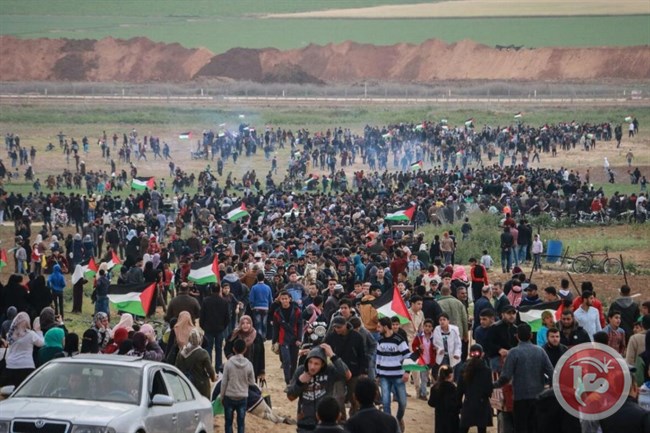
One of the slain Palestinians was identified as Amin Mahmoud Muhammar from Rafah in southern Gaza. His age remained unknown.
The other slain Palestinian was identified as Muhammad Kamal al-Najjar, 25, from eastern Jabaliya in northern Gaza.
Around 2:20 p.m. medical sources told Ma’an that a fourth Palestinian had been killed. He was identified as Muhammad Abu Omar, 19.
Fifteen minutes later, the Gaza Ministry of Health confirmed that a fifth Palestinian had been killed. He was identified as 16-year-old Ahmad Ibrahim Odeh from the northern Gaza Strip.
Around 3:15p.m. the ministry reported that Jihad Freineh, 33, from Gaza City was killed.
Minutes later, the ministry reported that the seventh Palestinian had been killed by Israeli forces. He was identified as Mahmoud Saadi Rahmi, from Gaza City.
Leading up to the march, the Israeli army released a statement saying it had declared the border area along Gaza a “closed military zone,” meaning that any Palestinian who got close to the border fence could risk getting shot.
The Israeli army released statements on Twitter describing the protests as “violent riots.”
“17,000 Palestinians are rioting in 5 locations along the Gaza Strip security fence. The rioters are rolling burning tires and hurling firebombs & rocks at the security fence & IDF troops, who are responding w riot dispersal means and firing towards main instigators,” the statement said.
Despite the Israeli army’s claims, Palestinian activists and leaders in the Gaza Strip have maintained that the “March of Return” was organized as a massive non-violent, weeks-long protest advocating for the return of Palestinian refugees to their original homelands in historic Palestine, now present day Israel.
Leading up to Friday, the first official day of the march — which will continue until the 70th anniversary of the Nakba, or catastrophe, in May — Palestinians set up tents along the border with Gaza, where protesters plan to stay until the Nakba anniversary.
Ismail Haniyeh, head of the Hamas politburo, gave a speech at the March of Return, saying it “demonstrates that there are no alternatives to Palestine and the right of return (for the Palestinian people),” praising the people who left their homes to attend the march.
When speaking about the goal of the march, Haniyeh said it constitutes “the beginning of a return (of the Palestinian people) to the entirety of the land of Palestine.”
“We will not give up and we will not bargain with the Zionist entity over even a small piece of the land of Palestine,” Haniyeh continued, stressing that the Palestinians will reject any deal proposed by the Trump administration.
“Our people went out today to make it clear that we will not give up Jerusalem and that there is no alternative to Palestine and the right of return. We will not accept the right of return staying only a slogan.”
On eve of rally, Israel threatens to kill Hamas leaders
MEMO | March 29, 2018
Israel on Thursday threatened to assassinate top Hamas leaders in the event of any major “escalations” during mass demonstrations planned for Friday in the blockaded Gaza Strip.
“We will not allow Hamas leaders to continue to hide in Gaza while women and children are sent to the border fence,” Israeli army spokesman Avichay Adaree tweeted.
Adaree’s warning comes only one day before planned demonstrations during which Palestinian protesters plan to converge en masse on the Gaza Strip’s roughly 45-kilometer eastern border with Israel.
“If necessary, we will respond — near the fence and inside the Gaza Strip — against those promoting violent demonstrations: the military wing of Hamas,” Adaree said.
All major Palestinian factions, including Hamas and Fatah, have endorsed the planned rally, in which thousands of Gazans are expected to participate.
According to organizers, the demonstration — dubbed the “Great Return March” — is to be entirely peaceful in nature.
Israeli Housing Minister Yoav Galant, however, said: “If the situation on the Gaza border escalates, the assassination of Hamas leaders is an option that remains on the table.”
Speaking to Israel’s Walla news website, he added: “In times of conflict, everything is allowed.”
The planned rallies are intended to pressure Israel to lift its decade-long siege of the Gaza Strip and reaffirm the Palestinians’ right to return to their ancestral homes in historical Palestine.
Since 2007, the Gaza Strip has suffered a crippling Israeli/Egyptian blockade that has gutted its economy and deprived its more than two million inhabitants of many basic commodities.
The UN disregard for Palestinians’ right of return colludes with Israeli violence

Thousands of internally displaced Palestinians take part in the March of Return [File photo]
By Ramona Wadi | MEMO | March 29, 2018
The Palestinian “Great March of Return” has exposed the frailty of Israel’s fabricated narratives, yet once again the international community prefers to speak about “sides” in the conflict. As the planned march draws nearer, the Jerusalem Post reported that UN Special Coordinator for the Middle East Peace Process, Nickolay Mladenov, has urged “all sides to exercise restraint and to take the necessary steps to avoid a violent escalation.”
Palestinians have already insisted repeatedly that the march is a form of non-violent protest stemming from a legitimate right to go back to the land from which the nascent Israeli state drove them out at gunpoint. Nevertheless, the Times of Israel reported yesterday that more than 100 snipers have been deployed along the border with the Gaza Strip “to deal with a Palestinian march expected to begin on Friday…” Officers will “authorise them to open fire if… Israeli lives are in danger.” Israel Defence Forces (IDF) Chief of Staff Gadi Eizenkot clarified this further: “The orders are to use a lot of force.”
Israeli media outlets have supported the state’s premeditated violence by framing the Palestinian protest as a violent act even before it has taken place, and thus justified in advance what they deem to be a necessarily violent response. However, they are not alone in promoting narratives of denial with regard to Israel’s colonial violence. The UN’s absence of any assertiveness when it comes to holding Israel accountable for its crimes is becoming a core component of the colonial entity’s ability to act with total impunity. Nowhere is this more evident than in its patronising attitude towards the Palestinian right of return.
Israel National News published an op-ed earlier this week which described the planned protest as the “latest innovation” with the immediate objective of Palestinians participating in the march “to get killed themselves”, simply in order to “delegitimise Israel”. The op-ed provides the most dissociated overviews of the Nakba, which the author describes as “the date in 1948 on which Ben Gurion declared the state of Israel and five Arab states invaded it.” Needless to say, the article also seeks to disavow the displacement, dispossession and ethnic cleansing which transformed Palestinians into perpetual refugees.
Israel’s widespread denial of the Palestinian right of return necessitates this manipulation of the indigenous population’s history. It also allows Eizenkot to justify targeting Palestinians with sniper fire for “marching into our territory.” Yet the international community’s refusal to support the perfectly legitimate right of return speaks volumes about the UN’s collusion with Israel. It is also proof that the UN never intended that the right should ever be implemented, even though it was made a condition of Israel’s membership of the international organisation. The only possibility lies in the hands of the Palestinian people, who have the power to move away, at least intellectually, from the impositions disguised as UN resolutions.
The Palestinian Great March of Return should thus prompt some thinking. Despite seeking to abide by UN resolutions, Palestinians have found themselves tethered to cycles of dispossession, which shows that the international agenda is deeply flawed and corrupted. The international response to this non-violent protest has not singled out Israeli plans to murder Palestinians at the border of their own land for condemnation; rather, the UN has chosen a discourse which insists on equivalence between the protagonists when it is clear to all and sundry that there is none. A colonial power with one of the best-equipped armed forces in the world — including nuclear weapons — is imposing its will on a colonised population which seeks to return to its own land and reverse the permanent refugee status which has become synonymous with the Palestinians.
Since Israel and the UN have already chosen their violent narratives, we are justified in asking why the latter’s intent is to maintain the political coercion that created the Palestinian refugee problem in the first place and face its own accountability for the transformation of the legitimate right to return into a dangerous game with limited options. The Palestinians, meanwhile, can either submit and stay permanently displaced, or stand up for their rights and be killed by acts of premeditated violence by Israel, with which the UN is colluding.
Israel army to use live ammo to disperse border rallies
MEMO | March 28, 2018
The Israeli army will use live ammunition to disperse planned Friday rallies in the Gaza Strip, according to Israel’s army chief-of-staff.
“We are reinforcing the barriers [along the Gaza-Israel border] while large numbers of [Israeli] soldiers will be stationed in the area to prevent infiltration attempts,” Israeli Army Chief-of-Staff Gadi Eizenkot said Wednesday.
Soldiers have received permission to open fire on protesters “if Israeli security infrastructure comes under threat,” Eizenkot told Israeli daily Maariv.
“Last year, hundreds were injured after they tried to destroy parts of the [border] fence,” he said. “We will not stand for this.”
Speaking to Israeli daily Yedioth Ahronoth, Eizenkot said the Israeli army had deployed more than 100 sharpshooters in advance of Friday’s planned rallies.
“If lives are in jeopardy, [soldiers will have] permission to open fire,” he said.
Eizenkot made the remarks only two days before planned demonstrations during which Gazan protesters hope to converge en masse on the Gaza Strip’s 45-kilometer eastern border with Israel.
Dubbed the “Great Return March”, the event is intended to pressure Israel to lift its decade-long siege of the Gaza Strip and reaffirm the Palestinians’ right to return to their homes in historical Palestine.
Since 2007, the Gaza Strip has groaned under a crippling Israeli/Egyptian blockade that has gutted its economy and deprived its more than two million inhabitants of many basic commodities.
Return March organizers: Israel’s terrorism will not intimidate us
Palestine Information Center – March 28, 2018
 GAZA – National committee for the March of Return, during a press conference held near the Great March of Return’s tent east of Gaza city which was targeted by Israeli gunfire on Wednesday morning, said that Israel will not succeed in terrorizing the Palestinian people.
The committee affirmed that preparations for the Great March of Return are ongoing, calling on the world nations to support this popular movement.
Head of the committee Khalid al-Batsh said that the Great March of Return is a purely peaceful event and that Palestinians are entitled to demand their right of return which is guaranteed by international law.
The PIC reporter said that the Israeli tanks stationed near Gaza’s eastern border fence fired two missiles on Wednesday morning at two sites east of al-Zaitoun neighborhood in Gaza city. No injuries were reported.
Member of the committee Ismail Ridwan warned the Israeli occupation against using violence against the protesters participating in the Great March of Return.
The Islamic Jihad leader Ahmad al-Modallal said that the Israeli occupation is in a state of confusion and trying to thwart this popular movement by various means. He continued to say that Israel will never be able to break the Palestinian will or kill the Palestinian dream of return.
The coordinating committee of the Great March of Return in February announced its intention to launch popular mass demonstrations toward the Palestinian territories occupied since 1948 in demand of the Palestinian refugees’ right of return.
Former Catalan Education Minister Ponsati Going to Surrender to UK Authorities

© REUTERS/ Russell Cheyne
Sputnik – March 28, 2018
Former Catalan Education Minister Clara Ponsati, who has been hiding from Spanish law enforcement in the United Kingdom, said Wednesday that she was going to surrender to UK authorities.
“Later on this morning I will attend police station with my lawyer @AamerAnwar & will b arrested & taken 2court as Spain tries 2extradite me, I need ur support,” Ponsati wrote on Twitter.
According to Spanish media, a UK judge will decide on the measure of restraint for her later in the day.
On Tuesday, the politician began raising funds online for her legal defense, saying that her goal was to get 40,000 pounds ($56,600). As of now, the campaign managed to raise almost 100,000 pounds.
Charges Against Ponsati
On October 1, Catalonia held an independence referendum, which the central authorities did not recognize. The results showed that the majority of Catalans supported secession, and the regional parliament unilaterally announced independence later in October. In response, Madrid imposed direct rule over the autonomous region, dissolved the Catalan parliament and called a snap election. Several pro-independence leaders were jailed, while others fled to Belgium.
Following the independence vote, Ponsati fled to Belgium with former Catalan leader Carles Puigdemont and three other regional politicians. In March, Ponsati moved back to Scotland and her position as a professor at St. Andrews University.On Friday, the Spanish Supreme Court activated a European arrest warrant for a number of Catalan politicians, including Puigdemont and Ponsati. Shortly after, Puigdemont was detained in Germany after he crossed the border with Denmark on his way from Finland to Belgium.
According to the Spanish Prosecutor’s Office, Ponsati was responsible for allowing polling places to stay open in schools during the referendum. She is charged with organizing an insurrection — which under Spanish law can mean a prison sentence of up to 30 years — as well as embezzlement of state funds.
READ MORE:
Israel readies extra troops, snipers and drones, for Palestinian ‘March of Return’

Courtesy: defenseindustrydaily.com
MEMO | March 27, 2018
Israeli authorities are preparing extra troops, snipers and drones ahead of the Palestinians’ planned “March of Return”, a six-week long series of actions beginning this Friday with Land Day protests.
According to the Times of Israel, Israeli occupation forces are “gearing up” for protests expected to take place along the Gaza Strip’s perimeter fence, “putting additional units on alert out of concerns that large numbers of Palestinians might try to break through the barrier and rush into Israel”.
The majority of Palestinians in the occupied and blockaded Gaza Strip are from nearby communities ethnically cleansed by Israel in the 1948 Nakba.
Land Day, which takes place annually on 30 March, marks the Israeli government’s appropriation of land from Palestinian citizens in 1976, and the bloody repression of protests against the seizure. The March of Return initiative is intended to continue until 15 May, the 70th anniversary of the Nakba.
Citing a “military source”, the Times of Israel reported that in preparation for the expected protests, “additional army battalions, Border Police units, and dozens of snipers will be deployed along the Gaza border on Friday, in order to keep demonstrators from crossing”.
In addition, “police officers will be stationed a bit farther back, in order to keep back any Palestinians who breach the first line of defence”, while “additional teams of IDF soldiers will also patrol the Israeli communities closest to the border”.
Israeli forces are also likely to “deploy drones that can drop tear gas on protesters on the Gaza side of the border, a technique that the Border Police tested earlier this month.”
In regular protests since December, Israeli occupation forces have used lethal violence against Palestinian demonstrators, killing a number of unarmed protesters and injuring hundreds more.
Cambridge Analytica & The Facebook-Big Data Conspiracy
By Andrew Korybko | Oriental Review | March 26, 2108
The Guardian published an exposé about how Cambridge Analytica allegedly mastered the use of social media data to give the Brexit and Trump campaigns a crucial edge in 2016.
The UK news outlet released an extensive story about Christopher Wylie, the Canadian genius behind the Cambridge Analytica data firm that was reportedly the secret weapon behind these two campaigns’ electoral successes. It’s long been speculated that the company used people’s Facebook information to enhance their electioneering efforts, but now its founder has come forward and purportedly claims to have documents proving that this was the case. What’s more, he says that his company was created by SCL Elections, a subsidiarity of the SCL Group that he told a reporter is supposedly known for its expertise in conducting “cyberwarfare for elections”. The SCL umbrella has military contracts alongside civilian ones, therefore making it an extension of the “deep state” and adding credence to the claims that Cambridge Analytica functioned as an indispensable component behind Brexit and Trump’s victories.
The Guardian goes on to explain how users’ Facebook data was mined through apps, quizzes, and “seeders”, and that people’s personality traits were paired with their “likes” and other account activity to build detailed profiles of millions of people, which the outlet and its interviewee suggest might have been illegal. In their defense, Cambridge Analytica always asserted under pressure that this isn’t the case, and has sometimes said that it was conducting academic research. This “plausibly deniable” stance shows just how blurred the line is becoming between academia, marketing, politics, and intelligence, but to be fair, this has been a steadily growing problem for years already and Cambridge Analytica isn’t the first company to be implicated with accusations of legal and ethical impropriety in this field. The only thing that they’re really “guilty” of is creatively identifying and tapping into the anti-systemic zeitgeist of the British and American societies.
The argument can be made that it was “wrong” for them to procure people’s private Facebook data, but that doesn’t change the fact that the results were used for very effective purposes in pushing forth what the masses apparently wanted, which is Brexit and Trump. The Mainstream Media was, and still is, completely taken aback by what happened because they convinced themselves of the inevitability of both of those campaigns’ defeats, arrogantly refusing to recognize and accept the obvious signs that people were clamoring for change. All that Cambridge Analytica did was process preexisting data, objectively assess its results, and pass along the findings to its clients so that they can hone their messages, though there are legitimate fears that data brokers such as this one might eventually become too powerful if they independently leverage this information for their own ends one day.
This whole affair goes to show the growing influence that technology companies are having in today’s post-modern society, but the only reason why it’s coming under the Mainstream Media’s microscope is because it was one of the reasons why the “wrong side” won. That’s why The Guardian also goes on a bizarre tangent in implying that there might have been a Russian government connection to Cambridge Analytica, all in order to pander to the Russiagate mob and their “deep state” controllers. That aside, the exposé is informative because it lays bare the truth of what’s happening behind the scenes – and literally, behind computer and phone screens – and explains how people’s private preferences are being vacuumed up and analyzed in creating a dizzying array of psychological profiles for political purposes.
Trump Should Withdraw Haspel Nomination, Intel Vets Say
Consortium News | March 25, 2018
MEMORANDUM FOR: The President
FROM: Veteran Intelligence Professionals for Sanity
SUBJECT: Request to Withdraw Nomination of Gina Haspel
EXECUTIVE SUMMARY
With respect, we veteran intelligence officers from CIA and other agencies urge you to withdraw the nomination of Gina Haspel for CIA director. From what is already known of her leading role in CIA torture 16 years ago, she has disqualified herself.

Gina Haspel
In 2002 Haspel supervised the first CIA “black site” for interrogation, where cruel and bizarre forms of torture were applied to suspected terrorists. And when the existence of 92 videotapes of those torture sessions was revealed, Haspel signed a cable ordering their destruction, against the advice of legal counsel at CIA and the White House.
Does Torture ‘Work?’
We are confident that if you set aside some time to read the unredacted portions of the Senate Intelligence Committee report of 2014 on the torture ordered and supervised by Haspel and other CIA managers, you will change your mind about her nomination. The five-year Senate investigation was based primarily on original CIA cables and other sensitive documents.
In addition to revealing clear violations of the UN Convention Against Torture, the Senate investigation shows that claims by senior CIA officials that torture is effective are far from true. The US Army — in which many of us have served — has been aware of the ineffectiveness of torture for decades.
General John Kimmons, head of Army Intelligence, drove home that point on September 6, 2006 — approximately an hour before President George W. Bush publicly extolled the virtues of torture methods that became known as “enhanced interrogation techniques.” Gen. Kimmons stated: “No good intelligence is going to come from abusive practices. I think history tells us that. I think the empirical evidence of the last five years — hard years — tell us that.”
We believe that Defense Secretary James Mattis’ lack of enthusiasm for torture reflects lessons drawn from the historical experience of the Marine Corps, as well. Not to mention the twin reality that torture brutalizes the brutalizer, and that US use of torture puts our own troops in serious jeopardy when captured. Moreover, there is no more effective recruitment tool than torture to attract more terrorists.
International and Domestic Law
Please also be aware that many signatories to the UN Convention Against Torture take seriously their obligations under the principle of “universal jurisdiction,” which applies when those who authorize or practice torture are not brought to justice by authorities in their home countries.
George W. Bush experienced a precarious brush with this reality in 2011, when he had to abruptly cancel a visit to Geneva, Switzerland, after discovering that plans were in place to arrest him as soon as he stepped onto Swiss soil. [See “America’s Stay-at-Home Ex-President”] The widely respected European Center for Constitutional and Human Rights already has made no secret of its intention to proceed quickly against Haspel, should she set foot in Europe.
We believe that CIA’s activities and general focus have become severely unbalanced, with the lion’s share of funding and energy going to the paramilitary-prone operational side — where the potential for human rights abuses is not given sufficient consideration.
That trend has gone on steroids in more recent decades, and it is a safe bet that Gina Haspel would accelerate it. We would also observe that if most of the talent and funding goes to CIA paramilitary operations, then the by-products will necessarily include a tendency to engage in politically motivated — and therefore shabby — analysis. That means that senior policymakers like you will be poorly informed, particularly with respect to complex world issues — including biased perspectives on Russia and its newly re-elected president, Vladimir Putin.
* * *
We Veteran Intelligence Professionals for Sanity (VIPS) are extremely concerned at the possibility that Gina Haspel might become the next Director of the CIA. Haspel actually supervised a CIA “black site” codenamed “Cat’s Eye” in Thailand where a number of suspected terrorists were tortured. She subsequently collaborated in destroying all 92 videotapes of the torture sessions, effectively covering up what were likely serious war crimes.
There should be no question about the illegality of torture. It has been universally condemned and banned by both the Geneva Conventions and United Nations Convention Against Torture and Other Cruel, Inhuman or Degrading Treatment or Punishment, which was signed by President Ronald Reagan in 1988 and ratified by the Senate in 1994.
The UN Convention defines torture “as any act by which severe pain or suffering, whether physical or mental, is intentionally inflicted on a person for such purposes as obtaining from him, or a third person, information or a confession…” and makes clear that “no exceptional circumstances whatsoever, whether a state of war or threat of war, internal political instability or any other public emergency, may be invoked as a justification of torture.”
The Convention’s Article 2 requires signatories to take effective measures to prevent torture in any territory under their jurisdiction. The complete prohibition of torture is absolute. Under international law, officials cannot receive immunity in cases involving torture and governments that have signed the Convention are obligated to bring torturers to justice. US domestic law was brought in line with the Convention once the US became a signatory and ratified it.
In the wake of the Abu Ghraib revelations, torture, to include its variations that have been euphemistically described as “enhanced interrogation techniques” (EIT), is now explicitly banned by the US military in its training manuals. A number of soldiers were tried and imprisoned in the wake of Abu Ghraib, although the “upper ranks” — in civilian as well as military spheres — who approved torture managed to escape serious consequences.
Some in the Pentagon clearly took seriously allegations of torture and were willing to file criminal charges against those involved, though Department of Defense leadership never saw fit to assume responsibility for having set up a policy environment that quite clearly condoned EIT.
There is also another significant historical and legal precedent that demonstrates that the United States government has by its own actions agreed that what is today being called “enhanced interrogation” is a war crime. In 1946-1948, Japanese officers who tortured Allied soldiers — including what is now referred to as waterboarding — were tried at the Tokyo post-war tribunals for that crime, found guilty, and executed.
Heinous
More recently, the meticulously documented unclassified 528 page Executive Summary of the Senate Select Committee on Intelligence (SSCI) report on the CIA’s secret Rendition, Detention and Interrogation (RDI) program is remarkable for its candor. That five-year investigation was based on original CIA cables and other documents.
In blunt language, the Senate report describes the horrors of the black site secret prisons and the efforts that were made to get terrorist suspects to talk. It demonstrates that the interrogations were brutal — worse than anyone had been led to believe — and also that they did not produce any information that might not have been developed otherwise or, in many cases, any actionable intelligence whatsoever. The full classified text of the report — which names names of the actual torture perpetrators redacted in the summary — runs to almost 7,000 pages.
Moreover, coercive interrogation frequently produced misleading or fabricated intelligence that wasted resources by having to be meticulously checked before being used. This conclusion was also arrived at by former FBI interrogator Ali Soufan — who deplored CIA methods — as well as by a review conducted by CIA’s then-Inspector General (IG), John Helgerson, in 2004. The “Helgerson Report” condemned both CIA leadership and Langley’s on-the-ground management of questionable programs driven by “analytical assessments that were unsupported by credible intelligence” — programs which quickly became abusive.
It is our collective judgment that the loathsome physical abuses that included beatings, repeated waterboardings and anal violations referred to as “rectal feeding” — as well as physical threats to family members — cannot be whitewashed with the convenient euphemism of “enhanced interrogation.” All of those are acts of torture — plain and simple.
And while there are undoubtedly many good moral arguments against torture, there are practical considerations as well. Despite what the media would have Americans believe, torture does not work.
We recall the unambiguous remarks of then-commander of Army intelligence, Gen. John Kimmons, who held a Pentagon press conference on Sept. 6, 2006 — the same day President George W. Bush announced what he called “an alternative set of procedures” for interrogation (which later morphed into the term “enhanced interrogation techniques”). Anticipating that Bush would claim the EITS to be necessary and effective, Gen. Kimmons told the media: “No good intelligence is going to come from abusive practices. I think history tells us that. I think the empirical evidence of the last five years — hard years —tells us that.”
Colin Powell Mousetrapped by ‘Intelligence’ From Torture
Worse still, intelligence officials have used information, which they knew was gained from torture, to mislead the most senior US officials on issues of war and peace. One of the signatories below was eyewitness to how CIA Director George Tenet persuaded Secretary of State Colin Powell to tell the UN of a “sinister nexus” between Saddam Hussein and al-Qaeda.
Tenet did not tell Powell that this “intelligence” came from a source, Abu Yahya al-Libi, who had been “rendered” to, and waterboarded by, Egyptian intelligence. The Defense Intelligence Agency had deemed this intelligence unreliable, but Tenet chose to ignore DIA and never informed Powell. Al-Libi recanted less than a year later, admitting that he fabricated the story about Saddam and al-Qaeda in order to stop his torture.
Moreover, when you wink at torture, you motivate enemies of the United States to do the same to captured US soldiers, diplomats and travelers while also providing a propaganda bonanza for terrorist groups like al-Qaeda and ISIS.
Indeed, the only reason why CIA torturers have not been tried and sentenced to prison for the damage they have done to the nation is that an intimidated President Barack Obama — who once proclaimed that “nobody is above the law” — balked at allowing the judicial process to run its course, thereby whitewashing the Bush Administration’s many crimes related to the so-called “global war on terror.” Obama attempted to justify his inaction as looking forward rather than backward, but it is more likely that he feared opening up a Pandora’s Box of shameful government secrets that no doubt would have emerged.
Promoting Haspel in spite of her tainted record would send a message to both intelligence and military personnel that embracing practices like torture — indisputably a war crime — can be a path to promotion.
Haspel’s involvement with torture began when she accepted the assignment to go to Thailand — which she could have turned down — to run the “black site” where the interrogations were being conducted. She was, at the time, the deputy in CIA’s Counter Terrorism Center (CTC), working for Jose Rodriguez.
She was in charge of the secret Thailand base in late 2002 while Abd al-Rahim al-Nashiri and possibly more suspects were being tortured in a process that included slamming victims’ heads against walls, subjecting them to painful stress positions, regularly depriving them of sleep, confining them to small, coffin-like boxes, and waterboarding.
The “confinement boxes” were of two types; one was coffin-sized, and the other was smaller and less than waist-high. Both had strong claustrophobic effects. A prisoner would be forced into the smaller box as an extreme form of stress positioning, creating excruciating pain. To maximize psychological distress and exploit phobias, insects were sometimes placed in the pitch-black “coffin” alongside the victim.
Destroying the Evidence
In 2005, after returning to CIA headquarters at Langley, she acted on instructions from Rodriguez and drafted the order to destroy the 92 videotapes that had been made of the interrogations. It has been reported that she was a “strong advocate” for the destruction. This was contrary to instructions provided by CIA Counsel John Rizzo and the White House. Thus, her act may have constituted destruction of evidence — a felony.
Jose Rodriguez was investigated for destruction of evidence by a Special Prosecutor who eventually ruled against charging him. An aide to CIA Executive Director Kyle “Dusty” Foggo later revealed Rodriguez’s rationale for shredding the tapes, writing in an email that “the heat from destroying [them] is nothing compared with what it would be if the tapes ever got into public domain – he [Rodriguez] said that they would make us look terrible; it would be devastating to us.” Gina Haspel ensured that these tapes — important, damning evidence of US government torture — would never see the light of day.
Haspel’s defenders claim that she was not the creator of the torture program and only served as a willing executor of a government initiative that she believed to be legal. That may be true as no one has access to the CTC documents that might prove otherwise. Nevertheless, it does not provide her a free pass under international law, where it is generally referred to as the “Nuremberg Defense” — a thoroughly discredited “defense” that harkens back to the era of Nazi atrocities and those who attempted to justify them by claiming perpetrators were “just following orders.”
‘Nuremberg Defense’ Didn’t Work at Nuremberg
Several former CIA leaders have supported her, saying that she was “implementing the legal orders of the president,” but many of them may be concerned about their own reputations or questionable decisions they may have made in the name of the “war on terror.” And the UN’s International Law Commission says something quite different in its codification of the legal options surrounding torture, writing that “the fact that a person acted pursuant to an order of his government or of a superior does not relieve him from responsibility under international law, provided a moral choice was in fact possible to him.”
It is also claimed that Gina Haspel was working for the CIA Chief of Station (COS) in Bangkok and acting under the COS’s orders, but those of us who have worked in and led CIA bases would dispute that that type of tight control was common, particularly since in this case, she was reporting directly to the Counterterrorism Center at Langley. Haspel would have been the boss and would have had independence in the field in executing directives from CIA Headquarters and the Counterterrorism Center — some of which she herself had a hand in drafting.
If Haspel is confirmed and wishes to travel abroad, she may have to restrict herself to countries not party to the UN Convention Against Torture because of her widely known involvement in the “black site” in Thailand. The 42 countries that have signed and ratified the Convention include the US and most of its allies. All take on a legal obligation to enforce the prohibition against torture, based on the principle of “universal jurisdiction,” when necessary. In other words, they are empowered to act when the accused’s home country refuses to do so.
Not Too Late to Do the Right Thing
If you do not withdraw the nomination of Gina Haspel and she is confirmed, this will cast a moral stain on the vast numbers of patriotic and ethically upright Americans who serve their country in the field of national security. It will also be a continuation of the steady erosion of human rights standards and rule of law post-9/11.
Apparent widespread support for torture among the US public — enabled largely by the false message of Hollywood, the media and the Cheney family that it “works” — is deplorable. It might have been headed off by the prosecutions of Haspel, Rodriguez and others by former President Obama, together with graphic exposure of the evidence. You have an opportunity to reverse this wrong.
Withdrawing Haspel’s nomination now would be a step in the right direction. Confirming her as Director of CIA would signal that Washington embraces what then-Vice President Dick Cheney referred to as the “dark side.” Regrettably, torture was once part of US policy. Indeed, one of this Memorandum’s signatories spent nearly two years in federal prison because he revealed that. But torture cannot be relied upon to yield accurate intelligence. It remains an internationally condemned malignancy that must be excised, never to return.
* * *
For the Steering Group, Veteran Intelligence Professionals for Sanity (VIPS)
Jean Maria Arrigo, PhD, member of 2005 American Psychological Association task force evaluating the role of psychologists in U.S. intelligence and military interrogations of detainees (associate VIPS)
William Binney, former NSA Technical Director for World Geopolitical & Military Analysis; Co-founder of NSA’s Signals Intelligence Automation Research Center (ret.)
Richard H. Black, Senator of Virginia, 13th District; Colonel US Army (ret.); Former Chief, Criminal Law Division, Office of the Judge Advocate General, the Pentagon (associate VIPS)
Bogdan Dzakovic, former Team Leader of Federal Air Marshals and Red Team, FAA Security (ret.) (associate VIPS)
Philip Giraldi, CIA, Operations Officer (ret.)
George Hunsinger, Professor, Princeton Theological Seminary; Founder, National Religious Campaign Against Torture (associate VIPS)
Michael S. Kearns, Captain, USAF (ret.), Intelligence Officer & ex-Master SERE Instructor
John Kiriakou, Former CIA Counterterrorism Officer and former senior investigator, Senate Foreign Relations Committee
Karen Kwiatkowski, Lt. Col., USAF (ret.)
Linda Lewis, WMD preparedness policy analyst, USDA (ret.) (associate VIPS)
Edward Loomis, NSA Cryptologic Computer Scientist, ret.
Ray McGovern, former US Army infantry/intelligence officer & CIA analyst; CIA Presidential briefer (ret.)
Elizabeth Murray, former Deputy National Intelligence Officer for the Near East, National Intelligence Council & CIA political analyst (ret.)
Todd E. Pierce, MAJ, US Army Judge Advocate (ret.)
Diane Roark, Republican Professional Staff, House Permanent Select Committee on Intelligence, 1985-2002 (ret.) (associate VIPS)
Coleen Rowley, FBI Special Agent and former Minneapolis Division Legal Counsel (ret.)
Greg Thielmann, former Director, Office of Strategic, Political, and Military Affairs, Bureau of Intelligence and Research, State Department; Former staff member, Senate Intelligence Committee
Peter Van Buren, US Department of State, Foreign Service Officer (ret.) (associate VIPS)
Kirk Wiebe, former Senior Analyst, SIGINT Automation Research Center, NSA
Lawrence Wilkerson, Colonel, US Army (ret.), former Chief of Staff for Secretary of State; Distinguished Visiting Professor, College of William and Mary (associate VIPS)
Valerie Wilson, former operations officer, CIA (associate VIPS)
Sarah G. Wilton, CDR, USNR, (ret.); Defense Intelligence Agency (ret.)
Robert Wing, former Foreign Service Officer (associate VIPS)
Ann Wright, Colonel, US Army (ret.); also Foreign Service Officer who resigned in opposition to the US war on Iraq
* * *
ANNEX
MEMORANDA from VIPS to President Barack Obama Regarding Torture
1 —
September 16, 2016
MEMORANDUM FOR: Sen. Dianne Feinstein, Vice Chairman, Senate Select Committee on Intelligence
FROM: Veteran Intelligence Professionals for Sanity (VIPS)
SUBJECT: U.S. Media Mum On How Your Committee Faced Down Both CIA and Obama
2 —
September 19, 2015
MEMORANDUM FOR: The President
FROM: Veteran Intelligence Professionals for Sanity (VIPS)
SUBJECT: Intelligence Veterans Challenge CIA’s “Rebuttal” on Torture
3 —
December 29, 2014
MEMORANDUM FOR: Senator Mark Udall
FROM: Veteran Intelligence Professionals for Sanity (VIPS)
SUBJECT: Time to Speak Out on Floor of Congress to Stop Torture
4 —
https://consortiumnews.com/2009/092809a.html
September 27, 2009
MEMORANDUM FOR: The President
FROM: Veteran Intelligence Professionals for Sanity (VIPS)
SUBJECT: There Must be Accountability for Torture
5 —
https://consortiumnews.com/2009/042909e.html
April 29, 2009
MEMORANDUM FOR: The President
FROM: Veteran Intelligence Professionals for Sanity (VIPS)
SUBJECT: Torture: An Accumulated Evil (see Nuremberg): John Brennan Publicly Defended “Extraordinary Rendition” Knowing Its Purpose Was Torture
Featured Video

Seyed M. Marandi: US-Iran War Inevitable: Kuwait and Bahrain May Fall
or go to
Aletho News Archives – Video-Images
From the Archives
Oil and the Israel Lobby
Reknowned economist M. Shahid Alam offers this excellent critique of Noam Chomsky’s defective analysis of the relative influence of Oil versus the Israel lobby over US foreign policy: … continue
Blog Roll
 Aletho News
- ICC ignored ‘very well-documented’ NATO crimes – ex-Libyan minister
- SNSC secretary dismisses US response to Iran’s conditions as ‘inadequate’
- Sanaa says Taiz roads open, secure for residents, warns Saudi forces
- Iraqi resistance group urges Saudi leadership to admit defeat, lift Yemen siege
- Trump’s Retreat: How Al-Aqsa Flood Took Down the US Empire
- Israel’s Military Actions in Lebanon Grossly Violate International Law — Lavrov
- Seyed M. Marandi: US-Iran War Inevitable: Kuwait and Bahrain May Fall
- Leaders Condemn Ansarallah Attack on Saudi Arabia While Ignoring Illegal War Against Yemen
- Leaked: Britain’s Covert Iraqi Psyops Network
- Yemeni Armed Forces Warn Airlines Against Using Saudi Airports, Exempt Mecca and Medina
- If Americans Knew
- How Israel Conquered the Latin American Right
- Agents search Rep. Omar’s Washington home in criminal probe as she vows she won’t ‘be silenced’
- “The Rule Was: ‘Shoot Everyone You See'”
- Israel goes ballistic over Nobel Laureate Navi Pillay
- U.S. May Join Yet Another Middle Eastern War — TCN
- Yellow Line moves again as Israel closes in on trapped Gazans – Daily Update
- Israeli Attacks Kill Seven Palestinians in Gaza Including Six-year-old Girl
- Gaza: Ceasefire Anniversary Marks Year of Failed Promises
- The American Conservative: Mike Huckabee Should Resign
- A C-Section in Shackles: A Palestinian Woman’s Harrowing Birth in Israeli Detention
- No Tricks Zone
- Germany’s Green Energy Debacle: High Energy Costs Force Kahla Porzellan to Close After 182 Years!
- New Study: 50 Years Of The Most Aggressive ‘Net Zero’ Policies Can Only Affect The Global Climate By 0.03°C
- US September “Heat” Was No Record…Many Records Set Decades Ago
- Latest European Green Energy Debacle; Portugal’s Largest Flagship Solar Park Insolvent!
- Green Energy Debacle: German Expert Professor Fritz Vahrenholt Warns Of Severe Economic And Social Consequences
- Two More Paleo Reconstructions Affirm Meters-Higher Sea Levels Across Ireland, Brazil 7000-6000 Years Ago
- New Study: Earth And Venus Surface Warmth Largely Explained By Convection And Lapse Rate, Not CO2 Or Radiation
- 2025 Nature Paper Claiming Worsening Global Drought Gets RETRACTED …Heavily Flawed
- New Study: ‘Global Drought Shows No Detectable Recent Acceleration Under Climate Warming’
- Economic Masterminds: German Socialists Suggest Taxing Productivity Gains Stemming From Using AI

