Feminists weigh in on draft registration for women
By Claire Schaeffer-Duffy | National catholic Reporter | June 28, 2016
Recent legislative efforts to extend draft registration to young women have raised an old conundrum for some feminists. Does pursuit of gender equality include support for universal conscription?
While not all feminists are anti-militarists, opposition to war and militarism has been a strong current within the women’s movement. Prominent suffragists like Quaker Alice Paul, and Barbara Deming, a feminist activist and thinker of the 1960s and ’70s, were ardent pacifists. Moreover, feminist critique has often regarded the military as a hierarchical, male-dominated institution promoting destructive forms of power.
In late April, the House Armed Services Committee voted for an amendment to the national defense bill that would extend draft registration — already a requirement for men — to women ages 18-26. The amendment was later dropped, but in mid-June, the Senate approved a similar provision in its version of the national defense bill.
Among the amendment’s staunchest defenders was Armed Services Committee member Rep. Jackie Speier (D-Calif.).
“If we want equality in this country, if we want women to be treated precisely like men are treated and that they should not be discriminated against, then we should support a universal conscription,” Speier told the political website The Hill in April.
Not all feminists agree with Speier’s path to equality. Days after the House Armed Services Committee approved the amendment, 24-year-old Julie Mastrine, an activist and media professional, authored an online petition calling on Congress not to force women to register and instead dump the draft entirely.
Mastrine, a self-described feminist libertarian, argues that draft registration violates individual choice.
“I can’t imagine a more tragic loss of liberty than forcing a citizen, whether male or female, to fight in a war with which they may disagree. Equality is a moot point if personal choice and bodily autonomy must first be eliminated to achieve it,” Mastrine said in a statement.
In an online editorial for Playboy, Lucy Steigerwald, a contributing editor to Antiwar.com, acknowledged that excluding women from draft registration was “unfair” and “sexist.”
“But the solution to the decrepit notion that the young of the country are communal property is not to remove the sexism, it’s to remove the draft,” she wrote.
Like Mastrine, Steigerwald supports equal access to the military for women, but opposes conscription. She does not believe, as some have argued, that the return of the draft would make the U.S. more cautious about engaging in conflicts.
“You don’t stop the runaway truck of U.S. foreign policy by throwing a man in front of it, and you definitely don’t stop it by throwing a man and a woman, just to make things equal,” Steigerwald wrote.
The linking of women’s equality to universal conscription dates back to the early 1980s. Draft registration had ended in 1975 with the conclusion of the Vietnam War. In 1980, a nervous President Jimmy Carter, alarmed over the Soviet Union’s invasion of Afghanistan, reinstated registration to demonstrate U.S. war readiness. Carter actually wanted universal draft registration, but Congress limited the mandate to men.
The male-only system was quickly challenged as sex discrimination. In 1981, a group of men brought a case before the Supreme Court that argued being singled out for compulsory registration violated their right to equal protection. A number of women’s groups, including the National Organization for Women (NOW), filed briefs contending that exclusion from the draft violated the constitutional rights of women.
“Compulsory universal military service is central to the concept of citizenship in a democracy,” the NOW brief asserted. It predicted “devastating long-term psychological and political repercussions” would result if women were excluded from “the compulsory involvement in the community’s survival that is perceived as entitling people to lead it and to derive from it the full rights and privileges of citizenship.”
A similar brief filed by 12 other women’s organizations, including the League of Women Voters, argued that exempting women from draft registration echoed “the stereotypic notions about women’s proper place in society that in the past promoted ‘protective’ labor laws and the exclusion of women from juries.”
NOW had previously opposed the draft, and its apparent about-face infuriated its members at the grassroots level, according to Cynthia Enloe, a research professor of political science and women’s studies at Clark University in Worcester, Mass.
Enloe, who has written extensively on women and the military, said she was just starting her research at the time, but as she recalls, “The local chapters were really angry. They were full of women activists who disagreed, who saw the draft as something to oppose.”
So why the switch? Enloe thinks it had more to do with NOW’s then-recent defeat in getting the Equal Rights Amendment passed than it did zeal for military service. The amendment, which pacifist Alice Paul originally penned in 1923, simply states, “Equality under the law shall not be denied or abridged by the United States or by any State on account of sex.” After Congress passed it in 1972, NOW led the unsuccessful fight for its ratification at the state level during the 1970s and early 1980s.
Eleanor Smeal, at the time president of NOW, “had just gone through a terrible defeat,” Enloe noted. “When the next thing comes up, you tend to see it through the lens of what you were defeated by. The people in the Washington office were terribly affected by the anti-ERA battle.”
Speaking in defense of the NOW brief back in 1981, Smeal told The New York Times that wherever she lobbied for the Equal Rights Amendment, male legislators frequently said to her, “When you women fight in a war, then we’ll talk about equal rights.”
That “argument of entitlement,” Smeal said, helped persuade her that exclusion from the draft hurt the interests of women. Ever since ancient Egypt, “the secondary class has not been given the right to serve in the military,” she told the newspaper.
Lory Manning, a retired U.S. Navy captain, echoes that thought today, noting, “Except for taxes, women have had to fight for the right to the assumption of the duties of citizenship, including jury duty.”
A senior researcher at Service Women’s Action Network (SWAN), Manning said she remembers well the anti-war feminism of the Vietnam War era, and agrees with its critique of the military.
“It is hierarchical,” she said. “It is also very powerful. People think that an organization with that kind of power should not be left to men. Having women on the ground as peacekeepers has shown to improve the fate of women on the other side.”
Like many feminists, Enloe thinks it is risky to frame any military issue around just equality. “A lot of feminists were not sure how to articulate their support for gays in the military,” she said. “Those against the ban found themselves having to promote gay men and lesbians as the perfect soldier.”
It’s a dilemma Enloe said her European counterparts do not face.
“While there are many societies which are more militarized than the U.S., militarism has sunk its roots down so deep in U.S. popular culture, it’s made a conundrum of how you carve out a space of equality without embracing military ideals of citizenship,” she said.
“The acuteness of this political, cultural dilemma is much sharper in the U.S. than in Europe,” she said. “European feminists have been surprised at the prevalence of the military’s footprint in our civilian settings. Most soccer games in Europe don’t start with fighter jet flyovers.”
In 1981, the U.S. Supreme Court upheld a male-only system for draft registration, arguing that since women were “excluded from combat service” they were not “similarly situated” as men for the draft or draft registration. In this instance, the court said, Congress had the authority to consider “military need” over “equity.”
With the removal of combat restrictions for women last December, that argument no longer applies. Maria Santelli, at the Washington, D.C.-based Center on Conscience and War, said it is quite likely the courts could soon strike down the current male-only system of draft registration on grounds of discrimination. “Before Congress lets that happen, they might vote for universal conscription,” she said.
Santelli thinks improvement in equity and justice within the military is a good thing, but these improvements are overridden by the “other justice issue, which is our reliance on war as a means for conflict resolution,” she said.
She pointed out that men who oppose draft registration for reasons of conscience face numerous penalties. Under what is commonly known as “the Solomon Amendment,” these penalties include denial of federal student loans, federal job training, and employment with federal executive agencies, and denial of citizenship to immigrants. According to the Center on Conscience and War, there are Solomon-like penalties in 44 states, with some denying state employment, state student loans, a driver’s license, or photo ID to non-registrants.
“These laws penalize men for the rest of their lives,” Santelli said. “Do we want to put women in that same position?”
How soon women who oppose the draft will face the registration dilemma remains to be seen. Meanwhile, the ERA has yet to be ratified.
Neocon NGO Pressures Google, Facebook to Censor Content
By Richard Silverstein | Tikun Olam | June 27, 2016
Executives from Google and Facebook have faced enormous political pressure from forces as diverse as Pres. Obama himself to the Israel Lobby, to rid their sites of Islamist content. Over the years, videos portraying ISIS beheadings have outraged the public (though not on YouTube or Facebook, which immediately removes them). Now it appears that the Israel Lobby and their right-wing allies are demanding further action restricting access for videos they deem offensive.
The companies are discussing various methods to automate the removal of the videos, which would supposedly wipe the sites clean of Islamist extremism in a more thorough, speedy fashion. Currently, they use an algorithm which help police videos which violate copyright. If someone uploads a video whose content has already been flagged, an algorithm prevents it being uploaded again by another user. They plan to use a similar process to flag offensive videos by detecting whether they’ve been previously censored.
However, there is a fly in the ointment regarding this process. The companies have invited into this discussion a neocon NGO which is a product of the Israel Lobby. The group, Counter-Extremism Network (CEN), hired a computer scientist from Dartmouth College who claims to have developed software with which it can successfully police these sites for offending content. Microsoft has, somewhat alarmingly, agreed to fund and provide research support to develop the professor’s system for its websites.
The companies have rightly displayed some skepticism about the group’s “generous” offer. CEN is a neocon organization founded by a pro-Israel apparachik from the Bush administration, Mark Wallace. Wallace is a veteran GOP consultant, turned capitalist entrepreneur and anti-Iran warrior. He also founded a sister-organization, United Against a Nuclear Iran (UANI-Rightweb profile and my own profile of it), which targeted (often falsely) American companies it claimed were doing business with Iran and violating the sanctions regime.
The nadir of UANI’s vitriolic anti-Iran campaign was its targeting of international shipping magnate, Victor Restis. In these cases, Wallace and his cronies would approach a corporate target and demand a large donation in return for ceasing the embarrassing publicity UANI directed at the victims. Most preferred to pay up. Unlike the other corporate targets, Restis fought back and sued UANI for libel. The suit proceeded in federal court until the Justice Department intervened, claiming that moving forward would jeopardize U.S. national security. The judge then dismissed the case, refusing to permit Restis to clear his name.
Journalists speculated that UANI was using information supplied to it by foreign intelligence sources, specifically the Mossad or other Israeli outlets. The Justice Department intervention was reported to be a favor offered by the Obama administration to the Israeli government, so as not to reveal its covert intervention in American politics. The favor wasn’t repaid when Netanyahu became the foremost opponent of the Iran nuclear deal opposed also by UANI.
Now that the agreement is a done deal, Wallace appears to have moved on. Instead of Iran being the bogeyman, now it is ISIS. With the recent outcry over Islamist attacks in Paris, San Bernardino and Ft. Hood, Islamism has become the target of choice for the Israel Lobby and allies like Wallace.

Counter Extremism Network’s “terror list”
The group’s name is a misnomer. It doesn’t fight against “extremism.” It fights against Islam. There are countless violent extremists in the world who aren’t Muslim. But CEN has no interest in them. I’m attaching a screenshot of its list of targets. Only four non-Muslim groups: the Ku Klux Klan, Golden Dawn, Jobbik, and a German neo-Nazi party. As opposed to 25 Muslim terror organizations.
To give you a sense of how ridiculous these designations are: the Muslim Brotherhood is a group which participated in a democratic election and won the Egyptian presidency. Only to have the democratic government violently overthrown in a military coup. If anyone is a terrorist, it is the putchist al-Sisi, who overthrew Mohammed Morsi. The “Nusra Front” is also on the list. This bona fide Islamist extremist group is Israel’s current ally in the war against the Assad regime.
Among prominent groups missing from this list are violent Israeli settler groups like Hilltop Youth and Jewish Underground, which have murdered many Palestinian civilians.
I’m also surprised the BDS movement isn’t on the list. No doubt that’s an oversight that will be corrected.
Joining Wallace in founding CEN was ex-Sen. Joe Lieberman. On its board are other Israel Lobby veterans, Dennis Ross and Irwin Cotler. CEN’s name is a misnomer. It is not anti-extremist, it is anti-Muslim.
It’s important to note a parallel campaign by the Israeli government to pressure these social media platforms to censor content it deems hate speech, by which it means critical of Israel and the Occupation. There can be no doubt that although CEN hasn’t formally joined with this initiative, the two are bound up with each other tighter than Siamese twins.
Which raises the critical point: who decides what is “extremist?” Clearly, a beheading is extremist. An imam’s sermon calling for the extermination of non-Muslims qualifies. Overtly advocating violence qualifies. But what about a Hamas video that advocates resistance against Israel’s illegal Occupation which has killed tens of thousands over the past 50 years? Or a Hamas video which depicts the devastation of Gaza in the aftermath of the 2014 war? Does a Hezbollah video depicting the destruction of wide swaths of southern Lebanon after the 2006 Israeli invasion quality as “extremist?” In other words, is all content published by these groups censored by virtue of their designation as terrorists? Is that really what we wish the internet to become? A restricted space policed by ideologically-suspect algorithms?
I would strongly urge these technology companies to develop their own solutions to this problem and not rely on far-right Islamophobic ideologues for methods to censor the internet.
Palestinian student sentenced to 10 months in Israeli prison

Samidoun Palestinian Prisoner Solidarity Network – June 28, 2016
Palestinian student Baraa Amer, 19, a student at an-Najah University and a resident of Kafr Qalil in southern Nablus, was sentenced on Monday, 27 June to 10 months imprisonment and a fine of 3,000 shekels ($675 USD).

Arrested two months ago, Amer is involved with the student Islamic Bloc at the University, and was previously arrested along with 18 fellow students by Palestinian Authority forces in 2015.
Amer was arrested by Israeli occupation forces amid ongoing student elections at the university; active members of Palestinian student blocs are frequently targeted for arrest and persecution, especially at the height of election campaigning.
Baraa was arrested one day before his final exams in a 2:00 am raid on his home by armed Israeli occupation forces.
His father, Nawwaf, is a journalist and former political prisoner himself.
The arrests of Palestinian students continue. On Saturday, 25 June, Israeli occupation forces arrested Ahmed Hussam Khader, 19, as he traveled south of Nablus; Khader is the son of Fateh Palestinian Legislative Council member Hussam Khader and a student of political science at Bir Zeit University.
Official: 71 Palestinian prisoners have died of torture in Israeli jails since 1967
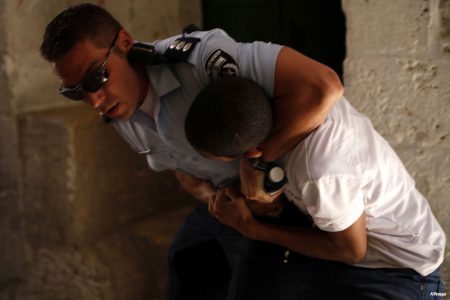
MEMO | June 27, 2016
As many as 71 Palestinian prisoners have died in Israeli jails as a result of torture since 1967, Abdel Nasser Farwana, head of the documentation and studies unit at the detainees and ex-detainees committee, said.
In a statement released on Sunday to mark the International Day Against Torture, Farwana said dozens of others died shortly after being released as an effect of the torture they had endured, adding that many more suffer from long-term physical and psychological disabilities.
“Israel practices a unique and atypical form of physical and psychological torture and it is the only country in the world that legalises torture in its jails and detention camps and protects its perpetrators,” he explained.
“Israel uses torture on institutional level against Palestinian and Arab detainees. According to our data, 100 per cent of the Palestinian prisoners were subjected to one form or another of torture,” he added.
Farwana called on international institutions and human rights organisations to take serious and effective steps to stop all forms of torture against Palestinian prisoners and to prosecute those who practice torture against them.
Google, YouTube, Facebook, Others, Now Using Automated Blocking of ‘Extremist’ Content
By Peter Van Buren | We Meant Well | June 25, 2016
The web’s biggest content providers have started using automation to remove “extremist propaganda” videos from their sites.
Censoring Content
YouTube (owned by Google) and Facebook are among the sites deploying systems to block or rapidly take down Islamic State videos and other similar material, sources said, though no company would confirm the action.
The technology employed was originally developed to remove copyright-protected content on video sites. It looks for “hashes,” unique digital fingerprints that Internet companies automatically assign to specific videos, allowing all content with matching fingerprints to be removed rapidly. Someone finds an offensive video, tags it, and then searches find other copies across the Internet.
Newly posted videos would be checked against a database of banned content to identify unauthorized information.
The system was kicked off in late April, amid pressure from an Obama White House concerned about online radicalization. Internet companies held a conference call to discuss options, including use of a content-blocking system put forward by the private Counter Extremism Project, a nonprofit controlled in part by George W. Bush Homeland Security Advisor Frances Townsend.
Get it yet?
Government and private industry will decide what content you (as well as journalists and academics) may see on the Internet. What is and is not allowable will be decided by a closed process, and will be automated. A database will be drawn upon for decision making.
Databases and tagging can be hacked/manipulated, perhaps by governmental intelligence organizations, maybe some bad guys, hell, even by advertisers to control what is available to you online.
Since content removed equals content prohibited, you’ll never know what you can’t see. The obvious slippery slope is in decisions about what is “extremist” and what is legitimate free, political speech that, while offensive, has a right to be heard and a place in the market of ideas.
So how about blocking all videos of police violence during say a Ferguson/Baltimore scenario, so as not to “inflame” a situation?
And even if Government A plays nicely, Government B may not, and dictatorships and oligarchies will have a new tool for repression. In the same way Western companies are forced now by China, for example, to adjust content, they will likely be forced to add things to the no-fly database of ideas. Corporations will be in a position to censor things on behalf of governments.
Via the Edward Snowden documents, we already know that many tech companies cooperate directly with the NSA and others, either voluntarily, or under pressure from secret national security practices and laws. It is not a matter of “it can happen here,” but one of “it is already happening here.”
But, some will say, Google, et al, are private companies. They can do what they want with their businesses, and you don’t have to use them.
Certain private businesses, such as power companies and transportation providers, have become clearly so much a part of society that they indeed can’t just do what they want. They become public utilities, and there is no doubt that organizations like Google are squarely in the category.
Lastly, for those who prefer dictionary things, do check up on the definition of true fascism: a collusion between government and industry.
European Union’s Imperial Overreach
By Jonathan Marshall | Consortium News | June 25, 2016
While few analysts are putting it this way, the European Union suffers from a self-inflicted crisis of overexpansion — a form of “imperial overstretch,” if you will. The Brexit vote was just the latest symptom of this policy disaster, which also includes escalating confrontations with Russia and the ongoing crisis in Ukraine.
Public opinion polls in the United Kingdom established that widespread concern over immigration was the single most important factor driving voters to support an E.U. exit. Pro-Brexit campaigners made much of the statistics released just last month that net annual migration into the U.K. reached a third of a million people in 2015, double the rate just three years earlier.
Such numbers fed public concerns over the impact of immigrants on the country’s National Health System and other social services, as well as jobs. They also fed deep suspicions about government credibility.
As the Guardian reported after the stunning election victory for the Brexit camp, “David Cameron’s failure to give a convincing response to the publication of near-record net migration figures in the first week of the EU referendum campaign has proved to be its decisive moment.
“The figure of 333,000 not only underlined beyond any doubt that Britain had become a country of mass migration but also meant politicians who claimed they could make deep cuts in the numbers while Britain remained in the European Union were simply not believed.”
The influx of these newcomers had a deeper psychological effect on the public. “The British government’s inability to control (intra-European) migration is seen as emblematic of a wider loss of control,” wrote Oxford political theorist David Miller just before the election. “Many Britons feel that they are no longer in charge of their own destiny: ‘Take back our country’ is a slogan that resonates along the campaign trail.”
E.U. Expansion and Immigration
Roughly half of immigrants to the U.K. in recent years have come from other E.U. countries, taking advantage of the association’s fundamental commitment to the free movement of people. Their large numbers reflected the enormous expansion of the E.U. since 2004 — and the lure of Britain’s relatively affluent economy to poor workers from newer members like Poland and Romania.
The E.U. — which actually has a commissioner for “enlargement” — has expanded relentlessly without heeding concerns from grassroots constituents of its traditional core members. In 2004, the E.U. absorbed Cyprus, the Czech Republic, Estonia, Hungary, Latvia, Lithuania, Malta, Poland, Slovakia and Slovenia — all low-wage countries with much lower standards of living than the likes of Germany, France or the U.K. In 2007, it also took in Romania and Bulgaria.
Official statistics show that citizens of these newer and poorer E.U. members account for nearly a third of net migration into the U.K. in recent years.
Although many economists defend free labor movement as good for the economy overall, the result — like that of free trade with low-wage countries — can harm less-skilled workers.
In 2011, two unpublished reports commissioned by the Department of Communities and Local Government made that point.
One warned senior government officials that sharply rising immigration could “increase tensions between migrant workers and other sections of the community” during the country’s recession. Another noted a huge rise in immigrants settling unexpectedly in rural areas, and concluded they were having “a negative impact on the wages of UK workers at the bottom of the occupational distribution.”
“We under-estimated significantly the number of people who were going to come in from Eastern Europe,” conceded Ed Milliband, leader of the Labour Party. “Economic migration and greater labour market flexibility have increased the pressure faced by those in lower skilled work.”
Ironically, many of the localities that voted most decisively for Brexit had relatively low migrant populations. But many of them are still suffering from economic austerity and sharp reductions in the social safety net imposed by the Conservative government since 2010.
“Switching the scapegoat from the government to the faceless migrant . . . is easier when people are scared for their livelihood, and more convenient for the politicians campaigning on both sides,” remarked the London-based writer Dawn Foster.
Voters were easily persuaded that “distant” and “faceless” E.U. bureaucrats just didn’t grasp their concerns. Indeed, the E.U. remains bent on continued expansion. It is currently in membership discussions with Albania, Macedonia, Montenegro, Serbia and Turkey, and recognizes Bosnia and Herzegovina and Kosovo as potential members.
Russia and Ukraine
The E.U.’s expansionist drive has had other costly repercussions for Britain and the rest of Europe. One notable disaster was its drive for an “association agreement” with Ukraine, a wide-ranging treaty that included not only provisions for tight economic integration, but also a commitment over time to abide by the E.U.’s Common Security and Defense Policy and European Defense Agency policies. On both fronts, the agreement was designed to pull Ukraine out of its traditional Russian orbit.
The E.U.’s expansion into Ukraine, like its expansion into the rest of Eastern Europe, was paralleled by the expansion of the NATO military alliance into the same countries, contrary to promises by Western leaders to their Russian counterparts in 1990. In 2008, NATO’s secretary general — backed by President George W. Bush and presidential candidate Barack Obama — pledged that Ukraine would be granted NATO membership.
Needless to say, Russia reacted badly, as it did to the E.U.’s later power play. It pressured the government of President Viktor Yanukovych to resist entreaties by NATO and the E.U. His refusal to break with Russia in turn triggered the so-called “Euromaidan” protests and the Western-backed putsch that ousted his government in February 2014.
Within a month, the new pro-European and pro-U.S. prime minister, Arseniy Yatseniuk, had signed the political provisions of the E.U. agreement. Just months later, he declared that he would seek NATO membership as well.
The result has been a bloody civil war in Eastern Ukraine; dangerous and costly military confrontations between Russia and NATO; and mutual economic sanctions that impoverish both Russia and the E.U.
Future historians will help us understand the underlying sources of the E.U.’s self-destructive expansion. No doubt they include some combination of ideological faith in the universality of European values, bureaucratic aggrandizement, and pandering to neo-liberal elites. Whatever the causes, the results now threaten the entire European project.
The E.U.’s future will require serious self-examination on many fronts, but especially about its grandiose ambitions for expansion.
Jonathan Marshall is author or co-author of five books on international affairs, including The Lebanese Connection: Corruption, Civil War and the International Drug Traffic (Stanford University Press, 2012).
Israeli soldiers shot Palestinian boy ‘deliberately’, claims B’Tselem
MEMO | June 25, 2016
The Israeli human rights group B’Tselem has said that the shooting of a 15-year-old Palestinian boy on Tuesday night was “deliberate, entirely unjustified and a direct result of military policy.” The group’s report gave details of the incident during which Mahmoud Badran was shot and killed by Israeli soldiers. The boy from Beit Ur a-Tahta was with four of his friends at the time; they were wounded in the unprovoked attack.
“The shots were fired at a car with seven passengers inside, who were making their way back from a night out at a water park,” reported B’Tselem. “The military initially announced the soldiers had ‘targeted terrorists who were throwing stones and Molotov cocktails at Israeli cars on Road 443’, but later changed its version and stated the boy had been ‘mistakenly’ killed.” The organisation’s field-researcher indicated that “the soldiers used heavy fire against the moving car without any justification.”
According to B’Tselem, said: “At around 1:30am, seven residents… were making their way home after a night out at the Lin Land Waterpark in the village of Beit Sira. When the car approached a narrow underpass used by Palestinian vehicles to get across Road 443, [Israeli] soldiers standing on the road, on top of the underpass, opened massive fire at the car from a distance of 40 to 50 metres.”
Most of the passengers in the car were hit by the shots, including the driver, who lost control and crashed into a wall. “Five of the seven passengers were hit in the shooting: Mahmoud Badran was killed instantly, four passengers were injured.”
Armenia is Swarmed by Western NGOs
By Vladimir Platov – New Eastern Outlook – 25.06.2016
The tactics of employing non-governmental organizations (NGOs) for the preparation of so-called “color revolutions” in North Africa, the Middle East and a number of former Soviet states has been the modus operandi of the US and its satellites, which have been thoroughly discussed in various NEO articles.
It’s curious that these NGOs who are heavily sponsored by Washington choose to act precisely in those moments when a specific state begins resisting pressure applied on it by the so-called Western World. This resistance often is manifested as a reluctance to support certain projects that were put forward by Washington.
If we are to talk about post-Soviet regions, all Western NGOs, and American ones in particular, have been particularly active in Central Asian and Caucasus states over recent years in a bid to launch “color revolutions” across the majority of them.
Western NGOs have been particularly active in Armenia recently, which remains Russia’s most faithful ally in the Caucasus region. In an effort to repeat a Ukrainian-style scenario in Armenia and to force this country away from Russia, these Western-backed organizations have been trying to use any minor concern among the civilian population to provoke demonstrations and unrest, taking advantage of the huge funds they have been receiving.
For example, over the past 5 years, a research center of the US-Armenian University has been carrying a wide variety of different programs. The absolute majority of its employees are foreigners (immigrants from the United States and Europe), or Armenian citizens who graduated from this very university or received part of their education in the United States. The better part of the above mentioned programs are aimed at reducing the usage of the Russian language in Armenia and the deconstruction of Soviet history and heritage. Washington is convinced that those measures that have already been tested in Ukraine could allow it to strike a note of discord between Russia and Armenia as well.
According to various reports, including a report prepared by the UN, the number of NGOs that are constantly operating in Armenia in such fields as “social equality,” “freedom of speech,” and “human rights protection” exceeds two hundred. At the same time, the US Embassy is actively supporting local media sources, including the well-known “Voice of Armenia.” It’s estimated that the US Embassy is providing financial support to over 60% of all media outlets in Armenia, in hopes that this would allow it to keep a firm grip on public perception within the country, and limiting Russia’s and Iran’s involvement in Transcaucasia.
But US think tanks seek to take all of this one step further by systematically undermining the traditional values of Armenians, such as morality and family traditions. This goal is being pursued through the creation of an unprecedented number of religious sects that are appearing in Armenia each week. For some “strange reason” the headquarters of those sects are always based in the United States, no matter whether the sect is following Baha’i, Hare Krishnas, Jehovah’s Witnesses, the Mormons, Scientologists, or other beliefs.
It’s curious that, conversely, in a truly democratic France, the Jehovah’s Witnesses sect is officially prohibited by law as a “cult.”
The Mormon sect which was the first to appear in Armenia in the early 90s was founded by the representatives of US secret services and military contractors. It’s hardly a secret that CIA creates such sects in states where the US is planning a coup d’etat to prepare a faithful proxy government beforehand.
The so-called “Church of Scientology” has also been pursuing similar goals, since it’s run by professional American agents. It is only logical that in most states the activities of Scientology sects are prohibited by law and regarded as a breach of national security. But in the US this sect enjoys complete freedom and even the tacit support of Washington. There’s a very good reason for this paradox, since back in 1959 the then CIA Director Allen Dulles struck a deal with the founder of the sect, Ron Hubbard, according to which the CIA would allow the “Church of Scientology” to operate freely in the US, it would get in return assistance in overseas operations and unconditional access to the the information this church accumulates in foreign states.
The above stated facts may explain why Armenia hosts one of the largest US embassies in the whole world, in spite of the fact that this country is relatively small in comparison to other nations. Nevertheless, the US still needs over five thousand NGOs under its control in Armenia, while spending up to 250 million dollars annually to keep them running.
Brexit could have destroyed UK…& it might be for the best
RT | June 24, 2016
It looks increasingly possible that Brexit will lead to the demise of the United Kingdom. That may be for the best, as it’s abundantly clear that the four members now have markedly different concerns.
Do you remember where you were on May 1, 2004? I do. I was in Dublin watching the Irish government – which held the rotating European Union presidency – welcome 10 new members to the bloc. It was the single biggest expansion, in terms of population, in the EU’s history. But tellingly, not in terms of wealth.
Make no mistake: that was also the day Britain’s membership of the EU became unsustainable. Because the main reason Brexit has been passed is English anger at the consequences of unfettered mass immigration. Despite a negative fertility rate (1.75 in 2004 vs. 2.41 in 1971), the population of the United Kingdom rose from 59.99 million in 2004 to 64.1 million in 2013. That surge of over 4 million in less than a decade is greater than the entire increase in the 33 years from 1971-2004.
Before the 2004 expansion, which admitted the likes of Poland, Hungary, Slovakia and the Baltic States, internal EU migration was manageable. That was down to the fact that living standards weren’t vastly different across the union. For example, life in Portugal, the then-poorest member, wasn’t that much worse than in wealthier countries like Germany, France and Denmark. However, the gap between wages in Latvia, for instance, and London was astounding. Back in 2004, the average worker in Riga brought home €239 ($265) a month. That was less than 10 percent of London incomes which were £2,058 (around €2,900 at the time). Thus, it’s hard to blame east Europeans for seizing the opportunity to move west.
Ill fares the land
Britain’s post-war social democratic consensus has been under pressure since the Thatcher years, but EU expansion collapsed it. Rightly or wrongly, resentment has taken hold at the perception, fueled by the media, that foreigners are abusing the UK benefit’s system. Meanwhile, British workers have endured declines in real wages in the past decade. The reason is easy to understand. The wide availability of cheap labor, unrestricted by visa requirements, has enabled employers to conduct a race to the bottom, heightening inequality. And to make things worse, the population explosion has increased competition for housing, leading to enormous inflation in rent and property prices. Put simply, for common folk, life in England is getting worse.
I say England, rather than Britain, because this is all about England. Or more precisely, England and Wales, (except London of course, which is a different world entirely these days). Scotland and Northern Ireland have overwhelmingly voted to remain in the EU. Of course, for reasons of climate and economics, both are far less attractive to migrants than England or Wales and their status as net recipients from the UK budget means they have less at stake than other regions. Yet, things aren’t that simple.
Ulster says yes
Northern Ireland needs the EU because the peace settlement which ended its decades-long civil war, or ‘Troubles,’ was contingent on Dublin and London being legally joined via Brussels. Additionally, Ulster’s economy is heavily-dependent on trade with the vastly richer Irish state. In Scotland’s case, attitudes to ‘Britishness’ differ from those in England. In Scotland, to be British is to face inwards, but to be European is to face outwards. Down south, ‘Englishness’ and ‘Britishness’ are mostly synonymous.
Now, 62 percent of Scots have voted to remain in the EU, but because they are controlled by London, their democratic wishes matter not a jot. With that in mind, it’s hardly a surprise that Scottish Nationalists have already issued calls for a new referendum on independence.
One that even those who passionately supported the survival of the UK in 2014 might support.
In Northern Ireland things are less straightforward.
Pro-Irish republicans were far more likely to support the EU than pro-British loyalists, whose leaders campaigned for Brexit. The (historically mainly-Catholic) nationalists will now hope that moderate unionists (usually nominally-Protestant) can be persuaded to support a united Ireland, sacrificing ethnic tradition for economic reality. However, there is no guarantee that citizens of Ireland itself would agree to accept them at this time. The south has only just recovered from the greatest economic crisis in its history and may feel it cannot afford unity. Unless of course, Brussels is willing to underwrite the project. That is not as outlandish as it seems. Because Eurocrats are angry and may want to ‘punish’ England.
Eurocrat rage
The European Parliament president, Germany’s Martin Schulz, announced Friday morning that there will be “consequences” for Britain so other EU countries are not “encouraged to follow that dangerous path.” Now Shulz’s comments might be mean and vindictive and show contempt for democracy, but they also reflect realpolitik in Brussels.
If the UK, or whatever is left of it, is successful outside the EU, it will be the biggest disaster imaginable for the EU establishment – an elite of unelected rootless cosmopolitans often contemptuous of public opinion. It will show that a brighter future is possible and expose ‘project fear’ as a load of baloney. Brussels has pushed a mantra for nearly 60 years now that European integration makes things better and that there is no alternative. If a country as important as England proves that theory wrong, all bets are off. Actually, maybe they already are.
Let’s be honest, nobody really expected this result. Even UKIP leader Nigel Farage practically conceded defeat for Brexit on Thursday night. When people realized, early Friday morning, that Leave was winning, it was as much of a shock as if England had beaten Germany in a penalty shoot-out. In ice hockey. Even Brexit’s best known exponent, Boris Johnson, looked stunned when he eventually emerged to face the cameras.
We are now in uncharted waters. A member state has decided to leave the EU. A major one at that. Furthermore, the vote has exposed deep divisions inside the UK itself. Discord perhaps profound enough to mean its demise. Nevertheless, in the long term, such an outcome may be better for all concerned.
Featured Video

Seyed M. Marandi: US-Iran War Inevitable: Kuwait and Bahrain May Fall
or go to
Aletho News Archives – Video-Images
From the Archives
Oil and the Israel Lobby
Reknowned economist M. Shahid Alam offers this excellent critique of Noam Chomsky’s defective analysis of the relative influence of Oil versus the Israel lobby over US foreign policy: … continue
Blog Roll
 Aletho News
- ICC ignored ‘very well-documented’ NATO crimes – ex-Libyan minister
- SNSC secretary dismisses US response to Iran’s conditions as ‘inadequate’
- Sanaa says Taiz roads open, secure for residents, warns Saudi forces
- Iraqi resistance group urges Saudi leadership to admit defeat, lift Yemen siege
- Trump’s Retreat: How Al-Aqsa Flood Took Down the US Empire
- Israel’s Military Actions in Lebanon Grossly Violate International Law — Lavrov
- Seyed M. Marandi: US-Iran War Inevitable: Kuwait and Bahrain May Fall
- Leaders Condemn Ansarallah Attack on Saudi Arabia While Ignoring Illegal War Against Yemen
- Leaked: Britain’s Covert Iraqi Psyops Network
- Yemeni Armed Forces Warn Airlines Against Using Saudi Airports, Exempt Mecca and Medina
- If Americans Knew
- After Oct 7, IDF policy allowed civilian casualties for even the lowest-ranking targets
- Israel’s Destruction of Southern Lebanon Intensified After the Cease-Fire
- The Last-Minute Decision That Gave Israel Its Name
- The American Conservative: How Trump Made the World Go Nuclear
- Meet the US generals and admirals advancing Israeli policy
- Opinion: Why news organizations should boycott Israel
- The Israeli witch hunt of Sami Abu Shehadeh exposes the lie of the ‘Jewish and democratic’ state
- No state has a ‘right’ to exist – least of all Israel
- Testimonies about Gaza’s civilian death toll expose Israel’s atrocities – Daily Update
- How Israel Conquered the Latin American Right
- No Tricks Zone
- New Study Suggests Large Regions Of The Pacific Ocean Have Been Cooling For The Last 80 Years
- Germany’s Green Energy Debacle: High Energy Costs Force Kahla Porzellan to Close After 182 Years!
- New Study: 50 Years Of The Most Aggressive ‘Net Zero’ Policies Can Only Affect The Global Climate By 0.03°C
- US September “Heat” Was No Record…Many Records Set Decades Ago
- Latest European Green Energy Debacle; Portugal’s Largest Flagship Solar Park Insolvent!
- Green Energy Debacle: German Expert Professor Fritz Vahrenholt Warns Of Severe Economic And Social Consequences
- Two More Paleo Reconstructions Affirm Meters-Higher Sea Levels Across Ireland, Brazil 7000-6000 Years Ago
- New Study: Earth And Venus Surface Warmth Largely Explained By Convection And Lapse Rate, Not CO2 Or Radiation
- 2025 Nature Paper Claiming Worsening Global Drought Gets RETRACTED …Heavily Flawed
- New Study: ‘Global Drought Shows No Detectable Recent Acceleration Under Climate Warming’

