How the Health Insurance Industry Defeated California’s Prop 45
By Jeff Sher | CounterPunch | November 6, 2014
The power of propaganda fueled by corporate cash triumphed over common sense once again in a California ballot measure on Tuesday. Two years after voters narrowly rejected a GMO labeling measure following a late-game, $46 million corporate advertising blitz led by Monsanto, the health insurance industry spent an estimated $57 million to successfully swamp Proposition 45, that would have given the elected state insurance commissioner the power to veto (some) excessive health insurance rate increases, a power that regulators exercise in 35 other states.
Here’s one part of the nonsense: one of the industry’s principal arguments was that the added regulation would increase the cost of health insurance. I’m not making this up! It takes some serious cojones to make that argument when you’re running a health care system that costs twice as much as that of any other industrialized nation and delivers inferior health outcomes, while there is nothing to stop you from raising the rates as high as you want without having to explain yourself to anyone. And you make your point by spending $57 million worth of premium payments that otherwise could have been used to provide health care. I’m willing to wager that the cost of insurance commissioner oversight would have been far less than $57 million.
But it worked. Prop 45 went down in flames 60% to 40%.
More nonsense: the industry ran scare ads that asked voters whether they wanted their health care decisions made by a single power-hungry government bureaucrat (the insurance commissioner). They just forgot to remind voters that now those decisions are made by a small circle of anonymous and very highly compensated insurance industry executives who are accountable to no one, unlike an elected insurance commissioner.
The rest of the nonsense: the industry argued that implementation of the rate review process might interfere with the ongoing roll out of the Affordable Care Act (ACA), otherwise known as Obamacare.
The subtext of this argument is the tried and true, right-wing talking point that government can’t do anything right. It always gets thrown into the mix because after decades of propaganda (endless repetition of this point), even supposedly liberal voters are susceptible to this canard.
The specific deceit behind this argument is that Obamacare is really working, so we can’t take the risk of messing with it. The cadaver of the politician formerly known as Nancy Pelosi was even wheeled before the public to plead for Obamacare.
“If I wanted to kill the Affordable Care Act, I would do this,” Pelosi told the editorial board of the San Francisco Chronicle (who were so impressed they urged voters to reject the measure, as did the LA Times ).
“ACA is who I am,” Pelosi reportedly said. “It’s why I stay in Congress, to protect it.”
OK, so the powerful San Francisco Democrat who is trying to cling to minority leadership in the House of Representatives says her main mission in public life now is to defend a law that was written by an insurance industry lobbyist and brokered in a back room deal with the insurance and pharmaceutical industries – a horrendously flawed bill that perpetuates a system that delivers substandard care at inflated prices to the American public. Reasonable alternatives (like Medicare for all) were taken off the table before public input was even considered.
All of these nonsense arguments were trotted out to deflect attention from the real issue: the health care system is horribly broken, prohibitively expensive, and since Obamacare pre-empted any attempts at real, effective reform, flawed bandaid measures like Prop 45 are all that’s available to the public – and therefore better than nothing. Let’s talk about anything besides the real human suffering and death the system causes unnecessarily – let’s focus on the bureaucratic problems the measure might cause. (Left unsaid is that the problems are likely to arise because the industry will do what it can to inhibit the optimal functioning of any regulatory scheme it perceives as disadvantageous to its own interests.)
Is Obamacare really working?
The original draft for Obamacare was written by the insurance industry – after they threatened to defeat any reform that did not leave in place their privileged role – to in effect collect a tax on health care in return for “financing” the cost of it. Supposedly they take risk for being the gatekeepers who decide who is eligible for care and who is not and what services should be covered and when. Obamacare was not an attempt to reform the basic problems of the industry. It was a deal to cover more people while leaving the parasitic insurance industry in place to collect their tax on an even larger population than before.
Bear in mind that in any rational system everyone would be covered the same – this business of offering scores of different plans and making distinctions about who is covered and what is covered is what you have to do to create the opportunity for profit within the system. If everyone had the same coverage, and we financed it collectively through the government – we would have no need for insurance company financing and all the layers of bureaucracy that are required to track the distinctions. The amount of insurance industry profits is a tiny fraction of the cost of the bureaucracy required to enable the profits. It adds an estimated $300 to $400 billion annually to the cost of health care.
So yes, some millions of people were able to get insurance who were denied the “privilege” before. This is how Obamacare is “working.” But that could have been done much more efficiently and at lower cost without the insurance industry.
Those who already had insurance are now paying more for the same coverage they enjoyed before Obamacare – or they have had to reduce their coverage by paying higher co-pays and deductibles. There are more underinsured than ever. When people are underinsured – or in other words they face barriers to care in the form of high access costs – they tend not to get the treatments they really need, which in the long run actually increases the overall cost of the system, because they don’t seek care until their conditions are more advanced and difficult and expensive to treat.
The insurance industry still promotes the fantasy of “consumer directed” health care, which is based on the falsehood that the high costs of the system are due to consumers over-utilizing health care, and if they are forced to spend more of their own money for care they will stop being care hogs and make better health care decisions.
When Obamacare opened the system to all those who had been denied insurance due to poverty or illness, the rates were jacked up for those already covered. This was most evident in California for those covered by individual plans in the state of California. Prop 45, by the way, applies only to those covered by individual and small group plans in California, or about 6 million people. The rest of the population is covered by large employer funded plans or the government. These large employer plans at least have some bargaining leverage with the insurance companies, while individuals and small groups are given no opportunity to bargain for lower rates. They can take what they are offered, and since Obamacare, they no longer have the option to leave it. Thus the proposition as written applied only to those who most need protection.
California Insurance Commissioner Dave Jones said he needed the authority to control rates because the insurance companies had raised prices in California 22% to 88% since Obamacare was implemented in January 2014. The industry argued those increases were intended and justified as part of Obamacare to offset the costs of covering all the people who hadn’t been previously covered.
Huh? I thought they sold us Obamacare on the premise that it would control the cost of health care, not immediately increase it by up to 88%. No, the industry took advantage of the situation – that some increases in overall rates might be expected because the uninsured population might be sicker than the already covered population, even though many of the newly covered would be young healthy people who had refrained from buying insurance previously because they were not compelled to and could not afford it – and jacked the rates as high as they thought they could get away with.
The insurance companies already knew exactly what their risk was with individuals they already covered, but they took the opportunity to raise their premiums by as much as 80 percent in order to cover projected additional risk. Same people. Same ages. Same illnesses, or not. Now paying up to 80 percent more. Why not? There was no one to stop them.
The rates for my individual plan were increased in the neighborhood of 70 percent effective January 1, 2014. I bought a plan in the exchange instead – but the price of the exchange plan was comparable to the new, inflated cost of my old plan, for about the same benefits. I received a subsidy from the government for most of the cost, but the insurance company received the full, inflated cost, 70 percent more than I had been paying the previous month.
While Pelosi was shilling for the health insurance industry, she was wringing her hands and saying that she supports the concept of cost control through rate review. Of course she offered no alternative proposal.
Meanwhile, the LA Times was twisting itself in knots by pointing out that supporters of Prop 45 were falsely claiming that the proposal would make insurance affordable. Not true, said the LA Times, because insurance is already unaffordable. They got that much right!
Then they said only a major overhaul in the way healthcare is delivered and paid for will make insurance affordable. Right again!
Then they slipped off the path of truth once more. They said the government and the industry have already started the overhaul process. They didn’t bother to mention how long this process might take. I’m guessing maybe by next decade they’ll work in a few superficial reforms, after the prices have doubled again, or worse.
Proposition 45 was not a cure. It was nothing more than a band-aid for a fatally diseased system. Obamacare didn’t fix the system. It never even tried. And that’s what Pelosi, the Chronicle, the LA Times and the insurance industry don’t want to talk about. That’s what this proposition was all about. We’re still trying to fix the system that ails us, while they want to pretend that it’s already been cured.
Jeff Sher is a journalist specializing in the health care industry. He lives in San Francisco.
Peace Talks in Havana and Murder in Colombia: The Santos Regime’s Dual Strategy
By James Petras | November 5, 2014
Introduction
There are many fabrications and false assumptions underlying the Colombia peace negotiations between the Santos regime and FARC – EP (Revolutionary Armed Forces of Colombia – Peoples Army). The first and most egregious is that Colombia is a democracy. The second is that the Santos regime pursues policies which enhance non-violent social and political activity conducive to integrating the armed insurgency into the political system.
There is sufficient evidence to call into question both assumptions. Over the past two decades and a half nearly three thousand trade union leaders and activists have been murdered; over 4.5 million peasants have been dispossessed and displaced by the military and paramilitary forces; and over nine thousand political prisoners are being held indefinitely for engaging in non-violent socio-political activity. In addition scores of human rights lawyers, activists and advocates have been assassinated.
The vast majority of the victims are a result of regime directed military and police repression or paramilitary death squads allied with the military and leading pro-government politicians.
The scale and scope of regime violence against social opposition precludes any notion that Colombia is a democracy: elections conducted under widespread terror and whose perpetrators are allied with the state and act with impunity, have no legitimacy.
The re-election of President Santos and the convocation of peace negotiations with the FARC to end Latin America’s longest civil war is certainly a welcome step toward ending the bloodshed and providing the basis for a transition to democracy.
While the Santos regime has put a stop to the massive state terror regime of his predecessor, the US backed Alvaro Uribe regime, political assassinations still occur and the perpetrators continue to act with impunity.
For any peace process to culminate with success, the peace accords, agreed to by both parties, must be effectively implemented. Previous agreements ended in state massacres of demobilized guerrillas turned civil society activists and elected political representatives.
The peace negotiations have proceeded for two years and major accords have been reached on a series of vital areas of mutual concern. In particular both sides have signed off on 3 of 5 points on the peace agenda: rural developments, guerrilla participation in politics, policy on drug trafficking. Current negotiations focus on the contentious “transitional justice” for victims of the conflict. Most human rights groups and experts agree that the vast majority of victims are a result of military and paramilitary repression. However, the Santos regime and its backers in the media claim otherwise – blaming the FARC.
Is There a “Peace Process”?
The Santos regime has thrice rejected cease fire offers by the FARC who have gone ahead and unilaterally implemented them . The regime has chosen to continue the war in Colombia while negotiating in Havana. The two year time span of the peace negotiations provides deep insights into the viability of the peace accords signed in Havana. International and Colombian human rights groups and social movements provide timely reports on the scope and depth of ongoing violations of political and human rights in Colombia during the peace negotiations.
Based on data compiled by human rights attorneys and experts affiliated with the Marcha Patriotica (Patriotic March), an alliance of scores of neighborhood, peasant, trade union and human rights organizations, between April 2012 and January 2014, it is clear that the reign of state and paramilitary terror continues parallel to the peace negotiations.
During this 21 month period, twenty-nine Patriotic March (PM) activists were killed and three others were “disappeared” – and presumed murdered. Scores of others have received death threats.
The class background of the victims points to the vulnerability of the peace agreement. Twenty-three of the murdered members of the PM were peasant leaders and activists promoting agrarian reform, the repossession of land under the regime’s Land Restitution Law or engaged in other peaceful civil society activity. Four of the victims were active in social movements supporting a “peace with social justice” agenda; two were human rights lawyers; two were community and neighborhood organizers and one was a leader of a local youth movement.
None of the assailants were arrested. Military and police officials, who had previous notice of death threats, took no precautions. Nor were any investigations undertaken, even when family and neighbors were privy to relevant evidence.
In the face of the Santos’ government’s unwillingness to curtail military, police and death squad complicity in the murder of peasant activists during the peace negotiations, can the regime be trusted to implement the accord on “rural development”? Can the government guarantee the security of disarmed guerrillas as they enter the political system when over one hundred human rights activists received death threats in September 2014?
According to Amnesty International, during 2013, seventy human rights defenders were killed, including indigenous and Afro-Colombian leaders and twenty-seven members of trade unions. At least forty-eight homicides were committed by military units. Military commanders engaged in “false positives”, meaning murdered civilians were falsely labelled by the military as “armed insurgents”. Extra judicial killings by the military continue under the Santos regime.
Equally ominous, Santos has failed to disband the paramilitary death squads. As a result, the regime fails to protect land claimants. Dispossessed peasants and farmers attempting to resettle their land under Santos’ “Land Restitution Law” have been threatened or murdered by paramilitary gangs. As a result the Law has virtually no impact on resettling peasants because of landlord retaliations.
In fact the number of dispossessed has increased according to the United Nations: 55,157, mostly rural, Colombians fled their homes between January and October 2013, because warfare between and among drug and paramilitary gangs.
Presidential Santos War on Civil Society
The pervasive insecurity that rules the countryside, the murders, disappearances and jailing of social activists, accompanying the peace negotiations, call into question the “accords” thus far reached between the FARC and the Santos regime. Supporters of the regime argue that the number of state murders has declined over the past three years. Critics counter that relatively fewer assassinations have the same effect in generating fear, undermining citizen participation and the transition to a democratic political system.
The entire conception of a successful peace process rests on the assumption that the accords will result in constitutional guarantees of free and democratic citizen participation. Yet throughout the two year period, the regime has not demonstrated a clear and consequential commitment to elementary rights. If that is the case during the negotiations with the popular insurgency, still active and armed, how much worse will conditions become once the military, police and paramilitary are free of any retaliation, when they will have a free hand to intimidate and strike down disarmed political dissidents attempting to compete in local or national elections?
The Santos regime appears to have adopted a two prong strategy: combining violent repression of the social movements in Colombia while adopting the language of peace, justice and reconciliation at the peace table in Havana.
The Santos regime can promise to accept many democratic changes but its practice over the past two years speaks to an authoritarian, lawless regime, content with maintaining the status quo.
The Santos regime has three strategic goals: to disarm the popular insurgency; to regain control over the territory under insurgent control; and to weaken and undermine the popular social movements and human rights groups which are likely to form political alliances with the insurgents when and if they become part of the political system.
It is doubtful that the FARC will surrender their arms in a political climate in which paramilitary killers operate with impunity; military commanders still engage in ‘false positives’; and rural development projects are inoperative because of landowners’ terror tactics.
Unless the peace accords are accompanied by fundamental changes in the military; unless the paramilitary forces are effectively demobilized; unless the government recognizes the legitimacy of the demands of the mass social movements and human rights group for a freely elected constituent assembly is accepted, the peace process will end in failure.
Conclusion: Four Hypothesis on Santos Strategy for War and Peace
There are several hypotheses regarding why the Santos regime negotiates a peace accord while gross violations of human rights continue on a daily basis.
(1) The Santos regime is divided, with one sector in favor of peace and another opposed. This hypothesis lacks any credible basis as there are no visible signs of internal conflict and the regime acts with a unified command. While some state violence may be a result of local military commanders, at no point have national leaders reprimanded the “local” transgressors.
(2) The Santos regime actively pursues violent acts against the social movements to strengthen its bargaining position in the peace negotiations to secure a more favorable settlement – in other words to make the minimum of social concessions in order to placate oligarchs critical of any negotiations. This hypothesis explains the ‘dual strategy’ approach advocated by the regime with regard to the FARC, talking peace in Havana and rejecting a cease fire in Colombia; continuing the war while negotiating peace. But it also undermines the regime’s claim that Santos seeks to incorporate combatant groups into the political system.
(3) The regime is in a tacit pact with former death squad – President Alvaro Uribe. As a result the government’s military apparatus is still tied to paramilitary gangs, working with landowners, drug traffickers and businesspeople. There is no doubt that Santos has long-standing ties to Uribe – he was his Defense Minister. Moreover, after Santos defeated Uribe’s candidate for the Presidency by a narrow margin he has sought a political accommodation with Uribe’s Congressional and business supporters. On the other hand Santos recognizes that his economic strategy, especially his focus on promoting trade with Latin America and especially Venezuela, and his big push to exploit the energy and mining sector depends on reaching a peace agreement with the FARC, which controls substantial mineral rich regions. Hence Santos signs “paper agreements’ with the FARC, while applying a ‘hard fist’ (‘mano duro’) policy to the social movements.
(4) The upsurge of the mass social movements, including the Marcha Patriotica, demanding the effective implementation of the ‘rural development’ reforms and repossession of land to 3.5 million displaced families and the increasing role of the human rights groups in monitoring the ongoing violations of human rights, means that the Santos regime cannot secure ‘peace’ solely through an agreement with the FARC in Havana. If the Santos regime’s goal in the peace negotiations is to disarm the guerrillas and incorporate them into the electoral system, without dealing with the root socio-economic structural reforms, it must weaken the civil society popular movements.
This is the most plausible hypothesis. President Santos is capable of promising the FARC any sort of ‘democratic reforms’ and is willing to sign off on anti-drug agreements and even ‘agrarian development’. But what he is unwilling to accept is the emergence of mass peasant movements actively engaged in changing land tenure, repossessing their farms and reclaiming millions of acres of land granted to big foreign owned mining consortiums.
Santos will not ‘demobilize’ the paramilitary gangs because they are instruments of the big landowners and protect the state grants to the big mining companies. But he will try to limit death squad targets to specific activists and organizations in contentious regions.
Santos has not even curtailed the cross border attacks by Colombian paramilitary groups. Assassinations continue, the latest, the assassination of a Venezuelan Congressional leader. He has expanded military ties with the US by pursuing agreements to collaborate with NATO – offering combat units for the Middle East wars.
What is abundantly clear is that the Santos regime has not complied with the most elementary conditions necessary to implement any of the five point reform agenda set forth in Havana. Military impunity, rampaging death squads, scores of daily death threats to human rights activists, over nine thousand political prisoners and dozens of unsolved killings of peasant leaders is not compatible with a transition to a democratic peace. They are compatible with the continuity of an authoritarian oligarchical regime. A democratic transition and a peace agreement requires a fundamental change in the political culture and institutions of the Colombian state.
Israeli forces demolish three houses, and several water pipes and roads in village near Nablus
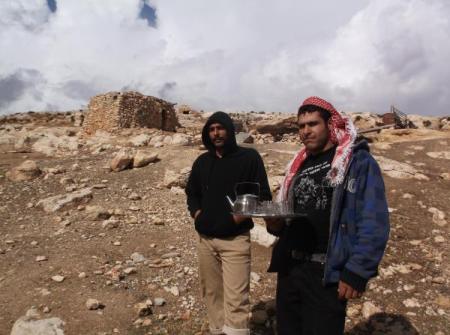
Sofian Maher and a local resident near their destroyed home near Khirbet Al-Tawil
International Solidarity Movement | November 4, 2014
Khirbet Al-Tawil, Occupied Palestine – Early on Monday morning, while the inhabitants of the village of Khirbet Al-Tawil, near Aqraba (Nablus), were sleeping, eight military vehicles, and 30-40 Israeli soldiers entered the village.
Within two hours the military had demolished three houses, and several water pipes and roads.
The water pipes destroyed were new and scheduled to be turned on Monday. The Aqraba community had funded these water pipes as part of the municipal water system.
Of their destruction, Sami Dariyah, stated: “They are trying to prevent people from living in this area. This is their clear policy.”
Due to the continuing demolition of houses, electricity lines, water lines and other living necessities, the farmers have fled to the city of Aqraba and departed their lands in Khirbet Al-Tawil. Sami Direyah grew up near Khirbet Al-Tawil and remembers the many houses and shops that used to be there.
Khirbet Al-Tawil is part of Area C (under full Israeli military civil and security control), which means the army can choose which buildings and activities are ‘allowed’. Sami wonders how their existing community, their farms and their 100-year-old houses, can suddenly become illegal.
Even though the three demolished houses were nearly 100 years old, dating back to the British occupation, they were all still active homes for families like the Mahers. The residents of the houses were not given any warning of the military’s planned visit. Sofian Maher, a former resident of one of these homes, spoke to ISM and explained that this is not the first time the military has paid a visit to Khirbet Al-Tawil. In May of this year the village’s Mosque was demolished, together with four houses, four cottages, and two barns. Less than one month ago the power line was cut by the military, leaving the village without electricity.
Sofian Maher explained to ISM that his family tried to rebuild their house after it was demolished in May. While rebuilding, Sofian’s family lived in a donated tent, which the army soon tore down. The family then moved into old stone huts that were built, long ago, to house animals while shepherding. Periodically the military returned and destroyed the newly rebuilt portions of their house.
The family is now trying to rebuild their home for the fourth time.
To further make the area uninhabitable, the military has destroyed large sections of the road leading to the remaining farms.
Gaza residents lose faith in international aid
MEMO | November 6, 2014
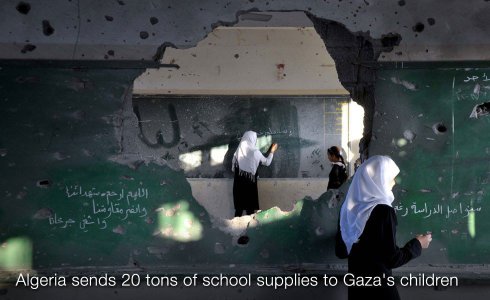
It has been more than three months since the end of the war on Gaza however Fadl Misbah, 41, is still living as others are, in a house which is covered in plastic sheets and which is not suitable for winter.
Fadl, whose family is made up of 13 members, said: “We are always subjected to extreme cold, and this is the case for most people whose homes were destroyed in the war. My children sit in this place and raindrops fall from the roof of the house which is made up of nylon sheets which do not protect us from the elements or the cold.”
“We have heard a lot about the donor conference to reconstruct Gaza, however they are working so slowly and we no longer believe what the international institutions are saying or what they are promising.”
“The occupation is the main problem; it allowed 440 tonnes of cement to enter Gaza 20 days ago during [UN Secretary-General] Ban Ki-moon’s visit to show a positive side to itself in front of the world, but after that it didn’t allow any more items into Gaza. Solving our problem will need contracts to be signed, and that’s if it is resolved at all,” Fadl said.
“International institutions have appealed to intervene and find a solution to this disaster, which hundreds of families whose homes were destroyed during the war on Gaza are now living through.
The West must be mobilise itself and not be satisfied by its silence. Those who call for human rights and advocate for it on behalf of those who are oppressed have exposed this world. It has no credibility.”
ICC: Israel Committed ‘War Crimes’ but It’s Not Our Problem
teleSUR | November 6, 2014
International Criminal Court (ICC) lawyers believe that Israel is guilty of “war crimes” for the raid on an aid ship bound for Gaza in 2010 that killed nine Turkish activists. However, they have also decided that the case does not meet their criteria for prosecution, according to court papers seen by Reuters on Wednesday.
On May 31, 2010, the Israeli military forcefully boarded six civilian ships from the “Gaza Freedom Flotilla” that were traveling from Turkey to deliver humanitarian aid and construction materials to the besieged region. The army boarded the ships in international waters in the Mediterranean Sea.
The activists on board say they did not put up a fight, however the Israeli army insists that they were met with resistance – which led to several activists being killed, including eight Turkish nationals and an American of Turkish origin on the Mavi Marmara boat.
The ICC does not have jurisdiction over crimes committed in either Turkey, where most the boats were registered, or Israel, since neither are members of the ICC. However, the Mavi Marmara was registered to the Comoros Islands, which is a member, making the crimes on board eligible for ICC investigation.
“The information available provides a reasonable basis to believe that war crimes under the Court’s jurisdiction have been committed in the context of interception and takeover of the Mavi Marmara by IDF (Israeli Defense Forces) soldiers on 31 May 2010,” read the papers.
But the papers also added that prosecutors had decided the crimes “were not of sufficient gravity to fall under the court’s jurisdiction,” reported Reuters. Their evidence and criteria for making this decision however, remained vague.
“Not having collected evidence itself, the Office’s analysis in this report must therefore not be considered to be the result of an investigation,” the paper read.
However, according to the ICC website, considering individuals guilty of war crimes does make them eligible to be tried under the ICC.
“The mandate of the Court is to try individuals rather than States, and to hold such persons accountable for the most serious crimes of concern to the international community as a whole, namely the crime of genocide, war crimes, crimes against humanity, and the crime of aggression…”
The Indian Ocean State, another ICC member, referred the raid to court, which obligated the ICC to begin preliminary examinations into the matter, according to their mandate.
“The Prosecutor’s decision marks the first time a State referral by an ICC States Party has ever been rejected by … Prosecutor without even initiating an investigation,” said lawyers Rodney Dixon and Geoffrey Nice in a statement.
“It confirms the view expressed by politicians, civil society organizations, NGOs and commentators from many quarters that Israel has a ‘special status,'” they added.
The report comes the same day that Bulent Yildirim, president of the Turkish NGO Humanitarian Relief Foundation (IHH) – one of the NGOs who organized the flotilla – praised the ICC, expecting that they would announce on Thursday that Israel is guilty of “war crimes.”
The ICC’s final decision is likely to anger other Turkish activists, but also Ankara who accused Israel of mass murder after the IDF attacked the flotilla.
Over 309,000 Ecuadoran Children Leave Work For Schools
teleSUR | November 5, 2014
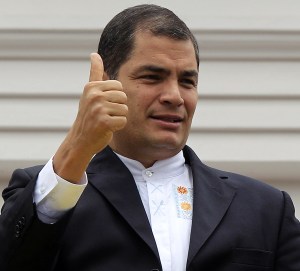 During a meeting Wednesday with the journalists in the coastal, economic hub of Guayaquil, Ecuadoran president Rafael Correa said that over 309,000 children had quit working to attend school.
According to official estimates, the number of working children decreased from 17 to eight percent.
Correa reiterated his commitment to eliminate child work in Ecuador, and sharply criticized the recent initiative of Guayaquil’s mayor, Jaime Nabot, to inaugurate a statue representing a shoeshine boy in the city center.
The head of state called the statue a “shame”, saying “(it) is not part of the folklore, it is part of exploitation.”
During the inauguration, Nebot himself took a picture simulating the act of having his shoes shined by the boy depicted in the statue.
“While the oligarchy builds statues about our exploitation, we build schools so children can keep studying,” added Correa.
Healthy girl confiscated from parents who smoked pot, given to murderous foster mother
Police State USA | November 5, 2014

ROUND ROCK, TX — A little girl was confiscated from her loving parents because they smoked marijuana, and given away to a foster mother who put her into a coma and killed her. Alexandria “Alex” Hill, age 2, succumbed to her injuries after being “thrown to the ground.”
“We never hurt our daughter. She was never sick, she was never in the hospital, and she never had any issues until she went into state care,” said the girl’s father, Joshua Hill, to KVUE.
Alex was seized by the Texas Department of Family and Protective Service (TDFPS) after her parents were accused of smoking marijuana while the girl slept. She was taken into state custody in November 2012.
Mr. Hill said that she was put into more than one dangerous foster home.
“She would come to visitation with bruises on her, and mold and mildew in her bag,” Mr. Hill told KVUE. “It got to a point where I actually told CPS that they would have to have me arrested because I wouldn’t let her go back.”
The girl’s final home was with Sherill Small, a foster care contractor in Rockdale, Texas. The TDFPS trusted Ms. Small enough to take custody of multiple children displaced by the agency.
On the evening of July 29th, 2013, Mr. Hill got an urgent call to come to the local hospital. When he got there, he found that Alex was in a coma. The girl had suffered traumatic head injuries after being thrown to the ground. She was also bruised on her buttocks, arm, and chin, and had so much hair ripped out that she was “nearly bald.” Alex died 2 days later.
“I was blown away to find out she was in a coma,” Hill told KXAN. “That’s not what you expect, especially when your child is in state custody for ‘safety,’ and now they’re suffering more injuries and more harm than they ever have in their entire life before that.”
Mr. Hill was 4 months away from getting his daughter returned to his custody.
This tragic case illustrates a widespread injustice perpetrated regularly in the United States in the name of child welfare. Healthy, happy children are commonly stolen from loving families who have never once caused them harm. Once in the care of the state, they are traumatized by familial separation, forcibly drugged, and placed into questionable situations with complete strangers.
As was the case for Alex and her family, the state intervention comes without a trial, without a conviction, and without due process for the parents. The state’s accusation of “neglect” (a loosely defined term) can result in armed agents of the state forcibly entering a home to abduct the child — ostensibly for his or her “safety.”
* * * * *
FOLLOW-UP:

Sherill Small was charged with the murder of Alex Hill. In November 2014, she was convicted and sentenced to life in prison without parole.
Although she claimed that she “does not shake babies,” a jury found the evidence against Mrs. Small to be overwhelming.
Alex’s mother, Mary Sweeney, has chronicled updates on the case on a Facebook page, “Justice 4 Alex Hill.”
The Texas DFPS was not found to be at fault for placing Alex in the home of Sherill Small. After numerous complaints statewide, and ten Texas children killed in state care in 2013, the Office of the Inspector General became involved, and found that the meddling bureaucracy was often dishonest and reckless in its placement of children.
Although new rules imposed in 2014 make it more difficult to be a foster parent, the agency itself remains dangerously powerful and unaccountable when it comes to snatching children. In 2013, over 30,000 children in Texas spent time in foster care — many for absurd reasons such as parents using marijuana. A major overhaul of child welfare agencies is needed in Texas and across the country.
Millions of Cell Phone Users’ Internet Activity Secretly Tracked for Years by Verizon and AT&T
By Noel Brinkerhoff | AllGov | November 6, 2014
Verizon and AT&T have been snooping on millions of Americans’ online browsing habits for years, all without users’ knowledge or approval.
The activity involves the use of “supercookies” placed on unencrypted web pages by the telecommunications companies that can’t be turned off by cell phone users, according to the Electronic Frontier Foundation (EFF).
Even customers who don’t use either provider can have their browsing monitored. If a user connects through a Verizon tower, their web use habits are subject to scrutiny as well. As many as 100 million people have had their internet browsing tracked by the two providers.
EFF contends that the use of the supercookies, or Unique Identifier Headers (X-UIDH), violates the federal Communications Act. X-UIDH allows Verizon and AT&T to “monitor their customers’ browsing history and create permanent identification profiles of their habits, likes, and interests. Once installed, the supercookies cannot be deleted nor evaded, even if customers clear their cookies, use private browsing modes, disable third-party cookies, or select ‘Do Not Track’ in their settings,” according to Nadia Prupis at Common Dreams.
Verizon customers can opt-out of the program, but the company still collects data on their browsing history. Verizon does not include government or corporate clients in the program, so it apparently has a way to let personal use customers avoid being tracked as well.
Mobile users who want to see if they’re being spied upon can go to AmIBeingTracked.com or lessonslearned.org/sniff.
To Learn More:
Verizon and AT&T Using Undeletable ‘Supercookies’ to Track Customers (by Nadia Prupis, Common Dreams )
Verizon Injecting Perma-Cookies to Track Mobile Customers, Bypassing Privacy Controls (Electronic Frontier Foundation)
AT&T Says It’s ‘Testing’ Unique Tracker On Customers’ Smartphones (by Kashmir Hill, Forbes )
Verizon is the Only Telecom that Retains Text Message Content (by Noel Brinkerhoff, AllGov )
Dozens injured during Aqsa clashes, several detained
Ma’an – November 5, 2014
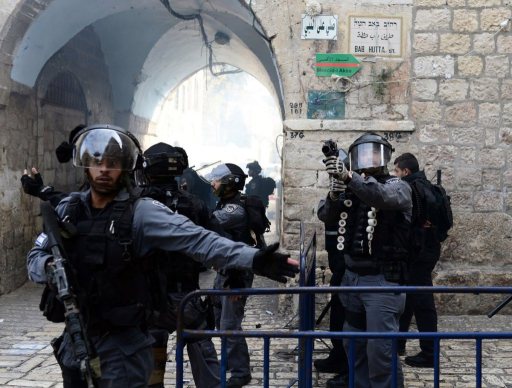
JERUSALEM – Dozens of Palestinians suffered tear-gas inhalation and several others were injured by stun grenades, shrapnel and rubber-coated steel bullets during clashes in the Al-Aqsa mosque compound area on Wednesday, an official said.
Palestinian Red Crescent official Amin Abu Ghazaleh told Ma’an that Red Crescent ambulances moved nine injured to the Al-Maqased Hospital where their injuries were reported as moderate.
Two were injured in the eye, and 32 with stun grenades, shrapnel and rubber-coated steel bullets in addition to many who suffered severe gas inhalation.
Three Palestinian members of Israel’s Knesset, Hanin Zoabi, Talab Abu Arrar and Ibrahim Sarsour, were able to enter the mosque during the closure and clashes.
Israeli soldiers neared the Al-Qabali mosque inside the compound as they fired stun grenades and tear-gas bombs inside, the director of the Al-Aqsa Mosque, Sheikh Omar al-Kiswani, said.
He said that a fire erupted inside the muezzin’s hall and cables and speakers were also burned and damaged.
Soldiers “deliberately” threw holy books on the floor, he alleged.
Israeli forces detained Tareq al-Hashlamon, an employee of the Islamic endowment department, after assaulting him inside Al-Aqsa, along with another endowment employee identified as Hussam Seder and three Palestinians.
Four Palestinians were also detained, one of them a minor. Two others were identified as Omar al-Kilani and Amin Qirsh.
Meanwhile, Jordan recalled its ambassador to Israel over the violence.
Jordanian Prime Minister Abdullah Nsur asked the foreign minister to “recall the Jordanian ambassador from Tel Aviv in protest at Israel’s escalation on the Al-Aqsa mosque compound,” the Petra news agency reported.
The clashes came amid continued tensions over right-wing Jewish demands to be able to pray inside the compound despite being off-limits in mainstream Judaism, in addition to the expansion of Israeli settlement building in Palestinian East Jerusalem.
Earlier, a police spokeswoman said that “Dozens of masked protesters threw stones and firecrackers at security forces who then entered the Temple Mount and pushed the demonstrators back inside the mosque.”
The price of positive reviews of Bahrain’s sham ‘reforms’
By Alastair Sloan | MEMO | November 5, 2014
Not much, as British parliamentary records reveal – the ruling Al-Khalifa family shelled out just £5,400 per head for British parliamentary grandees Baroness Scotland of Asthal, Lord Gulam Noon, Hazel Blears MP, Lord Patel of Bradford and Lord Clive Soley to visit the Kingdom in April.
I’ve recently acquired a copy of the 24 page report the delegation produced following their trip, and it’s a whitewash. Yet to be made public, it’s a perfect case study of Bahraini reputation laundering.
Each of the delegates demonstrates interests that illustrate the cunning of the Al-Khalifas and how they have tried to spin the revolution – firstly through false accusations of terrorism, and secondly that the pro-democracy movement is anything but, instead being secretly influenced by theocratic Iran.
Both are myths but the report shows that the delegates were happy to accept and propagate them nonetheless.
Lord Gulam Noon, for example, is on the record saying: “I personally consider Bahrain as my second home and look forward to settling here.”
“I would describe myself as half Bahraini,” he added.
Noon admitted to me some months ago he was a personal friend of the Al-Khalifas.
Hardly impartial, Noon spins the secret-Iranian-influence lie unashamedly. In an article entitled “Traitors Not Refugees” published in Bahrain during the delegation’s visit, he told a local reporter that the 500 or so Bahraini activists who have fled to London are undesirable.
They “are not refugees or asylum seekers, but are connected with the external agencies that are against the Kingdom.”
“In the UK, we are fully aware of the situation where our judicial system is allowing citizenship too easily,” he went on. “We are trying to review the possibilities of a change in the legal system, as we see that many are abusing this privilege.” Noon offered no evidence for these claims.
Lord Noon also has a quality which is admirable in itself – a strong agenda on terrorism and extremism. Indeed, Noon was briefly caught at the Taj Mahal Hotel in Mumbai during the November 2008 terrorist attack and has advocated since for far tougher measures on extremist preachers in the UK, making frequent overtures in the Lords regarding tough terror laws.
In parallel, it has been a standard tactic of the Bahraini government to smear pro-democracy activists as terrorists. On the day Noon and the other British politicians landed in Bahrain, local human rights activist Abdulhadi Al-Khawaja was serving the 1,025th day of his life sentence, handed down after the 2011 uprising. He, and seven others, had been charged with “organising and managing a terrorist organisation”.
Al-Khawaja’s real crime was defending human rights. He was the co-founder of the Bahrain Centre for Human Rights, not a terrorist. He was a regional representative for human rights group Frontline Defenders, not a bomber. He had previously been invited on a “fact-finding mission” to Iraq by Amnesty International, not Al-Qaeda.
Unfortunately, the wording of the delegation’s report, which is being published by Lord Gulam Noon, lends credibility to these false accusations of terrorism, through its frequent allusions to balancing human rights with “national security”.
You might reject the view that allegations of terrorist tactics are unfounded. The month previous to their visit, three policemen had been killed in a bomb attack for which the government blamed the opposition movement. The report adopts a concerned, but frustratingly unquestioning, tone.
“We were shown some of the weapons confiscated by the police. Unsurprisingly some of them were of Iranian origin, but perhaps more worryingly some had clearly been manufactured locally in a crude but effective way.”
“They included homemade bombs, one of which was thought to be similar… to that which may have been responsible for killing the three police officers… Such manufactured weapons indicate the existence of organised resistance in the Shia villages.”
Aside from whether “unsurprisingly” was an appropriate word to use in an impartial report – here are a few questions for the delegation about that “terror attack”: Consider simply who stood to gain more, the Bahraini regime or the opposition movement if that bomb went off? Wouldn’t the opposition movement lose greatly? Would the international community come to their aid if they resorted to terrorism?
There is a credible theory that this attack wasn’t the fault of the opposition movement. It is more likely that the security services planted the explosives. This point has been raised by an ex-Bahraini lawmaker and is widely believed in the anti-monarchy community.
Another delegate, Hazel Blears MP, is also ripe for exploitation on this point, having staked her career on being “tough” on terrorists.
As the biography that accompanies the report emphasises: Blears served as Police and Counter Terrorism Minister under the Labour government, has “a depth of expertise in national and international security matters”, and implemented the (disastrous) “Prevent” counter-terrorism strategy in the UK.
You might ask why any of this is relevant to assessing human rights abuses.
Perhaps because the Al-Khalifas wanted powerful Britons who see the world through “national security” eyes, who nod when someone smears revolutionaries as terrorists. It’s easy to distract from atrocious human rights abuses when the politician you are presenting to believe themselves to be at the forefront of the “war on terror”.
The report makes clear that Blears, along with Baroness Scotland, was on the trip because of her experience in the “engagement of the wider community”. Blears also had, the report insists, “extensive experience in overseeing community policing developments in the UK”.
Yet the document I’ve seen makes no mention of Bahrain’s cruel policing – in particular its lavish use of teargas. Just a month before the delegation’s visit, South Korea banned all teargas exports to Bahrain for fear they may be misused by security forces. By all accounts, police brutality, including torture, is at its worst not just since 2011, but since the uprising in the nineties.
What of Lord Clive Soley? Maybe he was chosen to lead the delegation because Lord Gulam Noon’s allegiance to the Al-Khalifa cause was too obvious, or perhaps because of his proven track record assisting another Gulf autocracy.
In 2012, the state-run Emirates Center for Strategic Studies and Research (ECSSR) in Abu Dhabi invited Soley to speak about the rule of law. He promptly and profusely praised “the legal framework and the impressive track record of the rule of law in the UAE”.
A report of his speech, published by the ECSSR concluded that “the most important remark in Lord Soley’s lecture was the link between the rule of law and stability in the UAE and the country’s development, economic prosperity and preservation of human rights and freedom.
Yet the United Arab Emirates don’t allow any independent human rights organisations to operate in the country, they are yet to answer to torture allegations against both British citizens and local political activists, and they were reviewed by the US State Department in 2013 as having serious “limitations on citizens’ civil liberties (including the freedoms of speech, press, assembly, association, and internet use)”, and “arbitrary arrests, incommunicado detentions, and lengthy pretrial detentions”.
If Soley is so easy to dupe or willing to be a stooge for the UAE, why not Bahrain? He readily admits to be no expert on the Middle East, his profile on the House of Lords’ website declares his foreign policy focus lie in far-away south east and central Asia. It was only after he attended the delegation visit that he even mentioned Bahrain in his frequent speeches to the Lords on the Middle East.
Lord Patel of Bradford, the final delegate, is a mighty academic and a passable politician – but again, admits on the Houses of Parliament’s website that his specialty is India, not the Middle East. Like Soley he may have been easy to fool.
Strangely, Patel also holds a Professorship at the University of East London (Baroness Scotland holds an honorary degree there). This is an establishment which has already made up its mind on Bahrain. With funding from none other than Lord Gulam Noon (who is also Honorary Chancellor for UoEL), the university already runs an exchange programme with the Bahraini government.
The Bahraini regime invited delegates who were either close friends – Lord Noon, naive – Lord Patel and Lord Soley, pre-disposed through their own beliefs and agenda to believing smears of terrorism – Lord Noon and Hazel Blears, or linked to organisations which already credited Bahrain with engagement – Lord Patel, Baroness Scotland and Lord Noon.
The report they have produced gives an impression of progress. There has been anything but. Human Rights Watch judge that Bahrain has “regressed further in key areas in 2013 and the government made little real progress regarding reforms it claimed to pursue”.
Amnesty International warned that the regime is torturing children. Even the US State Department recently released 49 pages of bruising rebuke. Yet this delegation saw only what the Bahraini dictators wanted them to see, and lavished them with praise. They should be ashamed.
Yep, Uncle Sam Still Wants to Log Your Calls
By Rachel Nusbaum | ACLU | November 4, 2014
Today, in a hushed courtroom in Washington, D.C., not far from the now-empty halls of Congress, a federal appeals court heard arguments in Klayman v. Obama, a challenge to the NSA’s bulk collection of telephone metadata first revealed by Edward Snowden. If you have ever made a phone call, or received a phone call, this case has implications for your personal privacy and you should pay close attention to what happens next.
The appeal follows a December win for Larry Klayman, a conservative lawyer and activist and the plaintiff in the case, where a district court judge ruled the program was likely unconstitutional. Today, government lawyers attempted to argue that this program should be allowed to continue.
The arguments hinged on a central question: Is the warrantless, non-targeted surveillance currently being conducted by the NSA, which is scooping up data on all (or almost all) calls made or received on U.S. telephone networks, a violation of the Fourth Amendment?
The government tried to argue that it is not. They claim that their searches of this massive call record database are reasonable, and that there is no reasonable expectation of privacy in the numbers one dials.
But, as EFF Legal Director Cindy Cohn argued on behalf of both EFF and the ACLU as friends of the court, the government has no right to scoop up such a massive amount of personal information about Americans in the first place.
The truth is, the NSA’s bulk collection of the phone records of all Americans is fundamentally different than putting a trace on the phone of an individual suspected of wrongdoing. The sheer scale of this program means that we are all suspects, or at least potential suspects, in the eyes of our government.
Think about the impact of knowing that your every phone interaction is being logged by the government. This kind of surveillance has even greater implications for lawyers and journalists, who have to worry about protecting the confidentiality of clients and sources. The phrase “chilling effect” seems insufficient to describe the potential loss to our society, to our whole way of life, as we slowly begin to censor ourselves because we know that the government is always monitoring our communications.
This is contrary to the very nature of a democracy, where people are supposed to hold their government to account. Who will be willing to speak out against an abusive government when that government knows all our deepest, darkest secrets?
Governments are by nature interested in acquiring more power, and today, more than ever, information is power. We should not be surprised that the government wants to know who Americans are speaking with, and for how long, and how often. We rely on the Constitution, and on the other branches of government, to provide a check on that desire.
Today, we asked the court to provide that check and to declare bulk collection of American’s telephone metadata unconstitutional.
(To read the ACLU and EFF’s amicus brief in Klayman v. Obama, click here.)
Featured Video

Why the U.S. Should Pull Back From the First Island Chain
or go to
Aletho News Archives – Video-Images
Book Review
‘Why Fauci Must Rot in Prison’: A Tale of Two Diaries
By Jill Erzen | The Defender | October 13, 2026
Dr. Anthony Fauci’s private diary reveals a “mind-numbing” contradiction between what the former top U.S. infectious disease official knew about COVID-19 and what he told the public, senior White House adviser Peter Navarro, Ph.D., said last week on “American Thought Leaders.”
In his new book, “Why Fauci Must Rot in Prison,” due out Oct. 20, Navarro compares Fauci’s private entries to his own pandemic-era diary, and uses what he calls “a tale of two diaries” to argue that Fauci should face criminal prosecution.
“I show, actually, how a prosecution can and should happen … at the state level, most likely,” Navarro said. “He should wind up in prison, and we’ve got the receipts in this book to put him there.”
Navarro said Fauci repeatedly acknowledged important facts in private, then publicly pursued policies that contradicted those facts — with devastating consequences.
“What he says many times privately in his diary is so at odds with both his public behavior and public statements that it’s mind-numbing,” Navarro said.
Navarro examines the lasting damage caused by lockdowns and other pandemic policies, and the ongoing toll of long COVID.
His book also addresses questions about vaccine safety, including why healthy young people faced COVID-19 vaccination mandates despite concerns about myocarditis, and why women were not warned about miscarriage risks linked to the shots. … continue
Blog Roll
 Aletho News
- Jennifer Kavanagh: Why the U.S. Should Pull Back From the First Island Chain
- Yemen denounces international community’s silence on Saudi aggression, siege
- UAE and Saudi Arabia move toward renewed coordination against Sanaa
- How Iran’s two-week retaliatory strikes exposed cracks in US military architecture in Persian Gulf
- The mother of all propaganda: Why the hype over US MOAB strike against Iran is nothing but theater
- Iran says it possesses technology behind US 14-ton GBU bunker-buster
- Trump asks Iran not to retaliate after he strikes Pickaxe Mountain – w/ Prof. Marandi
- Vice President J.D. Vance’s Deceptive ‘Antiwar’ Campaign Speech
- Iran: Palestinians’ rights must not be compromised in Gaza’s future; US, Israel to blame for Hormuz situation
- Ongoing tales of Syrian chemical weapons
- If Americans Knew
- Israeli rabbi permits occupiers to steal Palestinian olive harvest in West Bank
- Netanyahu’s spin on latest settler attack is laughable – Daily Update
- Israeli soldiers debunk Israel’s talking points
- In West Bank, Israeli settlers are totally out of control – Daily Update
- NPR investigation finds evidence of widespread fraud at mall kiosks tied to Israeli skincare brand
- Tucker Carlson exposes Israeli Lies about the Oct 7th attack, Charlie Kirk, and the U.S.
- Israel has detained thousands of Palestinian children since Oct 7th – over half spent time in solitary, many uncharged
- Israeli Analysis: Is Netanyahu Planning an ‘October Surprise’ Attack Before Israel’s Election?
- Israeli settlers brutally attack Palestinians and Washington Post female photographer, 65
- Words Have Changed, Occupation Continues: The Reality of the Gaza Ceasefire
- No Tricks Zone
- Predictions Made By Renowned Climate Proifessor Over Past Decades Have Been Proven To Be Poor
- New Study Suggests Large Regions Of The Pacific Ocean Have Been Cooling For The Last 80 Years
- Germany’s Green Energy Debacle: High Energy Costs Force Kahla Porzellan to Close After 182 Years!
- New Study: 50 Years Of The Most Aggressive ‘Net Zero’ Policies Can Only Affect The Global Climate By 0.03°C
- US September “Heat” Was No Record…Many Records Set Decades Ago
- Latest European Green Energy Debacle; Portugal’s Largest Flagship Solar Park Insolvent!
- Green Energy Debacle: German Expert Professor Fritz Vahrenholt Warns Of Severe Economic And Social Consequences
- Two More Paleo Reconstructions Affirm Meters-Higher Sea Levels Across Ireland, Brazil 7000-6000 Years Ago
- New Study: Earth And Venus Surface Warmth Largely Explained By Convection And Lapse Rate, Not CO2 Or Radiation
- 2025 Nature Paper Claiming Worsening Global Drought Gets RETRACTED …Heavily Flawed

