Haiti: Protest Leaders Arrested After Marches
Weekly News Update on the Americas | November 3, 2014
Two Haitian human rights groups, the Haitian Platform of Human Rights Organizations (POHDH) and the National Human Rights Defense Network (RNDDH), issued a joint statement on Oct. 27 demanding “the release of the political prisoners and the demonstrators arrested illegally” by the government of President Michel Martelly in recent weeks. Police agents arrested 18 demonstrators in Port-au-Prince on Oct. 17 during a march protesting government policies and marking the 208th anniversary of revolutionary hero Jean-Jacques Dessalines’ assassination; the police dispersed the demonstration with tear gas and gunshots. After an Oct. 26 march protesting the government’s failure to hold partial legislative elections on that date, the authorities arrested Rony Timothée and Byron Odigé, two leaders in the Patriotic Force for Respect for the Constitution (FOPARC), which backs the Family Lavalas (FL) party of former president Jean-Bertrand Aristide (1991-1996, 2001-2004). In addition to the 20 arrests in Port-au-Prince, police detained three demonstrators in the city of Les Cayes, South department, on Oct. 12 during a protest demanding electricity.
The two human rights groups indicated that the detainees were arrested for their political positions. The government failed to meet the requirement to question the detainees within 24 hours, the groups said, and they expressed astonishment that “accusations of incitation to violence and destruction could be made against demonstrators and opposition activists when no flagrant crime had taken place.” Timothée and Odigé were also arrested in May, on similar charges, but a judge ordered their release a few weeks later [see Update #1224]. On Oct. 30 demonstrators protested the arrests with a march to the prison in Carrefour, on Port-au-Prince’s southwest outskirts, where Timothée and Odigé were thought to be held. A large police group was on hand, backed up by a truck equipped with a water cannon; stores quickly closed, and mothers reportedly snatched children from schools so that they wouldn’t be exposed to tear gas, but the protest ended without any major confrontations. (AlterPresse (Haiti) 10/29/14, 10/31/14)
ISM activist shot in the head with rubber-coated steel bullet
International Solidarity Movement | November 2, 2014
Ramallah, Occupied Palestine – Today during a protest at Qalandia checkpoint, an Italian ISM volunteer was shot in the head with a rubber-coated steel bullet.
The injury is just two centimetres above her left eye.

Photo by IWPS
Giulia, the ISMer, stated, “I was just standing on the side of a street, and the military was firing tear gas at the protesters. I was photographing the army when I felt the bullets strike me, one in the head, and another in my leg, and then all I could see was blood.”
At least one other Palestinian teen was hospitalized after being shot with a rubber-coated steel bullet.
Giulia was immediately transferred to Ramallah Hospital for medical treatment, requiring stitches for her injury.
Approximately 100 people attended the demonstration, where Israeli forces fired stun grenades, tear gas canisters, and rubber-coated steel bullets.
The protest was called today to commemorate the 97th anniversary of the Balfour Declaration.
Israeli Matrix of Control: Use of Palestinian Civilians as Human Shields
Euromid Observer – October 30, 2014
This report presents documented cases of Palestinian civilians used as human shields by Israeli military forces during the 51-day conflict in the Gaza Strip, 8 July-26 August, 2014. It also discusses Israeli claims that Palestinian armed factions used their own civilians as human shields.
After interviewing Palestinians who reported being used as shields by Israeli forces, and documenting the testimonies of additional eyewitnesses, Euro-Mid Observer concluded that the Israeli army committed this violation of international law in at least six cases in Khan Younis, in the southern Gaza Strip. These civilians were held against their will for hours or days to protect Israeli soldiers from fire, and in the meantime were subjected to inhumane and abusive treatment such as beating, humiliation and exposure to the hot sun while naked for long periods of time.
Israeli authorities deny using Palestinian civilians as human shields. However, the testimonies documented by Euro-Mid prove the lie. Moreover, it seems that using Palestinian civilians as human shields is an Israeli policy, since other, similar cases have been documented in the West Bank.
In contrast, the Euro-Mid team did not find any evidence of Palestinians who were forced to stay in their homes or to use their bodies for the protection for Palestinian resistance factions. Likewise, the Israeli army did not provide any evidence to substantiate their accusations. Moreover, the UN’s Goldstone Report issued following Operation Cast Lead in 2009 exonerated Palestinian armed factions from previous claims by Israeli forces that Palestinians used their own people as human shields.
The use of human shields is a form of cruel and inhumane treatment, and constitutes a flagrant violation of the international humanitarian law and a war crime according to the Rome Statue of the International Criminal Court.
Euro-Mid Observer for Human Rights calls on Israel’s military prosecutors to carry out a serious and reliable investigation of the cases discussed in this report, and to hold the individuals found guilty to account. Euro-Mid also calls on the Fact Finding Committee on the Gaza Conflict recently established by the UN Human Rights Council to make every effort to focus international attention and pressure on all parties found to be guilty of this crime.
Download the Report: Here
Over 1.7 million Gazans isolated from the world after Israel, Egypt close crossings
Al-Akhbar | November 2, 2014
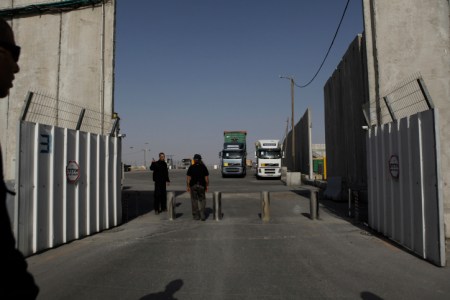
Gaza has become an open-air prison after Israel decided to close two border crossings with Gaza, the army said on Sunday, after a rocket allegedly fired from the Palestinian enclave struck its territory.
The Israeli blockade comes a week after Egypt closed its border with Gaza. With all borders closed, more than one and a half million people in Gaza are now isolated from the outside world. They are prisoners inside the 360 square kilometers that make up the coastal Strip.
“The crossing points for people and goods, Erez and Kerem Shalom, have been closed until further notice except for humanitarian aid,” an army spokeswoman said.
She said that the measure was taken after a rocket fired from Gaza hit Israeli-occupied Palestinian territory on Friday, without causing any casualties or damage.
There was no claim of responsibility from any armed faction in Gaza. A military spokeswoman said forces were still searching for debris.
The projectile struck harmlessly was the first to strike Israeli-occupied territory since September 16, and the second since the end of the Zionist state’s devastating 51-day assault on Gaza.
For 51 days this summer, Israel pounded the Gaza Strip – by air, land and sea – with the stated aim of ending rocket fire from the coastal enclave.
More than 2,160 Gazans, at least 505 of them children, were killed – and 11,000 injured – during seven weeks of unrelenting Israeli attacks in July and August.
The Israeli offensive ended on August 26 with the an Egypt-brokered cease-fire agreement.
However, Israel has violated the terms of the agreement repeatedly ever since.
The agreement calls for reopening Gaza’s border crossings with Israel after an eight-year blockade. Instead, Israel has further sealed the crossings.
The truce also stipulated that Israel would immediately expand the fishing zone off Gaza’s coast, allowing fishermen to sail as far as six nautical miles from shore, and would continue to expand the area gradually.
However, since the ceasefire was signed, Israeli forces have fired at several fishermen who they say have ventured beyond the newly-imposed limit of six nautical miles.
The head of the Gaza fishermen syndicate accused Israel of constantly violating the terms of the agreement.
“Since signing the truce, the Israeli army has violated (the agreement) eight times, arresting fishermen and destroying a giant fishing boat, in addition to firing at fishermen on a daily basis,” he said.
Besides the fishermen, Israeli forces have also fired at other civilians. On Wednesday, Israeli forces shot and injured a Palestinian man on the beach in the northern Gaza Strip.
Furthermore, Gaza is also littered with a large number of unexploded Israeli shells, one of which has recently killed 4-year-old Mohammed Sami Abu-Jrad from the northern Gaza city of Beit Hanoun.
Israel also agreed to allow construction material into Gaza. But two months after the war ended, no building material has entered Gaza due to Israel’s ongoing blockade.
Israel routinely bars the entry of building materials into the embattled coastal enclave on grounds that Palestinian resistance faction Hamas could use them to build underground tunnels or fortifications.
For years, the Gaza Strip has depended on construction materials smuggled into the territory through a network of tunnels linking it to Egypt’s Sinai Peninsula.
A recent crackdown on the tunnels by the Egyptian army, however, has effectively neutralized hundreds of tunnels, severely affecting Gaza’s construction sector.
Egypt leaves Gaza isolated
On Wednesday, Egypt began setting up a buffer zone along its border with the Gaza strip in a move which will see about 800 homes demolished.
It comes in the wake of a suicide car bombing which killed 30 Egyptian soldiers in Sinai last week, the deadliest attack on the military since ousting Egypt’s former president Mohammed Mursi.
Following the bombing, Egypt immediately closed the Rafah crossing into the Gaza Strip, the principal connection between Gaza’s 1.7 million people and the outside world.
In August, Egypt’s authorities have used an attack on the Egyptian military in Sinai as a pretext to start a campaign to destroy lifelines into Gaza. Over 120 tunnels were blown up or filled in.
More than just being the only way for some products to make it into the over 1.5 million Palestinians living in the strip, the Gaza tunnels have become a major source of income for the transporters of goods. Egypt has closed Gaza’s lifelines.
Since the beginning of 2014 until the end of May, Rafah crossing has been opened only 14 out of 120 days, limiting access to humanitarian cases and for other authorized travelers – including foreign nationals and visa holders.
(AFP, Reuters, Al-Akhbar)
Ballots or Bullets: Democracy and World Power
By James Petras | October 31, 2014
The principal reason why Washington engages in military wars, sanctions and clandestine operations to secure power abroad is because its chosen clients cannot, and do not, win free and open elections.
A brief survey of recent election outcomes testify to the electoral unattractiveness of Washington-backed clients. The majority of democratic electorates rejects candidates and parties which back the US global agenda: neo-liberal economic policies; a highly militarized foreign policy; Israeli colonization and annexation of Palestine; the concentration of wealth in the financial sector; the military escalation against China and Russia. While the US policy attempts to re-impose the pillage and dominance of the 1990s via recycled client regimes the democratic electorates want to move on toward less bellicose, more inclusive governments, which restore labor and welfare rights.
The US seeks to impose the unipolar world, of the Bush Sr. and Clinton era, failing to recognize the vast changes in the world economy, including the rise of China and Russia as world powers, the emergence of the BRIC and other regional organizations and above all the growth of popular democratic consciousness.
Failing to convince electorates by reason or manipulation, Washington has opted to intervene by force, and to finance organizations to subvert the democratic electoral process. The frequent resort to bullets and economic coercion when ballots fail to produce the “appropriate outcome” testifies to the profoundly reactionary nature of US foreign policy. Reactionary in the double sense of ends and means.
Pragmatically, the imperial centered socio-economic policies deepen inequalities and depress living standards. The means to achieve power, the instruments of policy, include wars, intervention, covert operations, are more akin to extremists, quasi-fascist, far right regimes.
Free Elections and the Rejection of US Clients
US-backed electoral parties and candidates have suffered defeats throughout most of the world, despite generous financial backing and international mass media propaganda campaigns. What is striking about the negative voting outcomes is the fact that the vast majority of adversaries are neither anti-capitalist nor ‘socialist’. What is equally striking is that all of the US clients are rightist or far-rightist parties and leaders. In other words, the polarization is usually between center-left and rightist parties; the choice is between reform or reaction, between an independent or satellite foreign policy.
Washington and Latin America: Masters of Defeats
Over the past decade, Washington has backed losing neo-liberal candidates throughout Latin America and then sought to subvert the democratic outcome.
Bolivia
Since 2005, Evo Morales, the center left leader favoring social reforms and an independent foreign policy, has won three Presidential elections against Washington backed rightist parties, each time by a greater margin. In 2008, he ousted the US ambassador for intervening, expelled the Drug Enforcement Agency (DEA) in 2008, USAID in 2013 and the Military Mission after foiling an aborted coup in Santa Cruz.
Venezuela
The United Socialist Party of Venezuela (PSUV) and its predecessor have won every Presidential and Congressional election (over a dozen) except one over the past 15 years despite US multi-million dollar funding of neo-liberal opposition parties. Unable to defeat the Chavez-led radical-reform government, Washington backed a violent coup (2002), a boss’s lockout (2002/3), and decades long paramilitary attacks of pro-democracy leaders and activists.
Ecuador
The US has opposed the center-left government of President Correa for ousting it from the military base in Manta, renegotiating and repudiating some of its foreign debt and backing regional pacts which exclude the US. As a result Washington backed an abortive police led coup in 2010 that was quickly defeated.
Honduras
During democratically elected President Manual Zelaya’s tenure in office, a center-left President, Honduras sought to pursue closer relations with Venezuela in order to receive greater economic aid and to shed its reputation as a US dominated “banana republic”. Washington, unable to defeat him at the ballot box, responded by supporting a military coup (2009) which ousted Zelaya and returned Honduras to the US fold. Since the coup Honduras has experienced more killings of popular leaders-200- than any country in Latin America.
Brazil
The center-left Workers Party has won four straight elections against US backed neo-liberal candidates beginning in 2002 and continuing through the 2014 elections. The US propaganda machine, including NSA’s spying on President Rousseff and the strategic state petrol company, Petrobras, and the international financial press went all out to discredit the reformist center-left government. To no avail! The voters preferred an ‘inclusive’ social liberal regime pursuing an independent foreign policy to an opposition embedded in the discredited socially regressive neo-liberal politics of the Cardoso regime (1994-2002). In the run-up to the 2014 elections Brazilian and US financial speculators attempted to strike fear in the electorate by betting against the currency (real) and driving the stock market into a precipitous fall.
To no avail. Rousseff won with 52% of the vote.
Argentina
In Argentina a massive popular revolt overthrew the US backed neo-liberal regime of De la Rua in 2001. Subsequently, the electorate elected the center-left Kirchner government over the rightist, US backed Menem candidacy in 2003. Kirchner pursued a reformist agenda imposing a moratorium on the debt and combining high economic growth with large scale social expenditures and an independent foreign policy. US opposition escalated with the election of his wife Cristina Fernandez. Financial elites, Wall Street, the US judiciary and Treasury intervened to destabilize the government, after failing to defeat Fernandez’s re-election. Extra-parliamentary financial pressures were matched by political and economic support for rightist politicians in preparation for the 2015 elections.
Earlier, in 1976, the US backed the military coup and political terror that led to the murder of 30,000 activists and militants. In 2014 the US backed a “financial coup” as a federal judge sided with vulture funds, sowing financial terror in international markets against a democratically elected government.
Paraguay
President Fernando Lugo was a moderate former Bishop who pursued a watered-down center-left agenda. Nevertheless, he raised issues that conflicted with Washington’s extremist agenda, including Paraguay’s membership in regional organizations that excluded the US (MERCOSUR). He appealed to the landless rural workers and he retained ties to other Latin American center-left regimes. He was deposed by Congress in 2012 in a highly dubious ‘institutional coup’, quickly supported by the White House and replaced by a straight-line neo-liberal, Federico Franco with tight links to Washington and hostile to Venezuela.
Globalizing US Threats to Democracy
US subversion of democracy when center-left political formations compete for power is not confined to Latin America – it has gone ‘global’.
Ukraine
The most egregious example is the Ukraine, where the US spent over $6 billion in over a decade and a half. Washington financed, organized, and promoted pro NATO shock troops to seize power against an elected regime (Viktor Yanukovych) which tried to balance ties between the West and Russia. In February 2014, an armed uprising and mob action led to the overthrow of the elected government and the imposition of a puppet regime totally beholden to the US. The violent putschists met resistance from a large swathe of pro-democracy activists in the Eastern region. The Kiev junta led by oligarch Petro Poroshenko dispatched air and ground troops to repress the popular resistance with the unanimous backing of the US and EU. When the rightist regime in Kiev moved to impose its rule over the Crimea and to break its military base treaty with Russia, the Crimean citizens voted, by a large margin (85%), to separate and merge with Russia.
In both the Ukraine and Crimea, US policy was directed toward imposing by force, the subordination of democracy to NATO’s drive to encircle Russia and undermine its democratically elected government.
Russia
Following the election of Vladimir Putin to the Presidency, the US organized and financed a large number of opposition “think tanks”, and NGO’s, to destabilize the government. Large scale demonstrations by well-funded NGO’s were given wide play by all the Western mass media.
Failing to secure an electoral majority and after suffering electoral defeats in the executive and legislative elections, Washington and the EU, using the pretext of Russian “intervention” in the Ukraine, launched a full scale economic war on Russia. Economic sanctions were enforced in the hopes of provoking economic collapse and a popular upheaval. Nothing of the sort occurred. Putin has gained greater popularity and stature in Russia and consolidated its ties with China and the other BRIC countries.
In sum, in the Ukraine, Crimea and Russia, facing independent elected governments, Washington resorted to a mob uprising, military encirclement and an escalation of economic sanctions.
Iran
Iran has periodic elections in which pro and anti-western parties compete. Iran has drawn the wrath of Washington because of its support for Palestinian liberation from the Israeli yoke; its opposition to the Gulf absolutist states; and its ties to Syria, Lebanon (Hezbollah) and post- Saddam Hussain Iraq. As a result, the US has imposed economic sanctions to cripple its economy and finances and has funded pro-Western neo-liberal opposition NGO’s and political factions. Unable to defeat the Islamist power elite electorally, it chooses to destabilize via sanctions in order to disrupt its economy and assassinations of scientists and cyber warfare.
Egypt
Washington backed the Hosni Mubarak dictatorship for over three decades. Following the popular uprising in 2011, which overthrew the regime, Washington retained and strengthened its ties to the Mubarak police, military and intelligence apparatus. While promoting an alliance between the military and the newly elected President Mohammed Morsi, Washington funded NGO’s, who acted to subvert the government through mass demonstrations. The military, under the leadership of US client General Abdel Fattah el-Sisi, seized power, outlawed the Moslem Brotherhood and abolished democratic freedoms.
Washington quickly renewed military and economic aid to the Sisi dictatorship and strengthened its ties with the authoritarian regime. In line with US and Israeli policy, General Sisi tightened the blockade of Gaza, allied with Saudi Arabia and the Gulf despots, strengthened its ties with the IMF and implemented a regressive neo-liberal program by eliminating fuel and food subsidies and lowering taxes on big business.
The US backed coup and restoration of dictatorship was the only way Washington could secure a loyal client relationship in North Africa.
Libya
The US and NATO and Gulf allies launched a war (2011) against the independent, nationalist Libyan government, as the only way to oust the popular, welfare government of Colonel Gaddafi. Unable to defeat him via internal subversion, unable to destabilize the economy, Washington and its NATO partners launched hundreds of bombing missions accompanied by arms transfers to local Islamic satraps, tribal, clans and other violent authoritarian groups. The subsequent ‘electoral process’ lacking the most basic political guarantees, fraught by corruption, violence and chaos, led to several competing power centers. Washington’s decision to undermine democratic procedures led to a violent Hobbesian world, replacing a popular welfare regime with chaos and terrorism.
Palestine
Washington has pursued a policy of backing Israeli seizures and colonization of Palestinian territory, savage bombings and the mass destruction of Gaza. Israel, determined to destroy the democratically elected Hamas government, has received unconditional US backing. The Israeli colonial regime has imposed racist, armed colonies throughout the West Bank, financed by the US government, private investors and US Zionist donors. Faced with the choice between a democratically elected nationalist regime, Hamas, and a brutal militarist regime, Israel, US policymakers have never failed to back Israel in its quest to destroy the Palestinian mini-state.
Lebanon
The US, along with Saudi Arabia and Israel, has opposed the freely elected Hezbollah led coalition government formed in 2011. The US backed the Israeli invasion in 2006, which was defeated by the Hezbollah militias. Washington backed the right wing Hariri-led coalition (2008 – 2011) which was marginalized in 2011. It sought to destabilize the society by backing Sunni extremists especially in Northern Lebanon. Lacking popular electoral support to convert Lebanon into a US client state, Washington relies on Israeli military incursions and Syrian based terrorists to destabilize Lebanon’s democratically elected government.
Syria
Syria’s Bashar Assad regime has been the target of US, EU, Saudi and Israeli enmity because of its support for Palestine, its ties with Iraq, Iran, Russia and Hezbollah. Its opposition to the Gulf despotism and its refusal to become a US client state (like Jordan and Egypt) has been another source of NATO hostility. Under pressure from its internal democratic opposition and its external allies, Russia and Iran , the Bashar Assad regime convoked a conference of non-violent opposition parties, leaders and groups to find an electoral solution to the ongoing conflict. Washington and its NATO allies rejected a democratic electoral road to reconciliation. They and their Turkish and Gulf allies financed and armed thousands of Islamic extremists who invaded the country. Over a million refugees and 200,000 dead Syrians were a direct result of Washington’s decision to pursue “regime change” via armed conflict.
China
China has become the world’s largest economy. It has become a leading investment and trading country in the world. It has replaced the US and the EU in Asian, African and Latin American markets. Faced with peaceful economic competition and offers of mutually beneficial free trade agreements, Washington has chosen to pursue a policy of military encirclement, internal destabilization and Pan Pacific integration agreements that exclude China. The US has expanded military deployments and bases in Japan, Australia and the Philippines. It has heightened naval and air force surveillance just beyond China’s limits. It has fanned rival maritime claims of China’s neighbors, encroaching on vital Chinese waterways.
The US has supported violent Uighur separatists, Tibetan terrorists and protests in Hong Kong in order to fragment and discredit China’s rule over its sovereign territory. Fomenting separation via violent means results in harsh repression, which in turn can alienate a domestic constituency and provide grist for the Western media mills. The key to the US countering China’s economic ascent is political: fomenting domestic divisions and weakening central authority. The democratization which Chinese citizens favor has little resonance with US financed ‘democracy’ charades in Hong Kong or separatist violence in the provinces.
Washington’s effort to exclude China from major trade and investment agreements in Asia and elsewhere has been a laughable failure. The principle US “partners”, Japan and Australia are heavily dependent on the Chinese market. Washington’s (free trade) allies in Latin America, namely Colombia, Peru, Chile and Mexico are eager to increase trade with China. India and Russia are signing off on multi-billion dollar trade and investment deals with China! Washington’s policy of economic exclusion miscarried in the first month!
In sum, Washington’s decision to pursue confrontation over conciliation and partnership; military encirclement over co-operation; exclusion over inclusion, goes counter to a democratic foreign policy designed to promote democracy in China and elsewhere. An authoritarian choice in pursuit of unachievable Asian supremacy is not a virtue; it is a sign of weakness and decay.
Conclusion
In our global survey of US policy toward democracy, center-left governments and free elections we find overwhelming evidence of systematic US hostility and opposition. The political essence of the “war on terrorism” is Washington’s world-wide long-term pernicious assault on independent governments, especially center-left democratic regimes engaged in serious efforts to reduce poverty and inequality.
Washington’s methods of choice range from financing rightist political parties via USAID and NGO’s, to supporting violent military coups; from backing street mobs engaged in destabilization campaigns to air and ground invasions. Washington’s animus to democratic processes is not confined to any region, religious, ethnic or racial group. The US has bombed black Africans in Libya; organized coups in Latin America against Indians and Christians in Bolivia; supported wars against Muslims in Iraq, Palestine and Syria; financed neo-fascist “battalions”and armed assaults against Orthodox Christians in the Eastern Ukraine; denounced atheists in China and Russia.
Washington subsidizes and backs elections only when neo-liberal client regimes win. It consistently destabilizes center-left governments which oppose US imperial policies.
None of the targets of US aggression are strictly speaking anti-capitalist. Bolivia, Ecuador, Brazil, Argentina are capitalist regimes which attempt to regulate tax and reduce disparities of wealth via moderate welfare reforms.
Throughout the world, Washington always supports extremist political groups engaged in violent and unconstitutional activity that have victimized democratic leaders and supporters. The coup regime in Honduras has murdered hundreds of rank and file democratic activists, farm workers,and poor peasants.
The US armed Islamic jihadist and ex-pat allies in Libya have fallen out with their NATO mentors and are at war among themselves, engaging in mutual bloodletting.
Throughout the Middle East, South Asia, North Africa, Central America and the Caucuses wherever US intervention has taken place, extreme right-wing groups have served, at least for a time, as Washington and Brussels’ principal allies.
Pro EU-NATO allies in the Ukraine include a strong contingent of neo-Nazis, paramilitary thugs and “mainstream” military forces given to bombing civilian neighborhoods with cluster bombs.
In Venezuela, Washington bankrolls terrorist paramilitary forces and political extremists who murdered a socialist congressional leader and dozens of leftists.
In Mexico the US has advised, financed and backed rightist regimes whose military, paramilitary and nacro-terrorist forces recently murdered and burned alive 43 teachers’ college students, and are deeply implicated in the killing of 100,000 “other” Mexicans, in less than a decade.
Over the past eleven years the US has pumped over $6 billion dollars in military aid to Colombia, funding its seven military bases and several thousand special operations forces and doubling the size of the Colombian military. As a result thousands of civil society and human rights activists, journalists, trade union leaders and peasants, have been murdered. Over 3 million small land-holders have been dispossessed.
The mass media cover up the US option for right wing extremism by describing ruling mass murderers as “center-right regimes” or as“moderates”: linguistic perversions and grotesque euphemisms are as bizarre as the barbarous activities, perpetrated by the White House.
In the drive for world power, no crime is left undone; no democracy that opposes it is tolerated. Countries as small and marginal as Honduras or Somalia or as great and powerful as Russia and China cannot escape the wrath and covert destabilization efforts of the White House.
The quest for world domination is driven by the subjective belief in the “triumph of the will”. Global supremacy depends entirely on force and violence: ravaging country after country, from carpet bombing of Yugoslavia, Iraq, Afghanistan and Libya to proxy wars in Somalia, Yemen, Ukraine to mass killings in Colombia, Mexico and Syria.
Yet there are limits to the spread of the “killing fields”. Democratic processes are defended by robust citizens’ movements in Venezuela, Ecuador and Bolivia. The spread of imperial backed terrorist seizures of power are stymied by emergence of global powers, China in in the Far East and Russia in Crimea and eastern Ukraine have taken bold steps to limit US imperial expansion.
In the United Nations, the President of the United States and his delegate Samantha Powers rant and rave, in a fit of pure insanity, against Russia as “the greatest world terrorist state” for resisting military encirclement and the violent annexation of the Ukraine.
Extremism, authoritarianism and political insanity know no frontiers. The massive growth of the secret political police, the National Security Agency, the shredding of constitutional guarantees, the conversion of electoral processes into elite controlled multi-billion dollar charades, the growing impunity of police involved in civilian murders, speaks to an emerging totalitarian police – state inside the US as a counterpart to the violent pursuit of world power.
Citizens’ movements, consequential center-left parties and governments, organized workers, in Latin America, Asia and Europe have demonstrated that authoritarian extremist proxies of Washington can be defeated. That disastrous neo-liberal policies can be reverted. That welfare states, reductions in poverty, unemployment and inequalities can be legislated despite imperial efforts to the contrary.
The vast majority of the Americans, here and now, are strongly opposed to Wall Street, big business and the financial sector. The Presidency and the Congress are despised by three quarters of the American public. Overseas wars are rejected. The US public, for its own reasons and interests, shares with the pro-democracy movement’s world-wide, a common enmity toward Washington’s quest for world power. Here and now in the United States of America we must learn and build our own powerful democratic political instruments.
We must, through the force of reason, contain and defeat “the reason of force”: the political insanity that informs Washington’s ‘will to power’. We must degrade the empire to rebuild the republic. We must turn from intervening against democracy abroad to building a democratic welfare republic at home.
Canadian police attack anti-austerity rally in Montreal
Press TV – October 31, 2014
Police have attacked thousands of demonstrators protesting against government spending cuts in the Canadian province of Quebec.
The anti-austerity protesters gathered outside the office of Quebec’s Premier Philippe Couillard in Montreal on Friday to condemn the local government’s plan to cut $3 billion from the province’s budget.
The Canadian police used force to disperse the anti-austerity protesters, saying the demonstration, which was dubbed “Austerity: A Horror story”, was unauthorized.
The demonstration, which started at 11 a.m. and ended at around 3 p.m. local time, was organized by a coalition of student unions, including Quebec House of Labour (Centrale des syndicats du Quebec), independent teachers’ federation, as well as Quebec Solidaire, a provincial political party.
“On the one hand, they’re very clear in their intention to cut. On the other hand they’re very clear in their intention not to get any money from people who actually have money,” said Joel Pedneault, a spokesperson for the coalition.
Pedneault further stated, “The orientation behind that is they just want to cut social spending. It’s an orientation against social spending and against our social programs which we fought so hard for in Quebec.”
Several demonstrators were arrested in the crackdown. The demonstration also caused heavy traffic in the area.
28 injured as clashes rage across Jerusalem overnight
Ma’an – 01/11/2014
JERUSALEM – At least 28 Palestinians were injured as clashes with Israeli forces continued into the late hours of the night on Friday across Jerusalem, as anger over a series of killings by Israeli police boiled over into the streets of the city’s Palestinian neighborhoods.
Clashes broke out in the occupied East Jerusalem neighborhoods of Silwan, al-Issawiya, al-Tur, and Wadi al-Joz, as hundreds marched and fought pitched battles with security forces in anger over the killing of Mutaz Hijazi, 32, early Thursday, as well as the killing of Abd al-Rahman al-Shaludi, 21, the week before.
Both men were suspected by authorities of involvement in violent incidents targeting Israelis. But Palestinians have been outraged by their killings, highlighting that instead of being arrested both were shot dead by police on sight.
An autopsy on Friday revealed that Mutaz Hijazi, 32, was shot 20 times by different officers and left to die on his rooftop, as Israeli police refused to allow locals to reach him — and later forced an ambulance to surrender his body, before returning it to the family late Thursday.
On Friday evening, Israeli forces raided the area around Hijazi’s home al-Thawri neighborhood in Silwan, and locals told Ma’an that soldiers attacked a tent set up by the mourning family where friends and relatives were dropping in to offer condolences.
Israeli forces reportedly fired stun grenades, tear-gas canisters, and rubber-coated steel bullets at mourners gathered at the tent, and several men and women suffered severe tear gas inhalation while many others were injured by rubber-coated bullets.
Activist Jihad Oweida told Ma’an that one mourner, Attiya Shabbaneh, was injured by shrapnel from stun grenades in his face and was taken to al-Maqasid Hospital for treatment.
In the Bir Ayyub neighborhood, Israeli soldiers fired rubber-coated steel bullets and tear-gas canisters at more than 200 Palestinian youths who had gathered to visit the mourning tent set up in Hijazi’s home.
Many suffered from excessive tear-gas inhalation and one was injured and received a fracture in his foot. A Palestinian youth identified as Rami Salah was detained by Israeli forces.
An official responsible for ambulance and emergency services at the Palestinian Red Crescent, Amin Abu Ghazaleh, told Ma’an that 28 Palestinians suffered from light injuries, including from rubber-coated steel bullets injuries and tear-gas inhalation, while three were taken to hospitals after they were hit at close range with rubber-coated steel bullets in the head, legs, and stomach.
In the al-Issawiya neighborhood, meanwhile, dozens suffered from excessive tear gas inhalation after Israeli forces fired tear gas canisters heavily during clashes that erupted as Israeli forces detained an unidentified Palestinian.
Clashes also erupted in the Sur Baher village, Wadi al-Jouz neighborhood, and other neighborhoods in the Old City of Jerusalem.
An Israeli police spokesman did not immediately return a request for comment.
Old City security tight
Also on Friday, Israeli police released the director of the Wadi Hilweh Information Center, Jawad Siyam, along with Yazan Siyam, Muntaser Faraj and Mahmoud Gaith who were all detained Friday on charges of “assaulting” Israeli settlers in September.
It was unclear why the arrests had taken place more than a month after the alleged assault, but some have speculated that the arrests were related to the political nature of the work of the Wadi Hilweh Information Center, which focuses on resisting settler encroachment in the neighborhood of Silwan.
The four were released on the condition to pay a 500 shekels bill each, and were sentenced to house arrest until next Monday.
The clashes and arrests across Jerusalem came after days of intense security across the city, where Israeli police have deployed heavily amid four months of tensions between local Palestinians and occupation authorities.
Police, some in riot gear, guarded a series of checkpoints leading from the Old City’s outer gates all the way to the Al-Aqsa compound, an AFP correspondent said.
They checked identity papers of people passing between the barricades, both those on their way to pray and those who worked nearby.
Zuheir Dana, 67, said he was unable to get from his shop to his home.
“I wanted just to get home, which is about 50 meters (yards) away from the Al-Aqsa compound, but police didn’t let me through,” he said.
“It’s been bad every day here since Ramadan,” he added, referring to the Muslim holy month that fell in July.
Markets in the Old City, normally bustling on a Friday morning, were nearly deserted due to the security measures.
The security measures followed the unprecedented complete closure of the Al-Aqsa mosque compound — the third-holiest site in Islam — for the first time since 1967, which ignited protest across the Arab world and even from the United States.
Palestinian community officials say the wave of unrest gripping the city is fueled by a sense of hopelessness resulting from Israel’s policies in occupied East Jerusalem, which have left many young people with a sense that they have nothing to lose.
The arrests of hundreds over summer for participation in protests against Israel’s massive assault on Gaza — which left nearly 2,200 dead in the tiny coastal enclave — has only added fuel to the fire.
Although Palestinians in East Jerusalem live within territory Israel has unilaterally annexed, they lack citizenship rights and are instead classified only as “residents” whose permits can be revoked if they move away from the city for more than a few years.
They face discrimination in all aspects of life including housing, employment, and services, and are unable to access services in the West Bank due to the construction of Israel’s separation wall.
East Jerusalem is internationally recognized as Palestinian territory, but Israel occupied it in 1967 and later annexed it in a move never considered legitimate abroad.
UN Report: Israeli settlements have doubled in the last four years
MEMO | October 31, 2014
The number of Israeli settlements on occupied Palestinian land have doubled in the last 54 months, UN Commission on Human Rights member Cees Flinterman said today.
Flinterman presented the fourth stage of a report monitoring activity of Israel’s practices in Palestinian territory at a press conference held at the United Nations in Geneva.
He said: “We are concerned by the level of violence that settlers are using against Palestinian civilians and property owners in both the West Bank and East Jerusalem.”
The UN official asked Israel to halt settlement expansion on occupied Palestinian land adding: “We have yet to receive an official response from Israel in regards to the increased number of settlements in the West Bank.”
Flinterman also expressed his disappointment at the fact that the Israeli government refuses to recognise that torture is a crime. “The committee is greatly disappointed in Israel for not recognising that torture is a crime. The torture and mistreatment that Israel practices in detention centres is a serious problem and we call on Israel to address them within a year’s time.”
Nigel Rodley, president of the UN Commission on Human Rights, pointed out that the situation in the region has not changed despite the number of international efforts in the region; very few changes have been implemented. Rodley also pointed out that the UN Commission on Human Rights criticised the latest Israeli aggression against the Gaza Strip and called on Tel Aviv to conduct the necessary investigations into human rights violations.
The UN committee’s report stressed the need to investigate Israeli violations in the 2008, 2009, 2012 and 2014 wars on the Gaza Strip.
Will the EU and IDB Fund Human Rights-Free Zones in Honduras?
By Dan Beeton | CEPR | October 31, 2014
Karen Spring of the Honduran Solidarity Network writes that in a recent meeting
… Juan Orlando Hernández (President of Honduras), Daniel Ortega (President of Nicaragua), and Salvador Sánchez Cerén (President of El Salvador) defined their nation’s [sic] interests in projects that would develop the [shared area of the Gulf of Fonseca] and came to an agreement on investments in the following sectors: Infrastructure, tourism, agroindustry, and renewable energy.
The meeting declaration mentions, among other projects
… the “implementation of a Employment and Economic Development Zone (ZEDE) [known as a Model City] that includes a logistics park.” The idea is to convert the Gulf into a “Free Trade and Sustainable Development Zone.”
Radio Progreso has noted that the Honduran government is courting investment for the projects from “the European Union [and] the Inter-American Development Bank and is seeking investors in Panama and the United States.”
The ZEDEs, or “model cities,” are areas in which large portions of the Honduran constitution will not apply, including various sections that apply to fundamental and internationally-recognized human rights.
A National Lawyers Guild (NLG) delegation recently traveled to Honduras to investigate the legal implications of the proposed ZEDEs. In a report released in September, the NLG described how few articles of the constitution residents of the ZEDEs would actually enjoy:
Chapter I, Article 1 of the ZEDE law states that Articles 10, 11, 12, 13, 15, and 19 of the Constitution are fully applicable. These provisions define the territorial limits of Honduras, obligate Honduras to international treaties and forbid the ratification of treaties that damage Honduras’ territorial integrity or sovereignty. The remaining sections of the Honduran Constitution, a document of 379 articles, will have only the effect that they are given by an agreement between the Committee for the Adoption of Best Practices (CABP), the independent governing board of the ZEDEs and the corporate promoters seeking to develop the land. [Emphasis added.]
Many fundamental rights of Honduran citizens who live within the borders of ZEDEs are not protected under the new ZEDE law. These rights include: the right to Habeas Corpus or Amparo 20 , Article 183; the inviolability of a right to life, 65; guarantees of human dignity and bodily integrity, 68; the guarantee against the extraction of forced labor, 69; freedom of expression, 72; protections for a free press, 73; freedom of religion, 77; guarantees of assembly and association, 78, 79, and 80; freedom of movement, 81; the right to a defense, to court access, and to counsel for indigents, 82 and 83; and freedom from non-legal detainment, 84 and 85.
Who is this CABP who will govern the ZEDEs and determine which basic human rights will be granted to their residents?
The 21-member CABP, which was announced in February 2014, includes nine US citizens, three Europeans and only four Hondurans. The CABP is dominated by neoliberal and libertarian activists, several with close connections to former President Ronald Reagan [including Grover Norquist and Mark Klugmann].
Ironically, the ZEDEs are being promoted by some libertarian intellectuals and “activists” as perhaps “the freest cities in the world” despite the fact that the zones will shred another fundamental right, and one usually considered sacred to libertarians: property rights. The NLG explains:
A further particularly troubling aspect of the ZEDE law relates to the provisions that allow for the placement of ZEDEs in areas of “low population density,” and in municipalities in the departments adjoining the Gulf of Fonseca and the Caribbean Sea, without prior consultation with the affected communities.
As an example, the report cites the historic Garifuna community of Rio Negro at Trujillo in Colón, which was disrupted by shady land deals ahead of foreign investment. “ZEDEs have created an increased the fear of such incidents in the future,” the NLG states.
Further down, the report elaborates that “ZEDEs do not present Hondurans with authentic choice because they can be imposed on unwilling communities without any referendum,” and that “If the Honduran National Statistics Institute declares the area to have a lower than average population density for a rural area, Congress may impose a ZEDE on any existing communities in that area without even the basic protection of a referendum.”
The NLG notes that “These provisions … violate international law.”
As both the NLG report and Radio Progreso describe, communities in Zacate Grande and Amapala are among those threatened with losing property to ZEDEs that might be “imposed” on them. As attorney Lauren Carasik, one of the authors of the NLG report, wrote in Foreign Affairs in August, “If Zacate Grande is subsumed into the first ZEDE, the island’s 5,000 inhabitants will lose the right to help determine what happens to its land or its resources.”
This is why, as Spring reported,
Last week on October 23, communities and individuals from all over Southern Honduras (El Transito, Nacaome, Amapala, Zacate Grande, Tegucigalpa, etc) crossed the beautiful Gulf of Fonseca – from Coyolito to Amapala – to participate in a march against the ZEDE project proposed for the area. While some participants handed out copies of the ZEDE law, over 500 people marched from the Amapala dock to the municipality office.
Amapala and neighboring communities are being sidelined from the decision-making process that could lead to ZEDEs in their region of Southern Honduras. Radio Progreso reports that while the Korea International Cooperation Agency is funding a feasibility study for the Gulf of Fonseca region, the study has not been presented to the mayors of the relevant municipalities, Alianza, Nacaome and Amapala en Valle. Residents of the areas being considered for ZEDEs are being told very little. NLG investigators explain that
Virtually everyone in the Gulf of Fonseca region who spoke with the delegation voiced concerns about the government’s unwillingness to explain the effects that ZEDEs will have on existing communities within their borders.
…despite the ZEDEs’ potential to nullify existing labor contracts and labor laws in their territory, members of the union of workers at the port that operates in the Gulf of Fonseca have been told nothing. They fear that the arrival of a ZEDE will spell the end of their jobs when a proposed port at Amapala replaces their livelihood.
The Gulf is just one of 14 “potential zones” the Honduran government is considering.
As Radio Progreso notes, the Liberty and Refundation (LIBRE) party is hoping to see the repeal of the constitutional amendment and the organic law facilitating establishment of the ZEDEs. Instead, LIBRE is proposing forms of investment that don’t involve “the surrender of national sovereignty and territory.”
Corporate Destruction of Free Markets Rules Us
By Ralph Nader | October 30, 2014
The ruling dogma of our political economy is corporatism. Corporatism claims to draw legitimacy from the free market theory that all vendors who do not meet market demands will go under. Corporatism uses this illusion to exert power over all aspects of our political economy.
Free markets, corporatists believe, are the best mechanism to allocate resources for the exchange of goods and services. They believe markets free of regulation, taxation or competition from government enterprises produce the best results. Their favorite metaphor is Adam Smith’s “invisible hand” that produces the greatest good for the greatest number of people by the exertions of many willing sellers and many willing buyers (Adam Smith, they neglected to add, favored public works, public education and social safety nets like decent wages and public welfare as needed.)
Many things intrude on free market theories including military expenditures, wars, taxation, public infrastructure, health and safety regulation and governments’ emergency duties. What financier George Soros has called “market fundamentalism,” is opposed to any interference with free markets. Yet, corporatism makes massive exceptions that rig markets and tilt the seller-buyer balance heavily in favor of the former who become bigger and bigger global corporations.
Market critics call this hypocrisy. Corporations push for larger military budgets, which have concentrated power in ever fewer military contractors. What are less recognized and more part of the culture of acceptance are the other interferences with free markets, which corporate power has entrenched so deeply that they are rarely part of any political or election-time debate.
Let this point be made in the form of questions rarely asked and therefore rarely answered.
Can there be a free market without freedom of contract? Corporatism has stripped consumers of freedom of contract with fine-print standard-form contracts that become more dictatorial every decade. They now often take away consumers rights to go to court for their grievances via compulsory arbitration clauses. They stipulate that the vendors can change the contract anyway they want – called unilateral modification – which takes away the last vestiges of consumer bargaining power. An example is the unilateral changes in what you have to pay in penalties, late fees or any hundreds of fees hidden in the fine print. And you can’t shop around because companies don’t compete over the fine print. (See faircontracts.org.)
Can there be a free market if workers cannot join together to bargain with large employers whose investors have expanding freedom to form companies, holding companies, subsidiaries, joint ventures and partnerships to advance their bargaining power? Moreover, in comparison with the freedom of investors, workers are besieged with union-busting intimidations, lockouts and a system of corporate-driven labor laws that present far more obstacles to go through than is the case with the labor laws of other Western nations.
Can there be a free market without strong and comprehensive anti-monopoly, anti-cartel and other laws against the myriad of anti-competitive practices that Adam Smith alluded to back in 1776 when he warned of the motives when businessmen gather together?
Today, the antitrust laws are weak, dated and little enforced with puny budgets.
For example, thousands of joint ventures between direct competitors are being formed without concern of the moribund antitrust police. There is globalization of businesses without globalization of law enforcement. Big companies can leverage the differences between nations in a race to the bottom to unfairly gain market power against buyers, workers and small businesses.
Can there be a free market without a free market of retaining lawyers to pursue wrongful injuries and fraud by both direct negotiation with the perpetrators or resorting to open, public courts? In our country, such private disputes are not socialized by government. They are given over to a market system of legal and other supplementary services. Yet corporatism strives strongly to block or limit, through captive legislators, access to the courts or tie the hands of judges and juries, the only people who see, hear and evaluate the evidence in each case.
Can there be a free market when corporatists produce crony capitalism or torrents of corporate welfare tax escapes, subsidies, handouts and bailouts that rig markets against other smaller businesses that are playing by the rules of the market?
Can there be a free market when corporate-managed trade agreements, such as NAFTA and the World Trade Organization (WTO), subordinate civic efforts to secure better labor, environmental and consumer treatments to the supremacy of commercial trade? (Seehttp://www.citizen.org/trade/.)
Finally, can there be a free market when the banks fund and control the powerful, secretive Federal Reserve that tightly regulates interest rates and can buy trillions of dollars in bonds (aka quantitative easing – QE) to juice the stock markets and the banks, while tens of millions of savers receive less than half of one percent in interest on their savings? Libertarians, to their credit, have noted this abuse by this corporate government more clearly than have many liberals.
There are other corporate controls against the free market, such as politically extending already lengthy patent monopolies to ward off competition by, for instance, generic drug producers.
Suffice it to say that the American people have enough evidence to abandon the ideological hypocrisy that corporatism uses to control them.
Corporatism, in reality, is the corporate state – a tyranny, greased by big money in elections – never envisioned by the framers of our Constitution when they started its preamble with “We the People.”
Wake up call, anyone? (See citizen.org for more information.)
NYPD arrests, ‘brutalizes’ peace activist McGovern ahead of Petraeus speech
RT | October 31, 2014
The New York Police Department has detained prominent peace activist and former CIA agent Ray McGovern, with witnesses saying he was “yelling in pain” during arrest. McGovern was detained ahead of a David Petraeus speech that he planned to attend.
McGovern was detained before the start of a talk between former CIA director David Petraeus, retired US Army Lt. Col. John Nagl, and author Max Boot on American Foreign Policy at the 92nd St Y., an Upper East Side cultural community center.
Anti-war group ‘The World Can’t Wait’ said the activist was arrested “at protest of speech.” He was reportedly prevented by security from entering, charged with criminal trespass and disorderly conduct, and will not be arraigned until Friday. The group has called for McGovern’s release on Twitter and Facebook.
The World Can’t Wait alleged on Twitter that McGovern was “brutalized” by the NYPD and later reported “screams coming from backroom” where the activist was being held. RT has contacted the NYPD who have yet to respond to allegations.
It appeared that the activist was detained even before entering the venue, despite having a ticket for the event.
Independent journalist and filmmaker Cat Watters was due to film McGovern during the talk, asking a question of Petraeus, but as she arrived she saw McGovern being arrested by police, telling them “I have a ticket!” Watters told RT that McGovern has a shoulder injury and was apparently yelling in pain during the arrest.
According to Watters, two members of World Can’t Wait, which asked her to film, were to hang a banner from balcony written with the words “War Criminal Iraq Afghanistan” and covered with handprints in red ink – however, McGovern was not going to take part in this action.
“He [Ray] doesn’t cause a ruckus. He asks questions. He stands up and turns his back,” Watters described the protesters’ plan.
McGovern is a former CIA officer turned political activist. He worked with the agency for just under three decades, retiring in 1990. He was highly critical and public about President George W. Bush’s use of government intelligence in the lead-up to the Iraq war. In 2006, he returned his Intelligence Commendation Medal in protest against the CIA’s involvement in torture.
Featured Video

Why the U.S. Should Pull Back From the First Island Chain
or go to
Aletho News Archives – Video-Images
Book Review
‘Why Fauci Must Rot in Prison’: A Tale of Two Diaries
By Jill Erzen | The Defender | October 13, 2026
Dr. Anthony Fauci’s private diary reveals a “mind-numbing” contradiction between what the former top U.S. infectious disease official knew about COVID-19 and what he told the public, senior White House adviser Peter Navarro, Ph.D., said last week on “American Thought Leaders.”
In his new book, “Why Fauci Must Rot in Prison,” due out Oct. 20, Navarro compares Fauci’s private entries to his own pandemic-era diary, and uses what he calls “a tale of two diaries” to argue that Fauci should face criminal prosecution.
“I show, actually, how a prosecution can and should happen … at the state level, most likely,” Navarro said. “He should wind up in prison, and we’ve got the receipts in this book to put him there.”
Navarro said Fauci repeatedly acknowledged important facts in private, then publicly pursued policies that contradicted those facts — with devastating consequences.
“What he says many times privately in his diary is so at odds with both his public behavior and public statements that it’s mind-numbing,” Navarro said.
Navarro examines the lasting damage caused by lockdowns and other pandemic policies, and the ongoing toll of long COVID.
His book also addresses questions about vaccine safety, including why healthy young people faced COVID-19 vaccination mandates despite concerns about myocarditis, and why women were not warned about miscarriage risks linked to the shots. … continue
Blog Roll
 Aletho News
- Jennifer Kavanagh: Why the U.S. Should Pull Back From the First Island Chain
- Yemen denounces international community’s silence on Saudi aggression, siege
- UAE and Saudi Arabia move toward renewed coordination against Sanaa
- How Iran’s two-week retaliatory strikes exposed cracks in US military architecture in Persian Gulf
- The mother of all propaganda: Why the hype over US MOAB strike against Iran is nothing but theater
- Iran says it possesses technology behind US 14-ton GBU bunker-buster
- Trump asks Iran not to retaliate after he strikes Pickaxe Mountain – w/ Prof. Marandi
- Vice President J.D. Vance’s Deceptive ‘Antiwar’ Campaign Speech
- Iran: Palestinians’ rights must not be compromised in Gaza’s future; US, Israel to blame for Hormuz situation
- Ongoing tales of Syrian chemical weapons
- If Americans Knew
- Israeli rabbi permits occupiers to steal Palestinian olive harvest in West Bank
- Netanyahu’s spin on latest settler attack is laughable – Daily Update
- Israeli soldiers debunk Israel’s talking points
- In West Bank, Israeli settlers are totally out of control – Daily Update
- NPR investigation finds evidence of widespread fraud at mall kiosks tied to Israeli skincare brand
- Tucker Carlson exposes Israeli Lies about the Oct 7th attack, Charlie Kirk, and the U.S.
- Israel has detained thousands of Palestinian children since Oct 7th – over half spent time in solitary, many uncharged
- Israeli Analysis: Is Netanyahu Planning an ‘October Surprise’ Attack Before Israel’s Election?
- Israeli settlers brutally attack Palestinians and Washington Post female photographer, 65
- Words Have Changed, Occupation Continues: The Reality of the Gaza Ceasefire
- No Tricks Zone
- Predictions Made By Renowned Climate Proifessor Over Past Decades Have Been Proven To Be Poor
- New Study Suggests Large Regions Of The Pacific Ocean Have Been Cooling For The Last 80 Years
- Germany’s Green Energy Debacle: High Energy Costs Force Kahla Porzellan to Close After 182 Years!
- New Study: 50 Years Of The Most Aggressive ‘Net Zero’ Policies Can Only Affect The Global Climate By 0.03°C
- US September “Heat” Was No Record…Many Records Set Decades Ago
- Latest European Green Energy Debacle; Portugal’s Largest Flagship Solar Park Insolvent!
- Green Energy Debacle: German Expert Professor Fritz Vahrenholt Warns Of Severe Economic And Social Consequences
- Two More Paleo Reconstructions Affirm Meters-Higher Sea Levels Across Ireland, Brazil 7000-6000 Years Ago
- New Study: Earth And Venus Surface Warmth Largely Explained By Convection And Lapse Rate, Not CO2 Or Radiation
- 2025 Nature Paper Claiming Worsening Global Drought Gets RETRACTED …Heavily Flawed

