Diego Garcia: ethnically cleansed for US forever wars
By Aidan J. Simardone | The Cradle | April 18, 2025
US President Donald Trump’s recent threat to strike Iran unless it halts its nuclear program has revived interest in a long-standing American asset: Diego Garcia. B-2 stealth bombers have been deployed to the island – British territory in name but an American garrison in practice – suggesting that Washington is either preparing for war or raising the stakes with an aggressive bluff.
Located in the heart of the Indian Ocean, the Diego Garcia island gives the United States unmatched reach across West Asia, Eastern Africa, and South Asia. It has been a launchpad for every major US war in the region – from Iraq to Afghanistan. Now, it may be key to a possible assault on the Islamic Republic of Iran.
But this island, remote and seemingly uncontroversial, is steeped in colonial injustice. Its original inhabitants, the Chagossians, were forcibly expelled to make way for the base. The UK, under pressure from Washington, detached the archipelago from Mauritius and ethnically cleansed it.
In 2024, Britain finally agreed to hand back the islands to Mauritius, but the US lease remains. For now, Diego Garcia is securely in American hands – and poised once again to serve as a launchpad for imperial warfare.
From paradise to genocide
Once colonized by France and later Britain, the Chagos Islands were home to a unique Creole population descended from African slaves and Indian laborers. For generations, the Chagossians lived peacefully on the islands, building a distinct identity with their own language and customs.
As anti-colonial movements swept across Africa and Asia in the 1950s and 1960s, the US sought new bases to maintain its influence around the Indian Ocean. Camp Badaber in Pakistan ultimately closed in 1970 as the country became closer with China. The Eritrean War of Independence threatened Kagnew Station in Ethiopia. The loss of both bases would be a major blow to US intelligence gathering of Soviet activities.
Diego Garcia could plug this gap, but there were two problems: the islands were part of Mauritius and had inhabitants.
In violation of international legal norms, Britain pressured Mauritius into giving up the Chagos Archipelago.
Then began the ethnic cleansing. To intimidate the islanders, their beloved pet dogs were killed en masse through shooting and gassing. The largest plantation was closed, depriving people of employment.
Food and medical supplies were restricted to kill the population or force them to leave. By 1971, those who remained were told they needed a legal permit, which no one received. With little notice, many were forced to leave their homes. Reminiscent of the slave boats their ancestors were brought in, Chagossians were crammed into the bottom of boats as they fled the islands.
A launchpad for endless war
With the island empty and the runway extended, Diego Garcia quickly became central to US war strategy. It played a key role in the 1980 failed hostage rescue mission in Iran, “Operation Eagle Claw,” and later against Iran during the Iran–Iraq War.
In 1987, the runway was improved for the stationing of US B-52 Bombers, which can deliver large payloads and precision-guided munitions. These bombers were vital during the Gulf War for attacking Iraq’s command and control centers, and again during the beginning of the invasions and occupations of Afghanistan and Iraq.
As the US expanded its footprint in the Persian Gulf, bases in Qatar and Bahrain took on greater significance – hosting long-range bombers, the US Central Command’s (CENTCOM) headquarters, and the US Navy’s Fifth Fleet. These two bases were vital: bombers from Qatar and vessels from Bahrain helped strike Taliban strongholds during the invasion of Afghanistan and hit Baghdad in the Shock and Awe campaign.
But proximity to the battlefield has become a double-edged sword. Iran’s significant missile arsenal, including hypersonic ones – demonstrated during its October 2024 retaliation against Israel – makes those Persian Gulf bases vulnerable.
Close proximity is also a challenge for B-2 stealth bombers, which can be detected at ground level and during takeoff. With only 20 B-2s, costing $2 billion each, this is a price the US cannot afford. If war breaks out, Tehran is unlikely to spare the economic infrastructure of its neighbors.
It is unlikely that either Bahrain or Qatar would be willing to bear the cost of an Iranian attack. Iran could not only attack US military bases, but also oil and gas infrastructure, which would destroy their economies. The two nations have also been edging closer to Iran: Tehran was one of the few capitals that supported Qatar during its diplomatic crisis with Saudi Arabia and other Persian Gulf emirates; in the past year, Bahrain and Iran have also been working on restoring ties.
Diego Garcia, by contrast, sits well beyond the range of most Iranian missiles – at least that is the assessment for now. It allows stealth bombers to launch undetected, and Iran’s limited ability to punish the island’s British overlords makes it an ideal staging ground for Washington’s war plans.
According to available data, Iran’s longest-range missile is the Khorramshahr-4, with a reach of approximately 2,000 kilometers. Yet, the US military base in Diego Garcia – located deep in the Indian Ocean – is nearly 4,000 kilometers from Iran’s southern coast. While there is no confirmed evidence that Iran currently has the means to strike such a distant target, the existence of capabilities – undisclosed by the Islamic Republic – that could reach the US base cannot be entirely ruled out.
Moreover, the Khorramshahr-4 missile’s proven ability to evade Israeli air defenses raises concerns about the US’s ability to defend Diego Garcia in a major conflict – particularly if Iran possesses long-range missiles capable of striking the remote base.
Any attack on Iran could trigger a wider regional war, with blowback against American assets and allies across West Asia – from Tel Aviv to Riyadh. Killing a few Iranian leaders might offer symbolic victories, but Tehran’s command structure is built for resilience. The risks far outweigh the tactical gains.
A homeland turned fortress
Despite a 2019 International Court of Justice (ICJ) ruling demanding Britain end “its administration of the Chagos Islands as rapidly as possible,” real justice for the Chagossians remains elusive. Although London agreed in October 2024 to begin the process of returning the archipelago to Mauritius, the US base is staying put. Mauritius offered a 99-year lease, without securing the right of return for the expelled Chagossians.
That could soon become permanent. If war erupts, Diego Garcia may once again be expanded, militarized further, and rendered uninhabitable. A concrete fortress will be all that remains of what was once a peaceful homeland.
In the end, whether through military strike or imperial inertia, the Chagossians risk losing their islands forever – not to history, but to America’s wars.
HEALTH FREEDOM’S BIG WIN IN IDAHO
The HighWire with Del Bigtree | April 17, 2025
President and founder of the Health Freedom Defense Fund, Leslie Manookian, shares how she helped pass Idaho’s sweeping new Medical Freedom Act, which protects individuals from coerced medical interventions. She describes the emotional rollercoaster of facing a governor’s veto and the ultimate victory that made the law even stronger.
UK Government and Tony Blair Back AI-Powered Surveillance Push Including Digital ID and Facial Recognition

By Didi Rankovic | Reclaim The Net | April 18, 2025
A new push is underway in the UK to promote AI-powered mass surveillance via a number of controversial technologies and tools.
The country’s government, former PM Tony Blair, the College of Policing (the professional body for police in England and Wales), as well as legacy media outlet The Times, and Axon, a surveillance company, have converged behind this latest effort.
Axon was the headline sponsor during The Times’ Crime and Justice Summit this week, organized to present the result of an inquiry launched a year ago by the newspaper under the title, “The Crime and Justice Commission,” meant to look into the future of policing and the criminal justice system.
The final report contains recommendations to introduce mandatory universal digital ID and online age verification, as well as expand the use of live facial recognition, AI, and data analytics.
Age verification and banning users under 16 from social media would be enforced through a universal digital ID system, which would also be used to create what the report refers to as a “single unique identifier from birth.”
And while “ethical dilemmas” around this are acknowledged, the document calls for a single digital case file for the justice system.
Live facial recognition, which is currently tested or used in limited areas, should be expanded across the UK, according to the report, which also urges for AI and data analytics to be more involved in policing and the criminal justice system.
And while civil liberties and privacy campaigner Big Brother Watch slammed what it calls “an obsession” with Orwellian AI-powered surveillance that “reeks of authoritarianism and would be a hammer blow to our civil liberties” – Tony Blair and several other high profile figures emerged as enthusiastic supporters of the recommendations.
According to Blair, digital ID is a necessity (he and his foundation push for the mandatory kind), as is live facial recognition deployment in “busy places like train stations and events.” The former PM wants AI to be used for “spotting crime patterns, guiding patrols, and streamlining decisions.”
UK Justice Secretary and Lord Chancellor Shabana Mahmood suggested that some of the recommendations would become law, while other supporters of the report include the Home Office, life peer in the House of Lords Baroness Longfield, Independent Victims’ Commissioner for London Claire Waxman, and the College of Policing.
Weaponized Surveillance: Biden Admin’s ‘Counterterror’ Plan Declassified
By Svetlana Ekimenko – Sputnik – 17.04.2025
America First Legal Foundation (AFL) had appealed to the US Director of National Intelligence to declassify and release the Biden administration’s classified 2021 domestic surveillance strategy, with Tulsi Gabbard promising to comply with the request for transparency and accountability.
The Biden administration’s strategy gave the green greenlight to mass digital stalking and thought-tracking, as evidenced by the playbook newly declassified by Tulsi Gabbard.
The Biden Administration’s Strategic Implementation Plan for Countering Domestic Terrorism empowers federal agencies to:
- Adopt pre-crime tactics, enhancing screening and vetting processes for federal employees, particularly those in sensitive positions
- Improve background checks by policing speech, tracking iconography and phraseology, vetting spending, and improving ideological filtering of public servants
- Incorporate mental health screening and community engagement lines to flag “threats” before a crime is committed
- Expand digital surveillance through tech platform partnerships
- Actively integrate foreign intelligence into data-sharing efforts
- Assess risks among military retirees during their transition to civilian life
American Death Throes
By Georgia Hayduke • Unz Review • April 18, 2025
If the situation was hopeless, their propaganda would be unnecessary.
– Anonymous
They say the most dangerous animal you can encounter in the wild is one that is dying and cornered. A trapped coyote will lash out and attack you with every fiber of its being, even if it’s mortally wounded. Especially if it’s mortally wounded.
The American Empire and the so-called state of Israel are a pair of conjoined coyotes whose paws are clamped in the jaws of a bear trap, hanging on by a few threads of tendon. In their last gasps of life before they enter the great beyond, in one final adrenaline fueled frenzy, these dogs are lashing out and doing everything in their power to destroy financially, legally, and socially anyone who dares speak out against the crimes they are committing in Palestine. I learned this for myself not too long ago.
On a recent afternoon, I attended a march for Palestine hosted by my school’s chapter of Students for Justice in Palestine. A few days prior, two Saudi national grad students at my school had their student visas revoked for expressing support for the Palestinian cause on their social media. They had taken the first flights back to Saudi Arabia so they could avoid run-ins with the police. These students weren’t thieves or rapists or anything worthy of being expelled over. The only crime these students had committed was daring to speak out against the middle east’s sex offender capital on Instagram. I found the expulsion of these students personally intolerable.
I had never attended a protest before. The SJP had held protests on campus since October 2023, but I hadn’t gone to any because I am a very private person, and I like to keep my identity hidden from individuals and organizations who would see me fired for my political beliefs. I’m a bit of a coward. I’d rather be at home with my roommates making a pot of spaghetti than marching down the street holding a flag. Plus I didn’t want to get beat up by a cop. Anyway, I figured if I could pull off a disguise, and kept my opsec airtight, I could go to a protest and make it home without my name and address plastered all over the canary mission website. My disguise was simple enough: long pants, boots, and a ski mask, with a hoodie and sunglasses to cover my face and hair. Nothing I had on was personally identifiable. I left my phone and bag at home. I just looked like some hobo. I walked to campus instead of driving, and I didn’t put on my disguise until I got to some bushes near the railroad tracks where the SJP was meeting up. I figured the steps I was taking were overkill, but I found out they were not.
The crowd was about what you would expect. A group of muslim students gathered at the front with a wagon with some water bottles and granola bars in it. A group of dysgenic looking transgender students stood to their right, sallow and lanky pink hair flopping around their shoulders. The enemy of my enemy is my friend I suppose. Other groups of generic looking kids stood around them, talking quietly. Ordinary folks. It was heartening to see them. The annoying preacher who stands on the quad everyday yelling about abortion was there too, which struck me as odd. I would have expected him to have a sign reading “Real Patriots Stand With Israel”, but he seemed determined to defy stereotypes. He carried a sign reading “Free Mahmoud Khalil” and wore the Palestinian flag like a cape. There were a few other older adults there as well, including a mother with her baby. The crowd stood about forty strong.
Off to the side stood a small group of shady looking folks with fluorescent green hats on. I made small talk with a skinny young man who stood by me to my left. He’d been to many protests before, and wasn’t surprised by the makeup of the crowd. New people like me show up every time. I asked him about the green hatted crowd, and he told me that they were marshals whose job was to monitor any policemen who showed up. They were from a police brutality watchdog organization. This was necessary since the time the police savagely beat protesters on UNC’s campus about a year ago. Footage of the cops dragging a girl across the ground by her hair is publicly available. This reaction was obviously serious overkill, and hadn’t been seen at other student protests on UNC’s campus in years past. The Black Lives Matter protests of 2020, while rowdy, had a very subdued police presence. I do not recall anyone getting their hair ripped out by the po-po in 2020. There is one key difference between the attempted race riots of 2020 and the protests for Palestine of today: the protests for Palestine are actually threatening to the powers that be.
We marched in a loop across campus. We went from the student union, to the historic district, to the library, and back to the student union. Overall I’d say we covered about a mile of ground. We had supporters. There’s a large Arab population close to campus, and we’d see Arab guys roll down the windows of their cars and cheer for us. It felt nice to have some people on our side. The trouble that showed up took the form of a small group of nasally enhanced individuals wearing sunglasses who joined our march when we reached the historic district. This group was composed of a bunch of creeps wearing dark clothes and ballcaps, who would slink into the crowd and attempt to covertly take photos of the marchers with phone cameras up their sleeve. I asked my lanky comrade about these freaks, and he told me the ADL hires people, usually Hillel students, to monitor student social media related to Palestine. These losers go to all SJP marches, and they try to dox students that go to them. Completely covering my face and body wasn’t overkill at all. They also try to bait people into losing their cool and punching them, catching assault charges. Little digs to try and ruin the lives of anyone standing against them.
As we were walking, the skinny young man pointed out a loud girl standing at the front of the group. She had on a keffiyeh, and her hair was in a slicked back blonde ponytail. She walked in the street a lot, and the muslim students seemed leery of her. “That’s a fed.” he whispered. “What makes you think that?” I asked. “She’s way older than everyone, and she’s wearing cop sneakers. Ten bucks says she’ll try to get someone to act violent later.” I kept watch on that girl. I had no reason to trust the skinny guy, but better safe than sorry.
Another paranoia inducing character was the driver of a certain grey Dodge Charger with tinted windows that followed the march the entire time we made our way across campus. It is common knowledge that the Dodge Charger has replaced the Crown Victoria as the car of choice for smokey and friends, so I immediately thought it to be an undercover cop. The rest of the crowd came to this conclusion independently. The muslim kids thought it was someone from the ADL coming to take pictures of us. Either was possible, or it could have been some rando. At least I hope it was a rando, and we were being paranoid for no reason. But the loop that car took was not a logical loop. He stayed right behind us the whole time and made no stops. Being leery of him was a smart move.
When we got back to the student union, still eyeing the Dodge Charger, the loud blonde girl spoke up. “That’s a cop no doubt!” She said, a little too loud. “Let’s throw bricks at it!” Her behavior was cartoonish. She was acting in a bizarrely scripted fashion, like a parody of an antifa thug. None of her words felt organic or genuine. If anyone was a fed at that march, it was her. I stayed far away. I walked home as discreetly as possible, thinking about what I saw.
I had a few takeaways from this experience. For one, I was shocked by the amount of effort, time, and money being put into ruining the lives of college students by organizations like the ADL and Uncle Sam. If I hadn’t seen for myself groups of shady thugs trying to get photos of and pick fights with students who have the nerve to stand up to the American Empire, I wouldn’t have believed it if you told me. Especially due to the small scale of this protest. We never left campus, and the crowd was small, especially compared to previous marches, which went directly to the state capitol building. But the powers that be decided that this goofy little crowd was a threat. This group of awkward college students and aging boomers is of top priority for the state. Not murderers, not robbers, but a bunch of kids trying to pass calculus. Really makes you think.
This experience also taught me that there is hope. The ADL and the feds wouldn’t be putting so much effort into crushing dissidence if they weren’t scared. The idea that there are Americans out there who don’t buy the propaganda pushed on us every day, from every angle, from every movie and news source since birth keeps the ADL up at night in a cold sweat. All I can say now is this: Get mad. Get even. Don’t let them see your face. They’re scared. Give them a reason to be.
With Yemen attack, U.S. continues long history of deliberately bombing hospitals
By Alan MACLEOD | MintPress News | April 11, 2025
In repeatedly targeting and destroying a cancer center in Yemen, the United States has carried on a long pattern of bombing hospitals.
On March 24, the United States carried out a premeditated attack on the Al Rasool Al-Azam Oncology Hospital in Saada, Yemen, turning it into rubble. At least two people were killed and 13 more injured.
This was not an isolated incident. Eight days previously, on March 16, Washington launched 13 separate airstrikes against the building, systematically destroying the hospital’s five blocks.
The Anti-Cancer Fund, a local government medical organization, described the events as a clear “war crime.”
“These attacks are not just airstrikes, but systematic executions, intended to eliminate hope and wipe out life amid a suffocating blockade,” it said in a statement.
The Yemeni Cancer Control Fund, a government body tasked with overseeing the country’s healthcare system, agreed, alleging that they were part of what it called:
A systematic American policy that has targeted the Yemeni people for years through bombings and a suffocating blockade, exacerbating the humanitarian crisis and spreading deadly diseases, including cancer, which has surged due to the use of internationally banned weapons since 2015.”
The newly built Al Rasool Al-Azam Hospital was the centerpiece of the region’s healthcare network. Costing over $7.5 million, the center provided crucial treatment to hundreds of cancer patients who previously went without any care at all or faced an eight-and-a-half-hour round trip to the capital, Sanaa, for therapy.
The repeated strikes on healthcare facilities in Yemen have received virtually zero attention in the United States. Indeed, Washington’s attacks on Yemen have elicited almost no critical coverage, with corporate media seemingly more outraged that senior Trump officials used a Signal group chat to plan their operations than those deeds leading to the deaths of dozens of civilians.
The United States returned to bombing Yemen because its government, in an effort to halt the Israeli assault on Gaza, stopped Israeli ships traveling through the Red Sea. And like Palestine, Yemen is under an international blockade, depriving its people of basic necessities.
Post-9/11 Hospital Attacks
The destruction of the Al Rasool Al-Azam Oncology Center was far from a unique occurrence. In fact, the attack carries on an extremely long and well-documented tradition of the United States targeting hospitals.
In August 2017, the Trump administration itself not only bombed a hospital in Raqqa, Syria but reportedly used white phosphorous munitions to do so. Officials from the Red Crescent reported that the U.S. carried out 20 separate attacks on the hospital, systematically targeting its power generators, vehicles and wards, turning the site into rubble. At least 30 civilians were killed, some likely due to the effects of the white phosphorous, which causes respiratory damage and organ failure.
A highly controversial and widely-banned weapon, white phosphorous instantly ignites upon contact with oxygen, sticks to clothes and skin, and burns at an extremely high temperature. It cannot be extinguished by water, leaving those affected to suffer excruciating – and deadly – injuries.
In 2015, the U.S. Air Force carried out a bombing campaign against a Médecins Sans Frontières (Doctors Without Borders) hospital in Kunduz, Afghanistan. The trauma center, one of the newest, largest, and most recognizable buildings in the city, was deliberately targeted; Doctors Without Borders had already supplied the military with its precise coordinates.
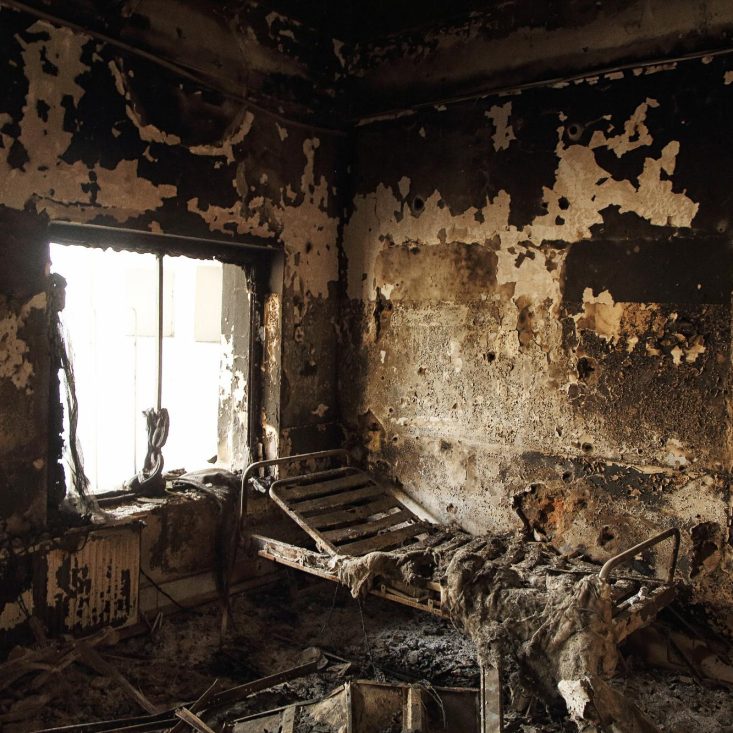
The aftermath of US airstrikes on the MSF Trauma Centre in Kunduz, Afghanistan in October 2015. Photo | MSF
An internal inquiry revealed that the airmen aboard the AC-130 gunship that carried out the operation pushed back against their superiors, questioning the strike’s legality. However, they were overruled and ordered to bomb the hospital regardless of their concerns. A Doctors Without Borders report concluded that the U.S. knew where the hospital was and that it did not hide any Taliban fighters and targeted it anyway. At least 42 people are known to have been killed in the incident.
The 2015 Kunduz bombing was a unique moment in history, as it was the first time that one Nobel Peace Prize winner (Barack Obama) bombed another one (Doctors Without Borders).
During his time in office, Obama bombed seven countries, including Libya. In July 2011, as part of its mission to overthrow the government of Muammar Gaddafi, NATO planes bombed Zliten, destroying the city’s hospital. Eighty-five people were killed, including at least 11 at the medical center. The event helped turn what was once Africa’s most prosperous and stable country into a failed state replete with open-air slave markets. Libya’s downfall has, in turn, helped to destabilize the entire Sahel region.
Perhaps no country in the 21st century has felt the wrath of Washington as much as Iraq. U.S. strikes on civilian infrastructure were a frequent occurrence, and hospitals were no different. Arguably, the most notable example is the April 2003 bombing of the Red Crescent Maternity Hospital in Baghdad.
American missiles struck the city center complex housing the hospital, killing several and wounding at least 25 people, including doctors.
The charitable hospital was crucial to providing affordable healthcare to working-class Iraqis, charging ten times less than the city’s private clinics. It developed a reputation as a first-class maternity hospital, delivering an average of 35 babies per day before the invasion. UNICEF noted a sharp rise in maternal mortality after the bombing, partially due to the lack of obstetric care in Baghdad.
Clinton’s War on Hospitals
Four years earlier, in May 1999, U.S.-led NATO planes dropped cluster munitions on an outdoor market and hospital in the Yugoslav city of Nis, killing at least 15 people and injuring 60 more, according to the hospital’s director. Cluster munitions are now banned under international law. Regardless, between 2023 and 2024, the United States transferred large quantities to Ukraine for use against Russian forces.
Two weeks after the Nis bombing, NATO targeted a hospital in the Yugoslav capital, Belgrade. The missile strike destroyed much of the maternity ward, with rescuers pulling infants and mothers from the rubble in the dead of night. At least three people were reported killed.
The Yugoslav attacks were not the Clinton administration’s only attacks on medical facilities. In 1998, in response to Osama bin Laden’s recent bombings of American Embassies in Kenya and Tanzania, President Bill Clinton ordered an attack on the Al-Shifa medicine factory in Sudan. Fourteen cruise missiles hit the plant, turning what had been the largest producer of medicine in the country into a pile of twisted metal. The factory had produced over half of Sudan’s pharmaceuticals, including crucial antibiotics and antimalarial and diarrhea medications.
While not a hospital, the destruction of Al-Shifa was vastly more lethal than any other attack listed. The event led to a collapse in the availability of drugs in one of Africa’s poorest countries. The German Ambassador to Sudan estimated that the death toll reached into the “tens of thousands.”
The Clinton administration publicly insisted that the plant was actually bin Laden’s chemical weapons factory. Privately, however, Secretary of State Madeline Albright worked hard to suppress a government report, noting this was not true.
Sudan was Clinton’s second attack on Africa. In June 1993, U.S. soldiers (under U.N. auspices) carried out a mortar attack against Digfer Hospital in Mogadishu, Somalia. The bombs destroyed the main reception area, blew a gaping hole in the wall of the recovery room, and shattered glass across the building. “It probably will never be known how many Somalis died in the U.N. [U.S.] onslaught,” wrote The Chicago Tribune. One reason for this is that helicopter-borne soldiers attacked reporters and photographers attempting to cover the attack, throwing stun grenades at them and chasing them away from the scene.
Latin American Dirty Wars
During the 1980s, Latin America and the Caribbean were the sites of intense U.S. interest. In October 1983, during the U.S. invasion of the island, American warplanes hit the Richmond Hill Mental Hospital in Grenada. The Reagan administration initially attempted to deny the attack before finally conceding their culpability. Dozens of people were injured, and at least 20 were killed, although The New York Times suggested an actual death toll of over twice that number.
The U.S. invaded Grenada in order to crush the island’s socialist revolution. In Central America, however, it relied on funding, training and arming proxy forces to do its bidding. These death squads would wreak destruction across the region and continue to shape its politics and society to this day.
In El Salvador, U.S.-trained forces waged a dirty war against the population in order to crush leftist FMLN guerilla forces. Hospitals were among their preferred targets. On April 15, 1989, for instance, pilots flying U.S.-made A-37 jets and UH 1M and Hughes-500 helicopters bombed an FMLN hospital in San Ildefonso, killing five people.
Paratroopers armed with M-16 rifles arrived on U.S. helicopters and attacked and abducted the medical staff, including French nurse Madeleine Lagadec. Before executing her, the soldiers spent eight hours raping and torturing her. Images of the remains of her mutilated body caused outrage in France, which issued an international arrest warrant for the four U.S.-backed officers overseeing the operation.
In Nicaragua, meanwhile, throughout the 1980s, U.S.-trained paramilitaries intentionally attacked “soft targets” such as hospitals in an effort to terrorize the population into dropping their support for the country’s socialist government.
A study by Richard M. Garfield, Professor of Nursing at Columbia University, found that, between 1981 and 1984, at least 63 health centers were forced to close due to attacks from the U.S.-backed “Contra” death squads.
These operations were carefully planned for maximum effect, with the Contras leaving behind graffiti at the crime scenes, announcing that the “Lion Cubs of Reagan” had visited the area. Throughout their campaign, President Reagan supported the Contras, labeling them “the moral equivalent of our Founding Fathers.” Dr. Michael Gray, Chairman of Occupational Medicine at Kino Community Hospital in Tucson, AZ., a doctor who visited Nicaragua, held a different opinion, describing them and their actions as “no different than the SS at the end of the Second World War.”
Cold War Killing Machine
During the American wars in Indochina, the bombing of hospitals was official – if unstated – U.S. policy.
Alan Stevenson, a former Army intelligence specialist, testified that, while on duty in Quang Tri province in Vietnam, he regularly identified hospitals to be struck by U.S. fighter jets. “The bigger the hospital, the better it was,” he said, explaining the military’s thought process. “This wasn’t something that was hush‐hush,” he added. “We really didn’t consider it that nasty an item.”
Former Air Force captain Gerald Greven corroborated Stevenson’s allegations, noting that he personally ordered bombing raids against medical centers. It was official policy to “look for hospitals as targets,” he said.
Perhaps the most notorious and well-documented case of this in Vietnam occurred on December 22, 1972, when American planes dropped over 100 bombs on the 1000-bed Bach Mai Hospital in Hanoi, nearly obliterating the building, in the process killing 28 medical staff and an unconfirmed number of patients.
The U.S. military justified the strike by claiming that the hospital “frequently housed antiaircraft positions” and noted its proximity to a military airbase.
During the Congressional hearings on clandestine U.S. activities in Laos and Cambodia, meanwhile, lawmakers were told that the bombing of hospitals was “routine.” Indeed, the former remains the most bombed country, per capita, in world history.
Like in Vietnam, the targeting of hospitals was not only commonplace but deliberate. In 1973, former Army captain Rowan Malphurs testified that, while serving with the Combined Intelligence Center of Vietnam, he helped orchestrate attacks on Cambodian health centers. “We were planning bombings of hospitals,” he said. Yet Malphurs was unrepentant. “I think it was a good thing because the North Vietnamese Army had a privileged sanctuary in Cambodia,” he added.
Thus, as this brief rundown of the past five decades has shown, last month’s attacks on the Al Rasool Al-Azam Oncology Hospital in Yemen are far from an aberration. As these examples from 13 different countries show, Washington, in fact, has a longstanding history of targeting medical centers.
Going further back, the government of North Korea estimates that the U.S. military destroyed some 1,000 hospitals during the Korean War. These numbers are entirely plausible, given the gigantic bombing campaign that the country faced. Entire cities were leveled or flooded after American planes targeted dams. Professor Bruce Cummings, America’s foremost expert on Korea, estimates that the U.S. killed around 25% of the entire North Korean population between 1950 and 1953.
Radio Silence
Article 8 of the Rome Statute, one of the fundamental texts of international law, explicitly identifies “intentionally directing attacks against buildings dedicated to religion, education, art, science or charitable purposes, historic monuments, hospitals and places where the sick and wounded are collected, provided they are not military objectives,” as war crimes.
That the Trump administration repeatedly struck a well-known and easily identifiable hospital in Yemen is an extremely important story. But it has, in fact, received zero coverage in corporate media. Searches for “Al Rasool Al-Azam Hospital” and “Yemen Hospital” in the Dow Jones Factiva news database, a tool that records the content from more than 32,000 U.S. and international media outlets, show that no mainstream American publication has even mentioned this grave war crime.
This is not because the information is particularly hard to find. Well-known media figures such as Pepe Escobar and Jackson Hinkle visited Saada and recorded viral videos from the wreckage where the hospital once stood. The information has been all over social media for weeks and has been covered widely in alternative media, including Drop Site News, AntiWar.com, Truthout, Common Dreams, and foreign outlets such as Al-Jazeera, RT (formerly Russia Today), and The Cradle. Thus, every single editor in every newsroom and television studio in the United States has access to this information and made the decision not to cover the story – a fact that suggests a lot about the diversity of opinion and freedom of our press.
This complete disinterest in U.S. misdeeds sits in stark contrast to when official enemy states do the same thing. When Russia hit hospitals in Ukraine and Syria, those incidents became front page news and led television news bulletins. Moreover, corporate media regularly explicitly framed the events as war crimes (see PBS, Politico, Foreign Policy, CNN, Newsweek, ABC News and the Los Angeles Times). Talking heads waxed lyrical about how Russian President Vladimir Putin must be brought to justice. And yet, when the United States does the same, that cacophony falls to complete silence – even when it is carried out by a president that many in corporate media appear desperate to attack at any opportunity.
What the recent attack on the cancer center in Yemen underlines is that it is dangerous to be a healthcare worker. The United States has a longstanding history of targeting hospitals in nations it selects for regime change. This is true of both Democratic and Republican administrations.
Therefore, the sad truth is that if you are in a country targeted by the United States, you are often safer away from a hospital than inside one.
Belgium eyes welfare cuts to meet NATO target – minister
RT | April 16, 2025
Belgium is preparing to raise debt and cut welfare to meet NATO’s minimum military spending target, the EU country’s budget minister has said.
Vincent Van Peteghem told the Financial Times on Wednesday that Brussels recently agreed to lift its 2025 military budget to 2% of GDP through a mix of temporary cash injections, creative accounting, and structural reforms.
The planned hike in military spending could exacerbate the budget crisis as debt mounts. Recent government plans to cut social services have sparked protests, with over 100,000 people rallying in Brussels in February.
Belgium had previously planned to meet the 2% target only by 2029. Military spending currently stands at around 1.31% of GDP, or roughly €8 billion ($8.5 billion), according to Defense Minister Theo Francken.
The shift comes amid pressure from Washington and ahead of a NATO summit in June, where members are expected to consider raising the spending target to above 3% of GDP. US President Donald Trump has urged the bloc members to increase military spending to 5%, warning that countries that fail to do so may no longer be guaranteed American protection.
Higher spending on military budgets would take a toll on the EU’s welfare programs, Van Peteghem warned.
Last month, the European Commission proposed exempting military budgets from fiscal rules and offering €150 billion in loans as part of its ‘ReArm Europe’ plan, which aims to mobilize up to €800 billion through debt and tax incentives for the bloc’s military-industrial complex.
Van Peteghem said Belgium would tap both options to fund additional military spending this year.
To maintain the 2% level, the government plans to raise more debt and may privatize state-owned assets, the minister said. The remaining gap would be filled through spending cuts, including curbs on unemployment benefits, pension reforms, and tax changes.
“But of course, we will need to do more,” Van Peteghem, who also serves as deputy prime minister, said.
France has also announced plans to cut €5 billion from its budget, with some of the savings potentially redirected to military spending.
Moscow has condemned the EU’s military buildup. Kremlin spokesman Dmitry Peskov called it “a matter of deep concern,” noting that it was aimed at Russia.
8 States Weigh Bills to Establish or Expand Exemptions to School Vaccine Mandates
By Suzanne Burdick, Ph.D. | The Defender | April 14, 2025
Should parents, students and employees be allowed to claim religious exemptions from vaccine mandates? That’s the question an increasing number of state lawmakers are being asked to decide as they consider a new wave of proposed bills.
Arizona is one of eight states that have introduced bills during the 2025 legislative session to establish or expand exemptions to school vaccine mandates, according to Dawn Richardson, advocacy director for the National Vaccine Information Center (NVIC).
“Vaccine mandates for school and childcare attendance and their corresponding vaccine exemptions have been in state law for decades,” Richardson said. But this year, “more states have bills to expand these exemptions than to restrict or remove them.”
In 2010, Richardson created and launched the NVIC Advocacy Portal, which provides free information about proposed state vaccine laws. Since then, she and her team have analyzed, tracked and issued positions on over 1,000 vaccine-related bills across the U.S.
“Until medical mandates are a relic of history — and that day is coming — religious exemptions are the primary way to avoid medical coercion,” said Children’s Health Defense CEO Mary Holland.
According to Richardson, only three states — Hawaii, Massachusetts and New Jersey — proposed legislation this year attempting to remove school vaccine mandate exemptions. However, Hawaii lawmakers, under pressure from constituents, voted last month to table the bill, which would have repealed the state’s religious exemption from vaccine mandates.
Meanwhile, other states are advancing legislation that strengthens or expands vaccine exemptions. For instance, Alabama lawmakers on April 3 passed a bill that specifies that a parent or guardian’s written declaration is “sufficient documentation” to exempt his or her child from a vaccine requirement for religious reasons.
Alabama lawmakers are also considering a bill that would require private and church schools to accept religious exemptions to vaccine requirements.
On March 26, Utah’s governor signed into law a measure to ensure that public school students’ vaccine exemption forms don’t expire and that they travel with them when the students transfer to another school.
Some of the state bills proposed this year focus on exemptions from vaccine mandates in the workplace rather than at school.
For example, Texas lawmakers are considering a law that would require healthcare facilities that have vaccine mandates to honor exemptions for “reasons of conscience, including a religious belief.”
Texas also introduced three other bills related to expanding or improving vaccine exemptions, according to legislative data Richardson shared with The Defender.
‘Momentum is gaining to remove vaccine mandates’
Holland noted that a handful of states allow only medical exemptions, not religious exemptions. Those states are California, New York, Connecticut and Maine. “They make even legitimate medical exemptions virtually impossible to obtain.”
“The good news,” Holland said, “is that Idaho just became the first medical freedom state, by outlawing any medical intervention mandates that prohibit people from participating in social life based on medical status. Likely, this will be a template for other states going forward.”
Idaho Gov. Brad Little signed the law almost a week after he vetoed a previous version of the bill, citing concerns it would have prohibited schools from sending home “sick students with highly contagious conditions.”
The new version of the bill clarifies that schools and businesses can turn away students, employees or customers who are sick, but they cannot require a medical intervention, including a vaccine.
The new version also specified that schools cannot exclude unvaccinated children during an outbreak of a contagious disease they are not vaccinated against.
Bills that outright prohibit vaccine mandates ‘much preferable’
Richardson said bills like the one passed in Idaho are part of a positive trend she and her team are seeing across recent legislative sessions, including this one.
“Momentum is gaining to remove vaccine mandates,” she said, “but medical trade and pharmaceutical lobbyists are working against medical freedom and informed consent.”
“This is why it is so important for people to speak with their legislators about how prohibiting vaccine mandates and requiring informed consent to vaccination without penalty for saying ‘no’ is very important to them,” Richardson said.
Bills that outright prohibit vaccine mandates — rather than just ensuring that a person can apply for an exemption — are “much preferable” in Richardson’s view because they “make vaccine exemptions not even necessary.”
“As we saw with school vaccine exemptions,” Richardson said, “sometimes [exemptions] can get taken away as evidenced in recent years in California, Connecticut, Maine, New York and Vermont.”
‘People are waking up’
NVIC’s mission is to prevent vaccine injuries through public education and to advocate for informed consent protections in medical policies and public health laws.
Commenting on state legislative action since 2010, NVIC’s Executive Director Theresa Wrangham said she has seen a shift toward more proposed legislation to protect informed consent and people’s choice to vaccinate or not vaccinate without penalty.
When NVIC first began, Wrangham said she saw a “lot of movement to try to restrict exemptions.” But overall, that’s changed. “I think people are waking up …That’s grassroots. That’s people getting involved.”
Wrangham said it’s important for families to educate themselves about vaccine risks versus benefits as they make their decisions.
There is no “risk-free” option, she said. “There’s just the ability to make a decision — an informed decision around what risk you’re willing to take. That’s really what informed consent is about. Let’s make sure everybody has good information. Let’s not let our fear run us.”
This article was originally published by The Defender — Children’s Health Defense’s News & Views Website under Creative Commons license CC BY-NC-ND 4.0. Please consider subscribing to The Defender or donating to Children’s Health Defense.
Funding the PA is for the benefit of Israel and the EU, not the Palestinians
By Ramona Wadi | MEMO | April 15, 2025
Palestinian Authority leader Mahmoud Abbas met with the EU’s High Representative for Foreign Affairs and Security Policy, Kaja Kallas, in March. The meeting was replete with the usual hyperbole that still clings to the defunct two-state paradigm, the PA’s reform and funding for this purpose.
Yesterday, Reuters reported that the EU will be funding the PA with a three-year package worth $1.8 billion to support reform. According to European Commissioner for the Mediterranean Dubravka Suica, “We want them to reform themselves because without reforming, they won’t be strong enough and credible in order to be an interlocutor, not for only for us, but an interlocutor also for Israel.”
The reasoning is warped.
It only spells one thing clearly: the EU wants the PA to be strong enough to act against the Palestinian people and prevent them from being their own interlocutors in a political process that concerns them much more than the PA.
Speaking about the EU funding for the PA, Kallas said, “This will reinforce the PA’s ability to meet the needs of the Palestinian people in the West Bank and prepare it to return to govern Gaza once conditions allow.” No time frames, of course, because the conditions will always depend on Israel. Funding buys time for Israel’s genocide in Gaza. Meanwhile, the PA, which has not only neglected the needs of Palestinians in the occupied West Bank, but also exacerbated their humanitarian and political neglect as evidenced in Jenin, for example, can rest assured of some more years of EU support. That is, as long as the humanitarian paradigm remains relevant to the illusory state-building funded by Brussels.
From the allocated budget, the UN Relief and Works Agency for Palestine Refugees (UNRWA) will receive €82 million per year.
The most telling clause in the European Commission’s statement detailing its assistance is found right at the end. “This designation shall not be construed as recognition of a State of Palestine and is without prejudice to the individual positions of the Member States on this issue.”
France’s announcement that it might recognise the State of Palestine by June this year, symbolic as the gesture is, only shows the EC’s urge to detach itself from all possibilities, no matter how remote, of Palestinian independence. Which brings one back to the big question:
Why is the EU really funding the PA’s state-building to prevent the eventual formation of a Palestinian state?
Funding a Palestinian entity for Israeli and EU purposes does not bode well for Palestinians, who are still only spoken of in terms of humanitarian matters. The political purpose is reserved only for Israel’s allies, the PA being one of them, as seen in many instances of its collaboration with the occupation state.
But Western diplomats would do well to recall that one major democratic implementation postponed repeatedly by Abbas – democratic legislative and presidential elections – has not featured once in the EU’s vision of a post-war Gaza, determined as it is to have the PA take over political authority in the enclave and bring Palestinians under different forms of misery. How scared is the EU of having Palestinians being allowed to vote freely and possibly electing alternatives that have nothing to do with the current Fatah-Hamas bipolarisation? Funding the PA indeed serves a purpose; that of destroying Palestinian democracy.
Germany: Far-left extremist on trial for attempted murder wins state-sponsored €30,000 art prize

By Thomas Brooke | Remix News | April 15, 2025
Hanna Schiller, a German art student charged with attempted murder and membership of the notorious far-left “Hammer Gang,” has been awarded the 27th Federal Prize for Art Students — a prestigious state-sponsored honor carrying €30,000 in prize money and additional production support.
Schiller has been in pre-trial detention since May 2024 and has been formally charged for her role in violent assaults carried out by the Antifa-affiliated gang, including in Budapest, where the gang severely beat nine people they suspected of being right-wing back in 2023.
The indictment states Schiller and others pinned one of the victims down during the attack while others beat him unconscious with a baton, which prosecutors say could have resulted in death.
Despite these charges, Schiller was nominated by the Academy of Fine Arts Nuremberg, where she remains a registered student. The nomination came months after her arrest and appears to have been made in full knowledge of the legal proceedings.
The prize is ultimately awarded by the Federal Ministry of Education and the German Students’ Union after assessing nominations from respective institutions.
As reported by Tichys Einblick, the prize jury praised Schiller’s work for its “precise political images” and its focus on “structural violence and power,” referencing pieces made from women’s hair as examples of her exploration of contemporary sociopolitical issues. The official announcement made no mention of the charges or her imprisonment.
Academy officials have defended the nomination, citing a commitment to the principle of presumption of innocence. “The AdBK Nuremberg treats her like any other student until the verdict is announced,” the school said in a written response to inquiries.
The academy does, however, state in its mission statement that it is “for openness, tolerance and against any kind of extremism and violence.”
Still, critics say the award signals an unacceptable tolerance for violent extremism, pointing to Schiller’s alleged crimes, which include premeditated assaults using hammers and pepper spray. The gang’s targets were reportedly individuals believed to be right-wing, whom they ambushed and beat without warning. Prosecutors say Schiller was directly involved in restraining and attacking several victims during the assaults, one of whom received over 15 blows to the head.
Other members of the gang have already been convicted. Lina Engel was sentenced to five years and three months in prison by a Dresden court back in June 2023, while three of her associates received lesser sentences. Another member was sentenced to three years in a Hungarian prison the following January.
After years on the run, Johann Guntermann, the 31-year-old suspected head of the extremist group, was arrested by German police after being apprehended near Leipzig in November last year.
In addition to the €30,000 prize money, Schiller also received a scholarship of €18,000 to fund an art exhibition scheduled to open in November at the exhibition planned from November 2025 at the Bundeskunsthalle in Bonn.
Commenting on the news, Alternative for Germany (AfD) co-leader Alice Weidel claimed Schiller’s violent activism may have actually been a key reason for her receiving the award.
“Left-wing extremist Hanna S., allegedly part of the ‘Hammer Gang,’ receives a state-sponsored art prize worth 30,000 euros, possibly not despite, but precisely because of, her ‘activism.” No taxpayer money for violent left-wing extremism!” Weidel wrote on X.
With the trial ongoing in Munich, the Ministry of Education and the Nuremberg Academy have yet to revise their position or address the appropriateness of awarding a national prize to an individual currently facing charges for attempted murder and violent extremism.
It is unclear whether the prize and subsequent funds will be revoked pending a conviction.
French police detain female Iranian academic to silence anti-Israeli genocide voices

Mahdieh Esfandiari has lived in Lyon for eight years. Police have arrested her for pro-Palestine advocacy.
Press TV – April 14, 2025
A female Iranian academic who denounced the Israeli genocidal campaign in the besieged Gaza Strip and expressed her solidarity with Palestinians has been arrested by the police in France.
The Iranian citizen was reportedly detained after publishing messages on a Telegram channel condemning the ongoing genocide in the blockaded Palestinian territory.
The French weekly Le Point identified the woman as Mahdieh Esfandiari, a 35-year-old French language graduate, who has lived in Lyon for eight years.
Her family, worried after losing contact, raised the alarm last month with Iranian authorities, who then contacted their French counterparts, Le Point reported, adding they have yet to hear back.
Iranian Foreign Ministry spokesman Esmaeil Baghaei said on Monday that France was unwilling to give an explanation on her situation.
“We hope that the French government will provide access to this case as soon as possible and clarify the reasons for the arrest of this Iranian citizen,” Baghaei was quoted as saying.
“Consular access has not been authorized” by French authorities, he told a news conference, adding that Iran was following the matter closely.
Her arrest came amid a crackdown in the US and other Western countries targeting scholars, students, and activists who oppose genocide and advocate for peace, both on campuses and in public spaces.
Her Iranian identity has further compounded this repression, as the Western countries escalate warmongering policies and economic sanctions against Iran while silencing dissent.
Pundits say these attacks aim to terrorize and silence the countless advocates who have courageously amplified Palestinian resistance and the call for freedom.
They say repression of freedom of speech will legitimize the Zionist child-killing forces and would undermine the principles of due process.
Diana Panchenko: How Zelensky Dismantled Ukraine’s Democracy
Glenn Diesen | April 13, 2025
Diana Panchenko was Ukraine’s “journalist of the year” in 2020 and ranked as the 7th most influential woman in the country. Panchenko has been a critic of both Russia’s invasion of Ukraine and Zelensky’s destruction of democracy in Ukraine.
Follow Prof. Glenn Diesen:
Substack: https://glenndiesen.substack.com/
Featured Video
BRITAIN’S WARNING: PREPARE FOR WAR
or go to
Aletho News Archives – Video-Images
From the Archives
British weapons and personnel doing much of the killing in Yemen
Press TV – June 18, 2019
A detailed report published by the Guardian newspaper has shown how Britain is massively contributing to Saudi Arabia’s devastating war on Yemen as it suggests that London is not only supplying the bombs that fall on Yemenis, but it provides the personnel and expertise that keep the war going.
The comprehensive report by Arron Merat published on Tuesday showed that Britain was doing much of the killing in Yemen as the country continues to provide Saudi Arabia with everything it needs to turn its southern impoverished neighbor into a graveyard.
“Every day Yemen is hit by British bombs – dropped by British planes that are flown by British-trained pilots and maintained and prepared inside Saudi Arabia by thousands of British contractors,” said Merat in the report. … continue
Blog Roll
 Aletho News
- Elijah Magnier: Yemen’s Strikes Are Shattering Saudi Arabia’s Long-Term Strategy
- Pentagon designates Chinese cultural centers national security threat
- Israel Demolishes Home Of Lebanese Journalist Whose Viral Film Exposed Pager Attack
- Record Oil, Empty Tanks: The UAE’s Miracle Recovery
- Burnham tackles Britain’s poverty with aggression in Yemen
- Peace in Ukraine: the easy way – or the hard way
- Trump & the Rrrrussians
- US taxpayer money laundered back through Ukraine – Musk
- Before COVID, an NIH lab chief proposed making a SARS-like bat virus more infectious
- Gates, Bourla on Trial in Netherlands Accused of ‘Great Reset’ Scheme at Vaccine Injury Hearing
- If Americans Knew
- An error has occurred; the feed is probably down. Try again later.
- No Tricks Zone
- Sudden Stratospheric Warming, Powerful El Niño Combination May Lead To Extreme Europe Cold, Energy Crisis!
- Two New Studies Find Thwaites Glacier Melt Cannot Be Driven By Human Activity Or A Warming Ocean
- E-Cars Reduce CO2 Emissions By Only 41% Compared To Internal Combustion Engine Vehicles
- Predictions Made By Renowned Climate Professor Over Past Decades Have Been Proven To Be Poor
- New Study Suggests Large Regions Of The Pacific Ocean Have Been Cooling For The Last 80 Years
- Germany’s Green Energy Debacle: High Energy Costs Force Kahla Porzellan to Close After 182 Years!
- New Study: 50 Years Of The Most Aggressive ‘Net Zero’ Policies Can Only Affect The Global Climate By 0.03°C
- US September “Heat” Was No Record…Many Records Set Decades Ago
- Latest European Green Energy Debacle; Portugal’s Largest Flagship Solar Park Insolvent!
- Green Energy Debacle: German Expert Professor Fritz Vahrenholt Warns Of Severe Economic And Social Consequences

