UK police summon Jeremy Corbyn after pro-Palestine rally
MEMO | January 20, 2025
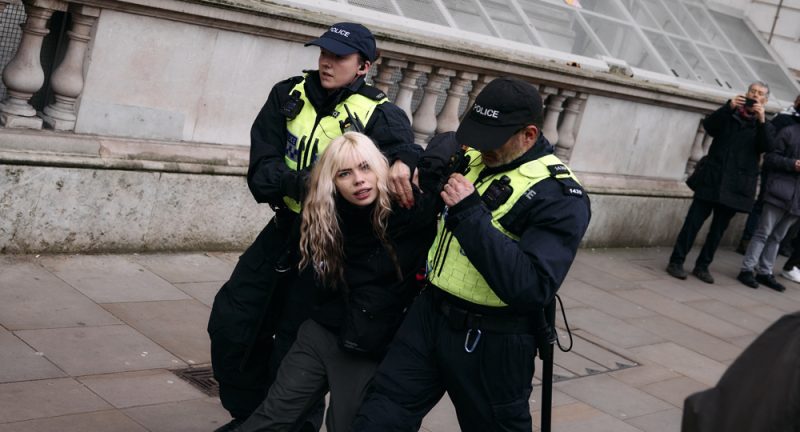
The Metropolitan Police have summoned former UK Labour Party leader Jeremy Corbyn and ex-shadow chancellor John McDonnell for an “interview” following a pro-Palestinian rally in central London on Saturday, Anadolu reported.
The Metropolitan Police is investigating what it described as a “coordinated effort by the rally’s organisers to breach conditions imposed on the event.”
Corbyn, 75, and McDonnell, 73, who agreed to the interviews, voluntarily appeared at a police station in the capital yesterday afternoon.
After leaving the police station, the two MPs did not answer reporters’ questions.
Police also summoned three unnamed persons to give voluntary testimony as part of an “ongoing investigation”.
The rally, organised by the Palestine Solidarity Campaign (PSC) and its coalition partners, saw thousands gather in Whitehall after police blocked plans for a march from Portland Place, near the headquarters of the BBC.
Officers had imposed conditions under the Public Order Act restricting the protest to Whitehall, citing concerns over a potential “serious disruption” near a synagogue.
Police said a group of protesters broke through a police line to reach Trafalgar Square, where officers stopped them.
The Metropolitan Police posted a photo on social media showing a group that it said have forced its way through the police line being held at the northwest corner of Trafalgar Square.
Corbyn, however, disputed the account.
“This is not an accurate description of events at all,” he said in a post on X.
He said he was part of a delegation of speakers intending to lay flowers in memory of children killed in Gaza, which was “facilitated by the police”.
McDonnell echoed his comments.
“We did not force our way through. The police allowed us to go through, and when we stopped in Trafalgar Square, we laid our flowers down and dispersed.”
Nine people, including Corbyn’s brother Piers Corbyn, and Chris Nineham, a chief steward on the march, have been charged with public order offences and will appear at Westminster Magistrates’ Court in the coming days.
The Met Police also confirmed that 24 people have been released on bail, while 48 remain in custody. Three other men aged 75, 73 and 61 have agreed to be interviewed under criminal caution.
The protest coincided with the announcement of a ceasefire and prisoner swap deal between Israel and Hamas.
Corbyn, who now sits as an independent member of parliament for Islington North, has been a vocal supporter of Palestinian rights.
McDonnell, the MP for Hayes and Harlington, also sits as an independent after Labour suspended the whip from him for six months in July 2024 over his vote against the government on child benefit rules.
The demonstration in London drew tens of thousands of supporters of Palestine, despite the police-imposed restrictions and banning of a previously agreed-upon route.
During the protest, 77 people were arrested.
Met Commander Adam Slonecki said security forces have been deployed for more than 20 national protests organised by the PSC since October 2023.
He highlighted that the number of arrests at yesterday’s rally marked the “highest number” recorded at such demonstrations during this period.
Dozens of Palestinian women, teens freed from Israeli jails as part of Gaza ceasefire

The Cradle | January 20, 2025
After several hours of delay following the handing over of three Israeli captives by Hamas’s Qassam Brigades, 90 Palestinian prisoners – all females and minors – were released from Israeli jails early on 20 January as part of the first phase of the ceasefire and exchange deal.
The Palestinians were released from Ofer prison in the occupied West Bank and Moscovia prison in Jerusalem, as well as the Damon prison.
Those from Ofer were dropped off by Red Cross buses at Beitunia north of Ramallah, where their families received them, and those from Moscovia went straight to their neighborhoods in occupied Jerusalem.
Among the prisoners was Abla Saadat, wife of the Secretary General of the Popular Front for the Liberation of Palestine (PFLP) Ahmad Saadat. She was detained in September last year.
PFLP member Khalida Jarrar was also released. Jarrar had been in and out of Israeli prisons for several years and was detained for the fifth and final time in December 2023 after the start of the genocidal war in Gaza.
She was held in solitary confinement for the last six months of her detention despite suffering from serious medical issues, including deep vein thrombosis. Jarrar was in a state of exhaustion upon her release and was not able to speak to the media.
Palestinian journalist and prisoner activist Bushra al-Tawil was also among those released. She has been incarcerated seven times.
Rose Khweis, an 18-year-old who was also freed, told Reuters inmates were treated ”like animals” where she was imprisoned.
“The occupation forces were cursing us and treating us badly [during the release]. The occupation authorities contacted our families and warned them against any manifestations of joy,” Jenin Amro told Al Jazeera upon being discharged.
The next six weeks are meant to see the release of 2,000 Palestinians. Israel will discharge 30 to 50 prisoners for each captive released by Hamas. The first phase of the deal – which was announced last week – is supposed to see the release of 33 Israeli captives being held in Gaza. Negotiations for the second phase will begin 16 days into phase one.
Three Israeli captives were handed over to the Red Cross in Gaza on the afternoon of 19 January.
Huge crowds of Palestinians, along with a strong presence of Qassam Brigades fighters, gathered in Gaza City’s Al-Saraya Square as the three female Israeli captives were released and given over to the Red Cross.
The captives were retrieved by the Israeli army at the Reim Base outside Gaza.
UK knew about Israel’s brutal torture of Palestinian detainees 50 years ago, but refused to act, British documents reveal
The UK knew about Israel’s brutal torture of Palestinian and Arab detainees nearly 50 years ago but refused to act, British documents reveal. The papers, unearthed by MEMO in the British National Archives, also reveal that the US opted to address the issue solely through non-governmental organisations.
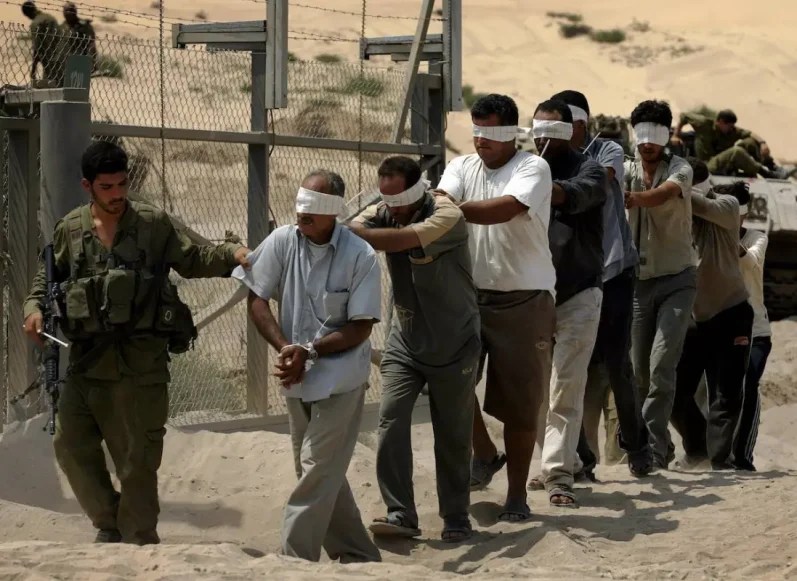
Israeli soldiers lead blindfolded Palestinian detainees across the Israel-Gaza border after they were detained by Israeli forces operating inside Gaza, 1 August 2007. [DAVID FURST / AFP/ Getty Images]
By Amer Sultan | MEMO |January 20, 2025
97 bodies recovered in Rafah as search for 10,000 missing continues in Gaza

Press TV – January 20, 2025
Medical sources say more than 97 bodies were recovered in Rafah a day after the Gaza ceasefire took effect.
The Palestinian Health Ministry said on Monday that 60 Gazans lost their lives on that first day.
Palestinian authorities estimate the number of unrecovered bodies to be around 10,000, with some claiming the number to be as high as 15,000.
Around 2,840 bodies were also said to have been “evaporated without a trace” due to the extreme temperatures caused by Israeli weapons.
The Israeli bombing of Gaza has left more than two-thirds of all buildings in the strip damaged or destroyed.
The recovery of dead bodies has also been compounded since Israeli forces have regularly attacked civil defense units.
During the Israeli campaign of genocide in Gaza, 99 civil defense members were killed with 319 being injured. At least 27 members of the Gaza civil defense were also abducted by Israeli soldiers with their fate currently being unknown.
According to the Palestinian Health Ministry, as of Monday, the death toll of Israel’s aggression surpasses 47,000.
Russian diplomat accuses Kiev of genocide
RT | January 20, 2025
The Ukrainian military is conducting “language-based genocide,” senior Russian diplomat Rodion Miroshnik claimed on Sunday.
Captured Ukrainian soldiers “have reported they were given orders to kill Russian speakers,” the official tasked by the Russian Foreign Ministry to record alleged Ukrainian atrocities in the conflict with Russia told Izvestia.
Miroshnik was commenting on the discovery of civilian bodies in a recently-liberated village in Russia’s Kursk Region. He asserted that the alleged Ukrainian policy amounts to “elimination of all civilians” in the area, which Kiev recognizes as Russian.
Russian authorities are investigating Ukrainian troops for suspected terrorism, after the bodies of civilians, who were apparently bound, beaten, and murdered by Kiev’s forces, were discovered in the settlement of Russkoye Porechnoye.
The village remained under Ukrainian control since late August, when it was captured during a Western-supported incursion into the Russian region. The Russian Defense Ministry listed it last Friday as freshly-retaken from Ukrainian forces.
On Sunday, the Foreign Ministry described the discovery as evidence of a “massacre” and the latest confirmation of the “terrorist and neo-Nazi essence of the Kiev regime,” as spokeswoman Maria Zakharova put it. She accused Western supporters of the Ukrainian government of turning a blind eye to Kiev’s crimes, and charged that foreign officials secretly condone such behavior.
The Russian Investigative Committee is probing the Ukrainian military for alleged terrorism, based on the reports from Russkoye Porechnoye. A person convicted of such a crime can be sentenced to life imprisonment in Russia.
A Telegram channel associated with the forces responsible for repelling the Ukrainian incursion in Kursk Region released footage on Saturday of Russian troops inspecting the village and finding seven heavily-decomposed bodies in two separate cellars. In both cases, people were reportedly bound and beaten, before being killed.
At one of the locations, a body was too damaged to tell whether it belonged to a man or a woman, with evidence suggesting the use of explosives. Most of the victims were described as elderly people, who presumably had failed to flee from advancing Ukrainian troops.
Officials have vowed to hold the perpetrators accountable, with Zakharova stating that, in the absence of action by relevant international bodies, Russia will pursue justice on its own.
Local police have received statements concerning over 1,100 people missing since the start of the Ukrainian incursion, acting Governor Aleksand Khinshtein reported earlier this month. Of those, 240 have been located, he added.
YouTube Removes Barrister’s Legal Submission at Official UK Covid Inquiry Amid Censorship of Vaccine Injury Discussions
By Cindy Harper | Reclaim The Net | January 15, 2025
YouTube’s decision to remove a barrister’s legal submission from the UK Covid Inquiry has intensified concerns over widespread censorship of vaccine-related discussions on major social media platforms.
Anna Morris KC, who represents families claiming injury from Covid-19 vaccines, disclosed that YouTube deleted a video of her preliminary remarks to the inquiry in September 2023, citing violations of its medical “misinformation” policy. Although the platform later reinstated the video, it failed to provide a clear explanation, admitting only that “it sometimes makes mistakes.”
This act of censorship has been condemned as part of a larger pattern of silencing voices critical of vaccine safety and government health policies. As reported by The Telegraph, during the inquiry’s Module 4 session — focused on vaccines and pharmaceutical measures — Morris directly addressed this issue, stating, “The inquiry must understand the stigma and censorship for the vaccine injured and bereaved.”
She revealed that a poll of affected families found that 74% had been censored when discussing vaccine injuries on social media platforms.
Morris further criticized the suppression of information, noting that doctors were instructed to withhold concerns from both the public and their own patients. Her removed statement emphasized that “the treatment of the vaccine injured in this country has historically been a source of shame.”
Morris argued that those harmed by vaccines have been systematically “dismissed, ignored, censored,” and subjected to hostility when seeking acknowledgment and support.
She condemned the ongoing silencing of vaccine-injured individuals as a severe barrier to accountability and transparency, adding, “Unfortunately, this censorship has continued years after the pandemic and into our engagement with this inquiry.”
Despite repeated requests for a review, YouTube justified the video’s removal by citing its medical “misinformation” policies, a rationale that critics argue is increasingly being used to suppress legitimate concerns and experiences. This censorship has fueled calls for a reevaluation of how social media platforms regulate content related to public health, especially when it involves dissenting voices.
An emotional impact video shown during the inquiry highlighted the tragic story of pharmacist John Cross, who took his own life after suffering paralyzing complications from a Covid vaccine and being denied compensation. His story underscores the devastating consequences of dismissing those seeking recognition and support.
ICAN’s INVESTIGATION INTO GEOENGINEERING, MILITARY SPRAYING & SELF-SPREADING VACCINES
The HighWire with Del Bigtree | January 16, 2025
Siri & Glimstad Attorney, Catherine Ybarra, Esq., presents ICAN’s assessment of the science behind geoengineering and transmissible vaccines. Discover the lengths the research team went to, to uncover the government agencies involved in current and future weather modification, and a few surprising discoveries they made along the way.
Biden worked ‘tirelessly around the clock’ — to prevent a ceasefire
Time to acknowledge that the president chose the circumstances that led to US complicity
By Trita Parsi | Responsible Statecraft | January 16, 2025
There is little doubt that President-elect Donald Trump’s posture vis-a-vis Israel is a key reason why a ceasefire in Gaza has finally been achieved. According to a diplomat briefed on the matter, this was “the first time there has been real pressure on the Israeli side to accept a deal.”
This means that for 15 months, Israel has dropped American bombs on children in tents, on refugees sheltering in schools, and on patients seeking help in hospitals without President Joe Biden exerting any “real pressure” on Israel to stop.
And once the mere posture of pressure was exerted on Israel by an envoy representing a man who isn’t even President yet, lo and behold, a ceasefire was secured.
All these senseless deaths, all the American credibility lost, all the Biden voters who stayed home in protest on November 5 could have been avoided.
The truth of the matter is that every day for the past year, Biden could have secured a ceasefire by using America’s vast leverage.
And every day for the past year, from all the evidence we have today, Biden chose not to.
That is the crux of the matter. It is precisely the fact that Biden chose this path that will damage America for years to come. It wasn’t that he lacked the ability or strength to stop the carnage. It’s not that he really wanted to stop it but sadly couldn’t. It wasn’t that his hands were tied. It wasn’t that Congress forced him. Or that polls showed that he or Kamala Harris would lose the elections if they pressed Israel. It wasn’t any of that.
Biden was simply in on it. He was on board with Prime Minister Netanyahu’s war plans. He even attended the war cabinet where the plans were adopted.
In an exit interview with the Times of Israel, Biden’s outgoing ambassador to Israel even bragged about the Biden administration never exerting pressure on Netanyahu to halt the killing. “Nothing that we ever said was, Just stop the war,” Ambassador Jack Lew proudly declared.
By willingly making America complicit, Biden’s decisions will have profound and long-lasting strategic repercussions for the American people on par with the damage George W. Bush’s illegal invasion of Iraq inflicted on America’s standing, credibility, and security, as well as on the region’s stability.
Biden’s own acting Director of the National Counterterrorism Center (NCTC), Brett Holmgren, told CBS that “anti-American sentiment fueled by the war in Gaza is at a level not seen since the Iraq war.” Terrorist groups such as Al Qaeda and ISIS are recruiting on these sentiments and issuing the most specific calls for America in years, according to Holmgren.
So every bomb Biden provided Israel to drop on children in Gaza was not only morally monstrous; it also made Americans less safe.
It will take years for America to recuperate from the damage Biden has inflicted on our standing, our moral compass, our credibility, and on our security. America is still recovering from the sins of the Iraq invasion.
But there will be no healing at all, no bouncing back, unless we admit the errors, hold those responsible accountable, and learn to do better. Just as Bush’s Iraq invasion and Global War on Terror gave birth to the strongest anti-war sentiments among Americans seen in decades, made war-mongering bad politics, and the epithet “neocon” an insult, Biden’s bearhug strategy on and blind deference to Israel must forever be remembered as the original sin that led America down the path of complicity in what most likely amounts to genocide.
Trita Parsi is the co-founder and Executive Vice president of the Quincy Institute for Responsible Statecraft.
Dr. Drew Pinsky Criticizes YouTube for Video Removals and Mandatory Reeducation Training Over Vaccine Discussions
By Cindy Harper | Reclaim The Net | January 15, 2025
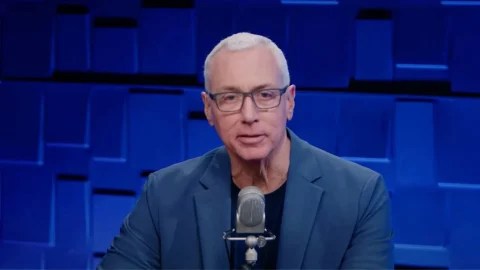
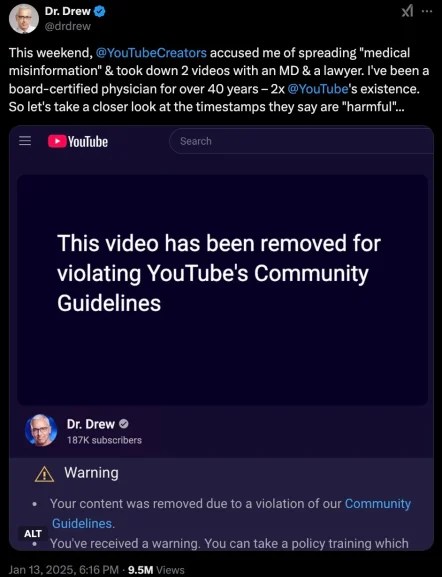
Dr. Drew Pinsky, widely known as Dr. Drew, has publicly criticized YouTube for removing two of his videos over alleged violations of the platform’s medical “misinformation” policy. On January 14, 2025, Pinsky took to X to challenge YouTube’s decision, highlighting concerns about free speech and the suppression of open dialogue on health-related topics.
In order to get the flags removed from his video, YouTube told Dr. Drew that he would have to attend a form of reeducation training and have no violations for 90 days, or else it would delete his entire channel and all of his videos. Pinsky has over 1,000 videos on the platform.
In one of his posts, Pinsky expressed frustration over the platform’s actions: “This weekend, @YouTubeCreators accused me of spreading ‘medical misinformation’ & took down 2 videos with an MD & a lawyer. I’ve been a board-certified physician for over 40 years – 2x @YouTube’s existence.”
The flagged videos featured discussions with Dr. Kelly Victory, a board-certified physician, and attorney Warner Mendenhall. Pinsky elaborated that these conversations centered around the side effects of mRNA vaccinations, a topic he argues warrants open discourse rather than censorship. In his discussion with Dr. Victory, she stated that the “vast majority of the people who have been injured are young, healthy people who were under the age of 50 who had fundamentally zero risk from COVID itself. They all got COVID. These are people who would have been fine if they were just left alone.”
Pinsky defended the content, asserting that sharing professional perspectives and personal beliefs in a public forum should not be equated with spreading misinformation. He emphasized that their dialogue was an exchange of viewpoints rather than a promotion of falsehoods.
In a separate video with Warner Mendenhall, the attorney discussed legal cases involving individuals who suffered severe reactions following vaccination. Pinsky highlighted that Mendenhall shared client experiences and expressed personal beliefs—not medical advice. Pinsky wrote, “It is not medical misinformation for someone to state their belief that a large number of people were harmed by a medical product or study.”
This isn’t the first time YouTube has targeted Dr. Drew’s content. He noted that previous strikes were resolved after discussions between his production team and YouTube officials. Despite the latest removals, Pinsky confirmed that the videos remain accessible on X, suggesting that alternative platforms may offer more space for unrestricted conversations.
A prominent internist and addiction medicine specialist, Dr. Drew Pinsky has been a notable media figure for decades. His career includes hosting television shows like Dr. Drew On Call on HLN and Lifechangers on The CW.
Biden warns of tech oligarchs’ power in farewell speech, ignoring his own role in expanding censorship
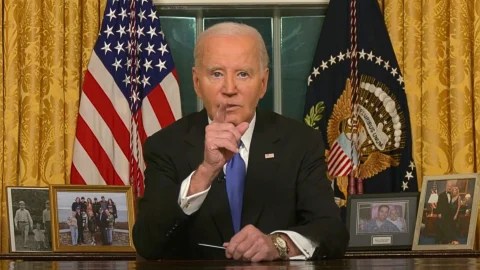
By Didi Rankovic | Reclaim The Net | January 16, 2025
Outgoing President Joe Biden concluded his presidency with a farewell address on Wednesday night, sharply criticizing what he termed the “tech-industrial complex” while urging tighter accountability for social media platforms. Ironically, Biden’s remarks highlighted the decline of free press and the dangers of “misinformation,” even as his administration has often been linked to censorship efforts and suppression of dissenting viewpoints.
During his speech, Biden drew parallels to President Dwight Eisenhower’s famous warning about the “military-industrial complex.” He stated, “Six decades later, I’m equally concerned about the potential rise of a tech-industrial complex that could pose real dangers for our country as well.” His comments painted a picture of concentrated power in the hands of tech oligarchs, whom he accused of enabling an “avalanche of misinformation and disinformation” to flourish unchecked.
The president, leaving office with historically low approval ratings, accused social media platforms of abandoning fact-checking efforts and contributing to the erosion of public trust. “The free press is crumbling. Editors are disappearing. Social media is giving up on fact-checking,” Biden said.
Biden’s condemnation of social media fact-checking policies appeared aimed directly at Meta CEO Mark Zuckerberg, whose platform recently transitioned away from third-party fact-checking to a “community notes” model reminiscent of the system employed by Elon Musk’s X.
Throughout his presidency, Biden frequently championed tighter controls on digital platforms under the guise of protecting democracy and public health. However, critics argue his administration’s push for censorship often targeted dissenting views and stifled legitimate debate.
Biden also lamented the decline of legacy media, suggesting that unchecked misinformation on digital platforms undermines democracy. “We must hold the social platforms accountable to protect our children, our families, and our very democracy from the abuse of power,” he declared.
The president’s rhetoric on misinformation is not without controversy. He has faced repeated accusations of spreading false or unverifiable claims himself, such as recent remarks regarding Los Angeles utilities during wildfire discussions that local officials disputed.
Regarding Covid vaccines, Biden also famously said: “You’re not going to get COVID if you have these vaccinations,” and added, “If you’re vaccinated, you’re not going to be hospitalized, you’re not going to be in the IC unit, and you’re not going to die.” Those who challenged this idea found themselves banned on several social media platforms.
Meta’s recently abandoned fact-checking model, which involved junior writers downgrading posts based on often-disputed analyses, has faced criticism for censoring accurate information that reflected poorly on Biden. The new community-based approach on X and Meta allows users to collaboratively evaluate content, signaling a move away from centralized content moderation.
Biden’s ’empty threats’ let Israel get away with horrors in Gaza: Prominent US journalist
Press TV – January 16, 2025
An investigative American journalist says the Biden administration repeatedly undermined international institutions and damaged US credibility in a desperate attempt to shield Israel during the regime’s aggression against the people of the besieged Gaza Strip.
Brett Murphy, a Pulitzer Prize finalist in 2018 for his investigative reporting series, said in a recent article published on ProPublica that Biden’s record of repeated empty threats had given the Israelis a sense of impunity.
The reputed journalist spoke with scores of current and former officials throughout the year and read through government memos, cables and emails, many of which have not been reported previously.
The records and interviews shed light on why Biden and his top advisers refused to adjust his policy even as new evidence of Israeli abuses emerged.
The author maintains that almost none of the US’s demands that Israel improve conditions in the besieged Palestinian territory had been met.
Biden’s failure to follow through led to impunity for widespread human rights abuses, including blocking aid deliveries, even after explicit US warnings, he wrote.
In October, US Secretary of State Antony Blinken and the administration delivered their most explicit ultimatum yet to Israel, demanding the army allow hundreds more truckloads of food and medicine into Gaza every day.
The October red line was the last one Biden laid down, but it wasn’t the first. His administration issued multiple threats, warnings and admonishments to Israel.
Soon after, when the 30-day deadline was up, Blinken made it official and said that Israelis had begun implementing most of the steps he had laid out in his letter. The top US diplomat’s position was immediately called into question.
In the month that followed, the Israeli military was accused of roundly defying the US, its most important ally.
The Israeli military tightened its grip, continued to restrict desperately needed aid trucks and displaced 100,000 Palestinians from North Gaza, humanitarian groups found, exacerbating what was already a dire crisis “to its worst point since the war began.”
On Nov. 14, a UN committee said that Israel’s methods in Gaza, including its use of starvation as a weapon, were “consistent with genocide.”
The international rights groups went further and concluded a genocide was underway.
The International Criminal Court also issued arrest warrants for Israeli prime minister Benjamin Netanyahu and his former war minister Yoav Gallant for the war crime of deliberately starving civilians, among other allegations.
Time and again, Israel crossed the Biden administration’s red lines without changing course in a meaningful way, according to interviews with government officials and outside experts.
Last spring, the president vowed to stop supplying offensive bombs to Israel if it launched a major invasion into the southern city of Rafah.
The Biden administration told Netanyahu the US was going to rethink support for the war unless he took new steps to protect civilians and aid workers after the Israeli military blew up a World Central Kitchen caravan.
And Blinken signaled that he would blacklist a notorious Israeli unit for the death of a Palestinian-American in the West Bank if the soldiers involved were not brought to justice.
The southern city of Rafah was supposed to be a haven for hundreds of thousands of Palestinians who the Israeli military had forced from their homes in the north at the start of the war.
“It is a red line,” Biden had said, marking the first high-profile warning from the US.
Netanyahu invaded in May anyway. Israeli tanks rolled into the city and the Israeli soldiers dropped bombs on residential areas, including a refugee camp, killing dozens of civilians.
Biden responded by pausing a shipment of 2,000-pound bombs but otherwise resumed military support.
In late May, the International Court of Justice ordered Israel to stop its assault on the city, citing the Geneva Conventions.
Behind the scenes, State Department lawyers scrambled to come up with a legal basis on which Israel could continue smaller attacks in Rafah.
Several experts told the author that international law has been effectively discretionary for some states or entities.
Each time, the US yielded and continued to send Israel’s military deadly weapons of war, approving more than $17.9 billion in military assistance since late 2023, by some estimates. The State Department recently told Congress about another $8 billion proposed deal to sell Israel munitions and artillery shells.
“It’s hard to avoid the conclusion that the red lines have all just been a smokescreen,” said Stephen Walt, a professor of international affairs at Harvard Kennedy School and a preeminent authority on US policy in the region. “The Biden administration decided to be all in and merely pretended that it was trying to do something about it.”
Throughout the contentious year inside the State Department, senior leaders repeatedly disregarded their own experts.
They cracked down on leaks by threatening criminal investigations and classifying material that was critical of Israel.
Some of the US top Middle East diplomats complained in private that they were sidelined by Biden’s National Security Council.
The council also distributed a list of banned phrases, including any version of “State of Palestine” that didn’t have the word “future” first.
Two human rights officials said they were prevented from pursuing evidence of abuses in Gaza and the occupied West Bank.
During a series of internal State Department meetings, top regional diplomats voiced their frustrations about messaging and appearances. Hady Amr, one of the government’s highest-ranking authorities on Palestinian affairs, said he was reluctant to address large groups about the administration’s Israel policy.
US Ambassador to Israel Jack Lew told the Times of Israel he worried that a generation of young Americans would harbor anti-Israel sentiments into the future.
The repercussions for the United States and the region will play out for years.
Protests have erupted outside the American embassies in Muslim-majority countries like Indonesia, the world’s third-largest democracy, while polls show Arab Americans grew increasingly hostile to their government stateside.
By the summer, State Department analysts in the Middle East sent cables to Washington expressing concerns that the Israeli military’s conduct would only inflame tensions in the West Bank and galvanize young Palestinians to take up arms against Israel.
On Wednesday, after months of negotiations, Israel and Hamas reached a ceasefire deal.
Early reports suggest if the Biden administration had followed through on its tough words, a deal could have been reached earlier, saving lives.
“Netanyahu’s conclusion was that Biden doesn’t have enough oomph to make him pay a price, so he was willing to ignore him,” said Ghaith al-Omari, a senior fellow at The Washington Institute.
“Part of it is that Netanyahu learned there is no cost to saying ‘no’ to the current president,” Omari said.
Over the past 15 months, Israeli soldiers have videotaped themselves burning food supplies and ransacking homes. One Israeli military group reportedly said, “Our job is to flatten Gaza.”
Israel’s defenders within the US administration acknowledge the devastating human toll but contend that American arms have helped Israel advance Western interests in the region and protect itself from other enemies.
Featured Video
HE SAVED LIVES. NOW HE FACES PRISON.
or go to
Aletho News Archives – Video-Images
From the Archives
NATO Sanctions and the Coming Global Diesel Fuel Disaster
By F. William Engdahl – New Eastern Outlook – 11.04.2022
Amid the ongoing global inflation crisis, NATO heads of state and mainstream media repeat a mantra that high energy prices are a direct result of Putin’s actions in Ukraine since end of February. The reality is that it is the western sanctions that are responsible. Those sanctions including cutting SWIFT interbank access for key Russian banks and some of the most severe sanctions ever imposed, are hardly having an impact on the military actions in Ukraine. What many overlook is the fact that they are increasingly impacting the economies of the West, especially the EU and USA. A closer look at the state of the global supply of diesel fuel is alarming. But Western sanctions planners at the US Treasury and the EU know fully well what they are doing. And it bodes ill for the world economy.
While most of us rarely think about diesel fuel as anything other than a pollutant, in fact it is essential to the entire world economy in a way few energy sources are. The director general of Fuels Europe, part of the European Petroleum Refiners Association, stated recently, “… there is a clear link between diesel and GDP, because almost everything that goes into and out of a factory goes using diesel.” … continue
Blog Roll
 Aletho News
- Trita Parsi: Middle East Unraveling — Are We on the Path to World War?
- Iran FM meets with US envoy on UN meeting’s sidelines at American side’s insistence: Report
- Qatar PM calls for Gulf security framework with Iran, says war must be ‘wake-up call’
- China condemns US extortion of Iranian airlines, rejects Washington’s ‘illegal’ sanctions threats
- Italy to move military personnel from Taif base after missile strike
- Finland’s Stubb tells European leaders to calm down
- Defeating Russia on battlefield impossible – Fico
- Finland’s Gender Clinic Reversal
- Massachusetts Wants Mental Health Visits, Why Does Government Use ‘Health’ to Enter Our Homes & Families?
- US lawmaker admits American people footing bill for Trump’s failed aggression against Iran
- If Americans Knew
- Sanctions are collective punishment: immoral and self-defeating
- Phosphorus Munitions Fired by Israel Burn Groves, Orchards in Southern Lebanon
- Israel Carries Out New Ceasefire Violations Across Gaza
- AI – Emphasis on the ‘I’: Israel Is Funding AI Chatbot Propaganda
- Israel Blocking Hundreds of Wheelchairs for Injured Children From Entering Gaza
- Israel Is Expanding and Upgrading Compounds for Palestinian Militias in Gaza
- The Palestinian-American Residents of This West Bank Town Are Wondering: Where Is Trump?
- Gaza desperately needs tents, wheelchairs, fuel… and everything else (Israel blocks it all) – Daily Update
- Israeli Attacks in Gaza Kill at Least Seven Palestinians Over Three Days, including Woman and Child
- Trump’s militarization of Washington DC as he pursues Israel’s war against Iran
- No Tricks Zone
- New Study: Earth And Venus Surface Warmth Largely Explained By Convection And Lapse Rate, Not CO2 Or Radiation
- 2025 Nature Paper Claiming Worsening Global Drought Gets RETRACTED …Heavily Flawed
- New Study: ‘Global Drought Shows No Detectable Recent Acceleration Under Climate Warming’
- Economic Masterminds: German Socialists Suggest Taxing Productivity Gains Stemming From Using AI
- The South China Sea Has Not Been Cooperating With The Climate Change Narrative
- Energy Crisis: Germany Enters Heating Season With Historically Low Gas Reserve Fill Levels
- New Study: The Antarctic Ice Sheet Gained Mass From 2020-2024 Due To Staggering Snow And Ice Accumulation
- Study: Ocean Heating Rates From Thousands Of Years Ago ‘Dwarf’ Modern Ocean Heating Rates
- Climate Extremists Target, Attack Large-Scale Power Grid Infrastructure In Germany!
- New Study: Antarctic Ice Melt Has Contributed Less Than 1 Centimeter To Sea Level Rise In The Last 30 Years

