Viktor Orban: “In A War Taking Place In Europe The Americans Have The Final Word”
By Tyler Durden | Zero Hedge | March 5, 2023
Hungarian Prime Minister Viktor Orbán has said in a fresh interview with Swiss weekly Weltwoche that his country’s leadership is “strong enough to keep the war away from our country” while also stressing that Washington has become prime the decision-maker over the conflict in Ukraine.
He further addressed the proxy war nature of the conflict in saying, “There are some who want to force Hungary into the war, and they are not picky about the means with which to achieve that goal.”
“Ukraine is our neighbor where Hungarians live as well,” he continued. “They are being conscripted and are dying by the hundreds on the front.” The Hungarian government has long protested this practice and presented its complaints to Kiev.
“Europe has retired from the debate,” Orban complained of EU countries being dragged into confrontation with Moscow by Washington. “In the decisions adopted in Brussels, I recognize American interests more frequently than European ones.”
“In a war that is taking place in Europe the Americans have the final word,” he stressed in the interview.
Most recently, Hungary has shown its unwillingness to go along with the rest of NATO by delaying a vote on ratifying Sweden and Finland’s accession bids.
According to a Thursday Associated Press report, “The delay, which pushes the vote back by two weeks to the parliamentary session beginning March 20, comes as Hungary remains the only NATO member country besides Turkey that hasn’t yet approved the two Nordic countries’ bids to join the Western military alliance.” The report indicates:
Hungary’s populist prime minister, Viktor Orban, has said that he is personally in favor of the two countries joining NATO, but alleges that the governments in Stockholm and Helsinki have “spread blatant lies” about Hungary which have raised questions among lawmakers in his party on whether to approve the bids.
“It’s not right for them to ask us to take them on board while they’re spreading blatant lies about Hungary, about the rule of law in Hungary, about our democracy and about life here,” Orban complained. “(How) can anyone want to be our ally in a military system while they’re shamelessly spreading lies about Hungary? So let’s stop for a friendly word and ask them how this can be.” But even if Budapest were ready and willing to give its approval, Turkey’s ongoing resistance has been even fiercer, and thus Sweden and Finland are unlikely to enter the alliance anytime soon.
Orban also recently broke ranks with other European leaders regarding China’s 10-point peace plan for resolving the Ukraine war. He was a lone Western voice in expressing approval. “We also consider China’s peace plan important and support it,” the Hungarian leader said before parliament last Monday. He also reiterated Hungary’s position that it will not be supplying weapons to Kiev.
Europe needs new NATO without US – Orban
RT | March 2, 2023
Europe needs its own military bloc free of American influence, Hungarian Prime Minister Viktor Orban told Swiss magazine Weltwoche on Thursday. The politician accused the US of dragging Europe into a conflict that cannot be won and risking a global war.
“The solution would be a European NATO,” Orban said, arguing that America’s desire for further expansion of its influence is what led to the current tensions between the West and Russia.
Moscow is concerned about NATO expanding further east into Ukraine and Georgia, Orban stated, referring to his conversation with Russian President Vladimir Putin just weeks before the conflict between Moscow and Kiev erupted in late February 2022.
“Putin told me his problem was with the American missile bases in Poland and Romania and possible NATO expansion in Ukraine and Georgia,” Orban told the Swiss media, noting that the Russian leader was concerned about the US potentially deploying its weapons to these nations as well.
According to the Hungarian premier, that was one of the underlying reasons behind the conflict in Ukraine. “I understand what Putin said. I do not accept what he did,” Orban explained.
He insisted that Hungary should stay out of the conflict, but added that Budapest was subjected to “constant pressure” as other Western nations “want to drag us into the war through every possible means.”
Orban believes that this is because the EU is serving the interests of the US at the expense of its own. “Decisions made by Brussels reflect American interests more often than European ones,” he said.
Orban argued that Western nations need to demonstrate a true “desire” and “will” for peace in Ukraine, adding “that will is what is lacking today, at least in the West.”
Hungary has repeatedly called for peace amid the conflict between Moscow and Kiev, and has criticized the Western sanctions imposed against Russia and arms deliveries to Ukraine. Earlier this week, Orban said that the hostilities benefitted no one in the world. Hungary was also the only NATO nation to voice support for China’s peace plan for Ukraine.
Hungary calls for UN probe into ‘terrorist attack’
RT | February 27, 2023
The UN should provide a framework for investigating last year’s attack on the Nord Stream gas pipelines, Hungarian Foreign Minister Peter Szijjarto has suggested. He called the incident “scandalous” and said Budapest wanted to get to the bottom of it.
“This is basically the first time when such a major European critical infrastructure was attacked. By whoever – but it was attacked,” the diplomat told RIA Novosti news agency. It should be considered an act of terrorism, he added.
Budapest supports a “comprehensive, deep, structured and detailed” probe into what happened, Szijjarto said. Hungary wants to know “who committed it and why.”
He said the UN should have a role in investigating the sabotage, because the organization was not created “as an integration of like-minded countries,” but as a “platform for countries to talk to each other, who even consider each other as enemies.”
“I think the UN should give a framework for such kind of an investigation,” regardless of who initiates one, Szijjarto added.
The Nord Stream natural gas pipelines connecting Russia and Germany were ruptured in late September by explosive devices planted by an unknown party, which is largely presumed to be a nation state. According to investigative journalist Seymour Hersh, the clandestine operation was conducted by the US with the assistance of Norway. Both nations have denied any involvement.
Before Hersh published his findings earlier this month, Moscow argued that the US had most to win from disabling the undersea pipelines, as it has long sought to stop the EU from buying Russian energy.
American producers of more expensive liquefied natural gas have captured a large share of the European energy market, since Brussels declared decoupling from Russia as a priority, after the Ukraine conflict escalated into open hostilities a year ago.
In the interview, which the Russian news agency released on Monday, Szijjarto reiterated his country’s commitment to opposing any attempts to ban cooperation with Russia on nuclear energy, and questioned the rationale for the EU’s blacklisting of Russian journalists.
Hungary wants apology for ‘outrageous’ claims by US official

RT | February 14, 2023
Hungary blasted the US over what it says are “outrageous” and “false” accusations of anti-Semitism, leveled by a senior diplomat against Budapest. Foreign Ministry spokesman Mate Paczolay added that while Washington later admitted the mistake, it has not issued a public apology.
On Tuesday, speaking to the Index news site, Paczolay slammed Linda Thomas-Greenfield, the US ambassador to the UN.
During a UN event on Thursday, Thomas-Greenfield cited Hungary as an example of a place where anti-Semitism is on the rise, noting that “a Holocaust memorial was vandalized” there. In a transcript later released by Washington’s mission to the UN, this phrase was crossed out.
An explanatory note said that Thomas-Greenfield was referring to a statue in Sweden of diplomat Raoul Wallenberg, who saved thousands of Jews from the Nazis in Hungary during WWII.
“It is quite outrageous that the US ambassador made baseless and false claims about Hungary in front of the… public,” the spokesman said, adding that the Hungarian delegation was not given an opportunity to speak, and was able to complain only after the event had ended.
Paczolay noted that “the American side admitted behind closed doors that it made a mistake.” However, it never issued “a clarifying or an apologetic statement,” which he said is the “minimum expectation in diplomacy” in this type of situation.
If the mistake was indeed unintentional and resulted from a “lack of preparation,” then it is “incomprehensible why the representation does not issue a statement in order to resolve the situation,” he said.
Earlier this month, Hungarian-US relations were marred by another diplomatic spat. Hungarian Foreign Minister Peter Szijjarto called out David Pressman, Washington’s ambassador to Budapest, over alleged “interference” in the nation’s internal affairs.
Pressman had commented that local decision-makers “continue to push policies endorsed by [Russian President Vladimir] Putin,” referring in particular to Hungary’s opposition to the Western sanctions on Moscow over the Ukraine conflict.
Hungary slams EU push to arm Ukraine
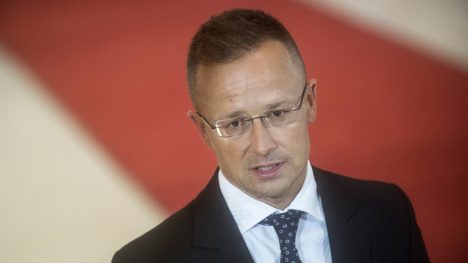
Hungarian Foreign Minister Peter Szijjarto © Michal Cizek / AFP
RT | February 12, 2023
Hungarian Foreign Minister Peter Szijjarto speaks to journalists in Prague, Czech Republic, on August 30, 2022. © Michal Cizek / AFP
The European Union’s calls to keep supporting Ukraine with arms shipments will only prolong the conflict with Russia, the Hungarian foreign minister said on Sunday.
Speaking to radio Kossuth, Peter Szijjarto commented on recent remarks by the President of the European Parliament, Roberta Metsola, who pushed for fighter jets and long-range weapons to be sent to Kiev. According to the minister, EU lawmakers’ decisions on Ukraine “have generally caused damage to Europe,” and further weapons deliveries will only worsen the hostilities.
He went on to blast the EU legislature, claiming that its “credibility is practically zero.” Szijjarto pointed to a recent graft scandal as proof that the EU parliament is “one of the most corrupt organizations in the world.”
He was referring to the recent arrest of the parliament’s former vice president, Eva Kaili, who has been charged with taking bribes from Qatar in exchange for illegally lobbying the interests of the Gulf state.
Szijjarto noted that in Western countries, war rhetoric sounds “incomparably louder than the rhetoric of peace,” while nations outside “the transatlantic bubble” tend to prefer peace to a deadly conflict.
The minister went on to question the West’s anti-Russia sanctions. He argued that they have failed to force Moscow to end the conflict, while Europe’s economy has “faced incredible difficulties,” and that “the tenth sanctions package will only be suitable for causing further damage to us Europeans, similar to the previous nine ones.”
Since the start of large-scale hostilities in Ukraine almost a year ago, Hungary, which is heavily dependent on Russian energy, has been critical of Western sanctions against Moscow. It has also refused to support Kiev with weapons, or allow arms transfers across its border with Ukraine.
‘Nobody can tell us how to live’: Hungary slams US envoy for meddlesome remarks
“We welcome non-governors and non-regents”
Press TV – February 3 2023
Hungarian Foreign Minister Peter Szijjarto has lashed out at the US ambassador to Budapest for meddling in the country’s internal affairs over its support for Russia, saying, “Nobody can tell us from the outside how to live.”
Szijjarto issued the scathing rebuke on Thursday after David Pressman, who has represented Washington in Budapest since September last year, censured Hungary’s push for the continuation of policies endorsed by Russian President Vladimir Putin and the country’s opposition to Western-led anti-Russia sanctions over the conflict in Ukraine.
“Nobody can tell us from the outside how to live, so it is of no interest what a citizen of another country – be it an ambassador – thinks about the domestic political processes in Hungary,” Szijjarto said at a press conference. “We ask for more respect for the Hungarians, even from the ambassador.”
Stressing that it is not Pressman’s “job to interfere in the internal affairs of Hungary,” the Hungarian foreign minister said, “If he wants to use his stay in Hungary to qualify the activities of the government elected by the Hungarian people with a fairly clear majority… then he will have a very difficult time.”
Szijjarto said when Hungary receives foreign ambassadors, it expects them to behave appropriately and work to improve bilateral relations, emphasizing that the era of foreign envoys telling Hungarians how to live in their own country “is over.”
Hungary has on numerous occasions voiced opposition to Western sanctions against Moscow in response to Russia’s protracted military operation in Ukraine, arguing that the restrictions have wreaked havoc on the EU economy.
Last month, Hungarian Prime Minister Viktor Orban also slammed Germany’s decision to support Ukraine by supplying 14 Leopard 2 tanks, warning that such steps would make Western countries active participants in the conflict. Orban stressed that, instead of arming Kiev, the West should pursue “a ceasefire and peace talks” in Ukraine.
Russia launched what it calls a special military operation in Ukraine on February 24, 2022, over the perceived threat of the ex-Soviet republic joining NATO and to “de-Nazify” Kiev. Since then, the United States and Ukraine’s other allies have sent Kiev tens of billions of dollars’ worth of weapons, including rocket systems, drones, armored vehicles, tanks, and communication systems.
Western countries have also imposed a slew of economic sanctions on Moscow. The Kremlin has said the sanctions and the Western military assistance will only prolong the war.
Almost all Hungarians oppose sanctions on Russia – survey
RT | January 14, 2023
The overwhelming majority of Hungarians are opposed to sanctions the West has imposed on Russia over Ukraine and believe that they are detrimental to the economy, the nation’s government said on Saturday, citing the results of a countrywide questionnaire, or “consultation.”
In a Facebook post, the Hungarian government revealed that “97% of Hungarians reject sanctions that cause serious damage,“ adding that “The message is clear: the Brussels sanctions policy must be reviewed.”
Szentkiralyi Alexandra, a government spokeswoman, said that the restrictions the EU had imposed on Russia over Ukraine had failed to stop the conflict, but caused a lot of economic issues for Europe. In this vein, Hungarians tend to reject oil restrictions and planned gas sanctions, she noted.
“The people taking part in the consultation say a clear ‘no’ to sanctions that further increase food prices or place additional burdens on European tourism,” Szentkiralyi added.
The spokeswoman pointed out that Hungary is the first EU country to poll its citizens about the sanctions’ impact. She also described the consultation as “a guideline for Hungarian public actors,” with the results set to be delivered to EU authorities in Brussels. “This is quite necessary because they want to introduce new sanctions instead of revising the sanctions policy,” Szentkiralyi explained.
She went on to thank about 1.4 million people that took part in the survey, noting that detailed results would be released in the near future. The consultation on the matter was launched in mid-October and included seven questions about sanctions on the oil, gas, raw materials export, and nuclear and tourism spheres.
In recent months, the sanctions the West imposed on Russia over the Ukraine conflict have exacerbated Europe’s energy crisis, causing fuel prices and costs of living to surge.
Hungary, which is heavily dependent on Russian energy, has long been critical of EU sanctions policy. On Friday, Hungarian Prime Minister Viktor Orban said that by promoting sanctions in the bloc, German politicians had “miscalculated,” but do not have the courage to admit that.
Last month, Russian Finance Minister Anton Siluanov said that the sanctions were taking a heavy toll on the European economy. He also claimed the US was the only nation benefiting from them, since it has been selling liquified natural gas to Europe at lucrative prices.
Hungary in ‘culture shock’ from German policies – Orban
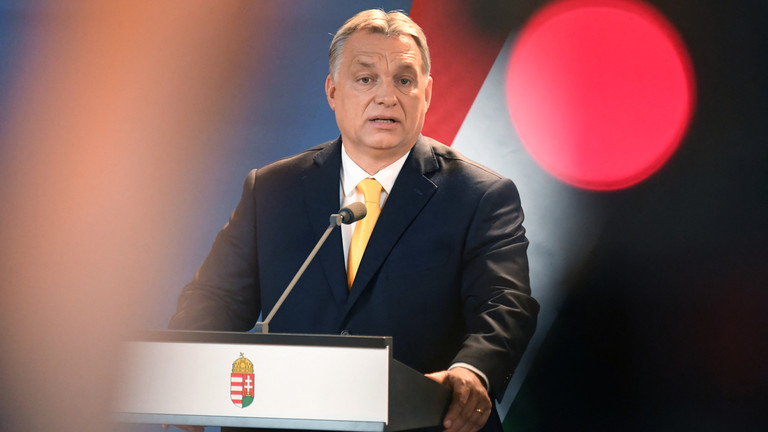
Hungarian Prime Minister Viktor Orban. © ATTILA KISBENEDEK / AFP
RT | January 13, 2023
Policies introduced by Germany and German politicians within the European Commission and the way they “miscalculated” the effects of anti-Russian sanctions has caused a “culture shock” in Hungary. The EU doesn’t have the courage to admit the fallacy of its sanctions policies, Hungarian Prime Minister Viktor Orban said in an interview on Friday.
“I grew up with the feeling that the Germans are precise, engineers, they calculate, take their time, they know what they are doing,” Orban told Kossuth Radio, adding that now that perspective has changed.
“Now we see what they are doing, because the European Commission has a German chairman,” Orban continued, referring to EU Commission President Ursula von der Leyen. “They failed with the sanctions, miscalculated and did not count to the end from a professional point of view,” he added.
According to the PM, the EU doesn’t have the courage to admit the fallacy of its sanctions policies against Russia amid the ongoing conflict in Ukraine. Orban noted, however, that Hungary lacked the strength to change the position of larger countries, meaning that sanctions on Moscow will likely continue despite their ineffectiveness.
Hungary, which relies heavily on Russian energy, has on several occasions criticized EU leaders for being responsible for the ongoing energy crisis by introducing “counterproductive” sanctions on Moscow. Budapest has repeatedly asked to scrap the “failed policy of Brussels” in order to stop Europe from “slowly bleeding.” Hungary has also been one of the few Western states that have so far refused to send any weapons to Ukraine or train its troops.
“If it were up to us, there would not be a sanctions policy,” Orban said last month. “It is not in our interest to permanently divide the European and Russian economies into two, so we are trying to save what can be saved from our economic cooperation with the Russians.”
Hungary’s relations with the EU have been particularly strenuous in recent months as Budapest has also clashed with several EU institutions on a number of issues, including LGBTQ rights and migration. Brussels, in turn, has accused Orban’s conservative government of eroding the rule of law while Western establishment media outlets have treated him like an authoritarian leader that is too sympathetic to Russian President Vladimir Putin.
Orban’s minister takes a jab at US
Free West Media | January 12, 2023
BUDAPEST – Hungary and Serbia want peace in Ukraine as soon as possible. Above all, they are against the negative effects of the EU’s anti-Russian sanctions on their economies. That is the conclusion of recent talks between Hungarian Foreign Minister Péter Szijjártó and his Serbian counterpart Ivica Dacic. Szijjártó pointed out how the two countries were experiencing the terrible consequences of the war – economically as well as in terms of safety due to their proximity to Ukraine.
Other countries, thousands of kilometers away from the conflict zone, do not have to face the same impact, he argued.
“It may not look so serious to them, but those who promote an escalation or prolong the war are acting against our national interests,” said the Orban minister, alluding to the US and its ongoing massive support for Ukraine. “Neither the Hungarians nor the Serbs are responsible for this war, but both peoples are paying for it. That is why we are interested in ending the armed conflict as soon as possible,” Szijjártó stressed.
Last month, the Hungarian Prime Minister Viktor Orbán had warned that the Ukraine crisis would continue as long as the US supported the Kiev regime with money and weapons.
There was a real danger that the Ukraine conflict could drag on for decades and Washington is responsible for the escalation, he said. “Ukraine can only fight as long as the USA supports it with money and weapons. If the Americans want peace, there will be peace,” Orban told the newspaper Magyar Nemzet.
“It is not in our interest to cut off all our economic relations with Russia. We look at these issues through the Hungarian prism and not through that of other countries,” he noted.
Ukraine to hike transit fees for Russian oil to EU – Transneft
RT | December 27, 2022
Ukraine will raise transit fees for Russian oil running via the Druzhba pipeline through its territory to the EU on January 1, Russian oil exporter Transneft announced on its website on Monday.
It is expected that Kiev will increase tariffs for transporting crude to Hungary and Slovakia by €2.10 per ton to €13.60 ($13.90), bringing the total hike to 18.3%.
In November, Bloomberg reported that Ukraine was mulling a tariff hike on Russian oil transit starting next year, citing a letter from Ukrtransnafta, the operator of Ukraine’s oil pipeline network. The Ukrainian operator had attributed the need for the price hike to the “continued destruction of Ukrainian energy infrastructure” which had resulted in “a significant shortage of electricity, an increase in its costs, a shortage of fuel, and spare parts.”
Transneft spokesman Igor Demin confirmed to the Russian media that the company had received the letter and was studying it.
Ukrainian oil transit fees have already been raised twice this year. The last hike in April reportedly brought the total increase to 51% on an annual basis.
Druzhba, one of the longest pipeline networks in the world, carries crude some 4,000 km from Russia to refineries in the Czech Republic, Germany, Hungary, Poland and Slovakia.
Hungary wants European Parliament dissolved
RT | December 22, 2022
The recent corruption scandal in the European Parliament (EP) is a sign that the EU institution should be abolished in its current form, Hungarian Prime Minister Viktor Orban said on Wednesday. He added that the EP already had an abysmal reputation.
Orban’s remarks came after Eva Kaili, a Greek politician who served as one of the European Parliament’s vice presidents, was arrested and charged this month with corruption for receiving bribes from Qatar.
“The Hungarians would like for the European Parliament to be dissolved in its current form,” he said at a press conference in Budapest.
Orban argued that the scandal “draws attention to the fact that national parliaments have a stronger control system in place,” adding that legislators from the parliaments of member states should be delegated to the European Parliament, as opposed to being elected separately.
“And they obviously know our political position: the swamp must be drained,” the prime minister said.
Budapest has repeatedly clashed with the European Parliament and other EU institutions over a number of issues, including migration and LGBTQ rights. Brussels, in turn, accused Orban’s conservative government of eroding the rule of law at home.
Hungary, whose economy heavily depends on Russian energy imports, has also criticized the EU sanctions imposed on Moscow in response to the military operation in Ukraine, which was launched in late February. Unlike many of the bloc’s member states, Orban has refused to send weapons to Kiev.
“If it were up to us, there would not be a sanctions policy,” Orban said on Wednesday. “It is not in our interest to permanently divide the European and Russian economies into two, so we are trying to save what can be saved from our economic cooperation with the Russians.”
Hungarian Parliament Speaker: West’s Push to Turn Ukraine Into Anti-Russian Bridgehead is a ‘Strategic Mistake’
Samizdat – 21.12.2022
Budapest has stood alone among NATO’s Eastern European flank in rejecting the transfer of weapons to Ukraine via its territory. Prime Minister Viktor Orban has essentially labeled the Ukrainian conflict a Russia-US proxy war, citing the need for peace talks between Russia and the US, rather than Moscow and Kiev, for the conflict to stop.
Hungarian Parliament speaker Laszlo Kover has lashed out against Western governments’ “hypocritical” behavior in Ukraine, and warned that the West’s attempts to pry Kiev out of Russia’s orbit and turn it into an armed base against Russia has proven to be a “strategic mistake.”
“I think the Western world made a strategic mistake when it tried to not only take Ukraine out of Moscow’s sphere of interest, but also turn it into a large military base against Russia,” Kover said in a broad ranging interview with a Hungarian radio station on Tuesday.
Asked whether he sees any prospects for a diplomatic resolution to the crisis, Kover said that if he “wanted to be cynical,” he would point out that Western countries have already found a workaround, by “proclaiming the protection of European values and international law and accusing Russia of all kinds of crimes, with basis or without basis. In the meantime, they have tried to stock up on Russian oil and gas, so their trade volume with Russia actually jumped radically after sanctions were announced.”
The politician, who is a member of Prime Minister Orban’s Fidesz party, accused Hungary’s European allies of engaging in a “hypocritical show” in Ukraine and behaving in a “terribly hypocritical and irrational” way, destroying their own economies, even as the United States “has embarked on the path of an openly protectionist economic policy,” by setting up trade barriers to European automobiles, for example, making American cars 25-30 percent cheaper than their European-made counterparts.
“This is clearly offensive. It violates all kinds of free trade rules and agreements, and of course violates the legitimate interests of European car manufacturers. Now, compared to this [the crisis with Russia, ed.] the leaders of the EU member states and the European Council are watching events with drooling glee, and we haven’t seen even a harsh outburst or verbal reaction, lest they take some kind of countermeasure, some kind of defensive step,” Kover complained.
The parliament speaker suggested that from the “first moment” of the Russia-West proxy conflict in Ukraine, the goal was to try to “destroy Russia economically, politically, in every sense” and to separate Moscow from the European Union, “to create a new Iron Curtain,” no matter the cost to Europe.
“This means in practice that the space of continuous economic and political cooperation based on mutual, fair consideration of interests, which could have been created in a unified Eurasia stretching to Portugal to say, Southeast Asia, seems to be falling apart at this moment, and I think that the damage caused by this conflict will stay with us for the rest of our lives,” Kover said.
Kover stressed that Hungary’s position has been and remains to defend its elementary economic interests by withdrawing from some EU-level sanctions against Russia “to prevent decisions that harm us more than Russia.” The official added that “the whole sanctions regime has hurt Europe much more than Russia, and I think we should fight here in Central Europe so that this scenario, where we become the eastern periphery of a North Atlantic empire, does not come true.”
Kover reiterated that measures were necessary “to try to end this armed conflict as quickly as possible,” even if it takes “years before this can take the form of some kind of peace treaty.” In the meantime, “we should try to create a new Central European or pan-European peace system in which each [country’s] security needs are taken into account by the other side,” the official said.
As for NATO’s role in the Ukraine crisis, Kover urged the Western alliance to stick to preparing to defend the sovereignty and security of alliance members, and not allow the bloc to drift into a hot war with Russia. “It’s very close to it anyway, because while no NATO members are involved in the war de jure… when a country supplies weapons to another that is at war or when a country or political community tries to destabilize the economic life of another country via various sanctions, blockades or the freezing of assets, this can be considered a kind of warfare.”
Relations between Hungary and Ukraine have been strained since the 2014 Euromaidan coup, which brought nationalist forces to power in Kiev which gradually moved to deprive the 150,000-strong community of ethnic Hungarian Ukrainians living in western Ukraine of their rights, including the right to receive an education in their native tongue.
Amid the escalation of the crisis, Hungarian and Ukrainian officials have gotten into a series of vicious verbal spats, with Ukraine’s Foreign Ministry asking Kover to produce a note from a psychiatrist on his mental state after the speaker suggested that Ukrainian President Volodymyr Zelensky was suffering from a “mental problem.”
Featured Video
Trita Parsi: Israel Set a Trap for Total War in the Region
or go to
Aletho News Archives – Video-Images
From the Archive
Zionism’s Violent Legacy
By Donald Neff | Washington Report On Middle East Affairs | January 1996
On January 4, 1948, Jewish terrorists drove a truck loaded with explosives into the center of the all Arab city of Jaffa and detonated it, killing 26 and wounding around 100 Palestinian men, women and children.[1] The attack was the work of the Irgun Zvai Leumi – the “National Military Organization,” also known by the Hebrew letters Etzel – the largest Jewish terrorist group in Palestine. The Irgun was headed by Revisionist Zionist Menachem Begin and had been killing and maiming Arabs, Britons and even Jews for the previous ten years in its efforts to establish a Jewish state.
This terror campaign meant that at the core of Revisionist Zionism there existed a philosophical embrace of violence. … continue
Blog Roll
 Aletho News
- Trita Parsi: Israel Set a Trap for Total War in the Region
- Trump’s Iran war is on an Israeli leash
- Saudi oil boss issues global supply warning
- Riyadh Says Its Oil System Is Intact. The Numbers Say Otherwise.
- Trump and Netanyahu Want to “Finish the Job” on Iran
- US ‘one-sided dictation’ not Iran’s beliefs makes rational talks impossible: Baghaei
- Iran’s Next Strike May Not Explode. It Could Shut You Down /Col Doug Macgregor
- Iran: US political targets legitimate if assassinations return
- Iraq shuts key border crossing with Iran under US pressure: Report
- Undersea Internet cables could be targeted in retaliation for attacks on Iran: IRGC deputy chief
- If Americans Knew
- The Israel Lobby’s Changing Fortunes
- AIPAC has become such a political liability that it’s shifting to a more “nimble” approach to buying politicians
- At least 160 Israeli settler attacks in 2 weeks
- Will Gaza’s Ancient Christian Community Disappear Forever?
- Israel’s vision of regional security rests on keeping Arab states weak
- Heidi Levine recounts how Palestinian youths helped save her in settler attack
- DAILY UPDATE: Latest essential news on Palestine, Israel, & region
- Trump’s Intensifying Sabotage of the ICC, for Israel’s Sake
- Israeli military detain US and UK volunteers in West Bank including Democratic NY politician Brad Lander
- Americans at National Conservatism Conference held in Israel this year criticize Israel
- No Tricks Zone
- E-Cars Reduce CO2 Emissions By Only 41% Compared To Internal Combustion Engine Vehicles
- Predictions Made By Renowned Climate Professor Over Past Decades Have Been Proven To Be Poor
- New Study Suggests Large Regions Of The Pacific Ocean Have Been Cooling For The Last 80 Years
- Germany’s Green Energy Debacle: High Energy Costs Force Kahla Porzellan to Close After 182 Years!
- New Study: 50 Years Of The Most Aggressive ‘Net Zero’ Policies Can Only Affect The Global Climate By 0.03°C
- US September “Heat” Was No Record…Many Records Set Decades Ago
- Latest European Green Energy Debacle; Portugal’s Largest Flagship Solar Park Insolvent!
- Green Energy Debacle: German Expert Professor Fritz Vahrenholt Warns Of Severe Economic And Social Consequences
- Two More Paleo Reconstructions Affirm Meters-Higher Sea Levels Across Ireland, Brazil 7000-6000 Years Ago
- New Study: Earth And Venus Surface Warmth Largely Explained By Convection And Lapse Rate, Not CO2 Or Radiation

