Iran Strikes Back! Daniel McAdams talks to RT
Ron Paul Institute | January 7, 2020
Iran fires missiles at at least two US bases in Iraq! What is next? RPI Director Daniel McAdams in an extensive interview as the dramatic events of tonight unfold of Iranian retaliation in Iraq for the US assassination of top anti-ISIS Iranian General Qassim Soleimani. Will Trump’s embrace of the neocons cost him a second term?
UK defence secretary ‘reserves the right’ to ‘strike’ Iran
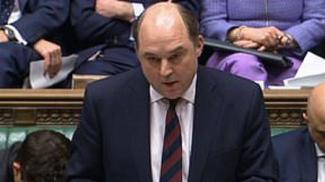
Ben Wallace in a combative mood in the House of Commons
Press TV – January 7, 2020
British defence secretary, Ben Wallace, has put up a spirited defence of the US decision to assassinate Iranian Quds force General Qassem Soleimani in a terrorist-style drone strike outside Baghdad airport.
Delivering a statement in the House of Commons, Wallace claimed that General Soleimani was “no friend of the UK or our allies in the region”.
Wallace tried to justify the assassination on dubious legal grounds by saying: “the UK will always defend the right of countries to defend themselves”.
Wallace’s claim flies in the face of all pertinent facts, notably credible reports that General Soleimani was on a peace mission to Baghdad to try to diffuse tensions with Saudi Arabia.
At any rate, the US accusation that General Soleimani had been planning attacks against US interests hasn’t been backed up by any evidence.
On a more ominous note, Wallace threatened that “aggressive behaviour” from Iran “was never going to go unchallenged”.
Wallace didn’t explain what he meant by “aggressive” behaviour, and the irony of his words was lost on him. After all, Iran was the victim of US aggression when the latter decided to kill the country’s top military commander.
The defence secretary claimed that the UK is “changing the readiness of our forces in the region” by placing “helicopters and ships on standby to assist if the need arises”.
Wallace didn’t address credible reports of the UK adopting an aggressive posture vis-à-vis Iran, in order to assist the US in any potential military action.
The Sun newspaper reported two days ago that a British nuclear-powered submarine was in “striking position” of Iran, ready to fire Tomahawk cruise missiles at Iranian targets.
During the question and answer phase, Wallace was asked by acting Liberal Democrats leader, Sir Ed Davey, whether he would rule out “any UK involvement in any attack in any site in Iran”.
“I’m not going to rule out anything”, said a combative Wallace.
“We cannot say what’s in the minds of Iran or anybody else in the future – that’s why we will always reserve that right to take the decision at the time of it”, he added.
Wallace’s aggressive tone towards Iran is in keeping with the positions of both the Prime Minister, Boris Johnson, and foreign secretary, Dominic Raab, both of whom have defended US actions in recent days.
But Wallace goes a step further by introducing for the first time the strong possibility of the UK taking military action against Iran.
Turkey, Russia, Iran officials discuss latest developments in region
![Russian Defence Minister Sergey Shoygu [Wikipedia]](https://i0.wp.com/www.middleeastmonitor.com/wp-content/uploads/2017/11/2015_5-24-ergey-Shoigu-Official_portrait_of_Sergey_Shoigu_19.jpg?resize=1200%2C800&quality=85&strip=all&ssl=1)
Russian Defence Minister Sergey Shoygu [Wikipedia]
MEMO | January 7, 2020
Senior officials from Turkey, Russia and Iran discussed the latest developments in the Middle East and North Africa region yesterday.
The Russian Ministry of Defence said the country’s Defence Minister Sergey Shoygu discussed the developments in the Middle East and Libya during a telephone conversation with the head of the Turkish intelligence organisation, Hakan Fidan. The two officials also discussed joint actions to reduce tensions in the region.
The statement added that Shoygu also spoke to Iranian Chief of Staff, Mohammad Bagheri, during which they discussed steps to reduce tensions in the region following Friday’s assassination of Iran’s Commander of the Quds Force, Qassem Soleimani, in a US drone attack near Baghdad airport.
Tensions between Washington and Tehran escalated following Soleimani’s assassination, while, Tehran announced that it would respond “harshly” to the assassination.
Iranian MPs declare all of US military ‘terrorist entity’ after General Soleimani killing

Soldiers from the 82nd Airborne Division wait for Middle East deployment © Global Look Press / Timothy L. Hale / Source: ZUMAPRESS.com
RT | January 7, 2020
The US Armed Forces are now regarded as a terrorist organization under an urgent motion by Iranian lawmakers, who earlier branded the assassination of the Quds Force commander “state-sponsored terrorism,” state media report.
Iranian MPs adopted a bill on Tuesday calling “personnel of the Pentagon, all affiliated companies, institutions, agents and commanders” members of a “terrorist entity,” local media reported.
The bill amends and expands previous legislation which gave a similar designation to US Central Command (CENTCOM). Initiated in April of last year, it was a tit-for-tat response to Washington’s blacklisting of the Islamic Revolutionary Guards Corps (IRGC).
The latest designation, however, comes as tensions between Washington and Tehran reach boiling point, following the US’ assassination of Quds Force commander Qassem Soleimani in Baghdad on Friday. Tehran has vowed to avenge Soleimani’s death, a promise that in turn led to US President Donald Trump threatening to strike 52 “very high level” Iranian cultural and state targets should Iran hit any American interests.
The Iranian government has reportedly been considering 13 “revenge scenarios” in retaliation for Soleimani’s killing. The semi-official Fars News Agency quoted Iranian Supreme National Security Council secretary Ali Shamkhani as saying that “even if there is consensus on the weakest scenario, carrying it out can be a historic nightmare for the Americans.”
Journalist: Trump ‘Could Lose’ US Presidential Election Due to Iran Affair
Sputnik – January 7, 2020
British Prime Minister Boris Johnson and US President Donald Trump have reportedly discussed recent developments in Iran in the aftermath of Iranian general Qassem Soleimani’s assassination. Journalist Hamid Reza Gholamzadeh expressed his opinion on the situation.
Sputnik: Has the US made a mistake by killing General Soleimani?
Hamid Reza Gholamzadeh: The United States has actually made a very grave mistake and they have left Iran with no other choice but to retaliate. The attack was a military one and Iran’s will need to be a military one as well, so Iran needs to react because if not; it would lead to the establishment of such a balance of power, that the US can attack and Iran just remains silent and it’s not something that anyone would accept.
The most vital thing for Iran is their security and the country needs to retaliate in order to deter the US from undertaking further attacks, otherwise, the United States would consider it a sign of weakness from Iran and that would lead to the possibility of full-fledged war against Iran, with the United States attacking Iran.
The only choice that the US has left for Iran is a retaliation of at least the same size that has happened to General Soleimani. Millions of people poured to the streets commemorating him this morning, because he was one of the most popular military leaders in Iran.
Sputnik: Should the EU defy US foreign policy for the sake of preserving peace in the Middle East?
Hamid Reza Gholamzadeh: Most of the statements coming from Europe so far have been awful I’m afraid to say. They were actually somehow supporting the US and demanding that Iran should de-escalate the situation and saying that it was Iran who made the US carry out an act of war, but diplomacy is never going to work like that.
The problem is that the Europeans have turned into puppet regimes of the US, particularly the UK and France, and they are now calling for de-escalation from Iran, when the Americans have carried out an act of war, they have carried out an attack against international law and they are threatening Iran with further attacks.
If there are going to be further attacks and retaliation from Iran, followed by a response from the United States, then it will create a full-scale war, which would at least engulf the region, if not the whole world and the consequences for sure would be harsh and destructive first to the American allies in the region and then to Europeans.
By supporting the US and by remaining silent against the violations of international law by the US, they are actually sort of abetting the American crimes and they will ultimately suffer more than the US from any consequences that might happen.
Sputnik: How will the Iran affair impact the upcoming US Presidential election?
Hamid Reza Gholamzadeh: Donald Trump could lose the US Presidential election, just like Jimmy Carter did, due to the Iran situation. The gamble he took was a very big mistake and his administration thinks there is going to be a response from Iran and that if there was a war, that it might be something that unites Americans and would guarantee a second term.
The miscalculation that they have made is that Iran is not Iraq or even Vietnam. Iran is for sure more powerful and more established than those countries and if there is any war, Iran would absolutely be the winner because of the power that it has in the region and because of the experiences that they have had over the years.
This miscalculation will be very dangerous for President Trump and I expect that he will actually lose the next US election if he wants to continue aggression in the Middle East and responding to Iranian retaliation.
US denies Iran’s FM Zarif visa to address Security Council in violation of UN treaty – reports
RT | January 7, 2020
Washington has reportedly refused to issue a visa to Iran’s Foreign Minister Mohammad Javad Zarif, even though, as the host of the United Nations headquarters, the US is obliged to allow foreign officials into the country.
According to multiple diplomatic sources, the visa request was filed several weeks ago, before the latest escalation, and would give the top Iranian diplomat a stage to speak out following last Thursday’s drone strike assassination of Islamic Revolutionary Guard Corps (IRGC) commander Qassem Soleimani, along with senior Iraqi militia leaders.
The murder of Soleimani, who played a key role in the fight against Islamic State (IS, formerly ISIS) terrorists in Syria and Iraq, has drawn outrage across Iran and Iraq, with Tehran vowing to avenge the assassination, which it called “an act of international terrorism.” Washington, meanwhile, insists that Soleimani was the mastermind behind a spate of attacks on American personnel, including at the US Embassy, and says he was plotting new assaults.
This wouldn’t be the first time Washington abused its status as the host of the UN headquarters, refusing to issue visas for nearly a dozen members of the Russian delegation to a summit in New York last year.
General Soleimani ‘martyr of Quds’: Hamas chief Haniyeh
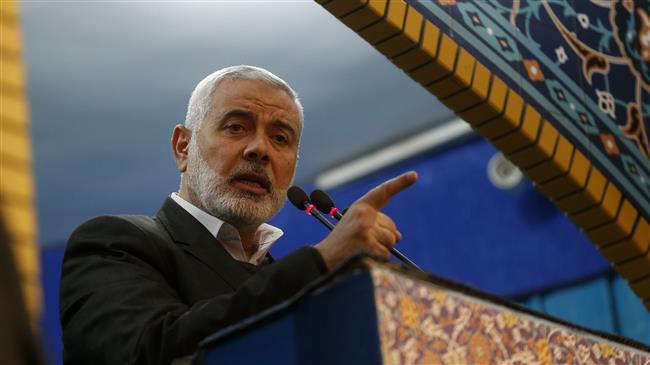
Hamas leader Ismail Haniyeh addresses a massive crowd of mourners during a funeral procession for General Qassem Soleimani in Tehran January 6, 2020. (Photo by Leader.ir)
Press TV – January 6, 2020
General Qassem Soleimani is a “martyr of Quds” for he devoted his life to supporting the Palestinian people’s struggle against Israel and his assassination by the United States is in many ways similar to crimes committed by the Israeli regime, says Hamas chief Ismail Haniyeh.
General Soleimani, commander of the Quds Force of Iran’s Islamic Revolution Guards Corps (IRGC), was assassinated in a US strike in Baghdad on Friday, alongside Abu Mahdi al-Muhandis, the deputy commander of Iraq’s pro-government Hashd al-Sha’abi forces.
A huge sea of mourners, streaming from all the adjoining streets, descended on the iconic Engelab Square in central Tehran early Monday morning and rallied to Azadi Tower in the capital’s west as they chanted “Death to America” and “Death to Israel.”
Leader of the Islamic Revolution Ayatollah Seyyed Ali Khamenei led the prayers over the general’s coffin and the remains of his companions at Tehran University, his voice cracking several times with emotion which caused the massive crowd to weep.
Speaking at the funeral procession in Tehran on Monday, Haniyeh condemned the US strike, which was personally authorized by President Donald Trump.
“We have come to Iran to condole with Leader of the Islamic Revolution Ayatollah Khamenei, the Iranian government and nation,” Haniyeh said.
“He [Gen. Soleimani] was the commander of the IRGC Quds Force and he is a martyr of Quds,” the Hamas official said.
Haniyeh also sent condolences to General Soleimani’s family and described him as one of the “flag-bearers of resistance against Zionist and American plots.”
Haniyeh said he was in Iran “to express our true and sincere feelings about a dear brother and a martyred commander – a commander who made many sacrifices for Palestine and the resistance until he achieved the position he has today.”
‘A crime similar to Zionist atrocities in Palestine’
Haniyeh said this “brutal crime” by the Americans is representative of the “criminal mentality” that is at work in the occupied Palestinian lands.
“The criminal mentality that led to Commander Soleimani’s assassination and martyrdom is the same mentality that drives the minds of the Zionist regime’s thugs, the same mentality and policy that assassinates and kills Palestinians every day,” he said.
He said Hamas owes its current prowess to General Soleimani’s wisdom. The Palestinian resistance, he said, won’t back away from combating Israel and the fight will continue “until we purge all enemies from the noble Quds.”
New Quds Force chief pledges vengeance
Brigadier General Esmail Qaani, who was named the new Quds commander by the Leader on Friday, said in a statement that Iran will no doubt avenge the assassination.
“Steps will be definitely taken” to avenge General Soleimani’s blood, which Qaani said has set in motion a series of steps that will lead to America’s expulsion from the region.
US ‘elimination’ from region only acceptable retribution
Brigadier General Amir Ali Hajizadeh, the commander of the IRGC’s Aerospace Division, echoed the remarks and said the only possible revenge for General Soleimani’s blood would be the total “elimination” of America from the region.
Launching a few missiles, destroying a base or even Trump’s death will not sufficiently avenge the blood of such a martyr, General Hajizadeh asserted, adding “the oppressed nations of the region will have to be rid of America’s evil.”
‘Middle East Will Become a Graveyard for US’: Pyongyang Apprehensively Eyes Iran Crisis
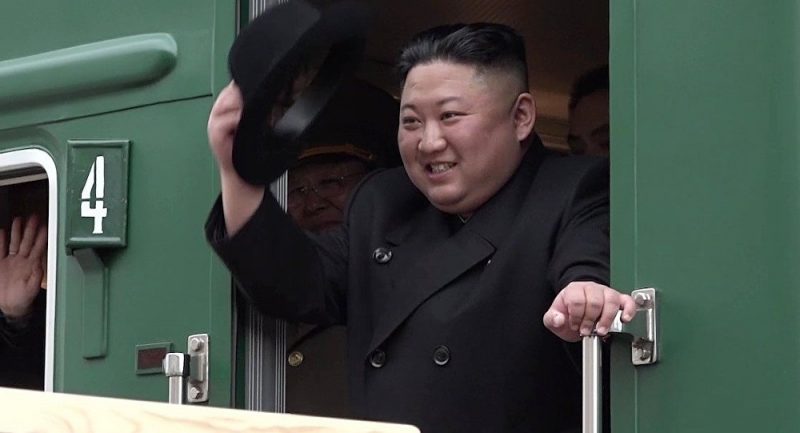
Sputnik – January 6, 2020
Following the US assassination of Iranian general Qassem Soleimani, the Democratic People’s Republic of Korea has taken measure of the international situation, which is expected to excercise new caution. However, North Korean dailies noted Washington’s course was destined for disaster.
North Korean cultural publication Arirang Meari put the issue in no uncertain terms, saying on Sunday that the “Middle East will become a graveyard for the US.”
“Global military experts recently analyzed that the US is being bogged down in a war in the Middle East,” Meari wrote, according to the South Korean-based Yonhap News Agency. “Even pro-American countries have been passively answering the US’s request for sending troops on account of their internal politics and economic challenges, driving the US into despair.”
The Korean Central News Agency (KCNA), the DPRK’s state-run news outlet, noted on Monday that Moscow and Beijing had taken strong stances against the US drone strike that killed Soleimani in Baghdad early Friday morning.
“China and Russia emphasized that they not only object to abuse of military power in international relations but also cannot tolerate adventurous military acts,” KCNA wrote, according to Yonhap, describing a Saturday phone call between Chinese Foreign Minister Wang Yi and his Russian counterpart Sergey Lavrov, noting they “expressed concerns over regional situations being worsened by the US’ illegal acts.”
Kim ‘Pressured Psychologically’ by Soleimani Killing
However, despite the rhetoric, experts have noted the episode is likely to shake Pyongyang’s leaders.
Yang Moo Jin, a professor at Seoul’s University of North Korean Studies, told the Korea Herald that as a result of the Baghdad airstrike, DPRK leader Kim Jong Un “will be pressured psychologically.”
Former South Korean Unification Minister Jeong Se Hyun said during a television appearance on Sunday the DPRK would be even more careful than before about revealing Kim’s precise whereabouts.
Andrei Lankov, a Russian scholar and expert on Korean affairs, noted in NK News on Sunday that Soleimani’s assassination showed US President Donald Trump was willing to take greater risks than North Korean strategists had previously believed, casting the “fire and fury” rhetoric of his presidency’s earlier years in a much starker light.
“As time went by, more and more observers were inclined to see the 2017 as a simple bluff, and it became widely accepted that Donald Trump did not have the guts to deliver on his threats of a military operation in a highly unstable part of the world,” Lankov wrote. “But last week’s killing of General Soleimani demonstrated that the world has underestimated Trump’s desire to take risks (or, perhaps, overestimated his ability to make rational decisions).”
“No doubt the North Koreans have taken note, and, most likely, see it as a warning sign.
Soleimani’s death reminded them that excessively risky behavior might result in a US drone quietly approaching some targets in Pyongyang suburbs,” Lankov added.
A Cautious But Steadfast Approach in 2020
As 2019 drew to a close, so did Pyongyang’s patience for negotiations with Washington, which after 18 months of talks had failed to yield significant results beyond a June 12, 2018, promise from Trump at his first summit with Kim in Singapore. In his New Year’s address, given several days before Soleimani’s killing, Kim had already taken a more cautious tone than in December, when North Korean publications promised a return to bellicose posturing.
Kim had previously promised a “Christmas gift” to Washington, which analysts widely predicted would be Pyongyang’s first long-range ballistic missile test since its self-imposed moratorium in 2017. However, no such “present” was delivered. Instead, Kim noted Washington’s delaying tactics were designed to prolong the harmful effects of economic sanctions on the DPRK, advising North Koreans to buckle their belts more tightly, since relief seemed unlikely anytime soon.
“If the US fails to keep the promises it made before the world, if it misjudges the patience of our people and continues to use sanctions and pressure against our republic, then we’ll have no choice except to seek a new path to secure the sovereignty and interests of our country,” Kim said on January 1.
Similar Struggles in Iran, DPRK
Like Pyongyang, Tehran has been engaged in a prolonged struggle to forge an independent path from Washington amid attempts to frustrate its ability to ensure its self-defense. Both countries have been subjected to strangling economic sanctions in an effort to force them into compliance, but unlike Iran, the DPRK has nuclear weapons as well as means of delivering them.

Kim Yong Nam, president of the Presidium of the Supreme People’s Assembly of North Korea, meets with Iranian President Hassan Rouhani in August 2018
Iranian leaders have long been accused by Washington of pursuing an atomic bomb and not merely nuclear power and medical research, as they have claimed. Tehran signed the Joint Comprehensive Plan of Action in 2015 to lower those sanctions in exchange for accepting tight constraints on the volume of nuclear fuel it could possess, but Trump reimposed them in 2018, accusing Iran of secretly pursuing a nuclear bomb – a conclusion not shared by other signatories to the agreement.
As a consequence, Tehran has slowly stepped back from the commitments it made in the 2015 deal, announcing on Sunday it would scrap the last ones it still followed.
The two countries’ experiences negotiating with Washington have long informed each other, and in the face of intransigence and doubletalk by the Trump administration, experts like Lankov have predicted US belligerence toward Iran, despite its obedience to the 2015 deal, was likely only to embolden those who hold hard-line positions in Pyongyang, opposing negotiations and concessions to Washington.
A Terrorist Attack Against Eurasian Integration
By Federico Pieraccini | Strategic Culture Foundation | January 6, 2020
The murder of Iranian general Qasem Soleimani in Baghdad, in the early hours of January 3 by US forces, only highlights the extent to which US strategy in the Middle East has failed. It is likely to provoke reactions that do not benefit US interests in the region.
To understand the significance of this event, it is necessary to quickly reconstruct the developments in Iraq. The US has occupied Iraq for 17 years, following its invasion of the country in 2003. During this time, Baghdad and Tehran have re-established ties by sustaining an important dialogue on post-war reconstruction as well as by acknowledging the importance of the Shia population in Iraq.
Within two decades, Iraq and Iran have gone from declaring war with each other to cooperating on the so-called Shia Crescent, favoring cooperation and the commercial and military development of the quartet composed of Iran, Iraq, Syria and Lebanon. Such ties, following recent victories over international terrorism, have been further consolidated, leading to current and planned overland connections between this quartet.
Local movements and organizations have been calling for US troops to leave Iraqi territory with increasing vigor and force in recent months. Washington has accused Tehran of inciting associated protests.
At the same time, groups of dubious origin, that have sought to equate the Iranian presence with the American one, have been calling for the withdrawal of the Popular Mobilization Units (PMUs) that are linked to Iran from Iraq. The protests from such groups appear to be sponsored and funded by Saudi Arabia.
With mutual accusations flying around, the US hit a pro-Iranian faction known as Kataib Hezbollah on December 29. This episode sparked a series of reactions in Iraq that ended up enveloping the US embassy in Baghdad, which was besieged for days by demonstrators angry about ongoing airstrikes by US forces.
The US secretary of state, Mike Pompeo, blamed this volatile situation on Iran, warning that Tehran would be held responsible for any escalation of the situation involving the embassy.
In the early hours of January 3, 2020, another tangle was added to the Gordian Knot that is the Middle East. Qasem Soleimani was assassinated when his convoy was attacked by a drone near Baghdad International Airport. The most effective opponents of ISIS and Wahabi jihadism in general was thus eliminated by the US in a terrorist act carried out in a foreign country in a civilian area (near Baghdad International Airport). The champagne would have no doubt been flowing immediately upon receiving this news in the US Congress, the Israeli Knesset, Riyadh royal palace and in Idlib among al Nusra and al Qaeda militants.
It remains to be seen what the reasons were behind Trump’s decision to okay the assassination of such an influential and important leader. Certainly the need to demonstrate to his base (and his Israeli and Saudi financiers) plays into his anti-Iranian crusade. But there are other reasons that better explain Trump’s actions that are more related to the influence of the US in the region; the geopolitical chess game in the Middle East transcends any single leader or any drone attack.
In Syria, for example, the situation is extremely favorable to the government in Damascus, with it only being a matter of time before the country is again under the control of the central government. General Soleimani and Iran have played a central role in ridding the country of the scourge of terrorism, a scourge directed and financed by the US and her regional allies.
In Iraq, the political situation is less favorable to the US now than it was back in 2006. Whatever progress in relations between Baghdad and Tehran has also been due to General Soleimani, who, together with the PMUs and the Iraqi army, freed the country from ISIS (which was created and nurtured by Western and Saudi intelligence, as revealed by Wikileaks).
It would seem that the US sanctions against Iran have not really had the intended effect, instead only serving to consolidate the country’s stance against imperialism. The US, as a result, is experiencing a crisis in the region, effectively being driven out of the Middle East, rather than leaving intentionally.
In this extraordinary and unprecedented situation, the Russians and Chinese are offering themselves variously as military, political and economic guarantors of the emerging Eurasian mega-project (the recent naval exercises between Beijing, Moscow and Tehran serving as a tangible example of this commitment). Naturally, it is in their interests to avoid any extended regional conflict that may only serve to throw a monkey wrench into their vast Eurasian mega-project.
Putin and Xi Jinping face tough days ahead, trying to council Iran in avoiding an excessive response that would give Washington the perfect excuse for a war against Iran.
The prospects of a region without terrorism, with a reinvigorated Shia Crescent, led by Iran at the regional level and accompanied by China and Russia at the economic (Belt and Road Initiative) and military level, offer little hope to Riyadh, Tel Aviv and Washington of being able to influence events in the region and this is likely going to be the top argument that Putin and Xi Jinping will use to try to deter any Iranian overt response.
Deciding to kill the leader of the Quds Force in Iraq proves only one thing: that the options available to Trump and his regional allies are rapidly shrinking, and that the regional trends over the next decade appear irreversible. Their only hope is for Tehran and her allies to lash out at the latest provocation, thereby justifying the regional war that would only serve to benefit Washington by slowing down regional unification under Iranian leadership.
We must remember that whenever the US finds itself in a situation where it cannot control a country or a region, its tendency is to create chaos and ultimately destroy it.
By killing General Soleimani, the US hopes to wreak havoc in the region so as to slow down or altogether scupper any prospect of integration. Fortunately, China, Russia and Iran are well aware that any conflict would not be in any of their own interests.
No drone-launched missiles will be enough to save the US from decades of foreign-policy errors and their associated horrors; nor will they be enough to extinguish the memory of a hero’s tireless struggle against imperialism and terrorism.
The Middle East Strategic “Balance” Shredded
By Alastair Crooke | Strategic Culture Foundation | January 6, 2020
President Trump was understood to not want a Mid-East war that might blight his rosy re-election prospects (so long as the US stock market stays inflated, and the economy doesn’t tank). Pat Buchanan, the three-times US Presidential candidate, warned Trump that if there is a potential landmine on Trump’s road to reelection, it may be found in the Middle and Near East: “Not infrequently, foreign policy has proven decisive in presidential years”. Plus Iran was not seeking any major confrontation; Hizbullah wasn’t; Iraq wasn’t; and the Israeli Security Establishment wasn’t.
In fact, the strategic balance – though sorely tested – had been hanging together. Just to be clear: Iran and Israel both had been keeping – just – within the parameters of unspoken ‘red lines’ – despite the inflated rhetoric. And both were practicing ‘strategic patience’. So the strategic balance seemed more or less sustainable: until its upending with the assassination of Qasem Soleimani and the head of the PMU, Al-Muhandis, ordered by Trump.
Israel has not – despite its lurid language – been landing strategic blows on Iran in Syria. It has not been killing Iranians there (apart from seven killed at T4 airport in eastern Syria last year). It did not target the head of the Iranian air force, some ten days ago, as some reports have suggested (he was not even in Iraq at the time). Most of the Israeli air attacks have been on depots in the early hours, when no personnel were present. It has been a campaign more of a regular, small slicing away at Iranian logistics. It was not strategic damage.
And Iran, after sending clear ‘messages’ to Gulf States of its willingness to inflict pain on parties to its economic siege, plainly had been calibrating this push-back carefully; Iran still had its eye to global diplomacy (to wit: the joint Iranian naval exercises with Russia and China in the Persian Gulf) – whilst countering politically, America’s ‘new’ tactic of inciting ‘colour’ protests across Lebanon and Iraq (and trying to bust Syria financially, by stealing its energy revenues).
Here is the point: The US was no longer content with mere sanctions on Iran. It has been covertly escalating across the board: orchestrating protests in Iraq, in Lebanon, and in Iran itself; mounting a major cyber offensive on Iran; and a ‘messaging’ operation aimed at turning genuine popular frustration with regional mis-governance and corruption, into a weapon aimed at weakening revolutionary Iran.
The US was having some success with turning protest messaging against Iran – until, that is – its killing and wounding of so many Iraqi security force members last week (Ketaib Hizbullah is a part of Iraq’s armed forces).
Escalation of maximum-pressure was one thing (Iran was confident of weathering that); but assassinating such a senior official on his state duties, was quite something else. We have not observed a state assassinating a most senior official of another state before.
And the manner of its doing, was unprecedented too. Soleimani was officially visiting Iraq. He arrived openly as a VIP guest from Syria, and was met on the tarmac by an equally senior Iraqi official, Al-Muhandis, who was assassinated also, (together with seven others). It was all open. General Soleimani regularly used his mobile phone as he argued that as a senior state official, if he were to be assassinated by another state, it would only be as an act of war.
This act, performed at the international airport of Baghdad, constitutes not just the sundering of red lines, but a humiliation inflicted on Iraq – its government and people. It will upend Iraq’s strategic positioning. The erstwhile Iraqi attempt at balancing between Washington and Iran will be swept away by Trump’s hubristic trampling on the country’s sovereignty. It may well mark the beginning of the end of the US presence in Iraq (and therefore Syria, too), and ultimately, of America’s footprint in the Middle East.
Trump may earn easy plaudits now for his “We’re America, Bitch!”, as one senior White House official defined the Trump foreign policy doctrine; but the doubts – and unforeseen consequences soon may come home to roost.
Why did he do it? If no one really wanted ‘war’, why did Trump escalate and smash up all the crockery? He has had an easy run (so far) towards re-election, so why play the always unpredictable ‘wild card’ of a yet another Mid-East conflict?
Was it that he wanted to show ‘no Benghazi’; no US embassy siege ‘on my watch’ – unlike Obama’s handling of that situation? Was he persuaded that these assassinations would play well to his constituency (Israeli and Evangelical)? Or was he offered this option baldly by the Netanyahu faction in Washington? Maybe.
Some in Israel are worried about a three or four front war reaching Israel. Senior Israeli officials recently have been speculating about the likelihood of regional conflict occurring within the coming months. Israel’s PM however, is fighting for his political life, and has requested immunity from prosecution on three indictments – pleading that this was his legal right, and that it was needed for him to “continue to lead Israel” for the sake of its future. Effectively, Netanyahu has nothing to lose from escalating tensions with Iran — but much to gain.
Opposition Israeli political and military leaders have warned that the PM needs ‘war’ with Iran — effectively to underscore the country’s ‘need’ for his continued leadership. And for technical reasons in the Israeli parliament, his plea is unlikely to be settled before the March general elections. Netanyahu thus may still have some time to wind up the case for his continued tenure of the premiership.
One prime factor in the Israeli caution towards Iran rests not so much on the waywardness of Netanyahu, but on the inconstancy of President Trump: Can it be guaranteed that the US will back Israel unreservedly — were it to again to become enmeshed in a Mid-East war? The Israeli and Gulf answer seemingly is ‘no’. The import of this assessment is significant. Trump now is seen by some in Israel – and by some insiders in Washington – as a threat to Israel’s future security vis à vis Iran. Was Trump aware of this? Was this act a gamble to guarantee no slippage in that vital constituency in the lead up to the US elections? We do not know.
So we arrive at three final questions: How far will Iran absorb this new escalation? Will Iran confine its retaliation to within Iraq? Or will the US cross another ‘red line’ by striking inside Iran itself, in any subsequent tit for tat?
Is it deliberate (or is it political autism) that makes Secretary Pompeo term all the Iraqi Hash’d a-Sha’abi forces – whether or not part of official Iraqi forces – as “Iran-led”? The term seems to be used as a laissez-passer to attack all the many Hash’d a-Sha’abi units on the grounds that, being “Iran-linked”, they therefore count as ‘terrorist forces’. This formulation gives rise to the false sequitur that all other Iraqis would somehow approve of the killings. This would be laughable, if it were not so serious. The Hash’d forces led the war against ISIS and are esteemed by the vast majority of Iraqis. And Soleimani was on the ground at the front line, with those Iraqi forces.
These forces are not Iranian ‘proxies’. They are Iraqi nationalists who share a common Shi’a identity with their co-religionists in Iran, and across the region. They share a common zeitgeist, they see politics similarly, but they are no puppets (we write from direct experience).
But what this formulation does do is to invite a widening conflict: Many Iraqis will be outraged by the US attacks on fellow Iraqis and will revenge them. Pompeo (falsely) will then blame Iran. Is that Pompeo’s purpose: casus belli?
But where is the off-ramp? Iran will respond… Is this affair simply set to escalate from limited military exchanges … and from thence, to escalate until what? We understand that this was not addressed in Washington before the President’s decision was made. There are no real US channels of communication (other than low level) with Iran; nor is there a plan for the next days. Nor an obvious exit. Is Trump relying on gut instinct again?
Iran holds all the cards in coming Middle East conflict with US – unless Trump is ready to drop a tactical NUKE
By Scott Ritter | RT | January 6, 2020
Iran has promised retaliation for the assassination of Qassem Suleimani. Donald Trump said this will lead to a disproportionate response from the US. One side can deliver on its threats, the other can’t, unless it goes nuclear.
Iran means business
“Our reaction,” Iranian general Hossein Dehghan said at the weekend, “will be wise, well considered and, in time, with decisive deterrent effect.”
Dehghan also noted that Iran was not seeking a wider confrontation with the US.
“It was America that has started the war. Therefore, they should accept appropriate reactions to their actions. The only thing that can end this period of war is for the Americans to receive a blow that is equal to the blow they have inflicted.”
Dehghan is no run-of-the-mill former Iranian general officer, but was one of the major decision makers within the Islamic Revolutionary Guard Corps (IRGC) during the Iran-Iraq War, and later went on to command the IRGC Air Force, before eventually being appointed Iran’s minister of defense. After stepping down from that position, Dehghan became a special advisor to the Supreme Leader of the Islamic Republic Ali Khamenei.
His words must be viewed as representing those of Khamenei himself.
Iran’s three likely targets
A closer assessment of Dehghan’s statement, when considered in the context of the vote by the Iraqi Parliament this Sunday to remove all foreign troops from Iraq, provides clarity as to what the US and the Middle East can expect from Tehran.
First and foremost, the response will not be carried out by proxy.
The attack will be military in nature. Assaults on the oil and gas infrastructure of America’s Gulf Arab allies, similar in nature to the drone attacks on Saudi oil production facilities last May, are not in the works. The same holds true for shipping transiting the strategic Strait of Hormuz, as well as US diplomatic facilities in the region.
Likewise, Iran must respect the will of the Iraqi Parliament regarding the operation of foreign troops on its soil, which means that the response will most probably not be conducted against US military forces currently stationed in Iraq.
This does not mean US troops and facilities in Iraq will be immune to attack; Khaitab Hezbollah, the Iraqi militia whose leader, Abu Mahdi al-Muhandis, was killed in the same attack that took Qassem Suleimani’s life, have pledged their own retaliatory attacks separate from those promised by Iran.
There are a host of viable US military targets in the Persian Gulf region that are of high enough stature as to qualify as “an equal blow” in the eyes of Tehran.
Three come to mind; the concentration of US forces based in Kuwait, the headquarters of the 5th Fleet in Bahrain, and the Al Udeid Air Base in Qatar.
Of these three, only one, Al Udeid Air Base, has a direct connection to the Suleimani assassination; the drones that fired the missiles that killed Suleimani were operated from there. Al Udeid is host to critical US command and control facilities, as well as the bulk of the American combat aircraft operating in the region. It is well within the range of Iranian ballistic missiles and armed drones, which could be expected to operate in concert with one another to defeat air defenses and then saturate the base with precision strikes which could destroy hundreds of millions of dollars of aircraft and equipment, and potentially kill and wound hundreds of US service members.
Trump’s all tweets, no capacity
President Trump has promised that the US will not tolerate any attack against its personnel or facilities. “If they do anything,” he told reporters, referring to Iran, “there will be major retaliation.”
Earlier, Trump had tweeted a very explicit warning, telling Iran that he had already designated some 52 sites inside Iran, “some at a very high level & important to Iran & the Iranian culture,” for destruction. “[T]hose targets,” Trump declared, “and Iran itself, WILL BE HIT VERY FAST AND VERY HARD. The USA wants no more threats!”
Trump’s threat, however, rings hollow. First, his tweet constitutes de facto evidence of a war crime (Section 5.16.2 of the US Department of Defense Law of War Manual prohibits threats to destroy cultural objects for the express purpose of deterring enemy operations), and as such would likely not be implemented by US military commanders for whom niceties such as the law of war, which forbids the execution of an unlawful order, are serious business.
Of more relevance, however, is the fact that Trump has been down this road before, when he threatened massive military retaliation against Iran for shooting down an unarmed drone over the Strait of Hormuz last May. At that time, he was informed by his military commanders that the US lacked the military wherewithal to counter what was expected to be a full-spectrum response by Iran if the US were to attack targets inside Iran.
In short, Iran was able to inflict massive harm on US and allied targets in the Middle East region, and there was nothing the US could do to prevent this outcome.
Little has changed since May that would alter the military balance of power between the US and Iran. If Iran were to strike a US facility such as the Al Udeid Air Base, and Trump were to order a response, then Iran would most likely unleash the totality of its military capability, and those of its regional proxies, to devastate the military and economic capabilities of those targeted. These strikes would most likely include oil production facilities in Kuwait, Saudi Arabia, and the UAE, in addition to US military facilities and diplomatic missions.
Seen in this light, Trump’s threats of retaliation appear to be little more than words that cannot be backed up by reality.
Pushing the red button for Fordow
However, there was a second significant development in the region on Sunday, in addition to the vote by the Iraqi Parliament to cut ties with the US military.
The Iranian government announced that it was ending all restrictions on the enrichment of uranium, in effect nullifying the Iran nuclear agreement (the Joint Comprehensive Program of Action, or JCPOA), which the US withdrew from in May 2018. While Iran has stated that these measures were reversible if the US returned to the agreement, the newly unconstrained enrichment capability puts Iran well inside the one year “breakout” window (i.e. the time needed by Iran to produce enough fissile material for a single nuclear device) of one year that underpinned the prime purpose of the JCPOA.
In doing so, Iran has inadvertently opened itself up to a preemptive nuclear attack by the US.
The centrifuges that could be used by Iran to produce enriched uranium capable of being used in a fissile device are housed in a hardened underground facility located near the town of Fordow. No conventional munition currently in the US arsenal can destroy Fordow.
Only a modified B-61 nuclear bomb can do the job.
Trump has hinted that any future war with Iran would not be a drawn-out affair. And while the law of war might curtail his commanders from executing any retaliation that includes cultural sites, it does not prohibit the US from using a nuclear weapon against a known nuclear facility deemed to pose a threat to national security.
This is the worst-case scenario of any tit-for-tat retaliation between Iran and the US, and it is not as far-fetched as one might believe.
Scott Ritter is a former US Marine Corps intelligence officer. He served in the Soviet Union as an inspector implementing the INF Treaty, in General Schwarzkopf’s staff during the Gulf War, and from 1991-1998 as a UN weapons inspector.
Featured Video
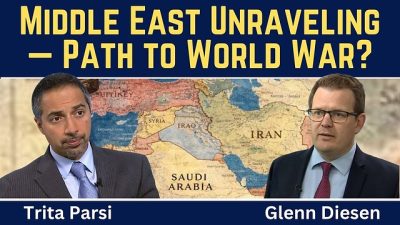
Trita Parsi: Middle East Unraveling — Are We on the Path to World War?
or go to
Aletho News Archives – Video-Images
New Book
Trans agenda is ‘normalization of sadism’ – US author

RT | September 23, 2026
The US Democratic Party has embraced a transgender agenda that amounts to “the normalization of sadism,” author A.J. Rice has said, warning that radical trans policies would return if the party is allowed to regain power.
Speaking to RT’s America First host Scotty Nell Hughes about his new book, ‘The Curse of the Bearded Lady: How the Trans Mafia Whacked American Sanity’, Rice argued that activists have gained significant influence in schools, medicine, and corporate America while people who questioned the agenda have faced pressure to stay silent.
The author described the “trans mafia” as the sprawling network of people and institutions that have helped the movement gain influence. He singled out parts of academia, wealthy backers, and corporations, and stated that providers of transition-related treatment also have a financial incentive to keep young people in their care indefinitely.
Rice argued that the consequences of these policies ultimately fall on children who are being drawn toward gender-affirming medical treatments and on girls who are expected to share locker rooms or compete in sports with biological males.
He noted that while voters rejected the Democrats’ approach to gender in 2024, the party, which has been “captured by madness,” has since only doubled down and is seeking what is effectively “the normalization of sadism.” … Full report
Blog Roll
 Aletho News
- Integrity Initiative: UK-funded network framed dissent as Russian disinformation for years
- ‘We don’t seek permission to defend our country’: Snippets from President Pezeshkian’s UNGA address
- NATO chief wants Europeans to fight American wars [for Israel]
- German chemicals giant reveals details of downsizing
- Refaat Al-Areer Was The Canary In The Coal Mine In Israel’s War On The Truth
- Israeli election committee bars candidate from Knesset race over Gaza war opposition
- French-Lebanese man files war crimes complaint over Israeli attacks
- Mahan Air Flight Lands in China Despite US Threat against Iranian Airlines
- US eyes $10bn fund to rebuild war-battered Gulf infrastructure
- Trump meets Rodríguez near Maduro’s prison as Venezuela’s oil flows to US
- If Americans Knew
- Caught on Tape: AIPAC CEO Boasted of Controlling Trump’s National Security Officials
- Why Hamas Attacked Israel in October 2023 – Israeli professor Ilan Pappé
- They see them, then kill them: Israeli quadcopters track, deliberately target civilians in Gaza
- Winter could turn Gaza’s treacherous, war-damaged buildings into deathtraps
- Majority of Democratic Voters Want to Prosecute Both Biden and Trump Administration Officials Over Gaza
- As Gaza languishes, world leaders gather at the UN – Daily Update
- Sanctions are collective punishment: immoral and self-defeating
- Phosphorus Munitions Fired by Israel Burn Groves, Orchards in Southern Lebanon
- Israel Carries Out New Ceasefire Violations Across Gaza
- AI – Emphasis on the ‘I’: Israel Is Funding AI Chatbot Propaganda
- No Tricks Zone
- New Study: Earth And Venus Surface Warmth Largely Explained By Convection And Lapse Rate, Not CO2 Or Radiation
- 2025 Nature Paper Claiming Worsening Global Drought Gets RETRACTED …Heavily Flawed
- New Study: ‘Global Drought Shows No Detectable Recent Acceleration Under Climate Warming’
- Economic Masterminds: German Socialists Suggest Taxing Productivity Gains Stemming From Using AI
- The South China Sea Has Not Been Cooperating With The Climate Change Narrative
- Energy Crisis: Germany Enters Heating Season With Historically Low Gas Reserve Fill Levels
- New Study: The Antarctic Ice Sheet Gained Mass From 2020-2024 Due To Staggering Snow And Ice Accumulation
- Study: Ocean Heating Rates From Thousands Of Years Ago ‘Dwarf’ Modern Ocean Heating Rates
- Climate Extremists Target, Attack Large-Scale Power Grid Infrastructure In Germany!
- New Study: Antarctic Ice Melt Has Contributed Less Than 1 Centimeter To Sea Level Rise In The Last 30 Years

