Russia: US trying to demonize Iran missile program
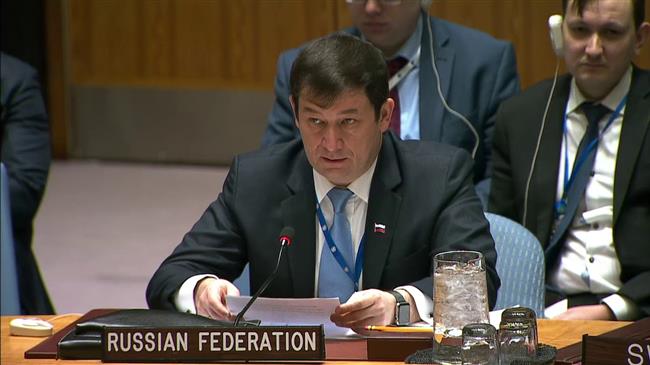
Dmitry Polyanskiy, Russia’s chargé d’affaires to the United Nations
Press TV – December 6, 2019
Russia’s mission to the United Nations says the US continually tries to demonize Iran’s missile activities despite lack of any damning evidence against the Islamic Republic’s defensive activities, and while Washington itself is in default of several international non-proliferation agreements.
Dmitry Polyanskiy, Moscow’s chargé d’affaires to the world body, addressed the remarks to the UN Secretary-General António Guterres in a letter dated November 26 that was made available on Friday.
He reminded that Iran was a signatory to many multilateral non-proliferation mechanisms, including the nuclear Non-Proliferation Treaty (NPT) and the Joint Comprehensive Plan of Action (JCPOA). The latter agreement came about in 2015 between the Islamic Republic and the P5+1 group of states — the United States, the UK, France, Russia, and China plus Germany, lifting nuclear-related sanctions against Tehran, which, in turn, voluntarily changed some aspects of its nuclear energy program.
Washington has, on numerous occasions, accused Tehran of developing nuclear-capable missiles, despite Tehran’s outright rejection of nuclear weapons of all type, and its observance of the JCPOA, which prohibits it from pursuing such armaments.
The Russian official highlighted “the complete lack of evidence that Iran is developing or producing a nuclear weapon or means of its delivery or is deploying any infrastructure for the storage or servicing of nuclear weapons.” He further endorsed the Islamic Republic’s continued commitment to the nuclear deal as verified by Tehran’s “refraining from activities related to ballistic missiles that are designed to be capable of carrying nuclear weapons.”
Nor has the UN Security Council, which has endorsed the JCPOA in the form of Resolution 2231, received any “viable information to the contrary,” Polyanskiy asserted.
However, he stated, the US would keep trying to implicate Iran in nuclear arms-related activities by, among other means, citing the Missile Technology Control Regime (MTCR). This is while the MTCR is an informal political understanding between 35 states on export control issues, and could not be deployed as a universal legally binding instrument or used in the context of Resolution 2231 to try and incriminate Iran’s missile activities, the envoy added.
Washington was on the offensive against Iran, while itself left the JCPOA last year “in violation of Article 25 of the United Nations Charter,” and is preventing other states from implementing it, Polyanskiy added. After leaving the deal, the White House returned its sanctions against Tehran, and also started pushing other JCPOA members into abiding by the American bans.
The Russian envoy also reminded how America left the Intermediate-Range Nuclear Forces (INF) Treaty with Moscow earlier this year, and was undermining efforts aimed at creating a Middle East region free of nuclear arms. He was referring to the US’s using its veto power at the UN in favor of Israel, which is the sole nuclear armed power in the region and has refused to join the NPT.
Iran’s FM Javad Zarif Claims Israel Tested Nuke-Missile ‘Aimed at Iran’
Sputnik – December 6, 2019
The Defence Ministry of Israel announced in the early hours of Friday morning that it had tested a new rocket propulsion system at a an airbase in the central part of the country, as part of a missile defence modernization plan.
Minister of Foreign Affairs of Iran, Mohammad Javad Zarif, commented on Friday on the recent test by the Israeli defense establishment of what has been described as a rocket propulsion system.
Zarif noted that the United States, along with the three European members of the Iran nuclear deal – officially known as the Joint Comprehensive Plan of Action (JCPOA), have never complained of the Israeli nuclear arsenal, the only nuclear arsenal in the region, although Tel Aviv has missiles that are “DESIGNED to be capable of carrying nukes”.
Earlier on Friday, Israel’s Ministry of Defence tweeted that its defence establishment had carried out a test of a rocket propulsion system from the Palmochim military base, located south of the nation’s capital city of Tel Aviv.
The tested missile propulsion system is reportedly capable of launching defence or attack payloads with a range of up to 2,000 kilometers. It is also said to be capable of carrying nuclear warheads, according to Tel Aviv’s news channel i24 News.
After the US unilaterally left the JCPOA in May 2018, Washington has since been waging a “maximum pressure” campaign against Tehran, claiming that the Islamic republic’s rocket program, alongside Iran’s alleged nuclear ambitions, represent a “threat” to the region. Under this pretext, the Trump administration has introduced multiple sanctions against the government in Tehran and against several senior officials, including Zarif.
Iran has repeatedly denied accusations regarding its intentions to obtain nuclear weapons, continuing to abide by the nuclear deal and urging European signatories to ensure its interests amid reimposed US sanctions, particularly through a partial withdrawal from some of the original commitments under the JCPOA.
Iranian Unrest: Cover-Up Of Mass Killings Or Infowar Conspiracy?
By Andrew Korybko | December 5, 2019
The Mainstream Media is pushing forth the weaponized narrative that the Iranian government is carrying out a cover-up of mass killings that supposedly occurred during its recent unrest, though this is nothing more than an infowar conspiracy.
Amnesty International scandalously cited unpublished and vaguely described “credible reports” to claim that over 200 people were killed during Iran’s recent unrest, adding that “the real figure is likely to be higher”. This accusation is part and parcel of the renewed Hybrid War on Iran that’s seeking to capitalize on the failed Color Revolution attempt from last month when tens of thousands of people took to the streets to protest the government’s decision to decrease fuel subsidies in order to fund a cash payment plan to the country’s most needy families. It should be said that the majority of the people who participated in these large-scale protests didn’t engage in acts of violence, but their presence at these events inadvertently served as cover for a select cadre of professional provocateurs and foreign intelligence agents to carry out attacks against law enforcement officers and public property by exploiting those people as human shields behind which to hide.
As the author wrote at the time, “Iran’s Protests Are Grassroots, Not Foreign-Driven, And That’s The Real Problem”, while also later warning in an exclusive interview with Iran’s “Young Journalists Club” that Iran is being victimized by a US Hybrid War. These two analyses might initially seem mutually exclusive but they aren’t. Legitimate grievances served to spontaneously bring a critical mass of protesters into the streets, during which time the vast majority of the participants were unwittingly turned into human shields by Hybrid War “sleeper cells” that were waiting for an opportunistic moment to carry out anti-state terrorist activities such as the ones that were previously described. The Iranian authorities ultimately prevailed in restoring law and order, though it’s presumed that some of the most radical provocateurs might have been injured or even killed throughout the course of these security operations, which could naturally occur in any country facing similar unrest.
The US and its regional allies who support the forces responsible for the recent violence desperately wanted to film, selectively edit, and then propagate decontextualized footage of those individuals clashing with the state so that they could then present this as so-called “evidence” that Iran is “killing unarmed protesters”, hoping that this infowar conspiracy would make the majority of the non-violent citizens that participated in the protests suspicious of the state as well as further discredit the country’s international reputation. That plan failed, so now the back-up one is to still make this claim regardless of any fabricated “evidence” and strongly hint that the reason that there isn’t any is because Iran cut off the internet during its “crackdown”. While criticized by some at the time, it was actually a very wise move for the state to do so in order to offset the exact same scenario that was just described, though it unwittingly fed into the US’ back-up infowar narrative.
Even so, that doesn’t mean that it was the wrong thing to do since the benefits of preventing further provocations during that very sensitive time far outweigh the “costs” of having Iran’s adversaries conspiratorially claim without any fabricated “evidence” that the security forces “killed hundreds of innocent protesters”. In terms of the bigger picture, it’s much better to decisively nip the Color Revolution unrest in the bud and deal with unsubstantiated claims from self-interested international forces than to be too afraid of being criticized for cutting off the internet and then having to face the consequences of those same actors fabricating “evidence” to back up their preplanned provocative claims that “hundreds of innocent protesters were killed”. Considering all of this, there isn’t any credence to the West’s accusations that Iran is carrying out a cover-up of mass killings during its recent unrest as these claims are nothing more than an infowar conspiracy.
Bilateral trade relations between Iran and EU suffer under harsh US sanctions
By Sarah Abed – December 2, 2019
Trade between the European Union (EU) and the Islamic Republic of Iran has dropped roughly 74.92% percent this year from January to September compared to last year during the same timeframe, due to US-imposed sanctions, according to the European statistical office. The top three trading partners in the European bloc were Germany, Italy, and the Netherlands. Analysts at the European Council on Foreign Relations have described the US’s secondary sanctions as abuse of its global financial dominance.
Iran’s commodities exports have fallen 94% and imports have declined 51.15%. Before the sanctions, the EU was Iran’s main trading partner, but now China and the United Arab Emirates have risen to the first and second slots respectively.
While most discussions regarding Iran and EU trade relations center on oil, a crucial indicator of Europe-Iran trade relations lies in European technology and the billions of dollars’ worth of European parts, machinery, and transport equipment exports, which play an important role in Iran’s industrial sector and economy.
In May 2018, the United States unilaterally withdrew from the 2015 Joint Comprehensive Plan of Action (JCPOA) complaining that the deal didn’t curb Iran’s nuclear capabilities but Europeans and the International Atomic Energy Agency (IAEA) have repeatedly confirmed that the nuclear deal was working and that Iran was in compliance. Since then the remaining five world powers who signed the nuclear deal with Iran, namely the UK, France, Russia, China, and Germany have tried to keep the nuclear deal alive by urging the United States to return to the deal and lift the harsh sanctions.
Immediately after leaving the nuclear deal, the United States reinstated crippling sanctions under its “maximum pressure campaign” with the goal of bringing about “regime change” while reducing Iran’s oil exports to zero.
Iran patiently waited for over a year for the United States to either return to the deal or for European nations to ease their suffering. France advocated for a $15 billion dollar line of credit and an EU Instrument for Supporting Trade Exchanges commonly referred to as INSTEX, became “operational” in June of this year, but hasn’t offered Iran any relief yet.
INSTEX was created to circumvent Washington’s sanctions as a payment channel with the UK, France, and Germany to help Iran continue to trade. The exchange of goods is allowed without requiring direct transfers of money, serving as a diplomatic shield. Good intentions aside, it’s been useless.
Sweden, Norway, the Netherlands, Finland, Denmark and Belgium announced on November 29th that they are in the process of becoming shareholders in INSTEX, in order to support the JCPOA and the economic parts of it and facilitate legitimate trade between Europe and Iran. A joint statement of support for the preservation and full implementation of the JCPOA was made. They reiterated that the nuclear agreement was unanimously endorsed by the UN Security Council and is an instrumental tool for global non-proliferation and stability in the region.
Unfortunately, neither the line of credit nor INSTEX have been properly implemented yet. With no relief in sight and economic conditions worsening, Iran started to scale back on its commitments under the JCPOA, thus far it has taken four such steps and has vowed to continue to scale back its obligations every sixty days, until there’s a solution.
For almost three decades the United States was Iran’s main military and economic partner and played an important role in its infrastructure and industry modernization, from 1950 until 1978. All of that ended when the US-backed Shah of Iran Mohammed Reza Pahlevi was forced to step down during the Iranian Revolution in 1979. And that’s when the United States cut economic and diplomatic ties, froze billions of dollars of assets, and banned Iranian imports.
Iran is the world’s third largest consumerer of natural gas after the United States and Russia, and a major oil exporter since 1913.
Iran’s economy is dominated by oil and gas production, ownership of 10% of the world’s proven oil reserves and 15% of its gas reserves have earned Iran recognition as an energy superpower. This of course puts a huge target on its back for US imperialism and intervention.
Since mid-2018 US sanctions have been placed on Iran’s oil sales, banking transactions, metals trading, petrochemicals, shipping etc. and as a result, Tehran was forced to raise oil prices on November 15th by fifty percent and impose a strict rationing system. Soon after, protests erupted and at least eight people linked to the U.S. Central Intelligence Agency (CIA) were arrested by Iranian security agents.
Although trade has significantly decreased Washington’s attempts to destroy Iran’s economy, bilateral attempts to improve and normalize Iran-EU trade relations have fallen short. If successful, Washington would benefit from increasing its own oil and commodities trade, while hurting economic ties between Iran and EU.
US harassing Iran on behalf of Israel
Press TV – November 25, 2019
A political analyst says the latest move by the US to call on social media networks to block the accounts of Iran’s leaders is part of Washington’s usual pattern of “harassing Iran on behalf of Israel.”
Brian Hook, special US representative for Iran, has recently urged Facebook, Instagram and Twitter to block the accounts of Iranian government leaders over an Internet blackout that began in the country following riots over fuel price hikes.
Tehran says it had to restrict access to the Internet to prevent “saboteurs” from using online services like navigation and maps to coordinate their activities in large cities across the country.
The government nevertheless has begun reestablishing Internet connectivity after around 100 of the ringleaders of the riots were apprehended.
In an interview with Press TV on Sunday, Walt Peretto said “this latest move by the State Department follows the usual pattern of the US harassing Iran on behalf of Israel and their New World Order overlords and the rest of global organized psychopathy.”
He said the US cannot invade “a nation like Iran that remains strong and independent,” so “instead, they harass them with rhetoric and propaganda, sanctions, nuclear agreements that they renege on.”
He went on to say that “hypocrisy and lies are as common as breathing with the officials in the State Department and White House.”
“On one hand the US has a mainstream media that is completely Zionist run, while independent sources of information particularly on social media and YouTube are harassed and often censored when truthful information becomes an irritant to the globalist overlords.”
“In the minds of the general public that receives its news and information from mainstream sources, the US is actually fighting censorship by reprimanding Iran for reacting in the way it chose in order to quell destructive protests, when in fact censorship is standard everyday practice in the US mainstream media and now harassment and censorship is increasingly becoming a problem with independent media based mostly on the internet. There is nothing that the globalist psychopaths fear more than the dissemination of the truth,” he stated.
US Federal Court Orders Tehran to Pay $180M to Washington Post Journalist – WaPo
Sputnik – 23.11.2019
Jason Rezaian, 43, the chief of The Washington Post’s Tehran bureau, was detained for over 18 months in Iran. along with his wife, who was released after two months of detention.
Washington DC federal Judge Richard Leon has ordered the government of Iran to pay Washington Post journalist Jason Rezaian and his family “compensatory damages” in the amount of $180 million, according to The Washington Post.
“Holding a man hostage and torturing him to gain leverage in negotiations with the United States is outrageous, deserving of punishment, and surely in need of deterrence”, the judge wrote in a 30-page ruling.
The federal judge distributed the amount between Rezaian and his family members as $23.8 million to the journalist in compensatory damages for pain, suffering, and economic losses; $2.7 million to his brother, Ali; $2.7 million to his mother, Mary; and $150 million for the whole family in punitive damages, according to WaPo.
Rezaian’s then-newlywed wife, fellow journalist and Iranian citizen Yeganeh Salehi, was not a plaintiff in the lawsuit against Iran, although she was detained together with her husband before being released after two months.
Rezaian, who served as The Washington Post’s Tehran bureau chief, was arrested on 22 July 2014 and was charged with espionage and three other security-related crimes, including “collaborating with hostile governments” and “propaganda against the establishment”. The administration of US President Barack Obama urged Tehran many times to free the journalist, accusing Iran of violating international law.
In 2015, Rezaian was sentenced to several years in jail after being indicted on all four charges, including espionage and propaganda against the establishment.
Rezaian, along with three other Americans, was released in January 2016 under a prisoner-swap deal with the United States, in exchange for seven Iranian-US nationals serving jail time in the US.
The swap agreement also envisaged that the international criminal police group Interpol would cease prosecuting 14 other Iranian nationals.
Following the prisoner swap exchange, The Wall Street Journal alleged that the US had paid a ransom for the US nationals, allegations that were denied by the Obama administration.
Who stands to gain from unrest in Iran?
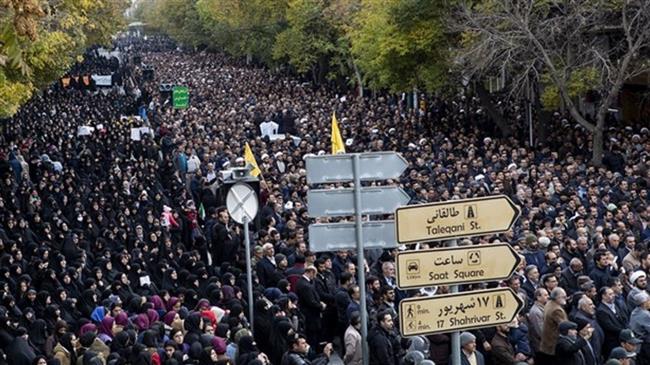
People rallied in the northwestern Iranian city of Tabriz to denounce the violent unrest in the country, Nov 19, 2019
By M. K. BHADRAKUMAR | Indian Punchline | November 21, 2019
I once had an animated conversation with the Middle East correspondent of a leading Indian newspaper regarding the resilience of the Iranian political system. The year was 2001. The conversation took place in the backdrop of mass protests and clashes between hard-liners and reformists on the the 22nd anniversary of the Islamic revolution in Iran. My friend forecast that the Iranian regime was in meltdown under the combined weight of US sanctions and a dysfunctional repressive regime. He point blank rejected my dissent that the stability of the Iranian system was not in doubt.
When it comes to Iran, everything depends on what prism you are holding. If you live in Dubai or visit Israel too often, you get one vision; if you live in Turkey, you get a vastly different view.
The recent days’ happenings fell into that familiar pattern. The protests were played up by the western media and American think tanks in apocalyptic terms, but when counter-demonstrations began appearing, supportive of the government, they have fallen silent. Life is returning to normal in Iran.
Two striking features must be noted. One, anti-government protests are possible to be staged in Iran; two, the regime enjoys a substantial social base. Unsurprisingly, when protests appear in Iran, democratic Turkey takes a balanced view while the repressive Saudi regime gleefully joins the western camp of ‘liberal democracies’ to pelt stones at the Iranian regime.
Isn’t there social and political discontent in Iran and Turkey? Indeed, there is. But representative rule provides safety valves and the political leaderships in Tehran or Ankara are receptive to popular opinion. Who would dispute that Hassan Rouhani and Recep Erdogan secured their mandates in hotly contested elections?
Can it be a coincidence that when the Iranian protests were raging in the past week, the US and Israel tested the waters, so to speak? The US aircraft carrier strike group Abraham Lincoln sailed through the strategic Strait of Hormuz on Tuesday. And Israel hit “dozens of targets” in Syria — in and around Damascus in Kiswa, Saasaa, Mezzeh military airport, Jdaidat Artouz, Qudsaya and Sahnaya — which it claimed were aimed at thwarting what Tel Aviv called Iran’s “military entrenchment” there and to block shipments of Iranian weapons to Lebanon’s Hezbollah movement.
Conceivably, these military operations would have needed some advance planning, especially the freedom of navigation exercised by the US aircraft carrier strike group through the narrow straits where Iran controls many of the shipping lanes. Yet, it happened just when the Iranian regime was preoccupied with the domestic unrest!
Again, President Trump notified the US Congress of his intention to step up military deployments in Saudi Arabia in the middle of the unrest in Iran. In the normal course, Tehran’s reaction would have been robust but, again, the US got away with it — for the time being, at least — as the Iranian regime and leadership has its hands full with internal developments. (Russia has warned that Washington’s plan for additional deployments of thousands of US troops to Saudi Arabia will only add to already simmering tensions in the Middle East region.)
The western narrative is that the unrest in Iran stemmed from economic factors at work triggered by the US sanctions. But, interestingly, the leading Israeli newspaper Haaretz has commented that “In the case of Iran, the headline figures about economic distress are misleading in critical ways. Iran is not quite the oil economy that, say, Saudi Arabia and the Gulf emirates are. Petroleum hasn’t accounted for more than a fifth of GDP and half of exports in the past, and it doesn’t employ a lot of people. So, while oil sanctions can inflict a lot of pain when they are first imposed, they don’t bring economic activity to a standstill.”
Haaretz points out, “Ironically, the non-oil sanctions may be giving the Iranian economy a small boost. Apart from oil, pistachios and carpets, Iran is not a globally competitive economy, but it does have a manufacturing and agricultural base… Iranian industry has the local market and is expanding output. As a result, manufacturing has been growing as has employment while the rial has stabilised… Media reports say there are plenty of ‘Made in Iran’ consumer goods on store shelves. The “resistance economy” may not be quite the miracle Tehran leaders tout, but it could be enough to stabilise the situation after the initial shock over oil sanctions have passed.
“Forecasts for the Iran going forward point in that direction. The World Bank, for instance, agrees with the IMF that Iranian GDP will contract sharply in 2019-2020 but afterwards start growing again.”
This analysis contradicts the western narrative that the Iranian people are up in revolt. Suffice to say, there is merit in the allegation by Iran’s top security officials that the protests have been actively orchestrated from abroad.
While addressing a cabinet meeting in Tehran on Wednesday, President Rouhani was explicit. The Iranian foreign ministry made a demarche with the Swiss embassy in Tehran, which represents Washington’s Interest Section, regarding US interference in the country’s internal affairs.
With eye on India, Pakistan strengthens military ties with Iran
By M. K. BHADRAKUMAR | Indian Punchline | November 20, 2019
he low-key coverage by the Pakistani media on the 2-day visit of the army chief General Qamar Bajwa to Iran notwithstanding, the event signifies a surge in the tempo of ‘mil-to-mil’ exchanges between the two countries.
The Iranian side gave the event a distinct political colouring with the Pakistani COAS having meetings with President Hassan Rohani, Foreign Minister Mohammad Javad Zarif and the Secretary of the Supreme National Security Council Ali Shamkhani, apart from talks with his host, Chief of Staff of the Iranian Armed Forces Major General Mohammad Hossein Baqeri.
Border security and counter-terrorism are key issues for Iran. But Gen. Bajwa’s talks extensively covered regional developments and even dwelt on the two countries’ “coordination on the major issues of the Muslim world”.
The Iranian reports did not make any references to the Kashmir issue or India-Pakistan tensions, but it is inconceivable that Gen. Bajwa sidestepped the topic.
In fact, even as Gen. Bajwa headed for Tehran on Monday, Pakistan conducted a training launch of the surface-to-surface ballistic missile Shaheen-1, a day after India conducted the first night trial of its Agni-II missile.
The Iranian news agency IRNA took note that the launch of Shaheen-1 “aimed at testing operational readiness of Army Strategic Forces Command, ensuring Pakistan’s credible minimum deterrence.”
The Pakistani army spokesman tweeted that Gen. Bajwa discussed with Rouhani the “regional security environment and matters of mutual interest”. According to the Iranian agency IRNA, Gen Bajwa told Rouhani that Pakistan was prepared to strengthen bilateral relations “in all spheres”.
Rouhani in turn hailed Pakistan’s role towards regional peace and called the relations between the two Muslim nations as “an invaluable asset” which should be used to further boost mutual cooperation.
Iranian reports quoted Gen. Bajwa as saying Pakistan and Iran face “common threats and have common interests”, calling for close cooperation and interaction.
An IRNA commentary said, “In recent years, Tehran and Islamabad have witnessed high level exchanges from top military officials and the recent visit of Pakistan Army Chief to Iran demonstrates the commitment of the two sides to consolidate defense ties through active diplomacy.”
The semi-official Fars agency reported that Gen. Bajwa and Gen. Baqeri discussed “different issues ranging from security partnership, regional developments and maintaining stable security at the regional level” and “explored avenues for bolstering and reinvigorating defence relations”.
Notably, Admiral Shamkhani, who reports to Supreme Leader Ali Khamenei, called for “all-out expansion of ties” with Pakistan “in a bid to provide regional security.” Equally, Foreign Minister Zarif and Gen. Bajwa “discussed a broad range of issues, including the political, economic and military relations” between Iran and Pakistan as well as “regional cooperation and the ongoing developments in the region, including the situation in Afghanistan.”
Without doubt, the Iranian reports uniformly underscored Tehran’s high expectations that a new phase of Iran-Pakistan relations may be commencing.
Gen. Bajwa’s visit tops up an intensification of high-level exchanges between the two countries during the past two-year period since his pathbreaking trip to Iran in 2017, which was the first by a Pakistani COAS in over two decades.
During the 2017 visit, Gen. Bajwa had told Rouhani that Pakistan was determined to expand its ties with Iran in all spheres and hoped that the two neighbours could collaborate for regional peace and security. To be sure, the shifts in the geopolitics of the region acted as catalyst in injecting new verve into the relationship.
Principal among them would be Delhi’s ‘pivot to Saudi Arabia’ in its Gulf strategy, markedly deviating from the traditional course of walking a fine line in the intra-Gulf discords and rivalries from a standpoint of benign neutrality.
Even as US-Iranian tensions began accelerating, the Modi government unceremoniously complied with Washington’s diktat to roll back ties with Iran by terminating all its oil imports from that country. The pusillanimous attitude of the self-styled nationalist leadership in Delhi took Tehran by surprise.
Tehran put its deep disappointment on display once it became apparent that the Modi government retracted even from its commitments at the highest level of leadership to cooperate with Iran on the development of Chabahar Port, which was a key underpinning of regional connectivity and security linked to the stability of Afghanistan. (See my column in Rediff, Why Iran is upset with India.)
The Indian U-turn on Chabahar has come to symbolise the phenomenal shift in Indian regional policies in the direction of harmonising with the US strategy at a critical juncture when Washington’s maximum pressure approach is fuelling tensions in the Gulf and leading to a steady augmentation of the American military deployments in Saudi Arabia that could well be the prelude to confrontation with Iran.
The unkindest cut of all is that Iran’s Sistan-Baluchistan province is also targetted by terrorist groups that are allegedly backed by Saudi Arabia. Tehran senses that the Modi government is inexorably gravitating toward the US-Israeli-Saudi axis, jettisoning India’s traditional independent Gulf policies.
The ardour of PM Modi’s personal friendships with the Saudi Crown Prince Mohammed bin Salman and Israeli PM Benjamin Netanyahu must have set alarm bells ringing in Tehran.
On the other hand, Pakistan is closely gauging the downhill slide in the India-Iran relationship and estimating that the 40-year old Indian strategic embrace of Iran as a “second front” is ending. Meanwhile, for the first time since the Islamic revolution in in 1979, Iranian leadership is appreciating Pakistan’s independent foreign foreign policies.
Tehran would estimate that conditions are getting ripe for a breakthrough in Pakistan-Iran military cooperation. Importantly, the UN’s five-year time frame for embargo on arms trade with Iran expires next year, while the eight-year limit on Iran’s missile activities ends in 2023. (See a recent IRNA commentary titled JCPOA, Sunset Clauses and struggle of Americans.)
Of course, Tehran’s willingness to support Pakistan on the Kashmir issue could be the ultimate clincher.
In geopolitical terms, Iran’s overarching foreign-policy agenda of Eurasian integration brings Tehran and Pakistan more or less onto the same page in regional politics.
Zarif acknowledged at a recent meeting in Tehran with a group of visiting Indian writers and journalists that US economic and political actions had created “an understanding” between China, Russia and Iran “that we’re all (US) targets” and there was “a commonality being felt” by the leaderships of the three countries. Of course, Islamabad is well aware of it, having been a “target” itself.
Tehran loses patience with Modi government’s hide and seek
By M. K. BHADRAKUMAR | Indian Punchline | November 18, 2019
Historically speaking, the India-Iran relationship had its ups and downs during the decades of the Shah’s rule. The Lowest point was reached when, during the 1965 and 1971 wars with India, Pakistani Air Force jets were stationed in Iran to gain ‘strategic depth’ vis-a-vis the IAF.
However, after the 1979 Islamic revolution, Iran adopted an explicitly anti-Western foreign policy and began viewing India as a natural ally. The ideology-based regime rooted in the principles of justice, freedom and resistance was greatly attracted by India’s freedom struggle, non-aligned policies, and the sheer grit to preserve its strategic autonomy. This perceived affinity withstood the changes and shifts in Delhi’s foreign policy outlook in the post-Cold war era.
Tehran was not unduly perturbed when the India-US relationship took an upward curve in the nineties during the Bill Clinton administration or when the 2008 nuclear deal was concluded — or, even when Washington and Delhi began chanting their ‘defining partnership of the 21st century’ during the Barack Obama Administration.
Tehran remained confident about India’s DNA anchored on the country’s strategic autonomy. This confidence took a beating when India voted for the first time in February 2006 in favour of a West-led resolution in the International Atomic Energy Agency (IAEA), which reported against Iran to the UN Security Council — and, again, in November 2009 when India voted in favour of a resolution spearheaded by the US at the IAEA censuring Tehran over its controversial nuclear programme and demanding that it stop uranium enrichment.
Nonetheless, life moved on. There was no apparent rancour. This much needs to be recalled to put in perspective the highly critical remarks by Iran’s foreign minister Mohammad Javad Zarif recently, while meeting a group of visiting journalists from New Delhi, regarding the Modi government’s pusillanimous attitude under American pressure to roll back cooperation with Tehran.
Zarif said Tehran had expected the Modi government to be “more resilient” in the face of Washington’s bullying. Zarif speculated that India probably “did not want to agitate” the US by being a sanctions spoiler and he added with biting sarcasm, “People want to be on the right side of President Trump” but the problem is “he hasn’t got a right side.”
Equally, Zarif regretted that the Modi government was dragging its feet on the Chabahar Port project, which has far-reaching implications for regional connectivity, stability and security.
Iranian state media widely reported Zarif’s remarks, which most certainly reflect deep misgivings at the highest level of the Iranian leadership that India’s capacity or political will to pursue independent foreign policies is increasingly in doubt.
To be sure, Zarif’s remarks must also be seen in the backdrop of the Modi government’s fawning attitude toward Saudi Arabia lately. There is no empirical evidence to suggest that Riyadh laid pre-conditions for Crown Prince Mohammed bin Salman’s embrace of PM Modi. In fact, Saudi-Iranian rivalry is far too complex to be reduced to zero-sum mindset. After all, Riyadh is robustly advancing cooperation with Russia and China despite these two countries having thriving strategic partnerships with Iran.
Indian analysts tend to link the Modi government’s dalliance with Saudi Arabia and the deepening chill in Indian-Iranian relations. Indeed, the Modi government has relegated cooperation with Iran to the back burner. It is no secret of course that Washington encourages third countries to replace Iranian crude with Saudi supplies.
The Modi government is pinning hopes on massive Saudi investments in India. During the Crown Prince’s visit to India in February, he forecast Saudi investments to the tune of $100 billion during the next two-year period. The Indian side has been daydreaming since then about big Saudi investments in the Ratnagiri petrochemical project and in Reliance Industries. While the Ratnagiri project is in limbo, Reliance is keeping its fingers crossed. Modi’s recent visit to Saudi Arabia can be viewed in this context.
How realistic are the Indian expectations? Clearly, Saudi Arabia itself needs to attract outside investment. Lackluster oil prices have caused the country’s budget deficit to widen. The budget deficit would be in the region of $36 billion in 2018 and 2019, and may widen to $50 billion in 2020. Saudi Aramco’s IPO itself is for raising money for funding the Crown Prince’s ambitious program of economic and social reforms (‘Vision 2030’).
CNBC recently featured an interview with ex-CIA chief General David Petraeus (who presently heads the KKR Global Institute, which provides consultancy to American companies active in the Middle East) regarding Saudi Arabia’s economic malaise. Some excerpts are worth noting:
“It’s a fact that Saudi Arabia is gradually running out of money, they’d be the first to acknowledge that the sovereign wealth fund has been reduced, it’s somewhere below $500 billion now.”
“The (budget) deficits each year, depending on the price of Brent crude, can be anywhere from $40 to $60 billion depending on some of their activities in countries in the region.”
“The bottom line is that they need the money, they need that outside investment that is crucial to delivering ‘Vision 2030’ which cannot be realized without outside investment, this is just one component of a number of different initiatives that they’re pursuing to try to attract that outside investment.”
The prospects aren’t bright for Reliance and Ratnagiri to pin hopes on Saudi investment. The Crown Prince’s priority is ‘Vision 2030’ — and it remains a hard sell. Period.
Put differently, neglecting India’s cooperation with Iran, especially Chabahar Port development, for the sake of a chimerical Saudi bonanza can only find the Modi government falling between two stools eventually. India cannot, should not and need not substitute Saudi Arabia as a preferred partner to Iran — or vice versa.
Why keep at arm’s length a regional power in our extended neighbourhood who is manifestly eager to foster cooperation with India? Such an attitude is illogical, myopic and cramps India’s diplomatic options in the Persian Gulf.
Iran is winning strategic struggle for influence, even as US cripples its economy
By Darius Shahtahmasebi | RT | November 8, 2019
A new report has confirmed what some analysts have been saying for some time: that Iran is winning the regional struggle for strategic influence.
The 217-page report, published by the London-based International Institute for Strategic Studies (IISS), is entitled “Iran’s Networks of Influence in the Middle East” and details Tehran’s use of proxy forces and networks throughout the region and the effects and benefits of its “minimum output” foreign policy strategy.
It is probably worth mentioning at this point that H.R. McMaster, Trump’s former national security adviser, was once an employee of the IISS. As was James Steinberg, a former US deputy secretary of state. Furthermore, at the end of 2016, the Guardian revealed that the organization had received £25 million ($32 million) from the Bahraini royal family (apparently almost half of its total income has come from Bahrain). Iran and Bahrain aren’t exactly close friends.
Notwithstanding the potential motives and bias of the IISS, the report definitely arrives at some interesting conclusions.
“The Islamic Republic of Iran has tipped the balance of effective force in the Middle East in its favor,” the report explains.
But here’s the crazy part. Iran is, and has been for years, completely pummeled to the ground by US-imposed sanctions. Many commentators have for some time now been predicting an impending collapse of the Iranian economy.
On top of that, and likely because of this fact, Iran’s military budget has consistently been low (especially when compared to the United States or any of Washington’s major allied powers in the region). This flies completely in the face of allegations that Iran is a regional aggressor and the number-one state sponsor of terrorism (with what money?), but don’t let this get in the way of a good story.
According to the US Defense Department’s annual review of the country, “Iran’s military doctrine is defensive. It is designed to deter an attack, survive an initial strike, retaliate against an aggressor, and force a diplomatic solution to hostilities while avoiding any concessions that challenge its core interests.”
In other words, despite being under the constant threat of war, whether from the US, Israel or Saudi Arabia, Iran is not looking for a fight. It maintains a much lower military expenditure than Saudi Arabia, Israel, and especially Washington, yet as the recent IISS report notes, it has emerged from the rubble of a war-torn Middle East region as a victor.
As Foreign Affairs (the Council on Foreign Relations’ magazine) explained in a recent article:
“Iran now enters its second year under maximum pressure strikingly confident in its economic stability and regional position.”
It is likely with this newfound confidence that Iran is beginning to dictate some shots of its own to the international community, particularly when it comes to the future of uranium enrichment. Foreign Affairs also explains that Iran has essentially weathered the storm of US sanctions and come up trumps all on its lonesome. Many of the people predicted to come to Tehran’s aid during the United States’ maximum pressure campaign have been nowhere to be seen.
According to the IISS report, Iran has been winning the regional geopolitical struggle for influence by developing asymmetric warfare, such as swarm tactics, drones and cyber-attacks. It has relied upon the Quds arm of the Islamic Revolutionary Guard Corps (IRGC) to increase its operations throughout the Middle East, as well as to provide training, support and weapons to other actors allied to Tehran. The report also notes Iran’s relationship with Hezbollah, its role in the conflicts in Iraq and Syria, as well as its role (supposedly) in Yemen.
As my Kung Fu instructor once told me, you serve yourself in a confrontation best by using minimum output for maximum gain. Winning the lottery doesn’t entail that you then go to a casino and put all your money down on your first gamble. Just because you have it, doesn’t mean you have to expend it.
In comparison, Saudi Arabia has expended time, effort, billions of dollars and the lives of many innocent civilians waging a genocidal war in Yemen – and it’s still losing. As Bloomberg once explained:
“Saudi Arabia has better weapons than its enemies in Yemen, no surprise in a war that pits one of the richest Arab countries against the poorest. And still the Saudis are struggling to impose their will.”
Not only is it losing a war, it’s also losing an economic battle. At the beginning of the conflict, Reuters estimated that the war would cost Saudi Arabia approximately $175 million per month. However, even by the end of the first year of the war, the kingdom had to increase its defense spending by $5.3 billion. This trend has continued right throughout the conflict. At the end of 2016, Saudi Arabia had to announce a projected increase of 6.7 percent in defense spending for 2017, bringing its total budget to around $50.8 billion.
If the IISS report’s findings are correct, there may be a deep lesson in here for the US and its allies. Perhaps it’s not that Iran has emerged victorious despite the fact it has not spent billions of dollars invading other nations at any one time; but because it hasn’t been.
At the end of the day, how much influence can you exert when you forcibly invade, occupy and kill those countries you seek to influence?
Israeli ministers moot war scenario with Iran: Ex-envoy
Press TV – November 6, 2019
Israeli ministers have reportedly held several meetings to review the likely scenario of a potential war with Iran, with the participants speculating that the Islamic Republic could deal paralyzing blows to the regime in the course of such a confrontation.
The meetings, two of which were held last week, discussed potential lead-ups and aftermath of a conflict, with Michael Oren, a former Israeli ambassador to the US, allegedly unveiling contents of the discussions in an opinion piece carried by The Atlantic on Monday.
Titled “The Coming Middle East Conflagration,” the feature claimed the ministerial gatherings had concluded that “fighting could break out at any time” by “a single spark.”
‘Dangerous Israeli miscalculation’
The Israeli ministers suspected that a conflict could come as a result of an “Israeli miscalculation,” such as erringly hitting “particularly sensitive targets” in the countries where the Islamic Republic provides advisory support against terrorists such as Iraq and Syria.
“The result could be a counterstrike by Iran, using cruise missiles that penetrate Israel’s air defenses and smash into targets like the Kiryah, Tel Aviv’s equivalent of the Pentagon,” Oren wrote. “And then, after a day of large-scale exchanges, the real war would begin,” he went on.
‘4,000 projectiles to rain on Israel’
The article said such a war triggered by Tel Aviv’s blunder could see as many as “4,000” projectiles being rained down on Israel every day, with the regime’s so-called Iron Dome missile system liable to miss 10 percent of them.
“All of Israel, from Metulla in the north to the southern port city of Eilat, would be in range of enemy fire,” the former official noted.
That threat, the piece added, is eclipsed by the one posed by Iran’s surgical and long-range missiles such as “the deadly Shahab-3” — which would reach Israel “from Syria, Iraq, Yemen, and Iran itself.”
Those missiles “a growing numbers of which are in Iranian arsenals, pose a far deadlier threat,” Oren cautioned, highlighting how the projectiles can switch flight routes airborne.
“The David’s Sling system, developed in conjunction with the United States, can stop them—in theory, because it has never been tested in combat. And each of its interceptors costs $1 million. Even if it is not physically razed, Israel can be bled economically.”
Oren said those missiles can reach Israel directly from Iran, while the Israeli Air Force itself lacks the type of strategic bombers, which are capable of flying as far as the Islamic Republic’s territory.
‘Israel to be paralyzed’
The former envoy also said in detail how a potential war could cripple Israel by killing international flights, shutting down lifeline ports, putting out the electrical grid, overwhelming hospitals, and sending millions into shelters.
The situation, he added, would only be compounded after “the skies darken with the toxic fumes of blazing chemical factories and oil refineries.”
Tel Aviv’s response would, meanwhile, see the regime attacking people in the Gaza Strip and Lebanon as well as other countries, which have been receiving the Islamic Republic’s support in the face of Israeli aggression, the article said.
This would face Israel with international repercussions, including by the United Nations and its legal arm, the International Criminal Court, it noted.
US support
However, Oren said the participants were wondering how the US, as a staunch ally of Israel, would respond to a potential war with Iran.
“And over all of them looms a pressing question: How will the United States respond?” he wrote.
These include stocking up and replenishing Israel’s ammunition stockpiles and shielding the regime at the UN by wielding its veto power, the piece concluded.
“Though the details remain top secret, the United States is clearly committed to helping protect Israel’s skies. Whether American troops would go on the offensive on Israel’s behalf, striking Iranian bases, remains uncertain,” the article concluded.
Featured Video
Trita Parsi: Middle East Unraveling — Are We on the Path to World War?
or go to
Aletho News Archives – Video-Images
From the Archives
Why Saudi Ties to 9/11 Mean U.S. Ties to 9/11
By Kevin Ryan | Dig Within | September 27, 2015
Media interest in Saudi Arabian connections to the crimes of 9/11 has centered on calls for the release of the 28 missing pages from the Joint Congressional Inquiry’s report. However, those calls focus on the question of hijacker financing and omit the most interesting links between the 9/11 attacks and Saudi Arabia—links that implicate powerful people in the United States. Here are twenty examples. … continue
Blog Roll
 Aletho News
- Integrity Initiative: UK-funded network framed dissent as Russian disinformation for years
- ‘We don’t seek permission to defend our country’: Snippets from President Pezeshkian’s UNGA address
- NATO chief wants Europeans to fight American wars [for Israel]
- German chemicals giant reveals details of downsizing
- Refaat Al-Areer Was The Canary In The Coal Mine In Israel’s War On The Truth
- Israeli election committee bars candidate from Knesset race over Gaza war opposition
- French-Lebanese man files war crimes complaint over Israeli attacks
- Mahan Air Flight Lands in China Despite US Threat against Iranian Airlines
- US eyes $10bn fund to rebuild war-battered Gulf infrastructure
- Trump meets Rodríguez near Maduro’s prison as Venezuela’s oil flows to US
- If Americans Knew
- Caught on Tape: AIPAC CEO Boasted of Controlling Trump’s National Security Officials
- Why Hamas Attacked Israel in October 2023 – Israeli professor Ilan Pappé
- They see them, then kill them: Israeli quadcopters track, deliberately target civilians in Gaza
- Winter could turn Gaza’s treacherous, war-damaged buildings into deathtraps
- Majority of Democratic Voters Want to Prosecute Both Biden and Trump Administration Officials Over Gaza
- As Gaza languishes, world leaders gather at the UN – Daily Update
- Sanctions are collective punishment: immoral and self-defeating
- Phosphorus Munitions Fired by Israel Burn Groves, Orchards in Southern Lebanon
- Israel Carries Out New Ceasefire Violations Across Gaza
- AI – Emphasis on the ‘I’: Israel Is Funding AI Chatbot Propaganda
- No Tricks Zone
- New Study: Earth And Venus Surface Warmth Largely Explained By Convection And Lapse Rate, Not CO2 Or Radiation
- 2025 Nature Paper Claiming Worsening Global Drought Gets RETRACTED …Heavily Flawed
- New Study: ‘Global Drought Shows No Detectable Recent Acceleration Under Climate Warming’
- Economic Masterminds: German Socialists Suggest Taxing Productivity Gains Stemming From Using AI
- The South China Sea Has Not Been Cooperating With The Climate Change Narrative
- Energy Crisis: Germany Enters Heating Season With Historically Low Gas Reserve Fill Levels
- New Study: The Antarctic Ice Sheet Gained Mass From 2020-2024 Due To Staggering Snow And Ice Accumulation
- Study: Ocean Heating Rates From Thousands Of Years Ago ‘Dwarf’ Modern Ocean Heating Rates
- Climate Extremists Target, Attack Large-Scale Power Grid Infrastructure In Germany!
- New Study: Antarctic Ice Melt Has Contributed Less Than 1 Centimeter To Sea Level Rise In The Last 30 Years

