Dissecting The Unfathomable American-Iranian War
By Ghassan Kadi | The Saker Blog | May 21, 2019
As the American military build-up continues around the Strait of Hormuz, and as a potential American-Iranian war looms, many analysts are convinced that war is imminent. I beg to differ.
Ever since the “War on Syria” started, I kept reiterating that America would never launch a full-on attack on Syria, and for very good reasons, and not long ago, I finally felt compelled to write a series of articles explaining that in as much as America would love to be able to pillage Syria, it is unable to do so.
Those predictions, which stood the test of time, were made long before the Russian involvement in Syria, and now, after Syria’s triumph, the chances of a decisive victory that America is able to score by way of a military gamble anywhere in the Middle East have been shrinking and reduced to the level of zero chance. If anything, the “War on Syria” was the surrogate war that America could not launch directly either on Syria or on Iran, and even by turning its war into a war by proxy, America was still unable to win.
To recap briefly, some obstacles that stood against an all-out American NATO-led assault on Syria back in 2013, I argued that America would never risk a retaliatory attack against Israel by both Syria and Hezbollah.
An American attack on Iran will not eliminate the risk of a Hezbollah retaliatory attack on Israel, and if anything, it will bring in a new risk; the risk of a retaliatory Iranian attack on Saudi soil.
Whether or not an American-Iranian show down will directly involve Saudi troops, given that Saudi Arabia is still unable to win in its war against Yemen, even though it has the third largest military budget after the USA and China, a direct Saudi role will have little in effecting any significant input. However, with or without a direct Saudi intervention, an American attack on Iran will immediately put American interests in Saudi Arabia under the Iranian target list.
In the event of such an attack, the first thing that Iran will do is close marine traffic in the Strait of Hormuz. As a result, the whole world will be affected and the price of a barrel of oil may jump to $200 and beyond, but the relevant issue here is the impact on the feasibility of American military success.
An American attack on Iran cannot be seen as an event that is independent from the wars on Syria and Yemen. It will be seen as an upscaling that directly involves Iran. Any such turning point will sooner or later involve Saudi Arabia directly. And given that Iran will more than likely close the Strait of Hormuz and thereby putting all Saudi oil exports to halt, whether or not Iran intended to intimidate America alone, the Saudis will see it as an act of war; and they will be “forced” to retaliate.
But the moment the Iranians see that Saudi forces are involved in military action against them, they will have a huge array of critical soft Saudi targets to hit; all the way from oil wells, ports, and more importantly perhaps, water desalination plants that are all scattered on the east coast of Saudi Arabia; ie across the gulf from Iran.
Those sites are undoubtedly protected by ground to air defence shields, but in the face of thousands, tens of thousands of cheap rockets fired from Iran, much more expensive and harder-to-come-by Patriot missiles will not be able to totally stop waves and waves of Iranian rockets.
The Saudi desalination plants feed all cities in the east; including the capital Riyadh. Without them, Saudi citizens will have no water. And without oil exports, they will also lose their income.
Power stations are also in the east, if they get hit, eastern Saudi Arabia will plunge into darkness, and as summer approaches, without air-conditioning, today’s Saudis who are not any longer attuned to the harsh climate of the desert, will suffer greatly from heat exhaustion; especially without water and fuel.
America may not give a damn about Saudis, but it cannot afford to lose Saudi revenue.
But this is only on the eastern front.
On the southern front, a weaker Saudi Arabia will have to relent in its attack on Yemen. Where will this leave the battle front?
On the western front however, an all-out American attack on Iran will be seen as a bigger existential threat to Hezbollah than the “War on Syria”. Hezbollah will retaliate by hitting back at Israel; not only using its rocket power in a retaliatory manner, but also for leverage and the ability to trade-off a cease fire against Israel by an American one against Iran. A scenario like this can become a game of playing chicken and seeing who blinks first; and more than likely, faced by potential civilian casualties, Israel will be the party to relent.
An onslaught of Hezbollah rockets on Israel has been something that the USA has thus far managed to avoid; despite its deep role in the “War on Syria”. But if the carnage eventuates, America will be “forced” to supply Israel with a massive number of Patriot missiles. But these cost more than a million dollars each at least. Such figures are easy to estimate even according to sources such as Wikipedia. But the question is, who is going to fork out the cost? Furthermore, Hezbollah is estimated to have over 150 thousand rockets poised at Israel. Does America have enough Patriots to intercept them? And if THAAD missiles are to be used here and there, the economy becomes more daunting with batteries costing over a billion dollars each, according to Wikipedia again.
This of course brings in the bigger question of economy; ie the economic front. If the invasion of Iraq has cost the American treasury something between 2 and 4 trillion dollars, how much will a war with Iran cost? With the American economy on the brink, can America financially afford a new war with an enemy that it hasn’t tested the fighting prowess of?
Trump was quoted saying that a war with Iran will be the official end of Iran. But the United States of America has thus far lost all of its post WWII wars, even though they were all launched against foes of seemingly much less military readiness than Iran. As a matter of fact, if one looks at the regional strategic risks, the military risks, plus the economic risks, an American war against Iran could well become the straw that breaks America’s back.
The above analysis does not even take into account the economic impact of such war on the EU and/or the possibility of Russian, Chinese and Indian roles.
As an energy exporter, Russia may gain from inflated petrol and gas prices, but strategically, it is not going to sit idle as America wreaks havoc and imposes superiority in an area that is of high interest to Russia. But China and India, and the EU, are highly dependent on fuel that has no way out of its origin to their ports other than via the Strait of Hormuz. Some EU nations may give America some grace if convinced by big brother that the attack will only last a matter of days, but what if it takes weeks, months, or years? What if the norm becomes a $200 oil barrel? Which world economy can survive such a calamity?
The only logical scenario here is that not unless America is able to incinerate Iran in a single knockout blow, any attack on Iran will result in a series of independent repercussions that have the potential of turning the attack into a nightmare for America.
The days of bottomless pockets that allowed America to launch wars on Korea and Vietnam under the guise of fighting Communism are no more.
The days of the so-called “New World Order” of the post-USSR period and which gave America a carte-blanche to attack Iraq, Afghanistan, Iraq again and Libya was put on hold in Syria, and Russia has marked her redlines for any such future offensives.
Without international impunity, without a successful military track record, without the risk of retaliation against Israel, with the prospect of losing EU support, with the prospect of turning the Saudi war on Yemen in favour of the Houthis, destroying the Saudi economy and leaving Saudis without power and water, and above all, without enough funds to fight a war that can last a very, very long time, and finally, without being able to hit Iran with a single knockout blow that can avoid all of the above, how can America enter this venture?
Hawks like Bolton may think that any military action is a walk in the park, but the top brass in the American military know better. Love him or hate him, Trump is a pragmatic man, financially pragmatic perhaps, but this is alone enough reason for him not to take stupid financial decisions; and any war against Iran will be judged by Trump on its financial merits.
On paper, Trump will see that this war is impossible to win, and just like his White House predecessors who have eyed Syria in the hope of being able to attack it, he will be the chicken who will blink first and find a face-saving exit. At the end of the day, if on the scale of one to ten, America’s decision to not attack Syria scored eight, the decision not to attack Iran will score ten.
Palestinian cabinet not consulted on US-led Bahrain summit, PM says
Press TV – May 20, 2019
Palestinian Prime Minister Mohammad Shtayyeh says his government has not been consulted about an economic conference that the United States will hold in Bahrain next month.
The White House announced on Sunday that the first part of President Donald Trump’s so-called “peace plan,” which is spearheaded by his son-in-law Jared Kushner, will be unveiled in Bahrain’s capital, Manama.
The US will host the economic conference on June 25 and 26 to purportedly encourage investment in the West Bank, and the Gaza Strip.
“The cabinet wasn’t consulted about the reported workshop, neither over the content, nor the outcome, nor timing,” Shtayyed told Palestinian ministers in the presence of reporters on Monday.
Relations between the Palestinian Authority and the US took an unprecedented dip in late 2017, when Washington recognized Jerusalem al-Quds as Israel’s “capital.”
The Trump administration has said that its secret plan, which has been dismissed by Palestinian authorities even before being unveiled, would require compromise by both sides.
‘We don’t trade our political rights’
The Palestinian Authority is facing steep aid cuts. Since being shunned by Palestinians, Trump’s administration has slashed hundreds of millions of dollars to humanitarian organizations.
“The financial crisis the Palestinian Authority is living through today is a result of the financial war that is being launched against us in order to win political concessions,” Shtayyeh said.
“We do not submit to blackmail and we don’t trade our political rights for money,” he added.
Palestinians want the West Bank as part of a future independent Palestinian state with East Jerusalem al-Quds as its capital. However, Israel insist on maintaining the occupation of Palestinian territories.
‘High treason’
Also reacting to news of the upcoming conference, Bahrain’s main opposition group, the al-Wefaq National Islamic Society, has described the US “deal of the century” as a plan to sell Jerusalem al-Quds and Palestine, slamming it as “high treason,” the Arabic-language Lualua television network reported.
The group criticized the ruling Al Khalifah regime for hosting the conference, saying that is a departure from all national, Islamic and humanitarian principles.
Al-Wefaq further said the Bahraini people are opposed to the “desecration” of their country and efforts for converting it into a “station” to sign a new version of the Balfour Declaration – the document that led to Israel’s creation.
The group noted that the Al Khalifah regime’s move to host the “disastrous project” is no surprise, adding Manama’s recent rapprochement with the Israeli regime comes as it “lacks popular legitimacy” and seeks international support in an attempt to sustain its legitimacy.
Al-Wefaq called on all Bahrains and “free governments” to reject the initiative and stop the “dangerous development” from proceeding.
Iraqis denounce rocket attack amid foul play suspicions
Press TV – May 20, 2019
Iraq’s Kata’ib Hezbollah, a major pro-government resistance group, says a rocket attack on Baghdad’s Green Zone Sunday night is “unacceptable” and against the country’s national interests.
No one has claimed responsibility for the attack which came in the wake of back-to-back sudden decisions taken by the US recently, including its withdrawal of “non-essential” staff from Iraq.
Those measures have surprised many Iraqi leaders and politicians who have questioned Washington’s claims of stepped-up threats to American interests in the Arab country.
Jaafar al-Husseini, a spokesman for the pro-government militia Kata’ib Hezbollah, told reporters on Monday that the rocket attack was “unjustifiable” and contrary to Iraq’s national interests.
The Green Zone, a 10-square-kilometer area in central Baghdad, is home to Iraqi government offices and those of other foreign governments, including the United States.
Although the apparent Katyusha attack hurt no one and its target was not specified, Trump was quick to point the finger at Iran in a tweet, saying if Tehran wants a war, “that will be the official end of Iran.”
Trump’s hawkish national security adviser, John Bolton, also headed to the White House to discuss the rocket attack, according to media reports.
Kata’ib Hezbollah’s reaction came in the wake of the US having turned its attention to pro-government military groups which played a crucial role in defeating Daesh and other terrorist groups in Iraq.
Washington has commonly described the popular Iraqi forces as “Iran-backed proxies” despite being formally funded and incorporated into Iraq’s security forces.
Earlier this month, during an unannounced visit to Baghdad, US Secretary of State Mike Pompeo called on the Iraqi government to restrain popular mobilization and anti-terror forces, saying they posed a “threat” to US interests.
Western media reports said Washington had notified Iraqi officials that the US might even directly attack the groups without coordinating with Baghdad if it perceived any threat.
The US military also said its forces in Syria and Iraq were ordered to stay vigilant over fears of “imminent threats” from what it called Iran-backed forces in the region.
Speaking to reporters last Tuesday, Iraqi Prime Minister Adel Abdul-Mahdi made it clear that Iraq had not observed “movements that constitute a threat to any side.”
Over the past few days, the US has put its political staff in its Baghdad embassy as well as in the American consulate in the Iraqi city of Erbil on high alert without a viable reason.
American energy giant Exxon Mobil also pulled its foreign workers out of West Qurna 1 oil field in Iraq’s southern province of Basra, a move Iraq’s Oil Minister Thamir al-Ghadhban called “unacceptable and unjustified.”
‘US stirring tension in Iraq to score negotiation points’
Iraqi political analyst Wathiq al-Hashimi said Sunday that Washington was building up a tension about the security situation in Iraq in order to drive a wedge between the Arab country and Iran.
He said in an interview with China Central Television (CCTV) that the recent measures by the US in Iraq were meant to send Iran a clear warning following high-profile visits to Baghdad by Iranian President Hassan Rouhani and Foreign Minister Mohammad Javad Zarif.
“Presidents of the US and Iran and foreign ministers of the two countries previously visited Iraq in a row. Now the US sends a warning signal to Iran that it is going to do something,” Hashimi said.
Trump caused outrage among Iraqi people and officials by suggesting during and after his Christmas trip to the country that he would use Iraq as a platform to “watch” Iran and take action against it if necessary.
The US has recently raised the stakes in its so-called maximum pressure campaign against Iran. Washington sent a carrier strike group as well as strategic B-52 bombers to the region in a “clear warning” to Tehran.
The deployment came days before several oil tankers were mysteriously “sabotaged” off the UAE emirate of Fujairah last week.
While dismissing US brinksmanship as a psychological warfare, Iranian officials have made it clear that such maneuvers will not coerce Tehran into negotiations with the United States.
Leader of the Islamic Revolution Ayatollah Seyyed Ali Khamenei said last week that Tehran would not negotiate with the United States on another nuclear deal and such talks would be “poison”.
Mossad Psychic Friends Network Strikes Again
By Helen Buyniski | Aletho News | May 20, 2019
The Trump administration’s war hawks couldn’t have asked for a more docile casus belli than the Katyusha rocket that landed a mile outside the US embassy in Baghdad’s American-occupied Green Zone on Sunday night, sparing persons, property, and the pride of a president who must have begun to doubt whether the mounting tensions between the US and Iran had any basis in reality at all – or whether the deliberately vague “credible intelligence” on the Iranian “threat” supplied by the Mossad was not a trick to convince the US to take out Israel’s last regional rival.
The plucky little rocket injured no one, and the launcher that fired it was immediately recovered by Iraqi security services in a canal in East Baghdad, which Israeli media breathlessly reported is “home to Iran-backed Shiite militias.” Authorities found no clues as to who had fired the rocket, but a narrative trap was clearly being laid. “Non-emergency” US government personnel had been safely bundled out of the Iraqi embassy by the State Department last Wednesday, supposedly due to an “imminent threat” from Iran, and even Exxon-Mobil had interrupted its plunder of Iraq’s resources, pulling 30 engineers off a Basra oil field as a “temporary precautionary measure.”
Despite its apparent futility as an offensive measure, the lonely rocket fulfills the purposefully broad criteria set forth by “Rapture Mike” Pompeo earlier this month when he warned that any attacks on “US interests or citizens” by “Iran or its proxies” would be met with a “swift and decisive” response. In a “coincidence” that should surprise no one, the malignant manatee followed those remarks with a statement celebrating Israel’s National Day and promising to “work toward a safer, more stable, and more prosperous” – and presumably depopulated of all those pesky Persians – “Middle East.”
Trump met with Bolton and other members of his cabinet on Sunday night to discuss the strike. While the State Department made ominous noises, its statement officially found no responsibility as yet; the president, however, had apparently made up his mind who to blame, and Bolton made up his mind decades ago.
It’s unlikely this will be the last provocation. Despite an “emergency” visit from Pompeo to Baghdad earlier this month in which he paid lip service to Iraqi “independence” while warning “any attack by Iran or its proxies on American forces in Iraq would affect the Iraqi government too,” Iraqi ambassador to Russia Haidar Mansour Hadi has said in no uncertain terms that Iraq will not allow the US to use it as a staging ground for an invasion of Iran. A few people would presumably have to die or be kidnapped before the Iraqis permit their country to be used as a launchpad for World War III by someone whose idea of international diplomacy is basically “that’s a nice sovereign nation you got there – sure would be a shame if we had to invade it a third time.” Though with 5,000 American troops still stationed in Iraq nearly a decade after Obama supposedly ended that war, the second invasion never really finished.

Unwilling to allow Mossad to hog the credit for predicting “Iran”‘s curiously self-defeating act of amateur rocketry, the State Department issued a Level 4 travel advisory on Wednesday, warning US citizens in Iraq that they are at “high risk for violence and kidnapping” from “numerous terrorist and insurgent groups” as well as “anti-US sectarian militias” – who also threaten “western companies.” That warning followed a similar notice from the US Maritime Administration cautioning ships passing through the Strait of Hormuz to give the US a few days notice, the better to attack them and blame Iran – er, protect them.
The Baghdad rocket attack, almost a carbon copy of the pointless “Hamas rocket strikes” Israel stages whenever it wants to derail peace talks or just flatten a few blocks in Gaza, comes almost exactly a week after four oil tankers mysteriously sprouted holes in their sides just below the water line, large enough to attract attention but small enough not to spill a single drop of precious oil or risk sinking the vessels. An anonymous US military source was breathlessly quoted blaming the “sabotage” on Iran the day after the “attack,” as if Americans had learned nothing in Syria other than that rushing into war without all the facts is a great way to cheer up Lockheed Martin stockholders.
Given the newly-leaked OPCW report confirming that last year’s “chemical attack” in Douma, which was immediately pinned on Bashar al-Assad without a shred of evidence based on the word of Oscar-winning terrorist head-choppers the White Helmets, was instead the work of anti-government rebels, the US should be doubly cautious about retaliating against any perceived attack. But Bolton and Pompeo have been baying for Iranian blood for over a decade now, and even the most transparently absurd excuse will do (the Onion’s headline “Bleeding John Bolton stumbles into Capitol Building claiming that Iran shot him” barely counts as satire).
Even if Iran, which has repeatedly said it does not want war with the US, suddenly developed a death wish, it wouldn’t waste its critical first strike on an abandoned building a mile from the American embassy – not when there’s billions of dollars worth of juicy American aircraft carrier sitting in the Gulf, one well-placed missile away from Davy Jones’ locker.
Like the Douma “chemical attack,” this rocket strike does not benefit the government in any way. Iran has nothing to gain by bringing down the full force of the American regime-change machine on its head by crossing Pompeo’s ridiculously vague red line (more of a red blob, really), even if, per the Pentagon’s own 2002 ‘war-gaming’ of the conflict, the US is unlikely to win the resulting war. Just as Nikki Haley’s warning that Assad would be blamed for all chemical attacks was a green light to rebel groups to stage false flag events and pin them on the government, so the Trump administration has essentially issued an open invitation to all Iran’s enemies to attack something – anything – in the CENTCOM region and point to Tehran as the culprit.
As usual, the only winner in this scenario is Israel, whose PM Benjamin Netanyahu actually had the chutzpah to tell US officials that his country wasn’t interested in direct participation in the war he’s been trying to start for the better part of three decades – even as his military official was in the New York Times trying to goad Trump into firing the first shot.
“If the Americans now act like nothing happened – ‘Iran didn’t spit on us, it’s only rain’ – it’s catastrophic, because it’s saying to the Iranians, ‘We won’t interfere.’ What kind of Middle East will we face when it’ll be clear to other countries that Americans are not ready to fulfill what people expect them to do?” Israeli military intelligence officer Yaakov Amidror asked, horrified by a world in which Israel is not able to run around throwing sand in the faces of the bigger kids on the geopolitical playground, safe in the knowledge that Big Daddy ‘Murica will come to its rescue, guns blazing. Saudi Arabia, too, has also claimed it wants no part of this war, even as it joins the US in blaming Iran for the holes in its ships and continues to blame Iran for the Houthis’ refusal to lay down and die in Yemen.
Nor have the US’ usual partners in war crime taken the bait. British Maj. Gen. Chris Ghika, deputy commander of the US-led anti-ISIS coalition, told reporters on Tuesday there was “no increased threat from Iranian-backed forces in Iraq and Syria,” triggering a sharp rebuke from the Pentagon, and Spain actually withdrew its ship from the US-led carrier strike group dispatched last month to the Gulf, determined to avoid getting roped into an extremely unattractive conflict.
I’ve already commented on the curiously threadbare quality of the US’ anti-Iran propaganda – for some reason, the American people aren’t being fed the usual Manichaean dramas starring “animal Assad” or Gaddafi-the-rapist. It’s unsettling how little effort is being expended to sell us what will certainly be the most ruinous war we’ve faced in a lifetime: recycled physics-defying threats about missiles fired from small boats, warnings of sleeper-cell militias Tehran can activate with a word, and the constantly-repeated-but-still-untrue line that Iran is the world’s top sponsor of terror are hardly sufficient to convince a country to act against its interests. Perhaps after the utter failure of the latest regime-change operation in Venezuela, the ruling class has realized that their persuasion skills have gotten soft. Meanwhile, instead of creating and amplifying western propaganda, they’ve merely silenced Iranian media, knocking out PressTV’s YouTube channel.
Americans are familiar with the tragedy of how shortsighted greed destroyed the country’s industrial base in the latter half of the twentieth century. But can we no longer even manufacture consent? Or have the powers that be realized they no longer need the consent of the governed to wage war in the service of empire?
Netanyahu to blame for US warmongering against Iran: American officials
Press TV – May 19, 2019
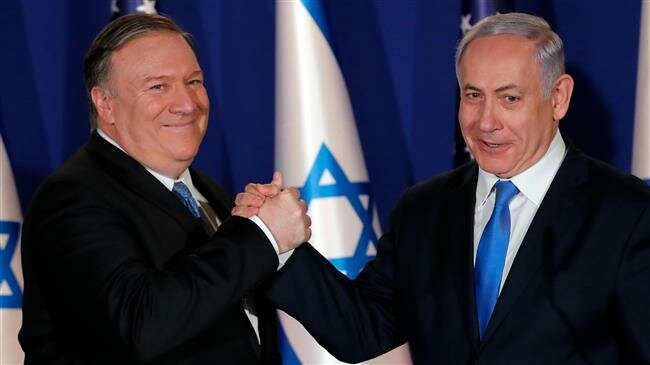
Israeli Prime Minister Benjamin Netanyahu is behind the US administration’s continued hostility towards Iran and the recent flare-up in tensions between the two sides, according to a number of American political figures and analysts.
Ben Rhodes, an advisor to the administration of former US president Barack Obama, was quoted as saying by The Jerusalem Post that “Bibi” was one of those “pushing to confront Iran.”
Last week, US Democratic presidential candidate Tulsi Gabbard also blasted “Saudi Arabia, Netanyahu [and] al-Qaeda” for promoting war with the Islamic Republic.
The report pointed to a 2006 essay on “The Israel Lobby” by John Mearsheimer and Stephen Walt, which later became a book. The authors argued back then that Israel and pro-Israel groups worked to shape the US administration’s policy towards Iran as part of a “grand scheme for reordering the Middle East.”
Moreover, the far-left and far-right parties view Israel as the shadowy manipulator of Washington’s policies towards Tehran.
“Who wants this war with Iran?” American political commentator Patrick Buchanan’s official website asked on Friday. “Answer: [US Secretary of State Mike] Pompeo and [National Security adviser John] Bolton, Bibi Netanyahu, [Saudi] Crown Prince Mohammed bin Salman.”
The US far-right has also blamed Israel for Trump’s policies, with one website claiming that “Bibi Satanyahoo” is pushing for a war with Iran.
On the far-left, the website Mondoweiss has a headline that says, “Israel wants the Trump administration to attack Iran, but US mainstream media ignores Netanyahu’s instigating.”
Iranian Foreign Minister Mohammad Javad Zarif recently pointed out that the US administration in Washington was taken over by “Netanyahu firsters”, according to the post.
Zarif blamed Israel and what he called the “B-team” for the US foreign policy decisions.
The hawkish “B-team” is comprised of US National Security Adviser John Bolton, Israeli Prime Minister Benjamin Netanyahu, Saudi Crown Prince Mohammed bin Salman and Abu Dhabi Crown Prince Mohammed bin Zayed Al Nahyan.
Tensions mounted between Tehran and Washington last May, when President Donald Trump pulled his country out of the 2015 nuclear deal with Iran, officially known as the Joint Comprehensive Plan of Action (JCPOA), and re-imposed harsh sanctions against the Islamic Republic in defiance of global criticism.
The tensions saw a sharp rise on the first anniversary of Washington’s exit from the deal as the US moved to ratchet up the pressure on Iran by tightening its oil sanctions and sending military reinforcements, including an aircraft carrier strike group, a squadron of B-52 bombers, and a battery of patriot missiles, to the Middle East.
On May 5, US National Security Advisor John Bolton — an ardent Iran hawk — said the deployment was in response to a “troubling and escalatory indications” of Iranian activity in the region, without giving details or evidence to support the claims.
Trump, however, later ordered his administration to avoid a military confrontation with Iran, The New York Times and Reuters reported.
Netanyahu’s influence with Trump is nothing short of conspicuous when it comes to regional issues in the Middle East.
Apart from relocating the US embassy from Tel Aviv to Jerusalem al-Quds and declaring the historical city as the “capital” of Israel, the American head of state has suspended aid to Palestinian groups and also recognized the Syria’s Golan Heights as being Israeli territory.
See also :
Saudi king calls for urgent meetings of Arab leaders
Press TV – May 19, 2019
Saudi Arabia’s King Salman bin Abdulaziz has called for emergency meetings of the Persian Gulf Cooperation Council ([P]GCC) and the Arab League, following mysterious “sabotage” attacks on Saudi and Emirati oil tankers as well as drone strikes targeting Saudi oil pumping stations.
The official Saudi Press Agency (SPA) reported on Saturday that Salman had invited Arab leaders to convene urgent summits in the city of Mecca on May 30 to discuss ways to “enhance the security and stability in the region.”
An official source at the Saudi Foreign Ministry said that the Saudi monarch had called the meetings due to “grave concerns” about recent attacks on commercial vessels off the coast of the United Arab Emirates and drone strikes on oil pumping stations in Saudi Arabia as well as the effects of those incidents on supply routes and oil markets.
The summits are meant “to discuss these aggressions [sic] and their consequences on the region,” the source said.
The Emirates’ Ministry of Foreign Affairs and International Cooperation has welcomed the Saudi call for the emergency meetings.
“The current critical circumstances entail a unified Arab and [Persian] Gulf stance toward the besetting challenges and risks,” the ministry said in a statement.
On May 12, four oil tankers, including two Saudi ones, were purportedly targeted near the port of Fujairah, in what the Emirates described as “sabotage” attacks. While Riyadh and Abu Dhabi failed to produce evidence of the attacks on their vessels, pictures emerged of a Norwegian-flagged tanker at the port having sustained some damage.
Two days later, drone strikes were launched on two oil pumping stations in Saudi Arabia. These attacks were believed to have been carried out by Yemen’s Houthi fighters in retaliation for the prolonged Saudi war against Yemen.
The attacks led Saudi Arabia to halt its main cross-country oil pipeline temporarily.
Saudi and Emirati officials have not said who carried out the attacks on the tankers and the pumping stations, but some political and media figures within the United States have claimed that Iran is responsible.
A day after the reported attacks on the oil tankers, Tehran called them “worrying,” and Iranian Foreign Minister Mohammad Javad Zarif later called them “suspicious.”
Yemen’s Houthis also noted that the retaliatory drone strikes on the Saudi oil pipeline were an act of self defense and had nothing to do with Iran.
Pompeo calls bin Salman
On Saturday night, Saudi Crown Prince Mohammed bin Salman held a phone conversation with US Secretary of State Mike Pompeo.
The SPA reported that the two sides exchanged views on the “developments in the region and efforts to enhance security and stability.”
Jubeir claims Riyadh doesn’t seek war
In a separate development on Sunday, Saudi Minister of State for Foreign Affairs Adel al-Jubeir claimed that his country did not want a war with Iran.
“The kingdom of Saudi Arabia does not want a war in the region nor does it seek that,” he told a press conference in Riyadh.
“It will do what it can to prevent this war and at the same time it reaffirms that in the event the other side chooses war, the kingdom will respond with all force and determination, and it will defend itself and its interests,” he added.
CrossTalk: Bolton War Machine
RT | May 17, 2019
Is Donald Trump’s National Security Advisor John Bolton a clear and present danger to America and the world? His saber-rattling in the Middle East, particularly against Iran, should concern us all. We are forced to ask a fundamental question – is Bolton the primary architect of Trump’s foreign policy?
US-Iran Showdown Is One False-Flag Attack Away From Global Calamity
By Robert Bridge | Strategic Culture Foundation | May 18, 2019
Hypocritical to the core, the execution of false-flag events spare aggressive states the ignominy of appearing in public as the warmongering psychopaths they are, lest their subjects get the wrong idea as to exactly who is governing over them.
The last thing tyrannical rulers want, after all, are battles raging on two fronts, especially if one of those fronts just happens to be back in the Heartland. Psychopaths are mentally deranged, of course, but that does not mean they are necessarily stupid.
Thus, once again, the United States is flying its jolly tricolors from the Mediterranean Sea into the Persian Gulf led by the aircraft carrier USS Abraham Lincoln, as well as nuclear-capable B-52 bombers and a Patriot missile battery on standby. But America’s reputation as a rabble-rouser and hell raiser long preceded its entry into the Gulf, as did the frenetic rhetoric.
Just as the fleet was en route, US Secretary of State Mike Pompeo delivered a warning that was so far beyond the pale of reality that it sounded as though it were scripted by a Hollywood film director with a penchant for embellishing American history.
“The response of the United States and our partners and allies has been clear: We do not seek war,” the statement reads. “But Iran’s forty years of killing American soldiers, attacking American facilities, and taking American hostages is a constant reminder that we must defend ourselves.”
Forty years of killing Americans? Really? That comment brought to mind Pompeo’s recent display of braggadocio as he reminisced over his former CIA days. “We lied, we cheated, we stole,” he confessed with a hearty chuckle to an audience from Texas A&M University last month. “We had entire training courses. It reminds you of the glory of the American experiment.”
Ah yes, the glory days. Next he’ll be shooting off about how he enjoys shaving with napalm in the morning, or some such nonsense.
In any case, the prospect of America’s leading diplomat who basically admits to being a bald-faced liar, and darn proud of it, delivering a fiery shot across the bow of the Iranian Republic at the same time a large US naval group is entering the Persian Gulf and Iran is struggling under severe sanctions does very little to instill much comfort or confidence.
One week before the US naval fleet turned up in Gulf waters, Pompeo was already laying the necessary groundwork for the buildup, saying that the US has observed “escalatory actions from the Iranians, and it is equally the case that we will hold the Iranians accountable for attacks on American interests,” he said, without providing any details. “If these actions take place — if they do by some third-party proxy, a militia group, Hezbollah — we will hold the Iranian leadership directly accountable for that.”
Now for anyone who followed the protracted Syrian crisis understands, that is exactly the sort of crazy talk that inspires friends and foes alike to pull off a false-flag attack that will force the United States to live up to its word and go after the villains, which will predictably be – as was the case following the chemical attacks against the Syrian rebels when the ‘Assad regime’ was duly blamed – the Islamic Republic of Iran.
So where did the information regarding a possible Iranian strike on some “American interest” derive? According to Axios, that news was delivered to National Security Advisor John Bolton by an Israeli delegation led by national security adviser Meir Ben Shabbat.
It is not too much of a stretch of the imagination to figure that the Israelis may have produced the report knowing full well that it would ratchet up tensions between Washington and Tehran, and more so when it is understood that the mad hatters Pompeo and Bolton figure into the calculus. Who knows? Perhaps they really do mean what they have been saying for years about Iran and would relish the prospects of an ‘Iranian attack,’ or false flag event in order to get World War III, which they both seem to anticipate with more excitement than the Second Coming.
Meanwhile, it should come as no surprise that the mainstream media is doing everything in its power to stoke the flames. On Monday, the New York Times, citing unnamed sources, published an article alleging that the White House was drafting plans to deploy some 120,000 troops to the Middle East in the event Iran attacked US forces or expedited work on nuclear weapon research. The paper giddily reported that such a force “would approach the size of the American force that invaded Iraq in 2003.” Trump, however, ruined the war party, flat out denying the claim, saying he would send a lot more than 120,000 troops under such circumstances.
To underscore exactly how dangerous the situation is becoming, Sputnik reported that four commercial ships – two Saudi, one Emirati and one Norwegian – were targets of a “sabotage attack” off the coast of the United Arab Emirates (UAE) on Sunday.
It should come as no surprise as to what country was blamed. “Iranian or Iranian-backed proxies” are thought to be behind the attack, according to US officials.
Although Iran in the past may have played down such provocations, this time around they are showing a striking level of confidence in the face of American firepower. “An aircraft carrier that has at least 40 to 50 planes on it and 6000 forces gathered within it was a serious threat for us in the past,” Amirali Hajiadeh, who heads Iran’s Revolutionary Guard’s aerospace unit, told the Iranian Students’ News Agency (ISNA), as reported by RT. “But now, the threats have switched to opportunities,” he added.
The only thing left to consider now is whether Trump left Bolton and Pompeo to their own mischievous devices in their dealings with Iran and even Israel, or is there some sort of safety catch on the gun, so to speak.
Considering that Trump didn’t seem to be fully informed as to what was happening in Venezuela with regards to puppet president Juan Guaido’s recent failed attempt at a coup, it makes one wonder if Trump is equally in the dark as to what is happening with Iran. The prospect of such a possibility is simply too terrifying to even contemplate.
Pretexts for an Attack on Iran
By Ray McGovern – Consortium News – May 15, 2019
An Iraq-War redux is now in full play, with leading roles played by some of the same protagonists — President Donald Trump’s national security adviser, John Bolton, for example, who says he still thinks attacking Iraq was a good idea. Co-starring is Secretary of State Mike Pompeo.
The New York Times on Tuesday played its accustomed role in stoking the fires, front-paging a report that, at Bolton’s request, Acting Defense Secretary Patrick Shanahan has come up with an updated plan to send as many as 120,000 troops to the Middle East, should Iran attack American forces or accelerate work on nuclear weapons. The Times headline writer, at least, thought it appropriate to point to echoes from the past: “White House Reviews Military Plans Against Iran, in Echoes of Iraq War.”
By midday, Trump had denied the Times report, branding it “fake news.” Keep them guessing, seems to be the name of the game.
Following the Iraq playbook, Bolton and Pompeo are conjuring up dubious intelligence from Israel to “justify” attacking — this time — Iran. (For belligerent Bolton, this was entirely predictable.) All this is clear.
What is not clear, to Americans and foreigners alike, is why Trump would allow Bolton and Pompeo to use the same specious charges — terrorism and nuclear weapons — to provoke war with a country that poses just as much strategic threat to the U.S. as Iraq did — that is to say, none. The corporate media, with a two-decade memory-loss and a distinct pro-Israel bias, offers little help toward understanding.
Before discussing the main, but unspoken-in-polite-circles, impulse behind the present step-up in threats to Iran, let’s clear some underbrush by addressing the two limping-but-still-preferred, ostensible rationales, neither of which can bear close scrutiny:
No. 1: It isn’t because Iran is the world’s leading sponsor of terrorism. We of Veteran Intelligence Professionals for Sanity shot down that canard a year and a half ago. In a Memorandum for President Trump, we said:
“The depiction of Iran as ‘the world’s leading state sponsor of terrorism’ is not supported by the facts. While Iran is guilty of having used terrorism as a national policy tool in the past, the Iran of 2017 is not the Iran of 1981. In the early days of the Islamic Republic, Iranian operatives routinely carried out car bombings, kidnappings and assassinations of dissidents and of American citizens. That has not been the case for many years.”
No. 2. It isn’t because Iran is building a nuclear weapon. A November 2007 U.S. National Intelligence Estimate concluded unanimously that Iran had stopped working on a nuclear weapon in 2003 and had not resumed any such work. That judgment has been re-affirmed by the Intelligence Community annually since then.
The Joint Comprehensive Plan of Action, commonly known as the Iran nuclear deal, imposed strict, new, verifiable restrictions on Iranian nuclear-related activities and was agreed to in July 2015 by Iran, the U.S., Russia, China, France, the U.K., Germany and the European Union.
Even the Trump administration has acknowledged that Iran has been abiding by the agreement’s provisions. Nevertheless, President Trump withdrew the U.S. from the Iran nuclear deal on May 8, 2018, four weeks after John Bolton became his national security adviser.
‘We Prefer No Outcome’
Fair Warning: What follows may come as a shock to those malnourished on the drivel in mainstream media: The “WHY,” quite simply, is Israel. It is impossible to understand U.S. Middle East policy without realizing the overwhelming influence of Israel on it and on opinion makers. (A personal experience drove home how strong the public appetite is for the straight story, after I gave a half-hour video interview to independent videographer Regis Tremblay three years ago. He titled it “The Inside Scoop on the Middle East & Israel,” put it on YouTube and it got an unusually high number of views.)
Syria is an illustrative case in point, since Israel has always sought to secure its position in the Middle East by enlisting U.S. support to curb and dominate its neighbors. An episode I recounted in that interview speaks volumes about Israeli objectives in the region as a whole, not only in Syria. And it includes an uncommonly frank admission/exposition of Israeli objectives straight from the mouths of senior Israeli officials. It is the kind of case-study, empirical approach much to be preferred to indulging in ponderous pronouncements or, worse still, so-called “intelligence assessments.”
It has long been clear that Israeli leaders have powerful incentives to get Washington more deeply engaged in yet another war in the area. This Israeli priority has become crystal clear in many ways. Reporter Jodi Rudoren, writing from Jerusalem, had an important article in TheNew York Times on Sept. 6, 2013, in which she addressed Israel’s motivation in a particularly candid way. Her article, titled “Israel Backs Limited Strike against Syria,” noted that the Israelis have argued, quietly, that the best outcome for Syria’s civil war, at least for the moment, is no outcome.
Rudoren wrote:
Jodi Rudoren. (Twitter)
“For Jerusalem, the status quo, horrific as it may be from a humanitarian perspective, seems preferable to either a victory by Mr. Assad’s government and his Iranian backers or a strengthening of rebel groups, increasingly dominated by Sunni jihadis.
“‘This is a playoff situation in which you need both teams to lose, but at least you don’t want one to win — we’ll settle for a tie,’ said Alon Pinkas, a former Israeli consul general in New York. ‘Let them both bleed, hemorrhage to death: that’s the strategic thinking here. As long as this lingers, there’s no real threat from Syria.’”

If this is the way Israel’s current leaders look at the carnage in Syria, they seem to believe that deeper U.S. involvement, including military action, is likely to ensure that there is no early resolution of the conflict especially when Syrian government forces seem to be getting the upper hand. The longer Sunni and Shia are at each other’s throats in Syria and in the wider region, the safer Israel calculates it will be.
The fact that Syria’s main ally is Iran, with whom it has a mutual defense treaty, also plays a role in Israeli calculations. And since Iranian military support has not been enough to destroy those challenging Bashar al-Assad, Israel can highlight that in an attempt to humiliate Iran as an ally.
Today the geography has shifted from Syria to Iran: What’s playing out in the Persian Gulf area is a function of the politically-dictated obsequiousness of American presidents to the policies and actions of Israel’s leaders. This bipartisan phenomenon was obvious enough under recent presidents like Clinton and Obama; but under Bush II and Trump, it went on steroids, including a born-again, fundamentalist religious aspect.
One need hardly mention the political power of the Israel lobby and the lucrative campaign donations from the likes of Sheldon Adelson. Israeli Prime Minister Benjamin Netanyahu is riding high, at least for the now, Israeli influence is particularly strong in the lead-up to U.S. elections, and Trump has been acquitted of colluding with Russia.
The stars seem aligned for very strong “retaliatory strikes” for terrorist acts blamed on Iran.
Tonkin — er, I Mean Persian Gulf
Over the weekend, four vessels, including two Saudi oil tankers, were sabotaged near the Strait of Hormuz. Last evening The Wall Street Journal was the first to report an “initial U.S. assessment” that Iran likely was behind the attacks, and quoted a “U.S. official” to the effect that if confirmed, this would inflame military tensions in the Persian Gulf.The attacks came as the U.S. deploys an aircraft carrier, bombers and an antimissile battery to the Gulf — supposedly to deter what the Trump administration said is the possibility of Iranian aggression.
On Tuesday, Yemen’s Houthi rebels, with whom Saudi Arabia has been fighting a bloody war for the past four years, launched a drone attack on a Saudi east-west pipeline that carries crude to the Red Sea. This is not the first such attack; a Houthi spokesman said the attack was a response to Saudi “aggression” and “genocide” in Yemen. The Saudis shut down the pipeline for repair.
Thus the dangers in and around the Strait of Hormuz increase apace with U.S.-Iran recriminations. This, too, is not new.
Tension in the Strait was very much on Joint Chiefs of Staff Chairman Adm. Mike Mullen’s mind as he prepared to retire on Sept. 30, 2011. Ten days before, he told the Armed Force Press Service of his deep concern over the fact that the U.S. and Iran have had no formal communications since 1979:
“Even in the darkest days of the Cold War, we had links to the Soviet Union. We are not talking to Iran. So we don’t understand each other. If something happens, it’s virtually assured that we won’t get it right, that there will be miscalculations.”
Now the potential for an incident has increased markedly. Adm. Mullen was primarily concerned about the various sides — Iran, the U.S., Israel — making hurried decisions with, you guessed it, “unintended consequences.”
With Pompeo and Bolton on the loose, the world may be well advised to worry even more about “intended consequences” from a false flag attack. The Israelis are masters at this. The tactic has been in the U.S. clandestine toolkit for a long time, as well. In recent days, the Pentagon has reported tracking “anomalous naval activity” in the Persian Gulf, including loading small sailing vessels with missiles and other military hardware.
Cheney: Down to the Sea in Boats
In July 2008, Pulitzer Prize-winning investigative journalist Seymour Hersh reported that Bush administration officials had held a meeting in the vice president’s office in the wake of a January 2008 incident between Iranian patrol boats and U.S. warships in the Strait of Hormuz. The reported purpose of the meeting was to discuss ways to provoke war with Iran.
Hersh wrote:
“There were a dozen ideas proffered about how to trigger a war. The one that interested me the most was why don’t we build in our shipyard four or five boats that look like Iranian PT boats. Put Navy seals on them with a lot of arms. And next time one of our boats goes to the Straits of Hormuz, start a shoot-up. Might cost some lives.
“And it was rejected because you can’t have Americans killing Americans. That’s the kind of, that’s the level of stuff we’re talking about. Provocation.
“Silly? Maybe. But potentially very lethal. Because one of the things they learned in the [January 2008] incident was the American public, if you get the right incident, the American public will support bang-bang-kiss-kiss. Youknow, we’re into it.”
Preparing the (Propaganda) Battlefield
One of Washington’s favorite ways to blacken Iran and its leaders is to blame it for killing U.S. troops in Iraq. Iran was accused, inter alia, of supplying the most lethal improvised explosive devices, but sycophants like Gen. David Petraeus wanted to score points by blaming the Iranians for still more actions.
On April 25, 2008, Joint Chiefs of Staff Chairman, Adm. Mike Mullen, told reporters that Gen. David Petraeus would be giving a briefing “in the next couple of weeks” that would provide detailed evidence of “just how far Iran is reaching into Iraq to foment instability.”
Petraeus’s staff alerted U.S. media to a major news event in which captured Iranian arms in Karbala, Iraq, would be displayed and then destroyed. But there was a small problem. When American munitions experts went to Karbala to inspect the alleged cache of Iranian weapons, they found nothing that could be credibly linked to Iran.
This embarrassing episode went virtually unreported in Western media – like the proverbial tree falling in the forest with no corporate media to hear it crash. A fiasco is only a fiasco if folks find out about it. The Iraqis did announce that Iraqi Prime Minister Nouri al-Maliki had formed his own Cabinet committee to investigate U.S. claims and attempt to “find tangible information and not information based on speculation.”
With his windsock full of neoconservative anti-Iran rhetoric, Petreaus, as CIA director, nevertheless persisted — and came up with even more imaginative allegations of Iranian perfidy. Think back, for example, to October 2011 and the outlandish White House spy feature at the time: the Iranian-American-used-car-salesman-Mexican-drug-cartel plot to assassinate the Saudi ambassador to the U.S. And hold your nose.
More recently, the Pentagon announced it has upped its estimate of how many U.S. troops Iran killed in Iraq between 2003 and 2011. The revised death tally would mean that Iran is responsible for 17 percent of all U.S. troops killed in Iraq.
Who Will Restrain the ‘Crazies’?
Pompeo stopped off in Brussels on Monday to discuss Iran with EU leaders, skipping what would have been the first day of a two-day trip to Russia. Pompeo did not speak to the news media in Brussels, but European foreign ministers said that they had urged “restraint.”
British Foreign Minister Jeremy Hunt told reporters: “We are very worried about the risk of a conflict happening by accident, with an escalation that is unintended, really on either side.” British Army Major General Christopher Ghika was rebuked by U.S. Central Command for saying Tuesday: “There has been no increased threat from Iranian backed forces in Iraq and Syria.” Central Command spokesperson Captain Bill Urban said Ghika’s remarks “run counter to the identified credible threats available to intelligence from U.S. and allies regarding Iranian backed forces in the region.”
Although there is growing resentment at the many serious problems tied to Trump’s pulling the U.S. out of the Iran deal, and there is the EU’s growing pique at heavyweights like Pompeo crashing their gatherings uninvited, I agree with Pepe Escobar’s bottom line, that “it’s politically naïve to believe the Europeans will suddenly grow a backbone.”
There remains a fleeting hope that cooler heads in the U.S. military might summon the courage to talk some sense into Trump, in the process making it clear that they will take orders from neither Pompeo nor from National Security Advisor John Bolton. But the generals and admirals of today are far more likely in the end to salute and “follow orders.”
There is a somewhat less forlorn hope that Russia will give Pompeo a strong warning in Sochi — a shot across the bow, so to speak. The last thing Russia, China, Turkey and other countries want is an attack on Iran. Strategic realities have greatly changed since the two wars on Iraq.
In 1992, still in the afterglow of Desert Storm (the first Gulf War), former Gen. Wesley Clark asked then Undersecretary of Defense for Policy Paul Wolfowitz about major lessons to be drawn from the Desert Storm attack on Iraq in 1991. Without hesitation, Wolfowitz answered, “We can do these things and the Russians won’t stop us.” That was still true for the second attack on Iraq in 2003.
But much has changed since then: In 2014, the Russians stopped NATO expansion to include Ukraine, after the Western-sponsored coup in Kiev; and in the years that followed, Moscow thwarted attempts by the U.S., Israel, and others to oust Syrian President Bashar al-Assad.
No doubt Russian President Vladimir Putin would like to “stop us” before the Bolton/Pompeo team finds an “Iranian” casus belli. Initial reporting from Sochi, where Pompeo met with Russian Foreign Minister Sergey Lavrov and President Vladimir Putin on Tuesday indicates there was no meeting of the minds on Iran. Both Pompeo and Lavrov described their talks as “frank” — diplomat-speak for acrimonious.
Pompeo was probably treated to much stronger warnings in private during the Sochi talks with Lavrov and Putin. Either or both may even have put into play the potent China card, now that Russia and China have a relationship just short of a military alliance — a momentous alteration of what the Soviets used to call the “correlation of forces.”
In my mind’s eye, I can even see Putin warning, “If you attack Iran, you may wish to be prepared for trouble elsewhere, including in the South China Sea. Besides, the strategic balance is quite different from conditions existing each time you attacked Iraq. We strongly advise you not to start hostilities with Iran — under any pretext. If you do, we are ready this time.”
And, of course, Putin could also pick up the phone and simply call Trump.
There is no guarantee, however, that tough talk from Russia could stick an iron rod into the wheels of the juggernaut now rolling downhill to war on Iran. But, failing that kind of strong intervention and disincentive, an attack on Iran seems all but assured. Were we to be advising President Trump today, we VIPS would not alter a word in the recommendation at the very end of the Memorandum for President George W. Bush we sent him on the afternoon of Feb. 5, 2003, after Colin Powell addressed the UN Security Council earlier that day:
“No one has a corner on the truth; nor do we harbor illusions that our analysis is irrefutable or undeniable [as Powell had claimed his was]. But after watching Secretary Powell today, we are convinced that you would be well served if you widened the discussion … beyond the circle of those advisers clearly bent on a war for which we see no compelling reason and from which we believe the unintended consequences are likely to be catastrophic.”
Ray McGovern works with Tell the Word, a publishing arm of the ecumenical Church of the Saviour in inner city Washington. He was a CIA analyst for 27 years and presidential briefer and is co-founder of Veteran Intelligence Professionals for Sanity.
Islamic Republic No Threat to Anybody in Iraq or Elsewhere: Iran UN Mission
Al-Manar | May 16, 2019
Iran has rejected the United States’ claims that ‘Iranian activities’ endanger American sites and troops in Iraq, saying the Islamic Republic is no threat to anybody in Iraq or elsewhere.
“’Iran is no threat to anybody in Iraq or elsewhere, and Iran is not preparing for any attacks anywhere,” Alireza Miryousefi, the spokesman for Iran mission to the United Nations made the statement on Wednesday.
“Iran, as is evidenced by our history, only acts in self-defense, and has no offensive strategy against any nation,” he added, according to Mehr news agency.
The official censured the US for sticking to fake reports for spreading propaganda against the Islamic Republic, saying, “Iranians will never capitulate to this new psychological war.”
The US has recently built up its military presence in the region over what it calls an Iranian threat to American troops and interests.
Last week, US Secretary of State Mike Pompeo claimed that the US administration had received intelligence related to “Iranian activity” that put American facilities and service personnel at “substantial risk.”
Other senior officials within the US administration itself as well as other countries have however dismissed that claim.
Following Pompeo’s claims, the US on Wednesday ordered the partial evacuation of its embassy in Baghdad and a consulate in Erbil.
History’s Dire Warning: Beware False-Flag Trigger for Long-Sought War with Iran
By Whitney Webb | MintPress News | May 14, 2019
With the beat of Washington’s war drums continuing to grow, particularly following the Monday revelation of a government plan to send as many as 120,000 troops to counter Iran, the threat of an “accidental” provocation or a “false flag” is also becoming increasingly likely. As MintPress recently reported, the possibility of an “accident” leading to open conflict between the U.S. and Iran is now being openly stated by top European officials — such as U.K. Foreign Minister Jeremy Hunt — following meetings with noted Iran hawk and current Secretary of State Mike Pompeo.
In Part I of this series, MintPress explored how current events — including seemingly unrelated regional events, such as the Israeli government’s bid to occupy the West Bank and the Syrian offensive against Al Qaeda-held Idlib — were converging to create a “now or never” scenario for those most eager for regime change in Iran and a U.S.-Iran military confrontation, particularly Israeli Prime Minister Benjamin Netanyahu and U.S. National Security Advisor John Bolton.
This installment will also reveal how Trump’s top political patron Sheldon Adelson — who is also the top donor to Netanyahu and a long-time confidant of Bolton, whom he helped install in his powerful post in the Trump administration — may be the deciding factor whether Trump authorizes the use of military force against Iran.
Yet, while the endgame for Bolton, Adelson and Netanyahu, as well as Pompeo, has long been a U.S.-led war with Iran, public justification for such hostilities must be given in order to manufacture American consent for a war against a country significantly larger than Iraq, complete with a more powerful army. Historically, the U.S. government has frequently planned and used false flags in order to justify the initiation or expansion of hostilities, with the best-known examples being Operation Northwoods and the Gulf of Tonkin incident.
However, given the current situation, it is essential to revisit two other incidents that reveal that the key players pushing for war in Iran — Israel’s government and neoconservatives of the Bush era (Bolton chief among them) — have planned and attempted to execute false flag attacks to push the U.S. into a major war that the American public would not normally support.
Remembering the U.S.S. Liberty
On June 8, 1967, one of the worst attacks on a U.S. naval vessel during peacetime took place, an attack that the U.S. government has kept shrouded in secrecy over 50 years later in what many have called a cover-up.
Around two in the afternoon on a cloudless, sunny day, unmarked aircraft and torpedo boats attacked the U.S.S. Liberty — a largely defenseless naval intelligence vessel flying visible American flags — without provocation. The attack saw the aggressors commit several war crimes, including attacking with unmarked aircraft and vessels; shooting survivor-bearing lifeboats out of the water with machine-gun fire; and the jamming of the Liberty’s ability to use international distress frequencies.
Thirty-four American sailors lost their lives and 173 were wounded, and the Liberty — which cost U.S. taxpayers $40 million to build — was so badly damaged it was subsequently sold for scrap metal for pennies on the dollar.
During the attack and in its immediate aftermath, Liberty survivors were puzzled as to why the U.S. Department of Defense ordered the recall of U.S. ships that were on route to aid the Liberty from the hostile attack, which many sailors had assumed at the time was being conducted by Egyptian or Arab forces in light of the ship’s proximity to the Sinai Peninsula.
Indeed, the attack on the Liberty took place during the Israeli-Arab Six Day War, a war that Israel claimed to have started as a preemptive means of self-defense but that was later revealed to have been the culmination of years of planning for a war of aggression. This fact was openly admitted by former Israeli Prime Minister Menachem Begin in the early 1980s. Israel, an American ally, was not suspected by Liberty crewmen at the time of the attack as being their potential assailants.
However, no Arab nation had attacked the Liberty that day, though that assumption by Liberty sailors was what their true assailants had hoped they and the American public would believe. Instead, it had been Israeli aircraft and torpedo boats that had fired on the clearly-marked American vessel with torpedoes, machine gun fire and even napalm. The Israelis “officially” maintain to this day, with little challenge from the U.S. government, that the attack was an accident, a fact that has been and continues to be heavily contested by the attack’s survivors.
Yet, beyond the testimony of survivors, the most compelling evidence that the attack on the Liberty was no accident comes from the Israelis themselves. Intercepted Israeli communications from the time of attack, made public only in recent years, reveal that the ship had been identified as American prior to the attack and, despite that, the plan was to sink the U.S.S. Liberty and ensure that there were no survivors. The goal of the attack was to place the blame on Egyptian forces, which necessitated there being no American survivors who could dispute the claim. If the Liberty had been sunk, it would have provided the United States legal cover and popular support for a more central role in the conflict and its crucial diplomatic aftermath. Indeed, the Israeli attack on the U.S.S. Liberty was a false flag, one that failed to achieve its intended goal of goading the U.S. into a major war.
Instead of responding with indignation, then-President Lyndon Johnson — whether it occurred before or during the attack is disputed — ordered that the Liberty not be rescued during the course of the attack, allegedly not wanting to harm relations with or “embarrass” an ally even if it meant consigning the 294-person crew of the Liberty to death.
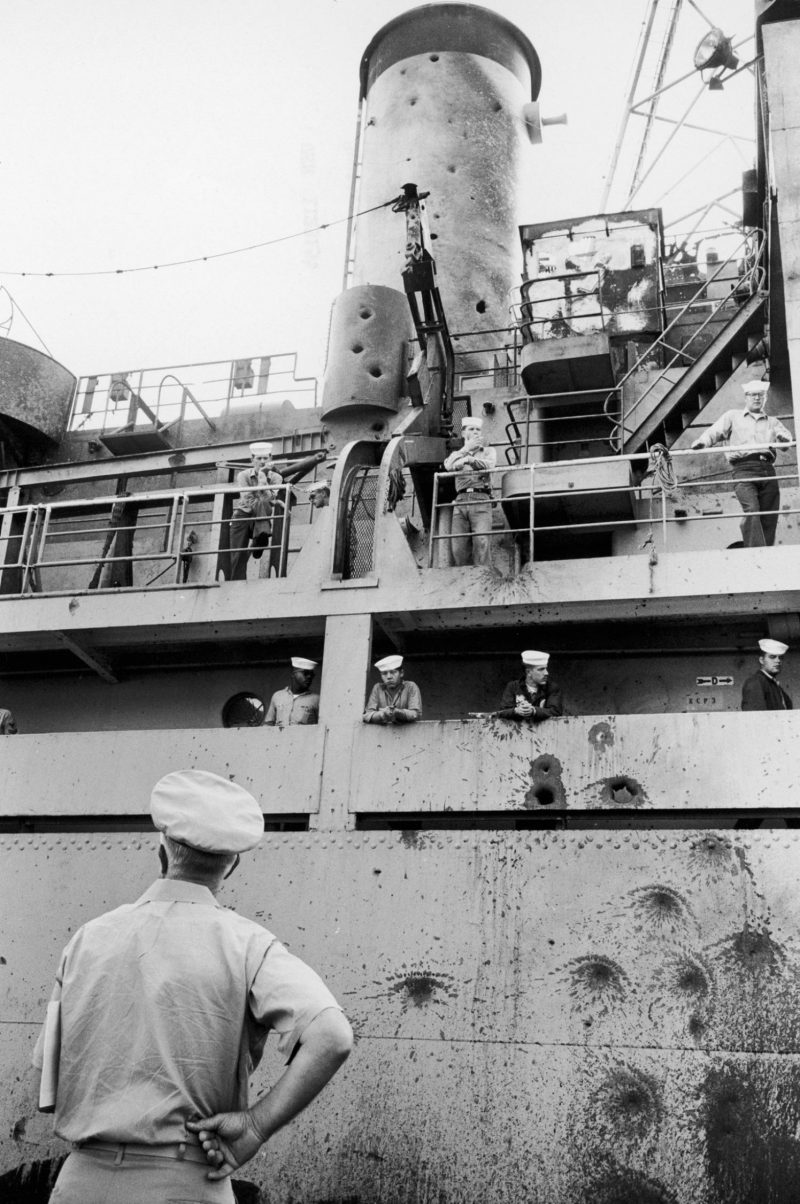
Damage to the starboard side of the USS Liberty following Israeli attacks, June, 1967. Photo | NSA Archive
Those who survived the assault of the Liberty owe their lives to the then-23-year-old Terry Halbardier, who valiantly navigated the Liberty’s napalm-glazed deck and managed to rig an antenna and send out an SOS signal to the Navy’s Sixth Fleet. Upon intercepting that distress signal, the Israelis immediately broke off the attack. Halbardier’s heroism prevented the massacre of all 294 crewmen and allowed them to live to tell their stories, despite Johnson’s having left them for dead.
Yet many Liberty survivors were unable to tell their stories for decades, as the U.S. government issued gag orders and threatened them with being court-martialed for speaking to anyone, even their spouses, about the incident. The Navy’s Board of Inquiry, which abetted the cover-up, was headed by Admiral John S. McCain Jr., the father of the late Senator John McCain of Arizona.
To this day, the U.S. government has failed to conduct a full, public inquiry into the attack. Liberty survivors who have since spoken out have been accused of “anti-Semitism” and of slandering Israel for discussing their personal and traumatic experiences of the attack, significantly compounding their suffering and post-traumatic stress.
While the survivors of Israel’s assault on the Liberty have been denied closure, the U.S. government’s response has endangered the lives of American personnel by clearly signaling to Israel that they will suffer no consequences for such “false flag” attacks, regardless of whether American servicemen are wounded or killed. As former CIA intelligence analyst Ray McGovern has previously noted for Consortium News, “the U.S. cover-up [of the attack on the U.S.S. Liberty ] taught the Israelis that they could literally get away with murder.”
In a 2015 interview on the Real News Network, McGovern warned that the attack on the Liberty still holds “current relevance” and that he felt that “the Israelis are capable of doing this kind of thing when they see their supreme national interests at stake.” McGovern further stated that Israeli officials may well have considered a provocation, such as false flag, to throw a wrench in the Iran nuclear deal, which was being negotiated at the time.
McGovern — in an open letter to President Barack Obama, co-authored with former Deputy National Intelligence Officer for the Near East in the National Intelligence Council Elizabeth Murray — noted that Admiral Mike Mullen, former member of the Joint Chiefs of Staff in the Bush administration, had flown to Israel in 2003 and told the Israeli government emphatically “to disabuse themselves of the notion that U.S. military support would be knee-jerk automatic if they somehow provoked open hostilities with Iran. According to the Israeli press, Mullen went so far as to warn the Israelis not to even think about another incident at sea like the deliberate Israeli attack on the U.S.S. Liberty.”
McGovern and Murray cited Mullen’s statements to Israeli officials as the first time that “a senior U.S. official braced Israel so blatantly about the Liberty incident.” In an email to MintPress, McGovern stated that he was unsure whether current Chairman of the Joint Chiefs of Staff Gen. Joseph Dunford “can be counted upon to play a similar restraining role” in preventing hostilities with Iran. Notably, Dunford was in attendance along with Bolton at the recent CIA meeting to discuss “highly sensitive covert actions” in relation to Iran.
An “accident” waiting to happen
Since Bolton announced the movement of the Lincoln carrier strike group towards the Persian Gulf, some have pointed out that the vessels could well be destined for use in a “false flag” provocation, such as one planned by former Vice President Dick Cheney in 2008 (to be discussed shortly) and another conducted by Israel in 1967. Indeed, as MintPress noted the day after Bolton’s announcement, the carrier strike group’s deployment was actually announced a month prior and was a routine deployment.
The political analysis blog Moon of Alabama also noticed that Bolton had framed this routine deployment as something more dire for his own purposes, writing:
The carrier deployment to the Gulf is routine. It had been announced on April 8. The U.S. has bombers on rotation in the Middle East since 2001. Moreover – a carrier in the Persian Gulf is a sure sign that the U.S. will not attack Iran. Within the restricted waters of the Persian Gulf a carrier is a too easy target. The idea though may be to provide for an ‘accident’’ as Iran’s Foreign Minister [Javad Zarif] described it in a recent CBS interview.”
In an interview late last month with CBS’ Face the Nation, Zarif explicitly told journalist Margaret Brennan his concern about an imminent “false flag” to trigger war with Iran by John Bolton in collaboration with Israeli, Saudi and Emirati leadership:
Foreign Minister Zarif | I don’t think military confrontation will happen. I think people have more prudence than allowing a military confrontation to happen. But, I think the U.S. administration is putting things in place for accidents to happen. And there has to be extreme vigilance, so that people who are planning this type of accident would not have their way.
Margaret Brennan | What do you mean? What kind of accident are you talking about?
Zarif | I’m talking about people who have — who are designing confrontation, whose interest —
Brennan | Who’s doing that?
Zarif | My ‘B’ team. I call —
Brennan | What do you mean ‘B’ team?
Zarif | I call the group ‘B’ team who have always tried to create tension, whose continued existence depends on tension. Ambassador Bolton, one ‘B,’ Bibi Netanyahu, second ‘B,’ Bin Zayed, third ‘B,’ Bin Salman, fourth ‘B.’ And I’m not just making accusations.
With an aircraft carrier little more than a sitting duck in the area amid rising tensions between the U.S. and Iran, an “accident” may well occur. As was noted in Part I of this mini-series, such a possibility was directly stated by British Foreign Minister Jeremy Hunt on Monday.
Hunt told reporters “We are very worried about the risk of a [U.S.-Iran] conflict happening by accident, with an escalation that is unintended really on either side but ends with some kind of conflict.” Hunt notably made the statement after meeting with Pompeo, who is currently in Europe meeting with European heads of state to discuss Iran. The Associated Press noted that the Trump administration had warned European officials, Hunt included, that “Iran or its proxies could be targeting maritime traffic in the Persian Gulf region.”
The possibility of such an “accident” is further compounded by Bolton’s aforementioned and “highly unusual” meeting about Iran and “highly sensitive covert actions” at CIA headquarters last week. Declassified CIA documents show that the agency had previously planned to stage terror attacks on U.S. soil and murder Americans to blame on Cuba in order to justify invading the Caribbean nation in the 1960s. That plan, known as Operation Northwoods, further called for the destruction of U.S. military vessels to be blamed on Cuba and also the staging of fires and mortar attacks on U.S. military installations in Cuba (i.e., Guantanamo Bay) or nearby (i.e., in Florida). Though Operation Northwoods was never enacted, the agency has been accused of orchestrating numerous “false flags” in the decades since.
As was recently seen with the alleged “sabotage” of Saudi oil tankers near Iran, there are many potential targets for provocation. However, the incident that would most assuredly force U.S. involvement in a military conflict would be an attack on an American military target. While some have dismissed Bolton’s announcement of the carrier’s movements as a self-serving manipulation of the facts, it may have had the added purpose of framing the lead-up to an unfortunate “accident” targeting American vessels in the area, particularly the Lincoln carrier strike group or one of the other subsequent U.S. naval deployments to the Middle East.
The neocon plan for a Liberty-like attack
If any sort of provocation blamed on Iran should occur, it is important to consider that a powerful group of U.S. politicians — the neo-conservatives — have long sought to plan provocations that would drag the U.S. into war with Iran. One of the most recent examples took place during the George W. Bush administration when then-Vice President Dick Cheney held a meeting with other administration officials in 2008 aimed at provoking war with Iran.
The details of that meeting were revealed by Pulitzer Prize-winning journalist Seymour Hersh, who described some of the ideas considered in that Cheney-led meeting as follows:
There were a dozen ideas proffered about how to trigger a war. The one that interested me the most was why don’t we build in our shipyard four or five boats that look like Iranian PT boats. Put Navy seals on them with a lot of arms. And next time one of our boats goes to the Straits of Hormuz, start a shoot-up. Might cost some lives.
And it was rejected because you can’t have Americans killing Americans. That’s the kind of, that’s the level of stuff we’re talking about. Provocation.
Silly? Maybe. But potentially very lethal. Because … if you get the right incident, the American public will support bang-bang-kiss-kiss. You know, we’re into it.”
It is unknown if any Bush officials now in the Trump administration were present at that meeting where the use of a “false flag” pitting Americans against Americans disguised as Iranian was discussed. However, what is known is that John Bolton — who was a member of the neo-conservative Project for a New American Century, along with Cheney, and who also served in the Bush administration — has zealously sought war with Iran for nearly two decades. Indeed, the New York Times recently described Bolton as “one of the administration’s most virulent Iran hawks, whose push for confrontation with Tehran was ignored more than a decade ago by President George W. Bush.” It is also known that Bolton has a history of playing fast and loose with unconfirmed intelligence and also distorting intelligence to fit his pre-determined narrative.
As MintPress reported last year, former Israeli Ambassador to the UN Danny Gillerman has stated that Bolton, when serving in the Bush administration, was prone to “direct fire on his own forces,” — i.e., the U.S. government — in order to advance the goals of the Israeli government, especially with respect to Iran. For instance, in more than one instance while in the Bush administration, Bolton traveled to Israel in violation of State Department rules and negotiated privately with Israeli officials, including the then-head of the Mossad, Meir Dagan, to lay the groundwork for a war with Iran. As journalist Gareth Porter has noted, Bolton did this in an effort to directly undermine Colin Powell, Bolton’s superior, just as Powell “was saying administration policy was not to attack Iran.”
Worse still, Bolton has pressured Israeli officials to initiate a war with Iran, even when they didn’t support such a move. One such case was Shaul Mofaz, former Israeli defense minister, who told Israeli media last March that Bolton “tried to convince me that Israel needs to attack Iran,” even though Mofaz did not see such a war as “a smart move — not on the part of the Americans today or anyone else until the threat is real.”
Pompeo’s Holy war and rapture
Furthermore, Bolton is not the only top Trump administration official who has long promoted a war with Iran, as current Secretary of State Mike Pompeo had also called for the preemptive bombing of Iran long before he joined the Trump administration. Pompeo’s desire to push the U.S. towards war with Iran is based on his fervent adherence to Christian Zionism. As a result of the admitted influence his beliefs hold over his foreign policy, Pompeo sees an “apocalyptic” war between Israel and Iran as a necessary precursor to the Second Coming of Christ and the “rapture.”
Pompeo is on record speaking about the rapture on several occasions, particularly as CIA director when he spoke about the event — which holds that “true believers” will ascend to Heaven prior to the tribulations and trials of the “end times” — so often that he made veteran intelligence officers uncomfortable. As a result, some have asserted that Pompeo is “a man who appears to view American foreign policy as a vehicle for holy war.”
The fact that the actions of the current Secretary of State are influenced by his Christian Zionist faith was on display last month, when American Christian journalist Chris Mitchell of the Christian Broadcasting Network asked Pompeo: “Could it be that President Trump right now has been sort of raised for such a time as this … to help save the Jewish people from the Iranian menace?” Pompeo responded that this was definitely “possible.”
If Adelson has his way . . .
Yet, perhaps the most dangerous force driving the U.S. towards a war with Israel is not the public face of the Trump administration’s foreign policy but its private face. Sheldon Adelson — the top donor to Trump, the entire Republican Party, and also the top political donor to Israeli Prime Minister Netanyahu — has long sought war with Iran, and several of Adelson’s desired policies have already been enacted by Trump. These include recognizing Jerusalem as Israel’s capital, replacing H.R. McMaster with Bolton as National Security Advisor, and withdrawing from the Iran nuclear deal. Several reports have asserted that pressure from Adelson was a deciding factor in Trump’s fulfillment of these policies.
Adelson’s influence over Trump again takes on great significance, given recent events with respect to Iran, as Adelson has previously advocated for a U.S. nuclear attack on Iran without provocation, just so the U.S. could “impose its demands [on Iran] from a position of strength.”
Per Adelson’s plan, the U.S. would drop a nuclear bomb in the middle of the Iranian desert and then threaten that “the next one is in the middle of Tehran” to show that “we mean business.” Tehran, Iran’s capital, is home to nearly 9 million people with 15 million more in its suburbs. Were Tehran to be attacked with nuclear weapons, an estimated 7 million would die within moments, according to a 2013 study jointly conducted by researchers at the University of Georgia and Harvard.
Yet, any sort of diplomatic engagement with Iran, according to Adelson, is “the worst negotiating tactic I could ever imagine.”
In other words, Adelson has called for dropping nuclear weapons on a country, including its heavily populated capital city, for no reason other than to show that the U.S. “means business” and considers nuclear war a negotiating tactic.
While some media reports have suggested that Trump is unwilling to go to war with Iran and is uneasy with the hawkish policies of Bolton and Pompeo, he will have a hard time ignoring Adelson. Adelson, who poured $35 million into Trump’s 2016 campaign and spent $55 million on Republican primary campaigns last year, is the party’s most influential donor and angering him could well mean the end of Trump’s political career.
Would Trump resist a push for war from not just Netanyhu, Bolton and Pompeo but Adelson as well? It seems unlikely. Craig Holman of the watchdog group Public Citizen told ProPublica in 2018 that he “would put Adelson at the very top of the list of both access and influence in the Trump administration,” a sentiment that was also echoed by Alan Dershowitz, who has done legal work for Adelson and advised Trump. Dershowitz told ProPublica that Adelson “just calls the president all the time. Donald Trump takes Sheldon Adelson’s calls.” As MintPress has noted on several occasions, those calls often translate into policy decisions.
Unfortunately, Trump — even when he tries to follow a different path, as he attempted to do in Syria — often ends up conceding to the neo-conservatives and Zionist extremists who surround (and fund) him.
History issues a warning
The combination of current tensions and the documented history of both Israel and Bush-era neo-conservatives planning and even executing false flag attacks in order to justify U.S. military action against a desired target — should set off alarm bells. Instead, most corporate media outlets are playing up unfounded or baseless claims of the “Iranian threat” and Iran’s unproven role in recent acts of “sabotage” in Saudi Arabia and in the UAE in ways that are strikingly similar to the lead-up to the 2003 invasion of Iraq.
Furthermore, the history and mindset of both Bolton and Pompeo, in addition to the unprecedented influence of Sheldon Adelson in the Trump administration, add yet another layer to this increasingly complex yet undeniably troubling situation.
As a consequence, it is imperative for people around the world, particularly in the United States, to be skeptical of any act of violence blamed on Iran before a full investigation is completed, and to resist a rapid push to begin a conflict with Iran that could well follow such an act.
The time for resistance, ideally, would be before such an attack occurs, making critical the widespread dissemination of relevant information left unmentioned by the corporate media, such as that contained in Parts I and II of this series. The crucial context here is the well-documented willingness of both the Israeli and U.S. governments to sacrifice (i.e., kill) Americans in order to plunder the natural resources of “unfriendly” nations and pursue the objectives of the political and economic elite of both countries.
Whitney Webb is a MintPress News journalist based in Chile. She has contributed to several independent media outlets including Global Research, EcoWatch, the Ron Paul Institute and 21st Century Wire, among others. She has made several radio and television appearances and is the 2019 winner of the Serena Shim Award for Uncompromised Integrity in Journalism.
Featured Video

EUROPE FEARS RUSSIA’S NEXT MOVE / Ian Proud
or go to
Aletho News Archives – Video-Images
New Book
New Book: No Autoimmunity The Body Doesn’t Attack Itself
Lies are Unbekoming | September 24, 2026
 The label for Humira, once the best-selling drug in the world, lists its risks in plain print. One of them, in the label’s own words, is new “autoimmune” disease.
A drug prescribed for a condition labelled autoimmune carries a warning that it can cause a condition labelled autoimmune. That contradiction sits in every box, on a folded paper almost nobody reads.
My new book starts there.
No Autoimmunity: The Body Doesn’t Attack Itself
For seventy years, “your body is attacking itself, and we don’t know why” has ended the conversation for people diagnosed with multiple sclerosis, lupus, rheumatoid arthritis, Hashimoto’s, Type 1 diabetes, Crohn’s and psoriasis. More than eighty conditions now carry the autoimmune label. The diagnosis comes with a prescription for life. It almost never comes with a question about cause.
This book asks the question and answers it from the framework’s own records: its drug labels, its journals, its regulatory filings, and its own experiments. … continue
Blog Roll
 Aletho News
- Italy and France debunk reports CIA issued ‘Russian drone threat’ warning
- How Russia is Rewiring the Global South
- Britain’s elites want you ready to die for a war they keep imagining
- Inside Ukraine’s propaganda operation targeting Americans
- Hackers From US, France, Singapore Tried to Disrupt Russian Elections – Internet Provider
- New Book: No Autoimmunity The Body Doesn’t Attack Itself
- EUROPE FEARS RUSSIA’S NEXT MOVE / Ian Proud
- Big tech hands in its DSA censorship reports to the EU
- ‘A Big Victory’ – Palestine Chronicle Wins Two-Year Legal Battle
- IAEA inspectors cannot return to Iran amid US threats: Russia
- If Americans Knew
- An error has occurred; the feed is probably down. Try again later.
- No Tricks Zone
- New Study: Earth And Venus Surface Warmth Largely Explained By Convection And Lapse Rate, Not CO2 Or Radiation
- 2025 Nature Paper Claiming Worsening Global Drought Gets RETRACTED …Heavily Flawed
- New Study: ‘Global Drought Shows No Detectable Recent Acceleration Under Climate Warming’
- Economic Masterminds: German Socialists Suggest Taxing Productivity Gains Stemming From Using AI
- The South China Sea Has Not Been Cooperating With The Climate Change Narrative
- Energy Crisis: Germany Enters Heating Season With Historically Low Gas Reserve Fill Levels
- New Study: The Antarctic Ice Sheet Gained Mass From 2020-2024 Due To Staggering Snow And Ice Accumulation
- Study: Ocean Heating Rates From Thousands Of Years Ago ‘Dwarf’ Modern Ocean Heating Rates
- Climate Extremists Target, Attack Large-Scale Power Grid Infrastructure In Germany!
- New Study: Antarctic Ice Melt Has Contributed Less Than 1 Centimeter To Sea Level Rise In The Last 30 Years

