History’s Dire Warning: Beware False-Flag Trigger for Long-Sought War with Iran
By Whitney Webb | MintPress News | May 14, 2019
With the beat of Washington’s war drums continuing to grow, particularly following the Monday revelation of a government plan to send as many as 120,000 troops to counter Iran, the threat of an “accidental” provocation or a “false flag” is also becoming increasingly likely. As MintPress recently reported, the possibility of an “accident” leading to open conflict between the U.S. and Iran is now being openly stated by top European officials — such as U.K. Foreign Minister Jeremy Hunt — following meetings with noted Iran hawk and current Secretary of State Mike Pompeo.
In Part I of this series, MintPress explored how current events — including seemingly unrelated regional events, such as the Israeli government’s bid to occupy the West Bank and the Syrian offensive against Al Qaeda-held Idlib — were converging to create a “now or never” scenario for those most eager for regime change in Iran and a U.S.-Iran military confrontation, particularly Israeli Prime Minister Benjamin Netanyahu and U.S. National Security Advisor John Bolton.
This installment will also reveal how Trump’s top political patron Sheldon Adelson — who is also the top donor to Netanyahu and a long-time confidant of Bolton, whom he helped install in his powerful post in the Trump administration — may be the deciding factor whether Trump authorizes the use of military force against Iran.
Yet, while the endgame for Bolton, Adelson and Netanyahu, as well as Pompeo, has long been a U.S.-led war with Iran, public justification for such hostilities must be given in order to manufacture American consent for a war against a country significantly larger than Iraq, complete with a more powerful army. Historically, the U.S. government has frequently planned and used false flags in order to justify the initiation or expansion of hostilities, with the best-known examples being Operation Northwoods and the Gulf of Tonkin incident.
However, given the current situation, it is essential to revisit two other incidents that reveal that the key players pushing for war in Iran — Israel’s government and neoconservatives of the Bush era (Bolton chief among them) — have planned and attempted to execute false flag attacks to push the U.S. into a major war that the American public would not normally support.
Remembering the U.S.S. Liberty
On June 8, 1967, one of the worst attacks on a U.S. naval vessel during peacetime took place, an attack that the U.S. government has kept shrouded in secrecy over 50 years later in what many have called a cover-up.
Around two in the afternoon on a cloudless, sunny day, unmarked aircraft and torpedo boats attacked the U.S.S. Liberty — a largely defenseless naval intelligence vessel flying visible American flags — without provocation. The attack saw the aggressors commit several war crimes, including attacking with unmarked aircraft and vessels; shooting survivor-bearing lifeboats out of the water with machine-gun fire; and the jamming of the Liberty’s ability to use international distress frequencies.
Thirty-four American sailors lost their lives and 173 were wounded, and the Liberty — which cost U.S. taxpayers $40 million to build — was so badly damaged it was subsequently sold for scrap metal for pennies on the dollar.
During the attack and in its immediate aftermath, Liberty survivors were puzzled as to why the U.S. Department of Defense ordered the recall of U.S. ships that were on route to aid the Liberty from the hostile attack, which many sailors had assumed at the time was being conducted by Egyptian or Arab forces in light of the ship’s proximity to the Sinai Peninsula.
Indeed, the attack on the Liberty took place during the Israeli-Arab Six Day War, a war that Israel claimed to have started as a preemptive means of self-defense but that was later revealed to have been the culmination of years of planning for a war of aggression. This fact was openly admitted by former Israeli Prime Minister Menachem Begin in the early 1980s. Israel, an American ally, was not suspected by Liberty crewmen at the time of the attack as being their potential assailants.
However, no Arab nation had attacked the Liberty that day, though that assumption by Liberty sailors was what their true assailants had hoped they and the American public would believe. Instead, it had been Israeli aircraft and torpedo boats that had fired on the clearly-marked American vessel with torpedoes, machine gun fire and even napalm. The Israelis “officially” maintain to this day, with little challenge from the U.S. government, that the attack was an accident, a fact that has been and continues to be heavily contested by the attack’s survivors.
Yet, beyond the testimony of survivors, the most compelling evidence that the attack on the Liberty was no accident comes from the Israelis themselves. Intercepted Israeli communications from the time of attack, made public only in recent years, reveal that the ship had been identified as American prior to the attack and, despite that, the plan was to sink the U.S.S. Liberty and ensure that there were no survivors. The goal of the attack was to place the blame on Egyptian forces, which necessitated there being no American survivors who could dispute the claim. If the Liberty had been sunk, it would have provided the United States legal cover and popular support for a more central role in the conflict and its crucial diplomatic aftermath. Indeed, the Israeli attack on the U.S.S. Liberty was a false flag, one that failed to achieve its intended goal of goading the U.S. into a major war.
Instead of responding with indignation, then-President Lyndon Johnson — whether it occurred before or during the attack is disputed — ordered that the Liberty not be rescued during the course of the attack, allegedly not wanting to harm relations with or “embarrass” an ally even if it meant consigning the 294-person crew of the Liberty to death.
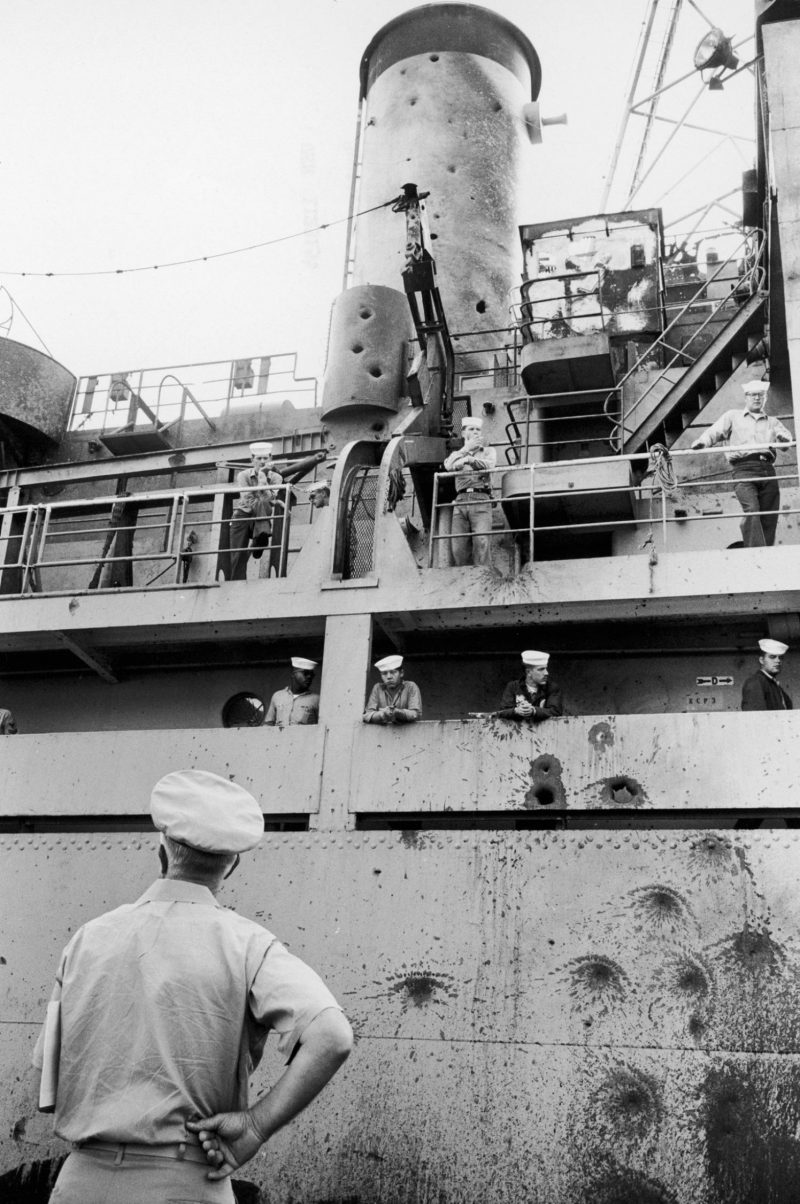
Damage to the starboard side of the USS Liberty following Israeli attacks, June, 1967. Photo | NSA Archive
Those who survived the assault of the Liberty owe their lives to the then-23-year-old Terry Halbardier, who valiantly navigated the Liberty’s napalm-glazed deck and managed to rig an antenna and send out an SOS signal to the Navy’s Sixth Fleet. Upon intercepting that distress signal, the Israelis immediately broke off the attack. Halbardier’s heroism prevented the massacre of all 294 crewmen and allowed them to live to tell their stories, despite Johnson’s having left them for dead.
Yet many Liberty survivors were unable to tell their stories for decades, as the U.S. government issued gag orders and threatened them with being court-martialed for speaking to anyone, even their spouses, about the incident. The Navy’s Board of Inquiry, which abetted the cover-up, was headed by Admiral John S. McCain Jr., the father of the late Senator John McCain of Arizona.
To this day, the U.S. government has failed to conduct a full, public inquiry into the attack. Liberty survivors who have since spoken out have been accused of “anti-Semitism” and of slandering Israel for discussing their personal and traumatic experiences of the attack, significantly compounding their suffering and post-traumatic stress.
While the survivors of Israel’s assault on the Liberty have been denied closure, the U.S. government’s response has endangered the lives of American personnel by clearly signaling to Israel that they will suffer no consequences for such “false flag” attacks, regardless of whether American servicemen are wounded or killed. As former CIA intelligence analyst Ray McGovern has previously noted for Consortium News, “the U.S. cover-up [of the attack on the U.S.S. Liberty ] taught the Israelis that they could literally get away with murder.”
In a 2015 interview on the Real News Network, McGovern warned that the attack on the Liberty still holds “current relevance” and that he felt that “the Israelis are capable of doing this kind of thing when they see their supreme national interests at stake.” McGovern further stated that Israeli officials may well have considered a provocation, such as false flag, to throw a wrench in the Iran nuclear deal, which was being negotiated at the time.
McGovern — in an open letter to President Barack Obama, co-authored with former Deputy National Intelligence Officer for the Near East in the National Intelligence Council Elizabeth Murray — noted that Admiral Mike Mullen, former member of the Joint Chiefs of Staff in the Bush administration, had flown to Israel in 2003 and told the Israeli government emphatically “to disabuse themselves of the notion that U.S. military support would be knee-jerk automatic if they somehow provoked open hostilities with Iran. According to the Israeli press, Mullen went so far as to warn the Israelis not to even think about another incident at sea like the deliberate Israeli attack on the U.S.S. Liberty.”
McGovern and Murray cited Mullen’s statements to Israeli officials as the first time that “a senior U.S. official braced Israel so blatantly about the Liberty incident.” In an email to MintPress, McGovern stated that he was unsure whether current Chairman of the Joint Chiefs of Staff Gen. Joseph Dunford “can be counted upon to play a similar restraining role” in preventing hostilities with Iran. Notably, Dunford was in attendance along with Bolton at the recent CIA meeting to discuss “highly sensitive covert actions” in relation to Iran.
An “accident” waiting to happen
Since Bolton announced the movement of the Lincoln carrier strike group towards the Persian Gulf, some have pointed out that the vessels could well be destined for use in a “false flag” provocation, such as one planned by former Vice President Dick Cheney in 2008 (to be discussed shortly) and another conducted by Israel in 1967. Indeed, as MintPress noted the day after Bolton’s announcement, the carrier strike group’s deployment was actually announced a month prior and was a routine deployment.
The political analysis blog Moon of Alabama also noticed that Bolton had framed this routine deployment as something more dire for his own purposes, writing:
The carrier deployment to the Gulf is routine. It had been announced on April 8. The U.S. has bombers on rotation in the Middle East since 2001. Moreover – a carrier in the Persian Gulf is a sure sign that the U.S. will not attack Iran. Within the restricted waters of the Persian Gulf a carrier is a too easy target. The idea though may be to provide for an ‘accident’’ as Iran’s Foreign Minister [Javad Zarif] described it in a recent CBS interview.”
In an interview late last month with CBS’ Face the Nation, Zarif explicitly told journalist Margaret Brennan his concern about an imminent “false flag” to trigger war with Iran by John Bolton in collaboration with Israeli, Saudi and Emirati leadership:
Foreign Minister Zarif | I don’t think military confrontation will happen. I think people have more prudence than allowing a military confrontation to happen. But, I think the U.S. administration is putting things in place for accidents to happen. And there has to be extreme vigilance, so that people who are planning this type of accident would not have their way.
Margaret Brennan | What do you mean? What kind of accident are you talking about?
Zarif | I’m talking about people who have — who are designing confrontation, whose interest —
Brennan | Who’s doing that?
Zarif | My ‘B’ team. I call —
Brennan | What do you mean ‘B’ team?
Zarif | I call the group ‘B’ team who have always tried to create tension, whose continued existence depends on tension. Ambassador Bolton, one ‘B,’ Bibi Netanyahu, second ‘B,’ Bin Zayed, third ‘B,’ Bin Salman, fourth ‘B.’ And I’m not just making accusations.
With an aircraft carrier little more than a sitting duck in the area amid rising tensions between the U.S. and Iran, an “accident” may well occur. As was noted in Part I of this mini-series, such a possibility was directly stated by British Foreign Minister Jeremy Hunt on Monday.
Hunt told reporters “We are very worried about the risk of a [U.S.-Iran] conflict happening by accident, with an escalation that is unintended really on either side but ends with some kind of conflict.” Hunt notably made the statement after meeting with Pompeo, who is currently in Europe meeting with European heads of state to discuss Iran. The Associated Press noted that the Trump administration had warned European officials, Hunt included, that “Iran or its proxies could be targeting maritime traffic in the Persian Gulf region.”
The possibility of such an “accident” is further compounded by Bolton’s aforementioned and “highly unusual” meeting about Iran and “highly sensitive covert actions” at CIA headquarters last week. Declassified CIA documents show that the agency had previously planned to stage terror attacks on U.S. soil and murder Americans to blame on Cuba in order to justify invading the Caribbean nation in the 1960s. That plan, known as Operation Northwoods, further called for the destruction of U.S. military vessels to be blamed on Cuba and also the staging of fires and mortar attacks on U.S. military installations in Cuba (i.e., Guantanamo Bay) or nearby (i.e., in Florida). Though Operation Northwoods was never enacted, the agency has been accused of orchestrating numerous “false flags” in the decades since.
As was recently seen with the alleged “sabotage” of Saudi oil tankers near Iran, there are many potential targets for provocation. However, the incident that would most assuredly force U.S. involvement in a military conflict would be an attack on an American military target. While some have dismissed Bolton’s announcement of the carrier’s movements as a self-serving manipulation of the facts, it may have had the added purpose of framing the lead-up to an unfortunate “accident” targeting American vessels in the area, particularly the Lincoln carrier strike group or one of the other subsequent U.S. naval deployments to the Middle East.
The neocon plan for a Liberty-like attack
If any sort of provocation blamed on Iran should occur, it is important to consider that a powerful group of U.S. politicians — the neo-conservatives — have long sought to plan provocations that would drag the U.S. into war with Iran. One of the most recent examples took place during the George W. Bush administration when then-Vice President Dick Cheney held a meeting with other administration officials in 2008 aimed at provoking war with Iran.
The details of that meeting were revealed by Pulitzer Prize-winning journalist Seymour Hersh, who described some of the ideas considered in that Cheney-led meeting as follows:
There were a dozen ideas proffered about how to trigger a war. The one that interested me the most was why don’t we build in our shipyard four or five boats that look like Iranian PT boats. Put Navy seals on them with a lot of arms. And next time one of our boats goes to the Straits of Hormuz, start a shoot-up. Might cost some lives.
And it was rejected because you can’t have Americans killing Americans. That’s the kind of, that’s the level of stuff we’re talking about. Provocation.
Silly? Maybe. But potentially very lethal. Because … if you get the right incident, the American public will support bang-bang-kiss-kiss. You know, we’re into it.”
It is unknown if any Bush officials now in the Trump administration were present at that meeting where the use of a “false flag” pitting Americans against Americans disguised as Iranian was discussed. However, what is known is that John Bolton — who was a member of the neo-conservative Project for a New American Century, along with Cheney, and who also served in the Bush administration — has zealously sought war with Iran for nearly two decades. Indeed, the New York Times recently described Bolton as “one of the administration’s most virulent Iran hawks, whose push for confrontation with Tehran was ignored more than a decade ago by President George W. Bush.” It is also known that Bolton has a history of playing fast and loose with unconfirmed intelligence and also distorting intelligence to fit his pre-determined narrative.
As MintPress reported last year, former Israeli Ambassador to the UN Danny Gillerman has stated that Bolton, when serving in the Bush administration, was prone to “direct fire on his own forces,” — i.e., the U.S. government — in order to advance the goals of the Israeli government, especially with respect to Iran. For instance, in more than one instance while in the Bush administration, Bolton traveled to Israel in violation of State Department rules and negotiated privately with Israeli officials, including the then-head of the Mossad, Meir Dagan, to lay the groundwork for a war with Iran. As journalist Gareth Porter has noted, Bolton did this in an effort to directly undermine Colin Powell, Bolton’s superior, just as Powell “was saying administration policy was not to attack Iran.”
Worse still, Bolton has pressured Israeli officials to initiate a war with Iran, even when they didn’t support such a move. One such case was Shaul Mofaz, former Israeli defense minister, who told Israeli media last March that Bolton “tried to convince me that Israel needs to attack Iran,” even though Mofaz did not see such a war as “a smart move — not on the part of the Americans today or anyone else until the threat is real.”
Pompeo’s Holy war and rapture
Furthermore, Bolton is not the only top Trump administration official who has long promoted a war with Iran, as current Secretary of State Mike Pompeo had also called for the preemptive bombing of Iran long before he joined the Trump administration. Pompeo’s desire to push the U.S. towards war with Iran is based on his fervent adherence to Christian Zionism. As a result of the admitted influence his beliefs hold over his foreign policy, Pompeo sees an “apocalyptic” war between Israel and Iran as a necessary precursor to the Second Coming of Christ and the “rapture.”
Pompeo is on record speaking about the rapture on several occasions, particularly as CIA director when he spoke about the event — which holds that “true believers” will ascend to Heaven prior to the tribulations and trials of the “end times” — so often that he made veteran intelligence officers uncomfortable. As a result, some have asserted that Pompeo is “a man who appears to view American foreign policy as a vehicle for holy war.”
The fact that the actions of the current Secretary of State are influenced by his Christian Zionist faith was on display last month, when American Christian journalist Chris Mitchell of the Christian Broadcasting Network asked Pompeo: “Could it be that President Trump right now has been sort of raised for such a time as this … to help save the Jewish people from the Iranian menace?” Pompeo responded that this was definitely “possible.”
If Adelson has his way . . .
Yet, perhaps the most dangerous force driving the U.S. towards a war with Israel is not the public face of the Trump administration’s foreign policy but its private face. Sheldon Adelson — the top donor to Trump, the entire Republican Party, and also the top political donor to Israeli Prime Minister Netanyahu — has long sought war with Iran, and several of Adelson’s desired policies have already been enacted by Trump. These include recognizing Jerusalem as Israel’s capital, replacing H.R. McMaster with Bolton as National Security Advisor, and withdrawing from the Iran nuclear deal. Several reports have asserted that pressure from Adelson was a deciding factor in Trump’s fulfillment of these policies.
Adelson’s influence over Trump again takes on great significance, given recent events with respect to Iran, as Adelson has previously advocated for a U.S. nuclear attack on Iran without provocation, just so the U.S. could “impose its demands [on Iran] from a position of strength.”
Per Adelson’s plan, the U.S. would drop a nuclear bomb in the middle of the Iranian desert and then threaten that “the next one is in the middle of Tehran” to show that “we mean business.” Tehran, Iran’s capital, is home to nearly 9 million people with 15 million more in its suburbs. Were Tehran to be attacked with nuclear weapons, an estimated 7 million would die within moments, according to a 2013 study jointly conducted by researchers at the University of Georgia and Harvard.
Yet, any sort of diplomatic engagement with Iran, according to Adelson, is “the worst negotiating tactic I could ever imagine.”
In other words, Adelson has called for dropping nuclear weapons on a country, including its heavily populated capital city, for no reason other than to show that the U.S. “means business” and considers nuclear war a negotiating tactic.
While some media reports have suggested that Trump is unwilling to go to war with Iran and is uneasy with the hawkish policies of Bolton and Pompeo, he will have a hard time ignoring Adelson. Adelson, who poured $35 million into Trump’s 2016 campaign and spent $55 million on Republican primary campaigns last year, is the party’s most influential donor and angering him could well mean the end of Trump’s political career.
Would Trump resist a push for war from not just Netanyhu, Bolton and Pompeo but Adelson as well? It seems unlikely. Craig Holman of the watchdog group Public Citizen told ProPublica in 2018 that he “would put Adelson at the very top of the list of both access and influence in the Trump administration,” a sentiment that was also echoed by Alan Dershowitz, who has done legal work for Adelson and advised Trump. Dershowitz told ProPublica that Adelson “just calls the president all the time. Donald Trump takes Sheldon Adelson’s calls.” As MintPress has noted on several occasions, those calls often translate into policy decisions.
Unfortunately, Trump — even when he tries to follow a different path, as he attempted to do in Syria — often ends up conceding to the neo-conservatives and Zionist extremists who surround (and fund) him.
History issues a warning
The combination of current tensions and the documented history of both Israel and Bush-era neo-conservatives planning and even executing false flag attacks in order to justify U.S. military action against a desired target — should set off alarm bells. Instead, most corporate media outlets are playing up unfounded or baseless claims of the “Iranian threat” and Iran’s unproven role in recent acts of “sabotage” in Saudi Arabia and in the UAE in ways that are strikingly similar to the lead-up to the 2003 invasion of Iraq.
Furthermore, the history and mindset of both Bolton and Pompeo, in addition to the unprecedented influence of Sheldon Adelson in the Trump administration, add yet another layer to this increasingly complex yet undeniably troubling situation.
As a consequence, it is imperative for people around the world, particularly in the United States, to be skeptical of any act of violence blamed on Iran before a full investigation is completed, and to resist a rapid push to begin a conflict with Iran that could well follow such an act.
The time for resistance, ideally, would be before such an attack occurs, making critical the widespread dissemination of relevant information left unmentioned by the corporate media, such as that contained in Parts I and II of this series. The crucial context here is the well-documented willingness of both the Israeli and U.S. governments to sacrifice (i.e., kill) Americans in order to plunder the natural resources of “unfriendly” nations and pursue the objectives of the political and economic elite of both countries.
Whitney Webb is a MintPress News journalist based in Chile. She has contributed to several independent media outlets including Global Research, EcoWatch, the Ron Paul Institute and 21st Century Wire, among others. She has made several radio and television appearances and is the 2019 winner of the Serena Shim Award for Uncompromised Integrity in Journalism.
Iranian MP Blames ‘Israeli Mischief’ for ‘Sabotage’ Against Tankers at UAE Port
Sputnik – 14.05.2019
Iran’s Foreign Ministry spokesman earlier called for an investigation into attacks on several vessels off the UAE coast on Sunday, having warned against any “conspiracy orchestrated by ill-wishers” and “adventurism by foreigners” to undermine the region’s stability.
Iranian parliamentary spokesman Behrouz Nemati has blamed the “sabotage” against four vessels off the United Arab Emirates’ (UAE) coast on Sunday on Israel, according to IRNA.
“The events that took place in the Emirates were Israeli mischief”, Nemati said, without going into details on what role Israel could have played in the incident.
Iran’s Foreign Minister Mohammad Javad Zarif, in turn, said that he had foreseen this sort of “suspicious activities”, which he stressed were “aimed at escalating tension in the region”.
The comments come shortly after several unnamed US officials told AP that “Iranian or Iranian-backed proxies” are alleged to be behind the attack.
Tehran has denied any involvement and urged for an investigation into the matter, calling the incident “worrisome and dreadful” and cautioning against any “conspiracy orchestrated by ill-wishers”.
In a parallel development, US Ambassador to Saudi Arabia John Abizaid said that Washington should take what he described as “reasonable responses short of war” once it determined who is behind the attacks on oil tankers.
“We need to do a thorough investigation to understand what happened, why it happened, and then come up with reasonable responses short of war. It’s not in (Iran’s) interest, it’s not in our interest, it’s not in Saudi Arabia’s interest to have a conflict”, Abizaid told reporters in Riyadh.
The remarks follow news of four commercial ships being targeted in what the UAE Foreign Ministry described as “acts of sabotage” near Fujairah, one of the seven emirates, without revealing the nature of the attack.
Saudi Arabia’s energy minister said on Monday that two of its oil tankers were among those targeted; the attack didn’t cause an oil spill or any casualties, but is said to have led to significant damage to the structures of both ships. The two other ships are alleged to belong to Norway and the UAE.
With the US-Iran War Ball Now Rolling, Could an “Accident” or “False Flag” Serve as Pretext?
By Whitney Webb | MintPress News | May 13, 2019
As tensions between the U.S. and Iran threaten to boil over, the probability of a provocation or “accident” that would provoke hostilities between the two countries is higher than ever. U.K. Foreign Minister Jeremy Hunt, after meeting with U.S. Secretary of State Mike Pompeo, openly stated as much on Monday, telling reporters in Brussels that the U.K. was worried of a conflict breaking out between the U.S. and Iran by “accident with an escalation that is unintended really on either side but ends with some kind of conflict.”
Yet, current and past events make it clear that such an “accidental” provocation is unlikely to be purely accidental in nature, as forces in the U.S. and Israel have been actively pushing for a U.S.-led war with Iran for years and have a track record that demonstrates little inhibition about using an “accident” or “false flag” to drag the country into a war with the Islamic Republic.
Notably, the state of Israel — in an event long since buried by the government and corporate media — has previously staged such a “false flag” by targeting an American naval vessel, killing 34 Americans, in order to blame the attack on Egypt and drag the U.S. into a war with several Middle Eastern nations in 1967. However, Israel is not alone in this, as the CIA as well as neo-conservatives serving in the Bush administration, led by then-Vice President Dick Cheney, have planned “false flags” that involved the murder of American servicemen and civilians in order to justify miltiary action against U.S. adversaries.
In this two-part series, MintPress explores the troubling evidence that preparations for another such “false flag” are well underway. In this first installment, current events in relation to U.S.-Iran relations and the role of Israel in the ratcheting up of tensions will be examined, while the second installment will focus on Israel’s past of conducting “false flags” to goad the U.S. into wars on Israel’s behalf as well as efforts by former Vice President Dick Cheney to conduct a “false flag” pitting American sailors against American sailors disguised as Iranian naval forces to justify a conflict with Iran.
Bolton, taking a page from Iraq 2003 playbook, sets ball rolling
Since National Security Advisor John Bolton sent out a dramatic press release announcing the deployment of a U.S. carrier strike group as a warning to Iran on May 5, tensions between the U.S. and Iran have risen dramatically, a development that Bolton — who has long advocated regime change and a pre-emptive war against Iran — likely welcomes. As MintPress recently reported, that press release was intentionally vague, allowing justification for a military response to any number of incidents, whether committed by Iran or alleged “proxies” of Iran, including groups over which Iran’s government has no control.
Furthermore, it has since been revealed that the “intelligence” Bolton used to frame the deployment and the rationale for future U.S. military action against Iran was from the Israeli government — which has long pushed the U.S. towards war with Iran. In addition, several unnamed U.S. officials stated soon after that Bolton and other Trump administration officials had greatly exaggerated the nature of this intelligence and overreacted. MintPress has noted on several occasions Bolton’s history of distorting intelligence to conform with a specific narrative or in order to promote specific policy actions and this tendency of Bolton’s was also recently noted in a New Yorker profile on the current National Security Advisor.
It was subsequently revealed that a few days prior to Bolton’s press release, Bolton had made a “highly unusual” visit to CIA headquarters to discuss Iran. NBC News reported that the “extremely rare” choice to hold this meeting at the CIA instead of the White House’s Situation Room likely meant that the purpose of the meeting was “to brief top officials on highly sensitive covert actions, either the results of existing operations or options for new ones,” based on statements from five former CIA operations officers and military officials.
That meeting, as noted by the political and financial news site ZeroHedge, “hearkens back to the Bush-Cheney White House’s direct intervention over Iraq intelligence in the lead-up to the 2003 invasion, which involved the VP and his staff making multiple personal visits to CIA headquarters and the Pentagon to pressure the intel analysts into conforming to a preferred ‘narrative.’” Yet, the emphasis on “covert actions” in relation to Iran suggests that something much more sinister may be afoot.
Indeed, in the weeks since that press release and the “highly unusual” CIA meeting, the U.S. has deployed more military assets towards the Persian Gulf and Secretary of State Pompeo has made several abrupt schedule changes in order to discuss Iran with various countries. Notably, the Trump administration has also announced the end of waivers that have allowed some foreign companies to continue buying Iranian oil without facing U.S. sanctions.
The situation has forced Iran to respond, with Iran announcing that it would begin withdrawing from the Iran nuclear deal — which the U.S. unilaterally withdrew from over a year ago — as the U.S.’ economic war against Iran shoots to another level.
Perhaps most telling of all is the fact that Western media, particularly U.S. media, have been heavily promoting the Iranian “threat” since soon after Bolton’s Mary 5 press release, in yet another striking parallel to the lead-up to the 2003 invasion of Iraq. Yet, particularly notable in this case is that much of the “intelligence” that has been used to justify these recent moves by the Trump administration has come from Israel’s government, led by the recently re-elected Israeli Prime Minister Benjamin Netanyahu, whose desire to goad the U.S. into a war with Iran is an open secret.
One potential pretext already in play in the Persian Gulf
On Sunday, reports surfaced that several oil tankers were the victims of “sabotage” while sailing towards the Persian Gulf near Fujairah, one of the seven emirates that comprise the United Arab Emirates (UAE), which is located just outside the Strait of Hormuz. Fujairah’s government initially denied that any “sabotage” took place and maintained that its port facilities were operating normally after media reports from Iranian outlet PressTV and Lebanese outlet Mayadeen reported on a series of “explosions” on unidentified ships in the area.
The UAE’s foreign ministry later confirmed an incident in the area but said no casualties or spills occurred and notably did not provide details as to the number or nationalities of the ships involved nor the groups responsible for the alleged attack.
However, Saudi Arabia subsequently claimed that its tankers had been affected by this act of “sabotage” and that the targeted tankers had been approaching the Strait of Hormuz on route to load oil destined for the United States. Saudi Arabia, like the UAE, did not blame any country for the attack. A Norwegian-registered oil tanker experienced hull damage after striking “an unknown object,” potentially suggesting the attack was caused by an explosion of a sea mine or the result of a torpedo or other projectile launched underwater. Notably, the U.S., U.K. and France held a “mine warfare drill” in the Persian Gulf just last month and past Western media reports have characterized sea mines as “Iran’s favorite military asset.”
Iran rejected any responsibility for the attack and Iran’s Foreign Ministry spokesman Abbas Mousavi warned against a “conspiracy orchestrated by ill-wishers” and “adventurism by foreigners.”
However, the timing of the sabotage came right on the heels of statements made by the U.S. and Israeli governments that have led some to blame Iran or suggest Iranian responsibility for the attacks — despite the lack of evidence made public and the decision by both the Saudis and Emiratis, long-time adversaries of Iran, from blaming any country for the incident or describing any specifics about the attack.
This past Thursday, the U.S. Maritime Administration — a division of the U.S. Department of Transportation — stated that “Iran or its proxies could respond by targeting commercial vessels, including oil tankers, or U.S. military vessels in the Red Sea, Bab-el-Mandeb Strait or the Persian Gulf.” The U.S. Department of Transportation is currently headed by Elaine Chao, who was paid $50,000 for a five-minute speech to the Iranian exile group, Mujahedeen-e-Khalq (MEK), known to actively seek regime change for Iran. Other top U.S. officials, such as Bolton, have also been paid hefty sums for appearances at MEK events, where they have openly advocated for the overthrow of the Iranian government.
In addition to warning from a U.S. department headed by an official with links to an Iranian opposition group actively seeking regime change, Israeli officials “leaked” information on Israel’s Channel 13 on Saturday that Iran was allegedly planning to target Saudi oil assets in the region. According to the unsourced report, as cited by the Times of Israel, the Iranians were “considering various aggressive acts” against American assets or those of its regional allies, such as Saudi Arabia and Israel. The report also claimed that Iran had considered targeting American bases in the Gulf, but rejected it as too drastic and instead had decided to target “Saudi oil production facilities.”
In light of recent events, as well as the corporate media’s willingness to suggest Iranian culpability despite little to no publicly available evidence, it appears that this recent attack — regardless of who was responsible — could be seized upon by officials in the U.S. or Israel eager to see tensions between the U.S. and Iran escalate.
Netanyahu: “America is easily moved”
It is an open secret that Israel’s government, particularly under Netanyahu, has been eager to see the U.S. engage in hostilities with Iran. The main driver for this is the fact that, while Israel has since forged alliances with several Arab-majority nations such as Saudi Arabia, Egypt and the United Arab Emirates, Iran and its regional allies — namely Lebanon’s Hezbollah and Syria — oppose Israeli objectives for the region and those of its allies. More crucially, Iran is arguably the country that is most supportive of Palestine and the major barrier to Netanyahu’s plans to annex Palestine’s occupied West Bank, a promise on which Netanyahu rode to reelection last month. Now more than ever, Netanyahu wants Iran’s government out of the way.
Netanyahu has openly stated that he views the U.S. government as a vehicle for fulfilling Israeli objectives and believes that Americans are easily manipulated, by Israel in particular. For instance, in a video recorded in the early 2000s — later broadcast on Israeli TV and subsequently reported on by Consortium News — Netanyahu “brags about how he deceived President Bill Clinton into believing he [Netanyahu] was helping implement the Oslo accords when he was actually destroying them. The tape displays a contemptuous attitude toward, and wonderment at, a malleable America so easily influenced by Israel.”
In the video, Netanyahu states:
America is something that can be easily moved. Moved in the right direction. They won’t get in our way; 80 percent of the Americans support us. It’s absurd.”
Israeli journalist Gideon Levy later asserted that the video reveals Netanyahu to be “a con artist who thinks that Washington is in his pocket and that he can pull the wool over its eyes” and that the current Israeli prime minister’s attitude is unlikely to “change over the years.”
Now, with the Trump administration having shown its willingness to favor Israeli interests in the Middle East, Netanyahu has apparently sensed that the hour has come to push the U.S. towards war with Iran. For instance, the Trump administration organized a summit aimed at securing “peace and security in the Middle East,” to which Iran was not invited. The New York Times described that summit as follows:
…Leaders of Israel and Arab states met publicly again, at an international conference in Warsaw staged by the Trump administration. But the goal of this meeting, drawing officials of some 60 nations, was not peacemaking. It was to rally support for economic and political war with Iran, for which the United States has found little enthusiasm among allies since withdrawing from the 2015 deal that restricts Iran’s nuclear program.”
Notably, during that meeting, Netanyahu wrote in a since deleted tweet that the summit was “an open meeting with representatives of leading Arab countries, that are sitting down together with Israel in order to advance the common interest of war with Iran.”
In the wake of the Warsaw summit, Netanyahu has since claimed that he was responsible for the Trump administration’s decision to label Iran’s Islamic Revolutionary Guard Corps (IRGC) a terror group, a move that dramatically increased the risk of a military confrontation between the U.S. and Iran, especially given that Iran subsequently responded by declaring the U.S. military’s Central Command a terrorist organization.
Now, with Netanyahu feeding Bolton “intelligence” that Bolton has greatly exaggerated in order to justify their common goal — a U.S. war with Iran — and also “predicting” dubious “sabotage” attacks near the Persian Gulf, Israel’s government has revealed itself to be a driving force behind the spiking tensions between the two countries.
Equally troubling is the fact that world leaders are now openly positing that an “accident” or “false flag” provocation will be used to provoke such hostilities.
For Netanyahu, it’s now or never for a U.S.-Iran war
With the Iran nuclear deal in tatters, one consequence of the Trump administration’s “maximum pressure” campaign against Iran has been to push Iran to renege on aspects of the deal, from which the U.S. has already long since withdrawn. The goal, by all appearances, is to use Iran’s plan to breach parts of the deal as justification for further aggressive actions against the country by claiming that such breaches, instead of a response to U.S.-led economic warfare, are a sign of an intention to develop nuclear weapons.
With waivers for the purchases of Iranian oil now ending and Iran’s president announcing that Iran will end compliance with some aspects of the deal if Europeans do not find a meaningful workaround for U.S. sanctions, the Trump administration — and the Iran hawks within — seem to have their ducks in a row.
While there has long been concern about a U.S.-Iran conflict, several situations have arisen that have made this push for a regime-change conflict with Iran of extreme importance to both U.S. and Israeli interests in the region.
For instance, Syria’s government is set to take the Idlib province, after which Syria will turn its attention towards the Israel-controlled Golan Heights and the U.S.-occupied area of northeastern Syria. Israel was revealed to be the “brains” behind the Syria conflict and has been actively preparing for hostilities with Syria and nearby Lebanon since last year, following the failure to overthrow Syria’s government. Syria holds a mutual defense pact with Iran, meaning that it will join a conflict with Iran if Iran is threatened, thus preventing Syria’s government from focusing its efforts on retaking areas occupied by the U.S. and Israel.
If the U.S. and Israel wait until Syria consolidates control over Idlib, they will be facing a much stronger adversary in Iran’s closest regional ally than one distracted by a pocket of Al Qaeda-dominated terrorist groups in its north.
Yet, the clearest indicator that the push for war is very much in earnest is the intention of Netanyahu to effectively destroy Palestine. Several analysts, including ex-CIA analyst Ray McGovern, have long maintained that Israel’s and Netanyahu’s main reason for wanting a war with Iran is to “have Iran bloodied the same way we did to Iraq” so that Iran “would no longer be able to support Hamas and Hezbollah in Gaza, Lebanon, and elsewhere.” In other words, Netanyahu wants Iran out of the picture so it can no longer provide material or financial support to groups that resist Israeli occupation.
Having won reelection in part because of his promise to annex the occupied West Bank, Netanyahu worries that Iran and its regional allies will strongly oppose that annexation and may even go to war over it, particularly if the fate of the Al-Aqsa mosque compound in Jerusalem is threatened. Now, with the Trump administration’s “Deal of the Century” also set to be made public in less than a month, that deal’s push to enable the annexation is also threatened by the regional bloc led by Iran that still supports Palestine. If Netanyahu is able to eliminate Iran as a regional power, he will have eliminated the greatest single threat to both his plans for complete annexation and the enactment of the Trump administration’s “Deal of the Century.”
With top officials in the U.S. government and much of the media failing to push back, Netanyahu finally has a window of opportunity — albeit one that is shrinking — to push the U.S. to war with Iran and it appears that he, along with his allies in the Trump administration, plans on taking it.
As Part II of this series will show, Israel’s government and Bush-era neo-conservatives have a track record of enacting and planning “false flag” attacks to embroil the U.S. in foreign wars and that playbook would include provoking the U.S. into a war with Iran.
Whitney Webb is a MintPress News journalist based in Chile. She has contributed to several independent media outlets including Global Research, EcoWatch, the Ron Paul Institute and 21st Century Wire, among others. She has made several radio and television appearances and is the 2019 winner of the Serena Shim Award for Uncompromised Integrity in Journalism.
Iran Warns Against ‘Conspiracy by Ill-Wishers’ Over ‘Sabotage’ at UAE Port
Sputnik – 13.05.2019
Iran’s Foreign Ministry Spokesman Abbas Mousavi has expressed concerns over a “sabotage” attack on several merchant ships off the UAE coast on Sunday, calling the incident “worrisome and dreadful”, and has urged an investigation into the matter, ISNA reported.
Mousavi was cited as saying that “such incidents have a negative impact on maritime transportation security”, cautioning against any “conspiracy orchestrated by ill-wishers” as well as “adventurism by foreigners” to undermine the region’s stability.
The comments followed a reported remark by Saudi Arabia’s Energy Minister Khalid al-Falih, who said that two Saudi vessels were among those targeted near the UAE.
One of the two ships in question was attacked on its way to be loaded with Saudi crude at the port of Ras Tanura for delivery to Saudi Aramco in the US, Reuters reported.
The suspected attack didn’t lead to any casualties or oil spill, but is said to have caused significant damage to the structures of the two vessels.
“The international community has a joint responsibility to protect the safety of maritime navigation and the security of oil tankers, to mitigate against the adverse consequences of such incidents on energy markets and the danger they pose to the global economy”, al-Falih said in a statement, as quoted by Reuters.
As reports of the alleged sabotage attack kept flooding in, the Cooperation Council for the Arab States in the Gulf (GCC) issued a statement to condemn the incident:
“It is a dangerous development and escalation that reflects the evil intentions of those who planned and carried out these operations that endanger the safety of maritime navigation in the region and threaten the lives of the ships’ civilian crews”, the statement read.
On Sunday, the UAE said that four merchant vessels had been targeted in “acts of sabotage” in its territorial waters, thus brushing off previous reports by the Lebanon-based broadcaster al-Mayadeen, which said that several large blasts had occurred in the port of Fujairah. Reacting to the reports about explosions, authorities in Fujairah refuted the claims, stressing that the port was functioning as usual.
Bolton Is Spinning Israeli ‘Intelligence’ to Push for War Against Iran
By Gareth Porter | TruthDig | May 11, 2019
John Bolton has gotten away with a dangerous deception. The national security adviser’s announcement Sunday that the Pentagon has deployed air and naval forces to the Middle East, which he combined with a threat to Iran, points to a new maneuver to prepare the ground for an incident that could justify a retaliatory attack against Iran.
Bolton presented his threat and the deployments as a response to alleged intelligence about a possible Iranian attack on U.S. targets in the Middle East. But what has emerged indicates that the alleged intelligence does not actually reflect any dramatic new information or analysis from the U.S. intelligence community. Instead, it has all the hallmarks of a highly political case concocted by Bolton.
Further underscoring the deceptive character of Bolton’s maneuver is evidence that senior Israeli national security officials played a key role in creating the alleged intelligence rationale for the case.
The new initiative follows an audacious ruse carried out last fall by Bolton and Secretary of State Mike Pompeo, detailed in Truthdig in February, to cast the firing of a few mortar rounds in the vicinity of the U.S. embassy and a consulate in Iraq as evidence of an effort by Tehran to harm U.S. diplomats. Bolton exploited that opportunity to press Pentagon officials to provide retaliatory military options, which they did, reluctantly.
Bolton and Pompeo thus established a policy that the Trump administration would hold Iran responsible for any incident involving forces supported by Iran that could be portrayed as an attack on either U.S. personnel or “interests.”
Bolton’s one-paragraph statement on Sunday considerably broadened that policy. It repeated the previously stated principle that the United States will respond to any alleged attack, whether by Iranian forces or by what the administration calls “proxy” forces. But it added yet another major point to Trump administration policy: “a clear and unmistakable message to the Iranian regime that any attack on United States interests or on those of our allies will be met with unrelenting force [emphasis added].”
That language represents an obvious move by Bolton to create potential options for U.S. retaliation against Iran for a real or alleged attack by “proxy forces” on Israeli or Saudi forces or “interests.” Such a commitment to go to war with Iran over incidents related to Israeli or Saudi conflicts should be the subject of a major debate in the press and in Congress. Thus far, it has somehow escaped notice.
Significantly, on a flight to Finland on Sunday, Pompeo repeated the threat he made last September to respond to any attack by “proxy forces” on U.S. “interests.” He made no reference to possible attacks against “allies.”
Bolton and his staff claimed to the news media that what he characterizes as “troubling and escalatory indications and warnings” are based on “intelligence.” Media reports about Bolton’s claim suggest, however, that his dramatic warning is not based on either U.S. intelligence reporting or analysis.
Citing “U.S. officials,” The Wall Street Journal reported Monday that the alleged intelligence “showed that Iran drew up plans to target U.S. forces in Iraq and possibly Syria, to orchestrate attacks in the Bab el-Mandeb strait near Yemen through proxies and in the Personal [sic] Gulf with its own armed drones.”
But in the very next paragraph, the report quotes an official saying it is “unclear whether the new intelligence indicated operations Tehran planned to carry out imminently or contingency preparations in the case U.S.-Iran tensions erupted into hostilities.”
A Defense Department source said the intelligence showed “a change in behavior that could be interpreted to foreshadow an attack on American forces or interests,” according to the New York Times’ story on the matter. But the source didn’t actually say that any emerging intelligence had led to such a conclusion or even that any U.S. intelligence official has come to that conclusion.
The timing of the alleged new intelligence also suggests that Bolton’s claim is false. “As recently as last week there were no obvious sign of a new threat,” the Wall Street Journal reported. The New York Times similarly reported that “several Defense officials” said “as recently as last Friday they have had [sic] not seen reason to change the American military’s posture in the region.”
Normally, it would require intelligence from either a highly credible source within the Iranian government or an intercept of a sensitive communication from Iran to justify this kind of accusation. But no news outlet has brought word that any such spectacular new intelligence has found its way to the White House or the Pentagon.
The Journal’s report revealed, moreover, that Bolton has only a “fresh intelligence assessment” rather than any new intelligence report. That “assessment” is clearly not a product of the intelligence community, which would have taken at least several days to arrive at such a fundamental reinterpretation of Iranian intentions. The mysterious new “assessment” was evidently unknown outside Bolton’s office before Bolton swung into action last weekend.
We now know, in fact, that the sources behind Bolton’s claim were Israel’s national security adviser and intelligence agency. Axios published a report Monday by leading Israeli journalist Barak Ravid, who covers national security for Israel’s Channel 13, revealing that a delegation of senior Israeli officials had given Bolton “information” about “possible Iranian plots against the U.S. or its allies in the Gulf” two weeks earlier.
The Israeli delegation, led by national security adviser Meir Ben Shabbat, met with Bolton and other unnamed officials in the White House, according to Ravid, to discuss possible Iranian plans. Bolton himself tweeted on April 15 about his meeting with Shabbat.
Israeli officials told Ravid that they understood that “intelligence, gathered by the Mossad intelligence agency, was part of the reason for Bolton’s announcement.” What Ravid’s official sources told him reveals, however, that what the Israelis provided to Bolton was not really new intelligence at all; it consisted of several scenarios for what the Iranians might be planning, according to one Israeli official.
“It is still unclear to us what the Iranians are trying to do and how they are planning to do it,” the Israeli official told Ravid, “but it is clear to us that the Iranian temperature is on the rise as a result of the growing U.S. pressure campaign against them, and that they are considering retaliating against U.S. interests in the Gulf.”
That revelation explains the lack of evidence of either genuine U.S. intelligence reporting or proper assessment to support Bolton’s statement.
Bolton is an old hand at using allegedly damning intelligence on Iran to advance a plan of aggressive U.S. war. In 2003-04, he leaked satellite photographs of specific sites in Iran’s Parchin military complex to the press, claiming those images provided evidence of covert Iranian nuclear weapons-related experiments—even though they showed nothing of the sort. He then tried to pressure International Atomic Energy Agency Director General Mohamed ElBaradei to insist on an inspection of the sites. When ElBaradei finally relented, he found nothing in that inspection to support Bolton’s claim.
Bolton’s deceptive maneuver has the effect of increasing the range of contingencies that would trigger a U.S. strike on Iran and represent a major advance toward his long-declared intention to attack it. More alarmingly, however, some media outlets have reported his claims without any serious questioning.
Given the violent struggles in Iraq, Yemen, Syria and Israel itself, Bolton and the Netanyahu government will be able to portray an incident as an attack by Shiite militias, the Houthis or Hamas on Israeli, Saudi or U.S. “interests,” just as Bolton and Pompeo did last fall. That, in turn, would offer an opportunity for urging Trump to approve a strike against one or more Iranian military targets.
Even more alarming is that both acting Defense Secretary Patrick Shanahan and new CENTCOM commander Gen. Kenneth McKenzie have signed up for the Bolton initiative. That means that the Pentagon and military leaders can no longer be counted on to oppose such a war, as they did in 2007, when Vice President Dick Cheney pushed unsuccessfully for a plan to retaliate against a future Iraqi militia attack on U.S. troops in Iraq.
The United States is in danger of falling for yet another war ruse as malignant as those that led Congress and the mainstream media to accept the invasion of Iraq or the Gulf of Tonkin resolution.
Bases in Almost Every Direction: HERE is Where US Outposts Near Iran are Located

Sputnik – May 11, 2019
Tensions between Washington and Tehran escalated sharply this week after the US announced the deployment of a carrier strike group to the region and warned that Washington would hit back at Iran with “unrelenting force” if the Islamic Republic threatened US interests.
The Pentagon doubled down on the deployment of its carrier strike group on Friday, saying it would beef up its Middle Eastern theatre command’s assets with additional Patriot missile defence batteries, an amphibious assault ship full of Marines and an amphibious dock ship to complement the recently deployed USS Abraham Lincoln and several nuclear-capable B-52 strategic bombers.
Iran has dismissed both Washington’s threats and President Trump’s simultaneous offer to negotiate with the country’s leadership, with a deputy commander of Iran’s Revolutionary Guards saying the US was mistaken if it felt it could intimidate Tehran into talks with threats and sanctions.
Senior US officials have claimed that the troop buildup was a response to Iranian behaviour. Acting Secretary of Defence Patrick Shanahan called the carrier deployment a “prudent repositioning of assets in response to indication of a credible threat” by Iranian forces. National Security Adviser John Bolton said the move was a reaction “to a number of troubling and escalatory indications and warnings,” and was aimed at sending “a clear and unmistakable message to [Tehran] that any attack on United States interests or on those of our allies will be met with unrelenting force.”
However, in light of the vast network of bases that the US has surrounding Iran from virtually all directions, it’s worth asking what the US’s real goal is in the present escalation. Because even without those fresh deployments, the US already has thousands of troops surrounding the Islamic Republic.
The US Navy’s 5th Fleet, whose area of responsibility includes the Middle East and North Africa, has at least 7,000 US troops at its permanent base in Bahrain. In Kuwait, meanwhile, the US Army’s Central Command has its forward command post, where some 13,000 troops are stationed.
Abu Dhabi’s Al Dhafra Air Base in the United Arab Emirates contains 5,000 plus US personnel, while Qatar’s massive Al Udeid Air Base has roughly US 10,000 troops.
Along with the bases, the US has special forces troops operating in Yemen, while Iraq, Afghanistan and Pakistan station thousands more troops, although some politicians in Baghdad have recently threatened to evict the estimated 5,200 troops based in their country.
Along with the bases, the US also has access to a large series of smaller ‘cooperative security locations’, also known as ‘lily pads’ with 200 troops or less, as well as access to airfields and ports in countries including Oman, Saudi Arabia, Turkey and Egypt.
On Saturday, Iranian Ambassador to the UN Majid Takht Ravanchi brushed aside US allegations about Iran posing a threat to US forces in the Middle East, accusing the Trump administration of using “fake intelligence.”
“These are all allegations which are being produced by the same people who, in the run-up to the US invasion of Iraq, did the same,” Ravanchi said, likely referring to John Bolton’s role in pushing the invasion during his work as an adviser in the administration of President George W. Bush.
Given the presence of US troops at bases in virtually every one of Tehran’s neighbours, perhaps it’s Iran’s leaders who should be the ones complaining about “credible threats” and “escalatory indications.”
Iran says not doing anything in breach of JCPOA
Press TV – May 7, 2019
Iran says the countermeasures it has vowed to unveil Wednesday are all within the framework of the 2015 nuclear deal, and the country is not leaving the Joint Comprehensive Plan of Action (JCPOA).
The remarks were made by Foreign Minister Mohammad Javad Zarif upon his arrival in the Russian capital Moscow, where he plans to hold talks with his Russian counterpart on the Iran nuclear deal, among others.
Speaking to reporters on Tuesday night, he said Iran’s “strategic patience” with the US’ violations of the nuclear accord during the past year is over.
“Unfortunately, the European Union and other members of the international community were not capable of standing up to the US’ pressures,” Zarif said.
Therefore, he added, Iran has decided to stop implementing some of the JCPOA commitments it used to fulfill voluntarily “for now”.
The Iranian top diplomat said the right to stop implementing commitments partially or in full in case of violation by other parties has been preserved for Iran in the JCPOA.
So Iran is not doing anything against JCPOA now; rather, it is acting totally within the framework of Articles 26 and 36 of the deal, Zarif noted.
He described the move as “an opportunity for other parties to the deal to take required measures, and not just issue statements.”
Zarif also noted that the decision has been passed by the Supreme National Security Council, and its details will be announced on Wednesday.
Iran said on Monday it seeks to unveil its countermeasures in response to the US’ 2018 withdraw from the landmark 2015 nuclear agreement signed between Tehran and six major world powers.
The plans will be announced on Wednesday, which marks the first anniversary of the US withdrawal from the nuclear deal.
US President Donald Trump withdrew Washington in May 2018 from the landmark Iran nuclear agreement, reached between Iran and the P5+1 group of countries — the US, Britain, France, Russia and China plus Germany — in July 2015. He also decided to re-impose unilateral sanctions against Tehran.
France threatens to re-impose bans
Sources at the French presidency said on Tuesday international sanctions could be re-imposed on Iran if it reneges on commitments under its nuclear deal.
A French presidential source said the European countries did not yet know precisely what steps Iran was now planning, but they could have to re-impose sanctions on Iran if those steps amount to reneging.
“We do not want Tehran to announce tomorrow actions that would violate the nuclear agreement, because in this case we Europeans would be obliged to re-impose sanctions as per the terms of the agreement,” the source said.
“We sent messages to Tehran to say that we were determined to implement the agreement, that we really wanted them to stay in this agreement even though we took into account the complexity of the situation and passed on the same messages to our American allies.”
A second French official later said that if Tehran failed to comply with the deal, the issue would be treated through a dispute mechanism under the accord itself, which could lead to the re-imposition of UN Security Council sanctions.
Letters to P4+1
Iranian President Hassan Rouhani is expected to write letters to the countries still signed up to the deal – Britain, France and Germany as well as Russia and China – on Wednesday to give them details about plans to “diminish its commitments” under the deal, ISNA quoted a source as saying.
The letters would be handed over to the ambassadors of the five countries by Deputy Foreign Minister Seyyed Abbas Araqchi. A separate letter would also be written to EU Foreign Policy Chief Federica Mogherini.
Israeli Intelligence Warned White House Of “Iran Plot” To Strike US Troops
By Tyler Durden – Zero Hedge – 05/06/2019
On Sunday night US national security advisor John Bolton threatened Iran with “unrelenting force” while announcing the deployment of the USS Abraham Lincoln Carrier Strike Group and a bomber task force to the Persian Gulf region, saying further it sends a “clear and unmistakable” message to the Iranian regime.
Bolton’s statement also cited a “number of troubling and escalatory indications and warnings” from Iran, which later on Monday morning CNN Pentagon correspondent Barbara Starr described based on unnamed US defense officials as including “specific and credible” Iranian threats against US assets in Syria, Iraq, and at sea.
CNN’s Starr reported the following:
US officials tell me the threats from Iran included “specific and credible” intelligence that Iranian forces and proxies were targeting US forces in Syria, Iraq and at sea. There were multiple threads of intelligence about multiple locations, the officials said.
It turns out, perhaps predictably, that the ultimate source of these claims is none other than Israeli intelligence.
Axios White House correspondent Barak Ravid reports:
Israel passed information on an alleged Iranian plot to attack U.S. interests in the Gulf to the U.S. before national security adviser John Bolton threatened Iran with “unrelenting force” last night, senior Israeli officials told me.
This also comes as some high level Israeli defense officials have claimed Iran ordered the Palestinian Islamic Jihad to initiate a conflict in Gaza in order to distract Israel from stopping supposed Iranian expansion inside Syria.
Thus it appears an entire US carrier strike group is now responding to what the White House believes is credible intelligence provided by the Israelis. Or, it could simply fit with Prime Minister Benjamin Netanyahu’s long stated intent to convince Washington to take preemptive military action against Iran.
Axios reports the Israeli intelligence is “not very specific at this stage” but that the “intelligence gathered by Israel, primarily by the Mossad intelligence agency, is understood to be part of the reason for Bolton’s announcement.” The threats against US interests also reportedly include locations in Saudi Arabia and the UAE.
But the most obvious question must be asked: could Tel Aviv be setting up its more powerful ally in a “wag the dog” scenario to initiate war against Israel’s archenemy Iran?
‘A lot to learn from Iran’: Tehran helps Venezuela ‘survive’ under US sanctions, FM Arreaza says
RT | May 6, 2019
Iran, which has been living under tight US sanctions for several decades, is consulting the crisis-hit Venezuela on how to overcome economic blockade and boost production, Foreign Minister Jorge Arreaza revealed.
For several decades, Tehran “has been growing its economy under the [US-imposed] sanctions in a bid to seek independence in various industries,” Arreaza told reporters during his visit to Moscow. Explaining further, he said Iran has indispensable experience in defying continuous US pressure.
We have a lot to learn from Iran. We have Iranian consultants in Venezuelan government that help us survive the blockade and boost production.
Iran has been suffering from US-imposed sanctions since the 1979 Islamic Revolution which toppled the pro-Western Shah Mohammad Reza Pahlavi. The restrictions targeted Iranian finances, exports and imports, as well as energy and the military.
Most of the sanctions that crippled Iran’s economy were lifted after Iran and the five world powers, the US, the UK, France, China and Russia, plus Germany, signed the 2015 nuclear deal. But the US has unilaterally quit the landmark accord under President Donald Trump who labeled it as “the worst deal ever,” and reimposed the sanctions last November.
Likewise, the US slapped Venezuela with restrictions targeting the Latin American country’s oil industry, including the major state-run company PDVSA. These sanctions were strongly condemned by Caracas which dismissed them as economic blackmail.
Iranian advisory aside, Venezuela is seeking alternative ways of dealing with friendly countries around the world, including China and Russia. “These methods and routes aren’t built up overnight, we need much time to create them,” he admitted.
On the Run-up to Pakistani Prime Minister Imran Khan’s Visit to Iran
By Natalya Zamarayeva – New Eastern Outlook – 03.05.2019
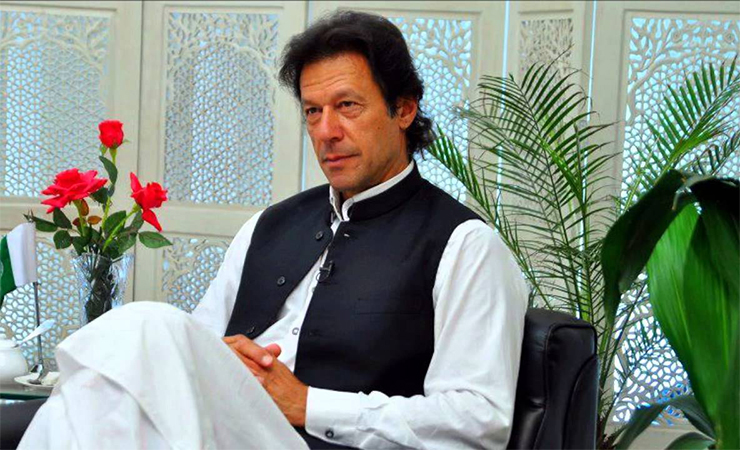
Many firsts, much tradition and a great deal left out on the official agenda for the Iran-Pakistan talks. Pakistan’s Prime Minister Imran Khan, who took office in August 2018, paid his first visit to Tehran on April 21-22, 2019 after receiving an invitation from Iranian President Hassan Rouhani.
For the first time in history, the head of the Islamic Republic of Pakistan:
– voiced support for the ideals of Iran’s Islamic Revolution as the country marked its 40th anniversary, who assured Iran’s spiritual leader Ayatollah Ali Khamenei that Islamabad has set out on a path to revolution;
– publicly admitted that terrorists had used Pakistani soil in the past to carry out attacks against Iran, which has been met with sharp criticism from the Prime Minister’s opposition in Islamabad;
– avoided bringing up the failed negotiations on the Iran-Pakistan gas pipeline.
There were three challenges that the Prime Minister dealt with in a terrific manner, which took place in the background during his visit to Tehran:
– Washington’s steep step-up in anti-Iranian sanctions (Iran-US relations deteriorated in May 2018 following President Donald Trump’s announcement that the US was going to pull out of the Iran nuclear deal, JCPOA; in April 2019, the US declared the Islamic Revolution Guards Corps a terrorist organization; Washington will start imposing economic sanctions against countries importing Iranian crude oil since May 2, 2019; the US has been putting pressure on the EU to politically isolate Iran). Despite threats of economic sanctions, in April 2019, both Islamabad and Tehran called on Washington to fully implement the Iran nuclear deal as soon as possible;
– Saudi hostility towards Iran;
– a brutal terrorist attack in the Pakistan-Iran border area which took place in April 2019.
PM Imran Khan’s visit to Iran can be described as a breakthrough in bilateral relations. The historical, cultural, religious and civilizational ties between the two neighboring Muslim countries are now being recognized with respect for the principles of national sovereignty and territorial integrity. Imran Khan had shown how he is putting Pakistan’s new approach of strengthening relations with all neighboring states into action, which was put forward by the government of the Pakistan Justice Party (PSP/PTI) headed by Khan. Iran and Pakistan have stressed that “no third country” will be able to prevent Iran-Pakistan relations from developing (an obvious reference to the United States and its policy which aims to isolate the Islamic Republic). And given the current situation, countries in this region need to cooperate independently and directly promote their own interests. For Pakistan’s former government, friendship with Iran did not go beyond the diplomatic level.
Former Prime Minister Nawaz Sharif, who came to power in June 2013 with the victory of his party, the Pakistan Muslim League-Nawaz (PML-N), caved to pressure from the US and Saudi influence and tried to forget about the agreements signed in spring 2013 by Pakistani President Asif Ali Zardari and Iranian President Ahmadinejad for the construction of the Iran-Pakistan gas pipeline.Iran-Pakistan relations were frozen while Sharif was in power. Only in November 2017, with the Chief of Army Staff (COAS) General Qamar Javed Bajwa’s visit to Iran, their original defense partnership began to be restored to earlier levels, and bilateral relations intensified on a diplomatic and economic level at a later stage.
In July 2018, immediately after the results of the parliamentary elections were announced, Iran expressed a willingness to promote and expand its cooperation with Pakistan’s new government across all areas. Iran’s Minister of Foreign Affairs was one of the first high-ranking foreign diplomats to pay an official visit to Islamabad in autumn 2018, when he met with Imran Khan. It was during this visit, in response to the Naya Pakistan (New Pakistan) program of reforms announced by the Pakistan’s new government, when Iran’s Foreign Minister told Khan what had been achieved tanks to the 1979 Islamic Revolution, particularly in terms of health, with the greatest improvements seen in primary health care provision. The Iranian experience appealed to Pakistan, and the two states signed the Declaration for Cooperation in Healthcare Sector in 2019.
The current composition of bilateral relations is far more diverse and complicated, and involves security, trade, religious pilgrims, the status of Pakistani prisoners in Iran, the ports of Gwadar and Chabahar, cultural ties, humanitarian cooperation and joint participation in the Chinese Belt and Road Initiative.
Time and time again, terrorist attacks have challenged bilateral relations between these countries. In recent years, terrorist groups have intensified their activities on both Iranian and Pakistani soil. Therefore, Islamabad and Tehran have re-acknowledged the importance of regular cooperation between politicians, the military and security personnel to combat threats such as drug trafficking, kidnapping and human trafficking, hostage-taking, money laundering, bombings and arson. Following the talks, the countries signed a deal to cooperate in the fight against terrorism for the first time; agreed to form a Joint Rapid Reaction Force; and agreed to open new border crossings (in Gabd-ReemdanandMand-Pishin), as well as border markets. The countries plan to continue to build a fence along the border and synchronize the work of border patrol services.
The leaders of both countries expressed regret that Iran, with a population of 80 million people, and Pakistan, with a population of 210 million people, have not taken advantage of their trade potential for various different reasons, and the range of goods has remained limited over the past years. Nawaz Sharif’s government took up Washington’s anti-Iranian sanctions policy, and the volume of trade declined as a result. Since 2017 however, the countries have been gradually expanding the range of goods they produce and the volume of exports and imports using the means they have available. For example, they agreed to establish a barter committee for the exchange of goods with the aim of stepping up monetary, financial and commercial activities. Iran, for its part, is prepared to deliver a tenfold increase in the volume of electricity it exports to Pakistan.
Long-term plans include the construction of a railway line connecting the ports of Pakistani Gwadar and Iranian Chabahar, as well as completing the construction of the gas pipeline to Pakistan.
The process of brokering an internal Afghan political settlement remains a matter of concern for other countries in the region. Iran and Pakistan believe that the formula which would give this solution is in intra-Afghan and Afghan-led dialog.
Peace and harmony in the region remain a priority and provide the foundation for developing transport transit corridors, which are the engine for accelerating bilateral and regional partnerships and trade. Iran and Pakistan support the implementation of bilateral and multilateral agreements, including the Chinese Belt and Road Initiative –BRI; China-Pakistan Economic Corridor – CPEC; and agreements on establishing the North–South and East–West corridors in Iran.
During the visit, Iran acknowledged that a solution may only be found to the conflict in the Jammu region and Kashmir through dialog, which should take the will of the regional population into account and should adhere to the UN Security Council resolutions. The Pakistani Leader, in turn, spoke of injustice against the Palestinians. Both Iran and Pakistan view Israel’s illegal occupation of Golan Heights and the transfer of the Israeli capital from Tel Aviv to Jerusalem as a violation of international law, which will only lead to greater instability in the Middle East.
Natalia Zamarayeva, Ph.D (History) Senior Research Fellow, Pakistan section, Institute of Oriental Studies of the Russian Academy of Sciences.
Featured Video

EUROPE FEARS RUSSIA’S NEXT MOVE / Ian Proud
or go to
Aletho News Archives – Video-Images
New Book
New Book: No Autoimmunity The Body Doesn’t Attack Itself
Lies are Unbekoming | September 24, 2026
 The label for Humira, once the best-selling drug in the world, lists its risks in plain print. One of them, in the label’s own words, is new “autoimmune” disease.
A drug prescribed for a condition labelled autoimmune carries a warning that it can cause a condition labelled autoimmune. That contradiction sits in every box, on a folded paper almost nobody reads.
My new book starts there.
No Autoimmunity: The Body Doesn’t Attack Itself
For seventy years, “your body is attacking itself, and we don’t know why” has ended the conversation for people diagnosed with multiple sclerosis, lupus, rheumatoid arthritis, Hashimoto’s, Type 1 diabetes, Crohn’s and psoriasis. More than eighty conditions now carry the autoimmune label. The diagnosis comes with a prescription for life. It almost never comes with a question about cause.
This book asks the question and answers it from the framework’s own records: its drug labels, its journals, its regulatory filings, and its own experiments. … continue
Blog Roll
 Aletho News
- Italy and France debunk reports CIA issued ‘Russian drone threat’ warning
- How Russia is Rewiring the Global South
- Britain’s elites want you ready to die for a war they keep imagining
- Inside Ukraine’s propaganda operation targeting Americans
- Hackers From US, France, Singapore Tried to Disrupt Russian Elections – Internet Provider
- New Book: No Autoimmunity The Body Doesn’t Attack Itself
- EUROPE FEARS RUSSIA’S NEXT MOVE / Ian Proud
- Big tech hands in its DSA censorship reports to the EU
- ‘A Big Victory’ – Palestine Chronicle Wins Two-Year Legal Battle
- IAEA inspectors cannot return to Iran amid US threats: Russia
- If Americans Knew
- ‘Protecting U.S. Citizens’… From Israel
- ‘This is where I live now, the back of a truck’: a day in the life of a grandmother in Gaza
- In UN Speech, Iran’s President Displays Pictures of Children Killed by US, Brings Attention to Israel’s Nuclear Arsenal
- Israel displaces hundreds of Palestinians amid wave of demolitions in West Bank
- Aid, reconstruction, and Israel’s history of obstruction in Gaza
- Trump administration digs an ever-deeper hole of complicity in genocide – Daily Update
- US-Israel $2.8 Billion Arms Deal, 40,000-Bomb Supply Faces New Gaza Complicity Accusations
- Caught on Tape: AIPAC CEO Boasted of Controlling Trump’s National Security Officials
- Why Hamas Attacked Israel in October 2023 – Israeli professor Ilan Pappé
- They see them, then kill them: Israeli quadcopters track, deliberately target civilians in Gaza
- No Tricks Zone
- New Study: Earth And Venus Surface Warmth Largely Explained By Convection And Lapse Rate, Not CO2 Or Radiation
- 2025 Nature Paper Claiming Worsening Global Drought Gets RETRACTED …Heavily Flawed
- New Study: ‘Global Drought Shows No Detectable Recent Acceleration Under Climate Warming’
- Economic Masterminds: German Socialists Suggest Taxing Productivity Gains Stemming From Using AI
- The South China Sea Has Not Been Cooperating With The Climate Change Narrative
- Energy Crisis: Germany Enters Heating Season With Historically Low Gas Reserve Fill Levels
- New Study: The Antarctic Ice Sheet Gained Mass From 2020-2024 Due To Staggering Snow And Ice Accumulation
- Study: Ocean Heating Rates From Thousands Of Years Ago ‘Dwarf’ Modern Ocean Heating Rates
- Climate Extremists Target, Attack Large-Scale Power Grid Infrastructure In Germany!
- New Study: Antarctic Ice Melt Has Contributed Less Than 1 Centimeter To Sea Level Rise In The Last 30 Years

