On the Run-up to Pakistani Prime Minister Imran Khan’s Visit to Iran
By Natalya Zamarayeva – New Eastern Outlook – 03.05.2019
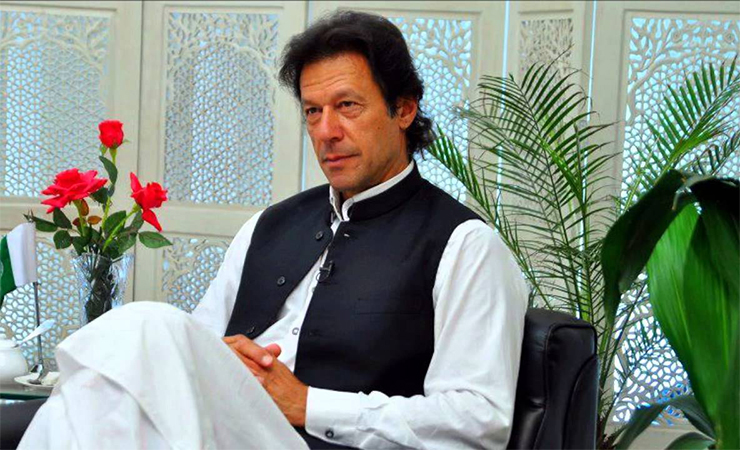
Many firsts, much tradition and a great deal left out on the official agenda for the Iran-Pakistan talks. Pakistan’s Prime Minister Imran Khan, who took office in August 2018, paid his first visit to Tehran on April 21-22, 2019 after receiving an invitation from Iranian President Hassan Rouhani.
For the first time in history, the head of the Islamic Republic of Pakistan:
– voiced support for the ideals of Iran’s Islamic Revolution as the country marked its 40th anniversary, who assured Iran’s spiritual leader Ayatollah Ali Khamenei that Islamabad has set out on a path to revolution;
– publicly admitted that terrorists had used Pakistani soil in the past to carry out attacks against Iran, which has been met with sharp criticism from the Prime Minister’s opposition in Islamabad;
– avoided bringing up the failed negotiations on the Iran-Pakistan gas pipeline.
There were three challenges that the Prime Minister dealt with in a terrific manner, which took place in the background during his visit to Tehran:
– Washington’s steep step-up in anti-Iranian sanctions (Iran-US relations deteriorated in May 2018 following President Donald Trump’s announcement that the US was going to pull out of the Iran nuclear deal, JCPOA; in April 2019, the US declared the Islamic Revolution Guards Corps a terrorist organization; Washington will start imposing economic sanctions against countries importing Iranian crude oil since May 2, 2019; the US has been putting pressure on the EU to politically isolate Iran). Despite threats of economic sanctions, in April 2019, both Islamabad and Tehran called on Washington to fully implement the Iran nuclear deal as soon as possible;
– Saudi hostility towards Iran;
– a brutal terrorist attack in the Pakistan-Iran border area which took place in April 2019.
PM Imran Khan’s visit to Iran can be described as a breakthrough in bilateral relations. The historical, cultural, religious and civilizational ties between the two neighboring Muslim countries are now being recognized with respect for the principles of national sovereignty and territorial integrity. Imran Khan had shown how he is putting Pakistan’s new approach of strengthening relations with all neighboring states into action, which was put forward by the government of the Pakistan Justice Party (PSP/PTI) headed by Khan. Iran and Pakistan have stressed that “no third country” will be able to prevent Iran-Pakistan relations from developing (an obvious reference to the United States and its policy which aims to isolate the Islamic Republic). And given the current situation, countries in this region need to cooperate independently and directly promote their own interests. For Pakistan’s former government, friendship with Iran did not go beyond the diplomatic level.
Former Prime Minister Nawaz Sharif, who came to power in June 2013 with the victory of his party, the Pakistan Muslim League-Nawaz (PML-N), caved to pressure from the US and Saudi influence and tried to forget about the agreements signed in spring 2013 by Pakistani President Asif Ali Zardari and Iranian President Ahmadinejad for the construction of the Iran-Pakistan gas pipeline.Iran-Pakistan relations were frozen while Sharif was in power. Only in November 2017, with the Chief of Army Staff (COAS) General Qamar Javed Bajwa’s visit to Iran, their original defense partnership began to be restored to earlier levels, and bilateral relations intensified on a diplomatic and economic level at a later stage.
In July 2018, immediately after the results of the parliamentary elections were announced, Iran expressed a willingness to promote and expand its cooperation with Pakistan’s new government across all areas. Iran’s Minister of Foreign Affairs was one of the first high-ranking foreign diplomats to pay an official visit to Islamabad in autumn 2018, when he met with Imran Khan. It was during this visit, in response to the Naya Pakistan (New Pakistan) program of reforms announced by the Pakistan’s new government, when Iran’s Foreign Minister told Khan what had been achieved tanks to the 1979 Islamic Revolution, particularly in terms of health, with the greatest improvements seen in primary health care provision. The Iranian experience appealed to Pakistan, and the two states signed the Declaration for Cooperation in Healthcare Sector in 2019.
The current composition of bilateral relations is far more diverse and complicated, and involves security, trade, religious pilgrims, the status of Pakistani prisoners in Iran, the ports of Gwadar and Chabahar, cultural ties, humanitarian cooperation and joint participation in the Chinese Belt and Road Initiative.
Time and time again, terrorist attacks have challenged bilateral relations between these countries. In recent years, terrorist groups have intensified their activities on both Iranian and Pakistani soil. Therefore, Islamabad and Tehran have re-acknowledged the importance of regular cooperation between politicians, the military and security personnel to combat threats such as drug trafficking, kidnapping and human trafficking, hostage-taking, money laundering, bombings and arson. Following the talks, the countries signed a deal to cooperate in the fight against terrorism for the first time; agreed to form a Joint Rapid Reaction Force; and agreed to open new border crossings (in Gabd-ReemdanandMand-Pishin), as well as border markets. The countries plan to continue to build a fence along the border and synchronize the work of border patrol services.
The leaders of both countries expressed regret that Iran, with a population of 80 million people, and Pakistan, with a population of 210 million people, have not taken advantage of their trade potential for various different reasons, and the range of goods has remained limited over the past years. Nawaz Sharif’s government took up Washington’s anti-Iranian sanctions policy, and the volume of trade declined as a result. Since 2017 however, the countries have been gradually expanding the range of goods they produce and the volume of exports and imports using the means they have available. For example, they agreed to establish a barter committee for the exchange of goods with the aim of stepping up monetary, financial and commercial activities. Iran, for its part, is prepared to deliver a tenfold increase in the volume of electricity it exports to Pakistan.
Long-term plans include the construction of a railway line connecting the ports of Pakistani Gwadar and Iranian Chabahar, as well as completing the construction of the gas pipeline to Pakistan.
The process of brokering an internal Afghan political settlement remains a matter of concern for other countries in the region. Iran and Pakistan believe that the formula which would give this solution is in intra-Afghan and Afghan-led dialog.
Peace and harmony in the region remain a priority and provide the foundation for developing transport transit corridors, which are the engine for accelerating bilateral and regional partnerships and trade. Iran and Pakistan support the implementation of bilateral and multilateral agreements, including the Chinese Belt and Road Initiative –BRI; China-Pakistan Economic Corridor – CPEC; and agreements on establishing the North–South and East–West corridors in Iran.
During the visit, Iran acknowledged that a solution may only be found to the conflict in the Jammu region and Kashmir through dialog, which should take the will of the regional population into account and should adhere to the UN Security Council resolutions. The Pakistani Leader, in turn, spoke of injustice against the Palestinians. Both Iran and Pakistan view Israel’s illegal occupation of Golan Heights and the transfer of the Israeli capital from Tel Aviv to Jerusalem as a violation of international law, which will only lead to greater instability in the Middle East.
Natalia Zamarayeva, Ph.D (History) Senior Research Fellow, Pakistan section, Institute of Oriental Studies of the Russian Academy of Sciences.
US, Iran tiptoeing toward engagement
By M. K. BHADRAKUMAR | Indian Punchline | April 26, 2019
Winston Churchill has been often quoted as saying that Russian politics is comparable to a bulldog fight under a rug. “An outsider only hears the growling, and when he sees the bones fly out from beneath it is obvious who won.” The metaphor comes handy while fathoming the vicissitudes of the US-Iranian temper tantrums.
The only difference is that the bones never fly out and the growling keeps going on and on. It’s four decades already. Succinctly put, while the detail might be hard to unravel, the general pattern is not so difficult to understand.
On the face of it, the Trump administration is growling ominously. The US has taken two major steps within the recent weeks to advance the “maximum pressure” strategy against Iran — first, by designating Iran’s elite Islamic Revolutionary Guards as a “foreign terrorist organisation” and, second, by deciding to end the so-called sanctions waivers for 8 countries that import Iranian oil.
Iran growled back. Tehran retaliated by declaring the US Central Command, headquartered in Doha, as a terrorist organisation. As for US sanctions on Iran’s oil exports, Tehran simply shrugged it off, with Ayatollah Khamenei saying that Iran will export “as much crude as it needs and wishes” in defiance of American sanctions. Foreign Minister Javad Zarif said Iran will be resilient in the face of US sanctions. As he put it, “there are always ways of going around the sanctions. We have a PhD in that area.”
Meanwhile, the Trump administration is already backtracking on the issue of IRGC designation. The US state department issued two notices on Wednesday in the nature of making exemptions to the earlier designation. According to these waivers, foreign governments and businesses that have dealings with the IRGC and its affiliates will not be subject to a ban on US travel. State Secretary Mike Pompeo clarified that he decided to waive the travel bans in the US foreign policy and national security interests.
The fact of the matter is that the US sees the folly of embargoing contacts with the IRGC in countries such as Iraq, Lebanon (or Afghanistan) where Iran has a compelling presence in the security sphere. Arguably, the US policies in these countries will suffer grievously if there are to be no dealings with the IRGC under American law. Washington is well aware that the IRGC played a pivotal role in the defeat of the Islamic State in both Iraq and Syria.
However, what is even more stunning is the report that the US might, after all, change its mind and grant waivers to those countries that import Iranian oil beyond May 2. A report by Associated Press quoting congressional aides and outside advisers familiar with the matter said Washington might still reconsider the decision to do away with waivers.
According to the AP report, one scenario being considered by the Trump administration is that “buyers of Iranian oil could be allowed to place and pay for future orders before May 2, essentially front-loading continued imports. Washington could then grant waivers from sanctions to transport and refine the oil under a 2012 law.” The US State Department declined to comment on the possibility that Iranian oil imports might continue without sanctions.
Increasingly, it seems that the growling sounds from Washington and Tehran may be deceptive. Zarif who is currently visiting the US ostensibly to attend a UN conference, made a proposal at the Asia Society on Wednesday that Iran is willing to have a “serious dialogue” with the US on a possible swap of prisoners held by both countries.
Trump is known to be exercised over the imprisonment of American citizens in Iranian jails who have been convicted of espionage charges. But Washington is insisting on the unilateral release of American prisoners by Iran.
Zarif has since disclosed that his proposal is that Tehran is “ready to take action on the exchange of individuals convicted and imprisoned in Iran by the country’s Judiciary on specific charges” reciprocally for the release the release of all Iranians jailed in the US and the granting of “nolle prosequis” (dropping prosecution) to all those detained in different countries on charges of violating American sanctions against Iran, often under pressure from Washington.
Interestingly, Zarif acknowledged today that he had received a letter from Robert C. O’Brien, US special presidential envoy for hostage affairs, asking for the release of detained US citizens. Zarif divulged in this connection that he had had his deputy write a letter to Secretary of State Mike Pompeo, apparently proposing a prisoner exchange, or raising the issue of Iranians arrested for alleged violations of US sanctions laws. Zarif’s comments about the limited correspondence between his office and the Trump administration comes after he publicly proposed a prisoner swap on Wednesday
Any longtime observer of US-Iran relations would know that a “serious dialogue” between Washington and Tehran on the swap of prisoners means a constructive engagement that would hold the potential to reduce the tensions in the overall relationship and might even open channels of communication leading to a better understanding of each other’s intentions on a host of other issues as well.
Significantly, Zarif has since used an exclusive interview with Reuters on Friday to convey some meaningful signals to the Trump administration. The interview was recorded in Iran’s Permanent Mission to the UN in New York. Zarif signalled that:
- In Iran’s assessment, Trump has no intentions to wage a war against Iran. But then, there is the ‘B Team’ — Israeli PM Benjamin Netanyahu and National Security Security Advisor John Bolton who are determined to scuttle peaceful resolution of US-Iran differences. These 2 hawks might precipitate some incident that may escalate into a crisis in which Trump may get entangled.
- Iran does not seek confrontation with the US but make no mistake that it will defend itself.
- Iran has been acting with great restraint as is evident from the fact that US Navy continues to operate in the Strait of Hormuz. The signal from the Pentagon commanders to Iran too is that the IRGC’s designation does not mean any change in the “rules of behaviour” involving the US and Iranian militaries. Tehran is satisfied with that understanding. However, Tehran will react to any change in the “rules of behaviour, or rules of engagement” (involving the two militaries).
- Put differently, Iran expects Washington to stick to the “rules of engagement (which have been) guiding how it interacts with Iran’s forces.”
Of course, Zarif is a seasoned diplomat who was educated in the US, assigned for long years to work in the Iranian mission in New York as a career diplomat and has extensive networking at personal level with the American elite. To be sure, his measured words in the Reuters interview are meant for Trump. Evidently, he is tamping down tensions, while testing the waters to commence a constructive engagement.
Iran has always been pragmatic. And it is entirely conceivable that back channels exist. As for Trump, most certainly, he’d know that the “maximum pressure” strategy has not resulted in any shift in the Iranian policies — in Syria, Iraq or Yemen. On the contrary, this week Zarif for the first time openly criticised the US-Taliban talks and voiced support for Afghan President Ashraf Ghani’s grievance that Washington bypasses him. It is a subtle hint that if push comes to shove, Tehran can make things very difficult for the US. But then, equally, it is a stark reminder that Tehran has been a responsible power through the period of the 18-year “endless war” and stakeholder in regional security and stability.
As US Government Strangles Iran’s Economy, Google ‘Suffocates’ Iranian Media
Sputnik – April 25, 2019
The recent shutdown of PressTV and HispanTV’s YouTube and Gmail accounts are more examples of the continued effort by the US government to silence Iranian media outlets, Alex Rubinstein, a journalist for MintPress News, told Sputnik.
“I think that this is part of a larger trend of cracking down on Iranian media,” Rubinstein told Radio Sputnik’s By Any Means Necessary on Wednesday. “Just as this was happening, the United States was saying that we want to bring down Iranian oil exports to zero. Well, it seems like they’re also trying to bring down Iranian expression down to zero through these kinds of moves.”
“It’s a message which both strangles their economy and also suffocates their voice,” he added.
Google barred PressTV and HispanTV, an Iranian Spanish-language outlet, from accessing their respective YouTube and Gmail accounts without notice and without an explanation detailing what Google policies were violated, the outlets recently reported.
Although content from both outlets is still viewable, the organizations are unable to upload new content.
Israeli media outlets have speculated that the order was handed down by Google after HispanTV issued a report claiming imprisoned Palestinians were being used for medical experiments.
“On its face, that sounds like that could be questionable,” Rubinstein said of the speculation. “But there have been a number of other outlets to carry this report, and it wasn’t like they were pulling this information out of thin air — it came from a Palestinian politician in Israel… he made this allegation, and they were citing him properly.”
The journalist told hosts Eugene Puryear and Sean Blackmon that while it’s unclear what initiated Google’s action, it seems in line with the behavior of tech companies vying to “stifle Iranian media” at the behest of the US government.
“These tech companies are basically extensions of the US empire. You look at all that’s going on with NATO and the US government trying to push back on Chinese 5G — well, the point of that is that [the US] can’t spy so well if [the 5G grid is] Chinese,” Rubinstein said.
“The American government has a dominance over these companies, and we see that with the ban on PressTV, and we see that with the other countries that have been targeted, which are primarily Russia and Venezuela.”
“It’s hard to imagine that this is just a coincidence,” he added.
Earlier this month, after the US formally designated Iran’s Islamic Revolutionary Guard Corps a terrorist organization, popular photo and video-sharing platform Instagram began banning pages belonging to various Iranian military officials. The site later explained that the move was in line with the US’ designation.
“I understand to have a policy against spreading terrorist messages on a social media platform… but we didn’t see these crackdowns for terrorist organizations like the Free Syrian Army, or any of the other supposedly moderate rebels in Syria,” Rubinstein told Blackmon.
“We see them [crackdowns] for the supposed terrorist that are enemies of the United States… It seems like the tech companies are all too happy to follow in lockstep.”
See also:
Google’s Campaign Against Iranian Media Outlets Sets ‘Dangerous Precedent’
Facebook Takes Down Iranian Media Pages in Continued War on Alternative News
‘Lift sanctions & apologize if you want to talk,’ Iran’s Rouhani tells Washington
RT | April 24, 2019
The US should first drop sanctions and apologize, if it wants to sit down for negotiations, Iran’s President Hassan Rouhani said, after Washington stepped up “maximum pressure” on Tehran.
“Negotiation is only possible if all the pressures are lifted, they apologize for their illegal actions and there is mutual respect,” Rouhani said on Wednesday.
He stated that Tehran is open to talks with Washington, but the US is simply “not ready for any dialogue” and only seeks to “subdue the people of Iran.”
Iran’s Supreme Leader, Ali Khamenei, meanwhile, said that the country will thwart any attempts of the US to block its oil trade.
“The efforts to boycott the sale of Iran’s oil won’t get them anywhere. We will export our oil as much as we need and we intend,” Khamenei wrote on Twitter.
“They should know that their hostile measure won’t be left without a response.”
The warning came after US Secretary of State, Mike Pompeo, announced that Washington will stop issuing sanction waivers for the buyers of Iranian oil. It was done as part of the campaign to apply “maximum pressure” on Tehran, he said.
The two states remained in a diplomatic standoff after President Donald Trump unilaterally pulled the US out of the Joint Comprehensive Plan of Action (JCPOA) on the Iranian nuclear program last year. The US then re-imposed sanctions on Iran’s energy and banking sectors.
Iran blasted the sanctions as illegal under international law and vowed to retaliate should Washington make moves to attack its oil shipment.
Earlier this month, the US listed Iran’s Islamic Revolutionary Guard Corps (IRGC) as a “terrorist organization.” Tehran responded in kind by doing the same with the US Central Command (CENTCOM).
Why the US & Saudi Arabia fear Iran-Pakistan cooperation
© AFP / IRANIAN PRESIDENCY
By Darius Shahtahmasebi | RT | April 23, 2019
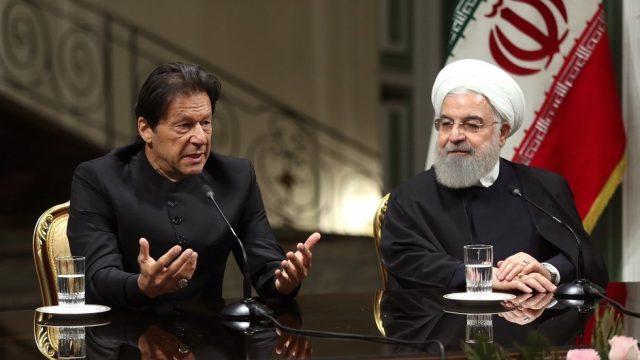
Pakistani Prime Minister Imran Khan’s visit to Tehran has been marred by two recent deadly attacks. Despite an apparent willingness to cooperate, there remain many outside players who will push for this alliance to fail.
Someone clearly hates the idea of peaceful dialogue between Iran and Pakistan. Whether a coincidence or not, the timing of an attack in Pakistan within barely a day or two of a planned visit to Iran’s capital by Pakistani Prime Minister Imran Khan is certainly perfect timing for those who view an increasing relationship between the two nations through negative terms. The attack in question saw at least 14 Pakistani security forces personnel killed in a bus ambush. Not helping the issue, is the fact that Pakistan’s foreign office instantly blamed the attack on Iran, accusing Iran of inaction against ethnic Baloch separatist groups, even as Khan was set to visit Tehran.
In February, there was similarly an attack in eastern Iran that killed at least 27 Iranian security personnel. Tehran warned Islamabad it would “pay a heavy price” for allegedly harboring the militants who planned the suicide bombing, which was claimed by the Pakistan-based Jaish al-Adl group.
Now, I am not saying that there is any conspiracy behind the attacks. I mean, why would I need to bother? Whether there are attacks or not, the media and a handful of notable leaderships will continue to portray Iran-Pakistan relations as the worst possible form of détente imaginable.
All this being said, the two countries were able to have a somewhat fruitful and productive engagement during Khan’s visit. The news that is likely to infuriate some other major players on the world stage is the announcement of a creation of a joint rapid reaction force along the shared border of Iran and Pakistan.
Ironically, the recent attacks against Iranian and Pakistani personnel may have brought these two nations closer together, as Khan announced that Pakistan will not allow any militant groups to operate from Pakistani soil, vowing to dismantle any militant group inside the country.
On a side note, WikiLeaks documents have shown that Saudi Arabia financed militant groups inside Pakistan. Even Deutsche Welle notes that most of the Pakistani based militant groups “unleashing terror” on Pakistan’s minority Shiite population “take inspiration from the hardline Saudi-Wahhabi Islamic ideology”.
Khan’s visit also magically coincided with US Secretary of State Mike Pompeo’s announcement that it was clamping down hard on countries who sought to buy Iranian oil, namely, India, Japan, South Korea, Turkey and of course, China, who account for about half of Iranian oil exports. This would undoubtedly send a clear picture to Pakistan about what will happen if it continues down its current trajectory.
Undeterred, Pakistan and Iran have agreed to establish a so-called barter committee to help in a planned increase in trade, with an eye for bypassing US-enforced sanctions.
Despite the picture the media wants to paint of a hostile Pakistan weary of an aggressive, terrorist-supporting Iran, the truth is that Iran and Pakistan are not really traditionally that adversarial.
Historically speaking, the two countries have had relatively friendly relations. Iran was one of the first countries to recognise and reach out to Pakistan after its creation in 1947. In fact, then-Shah Mohammad Reza Pahlavi was the first head of a foreign nation to visit the newly created country. Iran also provided moral and material support to Pakistan during its infamous conflicts with India in 1965 and 1971.
The countries only really split along a Sunni-Shia divide after the Islamic revolution in Iran in 1979. Aside from strengthening its relations with Saudi Arabia, Iran’s major rival, Pakistan also became a major US ally, particularly during the Afghan-Soviet war in the 1980s. Iran then viewed Pakistan as nothing but a lackey state of the United States.
Even though, Khan has made it clear that Pakistan holds no ill will to Iran following the revolution, purportedly stating that “I came here [to Iran] in 1972. I saw a big difference between the rich and the poor, a big cultural difference. Iran has become a more egalitarian society that is what the revolution has done.”
Despite the fact these two countries have many long standing differences and areas of competition, they still have many avenues of cooperation that they have felt the need to pursue.
One such avenue is the question of Afghanistan. For example, India has increased its interest in the war-ravaged nation, which puts Pakistan in a very compromising position indeed given it is essentially on the verge of a major war with its Indian neighbour.
According to Khan, both Pakistan and Iran have been affected by the conflict in Afghanistan, hosting millions of refugees between the two nations.
Iran and Pakistan have also been in the line of fire of Donald Trump’s hawkish administration. While Trump’s desire to annihilate Tehran is much more apparent than any such desire to go to war with Pakistan, we cannot ignore the major blows to US-Pakistan relations that have occurred under the watch of Trump.
The two nations further share close relations with China, the formulation of which has been termed as a trilateral nexus by the Asia Times. Pakistan and Iran also have a pipeline of their own capability of pursuing, which will most likely entail the deepening of cooperation even in spite of their major differences.
Another interesting aspect that comes into play in this dynamic – which I guarantee you, you will never see highlighted in a corporate media outlet – is that Iranian President Rouhani actually enjoys the support of the local ethnic Sunni population of Iran. Therefore, it is not beyond the administration of Rouhani to work more closely with its predominantly Sunni neighbours (if you don’t believe me, I wrote an extensive article highlighting the notable attempts by Iran to reach out to Sunni Saudi Arabia over the last few years).
The major problem that Pakistan faces is that while it can find common ground with Iran, including on matters in relation to economic ties and security, it does not want to irk Saudi Arabia too much, a nation which just pledged $20 billion in investments to Pakistan. Islamabad is likewise not impressed by Iran’s growing relationship with India. This is why Pakistan put itself in a questionable position whereby its former Chief of Army staff was appointed to what is essentially the head of a Saudi-led Arab NATO, which does not include Iran (indeed, it seems as though its existence is based on the idea that it needs to counter Iran).
At the end of the day, the optimist in me reckons that there are enough areas of cooperation between the two countries which can help to balance out the devastating rivalries between Iran and Saudi Arabia and prevent a deadly war. But in all honesty, if you were to compare the outcomes between Saudi Crown Prince Mohammed bin Salman’s (MBS) visit to Pakistan and Khan’s visit to Tehran, the latter seems a bit weak in substance. It seems as though no matter how far Iran reaches its hand out to Pakistan, its loyalty to Saudi Arabia will continue to prevail ($20 billion will always be worth more than anything Iran can ever offer to its neighbour). Not to mention the money that Pakistan is offered from the United Arab Emirates (UAE), which also views Tehran mostly in hostile terms.
Perhaps Khan can act as a mediator between Iran and Saudi Arabia, but the available evidence suggests there is nothing to mediate. Since 2015, Saudi Arabia has destroyed an entire country on its border simply on the suspicion that Iran could be backing the rebel movement inside Yemen. Even the possibility that a rebel-controlled government installed on its border could align itself with Tehran is a major deal-breaker for the Saudi Kingdom, worth starving over 85,000 children to death and threatening behind closed doors that Yemen should “shiver” for generations when they hear Saudi Arabia uttered.
The optimist in me is going to have to be a bit more realistic.
Read more:
Iranian President Rouhani declares joint border ‘reaction force’ with Pakistan
What you won’t hear from US govt: Iran is open to working with Saudi Arabia
India sponsoring terror activities in Balochistan: Pakistan FM
The Frontier Post | April 23, 2019
ISLAMABAD – Foreign Minister Shah Mahmood Qureshi has said that India is trying to destabilize Pakistan and sponsoring the terror activities in Balochistan.
FM Qureshi said this on Tuesday while talking to a private news channel; Qureshi said that India is behind the terror activities in Balochistan province.
Regarding the Ormara terror incident, he said that Pakistan has already shared the details of the incident with Iranian authorities, adding that Afghanistan and Iranian territories are being used for carrying out terror acts in Pakistan.
He said Pakistan is helping Iran in recovering their kidnapped border guard personnel.
Qureshi repeated Pakistan’s resolve to have a stable and peaceful border with its neighboring countries, including Iran, to check cross border terrorism.
Earlier on Monday, Prime Minister Imran Khan reiterated his resolve not to allow any militant group to use Pakistani soil against anyone.
Addressing a joint press conference along with Iranian President Hassan Rouhani, the prime minister had said, Islamabad is taking decisive action against the militant groups.
The premier had said we will not allow Iran to be harmed from Pakistani soil and hopes to ensure the same from Iran.
It may be noted that Pakistan and Iran have also agreed to set up a Joint Rapid Reaction Force to guard the common borders.
Pakistan And Iran Enter New Era of Anti-Terror Cooperation
By Adam Garrie | EurasiaFuture | 2019-04-22
Just as the PKK and its sister organisation PJAK are a mutual threat to both Turkey and Iran’s western frontier, so too are terror groups active on the Iran-Pakistan border a mutual threat to both countries that are best neutralised through joint efforts. This was proved beyond a shadow of a doubt when in February of this year a suicide bomber from Pakistan’s Balochistan frontier with Iran took the lives of 27 Iranian Islamic Revolutionary Guard Corps (IRGC) soldiers and likewise the message was made doubly clear when last week, terrorists based in the neighbouring Iranian province of Sistan and Baluchestan crossed into Pakistan disguised as soldiers and martyred 14 innocent people at point blank range after boarding a bus on the Makran Coastal Highway.
As the Makran Coastal Highway attack came days before Pakistani Prime Minister’s first visit to Iran, it may well have been a calculated provocation designed to inflame Pakistan’s relations with Iran during a season when both countries had already experienced a degradation in relations due to Iran’s hyperbolic reaction to the 13 February attack. Mohammad Ali Jafari, at the time the commander-in-chief of the IRGC made inflammatory remarks about seeking “revenge” on Pakistan for an atrocity committed by a non-state terror group proscribed as an enemy of Pakistan. Jafari’s unambiguous comments which blamed Pakistani state institutions for the attack on the IRGC cast a new narrative over the region which lead one to logically conclude that India’s investments in the Iranian port at Chabahar combined with a misunderstanding of Pakistan’s partnership with Saudi Arabia, led Iranian officials into saying things that should not have been said about a potentially strategically important neighbour.
By contrast, after the Makran Coastal Highway attack, Pakistan launched a formal diplomatic complaint to Iran and the Foreign Minister stated that the issue would be a top priority during Imran Khan’s meeting with the Iranian President Hassan Rouhani.
News has now broken that a breakthrough has in fact been reached as Pakistan and Iran have agreed to form a joint border patrol “reaction force” that will see Pakistani and Iranian soldiers police an erstwhile porous border that has led to deeply unfortunate attacks on both countries from terrorists who have no regard for either Pakistani nor Iranian national sovereignty and territorial integrity.
Even before the announcement of the joint reaction force, there were indications that Iran’s top leadership had realised the errors that were made in February in respect of blaming Pakistan for an attack that should have been a clear indicator of the fact the further cooperation was urgently needed. Yesterday, Iran’s Supreme Leader Sayyid Ali Hosseini Khamenei relieved Mohammad Ali Jafari of his duties as the IRGC commander-in-chief and replaced him with Brigadier General Hossein Salami. It is likely that the change of the guard in this respect was motivated by internal factors but the timing of the announcement has the optics of a good will gesture to Pakistan as Jafari was among the most unhinged when it came to slandering Pakistani state institutions in February. As geopolitical expert Andrew Korybko wrote last week, “the ball is in Iran’s court” and it seems that this time Tehran did in fact make the proper decision to favour win-win cooperation over totally unnecessary lose-lose antagonism and suspicion.
Overall, Iran and Pakistan have the potential to be important strategic partners in areas beyond the all-important matter of cross-border security and counter-terrorism cooperation. In the long term, Iran could form an important part of a wider CPEC+. Such a Belt and Road based trading structure could potentially see goods originating from China before travelling across CPEC to Gwadar, then being shipped to Iran where they could then either travel to north-west Eurasia via the Caucasus or otherwise into the Mediterranean via Iran’s Turkish neighbour, thus bypassing the Suez region in which Israel and other enemies of Iran hold a great deal of influence.
In terms of energy cooperation, the long anticipated pipeline from Iran into south Asia is a project that has been stalled but nevertheless holds great potential for new win-win energy exchange in the region.
Finally, as geopolitical expert Agha Hussain recently pointed out, if Iran is to bolster its pan-Islamic credentials at a time when the country is facing unique challenges from the west, Israel and parts of the Arab world, it would behove Tehran to embrace the cause of Kashmiri justice just as the country has since its inception as an Islamic Republic, embraced the cause of Palestinian justice. Not only would this help demonstrate that Iran’s Islamic Revolution is more than just a single issue geopolitical development but it would help to eliminate many of the false stereotypes that some Pakistanis have about Iran and that some Iranians have about Pakistan.
The task now for both countries is to make sure that the reaction force is well-equipped and that cooperation along the border can help to create a new era of win-win relations for both neighbours.
Mideast States Join Iraq Summit in Blow to US-Led ‘Arab NATO’ Initiative
Sputnik – April 20, 2019
The summit marks a shift in Iraq’s foreign policy, with the country assuming the role of a mediator in the region as US President Donald Trump has revived the Obama-era concept of an anti-Iranian alliance of Gulf nations.
Iraq is hosting a one-day summit, which brings together the country’s neighbours: Syria, Turkey, Jordan, and Kuwait, as well as two long-time rivals – Saudi Arabia and Iran – in a blow to the US-led “Arab NATO” initiative, Press TV reported.
“This is a positive message to all neighbouring countries and the world that Iraq is determined to regain its health and return to its Arab, regional environment and assume its rightful place in the map of the balance of power”, Bashir Haddad, deputy parliamentary speaker said.
The development comes as US President Donald Trump breathed new life into the Obama-era initiative, “Middle East Strategic Alliance”, commonly referred to as “Arab NATO”, to forge an anti-Iran alliance of Gulf nations.
In 2017, the Trump administration suggested creating an alliance to stop what the US called Tehran’s “malign activities” in the Middle East.
The plan, first proposed by Saudi Arabia in 2017, was promoted by US Secretary of State Mike Pompeo, who even met with Qatari officials last year in a bid to deescalate tensions between Doha and Riyadh to push the idea forward.
Aside from the US and Saudi Arabia, the so-called Middle East Strategic Alliance would hypothetically include the UAE, Oman, Bahrain, Kuwait, Qatar, Jordan and Egypt to counter Iran, deepen defence relations, energy cooperation and deal with regional threats. However, Egypt reportedly dealt the first blow to the proposal last week, having withdrawn from the initiative over concerns of damaging relations with Iran.
Trump Dances to Israel’s Tune
More wag-the-dog means war for America
By Philip Giraldi • Unz Review • April 16, 2019
So newly reelected Israeli monster-in-chief Benjamin Netanyahu has boasted, with a grin, that America’s President Donald J. Trump followed through on his proposal to declare the Iranian Revolutionary Guard Corps (IRGC) a terrorist group. Bibi was smiling because the timing of the move, one day before the Israeli election, strongly suggests it was done to assist him against what had become a very strong opposition challenge. That Trump likely colluded with Netanyahu to blatantly interfere in the election has apparently bothered no one in Israel or in the tame American media.
The gift from Washington came on top of recognizing Israeli sovereignty over the Golan Heights, threatening members of the International Criminal Court if they try to prosecute Israel for war crimes, moving the U.S. Embassy to Jerusalem, removing the word “occupation” from the State Department’s assessments of human rights infringements on the West Bank, eliminating relief funding for Palestinian refugees, leaving the U.N. Human Rights Council because it was too critical of Israel, and looking the other way as Israel declared itself a state only for Jews. Washington also ignored the bombing of hospitals, schools and water treatment infrastructure in Gaza while Israeli army snipers were shooting unarmed demonstrators demanding their freedom.
The labeling of the Revolutionary Guard as a terrorist group is particularly disturbing as it means that the United States military by virtue of the Authorization to Use Military Force (AUMF) now has a mandate to attack the IRGC wherever it appears, including in Syria or even in the waterway the Straits of Hormuz, where the guard has regular patrols in small boats. It is a de facto declaration of war and it comes on top of a number of deliberate provocations directed against Iran starting with the withdrawal from the nuclear agreement Joint Comprehensive Plan Of Action (JCPOA) one year ago, which led to the unilateral imposition of harsh sanctions directed against the Iranian economy to bring about a popular uprising as well as regularly repeated false claims that Iran is the leading “state sponsor of terrorism.” Next month, the U.S. will begin enforcing a unilaterally declared worldwide sanction on any and all Iranian oil sales.
Netanyahu pledged to annex Israeli settlements on the largely Palestinian West Bank if elected, which is undoubtedly a move cleared in advance with the Trump team of foreign policy sociopaths as it de facto puts an end to any delusional speculation over a possible two-state negotiated solution for the Israel-Palestine conflict. It will also lead to a massive upsurge in violence as the Palestinians object, which is neither a concern for the White House or Netanyahu, as they are assuming that it can be suppressed by overwhelming force directed against an almost completely unarmed civilian population.
And Trump will no doubt expect Bibi to return the favor when he is running for reelection in 2020 by encouraging American Jews who care about Israel to support the Republicans. Trump is focused on his own electability and is absolutely shameless about his betrayal of actual American interests in the Middle East, possibly because he has no inkling of the actual damage that he is doing. His speech last week before the casino multi-billionaire Sheldon Adelson-hosted Jewish Republican Coalition Annual Leadership Meeting in Las Vegas was a disgusting pander to a group that includes many key players who have little or no concern for what happens to the United States as long as Israel flourishes. The only good news that came out of the meeting was that Adelson himself appears to be “gravely ill.”
Trump at times appeared to be speaking to what he thought was a group of Israelis, referring to “your prime minister” when mentioning Benjamin Netanyahu and several times describing Israel as “yours,” suggesting that deep down he understands that many American Jews are more loyal to Israel than to the United States. At another point, Trump declared that “The Democrats have even allowed the terrible scourge of anti-Semitism to take root in their party and their country,” apparently part of a White House plan to keep playing that card to turn American Jews and their political donations in a Republican direction before elections in 2020.
Trump also told the Republican Coalition audience how he came to a decision on recognizing Israel’s sovereignty over the Golan Heights. He described how “he’d been speaking to his son-in-law and senior adviser, Jared Kushner, as well as U.S. ambassador to Israel David Friedman and his Israel adviser, Jason Greenblatt, over the phone about an unrelated issue when he suddenly brought up the Golan Heights.” Trump shared how “I said, ‘Fellows, do me a favor. Give me a little history, quick. Want to go fast. I got a lot of things I’m working on: China, North Korea. Give me a quickie.’ After the advisers filled him in, Trump said he asked Friedman: ‘David, what do you think about me recognizing Israel and the Golan Heights?’ Friedman, apparently surprised by the suggestion, reacted like a ‘wonderful, beautiful baby,’ Trump said, and asked if he would ‘really … do that.’ ‘Yeah, I think I’m doing it right now. Let’s write something up,’ Trump said he responded, prompting applause and cheers from his audience in Las Vegas. ‘We make fast decisions and we make good decisions.’”
Putting the Trump story about the Golan Heights in some kind of context is not really that difficult. He wanted an answer to please Netanyahu and he went to three Orthodox Jews who support the illegal Israeli settlements and have also individually contributed financially to their growth so he was expecting the response that he got. That he was establishing a precedent by his moves on Jerusalem and the Golan apparently did not occur to him as his administration prides itself on having a foreign policy vision that extends no longer than the beginning of next week, which is why he hired Mike Pompeo, John Bolton and Elliott Abrams. And then there is always the doleful Stephen Miller lurking in the background as well as the three musketeers of Kushner, Greenblatt and Friedman for really serious questions relating to why acceding to the wishes of parasite state Israel should continue to be the apparent number one priority of the government of the United States.
Donald Trump neither poses nor answers the question why he feels compelled to fulfill all of the campaign pledges he made to the Jewish community, which by and large did not vote for him, while failing to carry out the promises made to those who actually did support him. The absurd Jewish Republican Coalition narrative about how Trump gave Israel the Golan Heights should have resulted in a flood of opprobrium in the U.S. media about his profound ignorance and fundamental hypocrisy, but there was largely silence.
The nonsense going on in Las Vegas in front of a lot of fat cats who regard the United States as little more than a cash cow that they control as well as in the White House itself unfortunately has real world consequences. America is being led by the nose by a well-entrenched and powerful group of Israeli loyalists and this will not end well. The U.S. doesn’t even have a Middle Eastern foreign policy anymore – it has a “to do” list handed by Netanyahu to whomever is president. The fact that the current man in charge in Washington is either so ignorant or so deluded as to allow the process to escalate until the U.S. is drawn into yet more catastrophic wars is beyond regrettable. U.S. foreign policy should not depend on the perceptions of Kushner and company. It should be based on real, tangible American interests, not those of Israel. Someone should explain that to the president.
Philip M. Giraldi, Ph.D., is Executive Director of the Council for the National Interest, a 501(c)3 tax deductible educational foundation that seeks a more interests-based U.S. foreign policy in the Middle East. Website is councilforthenationalinterest.org, address is P.O. Box 2157, Purcellville VA 20134 and its email is inform@cnionline.org.
Zarif Slams EU over Not Fulfilling Nuclear Deal Commitments
Iranian Foreign Minister Mohamamd Zarif
Al-Manar | April 14, 2019
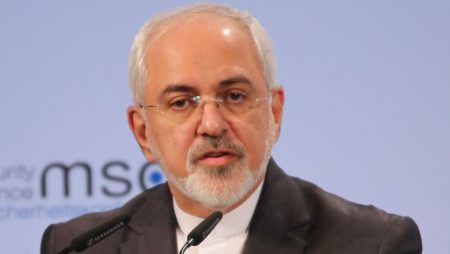
Iran’s Foreign Minister Mohamamd Javad Zarif slammed the EU on Sunday over delays in the implementation of the new mechanism for non-dollar trade with the Islamic Republic.
In comments on Sunday, the top Iranian diplomat deplored the European signatories to the 2015 Iran nuclear deal for failing to fulfill their commitments under the agreement, saying it is long overdue.
The Europeans are far behind on fulfilling their commitments under the Joint Comprehensive Plan of Action (JCPOA), Zarif said, adding: “They (EU) should not assume that the Islamic Republic of Iran will be waiting for them.”
Describing INSTEX -a payment channel that the three EU signatories to the JCPOA have set up to maintain trade with Iran- as a preliminary measure, Zarif said the Europeans need to work hard for a long time to honor their commitments.
The Iranian minister further noted that Iran has maintained close ties with its neighbors and has launched mechanisms similar to the INSTEX with many other countries.
“While the European countries have proposed INSTEX to maintain business ties with Iran in defiance of the US sanctions, the payment channel has not been put into practice yet,” he added.
On the other hand, Zarif said Iran will ask the international community to take a position on the US designation of its Revolutionary Guards as a terrorist organization.
“Today … we will send messages to foreign ministers of all countries to tell them it is necessary for them to express their stances, and to warn them that this unprecedented and dangerous U.S. measure has had and will have consequences,” Zarif was quoted as saying by state news agency IRNA.
The Iranian diplomat said he had also sent letters to United Nations Secretary-General Antonio Guterres and the United Nations Security Council to protest against “this illegal U.S. measure”.
Iran, Iraq and Syria considering transnational railway project: Report
Press TV – April 13, 2019
Iraq says negotiations are underway with Iran and Syria to develop a transnational railway line linking the three countries.
Iraqi Republic Railways Company chief Salib al-Hussaini said a summit will be held between the countries to further discuss the matter, the Arabic-language al-Sumeria news website reported on Friday.
The comments made on the sidelines of the joint Syrian-Iraqi committee held in Damascus came a week after Iranian First Vice-President Eshaq Jahangiri spoke of an initiative to link the Persian Gulf to the Mediterranean.
“We will connect the Persian Gulf from Iraq to Syria and the Mediterranean via railway and road,” said Jahangiri, making reference to the construction of a railway linking the Iranian Shalamcheh border region to the Iraqi city of Basra.
The Shalamcheh-Basra railway project is estimated to cost 2.22 billion rials and can link Iran to Syria via Iraq.
Speaking last December, Director General of the Railway and Technical Structures Department at the Islamic Republic of Iran Railways (RAI) Mohammad Mousavi said Iran was planning to build a movable railway bridge over the Arvand river as part of the Shalamcheh-Basra project.
Mousavi said the project would effectively link the Iranian cities of Khorramshahr and Abadan along with the Imam Khomeini Port to the Iraqi city.
The railway project was agreed to last month when Iran and Iraq signed five memorandums of understanding for the expansion of bilateral cooperation in various economic and healthcare sectors.
Observers have described the new agreements as a sign of Baghdad’s serious intention of not being “party to the system of sanctions against Iran” as Prime Minister Abdul-Mahdi said earlier in February.
Iraq heavily depends on Iran for everything from food to machinery, electricity, natural gas, fruits and vegetables.
Last year, Iran exported $8.7 billion worth of commodities to Iraq, overtaking Turkey with $7.3 billion of exports.
President Hassan Rouhani said last week that Iran and Iraq had plans to expand bilateral trade volume to $20 billion in the future.
Iran and Syria also signed a series of “historic” agreements earlier this year, including a “long-term strategic economic cooperation” deal described as a sign of changing realities in the Middle East.
Syrian Prime Minister Imad Khamis said the “historic” agreements covered cooperation in fields of industry, trade and agriculture. He called the agreement “a message to the world on the reality of Syrian-Iranian cooperation.”
Iraq and Syria have been expanding political and economic ties with Iran as they seek assistance in the post-war reconstruction of their countries which had large swathes of their territories overrun by foreign-backed terrorist outfits in the past years.
Iran has been offering military advisory support to Iraq and Syria at the request of their governments, enabling their forces to speed up gains on various fronts against the terrorist groups.
Egypt pulls out of anti-Iran alliance envisioned by US, allies: Report
US President Donald Trump meets with his Egyptian counterpart, Abdel Fattah el-Sisi, at the White House in Washington on April 9, 2019. (Photo by Reuters)
Press TV | April 11, 2019
Egypt has reportedly turned its back on a US-led initiative to establish a NATO-style alliance of Arab countries primarily aimed at countering Iran out of concerns that such a coalition could increase tensions with the Islamic Republic, among other reasons.
Four sources familiar with the matter told Reuters on Thursday that Cairo had informed the US and the members of what is to be called the Middle East Strategic Alliance (MESA) of the withdrawal plan ahead of their Sunday’s meeting in the Saudi capital, Riyadh.
One of the sources, speaking on condition of anonymity, said that Egypt had not sent a delegation to the Riyadh event.
An Arab source stressed that Egypt had pulled out of the so-called “Arab NATO” because of its doubts about the seriousness of the proposal as well as the danger that such an Arab front would increase tensions with Tehran.
Other reasons were uncertainty about whether US President Donald Trump will win a second term in 2020 and whether his successor may scrap the initiative to form an anti-Iran alliance, the Arab source added.
Reuters described Cairo’s move as a blow to the Trump administration’s anti-Iran strategy.
A Saudi source also confirmed problems with the plan, saying, “It’s not moving well.”
Meanwhile, two other sources emphasized that the remaining MESA members were moving ahead with the initiative and would press Egypt diplomatically to revoke its withdrawal from the anti-Iran group.
“We all want them back,” said one of the sources.
The Arab source, however, noted that Egypt could not be convinced to return to the so-called “Arab NATO,” which is comprised of Jordan and six Persian Gulf Arab countries, including Saudi Arabia, the United Arab Emirates, Bahrain, Kuwait, Oman and Qatar.
Egyptian officials have not yet commented on the report.
The alliance was first proposed by Saudi Arabia back in 2017 in a bid to counter Iran as well as Russia and China, according to a classified White House document reviewed by Reuters last year.
It has, however, faced several obstacles such as a diplomatic standoff between Qatar and a Saudi-led quartet of countries and the fallout of the state-sponsored killing of dissident Saudi journalist Jamal Khashoggi.
The problems have delayed a summit in the United States, which would feature the signing of a preliminary accord on the anti-Iran alliance.
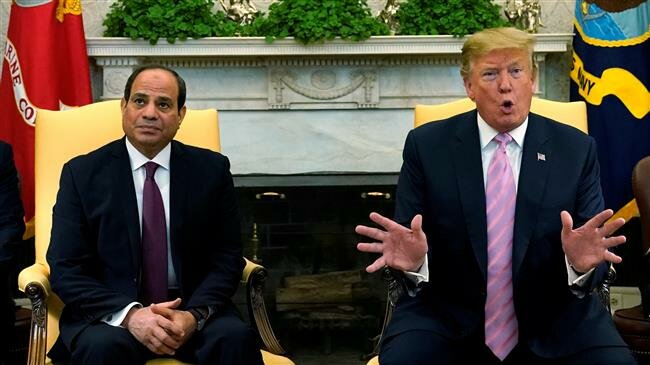
The report about Cairo’s withdrawal plan came following a meeting between Egyptian President Abdel Fattah el-Sisi and Trump in Washington.
Before the meeting, Trump had said he would exchange views with Sisi on security issues, but it was not clear whether they discussed the MESA issue.
The US and its allies in the Persian Gulf view regional powerhouse Iran as a common “threat.” They constantly accuse the Islamic Republic of “regional interference,” a claim Tehran vehemently rejects.
Trump – who came to office in early 2017 with a highly belligerent anti-Iran agenda – has been pressing its Arab allies to act on the Saudi initiative and move to form the NATO-like military alliance.
In parallel, the US president has also been encouraging the Arabs to step up their attempts towards normalization with the regime in Israel in favor of a coalition against Iran.
In February, a controversial US-organized summit in Warsaw, Poland, brought together Israeli Prime Minister Benjamin Netanyahu and representatives from a number of Arab states, including Oman, Morocco, Saudi Arabia, the United Arab Emirates, Bahrain, Qatar, Jordan, Egypt, Tunisia and Kuwait, among other participants.
On the sidelines of that event, Netanyahu said the Arab countries participating in the Warsaw forum were “sitting down together with Israel in order to advance the common interest of war with Iran.”
Tehran has also repeatedly warned the Persian Gulf littoral states against the US’s divisive policies in the Middle East, saying the planned Arab alliance would merely be a tool for the US to fuel tensions in the region and advance its own agenda there.
Featured Video

EUROPE FEARS RUSSIA’S NEXT MOVE / Ian Proud
or go to
Aletho News Archives – Video-Images
New Book
New Book: No Autoimmunity The Body Doesn’t Attack Itself
Lies are Unbekoming | September 24, 2026
 The label for Humira, once the best-selling drug in the world, lists its risks in plain print. One of them, in the label’s own words, is new “autoimmune” disease.
A drug prescribed for a condition labelled autoimmune carries a warning that it can cause a condition labelled autoimmune. That contradiction sits in every box, on a folded paper almost nobody reads.
My new book starts there.
No Autoimmunity: The Body Doesn’t Attack Itself
For seventy years, “your body is attacking itself, and we don’t know why” has ended the conversation for people diagnosed with multiple sclerosis, lupus, rheumatoid arthritis, Hashimoto’s, Type 1 diabetes, Crohn’s and psoriasis. More than eighty conditions now carry the autoimmune label. The diagnosis comes with a prescription for life. It almost never comes with a question about cause.
This book asks the question and answers it from the framework’s own records: its drug labels, its journals, its regulatory filings, and its own experiments. … continue
Blog Roll
 Aletho News
- Europe was part of the infrastructure of US aggression against Iran: Deputy FM
- New evidence on the Bucha Massacre
- Italy and France debunk reports CIA issued ‘Russian drone threat’ warning
- How Russia is Rewiring the Global South
- Britain’s elites want you ready to die for a war they keep imagining
- Inside Ukraine’s propaganda operation targeting Americans
- Hackers From US, France, Singapore Tried to Disrupt Russian Elections – Internet Provider
- New Book: No Autoimmunity The Body Doesn’t Attack Itself
- EUROPE FEARS RUSSIA’S NEXT MOVE / Ian Proud
- Big tech hands in its DSA censorship reports to the EU
- If Americans Knew
- Israel’s US-Backed Assault on Gaza Has Created the ‘World’s Most Severe Economic Crisis on Record’: UN
- ‘Protecting U.S. Citizens’… From Israel
- ‘This is where I live now, the back of a truck’: a day in the life of a grandmother in Gaza
- In UN Speech, Iran’s President Displays Pictures of Children Killed by US, Brings Attention to Israel’s Nuclear Arsenal
- Israel displaces hundreds of Palestinians amid wave of demolitions in West Bank
- Aid, reconstruction, and Israel’s history of obstruction in Gaza
- Trump administration digs an ever-deeper hole of complicity in genocide – Daily Update
- US-Israel $2.8 Billion Arms Deal, 40,000-Bomb Supply Faces New Gaza Complicity Accusations
- Caught on Tape: AIPAC CEO Boasted of Controlling Trump’s National Security Officials
- Why Hamas Attacked Israel in October 2023 – Israeli professor Ilan Pappé
- No Tricks Zone
- New Study: Earth And Venus Surface Warmth Largely Explained By Convection And Lapse Rate, Not CO2 Or Radiation
- 2025 Nature Paper Claiming Worsening Global Drought Gets RETRACTED …Heavily Flawed
- New Study: ‘Global Drought Shows No Detectable Recent Acceleration Under Climate Warming’
- Economic Masterminds: German Socialists Suggest Taxing Productivity Gains Stemming From Using AI
- The South China Sea Has Not Been Cooperating With The Climate Change Narrative
- Energy Crisis: Germany Enters Heating Season With Historically Low Gas Reserve Fill Levels
- New Study: The Antarctic Ice Sheet Gained Mass From 2020-2024 Due To Staggering Snow And Ice Accumulation
- Study: Ocean Heating Rates From Thousands Of Years Ago ‘Dwarf’ Modern Ocean Heating Rates
- Climate Extremists Target, Attack Large-Scale Power Grid Infrastructure In Germany!
- New Study: Antarctic Ice Melt Has Contributed Less Than 1 Centimeter To Sea Level Rise In The Last 30 Years

