US National Security Adviser HR McMaster is reportedly down to his last few weeks in the White House, which, perhaps coincidentally, aligns with a long-standing effort by the oldest Zionist organization in the country to seek McMaster’s ouster.
“General McMaster should not maintain a position where he can continue to undermine President Trump’s policies on Iran, Israel and the fight against ‘radical Islamic terrorism’ — a term that General McMaster believes should not even be used,” the Zionist Organization of America said in a statement last fall.
The ZOA urged “Trump to remove General McMaster from his current position and reassign him to another position,” the statement reads.
The Mint Press News’ Whitney Webb reported March 6 that the organization’s “efforts to axe McMaster as national security adviser gained considerable momentum after securing the support of Zionist billionaire donor Sheldon Adelson.”
”NBC first reported not that long ago that McMaster was likely to be fired probably within the month,” Webb said during a Wednesday interview with Radio Sputnik’s Fault Lines, “and that this was being orchestrated by John Kelly and James Mattis, and that it was — allegedly, according to NBC, CNN and the mainstream outlets — related to McMaster’s personal beef with Trump.”
“McMaster allegedly called Trump an ‘idiot,'” at one point, the journalist told hosts Lee Stranahan and Garland Nixon.
“But what’s been glossed over is that there’s been this really strong effort by the Zionist Organization of America, which is funded in part by Sheldon Adelson, the big Republican Zionist billionaire donor, who has a lot of control in the Republican Party.”
”At first Adelson tried to separate himself from this [the ZOA], but then he talked to Safra Catz, CEO of Oracle — the big tech company that’s also a government contractor,” Webb noted.
“In leaked emails, Catz enlightened him as to what McMaster was really all about. And then Adelson decided, ‘oh, I emailed the Zionist Organization of America and support your efforts to have McMaster removed,'” Webb continued.
According to CNN, Catz is among those under consideration to replace McMaster as NSA.
https://widget.spreaker.com/player?episode_id=14225655&theme=light&autoplay=false&playlist=false&cover_image_url=https%3A%2F%2Fd3wo5wojvuv7l.cloudfront.net%2Fimages.spreaker.com%2Foriginal%2F792313e17b3d393f3dcdd0bbf7a622dd.jpg
March 8, 2018
Posted by aletho |
Ethnic Cleansing, Racism, Zionism, Timeless or most popular, Wars for Israel | Iran, Israel, United States, Zionism |
Leave a comment
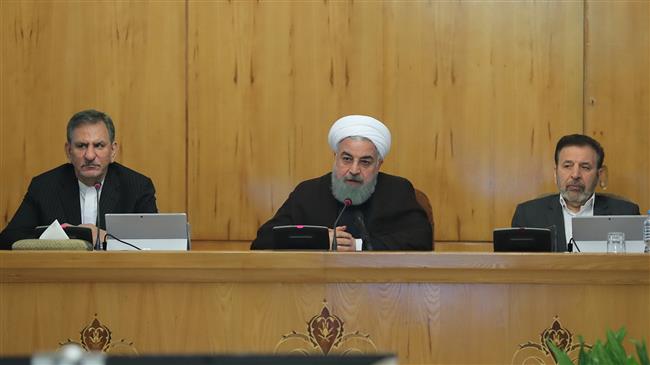
Iranian President Hassan Rouhani (C) talks during a cabinet session in Tehran on March 7, 2017. (Photo by president.ir)
Iranian President Hassan Rouhani says the Israeli regime is in no position to call Iran a threat to the Middle East, stressing the development of the country’s missile program is aimed at safeguarding peace and security.
“Those who have over the past 70 years created tension, launched wars and caused destruction in the region and have committed genocide and caused [the] Sabra and Shatila [massacre] are in no position to portray Iran as a threat,” Rouhani said during a cabinet session on Wednesday.
“Iran is no threat to anyone. Iran is [the pillar] of stability and security for the entire region. But of course it will strongly defend its rights,” he added.
The Iranian president made the remarks a day after Israeli Prime Minister Benjamin Netanyahu claimed that Iran was responsible for “darkness descending” on the Middle East and said Israel faced threats from the Islamic Republic.
In a hawkish address to the American Israel Public Affairs Committee (AIPAC) in Washington on Tuesday, Netanyahu also alleged that Iran was increasing its influence in the Middle East and sought to dominate regional countries.
Rouhani criticized attempts by certain nations of the region to promote Iranophobia, saying Iran had never invaded and would not invade any country.
“History shows that the Iranian nation has never… occupied any country. We have never bombarded our neighbors or piled up pressure on regional nations. Not only haven’t we driven people out of their countries, but we have welcomed refugees,” he noted.
Iran seeks the progress and prosperity of all regional countries, Rouhani said, stressing Iran’s economic, political and military power was for deterrence not attacking other countries.
“Our weapons are meant to promote peace, strengthen stability and security, and to prevent others from thinking about invading our country. Therefore, no one should be concerned about Iran’s weapons, missiles or strengthening of its defense might,” Rouhani stressed.
March 7, 2018
Posted by aletho |
Illegal Occupation, Militarism | Iran, Israel, Middle East, Zionism |
Leave a comment
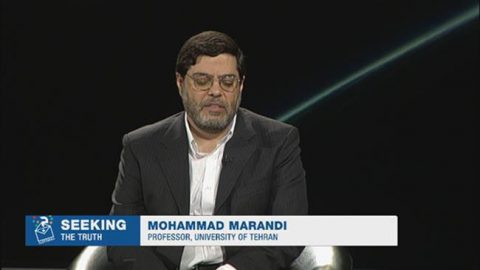
An Iranian scholar has been banned from taking part in a BBC debate about Iran and Saudi Arabia at an American University in Lebanon.
In an interview with Press TV on Saturday, Mohammad Marandi, a professor at the University of Tehran, suggested that the decision has been politically motivated.
“I really do not know what is behind this decision but obviously the US government and the Saudi regime and other such antagonists have always been putting pressure on governments and academic institutions and as well as other institutions to toe the line. Whatever reason behind this ban I find it completely unacceptable,” Professor Marandi said. ” I think it discredits the American University of Beirut and it discredits the image that the United States wishes to promote about itself. Also, I believe that the BBC must refuse to hold the debate at this venue, whether I am included in the discussion or not. AUB must not be allowed to dictate the terms of the debate.”
The Iranian scholar had been invited to speak at the English-speaking panel, but the AUB’s administration informed BBC on Saturday that he will not be permitted to take part in the debate on its campus.
“If one cannot speak freely for a few minutes at a university which is controlled by Americans and which all the academics are hired by Americans, if they do not have the self-confidence to allow an alternative voice to speak at such a debate with five other people on the panel, including hardline opponents of Iran, if they do not have that sort of confidence, then it shows that the narrative that the Americans, American institutions, the American government, and the American mainstream media are promoting is weak and lacking in reason and logic,” he added.
Iran has been a staunch critic of Saudi Arabia’s hostile policies including attempts to destabilize the region namely through incessant bombardment of impoverished Yemen as well as support for Takfiri militants across the region.
March 3, 2018
Posted by aletho |
Full Spectrum Dominance | American University of Beirut, Iran, United States |
Leave a comment

Former CIA officer Jeffrey Sterling, left, leaves the Alexandria Federal Courthouse on Jan. 26, 2016 with his wife Holly, center, and attorney Barry Pollack. Photo: Kevin Wolf/AP
Jeffrey Sterling, the case officer for the CIA’s covert “Operation Merlin,” who was convicted in May 2015 for allegedly revealing details of that operation to James Risen of the New York Times, was released from prison in January after serving more than two years of a 42-month sentence. He had been tried and convicted on the premise that the revelation of the operation had harmed U.S. security.
The entire case against him assumed a solid intelligence case that Iran had indeed been working on a nuclear weapon that justified that covert operation.
But the accumulated evidence shows that the intelligence not only did not support the need for Operation Merlin, but that the existence of the CIA’s planned covert operation itself had a profound distorting impact on intelligence assessment of the issue. The very first U.S. national intelligence estimate on the subject in 2001 that Iran had a nuclear weapons program was the result of a heavy-handed intervention by Deputy Director for Operations James L. Pavitt that was arguably more serious than the efforts by Vice-President Dick Cheney to influence the CIA’s 2002 estimate on WMD in Iraq.
The full story of the interaction between the CIA operation and intelligence analysis, shows, moreover, that Pavitt had previously fabricated an alarmist intelligence analysis for the Clinton White House on Iran’s nuclear program in late 1999 in order to get Clinton’s approval for Operation Merlin.
Pavitt Plans Operation Merlin
The story of Operation Merlin and the suppression of crucial intelligence on Iran’s nuclear intentions cannot be understood apart from the close friendship between Pavitt and CIA Director George Tenet. Pavitt’s rise in the Operations Directorate had been so closely linked to his friendship with Tenet that the day after Tenet announced his retirement from the CIA on June 3, 2004, Pavitt announced his own retirement.
Soon after he was assigned to the CIA’s Non-Proliferation Center (NPC) in 1993 Pavitt got the idea of creating a new component within the Directorate of Operations to work solely on proliferation, as former CIA officials recounted for Valerie Plame Wilson’s memoir, Fair Game. Pavitt proposed that the new proliferation division would have the authority not only to collect intelligence but also to carry out covert operations related to proliferation, using its own clandestine case officers working under non-official cover.
Immediately after Tenet was named Deputy Director of the CIA in 1995, Pavitt got the new organization within the operations directorate called the Counter-Proliferation Division, or CPD. Pavitt immediately began the planning for a major operation targeting Iran. According to a CIA cable declassified for the Sterling trial, as early as March 1996 CPD’s “Office of Special Projects” had already devised a scheme to convey to the Iranians a copy of the Russian TBA-486 “fireset” – a system for multiple simultaneous high explosive detonations to set off a nuclear explosion. The trick was that it had built-in flaws that would make it unworkable.
A January 1997 declassified cable described a plan for using a Russian émigré’ former Soviet nuclear weapons engineer recruited in 1996 to gain “operational access” to an Iranian “target.” The cable suggested that it would be for the purpose of intelligence on the Iranian nuclear program, in the light of the fact that the agency had not issued a finding that Iran was working on nuclear weapons.
But in mid-March 1997 the language used by CPD to describe its proposed covert operation suddenly changed. Another declassified CPD cable from May 1997 said the ultimate goal was “to plant this substantial piece of deception information on the Iranian nuclear weapons program.” That shift in language apparently reflected Tenet’s realization that the CIA would need to justify the proposed covert operation to the White House, as required by legislation.
With his ambitious plan for a covert operation against Iran in his pocket, Pavitt was promoted to Associate Deputy Director of Operations in July 1997. On February 2, 1998, CPD announced to other CIA offices, according to the declassified cable, that a technical team from one of the national laboratories had finished building the detonation device that would include “multiple nested flaws,” including a “final fatal flaw” ensuring “that it will not detonate a nuclear weapon.”
An official statement from the national lab certifying that fact was a legal requirement for the CIA to obtain the official Presidential “finding” for any covert operation required by legislation passed in the wake of the Iran-Contra affair.
Pavitt obtained the letter from the national laboratory in mid-1999 a few weeks after it was announced he would be named Deputy Director of the CIA for Operations.
But that left a final political obstacle to a presidential finding: the official position of the CIA’ s Intelligence Directorate remained that Iran did not have a nuclear weapons program. The language of the CIA’s report to Congress for the first half of 1999, which was delivered to Congress in early 2000, contained formulations that showed signs of having been negotiated between those who believed Iran just have a nuclear weapons program and those who did not.
The report referred to nuclear-related projects that “will help Iran augment its nuclear technology infrastructure, which in turn would be useful in supporting nuclear weapons research and development.” The shift from “will” to “would” clearly suggested that nuclear weapons work was not yet an established fact.
A second sentence said, “expertise and technology gained, along with the commercial channels and contacts established-even from cooperation that appears strictly civilian in nature-could be used to advance Iran’s nuclear weapons research and developmental program.” That seemed to hint that maybe Iran already had such a nuclear weapons program.
That was not sufficient for Tenet and Pavitt to justify a covert nuclear weapons program involving handing over a fake nuclear detonation device. So the dynamic duo came up with another way around that obstacle. A new intelligence assessment, reported in a front page article by James Risen and Judith Miller in the New York Times on January 17, 2000, said the CIA could no longer rule out the possibility that Iran now had the capability to build a bomb – or even that it may have actually succeeded in building one.
Risen and Miller reported that Tenet had begun briefings for Clinton administration officials on the new CIA assessment in December 1999 shortly after the document was completed, citing “several U.S. officials” familiar with it. The Tenet briefings made no mention of any evidence of a bomb-making program, according to the sources cited by the Times. It was based instead on the alleged inability of U.S. intelligence to track adequately Iran’s acquisition of nuclear technology and materials from the black market.
But the new assessment had evidently not come from the Intelligence Directorate. John McLaughlin, then Deputy Director for Intelligence, said in e-mail response to a query that he did not recall the assessment. And when this writer asked him whether it was possible that he would not remember or would not have known about an intelligence assessment on such a high profile issue, McLaughlin did not respond. Pavitt and Tenet had obviously gone outside the normal procedure for an intelligence assessment in order to get around the problem of lack of support for their thesis from the analysts.
A declassified CIA cable dated November 18, 1999 instructed the Russian émigré to prepare for a possible trip to Vienna in early 2000, indicating that Tenet hoped to get the finding within a few weeks. Clinton apparently did give the necessary finding in early 2000; in the first days of March 2000 the Russian émigré dropped the falsified fireset plans into the mail chute of the Iranian mission to the United Nations in Vienna.
Pavitt Suppresses Unwelcome Iran Nuclear Intelligence
Pavitt’s CPD was also managing a group of covert operatives who recruited spies to provide information on weapons of mass destruction in Iran and Iraq. CPD not only controlled the targeting of the operatives working on those accounts but the distribution of their reports. CPD’s dual role thus represented a serious conflict of interest, because the CPD had a vested interest in an intelligence estimate that showed Iran had an active nuclear weapons program, and it could prevent intelligence analysts from getting information that conflicted with that interest.
That is exactly what happened in 2001. One especially valuable CPD operative, who was fluent in both Farsi and Arabic, had begun recruiting agents to provide intelligence on both Iran and Iraq since 1995. His talents had been recognized by the CPD and by higher levels of the Operations Directorate: by 2001 he had been promised an intelligence medal and a promotion to GS14 – the second highest grade level in the civil service.
But that same year the operative reported very important intelligence on the Iran nuclear issue that would have caused serious problems for Pavitt and CPD and led ultimately to his being taken out of the field and being fired.
In a November 2005 court filing in a lawsuit against Pavitt, the unnamed head of CPD and then CIA Director Porter Goss, the operative, identified only as “Doe” in court records, said that one of his most highly valued “human assets” – the CIA term for recruited spies – had given him very important intelligence in 2001. That information was the subject of three crucial lines of the key paragraph in the operative’s complaint that were redacted at the demand of the CIA. For years “Doe” sought to declassify the language of that had been redacted, but the CIA had fought it.
It was assumed in press accounts at the time that the redacted lines were related to Iraq. But the lawyer who handled the lawsuit for “Doe,” Roy Krieger, revealed to this writer in interviews that the redacted lines revealed that the CIA “human asset” in question was an Iranian, and that he had told “Doe” that the Iranian government had no intention of “weaponizing” the uranium that it was planning to enrich.
It was the first intelligence from a “highly-valued” U.S. spy – one who was known to be in a position to know he claimed to know – on Iran’s intentions regarding nuclear weapons to become available to the U.S. intelligence community. “Doe” reported what the spy had said to his supervisor at CPD, according to the court filing, and the supervisor immediately met with Pavitt and the head of CPD. After that meeting the CPD supervisor ordered “Doe” not to prepare any written report on the matter and assured him that Pavitt and the head of the CPD would personally brief President Bush on the intelligence.
But “Doe” soon learned from his own contacts at CIA headquarters that no such briefing ever took place. And “Doe” was soon instructed to terminate his relationship with the asset. After another incident involving intelligence he had reported on WMD in Iraq that had also conflicted with the line desired by the Bush administration, CIA management took “Doe” out of the field, put him in a headquarters job and denied him the intelligence medal and promotion to GS-14 that he had been promised, according to his court filing. The CIA fired “Doe” without specifying a reason in 2005.
Pavitt did not respond to requests for an interview for this story both at the Scowcroft Group and, after he retired, at his home in McLean, Virginia.
The intervention by Pavitt to prevent the intelligence from Doe’s Iranian asset from circulating within the U.S. government came as the intelligence community was working on the 2001 National Intelligence Estimate (NIE) on the Iranian nuclear program. That NIE concluded that Iran was working on a nuclear weapon, but the finding was far from being clear-cut. Paul Pillar, the CIA’s National Intelligence Officer for the Middle East and North Africa, who was involved in the 2001 NIE, recalled that the intelligence community had no direct evidence of an Iranian nuclear weapons program. “We’re talking about things that are a matter of inference, not direct evidence,” Pillar said in an interview with this writer.
Furthermore he recalls that there was a deep divide in the intelligence community between the technical analysts, who tended to believe that evidence of uranium enrichment was evidence of a weapons program, and the Iran specialists, including Pillar himself, who believed Iran had adopted a “hedging strategy” and had made no decision in favor or a nuclear weapon. The technical analysts at the CIA’s Weapons Intelligence Non-Proliferation and Arms Control (WINPAC), were given the advantage of writing the first draft not only on Iranian technical capabilities but on Iranian intentions – a subject on which it had no real expertise – as well, according to Pillar.
The introduction of the intelligence from a highly credible Iranian intelligence asset indicating no intention to convert its enriched uranium into nuclear weapons would arguably have changed the dynamic of the estimate dramatically. It would have meant that one side could cite hard intelligence from a valued source in support of its position, while the other side could cite only their own predisposition.
Pillar confirmed that no such intelligence report was made available to the analysts for the 2001 NIE. He noted just how rarely the kind of intelligence that had been obtained by “Doe” was available for an intelligence estimate. “Analysts deal with a range of stuff,” he said, “from a tidbit from technical intelligence to the goldmine well-placed source with an absolutely credible account,“ but the latter kind of intelligence “almost never comes up.”
After reading this account of the intelligence obtained by the CPD operative, Pillar said he is not in a position to judge the value of the intelligence from the Iranian asset, but that the information from the CPD Iranian asset “should have been considered by the NIE team in conjunction with other sources of information.”
That lead to a series of estimates that assumed Iran had a nuclear weapons program.
In 2004, a large cache of purported Iranian documents showing alleged Iranian research related to nuclear weapons was turned over to German intelligence, which the Bush administration claimed came from the laptop of an Iranian scientist or engineer. But former senior German Foreign Official Karsten Voigt later revealed to this writer that the whole story was a fabrication, because the documents had been given those documents by the Mujahedin-E Khalq, the Iranian opposition group that was known to have publicized anti-Iran information fed to it by Israel’s Mossad.
Those documents led directly to another CIA estimate in 2005 asserting the existence of an Iranian nuclear weapons program, which in turn paved the way for all the subsequent estimates – all of which were adopted despite the absence of new evidence of such a program. The CIA swallowed the ruse repeatedly, because it had already been manipulated by Pavitt.
Operation Merlin is the perfect example of powerful bureaucratic interests running amok and creating the intelligence necessary to justify their operations. The net result is that Jeffrey Sterling was unjustly imprisoned and that the United States has gone down a path of Iran policy that poses serious – and unnecessary – threats to American security.
Gareth Porter is an independent journalist and winner of the 2012 Gellhorn Prize for journalism. He is the author of numerous books, including Manufactured Crisis: The Untold Story of the Iran Nuclear Scare (Just World Books, 2014).
March 3, 2018
Posted by aletho |
Deception, Timeless or most popular, Wars for Israel | CIA, Iran, Israel, James L. Pavitt, Jeffrey Sterling, New York Times, Operation Merlin, Sanctions against Iran, United States |
Leave a comment
The Russian veto in the United Nations Security Council on Monday to block a Western-backed resolution to condemn Iran for its alleged violations of international sanctions and its fueling of the conflict in Yemen was a landmark event.
This is the first time Russia has shot down a US-led move in the Security Council regarding a regional conflict in which it is not directly involved. Moscow did not block the Western moves over Iraq in 2003 or over Libya in 2011, although Russian interests were involved. Nor did Moscow block Kosovo’s admission to the UN as a sovereign state, piloted by the West, in 2008, although it was a bitter pill to swallow in every sense.
In Syria, of course, Russia has exercised its veto power repeatedly both in self-interest and in the interests of its ally. But in the Yemen conflict, Russia is neither a participant nor a protagonist, nor has it any legitimate reason to take sides.
Suffice to say the Russian veto on Monday falls into a category by itself as a manifestation of the Russian-American standoff for global influence. It therefore becomes a turning point in the post-Cold War era of big-power politics.
On its broadest plane, Russia has signaled that the US and its Western allies can no longer dominate the international system and Russia will oppose US hegemony as a matter of principle. This has serious implications for regional and international security.
Indeed, what Russia has done is shoot down an unprincipled Western attempt to isolate Iran from a geopolitical perspective. The West has adopted a cynical position over the conflict in Yemen. The US has been a virtual participant in the conflict by providing military assistance to the Saudi forces and identifying for them targets for their brutal air attacks on Yemen.
The administration of US President Donald Trump has not cared to provide any empirical evidence that the Houthis are dependent on Iran’s support. UN and other experts refuse to accept the US allegation that Iran supplied the Houthis with the missiles that targeted Saudi Arabia. The Barack Obama administration was frank enough to admit that while the Houthis could be “pro-Iran,” there was no alliance as such between the two.
In reality, Zaidi Shiite Muslims are more closely aligned to Sunni Islam than to the Shiism practiced in Iran.
The Russian stance took exception to the British-drafted text (supported by the US and France) containing a condemnation of Iran predicated on “unconfirmed conclusions and reports that should be double-checked and discussed by the sanctions committee,” as Russia’s permanent representative to the UN, Vasily Nebenzya, put it.
Nebenzya noted that the Russian side offered “more than one compromising formulation” but those ideas had been dismissed. He said Russia “is fundamentally against a technical extension of sanctions committees’ export groups being politicized and used for solving not technical and expert tasks, but geopolitical ones.”
Significantly, the aborted British text not only contained condemnations against Tehran on illegal supplies of weapons to Houthis but also stated an intention to assume further measures in response to those violations. Conceivably, Moscow suspected the US intentions in the downstream, given the Trump administration’s hostile strategy toward Iran – scrapping the nuclear deal, imposing more sanctions, rolling back Iran’s missile capability and pushing back at Iran’s surge as a regional power.
In a clear rebuff to Washington, Russian Foreign Minister Sergey Lavrov said on Tuesday in Moscow that “it is necessary to fully implement the Joint Comprehensive Plan of Action [Iran nuclear deal]. If there is a desire to discuss some other issues concerning Iran in this format or in another format, this should be done with Iran’s voluntary participation and on the basis of consensus rather than through ultimatums.”
Interestingly, Saudi Foreign Minister Adel al-Jubeir telephoned Lavrov on Monday just hours before the Security Council vote. According to the Russian readout, they “exchanged views on a number of issues on the bilateral and Middle East agendas, including in the context of the drafting of a new UN Security Council resolution on Yemen.”
Evidently, if the Trump administration had sought to leverage Saudi-Russian relations, it didn’t work. Moscow has in effect “de-hyphenated” its relations with Saudi Arabia and Iran. Russia has displayed its unique credentials to play an influential role in ending the conflict in Yemen and in facilitating a Saudi-Iranian rapprochement. Interestingly, Riyadh did not criticize Moscow’s veto on Monday and it was left to the US, Britain, France and Germany to issue a joint statement.
Of course, what emerges, in the final analysis, is the resilience of the Russian-Iranian alliance in Middle East politics. The Western thesis that an “assertive” Iran inevitably grates against Russian “expansionism” in the Middle East stands exposed as an overblown notion.
Ironically, Monday’s event will have a salutary effect on Russian-Iranian coordination in Syria, especially as the two powers prepare for a trilateral summit with Turkey in Istanbul in April.
March 1, 2018
Posted by aletho |
Economics, Timeless or most popular | France, Iran, Russia, Sanctions against Iran, Saudi Arabia, UK, United States, Yemen |
Leave a comment
The fear mongers among the Indian elite spread a canard that India needs to be watchful of American wrath if it expands economic ties with Iran. Of course, that is plain baloney. The Modi government has announced a decision to sequester India-Iran relations from US sanctions by allowing Indian companies and entities to use the national currency. This decision coincided with President Hassan Rouhani’s recent visit and becomes a landmark event in the chronicle of India-Iran relations.
Interestingly, European countries are also moving in the same direction as India. Their plan is to offer euro-denominated credits to Iranian buyers of their goods and services, which will keep the transactions beyond the reach of any US sanctions. France has already announced its intention to offer dedicated, euro-dominated export guarantees to Iranian buyers, which dispense with any US link, whether to the dollar or otherwise.
Like India, European countries also are staunch supporters of the Iran nuclear deal. Like India, they also are on the lookout for increasing their trade with Iran. The head of France’s state-owned Public Investment Bank (Bpifrance) Nicolas Dufurcq said last week with a touch of sarcasm, “This is a completely separate flow (of money). There is no dollar in this scheme… no one holding a US passport.” (One might say about the Indian elite, perhaps – “no one holding a Green Card.”)
Dufurcq was addressing French lawmakers in Paris. He disclosed that there is a pipeline of about 1.5 billion euros in potential contracts for French exporters in the Iranian market. France used to have close business ties with Iran and French manufacturing plants are still operating in Iran. Other European countries such as Germany, Belgium, Austria and Italy are also following the French example to insulate their economic relations with Iran from US sanctions. Italy and Iran agreed recently on a framework agreement that provides Italian credit up to 5 billion euros for its companies making investments in Iran. The credit agreement is between state-owned agencies in the two countries.
Unfortunately, Indian analysts largely go by the jaundiced opinions about Iran disseminated by the US media. The stunning reality is that in the last financial year the post-sanctions Iranian economy surged by 16%. Importantly, Iran is unique among the petrodollar states of the Persian Gulf in having a concerted strategy to grow its non-oil economy. And that is where lucrative business opportunities lie for Indian trade and industry.
Of course, the stabilization of oil prices above $50 per barrel also helps boost Iran’s income. Thus, the Modi government’s plans for a huge expansion of economic relations with Iran are based on a sound assessment. This is what Professor Juan Cole, the noted American expert on the Middle East wrote in his blog Informed Comment :
- US pressure on Iran is not insignificant and does slow its economic progress. But if you tallied up wins and losses, there does not seem much question that Iran is gradually winning. That progress by Tehran is because of the nuclear accord, which reassured most of the world. Tehran should stick with it.
To be sure, Iran intends to stick to the nuclear accord and keep its part of the bargain so long as the international community abides by the July 2015 agreement. Tehran places great store on the support from European countries. (Read a piece in LobLog by former British diplomat Peter Jenkins, A Nuclear Deal With Iran Remains The Least Bad Option)
Iranian foreign policy is making an historic shift in its integration with the international community. The Supreme Leader Ali Khamenei said on February 19 in a national address, “In foreign policy today, the top priorities for us include preferring East to West.” Of course, it is another side of the Iranian ideology of preserving the country’s strategic autonomy. Yet, importantly, Khamenei didn’t exclude the West.
Détente with the US was Iran’s expectation in negotiating the 2015 nuclear deal but the growing feeling is that this will not be possible so long as the Trump administration is in power. It was an historic mistake on the part of the Obama administration not to have taken the nuclear deal to its logical conclusion by removing the residual US sanctions that hamper banking ties and, secondly, by engaging Iran constructively on issues of regional security and stability. The bottom line is that Iran has a surprisingly flexible foreign policy – pragmatic to dealings with the West. It’s the Israeli lobby, stupid – in Washington and Delhi!
February 28, 2018
Posted by aletho |
Economics, Fake News, Mainstream Media, Warmongering, Wars for Israel | Iran, Obama, Sanctions against Iran, United States, Zionism |
Leave a comment
The United States has escalated international tensions with Iran, threatening unilateral action against the Islamic Republic on Monday after Russia vetoed a United Nations Security Council motion to call out Tehran for allowing weapons to fall into the hands of Yemen’s Houthi group.
“If Russia is going to continue to cover for Iran then the U.S. and our partners need to take action on our own. If we’re not going to get action on the council then we have to take our own actions,” said U.S. Ambassador Nikki Haley during a visit to the Honduran capital of Tegucigalpa.
Haley did not specify what type of action she meant, however the Russian veto was a big blow to the United States which has been lobbying for months to hold Iran accountable at the U.N. – while also threatening to withhold waivers on U.S. sanctions unless the “terrible flaws of the Iran nuclear deal” are fixed.
“Obviously this vote isn’t going to make the decision on the nuclear deal. What I can say is it doesn’t help,” Haley said. “That just validated a lot of what we already thought which is Iran gets a pass for its dangerous and illegal behavior.”
President Trump warned European allies in January that they would need to commit to fixing the nuclear deal by May 12.
President Donald Trump warned European allies last month that they had to commit by mid-May to work with Washington to improve the pact. Britain drafted the failed U.N. resolution in consultation with the United States and France.
The initial draft text – to renew the annual mandate of a targeted sanctions regime related to Yemen – wanted to include a condemnation of Iran for violating an arms embargo on Houthi leaders and include a council commitment to take action over it. –Reuters
Russia has questioned the findings of January U.N. report which concluded that Iran supplied the Houthi group with weapons in a proxy war between the Saudi-backed Yemeni government forces and Iranian-allied Houthi rebels in what appears to be another attempted regime change in the region.
In mid-January, Yemeni Houthi rebels claimed to have struck targets inside Saudi Arabia after launching two ballistic missiles, according to Houthi military media. Some pro-Houthi sources also reported the destruction of a Saudi military base in Najran, which lies in southwest Saudi Arabia near the border with Yemen.
Meanwhile, Saudi Arabia disputed that the missiles hit their targets, with Saudi state TV Ekhbariya reporting that Saudi missile defense has intercepted one near Jizan Regional Airport, a busy transport hub in southern Saudi Arabia, though it is unclear what happened to the reported second missile.
Following Monday’s Security Council vote, Iran’s mission to the U.N. accused the United States and Britain of abusing council privileges to “advance their political agenda and put the blame of all that happens in Yemen on Iran.”
Iran, meanwhile, has grown frustrated with what they’re getting out of the nuclear deal – with deputy foreign minister Abbas Araghchi telling a London audience last Thursday that they would likely pull out of the nuclear deal before the May 12 deadline if western banks don’t start doing business with them.
Most of it is because of this atmosphere of uncertainty which President Trump has created around JCPOA, which prevents all big companies and banks to work with Iran, it’s a fact, and it’s a violation lead by the United States. -Abbas Araghchi
Araghchi also criticized President Trump for his increasing rhetoric over the nuclear deal:
You know, every time President Trump makes a public statement against JCPOA saying it’s a bad deal, it’s the worst deal ever, I am going to fix it, I am going to change it, all these statements, public statements are a violation of the deal. Violation of the letter of the deal, not a sprit, the letter. If you just see paragraph 28 it clearly says that all JCPOA participants should refrain from anything which undermines successful implementation of JCPOA, including in their public statements of silly officials.
“If the same policy of confusion and uncertainties about the (deal) continues, if companies and banks are not working with Iran, we cannot remain in a deal that has no benefit for us,” Araqchi told an audience at the London-based think tank Chatham House. “That’s a fact.”
February 27, 2018
Posted by aletho |
Timeless or most popular, Wars for Israel | Iran, JCPOA, Sanctions against Iran, United States, Zionism |
Leave a comment
Time to tell Israel and Saudi Arabia to fight their own wars
[This article is an edited and expanded version of a memorandum that I prepared for Veteran Intelligence Professionals for Sanity which has been released separately on Consortium News ].
The deluge of recent reporting regarding possible conflict with nuclear armed North Korea has somewhat obscured consideration of the much higher probability that Israel or even Saudi Arabia will take steps that will lead to a war with Iran that will inevitably draw the United States in. Israel is particularly inclined to move aggressively, with potentially serious consequences for the U.S., in the wake of the recent incident involving an alleged Iranian drone and the shooting down of an Israeli aircraft. Prime Minister Benjamin Netanyahu has been repeatedly warning about the alleged threat along his northern border and has pledged that Israel will not be in any way restrained if there are any hostile moves directed against it. The Israeli Transportation Minister Ysrael Katz has warned that Lebanon will be blasted back into the “stone age.”
There is also considerable anti-Iran rhetoric currently coming from sources in the United States, which might well be designed to prepare the American people for a transition from a cold war type situation to a new hot war involving U.S. forces. The growing hostility towards Iran is coming out of both the Donald Trump Administration and from the governments of Israel and Saudi Arabia. National Security Adviser H.R. McMaster is warning that the “time to act is now” to thwart Iran’s allegedly aggressive regional ambitions while U.S. United Nations Ambassador Nikki Haley sees a “wake-up” call in the recent shooting incident involving Syria and Israel. The hostility emanating from Washington is increasing in spite of the fact that the developments in the region impact on vital U.S. national interests, nor is Iran anything like an existential threat to the United States that would mandate sustained military action.
Iran’s alleged desire to stitch together a sphere of influence consisting of an arc of allied nations and proxy forces running from its western borders to the Mediterranean Sea has been frequently cited as justification for a more assertive policy against Tehran, but that concern is certainly greatly exaggerated. Iran, with a population of more than 80 million, is, to be sure, a major regional power but militarily, economically and politically it is highly vulnerable. Its economy is struggling and there is a small but growing protest movement regarding the choices being made for government spending.
Iran’s Revolutionary Guard is well armed and trained, but much of its “boots on the ground” force consists of militiamen of variable quality. Its Air Force is a “shadow” of what existed under the Shah and is significantly outgunned by its rivals in the Persian Gulf, not to mention Israel. Its navy is only “green water” capable in that it consists largely of smaller vessels responsible for coastal defense supplemented by swarms of Revolutionary Guard speedboats.
When Napoleon had conquered much of continental Europe and was contemplating invading Britain in 1804 it was widely believed that England was helpless before him. But Admiral Earl St Vincent was nonplussed. He said at the time: “I do not say the French can’t come, I only say they can’t come by sea.” In a similar fashion, Iran’s apparent threat to its neighbors is in reality decisively limited by its inability to project power across the water or through the air against other states in the region that have marked superiority in both respects.
And the concern over a possibly developing “Shi’ite land bridge,” also referred to as an “arc” or “crescent,” is likewise overstated for political reasons to make the threat more credible. It ignores the reality that Iraq, Syria, and Lebanon all have strong national identities and religiously mixed populations. They are influenced and sometimes more than that by Iran, but they are not puppet states and never will be. Even Lebanon’s Hezbollah, often cited as Iran’s fifth column in that country, is not considered a reliable proxy.
Majority Shi’a Iraq, for example, is generally considered to be very friendly to Iran but it has to deal with considerable Kurdish and Sunni minorities in its governance and in the direction of its foreign policy. It will not do Iran’s bidding on a number of key issues, including its relationship with Washington, and would be unwilling to become a proxy in Tehran’s conflicts with Israel and Saudi Arabia as such a move would be extremely unpopular. Iraqi Vice President Osama al-Nujaifi, the highest-ranking Sunni in the Prime Minister Haider al-Abadi government, has, for example, recently called for the demobilization of the Shi’ite Popular Mobilization Forces or militias that have been fighting ISIS because they “have their own political aspirations, their own [political] agendas. … They are very dangerous to the future of Iraq.”
A seemingly legitimate major concern driving much of the perception of an Iranian threat is the possibility that Tehran will develop a nuclear weapon somewhere down the road. Such a development is quite plausible if only from a defensive point of view as Iran has been repeatedly threatened by nuclear armed Israel and the United States, but the current Joint Comprehensive Plan of Action provides the best response to the possible proliferation problem. The U.N. inspections regime is rigorous and Iran is reported to be in compliance with the agreement. If the plan survives the attacks by the White House, there is every reason to believe that Iran will be unable to take the necessary precursor steps leading to a nuclear weapons program while the inspections continue. And it will be further limited in its options after the agreement expires in nine years because it will not be able to accumulate the necessary highly enriched uranium stocks to proceed if it should ever make the political and economic decisions to go ahead with such a program.
The recent incident involving the shoot-down of a drone alleged to be of Iranian provenance followed by the downing of an Israeli fighter by a Syrian air defense missile resulted in a sharp response from Tel Aviv, though reportedly mitigated by a warning from Russian President Vladimir Putin that anything more provocative might inadvertently involve Russia in the conflict. Israeli Prime Minister Benjamin Netanyahu accordingly moderated his response but his government is clearly contemplating a more robust intervention to counter what he calls a developing Iranian presence in Syria. It is important to recall that Netanyahu’s prime objective in Syria and Lebanon is to have both nations in turmoil so they cannot threaten Israel. With that in mind, it is wise to be skeptical about Israeli claims regarding Iranian intentions to build bases and construct missiles in Syria. Those claims made by Israel’s Mossad have not been confirmed by any western intelligence service, not even by America’s totally corrupted and subservient CIA.
Netanyahu is also facing a trial on corruption charges and it would not be wildly off target to suggest that he might welcome a small war to change the narrative, just as Bill Clinton did when he launched cruise missiles into Afghanistan and Sudan to deflect congressional and media criticism of his involvement with Monica Lewinsky. Unfortunately, if Netanyahu does wind up being charged and going to prison his successor will likely be even more hardline.
It must be understood that the mounting Iran hysteria evident in the U.S. media and as reflected in Beltway groupthink has largely been generated by allies in the region, most notably Saudi Arabia and Israel, who nurture their own aspirations for regional political and military supremacy. There are no actual American vital interests at stake and it is past time to pause and take a step backwards to consider what those interests actually are in a region that has seen nothing but U.S. missteps since 2003. Countering an assumed Iranian threat that is no threat at all and triggering a catastrophic war would be a major mistake that would lead to a breakdown in the current political alignment of the entire Middle East. And it would be costly for the United States. Iran is not militarily formidable, but its ability to fight on the defensive against U.S. Naval and air forces is likely to be considerable, producing high casualty levels on both sides. How would the U.S. public respond if an aircraft carrier were to be sunk by a barrage of Iranian shore-to-ship missiles? And Tehran would also be able to unleash terrorist resources throughout the region, particularly endangering U.S. military and diplomats based there as well as American travelers and businesses. The terror threat might easily extend beyond the Middle East, into Europe and also within the United States while the dollar costs of a major new conflict and its aftermath could also break the bank, literally. Promoting a robust U.S. role in “regime change” for Iran as a viable military option to support objectives largely fabricated by allies would be a phony war fought for bad reasons. It is not commensurate with the threat that the Mullahs actually pose, which is minimal, and is just not worth the price either in dollars or lives.
Philip M. Giraldi, Ph.D., is Executive Director of the Council for the National Interest, a 501(c)3 tax deductible educational foundation that seeks a more interests-based U.S. foreign policy in the Middle East. Website is http://www.councilforthenationalinterest.org, address is P.O. Box 2157, Purcellville VA 20134 and its email is inform@cnionline.org.
February 27, 2018
Posted by aletho |
Timeless or most popular, Wars for Israel | Iran, Israel, United States |
Leave a comment
A UK-drafted resolution aimed at pressuring Iran over alleged weapons supplies to Yemeni fighters has failed at the UN Security Council.
On Monday, the resolution gained 11 favorable votes at the 15-member Security Council but was halted by Russia’s veto.
“We cannot concur with uncorroborated conclusions and evidence which requires verification and discussions within the sanctions committee,” Russian Ambassador Vassily Nebenzia told the council.
Earlier in the month, Britain circulated a draft resolution that would renew sanctions on Yemen for another year and also “condemns” Iran for allegedly breaching the 2015 arms embargo on the country by “failing to take the necessary measures to prevent the direct or indirect supply, sale or transfer” of short-range ballistic missiles, UAVs and other military equipment to Yemen’s Houthi Ansarullah movement.
The Houthi movement has been defending Yemen against a bloody Saudi-led military campaign, which was launched in 2015 with the help of the US and the UK to reinstall the country’s former Riyadh-friendly government.
The draft resolution, backed by France and the US, called for unspecified measures in response to the UN report about Iran’s alleged role in Yemen, stressing that the UNSC will take “additional measures to address these violations,” and that “any activity related to the use of ballistic missiles in Yemen” is a criteria for sanctions.
A group of UN experts monitoring the sanctions on Yemen reported to the Security Council in January that it had “identified missile remnants, related military equipment and military unmanned aerial vehicles that are of Iranian origin and were brought into Yemen after the imposition of the targeted arms embargo.”
The UN experts, however, said they were unable to identify the supplier.
Both Tehran and Sana’a have repeatedly rejected the allegations as a fabricated scenario, and said the armed forces of Yemen have strengthened their missile power on their own.
After the veto, the UNSC unanimously adopted a Russian-drafted measure to extend for one year the sanctions regime against Yemen.
February 26, 2018
Posted by aletho |
Aletho News | France, Iran, Russia, Saudi Arabia, UK, United Nations, United States, Yemen |
Leave a comment
It was refreshing to hear then aspirant to the GOP nomination for president Donald Trump tell a gathering of Republican Jews in New York City that he didn’t need their money. It was, of course, a lie, like so many other lies that came out of the electoral campaign, but it seemed to open the door on a new era for American foreign policy. Combined with Trump’s pledge that he would not rush headlong into any new wars in the Middle East, linked to a robust condemnation of what had gone wrong in Iraq, it seemed to indicate that the Israel Lobby would no longer be defining the playing field for U.S. engagement in the region and that a Trump presidency just might take office with considerable wariness about Jewish power in the United States. Or so it seemed.
Two years later, how things have changed. The real Donald Trump has emerged as a dedicated supporter of the most hardline elements in Israel, whose aspirations are fueled by the money flowing from American Jewish billionaires. And nowhere in sight is any actual American national interest.
Trump’s A-team in the Middle East is headed by his son-in-law Jared Kushner who is being advised by a group of Orthodox Jews. The Ambassador to Israel is David Friedman, a former bankruptcy lawyer, who is a passionate supporter of the illegal Israeli settlements and his chief “international negotiator” for the Middle East is Jason Greenblatt, the former Trump Organization lawyer. Both are Orthodox Jews with strong ties to Israel and Friedman has already distinguished himself by condemning the Palestinians at every opportunity.
Israeli Prime Minister Benjamin Netanyahu, who is facing criminal charges for corruption, is reportedly delighted with Trump and his “team.” To be sure, Israel has benefited from the White House’s reconstruction of what might be referred to as U.S. Middle East policy to favor Israel even more strongly than did George W. Bush and Barack Obama. The decision to move the U.S. Embassy from Tel Aviv to Jerusalem is a de facto affirmation of Israel’s “right” to annex and control of all of the city and its surroundings, a violation of the United Nations resolutions that established Israel in 1948. Having received what is perceived to be a green light from the White House, the expansion of Israel’s equally illegal settlements in the West Bank has been accelerating in expectation that Netanyahu will eventually move to incorporate nearly all of what might have become a Palestinian state.
Trump is also making Israel happy in other ways, to include Ambassador Nikki Haley’s Jeremiads at the United Nations and the withholding of U.S. funding to assist Palestinian refugees. Beyond that, the pressure on what Netanyahu perceives as his arch-enemy, the state of Iran, has been unrelenting both from Washington and Jerusalem, with Donald Trump repeatedly asserting that he will tear up the “terrible” nuclear agreement. Some pretext for war will surely follow with the United States having to bear much of the burden as well as most of the consequences, including what is likely to be a large casualty list as the Iranians will surely fight back.
And then there is Syria, where the U.S. looks the other way as Israel bombs targets that it claims to be Iranian or Hezbollah based on alleged intelligence that only it seems to have obtained, while Washington maintains an active presence on the ground to further destabilize the country, a major Israeli objective.
But all of the above pales beside the recent news coming from the bought-and-paid-for politician front, a congenital feature of American democracy capitalist style that Donald Trump promised to end. Jewish- Israeli mega billionaire and casino magnate Sheldon Adelson, who contributed $25 million to the Trump campaign and $5 million to his inauguration ceremony, is calling in his markers. It is widely believed that Adelson is the man who pressured the White House into making the embassy shift in the first place, and now he is offering to help pay for the new building, which will take several years to construct, to accelerate and institutionalize the process. The White House has folded, declaring that a temporary embassy will now be opening in May, to celebrate the 70th anniversary of the founding of the State of Israel and the dispossession and scattering of the Palestinians. Trump had previously declared that the opening of the embassy would take some time, but money talks, apparently.
Even the New York Times, citing some “Adelson allies,” expressed concern that the gesture “could be seen as a well-heeled financial contributor effectively privatizing – and politicizing – American foreign policy.” Bingo.
For those who are unfamiliar with Adelson and his obsession with Israel, it is possible to gain some insights from the following reports concerning his views and behavior. Adelson served in the U.S. Army in World War 2 but has since declared that he is ashamed of that service and would much prefer having served in the Israel Defense Forces. He and his wife Miriam, an IDF veteran, have stated that they would like to raise a son who would become an Israeli sniper. Adelson has declared that his primary goal in life is to obtain 100% U.S. support for Israel, to include annexation of all of historic Palestine and expulsion of its Arab inhabitants. He has referred to Palestinians as “fake people.” Regarding Iran, Adelson has recommended that Washington drop a nuclear bomb on it in a desert area with a warning that the next one would be in the middle of Tehran.
So, it turns out that Donald Trump was not so rich that he could not be bought by Adelson, worth an estimated $40 billion, who had to spend less than one-thousandth of that to ensnare an American president. It was a bargain for Israel but a very bad deal for those of us who wish to see a United States government promoting policies that benefit the American people rather than a badly-behaved tiny client-state five thousand miles away.
February 26, 2018
Posted by aletho |
Ethnic Cleansing, Racism, Zionism, Timeless or most popular, Wars for Israel | Iran, Israel, Middle East, Palestine, United States, Zionism |
Leave a comment
As President Donald Trump prepares to host Israeli Prime Minister Benjamin Netanyahu next week, a group of U.S. intelligence veterans offers corrections to a number of false accusations that have been levelled against Iran.
MEMORANDUM FOR: The President
FROM: Veteran Intelligence Professionals for Sanity (VIPS)
SUBJECT: War With Iran
INTRODUCTION
In our December 21st Memorandum to you, we cautioned that the claim that Iran is currently the world’s top sponsor of terrorism is unsupported by hard evidence. Meanwhile, other false accusations against Iran have intensified. Thus, we feel obliged to alert you to the virtually inevitable consequences of war with Iran, just as we warned President George W. Bush six weeks before the U.S. attack on Iraq 15 years ago.
In our first Memorandum in this genre we told then-President Bush that we saw “no compelling reason” to attack Iraq, and warned “the unintended consequences are likely to be catastrophic.” The consequences will be far worse, should the U.S. become drawn into war with Iran. We fear that you are not getting the straight story on this from your intelligence and national security officials.
After choosing “War With Iran” for the subject-line of this Memo, we were reminded that we had used it before, namely, for a Memorandum to President Obama on August 3, 2010 in similar circumstances. You may wish to ask your staff to give you that one to read and ponder. It included a startling quote from then-Chairman of President Bush Jr.’s Intelligence Advisory Board (and former national security adviser to Bush Sr.) Gen. Brent Scowcroft, who told the Financial Times on October 14, 2004 that Israeli Prime Minister Ariel Sharon had George W. Bush “mesmerized;” that “Sharon just has him wrapped around his little finger.” We wanted to remind you of that history, as you prepare to host Israeli Prime Minister Benjamin Netanyahu next week.
* * *
Rhetoric vs. Reality
We believe that the recent reporting regarding possible conflict with nuclear-armed North Korea has somewhat obscured consideration of the significantly higher probability that Israel or even Saudi Arabia will take steps that will lead to a war with Iran that will inevitably draw the United States in. Israel is particularly inclined to move aggressively, with potentially serious consequences for the U.S., in the wake of the recent incident involving an alleged Iranian drone and the shooting down of an Israeli aircraft.
There is also considerable anti-Iran rhetoric in U.S. media, which might well facilitate a transition from a cold war-type situation to a hot war involving U.S. forces. We have for some time been observing with some concern the growing hostility towards Iran coming out of Washington and from the governments of Israel and Saudi Arabia. National Security Adviser H.R. McMaster is warning that the “time to act is now” to thwart Iran’s aggressive regional ambitions while U.S. United Nations Ambassador Nikki Haley sees a “wake-up” call in the recent shooting incident involving Syria and Israel. Particular concern has been expressed by the White House that Iran is exploiting Shi’a minorities in neighboring Sunni dominated states to create unrest and is also expanding its role in neighboring Iraq and Syria.
While we share concerns over the Iranian government’s intentions vis-à-vis its neighbors, we do not believe that the developments in the region, many of which came about through American missteps, have a major impact on vital U.S. national interests. Nor is Iran, which often sees itself as acting defensively against surrounding Sunni states, anything like an existential threat to the United States that would mandate the sustained military action that would inevitably result if Iran is attacked.
Iran’s alleged desire to stitch together a sphere of influence consisting of an arc of allied nations and proxy forces running from its western borders to the Mediterranean Sea has been frequently cited as justification for a more assertive policy against Tehran, but we believe this concern to be greatly exaggerated. Iran, with a population of more than 80 million, is, to be sure, a major regional power but militarily, economically and politically it is highly vulnerable.
Limited Military Capability
Tehran’s Revolutionary Guard is well armed and trained, but much of its “boots on the ground” army consists of militiamen of variable quality. Its Air Force is a “shadow” of what existed under the Shah and is significantly outgunned by its rivals in the Persian Gulf, not to mention Israel. Its navy is only “green water” capable in that it consists largely of smaller vessels responsible for coastal defense supplemented by the swarming of Revolutionary Guard small speedboats.
When Napoleon had conquered much of continental Europe and was contemplating invading Britain it was widely believed that England was helpless before him. British Admiral Earl St Vincent was unperturbed: “I do not say the French can’t come, I only say they can’t come by sea.” We likewise believe that Iran’s apparent threat is in reality decisively limited by its inability to project power across the water or through the air against neighboring states that have marked superiority in both respects.
The concern over a possibly developing “Shi’ite land bridge,” also referred to as an “arc” or “crescent,” is likewise overstated. It ignores the reality that Iraq, Syria, and Lebanon all have strong national identities and religiously mixed populations. They are influenced — some of them strongly — by Iran but they are not puppet states. And there is also an ethnic division that the neighboring states’ populations are very conscious of– they are Arabs and Iran is Persian, which is also true of the Shi’a populations in Saudi Arabia and the Emirates.
Majority Shi’a Iraq, for example, is now very friendly to Iran but it has to deal with considerable Kurdish and Sunni minorities in its governance and in the direction of its foreign policy. It will not do Iran’s bidding on a number of key issues, including Baghdad’s relationship with Washington, and would be unwilling to become a proxy in Tehran’s conflicts with Israel and Saudi Arabia. Iraqi Vice President Osama al-Nujaifi, the highest-ranking Sunni in the Prime Minister Haider al-Abadi government, has, for example, recently called for the demobilization of the Shi’ite Popular Mobilization Forces or militias that have been fighting ISIS because they “have their own political aspirations, their own [political] agendas. … They are very dangerous to the future of Iraq.”
Nuclear Weapons Thwarted
A major concern that has undergirded much of the perception of an Iranian threat is the possibility that Tehran will develop a nuclear weapon somewhere down the road. We believe that the current Joint Comprehensive Plan of Action, even if imperfect, provides the best response to that Iranian proliferation problem. The U.N. inspections regime is strict and, if the agreement stands, there is every reason to believe that Iran will be unable to take the necessary precursor steps leading to a nuclear weapons program. Iran will be further limited in its options after the agreement expires in nine years. Experts believe that, at that point, Iran its not likely to choose to accumulate the necessary highly enriched uranium stocks to proceed.
The recent incident involving the shoot-down of a drone alleged to be Iranian, followed by the downing of an Israeli fighter by a Syrian air defense missile, resulted in a sharp response from Tel Aviv, though reportedly mitigated by a warning from Russian President Vladimir Putin that anything more provocative might inadvertently involve Russia in the conflict. Israeli Prime Minister Benjamin Netanyahu is said to have moderated his response but his government is clearly contemplating a more robust intervention to counter what he describes as a developing Iranian presence in Syria.
In addition, Netanyahu may be indicted on corruption charges, and it is conceivable that he might welcome a “small war” to deflect attention from mounting political problems at home.
Getting Snookered Into War
We believe that the mounting Iran hysteria evident in the U.S. media and reflected in Beltway groupthink has largely been generated by Saudi Arabia and Israel, who nurture their own aspirations for regional political and military supremacy. There are no actual American vital interests at stake and it is past time to pause and take a step backwards to consider what those interests actually are in a region that has seen nothing but disaster since 2003. Countering an assumed Iranian threat that is minimal and triggering a war would be catastrophic and would exacerbate instability, likely leading to a breakdown in the current political alignment of the entire Middle East. It would be costly for the United States.
Iran is not militarily formidable, but its ability to fight on the defensive against U.S. naval and air forces is considerable and can cause high casualties. There appears to be a perception in the Defense Department that Iran could be defeated in a matter of days, but we would warn that such predictions tend to be based on overly optimistic projections, witness the outcomes in Afghanistan and Iraq. In addition, Tehran would be able again to unleash terrorist resources throughout the region, endangering U.S. military and diplomats based there as well as American travelers and businesses. The terrorist threat might easily extend beyond the Middle East into Europe and also the United States, while the dollar costs of a major new conflict and its aftermath could break the bank, literally.
Another major consideration before ratcheting up hostilities should be that a war with Iran might not be containable. As the warning from President Vladimir Putin to Netanyahu made clear, other major powers have interests in what goes on in the Persian Gulf, and there is a real danger that a regional war could have global consequences.
In sum, we see a growing risk that the U.S. will become drawn into hostilities on pretexts fabricated by Israel and Saudi Arabia for their actual common objective (“regime change” in Iran). A confluence of factors and misconceptions about what is at stake and how such a conflict is likely to develop, coming from both inside and outside the Administration have, unfortunately, made such an outcome increasingly likely.
We have seen this picture before, just 15 years ago in Iraq, which should serve as a warning. The prevailing perception of threat that the Mullahs of Iran allegedly pose directly against the security of the U.S. is largely contrived. Even if all the allegations were true, they would not justify an Iraq-style “preventive war” violating national as well as international law. An ill-considered U.S. intervention in Iran is surely not worth the horrific humanitarian, military, economic, and political cost to be paid if Washington allows itself to become part of an armed attack.
FOR THE STEERING GROUP, VETERAN INTELLIGENCE PROFESSIONALS FOR SANITY
William Binney, former NSA Technical Director for World Geopolitical & Military Analysis; Co-founder of NSA’s Signals Intelligence Automation Research Center (ret.)
Kathleen Christison, CIA, Senior Analyst on Middle East (ret.)
Graham E. Fuller, Vice-Chair, National Intelligence Council (ret.)
Philip Giraldi, CIA, Operations Officer (ret.)
Matthew Hoh, former Capt., USMC Iraq; Foreign Service Officer, Afghanistan (associate VIPS)
Larry C. Johnson, former CIA and State Department Counter Terrorism officer
Michael S. Kearns, Captain, USAF; ex-Master SERE Instructor for Strategic Reconnaissance Operations (NSA/DIA) and Special Mission Units (JSOC) (ret.)
John Brady Kiesling, Foreign Service Officer; resigned Feb. 27, 2003 as Political Counselor, U.S. Embassy, Athens, in protest against the U.S. attack on Iraq (ret.)
John Kiriakou, Former CIA Counterterrorism Officer and former senior investigator, Senate Foreign Relations Committee
Edward Loomis, Jr., former NSA Technical Director for the Office of Signals Processing (ret.)
David MacMichael, National Intelligence Council, National Intelligence Estimates Officer (ret.)
Ray McGovern, former US Army infantry/intelligence officer & CIA analyst; CIA Presidential briefer (ret.)
Elizabeth Murray, Deputy National Intelligence Officer for Near East (ret.)
Todd E. Pierce, MAJ, US Army Judge Advocate (ret.)
Coleen Rowley, FBI Special Agent and former Minneapolis Division Legal Counsel (ret.)
Greg Thielmann, former Director of the Strategic, Proliferation, and Military Affairs Office, State Department Bureau of Intelligence & Research (INR), and former senior staffer on Senate Intelligence Committee (ret.)
Kirk Wiebe, former Senior Analyst, SIGINT Automation Research Center, NSA ret.)
Lawrence Wilkerson, Colonel (USA, ret.), former Chief of Staff for Secretary of State; Distinguished Visiting Professor, College of William and Mary (associate VIPS)
Sarah G. Wilton, CDR, USNR, (ret.); Defense Intelligence Agency (ret.)
Robert Wing, former Foreign Service Officer (associate VIPS)
Ann Wright, Colonel, US Army (ret.); also Foreign Service Officer who, like Political Counselor John Brady Kiesling, resigned in opposition to the war on Iraq
February 26, 2018
Posted by aletho |
Militarism, Timeless or most popular, Wars for Israel | Iran, Israel, Middle East, Saudi Arabia, United States |
Leave a comment
By Brenda Heard | Aletho News | February 24, 2018
“Iran brazenly violated Israel’s sovereignty,” stated Netanyahu on 10 February. “They dispatched an Iranian drone from Syrian territory into Israel.”
In response to this alleged reconnaissance drone, which the Israeli military characterized as a “serious Iranian attack on Israeli territory,” Israel promptly bombed twelve Syrian and Iranian targets in Syria.
A vagueness persists about the alleged drone. Iran stated the claim was “baseless” and “ridiculous.” The US called the drone “provocative.” Israel noted that it waited for the drone to enter its territory and “chose where to bring it down,” just ninety seconds later. Some sources indicate it was over Beit Shean, some say over the Golan. While the drone caused no damage, Israeli airstrikes killed six people.
At the Munich Security Conference a week later, Netanyahu underscored his indignation: “[Iran’s] brazenness reached new heights, literally new heights. It sent a drone into Israeli territory, violating Israel’s sovereignty, threatening our security. We destroyed that drone and the control center that operated it from Syria.” He then portrayed Israel as the innocent victim under threat, characterising the alleged drone as an “act of aggression.”
Talk about brazen.
Let us recall that in August 2014 it was Israel’s drone that was shot down in Iranian territory. While Israeli media reported that the “device looks like a kind of UAV used by the Israeli military,” all sources agree with Reuters’ observation: “Israel has always declined comment on such accusations.” Did the Netanyahu-labelled “tyrants of Tehran” respond as Israel has just done? Did Iran retaliate by sending fighter jets into Israel? Absolutely not. Instead, Iran did what it was meant to do as a cooperative member of the international community. It verbally condemned the affront; it reported it to the IAEA (INFCIRC/867) and to the UN Security Council (S/2014/641). The IAEA merely circulated the complaint to member states, and the world ignored the brazenness of Israel.
Let us recall that in August 2011 it was a US drone that was shot down in Iranian territory. Somehow this was not “provocative,” but was rather, as then-current and former officials said, “part of an increasingly aggressive intelligence collection program aimed at Iran,” encouraged by “public debate in Israel.” This 2011 drone is even flaunted in current Israeli media, noting the US “initially denied the incident but eventually acknowledged the loss.” A bit brazen, wouldn’t you say?
Let us recall Israel’s unconscionable use of air power, including drones, over Occupied Palestine. Seen as “near continual surveillance and intermittent death raining down from the sky,” its decades-long aerial persecution of the Palestinians epitomises brazenness.
Lastly, let us recall Lebanon. Since the 1960s, Israel has routinely occupied Lebanese skies. This flagrant defiance of international law is a matter of record. Lebanon has issued numerous formal complaints with the UN—to no avail. Lebanese skies are violated virtually daily by a combination of helicopters, reconnaissance aircraft, and two, four or eight Israeli warplanes. They fly through all regions of Lebanon, including over UNIFIL territory, over Beirut, and over the Ba‘abda Presidential Palace. The Israeli overflights might just spy, or they might create sonic booms, or they might fire flares, or they might fly round-the-clock shifts so that there are always one or two Israeli aircraft in the skies of Lebanon. Or they might fly through Lebanese airspace to bomb Syria.
A recent UN Security Council Report states:
“Israel continued to violate Lebanese airspace on a daily basis, in violation of resolution 1701 (2006) and Lebanese sovereignty. From 1 July to 30 October [2017], UNIFIL recorded 758 air violations, totalling 3,188 overflight hours, an increase of 80 per cent compared with the same period in 2016.”
This was, of course, despite the Security Council’s previously reiterated call for “Israel to cease immediately its overflights of Lebanese airspace.” But, then again, that call has been reiterated by the UN for decades. Extraordinary brazenness.
It has been argued that Israel should not be bound by Resolution 1701 because Hezbollah has remained armed. Such an argument is simply making excuses for Israel’s belligerent conduct. It should be noted that:
- UN Resolutions do not subscribe to the all-or-none approach; they specify obligations to each party separately.
- Israeli overflights in Lebanese airspace are in direct violation of the 1949 Armistice, which forbids Israel to “enter into or pass through the air space” of Lebanon, clarifying specifically “for any purpose whatsoever.”
- Prior to the formation of the Hezbollah Resistance there were already 28 Security Council Resolutions condemning Israel’s aggressions against Lebanon. Since at least 1972—a decade before Hezbollah—UNSC Resolution 316 called on Israel specifically “to desist forthwith from any violation of the sovereignty and territorial integrity of Lebanon.”
- Resolution 1701 states that prohibitions on weaponry “shall not apply to arms, related material, training or assistance authorized by the Government of Lebanon or by UNIFIL.” This authorization is indeed expressed, as is custom, in the 2016 Ministerial Statement of the Government, which emphasises the right of Lebanese citizens to resist the Israeli occupation and to respond to its aggression. As President Aoun, a former Army General, explained: “Hizbullah’s arms do not contradict with the State and are an essential component of the means to defend Lebanon.”
With 552 violations of Lebanese airspace in 2016, Israel has exhibited extreme brazenness. With 805 violations in the ten months of 2017 that have been officially reported, Israel has surely forfeited the right to stand in judgement. Fifty years of consistent air violations in Lebanon and Palestine. And Netanyahu calls Iran “brazen” for ninety seconds?
Brenda Heard is the founder of Friends of Lebanon UK. She is the author of Hezbollah: An Outsider’s Inside View (2015). She can be reached at brenda.heard@friendsoflebanon.org.
February 24, 2018
Posted by aletho |
Ethnic Cleansing, Racism, Zionism, Timeless or most popular | Iran, Israel, Lebanon, Middle East, Palestine, Syria, United States, Zionism |
Leave a comment

 The label for Humira, once the best-selling drug in the world, lists its risks in plain print. One of them, in the label’s own words, is new “autoimmune” disease.
 Aletho News

